2026 Planning Progress Study Long-Term Care Background Methodology Background The 2026 Planning Progress Study, a research series from Northwestern Mutual, explores U.S. adults attitudes and behaviors toward money, financial
"2026 Planning & Progress Study Long-Term Care" is the property of its rightful owner. Permission is granted to
download and print the materials on this website for personal, non-commercial use only, and to display it
on your personal computer provided you do not modify the materials and that you retain all copyright
notices contained in the materials. By downloading content from our website, you accept the terms of this
agreement.
Presentation Transcript
01
2026 Planning & Progress Study Long-Term Care<br>
02
Background & Methodology Background
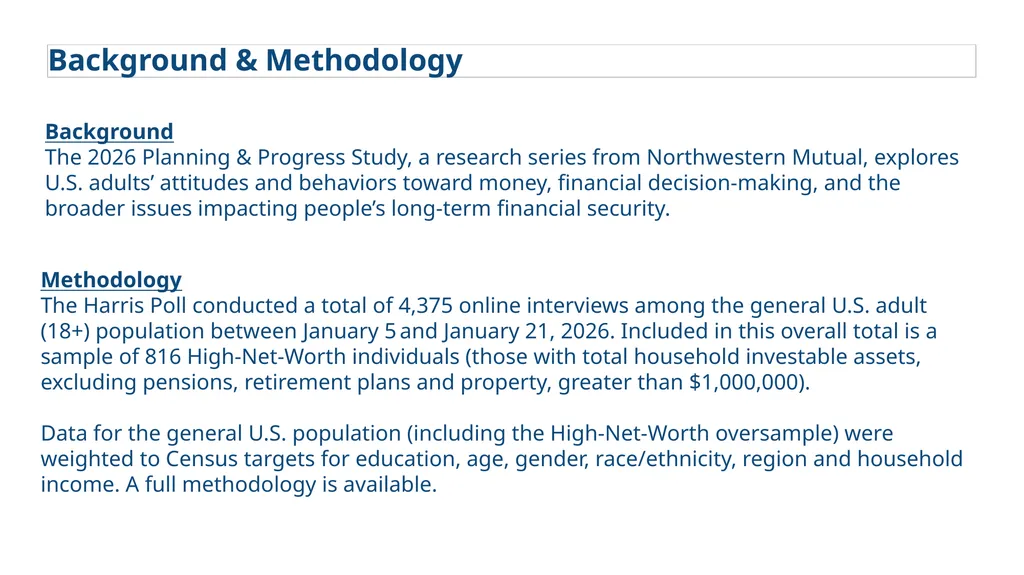
The 2026 Planning & Progress Study, a research series from Northwestern Mutual, explores U.S. adults’ attitudes and behaviors toward money, financial decision-making, and the broader issues impacting people’s long-term financial security. Methodology
The Harris Poll conducted a total of 4,375 online interviews among the general U.S. adult (18+) population between January 5 and January 21, 2026. Included in this overall total is a sample of 816 High-Net-Worth individuals (those with total household investable assets, excluding pensions, retirement plans and property, greater than $1,000,000).
Data for the general U.S. population (including the High-Net-Worth oversample) were weighted to Census targets for education, age, gender, race/ethnicity, region and household income. A full methodology is available.<br>
03
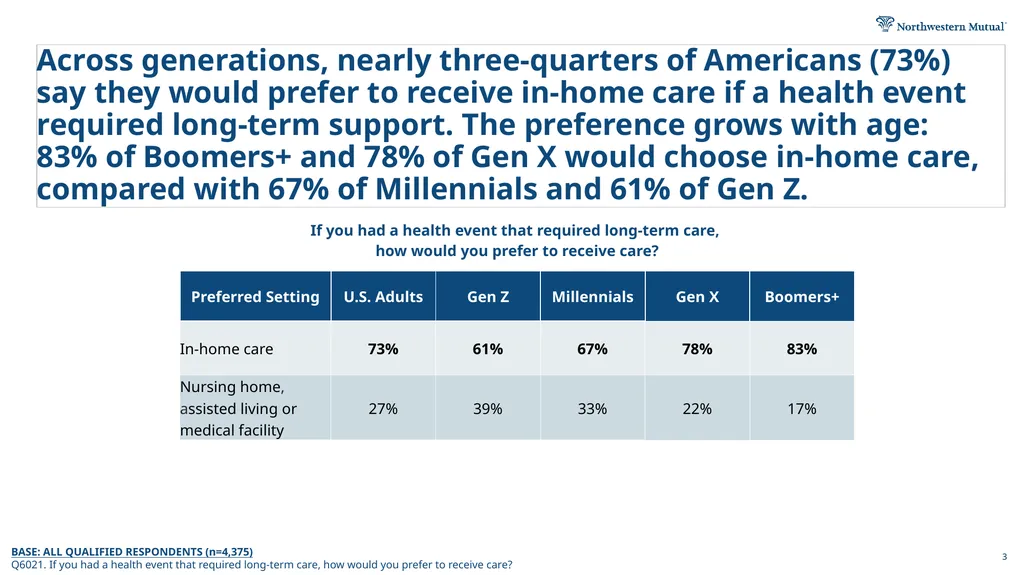
Across generations, nearly three-quarters of Americans (73%) say they would prefer to receive in-home care if a health event required long-term support. The preference grows with age: 83% of Boomers+ and 78% of Gen X would choose in-home care, compared with 67% of Millennials and 61% of Gen Z. BASE: ALL QUALIFIED RESPONDENTS (n=4,375) Q6021. If you had a health event that required long-term care, how would you prefer to receive care?<br>
04
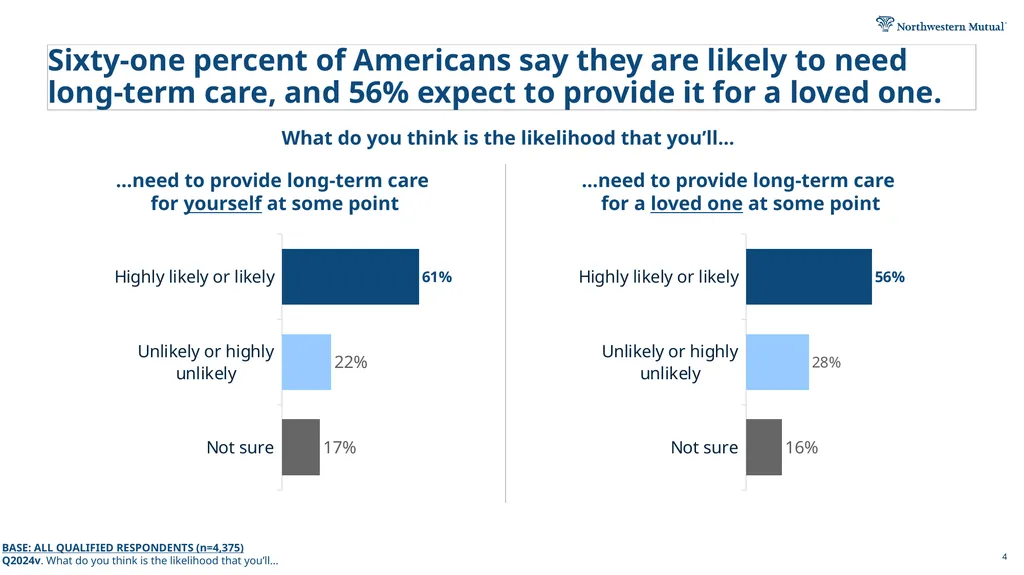
Sixty-one percent of Americans say they are likely to need long-term care, and 56% expect to provide it for a loved one. BASE: ALL QUALIFIED RESPONDENTS (n=4,375)
Q2024v. What do you think is the likelihood that you’ll… What do you think is the likelihood that you’ll… …need to provide long-term care
for yourself at some point …need to provide long-term care
for a loved one at some point<br>
05
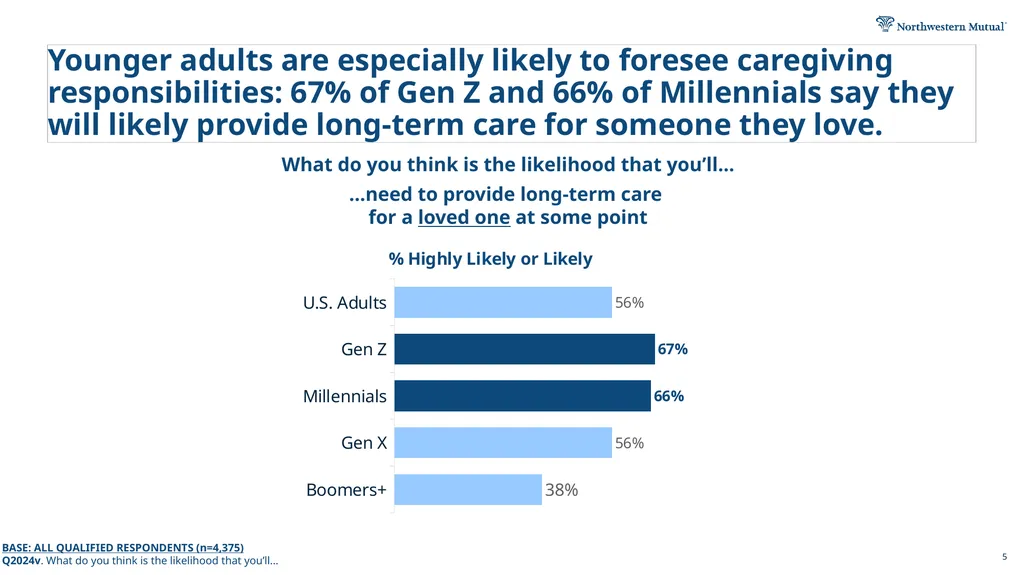
Younger adults are especially likely to foresee caregiving responsibilities: 67% of Gen Z and 66% of Millennials say they will likely provide long-term care for someone they love. BASE: ALL QUALIFIED RESPONDENTS (n=4,375)
Q2024v. What do you think is the likelihood that you’ll… What do you think is the likelihood that you’ll…
…need to provide long-term care
for a loved one at some point<br>
06
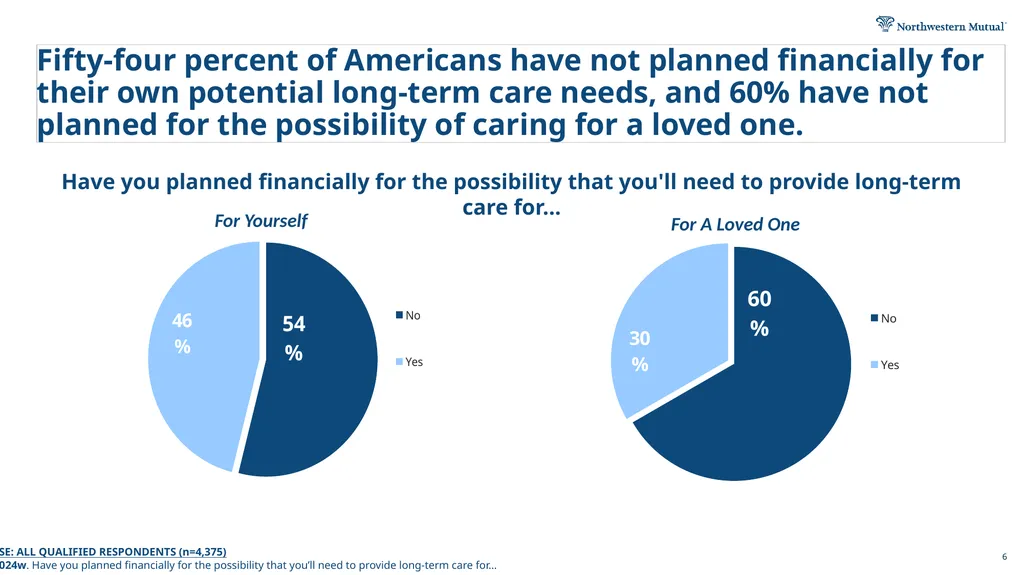
Fifty-four percent of Americans have not planned financially for their own potential long-term care needs, and 60% have not planned for the possibility of caring for a loved one. BASE: ALL QUALIFIED RESPONDENTS (n=4,375)
Q2024w. Have you planned financially for the possibility that you’ll need to provide long-term care for… Have you planned financially for the possibility that you'll need to provide long-term care for... For Yourself For A Loved One<br>
07
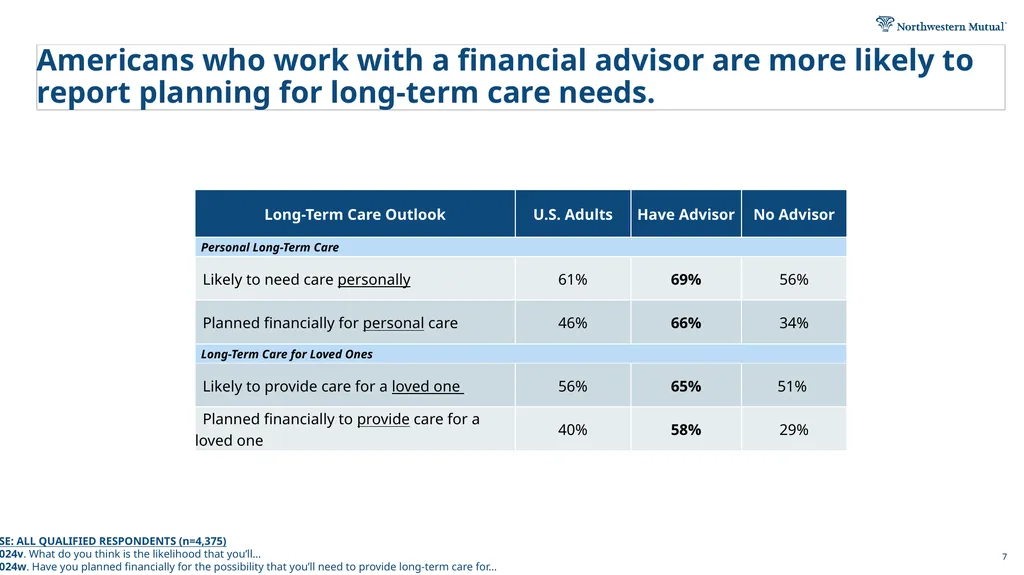
Americans who work with a financial advisor are more likely to report planning for long-term care needs. BASE: ALL QUALIFIED RESPONDENTS (n=4,375)
Q2024v. What do you think is the likelihood that you’ll…
Q2024w. Have you planned financially for the possibility that you’ll need to provide long-term care for…<br>
08
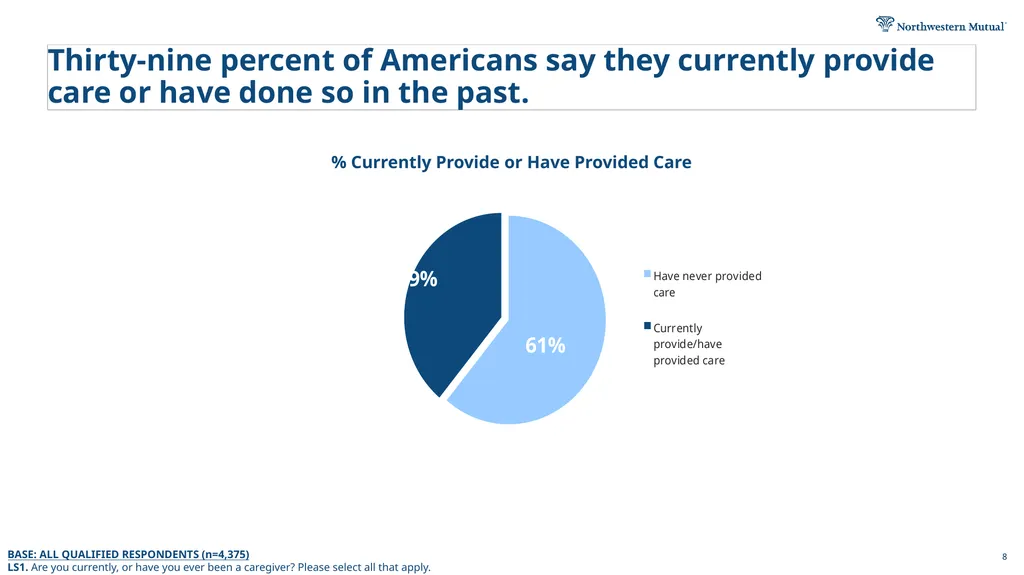
Thirty-nine percent of Americans say they currently provide care or have done so in the past. % Currently Provide or Have Provided Care BASE: ALL QUALIFIED RESPONDENTS (n=4,375)
LS1. Are you currently, or have you ever been a caregiver? Please select all that apply.<br>
09
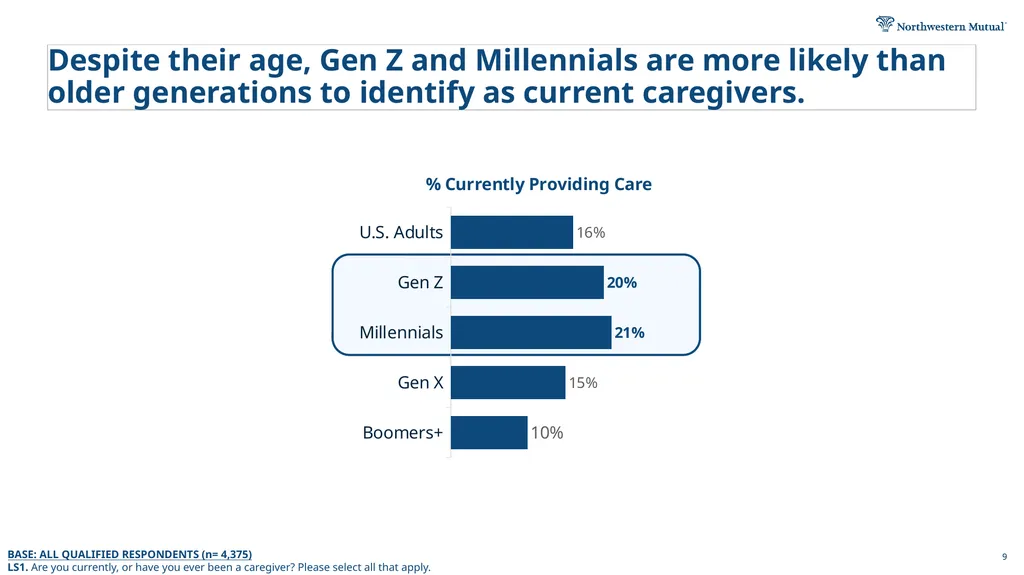
Despite their age, Gen Z and Millennials are more likely than older generations to identify as current caregivers. BASE: ALL QUALIFIED RESPONDENTS (n= 4,375)
LS1. Are you currently, or have you ever been a caregiver? Please select all that apply.<br>
10
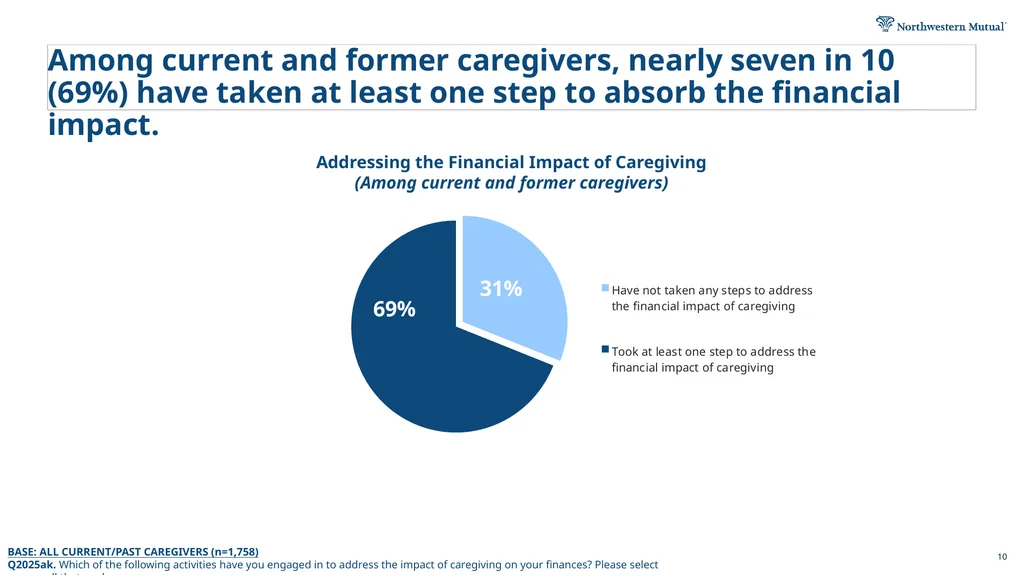
Among current and former caregivers, nearly seven in 10 (69%) have taken at least one step to absorb the financial impact. Addressing the Financial Impact of Caregiving
(Among current and former caregivers) BASE: ALL CURRENT/PAST CAREGIVERS (n=1,758)
Q2025ak. Which of the following activities have you engaged in to address the impact of caregiving on your finances? Please select all that apply.<br>
11
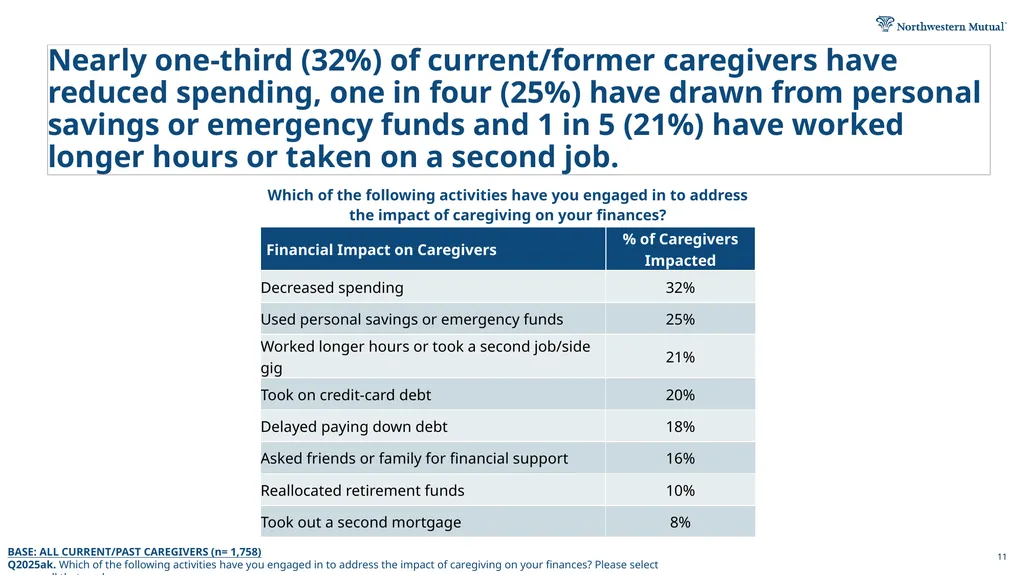
Nearly one-third (32%) of current/former caregivers have reduced spending, one in four (25%) have drawn from personal savings or emergency funds and 1 in 5 (21%) have worked longer hours or taken on a second job. BASE: ALL CURRENT/PAST CAREGIVERS (n= 1,758)
Q2025ak. Which of the following activities have you engaged in to address the impact of caregiving on your finances? Please select all that apply.<br>
12
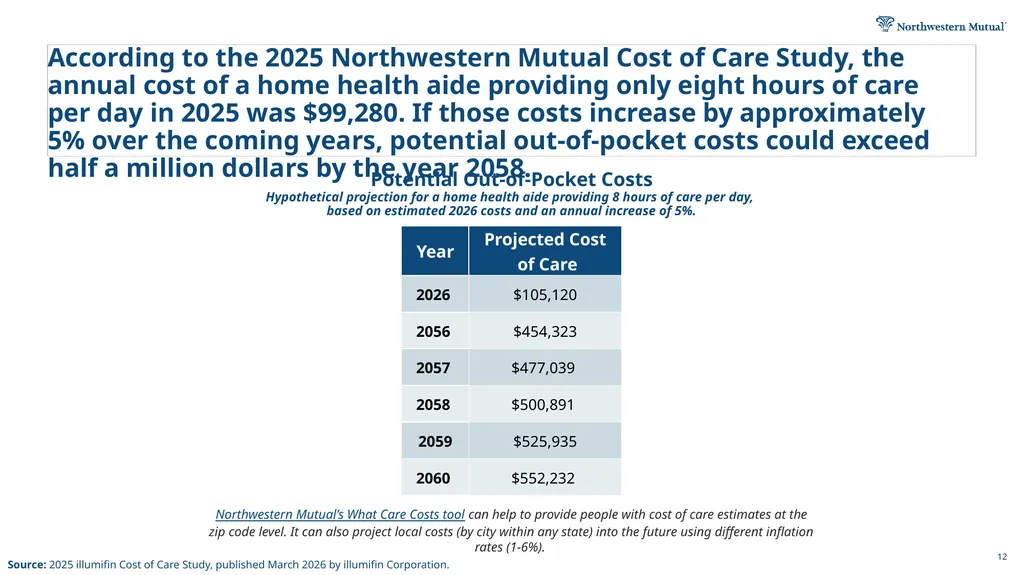
According to the 2025 Northwestern Mutual Cost of Care Study, the annual cost of a home health aide providing only eight hours of care per day in 2025 was $99,280. If those costs increase by approximately 5% over the coming years, potential out-of-pocket costs could exceed half a million dollars by the year 2058. Source: 2025 illumifin Cost of Care Study, published March 2026 by illumifin Corporation. Potential Out-of-Pocket Costs
Hypothetical projection for a home health aide providing 8 hours of care per day,
based on estimated 2026 costs and an annual increase of 5%. Northwestern Mutual’s What Care Costs tool can help to provide people with cost of care estimates at the zip code level. It can also project local costs (by city within any state) into the future using different inflation rates (1-6%).<br>