
25 October 2021 Illicit trade and counterfeit
T
Published · 29 slides · 0 views

1 / 1

Description
25 October 2021 Illicit trade and counterfeit goods Presenter: Patrick Moeng CONTENT 1 Illicit Trade Introduction Manifestation of Illicit Trade Risks of Illicit Trade The Impact of Illicit Trade and Illicit Financial flows Contents 2
Related Topics
Share
Embed code
Download this presentation From Below
"25 October 2021 Illicit trade and counterfeit" is the property of its rightful owner. Permission is granted to download and print the materials on this website for personal, non-commercial use only, and to display it on your personal computer provided you do not modify the materials and that you retain all copyright notices contained in the materials. By downloading content from our website, you accept the terms of this agreement.
Presentation Transcript
01
25 October 2021 Illicit trade and counterfeit goods
Presenter: Patrick Moeng<br>
02
CONTENT 1 Illicit Trade
Introduction
Manifestation of Illicit Trade
Risks of Illicit Trade
The Impact of Illicit Trade and Illicit Financial flows<br>
Introduction
Manifestation of Illicit Trade
Risks of Illicit Trade
The Impact of Illicit Trade and Illicit Financial flows<br>
03
Contents 2 Counterfeit Goods
Introduction
Legislation
Acts Constituting Counterfeiting
Socio-Economic Impact
Impact of Counterfeit Goods
The Role of Customs
Powers And Duties Of Officers
Without A Warrant-sec 5 CGA
Lodging A Complaint With An Inspector
Duties of Brand Holder After Seizure- sec 9 CGA
Penalties<br>
Introduction
Legislation
Acts Constituting Counterfeiting
Socio-Economic Impact
Impact of Counterfeit Goods
The Role of Customs
Powers And Duties Of Officers
Without A Warrant-sec 5 CGA
Lodging A Complaint With An Inspector
Duties of Brand Holder After Seizure- sec 9 CGA
Penalties<br>
04
3<br>
05
Purpose The purpose of this presentation is to:
provide an overview of Illicit trade, its manifestation and socio-economic consequences; and
Provide a practical approach towards addressing counterfeit conundrum, and
Discussions and Questions<br>
provide an overview of Illicit trade, its manifestation and socio-economic consequences; and
Provide a practical approach towards addressing counterfeit conundrum, and
Discussions and Questions<br>
06
Introduction “Illicit Trade” is a global problem. It abuses the international trade system and negates the foundations of the multilateral legal framework. “Illicit trade” destabilizes institutions, recognizes no frontiers and nullifies the collective objective of fair trade.
The WTO working definition of illicit trade reads as follows:
“Illicit trade means any commercial practice or transaction related to the production, acquisition, sale, purchase, shipment, movement, transfer, receipt, possession or distribution of:
(i) any illicit product defined as such by international law; or
(ii) any licit product for non-licit purposes as defined by international law
Illicit trade also covers any conduct intended to facilitate such activities.”
(Ref: Illicit Trade and the World Trade Organization: Raising awareness, identifying limitations and building strategies doc)<br>
07
Manifestation of Illicit Trade? The World Customs Organisation (WCO) 2017 Illicit Trade Report outlines the following areas of risk that I would like to use as the assumed convergent point to practically accentuate the definition of illicit trade:
Illicit trafficking of stolen or looted cultural objects that include both archaeological objects and works of art;
Drug trafficking, including cultivation, manufacture, distribution and sale of substances subject to drug prohibition laws;
Environmental risks relating to trafficking of endangered species, hazardous and toxic waste, ozone-depleting substances, and trading of indigenous or protected timber, etc.<br>
08
Manifestation of Illicit Trade? Intellectual Property Rights (IPR), and health and safety risks relating to trade in counterfeit or illicit goods, particularly products which pose a serious threat to health and safety, such as pharmaceuticals (including veterinary medicines), foodstuffs, toys and sub-standard items (such as electrical components and spare parts);
Revenue risks, including leakage, through the smuggling of highly taxed goods such as tobacco, alcohol and motor spirits, plus commercial fraud activities such as under-valuation, misuse of origin and preferential duties, misclassification and drawback fraud;
Security risks, including terrorism, proliferation of weapons of mass destruction, trafficking of small arms and explosives, and diversion of dual-use goods.<br>
09
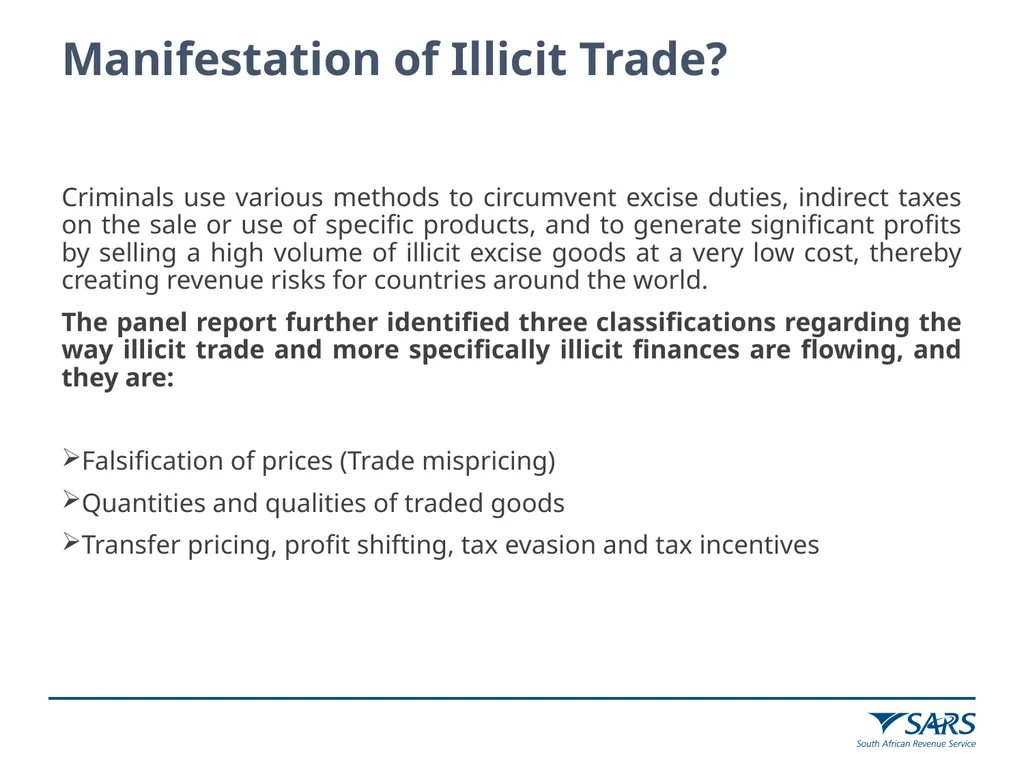
Manifestation of Illicit Trade? Criminals use various methods to circumvent excise duties, indirect taxes on the sale or use of specific products, and to generate significant profits by selling a high volume of illicit excise goods at a very low cost, thereby creating revenue risks for countries around the world.
The panel report further identified three classifications regarding the way illicit trade and more specifically illicit finances are flowing, and they are:
Falsification of prices (Trade mispricing)
Quantities and qualities of traded goods
Transfer pricing, profit shifting, tax evasion and tax incentives<br>
10
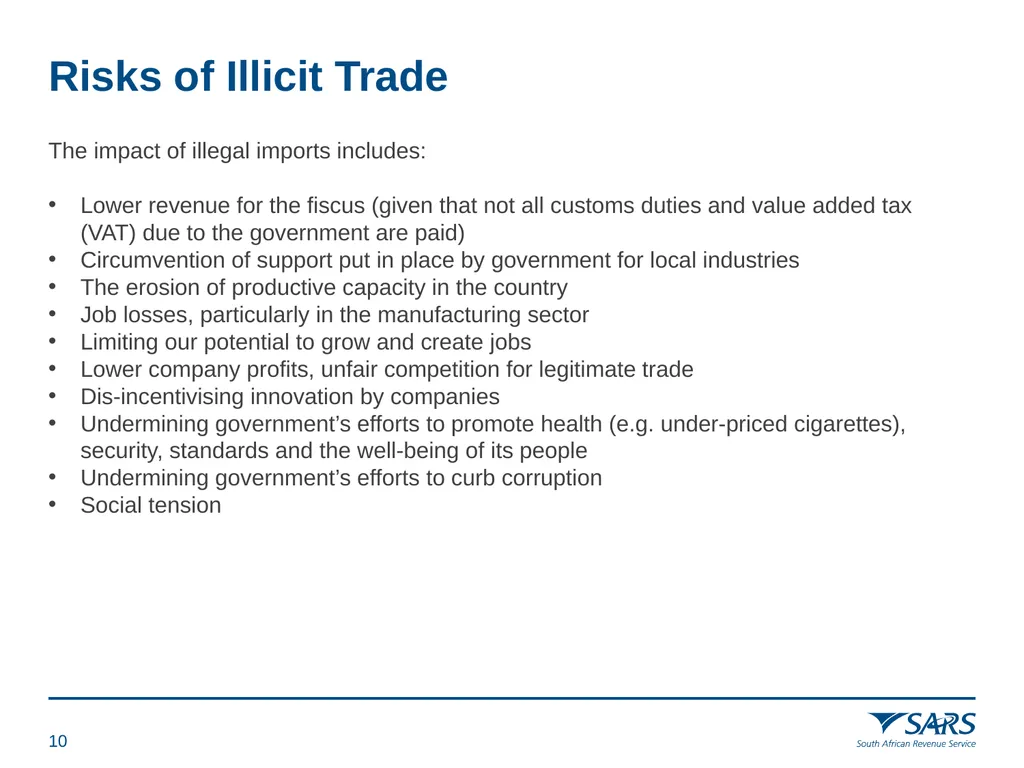
Risks of Illicit Trade 9 The impact of illegal imports includes:
Lower revenue for the fiscus (given that not all customs duties and value added tax (VAT) due to the government are paid)
Circumvention of support put in place by government for local industries
The erosion of productive capacity in the country
Job losses, particularly in the manufacturing sector
Limiting our potential to grow and create jobs
Lower company profits, unfair competition for legitimate trade
Dis-incentivising innovation by companies
Undermining government’s efforts to promote health (e.g. under-priced cigarettes), security, standards and the well-being of its people
Undermining government’s efforts to curb corruption
Social tension<br>
11
Where is Africa currently wrt illicit trade/Flow? Whilst addressing the Pan African Parliament in May 2015, President Mbeki indicated that it is estimated that over the last 50 years, Africa lost in excess of US1-trillion in illicit financial flows, which amounts to $50-billion annually through these illicit flows.
Findings on Illicit Financial Flows (Source: High Level Panel on Illicit Financial flows)
60% of illicit financial flows derives from Large Commercial Companies
30% of illicit financial flows is through criminal activities and drug trafficking; and
10% from corruption activities
Outflow of capital from Africa ends up somewhere else outside of Africa
Many African Countries lack capacity to combat the illicit financial flows
Ill-informed policy decisions to grant tax incentives leading to harmful tax competition
According to the Tobacco Institute of Southern Africa, the tobacco industry in South Africa is estimated at around R29 billion and contributes approximately R17.2 billion in excise duty and VAT per annum. It is estimated that the industry is an employer to about 108.5 thousand individuals.<br>
12
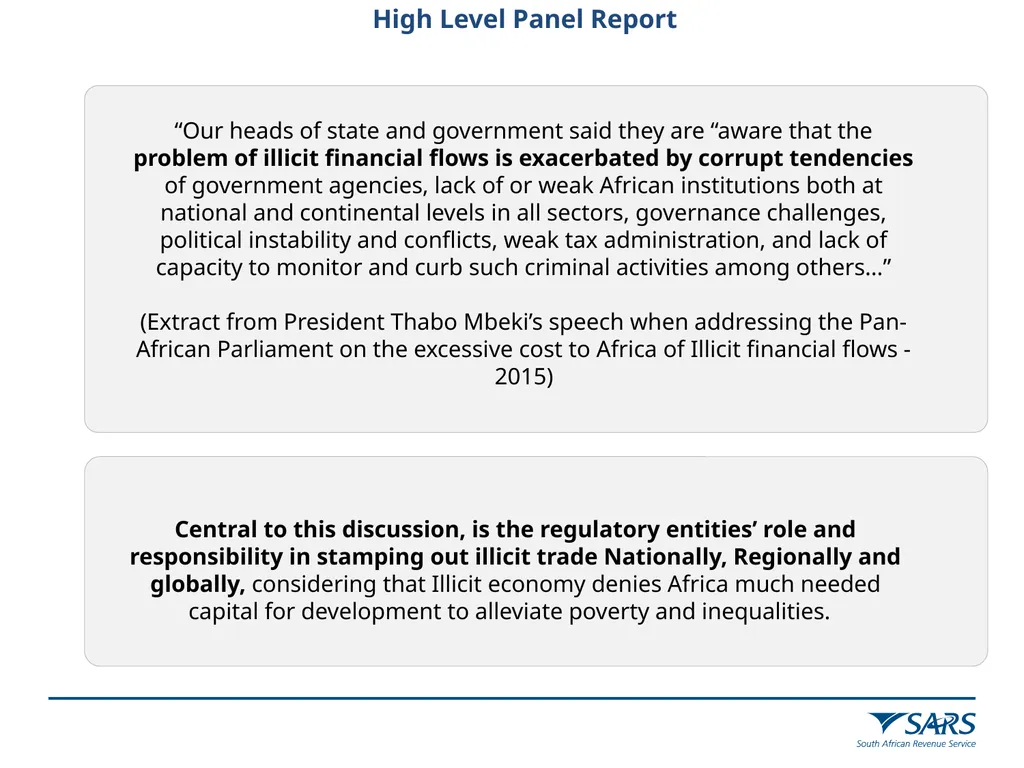
High Level Panel Report “Our heads of state and government said they are “aware that the problem of illicit financial flows is exacerbated by corrupt tendencies of government agencies, lack of or weak African institutions both at national and continental levels in all sectors, governance challenges, political instability and conflicts, weak tax administration, and lack of capacity to monitor and curb such criminal activities among others…”
(Extract from President Thabo Mbeki’s speech when addressing the Pan-African Parliament on the excessive cost to Africa of Illicit financial flows - 2015) Central to this discussion, is the regulatory entities’ role and responsibility in stamping out illicit trade Nationally, Regionally and globally, considering that Illicit economy denies Africa much needed capital for development to alleviate poverty and inequalities.<br>
(Extract from President Thabo Mbeki’s speech when addressing the Pan-African Parliament on the excessive cost to Africa of Illicit financial flows - 2015) Central to this discussion, is the regulatory entities’ role and responsibility in stamping out illicit trade Nationally, Regionally and globally, considering that Illicit economy denies Africa much needed capital for development to alleviate poverty and inequalities.<br>
13
12<br>
14
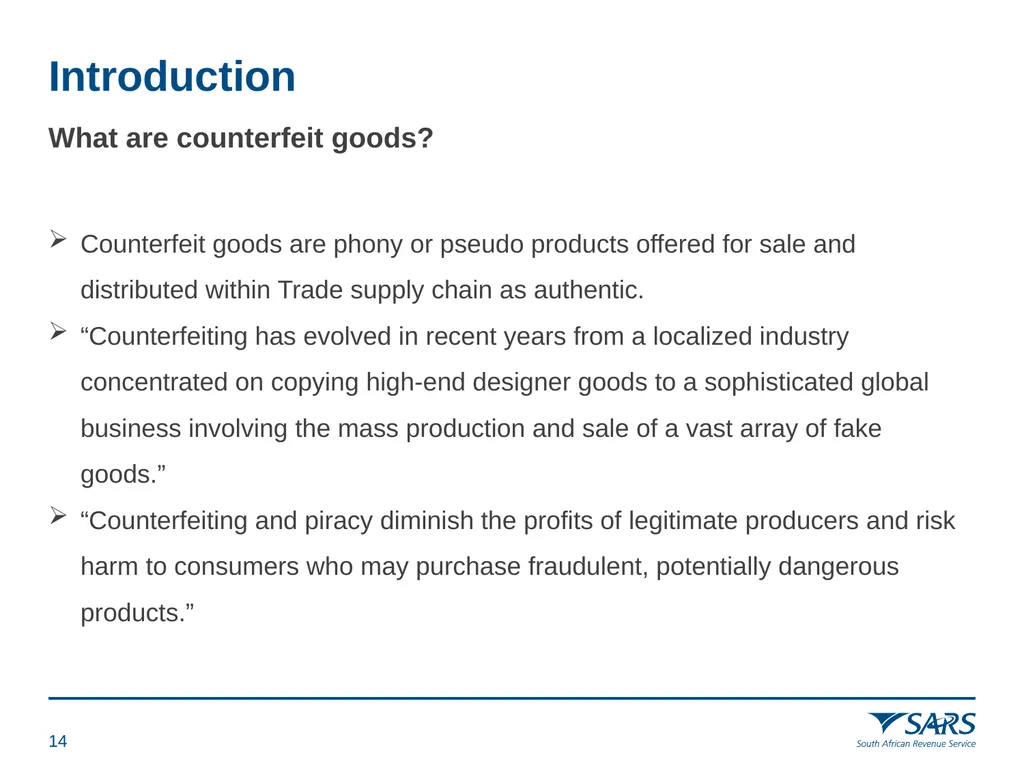
Introduction 13 Counterfeit goods are phony or pseudo products offered for sale and distributed within Trade supply chain as authentic.
“Counterfeiting has evolved in recent years from a localized industry concentrated on copying high-end designer goods to a sophisticated global business involving the mass production and sale of a vast array of fake goods.”
“Counterfeiting and piracy diminish the profits of legitimate producers and risk harm to consumers who may purchase fraudulent, potentially dangerous products.” What are counterfeit goods?<br>
15
Types of Intellectual Property Rights 14 Geographical Indicators
Copyrights
Industrial Design
Trade Mark
Patterns
Layout & Design
Protection of undisclosed information
Control of anti-competitive practices
The two most infringed IPR fields are Copyrights and Trademarks<br>
Copyrights
Industrial Design
Trade Mark
Patterns
Layout & Design
Protection of undisclosed information
Control of anti-competitive practices
The two most infringed IPR fields are Copyrights and Trademarks<br>
16
Acts Which Constitute Counterfeiting 15 Being in possession of infringing goods in the course of business.
Manufacturing, making or producing infringing goods for non-private or domestic use.
Selling, hiring or exchanging infringing goods.
Exhibiting infringing goods for the purposes of trade.
Distributing infringing goods for the purposes of trade or other purposes.
Importing infringing goods into or through or exporting from South Africa
The act of dealing in counterfeit or suspected counterfeit goods<br>
17
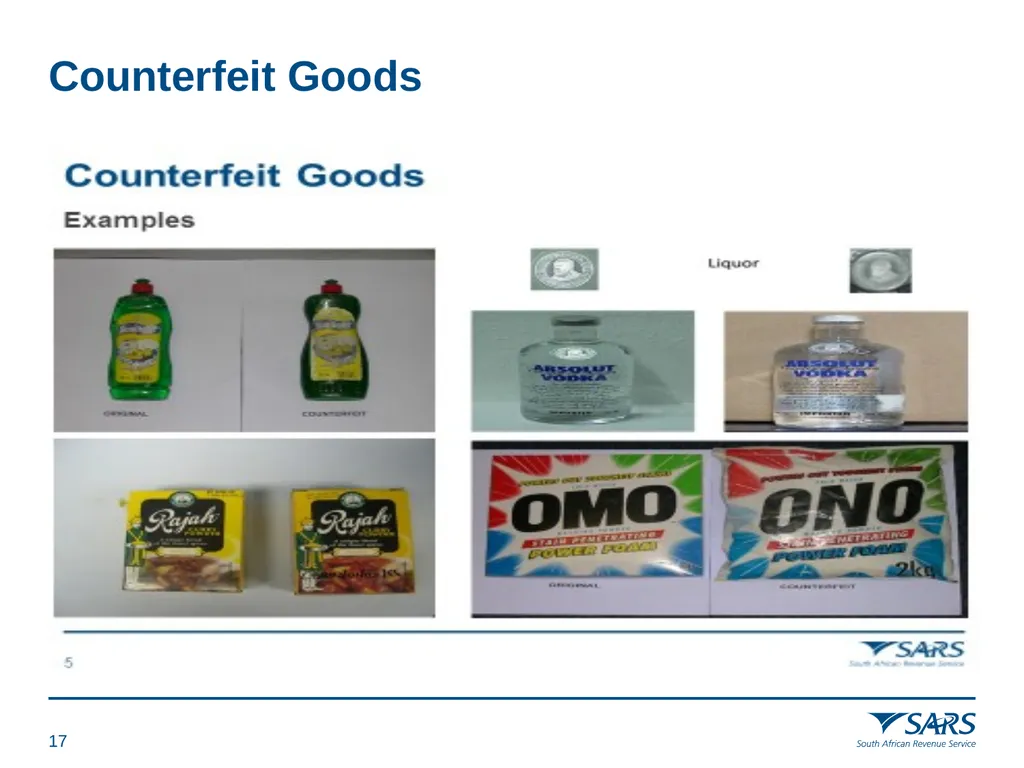
Counterfeit Goods 16<br>
18
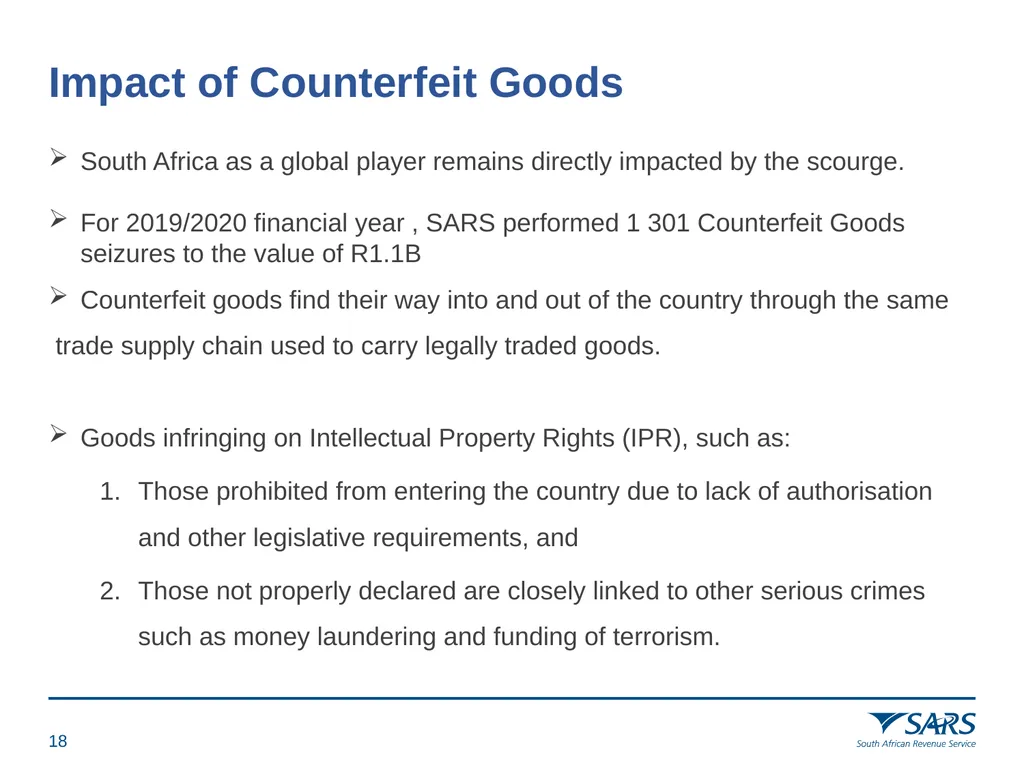
Impact of Counterfeit Goods 17 South Africa as a global player remains directly impacted by the scourge.
For 2019/2020 financial year , SARS performed 1 301 Counterfeit Goods seizures to the value of R1.1B
Counterfeit goods find their way into and out of the country through the same
trade supply chain used to carry legally traded goods.
Goods infringing on Intellectual Property Rights (IPR), such as:
Those prohibited from entering the country due to lack of authorisation and other legislative requirements, and
Those not properly declared are closely linked to other serious crimes such as money laundering and funding of terrorism.<br>
19
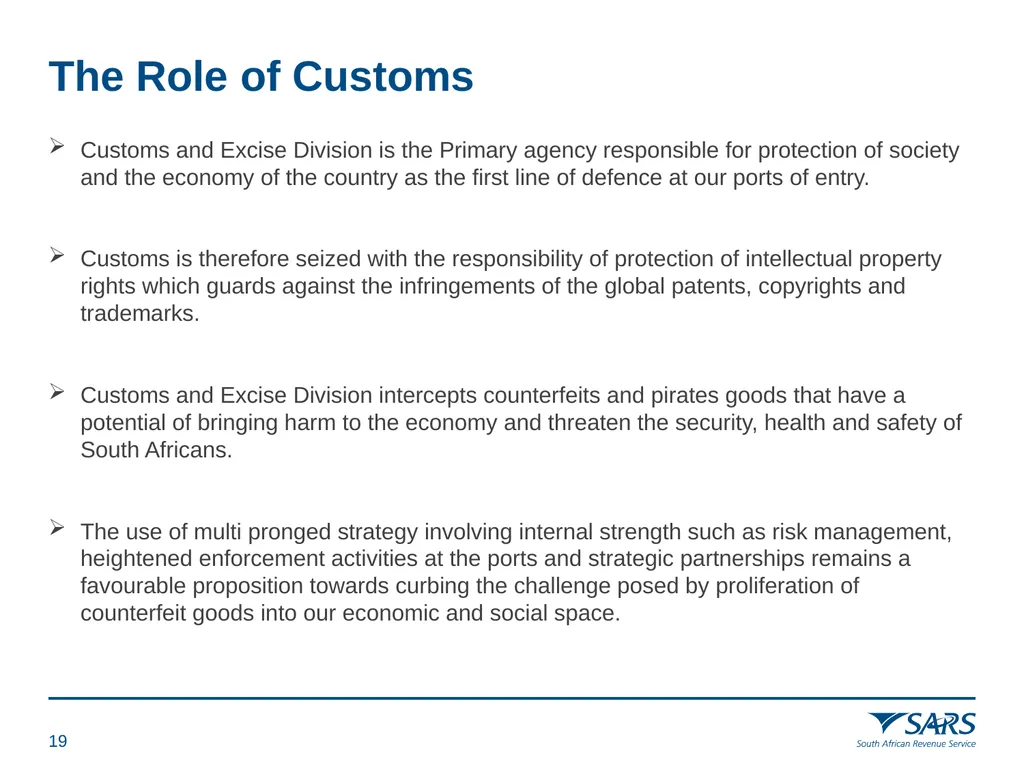
The Role of Customs 18 Customs and Excise Division is the Primary agency responsible for protection of society and the economy of the country as the first line of defence at our ports of entry.
Customs is therefore seized with the responsibility of protection of intellectual property rights which guards against the infringements of the global patents, copyrights and trademarks.
Customs and Excise Division intercepts counterfeits and pirates goods that have a potential of bringing harm to the economy and threaten the security, health and safety of South Africans.
The use of multi pronged strategy involving internal strength such as risk management, heightened enforcement activities at the ports and strategic partnerships remains a favourable proposition towards curbing the challenge posed by proliferation of counterfeit goods into our economic and social space.<br>
20
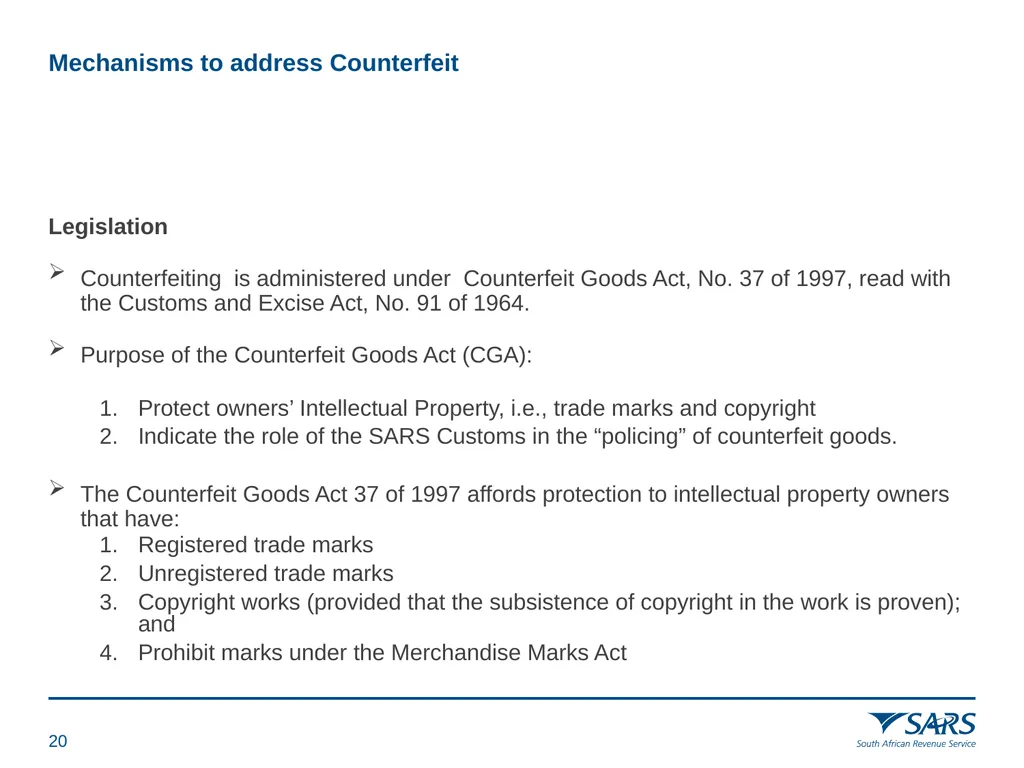
Mechanisms to address Counterfeit 19 Legislation
Counterfeiting is administered under Counterfeit Goods Act, No. 37 of 1997, read with the Customs and Excise Act, No. 91 of 1964.
Purpose of the Counterfeit Goods Act (CGA):
Protect owners’ Intellectual Property, i.e., trade marks and copyright
Indicate the role of the SARS Customs in the “policing” of counterfeit goods.
The Counterfeit Goods Act 37 of 1997 affords protection to intellectual property owners that have:
Registered trade marks
Unregistered trade marks
Copyright works (provided that the subsistence of copyright in the work is proven); and
Prohibit marks under the Merchandise Marks Act<br>
21
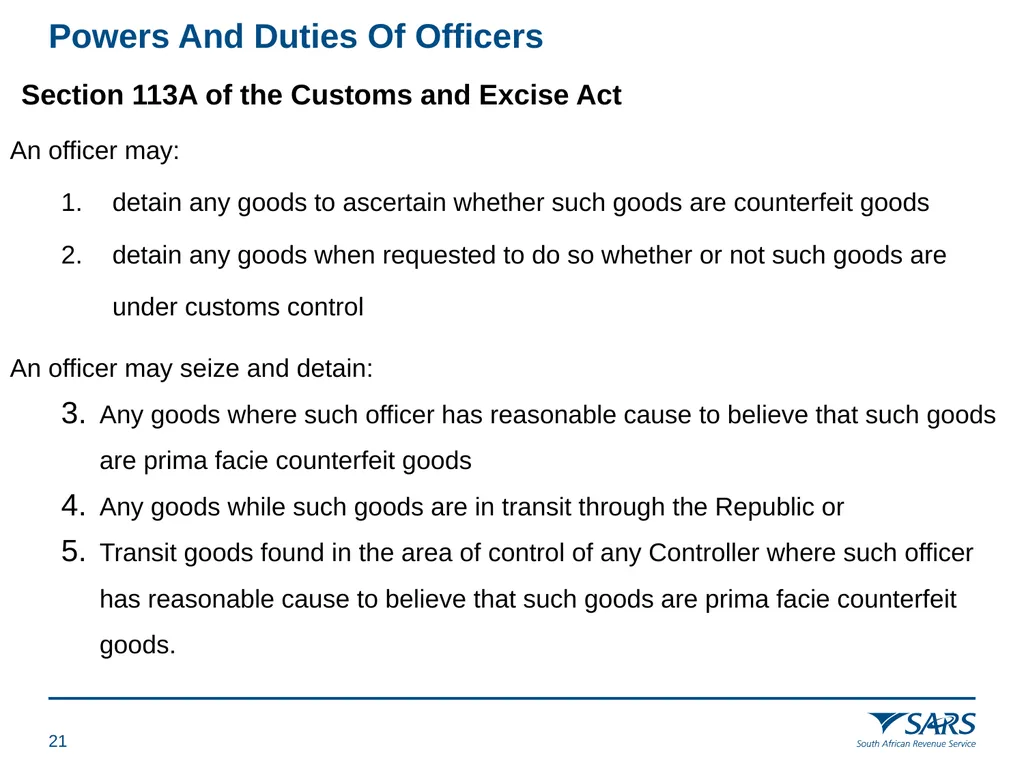
Powers And Duties Of Officers 20 An officer may:
detain any goods to ascertain whether such goods are counterfeit goods
detain any goods when requested to do so whether or not such goods are under customs control
An officer may seize and detain:
Any goods where such officer has reasonable cause to believe that such goods are prima facie counterfeit goods
Any goods while such goods are in transit through the Republic or
Transit goods found in the area of control of any Controller where such officer has reasonable cause to believe that such goods are prima facie counterfeit goods. Section 113A of the Customs and Excise Act<br>
22
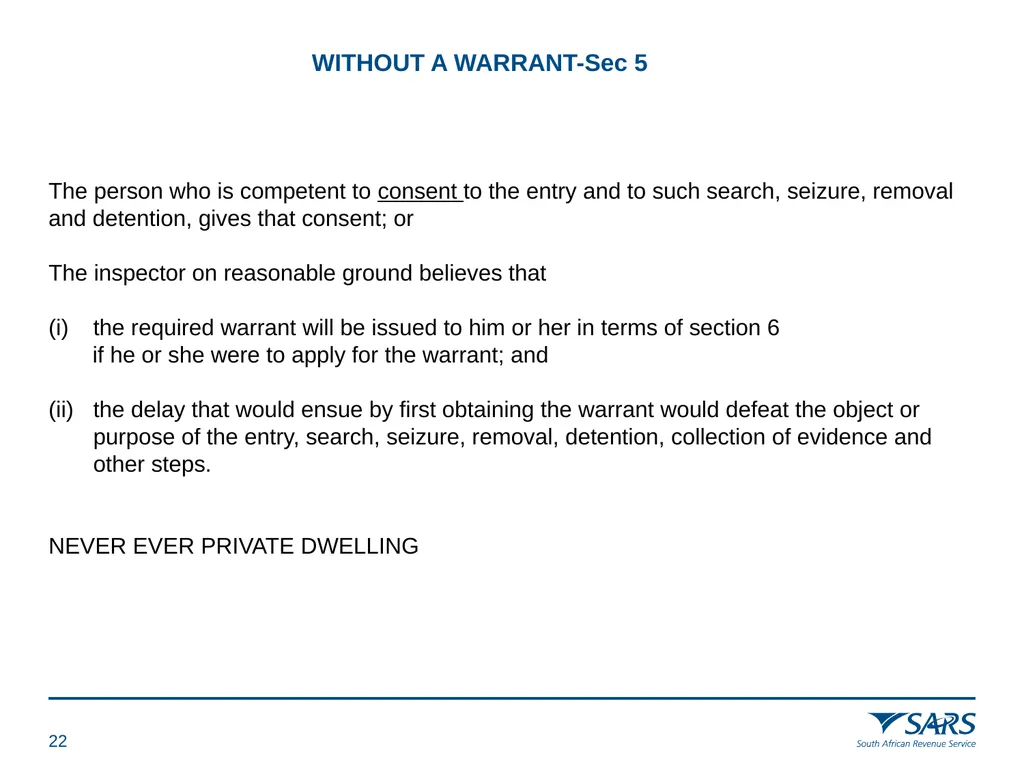
WITHOUT A WARRANT-Sec 5 21 The person who is competent to consent to the entry and to such search, seizure, removal and detention, gives that consent; or
The inspector on reasonable ground believes that
the required warrant will be issued to him or her in terms of section 6
if he or she were to apply for the warrant; and
the delay that would ensue by first obtaining the warrant would defeat the object or purpose of the entry, search, seizure, removal, detention, collection of evidence and other steps.
NEVER EVER PRIVATE DWELLING<br>
23
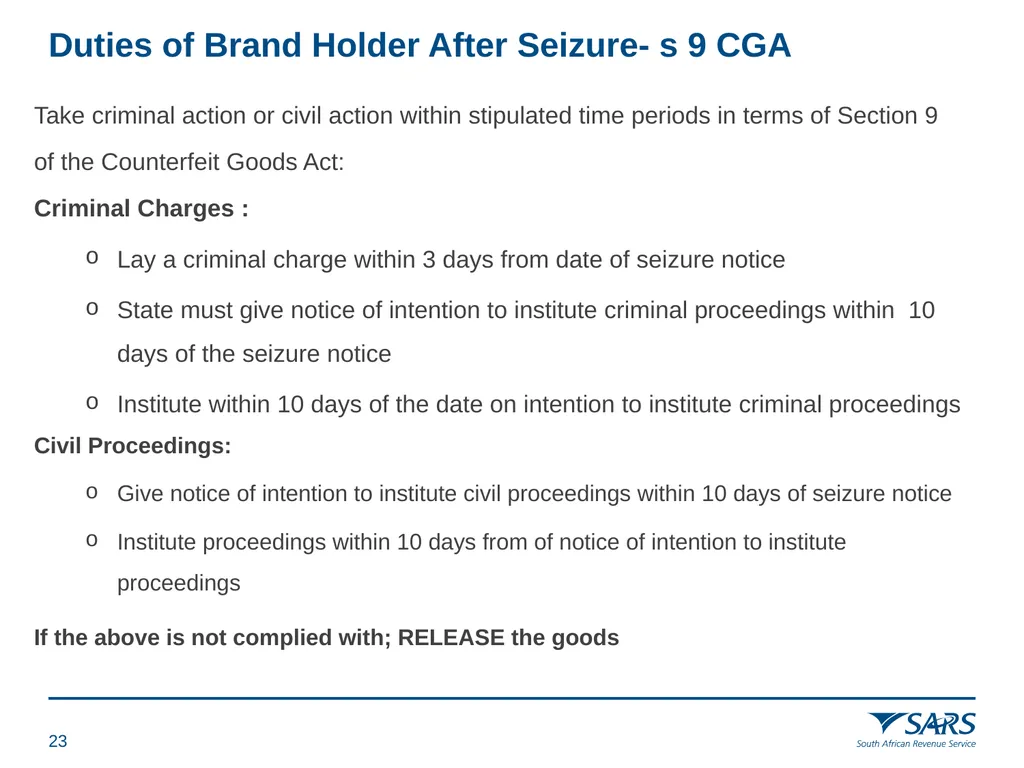
Duties of Brand Holder After Seizure- s 9 CGA 22 Take criminal action or civil action within stipulated time periods in terms of Section 9 of the Counterfeit Goods Act:
Criminal Charges :
Lay a criminal charge within 3 days from date of seizure notice
State must give notice of intention to institute criminal proceedings within 10 days of the seizure notice
Institute within 10 days of the date on intention to institute criminal proceedings
Civil Proceedings:
Give notice of intention to institute civil proceedings within 10 days of seizure notice
Institute proceedings within 10 days from of notice of intention to institute proceedings
If the above is not complied with; RELEASE the goods<br>
24
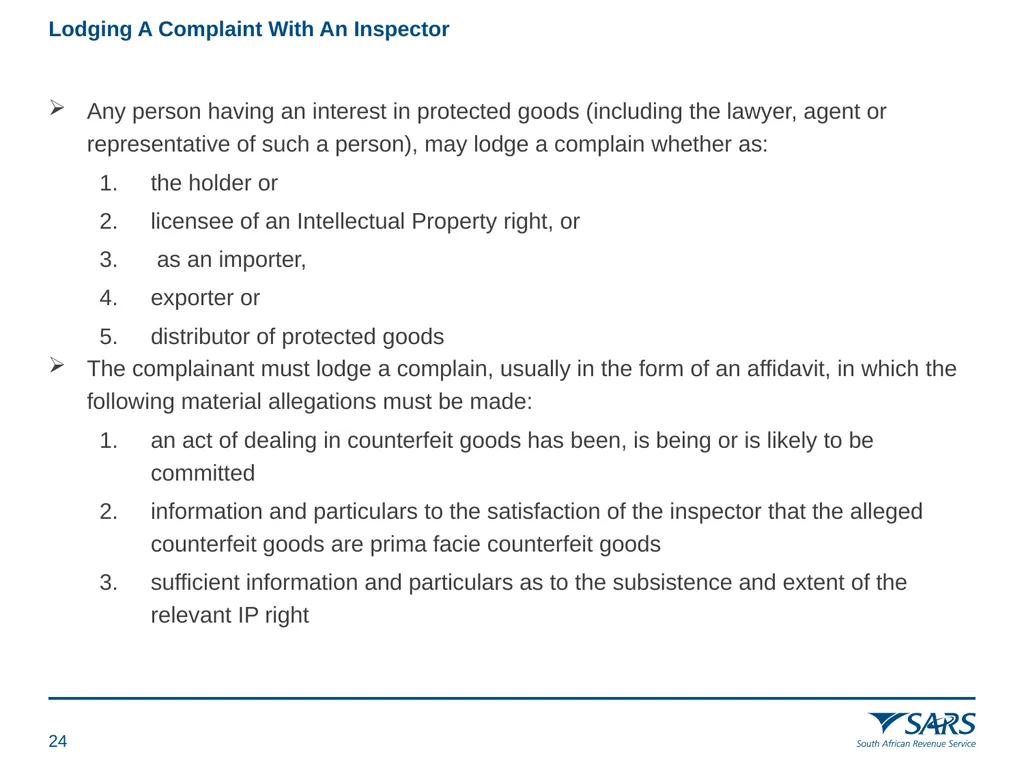
Lodging A Complaint With An Inspector 23 Any person having an interest in protected goods (including the lawyer, agent or representative of such a person), may lodge a complain whether as:
the holder or
licensee of an Intellectual Property right, or
as an importer,
exporter or
distributor of protected goods
The complainant must lodge a complain, usually in the form of an affidavit, in which the following material allegations must be made:
an act of dealing in counterfeit goods has been, is being or is likely to be committed
information and particulars to the satisfaction of the inspector that the alleged counterfeit goods are prima facie counterfeit goods
sufficient information and particulars as to the subsistence and extent of the relevant IP right<br>
25
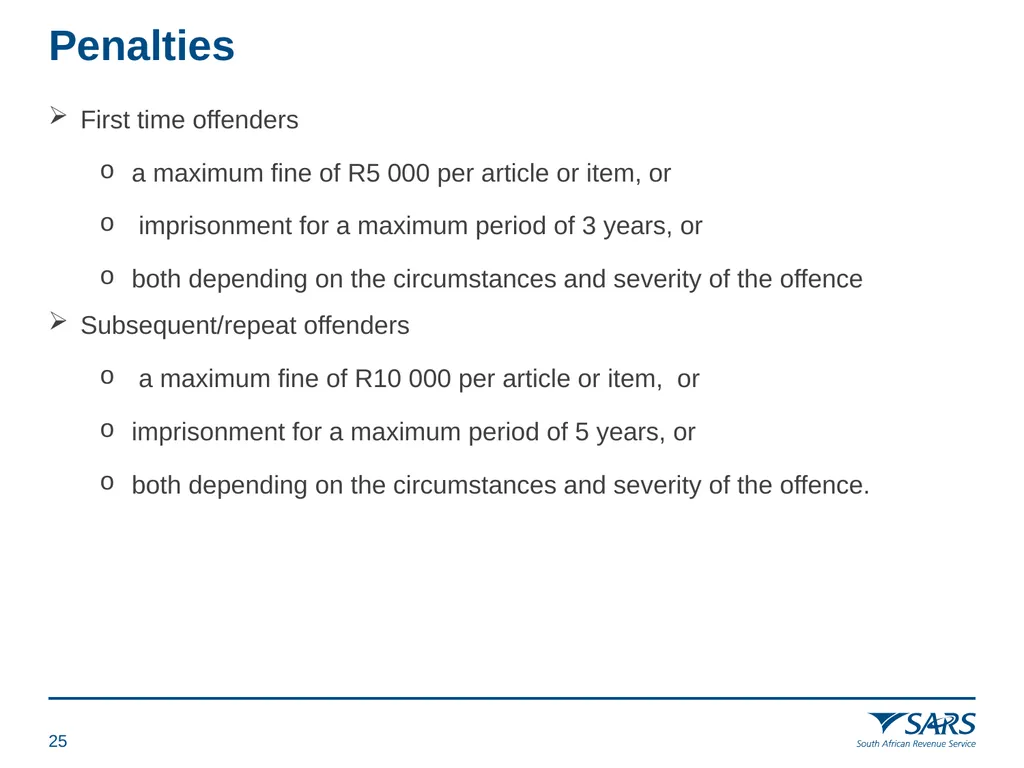
Penalties 24 First time offenders
a maximum fine of R5 000 per article or item, or
imprisonment for a maximum period of 3 years, or
both depending on the circumstances and severity of the offence
Subsequent/repeat offenders
a maximum fine of R10 000 per article or item, or
imprisonment for a maximum period of 5 years, or
both depending on the circumstances and severity of the offence.<br>
26
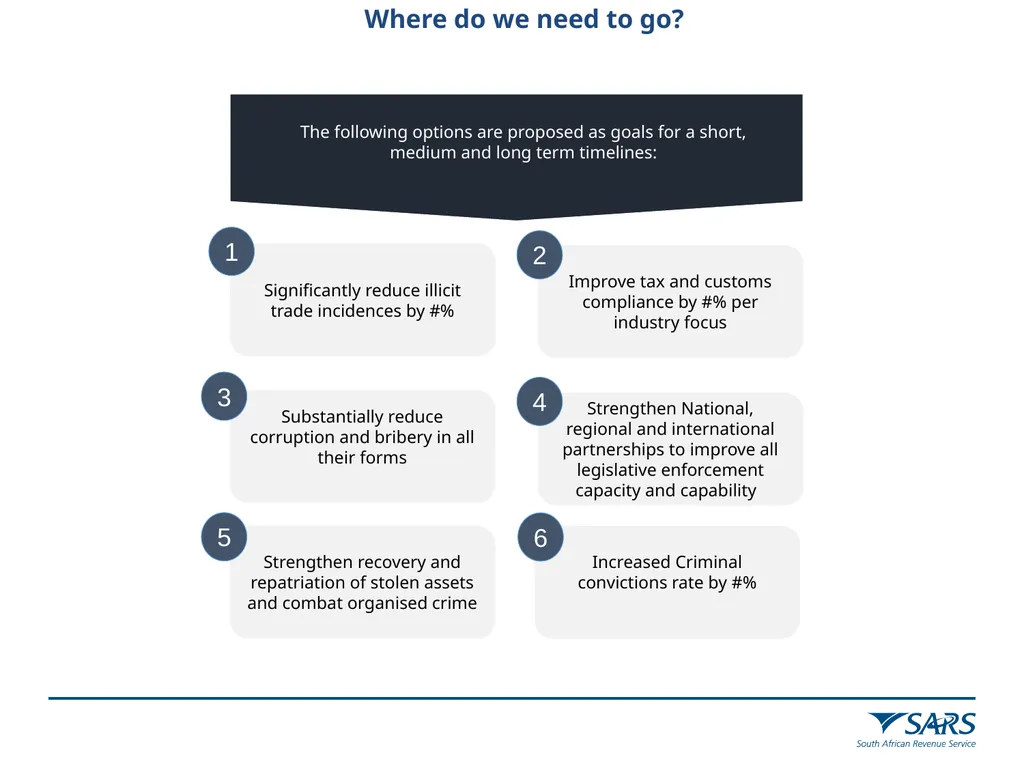
Where do we need to go? Significantly reduce illicit trade incidences by #% Improve tax and customs compliance by #% per industry focus Substantially reduce corruption and bribery in all their forms Strengthen National, regional and international partnerships to improve all legislative enforcement capacity and capability Increased Criminal convictions rate by #% Strengthen recovery and repatriation of stolen assets and combat organised crime The following options are proposed as goals for a short, medium and long term timelines:<br>
27
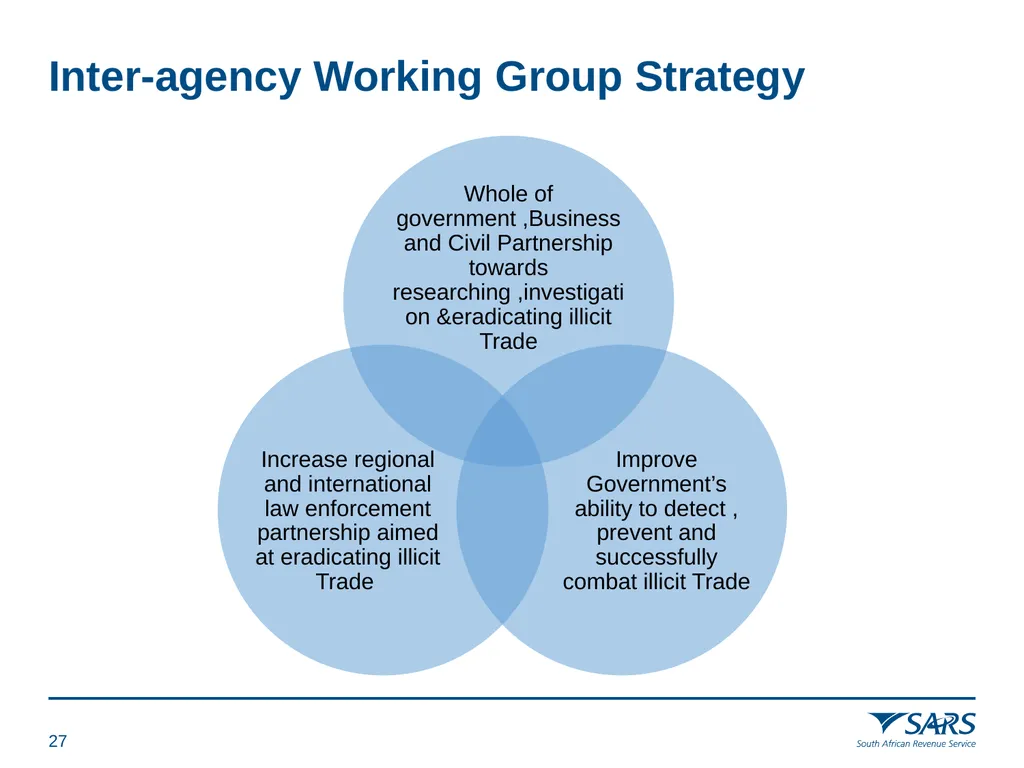
Inter-agency Working Group Strategy 26<br>
28
QUESTIONS? 27 Any questions?<br>