
25th September 2019 Practical Challenges &
TF
Published · 37 slides · 0 views
1 / 1


Description
25th September 2019 Practical Challenges Difficulties Dos Donts from Tax Regulatory perspective for startup PANKIL sanghvi EXPERTISE SUMMARY Pankil is a Partner with the Tax Regulatory practice. He operates out of Bangalore office
Related Topics
Share
Embed code
Download this presentation From Below
"25th September 2019 Practical Challenges &" is the property of its rightful owner. Permission is granted to download and print the materials on this website for personal, non-commercial use only, and to display it on your personal computer provided you do not modify the materials and that you retain all copyright notices contained in the materials. By downloading content from our website, you accept the terms of this agreement.
Presentation Transcript
01
25th September 2019 Practical Challenges & Difficulties – Do’s & Dont’s from Tax Regulatory perspective for startup<br>
02
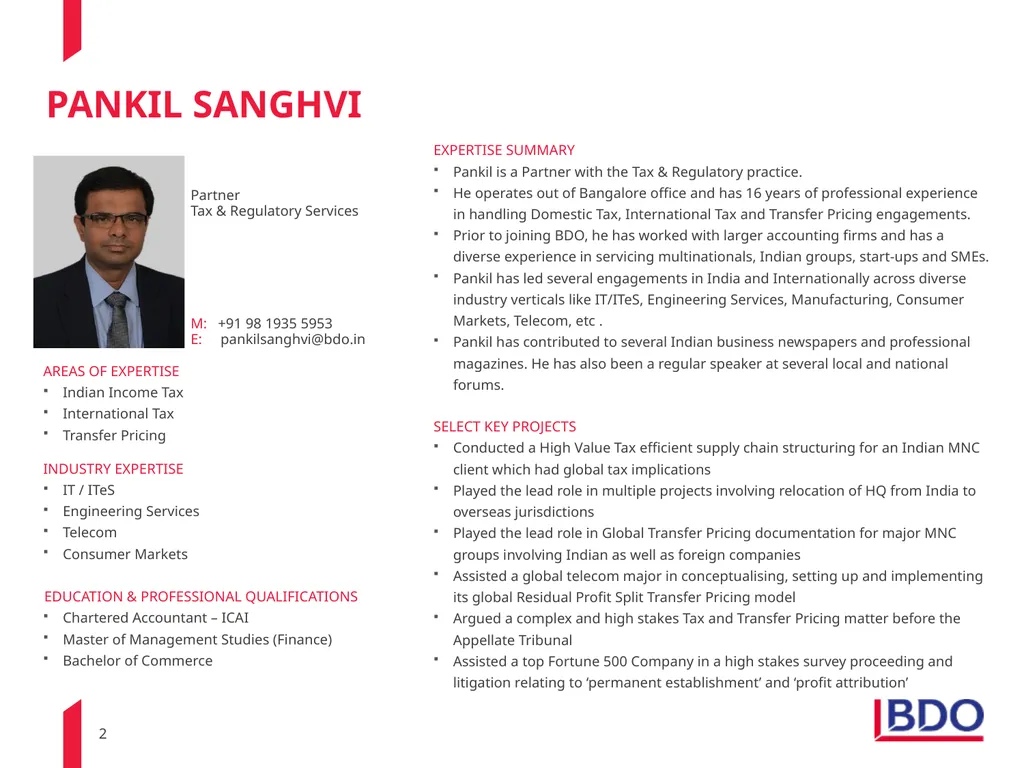
PANKIL sanghvi EXPERTISE SUMMARY
Pankil is a Partner with the Tax & Regulatory practice.
He operates out of Bangalore office and has 16 years of professional experience in handling Domestic Tax, International Tax and Transfer Pricing engagements.
Prior to joining BDO, he has worked with larger accounting firms and has a diverse experience in servicing multinationals, Indian groups, start-ups and SMEs.
Pankil has led several engagements in India and Internationally across diverse industry verticals like IT/ITeS, Engineering Services, Manufacturing, Consumer Markets, Telecom, etc .
Pankil has contributed to several Indian business newspapers and professional magazines. He has also been a regular speaker at several local and national forums.
SELECT KEY PROJECTS
Conducted a High Value Tax efficient supply chain structuring for an Indian MNC client which had global tax implications
Played the lead role in multiple projects involving relocation of HQ from India to overseas jurisdictions
Played the lead role in Global Transfer Pricing documentation for major MNC groups involving Indian as well as foreign companies
Assisted a global telecom major in conceptualising, setting up and implementing its global Residual Profit Split Transfer Pricing model
Argued a complex and high stakes Tax and Transfer Pricing matter before the Appellate Tribunal
Assisted a top Fortune 500 Company in a high stakes survey proceeding and litigation relating to ‘permanent establishment’ and ‘profit attribution’ AREAS OF EXPERTISE
Indian Income Tax
International Tax
Transfer Pricing
INDUSTRY EXPERTISE
IT / ITeS
Engineering Services
Telecom
Consumer Markets
EDUCATION & PROFESSIONAL QUALIFICATIONS
Chartered Accountant – ICAI
Master of Management Studies (Finance)
Bachelor of Commerce Partner
Tax & Regulatory Services M: +91 98 1935 5953
E: pankilsanghvi@bdo.in<br>
Pankil is a Partner with the Tax & Regulatory practice.
He operates out of Bangalore office and has 16 years of professional experience in handling Domestic Tax, International Tax and Transfer Pricing engagements.
Prior to joining BDO, he has worked with larger accounting firms and has a diverse experience in servicing multinationals, Indian groups, start-ups and SMEs.
Pankil has led several engagements in India and Internationally across diverse industry verticals like IT/ITeS, Engineering Services, Manufacturing, Consumer Markets, Telecom, etc .
Pankil has contributed to several Indian business newspapers and professional magazines. He has also been a regular speaker at several local and national forums.
SELECT KEY PROJECTS
Conducted a High Value Tax efficient supply chain structuring for an Indian MNC client which had global tax implications
Played the lead role in multiple projects involving relocation of HQ from India to overseas jurisdictions
Played the lead role in Global Transfer Pricing documentation for major MNC groups involving Indian as well as foreign companies
Assisted a global telecom major in conceptualising, setting up and implementing its global Residual Profit Split Transfer Pricing model
Argued a complex and high stakes Tax and Transfer Pricing matter before the Appellate Tribunal
Assisted a top Fortune 500 Company in a high stakes survey proceeding and litigation relating to ‘permanent establishment’ and ‘profit attribution’ AREAS OF EXPERTISE
Indian Income Tax
International Tax
Transfer Pricing
INDUSTRY EXPERTISE
IT / ITeS
Engineering Services
Telecom
Consumer Markets
EDUCATION & PROFESSIONAL QUALIFICATIONS
Chartered Accountant – ICAI
Master of Management Studies (Finance)
Bachelor of Commerce Partner
Tax & Regulatory Services M: +91 98 1935 5953
E: pankilsanghvi@bdo.in<br>
03
The taxation laws (amendment) ordinance 2019<br>
04
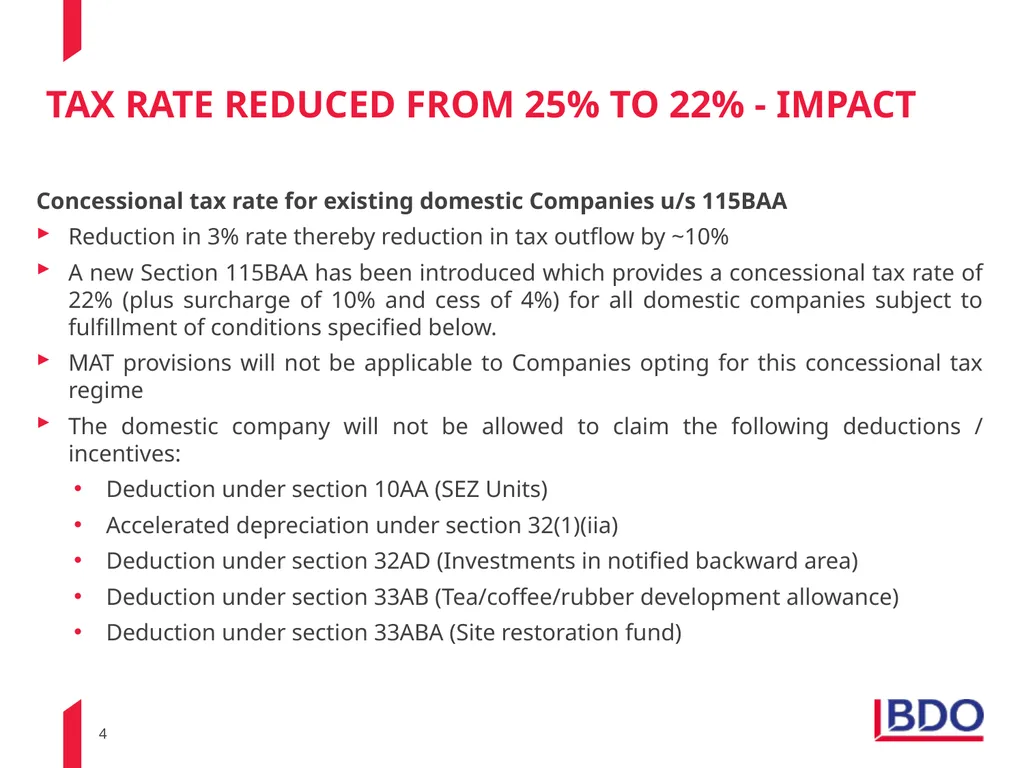
Tax rate reduced from 25% to 22% - impact Concessional tax rate for existing domestic Companies u/s 115BAA
Reduction in 3% rate thereby reduction in tax outflow by ~10%
A new Section 115BAA has been introduced which provides a concessional tax rate of 22% (plus surcharge of 10% and cess of 4%) for all domestic companies subject to fulfillment of conditions specified below.
MAT provisions will not be applicable to Companies opting for this concessional tax regime
The domestic company will not be allowed to claim the following deductions / incentives:
Deduction under section 10AA (SEZ Units)
Accelerated depreciation under section 32(1)(iia)
Deduction under section 32AD (Investments in notified backward area)
Deduction under section 33AB (Tea/coffee/rubber development allowance)
Deduction under section 33ABA (Site restoration fund)<br>
Reduction in 3% rate thereby reduction in tax outflow by ~10%
A new Section 115BAA has been introduced which provides a concessional tax rate of 22% (plus surcharge of 10% and cess of 4%) for all domestic companies subject to fulfillment of conditions specified below.
MAT provisions will not be applicable to Companies opting for this concessional tax regime
The domestic company will not be allowed to claim the following deductions / incentives:
Deduction under section 10AA (SEZ Units)
Accelerated depreciation under section 32(1)(iia)
Deduction under section 32AD (Investments in notified backward area)
Deduction under section 33AB (Tea/coffee/rubber development allowance)
Deduction under section 33ABA (Site restoration fund)<br>
05
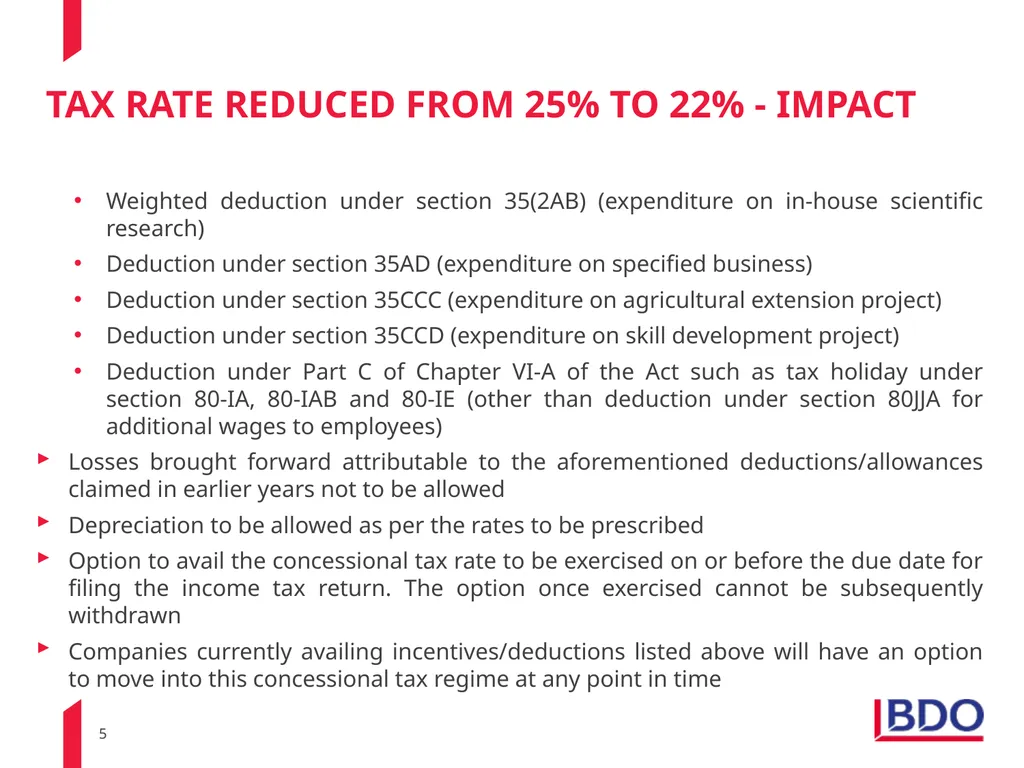
Weighted deduction under section 35(2AB) (expenditure on in-house scientific research)
Deduction under section 35AD (expenditure on specified business)
Deduction under section 35CCC (expenditure on agricultural extension project)
Deduction under section 35CCD (expenditure on skill development project)
Deduction under Part C of Chapter VI-A of the Act such as tax holiday under section 80-IA, 80-IAB and 80-IE (other than deduction under section 80JJA for additional wages to employees)
Losses brought forward attributable to the aforementioned deductions/allowances claimed in earlier years not to be allowed
Depreciation to be allowed as per the rates to be prescribed
Option to avail the concessional tax rate to be exercised on or before the due date for filing the income tax return. The option once exercised cannot be subsequently withdrawn
Companies currently availing incentives/deductions listed above will have an option to move into this concessional tax regime at any point in time Tax rate reduced from 25% to 22% - impact<br>
Deduction under section 35AD (expenditure on specified business)
Deduction under section 35CCC (expenditure on agricultural extension project)
Deduction under section 35CCD (expenditure on skill development project)
Deduction under Part C of Chapter VI-A of the Act such as tax holiday under section 80-IA, 80-IAB and 80-IE (other than deduction under section 80JJA for additional wages to employees)
Losses brought forward attributable to the aforementioned deductions/allowances claimed in earlier years not to be allowed
Depreciation to be allowed as per the rates to be prescribed
Option to avail the concessional tax rate to be exercised on or before the due date for filing the income tax return. The option once exercised cannot be subsequently withdrawn
Companies currently availing incentives/deductions listed above will have an option to move into this concessional tax regime at any point in time Tax rate reduced from 25% to 22% - impact<br>
06
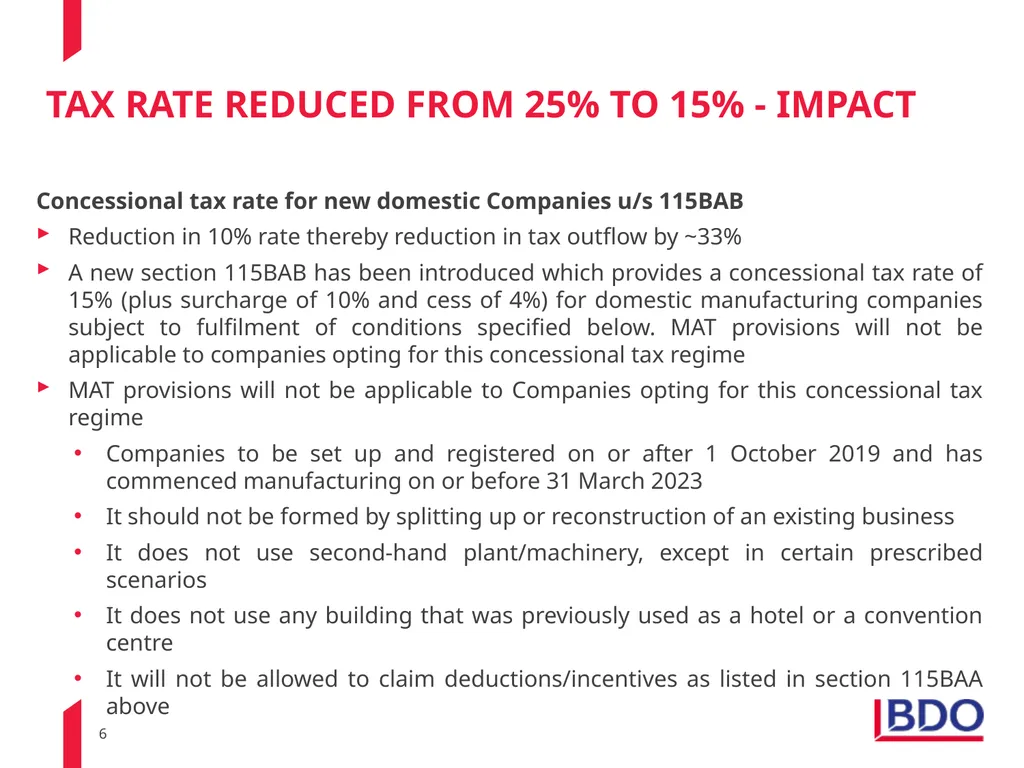
Tax rate reduced from 25% to 15% - impact Concessional tax rate for new domestic Companies u/s 115BAB
Reduction in 10% rate thereby reduction in tax outflow by ~33%
A new section 115BAB has been introduced which provides a concessional tax rate of 15% (plus surcharge of 10% and cess of 4%) for domestic manufacturing companies subject to fulfilment of conditions specified below. MAT provisions will not be applicable to companies opting for this concessional tax regime
MAT provisions will not be applicable to Companies opting for this concessional tax regime
Companies to be set up and registered on or after 1 October 2019 and has commenced manufacturing on or before 31 March 2023
It should not be formed by splitting up or reconstruction of an existing business
It does not use second-hand plant/machinery, except in certain prescribed scenarios
It does not use any building that was previously used as a hotel or a convention centre
It will not be allowed to claim deductions/incentives as listed in section 115BAA above<br>
Reduction in 10% rate thereby reduction in tax outflow by ~33%
A new section 115BAB has been introduced which provides a concessional tax rate of 15% (plus surcharge of 10% and cess of 4%) for domestic manufacturing companies subject to fulfilment of conditions specified below. MAT provisions will not be applicable to companies opting for this concessional tax regime
MAT provisions will not be applicable to Companies opting for this concessional tax regime
Companies to be set up and registered on or after 1 October 2019 and has commenced manufacturing on or before 31 March 2023
It should not be formed by splitting up or reconstruction of an existing business
It does not use second-hand plant/machinery, except in certain prescribed scenarios
It does not use any building that was previously used as a hotel or a convention centre
It will not be allowed to claim deductions/incentives as listed in section 115BAA above<br>
07
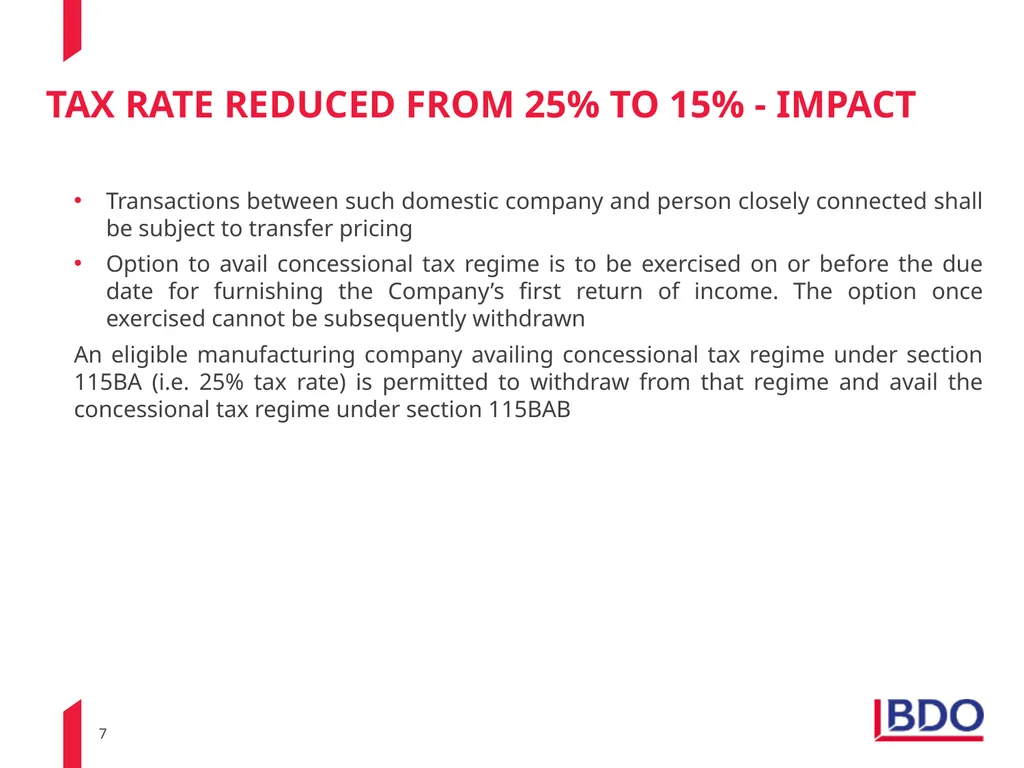
Transactions between such domestic company and person closely connected shall be subject to transfer pricing
Option to avail concessional tax regime is to be exercised on or before the due date for furnishing the Company’s first return of income. The option once exercised cannot be subsequently withdrawn
An eligible manufacturing company availing concessional tax regime under section 115BA (i.e. 25% tax rate) is permitted to withdraw from that regime and avail the concessional tax regime under section 115BAB Tax rate reduced from 25% to 15% - impact<br>
Option to avail concessional tax regime is to be exercised on or before the due date for furnishing the Company’s first return of income. The option once exercised cannot be subsequently withdrawn
An eligible manufacturing company availing concessional tax regime under section 115BA (i.e. 25% tax rate) is permitted to withdraw from that regime and avail the concessional tax regime under section 115BAB Tax rate reduced from 25% to 15% - impact<br>
08
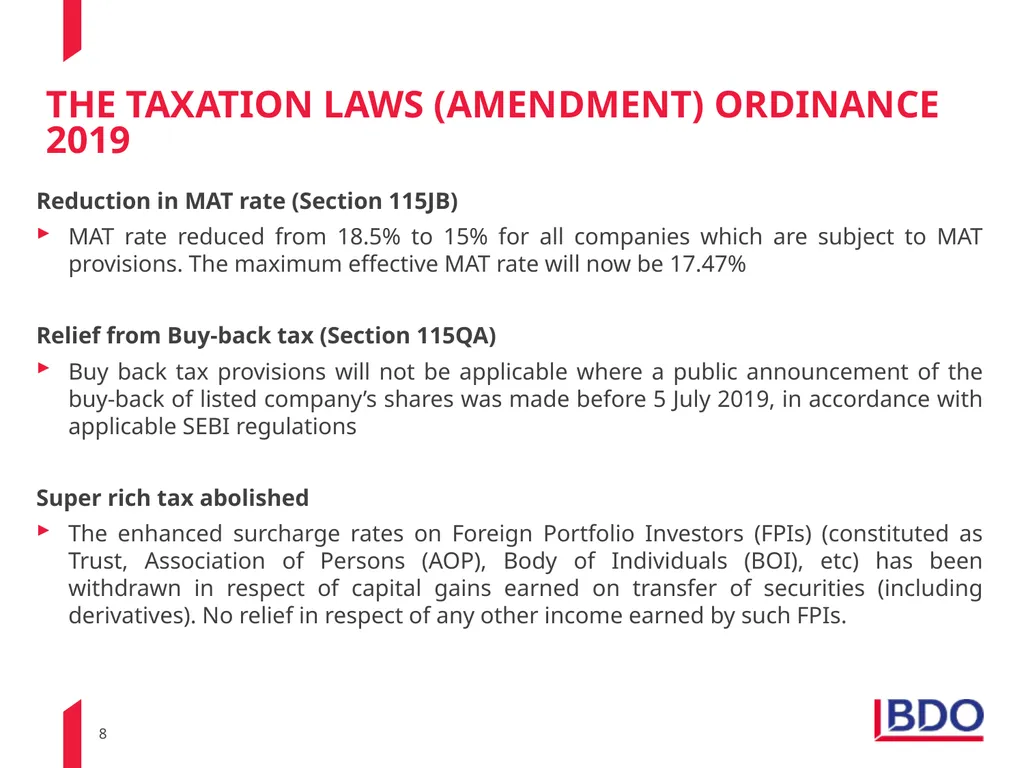
The taxation laws (amendment) ordinance 2019 Reduction in MAT rate (Section 115JB)
MAT rate reduced from 18.5% to 15% for all companies which are subject to MAT provisions. The maximum effective MAT rate will now be 17.47%
Relief from Buy-back tax (Section 115QA)
Buy back tax provisions will not be applicable where a public announcement of the buy-back of listed company’s shares was made before 5 July 2019, in accordance with applicable SEBI regulations
Super rich tax abolished
The enhanced surcharge rates on Foreign Portfolio Investors (FPIs) (constituted as Trust, Association of Persons (AOP), Body of Individuals (BOI), etc) has been withdrawn in respect of capital gains earned on transfer of securities (including derivatives). No relief in respect of any other income earned by such FPIs.<br>
MAT rate reduced from 18.5% to 15% for all companies which are subject to MAT provisions. The maximum effective MAT rate will now be 17.47%
Relief from Buy-back tax (Section 115QA)
Buy back tax provisions will not be applicable where a public announcement of the buy-back of listed company’s shares was made before 5 July 2019, in accordance with applicable SEBI regulations
Super rich tax abolished
The enhanced surcharge rates on Foreign Portfolio Investors (FPIs) (constituted as Trust, Association of Persons (AOP), Body of Individuals (BOI), etc) has been withdrawn in respect of capital gains earned on transfer of securities (including derivatives). No relief in respect of any other income earned by such FPIs.<br>
09
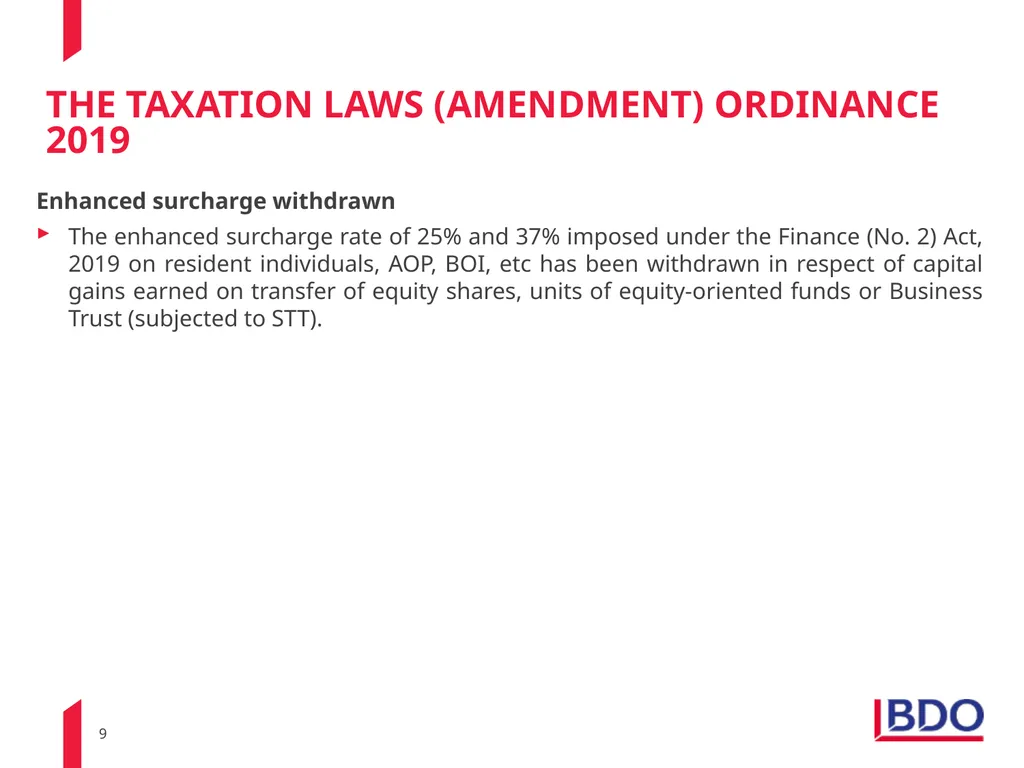
The taxation laws (amendment) ordinance 2019 Enhanced surcharge withdrawn
The enhanced surcharge rate of 25% and 37% imposed under the Finance (No. 2) Act, 2019 on resident individuals, AOP, BOI, etc has been withdrawn in respect of capital gains earned on transfer of equity shares, units of equity-oriented funds or Business Trust (subjected to STT).<br>
The enhanced surcharge rate of 25% and 37% imposed under the Finance (No. 2) Act, 2019 on resident individuals, AOP, BOI, etc has been withdrawn in respect of capital gains earned on transfer of equity shares, units of equity-oriented funds or Business Trust (subjected to STT).<br>
10
Company vs. llp for start-ups – post amendment to Finance Act 2019<br>
11
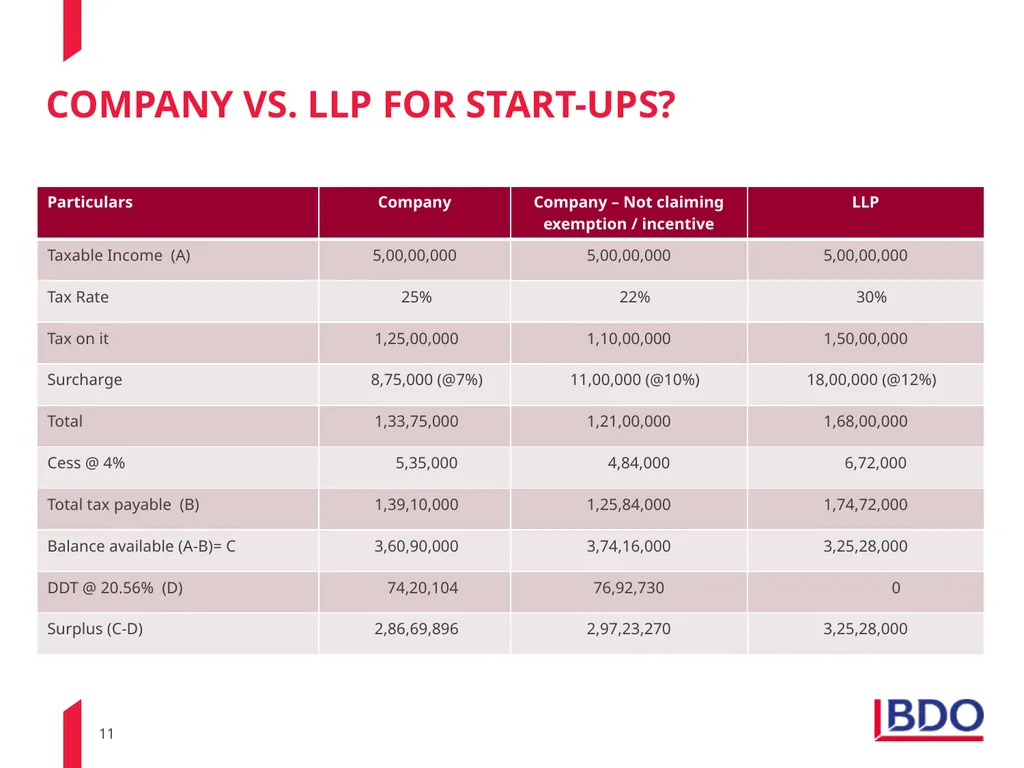
COMPANY VS. LLP for start-ups?<br>
12
TAX ISSUES FOR START-UPS<br>
13
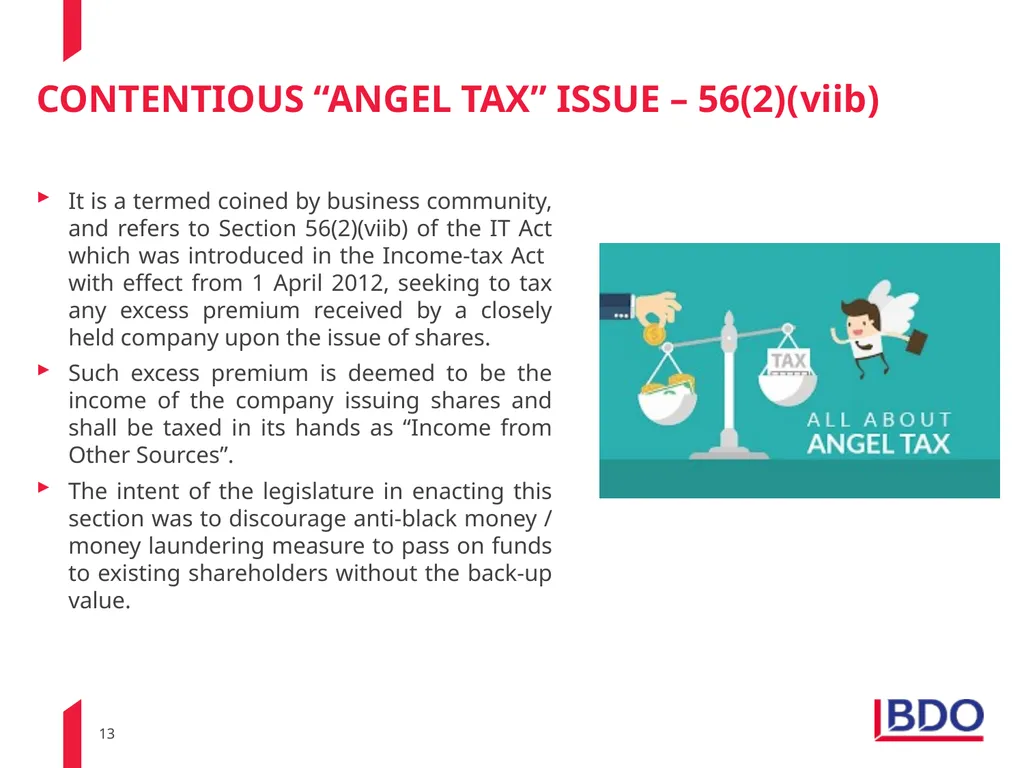
Contentious “Angel tax” issue – 56(2)(viib) It is a termed coined by business community, and refers to Section 56(2)(viib) of the IT Act which was introduced in the Income-tax Act with effect from 1 April 2012, seeking to tax any excess premium received by a closely held company upon the issue of shares.
Such excess premium is deemed to be the income of the company issuing shares and shall be taxed in its hands as “Income from Other Sources”.
The intent of the legislature in enacting this section was to discourage anti-black money / money laundering measure to pass on funds to existing shareholders without the back-up value.<br>
Such excess premium is deemed to be the income of the company issuing shares and shall be taxed in its hands as “Income from Other Sources”.
The intent of the legislature in enacting this section was to discourage anti-black money / money laundering measure to pass on funds to existing shareholders without the back-up value.<br>
14
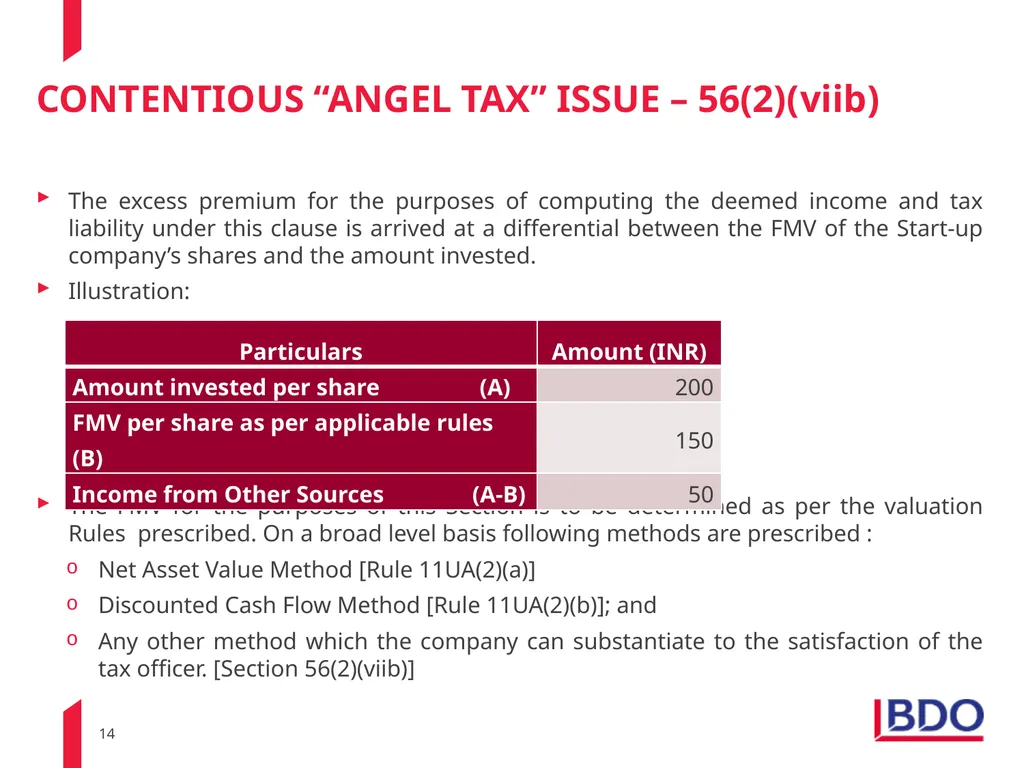
Contentious “Angel tax” issue – 56(2)(viib) The excess premium for the purposes of computing the deemed income and tax liability under this clause is arrived at a differential between the FMV of the Start-up company’s shares and the amount invested.
Illustration:
The FMV for the purposes of this Section is to be determined as per the valuation Rules prescribed. On a broad level basis following methods are prescribed :
Net Asset Value Method [Rule 11UA(2)(a)]
Discounted Cash Flow Method [Rule 11UA(2)(b)]; and
Any other method which the company can substantiate to the satisfaction of the tax officer. [Section 56(2)(viib)]<br>
Illustration:
The FMV for the purposes of this Section is to be determined as per the valuation Rules prescribed. On a broad level basis following methods are prescribed :
Net Asset Value Method [Rule 11UA(2)(a)]
Discounted Cash Flow Method [Rule 11UA(2)(b)]; and
Any other method which the company can substantiate to the satisfaction of the tax officer. [Section 56(2)(viib)]<br>
15
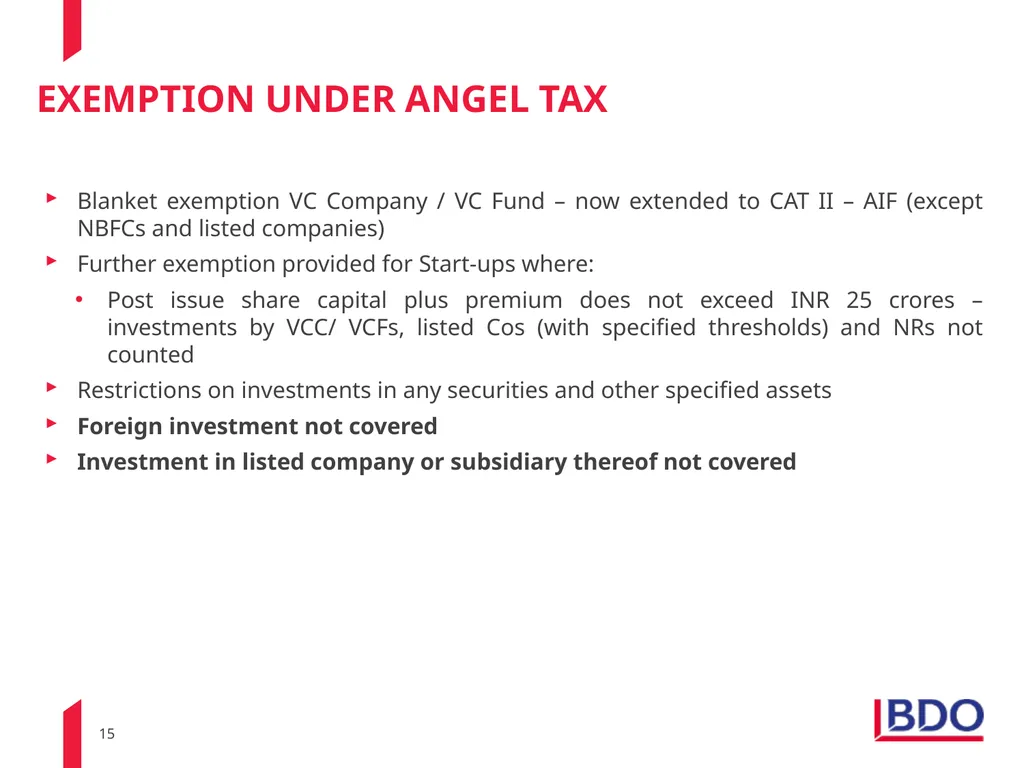
Exemption under Angel tax Blanket exemption VC Company / VC Fund – now extended to CAT II – AIF (except NBFCs and listed companies)
Further exemption provided for Start-ups where:
Post issue share capital plus premium does not exceed INR 25 crores – investments by VCC/ VCFs, listed Cos (with specified thresholds) and NRs not counted
Restrictions on investments in any securities and other specified assets
Foreign investment not covered
Investment in listed company or subsidiary thereof not covered<br>
Further exemption provided for Start-ups where:
Post issue share capital plus premium does not exceed INR 25 crores – investments by VCC/ VCFs, listed Cos (with specified thresholds) and NRs not counted
Restrictions on investments in any securities and other specified assets
Foreign investment not covered
Investment in listed company or subsidiary thereof not covered<br>
16
Contentious “Angel tax” issue – 56(2)(viib) A technical issue to be considered in this regard is whether or not a tax officer would be permitted to challenge the valuation conducted by a registered valuer in accordance with the Rules. Key judicial precedents could be considered as a guide in examining the above question.
In the case of Innoviti Payment Solutions Private Limited (Bangalore Tribunal) [TS-4-ITAT-2019 (Bang)], the tax payer was challenged on the projections used for DCF valuation. The Tribunal sought guidance from the CA institute’s Technical Guide on share valuation. The guidance note laid emphasis on the assumptions behind the projections used for conducting DCF valuation. The Tribunal agreed to the fact that adoption of the DCF method cannot be challenged. However, the Tribunal opined that the tax officer can examine the appropriateness and the underlying assumptions in arriving at the projections for DCF valuation. In case the tax payer is not able to establish the fact that such projections were made applying scientific methodology for estimation, the tax officer can challenge such projections and consequentially the valuation itself.
There is also a contradictory view by the Bangalore Tribunal in the case of TUV Rheinland NIFE Academy Pvt Ltd. [ITA No.3160/Bang/2018]. The Tribunal held that even the valuation methodology can be challenged if its veracity is not appropriately established.<br>
In the case of Innoviti Payment Solutions Private Limited (Bangalore Tribunal) [TS-4-ITAT-2019 (Bang)], the tax payer was challenged on the projections used for DCF valuation. The Tribunal sought guidance from the CA institute’s Technical Guide on share valuation. The guidance note laid emphasis on the assumptions behind the projections used for conducting DCF valuation. The Tribunal agreed to the fact that adoption of the DCF method cannot be challenged. However, the Tribunal opined that the tax officer can examine the appropriateness and the underlying assumptions in arriving at the projections for DCF valuation. In case the tax payer is not able to establish the fact that such projections were made applying scientific methodology for estimation, the tax officer can challenge such projections and consequentially the valuation itself.
There is also a contradictory view by the Bangalore Tribunal in the case of TUV Rheinland NIFE Academy Pvt Ltd. [ITA No.3160/Bang/2018]. The Tribunal held that even the valuation methodology can be challenged if its veracity is not appropriately established.<br>
17
Contentious “Angel tax” issue – 56(2)(viib) Based on the above, it appears that while the tax officer ought not to challenge the valuation method adopted, the validity of projections in a DCF scenario may be verified. The tax payer may be required to provide a best estimate and scientific basis for the projections, considering the economic factors and provide evidence in support.
In the case of Apollo Sugar Clinics Ltd. vs. DCIT [2019] 105 taxmann.com 254 (Hyderabad - Trib.), the assessee-company is a second-level subsidiary of a Company in which public is substantially interested. The assessee-company issued the shares at the share premium of Rs. 990 per share and at Rs.1,220 per share in the first year of its operations and the allotments made to SSIL and AHLSL respectively. The Assessing Officer concluded that the valuation report submitted by the assessee for determination of share premium was imaginary with surmises and moreover there was very huge gap between the projections and actuals. Hence, the Assessing Officer determined the share premium under rule 11UA(1)(b) and disallowed the excess share premium collected under section 56 and added to the total income. ITAT held that since Holding company was a public limited company and by virtue of section 2(18), the assessee-company would be said to be a company in which public were substantially interested. Hence, the provisions of section 56(2)(viib) would not attract.<br>
In the case of Apollo Sugar Clinics Ltd. vs. DCIT [2019] 105 taxmann.com 254 (Hyderabad - Trib.), the assessee-company is a second-level subsidiary of a Company in which public is substantially interested. The assessee-company issued the shares at the share premium of Rs. 990 per share and at Rs.1,220 per share in the first year of its operations and the allotments made to SSIL and AHLSL respectively. The Assessing Officer concluded that the valuation report submitted by the assessee for determination of share premium was imaginary with surmises and moreover there was very huge gap between the projections and actuals. Hence, the Assessing Officer determined the share premium under rule 11UA(1)(b) and disallowed the excess share premium collected under section 56 and added to the total income. ITAT held that since Holding company was a public limited company and by virtue of section 2(18), the assessee-company would be said to be a company in which public were substantially interested. Hence, the provisions of section 56(2)(viib) would not attract.<br>
18
Relief from Angel tax demand<br>
19
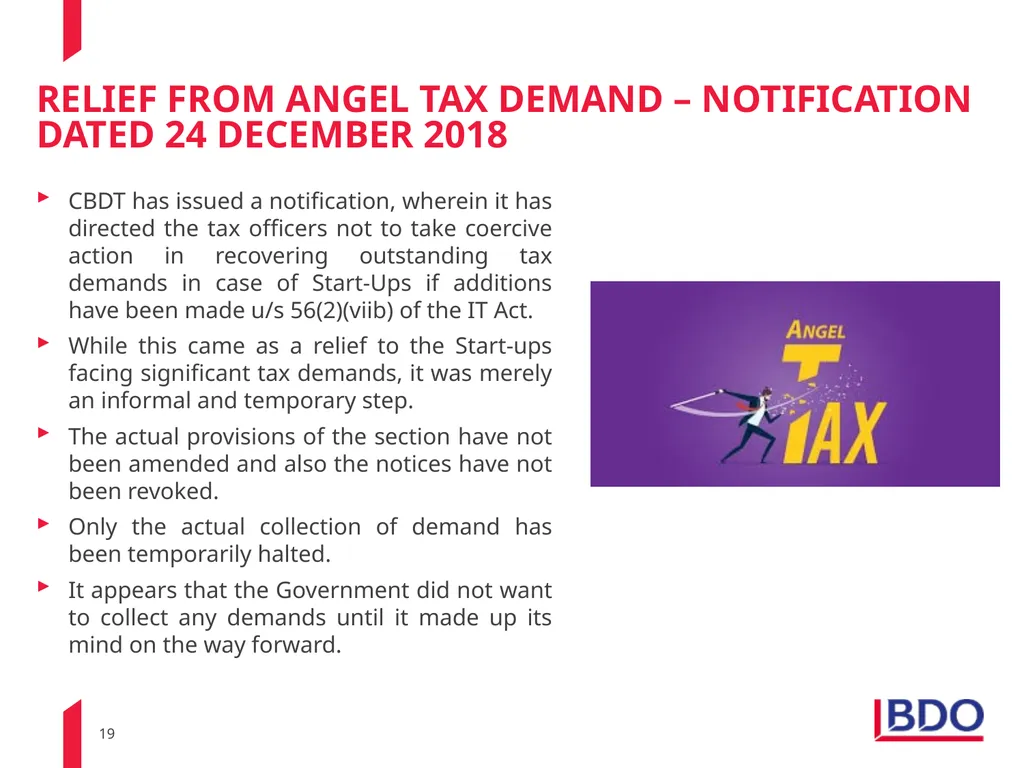
Relief from Angel tax demand – notification dated 24 December 2018 CBDT has issued a notification, wherein it has directed the tax officers not to take coercive action in recovering outstanding tax demands in case of Start-Ups if additions have been made u/s 56(2)(viib) of the IT Act.
While this came as a relief to the Start-ups facing significant tax demands, it was merely an informal and temporary step.
The actual provisions of the section have not been amended and also the notices have not been revoked.
Only the actual collection of demand has been temporarily halted.
It appears that the Government did not want to collect any demands until it made up its mind on the way forward.<br>
While this came as a relief to the Start-ups facing significant tax demands, it was merely an informal and temporary step.
The actual provisions of the section have not been amended and also the notices have not been revoked.
Only the actual collection of demand has been temporarily halted.
It appears that the Government did not want to collect any demands until it made up its mind on the way forward.<br>
20
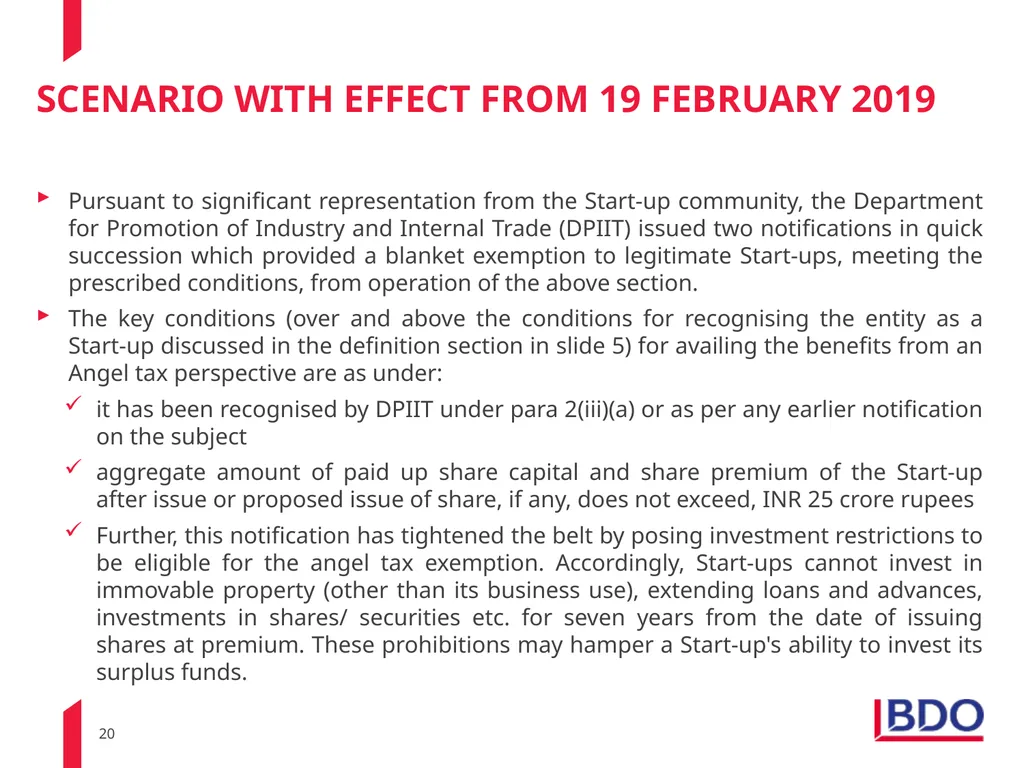
Scenario with effect from 19 February 2019 Pursuant to significant representation from the Start-up community, the Department for Promotion of Industry and Internal Trade (DPIIT) issued two notifications in quick succession which provided a blanket exemption to legitimate Start-ups, meeting the prescribed conditions, from operation of the above section.
The key conditions (over and above the conditions for recognising the entity as a Start-up discussed in the definition section in slide 5) for availing the benefits from an Angel tax perspective are as under:
it has been recognised by DPIIT under para 2(iii)(a) or as per any earlier notification on the subject
aggregate amount of paid up share capital and share premium of the Start-up after issue or proposed issue of share, if any, does not exceed, INR 25 crore rupees
Further, this notification has tightened the belt by posing investment restrictions to be eligible for the angel tax exemption. Accordingly, Start-ups cannot invest in immovable property (other than its business use), extending loans and advances, investments in shares/ securities etc. for seven years from the date of issuing shares at premium. These prohibitions may hamper a Start-up's ability to invest its surplus funds.<br>
The key conditions (over and above the conditions for recognising the entity as a Start-up discussed in the definition section in slide 5) for availing the benefits from an Angel tax perspective are as under:
it has been recognised by DPIIT under para 2(iii)(a) or as per any earlier notification on the subject
aggregate amount of paid up share capital and share premium of the Start-up after issue or proposed issue of share, if any, does not exceed, INR 25 crore rupees
Further, this notification has tightened the belt by posing investment restrictions to be eligible for the angel tax exemption. Accordingly, Start-ups cannot invest in immovable property (other than its business use), extending loans and advances, investments in shares/ securities etc. for seven years from the date of issuing shares at premium. These prohibitions may hamper a Start-up's ability to invest its surplus funds.<br>
21
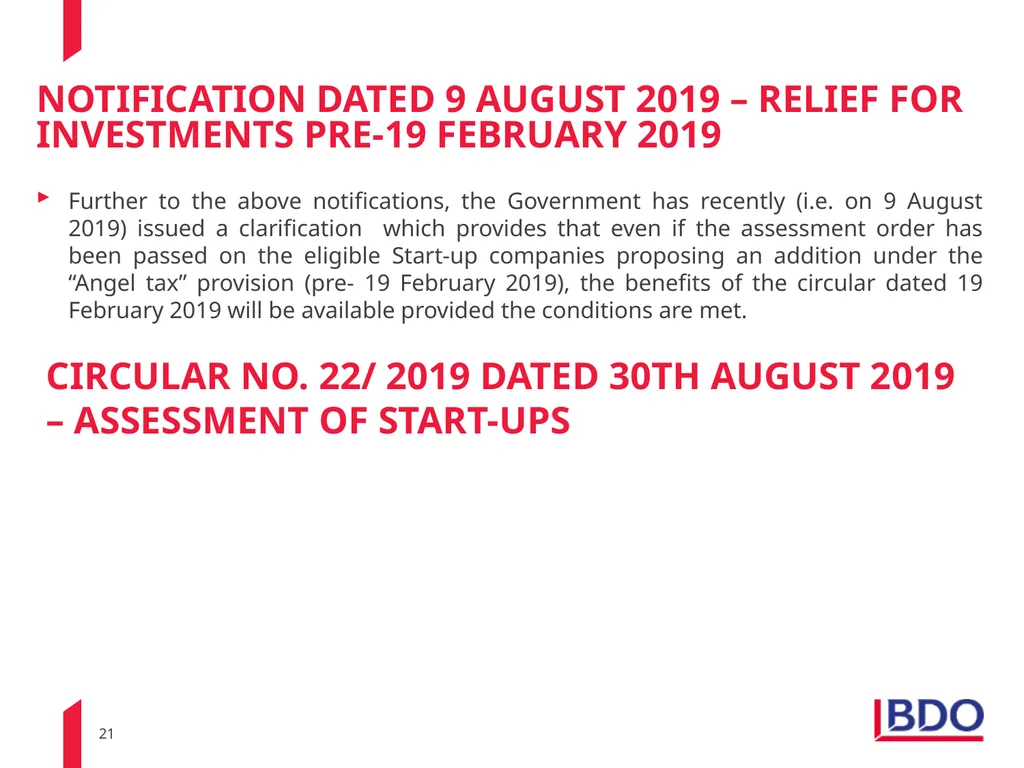
Notification dated 9 August 2019 – relief for investments pre-19 February 2019 Further to the above notifications, the Government has recently (i.e. on 9 August 2019) issued a clarification which provides that even if the assessment order has been passed on the eligible Start-up companies proposing an addition under the “Angel tax” provision (pre- 19 February 2019), the benefits of the circular dated 19 February 2019 will be available provided the conditions are met. Circular no. 22/ 2019 dated 30th august 2019 – Assessment of Start-ups<br>
22
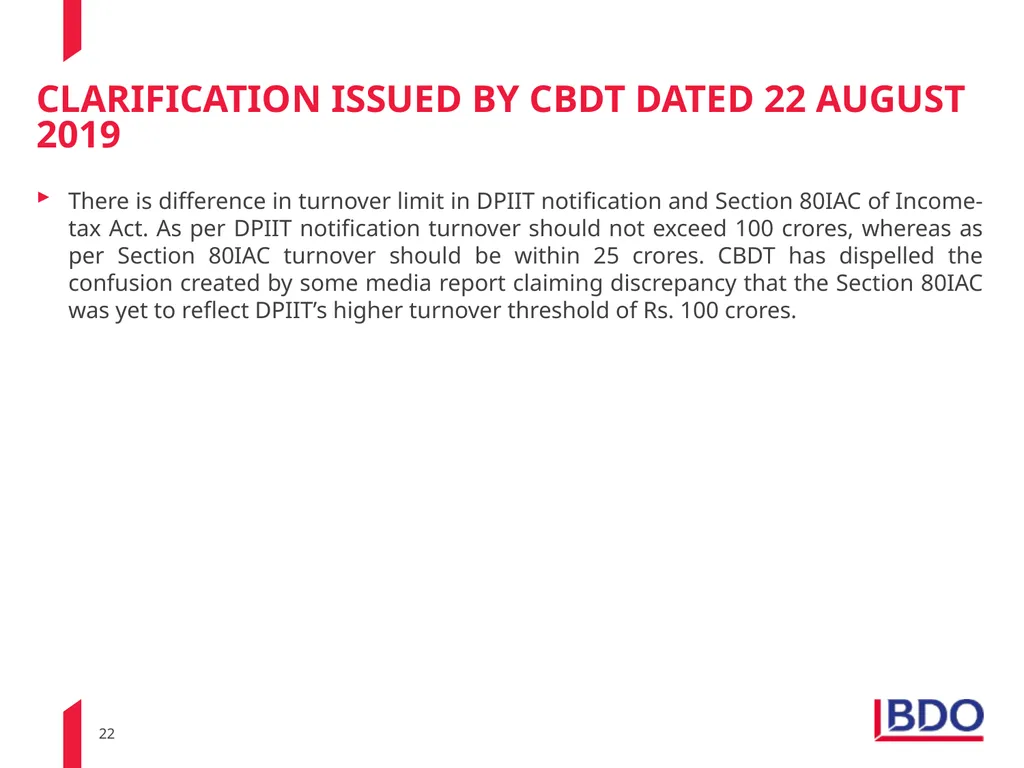
Clarification issued by CBDT dated 22 August 2019 There is difference in turnover limit in DPIIT notification and Section 80IAC of Income-tax Act. As per DPIIT notification turnover should not exceed 100 crores, whereas as per Section 80IAC turnover should be within 25 crores. CBDT has dispelled the confusion created by some media report claiming discrepancy that the Section 80IAC was yet to reflect DPIIT’s higher turnover threshold of Rs. 100 crores.<br>
23
IP capitalization<br>
24
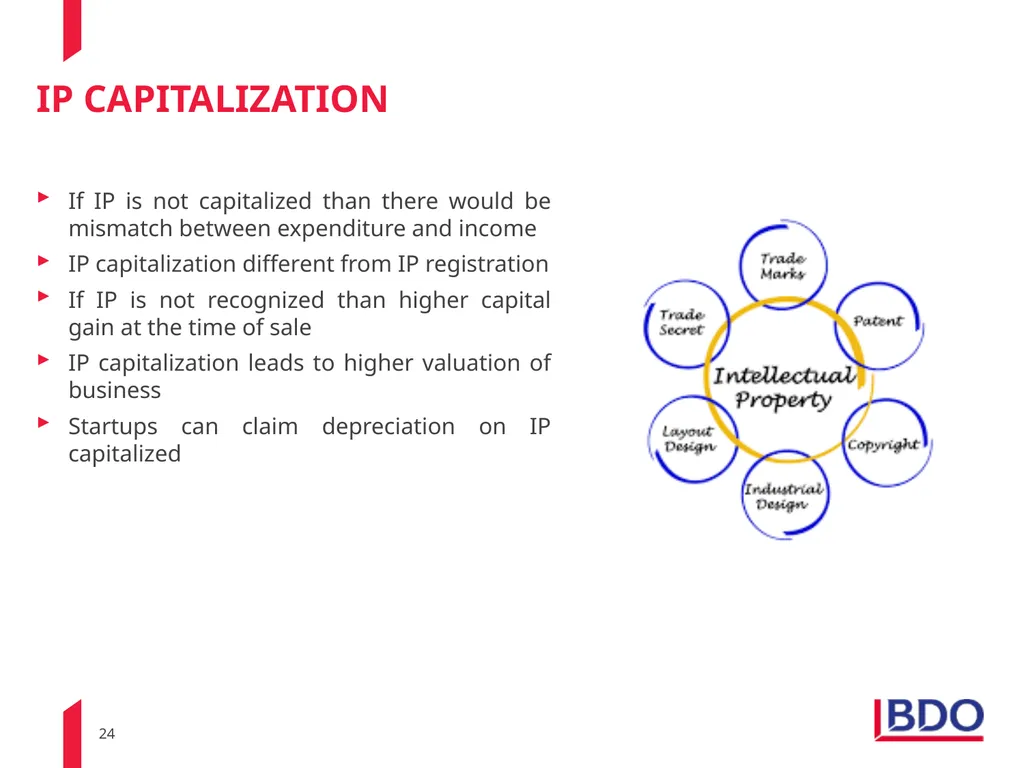
IP Capitalization If IP is not capitalized than there would be mismatch between expenditure and income
IP capitalization different from IP registration
If IP is not recognized than higher capital gain at the time of sale
IP capitalization leads to higher valuation of business
Startups can claim depreciation on IP capitalized<br>
IP capitalization different from IP registration
If IP is not recognized than higher capital gain at the time of sale
IP capitalization leads to higher valuation of business
Startups can claim depreciation on IP capitalized<br>
25
Externalization<br>
26
Externalization… Innovative tech or tech backed products find significant customers outside India
Start-ups with overseas customer-base explore shifting of HQ and IP outside India
typically referred to as “externalization”
Externalization typically involves:
movement of IP outside India
movement of capital outside India; and
migration of promoters
Whether to externalize – key factors / business realities:
business requirement or significant tax and regulatory benefits
justifiable commercial rationale for shift outside India
BEPS / GAAR / POEM
significant external customers demand doing business with same or friendly jurisdiction
group plans to make overseas investments in multiple jurisdictions<br>
Start-ups with overseas customer-base explore shifting of HQ and IP outside India
typically referred to as “externalization”
Externalization typically involves:
movement of IP outside India
movement of capital outside India; and
migration of promoters
Whether to externalize – key factors / business realities:
business requirement or significant tax and regulatory benefits
justifiable commercial rationale for shift outside India
BEPS / GAAR / POEM
significant external customers demand doing business with same or friendly jurisdiction
group plans to make overseas investments in multiple jurisdictions<br>
27
…Externalization Externalisation to be undertaken at the right stage:
the Start-up is fully operational,
the IP is registered and well established in the market, and
there has been recognition from investors by way of round(s) of external investment.
Key factors in determining appropriate HQ / IP jurisdiction:
customer requirements
ease of doing business
availability of talent
ease of mobility of Indian personnel
ease in tax and regulatory compliance
Preferred jurisdictions by Indian Start-ups - Singapore, USA, Netherlands, Switzerland, Canada, UAE, etc
Gift of IP – the debate and thoughts<br>
the Start-up is fully operational,
the IP is registered and well established in the market, and
there has been recognition from investors by way of round(s) of external investment.
Key factors in determining appropriate HQ / IP jurisdiction:
customer requirements
ease of doing business
availability of talent
ease of mobility of Indian personnel
ease in tax and regulatory compliance
Preferred jurisdictions by Indian Start-ups - Singapore, USA, Netherlands, Switzerland, Canada, UAE, etc
Gift of IP – the debate and thoughts<br>
28
IP migration<br>
29
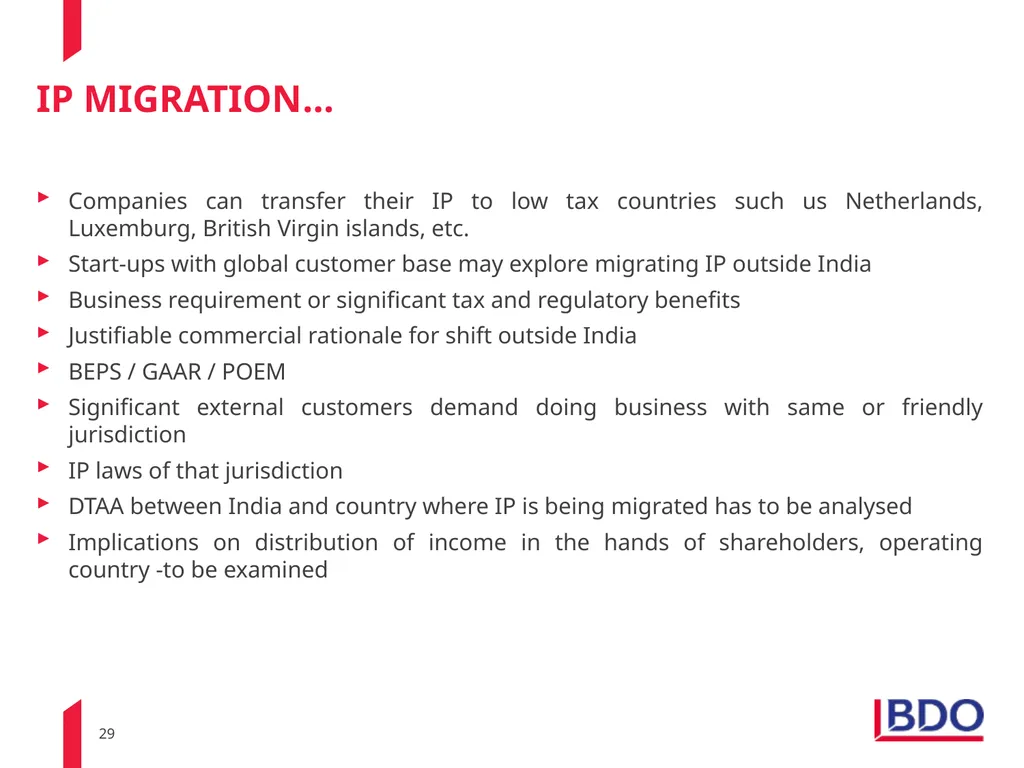
IP Migration… Companies can transfer their IP to low tax countries such us Netherlands, Luxemburg, British Virgin islands, etc.
Start-ups with global customer base may explore migrating IP outside India
Business requirement or significant tax and regulatory benefits
Justifiable commercial rationale for shift outside India
BEPS / GAAR / POEM
Significant external customers demand doing business with same or friendly jurisdiction
IP laws of that jurisdiction
DTAA between India and country where IP is being migrated has to be analysed
Implications on distribution of income in the hands of shareholders, operating country -to be examined<br>
Start-ups with global customer base may explore migrating IP outside India
Business requirement or significant tax and regulatory benefits
Justifiable commercial rationale for shift outside India
BEPS / GAAR / POEM
Significant external customers demand doing business with same or friendly jurisdiction
IP laws of that jurisdiction
DTAA between India and country where IP is being migrated has to be analysed
Implications on distribution of income in the hands of shareholders, operating country -to be examined<br>
30
Investment in start-ups<br>
31
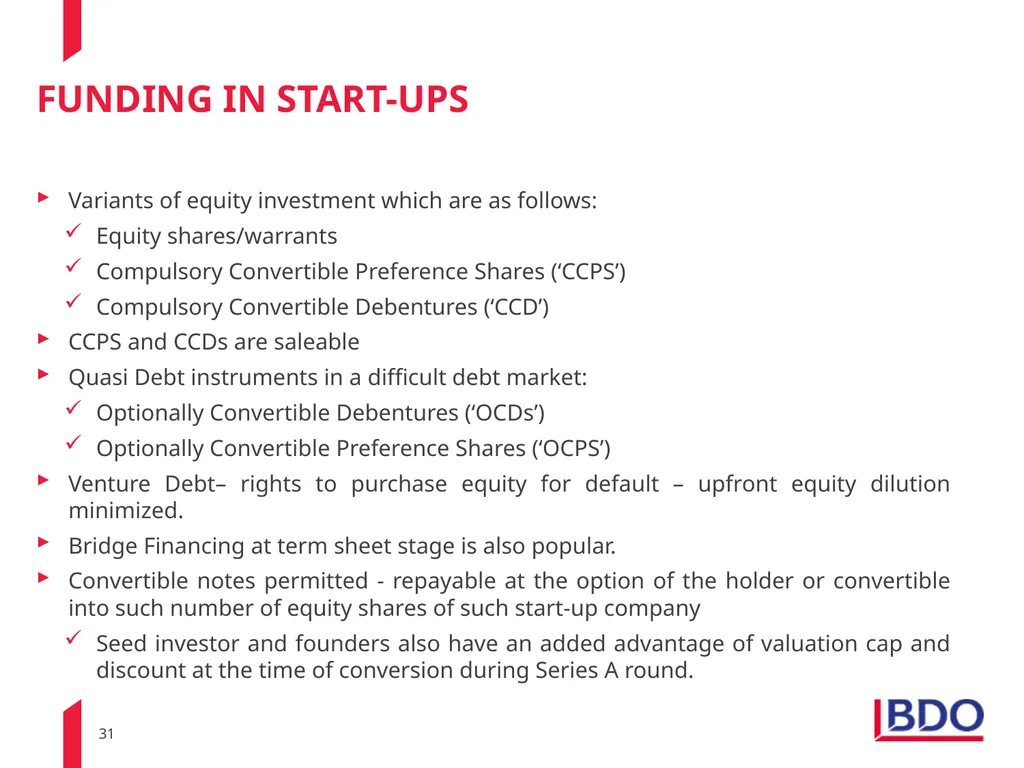
FUNDING IN START-UPS Variants of equity investment which are as follows:
Equity shares/warrants
Compulsory Convertible Preference Shares (‘CCPS’)
Compulsory Convertible Debentures (‘CCD’)
CCPS and CCDs are saleable
Quasi Debt instruments in a difficult debt market:
Optionally Convertible Debentures (‘OCDs’)
Optionally Convertible Preference Shares (‘OCPS’)
Venture Debt– rights to purchase equity for default – upfront equity dilution minimized.
Bridge Financing at term sheet stage is also popular.
Convertible notes permitted - repayable at the option of the holder or convertible into such number of equity shares of such start-up company
Seed investor and founders also have an added advantage of valuation cap and discount at the time of conversion during Series A round.<br>
Equity shares/warrants
Compulsory Convertible Preference Shares (‘CCPS’)
Compulsory Convertible Debentures (‘CCD’)
CCPS and CCDs are saleable
Quasi Debt instruments in a difficult debt market:
Optionally Convertible Debentures (‘OCDs’)
Optionally Convertible Preference Shares (‘OCPS’)
Venture Debt– rights to purchase equity for default – upfront equity dilution minimized.
Bridge Financing at term sheet stage is also popular.
Convertible notes permitted - repayable at the option of the holder or convertible into such number of equity shares of such start-up company
Seed investor and founders also have an added advantage of valuation cap and discount at the time of conversion during Series A round.<br>
32
Housekeeping measures before series A funding<br>
33
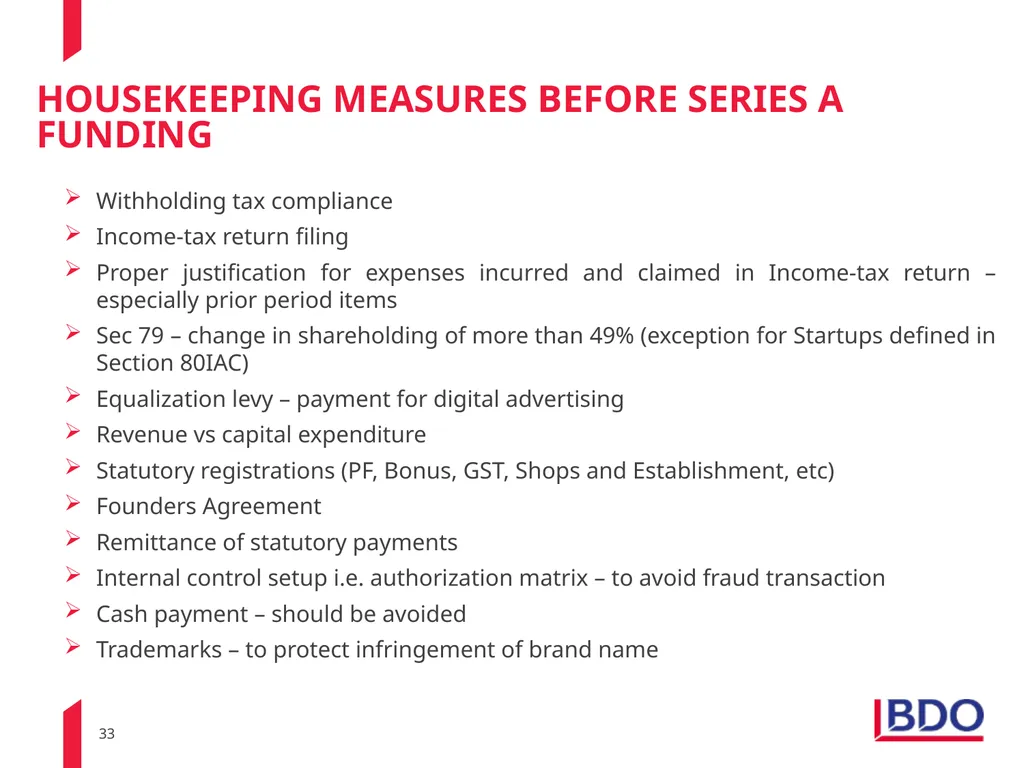
Housekeeping measures before series A funding Withholding tax compliance
Income-tax return filing
Proper justification for expenses incurred and claimed in Income-tax return – especially prior period items
Sec 79 – change in shareholding of more than 49% (exception for Startups defined in Section 80IAC)
Equalization levy – payment for digital advertising
Revenue vs capital expenditure
Statutory registrations (PF, Bonus, GST, Shops and Establishment, etc)
Founders Agreement
Remittance of statutory payments
Internal control setup i.e. authorization matrix – to avoid fraud transaction
Cash payment – should be avoided
Trademarks – to protect infringement of brand name<br>
Income-tax return filing
Proper justification for expenses incurred and claimed in Income-tax return – especially prior period items
Sec 79 – change in shareholding of more than 49% (exception for Startups defined in Section 80IAC)
Equalization levy – payment for digital advertising
Revenue vs capital expenditure
Statutory registrations (PF, Bonus, GST, Shops and Establishment, etc)
Founders Agreement
Remittance of statutory payments
Internal control setup i.e. authorization matrix – to avoid fraud transaction
Cash payment – should be avoided
Trademarks – to protect infringement of brand name<br>
34
Founder / promoter STAKE dilution<br>
35
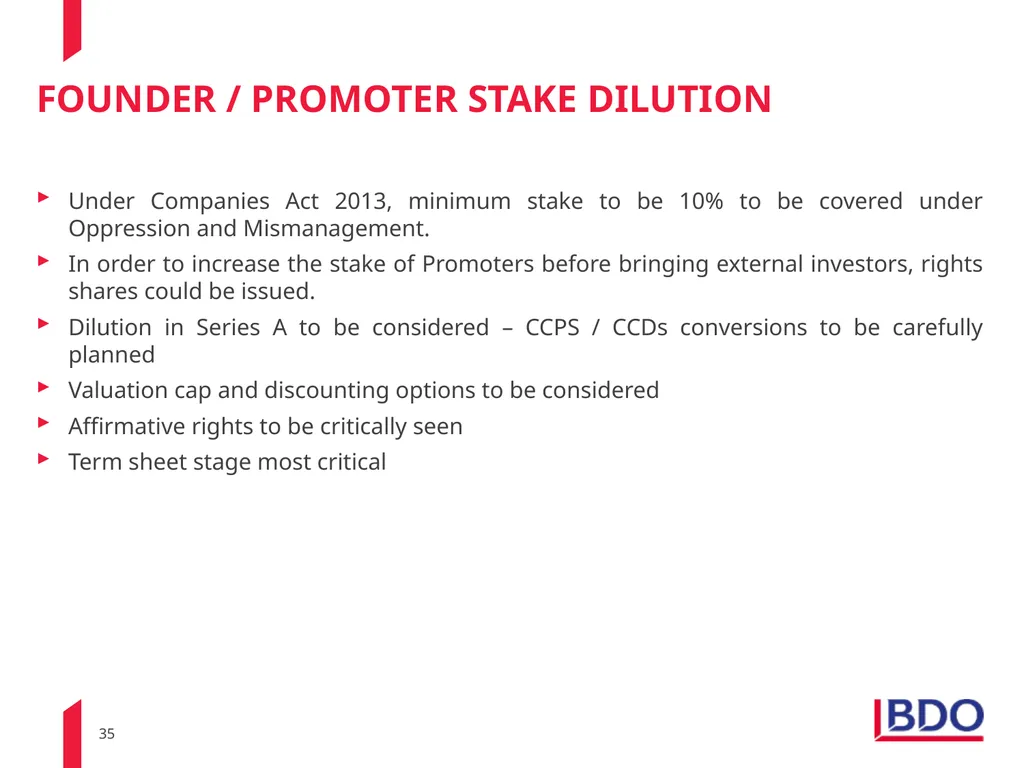
Founder / promoter stake dilution Under Companies Act 2013, minimum stake to be 10% to be covered under Oppression and Mismanagement.
In order to increase the stake of Promoters before bringing external investors, rights shares could be issued.
Dilution in Series A to be considered – CCPS / CCDs conversions to be carefully planned
Valuation cap and discounting options to be considered
Affirmative rights to be critically seen
Term sheet stage most critical<br>
In order to increase the stake of Promoters before bringing external investors, rights shares could be issued.
Dilution in Series A to be considered – CCPS / CCDs conversions to be carefully planned
Valuation cap and discounting options to be considered
Affirmative rights to be critically seen
Term sheet stage most critical<br>
36
THANK YOU<br>