
3rd Lecturer Phycology Reproduction Algae

Description: 3rd Lecturer Phycology Reproduction Algae reproduce both asexually as well as sexually. The asexual method of reproduction includes reproduction by vegetative methods and reproduction by spores. The different methods of reproduction in
Related Topics
Download Presentation
"3rd Lecturer Phycology Reproduction Algae" is the property of its rightful owner. Permission is granted to download and print the materials on this website for personal, non-commercial use only, and to display it on your personal computer provided you do not modify the materials and that you retain all copyright notices contained in the materials. By downloading content from our website, you accept the terms of this agreement.
Presentation Transcript
slide1. 3rd Lecturer
Phycology<br>
slide2. Reproduction Algae reproduce both asexually as well as sexually. The asexual method of reproduction includes reproduction by vegetative methods and reproduction by spores.
The different methods of reproduction in algae are discussed below:<br>
slide3. Reproduction 1. Vegetative Methods
The vegetative reproduction is a type of reproduction where a part of thallus becomes specialized and gets detached from the parent to form a new offspring.
The new individual thus formed in this way is genetically identical to parent and no variation is observed. The different ways by which algae reproduces vegetative are:
1.1 Budding
Some vesicles which get detached from the parent plant by the formation of a septum, and are cable of giving rise to a new thallus is called buds. For example:
Protosiphon .
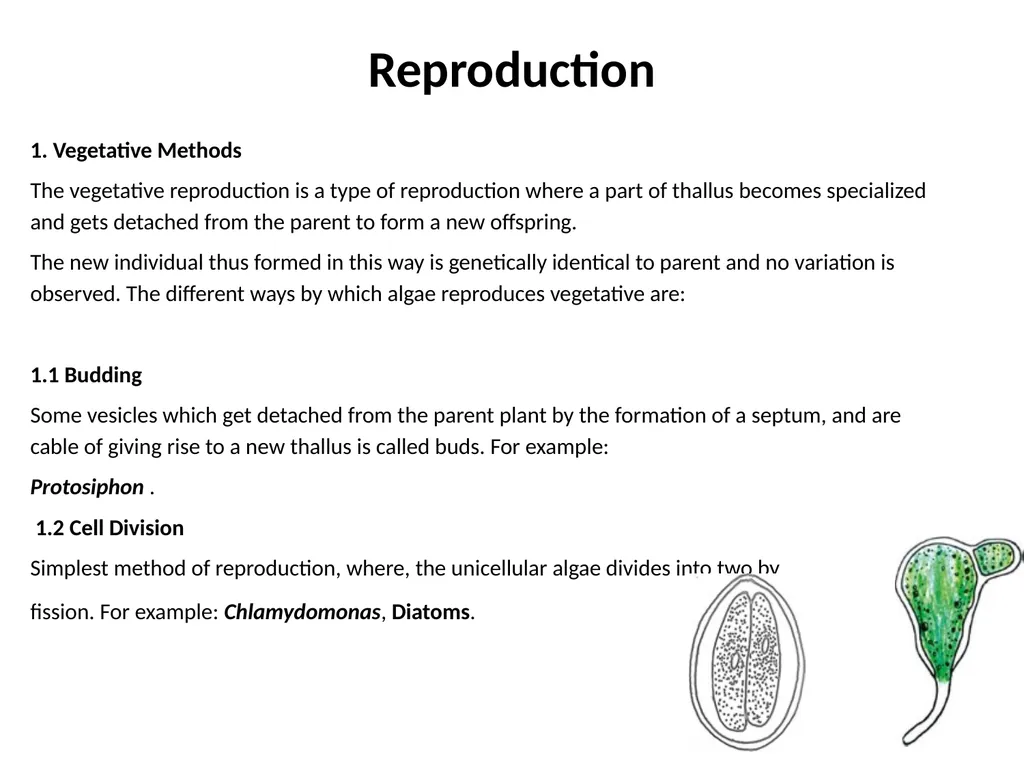
1.2 Cell Division
Simplest method of reproduction, where, the unicellular algae divides into two by
fission. For example: Chlamydomonas, Diatoms.<br>
slide4. Reproduction 1.3 Fragmentation
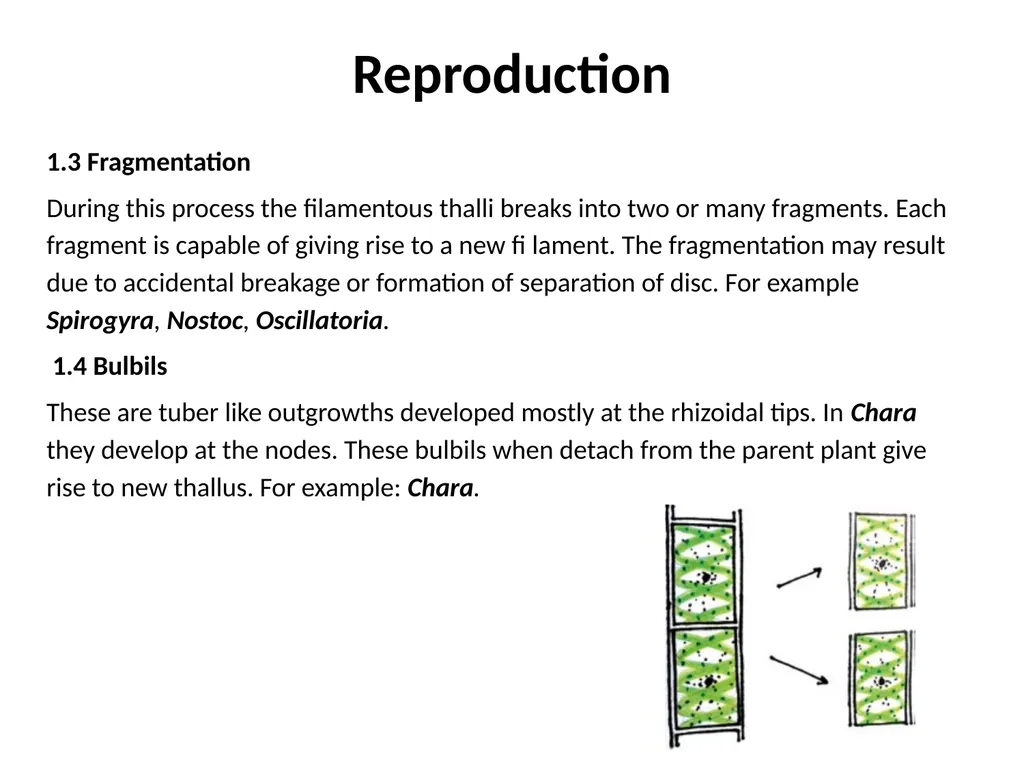
During this process the filamentous thalli breaks into two or many fragments. Each fragment is capable of giving rise to a new fi lament. The fragmentation may result due to accidental breakage or formation of separation of disc. For example Spirogyra, Nostoc, Oscillatoria.
1.4 Bulbils
These are tuber like outgrowths developed mostly at the rhizoidal tips. In Chara they develop at the nodes. These bulbils when detach from the parent plant give rise to new thallus. For example: Chara.<br>
slide5. Reproduction 1.5 Hormogones
These are short segments of filaments with in the sheath of parent filament.
Hormogones are many celled segments and are commonly found in members of cyanophyceae.
1.6 Amylum Stars
Present on lower nodes in Chara. These are star shaped aggregation of starch<br>
slide6. Reproduction 2 Asexual Reproductions or Reproduction by Spores
2.1 Akinetes
These are thick walled spores with abundance of food reserve. They withstand the unfavorable conditions and germinate on the onset of favorable conditions.
Example: Nostoc , Gloeotrichia , Ulothrix , Cladophora , Pithophora .
2.2 Autospores
During unfavourable conditions protoplast inside the sporangium divides and forms spores which are identical to parent plant are termed autospores. The autospores are non-motile, thick walled and abundant in food reserve. Example: Scenedesmus,Chlorella.<br>
slide7. Reproduction 2.3 Aplanospores
They may be formed singly or by the repeated division of the sporangium of parent plant during drought (unfavourable conditions). Example: Ulothrix.
2.4 Bispores
When two spores are formed in a sporangium they are called bispores and the sporangium is termed as bisporangium as reported in Grateloupia filicina.
2.5 Carpospores
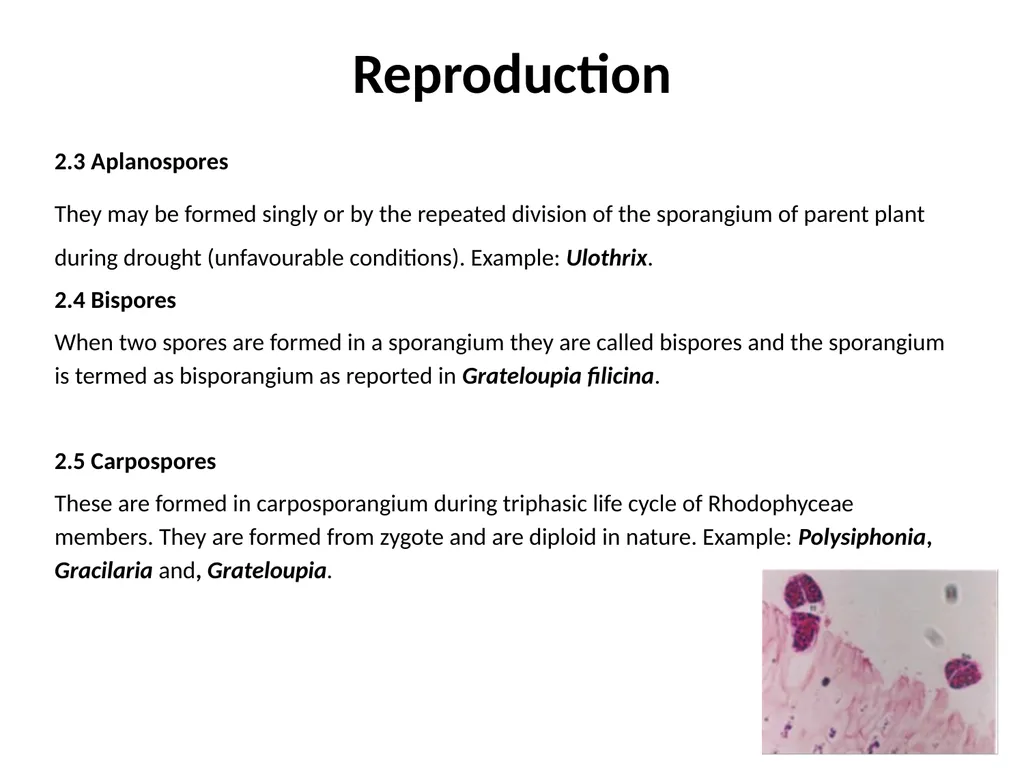
These are formed in carposporangium during triphasic life cycle of Rhodophyceae members. They are formed from zygote and are diploid in nature. Example: Polysiphonia, Gracilaria and, Grateloupia.<br>
slide8. Reproduction 2.6 Endospores
These are formed in the sporangium by successive repeated divisions of cell contents. All spores are formed first, and then the sporangium opens to liberate the motile spores. E.g. Dermocarpa clavata.
2.7 Exospores
During exospore formation in Cyanophycean members, the sporangium gets burst at the apex and is exposed to the external environment and further by successive repeated divisions of cell contents the spherical spores are formed which are termed exospores. All spores get liberated one by one. For example Chaemasiphon, Stichosiphon<br>
slide9. Reproduction 2.8 Hypnospores
Aplanospores with thick walled and abundance of food reserve are known as hypnospores. They may germinate directly or their protoplast may divide further to form zoospores which germinate to new plant. Example: Pediastrum, Sphaerella.
2.9 Monospores
Single spores formed in a sporangium are termed as monospores. Commonly monospores are found in Brown and red algae and are considered to be the commonest asexual spores of red algae.
2.10 Neutral Spores
These are common in red algae for example Bangia where, the vegetative cells directly get transformed into spores and such spores are termed neutral spores.
2.11 Paraspores
When more than four spores are formed because of reduction division in a sporangium in red algae, such spores are called as paraspores or polyspores for example: Palmaria elegans.<br>
slide10. Reproduction 2.12 Statopsores
Thick and ornamented smooth walled spores of bacillariophyceae are termed as Statospores. Example: Chaetoceros (Bacillariophyceae), Chrysophyceae,
Xanthophyceae .
2.13 Tetraspores
Commonly found in red algae. These are formed in four in number in a tetrasporangium. E.g. Porphyra, Gracilaria, Grateloupia.
2.14 Zoospores
The motile and naked spores are known as zoospores. They may be haploid or diploid and are formed in zoosporangium. The zoospores of Vaucheria are known as
Synzoospores as they are multinucleate and Multiflagellate. Zoospores may have two, four or many flagella for example: Biflagellate zoospores: Chlamydomonas, Quadriflagellate: Ulothrix Multiflagellate Oedogonium.<br>
slide12. Reproduction 3. Sexual Reproduction
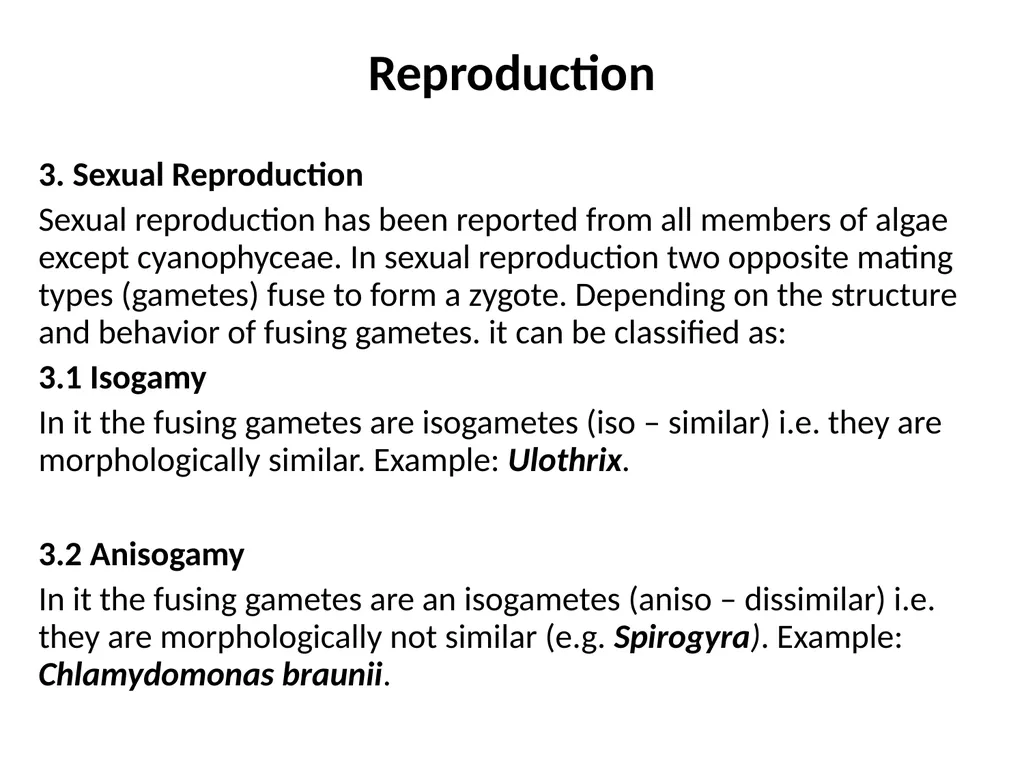
Sexual reproduction has been reported from all members of algae except cyanophyceae. In sexual reproduction two opposite mating types (gametes) fuse to form a zygote. Depending on the structure and behavior of fusing gametes. it can be classified as:
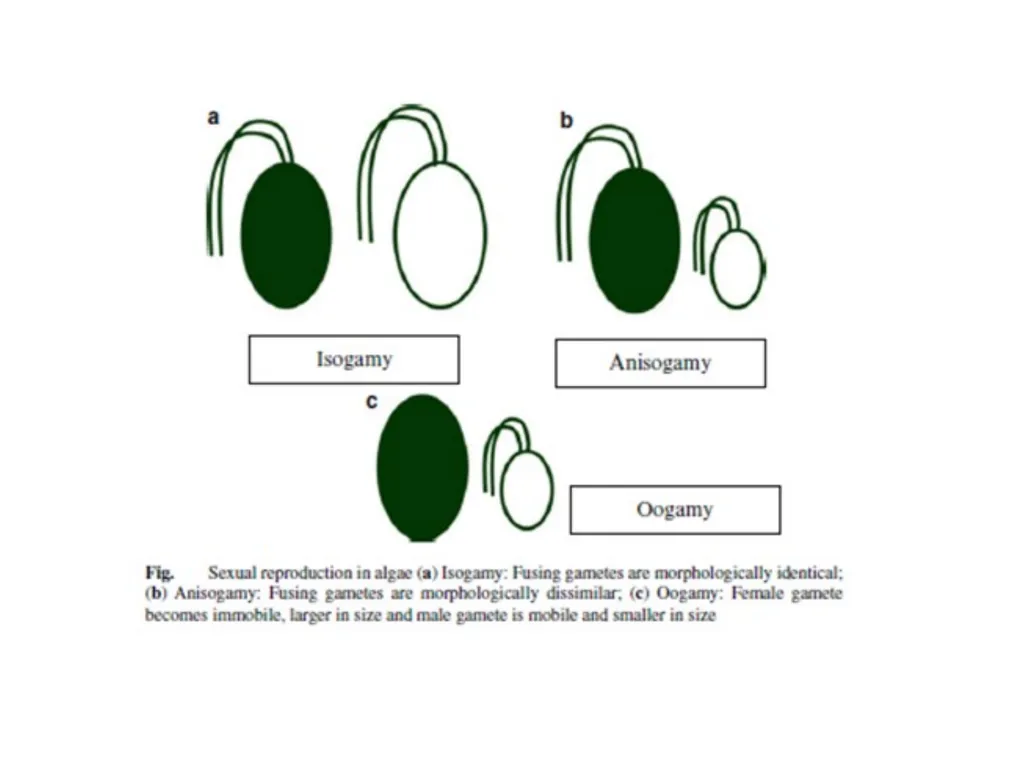
3.1 Isogamy
In it the fusing gametes are isogametes (iso – similar) i.e. they are morphologically similar. Example: Ulothrix.
3.2 Anisogamy
In it the fusing gametes are an isogametes (aniso – dissimilar) i.e. they are morphologically not similar (e.g. Spirogyra). Example: Chlamydomonas braunii.<br>
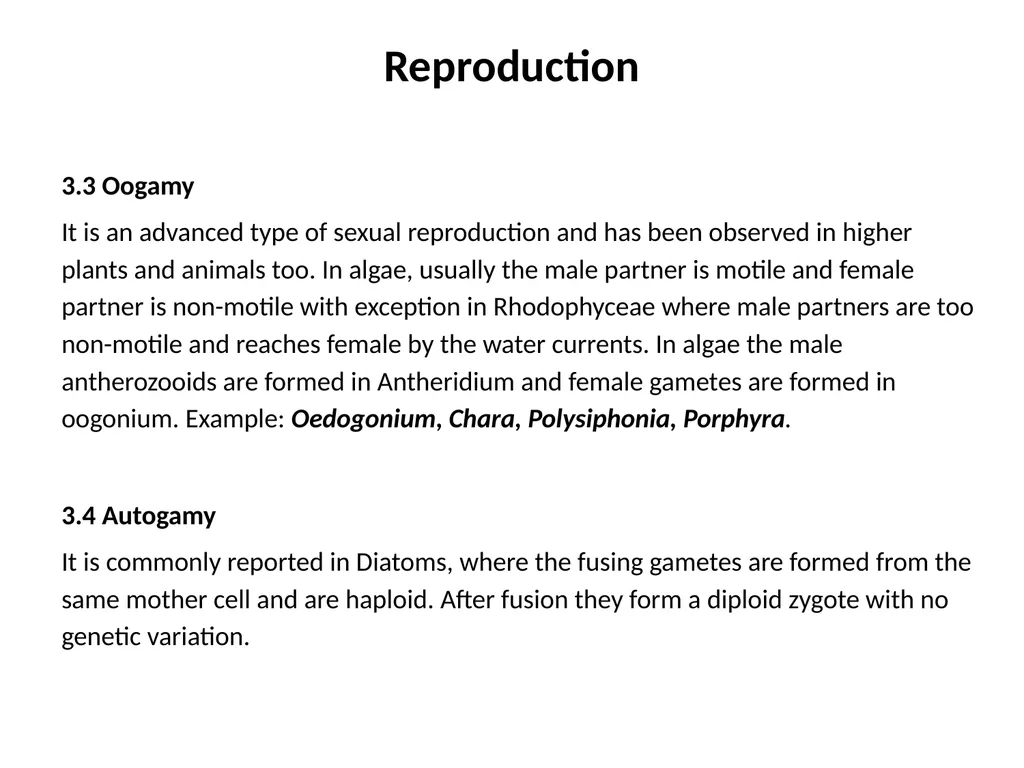
slide13. Reproduction 3.3 Oogamy
It is an advanced type of sexual reproduction and has been observed in higher plants and animals too. In algae, usually the male partner is motile and female partner is non-motile with exception in Rhodophyceae where male partners are too non-motile and reaches female by the water currents. In algae the male antherozooids are formed in Antheridium and female gametes are formed in oogonium. Example: Oedogonium, Chara, Polysiphonia, Porphyra.
3.4 Autogamy
It is commonly reported in Diatoms, where the fusing gametes are formed from the same mother cell and are haploid. After fusion they form a diploid zygote with no genetic variation.<br>
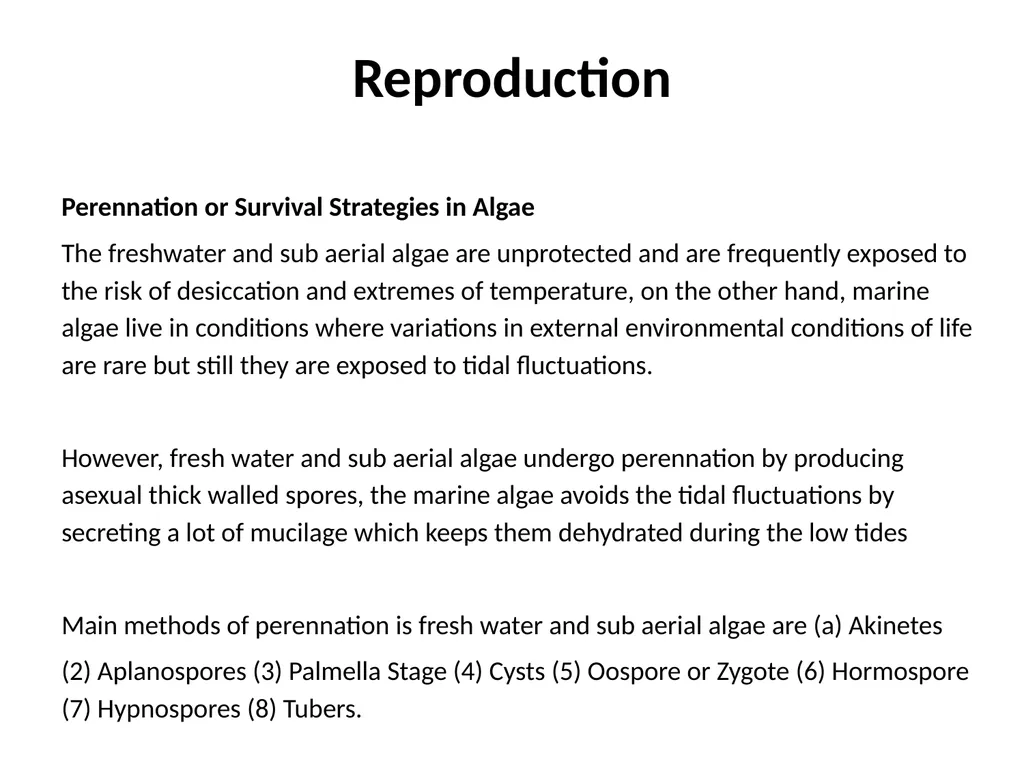
slide15. Reproduction Perennation or Survival Strategies in Algae
The freshwater and sub aerial algae are unprotected and are frequently exposed to the risk of desiccation and extremes of temperature, on the other hand, marine algae live in conditions where variations in external environmental conditions of life are rare but still they are exposed to tidal fluctuations.
However, fresh water and sub aerial algae undergo perennation by producing asexual thick walled spores, the marine algae avoids the tidal fluctuations by secreting a lot of mucilage which keeps them dehydrated during the low tides
Main methods of perennation is fresh water and sub aerial algae are (a) Akinetes
(2) Aplanospores (3) Palmella Stage (4) Cysts (5) Oospore or Zygote (6) Hormospore (7) Hypnospores (8) Tubers.<br>
slide16. Reproduction Akinetes
Akinetes are specially modified vegetative cells with thick, resistant cell wall and abundance of food reserve. These are formed during conditions of drought, when the whole thalli or filament dries and die but akinetes remains to overcome the unfavourable conditions. As the favorable conditions returns, they develop into new plants. Example: Ulothrix, Cladophora, Pithophora, and Nostoc.
Aplanospores
These are thick walled non-motile spores which are formed during unfavourable conditions. They are formed by the rounding off cytoplasmic contents and development of thick wall. Aplanospores are liberated by the separation of parent wall. After a period of rest and on the approach of favorable conditions they develop into new plants. Example: Chlamydomonas, Ulothrix, Coleochaete, Oedogonium.
Palmella Stage
In Chlamydomonas during adverse conditions the vegetative cell divides and forms new daughter cell. Which further increase in number by repeated cell divisions. All daughter cells thus formed remain clustered together inside a mucilaginous envelop.
This envelope is formed by the gelatinisation of parent cell wall of the successive generations. This is called Palmella stage, which is of short duration and represents milder method of perennation.<br>
slide17. Reproduction Cyst
Unfavourable conditions the plant body of certain algae like Euglena, Vaucheria, Protosiphon produces cysts, which separates. Each cyst germinates directly into a new plant on the approach of favorable conditions.
Oospore or Zygospore
In algae zygote or Zygospore do not germinate directly and undergo a resting period before the onset of favorable conditions, therefore formation of zygotes is considered a method of perennation in green algae. The zygote which is formed as a result of sexual fusion is thick walled structure with plenty of food material.
Hormospores
During unfavourable conditions, Hormogones in blue green algae gets separated from the tips of trichomes. These hormogones gets rounded off, secretes a thick wall and are termed hormopsores.<br>
slide18. Reproduction Hypnospores
When aplanospores secretes a thick wall around them to withstand extreme stressful conditions such as winter and draught, are termed as hypnospores. These spores remain in quiescent condition for some time, and as the favorable conditions approaches they germinate into a new plant for e. g. Westilla (Cyanophyceae).
Tubers
These are commonly reported in Chara and Cladophora and are outgrowth of rhizoids. They are formed from specialized rhizoidal cell which divides a number of time, gets thick walled and store abundance of food reserve material. As these are produced from the subterranean part of the plant, these are able to withstand the extremes of drought and temperature.<br>
slide19. The End<br>
slide20. Next Lecturer Cyanophyta<br>
Phycology<br>
slide2. Reproduction Algae reproduce both asexually as well as sexually. The asexual method of reproduction includes reproduction by vegetative methods and reproduction by spores.
The different methods of reproduction in algae are discussed below:<br>
slide3. Reproduction 1. Vegetative Methods
The vegetative reproduction is a type of reproduction where a part of thallus becomes specialized and gets detached from the parent to form a new offspring.
The new individual thus formed in this way is genetically identical to parent and no variation is observed. The different ways by which algae reproduces vegetative are:
1.1 Budding
Some vesicles which get detached from the parent plant by the formation of a septum, and are cable of giving rise to a new thallus is called buds. For example:
Protosiphon .
1.2 Cell Division
Simplest method of reproduction, where, the unicellular algae divides into two by
fission. For example: Chlamydomonas, Diatoms.<br>
slide4. Reproduction 1.3 Fragmentation
During this process the filamentous thalli breaks into two or many fragments. Each fragment is capable of giving rise to a new fi lament. The fragmentation may result due to accidental breakage or formation of separation of disc. For example Spirogyra, Nostoc, Oscillatoria.
1.4 Bulbils
These are tuber like outgrowths developed mostly at the rhizoidal tips. In Chara they develop at the nodes. These bulbils when detach from the parent plant give rise to new thallus. For example: Chara.<br>
slide5. Reproduction 1.5 Hormogones
These are short segments of filaments with in the sheath of parent filament.
Hormogones are many celled segments and are commonly found in members of cyanophyceae.
1.6 Amylum Stars
Present on lower nodes in Chara. These are star shaped aggregation of starch<br>
slide6. Reproduction 2 Asexual Reproductions or Reproduction by Spores
2.1 Akinetes
These are thick walled spores with abundance of food reserve. They withstand the unfavorable conditions and germinate on the onset of favorable conditions.
Example: Nostoc , Gloeotrichia , Ulothrix , Cladophora , Pithophora .
2.2 Autospores
During unfavourable conditions protoplast inside the sporangium divides and forms spores which are identical to parent plant are termed autospores. The autospores are non-motile, thick walled and abundant in food reserve. Example: Scenedesmus,Chlorella.<br>
slide7. Reproduction 2.3 Aplanospores
They may be formed singly or by the repeated division of the sporangium of parent plant during drought (unfavourable conditions). Example: Ulothrix.
2.4 Bispores
When two spores are formed in a sporangium they are called bispores and the sporangium is termed as bisporangium as reported in Grateloupia filicina.
2.5 Carpospores
These are formed in carposporangium during triphasic life cycle of Rhodophyceae members. They are formed from zygote and are diploid in nature. Example: Polysiphonia, Gracilaria and, Grateloupia.<br>
slide8. Reproduction 2.6 Endospores
These are formed in the sporangium by successive repeated divisions of cell contents. All spores are formed first, and then the sporangium opens to liberate the motile spores. E.g. Dermocarpa clavata.
2.7 Exospores
During exospore formation in Cyanophycean members, the sporangium gets burst at the apex and is exposed to the external environment and further by successive repeated divisions of cell contents the spherical spores are formed which are termed exospores. All spores get liberated one by one. For example Chaemasiphon, Stichosiphon<br>
slide9. Reproduction 2.8 Hypnospores
Aplanospores with thick walled and abundance of food reserve are known as hypnospores. They may germinate directly or their protoplast may divide further to form zoospores which germinate to new plant. Example: Pediastrum, Sphaerella.
2.9 Monospores
Single spores formed in a sporangium are termed as monospores. Commonly monospores are found in Brown and red algae and are considered to be the commonest asexual spores of red algae.
2.10 Neutral Spores
These are common in red algae for example Bangia where, the vegetative cells directly get transformed into spores and such spores are termed neutral spores.
2.11 Paraspores
When more than four spores are formed because of reduction division in a sporangium in red algae, such spores are called as paraspores or polyspores for example: Palmaria elegans.<br>
slide10. Reproduction 2.12 Statopsores
Thick and ornamented smooth walled spores of bacillariophyceae are termed as Statospores. Example: Chaetoceros (Bacillariophyceae), Chrysophyceae,
Xanthophyceae .
2.13 Tetraspores
Commonly found in red algae. These are formed in four in number in a tetrasporangium. E.g. Porphyra, Gracilaria, Grateloupia.
2.14 Zoospores
The motile and naked spores are known as zoospores. They may be haploid or diploid and are formed in zoosporangium. The zoospores of Vaucheria are known as
Synzoospores as they are multinucleate and Multiflagellate. Zoospores may have two, four or many flagella for example: Biflagellate zoospores: Chlamydomonas, Quadriflagellate: Ulothrix Multiflagellate Oedogonium.<br>
slide12. Reproduction 3. Sexual Reproduction
Sexual reproduction has been reported from all members of algae except cyanophyceae. In sexual reproduction two opposite mating types (gametes) fuse to form a zygote. Depending on the structure and behavior of fusing gametes. it can be classified as:
3.1 Isogamy
In it the fusing gametes are isogametes (iso – similar) i.e. they are morphologically similar. Example: Ulothrix.
3.2 Anisogamy
In it the fusing gametes are an isogametes (aniso – dissimilar) i.e. they are morphologically not similar (e.g. Spirogyra). Example: Chlamydomonas braunii.<br>
slide13. Reproduction 3.3 Oogamy
It is an advanced type of sexual reproduction and has been observed in higher plants and animals too. In algae, usually the male partner is motile and female partner is non-motile with exception in Rhodophyceae where male partners are too non-motile and reaches female by the water currents. In algae the male antherozooids are formed in Antheridium and female gametes are formed in oogonium. Example: Oedogonium, Chara, Polysiphonia, Porphyra.
3.4 Autogamy
It is commonly reported in Diatoms, where the fusing gametes are formed from the same mother cell and are haploid. After fusion they form a diploid zygote with no genetic variation.<br>
slide15. Reproduction Perennation or Survival Strategies in Algae
The freshwater and sub aerial algae are unprotected and are frequently exposed to the risk of desiccation and extremes of temperature, on the other hand, marine algae live in conditions where variations in external environmental conditions of life are rare but still they are exposed to tidal fluctuations.
However, fresh water and sub aerial algae undergo perennation by producing asexual thick walled spores, the marine algae avoids the tidal fluctuations by secreting a lot of mucilage which keeps them dehydrated during the low tides
Main methods of perennation is fresh water and sub aerial algae are (a) Akinetes
(2) Aplanospores (3) Palmella Stage (4) Cysts (5) Oospore or Zygote (6) Hormospore (7) Hypnospores (8) Tubers.<br>
slide16. Reproduction Akinetes
Akinetes are specially modified vegetative cells with thick, resistant cell wall and abundance of food reserve. These are formed during conditions of drought, when the whole thalli or filament dries and die but akinetes remains to overcome the unfavourable conditions. As the favorable conditions returns, they develop into new plants. Example: Ulothrix, Cladophora, Pithophora, and Nostoc.
Aplanospores
These are thick walled non-motile spores which are formed during unfavourable conditions. They are formed by the rounding off cytoplasmic contents and development of thick wall. Aplanospores are liberated by the separation of parent wall. After a period of rest and on the approach of favorable conditions they develop into new plants. Example: Chlamydomonas, Ulothrix, Coleochaete, Oedogonium.
Palmella Stage
In Chlamydomonas during adverse conditions the vegetative cell divides and forms new daughter cell. Which further increase in number by repeated cell divisions. All daughter cells thus formed remain clustered together inside a mucilaginous envelop.
This envelope is formed by the gelatinisation of parent cell wall of the successive generations. This is called Palmella stage, which is of short duration and represents milder method of perennation.<br>
slide17. Reproduction Cyst
Unfavourable conditions the plant body of certain algae like Euglena, Vaucheria, Protosiphon produces cysts, which separates. Each cyst germinates directly into a new plant on the approach of favorable conditions.
Oospore or Zygospore
In algae zygote or Zygospore do not germinate directly and undergo a resting period before the onset of favorable conditions, therefore formation of zygotes is considered a method of perennation in green algae. The zygote which is formed as a result of sexual fusion is thick walled structure with plenty of food material.
Hormospores
During unfavourable conditions, Hormogones in blue green algae gets separated from the tips of trichomes. These hormogones gets rounded off, secretes a thick wall and are termed hormopsores.<br>
slide18. Reproduction Hypnospores
When aplanospores secretes a thick wall around them to withstand extreme stressful conditions such as winter and draught, are termed as hypnospores. These spores remain in quiescent condition for some time, and as the favorable conditions approaches they germinate into a new plant for e. g. Westilla (Cyanophyceae).
Tubers
These are commonly reported in Chara and Cladophora and are outgrowth of rhizoids. They are formed from specialized rhizoidal cell which divides a number of time, gets thick walled and store abundance of food reserve material. As these are produced from the subterranean part of the plant, these are able to withstand the extremes of drought and temperature.<br>
slide19. The End<br>
slide20. Next Lecturer Cyanophyta<br>