
4 Feb 2016 Business Plans 1 SCIENTIFIC & TECHNICAL
JO
Published · 33 slides · 0 views

1 / 1
Description
4 Feb 2016 Business Plans 1 SCIENTIFIC TECHNICAL WRITING Business Plans Edith BOXMAN MBA, financial consultant editor Communicating Science: 6 E.S. Boxman, 112013, 22016 6 Nov 2013 - USYD Business Plans 2 BUSINESS - Why? You think
Related Topics
Share
Embed code
Download this presentation From Below
"4 Feb 2016 Business Plans 1 SCIENTIFIC & TECHNICAL" is the property of its rightful owner. Permission is granted to download and print the materials on this website for personal, non-commercial use only, and to display it on your personal computer provided you do not modify the materials and that you retain all copyright notices contained in the materials. By downloading content from our website, you accept the terms of this agreement.
Presentation Transcript
01
4 Feb 2016 Business Plans 1 SCIENTIFIC & TECHNICAL WRITING
Business Plans Edith BOXMAN
MBA, financial consultant & editor
Communicating Science: 6
E.S. Boxman, 11/2013, 2/2016<br>
MBA, financial consultant & editor
Communicating Science: 6
E.S. Boxman, 11/2013, 2/2016<br>
02
6 Nov 2013 - USYD Business Plans 2 “BUSINESS” - Why? You think that an idea or result of your research has commercial potential
Professional satisfaction in being part of its practical implementation.
Lure of financial success
While most ventures ultimately fail, some of the few start-ups which do succeed are legendary<br>
Professional satisfaction in being part of its practical implementation.
Lure of financial success
While most ventures ultimately fail, some of the few start-ups which do succeed are legendary<br>
03
6 Nov 2013 - USYD Business Plans 3 BUSINESS PLAN Basically a proposal to establish a business activity.
Similar to research proposal:
In structure and
In objective (to raise funds)
Different from research proposal
Expected return is financial
rather than advancement of science.<br>
Similar to research proposal:
In structure and
In objective (to raise funds)
Different from research proposal
Expected return is financial
rather than advancement of science.<br>
04
6 Nov 2013 - USYD Business Plans 4 BUSINESS PLAN OBJECTIVES Convince someone else to put $$ or other resources into your company
Individual – partners, friends & family, “angels”
Venture fund
Government – e.g. small business agency
corporation
Banks (loans) – usually after venture capital investment<br>
Individual – partners, friends & family, “angels”
Venture fund
Government – e.g. small business agency
corporation
Banks (loans) – usually after venture capital investment<br>
05
6 Nov 2013 - USYD Business Plans 5 BUSINESS PLAN OBJECTIVES Convince yourself that you have
a viable proposition and
addressed all the key issues
Provides a structured framework to keep your business on course – a “roadmap”<br>
a viable proposition and
addressed all the key issues
Provides a structured framework to keep your business on course – a “roadmap”<br>
06
6 Nov 2013 - USYD Business Plans 6 BUSINESS PLAN AUDIENCE Typically, potential investors who:
are primarily interested in making money (and/or have a social agenda)
are very busy
tend to skim submitted business plans
look for projects that interest them and meet their criteria
may be technologically “savvy” but very unlikely to be experts in your field
may use consultants versed in technology<br>
are primarily interested in making money (and/or have a social agenda)
are very busy
tend to skim submitted business plans
look for projects that interest them and meet their criteria
may be technologically “savvy” but very unlikely to be experts in your field
may use consultants versed in technology<br>
07
6 Nov 2013 - USYD Business Plans 7 WHAT DOES THE INVESTOR WANT TO KNOW? “Bang for buck”
How much investment is needed?
How long will it take to recoup the initial investment (Payback)
What is the expected return on investment?
Is there potential for dramatic growth?<br>
How much investment is needed?
How long will it take to recoup the initial investment (Payback)
What is the expected return on investment?
Is there potential for dramatic growth?<br>
08
6 Nov 2013 - USYD Business Plans 8 WHAT DOES THE INVESTOR WANT TO KNOW? Probability of Success
Commercial Feasibility
Unique idea that can command a price well in excess of development, production & marketing costs?
Market large enough for potential sales to generate an adequate profit?
Barriers to entry of competitors (unique competitive advantage; importance of patent or at least patent application filed)
.<br>
Commercial Feasibility
Unique idea that can command a price well in excess of development, production & marketing costs?
Market large enough for potential sales to generate an adequate profit?
Barriers to entry of competitors (unique competitive advantage; importance of patent or at least patent application filed)
.<br>
09
6 Nov 2013 - USYD Business Plans 9 WHAT DOES THE INVESTOR WANT TO KNOW? Probability of Success (continued)
Organizational Strengths
Qualifications of Initiators & core competencies
Look for business as well as scientific expertise
Key personnel retention
Technological feasibility
Production Feasibility
May include outsourced resources
.<br>
Organizational Strengths
Qualifications of Initiators & core competencies
Look for business as well as scientific expertise
Key personnel retention
Technological feasibility
Production Feasibility
May include outsourced resources
.<br>
10
6 Nov 2013 - USYD Business Plans 10 BUSINESS PLAN STRUCTURE Typical format- may vary by type of business.
Executive summary
General company description/status
Products & services
Market: Size, competitive situation & advantages
Product & Marketing strategy
Operational plans
Management & organization
Financial plans
Appendices<br>
Executive summary
General company description/status
Products & services
Market: Size, competitive situation & advantages
Product & Marketing strategy
Operational plans
Management & organization
Financial plans
Appendices<br>
11
6 Nov 2013 - USYD Business Plans 11 1. Executive Summary Briefly summarize (less than 2 pages):
The product and its competitive edge.
Customers
Owners and key personnel
Their core competencies
How will they be retained?
Resources
Your own, and
What do you need?
Projected profit (when and how much)
Similar to research proposal abstract
May be the only section most potential investors read<br>
The product and its competitive edge.
Customers
Owners and key personnel
Their core competencies
How will they be retained?
Resources
Your own, and
What do you need?
Projected profit (when and how much)
Similar to research proposal abstract
May be the only section most potential investors read<br>
12
6 Nov 2013 - USYD Business Plans 12 2. Company Description Entity which will implement the business plan
Parallel to the part of “Resources” section of the research proposal which describes the research group.
Different in that the company rarely has a track record.<br>
Parallel to the part of “Resources” section of the research proposal which describes the research group.
Different in that the company rarely has a track record.<br>
13
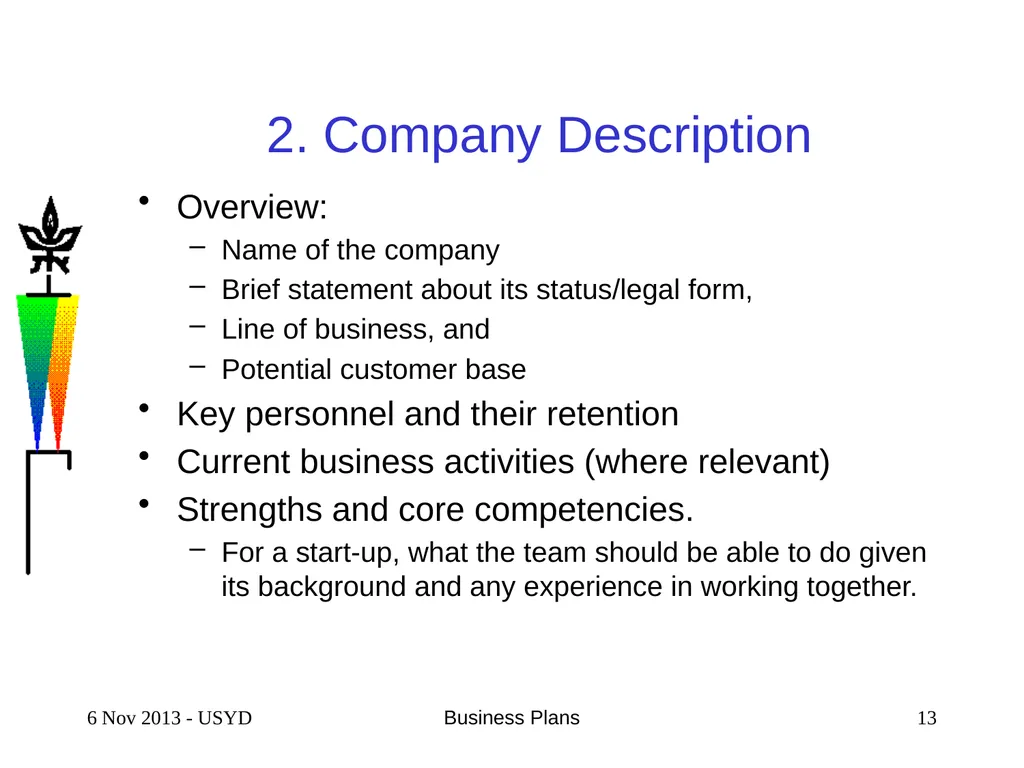
6 Nov 2013 - USYD Business Plans 13 2. Company Description Overview:
Name of the company
Brief statement about its status/legal form,
Line of business, and
Potential customer base
Key personnel and their retention
Current business activities (where relevant)
Strengths and core competencies.
For a start-up, what the team should be able to do given its background and any experience in working together.<br>
Name of the company
Brief statement about its status/legal form,
Line of business, and
Potential customer base
Key personnel and their retention
Current business activities (where relevant)
Strengths and core competencies.
For a start-up, what the team should be able to do given its background and any experience in working together.<br>
14
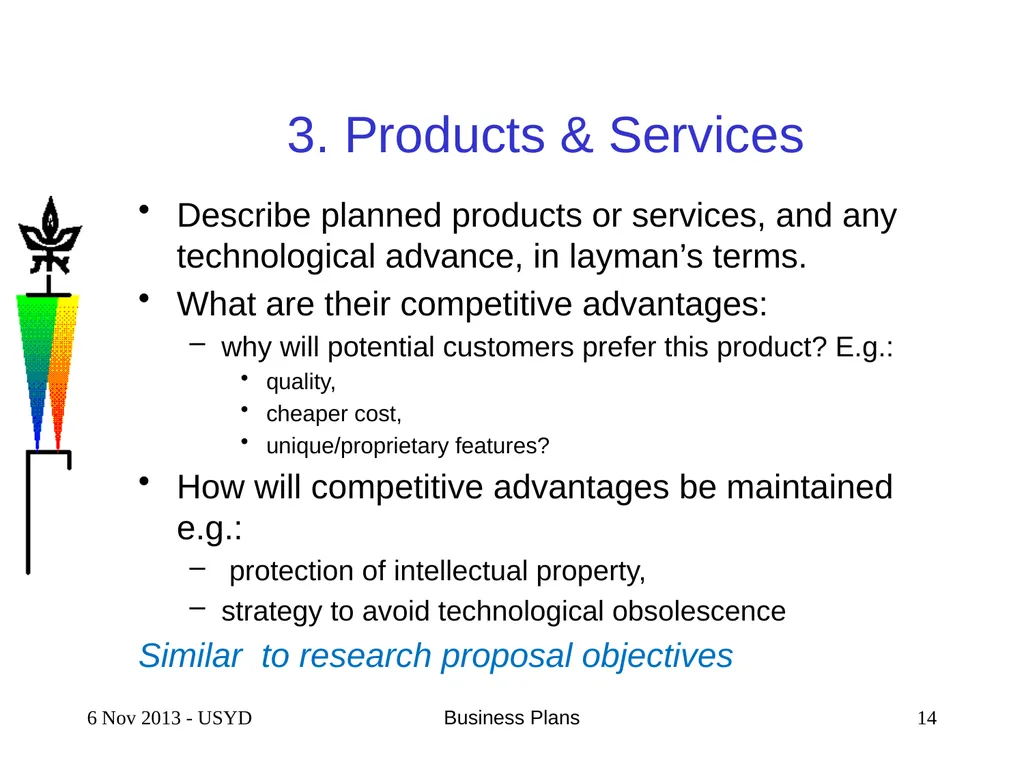
6 Nov 2013 - USYD Business Plans 14 3. Products & Services Describe planned products or services, and any technological advance, in layman’s terms.
What are their competitive advantages:
why will potential customers prefer this product? E.g.:
quality,
cheaper cost,
unique/proprietary features?
How will competitive advantages be maintained e.g.:
protection of intellectual property,
strategy to avoid technological obsolescence
Similar to research proposal objectives<br>
What are their competitive advantages:
why will potential customers prefer this product? E.g.:
quality,
cheaper cost,
unique/proprietary features?
How will competitive advantages be maintained e.g.:
protection of intellectual property,
strategy to avoid technological obsolescence
Similar to research proposal objectives<br>
15
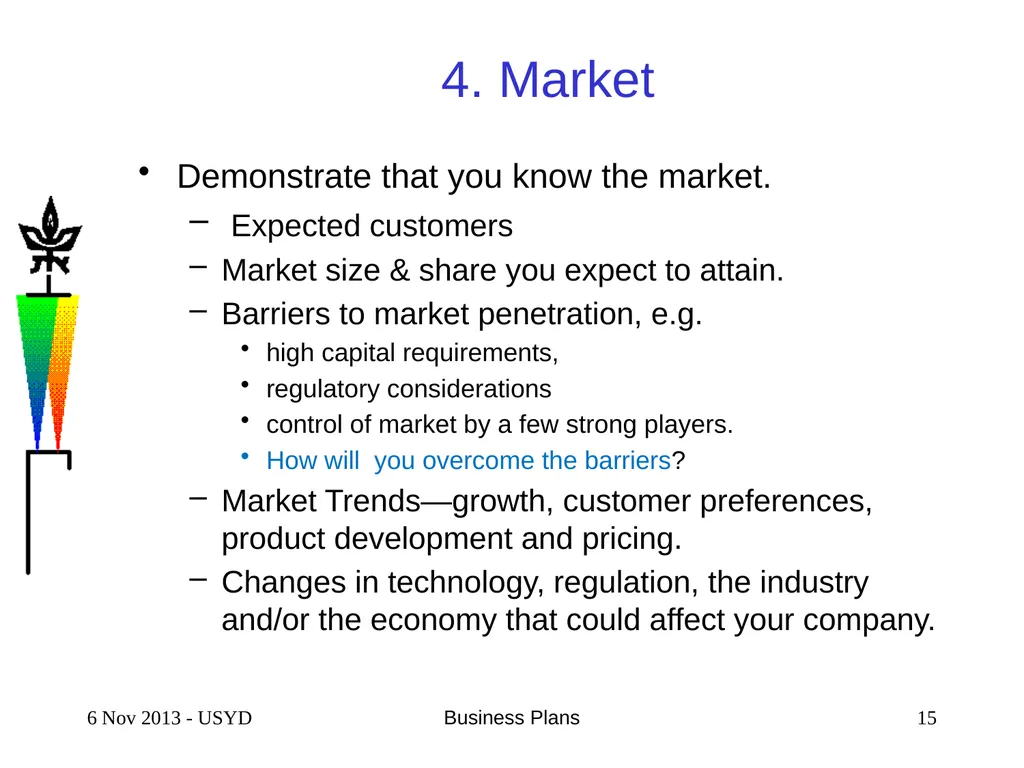
6 Nov 2013 - USYD Business Plans 15 4. Market Demonstrate that you know the market.
Expected customers
Market size & share you expect to attain.
Barriers to market penetration, e.g.
high capital requirements,
regulatory considerations
control of market by a few strong players.
How will you overcome the barriers?
Market Trends—growth, customer preferences, product development and pricing.
Changes in technology, regulation, the industry and/or the economy that could affect your company.<br>
Expected customers
Market size & share you expect to attain.
Barriers to market penetration, e.g.
high capital requirements,
regulatory considerations
control of market by a few strong players.
How will you overcome the barriers?
Market Trends—growth, customer preferences, product development and pricing.
Changes in technology, regulation, the industry and/or the economy that could affect your company.<br>
16
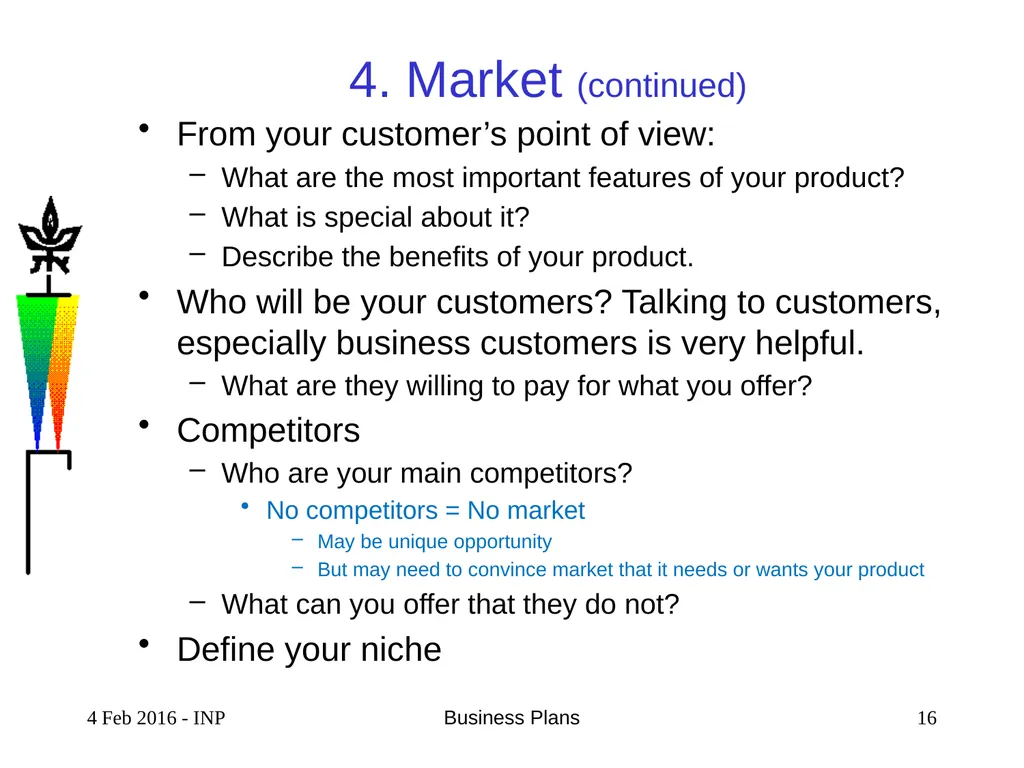
4 Feb 2016 - INP Business Plans 16 4. Market (continued) From your customer’s point of view:
What are the most important features of your product?
What is special about it?
Describe the benefits of your product.
Who will be your customers? Talking to customers, especially business customers is very helpful.
What are they willing to pay for what you offer?
Competitors
Who are your main competitors?
No competitors = No market
May be unique opportunity
But may need to convince market that it needs or wants your product
What can you offer that they do not?
Define your niche<br>
What are the most important features of your product?
What is special about it?
Describe the benefits of your product.
Who will be your customers? Talking to customers, especially business customers is very helpful.
What are they willing to pay for what you offer?
Competitors
Who are your main competitors?
No competitors = No market
May be unique opportunity
But may need to convince market that it needs or wants your product
What can you offer that they do not?
Define your niche<br>
17
6 Nov 2013 - USYD Business Plans 17 5. Production & Marketing Strategy How will the company get its product to the ultimate customer?
In which links of the production chain (R&D, production, wholesale/retail distribution and sales, and service)
participate directly, or
rely on strategic partners
Should be consistent with market niche defined and the company’s core strengths.<br>
In which links of the production chain (R&D, production, wholesale/retail distribution and sales, and service)
participate directly, or
rely on strategic partners
Should be consistent with market niche defined and the company’s core strengths.<br>
18
6 Nov 2013 - USYD Business Plans 18 6. Operational Plans How will the marketing & operational strategy be implemented?
For each main activity, explain how it will be carried out.
May be abbreviated for “seed money” investments.<br>
For each main activity, explain how it will be carried out.
May be abbreviated for “seed money” investments.<br>
19
6 Nov 2013 - USYD Winning Research Proposals 19 7. Management & Organization For a start up, may be abbreviated but should include at least:
Who is responsible for each element of the operational plan?
Who will make critical decisions?
If more than 10 employees, organizational chart should show the management hierarchy and those responsible for key functions.
Include position descriptions and resumes of key employees.
List main sources of professional/advisory support – Board of Directors, Attorney, Accountant, Consultants<br>
Who is responsible for each element of the operational plan?
Who will make critical decisions?
If more than 10 employees, organizational chart should show the management hierarchy and those responsible for key functions.
Include position descriptions and resumes of key employees.
List main sources of professional/advisory support – Board of Directors, Attorney, Accountant, Consultants<br>
20
6 Nov 2013 - USYD Business Plans 20 8. Financial Plans Present the “bottom line” of the business plan –
What is the amount of investment required,
How much money the investors may expect to see as profit, and in what form.
Explain how and how much money
Will flow into the company from
Investments,
Loans, and
Hopefully, ultimately, sales of products and services
will flow out of the company, for
Equipment and materials
Salaries,
Rent,
Fees for various services, etc.,
and ultimately as dividends to investors<br>
What is the amount of investment required,
How much money the investors may expect to see as profit, and in what form.
Explain how and how much money
Will flow into the company from
Investments,
Loans, and
Hopefully, ultimately, sales of products and services
will flow out of the company, for
Equipment and materials
Salaries,
Rent,
Fees for various services, etc.,
and ultimately as dividends to investors<br>
21
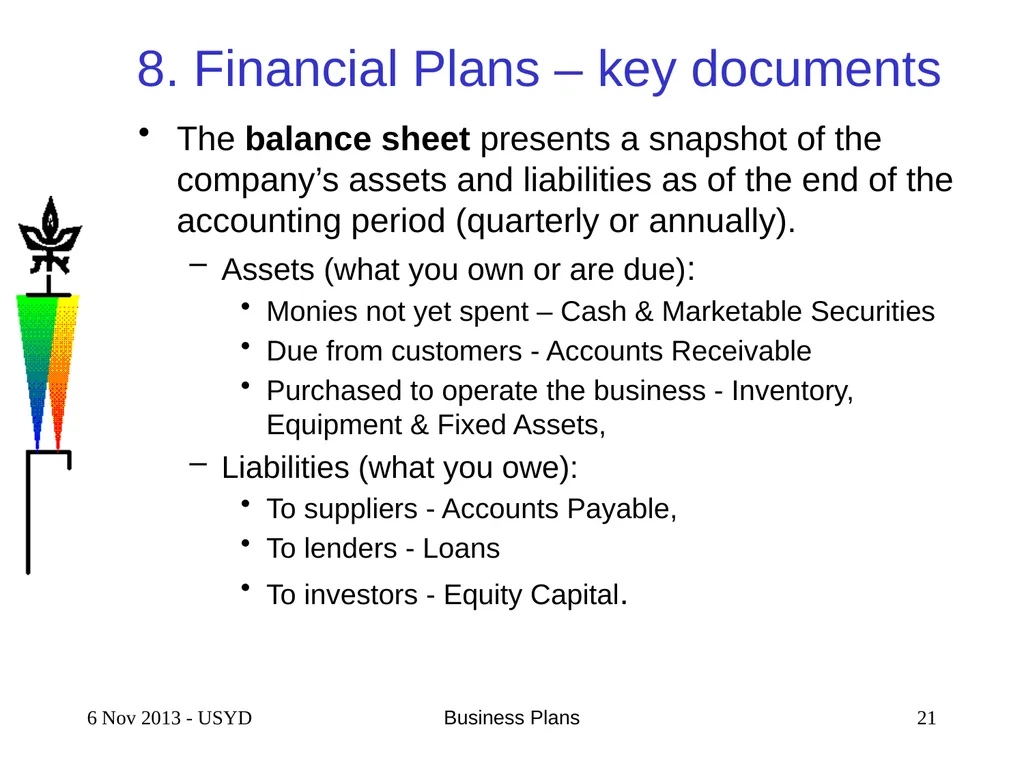
6 Nov 2013 - USYD Business Plans 21 8. Financial Plans – key documents The balance sheet presents a snapshot of the company’s assets and liabilities as of the end of the accounting period (quarterly or annually).
Assets (what you own or are due):
Monies not yet spent – Cash & Marketable Securities
Due from customers - Accounts Receivable
Purchased to operate the business - Inventory, Equipment & Fixed Assets,
Liabilities (what you owe):
To suppliers - Accounts Payable,
To lenders - Loans
To investors - Equity Capital.<br>
Assets (what you own or are due):
Monies not yet spent – Cash & Marketable Securities
Due from customers - Accounts Receivable
Purchased to operate the business - Inventory, Equipment & Fixed Assets,
Liabilities (what you owe):
To suppliers - Accounts Payable,
To lenders - Loans
To investors - Equity Capital.<br>
22
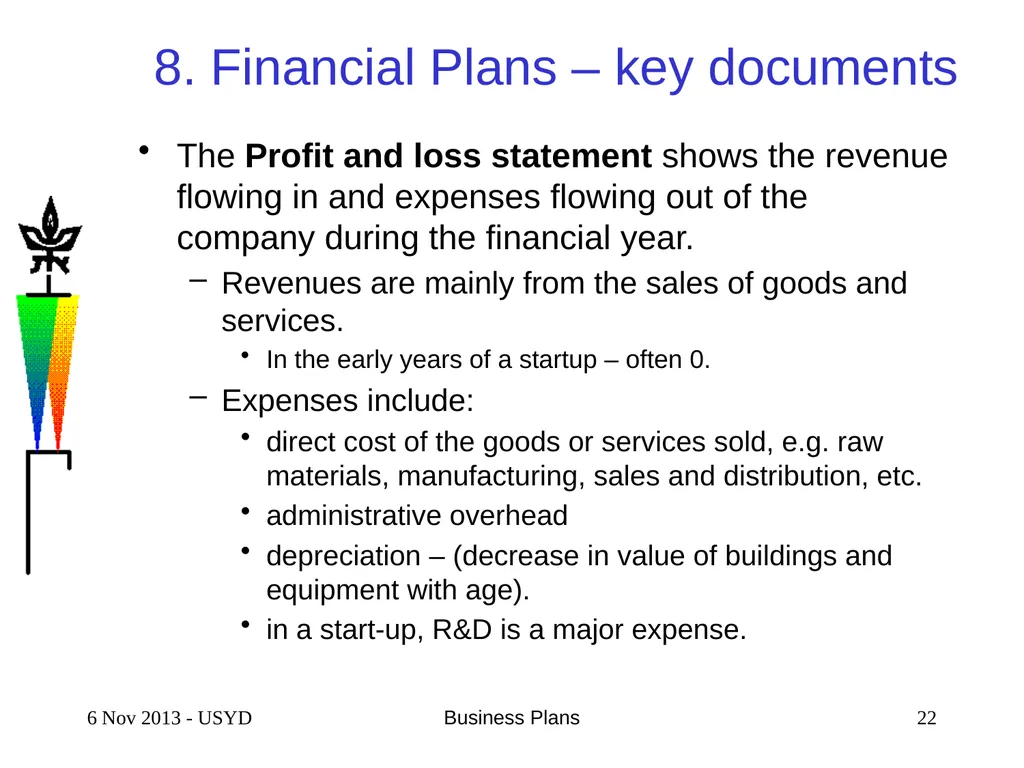
6 Nov 2013 - USYD Business Plans 22 8. Financial Plans – key documents The Profit and loss statement shows the revenue flowing in and expenses flowing out of the company during the financial year.
Revenues are mainly from the sales of goods and services.
In the early years of a startup – often 0.
Expenses include:
direct cost of the goods or services sold, e.g. raw materials, manufacturing, sales and distribution, etc.
administrative overhead
depreciation – (decrease in value of buildings and equipment with age).
in a start-up, R&D is a major expense.<br>
Revenues are mainly from the sales of goods and services.
In the early years of a startup – often 0.
Expenses include:
direct cost of the goods or services sold, e.g. raw materials, manufacturing, sales and distribution, etc.
administrative overhead
depreciation – (decrease in value of buildings and equipment with age).
in a start-up, R&D is a major expense.<br>
23
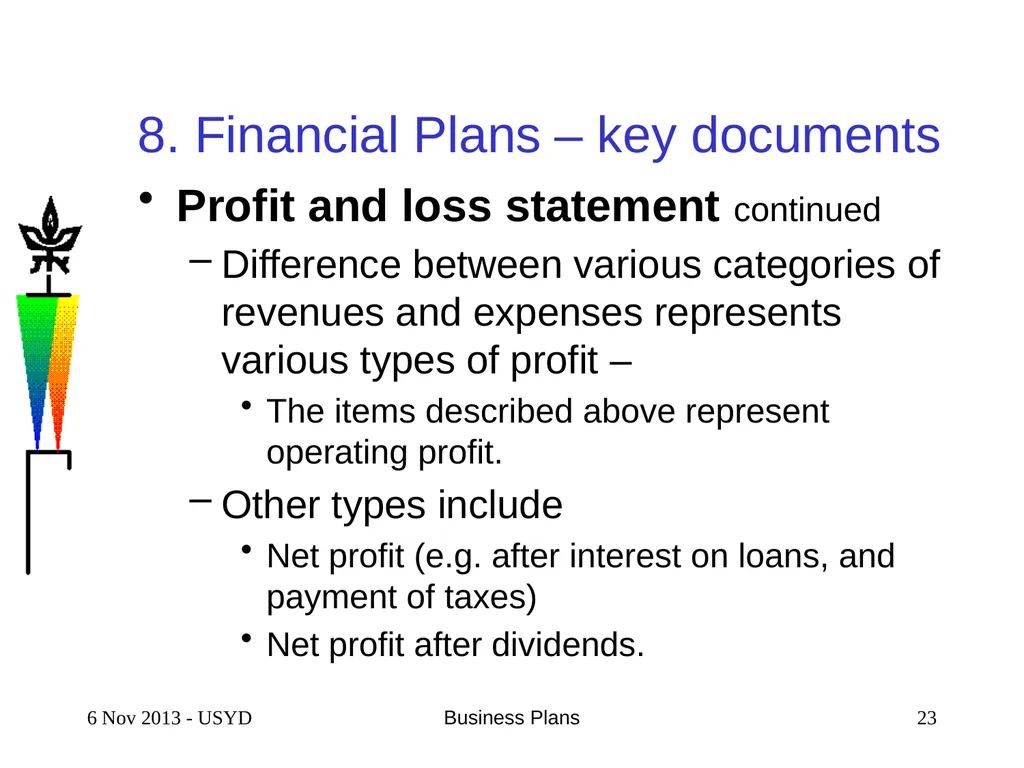
6 Nov 2013 - USYD Business Plans 23 8. Financial Plans – key documents Profit and loss statement continued
Difference between various categories of revenues and expenses represents various types of profit –
The items described above represent operating profit.
Other types include
Net profit (e.g. after interest on loans, and payment of taxes)
Net profit after dividends.<br>
Difference between various categories of revenues and expenses represents various types of profit –
The items described above represent operating profit.
Other types include
Net profit (e.g. after interest on loans, and payment of taxes)
Net profit after dividends.<br>
24
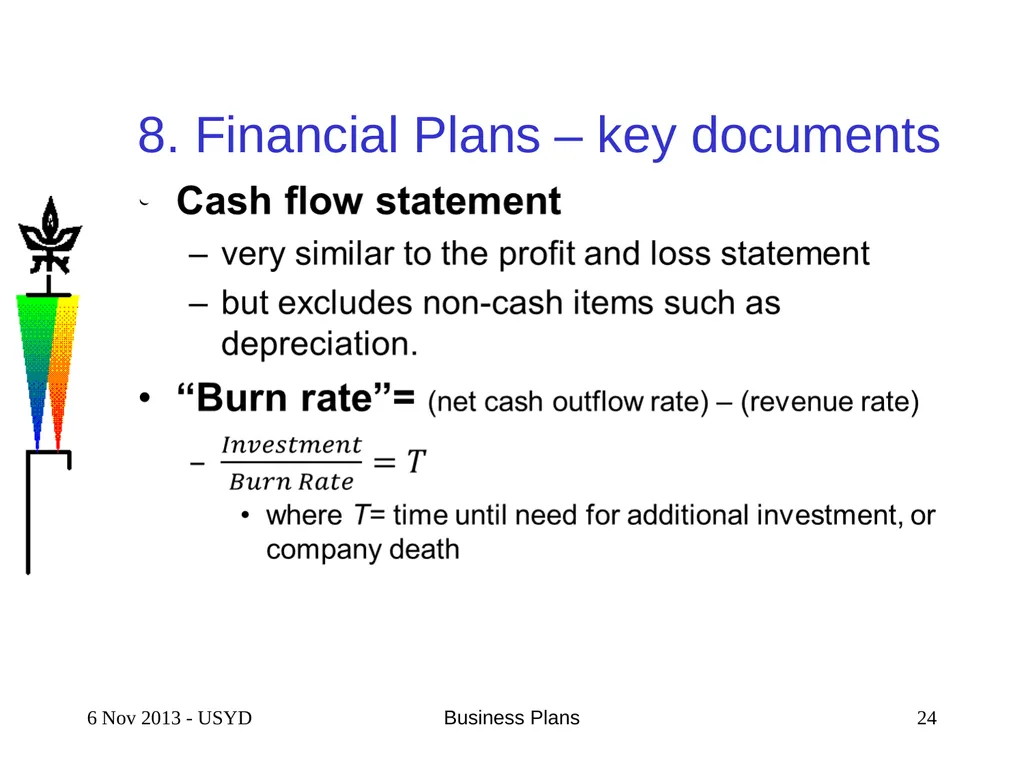
6 Nov 2013 - USYD Business Plans 24 8. Financial Plans – key documents<br>
25
6 Nov 2013 - USYD Business Plans 25 8. Financial Plans –early stage Financial information for early-stage high-tech startups:
abbreviated
focus on:
Investment required – in resources and time – to key development milestones.
Burn rate
Range of potential income upon success<br>
abbreviated
focus on:
Investment required – in resources and time – to key development milestones.
Burn rate
Range of potential income upon success<br>
26
6 Nov 2013 - USYD Business Plans 26 8. Financial Plans – as the company grows For later stage financing, details more formally structured.
For a mature start-up or established company, Financial Plans present annual forecasts of the statements detailed above
usually over a 5 year period
or until the company profitable<br>
For a mature start-up or established company, Financial Plans present annual forecasts of the statements detailed above
usually over a 5 year period
or until the company profitable<br>
27
6 Nov 2013 - USYD Business Plans 27 8. Financial Plans –as the company grows continued Forecasts are based on a number of assumptions
Expected sales – volume and price
Direct cost of production and marketing
Administrative costs
Costs of R & D
Document assumptions!
Not necessarily in the business plan
But needed for ongoing revisions<br>
Expected sales – volume and price
Direct cost of production and marketing
Administrative costs
Costs of R & D
Document assumptions!
Not necessarily in the business plan
But needed for ongoing revisions<br>
28
6 Nov 2013 - USYD Business Plans 28 8. Financial Plans (continued) Personal financial statements
personal net worth outside of the business
often required for owners.<br>
personal net worth outside of the business
often required for owners.<br>
29
8. Financial Plans additional questions Exit strategy for investors (buyback, sale, or IPO)
Percent of ownership that you will give up to investors
Milestones or conditions that you will accept
Financial reporting to be provided
Involvement of investors on the board or in management 6 Nov. 2013 - USYD Winning Research Proposals 29<br>
Percent of ownership that you will give up to investors
Milestones or conditions that you will accept
Financial reporting to be provided
Involvement of investors on the board or in management 6 Nov. 2013 - USYD Winning Research Proposals 29<br>
30
6 Nov 2013 - USYD Business Plans 30 8. Financial Plans (continued) The ultimate success of a business activity is measured by the ability of the company to profitably sell its product or service to the market.<br>
31
6 Nov 2013 - USYD Business Plans 31 9. Appendices May contain technical specifications, drawings, photos, sales brochures, etc
Cited references.
CVs of key personnel
Use a uniform style.<br>
Cited references.
CVs of key personnel
Use a uniform style.<br>
32
6 Nov 2013 - USYD Business Plans 32 Most Common Problems Lack of focus on the critical issues
Using “boiler plate” business plan and concept
Failure to develop adequate business model for making money!
Too much detail (re the technology, financial projections, etc.)
Too wordy, not specific enough
Overly restrictive NDA requirements.<br>
Using “boiler plate” business plan and concept
Failure to develop adequate business model for making money!
Too much detail (re the technology, financial projections, etc.)
Too wordy, not specific enough
Overly restrictive NDA requirements.<br>
33
6 Nov 2013 - USYD Business Plans 33 Summary Business plan - primarily tool for the entrepreneur to think about his/her business and what is needed to make it work.
Secondarily, tool for attracting investors
Clear goals and organized approach to achieving them underpin the business plan (and success)
Never underestimate the importance of knowing your market.<br>
Secondarily, tool for attracting investors
Clear goals and organized approach to achieving them underpin the business plan (and success)
Never underestimate the importance of knowing your market.<br>