
6th oneM2M Industry Day Workshop @ Hyderabad
AM
Published · 20 slides · 0 views

1 / 1

Description
6th oneM2M Industry Day Workshop Hyderabad ,India RAJIV SINHA Deputy Director General Networks Technologies Department of Telecommunications Government of India 25th September , 2019 oneM2M Standards and Enablement of IoT ecosystem
Related Topics
Share
Embed code
Download this presentation From Below
"6th oneM2M Industry Day Workshop @ Hyderabad" is the property of its rightful owner. Permission is granted to download and print the materials on this website for personal, non-commercial use only, and to display it on your personal computer provided you do not modify the materials and that you retain all copyright notices contained in the materials. By downloading content from our website, you accept the terms of this agreement.
Presentation Transcript
01
6th oneM2M Industry Day Workshop
@ Hyderabad ,India RAJIV SINHA Deputy Director General
Networks & Technologies
Department of Telecommunications
Government of India 25th September , 2019 oneM2M Standards and
Enablement of IoT ecosystem
-Bridging the Gap<br>
@ Hyderabad ,India RAJIV SINHA Deputy Director General
Networks & Technologies
Department of Telecommunications
Government of India 25th September , 2019 oneM2M Standards and
Enablement of IoT ecosystem
-Bridging the Gap<br>
02
Need for M2M/IoT ecosystem IoT is transformational
IoT will generate significant socio-economic benefits to our society.
It will enable innovation through the creation of new services, thereby enhancing the functionality of existing ones, and the smarter and more efficient use of resources.
IoT presents new business opportunities for the MNOs, SMEs to reach more markets and customers.
IoT enables large business to operate more efficiently, improve distribution and reduce costs<br>
IoT will generate significant socio-economic benefits to our society.
It will enable innovation through the creation of new services, thereby enhancing the functionality of existing ones, and the smarter and more efficient use of resources.
IoT presents new business opportunities for the MNOs, SMEs to reach more markets and customers.
IoT enables large business to operate more efficiently, improve distribution and reduce costs<br>
03
Issues for enablement of M2M/IoT ecosystem IoT will impact business model evolution
The IoT value chain is complex and highly competitive
IoT requires a technology and service neutral approach
Investment-friendly environment is the need for the IoT to scale
In the IoT world the customer relationship will become more contestable
There is need to ensure consistency and clarity on legal, data protection and privacy regulation across verticals and jurisdictions.<br>
The IoT value chain is complex and highly competitive
IoT requires a technology and service neutral approach
Investment-friendly environment is the need for the IoT to scale
In the IoT world the customer relationship will become more contestable
There is need to ensure consistency and clarity on legal, data protection and privacy regulation across verticals and jurisdictions.<br>
04
Importance of Interoperability The Buenos Aires Declaration (WTDC-17) has recognised that widespread conformance and interoperability of telecommunication/ICT equipment and systems can:
increase market opportunities
Increase competitiveness and reliability
encourage global integration and trade.
The emphasis on importance of Interoperability as recognised by WTDC requires an environment for conformance and interoperability testing. The showcasing through demonstrations will facilitate and enable this requirement.<br>
increase market opportunities
Increase competitiveness and reliability
encourage global integration and trade.
The emphasis on importance of Interoperability as recognised by WTDC requires an environment for conformance and interoperability testing. The showcasing through demonstrations will facilitate and enable this requirement.<br>
05
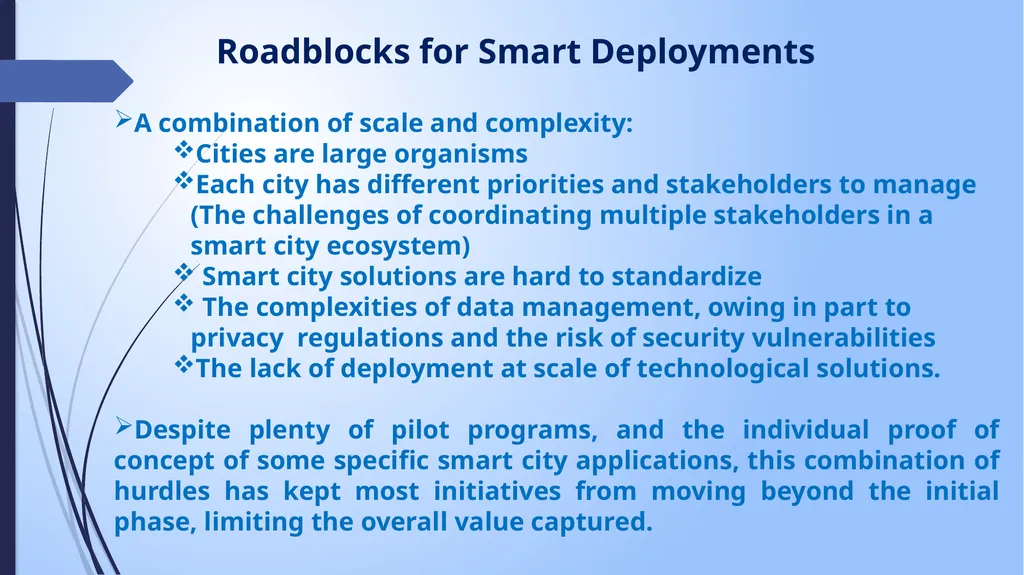
Roadblocks for Smart Deployments A combination of scale and complexity:
Cities are large organisms
Each city has different priorities and stakeholders to manage (The challenges of coordinating multiple stakeholders in a smart city ecosystem)
Smart city solutions are hard to standardize
The complexities of data management, owing in part to privacy regulations and the risk of security vulnerabilities
The lack of deployment at scale of technological solutions.
Despite plenty of pilot programs, and the individual proof of concept of some specific smart city applications, this combination of hurdles has kept most initiatives from moving beyond the initial phase, limiting the overall value captured.<br>
Cities are large organisms
Each city has different priorities and stakeholders to manage (The challenges of coordinating multiple stakeholders in a smart city ecosystem)
Smart city solutions are hard to standardize
The complexities of data management, owing in part to privacy regulations and the risk of security vulnerabilities
The lack of deployment at scale of technological solutions.
Despite plenty of pilot programs, and the individual proof of concept of some specific smart city applications, this combination of hurdles has kept most initiatives from moving beyond the initial phase, limiting the overall value captured.<br>
06
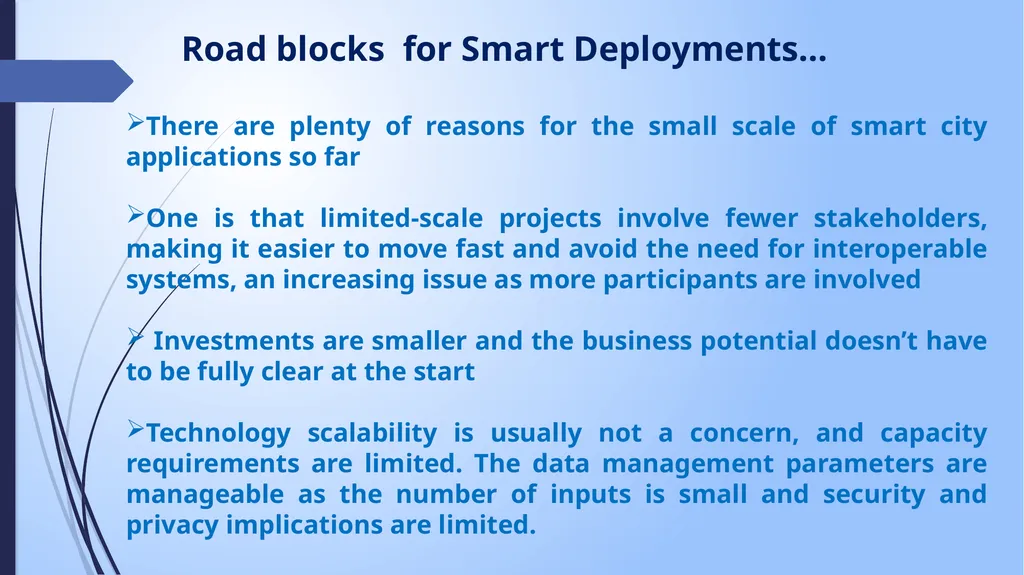
Road blocks for Smart Deployments… There are plenty of reasons for the small scale of smart city applications so far
One is that limited-scale projects involve fewer stakeholders, making it easier to move fast and avoid the need for interoperable systems, an increasing issue as more participants are involved
Investments are smaller and the business potential doesn’t have to be fully clear at the start
Technology scalability is usually not a concern, and capacity requirements are limited. The data management parameters are manageable as the number of inputs is small and security and privacy implications are limited.<br>
One is that limited-scale projects involve fewer stakeholders, making it easier to move fast and avoid the need for interoperable systems, an increasing issue as more participants are involved
Investments are smaller and the business potential doesn’t have to be fully clear at the start
Technology scalability is usually not a concern, and capacity requirements are limited. The data management parameters are manageable as the number of inputs is small and security and privacy implications are limited.<br>
07
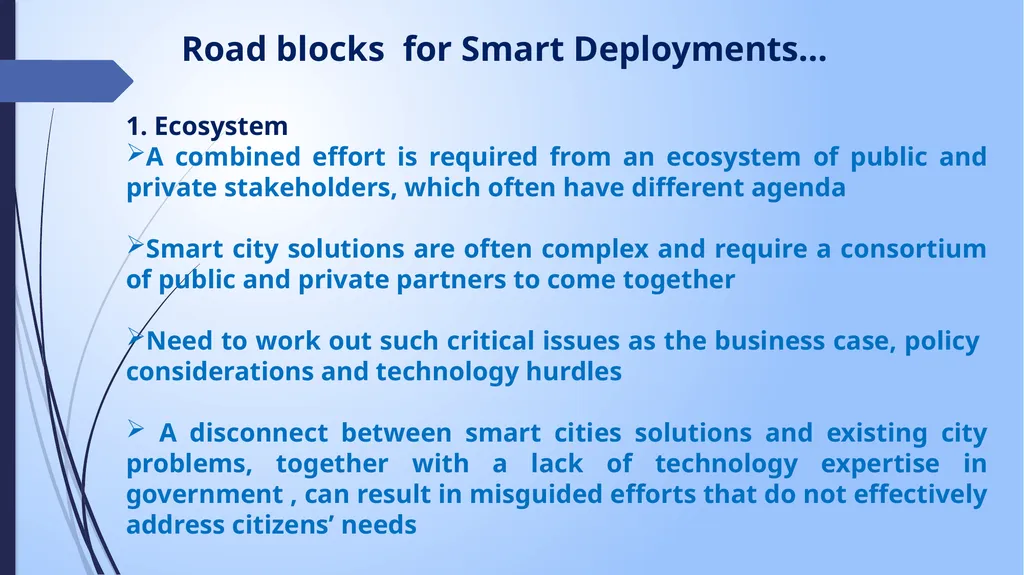
Road blocks for Smart Deployments… 1. Ecosystem
A combined effort is required from an ecosystem of public and private stakeholders, which often have different agenda
Smart city solutions are often complex and require a consortium of public and private partners to come together
Need to work out such critical issues as the business case, policy considerations and technology hurdles
A disconnect between smart cities solutions and existing city problems, together with a lack of technology expertise in government , can result in misguided efforts that do not effectively address citizens’ needs<br>
A combined effort is required from an ecosystem of public and private stakeholders, which often have different agenda
Smart city solutions are often complex and require a consortium of public and private partners to come together
Need to work out such critical issues as the business case, policy considerations and technology hurdles
A disconnect between smart cities solutions and existing city problems, together with a lack of technology expertise in government , can result in misguided efforts that do not effectively address citizens’ needs<br>
08
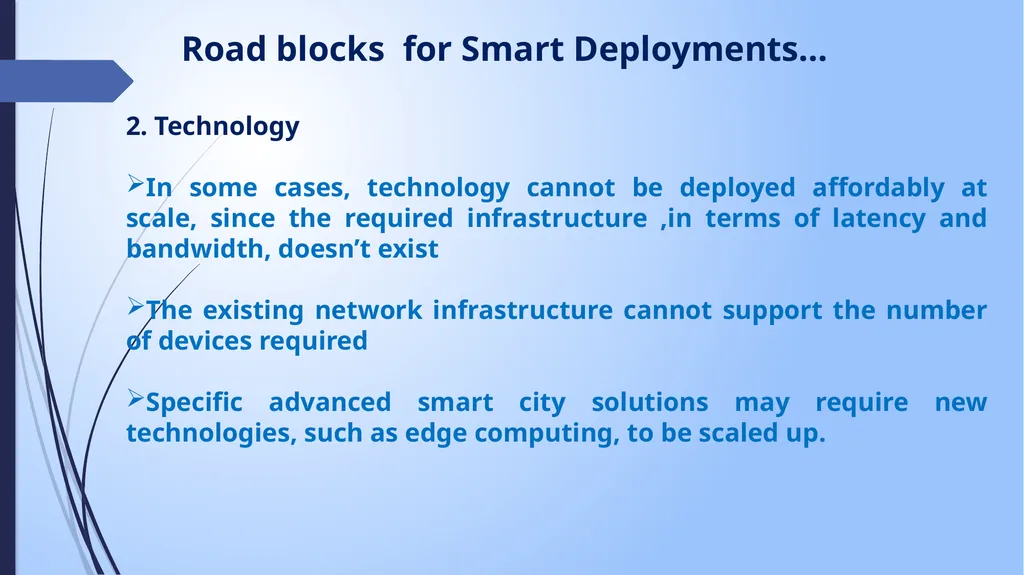
Road blocks for Smart Deployments… 2. Technology
In some cases, technology cannot be deployed affordably at scale, since the required infrastructure ,in terms of latency and bandwidth, doesn’t exist
The existing network infrastructure cannot support the number of devices required
Specific advanced smart city solutions may require new technologies, such as edge computing, to be scaled up.<br>
In some cases, technology cannot be deployed affordably at scale, since the required infrastructure ,in terms of latency and bandwidth, doesn’t exist
The existing network infrastructure cannot support the number of devices required
Specific advanced smart city solutions may require new technologies, such as edge computing, to be scaled up.<br>
09
Road blocks for Smart Deployments… 3.VALUE CASE
At scale, the investments are considerably larger, business cases are harder to demonstrate and intangible social or indirect benefits are not easily captured
A large number of initiatives do not proceed beyond the pilot phase because indirect benefits cannot be monetized
Private players cannot demonstrate a positive business case.<br>
At scale, the investments are considerably larger, business cases are harder to demonstrate and intangible social or indirect benefits are not easily captured
A large number of initiatives do not proceed beyond the pilot phase because indirect benefits cannot be monetized
Private players cannot demonstrate a positive business case.<br>
10
Road blocks for Smart Deployments… 4. DATA MANAGEMENT
Complexity and risk increase as more data sources are connected
Privacy considerations and national and international regulations, along with the risk of negative press attention, can slow adoption
Security considerations outweigh the benefits of solutions<br>
Complexity and risk increase as more data sources are connected
Privacy considerations and national and international regulations, along with the risk of negative press attention, can slow adoption
Security considerations outweigh the benefits of solutions<br>
11
Standardization and IoT deployments Need of Standardization:
According to a recent study from Machina Research, an M2M and IoT research firm, cities worldwide could waste as much as $341bn by 2025 if they adopt a fragmented approach towards IoT as opposed to a standardised one
This sum comes from the extra cost of vendor lock-in, lack of interoperability and higher system-integration fees
Machina further points out that fragmentation of different IoT platforms will dampen the rollout of connected devices and could even curtail adoption of smart city apps<br>
According to a recent study from Machina Research, an M2M and IoT research firm, cities worldwide could waste as much as $341bn by 2025 if they adopt a fragmented approach towards IoT as opposed to a standardised one
This sum comes from the extra cost of vendor lock-in, lack of interoperability and higher system-integration fees
Machina further points out that fragmentation of different IoT platforms will dampen the rollout of connected devices and could even curtail adoption of smart city apps<br>
12
Standardization and IoT deployments… oneM2M is a response to the growing demand for a smarter approach to smart cities
Based on open standards, developed in partnership with its some 200 members worldwide, which include various regional standards bodies, oneM2M marks a seismic change in the IoT landscape. It combats market fragmentation
Instead of the vertical approach, where cities might have several dedicated IoT platforms, one for smart metering, another for waste management and so on, oneM2M enables different IoT use cases to be supported by the same platform. The horizontal approach<br>
Based on open standards, developed in partnership with its some 200 members worldwide, which include various regional standards bodies, oneM2M marks a seismic change in the IoT landscape. It combats market fragmentation
Instead of the vertical approach, where cities might have several dedicated IoT platforms, one for smart metering, another for waste management and so on, oneM2M enables different IoT use cases to be supported by the same platform. The horizontal approach<br>
13
Standardization and IoT deployments… Interoperability of this sort, where different apps can use the same device management and security software, or where sensor-generated data is put to multiple uses, it can reap huge cost savings for city authorities
In an era of globalisation, businesses pay close attention to these listings before deciding where to invest.
By adopting oneM2M, however, cities have a route to much more cost-efficient IoT deployment, especially as apps and devices proliferate. There is also peace of mind.
Legacy implementations, through the development of adapters, can be brought onto the oneM2M horizontal platform without disruption<br>
In an era of globalisation, businesses pay close attention to these listings before deciding where to invest.
By adopting oneM2M, however, cities have a route to much more cost-efficient IoT deployment, especially as apps and devices proliferate. There is also peace of mind.
Legacy implementations, through the development of adapters, can be brought onto the oneM2M horizontal platform without disruption<br>
14
Roadmap for Adoption of oneM2M Standards in India There is no denying of the fact that oneM2M standards are here to stay
What next ?
Demonstrate the oneM2M network architecture to the organizations/enterprises/city
How?
TSDSI should showcase its benefits to stakeholders across all verticals. Collaborative efforts are required.
Government will extend all support<br>
What next ?
Demonstrate the oneM2M network architecture to the organizations/enterprises/city
How?
TSDSI should showcase its benefits to stakeholders across all verticals. Collaborative efforts are required.
Government will extend all support<br>
15
Roadmap for Adoption of oneM2M Standards in India Invite existing IoT solution/platform providers who are deploying oneM2M based solutions to demonstrate interoperability among oneM2M compliant solutions
Organize it on zonal basis for wider participation
Security of deployment is a concern: demonstrate that rogue devices and applications do not get access
Also onboard proprietary solution providers/platform providers and educate them how to integrate with oneM2M platform
This will boost their confidence(city planners & IoT platforms) that their investment are secured : A win- win situation for all stakeholders of value chain<br>
Organize it on zonal basis for wider participation
Security of deployment is a concern: demonstrate that rogue devices and applications do not get access
Also onboard proprietary solution providers/platform providers and educate them how to integrate with oneM2M platform
This will boost their confidence(city planners & IoT platforms) that their investment are secured : A win- win situation for all stakeholders of value chain<br>
16
Challenges for IoT deployments Ultimately, when things become interconnected and highly autonomous, entirely new business opportunities will emerge, creating an “economy of things”
Privacy, Security and Ownership are the key issues which need to be taken care while enabling IoT ecosystem
IoT devices must retain a certain amount of privacy when processing data and have security measures built in
Ownership of data must also be established clearly for consumers to feel comfortable with integrating IoT into their daily lives<br>
Privacy, Security and Ownership are the key issues which need to be taken care while enabling IoT ecosystem
IoT devices must retain a certain amount of privacy when processing data and have security measures built in
Ownership of data must also be established clearly for consumers to feel comfortable with integrating IoT into their daily lives<br>
17
Challenges for IoT deployments The incredible connectivity that comes with the IoT has made it the ideal target for hackers
Reason: a vast majority of the connected devices released in the market is deployed with little consideration for threat protection.
Cyber security systems must be capable of intelligently monitoring and taking action in shutting down malware. They must be programmed to identify threat patterns, allow or deny network access and stop risks, all without human intervention.
Updated Security Standards suited for requirements to IoT is the need of the hour.<br>
Reason: a vast majority of the connected devices released in the market is deployed with little consideration for threat protection.
Cyber security systems must be capable of intelligently monitoring and taking action in shutting down malware. They must be programmed to identify threat patterns, allow or deny network access and stop risks, all without human intervention.
Updated Security Standards suited for requirements to IoT is the need of the hour.<br>
18
Way Forward Recent reports by ASSOCHAM and EY reveal that the Indian IoT market has the potential to unlock USD $11.1 billion in revenues by 2022 by reaching 2 billion connections, making it a key economic contributor that will help propel India towards a USD $1 trillion economy
The most successful IoT solutions will have the agility to expand and pivot in line with market trends and customer expectations. IoT offers the opportunity to enhance the capabilities of existing products by adding new features or tailoring them for new markets
While IoT promises to connect all things – people, devices and networks – it is the integration of applications and data in the cloud that will truly propel its use and value – making IoT cloud the new engine of growth for businesses, societies and nations<br>
The most successful IoT solutions will have the agility to expand and pivot in line with market trends and customer expectations. IoT offers the opportunity to enhance the capabilities of existing products by adding new features or tailoring them for new markets
While IoT promises to connect all things – people, devices and networks – it is the integration of applications and data in the cloud that will truly propel its use and value – making IoT cloud the new engine of growth for businesses, societies and nations<br>
19
In Conclusion oneM2M standards adoption is essential for growth and enablement of IoT ecosystem in the country
At present, lack of M2M standards seems to be a major roadblock for mass deployment of M2M services
Lack of standardization is likely to halt the M2M juggernaut
oneM2M standards will provide an impetus for mass scale deployment of IoT especially for those enterprises who at present are sitting on the fence to see which way the wind blows
“So, let us collaborate for bridging this gap for
seamless connected society”<br>
At present, lack of M2M standards seems to be a major roadblock for mass deployment of M2M services
Lack of standardization is likely to halt the M2M juggernaut
oneM2M standards will provide an impetus for mass scale deployment of IoT especially for those enterprises who at present are sitting on the fence to see which way the wind blows
“So, let us collaborate for bridging this gap for
seamless connected society”<br>
20
Thank You<br>