
7-Apr-15 Polymorphism 2 Signatures In any

Description: 7-Apr-15 Polymorphism 2 Signatures In any programming language, a signature is what distinguishes one function or method from another In C, every function has to have a different name In Java, two methods have to differ in their names or in
Related Topics
Download Presentation
"7-Apr-15 Polymorphism 2 Signatures In any" is the property of its rightful owner. Permission is granted to download and print the materials on this website for personal, non-commercial use only, and to display it on your personal computer provided you do not modify the materials and that you retain all copyright notices contained in the materials. By downloading content from our website, you accept the terms of this agreement.
Presentation Transcript
slide1. 7-Apr-15 Polymorphism<br>
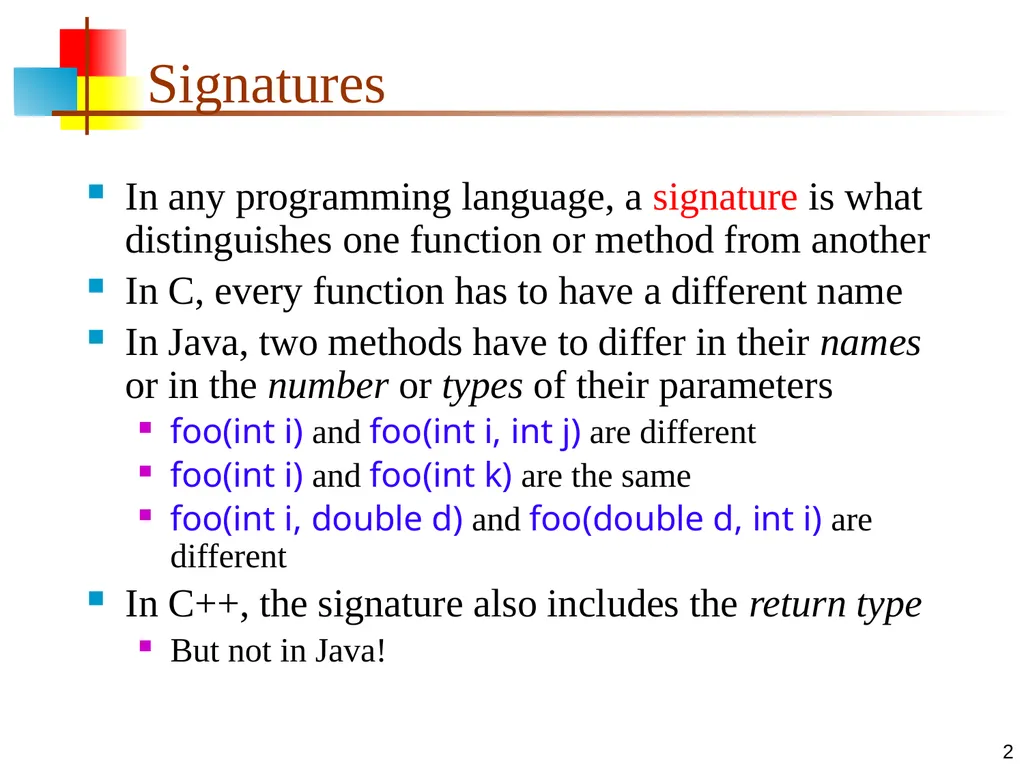
slide2. 2 Signatures In any programming language, a signature is what distinguishes one function or method from another
In C, every function has to have a different name
In Java, two methods have to differ in their names or in the number or types of their parameters
foo(int i) and foo(int i, int j) are different
foo(int i) and foo(int k) are the same
foo(int i, double d) and foo(double d, int i) are different
In C++, the signature also includes the return type
But not in Java!<br>
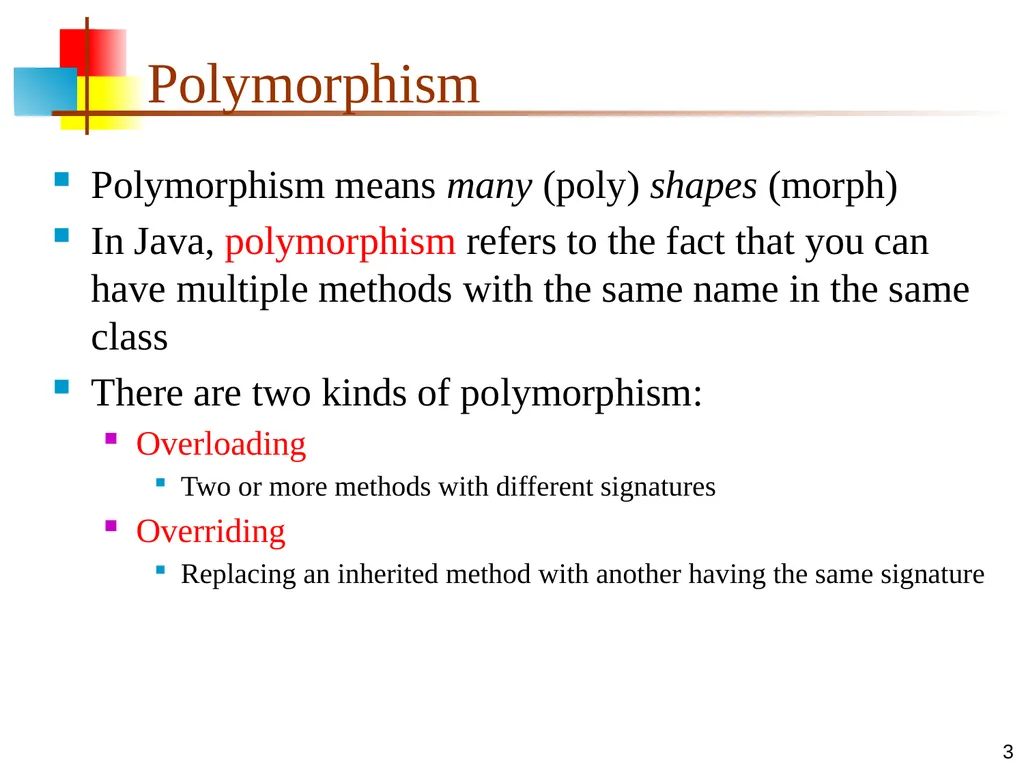
slide3. 3 Polymorphism Polymorphism means many (poly) shapes (morph)
In Java, polymorphism refers to the fact that you can have multiple methods with the same name in the same class
There are two kinds of polymorphism:
Overloading
Two or more methods with different signatures
Overriding
Replacing an inherited method with another having the same signature<br>
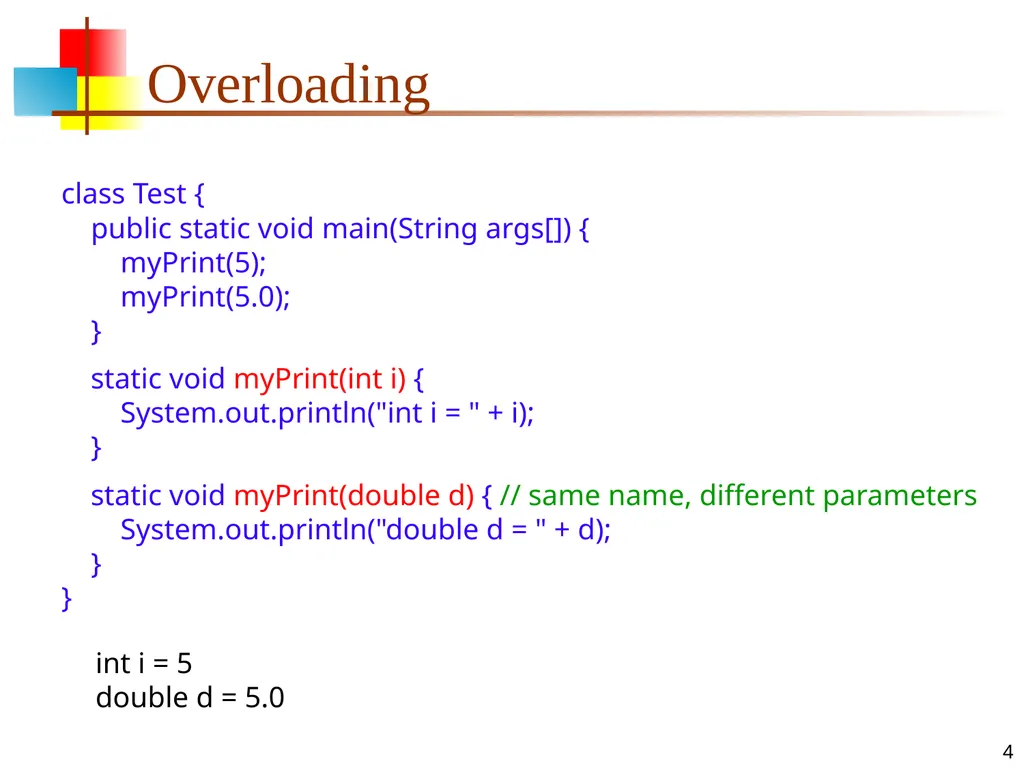
slide4. 4 Overloading class Test { public static void main(String args[]) { myPrint(5); myPrint(5.0); }
static void myPrint(int i) { System.out.println("int i = " + i); }
static void myPrint(double d) { // same name, different parameters System.out.println("double d = " + d); } } int i = 5 double d = 5.0<br>
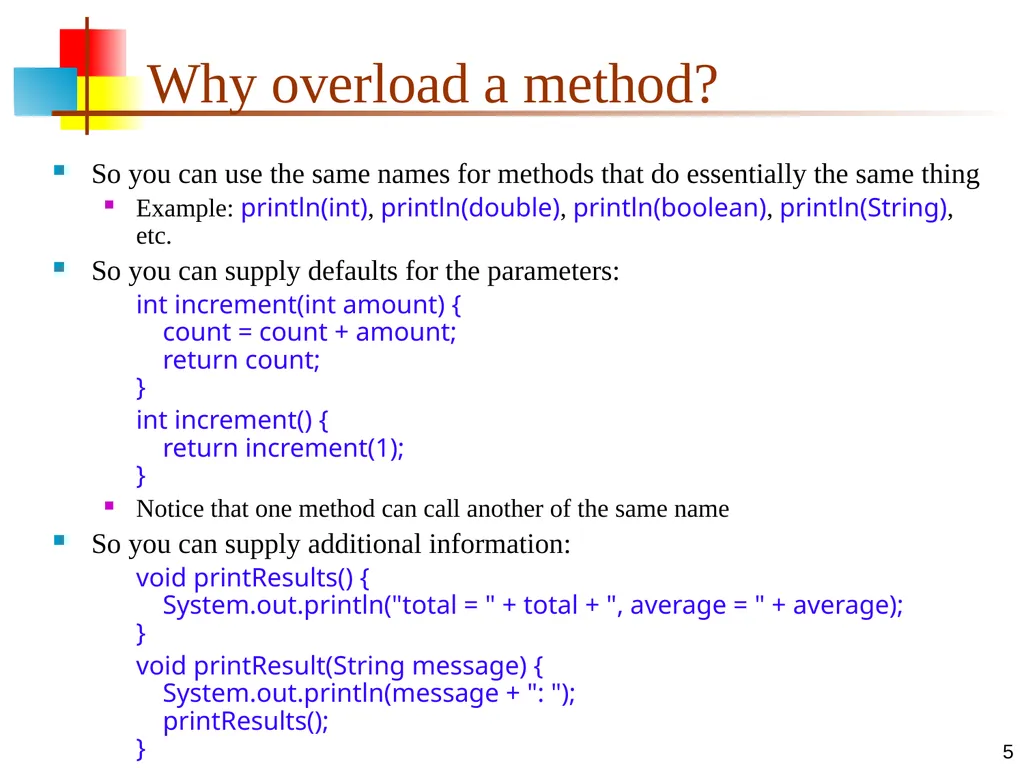
slide5. 5 Why overload a method? So you can use the same names for methods that do essentially the same thing
Example: println(int), println(double), println(boolean), println(String), etc.
So you can supply defaults for the parameters:
int increment(int amount) { count = count + amount; return count; }
int increment() { return increment(1); }
Notice that one method can call another of the same name
So you can supply additional information:
void printResults() { System.out.println("total = " + total + ", average = " + average); }
void printResult(String message) { System.out.println(message + ": "); printResults(); }<br>
slide6. Have we already seen overloading? Is there an example of this in your current assignment? 6<br>
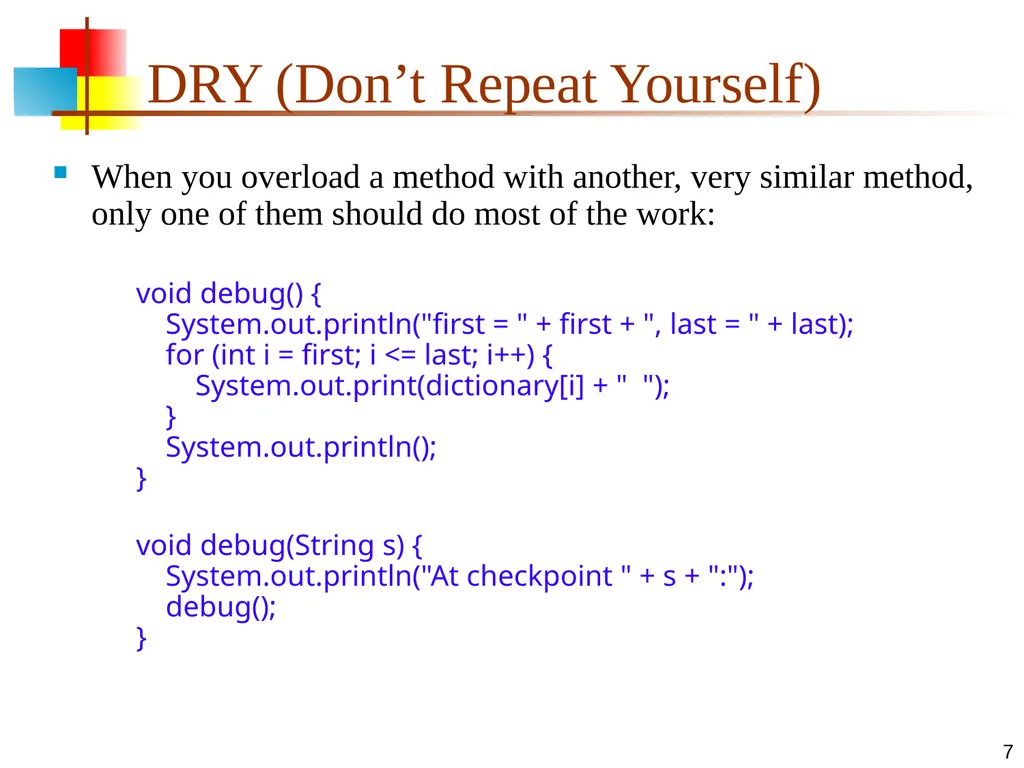
slide7. 7 DRY (Don’t Repeat Yourself) When you overload a method with another, very similar method, only one of them should do most of the work:
void debug() { System.out.println("first = " + first + ", last = " + last); for (int i = first; i <= last; i++) { System.out.print(dictionary[i] + " "); } System.out.println(); }
void debug(String s) { System.out.println("At checkpoint " + s + ":"); debug(); }<br>
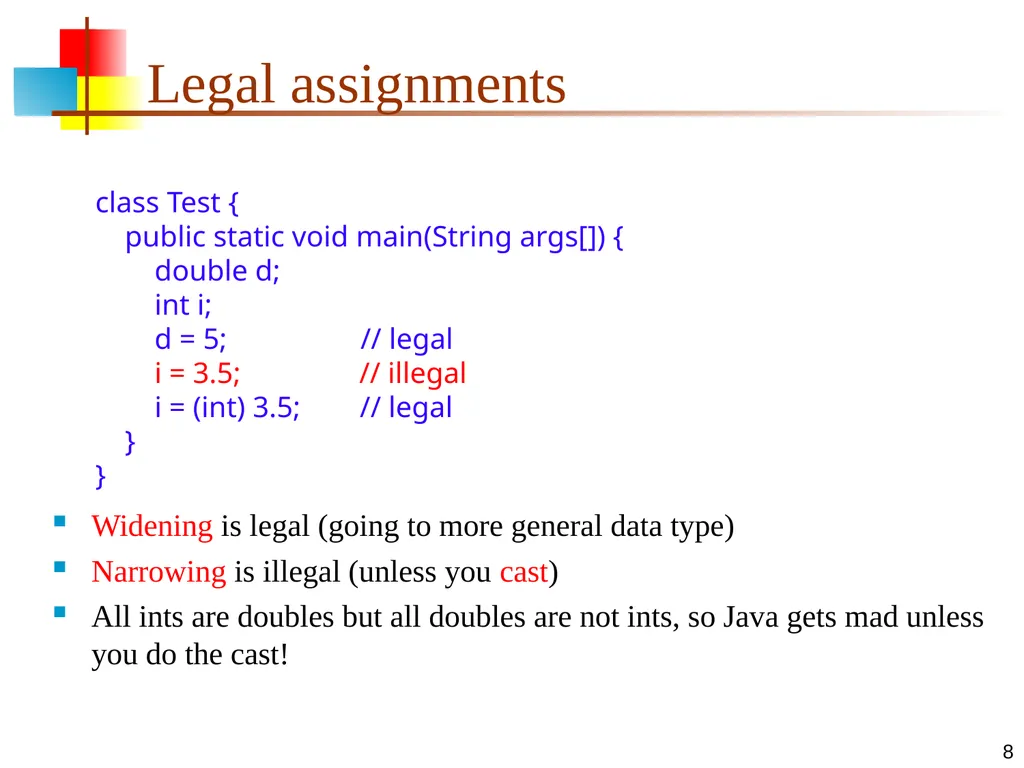
slide8. 8 Legal assignments Widening is legal (going to more general data type)
Narrowing is illegal (unless you cast)
All ints are doubles but all doubles are not ints, so Java gets mad unless you do the cast! class Test { public static void main(String args[]) { double d; int i; d = 5; // legal i = 3.5; // illegal i = (int) 3.5; // legal } }<br>
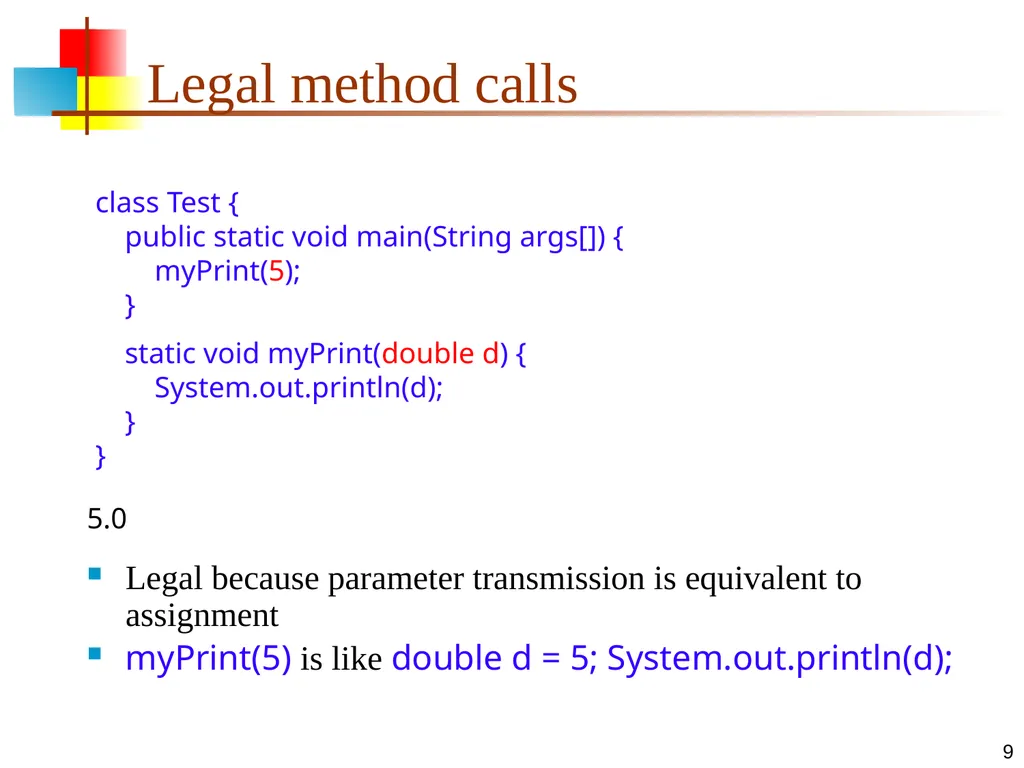
slide9. 9 Legal method calls Legal because parameter transmission is equivalent to assignment
myPrint(5) is like double d = 5; System.out.println(d); class Test { public static void main(String args[]) { myPrint(5); }
static void myPrint(double d) { System.out.println(d); } } 5.0<br>
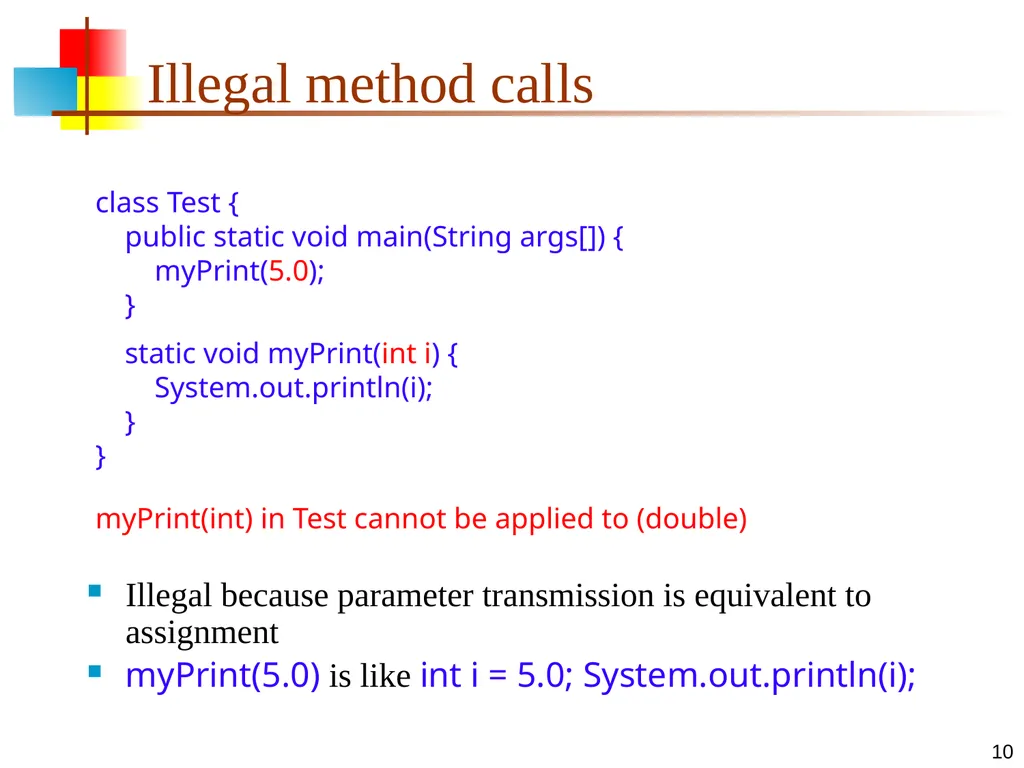
slide10. 10 Illegal method calls Illegal because parameter transmission is equivalent to assignment
myPrint(5.0) is like int i = 5.0; System.out.println(i); class Test { public static void main(String args[]) { myPrint(5.0); }
static void myPrint(int i) { System.out.println(i); } } myPrint(int) in Test cannot be applied to (double)<br>
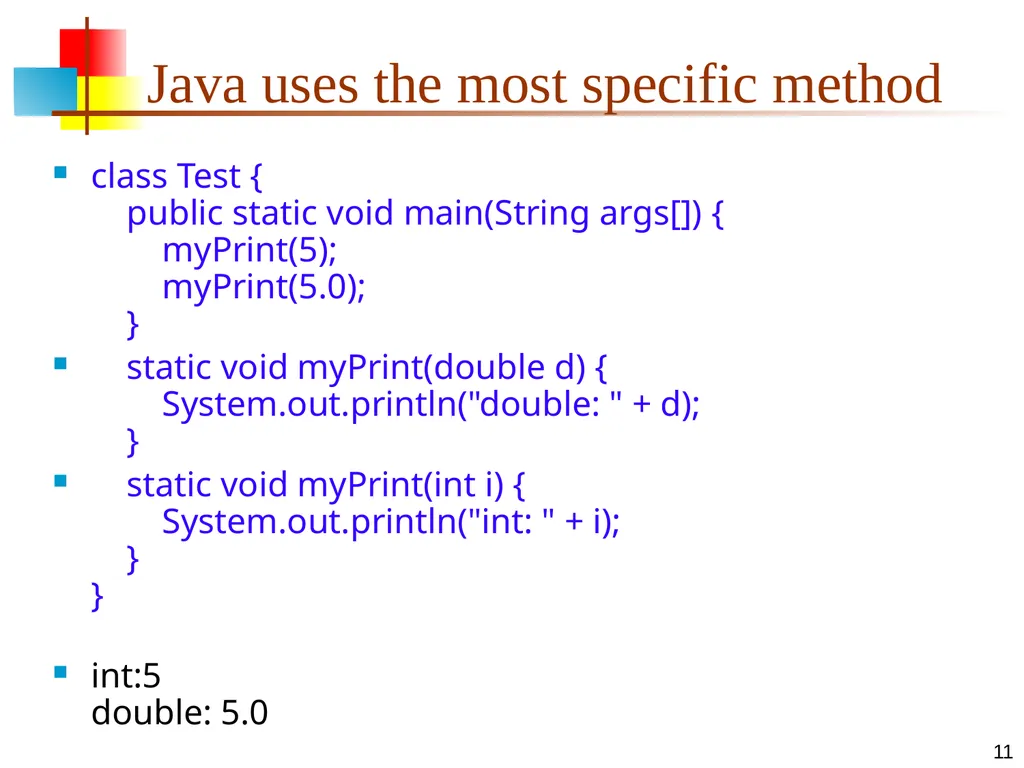
slide11. 11 Java uses the most specific method class Test { public static void main(String args[]) { myPrint(5); myPrint(5.0); }
static void myPrint(double d) { System.out.println("double: " + d); }
static void myPrint(int i) { System.out.println("int: " + i); } }
int:5 double: 5.0<br>
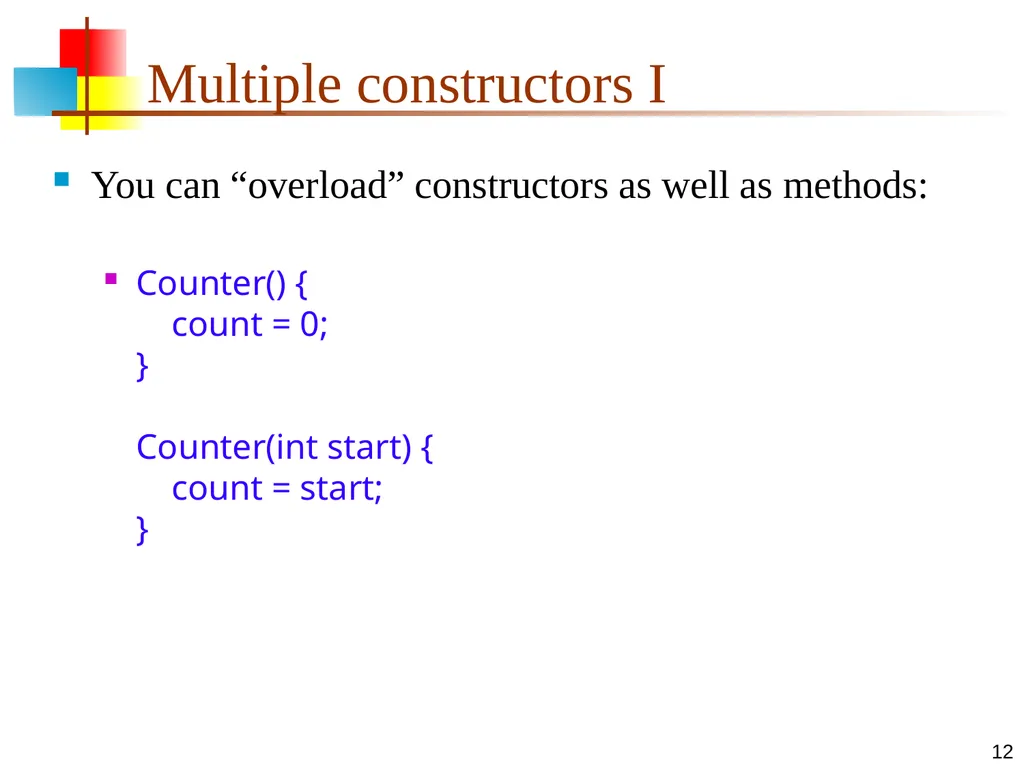
slide12. 12 Multiple constructors I You can “overload” constructors as well as methods:
Counter() { count = 0; } Counter(int start) { count = start; }<br>
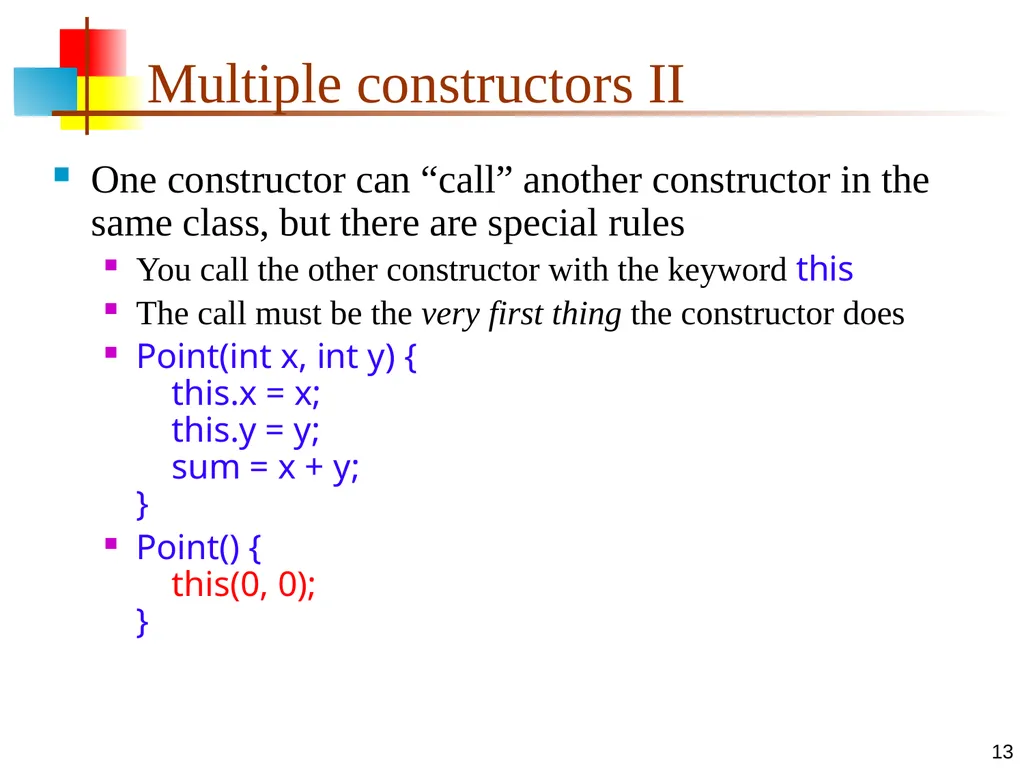
slide13. 13 Multiple constructors II One constructor can “call” another constructor in the same class, but there are special rules
You call the other constructor with the keyword this
The call must be the very first thing the constructor does
Point(int x, int y) { this.x = x; this.y = y; sum = x + y; }
Point() { this(0, 0); }<br>
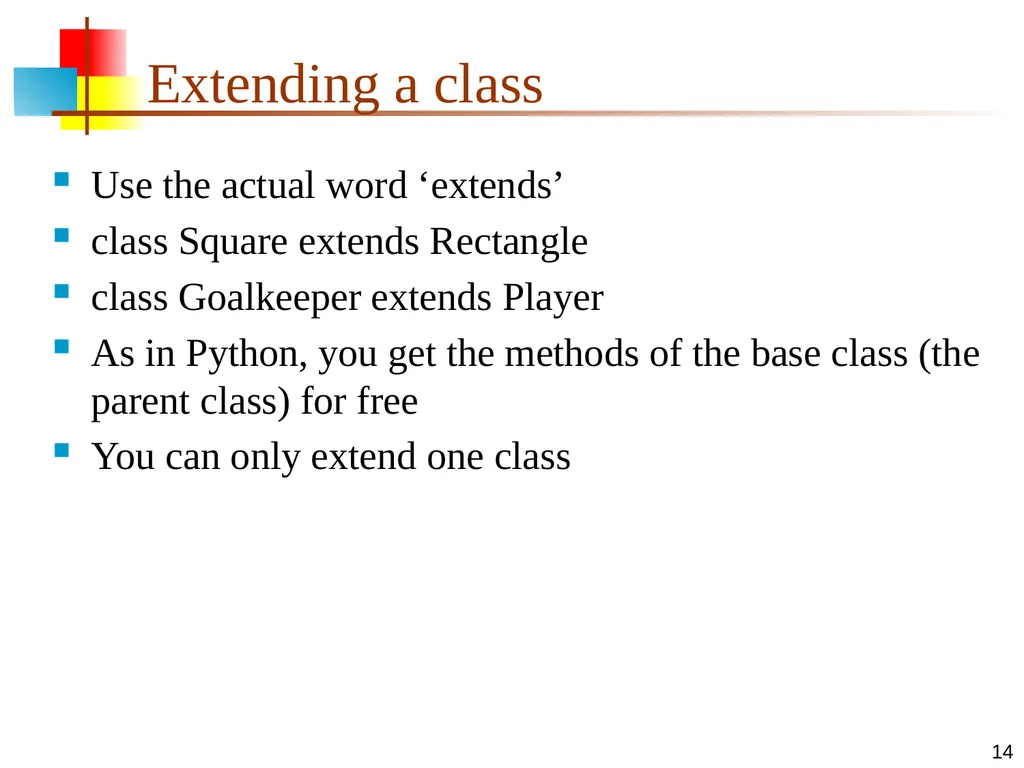
slide14. Extending a class Use the actual word ‘extends’
class Square extends Rectangle
class Goalkeeper extends Player
As in Python, you get the methods of the base class (the parent class) for free
You can only extend one class 14<br>
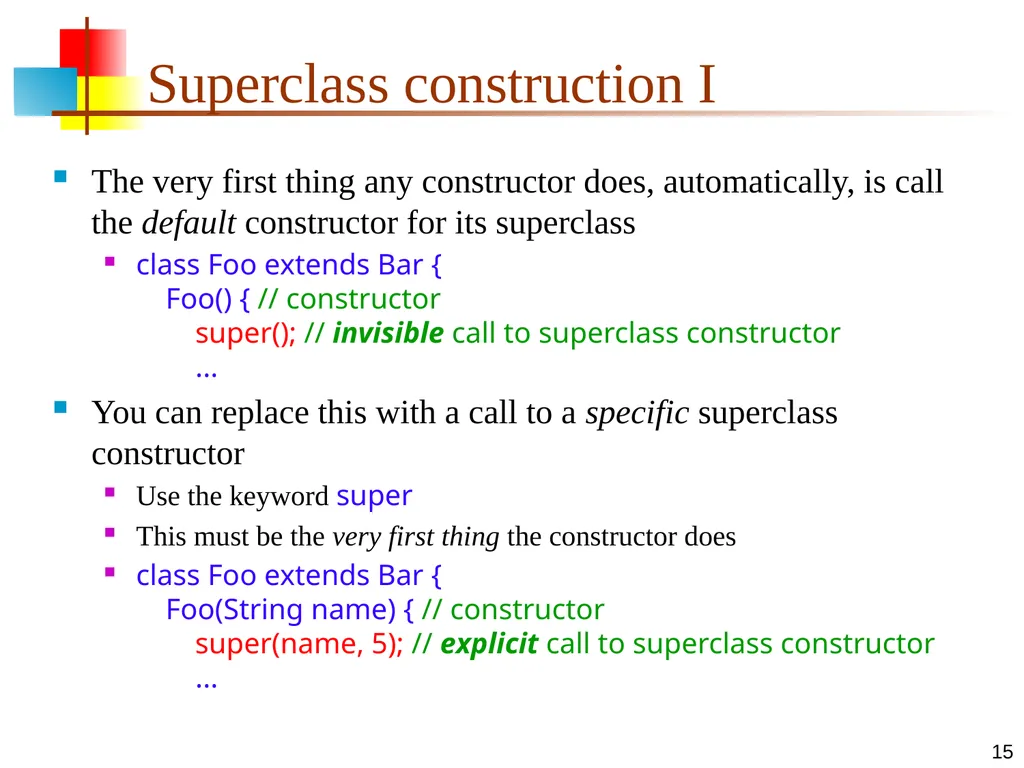
slide15. 15 Superclass construction I The very first thing any constructor does, automatically, is call the default constructor for its superclass
class Foo extends Bar { Foo() { // constructor super(); // invisible call to superclass constructor ...
You can replace this with a call to a specific superclass constructor
Use the keyword super
This must be the very first thing the constructor does
class Foo extends Bar { Foo(String name) { // constructor super(name, 5); // explicit call to superclass constructor ...<br>
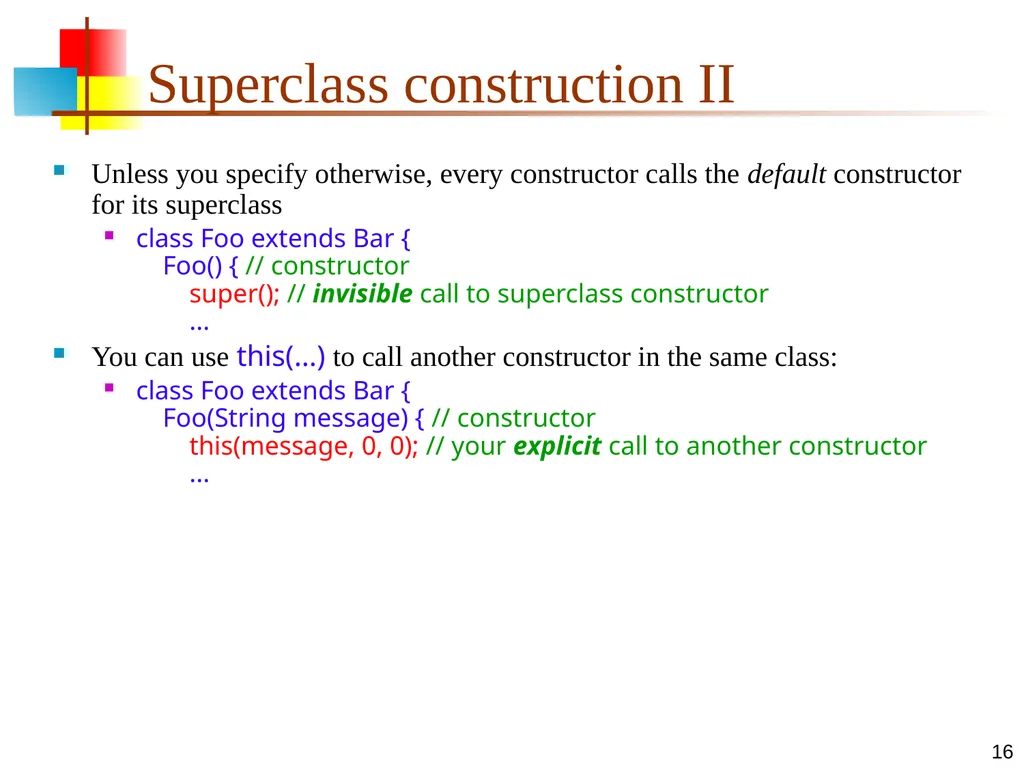
slide16. 16 Superclass construction II Unless you specify otherwise, every constructor calls the default constructor for its superclass
class Foo extends Bar { Foo() { // constructor super(); // invisible call to superclass constructor ...
You can use this(...) to call another constructor in the same class:
class Foo extends Bar { Foo(String message) { // constructor this(message, 0, 0); // your explicit call to another constructor ...<br>
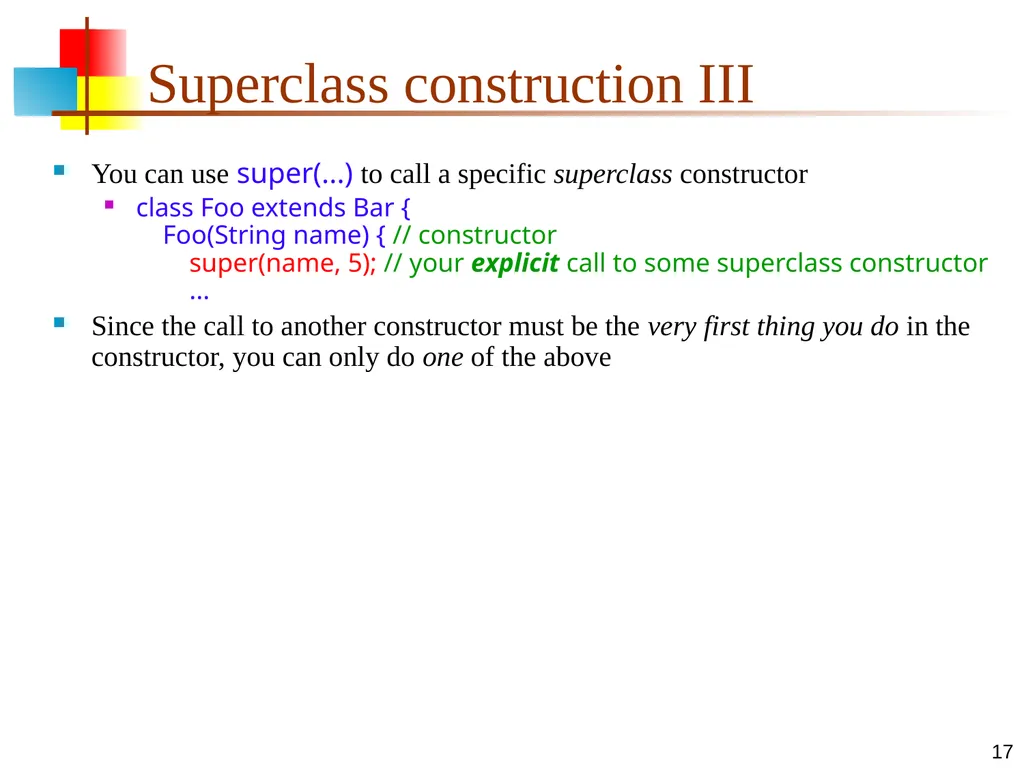
slide17. Superclass construction III You can use super(...) to call a specific superclass constructor
class Foo extends Bar { Foo(String name) { // constructor super(name, 5); // your explicit call to some superclass constructor ...
Since the call to another constructor must be the very first thing you do in the constructor, you can only do one of the above 17<br>
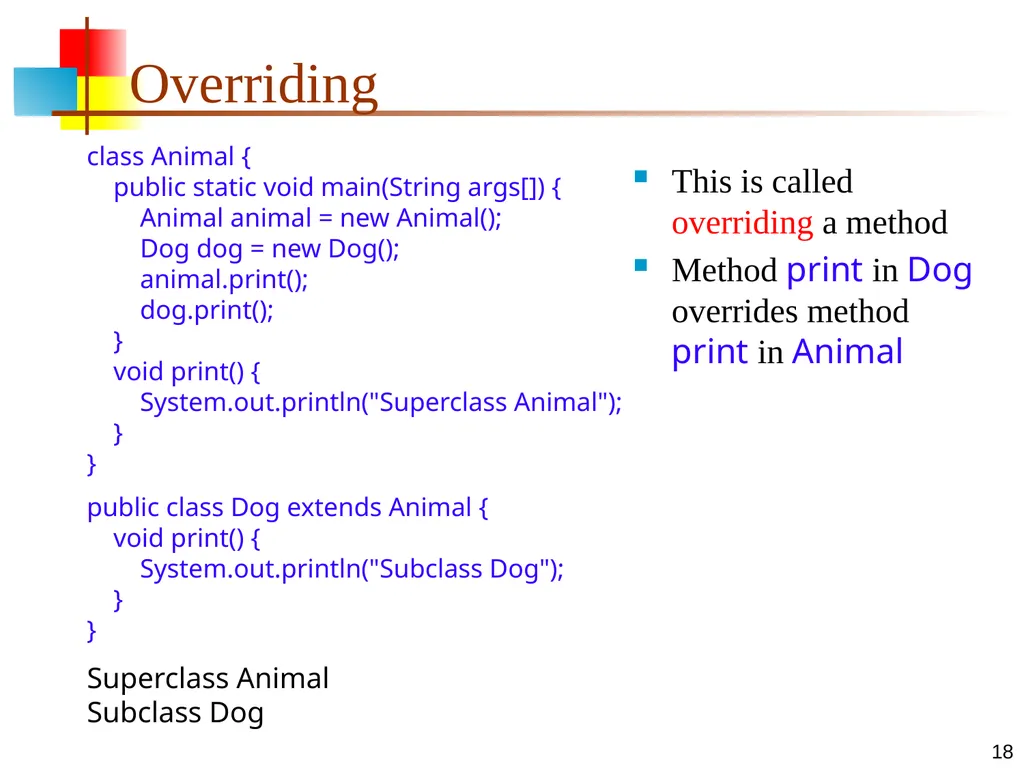
slide18. 18 Overriding This is called overriding a method
Method print in Dog overrides method print in Animal class Animal { public static void main(String args[]) { Animal animal = new Animal(); Dog dog = new Dog(); animal.print(); dog.print(); } void print() { System.out.println("Superclass Animal"); } }
public class Dog extends Animal { void print() { System.out.println("Subclass Dog"); } } Superclass Animal Subclass Dog<br>
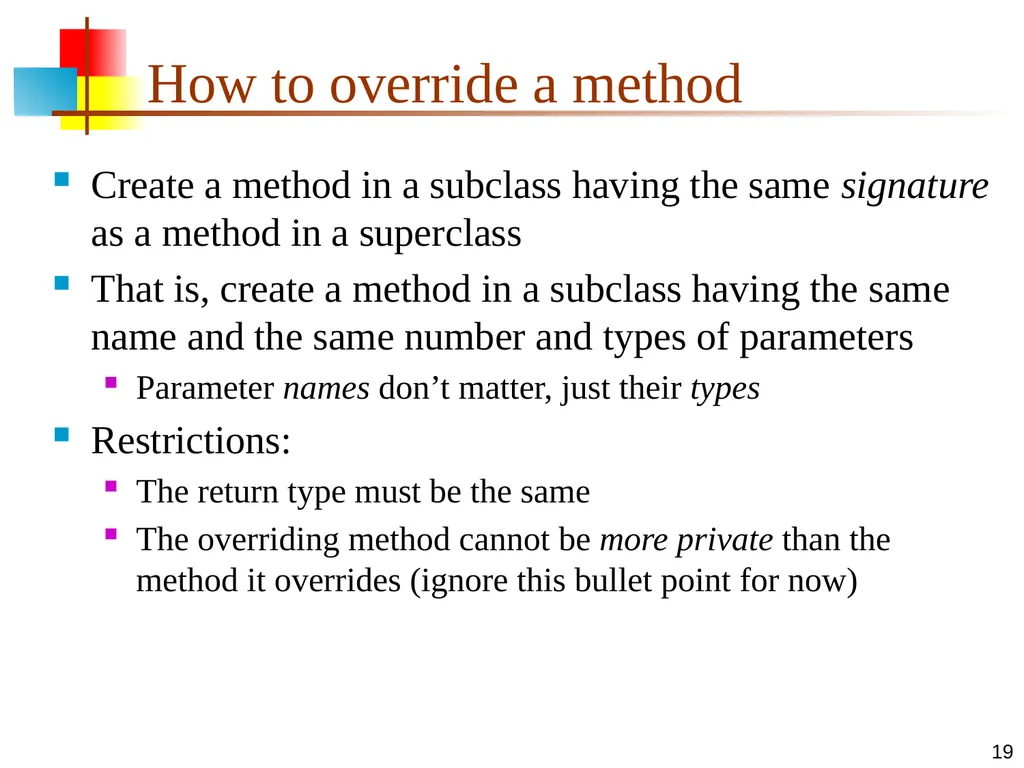
slide19. 19 How to override a method Create a method in a subclass having the same signature as a method in a superclass
That is, create a method in a subclass having the same name and the same number and types of parameters
Parameter names don’t matter, just their types
Restrictions:
The return type must be the same
The overriding method cannot be more private than the method it overrides (ignore this bullet point for now)<br>
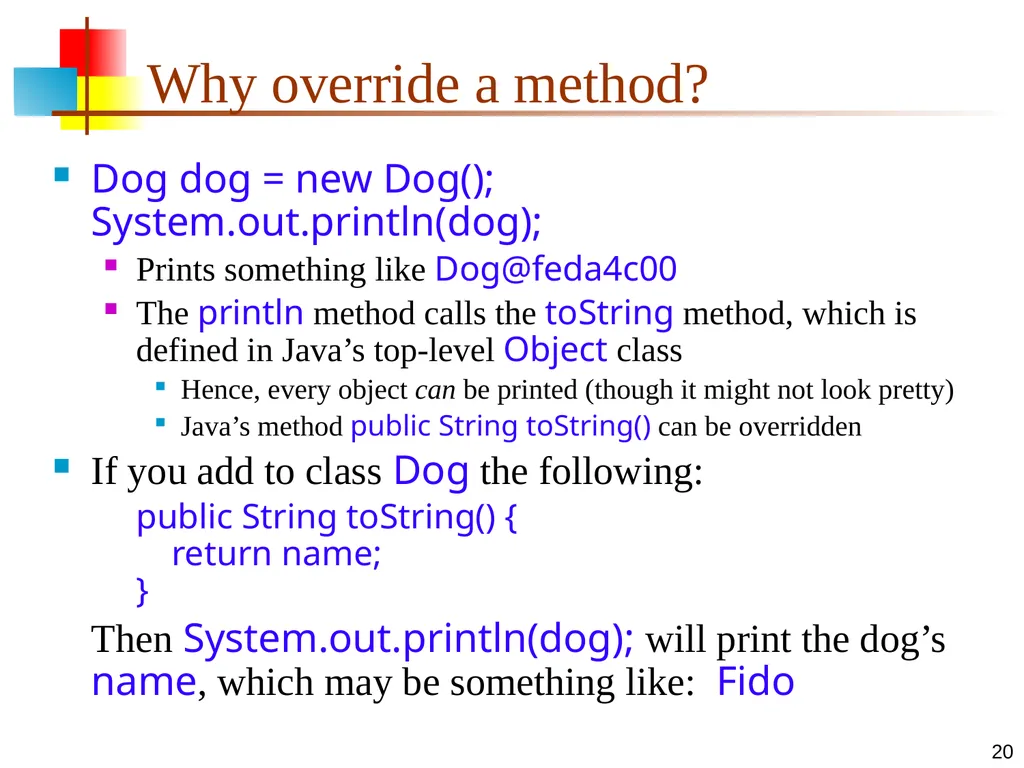
slide20. 20 Why override a method? Dog dog = new Dog(); System.out.println(dog);
Prints something like Dog@feda4c00
The println method calls the toString method, which is defined in Java’s top-level Object class
Hence, every object can be printed (though it might not look pretty)
Java’s method public String toString() can be overridden
If you add to class Dog the following:
public String toString() { return name; }
Then System.out.println(dog); will print the dog’s name, which may be something like: Fido<br>
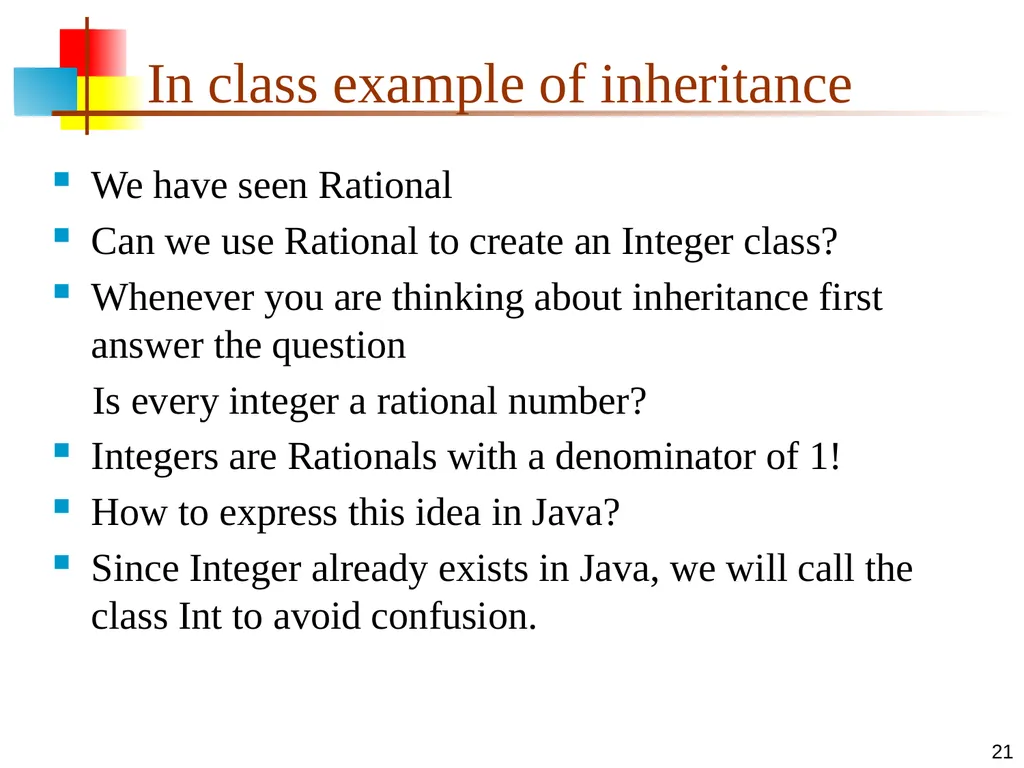
slide21. In class example of inheritance We have seen Rational
Can we use Rational to create an Integer class?
Whenever you are thinking about inheritance first answer the question
Is every integer a rational number?
Integers are Rationals with a denominator of 1!
How to express this idea in Java?
Since Integer already exists in Java, we will call the class Int to avoid confusion. 21<br>
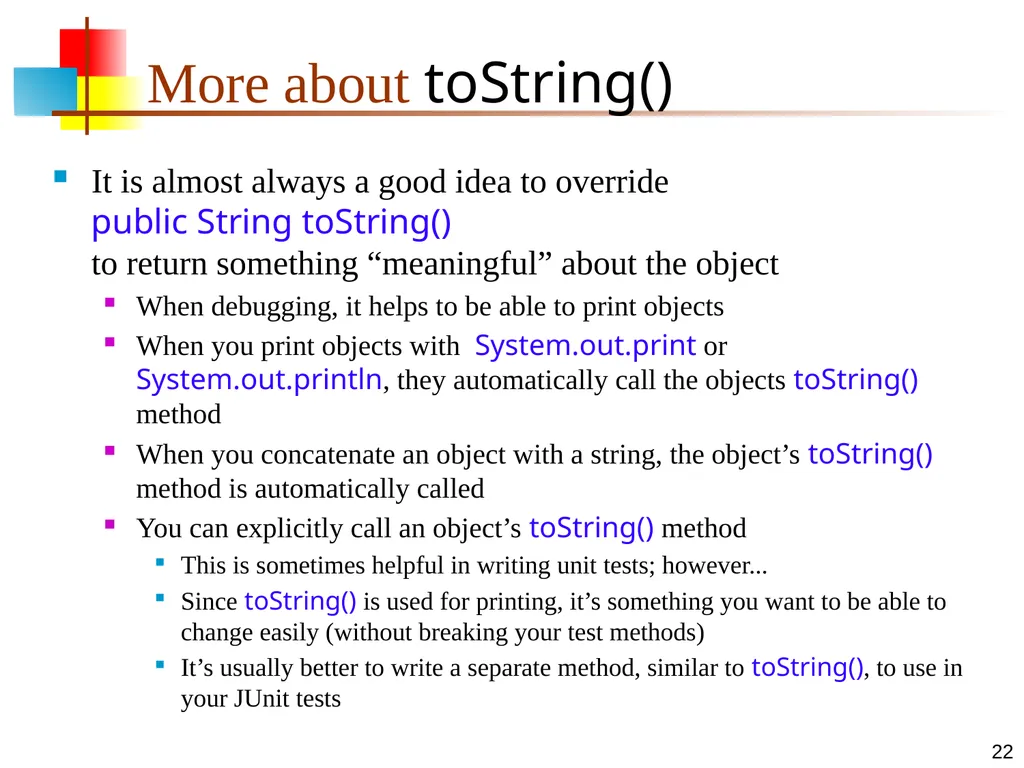
slide22. 22 More about toString() It is almost always a good idea to override public String toString() to return something “meaningful” about the object
When debugging, it helps to be able to print objects
When you print objects with System.out.print or System.out.println, they automatically call the objects toString() method
When you concatenate an object with a string, the object’s toString() method is automatically called
You can explicitly call an object’s toString() method
This is sometimes helpful in writing unit tests; however...
Since toString() is used for printing, it’s something you want to be able to change easily (without breaking your test methods)
It’s usually better to write a separate method, similar to toString(), to use in your JUnit tests<br>
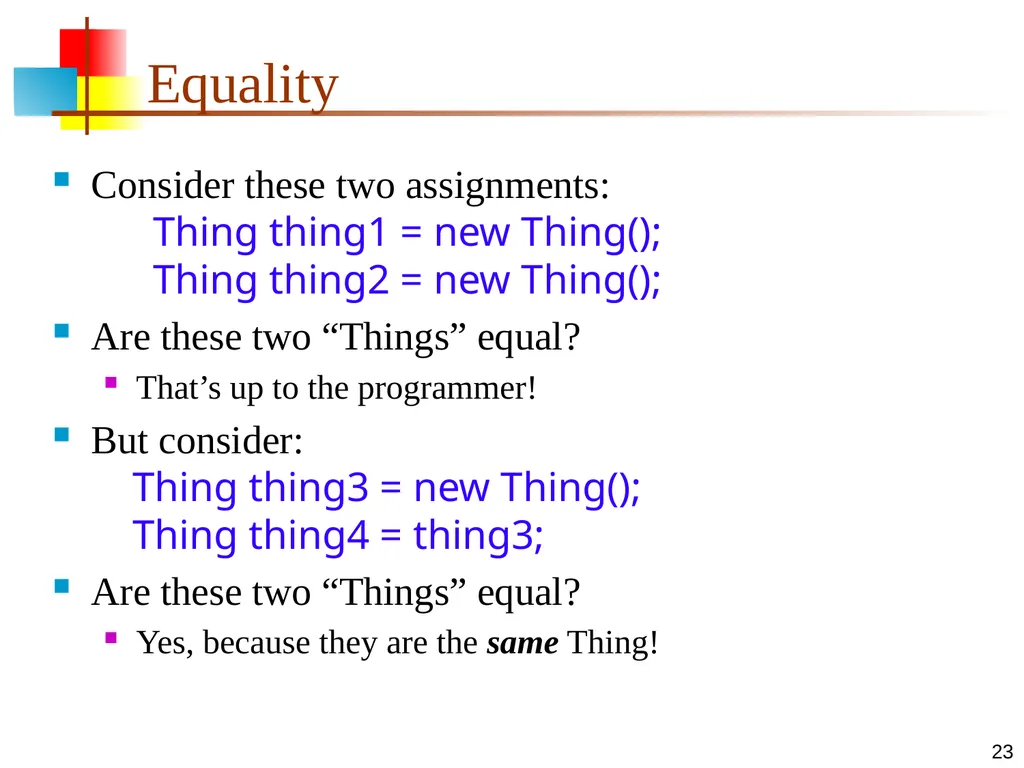
slide23. 23 Equality Consider these two assignments: Thing thing1 = new Thing(); Thing thing2 = new Thing();
Are these two “Things” equal?
That’s up to the programmer!
But consider: Thing thing3 = new Thing(); Thing thing4 = thing3;
Are these two “Things” equal?
Yes, because they are the same Thing!<br>
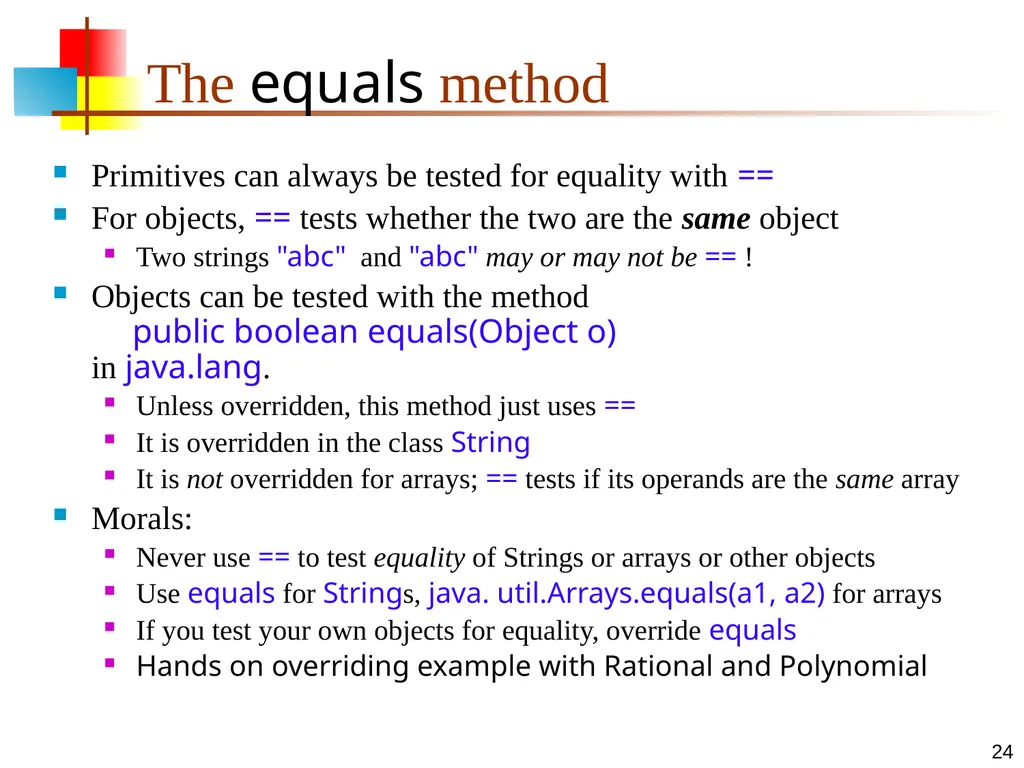
slide24. 24 The equals method Primitives can always be tested for equality with ==
For objects, == tests whether the two are the same object
Two strings "abc" and "abc" may or may not be == !
Objects can be tested with the method public boolean equals(Object o) in java.lang.
Unless overridden, this method just uses ==
It is overridden in the class String
It is not overridden for arrays; == tests if its operands are the same array
Morals:
Never use == to test equality of Strings or arrays or other objects
Use equals for Strings, java. util.Arrays.equals(a1, a2) for arrays
If you test your own objects for equality, override equals
Hands on overriding example with Rational and Polynomial<br>
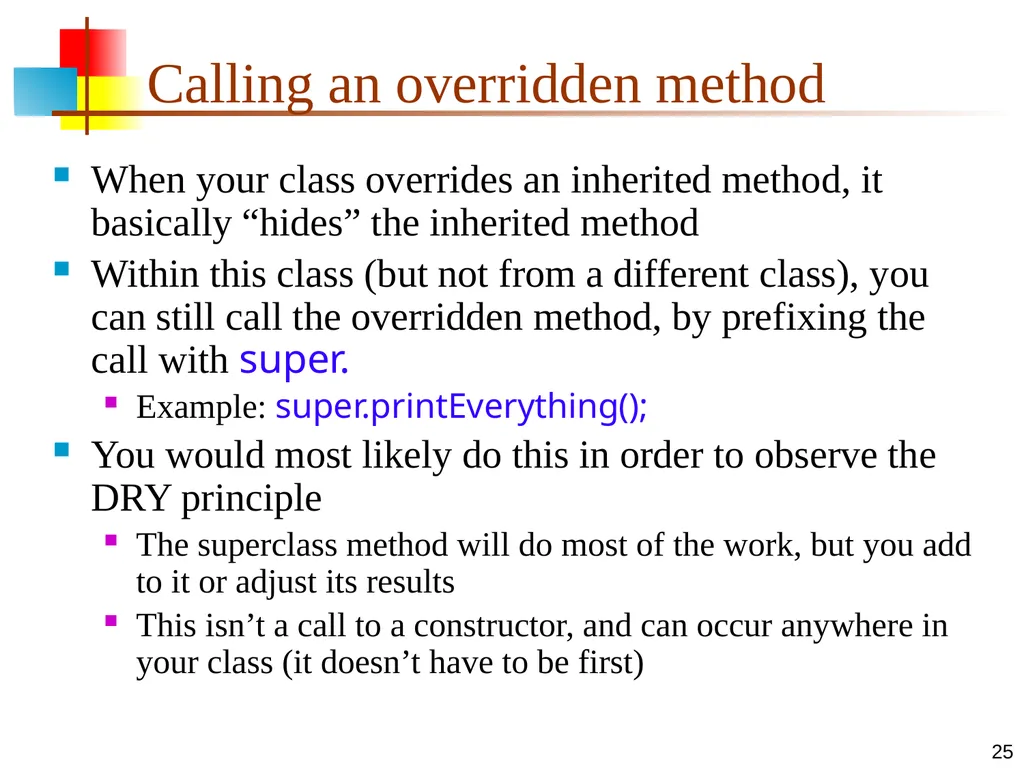
slide25. 25 Calling an overridden method When your class overrides an inherited method, it basically “hides” the inherited method
Within this class (but not from a different class), you can still call the overridden method, by prefixing the call with super.
Example: super.printEverything();
You would most likely do this in order to observe the DRY principle
The superclass method will do most of the work, but you add to it or adjust its results
This isn’t a call to a constructor, and can occur anywhere in your class (it doesn’t have to be first)<br>
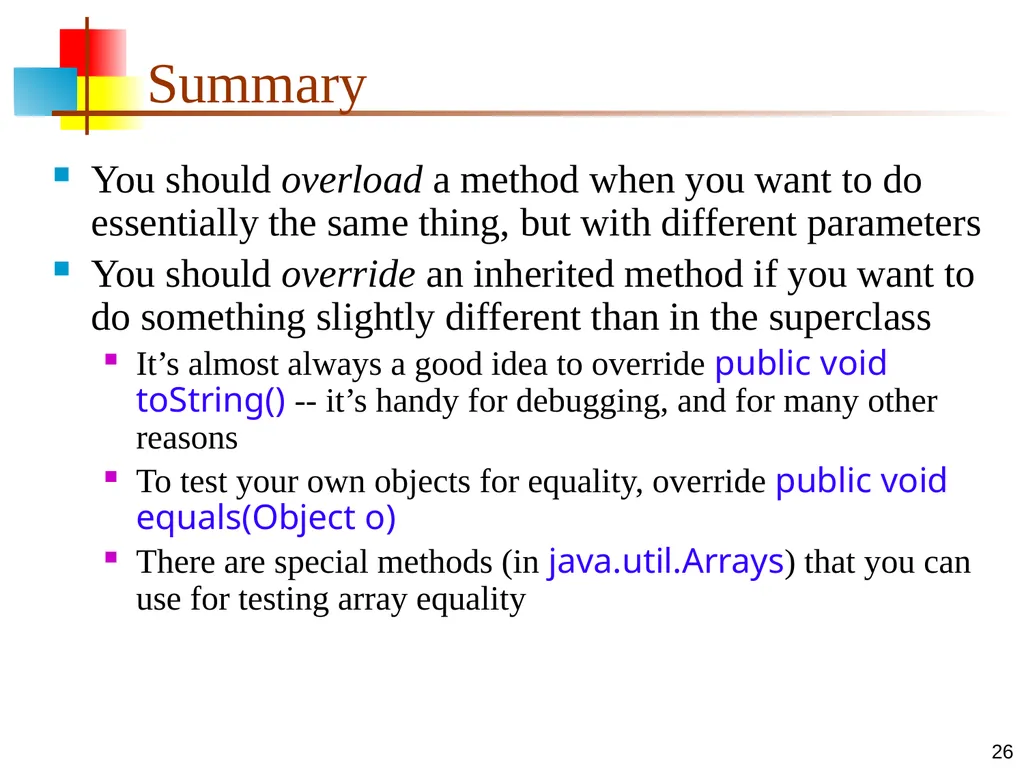
slide26. 26 Summary You should overload a method when you want to do essentially the same thing, but with different parameters
You should override an inherited method if you want to do something slightly different than in the superclass
It’s almost always a good idea to override public void toString() -- it’s handy for debugging, and for many other reasons
To test your own objects for equality, override public void equals(Object o)
There are special methods (in java.util.Arrays) that you can use for testing array equality<br>
slide2. 2 Signatures In any programming language, a signature is what distinguishes one function or method from another
In C, every function has to have a different name
In Java, two methods have to differ in their names or in the number or types of their parameters
foo(int i) and foo(int i, int j) are different
foo(int i) and foo(int k) are the same
foo(int i, double d) and foo(double d, int i) are different
In C++, the signature also includes the return type
But not in Java!<br>
slide3. 3 Polymorphism Polymorphism means many (poly) shapes (morph)
In Java, polymorphism refers to the fact that you can have multiple methods with the same name in the same class
There are two kinds of polymorphism:
Overloading
Two or more methods with different signatures
Overriding
Replacing an inherited method with another having the same signature<br>
slide4. 4 Overloading class Test { public static void main(String args[]) { myPrint(5); myPrint(5.0); }
static void myPrint(int i) { System.out.println("int i = " + i); }
static void myPrint(double d) { // same name, different parameters System.out.println("double d = " + d); } } int i = 5 double d = 5.0<br>
slide5. 5 Why overload a method? So you can use the same names for methods that do essentially the same thing
Example: println(int), println(double), println(boolean), println(String), etc.
So you can supply defaults for the parameters:
int increment(int amount) { count = count + amount; return count; }
int increment() { return increment(1); }
Notice that one method can call another of the same name
So you can supply additional information:
void printResults() { System.out.println("total = " + total + ", average = " + average); }
void printResult(String message) { System.out.println(message + ": "); printResults(); }<br>
slide6. Have we already seen overloading? Is there an example of this in your current assignment? 6<br>
slide7. 7 DRY (Don’t Repeat Yourself) When you overload a method with another, very similar method, only one of them should do most of the work:
void debug() { System.out.println("first = " + first + ", last = " + last); for (int i = first; i <= last; i++) { System.out.print(dictionary[i] + " "); } System.out.println(); }
void debug(String s) { System.out.println("At checkpoint " + s + ":"); debug(); }<br>
slide8. 8 Legal assignments Widening is legal (going to more general data type)
Narrowing is illegal (unless you cast)
All ints are doubles but all doubles are not ints, so Java gets mad unless you do the cast! class Test { public static void main(String args[]) { double d; int i; d = 5; // legal i = 3.5; // illegal i = (int) 3.5; // legal } }<br>
slide9. 9 Legal method calls Legal because parameter transmission is equivalent to assignment
myPrint(5) is like double d = 5; System.out.println(d); class Test { public static void main(String args[]) { myPrint(5); }
static void myPrint(double d) { System.out.println(d); } } 5.0<br>
slide10. 10 Illegal method calls Illegal because parameter transmission is equivalent to assignment
myPrint(5.0) is like int i = 5.0; System.out.println(i); class Test { public static void main(String args[]) { myPrint(5.0); }
static void myPrint(int i) { System.out.println(i); } } myPrint(int) in Test cannot be applied to (double)<br>
slide11. 11 Java uses the most specific method class Test { public static void main(String args[]) { myPrint(5); myPrint(5.0); }
static void myPrint(double d) { System.out.println("double: " + d); }
static void myPrint(int i) { System.out.println("int: " + i); } }
int:5 double: 5.0<br>
slide12. 12 Multiple constructors I You can “overload” constructors as well as methods:
Counter() { count = 0; } Counter(int start) { count = start; }<br>
slide13. 13 Multiple constructors II One constructor can “call” another constructor in the same class, but there are special rules
You call the other constructor with the keyword this
The call must be the very first thing the constructor does
Point(int x, int y) { this.x = x; this.y = y; sum = x + y; }
Point() { this(0, 0); }<br>
slide14. Extending a class Use the actual word ‘extends’
class Square extends Rectangle
class Goalkeeper extends Player
As in Python, you get the methods of the base class (the parent class) for free
You can only extend one class 14<br>
slide15. 15 Superclass construction I The very first thing any constructor does, automatically, is call the default constructor for its superclass
class Foo extends Bar { Foo() { // constructor super(); // invisible call to superclass constructor ...
You can replace this with a call to a specific superclass constructor
Use the keyword super
This must be the very first thing the constructor does
class Foo extends Bar { Foo(String name) { // constructor super(name, 5); // explicit call to superclass constructor ...<br>
slide16. 16 Superclass construction II Unless you specify otherwise, every constructor calls the default constructor for its superclass
class Foo extends Bar { Foo() { // constructor super(); // invisible call to superclass constructor ...
You can use this(...) to call another constructor in the same class:
class Foo extends Bar { Foo(String message) { // constructor this(message, 0, 0); // your explicit call to another constructor ...<br>
slide17. Superclass construction III You can use super(...) to call a specific superclass constructor
class Foo extends Bar { Foo(String name) { // constructor super(name, 5); // your explicit call to some superclass constructor ...
Since the call to another constructor must be the very first thing you do in the constructor, you can only do one of the above 17<br>
slide18. 18 Overriding This is called overriding a method
Method print in Dog overrides method print in Animal class Animal { public static void main(String args[]) { Animal animal = new Animal(); Dog dog = new Dog(); animal.print(); dog.print(); } void print() { System.out.println("Superclass Animal"); } }
public class Dog extends Animal { void print() { System.out.println("Subclass Dog"); } } Superclass Animal Subclass Dog<br>
slide19. 19 How to override a method Create a method in a subclass having the same signature as a method in a superclass
That is, create a method in a subclass having the same name and the same number and types of parameters
Parameter names don’t matter, just their types
Restrictions:
The return type must be the same
The overriding method cannot be more private than the method it overrides (ignore this bullet point for now)<br>
slide20. 20 Why override a method? Dog dog = new Dog(); System.out.println(dog);
Prints something like Dog@feda4c00
The println method calls the toString method, which is defined in Java’s top-level Object class
Hence, every object can be printed (though it might not look pretty)
Java’s method public String toString() can be overridden
If you add to class Dog the following:
public String toString() { return name; }
Then System.out.println(dog); will print the dog’s name, which may be something like: Fido<br>
slide21. In class example of inheritance We have seen Rational
Can we use Rational to create an Integer class?
Whenever you are thinking about inheritance first answer the question
Is every integer a rational number?
Integers are Rationals with a denominator of 1!
How to express this idea in Java?
Since Integer already exists in Java, we will call the class Int to avoid confusion. 21<br>
slide22. 22 More about toString() It is almost always a good idea to override public String toString() to return something “meaningful” about the object
When debugging, it helps to be able to print objects
When you print objects with System.out.print or System.out.println, they automatically call the objects toString() method
When you concatenate an object with a string, the object’s toString() method is automatically called
You can explicitly call an object’s toString() method
This is sometimes helpful in writing unit tests; however...
Since toString() is used for printing, it’s something you want to be able to change easily (without breaking your test methods)
It’s usually better to write a separate method, similar to toString(), to use in your JUnit tests<br>
slide23. 23 Equality Consider these two assignments: Thing thing1 = new Thing(); Thing thing2 = new Thing();
Are these two “Things” equal?
That’s up to the programmer!
But consider: Thing thing3 = new Thing(); Thing thing4 = thing3;
Are these two “Things” equal?
Yes, because they are the same Thing!<br>
slide24. 24 The equals method Primitives can always be tested for equality with ==
For objects, == tests whether the two are the same object
Two strings "abc" and "abc" may or may not be == !
Objects can be tested with the method public boolean equals(Object o) in java.lang.
Unless overridden, this method just uses ==
It is overridden in the class String
It is not overridden for arrays; == tests if its operands are the same array
Morals:
Never use == to test equality of Strings or arrays or other objects
Use equals for Strings, java. util.Arrays.equals(a1, a2) for arrays
If you test your own objects for equality, override equals
Hands on overriding example with Rational and Polynomial<br>
slide25. 25 Calling an overridden method When your class overrides an inherited method, it basically “hides” the inherited method
Within this class (but not from a different class), you can still call the overridden method, by prefixing the call with super.
Example: super.printEverything();
You would most likely do this in order to observe the DRY principle
The superclass method will do most of the work, but you add to it or adjust its results
This isn’t a call to a constructor, and can occur anywhere in your class (it doesn’t have to be first)<br>
slide26. 26 Summary You should overload a method when you want to do essentially the same thing, but with different parameters
You should override an inherited method if you want to do something slightly different than in the superclass
It’s almost always a good idea to override public void toString() -- it’s handy for debugging, and for many other reasons
To test your own objects for equality, override public void equals(Object o)
There are special methods (in java.util.Arrays) that you can use for testing array equality<br>