
7 Marx on alienation 1 Alienation and overcoming
TG
Published · 34 slides · 0 views

1 / 1
Description
7 Marx on alienation 1 Alienation and overcoming alienation Hegel: Not until consciousness has given up hope of overcoming that alienation in an external, i.e., alien, manner does it turn to itself, because the overcoming of that
Related Topics
Download this presentation From Below
"7 Marx on alienation 1 Alienation and overcoming" is the property of its rightful owner. Permission is granted to download and print the materials on this website for personal, non-commercial use only, and to display it on your personal computer provided you do not modify the materials and that you retain all copyright notices contained in the materials. By downloading content from our website, you accept the terms of this agreement.
Share
Embed code
Presentation Transcript
01
7 Marx on alienation 1<br>
02
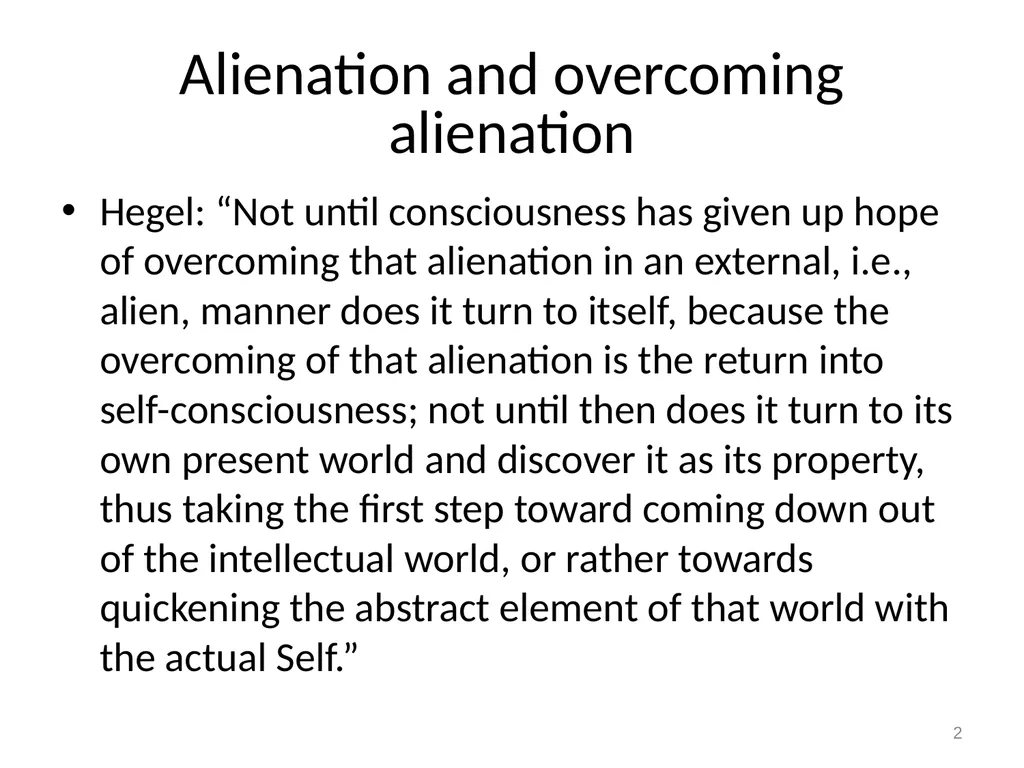
Alienation and overcoming alienation Hegel: “Not until consciousness has given up hope of overcoming that alienation in an external, i.e., alien, manner does it turn to itself, because the overcoming of that alienation is the return into self-consciousness; not until then does it turn to its own present world and discover it as its property, thus taking the first step toward coming down out of the intellectual world, or rather towards quickening the abstract element of that world with the actual Self.” 2<br>
03
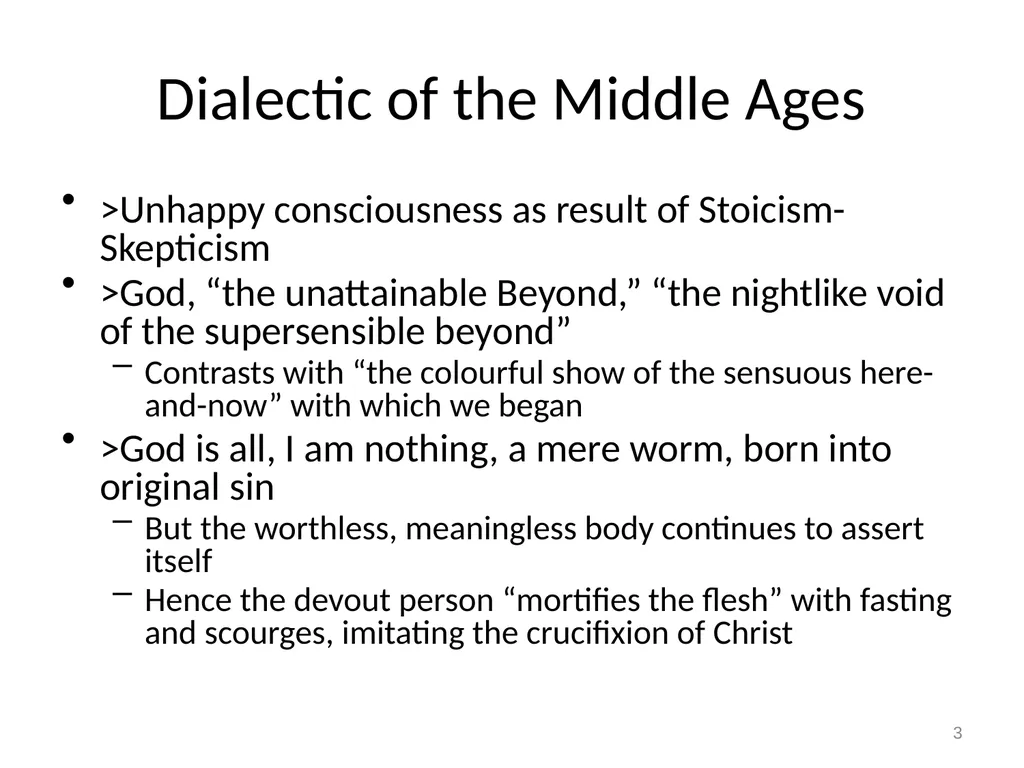
Dialectic of the Middle Ages >Unhappy consciousness as result of Stoicism-Skepticism
>God, “the unattainable Beyond,” “the nightlike void of the supersensible beyond”
Contrasts with “the colourful show of the sensuous here-and-now” with which we began
>God is all, I am nothing, a mere worm, born into original sin
But the worthless, meaningless body continues to assert itself
Hence the devout person “mortifies the flesh” with fasting and scourges, imitating the crucifixion of Christ 3<br>
>God, “the unattainable Beyond,” “the nightlike void of the supersensible beyond”
Contrasts with “the colourful show of the sensuous here-and-now” with which we began
>God is all, I am nothing, a mere worm, born into original sin
But the worthless, meaningless body continues to assert itself
Hence the devout person “mortifies the flesh” with fasting and scourges, imitating the crucifixion of Christ 3<br>
04
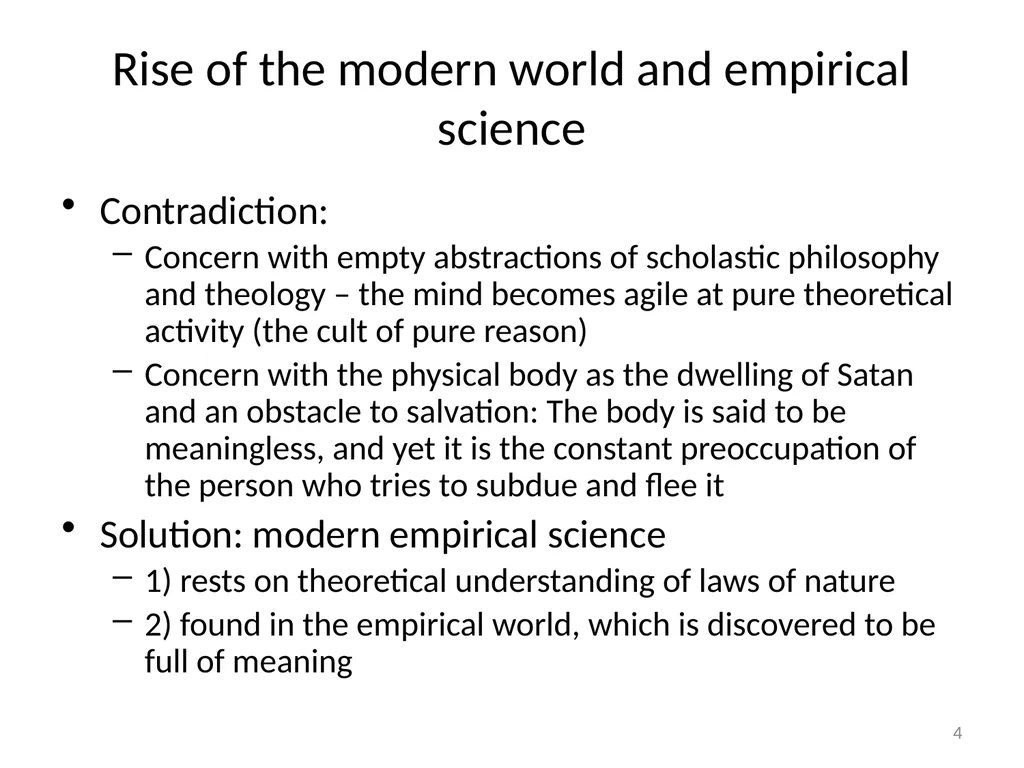
Rise of the modern world and empirical science Contradiction:
Concern with empty abstractions of scholastic philosophy and theology – the mind becomes agile at pure theoretical activity (the cult of pure reason)
Concern with the physical body as the dwelling of Satan and an obstacle to salvation: The body is said to be meaningless, and yet it is the constant preoccupation of the person who tries to subdue and flee it
Solution: modern empirical science
1) rests on theoretical understanding of laws of nature
2) found in the empirical world, which is discovered to be full of meaning 4<br>
Concern with empty abstractions of scholastic philosophy and theology – the mind becomes agile at pure theoretical activity (the cult of pure reason)
Concern with the physical body as the dwelling of Satan and an obstacle to salvation: The body is said to be meaningless, and yet it is the constant preoccupation of the person who tries to subdue and flee it
Solution: modern empirical science
1) rests on theoretical understanding of laws of nature
2) found in the empirical world, which is discovered to be full of meaning 4<br>
05
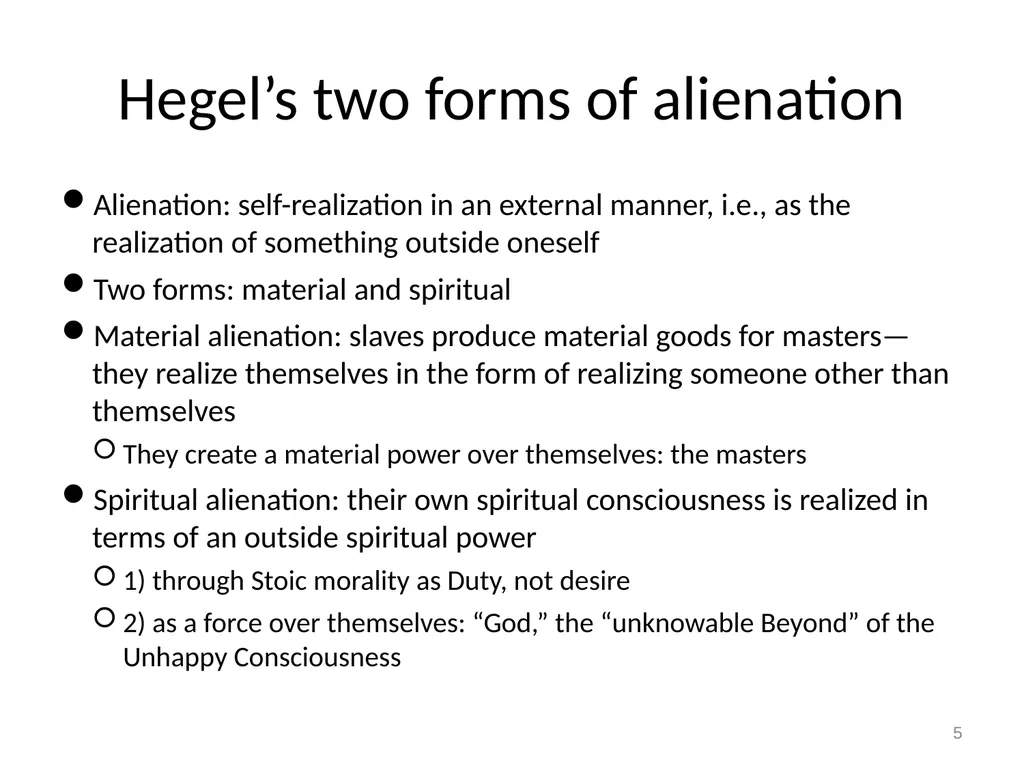
Hegel’s two forms of alienation Alienation: self-realization in an external manner, i.e., as the realization of something outside oneself
Two forms: material and spiritual
Material alienation: slaves produce material goods for masters—they realize themselves in the form of realizing someone other than themselves
They create a material power over themselves: the masters
Spiritual alienation: their own spiritual consciousness is realized in terms of an outside spiritual power
1) through Stoic morality as Duty, not desire
2) as a force over themselves: “God,” the “unknowable Beyond” of the Unhappy Consciousness 5<br>
Two forms: material and spiritual
Material alienation: slaves produce material goods for masters—they realize themselves in the form of realizing someone other than themselves
They create a material power over themselves: the masters
Spiritual alienation: their own spiritual consciousness is realized in terms of an outside spiritual power
1) through Stoic morality as Duty, not desire
2) as a force over themselves: “God,” the “unknowable Beyond” of the Unhappy Consciousness 5<br>
06
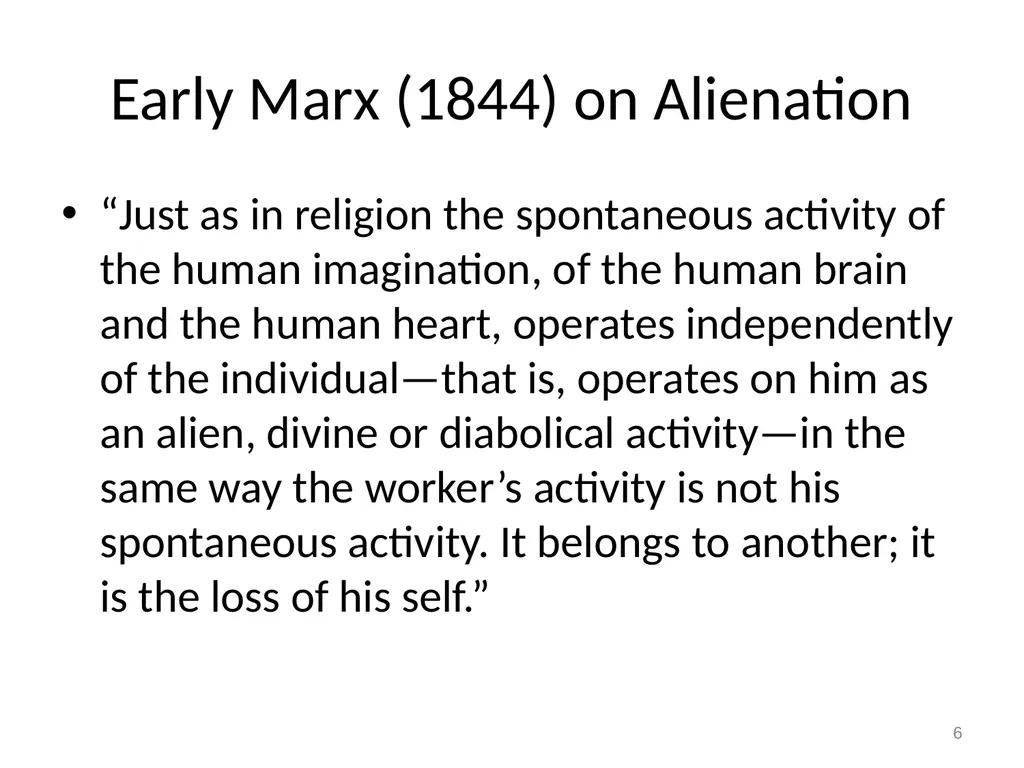
Early Marx (1844) on Alienation “Just as in religion the spontaneous activity of the human imagination, of the human brain and the human heart, operates independently of the individual—that is, operates on him as an alien, divine or diabolical activity—in the same way the worker’s activity is not his spontaneous activity. It belongs to another; it is the loss of his self.” 6<br>
07
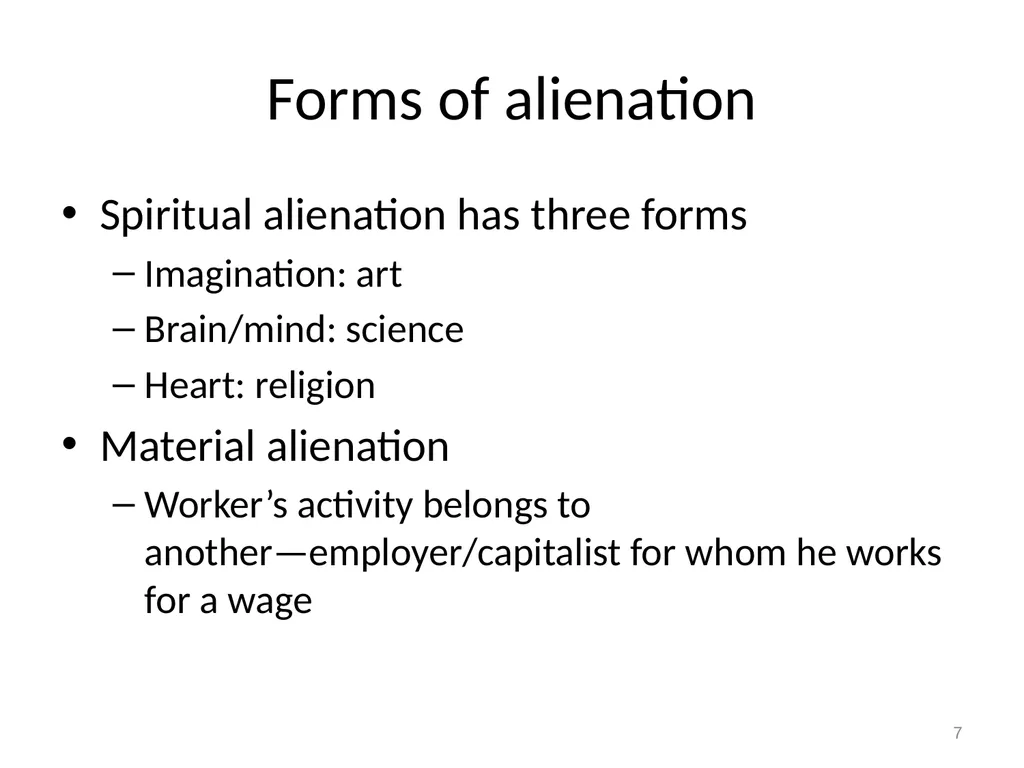
Forms of alienation Spiritual alienation has three forms
Imagination: art
Brain/mind: science
Heart: religion
Material alienation
Worker’s activity belongs to another—employer/capitalist for whom he works for a wage 7<br>
Imagination: art
Brain/mind: science
Heart: religion
Material alienation
Worker’s activity belongs to another—employer/capitalist for whom he works for a wage 7<br>
08
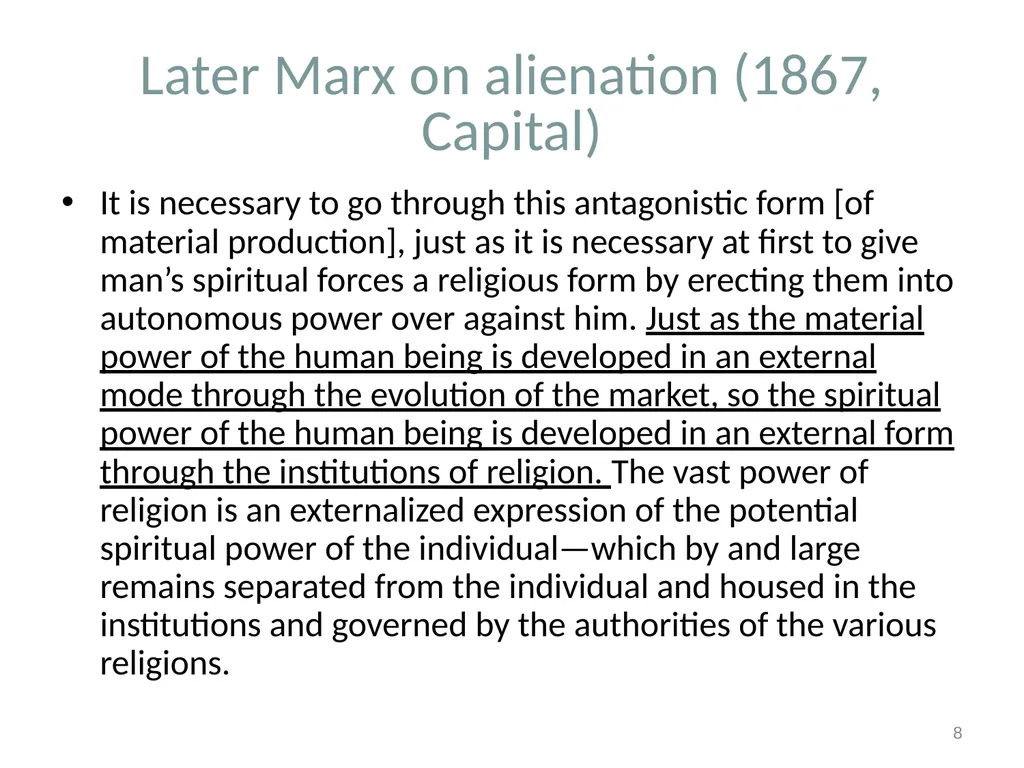
Later Marx on alienation (1867, Capital) It is necessary to go through this antagonistic form [of material production], just as it is necessary at first to give man’s spiritual forces a religious form by erecting them into autonomous power over against him. Just as the material power of the human being is developed in an external mode through the evolution of the market, so the spiritual power of the human being is developed in an external form through the institutions of religion. The vast power of religion is an externalized expression of the potential spiritual power of the individual—which by and large remains separated from the individual and housed in the institutions and governed by the authorities of the various religions. 8<br>
09
Main focus of Marx’s life work Marx thus remains close to Hegel throughout his life: not only in 1844 (so-called “young Marx)
Focus of Marx’s later work (Das Kapital): is on material alienation, the logic of the economic system
But spiritual alienation is also, equally important, although “Marxism” tends to ignore this and treat material alienation as what is truly important
> Marx’s “materialist” critique of Hegel needs to be reexamined 9<br>
Focus of Marx’s later work (Das Kapital): is on material alienation, the logic of the economic system
But spiritual alienation is also, equally important, although “Marxism” tends to ignore this and treat material alienation as what is truly important
> Marx’s “materialist” critique of Hegel needs to be reexamined 9<br>
10
Alienation of labor Marx argues (1844) that (alienated) “labor is external to the worker, i.e., it does not belong to his essential being; that in his work, therefore, he does not affirm himself but denies himself, does not feel content but unhappy, does not develop freely his physical and mental energy but mortifies his body and ruins his mind.” 10<br>
11
Contradiction of essence and existence The essential powers of the worker are actualized in an external form: as something that the worker sells to the capitalist for a wage, so that he can keep body and soul together
She sells her labor: it is treated as a thing that can be bought and sold, just like other commodities
But in truth as opposed to appearance, work is the essential life-activity of a human being: the activity by which he transforms nature to achieve his goals
= Hegel’s master-slave dialectic
Essential powers are realized in an existential form that contradicts them 11<br>
She sells her labor: it is treated as a thing that can be bought and sold, just like other commodities
But in truth as opposed to appearance, work is the essential life-activity of a human being: the activity by which he transforms nature to achieve his goals
= Hegel’s master-slave dialectic
Essential powers are realized in an existential form that contradicts them 11<br>
12
Implicit “ought” Implicit “ought”: existence ought to accord with essence
“he does not affirm himself but denies himself,
In our work we should affirm ourselves
does not feel content but unhappy
In our work we should feel happy
does not develop freely his physical and mental energy but mortifies his body and ruins his mind.
In our work we should develop our physical and mental energies 12<br>
“he does not affirm himself but denies himself,
In our work we should affirm ourselves
does not feel content but unhappy
In our work we should feel happy
does not develop freely his physical and mental energy but mortifies his body and ruins his mind.
In our work we should develop our physical and mental energies 12<br>
13
Human essence: species being “The animal is one with its life activity. It does not distinguish itself from it. It is its life activity. Man makes his life activity itself the object of his will and of his consciousness. He has conscious life activity. It is not a determination with which he directly merges. It is just because of this that he is a species being. Or, it is only because he is a species-being that he is a conscious being, i.e., that his own life is an object for him.” 13<br>
14
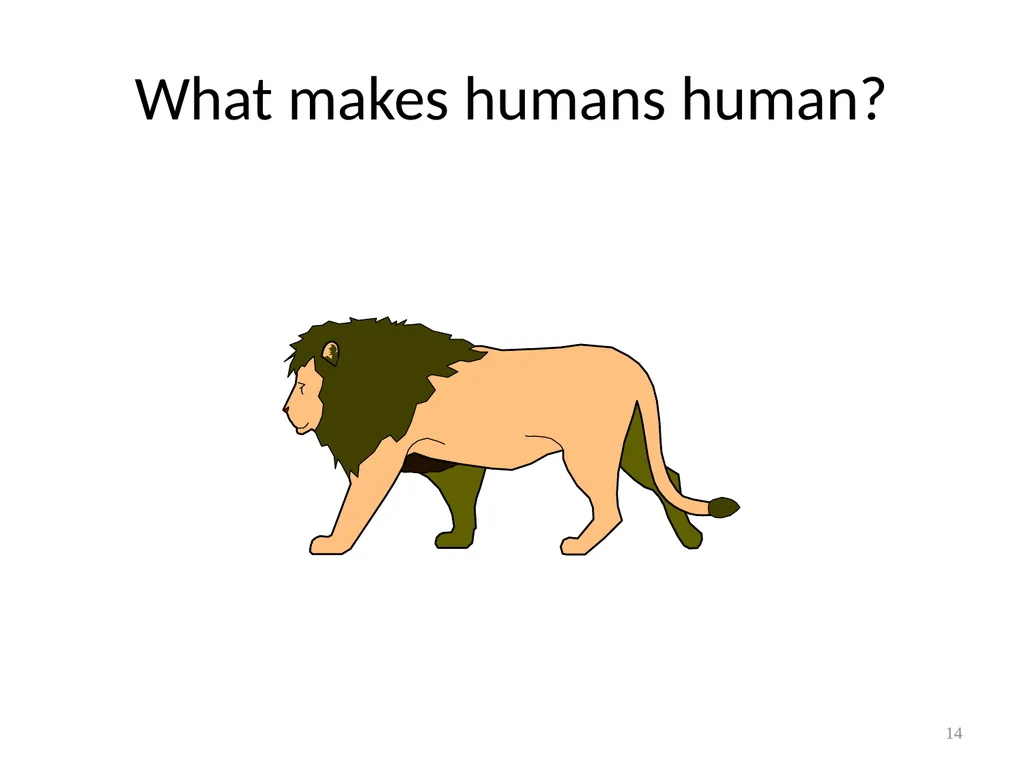
What makes humans human? 14<br>
15
Why animals cannot alienate themselves The animal is its life activity; it merges with it.
Hence it is governed by species instincts
The individual explicitly lives for itself, but implicitly the species governs the individual
The animal is one with its life activity: the claws of the tiger, the speed of the gazelle
The animal is determined by its specific species nature 15<br>
Hence it is governed by species instincts
The individual explicitly lives for itself, but implicitly the species governs the individual
The animal is one with its life activity: the claws of the tiger, the speed of the gazelle
The animal is determined by its specific species nature 15<br>
16
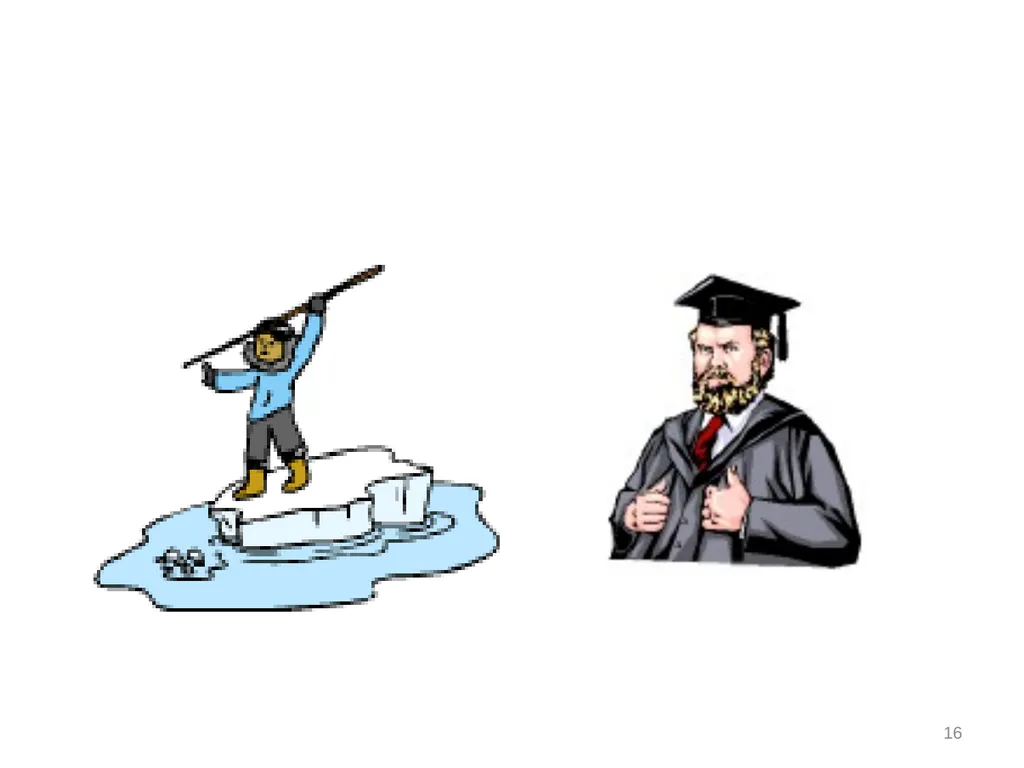
16<br>
17
Human self-consciousness Human beings are self-conscious because they are species beings
Self-consciousness:
one is outside of oneself; can treat oneself as an object;
and yet this “object” is oneself
1) Subjective reflection on oneself: Descartes’ cogito
2) Practical working on oneself through the tools that exist as objects outside oneself
Tools are the external, non-biological organs of the human being
Humans make their tools: i.e., we make ourselves as human beings 17<br>
Self-consciousness:
one is outside of oneself; can treat oneself as an object;
and yet this “object” is oneself
1) Subjective reflection on oneself: Descartes’ cogito
2) Practical working on oneself through the tools that exist as objects outside oneself
Tools are the external, non-biological organs of the human being
Humans make their tools: i.e., we make ourselves as human beings 17<br>
18
External powers of species being The human being has its life activity outside itself, so that it can be an object that can be transformed
1) material tools (stone age, bronze age, iron …)
2) spiritual tools (oral language, written language, printed books, newspapers, Internet)
Is the human being “The Naked Ape” (Desmond Morris), or the ape that makes and wears clothes?
= unlimited potential for development
=freedom from determination by biological forces 18<br>
1) material tools (stone age, bronze age, iron …)
2) spiritual tools (oral language, written language, printed books, newspapers, Internet)
Is the human being “The Naked Ape” (Desmond Morris), or the ape that makes and wears clothes?
= unlimited potential for development
=freedom from determination by biological forces 18<br>
19
Selling oneself Under capitalism, the tools belong to the capitalist
=The worker does not own what makes her a human being
Hence he identifies himself with his physical existence alone
The actualization of the worker’s essential life activity requires re-connecting with the tools that have evolved through human history
The worker treats his own potential human activity (ability to work) as an object to sell in order to live 19<br>
=The worker does not own what makes her a human being
Hence he identifies himself with his physical existence alone
The actualization of the worker’s essential life activity requires re-connecting with the tools that have evolved through human history
The worker treats his own potential human activity (ability to work) as an object to sell in order to live 19<br>
20
Work to live or live to work? The modern worker works to get a wage in order to live
Eating, reproducing, caring for one’s bodily needs—this is the goal of life
But this is animal life
One’s human essence—rising above animal existence by transforming nature—this essential power is treated as a means for mere animal existence 20<br>
Eating, reproducing, caring for one’s bodily needs—this is the goal of life
But this is animal life
One’s human essence—rising above animal existence by transforming nature—this essential power is treated as a means for mere animal existence 20<br>
21
Animal <> Human “As a result [of the alienation of labor], therefore, man (the worker) no longer feels himself to be freely active in any but his animal functions—eating, drinking, procreating, or at most in his dwelling and in dressing-up, etc.; and in his human functions he no longer feels himself to be anything but an animal. What is animal becomes human and what is human becomes animal.” 21<br>
22
Where is the human essence? In his 6th Thesis on Feuerbach: Marx states that the human essence is not something within each individual. Instead, it is the ensemble (or totality) of the social relations.
The same idea is expressed in the 1857 Preface to a Contribution to the Critique of Political Economy: “It is not the consciousness of men that determines their being, but, on the contrary, their social being that determines their consciousness.”
= consciousness is not something within the separate individual, but is the expression within the individual of social (i.e., species) being 22<br>
The same idea is expressed in the 1857 Preface to a Contribution to the Critique of Political Economy: “It is not the consciousness of men that determines their being, but, on the contrary, their social being that determines their consciousness.”
= consciousness is not something within the separate individual, but is the expression within the individual of social (i.e., species) being 22<br>
23
Alienated consciousness Hegel: “I” is a “we”: There is no “I” without a “not-I” (an other person)
Consciousness is “inter-subjective”: not something within the “head” of an individual
contrary to early modern philosophy
Such a concept of the location of consciousness within the skin of the individual expresses conditions of alienation (The Naked Ape) 23<br>
Consciousness is “inter-subjective”: not something within the “head” of an individual
contrary to early modern philosophy
Such a concept of the location of consciousness within the skin of the individual expresses conditions of alienation (The Naked Ape) 23<br>
24
Alienation is necessary (greed is good) “It is necessary to go through this antagonistic form [of material production], just as it is necessary at first to give man’s spiritual forces a religious form by erecting them into autonomous power over against him. Just as the material power of the human being is developed in an external mode through the evolution of the market, so the spiritual power of the human being is developed in an external form through the institutions of religion. The vast power of religion is an externalized expression of the potential spiritual power of the individual—which by and large remains separated from the individual and housed in the institutions and governed by the authorities of the various religions.” 24<br>
25
Don’t forget Kant “Thanks be to Nature, then, for the incompatibility, for the heartless competitive vanity, for the insatiable desire to possess and to rule! Without them, all the excellent natural capacities of humanity would sleep, undeveloped.”
Kant’s stages of history: 1) the contented shepherd; 2) egotism, competition, capitalism; 3) a society governed by moral norms (the Highest Good)
2 is necessary for 3 25<br>
Kant’s stages of history: 1) the contented shepherd; 2) egotism, competition, capitalism; 3) a society governed by moral norms (the Highest Good)
2 is necessary for 3 25<br>
26
Hegel’s three stages of history 1) human life as a quasi-natural existence: nature religion of primitive peoples and the East
2) the dialectic of the ego of the West
3) recognition of spirit: the modern State with citizenship participation in the life of society as a whole 26<br>
2) the dialectic of the ego of the West
3) recognition of spirit: the modern State with citizenship participation in the life of society as a whole 26<br>
27
Marx’s stages 0) Early communal societies dependent on nature
People directly, consciously relate to one another as they produce goods they need
1) “Relationships of personal dependence (which originally arise quite spontaneously) are the first forms of society, in which the human productivity develops to a limited extent and at isolated points.
E.g., slavery, feudalism: early “civilizations” 27<br>
People directly, consciously relate to one another as they produce goods they need
1) “Relationships of personal dependence (which originally arise quite spontaneously) are the first forms of society, in which the human productivity develops to a limited extent and at isolated points.
E.g., slavery, feudalism: early “civilizations” 27<br>
28
Nature of capitalism 2) “Personal independence based upon dependence mediated by things is the second great form, and only in it is a system of general social exchange of matter, a system of universal relations, universal requirements and universal capacities, formed.” 28<br>
29
Society of separate egos = capitalism: independent individuals whose relation to one another is mediated by the exchange of things (commodities)
The relation between humans is not a direct relation, as in primitive societies or between master and slave
There is the limited independence of individuals (contrary to the previous stages of slavery and feudalism), but also powerful dependence on society as an impersonal system in the form of the market
=Society (species being) as an external force still dominates the individual 29<br>
The relation between humans is not a direct relation, as in primitive societies or between master and slave
There is the limited independence of individuals (contrary to the previous stages of slavery and feudalism), but also powerful dependence on society as an impersonal system in the form of the market
=Society (species being) as an external force still dominates the individual 29<br>
30
Communism 3) “Free individuality, based on the universal development of the individuals and the subordination of their communal, social productivity, which is their social possession [Vermőgen], is the third stage. The second stage creates the conditions for the third.”
Note: communism subordinates the communal/social side of activity to the individual
Not the opposite!
Species being is subordinated to the individuals who freely develop their powers in relationship to one another 30<br>
Note: communism subordinates the communal/social side of activity to the individual
Not the opposite!
Species being is subordinated to the individuals who freely develop their powers in relationship to one another 30<br>
31
Energy expansion The alienated individual is one unit of energy confronting seven billion potentially hostile units that take the form of the indifferent market to which the individual must adapt.
The freely developing individual would be able to channel the material and spiritual energies of seven billion people
And since each of these seven billion individuals is also awakening to the potential of connecting to all the others, the total increase of energy available to each individual expands on a logarithmic scale. 31<br>
The freely developing individual would be able to channel the material and spiritual energies of seven billion people
And since each of these seven billion individuals is also awakening to the potential of connecting to all the others, the total increase of energy available to each individual expands on a logarithmic scale. 31<br>
32
Definitions of Communism: 1848 Definition of Communism: “an association in which the free development of each is the condition for the free development of all.” (Communist Manifesto: 1848) 32<br>
33
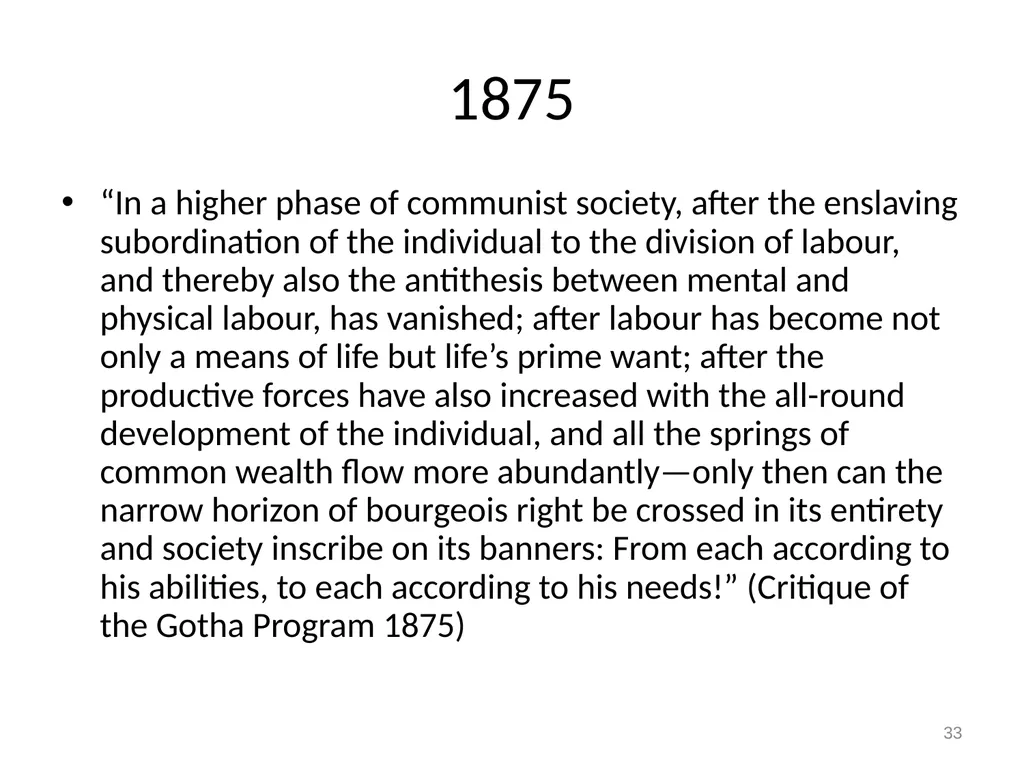
1875 “In a higher phase of communist society, after the enslaving subordination of the individual to the division of labour, and thereby also the antithesis between mental and physical labour, has vanished; after labour has become not only a means of life but life’s prime want; after the productive forces have also increased with the all-round development of the individual, and all the springs of common wealth flow more abundantly—only then can the narrow horizon of bourgeois right be crossed in its entirety and society inscribe on its banners: From each according to his abilities, to each according to his needs!” (Critique of the Gotha Program 1875) 33<br>
34
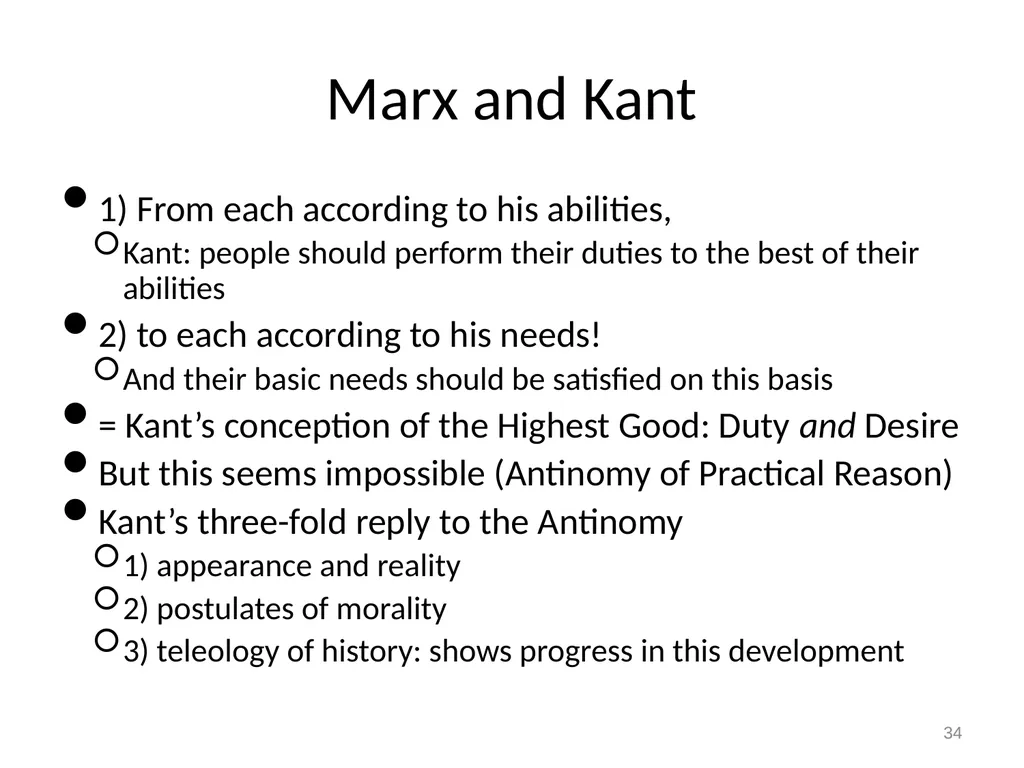
Marx and Kant 1) From each according to his abilities,
Kant: people should perform their duties to the best of their abilities
2) to each according to his needs!
And their basic needs should be satisfied on this basis
= Kant’s conception of the Highest Good: Duty and Desire
But this seems impossible (Antinomy of Practical Reason)
Kant’s three-fold reply to the Antinomy
1) appearance and reality
2) postulates of morality
3) teleology of history: shows progress in this development 34<br>
Kant: people should perform their duties to the best of their abilities
2) to each according to his needs!
And their basic needs should be satisfied on this basis
= Kant’s conception of the Highest Good: Duty and Desire
But this seems impossible (Antinomy of Practical Reason)
Kant’s three-fold reply to the Antinomy
1) appearance and reality
2) postulates of morality
3) teleology of history: shows progress in this development 34<br>