7 YEAR Introduction to the workshop: Health and
Description: 7 YEAR Introduction to the workshop: Health and Safety Baseline Assessment: What do you already know about DT? TEXTILES Monsters PROJECT Materials: Wood classification. Where does timber come from? Evaluate: What makes a good Birdhouse? How
Related Topics
Download Presentation
"7 YEAR Introduction to the workshop: Health and" is the property of its rightful owner. Permission is granted to download and print the materials on this website for personal, non-commercial use only, and to display it on your personal computer provided you do not modify the materials and that you retain all copyright notices contained in the materials. By downloading content from our website, you accept the terms of this agreement.
Presentation Transcript
slide1. 7 YEAR Introduction to the workshop:
Health and Safety Baseline Assessment:
What do you already know about DT? TEXTILES
Monsters PROJECT Materials:
Wood classification. Where does timber come from? Evaluate:
What makes a good Birdhouse? How can you improve / modify your design? Materials:
An introduction to fabrics and using sewing machine. Make:
Use different methods to decorate fabric, develop sewing machine skills and produce a working product. Design:
Use industry methods to produce a range of designs suited to the brief. Knowledge:
Health and Safety in the Kitchen.
The Eatwell Guide, 8 tips for healthy living. Make:
Wood joints
Use of hand tools and machines Bag 4 Life
PROJECT SAMPLER
Textile
PROJECT Materials:
Develop a knowledge of sustainability within the textile industry. Source pre-loved fabrics to be used for project. Make:
Using sewing machine to follow instructions and construct a Tote bag. FOOD
Nutrients KS4
OPTIONS Design:Â
Use materials and industry techniques to produce a series of designs, showing development from concept to final product. Design:
Following recipes and adapting them to meet your preferences, looking at dietary needs Make:
Beginning to use kitchen equipment to make; a range of nutritious recipe. Evaluate:
Does your product work? ACCESS FM. How can you fix problems? SKILLS BOX
MIXED MATERIALS Evaluate:
How successful we my products? Did they meet the brief? Experience a wide range of fun and exciting projects that teach you valuable skills in the workshop, understanding different materials and how they work. After choosing options in year 10, focus your studies in GCSE D&T, vocational food & cookery or Engineering in years 10 -11, through exciting, real life projects.
Deepen your understanding of these subjects in the world around us whilst developing products that help various needs and users. Real life scenarios and experiences. Work in more depth on projects, honing your practical skills, improving your resilience & problem solving whilst developing independence in the workshop. Make:
Use a wide range of skills, materials and making skills. To develop high quality craftsmanship wind chime. Using CAD and CAM Design:
Design development of the Birdhouse Identifying problems and creating solutions RSPB - Birdhouse
PROJECT FOOD
Healthy eating
PROJECTs FOOD - Choices
Outside
Influences Materials:
Polymers Classification.
What is a polymer?
Manmade materials
Regenerated materials Make:
Vacuum Forming & Vinyl Cutter, CAD Laser cutting Evaluate:
Does your product work? How can you fix problems? Design:
Designing for a user and client. What is an isometric projection? Develop design ideas using 2D Design. Wind powered
BOAT
PROJECT PRODUCT
DESIGN GRAPHICS PRODUCT FASHION & TEXTILES FOOD & COOKERY
Hospitality Evaluate:
Sustainability impacting design. Product evaluation. Knowledge:Â
What are the implications of not following the Eatwell guide, seasonal produce, food ethics, cost/ budget & culture/ religion. Design:Â Â
Adapting recipes in order to meet the needs of a specific brief / customer need. Make:
Refine skills and develop new skills and make: a range of modified recipes to meet customers needs. Evaluate:
How the moral consequences of food choice influences what we eat Design:
Designing for families, outdoor space. How do we make a product fun, functional and safe? Materials:
Working with hardwoods, metal, acrylic and specialist materials. Working properties and recognizing materials. Design:
Practicing Isometric Projection and rendering skills. Orthographic projection. Evaluate:
What skills have you developed? Test your product and consider how you would improve it. Work in more depth on projects, honing your practical skills, improving your resilience & problem solving whilst developing independence in the workshop. Knowledge:Â
Exploring Macronutrients and Micronutrients, the impact on the health and wellbeing. Design:Â Â
Adapting a standard recipe to make it meet dietary needs/ lifestyle choices Make:
Continuing to refine skills in order to demonstrate confidence when cooking a variety of dishes: including presentation skills and side dishes (professional standards) Evaluate:
How? What? Why?
Constraints/ limitations and possibilities? Materials:
Sustainable material focus. Natural fibres suitability Make:
Decorate fabric,  using sewing machine, produce a suitable end product Design:Â
Use surface decoration to design a personalised item for teens. Mood boards. Design developments. Evaluate:
Product, skills, progression, knowledge. How it's assessed
Written exam: 2 hours
100 marks
50% of GCSE Non-exam assessment (NEA): 30–35 hours approx.
100 marks
50% of GCSE TIMBERS
METALS
POLYMERS PAPER & BOARDS
ICT FABRICS
,FAHSION AND FURNISHINGS GCSE DESIGN & TECHNOLOGY How it's assessed
40% of THE Vtec - Written exam: 1 h 45 m
60% of GCSE - Non-exam assessment
Task 1:Â Recipe adaption
Task 2: 2 course meal – special diet
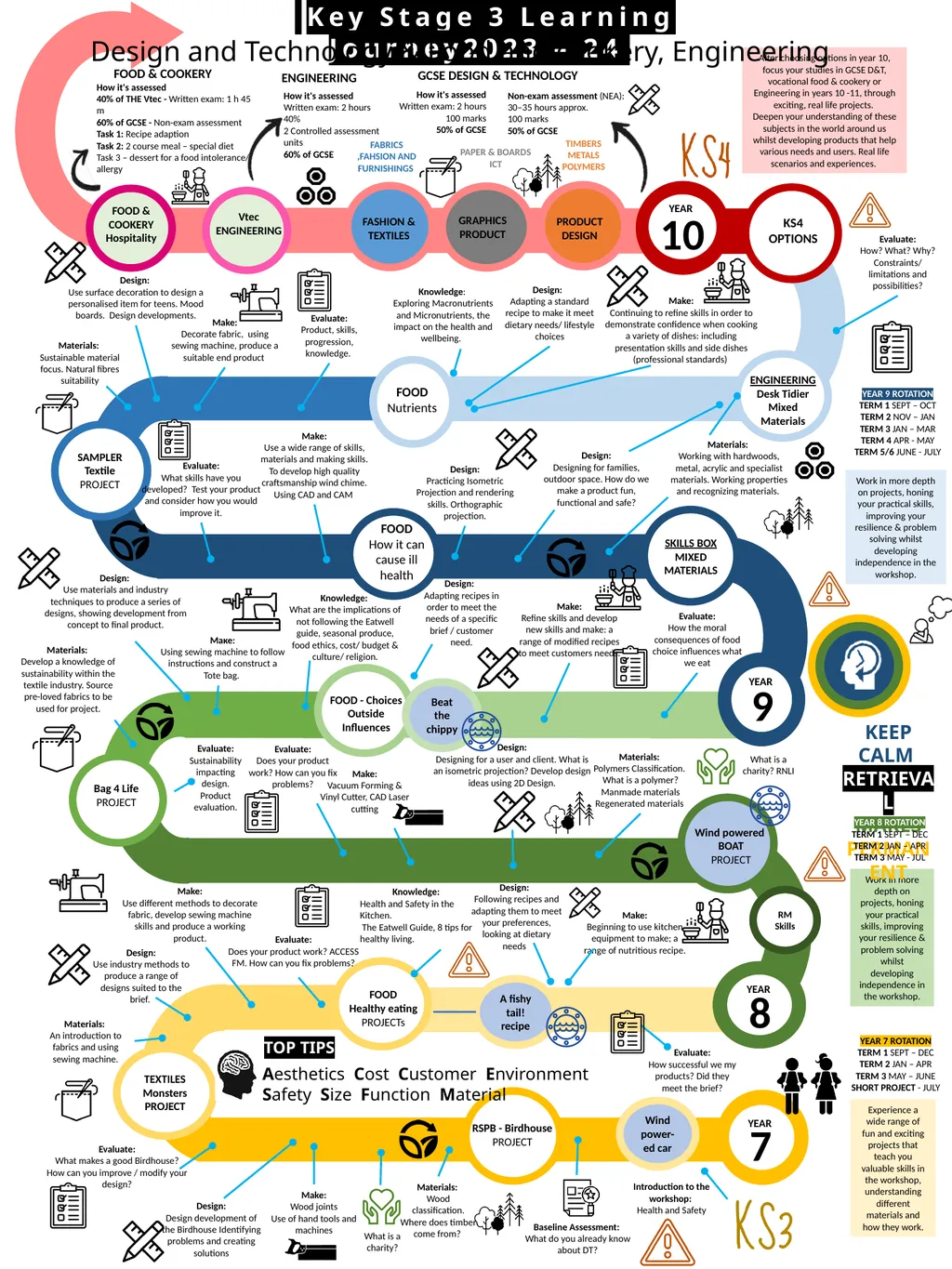
Task 3 – dessert for a food intolerance/ allergy FOOD & COOKERY Key Stage 3 Learning Journey2023 – 24 Design and Technology & Food and cookery, Engineering Aesthetics Cost Customer Environment
Safety Size Function Material TOP TIPS KEEP CALM
RETRIEVAL
MAKES
PERMANENT YEAR 9 ROTATION
TERM 1 SEPT – OCT
TERM 2 NOV – JAN
TERM 3 JAN – MAR
TERM 4 APR - MAY
TERM 5/6 JUNE - JULY YEAR 8 ROTATION
TERM 1 SEPT – DEC
TERM 2 JAN – APR
TERM 3 MAY - JUL YEAR 7 ROTATION
TERM 1 SEPT – DEC
TERM 2 JAN – APR
TERM 3 MAY – JUNE
SHORT PROJECT - JULY Wind power-ed car What is a charity? RM
Skills What is a charity? RNLI Vtec ENGINEERING How it's assessed
Written exam: 2 hours
40%
2 Controlled assessment units
60% of GCSE ENGINEERING A fishy tail! recipe Beat the chippy FOOD
How it can cause ill health ENGINEERING
Desk Tidier
Mixed Materials<br>
Health and Safety Baseline Assessment:
What do you already know about DT? TEXTILES
Monsters PROJECT Materials:
Wood classification. Where does timber come from? Evaluate:
What makes a good Birdhouse? How can you improve / modify your design? Materials:
An introduction to fabrics and using sewing machine. Make:
Use different methods to decorate fabric, develop sewing machine skills and produce a working product. Design:
Use industry methods to produce a range of designs suited to the brief. Knowledge:
Health and Safety in the Kitchen.
The Eatwell Guide, 8 tips for healthy living. Make:
Wood joints
Use of hand tools and machines Bag 4 Life
PROJECT SAMPLER
Textile
PROJECT Materials:
Develop a knowledge of sustainability within the textile industry. Source pre-loved fabrics to be used for project. Make:
Using sewing machine to follow instructions and construct a Tote bag. FOOD
Nutrients KS4
OPTIONS Design:Â
Use materials and industry techniques to produce a series of designs, showing development from concept to final product. Design:
Following recipes and adapting them to meet your preferences, looking at dietary needs Make:
Beginning to use kitchen equipment to make; a range of nutritious recipe. Evaluate:
Does your product work? ACCESS FM. How can you fix problems? SKILLS BOX
MIXED MATERIALS Evaluate:
How successful we my products? Did they meet the brief? Experience a wide range of fun and exciting projects that teach you valuable skills in the workshop, understanding different materials and how they work. After choosing options in year 10, focus your studies in GCSE D&T, vocational food & cookery or Engineering in years 10 -11, through exciting, real life projects.
Deepen your understanding of these subjects in the world around us whilst developing products that help various needs and users. Real life scenarios and experiences. Work in more depth on projects, honing your practical skills, improving your resilience & problem solving whilst developing independence in the workshop. Make:
Use a wide range of skills, materials and making skills. To develop high quality craftsmanship wind chime. Using CAD and CAM Design:
Design development of the Birdhouse Identifying problems and creating solutions RSPB - Birdhouse
PROJECT FOOD
Healthy eating
PROJECTs FOOD - Choices
Outside
Influences Materials:
Polymers Classification.
What is a polymer?
Manmade materials
Regenerated materials Make:
Vacuum Forming & Vinyl Cutter, CAD Laser cutting Evaluate:
Does your product work? How can you fix problems? Design:
Designing for a user and client. What is an isometric projection? Develop design ideas using 2D Design. Wind powered
BOAT
PROJECT PRODUCT
DESIGN GRAPHICS PRODUCT FASHION & TEXTILES FOOD & COOKERY
Hospitality Evaluate:
Sustainability impacting design. Product evaluation. Knowledge:Â
What are the implications of not following the Eatwell guide, seasonal produce, food ethics, cost/ budget & culture/ religion. Design:Â Â
Adapting recipes in order to meet the needs of a specific brief / customer need. Make:
Refine skills and develop new skills and make: a range of modified recipes to meet customers needs. Evaluate:
How the moral consequences of food choice influences what we eat Design:
Designing for families, outdoor space. How do we make a product fun, functional and safe? Materials:
Working with hardwoods, metal, acrylic and specialist materials. Working properties and recognizing materials. Design:
Practicing Isometric Projection and rendering skills. Orthographic projection. Evaluate:
What skills have you developed? Test your product and consider how you would improve it. Work in more depth on projects, honing your practical skills, improving your resilience & problem solving whilst developing independence in the workshop. Knowledge:Â
Exploring Macronutrients and Micronutrients, the impact on the health and wellbeing. Design:Â Â
Adapting a standard recipe to make it meet dietary needs/ lifestyle choices Make:
Continuing to refine skills in order to demonstrate confidence when cooking a variety of dishes: including presentation skills and side dishes (professional standards) Evaluate:
How? What? Why?
Constraints/ limitations and possibilities? Materials:
Sustainable material focus. Natural fibres suitability Make:
Decorate fabric,  using sewing machine, produce a suitable end product Design:Â
Use surface decoration to design a personalised item for teens. Mood boards. Design developments. Evaluate:
Product, skills, progression, knowledge. How it's assessed
Written exam: 2 hours
100 marks
50% of GCSE Non-exam assessment (NEA): 30–35 hours approx.
100 marks
50% of GCSE TIMBERS
METALS
POLYMERS PAPER & BOARDS
ICT FABRICS
,FAHSION AND FURNISHINGS GCSE DESIGN & TECHNOLOGY How it's assessed
40% of THE Vtec - Written exam: 1 h 45 m
60% of GCSE - Non-exam assessment
Task 1:Â Recipe adaption
Task 2: 2 course meal – special diet
Task 3 – dessert for a food intolerance/ allergy FOOD & COOKERY Key Stage 3 Learning Journey2023 – 24 Design and Technology & Food and cookery, Engineering Aesthetics Cost Customer Environment
Safety Size Function Material TOP TIPS KEEP CALM
RETRIEVAL
MAKES
PERMANENT YEAR 9 ROTATION
TERM 1 SEPT – OCT
TERM 2 NOV – JAN
TERM 3 JAN – MAR
TERM 4 APR - MAY
TERM 5/6 JUNE - JULY YEAR 8 ROTATION
TERM 1 SEPT – DEC
TERM 2 JAN – APR
TERM 3 MAY - JUL YEAR 7 ROTATION
TERM 1 SEPT – DEC
TERM 2 JAN – APR
TERM 3 MAY – JUNE
SHORT PROJECT - JULY Wind power-ed car What is a charity? RM
Skills What is a charity? RNLI Vtec ENGINEERING How it's assessed
Written exam: 2 hours
40%
2 Controlled assessment units
60% of GCSE ENGINEERING A fishy tail! recipe Beat the chippy FOOD
How it can cause ill health ENGINEERING
Desk Tidier
Mixed Materials<br>