90th IETF, Toronto, July 2014 PCEP Extensions in Support of Transporting Traffic Engineering Data Young Lee, Huawei Greg Bernstein, Grotto Networking Haomian Zheng, Huawei Dhruv Dhody, Huawei draft-lee-pce-transporting-te-data-00.txt 90th
"90th IETF, Toronto, July 2014 PCEP Extensions in" is the property of its rightful owner. Permission is granted to
download and print the materials on this website for personal, non-commercial use only, and to display it
on your personal computer provided you do not modify the materials and that you retain all copyright
notices contained in the materials. By downloading content from our website, you accept the terms of this
agreement.
Presentation Transcript
01
90th IETF, Toronto, July 2014 PCEP Extensions in Support of Transporting Traffic Engineering Data Young Lee, Huawei
Greg Bernstein, Grotto Networking
Haomian Zheng, Huawei
Dhruv Dhody, Huawei draft-lee-pce-transporting-te-data-00.txt<br>
02
90th IETF, Toronto, July 2014 Architectural Context [RFC4655] Section 4.3 describes the potential load of the TED on a network node and proposes an architecture where the TED is maintained by the PCE rather than the network nodes.
draft-ietf-pce-questions Section 3 touches upon this issue: “It has also been proposed that the PCE Communication Protocol (PCEP) [RFC5440] could be extended to serve as an information collection protocol to supply information from network devices to a PCE. The logic is that the network devices may already speak PCEP and so the protocol could easily be used to report details about the resources and state in the network, including the LSP state discussed in Sections 14 and 15.”<br>
03
Why this draft? Networks that do not support IGP-TE or BGP-LS but want to implement PCE as a centralized control.
Applications that require accurate and timely TE data that current convergence time associated with flooding is not justified.
Reduction of node OH processing of flooding mechanisms (esp. optical transport networks where there are large amounts of traffic data and constraints due to OTN/WSON/Flexi-grid, etc.)
Note that BGP-LS is not widely supported in optical transport networks today). 90th IETF, Toronto, July 2014<br>
04
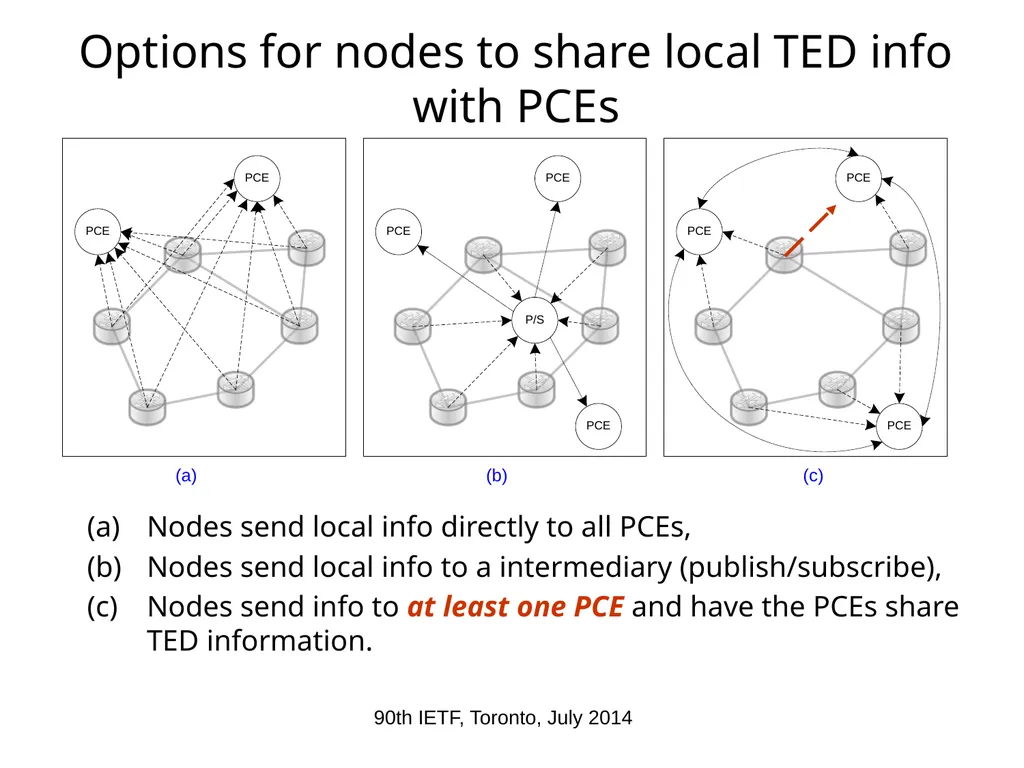
90th IETF, Toronto, July 2014 Nodes send local info directly to all PCEs,
Nodes send local info to a intermediary (publish/subscribe),
Nodes send info to at least one PCE and have the PCEs share TED information. Options for nodes to share local TED info with PCEs<br>
05
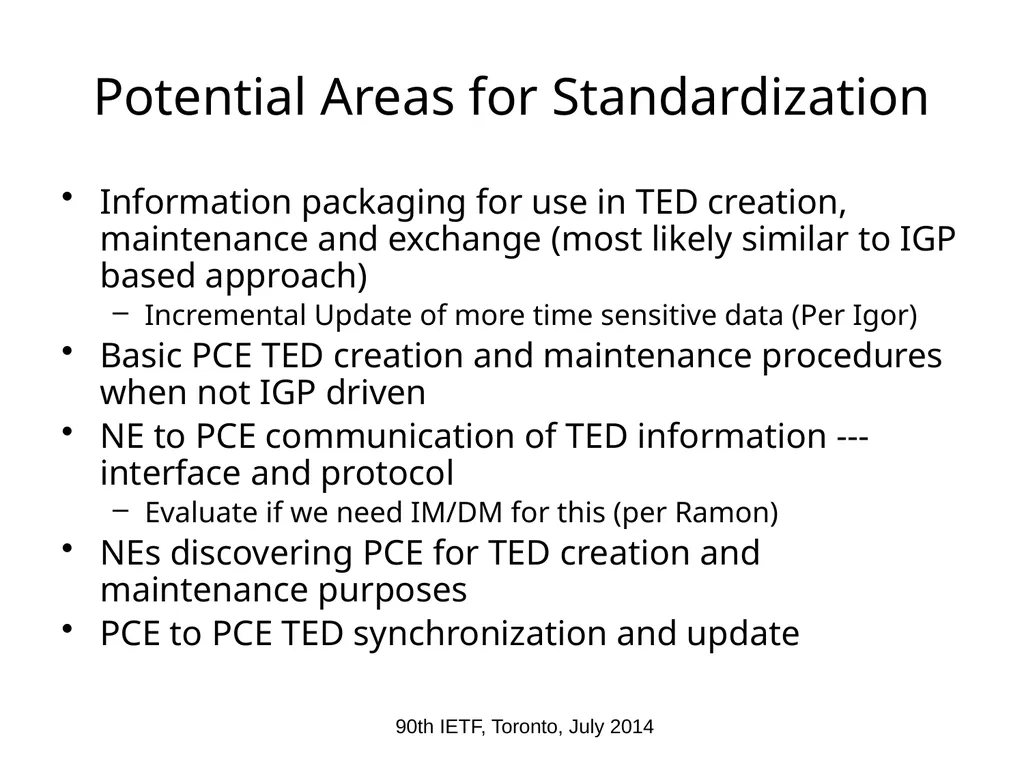
Potential Areas for Standardization Information packaging for use in TED creation, maintenance and exchange (most likely similar to IGP based approach)
Incremental Update of more time sensitive data (Per Igor)
Basic PCE TED creation and maintenance procedures when not IGP driven
NE to PCE communication of TED information --- interface and protocol
Evaluate if we need IM/DM for this (per Ramon)
NEs discovering PCE for TED creation and maintenance purposes
PCE to PCE TED synchronization and update 90th IETF, Toronto, July 2014<br>
06
90th IETF, Toronto, July 2014 Summary & Next Steps A reasonable level of interest expressed in this work in the mailing list.
What do you think?<br>