
A COMPARISON OF MULTI-SOURCE ACTUAL
Description: A COMPARISON OF MULTI-SOURCE ACTUAL EVAPOTRANSPIRATION ESTIMATES TO DERIVE A COMBINED DATASET OVER ITALY Carmelo Cammalleri, C. Corbari and M. Mancini Politecnico di Milano - Dipartimento di Ingegneria Civile e Ambientale (DICA) MOTIVATION:
Related Topics
Download Presentation
"A COMPARISON OF MULTI-SOURCE ACTUAL" is the property of its rightful owner. Permission is granted to download and print the materials on this website for personal, non-commercial use only, and to display it on your personal computer provided you do not modify the materials and that you retain all copyright notices contained in the materials. By downloading content from our website, you accept the terms of this agreement.
Presentation Transcript
slide1. A COMPARISON OF MULTI-SOURCE ACTUAL EVAPOTRANSPIRATION ESTIMATES TO DERIVE A COMBINED DATASET OVER ITALY
Carmelo Cammalleri, C. Corbari and M. Mancini
Politecnico di Milano - Dipartimento di Ingegneria Civile e Ambientale (DICA) MOTIVATION: due to the sparseness of ET measurements, large scale ET estimates are often based on models, which outputs are usually validated only on a limited number of sites. This may result in a large variety of estimates, which may differ significantly in magnitude and that can limit the use especially when volumes are needed for engineering applications. GOAL: a robust assessment of ET based on a multisource combined product over the climatological reference period 1991-2020 at monthly time scale and at a moderate spatial resolution (i.e., 1-km). Three main desirable characteristics:
1. overall temporal consistency, despite the different temporal coverage of the merged sources;
2. preserved inter-annual variability signals of the source datasets;
3. information on the uncertainty of the best-guess estimations based on the discrepancies among datasets. DATASETS
APPROACH NEXT STEPS: 1) applying the extended collocation (EC) to anomalies (z-score) in order to derive robust estimates of inter-annual fluctuations to be added to the long-term climatology; 2) comparison with ground observations. best-guess
+
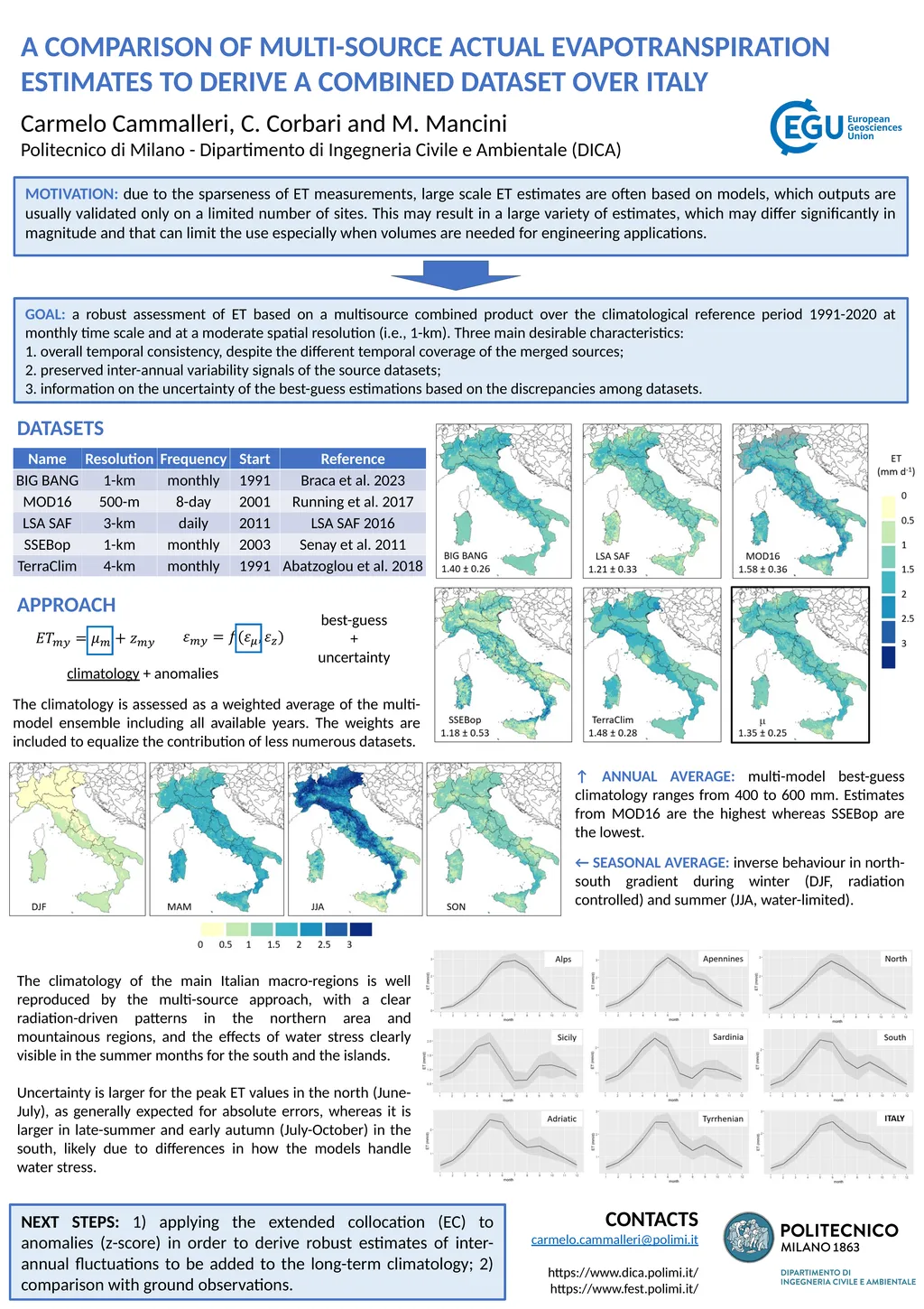
uncertainty climatology + anomalies ↑ ANNUAL AVERAGE: multi-model best-guess climatology ranges from 400 to 600 mm. Estimates from MOD16 are the highest whereas SSEBop are the lowest.
← SEASONAL AVERAGE: inverse behaviour in north-south gradient during winter (DJF, radiation controlled) and summer (JJA, water-limited). CONTACTS
carmelo.cammalleri@polimi.it
https://www.dica.polimi.it/
https://www.fest.polimi.it/ The climatology of the main Italian macro-regions is well reproduced by the multi-source approach, with a clear radiation-driven patterns in the northern area and mountainous regions, and the effects of water stress clearly visible in the summer months for the south and the islands.
Uncertainty is larger for the peak ET values in the north (June-July), as generally expected for absolute errors, whereas it is larger in late-summer and early autumn (July-October) in the south, likely due to differences in how the models handle water stress. The climatology is assessed as a weighted average of the multi-model ensemble including all available years. The weights are included to equalize the contribution of less numerous datasets.<br>
Carmelo Cammalleri, C. Corbari and M. Mancini
Politecnico di Milano - Dipartimento di Ingegneria Civile e Ambientale (DICA) MOTIVATION: due to the sparseness of ET measurements, large scale ET estimates are often based on models, which outputs are usually validated only on a limited number of sites. This may result in a large variety of estimates, which may differ significantly in magnitude and that can limit the use especially when volumes are needed for engineering applications. GOAL: a robust assessment of ET based on a multisource combined product over the climatological reference period 1991-2020 at monthly time scale and at a moderate spatial resolution (i.e., 1-km). Three main desirable characteristics:
1. overall temporal consistency, despite the different temporal coverage of the merged sources;
2. preserved inter-annual variability signals of the source datasets;
3. information on the uncertainty of the best-guess estimations based on the discrepancies among datasets. DATASETS
APPROACH NEXT STEPS: 1) applying the extended collocation (EC) to anomalies (z-score) in order to derive robust estimates of inter-annual fluctuations to be added to the long-term climatology; 2) comparison with ground observations. best-guess
+
uncertainty climatology + anomalies ↑ ANNUAL AVERAGE: multi-model best-guess climatology ranges from 400 to 600 mm. Estimates from MOD16 are the highest whereas SSEBop are the lowest.
← SEASONAL AVERAGE: inverse behaviour in north-south gradient during winter (DJF, radiation controlled) and summer (JJA, water-limited). CONTACTS
carmelo.cammalleri@polimi.it
https://www.dica.polimi.it/
https://www.fest.polimi.it/ The climatology of the main Italian macro-regions is well reproduced by the multi-source approach, with a clear radiation-driven patterns in the northern area and mountainous regions, and the effects of water stress clearly visible in the summer months for the south and the islands.
Uncertainty is larger for the peak ET values in the north (June-July), as generally expected for absolute errors, whereas it is larger in late-summer and early autumn (July-October) in the south, likely due to differences in how the models handle water stress. The climatology is assessed as a weighted average of the multi-model ensemble including all available years. The weights are included to equalize the contribution of less numerous datasets.<br>