
A Comparison Study for Novelty Control Mechanisms
Description: A Comparison Study for Novelty Control Mechanisms Applied to Web News Stories 2012 IEEEWICACM International Conference on Web Intelligence (WI 2012) December 4-7, 2012 Introduction (1) The Web is a great source of information However,
Related Topics
Download Presentation
"A Comparison Study for Novelty Control Mechanisms" is the property of its rightful owner. Permission is granted to download and print the materials on this website for personal, non-commercial use only, and to display it on your personal computer provided you do not modify the materials and that you retain all copyright notices contained in the materials. By downloading content from our website, you accept the terms of this agreement.
Presentation Transcript
slide1. A Comparison Study for Novelty Control Mechanisms Applied to Web News Stories 2012 IEEE/WIC/ACM International Conference on Web Intelligence (WI 2012) December 4-7, 2012<br>
slide2. Introduction (1) The Web is a great source of information
However, there is an information overload
Solution: information filtering and structuring based on user interests (commonly derived from queries)
Example: Hermes news personalization framework retrieves relevant news based on preferences expressed using concepts from an ontology 2012 IEEE/WIC/ACM International Conference on Web Intelligence (WI 2012)<br>
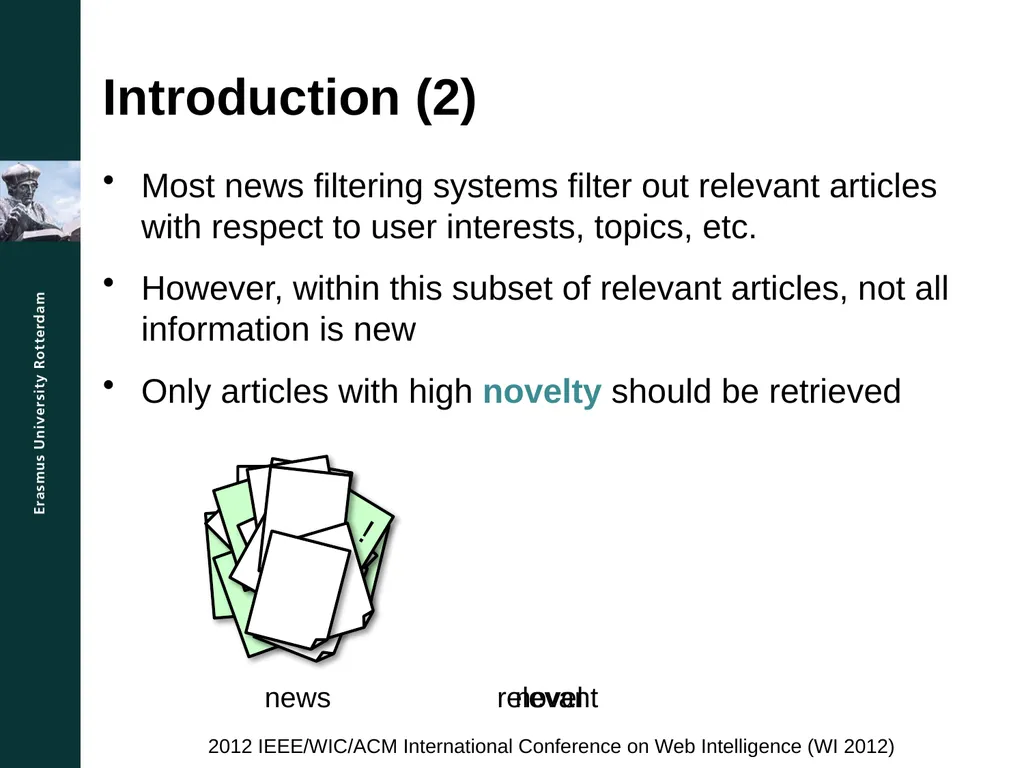
slide3. Introduction (2) Most news filtering systems filter out relevant articles with respect to user interests, topics, etc.
However, within this subset of relevant articles, not all information is new
Only articles with high novelty should be retrieved 2012 IEEE/WIC/ACM International Conference on Web Intelligence (WI 2012) ! ! news relevant novel<br>
slide4. Introduction (3) Key solution: story-based news representation combined with novelty control mechanisms
Novelty control:
Sorting news items based on novelty compared to the seed item and previously browsed items
Based on distance measures for similarity
News items that are dissimilar to other news items but belong to the same topic indicate that the storyline is developing and should receive a high novelty score 2012 IEEE/WIC/ACM International Conference on Web Intelligence (WI 2012)<br>
slide5. Introduction (4) Most novelty control methods use all words from documents in a vector-based news representation
Considering all words generates noise
Named entities (persons, companies, products, etc.) could carry a large part of the story information contained in a news item
Hence, we explore different frequently used novelty control mechanisms and compare word-based and named entity-based vector representations approaches 2012 IEEE/WIC/ACM International Conference on Web Intelligence (WI 2012)<br>
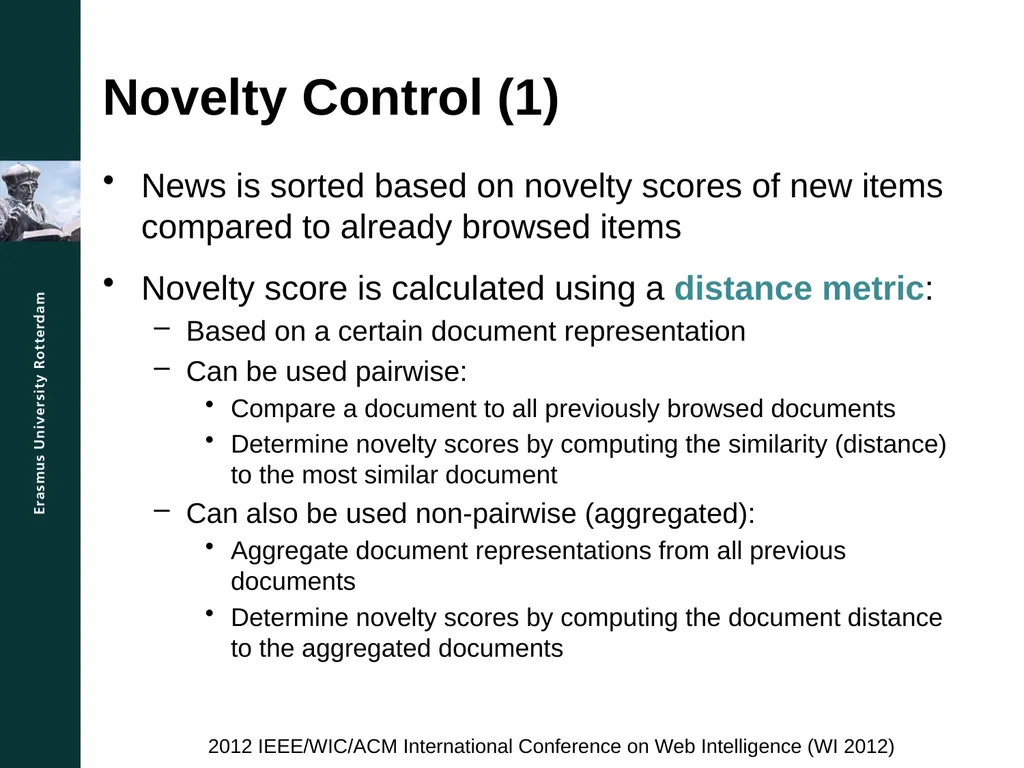
slide6. Novelty Control (1) News is sorted based on novelty scores of new items compared to already browsed items
Novelty score is calculated using a distance metric:
Based on a certain document representation
Can be used pairwise:
Compare a document to all previously browsed documents
Determine novelty scores by computing the similarity (distance) to the most similar document
Can also be used non-pairwise (aggregated):
Aggregate document representations from all previous documents
Determine novelty scores by computing the document distance to the aggregated documents 2012 IEEE/WIC/ACM International Conference on Web Intelligence (WI 2012)<br>
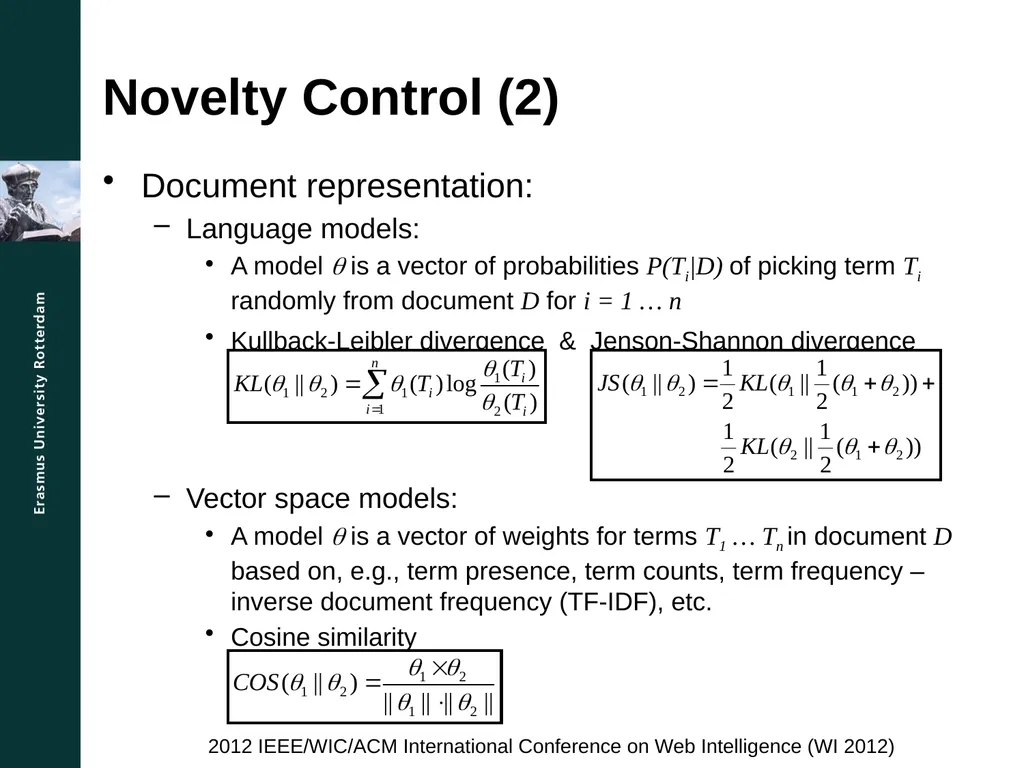
slide7. Novelty Control (2) Document representation:
Language models:
A model is a vector of probabilities P(Ti|D) of picking term Ti randomly from document D for i = 1 … n
Kullback-Leibler divergence & Jenson-Shannon divergence
Vector space models:
A model is a vector of weights for terms T1 … Tn in document D based on, e.g., term presence, term counts, term frequency – inverse document frequency (TF-IDF), etc.
Cosine similarity 2012 IEEE/WIC/ACM International Conference on Web Intelligence (WI 2012)<br>
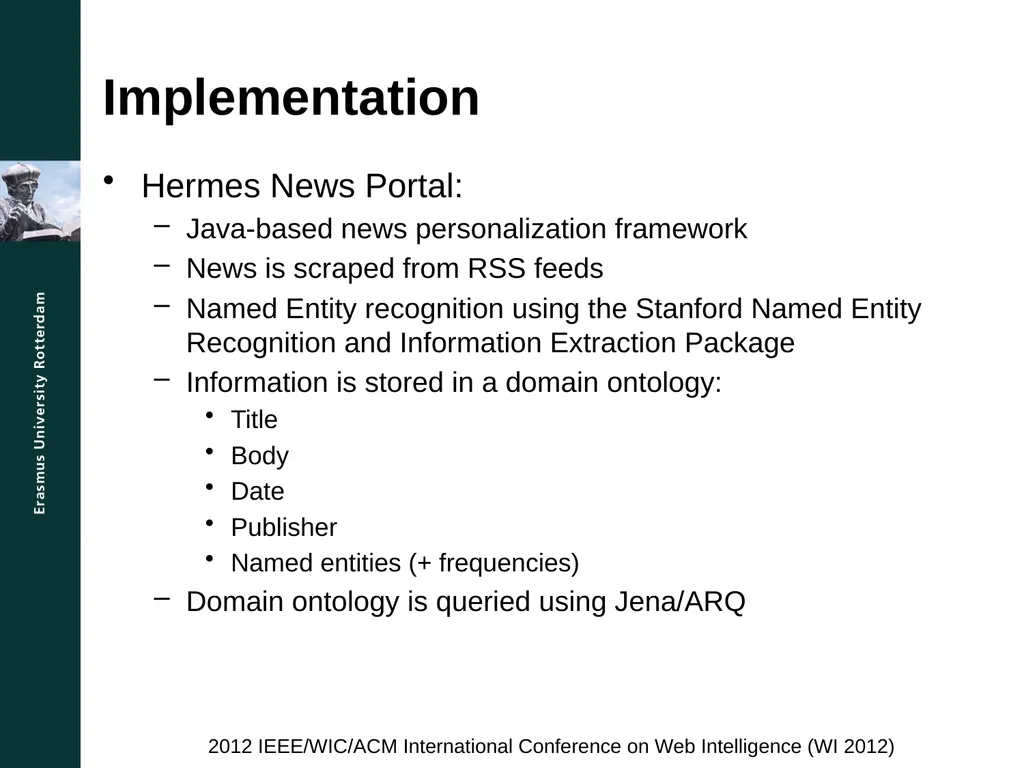
slide8. Implementation Hermes News Portal:
Java-based news personalization framework
News is scraped from RSS feeds
Named Entity recognition using the Stanford Named Entity Recognition and Information Extraction Package
Information is stored in a domain ontology:
Title
Body
Date
Publisher
Named entities (+ frequencies)
Domain ontology is queried using Jena/ARQ 2012 IEEE/WIC/ACM International Conference on Web Intelligence (WI 2012)<br>
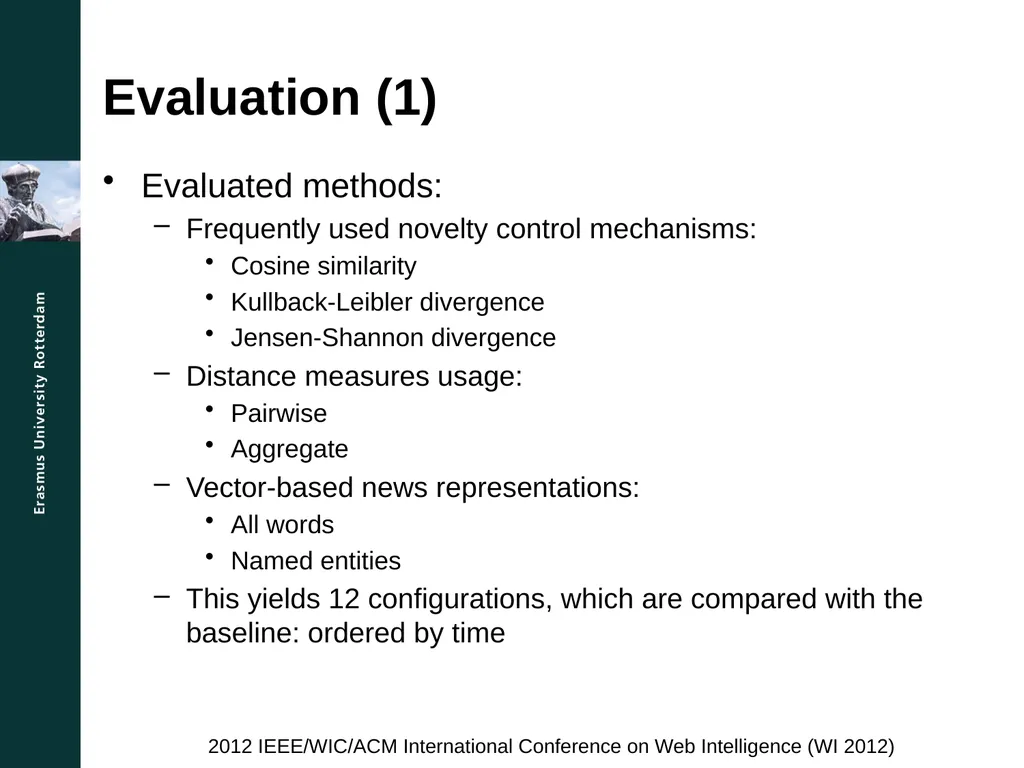
slide9. Evaluation (1) Evaluated methods:
Frequently used novelty control mechanisms:
Cosine similarity
Kullback-Leibler divergence
Jensen-Shannon divergence
Distance measures usage:
Pairwise
Aggregate
Vector-based news representations:
All words
Named entities
This yields 12 configurations, which are compared with the baseline: ordered by time 2012 IEEE/WIC/ACM International Conference on Web Intelligence (WI 2012)<br>
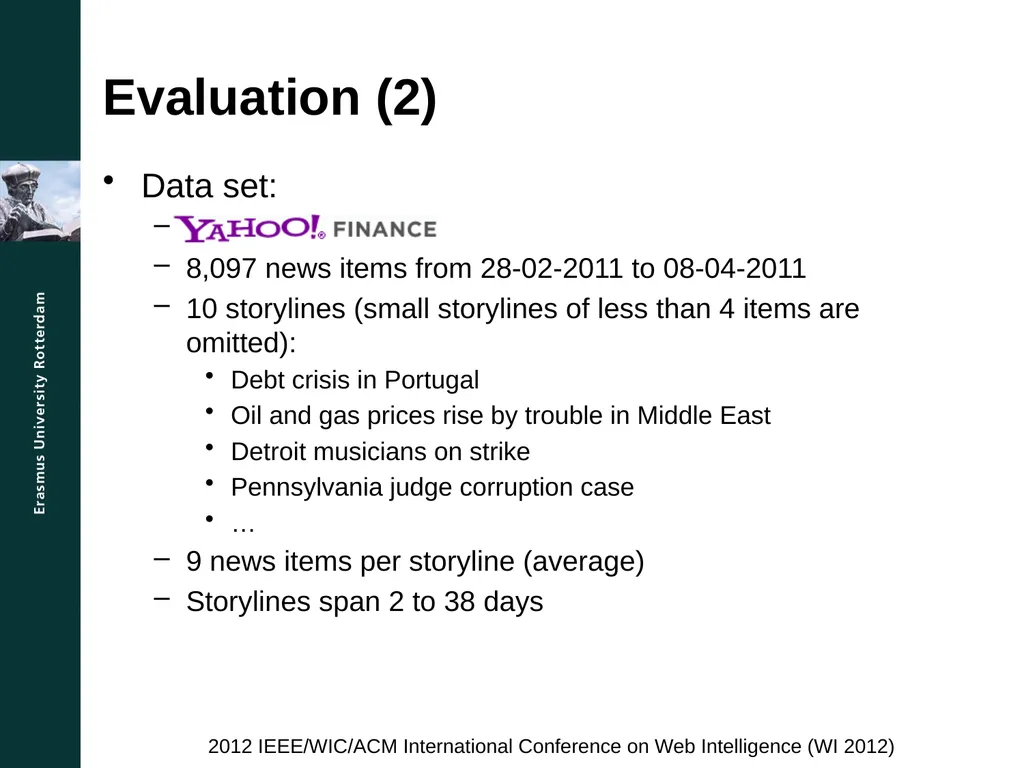
slide10. Evaluation (2) Data set:
8,097 news items from 28-02-2011 to 08-04-2011
10 storylines (small storylines of less than 4 items are omitted):
Debt crisis in Portugal
Oil and gas prices rise by trouble in Middle East
Detroit musicians on strike
Pennsylvania judge corruption case
…
9 news items per storyline (average)
Storylines span 2 to 38 days 2012 IEEE/WIC/ACM International Conference on Web Intelligence (WI 2012)<br>
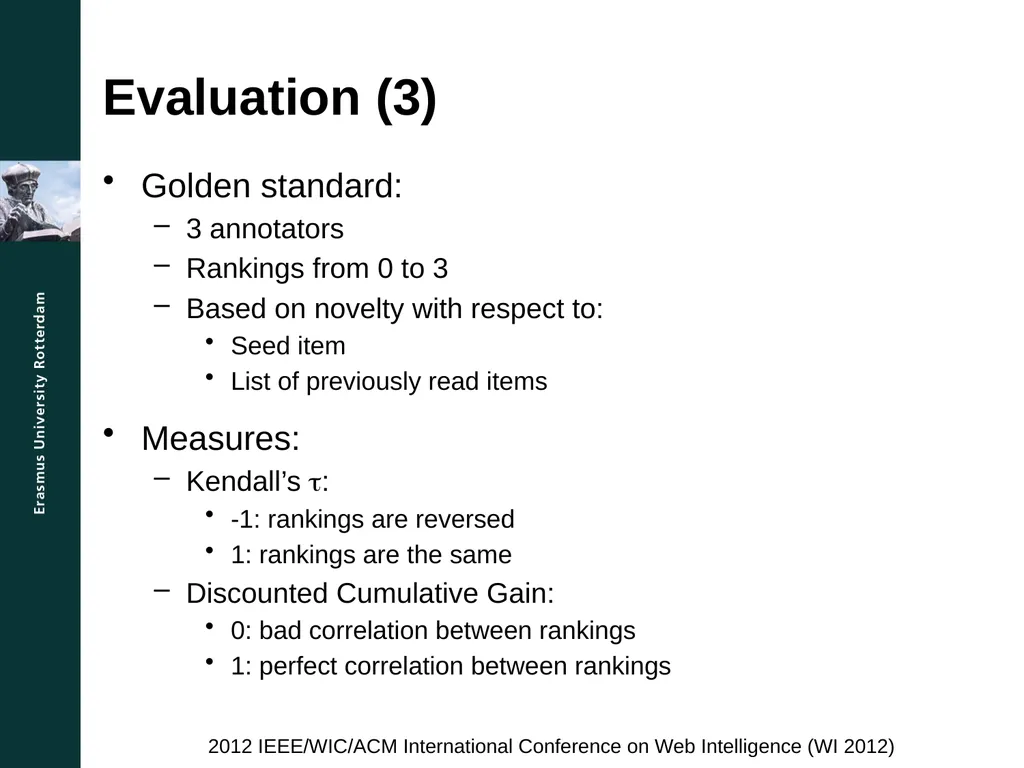
slide11. Evaluation (3) Golden standard:
3 annotators
Rankings from 0 to 3
Based on novelty with respect to:
Seed item
List of previously read items
Measures:
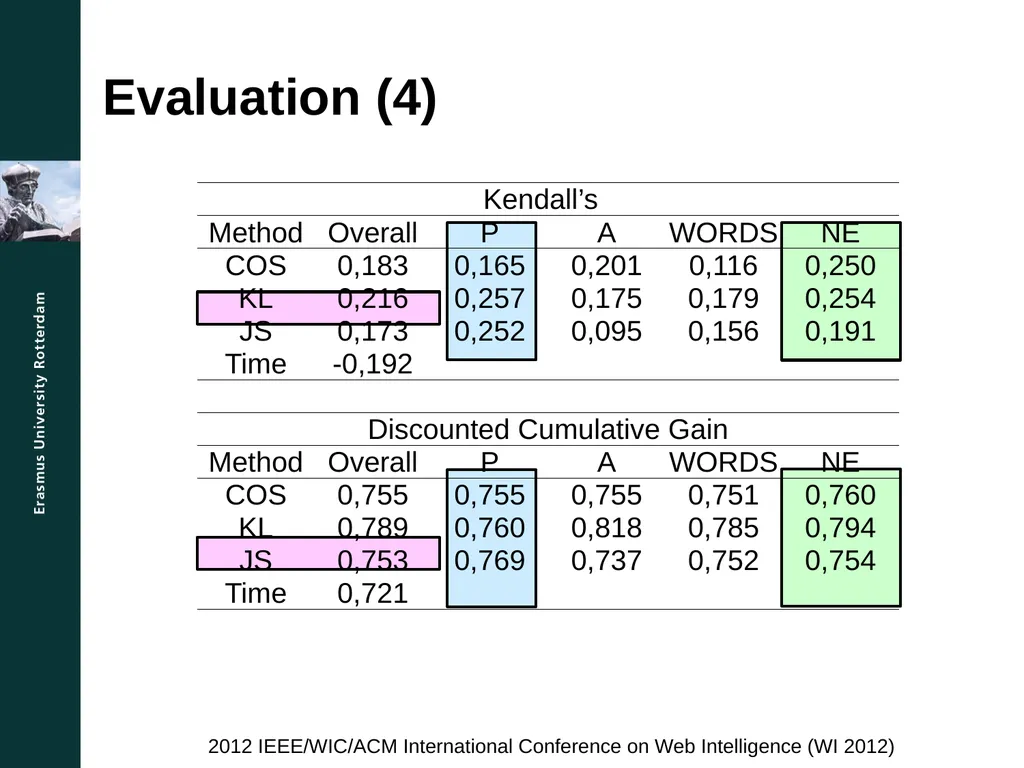
Kendall’s :
-1: rankings are reversed
1: rankings are the same
Discounted Cumulative Gain:
0: bad correlation between rankings
1: perfect correlation between rankings 2012 IEEE/WIC/ACM International Conference on Web Intelligence (WI 2012)<br>
slide12. Evaluation (4) 2012 IEEE/WIC/ACM International Conference on Web Intelligence (WI 2012)<br>
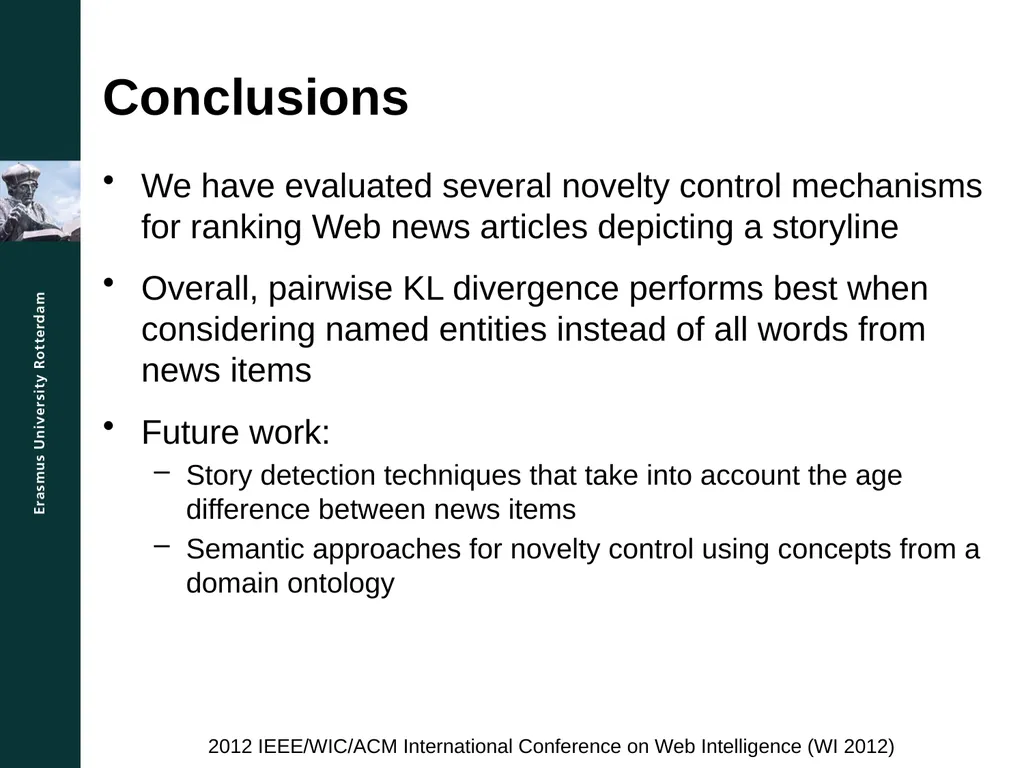
slide13. Conclusions We have evaluated several novelty control mechanisms for ranking Web news articles depicting a storyline
Overall, pairwise KL divergence performs best when considering named entities instead of all words from news items
Future work:
Story detection techniques that take into account the age difference between news items
Semantic approaches for novelty control using concepts from a domain ontology 2012 IEEE/WIC/ACM International Conference on Web Intelligence (WI 2012)<br>
slide14. Questions 2012 IEEE/WIC/ACM International Conference on Web Intelligence (WI 2012)<br>
slide2. Introduction (1) The Web is a great source of information
However, there is an information overload
Solution: information filtering and structuring based on user interests (commonly derived from queries)
Example: Hermes news personalization framework retrieves relevant news based on preferences expressed using concepts from an ontology 2012 IEEE/WIC/ACM International Conference on Web Intelligence (WI 2012)<br>
slide3. Introduction (2) Most news filtering systems filter out relevant articles with respect to user interests, topics, etc.
However, within this subset of relevant articles, not all information is new
Only articles with high novelty should be retrieved 2012 IEEE/WIC/ACM International Conference on Web Intelligence (WI 2012) ! ! news relevant novel<br>
slide4. Introduction (3) Key solution: story-based news representation combined with novelty control mechanisms
Novelty control:
Sorting news items based on novelty compared to the seed item and previously browsed items
Based on distance measures for similarity
News items that are dissimilar to other news items but belong to the same topic indicate that the storyline is developing and should receive a high novelty score 2012 IEEE/WIC/ACM International Conference on Web Intelligence (WI 2012)<br>
slide5. Introduction (4) Most novelty control methods use all words from documents in a vector-based news representation
Considering all words generates noise
Named entities (persons, companies, products, etc.) could carry a large part of the story information contained in a news item
Hence, we explore different frequently used novelty control mechanisms and compare word-based and named entity-based vector representations approaches 2012 IEEE/WIC/ACM International Conference on Web Intelligence (WI 2012)<br>
slide6. Novelty Control (1) News is sorted based on novelty scores of new items compared to already browsed items
Novelty score is calculated using a distance metric:
Based on a certain document representation
Can be used pairwise:
Compare a document to all previously browsed documents
Determine novelty scores by computing the similarity (distance) to the most similar document
Can also be used non-pairwise (aggregated):
Aggregate document representations from all previous documents
Determine novelty scores by computing the document distance to the aggregated documents 2012 IEEE/WIC/ACM International Conference on Web Intelligence (WI 2012)<br>
slide7. Novelty Control (2) Document representation:
Language models:
A model is a vector of probabilities P(Ti|D) of picking term Ti randomly from document D for i = 1 … n
Kullback-Leibler divergence & Jenson-Shannon divergence
Vector space models:
A model is a vector of weights for terms T1 … Tn in document D based on, e.g., term presence, term counts, term frequency – inverse document frequency (TF-IDF), etc.
Cosine similarity 2012 IEEE/WIC/ACM International Conference on Web Intelligence (WI 2012)<br>
slide8. Implementation Hermes News Portal:
Java-based news personalization framework
News is scraped from RSS feeds
Named Entity recognition using the Stanford Named Entity Recognition and Information Extraction Package
Information is stored in a domain ontology:
Title
Body
Date
Publisher
Named entities (+ frequencies)
Domain ontology is queried using Jena/ARQ 2012 IEEE/WIC/ACM International Conference on Web Intelligence (WI 2012)<br>
slide9. Evaluation (1) Evaluated methods:
Frequently used novelty control mechanisms:
Cosine similarity
Kullback-Leibler divergence
Jensen-Shannon divergence
Distance measures usage:
Pairwise
Aggregate
Vector-based news representations:
All words
Named entities
This yields 12 configurations, which are compared with the baseline: ordered by time 2012 IEEE/WIC/ACM International Conference on Web Intelligence (WI 2012)<br>
slide10. Evaluation (2) Data set:
8,097 news items from 28-02-2011 to 08-04-2011
10 storylines (small storylines of less than 4 items are omitted):
Debt crisis in Portugal
Oil and gas prices rise by trouble in Middle East
Detroit musicians on strike
Pennsylvania judge corruption case
…
9 news items per storyline (average)
Storylines span 2 to 38 days 2012 IEEE/WIC/ACM International Conference on Web Intelligence (WI 2012)<br>
slide11. Evaluation (3) Golden standard:
3 annotators
Rankings from 0 to 3
Based on novelty with respect to:
Seed item
List of previously read items
Measures:
Kendall’s :
-1: rankings are reversed
1: rankings are the same
Discounted Cumulative Gain:
0: bad correlation between rankings
1: perfect correlation between rankings 2012 IEEE/WIC/ACM International Conference on Web Intelligence (WI 2012)<br>
slide12. Evaluation (4) 2012 IEEE/WIC/ACM International Conference on Web Intelligence (WI 2012)<br>
slide13. Conclusions We have evaluated several novelty control mechanisms for ranking Web news articles depicting a storyline
Overall, pairwise KL divergence performs best when considering named entities instead of all words from news items
Future work:
Story detection techniques that take into account the age difference between news items
Semantic approaches for novelty control using concepts from a domain ontology 2012 IEEE/WIC/ACM International Conference on Web Intelligence (WI 2012)<br>
slide14. Questions 2012 IEEE/WIC/ACM International Conference on Web Intelligence (WI 2012)<br>