
A Deep Dive into ADHD (Attention Hyperactivity
KB
Published · 25 slides · 0 views
1 / 1

Description
A Deep Dive into ADHD (Attention Hyperactivity Disorder) Presented by Donna Stevenson, SheHer Head of Training Services donnaneurobox.co.uk Neurodiversity? A Growing Family of Differences Dyslexia ADHD Autism DCD Dyspraxia Dyscalculia
Related Topics
Download this presentation From Below
"A Deep Dive into ADHD (Attention Hyperactivity" is the property of its rightful owner. Permission is granted to download and print the materials on this website for personal, non-commercial use only, and to display it on your personal computer provided you do not modify the materials and that you retain all copyright notices contained in the materials. By downloading content from our website, you accept the terms of this agreement.
Share
Embed code
Presentation Transcript
01
A Deep Dive into ADHD (Attention Hyperactivity Disorder) Presented by Donna Stevenson, She/Her
Head of Training Services
donna@neurobox.co.uk<br>
Head of Training Services
donna@neurobox.co.uk<br>
02
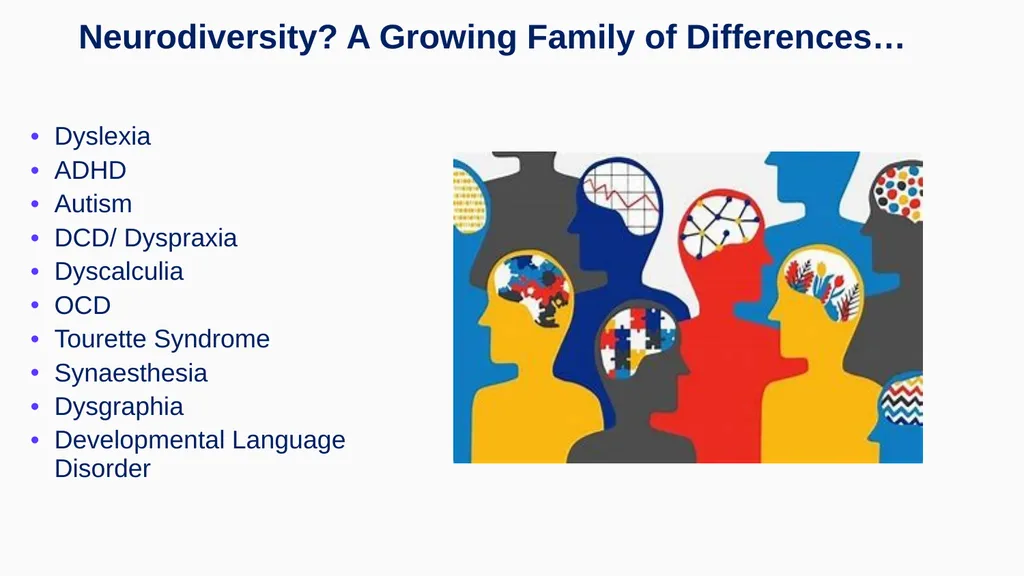
Neurodiversity? A Growing Family of Differences… Dyslexia
ADHD
Autism
DCD/ Dyspraxia
Dyscalculia
OCD
Tourette Syndrome
Synaesthesia
Dysgraphia
Developmental Language Disorder<br>
ADHD
Autism
DCD/ Dyspraxia
Dyscalculia
OCD
Tourette Syndrome
Synaesthesia
Dysgraphia
Developmental Language Disorder<br>
03
ADHD (Attention Deficit Hyperactivity Disorder) is defined as a neurodevelopmental condition that affects how the brain functions. According to the NHS, ADHD is a condition where the brain works differently from most people, leading to challenges with attention, hyperactivity, and impulsivity
Recognised by the NHS as a brain-based condition that impacts focus, energy levels, and impulse control. Described by the ADHD Foundation as a lifelong condition that can vary in how it affects individuals over time. It typically involves traits of
Inattention (e.g., forgetfulness, disorganisation)
Hyperactivity (e.g., restlessness, excessive talking)
Impulsivity (e.g., interrupting, poor decision-making).
Not a reflection of intelligence or motivation—ADHD is about how the brain is wired; not how hard someone tries. What is ADHD – A Definition<br>
Recognised by the NHS as a brain-based condition that impacts focus, energy levels, and impulse control. Described by the ADHD Foundation as a lifelong condition that can vary in how it affects individuals over time. It typically involves traits of
Inattention (e.g., forgetfulness, disorganisation)
Hyperactivity (e.g., restlessness, excessive talking)
Impulsivity (e.g., interrupting, poor decision-making).
Not a reflection of intelligence or motivation—ADHD is about how the brain is wired; not how hard someone tries. What is ADHD – A Definition<br>
04
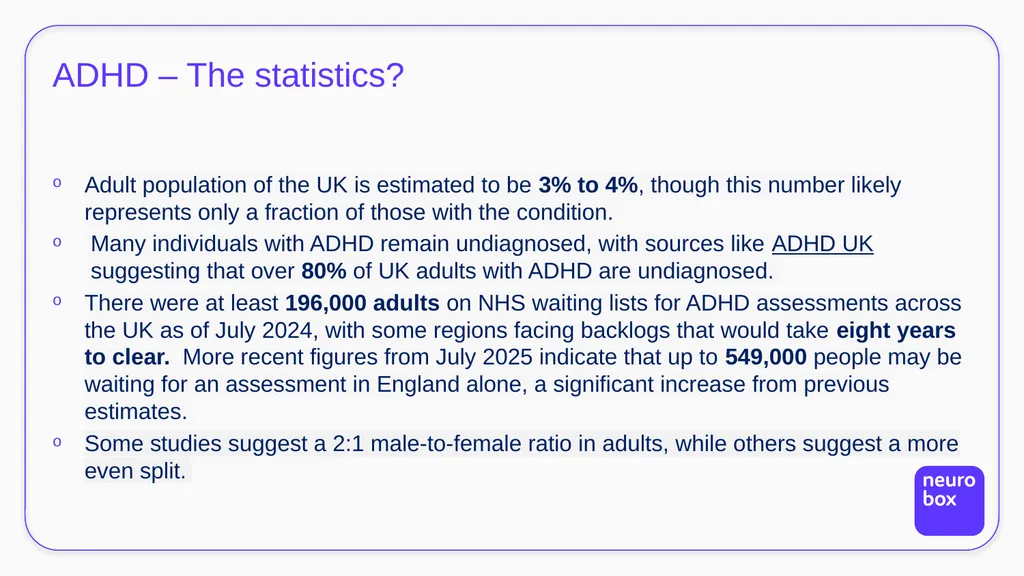
Adult population of the UK is estimated to be 3% to 4%, though this number likely represents only a fraction of those with the condition.
Many individuals with ADHD remain undiagnosed, with sources like ADHD UK suggesting that over 80% of UK adults with ADHD are undiagnosed.
There were at least 196,000 adults on NHS waiting lists for ADHD assessments across the UK as of July 2024, with some regions facing backlogs that would take eight years to clear. More recent figures from July 2025 indicate that up to 549,000 people may be waiting for an assessment in England alone, a significant increase from previous estimates.
Some studies suggest a 2:1 male-to-female ratio in adults, while others suggest a more even split. ADHD – The statistics?<br>
Many individuals with ADHD remain undiagnosed, with sources like ADHD UK suggesting that over 80% of UK adults with ADHD are undiagnosed.
There were at least 196,000 adults on NHS waiting lists for ADHD assessments across the UK as of July 2024, with some regions facing backlogs that would take eight years to clear. More recent figures from July 2025 indicate that up to 549,000 people may be waiting for an assessment in England alone, a significant increase from previous estimates.
Some studies suggest a 2:1 male-to-female ratio in adults, while others suggest a more even split. ADHD – The statistics?<br>
05
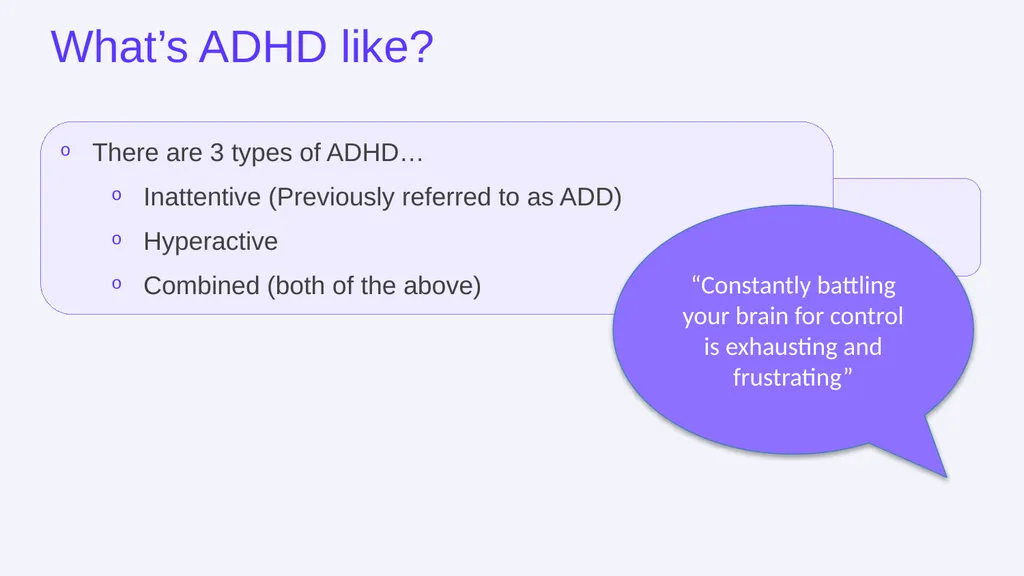
What’s ADHD like? There are 3 types of ADHD…
Inattentive (Previously referred to as ADD)
Hyperactive
Combined (both of the above) “Constantly battling your brain for control is exhausting and frustrating”<br>
Inattentive (Previously referred to as ADD)
Hyperactive
Combined (both of the above) “Constantly battling your brain for control is exhausting and frustrating”<br>
06
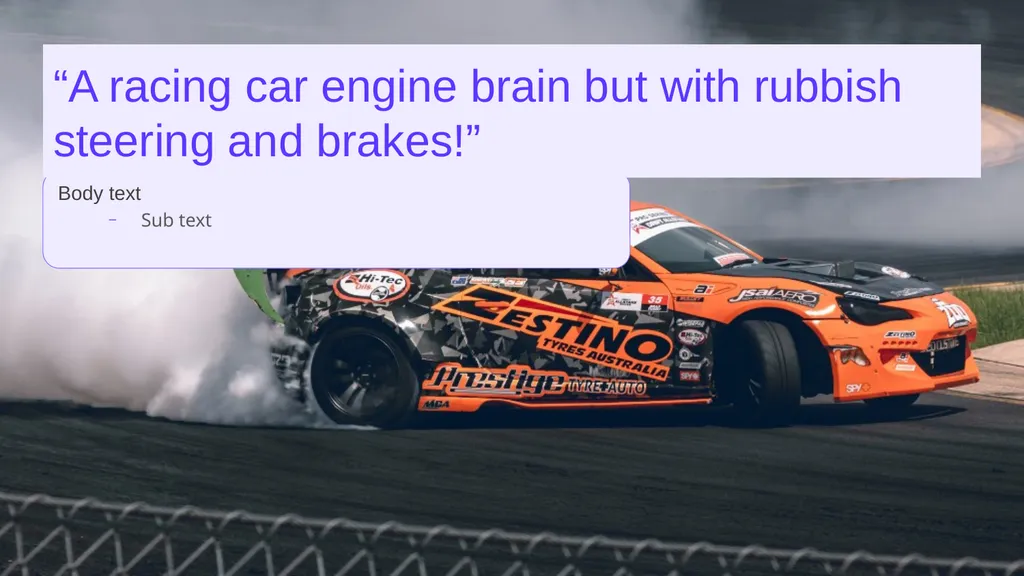
“A racing car engine brain but with rubbish steering and brakes!”<br>
07
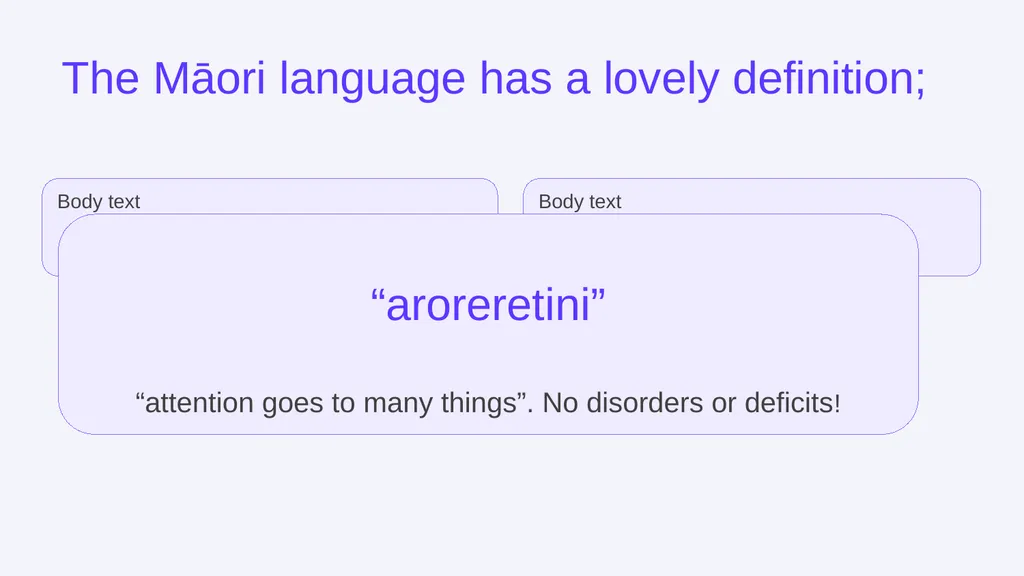
The Māori language has a lovely definition; “aroreretini”
“attention goes to many things”. No disorders or deficits!<br>
“attention goes to many things”. No disorders or deficits!<br>
08
Aren’t we all just a bit scatty at times? Why is this a thing??
I don’t believe suddenly everyone has got ADHD, it’s just a fad…
Why are there now so many middle-aged woman with ADHD, isn’t this just the menopause?!
ADHD is like the new ‘bad back’ everyone seems to have it!! What can be the Impact of these types of sentiments on colleagues? Things we can hear about ADHD these days…<br>
I don’t believe suddenly everyone has got ADHD, it’s just a fad…
Why are there now so many middle-aged woman with ADHD, isn’t this just the menopause?!
ADHD is like the new ‘bad back’ everyone seems to have it!! What can be the Impact of these types of sentiments on colleagues? Things we can hear about ADHD these days…<br>
09
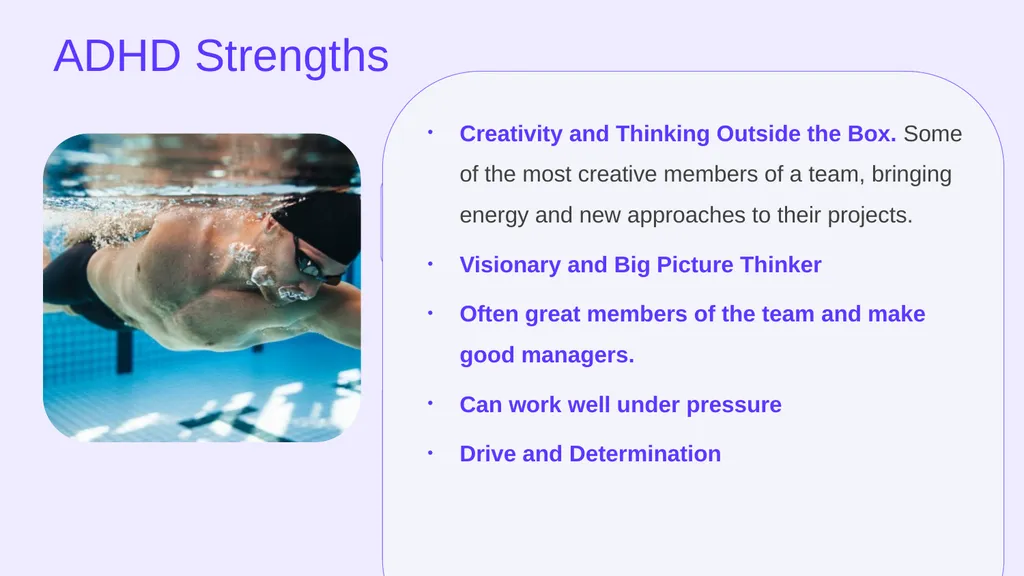
Creativity and Thinking Outside the Box. Some of the most creative members of a team, bringing energy and new approaches to their projects.
Visionary and Big Picture Thinker
Often great members of the team and make good managers.
Can work well under pressure
Drive and Determination ADHD Strengths<br>
Visionary and Big Picture Thinker
Often great members of the team and make good managers.
Can work well under pressure
Drive and Determination ADHD Strengths<br>
10
Hyperfocus can be a real advantage when focused on work that aligns with interests and strengths and when managed safely.
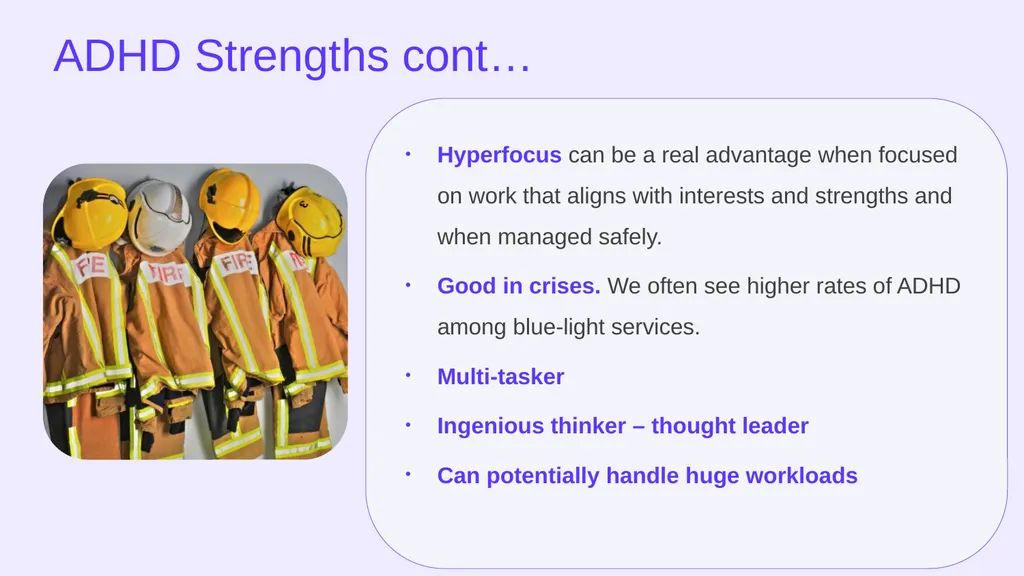
Good in crises. We often see higher rates of ADHD among blue-light services.
Multi-tasker
Ingenious thinker – thought leader
Can potentially handle huge workloads ADHD Strengths cont…<br>
Good in crises. We often see higher rates of ADHD among blue-light services.
Multi-tasker
Ingenious thinker – thought leader
Can potentially handle huge workloads ADHD Strengths cont…<br>
11
‘Because of the way I think, my colleagues often come to me as the ‘ideas person’, it is great to have this kind of recognition, as I truly believe it is because of my ADHD and Autism that I have a sense of creativity within our quite rigid processes. I hope it inspires other colleagues to share of themselves too’
Keisha The Lived Experience…<br>
Keisha The Lived Experience…<br>
12
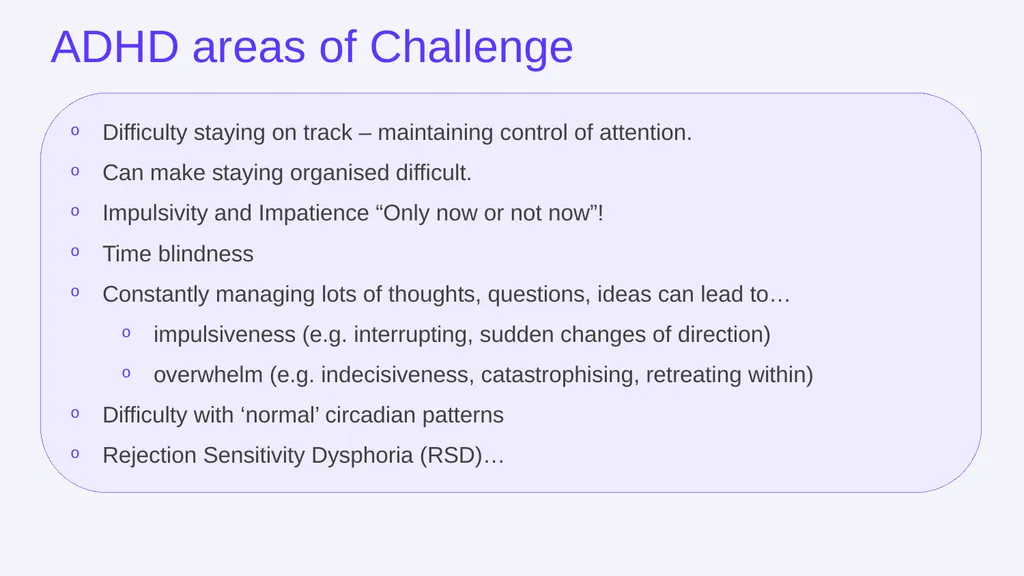
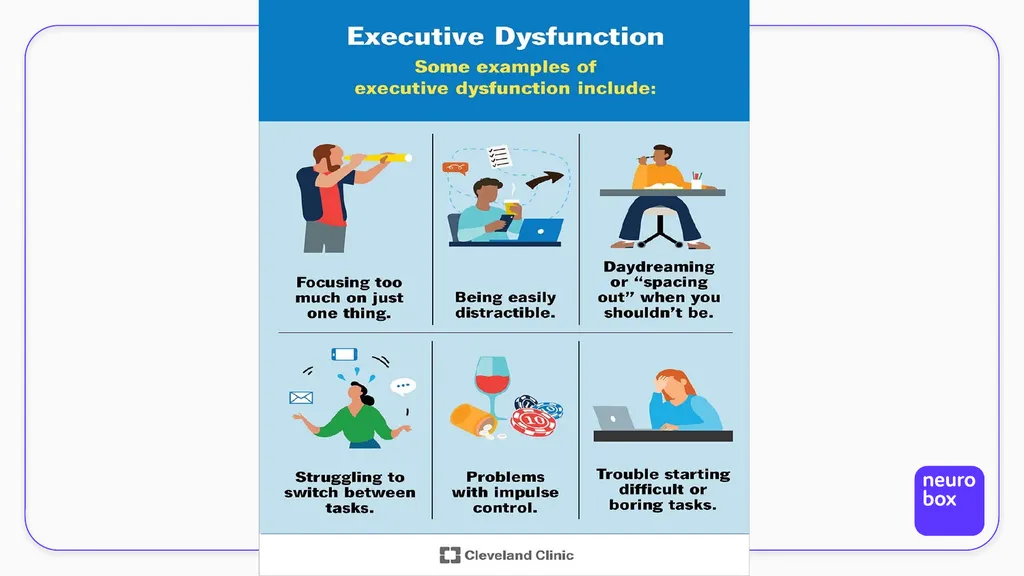
ADHD areas of Challenge Difficulty staying on track – maintaining control of attention.
Can make staying organised difficult.
Impulsivity and Impatience “Only now or not now”!
Time blindness
Constantly managing lots of thoughts, questions, ideas can lead to…
impulsiveness (e.g. interrupting, sudden changes of direction)
overwhelm (e.g. indecisiveness, catastrophising, retreating within)
Difficulty with ‘normal’ circadian patterns
Rejection Sensitivity Dysphoria (RSD)…<br>
Can make staying organised difficult.
Impulsivity and Impatience “Only now or not now”!
Time blindness
Constantly managing lots of thoughts, questions, ideas can lead to…
impulsiveness (e.g. interrupting, sudden changes of direction)
overwhelm (e.g. indecisiveness, catastrophising, retreating within)
Difficulty with ‘normal’ circadian patterns
Rejection Sensitivity Dysphoria (RSD)…<br>
13
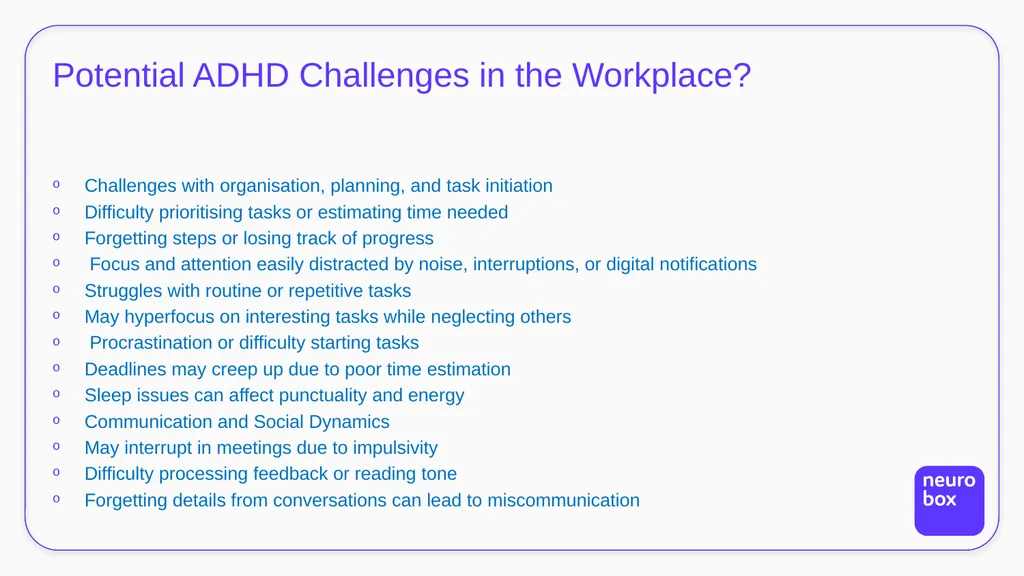
Challenges with organisation, planning, and task initiation
Difficulty prioritising tasks or estimating time needed
Forgetting steps or losing track of progress
Focus and attention easily distracted by noise, interruptions, or digital notifications
Struggles with routine or repetitive tasks
May hyperfocus on interesting tasks while neglecting others
Procrastination or difficulty starting tasks
Deadlines may creep up due to poor time estimation
Sleep issues can affect punctuality and energy
Communication and Social Dynamics
May interrupt in meetings due to impulsivity
Difficulty processing feedback or reading tone
Forgetting details from conversations can lead to miscommunication Potential ADHD Challenges in the Workplace?<br>
Difficulty prioritising tasks or estimating time needed
Forgetting steps or losing track of progress
Focus and attention easily distracted by noise, interruptions, or digital notifications
Struggles with routine or repetitive tasks
May hyperfocus on interesting tasks while neglecting others
Procrastination or difficulty starting tasks
Deadlines may creep up due to poor time estimation
Sleep issues can affect punctuality and energy
Communication and Social Dynamics
May interrupt in meetings due to impulsivity
Difficulty processing feedback or reading tone
Forgetting details from conversations can lead to miscommunication Potential ADHD Challenges in the Workplace?<br>
14
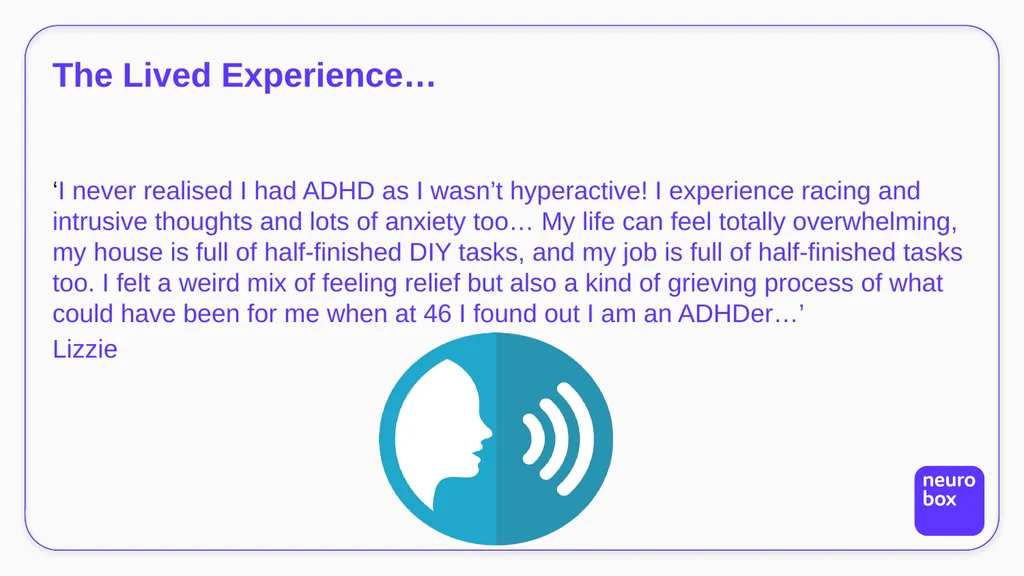
‘I never realised I had ADHD as I wasn’t hyperactive! I experience racing and intrusive thoughts and lots of anxiety too… My life can feel totally overwhelming, my house is full of half-finished DIY tasks, and my job is full of half-finished tasks too. I felt a weird mix of feeling relief but also a kind of grieving process of what could have been for me when at 46 I found out I am an ADHDer…’
Lizzie The Lived Experience…<br>
Lizzie The Lived Experience…<br>
15
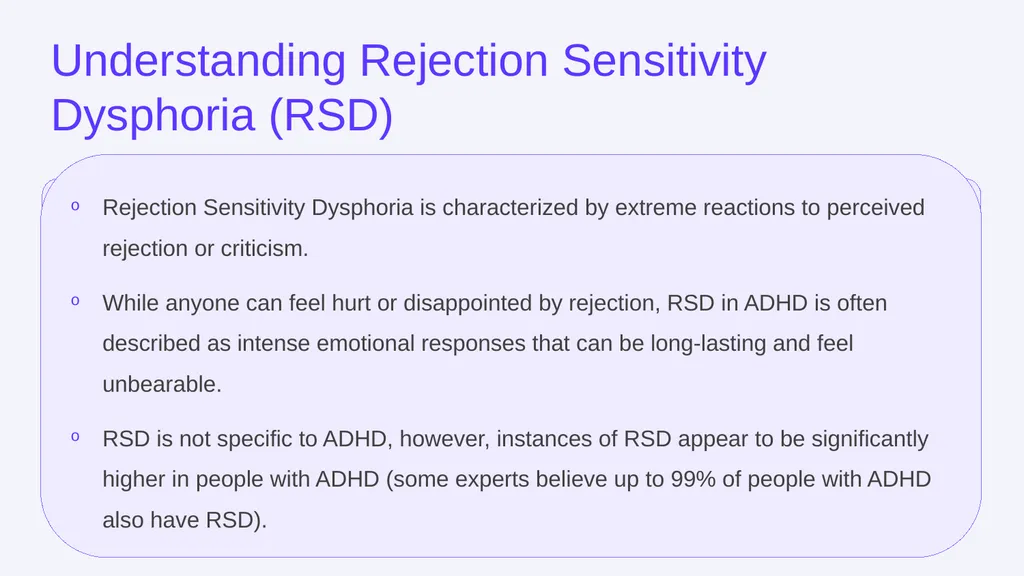
Understanding Rejection Sensitivity Dysphoria (RSD) Rejection Sensitivity Dysphoria is characterized by extreme reactions to perceived rejection or criticism.
While anyone can feel hurt or disappointed by rejection, RSD in ADHD is often described as intense emotional responses that can be long-lasting and feel unbearable.
RSD is not specific to ADHD, however, instances of RSD appear to be significantly higher in people with ADHD (some experts believe up to 99% of people with ADHD also have RSD).<br>
While anyone can feel hurt or disappointed by rejection, RSD in ADHD is often described as intense emotional responses that can be long-lasting and feel unbearable.
RSD is not specific to ADHD, however, instances of RSD appear to be significantly higher in people with ADHD (some experts believe up to 99% of people with ADHD also have RSD).<br>
16
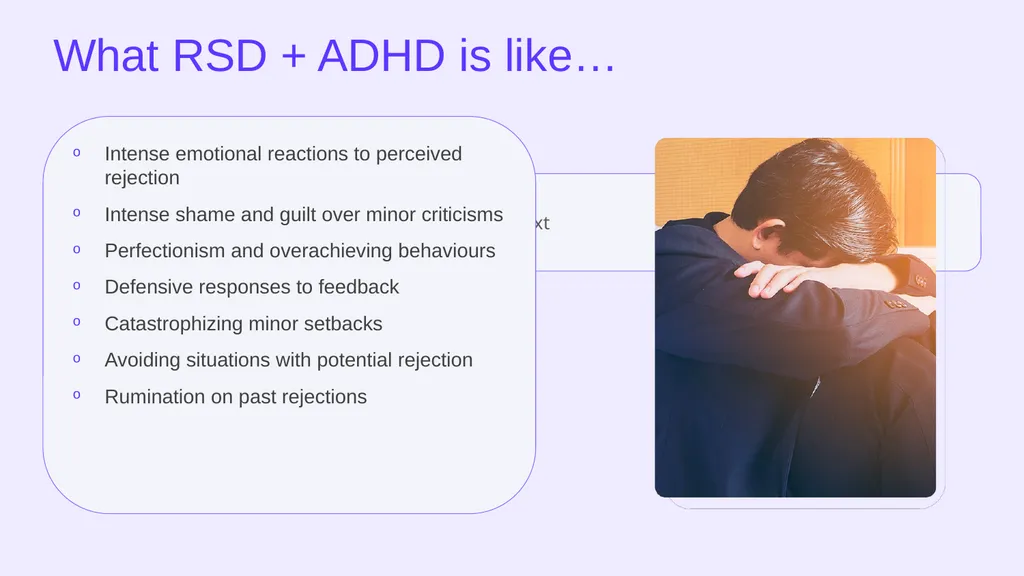
What RSD + ADHD is like… Intense emotional reactions to perceived rejection
Intense shame and guilt over minor criticisms
Perfectionism and overachieving behaviours
Defensive responses to feedback
Catastrophizing minor setbacks
Avoiding situations with potential rejection
Rumination on past rejections<br>
Intense shame and guilt over minor criticisms
Perfectionism and overachieving behaviours
Defensive responses to feedback
Catastrophizing minor setbacks
Avoiding situations with potential rejection
Rumination on past rejections<br>
17
ADHDers may also be overstimulated by things in the environment, like noises from a crowd or a flickering and bright light. These stimuli can take their focus away from the task.
Understimulation can also cause ADHD paralysis. When the ADHD brain is not engaged or stimulated by a task, it can be easily distracted.
ADHDers may get distracted by unrelated activities or thoughts. When they become hyperfixated on such distractions, they may be so engrossed in the activity that they tune out everything else. This can cause them to lose track of time. Being Overstimulated or Overwhelmed?<br>
Understimulation can also cause ADHD paralysis. When the ADHD brain is not engaged or stimulated by a task, it can be easily distracted.
ADHDers may get distracted by unrelated activities or thoughts. When they become hyperfixated on such distractions, they may be so engrossed in the activity that they tune out everything else. This can cause them to lose track of time. Being Overstimulated or Overwhelmed?<br>
18
“I think what has made the difference for me to openly talk about my ADHD has been the allies around the organisation and our Neurodiversity ERG. This is the first time in 10 years of working that I have decided to be open, it has been scary at times and not everyone ‘gets it’ yet, but there is power in numbers and solidarity too”
Jah The Lived Experience…<br>
Jah The Lived Experience…<br>
19
The Racehorse – races ahead, super-focused, not easily distracted, ‘finish-focused’ However can miss information that is not right in front!
The Owl – Sees every detail, can be very thorough and often spots details others miss. However can be so focused on ‘scanning details’ they can struggle to move forward.
The Chameleon (is a Racehorse and an Owl depending on situation) able to adapt at speed, can zoom in and out, changing perspective at a very fast pace, can be flexible and a great strategist. However this can be draining and makes the individual prone to burn-out. Styles of ADHD Working?<br>
The Owl – Sees every detail, can be very thorough and often spots details others miss. However can be so focused on ‘scanning details’ they can struggle to move forward.
The Chameleon (is a Racehorse and an Owl depending on situation) able to adapt at speed, can zoom in and out, changing perspective at a very fast pace, can be flexible and a great strategist. However this can be draining and makes the individual prone to burn-out. Styles of ADHD Working?<br>
20
Workplace Needs Assessment
Give deadlines
Clarify priorities
Be clear about expectations
Flexible breaks and unconventional hours
Give feedback positively and kindly Supporting ADHD Team Members<br>
Give deadlines
Clarify priorities
Be clear about expectations
Flexible breaks and unconventional hours
Give feedback positively and kindly Supporting ADHD Team Members<br>
21
Ways to allow movement whilst working, e.g., sitting/standing at desks and fidget tools.
Be concise and unambiguous with instructions.
Minimise the need to take notes during meetings
Follow-up conversations with emails where actions have been agreed.
Coaching
Assistive Technology Supporting ADHD Team Members cont…<br>
Be concise and unambiguous with instructions.
Minimise the need to take notes during meetings
Follow-up conversations with emails where actions have been agreed.
Coaching
Assistive Technology Supporting ADHD Team Members cont…<br>
22
Body Doubling sessions
Allies and Champions to minimise isolation
A Neurodiversity Network
Eisenhower Matrix to help prioritise
Encourage self-care to avoid burn-out
Pomodoro Technique can help with time planning Supporting ADHD Team Members cont…<br>
Allies and Champions to minimise isolation
A Neurodiversity Network
Eisenhower Matrix to help prioritise
Encourage self-care to avoid burn-out
Pomodoro Technique can help with time planning Supporting ADHD Team Members cont…<br>
23
‘My message to those who live with ADHD is be kind to yourself, get educated about what this means to you and find other like-minded people to connect with. You’re not alone and I think what made a big difference for me was realising some of the good things ADHD has given me too, it is part of who I am and yes I think I have got to a place where I am proud of that!’
Eddie The Lived Experience<br>
Eddie The Lived Experience<br>
24
Thank you and Keep in Touch Any questions?<br>