
A Good Paper for Applied Thermal Engineering Prof.
Description: A Good Paper for Applied Thermal Engineering Prof. David Reay, Editor-in-Chief Heriot-Watt, Newcastle, Northumbria Nottingham University; David Reay Associates The Journal URL and Home Page www.elsevier.comlocateapthermeng 11 July
Related Topics
Download Presentation
"A Good Paper for Applied Thermal Engineering Prof." is the property of its rightful owner. Permission is granted to download and print the materials on this website for personal, non-commercial use only, and to display it on your personal computer provided you do not modify the materials and that you retain all copyright notices contained in the materials. By downloading content from our website, you accept the terms of this agreement.
Presentation Transcript
slide1. A Good Paper for
Applied Thermal Engineering Prof. David Reay,
Editor-in-Chief
Heriot-Watt, Newcastle, Northumbria & Nottingham University;
David Reay & Associates<br>
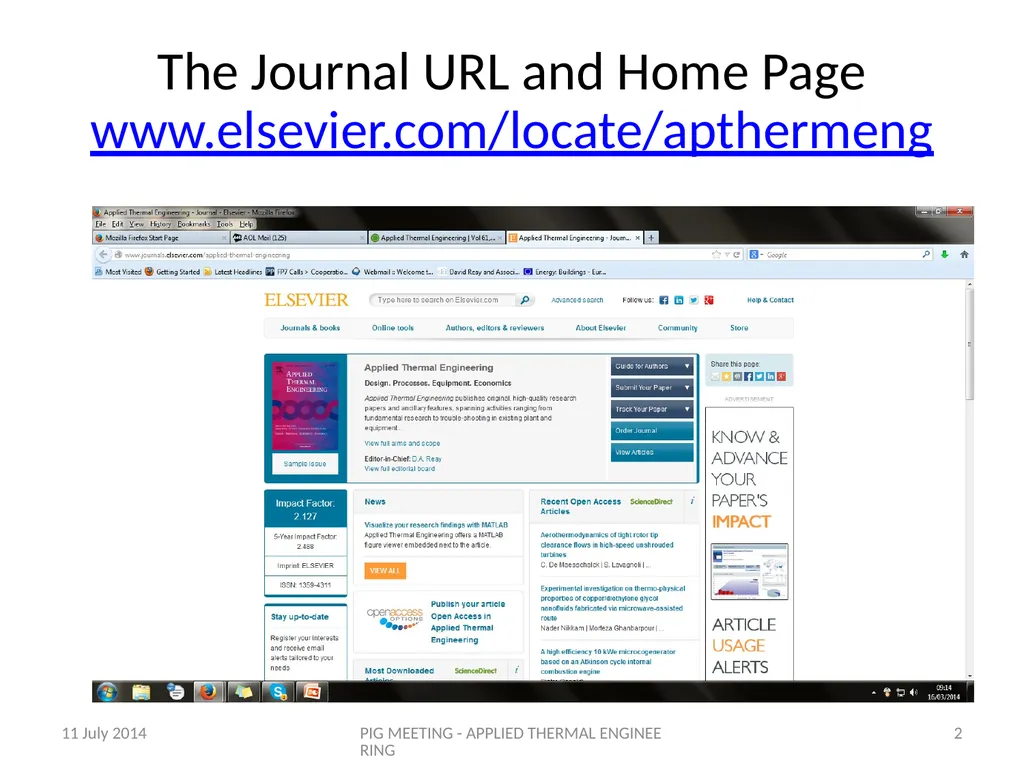
slide2. The Journal URL and Home Page www.elsevier.com/locate/apthermeng 11 July 2014 PIG MEETING - APPLIED THERMAL ENGINEERING 2<br>
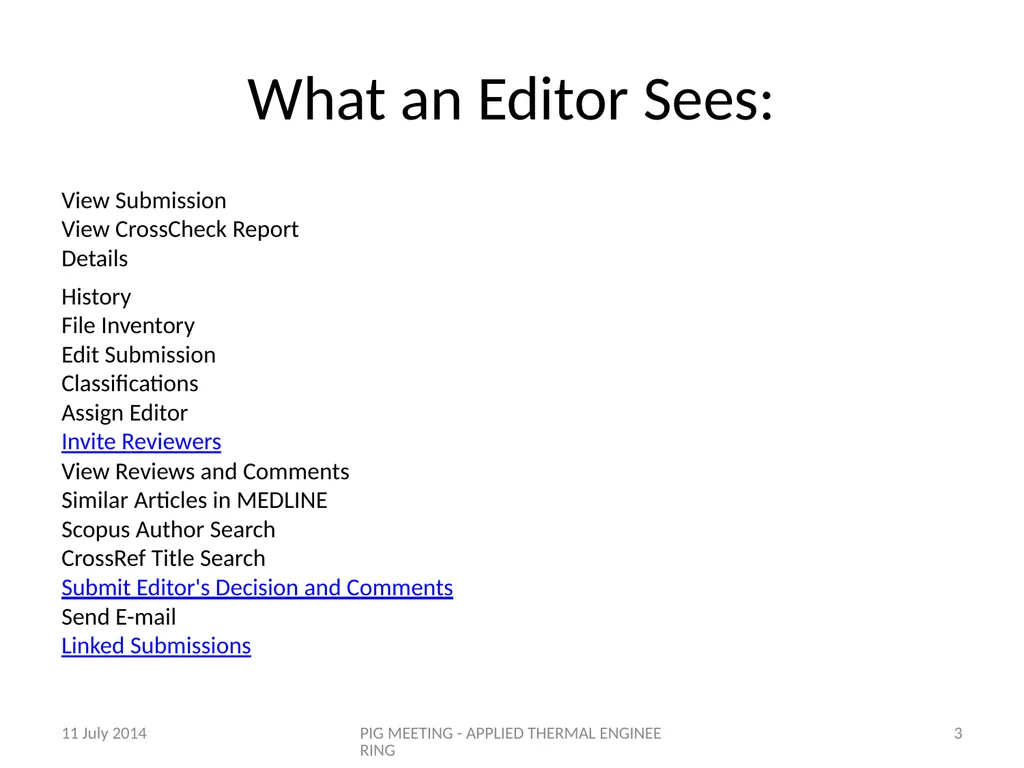
slide3. What an Editor Sees: View Submission View CrossCheck Report Details
History File Inventory Edit Submission Classifications Assign Editor Invite Reviewers View Reviews and Comments Similar Articles in MEDLINE Scopus Author Search CrossRef Title Search Submit Editor's Decision and Comments Send E-mail Linked Submissions 11 July 2014 PIG MEETING - APPLIED THERMAL ENGINEERING 3<br>
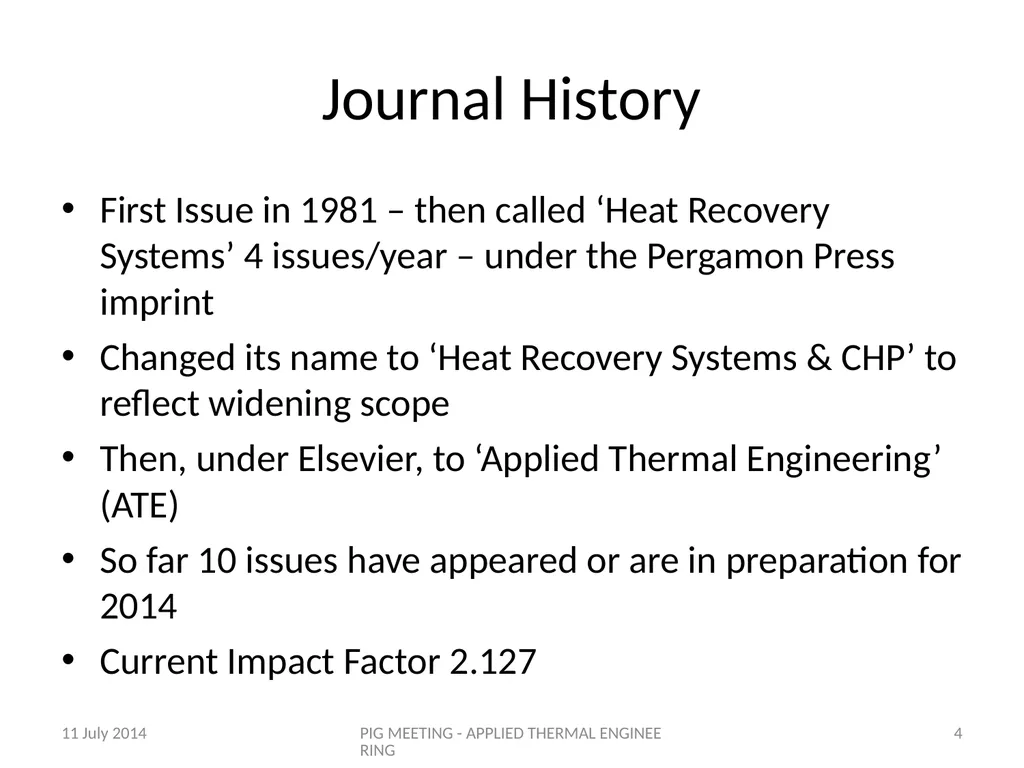
slide4. Journal History First Issue in 1981 – then called ‘Heat Recovery Systems’ 4 issues/year – under the Pergamon Press imprint
Changed its name to ‘Heat Recovery Systems & CHP’ to reflect widening scope
Then, under Elsevier, to ‘Applied Thermal Engineering’ (ATE)
So far 10 issues have appeared or are in preparation for 2014
Current Impact Factor 2.127 11 July 2014 4 PIG MEETING - APPLIED THERMAL ENGINEERING<br>
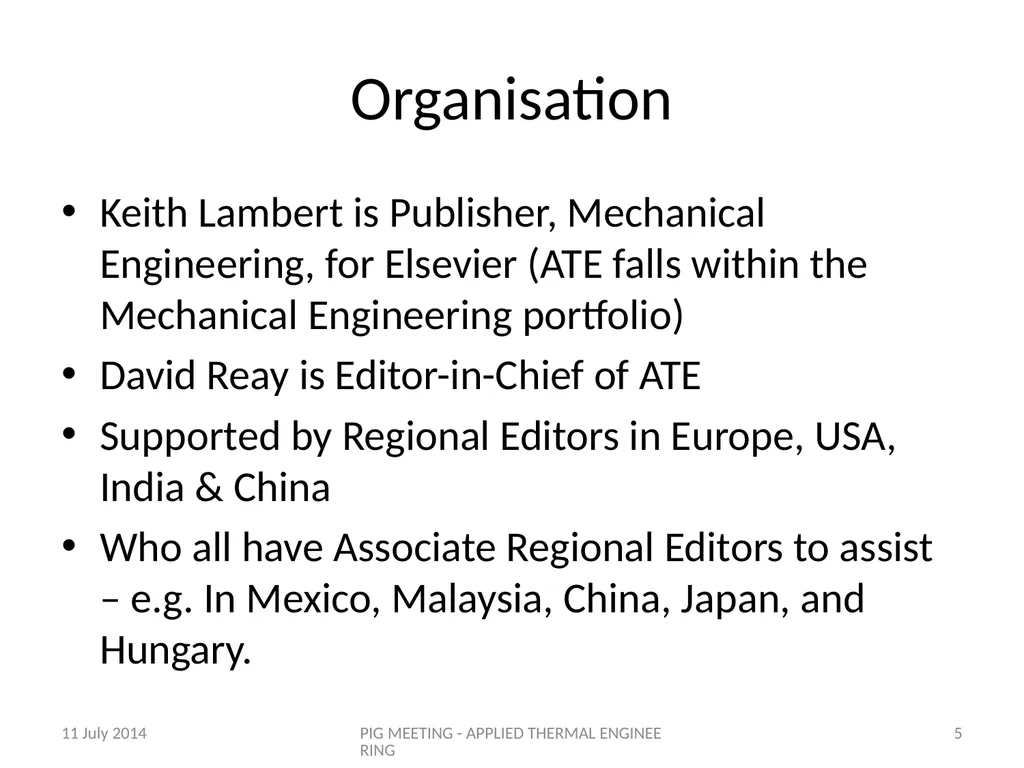
slide5. Organisation Keith Lambert is Publisher, Mechanical Engineering, for Elsevier (ATE falls within the Mechanical Engineering portfolio)
David Reay is Editor-in-Chief of ATE
Supported by Regional Editors in Europe, USA, India & China
Who all have Associate Regional Editors to assist – e.g. In Mexico, Malaysia, China, Japan, and Hungary. 11 July 2014 5 PIG MEETING - APPLIED THERMAL ENGINEERING<br>
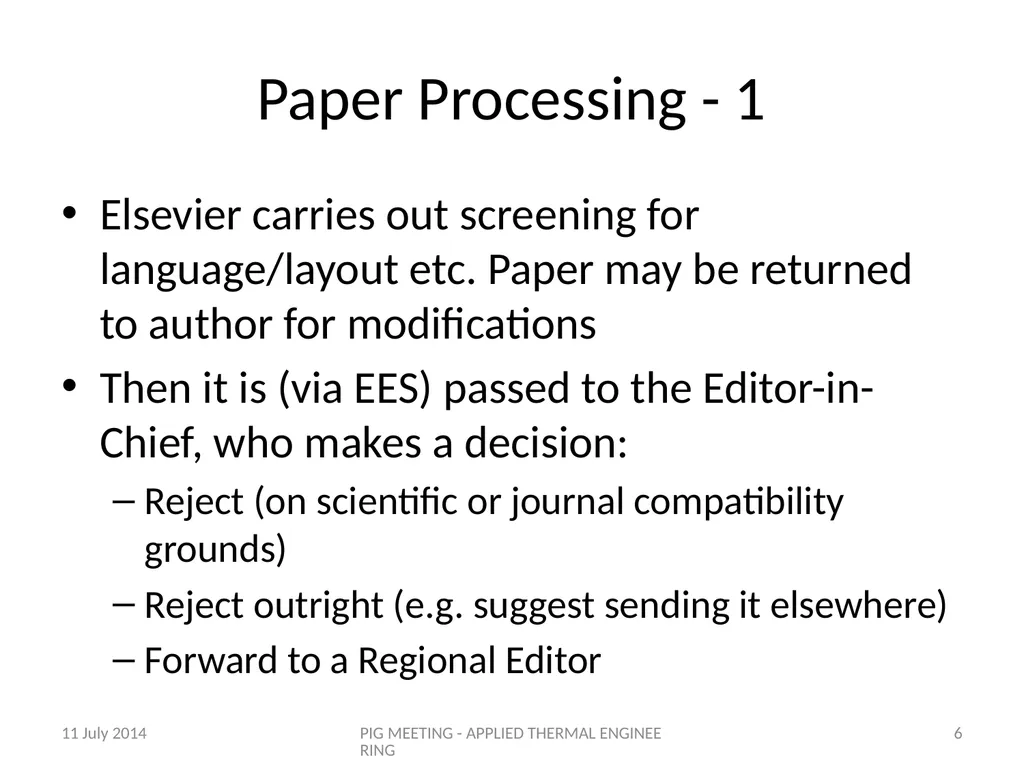
slide6. Paper Processing - 1 Elsevier carries out screening for language/layout etc. Paper may be returned to author for modifications
Then it is (via EES) passed to the Editor-in-Chief, who makes a decision:
Reject (on scientific or journal compatibility grounds)
Reject outright (e.g. suggest sending it elsewhere)
Forward to a Regional Editor 11 July 2014 6 PIG MEETING - APPLIED THERMAL ENGINEERING<br>
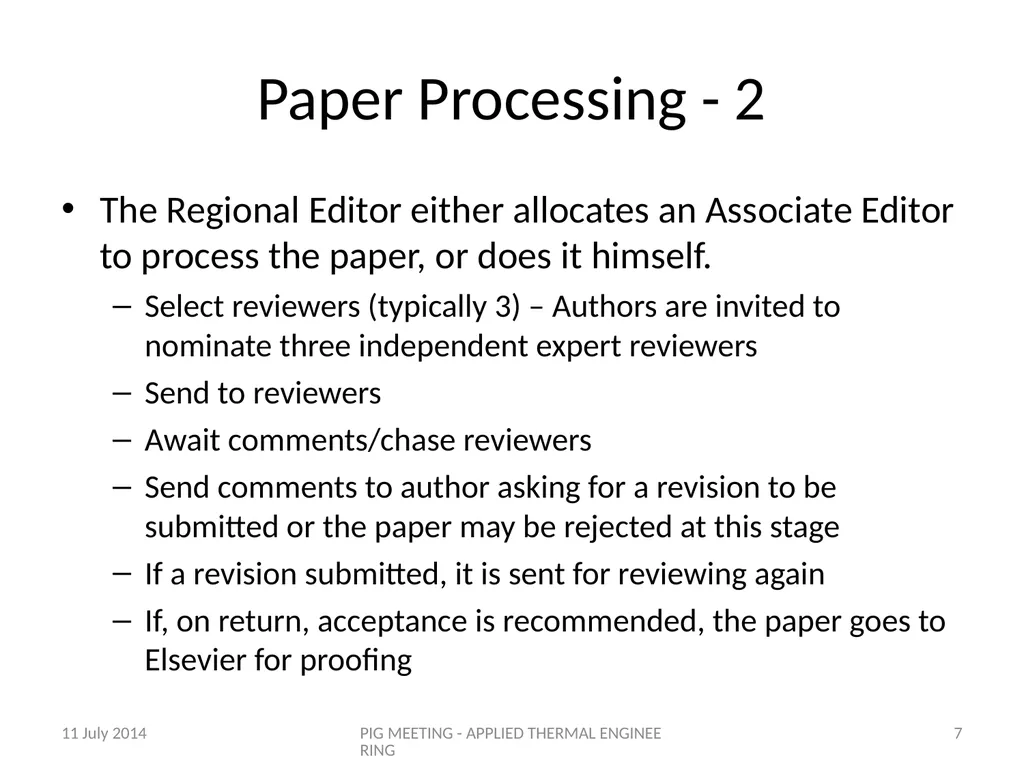
slide7. Paper Processing - 2 The Regional Editor either allocates an Associate Editor to process the paper, or does it himself.
Select reviewers (typically 3) – Authors are invited to nominate three independent expert reviewers
Send to reviewers
Await comments/chase reviewers
Send comments to author asking for a revision to be submitted or the paper may be rejected at this stage
If a revision submitted, it is sent for reviewing again
If, on return, acceptance is recommended, the paper goes to Elsevier for proofing 11 July 2014 7 PIG MEETING - APPLIED THERMAL ENGINEERING<br>
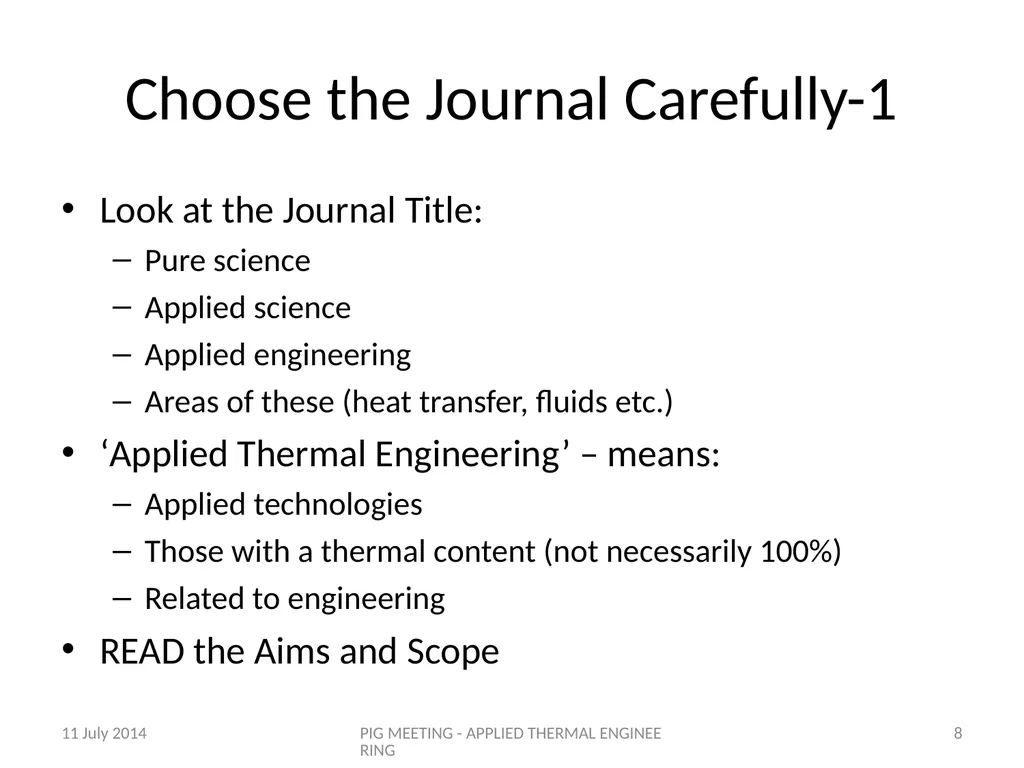
slide8. Choose the Journal Carefully-1 Look at the Journal Title:
Pure science
Applied science
Applied engineering
Areas of these (heat transfer, fluids etc.)
‘Applied Thermal Engineering’ – means:
Applied technologies
Those with a thermal content (not necessarily 100%)
Related to engineering
READ the Aims and Scope 11 July 2014 8 PIG MEETING - APPLIED THERMAL ENGINEERING<br>
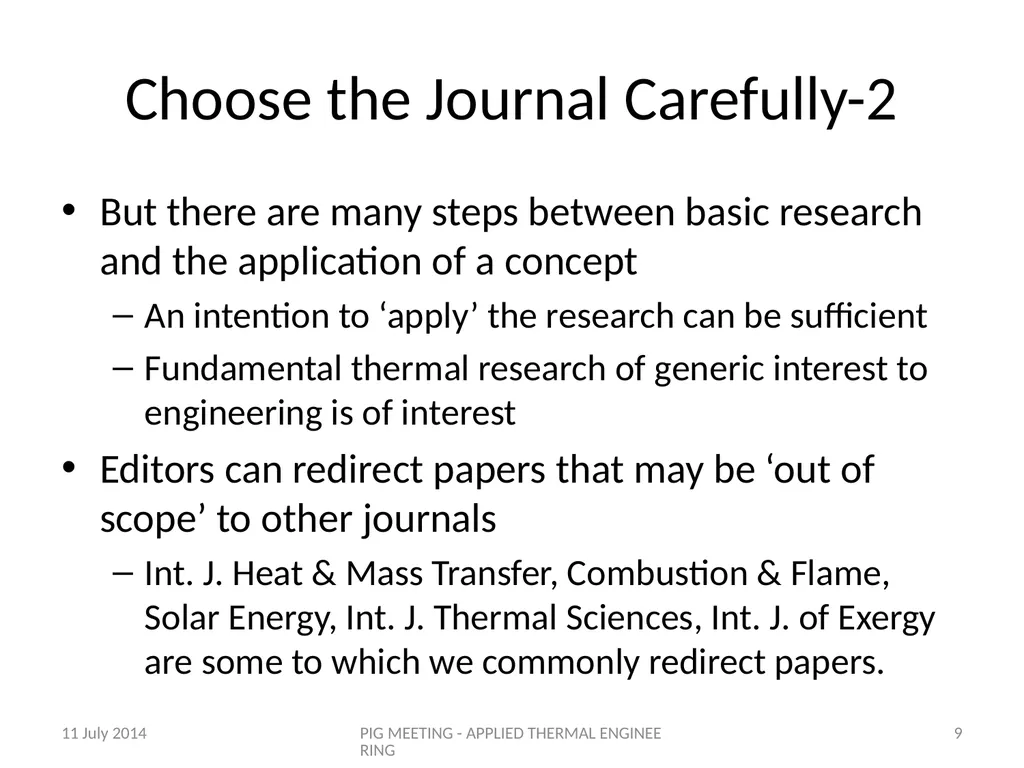
slide9. Choose the Journal Carefully-2 But there are many steps between basic research and the application of a concept
An intention to ‘apply’ the research can be sufficient
Fundamental thermal research of generic interest to engineering is of interest
Editors can redirect papers that may be ‘out of scope’ to other journals
Int. J. Heat & Mass Transfer, Combustion & Flame, Solar Energy, Int. J. Thermal Sciences, Int. J. of Exergy are some to which we commonly redirect papers. 11 July 2014 9 PIG MEETING - APPLIED THERMAL ENGINEERING<br>
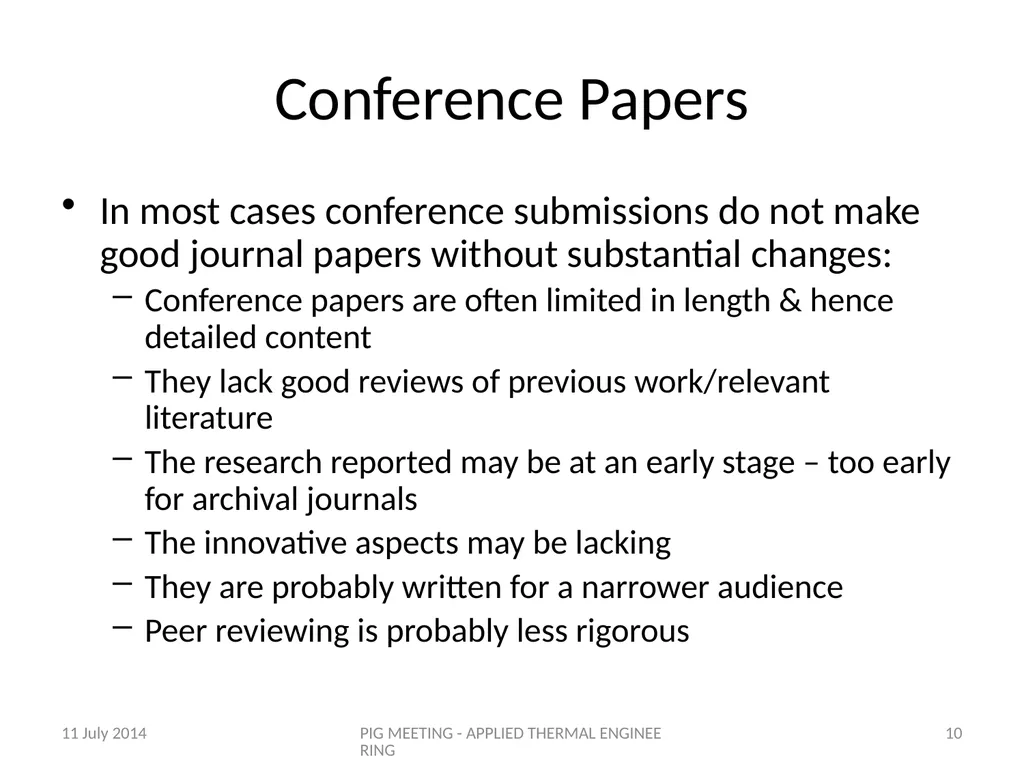
slide10. Conference Papers In most cases conference submissions do not make good journal papers without substantial changes:
Conference papers are often limited in length & hence detailed content
They lack good reviews of previous work/relevant literature
The research reported may be at an early stage – too early for archival journals
The innovative aspects may be lacking
They are probably written for a narrower audience
Peer reviewing is probably less rigorous 11 July 2014 10 PIG MEETING - APPLIED THERMAL ENGINEERING<br>
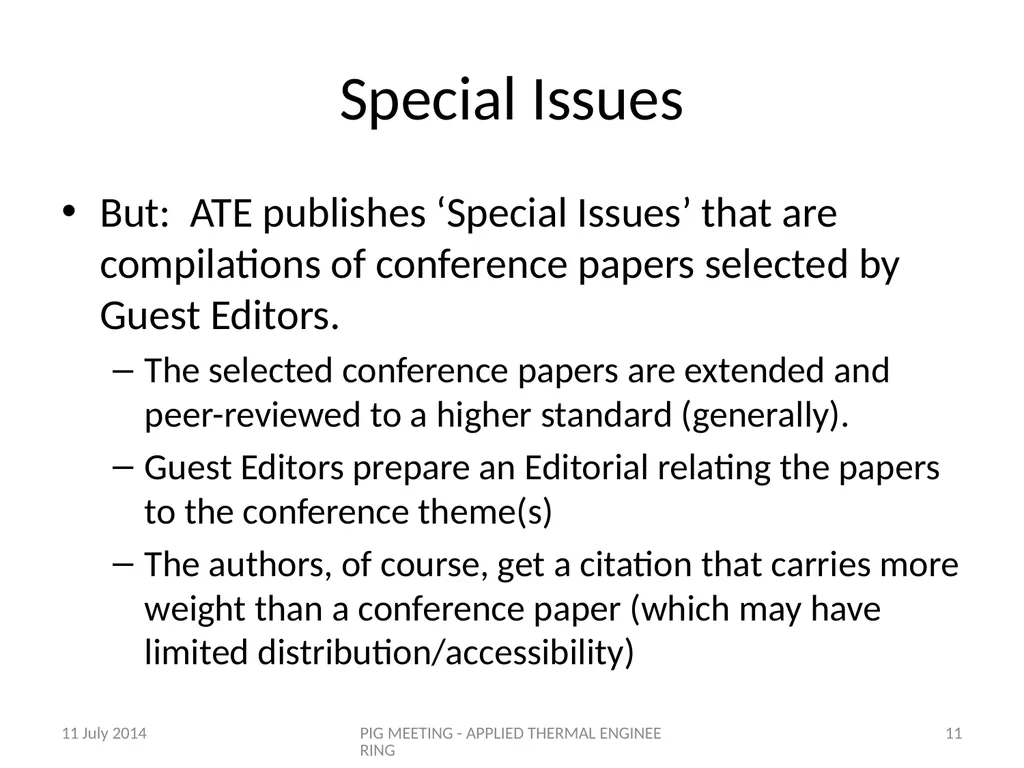
slide11. Special Issues But: ATE publishes ‘Special Issues’ that are compilations of conference papers selected by Guest Editors.
The selected conference papers are extended and peer-reviewed to a higher standard (generally).
Guest Editors prepare an Editorial relating the papers to the conference theme(s)
The authors, of course, get a citation that carries more weight than a conference paper (which may have limited distribution/accessibility) 11 July 2014 11 PIG MEETING - APPLIED THERMAL ENGINEERING<br>
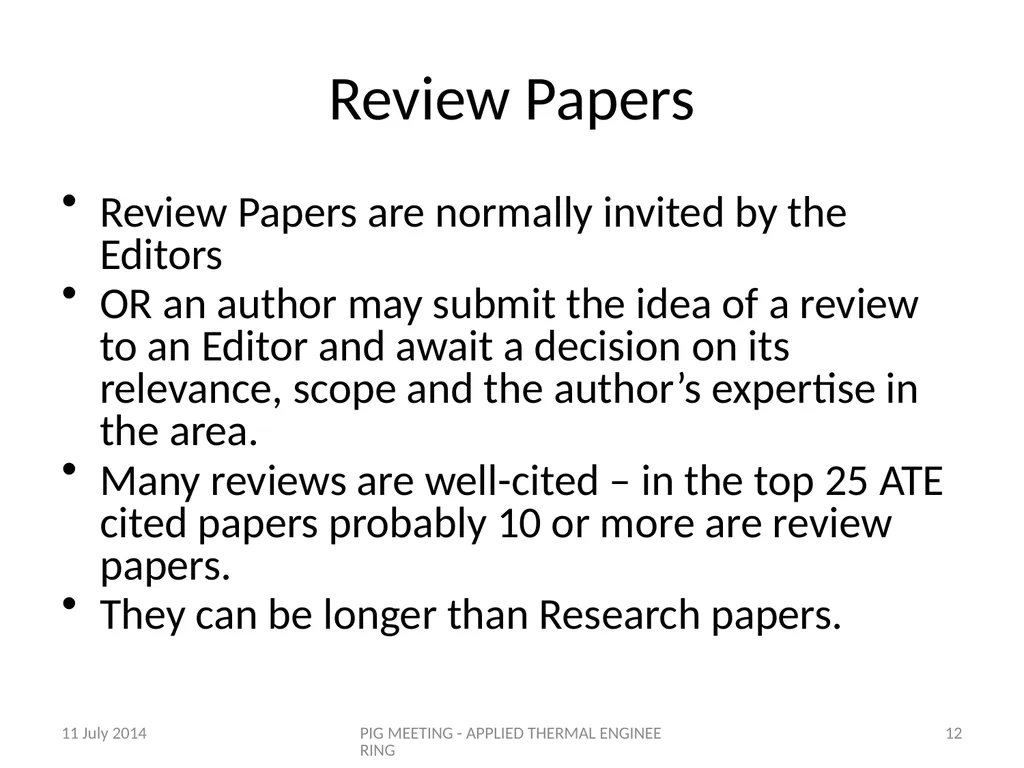
slide12. Review Papers Review Papers are normally invited by the Editors
OR an author may submit the idea of a review to an Editor and await a decision on its relevance, scope and the author’s expertise in the area.
Many reviews are well-cited – in the top 25 ATE cited papers probably 10 or more are review papers.
They can be longer than Research papers. 11 July 2014 PIG MEETING - APPLIED THERMAL ENGINEERING 12<br>
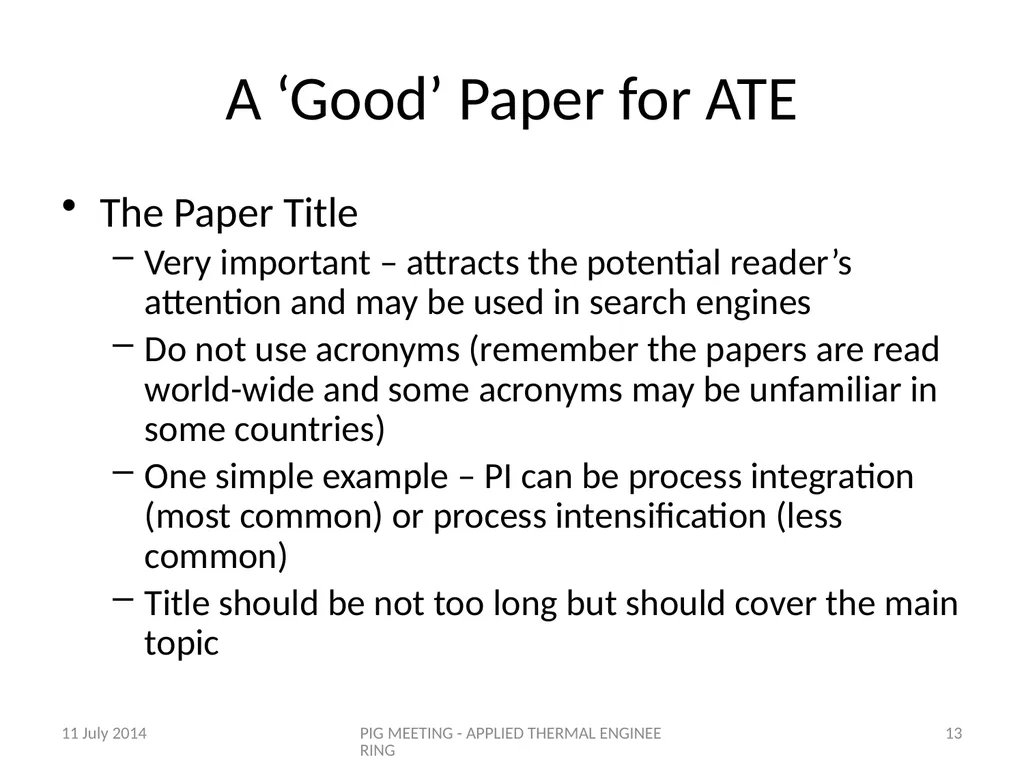
slide13. A ‘Good’ Paper for ATE The Paper Title
Very important – attracts the potential reader’s attention and may be used in search engines
Do not use acronyms (remember the papers are read world-wide and some acronyms may be unfamiliar in some countries)
One simple example – PI can be process integration (most common) or process intensification (less common)
Title should be not too long but should cover the main topic 11 July 2014 13 PIG MEETING - APPLIED THERMAL ENGINEERING<br>
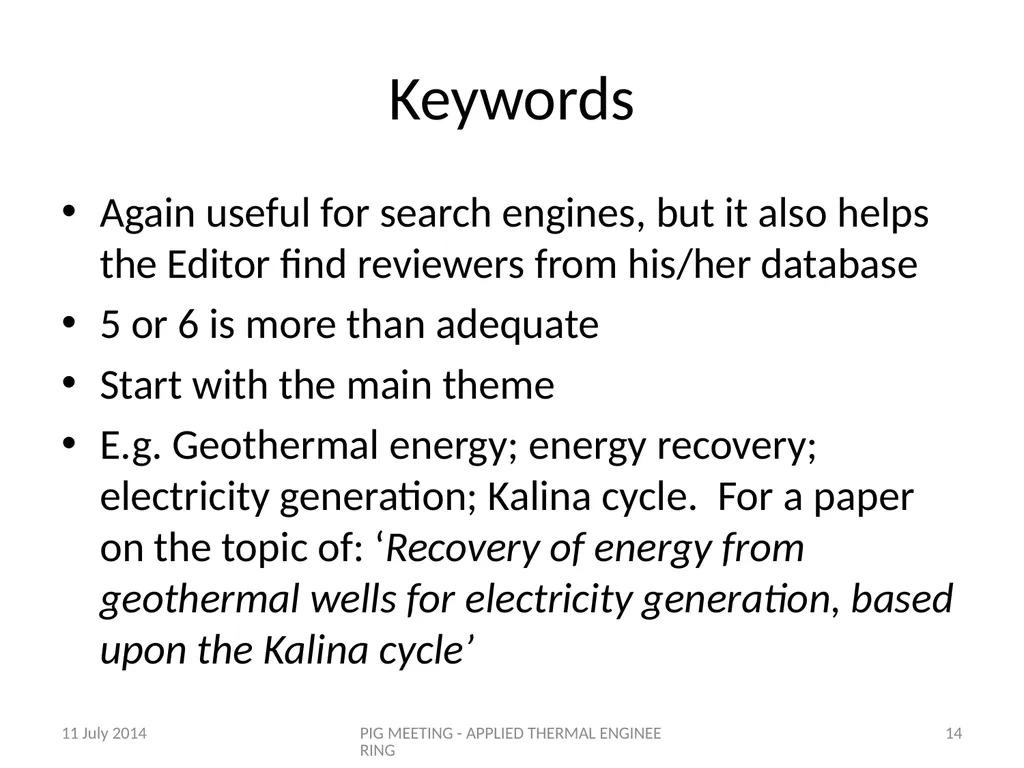
slide14. Keywords Again useful for search engines, but it also helps the Editor find reviewers from his/her database
5 or 6 is more than adequate
Start with the main theme
E.g. Geothermal energy; energy recovery; electricity generation; Kalina cycle. For a paper on the topic of: ‘Recovery of energy from geothermal wells for electricity generation, based upon the Kalina cycle’ 11 July 2014 14 PIG MEETING - APPLIED THERMAL ENGINEERING<br>
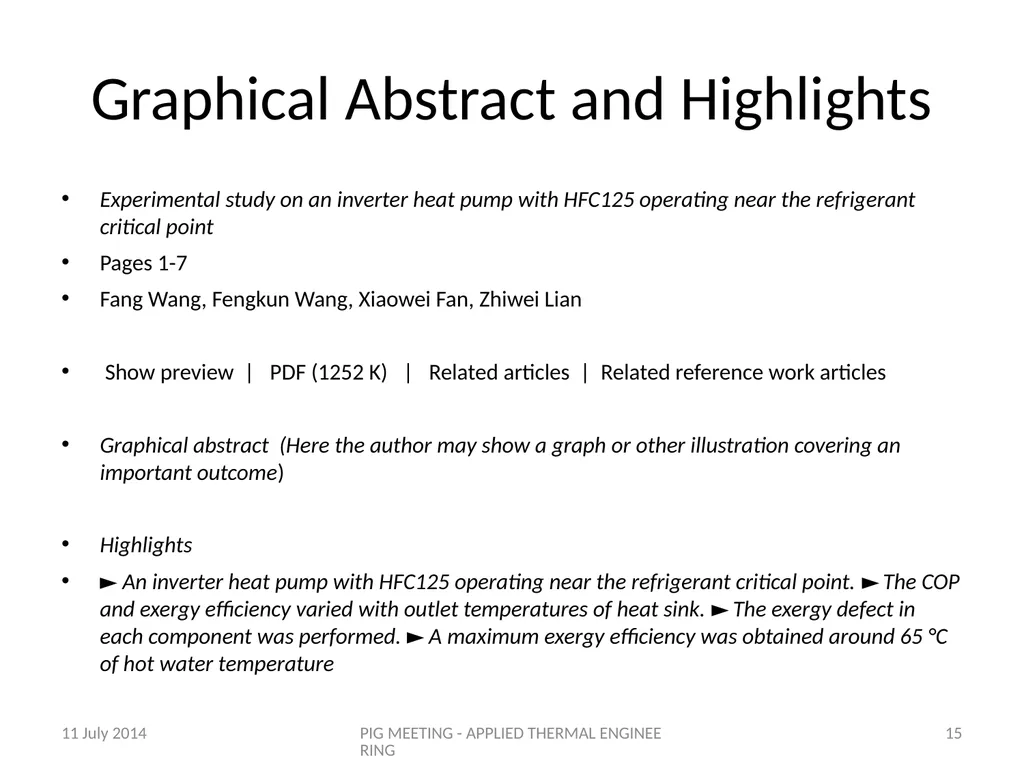
slide15. Graphical Abstract and Highlights Experimental study on an inverter heat pump with HFC125 operating near the refrigerant critical point
Pages 1-7
Fang Wang, Fengkun Wang, Xiaowei Fan, Zhiwei Lian
Show preview | PDF (1252 K) | Related articles | Related reference work articles
Graphical abstract (Here the author may show a graph or other illustration covering an important outcome)
Highlights
► An inverter heat pump with HFC125 operating near the refrigerant critical point. ► The COP and exergy efficiency varied with outlet temperatures of heat sink. ► The exergy defect in each component was performed. ► A maximum exergy efficiency was obtained around 65 °C of hot water temperature 11 July 2014 15 PIG MEETING - APPLIED THERMAL ENGINEERING<br>
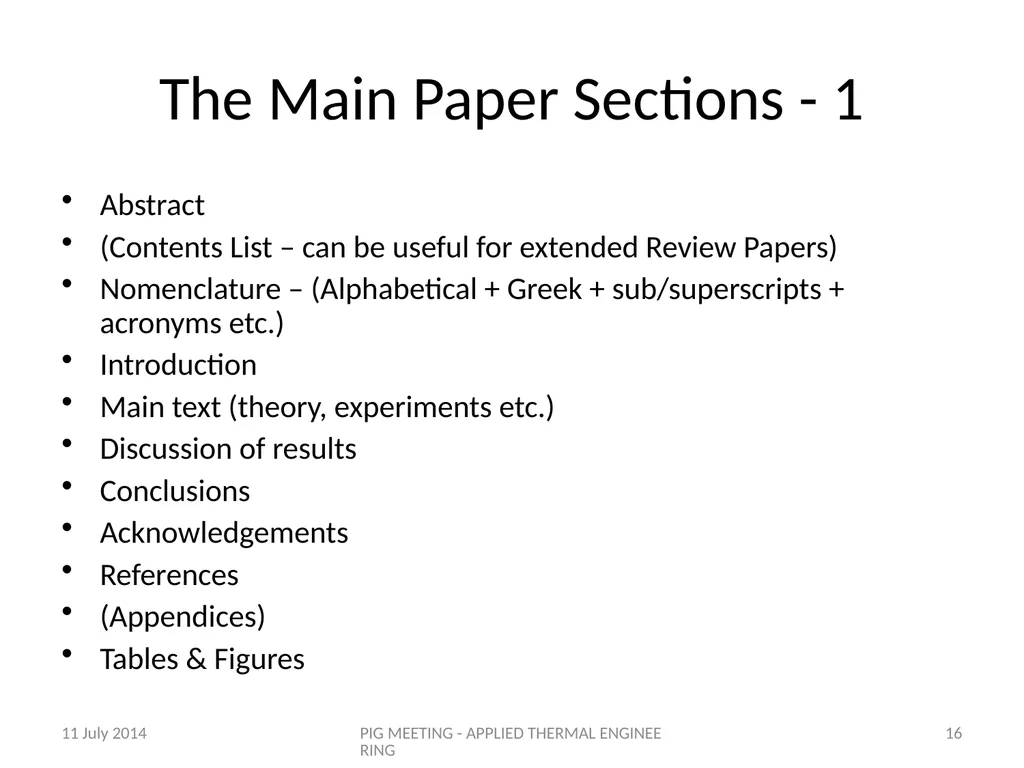
slide16. The Main Paper Sections - 1 Abstract
(Contents List – can be useful for extended Review Papers)
Nomenclature – (Alphabetical + Greek + sub/superscripts + acronyms etc.)
Introduction
Main text (theory, experiments etc.)
Discussion of results
Conclusions
Acknowledgements
References
(Appendices)
Tables & Figures 11 July 2014 16 PIG MEETING - APPLIED THERMAL ENGINEERING<br>
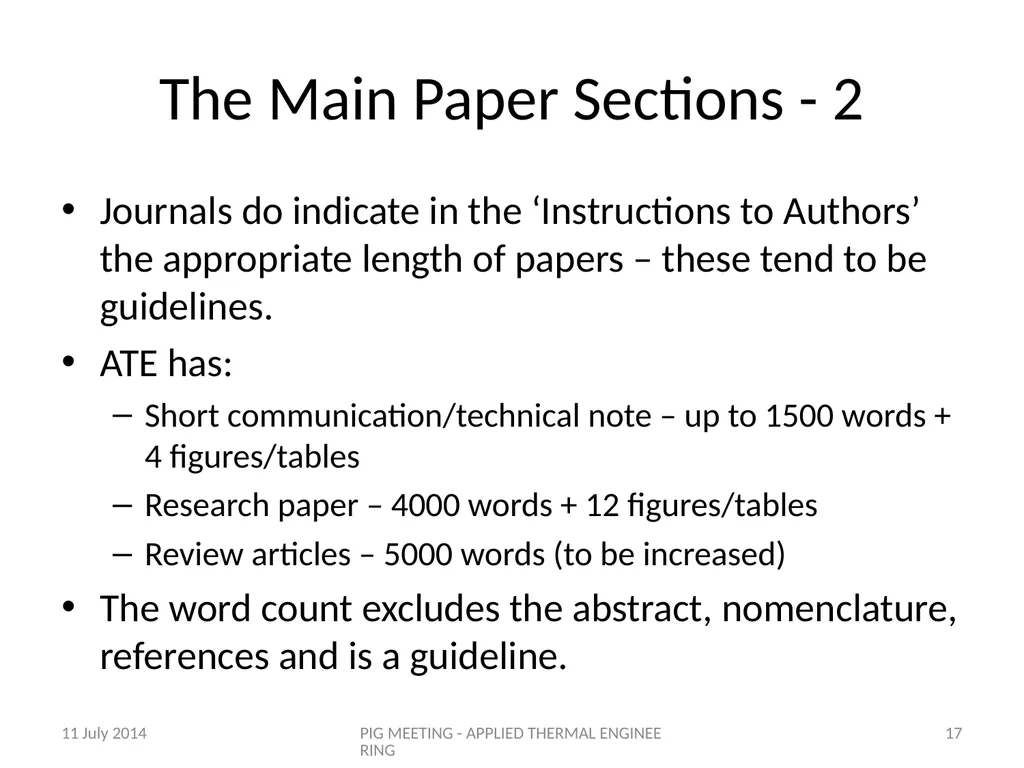
slide17. The Main Paper Sections - 2 Journals do indicate in the ‘Instructions to Authors’ the appropriate length of papers – these tend to be guidelines.
ATE has:
Short communication/technical note – up to 1500 words + 4 figures/tables
Research paper – 4000 words + 12 figures/tables
Review articles – 5000 words (to be increased)
The word count excludes the abstract, nomenclature, references and is a guideline. 11 July 2014 17 PIG MEETING - APPLIED THERMAL ENGINEERING<br>
slide18. The Main Paper Sections - 2 It is helpful to editors and reviewers if pages are numbered
It is also useful to give each text line a number – this aids reviewers in highlighting where their comments apply. 11 July 2014 PIG MEETING - APPLIED THERMAL ENGINEERING 18<br>
slide19. The Abstract Typically 200 words
It states not just what you have done, but the principal outputs of the work.
Ideally there will be quantified data
It is a ‘stand alone’ item so should be written to attract the reader’s attention – it may be the only part he has access to in data searches. 11 July 2014 19 PIG MEETING - APPLIED THERMAL ENGINEERING<br>
slide20. The Introduction As well as introducing your work, it should include a review of relevant literature and previous research in the field.
Conclude with a summary of what you are proposing to report on, highlighting how it moves on from earlier work.
The Introduction may contain most of the references you cite in your paper, if the review is extensive. 11 July 2014 20 PIG MEETING - APPLIED THERMAL ENGINEERING<br>
slide21. The Introduction - 2 When using multiple references e.g. (2), (3) (7) 10) … briefly describe features of EACH reference rather than just giving an overview of what is included. 11 July 2014 PIG MEETING - APPLIED THERMAL ENGINEERING 21<br>
slide22. Main Text May be sub-divided into numbered sections/subsections
Experimental data should be backed up by error analyses/instrumentation accuracies etc. Data on the test facility – a photo of it helps (cases where no rig existed!)
Heavy theory can be relegated to an Appendix 11 July 2014 22 PIG MEETING - APPLIED THERMAL ENGINEERING<br>
slide23. Discussion of Results An analysis of your experimental/theoretical data.
Highlight important outcomes and also areas where you feel further research may be warranted.
Be objective in your analysis – you are a scientist/engineer, after all! 11 July 2014 23 PIG MEETING - APPLIED THERMAL ENGINEERING<br>
slide24. Conclusions Be brief
Do not repeat whole paragraphs from the Discussion of Results
You may use bullet points
Do not cite references or figures in the Conclusions
Make sure results mentioned here are consistent with those in the Abstract. 11 July 2014 24 PIG MEETING - APPLIED THERMAL ENGINEERING<br>
slide25. Acknowledgements Supporting bodies (EPSRC & Contract number); companies funding the R&D; colleagues who helped significantly (but are not co-authors)
Brief if possible.
Acknowledge material taken from other workers/publications where you have sought permission.
ATE does not carry pen portraits of the authors, unlike some journals. 11 July 2014 25 PIG MEETING - APPLIED THERMAL ENGINEERING<br>
slide26. Figures & Tables Tables headings go ABOVE Tables. Check any symbols/acronyms used are listed earlier.
Figures numbered sequentially. May be submitted as separate files or in the text as a single document. Titles go BELOW figures.
Read journal guidelines regarding number of each allowed (if limited)
Check for legibility at the size they are likely to appear in the printed version of ATE (which is also not in colour unless specifically requested and paid for by the author) 11 July 2014 26 PIG MEETING - APPLIED THERMAL ENGINEERING<br>
slide27. Videos & Webcasts You can now add videos to a paper and these will appear in on-line versions.
For example, boiling phenomena in narrow channels, some CFD simulations, etc.
http://www.elsevier.com/audioslides
Allows you to add a Webcast explaining aspects of your research – a sales pitch! 11 July 2014 PIG MEETING - APPLIED THERMAL ENGINEERING 27<br>
slide28. References Standard format for these – see journal home pages
If you cite a web site, give the date when accessed
A normal research paper may have 20-30 references, a review 70-100 references. 11 July 2014 28 PIG MEETING - APPLIED THERMAL ENGINEERING<br>
slide29. Finally: A Reminder of the Journal Web Site www.elsevier.com/locate/apthermeng 11 July 2014 29 PIG MEETING - APPLIED THERMAL ENGINEERING<br>
Editor-in-Chief
Heriot-Watt, Newcastle, Northumbria & Nottingham University;
David Reay & Associates<br>
slide2. The Journal URL and Home Page www.elsevier.com/locate/apthermeng 11 July 2014 PIG MEETING - APPLIED THERMAL ENGINEERING 2<br>
slide3. What an Editor Sees: View Submission View CrossCheck Report Details
History File Inventory Edit Submission Classifications Assign Editor Invite Reviewers View Reviews and Comments Similar Articles in MEDLINE Scopus Author Search CrossRef Title Search Submit Editor's Decision and Comments Send E-mail Linked Submissions 11 July 2014 PIG MEETING - APPLIED THERMAL ENGINEERING 3<br>
slide4. Journal History First Issue in 1981 – then called ‘Heat Recovery Systems’ 4 issues/year – under the Pergamon Press imprint
Changed its name to ‘Heat Recovery Systems & CHP’ to reflect widening scope
Then, under Elsevier, to ‘Applied Thermal Engineering’ (ATE)
So far 10 issues have appeared or are in preparation for 2014
Current Impact Factor 2.127 11 July 2014 4 PIG MEETING - APPLIED THERMAL ENGINEERING<br>
slide5. Organisation Keith Lambert is Publisher, Mechanical Engineering, for Elsevier (ATE falls within the Mechanical Engineering portfolio)
David Reay is Editor-in-Chief of ATE
Supported by Regional Editors in Europe, USA, India & China
Who all have Associate Regional Editors to assist – e.g. In Mexico, Malaysia, China, Japan, and Hungary. 11 July 2014 5 PIG MEETING - APPLIED THERMAL ENGINEERING<br>
slide6. Paper Processing - 1 Elsevier carries out screening for language/layout etc. Paper may be returned to author for modifications
Then it is (via EES) passed to the Editor-in-Chief, who makes a decision:
Reject (on scientific or journal compatibility grounds)
Reject outright (e.g. suggest sending it elsewhere)
Forward to a Regional Editor 11 July 2014 6 PIG MEETING - APPLIED THERMAL ENGINEERING<br>
slide7. Paper Processing - 2 The Regional Editor either allocates an Associate Editor to process the paper, or does it himself.
Select reviewers (typically 3) – Authors are invited to nominate three independent expert reviewers
Send to reviewers
Await comments/chase reviewers
Send comments to author asking for a revision to be submitted or the paper may be rejected at this stage
If a revision submitted, it is sent for reviewing again
If, on return, acceptance is recommended, the paper goes to Elsevier for proofing 11 July 2014 7 PIG MEETING - APPLIED THERMAL ENGINEERING<br>
slide8. Choose the Journal Carefully-1 Look at the Journal Title:
Pure science
Applied science
Applied engineering
Areas of these (heat transfer, fluids etc.)
‘Applied Thermal Engineering’ – means:
Applied technologies
Those with a thermal content (not necessarily 100%)
Related to engineering
READ the Aims and Scope 11 July 2014 8 PIG MEETING - APPLIED THERMAL ENGINEERING<br>
slide9. Choose the Journal Carefully-2 But there are many steps between basic research and the application of a concept
An intention to ‘apply’ the research can be sufficient
Fundamental thermal research of generic interest to engineering is of interest
Editors can redirect papers that may be ‘out of scope’ to other journals
Int. J. Heat & Mass Transfer, Combustion & Flame, Solar Energy, Int. J. Thermal Sciences, Int. J. of Exergy are some to which we commonly redirect papers. 11 July 2014 9 PIG MEETING - APPLIED THERMAL ENGINEERING<br>
slide10. Conference Papers In most cases conference submissions do not make good journal papers without substantial changes:
Conference papers are often limited in length & hence detailed content
They lack good reviews of previous work/relevant literature
The research reported may be at an early stage – too early for archival journals
The innovative aspects may be lacking
They are probably written for a narrower audience
Peer reviewing is probably less rigorous 11 July 2014 10 PIG MEETING - APPLIED THERMAL ENGINEERING<br>
slide11. Special Issues But: ATE publishes ‘Special Issues’ that are compilations of conference papers selected by Guest Editors.
The selected conference papers are extended and peer-reviewed to a higher standard (generally).
Guest Editors prepare an Editorial relating the papers to the conference theme(s)
The authors, of course, get a citation that carries more weight than a conference paper (which may have limited distribution/accessibility) 11 July 2014 11 PIG MEETING - APPLIED THERMAL ENGINEERING<br>
slide12. Review Papers Review Papers are normally invited by the Editors
OR an author may submit the idea of a review to an Editor and await a decision on its relevance, scope and the author’s expertise in the area.
Many reviews are well-cited – in the top 25 ATE cited papers probably 10 or more are review papers.
They can be longer than Research papers. 11 July 2014 PIG MEETING - APPLIED THERMAL ENGINEERING 12<br>
slide13. A ‘Good’ Paper for ATE The Paper Title
Very important – attracts the potential reader’s attention and may be used in search engines
Do not use acronyms (remember the papers are read world-wide and some acronyms may be unfamiliar in some countries)
One simple example – PI can be process integration (most common) or process intensification (less common)
Title should be not too long but should cover the main topic 11 July 2014 13 PIG MEETING - APPLIED THERMAL ENGINEERING<br>
slide14. Keywords Again useful for search engines, but it also helps the Editor find reviewers from his/her database
5 or 6 is more than adequate
Start with the main theme
E.g. Geothermal energy; energy recovery; electricity generation; Kalina cycle. For a paper on the topic of: ‘Recovery of energy from geothermal wells for electricity generation, based upon the Kalina cycle’ 11 July 2014 14 PIG MEETING - APPLIED THERMAL ENGINEERING<br>
slide15. Graphical Abstract and Highlights Experimental study on an inverter heat pump with HFC125 operating near the refrigerant critical point
Pages 1-7
Fang Wang, Fengkun Wang, Xiaowei Fan, Zhiwei Lian
Show preview | PDF (1252 K) | Related articles | Related reference work articles
Graphical abstract (Here the author may show a graph or other illustration covering an important outcome)
Highlights
► An inverter heat pump with HFC125 operating near the refrigerant critical point. ► The COP and exergy efficiency varied with outlet temperatures of heat sink. ► The exergy defect in each component was performed. ► A maximum exergy efficiency was obtained around 65 °C of hot water temperature 11 July 2014 15 PIG MEETING - APPLIED THERMAL ENGINEERING<br>
slide16. The Main Paper Sections - 1 Abstract
(Contents List – can be useful for extended Review Papers)
Nomenclature – (Alphabetical + Greek + sub/superscripts + acronyms etc.)
Introduction
Main text (theory, experiments etc.)
Discussion of results
Conclusions
Acknowledgements
References
(Appendices)
Tables & Figures 11 July 2014 16 PIG MEETING - APPLIED THERMAL ENGINEERING<br>
slide17. The Main Paper Sections - 2 Journals do indicate in the ‘Instructions to Authors’ the appropriate length of papers – these tend to be guidelines.
ATE has:
Short communication/technical note – up to 1500 words + 4 figures/tables
Research paper – 4000 words + 12 figures/tables
Review articles – 5000 words (to be increased)
The word count excludes the abstract, nomenclature, references and is a guideline. 11 July 2014 17 PIG MEETING - APPLIED THERMAL ENGINEERING<br>
slide18. The Main Paper Sections - 2 It is helpful to editors and reviewers if pages are numbered
It is also useful to give each text line a number – this aids reviewers in highlighting where their comments apply. 11 July 2014 PIG MEETING - APPLIED THERMAL ENGINEERING 18<br>
slide19. The Abstract Typically 200 words
It states not just what you have done, but the principal outputs of the work.
Ideally there will be quantified data
It is a ‘stand alone’ item so should be written to attract the reader’s attention – it may be the only part he has access to in data searches. 11 July 2014 19 PIG MEETING - APPLIED THERMAL ENGINEERING<br>
slide20. The Introduction As well as introducing your work, it should include a review of relevant literature and previous research in the field.
Conclude with a summary of what you are proposing to report on, highlighting how it moves on from earlier work.
The Introduction may contain most of the references you cite in your paper, if the review is extensive. 11 July 2014 20 PIG MEETING - APPLIED THERMAL ENGINEERING<br>
slide21. The Introduction - 2 When using multiple references e.g. (2), (3) (7) 10) … briefly describe features of EACH reference rather than just giving an overview of what is included. 11 July 2014 PIG MEETING - APPLIED THERMAL ENGINEERING 21<br>
slide22. Main Text May be sub-divided into numbered sections/subsections
Experimental data should be backed up by error analyses/instrumentation accuracies etc. Data on the test facility – a photo of it helps (cases where no rig existed!)
Heavy theory can be relegated to an Appendix 11 July 2014 22 PIG MEETING - APPLIED THERMAL ENGINEERING<br>
slide23. Discussion of Results An analysis of your experimental/theoretical data.
Highlight important outcomes and also areas where you feel further research may be warranted.
Be objective in your analysis – you are a scientist/engineer, after all! 11 July 2014 23 PIG MEETING - APPLIED THERMAL ENGINEERING<br>
slide24. Conclusions Be brief
Do not repeat whole paragraphs from the Discussion of Results
You may use bullet points
Do not cite references or figures in the Conclusions
Make sure results mentioned here are consistent with those in the Abstract. 11 July 2014 24 PIG MEETING - APPLIED THERMAL ENGINEERING<br>
slide25. Acknowledgements Supporting bodies (EPSRC & Contract number); companies funding the R&D; colleagues who helped significantly (but are not co-authors)
Brief if possible.
Acknowledge material taken from other workers/publications where you have sought permission.
ATE does not carry pen portraits of the authors, unlike some journals. 11 July 2014 25 PIG MEETING - APPLIED THERMAL ENGINEERING<br>
slide26. Figures & Tables Tables headings go ABOVE Tables. Check any symbols/acronyms used are listed earlier.
Figures numbered sequentially. May be submitted as separate files or in the text as a single document. Titles go BELOW figures.
Read journal guidelines regarding number of each allowed (if limited)
Check for legibility at the size they are likely to appear in the printed version of ATE (which is also not in colour unless specifically requested and paid for by the author) 11 July 2014 26 PIG MEETING - APPLIED THERMAL ENGINEERING<br>
slide27. Videos & Webcasts You can now add videos to a paper and these will appear in on-line versions.
For example, boiling phenomena in narrow channels, some CFD simulations, etc.
http://www.elsevier.com/audioslides
Allows you to add a Webcast explaining aspects of your research – a sales pitch! 11 July 2014 PIG MEETING - APPLIED THERMAL ENGINEERING 27<br>
slide28. References Standard format for these – see journal home pages
If you cite a web site, give the date when accessed
A normal research paper may have 20-30 references, a review 70-100 references. 11 July 2014 28 PIG MEETING - APPLIED THERMAL ENGINEERING<br>
slide29. Finally: A Reminder of the Journal Web Site www.elsevier.com/locate/apthermeng 11 July 2014 29 PIG MEETING - APPLIED THERMAL ENGINEERING<br>