
A Hanging – George Orwell George Orwell -
KB
Published · 61 slides · 0 views

1 / 1




Description
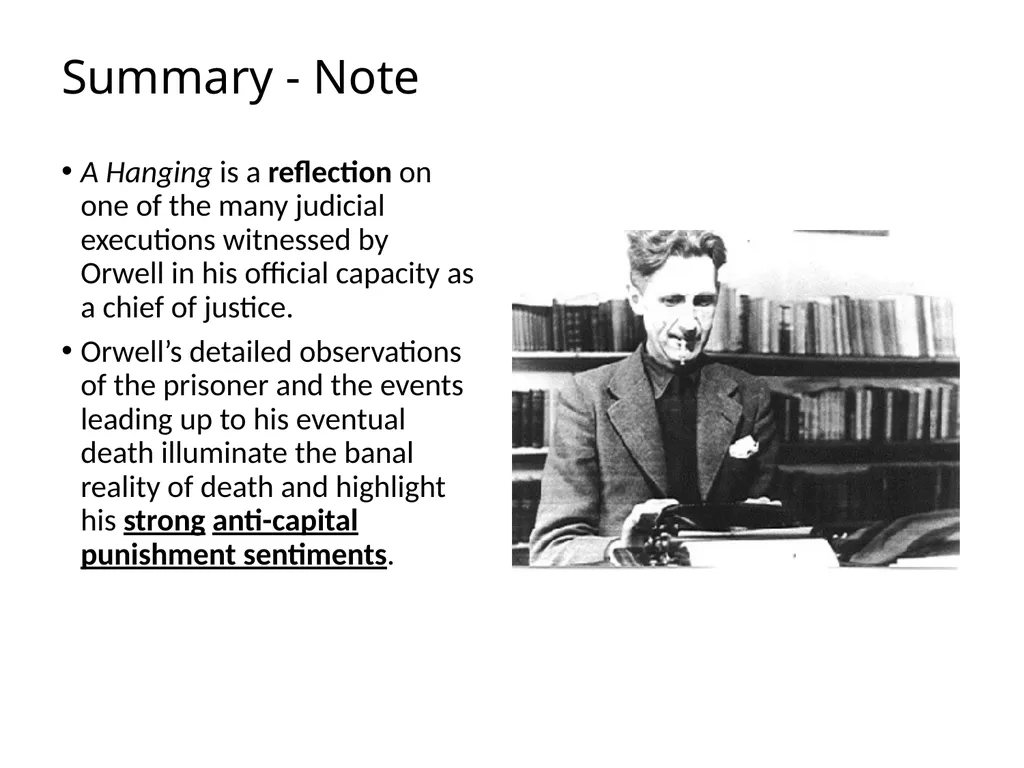
A Hanging George Orwell George Orwell - Biography Eric Arthur Blair (25 June 1903 21 January 1950), better known by his pen name George Orwell, was an English author. His work is marked by a profound consciousness of social injustice,
Related Topics
Share
Embed code
Download this presentation From Below
"A Hanging – George Orwell George Orwell -" is the property of its rightful owner. Permission is granted to download and print the materials on this website for personal, non-commercial use only, and to display it on your personal computer provided you do not modify the materials and that you retain all copyright notices contained in the materials. By downloading content from our website, you accept the terms of this agreement.
Presentation Transcript
01
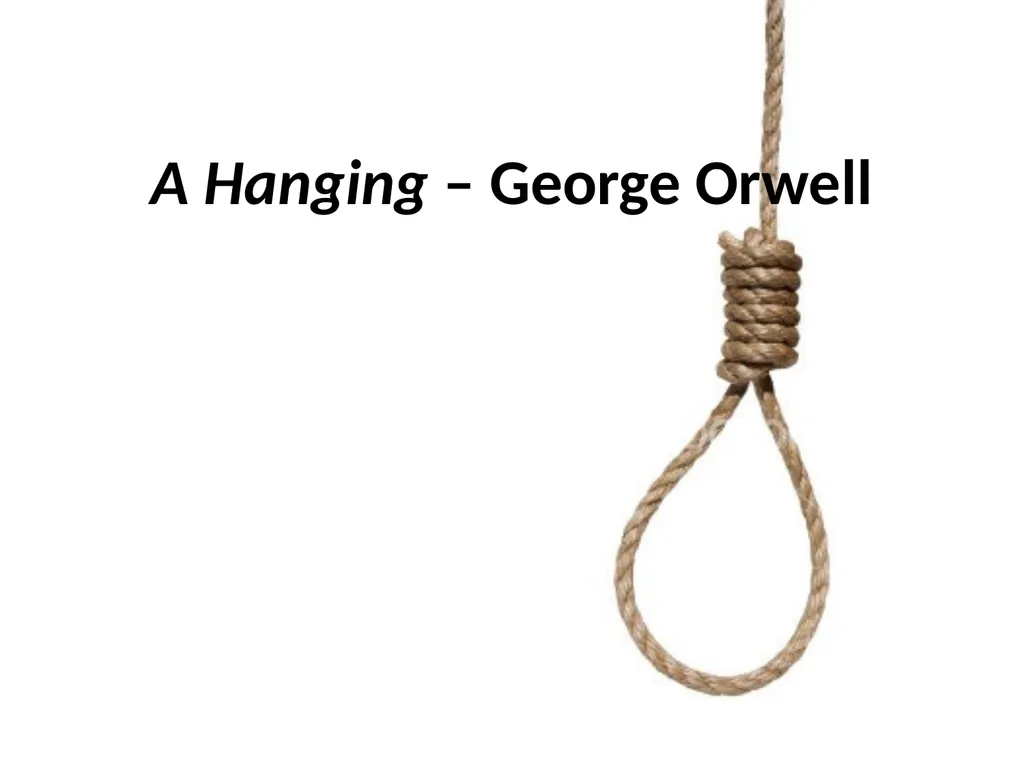
A Hanging – George Orwell<br>
02
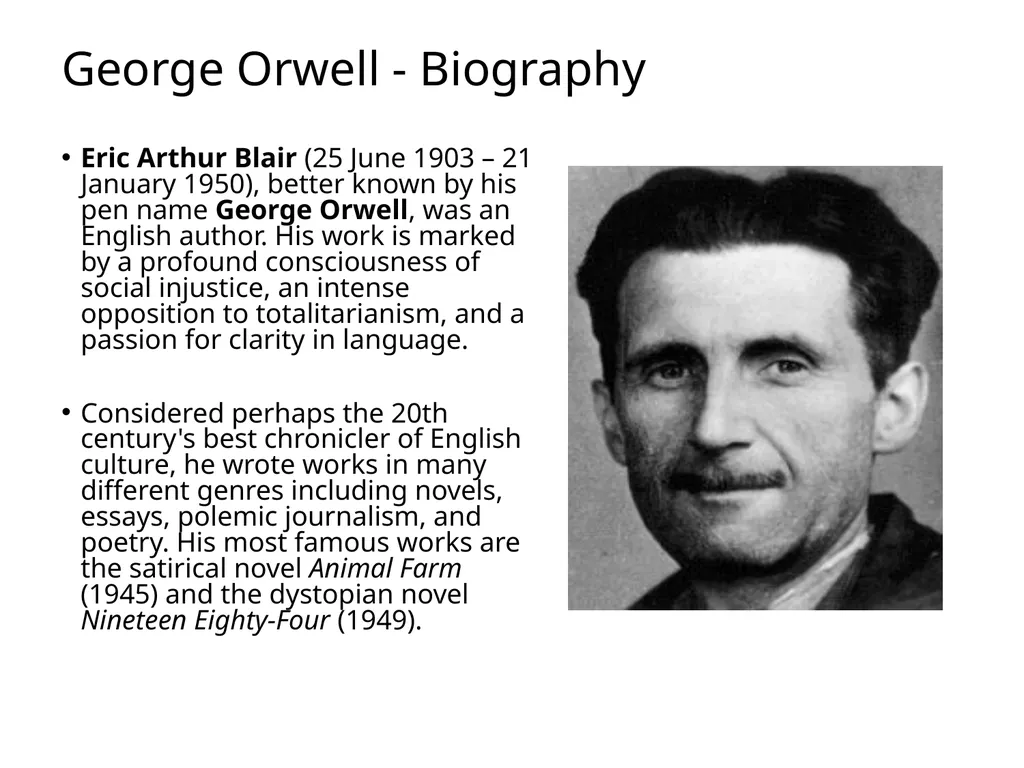
George Orwell - Biography Eric Arthur Blair (25 June 1903 – 21 January 1950), better known by his pen name George Orwell, was an English author. His work is marked by a profound consciousness of social injustice, an intense opposition to totalitarianism, and a passion for clarity in language.
Considered perhaps the 20th century's best chronicler of English culture, he wrote works in many different genres including novels, essays, polemic journalism, and poetry. His most famous works are the satirical novel Animal Farm (1945) and the dystopian novel Nineteen Eighty-Four (1949).<br>
Considered perhaps the 20th century's best chronicler of English culture, he wrote works in many different genres including novels, essays, polemic journalism, and poetry. His most famous works are the satirical novel Animal Farm (1945) and the dystopian novel Nineteen Eighty-Four (1949).<br>
03
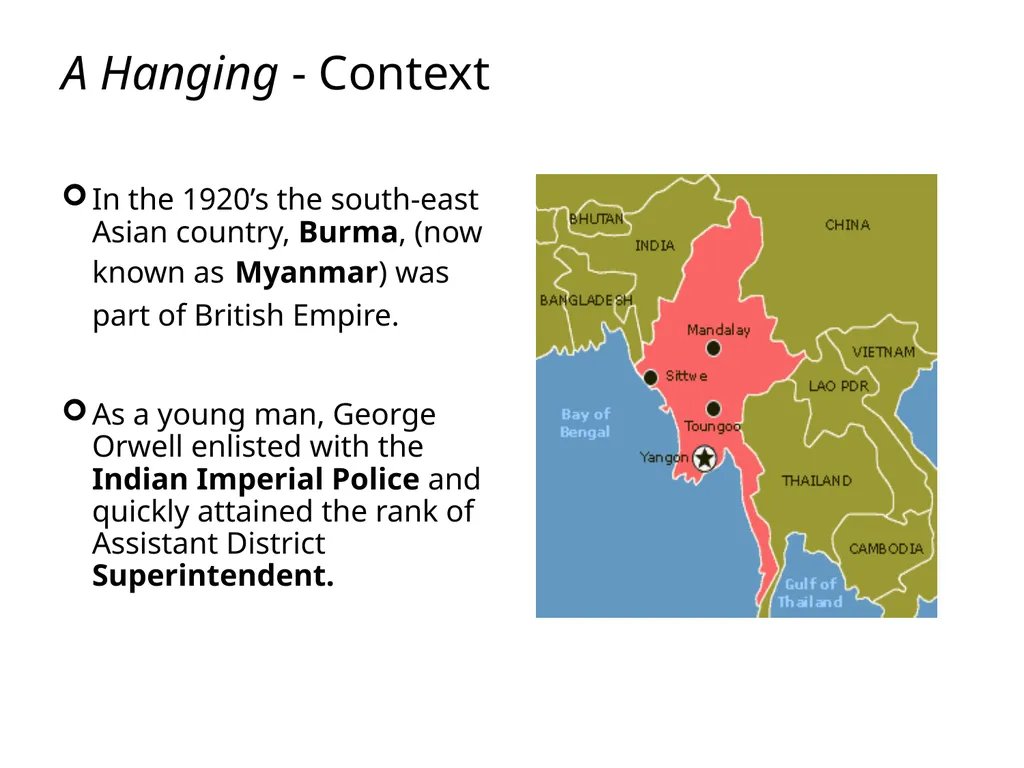
A Hanging - Context In the 1920’s the south-east Asian country, Burma, (now known as Myanmar) was part of British Empire.
As a young man, George Orwell enlisted with the Indian Imperial Police and quickly attained the rank of Assistant District Superintendent.<br>
As a young man, George Orwell enlisted with the Indian Imperial Police and quickly attained the rank of Assistant District Superintendent.<br>
04
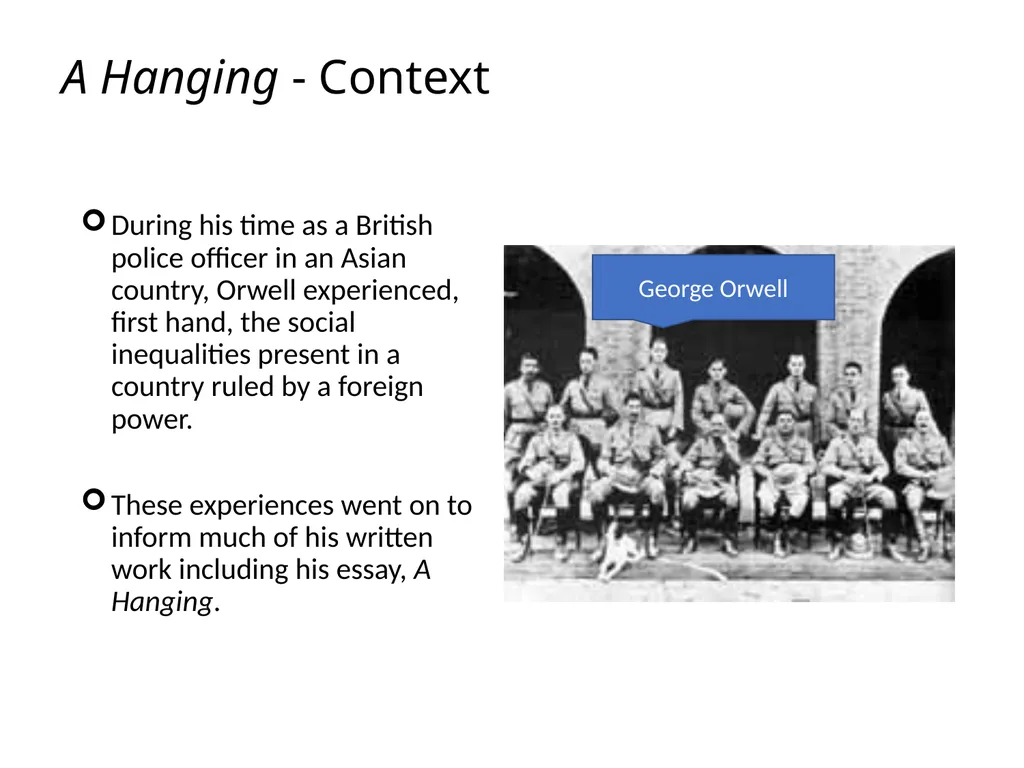
A Hanging - Context During his time as a British police officer in an Asian country, Orwell experienced, first hand, the social inequalities present in a country ruled by a foreign power.
These experiences went on to inform much of his written work including his essay, A Hanging. George Orwell<br>
These experiences went on to inform much of his written work including his essay, A Hanging. George Orwell<br>
05
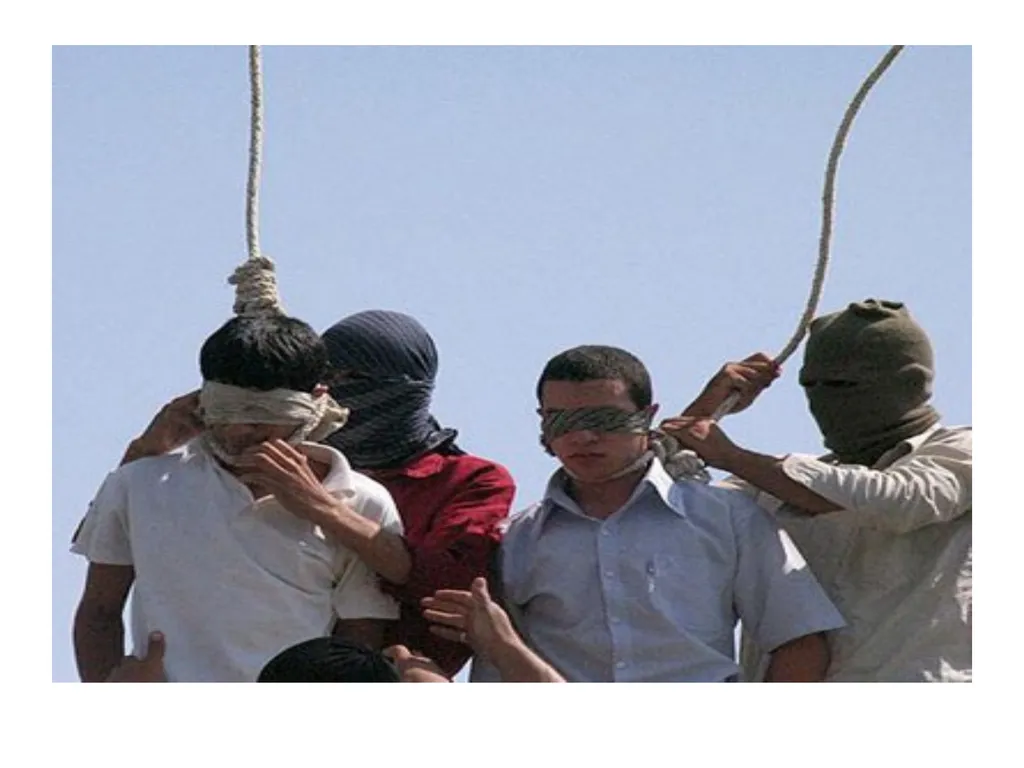
Summary - Note A Hanging is a reflection on one of the many judicial executions witnessed by Orwell in his official capacity as a chief of justice.
Orwell’s detailed observations of the prisoner and the events leading up to his eventual death illuminate the banal reality of death and highlight his strong anti-capital punishment sentiments.<br>
Orwell’s detailed observations of the prisoner and the events leading up to his eventual death illuminate the banal reality of death and highlight his strong anti-capital punishment sentiments.<br>
06
Writer’s Purpose - Note When producing a written piece of work all writers will have a particular purpose in mind which they wish to communicate to the reader. In A Hanging, Orwell makes a social comment about capital punishment.
Through his clever use of language techniques such as imagery, symbolism, tone and word choice Orwell evokes the reader’s sympathy for the prisoner’s plight.<br>
Through his clever use of language techniques such as imagery, symbolism, tone and word choice Orwell evokes the reader’s sympathy for the prisoner’s plight.<br>
07
Orwell paints a wonderfully intense picture of the man condemned to death, the jailers walking away, and the dog's unpredictable actions amidst the solemn occasion.
The execution's formality allows the participants to automatically and thoughtlessly conduct their business.
The condemned man's automatic action of side-stepping the puddle, important to one's own continuing comfort later in the day, makes Orwell begin to think about the difference between being alive and being dead, and the horror of what is being done in killing the man. He is alive, his toenails are growing, his blood is pumping, yet he avoids wetting his feet in that moment while in the next moment he will be dead, gone from the world.
Ultimately, Orwell contemplates how tradition and ritual prevent participants from thinking about their actions. Such ideas resonate through Orwell's writing through to Nineteen Eighty-Four. 'A Hanging' - Discussion<br>
The execution's formality allows the participants to automatically and thoughtlessly conduct their business.
The condemned man's automatic action of side-stepping the puddle, important to one's own continuing comfort later in the day, makes Orwell begin to think about the difference between being alive and being dead, and the horror of what is being done in killing the man. He is alive, his toenails are growing, his blood is pumping, yet he avoids wetting his feet in that moment while in the next moment he will be dead, gone from the world.
Ultimately, Orwell contemplates how tradition and ritual prevent participants from thinking about their actions. Such ideas resonate through Orwell's writing through to Nineteen Eighty-Four. 'A Hanging' - Discussion<br>
08
Questions – Paras 1 and 2 What evidence is there for the poor condition of the prisoners?
For each quote explain, in as much detail as you can, the reason for your choice.
2. Why do you think Orwell chose to include such detailed description of the prisoner’s conditions?<br>
For each quote explain, in as much detail as you can, the reason for your choice.
2. Why do you think Orwell chose to include such detailed description of the prisoner’s conditions?<br>
09
Sympathy for the Prisoner - Setting The setting described in the opening lines of the essay immediately highlights the poor conditions in which the prisoners are kept.
“A sickly light…” – connotations of prisoner health
“small animal cages” – inhumane conditions
“ten feet by ten feet and was quite bare”<br>
“A sickly light…” – connotations of prisoner health
“small animal cages” – inhumane conditions
“ten feet by ten feet and was quite bare”<br>
10
Sympathy for the Prisoner – Physical Description “squatting” – continues animal image
“a puny wisp of a man” – suggests malnourishment and neglect.
“sprouting moustache, absurdly too big for his body” - comic image further emphasises the prisoner’s frailty.<br>
“a puny wisp of a man” – suggests malnourishment and neglect.
“sprouting moustache, absurdly too big for his body” - comic image further emphasises the prisoner’s frailty.<br>
11
Question How does the description of the prisoner compare with the descriptions of the guards in paragraphs 2 and 4?
In what way does this comparison contribute to the writer’s purpose?<br>
In what way does this comparison contribute to the writer’s purpose?<br>
12
Contrast – Guards and Prisoner The prison guards are described as “tall Indian warders” and one, in particular, as a “fat Dravidian”
These descriptions of healthy, well-fed guards contrast with the ill treatment of the prisoners .
In doing so Orwell stimulates the reader’s sympathy for the prisoners, who seem so frail and vulnerable in comparison – writer’s purpose.<br>
These descriptions of healthy, well-fed guards contrast with the ill treatment of the prisoners .
In doing so Orwell stimulates the reader’s sympathy for the prisoners, who seem so frail and vulnerable in comparison – writer’s purpose.<br>
13
Can the Punishment Ever
Fit the Crime? For what crime is the prisoner being executed?
Orwell omits to mention the prisoner’s crime as he does not want the reader to make any judgement about the whether or not the death penalty was justified.
By focussing solely on the process of killing another human being Orwell exposes the brutal reality of capital punishment – writer’s purpose.<br>
Orwell omits to mention the prisoner’s crime as he does not want the reader to make any judgement about the whether or not the death penalty was justified.
By focussing solely on the process of killing another human being Orwell exposes the brutal reality of capital punishment – writer’s purpose.<br>
14
Symbolism – The Dog Why do you think Orwell decided to include a detailed description of the dog’s appearance in the prison yard?
By noting that the dog goes directly to the prisoner instead of the officials Orwell uses symbolism to suggest that all people are equal regardless of their circumstances.
The reaction of the prison officials to the appearance of the dog demonstrates their underlying discomfort at having to take a life – “Everyone stood aghast…”
This symbolises Orwell’s further belief that not only is capital punishment wrong, it is also against human nature to kill another person.<br>
By noting that the dog goes directly to the prisoner instead of the officials Orwell uses symbolism to suggest that all people are equal regardless of their circumstances.
The reaction of the prison officials to the appearance of the dog demonstrates their underlying discomfort at having to take a life – “Everyone stood aghast…”
This symbolises Orwell’s further belief that not only is capital punishment wrong, it is also against human nature to kill another person.<br>
15
Symbolism – The Puddle What does Orwell suggest in his description of the prisoner avoiding a puddle while being led to the gallows?
Although the prisoner is being led to his death he instinctively avoids a puddle in order to minimise his discomfort; a seemingly futile action.
Symbolises human survival instinct and reiterates Orwell’s belief that taking life is against human nature.<br>
Although the prisoner is being led to his death he instinctively avoids a puddle in order to minimise his discomfort; a seemingly futile action.
Symbolises human survival instinct and reiterates Orwell’s belief that taking life is against human nature.<br>
16
1) See paragraph 2. What impression do you get of the prisoner?
2) How does this compare to the impression you get from the warders who guard him?
3) What techniques are used by Orwell in this paragraph and what do you think Orwell’s purpose is in using them?
4) In paragraph 3-5, what impression do you get of:
the superintendent b) Francis the head jailer.
Consider their attitude towards the proceedings and their character.
5) What is interesting about the structure of paragraphs 1 -7?
6) Look at paragraph 6. What is unusual/interesting about the ideas and structure of the sentence:
“Two warders marched on either side of the prisoner, with their rifles at the slope; two others marched close against him, gripping him by arm and shoulder, as though at once pushing and supporting him”.
7) Look at paragraph 6. Write down three words or phrases that describe the behaviour of the dog. What impression does Orwell give of it and what is his purpose in doing so?
8) Look at paragraph 7. What is ironic about the phrase “bloody brute”?
9) Why do you think the incident with the dog is so upsetting for the characters and for the reader?
10) Look at how paragraphs 6, 9 & 11 begin. Can you see any similarities? Why has Orwell structured his writing this way? Questions on ‘A Hanging’<br>
2) How does this compare to the impression you get from the warders who guard him?
3) What techniques are used by Orwell in this paragraph and what do you think Orwell’s purpose is in using them?
4) In paragraph 3-5, what impression do you get of:
the superintendent b) Francis the head jailer.
Consider their attitude towards the proceedings and their character.
5) What is interesting about the structure of paragraphs 1 -7?
6) Look at paragraph 6. What is unusual/interesting about the ideas and structure of the sentence:
“Two warders marched on either side of the prisoner, with their rifles at the slope; two others marched close against him, gripping him by arm and shoulder, as though at once pushing and supporting him”.
7) Look at paragraph 6. Write down three words or phrases that describe the behaviour of the dog. What impression does Orwell give of it and what is his purpose in doing so?
8) Look at paragraph 7. What is ironic about the phrase “bloody brute”?
9) Why do you think the incident with the dog is so upsetting for the characters and for the reader?
10) Look at how paragraphs 6, 9 & 11 begin. Can you see any similarities? Why has Orwell structured his writing this way? Questions on ‘A Hanging’<br>
17
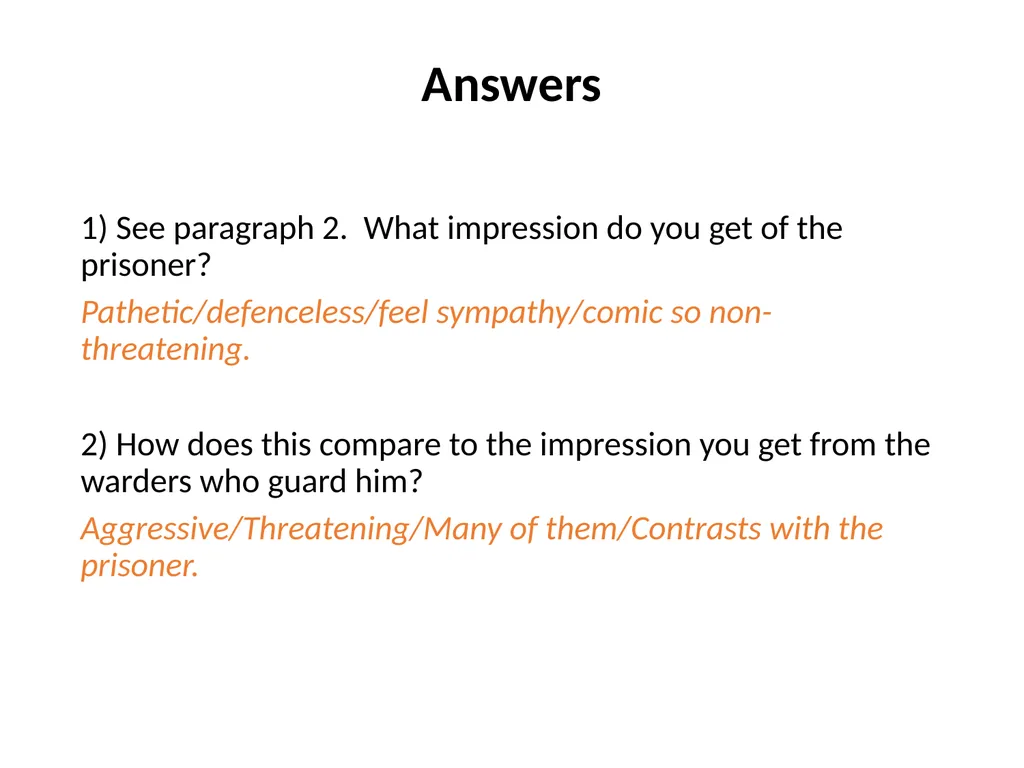
1) See paragraph 2. What impression do you get of the prisoner?
Pathetic/defenceless/feel sympathy/comic so non-threatening.
2) How does this compare to the impression you get from the warders who guard him?
Aggressive/Threatening/Many of them/Contrasts with the prisoner. Answers<br>
Pathetic/defenceless/feel sympathy/comic so non-threatening.
2) How does this compare to the impression you get from the warders who guard him?
Aggressive/Threatening/Many of them/Contrasts with the prisoner. Answers<br>
18
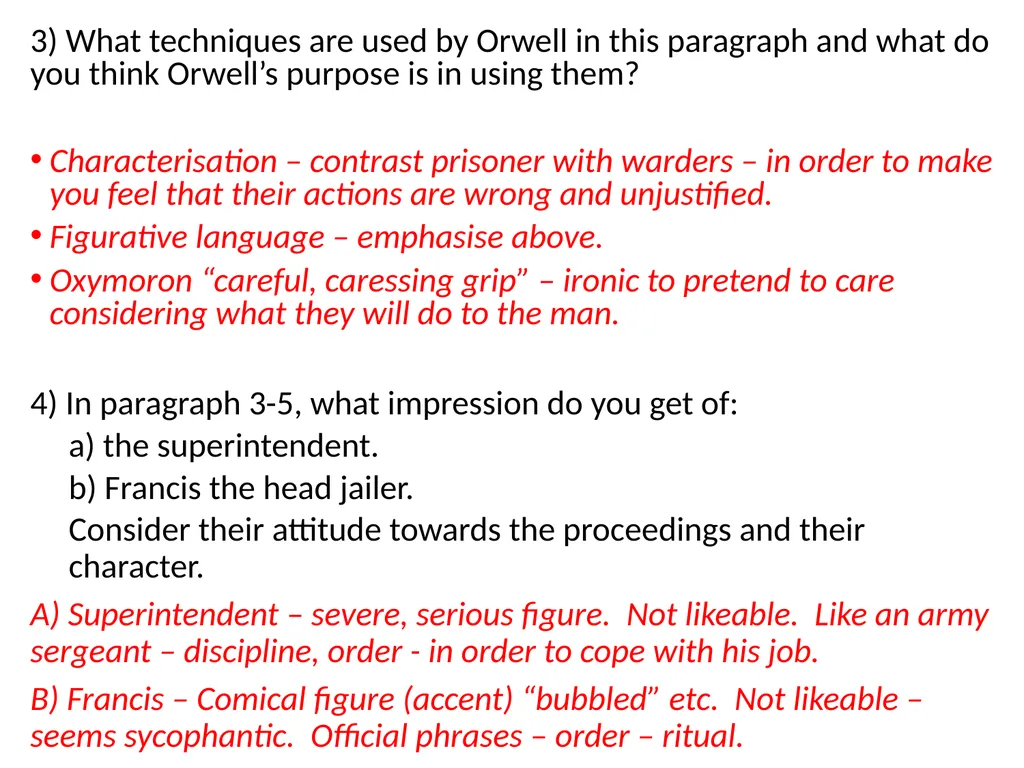
3) What techniques are used by Orwell in this paragraph and what do you think Orwell’s purpose is in using them?
Characterisation – contrast prisoner with warders – in order to make you feel that their actions are wrong and unjustified.
Figurative language – emphasise above.
Oxymoron “careful, caressing grip” – ironic to pretend to care considering what they will do to the man.
4) In paragraph 3-5, what impression do you get of:
a) the superintendent.
b) Francis the head jailer.
Consider their attitude towards the proceedings and their character.
A) Superintendent – severe, serious figure. Not likeable. Like an army sergeant – discipline, order - in order to cope with his job.
B) Francis – Comical figure (accent) “bubbled” etc. Not likeable – seems sycophantic. Official phrases – order – ritual.<br>
Characterisation – contrast prisoner with warders – in order to make you feel that their actions are wrong and unjustified.
Figurative language – emphasise above.
Oxymoron “careful, caressing grip” – ironic to pretend to care considering what they will do to the man.
4) In paragraph 3-5, what impression do you get of:
a) the superintendent.
b) Francis the head jailer.
Consider their attitude towards the proceedings and their character.
A) Superintendent – severe, serious figure. Not likeable. Like an army sergeant – discipline, order - in order to cope with his job.
B) Francis – Comical figure (accent) “bubbled” etc. Not likeable – seems sycophantic. Official phrases – order – ritual.<br>
19
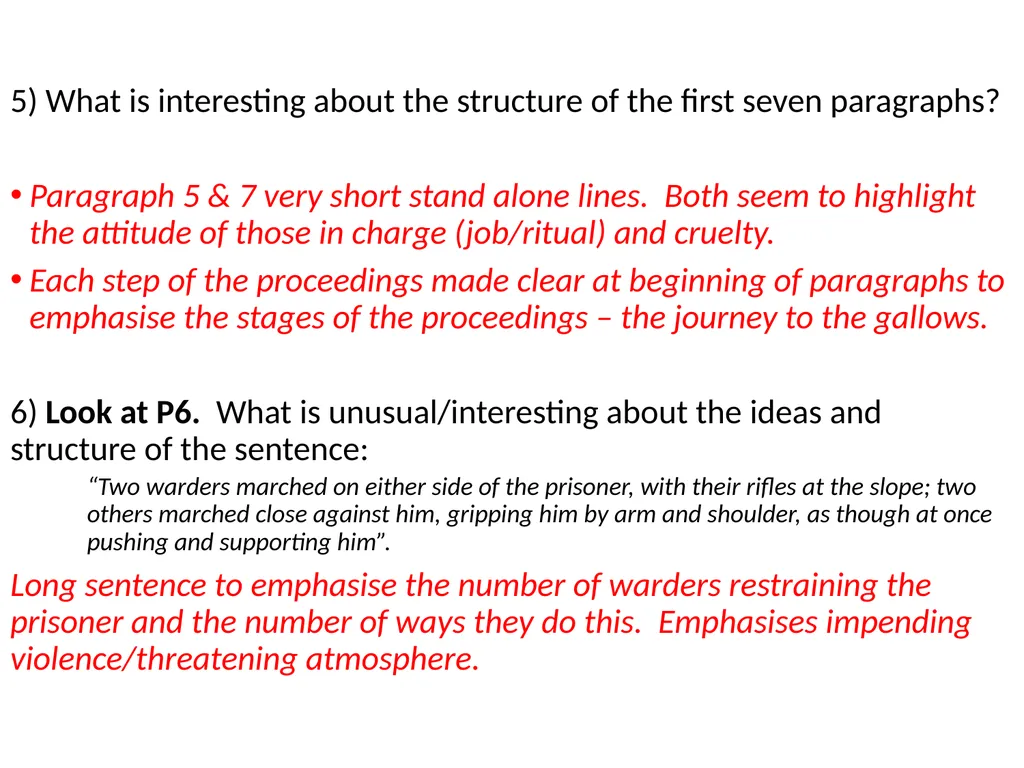
5) What is interesting about the structure of the first seven paragraphs?
Paragraph 5 & 7 very short stand alone lines. Both seem to highlight the attitude of those in charge (job/ritual) and cruelty.
Each step of the proceedings made clear at beginning of paragraphs to emphasise the stages of the proceedings – the journey to the gallows.
6) Look at P6. What is unusual/interesting about the ideas and structure of the sentence:
“Two warders marched on either side of the prisoner, with their rifles at the slope; two others marched close against him, gripping him by arm and shoulder, as though at once pushing and supporting him”.
Long sentence to emphasise the number of warders restraining the prisoner and the number of ways they do this. Emphasises impending violence/threatening atmosphere.<br>
Paragraph 5 & 7 very short stand alone lines. Both seem to highlight the attitude of those in charge (job/ritual) and cruelty.
Each step of the proceedings made clear at beginning of paragraphs to emphasise the stages of the proceedings – the journey to the gallows.
6) Look at P6. What is unusual/interesting about the ideas and structure of the sentence:
“Two warders marched on either side of the prisoner, with their rifles at the slope; two others marched close against him, gripping him by arm and shoulder, as though at once pushing and supporting him”.
Long sentence to emphasise the number of warders restraining the prisoner and the number of ways they do this. Emphasises impending violence/threatening atmosphere.<br>
20
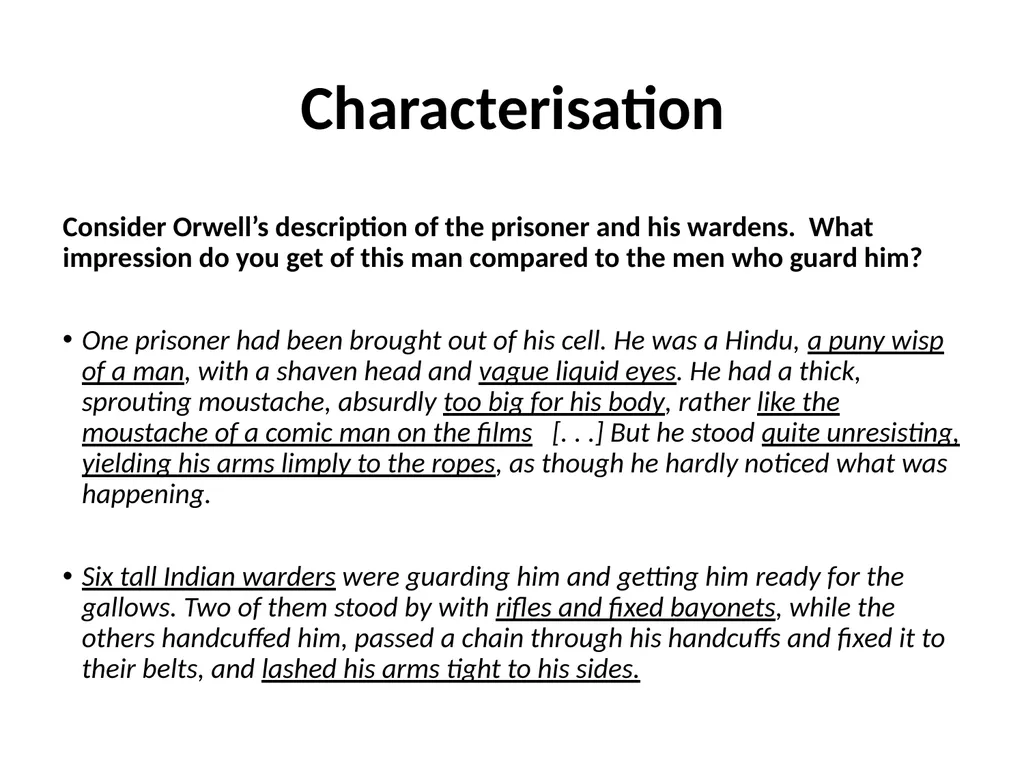
Consider Orwell’s description of the prisoner and his wardens. What impression do you get of this man compared to the men who guard him?
One prisoner had been brought out of his cell. He was a Hindu, a puny wisp of a man, with a shaven head and vague liquid eyes. He had a thick, sprouting moustache, absurdly too big for his body, rather like the moustache of a comic man on the films [. . .] But he stood quite unresisting, yielding his arms limply to the ropes, as though he hardly noticed what was happening.
Six tall Indian warders were guarding him and getting him ready for the gallows. Two of them stood by with rifles and fixed bayonets, while the others handcuffed him, passed a chain through his handcuffs and fixed it to their belts, and lashed his arms tight to his sides. Characterisation<br>
One prisoner had been brought out of his cell. He was a Hindu, a puny wisp of a man, with a shaven head and vague liquid eyes. He had a thick, sprouting moustache, absurdly too big for his body, rather like the moustache of a comic man on the films [. . .] But he stood quite unresisting, yielding his arms limply to the ropes, as though he hardly noticed what was happening.
Six tall Indian warders were guarding him and getting him ready for the gallows. Two of them stood by with rifles and fixed bayonets, while the others handcuffed him, passed a chain through his handcuffs and fixed it to their belts, and lashed his arms tight to his sides. Characterisation<br>
21
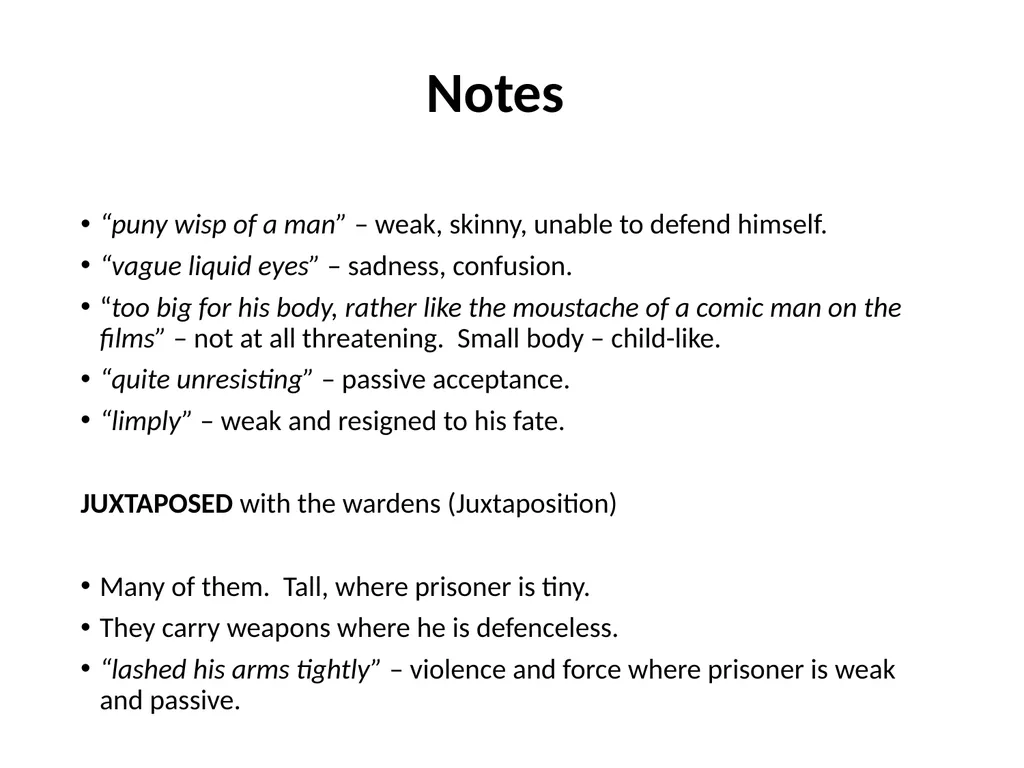
“puny wisp of a man” – weak, skinny, unable to defend himself.
“vague liquid eyes” – sadness, confusion.
“too big for his body, rather like the moustache of a comic man on the films” – not at all threatening. Small body – child-like.
“quite unresisting” – passive acceptance.
“limply” – weak and resigned to his fate.
JUXTAPOSED with the wardens (Juxtaposition)
Many of them. Tall, where prisoner is tiny.
They carry weapons where he is defenceless.
“lashed his arms tightly” – violence and force where prisoner is weak and passive. Notes<br>
“vague liquid eyes” – sadness, confusion.
“too big for his body, rather like the moustache of a comic man on the films” – not at all threatening. Small body – child-like.
“quite unresisting” – passive acceptance.
“limply” – weak and resigned to his fate.
JUXTAPOSED with the wardens (Juxtaposition)
Many of them. Tall, where prisoner is tiny.
They carry weapons where he is defenceless.
“lashed his arms tightly” – violence and force where prisoner is weak and passive. Notes<br>
22
The focus of the essay is the prisoner’s walk to the gallows. Orwell repeatedly mentions the gallows and how the distance decreases.
The effect is to convey the increasing sense of tension as the prisoner’s execution approaches.
This concentration on the gallows throws Orwell’s thoughts on killing the prisoner into sharp focus.
The incident with the dog is probably an ironic device. Its intrusion delays the prisoner’s execution. However, more importantly, we compare the dog’s horror of what happens to the authorities’ cruel detachment. That a mere dog seems shocked that human beings could act in such a way shows these humans’ lack of morals and sensitivity. Narrative Structure<br>
The effect is to convey the increasing sense of tension as the prisoner’s execution approaches.
This concentration on the gallows throws Orwell’s thoughts on killing the prisoner into sharp focus.
The incident with the dog is probably an ironic device. Its intrusion delays the prisoner’s execution. However, more importantly, we compare the dog’s horror of what happens to the authorities’ cruel detachment. That a mere dog seems shocked that human beings could act in such a way shows these humans’ lack of morals and sensitivity. Narrative Structure<br>
23
Orwell uses irony as an indictment of capital punishment.
The dog’s reaction is just one example of irony.
Another is, as the prisoner cries out, Orwell wishes the man was dead so he could no longer witness such a disturbing scene. Irony<br>
The dog’s reaction is just one example of irony.
Another is, as the prisoner cries out, Orwell wishes the man was dead so he could no longer witness such a disturbing scene. Irony<br>
24
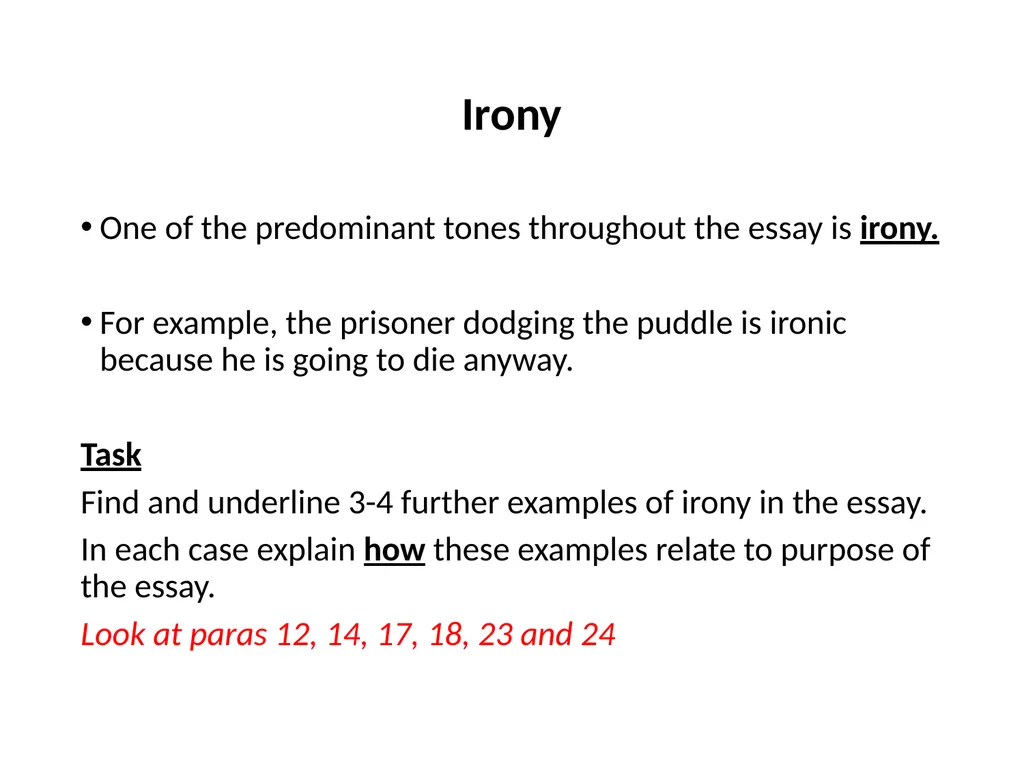
Irony One of the predominant tones throughout the essay is irony.
For example, the prisoner dodging the puddle is ironic because he is going to die anyway.
Task
Find and underline 3-4 further examples of irony in the essay.
In each case explain how these examples relate to purpose of the essay.
Look at paras 12, 14, 17, 18, 23 and 24<br>
For example, the prisoner dodging the puddle is ironic because he is going to die anyway.
Task
Find and underline 3-4 further examples of irony in the essay.
In each case explain how these examples relate to purpose of the essay.
Look at paras 12, 14, 17, 18, 23 and 24<br>
25
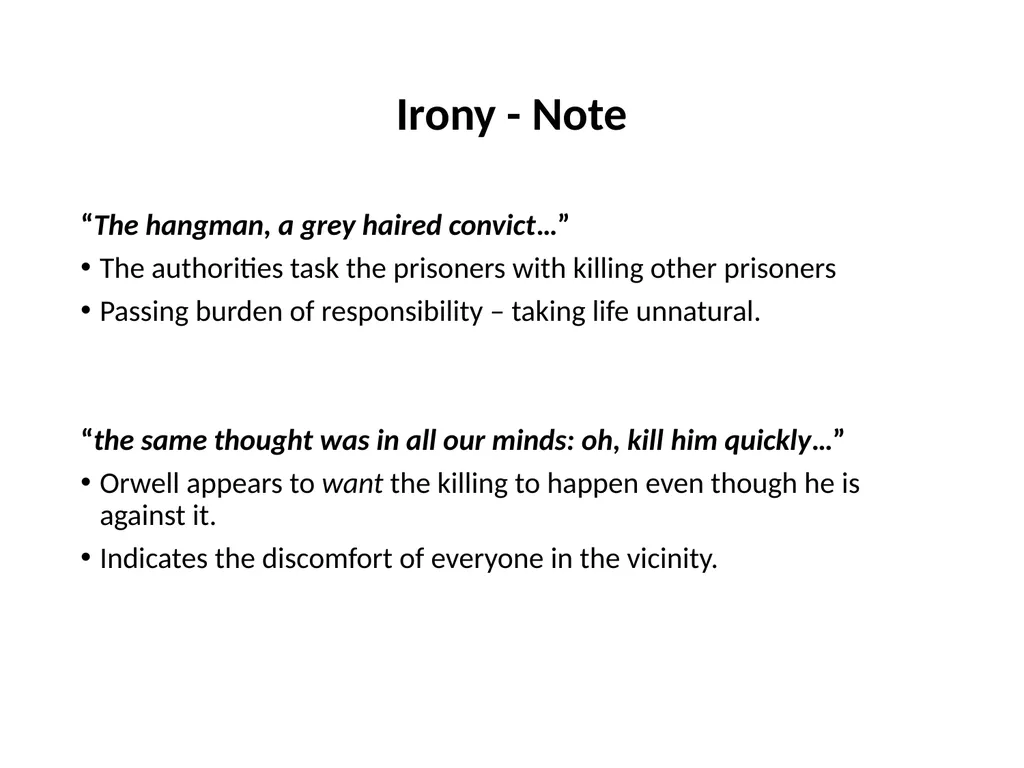
Irony - Note “The hangman, a grey haired convict…”
The authorities task the prisoners with killing other prisoners
Passing burden of responsibility – taking life unnatural.
“the same thought was in all our minds: oh, kill him quickly…”
Orwell appears to want the killing to happen even though he is against it.
Indicates the discomfort of everyone in the vicinity.<br>
The authorities task the prisoners with killing other prisoners
Passing burden of responsibility – taking life unnatural.
“the same thought was in all our minds: oh, kill him quickly…”
Orwell appears to want the killing to happen even though he is against it.
Indicates the discomfort of everyone in the vicinity.<br>
26
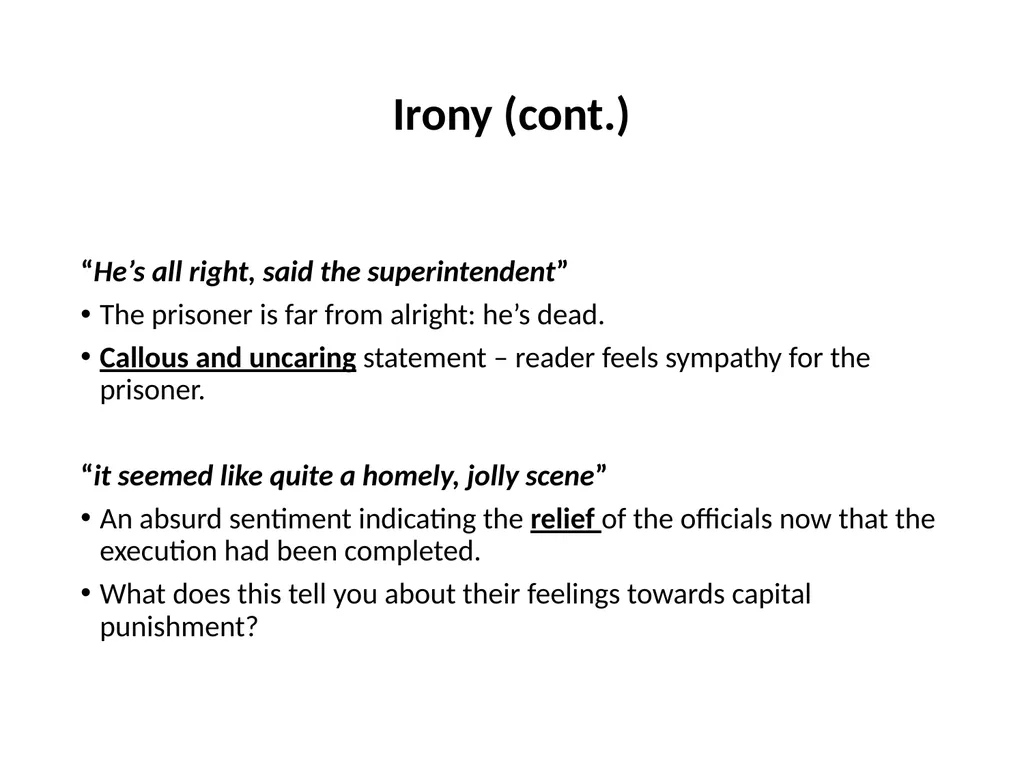
Irony (cont.) “He’s all right, said the superintendent”
The prisoner is far from alright: he’s dead.
Callous and uncaring statement – reader feels sympathy for the prisoner.
“it seemed like quite a homely, jolly scene”
An absurd sentiment indicating the relief of the officials now that the execution had been completed.
What does this tell you about their feelings towards capital punishment?<br>
The prisoner is far from alright: he’s dead.
Callous and uncaring statement – reader feels sympathy for the prisoner.
“it seemed like quite a homely, jolly scene”
An absurd sentiment indicating the relief of the officials now that the execution had been completed.
What does this tell you about their feelings towards capital punishment?<br>
27
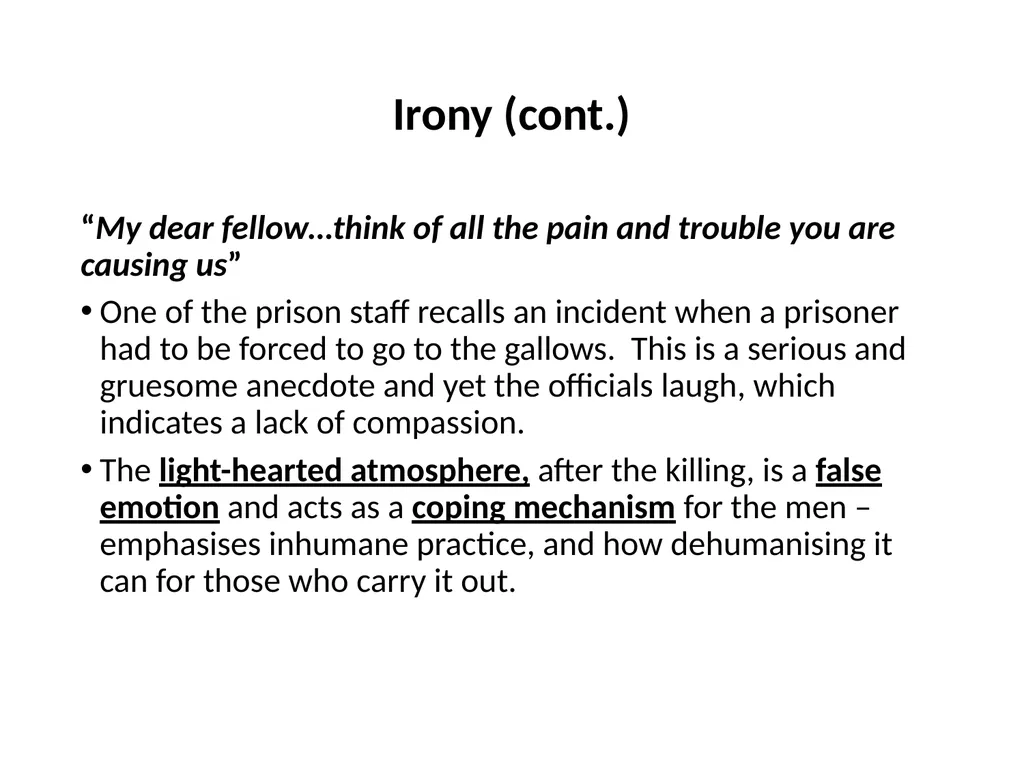
Irony (cont.) “My dear fellow…think of all the pain and trouble you are causing us”
One of the prison staff recalls an incident when a prisoner had to be forced to go to the gallows. This is a serious and gruesome anecdote and yet the officials laugh, which indicates a lack of compassion.
The light-hearted atmosphere, after the killing, is a false emotion and acts as a coping mechanism for the men – emphasises inhumane practice, and how dehumanising it can for those who carry it out.<br>
One of the prison staff recalls an incident when a prisoner had to be forced to go to the gallows. This is a serious and gruesome anecdote and yet the officials laugh, which indicates a lack of compassion.
The light-hearted atmosphere, after the killing, is a false emotion and acts as a coping mechanism for the men – emphasises inhumane practice, and how dehumanising it can for those who carry it out.<br>
28
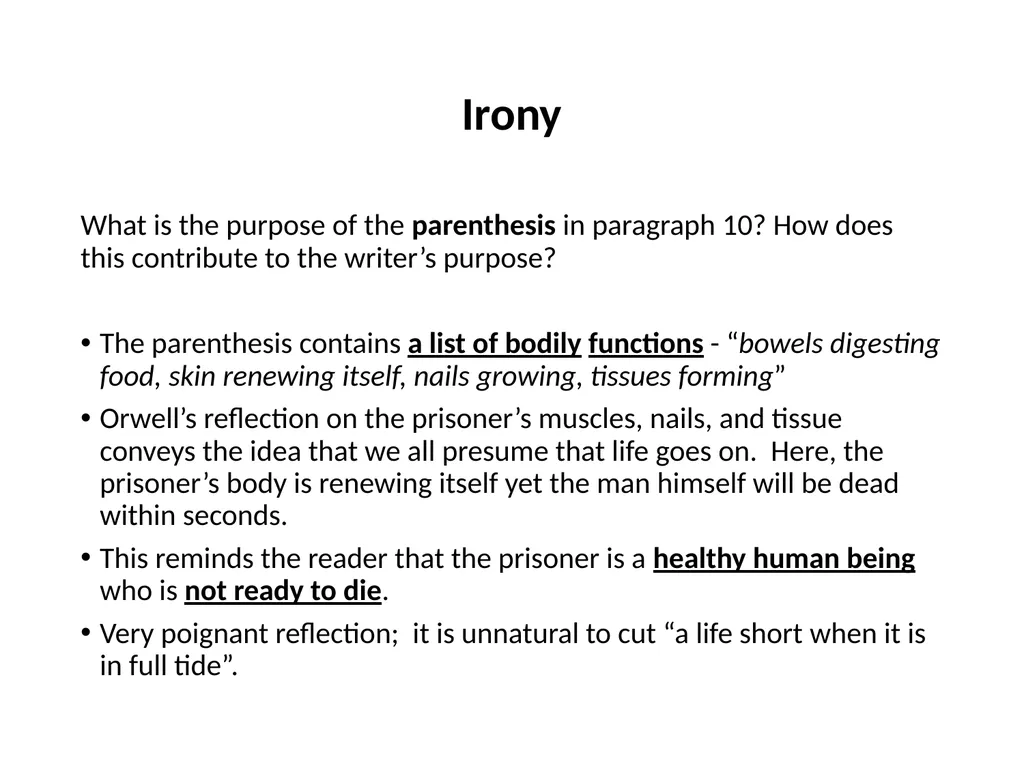
Irony What is the purpose of the parenthesis in paragraph 10? How does this contribute to the writer’s purpose?
The parenthesis contains a list of bodily functions - “bowels digesting food, skin renewing itself, nails growing, tissues forming”
Orwell’s reflection on the prisoner’s muscles, nails, and tissue conveys the idea that we all presume that life goes on. Here, the prisoner’s body is renewing itself yet the man himself will be dead within seconds.
This reminds the reader that the prisoner is a healthy human being who is not ready to die.
Very poignant reflection; it is unnatural to cut “a life short when it is in full tide”.<br>
The parenthesis contains a list of bodily functions - “bowels digesting food, skin renewing itself, nails growing, tissues forming”
Orwell’s reflection on the prisoner’s muscles, nails, and tissue conveys the idea that we all presume that life goes on. Here, the prisoner’s body is renewing itself yet the man himself will be dead within seconds.
This reminds the reader that the prisoner is a healthy human being who is not ready to die.
Very poignant reflection; it is unnatural to cut “a life short when it is in full tide”.<br>
29
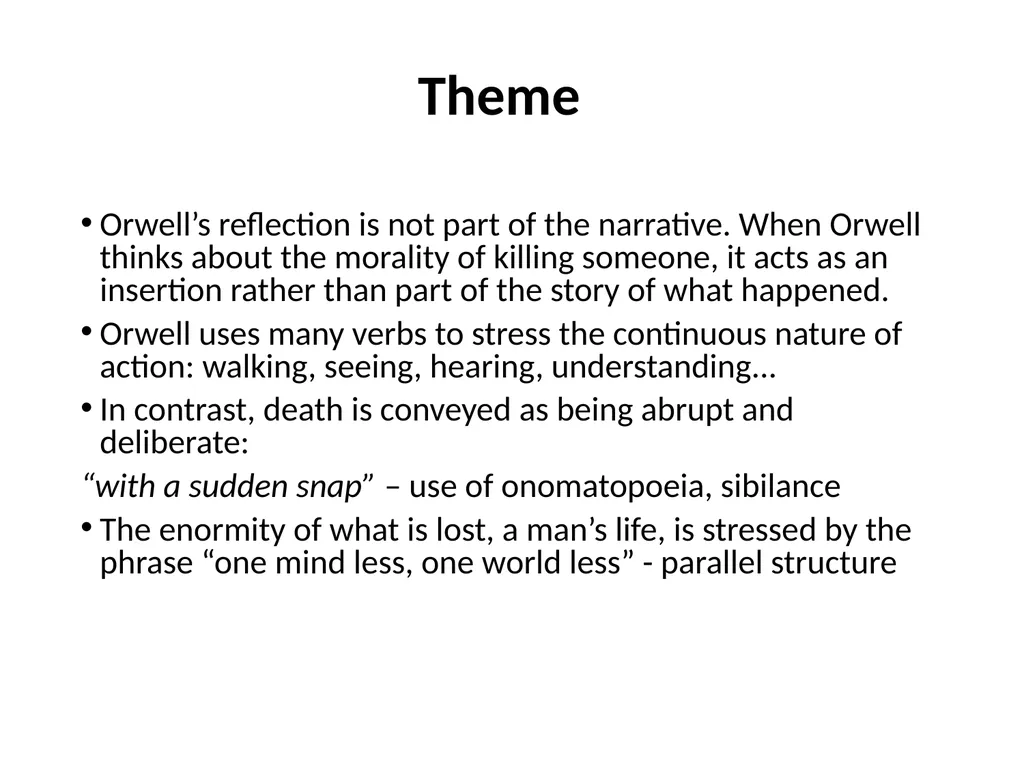
Orwell’s reflection is not part of the narrative. When Orwell thinks about the morality of killing someone, it acts as an insertion rather than part of the story of what happened.
Orwell uses many verbs to stress the continuous nature of action: walking, seeing, hearing, understanding...
In contrast, death is conveyed as being abrupt and deliberate:
“with a sudden snap” – use of onomatopoeia, sibilance
The enormity of what is lost, a man’s life, is stressed by the phrase “one mind less, one world less” - parallel structure Theme<br>
Orwell uses many verbs to stress the continuous nature of action: walking, seeing, hearing, understanding...
In contrast, death is conveyed as being abrupt and deliberate:
“with a sudden snap” – use of onomatopoeia, sibilance
The enormity of what is lost, a man’s life, is stressed by the phrase “one mind less, one world less” - parallel structure Theme<br>
30
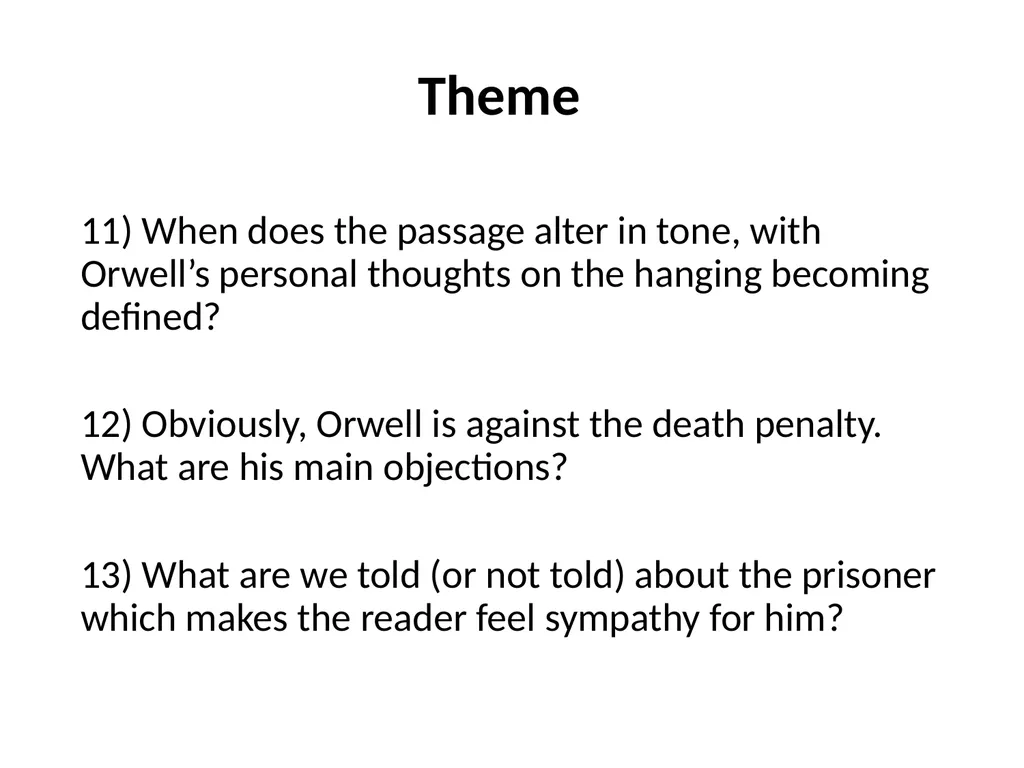
11) When does the passage alter in tone, with Orwell’s personal thoughts on the hanging becoming defined?
12) Obviously, Orwell is against the death penalty. What are his main objections?
13) What are we told (or not told) about the prisoner which makes the reader feel sympathy for him? Theme<br>
12) Obviously, Orwell is against the death penalty. What are his main objections?
13) What are we told (or not told) about the prisoner which makes the reader feel sympathy for him? Theme<br>
31
Orwell uses delayed revelation or climax. The hanging is delayed by the intrusion of the dog and the time given for the prisoner to pray to his god.
14) What is the effect of both incidents? Do they add or lessen the sense of tension? Climax<br>
14) What is the effect of both incidents? Do they add or lessen the sense of tension? Climax<br>
32
Another feature is the end of the essay - it does not end with the actual hanging.
The officials’ grisly anecdotes about past executions are ironic:
“We reasoned with him.. ”think of all the trouble you are causing us”.
These stories being inappropriate are slightly humorous. This reflects the easing of tension in the men after the execution.
The mundane (feeding the prisoners) continues. Life goes on (the officials have a drink) in contrast with the sudden end to the prisoner’s life.
15) How does the last line highlight this juxtaposition? Climax<br>
The officials’ grisly anecdotes about past executions are ironic:
“We reasoned with him.. ”think of all the trouble you are causing us”.
These stories being inappropriate are slightly humorous. This reflects the easing of tension in the men after the execution.
The mundane (feeding the prisoners) continues. Life goes on (the officials have a drink) in contrast with the sudden end to the prisoner’s life.
15) How does the last line highlight this juxtaposition? Climax<br>
33
Orwell’s use of understatement (or litotes) to describe awful events is so shocking it is almost comic.
At the beginning the superintendent refers to the execution as “this job”.
16) What is Orwell trying to stress about the official and the effect that such work has had on him?
The same official’s response to the prisoner’s death is even more shocking.
17) As with the description of the horrific anecdotes, what point is Orwell making about those who deal with executions? Understatement - Litotes<br>
At the beginning the superintendent refers to the execution as “this job”.
16) What is Orwell trying to stress about the official and the effect that such work has had on him?
The same official’s response to the prisoner’s death is even more shocking.
17) As with the description of the horrific anecdotes, what point is Orwell making about those who deal with executions? Understatement - Litotes<br>
34
Question In paragraph 10 there is a change in tone where, for the first time, Orwell openly states his opinion on the events he witnessed.
Find one phrase from this paragraph which indicates Orwell’s reflection on the events.
Find one phrase which clearly indicates Orwell’s feelings.<br>
Find one phrase from this paragraph which indicates Orwell’s reflection on the events.
Find one phrase which clearly indicates Orwell’s feelings.<br>
35
Tone - Note “It is curious…” – reflective tone where Orwell goes on to describe his own feelings on the subject.
“The unspeakable wrongness…” – frankness of tone leaves the reader in no doubt about his opinion on capital punishment.<br>
“The unspeakable wrongness…” – frankness of tone leaves the reader in no doubt about his opinion on capital punishment.<br>
36
Question In paragraphs 1 and 2 there are a number of examples of figurative language (metaphor, simile, personification etc.)
Quote 2-3 examples and in each case explain the comparison being made and how this contributes to the writer’s purpose.<br>
Quote 2-3 examples and in each case explain the comparison being made and how this contributes to the writer’s purpose.<br>
37
Figurative Language (cont…) “…like small animal cages…”
Describes prisoners’ living conditions.
Evokes reader sympathy.
“it was like men handling a fish which is still alive…”
Continues comparison between prisoners and animals.
Highlights the helplessness of the prisoner – sympathy.<br>
Describes prisoners’ living conditions.
Evokes reader sympathy.
“it was like men handling a fish which is still alive…”
Continues comparison between prisoners and animals.
Highlights the helplessness of the prisoner – sympathy.<br>
38
Figurative Language (cont…) “the Indians had gone grey like bad coffee…”
Indicates the discomfort felt by the guards – emphasises dehumanising effect of the execution on the men.
Orwell suggests that everybody involved in the execution is a victim.<br>
Indicates the discomfort felt by the guards – emphasises dehumanising effect of the execution on the men.
Orwell suggests that everybody involved in the execution is a victim.<br>
39
Sentence Structure (cont.) The line, “one mind less, one world less” is an example of a rhetorical device called ANAPHORA
This involves the repetition of one or more words at the beginning of two or more balanced clauses.
Designed to make a point more memorable.<br>
This involves the repetition of one or more words at the beginning of two or more balanced clauses.
Designed to make a point more memorable.<br>
40
Anaphora - Note OTHER FAMOUS EXAMPLES?
“One small step for man, one giant leap for mankind”
By ending the paragraph with the line, “one mind less, one world less”, Orwell emphasises that the prisoner is a living human being who is, not yet, ready to die – writer’s purpose.<br>
“One small step for man, one giant leap for mankind”
By ending the paragraph with the line, “one mind less, one world less”, Orwell emphasises that the prisoner is a living human being who is, not yet, ready to die – writer’s purpose.<br>
41
Sentence Structure (cont.) The final two sentences of the essay are designed for maximum impact.
“We all had a drink together, native and European alike, quite amicably. The dead man was a hundred yards away.”
The jovial scene of the penultimate sentence is contrasted with the nearby dead man.
The final sentence is a short statement which neatly summarises Orwell’s message.
Upon finishing reading the essay the reader is left to contemplate this vulgar scene – IMPACT<br>
“We all had a drink together, native and European alike, quite amicably. The dead man was a hundred yards away.”
The jovial scene of the penultimate sentence is contrasted with the nearby dead man.
The final sentence is a short statement which neatly summarises Orwell’s message.
Upon finishing reading the essay the reader is left to contemplate this vulgar scene – IMPACT<br>
42
Choose a novel or a short story or a work of non-fiction which deals with an important issue or theme.
By referring to appropriate techniques, show how the issue or theme is explored.
Detail Understatement
Style Irony
Setting Climax
Structure Theme
Characterisation Language The Task<br>
By referring to appropriate techniques, show how the issue or theme is explored.
Detail Understatement
Style Irony
Setting Climax
Structure Theme
Characterisation Language The Task<br>
43
There are two different ways to organise/structure your essay.
1) Writing about a different technique in each paragraph.
2) Writing a paragraph about each significant part of the text and the techniques used for each. Structuring the Essay<br>
1) Writing about a different technique in each paragraph.
2) Writing a paragraph about each significant part of the text and the techniques used for each. Structuring the Essay<br>
44
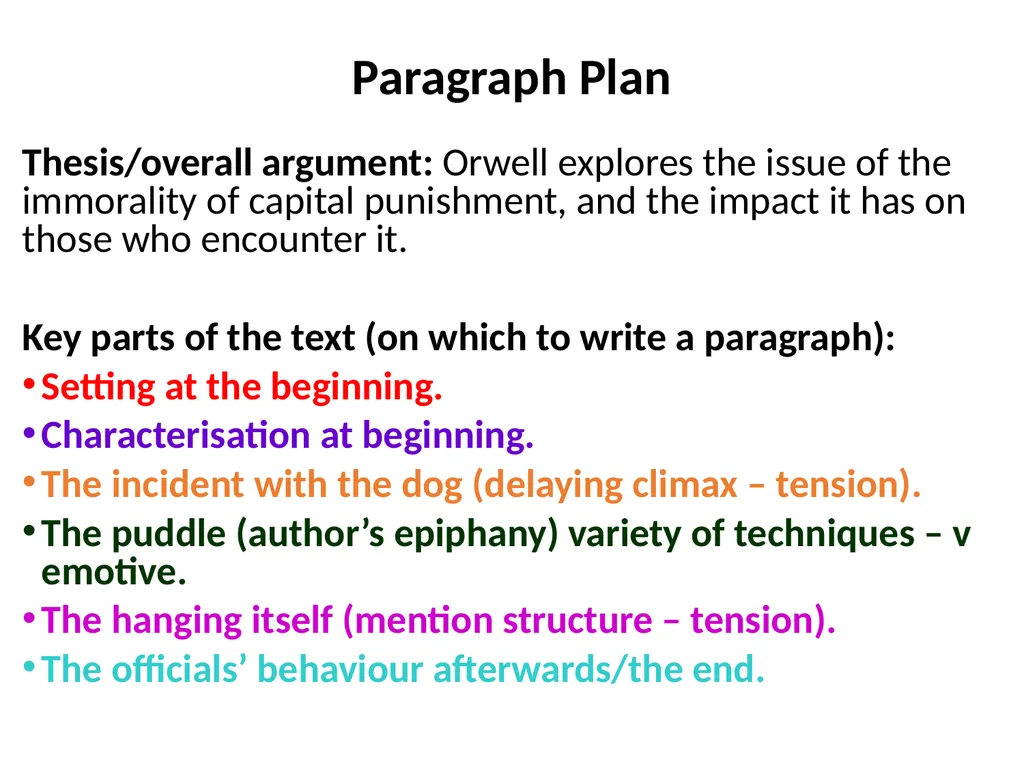
Thesis/overall argument: Orwell explores the issue of the immorality of capital punishment, and the impact it has on those who encounter it.
Key parts of the text (on which to write a paragraph):
Setting at the beginning.
Characterisation at beginning.
The incident with the dog (delaying climax – tension).
The puddle (author’s epiphany) variety of techniques – v emotive.
The hanging itself (mention structure – tension).
The officials’ behaviour afterwards/the end. Paragraph Plan<br>
Key parts of the text (on which to write a paragraph):
Setting at the beginning.
Characterisation at beginning.
The incident with the dog (delaying climax – tension).
The puddle (author’s epiphany) variety of techniques – v emotive.
The hanging itself (mention structure – tension).
The officials’ behaviour afterwards/the end. Paragraph Plan<br>
45
Introduction TART – Title, Author, Refer to Task
Briefly summarise essay
Outline points<br>
Briefly summarise essay
Outline points<br>
46
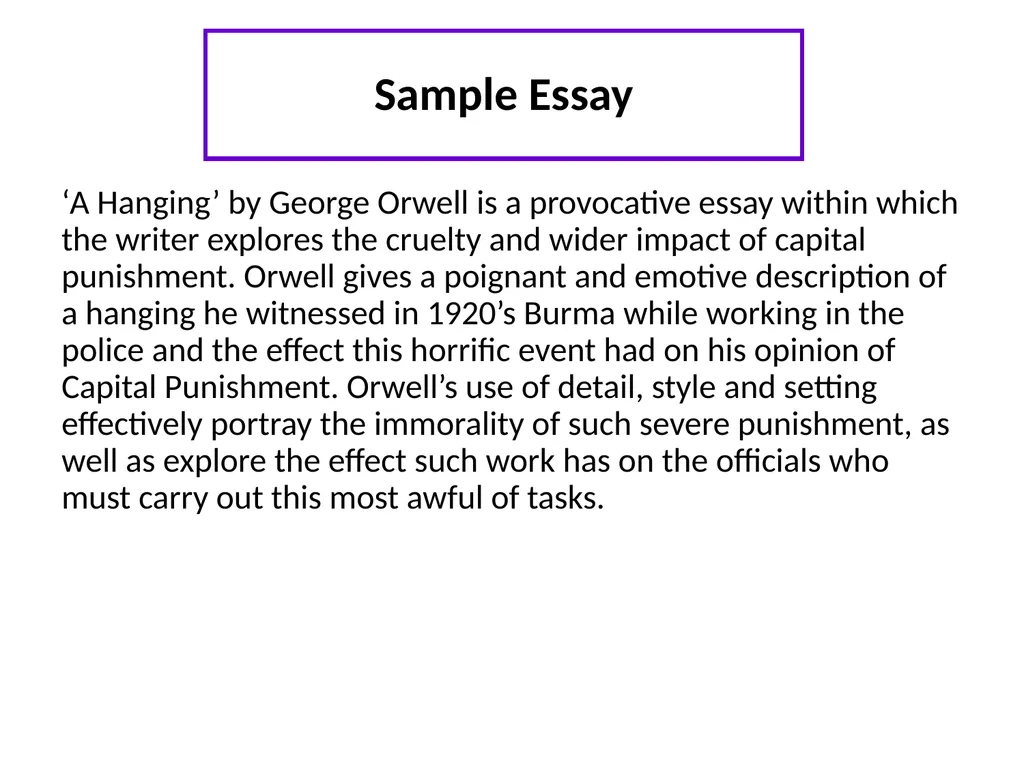
Sample Essay ‘A Hanging’ by George Orwell is a provocative essay within which the writer explores the cruelty and wider impact of capital punishment. Orwell gives a poignant and emotive description of a hanging he witnessed in 1920’s Burma while working in the police and the effect this horrific event had on his opinion of Capital Punishment. Orwell’s use of detail, style and setting effectively portray the immorality of such severe punishment, as well as explore the effect such work has on the officials who must carry out this most awful of tasks.<br>
47
Your topic sentence should make a clear Point that relates to your question. This may include the techniques used by Orwell to explore this theme/issue.
You must not simply tell a bit of the story – this is not a point!
Evidence
Remember to provide context of quotation: make it clear which part of the essay you are referring to (who/where etc).
Quotation: Choose one that allows you to analyse as many techniques as possible. Not one that you could simply explain in your own words.
Evaluation: Wring that quotation dry! Link your analysis of the quotation to the task. This should form the bulk of your paragraph. Structuring Paragraphs<br>
You must not simply tell a bit of the story – this is not a point!
Evidence
Remember to provide context of quotation: make it clear which part of the essay you are referring to (who/where etc).
Quotation: Choose one that allows you to analyse as many techniques as possible. Not one that you could simply explain in your own words.
Evaluation: Wring that quotation dry! Link your analysis of the quotation to the task. This should form the bulk of your paragraph. Structuring Paragraphs<br>
48
Paragraph 1 Opening
The essay begins with a negative description of the setting which instantly has an impact on the reader, emphasises how immoral this punishment is.
Setting – pathetic fallacy
Animal cages<br>
The essay begins with a negative description of the setting which instantly has an impact on the reader, emphasises how immoral this punishment is.
Setting – pathetic fallacy
Animal cages<br>
49
The opening lines of Orwell’s essay immediately depict a vivid image of the setting, which foreshadows the awful conclusion and creates sympathy for the prisoners. I the opening lines, Orwell uses pathetic fallacy to create a sense of the bleak, depressing prison:
“It was Burma, a sodden morning of the rains. A sickly light, like yellow tinfoil, was slanting over the high walls into the jail yard.”
The mood of these lines is very fitting to the events which will later take place: a horrible, miserable day on which a gut-wrenching, macabre task will be carried out. The word “sickly” suggests not only the notion of decay, but also the idea of something being ill or wrong. Moreover, this use of pathetic fallacy is symbolic of sadness, foreboding, and imminent tragedy, all of which is apparent here. This contributes greatly to the mood of this particular essay, and the tragedy contained within it. Orwell’s exploration of the immorality of capital punishment is also noticeable for the first time in the opening of the essay, when we are given a description of the prison’s cramped and crowded conditions:
“We were waiting outside the condemned cells, a row of sheds fronted with double bars, like small animal cages.”
Words such as “high walls” and “jail yard” are used to make it clear that Orwell’s essay is set in a high security jail, again re-iterating the restriction and foreboding of the prison. As well as this, the imagery used to describe the conditions the prisoners are kept in show us that they are essentially treated as animals, dehumanised, emphasising the cruelty they experience, and increasing our sympathy for them.<br>
“It was Burma, a sodden morning of the rains. A sickly light, like yellow tinfoil, was slanting over the high walls into the jail yard.”
The mood of these lines is very fitting to the events which will later take place: a horrible, miserable day on which a gut-wrenching, macabre task will be carried out. The word “sickly” suggests not only the notion of decay, but also the idea of something being ill or wrong. Moreover, this use of pathetic fallacy is symbolic of sadness, foreboding, and imminent tragedy, all of which is apparent here. This contributes greatly to the mood of this particular essay, and the tragedy contained within it. Orwell’s exploration of the immorality of capital punishment is also noticeable for the first time in the opening of the essay, when we are given a description of the prison’s cramped and crowded conditions:
“We were waiting outside the condemned cells, a row of sheds fronted with double bars, like small animal cages.”
Words such as “high walls” and “jail yard” are used to make it clear that Orwell’s essay is set in a high security jail, again re-iterating the restriction and foreboding of the prison. As well as this, the imagery used to describe the conditions the prisoners are kept in show us that they are essentially treated as animals, dehumanised, emphasising the cruelty they experience, and increasing our sympathy for them.<br>
50
Paragraph 2 Opening
Juxtaposition – description of guards vs. prisoner
Understatement – guard mentioning “this job”, desensitised<br>
Juxtaposition – description of guards vs. prisoner
Understatement – guard mentioning “this job”, desensitised<br>
51
Paragraph 3 Dog incident; delays to hanging
Orwell structures the narrative of this essay in order to delay the hanging and therefore create tension for the reader.
Ironic device – humans’ lack of morals
Repetition of “the gallows”; decreases as essay progresses
Prisoner praying to his god - delayed revelation/climax<br>
Orwell structures the narrative of this essay in order to delay the hanging and therefore create tension for the reader.
Ironic device – humans’ lack of morals
Repetition of “the gallows”; decreases as essay progresses
Prisoner praying to his god - delayed revelation/climax<br>
52
Orwell introduces an anecdote involving a dog in paragraph six, an ironic insertion into the action of the essay:
“It came bounding among us with a loud volley of barks…before anyone could stop it, it had made a dash for the prisoner, and jumping up tried to lick his face.”
The dog is ecstatic to come across this large group of humans for in its experience, humans represent fun. The dog is completely oblivious to the fact that it has intruded upon the most grave of situations. It has ironically come upon a group who are about to engage in the ritualistic killing of one of its members. Orwell’s point of view seems particularly clear when he describes the prisoner’s last gasp attempt at maintaining his dignity:
“And once, in spite of the men who gripped him by each shoulder, he stepped slightly aside to avoid a puddle on his path”
The harsh reality of the heart-breaking situation is evident: the man is going to lose his life, yet he retains enough dignity and pride to take the kind of precautions that any other person would when avoiding puddles.<br>
“It came bounding among us with a loud volley of barks…before anyone could stop it, it had made a dash for the prisoner, and jumping up tried to lick his face.”
The dog is ecstatic to come across this large group of humans for in its experience, humans represent fun. The dog is completely oblivious to the fact that it has intruded upon the most grave of situations. It has ironically come upon a group who are about to engage in the ritualistic killing of one of its members. Orwell’s point of view seems particularly clear when he describes the prisoner’s last gasp attempt at maintaining his dignity:
“And once, in spite of the men who gripped him by each shoulder, he stepped slightly aside to avoid a puddle on his path”
The harsh reality of the heart-breaking situation is evident: the man is going to lose his life, yet he retains enough dignity and pride to take the kind of precautions that any other person would when avoiding puddles.<br>
53
Paragraph 4 Puddle Incident
Orwell’s personal feelings on Capital Punishment soon become apparent when the prisoner encounters a puddle on his way to the gallows and at this point I found the essay to be particularly provocative.
Tone changes
Wrong, unnatural, enormity of action
Ironic contrast – does not want prisoner to die but wants hanging to be over.<br>
Orwell’s personal feelings on Capital Punishment soon become apparent when the prisoner encounters a puddle on his way to the gallows and at this point I found the essay to be particularly provocative.
Tone changes
Wrong, unnatural, enormity of action
Ironic contrast – does not want prisoner to die but wants hanging to be over.<br>
54
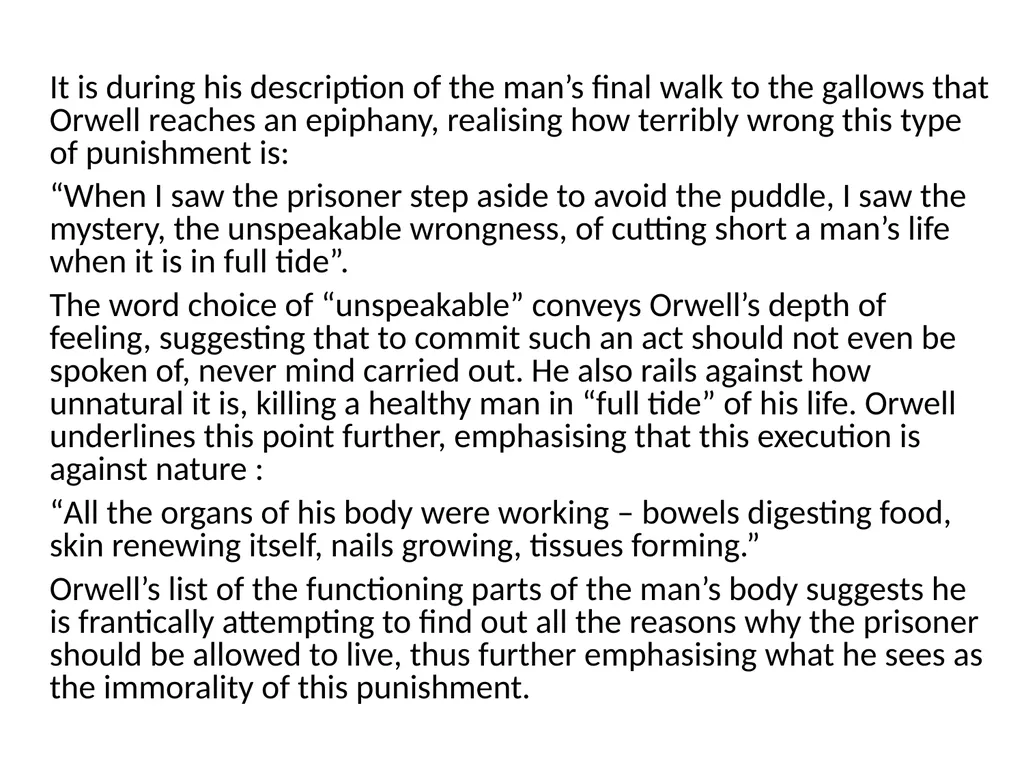
It is during his description of the man’s final walk to the gallows that Orwell reaches an epiphany, realising how terribly wrong this type of punishment is:
“When I saw the prisoner step aside to avoid the puddle, I saw the mystery, the unspeakable wrongness, of cutting short a man’s life when it is in full tide”.
The word choice of “unspeakable” conveys Orwell’s depth of feeling, suggesting that to commit such an act should not even be spoken of, never mind carried out. He also rails against how unnatural it is, killing a healthy man in “full tide” of his life. Orwell underlines this point further, emphasising that this execution is against nature :
“All the organs of his body were working – bowels digesting food, skin renewing itself, nails growing, tissues forming.”
Orwell’s list of the functioning parts of the man’s body suggests he is frantically attempting to find out all the reasons why the prisoner should be allowed to live, thus further emphasising what he sees as the immorality of this punishment.<br>
“When I saw the prisoner step aside to avoid the puddle, I saw the mystery, the unspeakable wrongness, of cutting short a man’s life when it is in full tide”.
The word choice of “unspeakable” conveys Orwell’s depth of feeling, suggesting that to commit such an act should not even be spoken of, never mind carried out. He also rails against how unnatural it is, killing a healthy man in “full tide” of his life. Orwell underlines this point further, emphasising that this execution is against nature :
“All the organs of his body were working – bowels digesting food, skin renewing itself, nails growing, tissues forming.”
Orwell’s list of the functioning parts of the man’s body suggests he is frantically attempting to find out all the reasons why the prisoner should be allowed to live, thus further emphasising what he sees as the immorality of this punishment.<br>
55
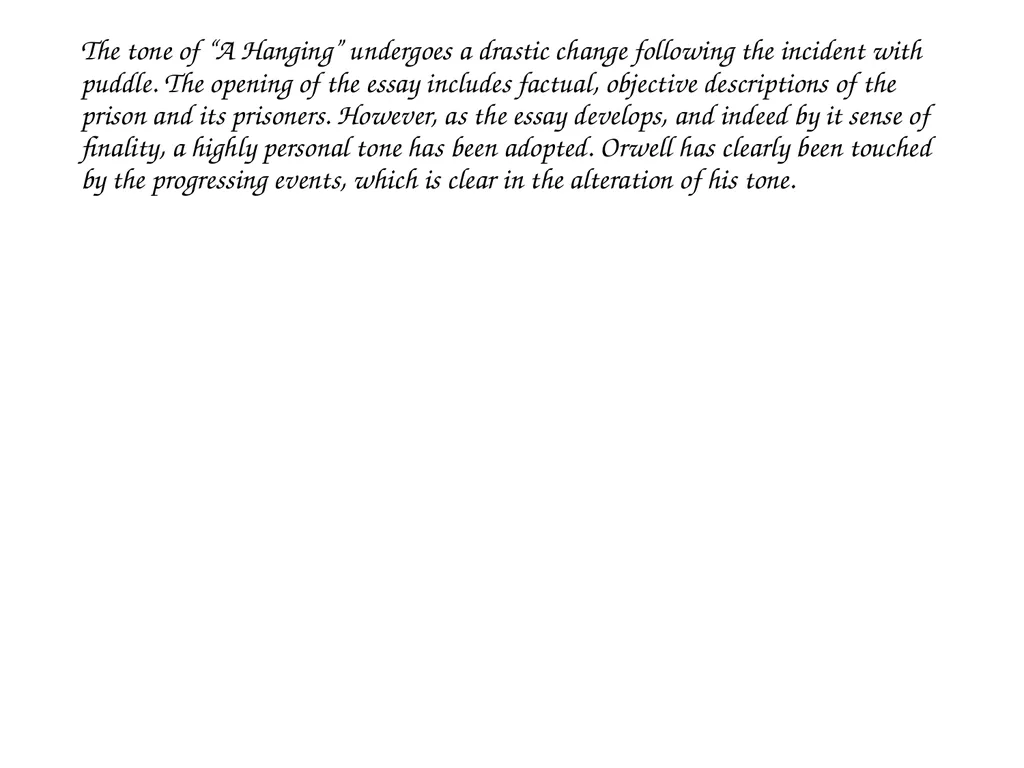
The tone of “A Hanging” undergoes a drastic change following the incident with puddle. The opening of the essay includes factual, objective descriptions of the prison and its prisoners. However, as the essay develops, and indeed by it sense of finality, a highly personal tone has been adopted. Orwell has clearly been touched by the progressing events, which is clear in the alteration of his tone.<br>
56
Paragraph 5 After the Hanging
The fact that Orwell does not end his essay with the hanging but instead chooses to focus on the almost jolly reactions of those involved, is something which provoked a strong reaction in the reader.
Understatement of guard. Immune to reality?
Inappropriate anecdotes
Juxtaposition: death and ‘life goes on’<br>
The fact that Orwell does not end his essay with the hanging but instead chooses to focus on the almost jolly reactions of those involved, is something which provoked a strong reaction in the reader.
Understatement of guard. Immune to reality?
Inappropriate anecdotes
Juxtaposition: death and ‘life goes on’<br>
57
Another most interesting aspect of Orwell’s essay is the extent to which it continues after the hanging itself. The anecdotes which follow the hanging are unexpected, out of place and certainly in bad taste. However, the anecdotes also seem highly ironic and due to their distastefulness, slightly humorous. This is particularly true of the story concerning Francis, and the “troublesome” prisoner who struggled to avoid being executed:
“We reasoned with him…”
Given the situation in hand, the use of the word “reason” seems highly inappropriate and therefore slightly humorous. This humour appears to reflect the easing of the considerable tension which has built up throughout the process of the execution. This is also extremely important within the context of the essay. Orwell’s use of numerous verbs: “seeing”, “feeling” and “walking” emphasise the continuous nature of action:
“In two minutes, with a sudden snap, one of us would be gone.”
The suddenness of the prisoner’s death is described in a particularly saddening way: the man’s life is over, yet those around him continue to laugh and joke.<br>
“We reasoned with him…”
Given the situation in hand, the use of the word “reason” seems highly inappropriate and therefore slightly humorous. This humour appears to reflect the easing of the considerable tension which has built up throughout the process of the execution. This is also extremely important within the context of the essay. Orwell’s use of numerous verbs: “seeing”, “feeling” and “walking” emphasise the continuous nature of action:
“In two minutes, with a sudden snap, one of us would be gone.”
The suddenness of the prisoner’s death is described in a particularly saddening way: the man’s life is over, yet those around him continue to laugh and joke.<br>
58
Similarly, Orwell uses understatement in such and apparently unfeeling way that it is almost comical:
“He’s all right,” said the superintendent”
Orwell attempts here to show the dehumanising which occurs when one takes part in the killing of another person. Through his use of understatement, he is forcing us to share his view on the “essential wrongness of taking another human being’s life”.<br>
“He’s all right,” said the superintendent”
Orwell attempts here to show the dehumanising which occurs when one takes part in the killing of another person. Through his use of understatement, he is forcing us to share his view on the “essential wrongness of taking another human being’s life”.<br>
59
You must clearly explain EACH STAGE of the development of Orwell’s views on this issue. Explain which technique was used at each stage.
e.g.
Through the setting Orwell shows the vulnerability of the prisoners about to face execution…
When Orwell writes about his first observation of the prisoner and the way he is treated, his characterisation suggests that he is beginning to see the wrongness in the authorities, who have a duty of care, executing a human being…
Orwell’s criticism of capital punishment become more solidified when [puddle]. . . The reader feels…
The way Orwell describes the hanging itself through powerful imagery makes us…
The powerful and disturbing ending of the essay…
Overall, ‘A Hanging’ is a… essay which makes the reader contemplate… Conclusion<br>
e.g.
Through the setting Orwell shows the vulnerability of the prisoners about to face execution…
When Orwell writes about his first observation of the prisoner and the way he is treated, his characterisation suggests that he is beginning to see the wrongness in the authorities, who have a duty of care, executing a human being…
Orwell’s criticism of capital punishment become more solidified when [puddle]. . . The reader feels…
The way Orwell describes the hanging itself through powerful imagery makes us…
The powerful and disturbing ending of the essay…
Overall, ‘A Hanging’ is a… essay which makes the reader contemplate… Conclusion<br>
60
Conclusion TRY NOT TO BEGIN WITH: In conclusion/To conclude…
‘A Hanging’ is undoubtedly a provocative essay which I believe Orwell has carefully constructed in order to make a great impact on the reader. From the essay’s opening with a negative description of setting, through the building tension as the prisoner makes his way to the gallows, to the guards’ reactions after the prisoner has been hanged, we are left in no doubt about Orwell’s views on the immorality of capital punishment. By the end of the essay, the reader feels that it has such an impact on us that we too share Orwell’s views.<br>
‘A Hanging’ is undoubtedly a provocative essay which I believe Orwell has carefully constructed in order to make a great impact on the reader. From the essay’s opening with a negative description of setting, through the building tension as the prisoner makes his way to the gallows, to the guards’ reactions after the prisoner has been hanged, we are left in no doubt about Orwell’s views on the immorality of capital punishment. By the end of the essay, the reader feels that it has such an impact on us that we too share Orwell’s views.<br>