
A presentation by Brendan Allen Scarton House,
MT
Published · 56 slides · 0 views

1 / 1
Description
A presentation by Brendan Allen Scarton House, Priory Court, Kildare, Co. Kildare PHONE: 045 530777 087 236 9920 EMAIL: brendan.allenokellysutton.ie FOR INFORMATION No action should be taken without consulting the detailed legislation
Related Topics
Share
Embed code
Download this presentation From Below
"A presentation by Brendan Allen Scarton House," is the property of its rightful owner. Permission is granted to download and print the materials on this website for personal, non-commercial use only, and to display it on your personal computer provided you do not modify the materials and that you retain all copyright notices contained in the materials. By downloading content from our website, you accept the terms of this agreement.
Presentation Transcript
01
A presentation by
Brendan Allen
Scarton House,
Priory Court,
Kildare, Co. Kildare
PHONE: 045 530777
087 236 9920
EMAIL: brendan.allen@okellysutton.ie<br>
Brendan Allen
Scarton House,
Priory Court,
Kildare, Co. Kildare
PHONE: 045 530777
087 236 9920
EMAIL: brendan.allen@okellysutton.ie<br>
02
FOR INFORMATION No action should be taken without consulting the detailed legislation
Always seek professional advice
No responsibility for loss occasioned to any person acting or refraining from action as a result of the material contained in this presentation can be accepted by this firm. 2<br>
Always seek professional advice
No responsibility for loss occasioned to any person acting or refraining from action as a result of the material contained in this presentation can be accepted by this firm. 2<br>
03
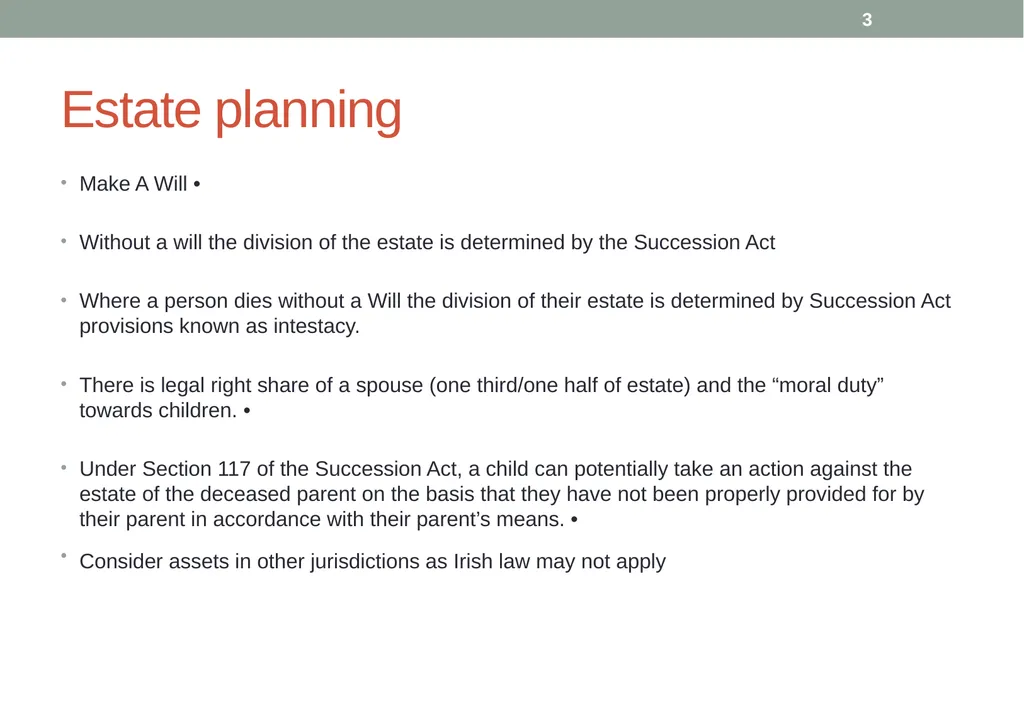
Estate planning Make A Will •
Without a will the division of the estate is determined by the Succession Act
Where a person dies without a Will the division of their estate is determined by Succession Act provisions known as intestacy.
There is legal right share of a spouse (one third/one half of estate) and the “moral duty” towards children. •
Under Section 117 of the Succession Act, a child can potentially take an action against the estate of the deceased parent on the basis that they have not been properly provided for by their parent in accordance with their parent’s means. •
Consider assets in other jurisdictions as Irish law may not apply 3<br>
Without a will the division of the estate is determined by the Succession Act
Where a person dies without a Will the division of their estate is determined by Succession Act provisions known as intestacy.
There is legal right share of a spouse (one third/one half of estate) and the “moral duty” towards children. •
Under Section 117 of the Succession Act, a child can potentially take an action against the estate of the deceased parent on the basis that they have not been properly provided for by their parent in accordance with their parent’s means. •
Consider assets in other jurisdictions as Irish law may not apply 3<br>
04
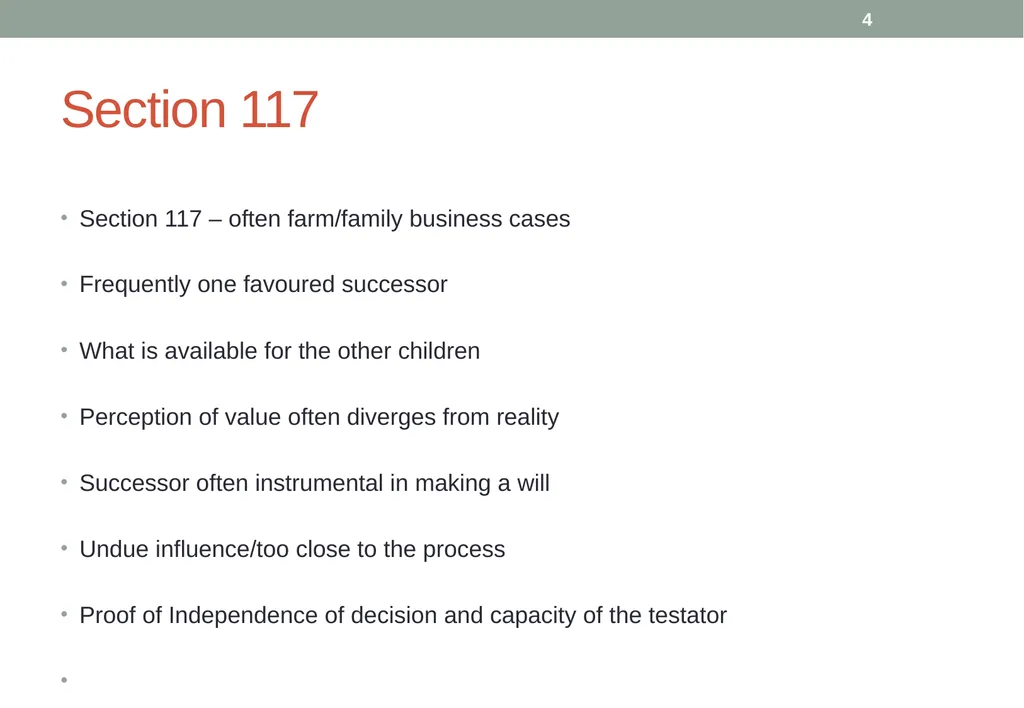
Section 117 Section 117 – often farm/family business cases
Frequently one favoured successor
What is available for the other children
Perception of value often diverges from reality
Successor often instrumental in making a will
Undue influence/too close to the process
Proof of Independence of decision and capacity of the testator 4<br>
Frequently one favoured successor
What is available for the other children
Perception of value often diverges from reality
Successor often instrumental in making a will
Undue influence/too close to the process
Proof of Independence of decision and capacity of the testator 4<br>
05
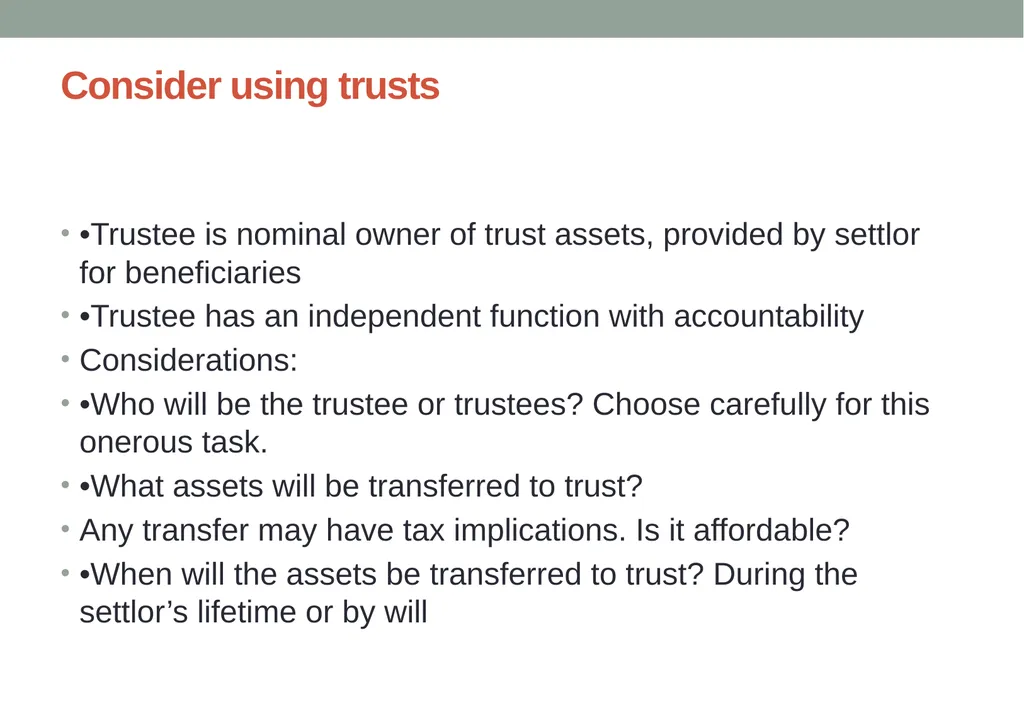
Consider using trusts •Trustee is nominal owner of trust assets, provided by settlor for beneficiaries
•Trustee has an independent function with accountability
Considerations:
•Who will be the trustee or trustees? Choose carefully for this onerous task.
•What assets will be transferred to trust?
Any transfer may have tax implications. Is it affordable?
•When will the assets be transferred to trust? During the settlor’s lifetime or by will<br>
•Trustee has an independent function with accountability
Considerations:
•Who will be the trustee or trustees? Choose carefully for this onerous task.
•What assets will be transferred to trust?
Any transfer may have tax implications. Is it affordable?
•When will the assets be transferred to trust? During the settlor’s lifetime or by will<br>
06
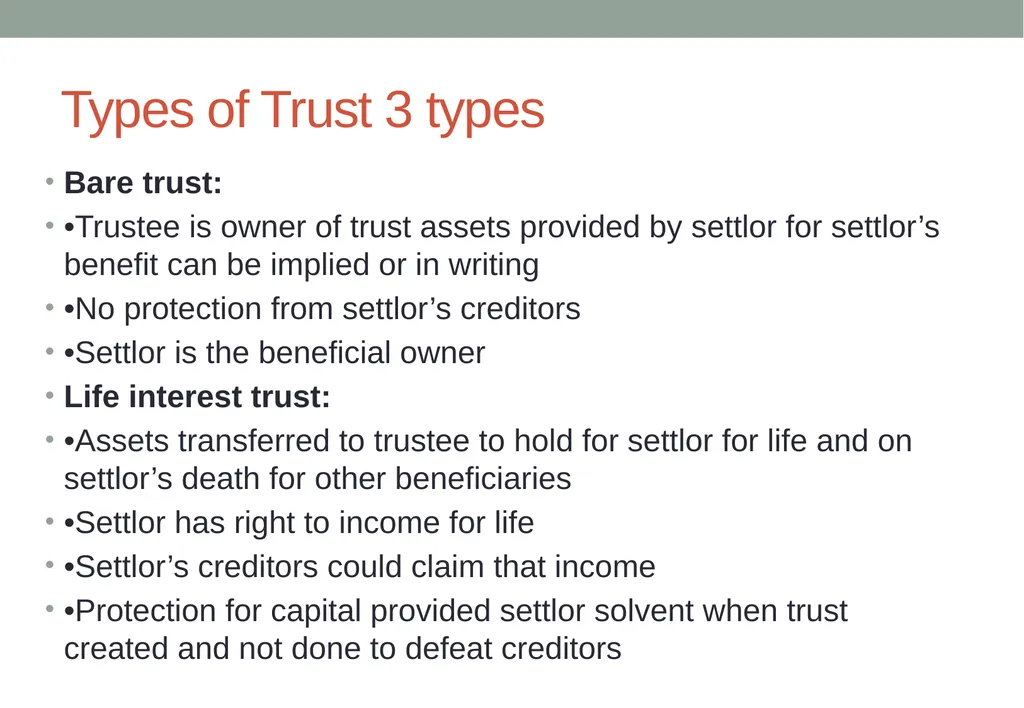
Types of Trust 3 types Bare trust:
•Trustee is owner of trust assets provided by settlor for settlor’s benefit can be implied or in writing
•No protection from settlor’s creditors
•Settlor is the beneficial owner
Life interest trust:
•Assets transferred to trustee to hold for settlor for life and on settlor’s death for other beneficiaries
•Settlor has right to income for life
•Settlor’s creditors could claim that income
•Protection for capital provided settlor solvent when trust created and not done to defeat creditors<br>
•Trustee is owner of trust assets provided by settlor for settlor’s benefit can be implied or in writing
•No protection from settlor’s creditors
•Settlor is the beneficial owner
Life interest trust:
•Assets transferred to trustee to hold for settlor for life and on settlor’s death for other beneficiaries
•Settlor has right to income for life
•Settlor’s creditors could claim that income
•Protection for capital provided settlor solvent when trust created and not done to defeat creditors<br>
07
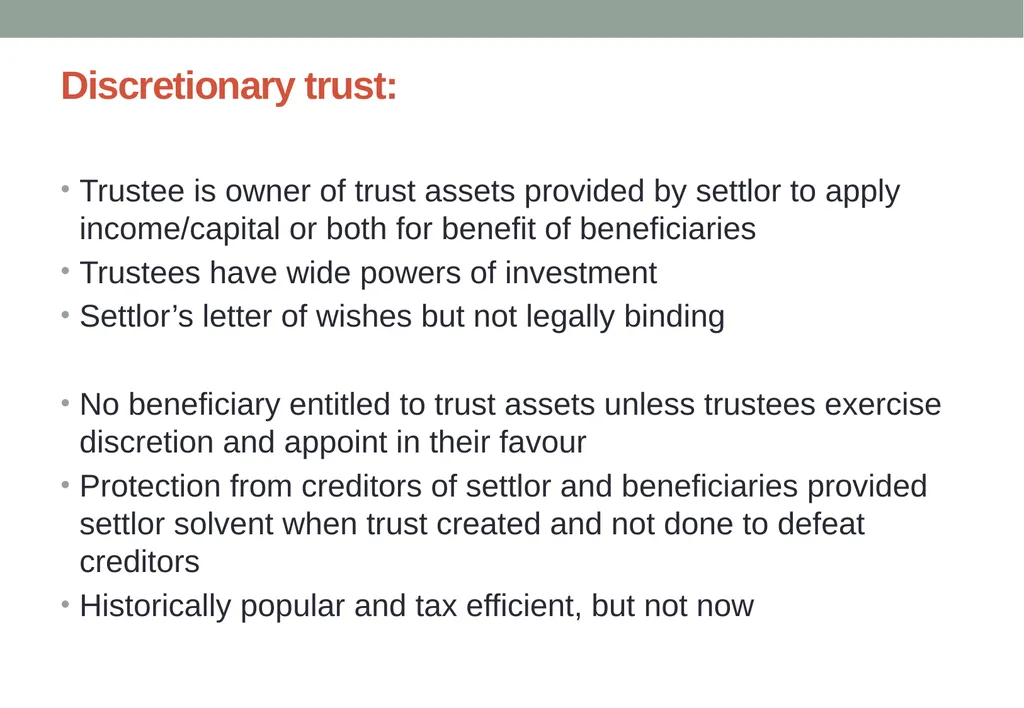
Discretionary trust: Trustee is owner of trust assets provided by settlor to apply income/capital or both for benefit of beneficiaries
Trustees have wide powers of investment
Settlor’s letter of wishes but not legally binding
No beneficiary entitled to trust assets unless trustees exercise discretion and appoint in their favour
Protection from creditors of settlor and beneficiaries provided settlor solvent when trust created and not done to defeat creditors
Historically popular and tax efficient, but not now<br>
Trustees have wide powers of investment
Settlor’s letter of wishes but not legally binding
No beneficiary entitled to trust assets unless trustees exercise discretion and appoint in their favour
Protection from creditors of settlor and beneficiaries provided settlor solvent when trust created and not done to defeat creditors
Historically popular and tax efficient, but not now<br>
08
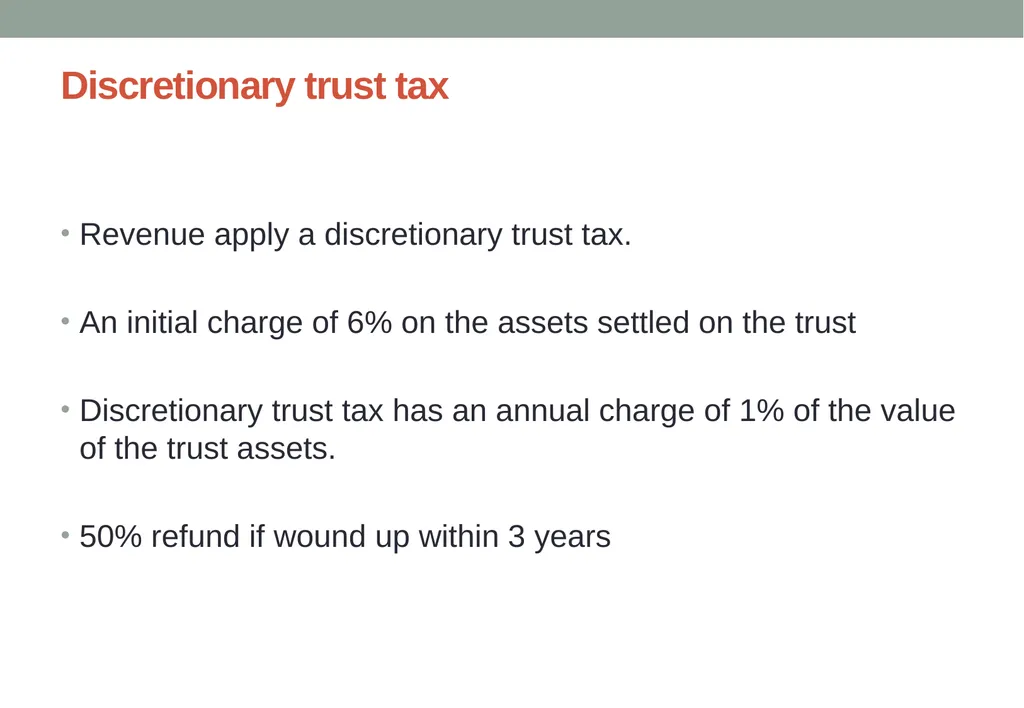
Discretionary trust tax Revenue apply a discretionary trust tax.
An initial charge of 6% on the assets settled on the trust
Discretionary trust tax has an annual charge of 1% of the value of the trust assets.
50% refund if wound up within 3 years<br>
An initial charge of 6% on the assets settled on the trust
Discretionary trust tax has an annual charge of 1% of the value of the trust assets.
50% refund if wound up within 3 years<br>
09
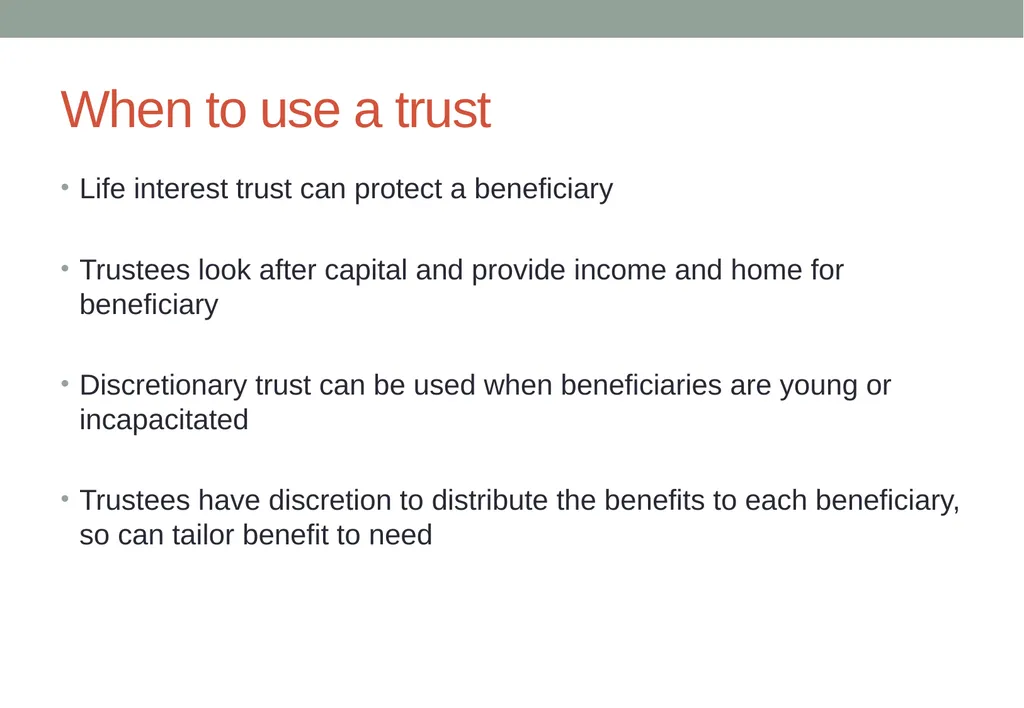
When to use a trust Life interest trust can protect a beneficiary
Trustees look after capital and provide income and home for beneficiary
Discretionary trust can be used when beneficiaries are young or incapacitated
Trustees have discretion to distribute the benefits to each beneficiary, so can tailor benefit to need<br>
Trustees look after capital and provide income and home for beneficiary
Discretionary trust can be used when beneficiaries are young or incapacitated
Trustees have discretion to distribute the benefits to each beneficiary, so can tailor benefit to need<br>
10
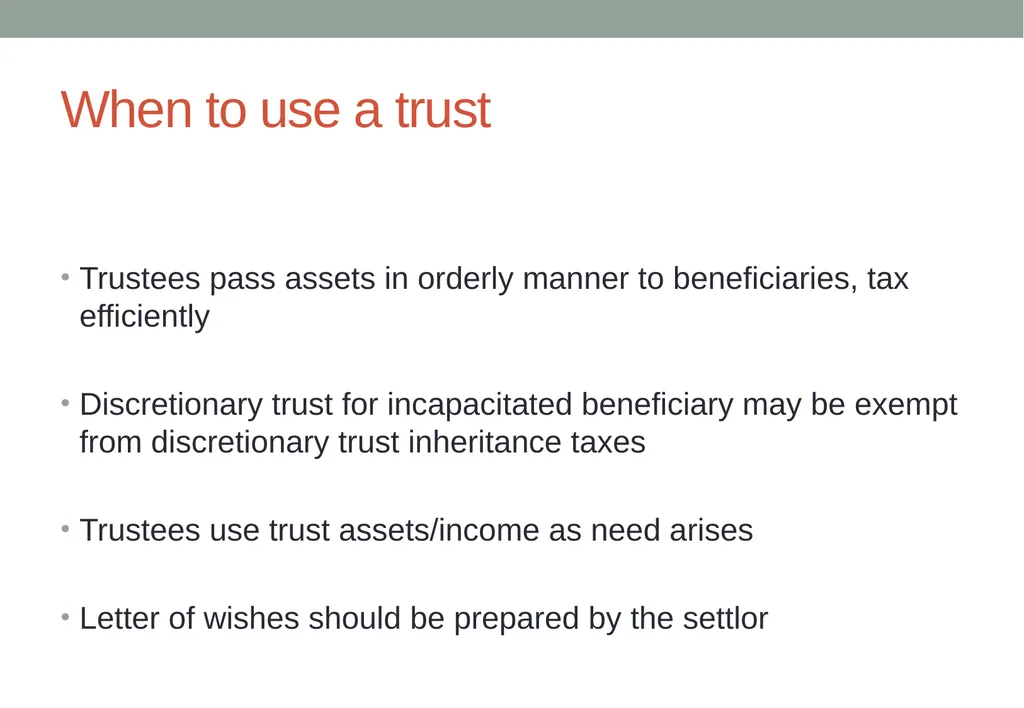
When to use a trust Trustees pass assets in orderly manner to beneficiaries, tax efficiently
Discretionary trust for incapacitated beneficiary may be exempt from discretionary trust inheritance taxes
Trustees use trust assets/income as need arises
Letter of wishes should be prepared by the settlor<br>
Discretionary trust for incapacitated beneficiary may be exempt from discretionary trust inheritance taxes
Trustees use trust assets/income as need arises
Letter of wishes should be prepared by the settlor<br>
11
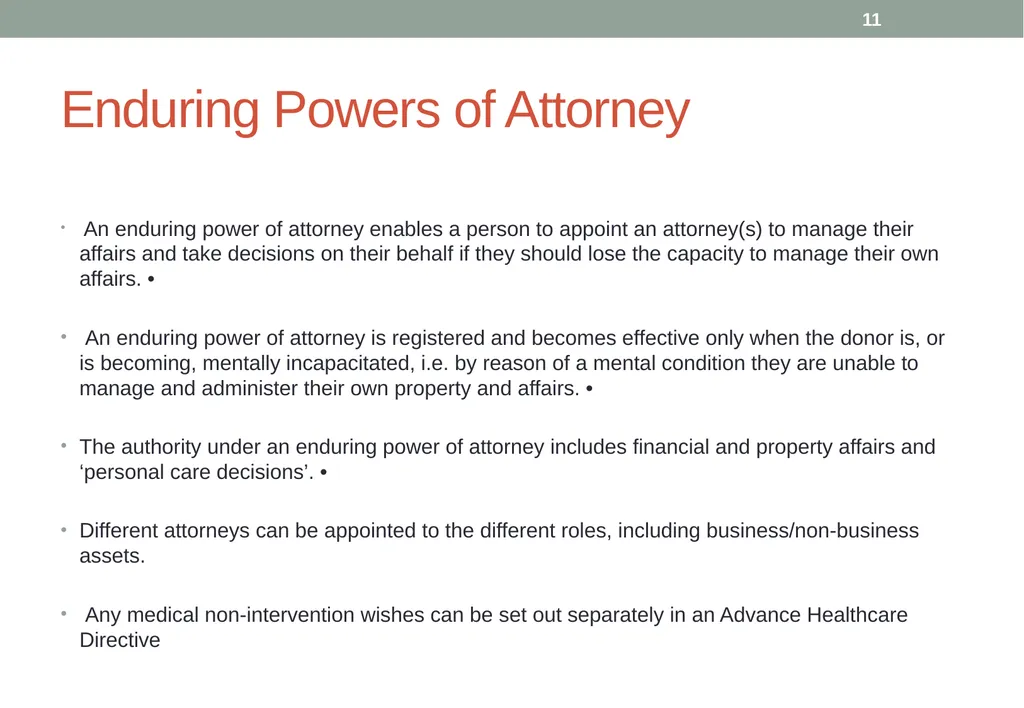
Enduring Powers of Attorney An enduring power of attorney enables a person to appoint an attorney(s) to manage their affairs and take decisions on their behalf if they should lose the capacity to manage their own affairs. •
An enduring power of attorney is registered and becomes effective only when the donor is, or is becoming, mentally incapacitated, i.e. by reason of a mental condition they are unable to manage and administer their own property and affairs. •
The authority under an enduring power of attorney includes financial and property affairs and ‘personal care decisions’. •
Different attorneys can be appointed to the different roles, including business/non-business assets.
Any medical non-intervention wishes can be set out separately in an Advance Healthcare Directive 11<br>
An enduring power of attorney is registered and becomes effective only when the donor is, or is becoming, mentally incapacitated, i.e. by reason of a mental condition they are unable to manage and administer their own property and affairs. •
The authority under an enduring power of attorney includes financial and property affairs and ‘personal care decisions’. •
Different attorneys can be appointed to the different roles, including business/non-business assets.
Any medical non-intervention wishes can be set out separately in an Advance Healthcare Directive 11<br>
12
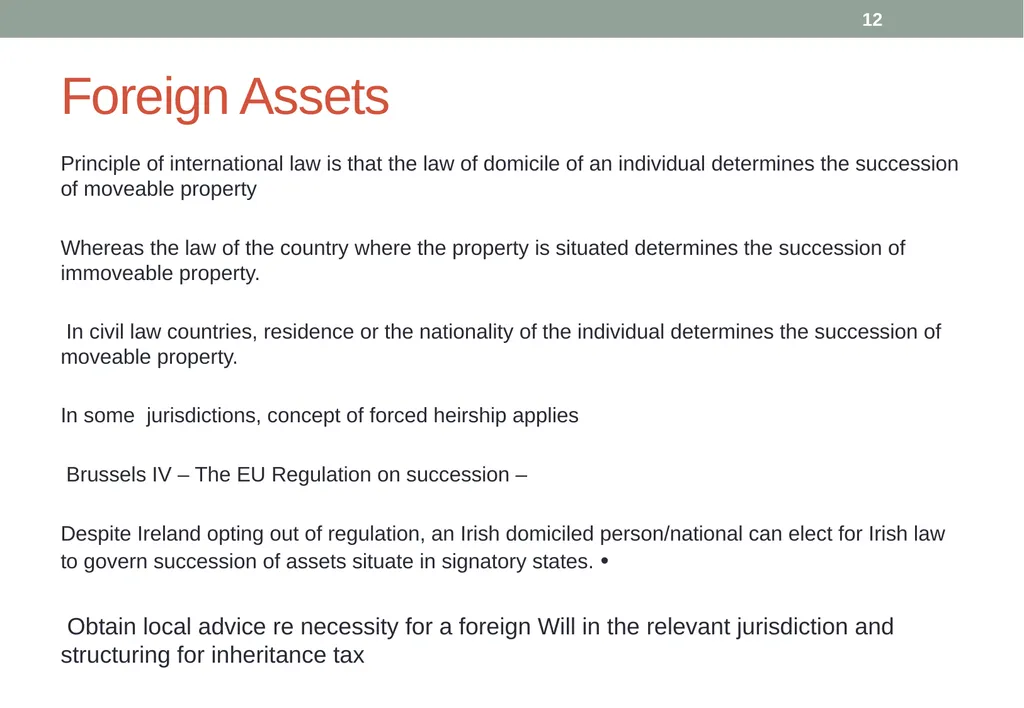
Foreign Assets Principle of international law is that the law of domicile of an individual determines the succession of moveable property
Whereas the law of the country where the property is situated determines the succession of immoveable property.
In civil law countries, residence or the nationality of the individual determines the succession of moveable property.
In some jurisdictions, concept of forced heirship applies
Brussels IV – The EU Regulation on succession –
Despite Ireland opting out of regulation, an Irish domiciled person/national can elect for Irish law to govern succession of assets situate in signatory states. •
Obtain local advice re necessity for a foreign Will in the relevant jurisdiction and structuring for inheritance tax 12<br>
Whereas the law of the country where the property is situated determines the succession of immoveable property.
In civil law countries, residence or the nationality of the individual determines the succession of moveable property.
In some jurisdictions, concept of forced heirship applies
Brussels IV – The EU Regulation on succession –
Despite Ireland opting out of regulation, an Irish domiciled person/national can elect for Irish law to govern succession of assets situate in signatory states. •
Obtain local advice re necessity for a foreign Will in the relevant jurisdiction and structuring for inheritance tax 12<br>
13
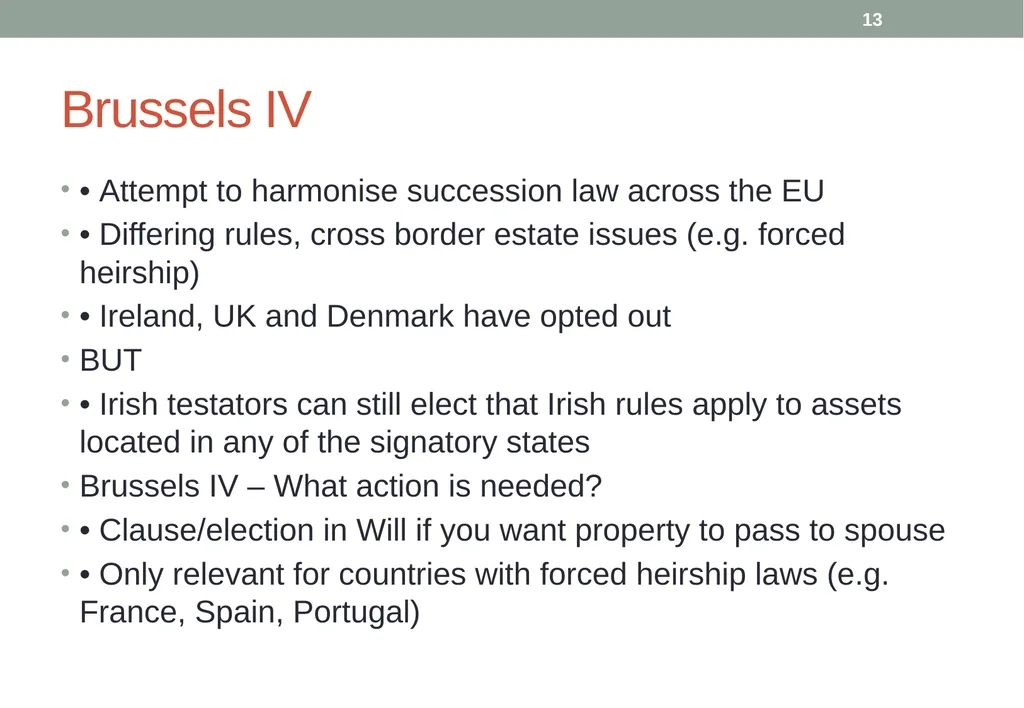
Brussels IV • Attempt to harmonise succession law across the EU
• Differing rules, cross border estate issues (e.g. forced heirship)
• Ireland, UK and Denmark have opted out
BUT
• Irish testators can still elect that Irish rules apply to assets located in any of the signatory states
Brussels IV – What action is needed?
• Clause/election in Will if you want property to pass to spouse
• Only relevant for countries with forced heirship laws (e.g. France, Spain, Portugal) 13<br>
• Differing rules, cross border estate issues (e.g. forced heirship)
• Ireland, UK and Denmark have opted out
BUT
• Irish testators can still elect that Irish rules apply to assets located in any of the signatory states
Brussels IV – What action is needed?
• Clause/election in Will if you want property to pass to spouse
• Only relevant for countries with forced heirship laws (e.g. France, Spain, Portugal) 13<br>
14
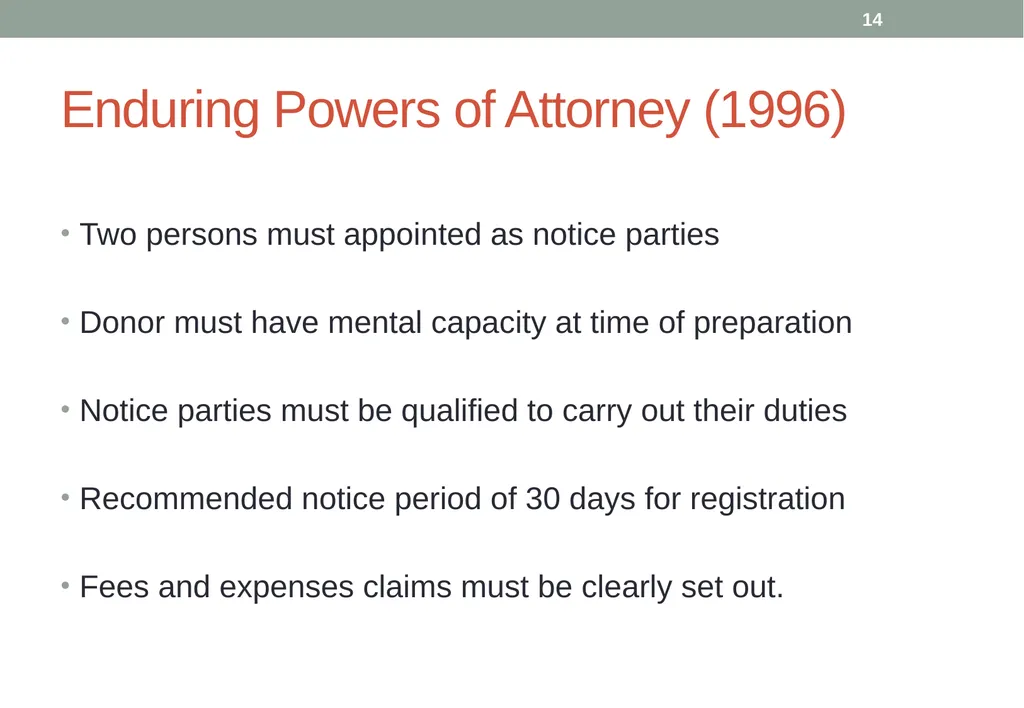
Enduring Powers of Attorney (1996) Two persons must appointed as notice parties
Donor must have mental capacity at time of preparation
Notice parties must be qualified to carry out their duties
Recommended notice period of 30 days for registration
Fees and expenses claims must be clearly set out. 14<br>
Donor must have mental capacity at time of preparation
Notice parties must be qualified to carry out their duties
Recommended notice period of 30 days for registration
Fees and expenses claims must be clearly set out. 14<br>
15
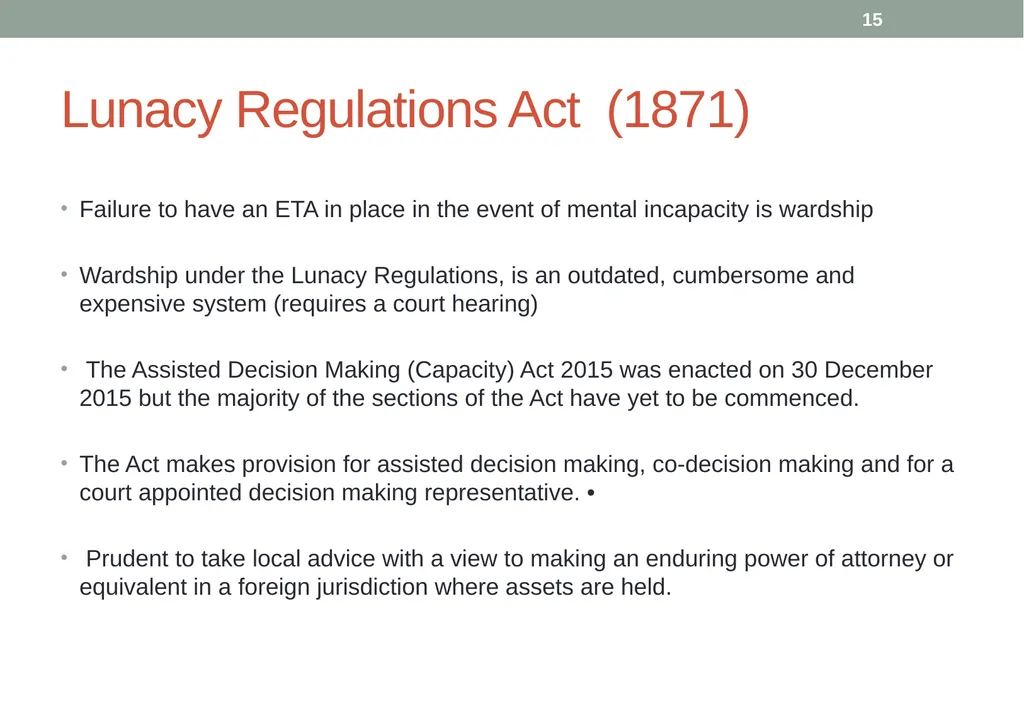
Lunacy Regulations Act (1871) Failure to have an ETA in place in the event of mental incapacity is wardship
Wardship under the Lunacy Regulations, is an outdated, cumbersome and expensive system (requires a court hearing)
The Assisted Decision Making (Capacity) Act 2015 was enacted on 30 December 2015 but the majority of the sections of the Act have yet to be commenced.
The Act makes provision for assisted decision making, co-decision making and for a court appointed decision making representative. •
Prudent to take local advice with a view to making an enduring power of attorney or equivalent in a foreign jurisdiction where assets are held. 15<br>
Wardship under the Lunacy Regulations, is an outdated, cumbersome and expensive system (requires a court hearing)
The Assisted Decision Making (Capacity) Act 2015 was enacted on 30 December 2015 but the majority of the sections of the Act have yet to be commenced.
The Act makes provision for assisted decision making, co-decision making and for a court appointed decision making representative. •
Prudent to take local advice with a view to making an enduring power of attorney or equivalent in a foreign jurisdiction where assets are held. 15<br>
16
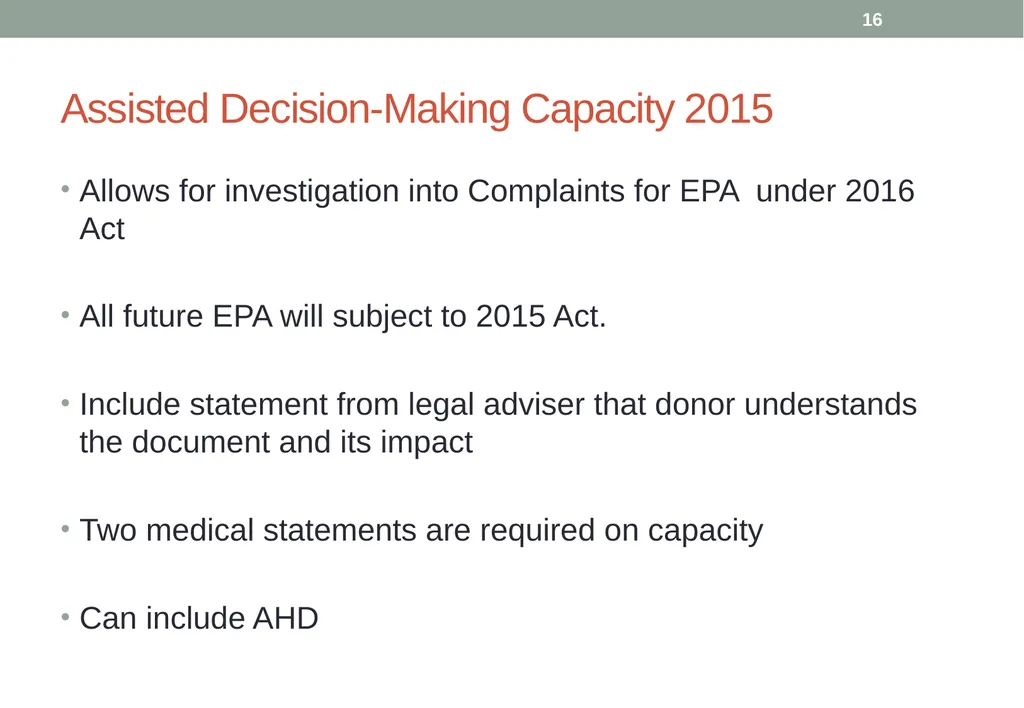
Assisted Decision-Making Capacity 2015 Allows for investigation into Complaints for EPA under 2016 Act
All future EPA will subject to 2015 Act.
Include statement from legal adviser that donor understands the document and its impact
Two medical statements are required on capacity
Can include AHD 16<br>
All future EPA will subject to 2015 Act.
Include statement from legal adviser that donor understands the document and its impact
Two medical statements are required on capacity
Can include AHD 16<br>
17
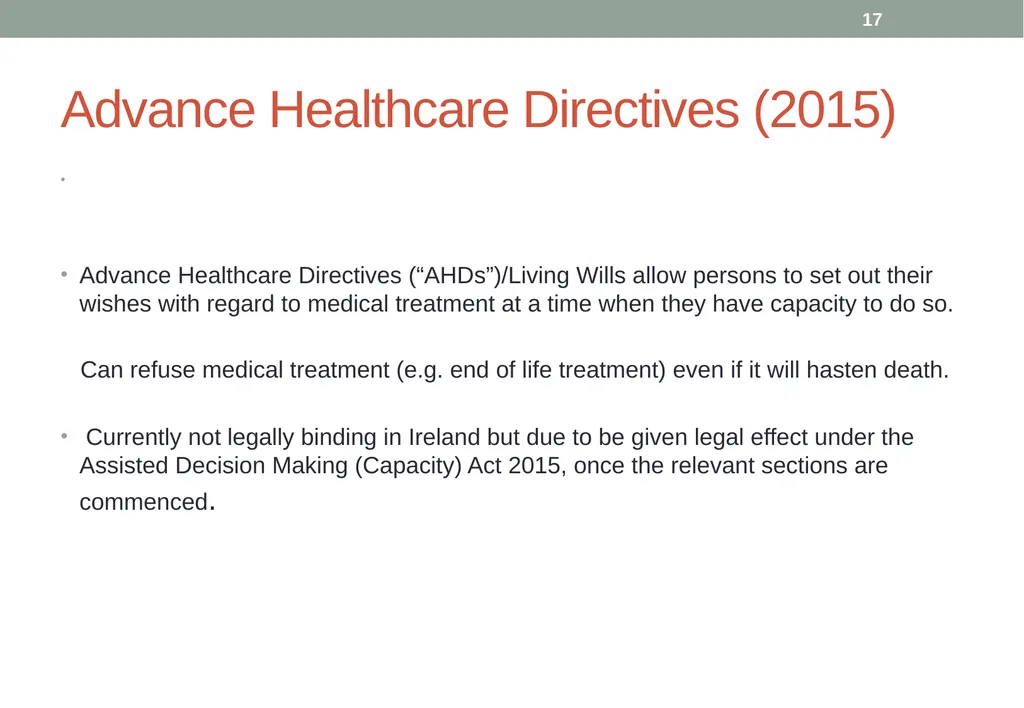
Advance Healthcare Directives (2015) Advance Healthcare Directives (“AHDs”)/Living Wills allow persons to set out their wishes with regard to medical treatment at a time when they have capacity to do so.
Can refuse medical treatment (e.g. end of life treatment) even if it will hasten death.
Currently not legally binding in Ireland but due to be given legal effect under the Assisted Decision Making (Capacity) Act 2015, once the relevant sections are commenced. 17<br>
Can refuse medical treatment (e.g. end of life treatment) even if it will hasten death.
Currently not legally binding in Ireland but due to be given legal effect under the Assisted Decision Making (Capacity) Act 2015, once the relevant sections are commenced. 17<br>
18
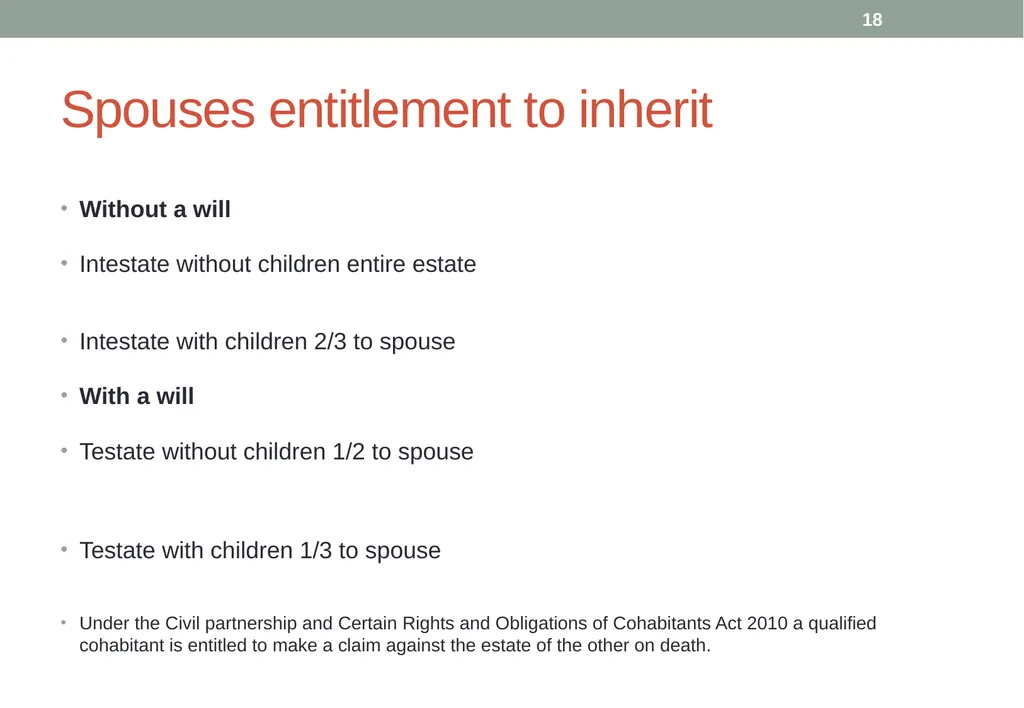
Spouses entitlement to inherit Without a will
Intestate without children entire estate
Intestate with children 2/3 to spouse
With a will
Testate without children 1/2 to spouse
Testate with children 1/3 to spouse
Under the Civil partnership and Certain Rights and Obligations of Cohabitants Act 2010 a qualified cohabitant is entitled to make a claim against the estate of the other on death. 18<br>
Intestate without children entire estate
Intestate with children 2/3 to spouse
With a will
Testate without children 1/2 to spouse
Testate with children 1/3 to spouse
Under the Civil partnership and Certain Rights and Obligations of Cohabitants Act 2010 a qualified cohabitant is entitled to make a claim against the estate of the other on death. 18<br>
19
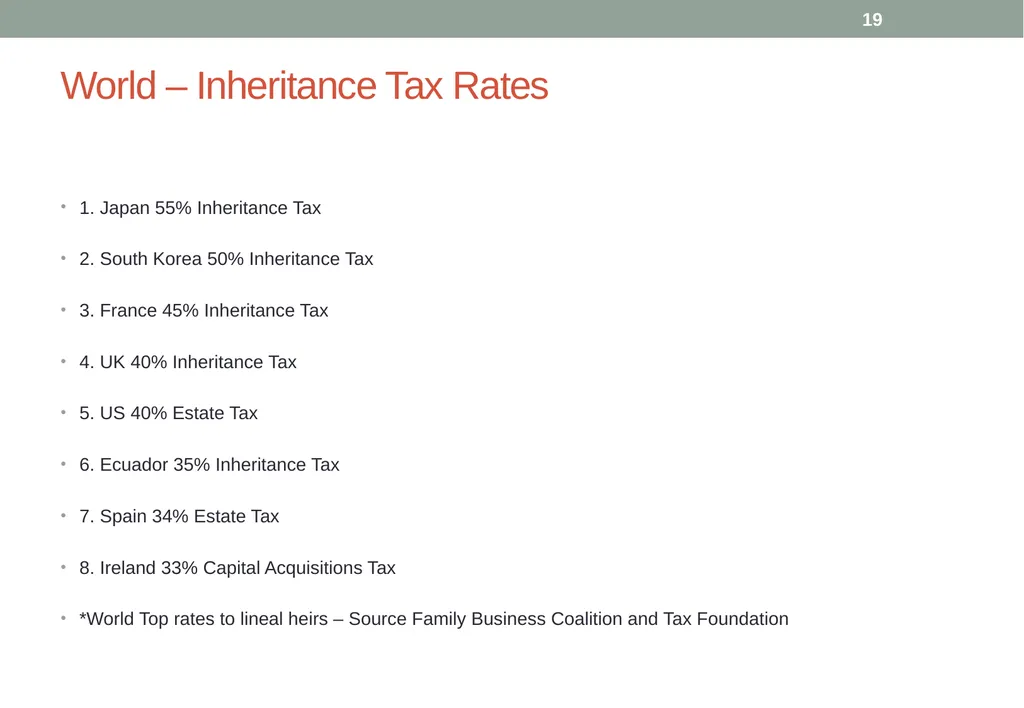
World – Inheritance Tax Rates 1. Japan 55% Inheritance Tax
2. South Korea 50% Inheritance Tax
3. France 45% Inheritance Tax
4. UK 40% Inheritance Tax
5. US 40% Estate Tax
6. Ecuador 35% Inheritance Tax
7. Spain 34% Estate Tax
8. Ireland 33% Capital Acquisitions Tax
*World Top rates to lineal heirs – Source Family Business Coalition and Tax Foundation 19<br>
2. South Korea 50% Inheritance Tax
3. France 45% Inheritance Tax
4. UK 40% Inheritance Tax
5. US 40% Estate Tax
6. Ecuador 35% Inheritance Tax
7. Spain 34% Estate Tax
8. Ireland 33% Capital Acquisitions Tax
*World Top rates to lineal heirs – Source Family Business Coalition and Tax Foundation 19<br>
20
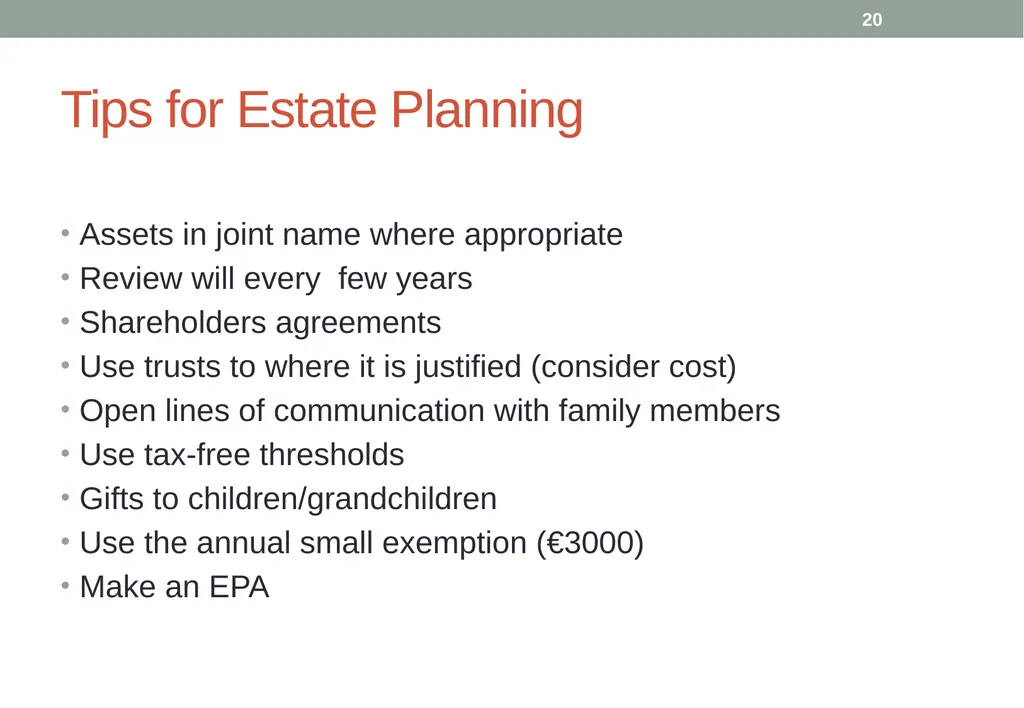
Tips for Estate Planning Assets in joint name where appropriate
Review will every few years
Shareholders agreements
Use trusts to where it is justified (consider cost)
Open lines of communication with family members
Use tax-free thresholds
Gifts to children/grandchildren
Use the annual small exemption (€3000)
Make an EPA 20<br>
Review will every few years
Shareholders agreements
Use trusts to where it is justified (consider cost)
Open lines of communication with family members
Use tax-free thresholds
Gifts to children/grandchildren
Use the annual small exemption (€3000)
Make an EPA 20<br>
21
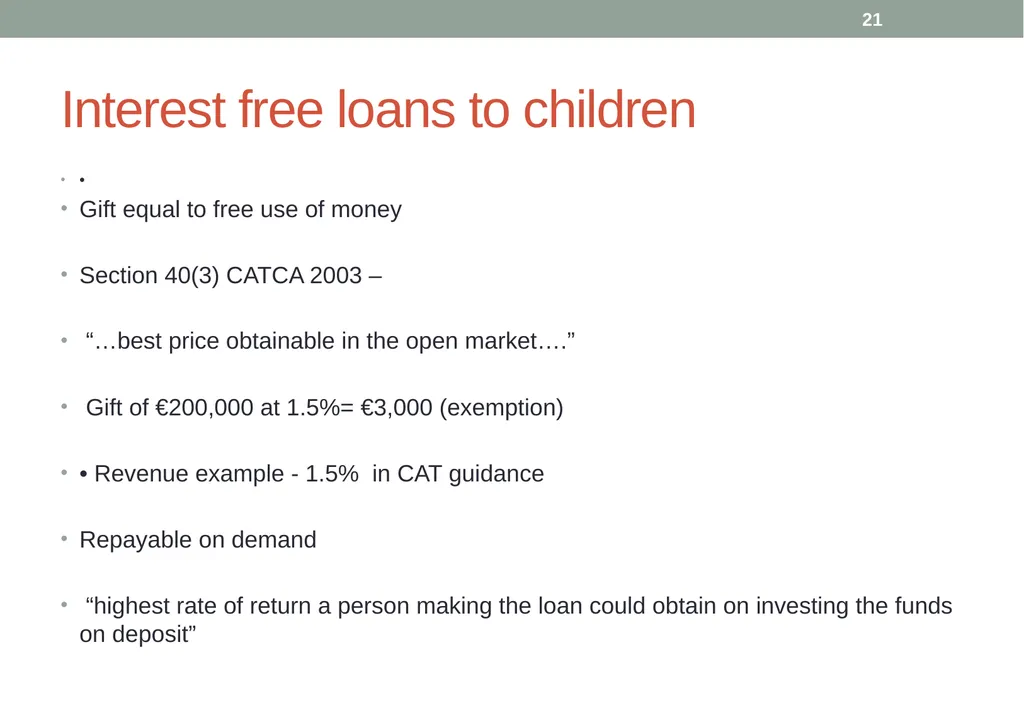
Interest free loans to children •
Gift equal to free use of money
Section 40(3) CATCA 2003 –
“…best price obtainable in the open market….”
Gift of €200,000 at 1.5%= €3,000 (exemption)
• Revenue example - 1.5% in CAT guidance
Repayable on demand
“highest rate of return a person making the loan could obtain on investing the funds on deposit” 21<br>
Gift equal to free use of money
Section 40(3) CATCA 2003 –
“…best price obtainable in the open market….”
Gift of €200,000 at 1.5%= €3,000 (exemption)
• Revenue example - 1.5% in CAT guidance
Repayable on demand
“highest rate of return a person making the loan could obtain on investing the funds on deposit” 21<br>
22
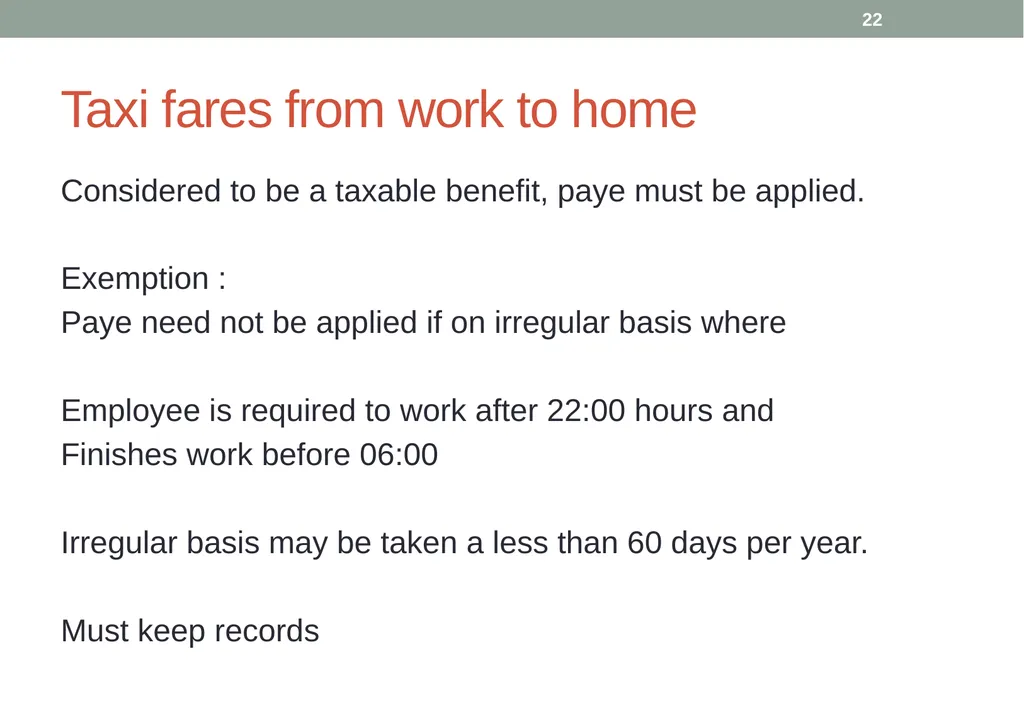
Taxi fares from work to home Considered to be a taxable benefit, paye must be applied.
Exemption :
Paye need not be applied if on irregular basis where
Employee is required to work after 22:00 hours and
Finishes work before 06:00
Irregular basis may be taken a less than 60 days per year.
Must keep records 22<br>
Exemption :
Paye need not be applied if on irregular basis where
Employee is required to work after 22:00 hours and
Finishes work before 06:00
Irregular basis may be taken a less than 60 days per year.
Must keep records 22<br>
23
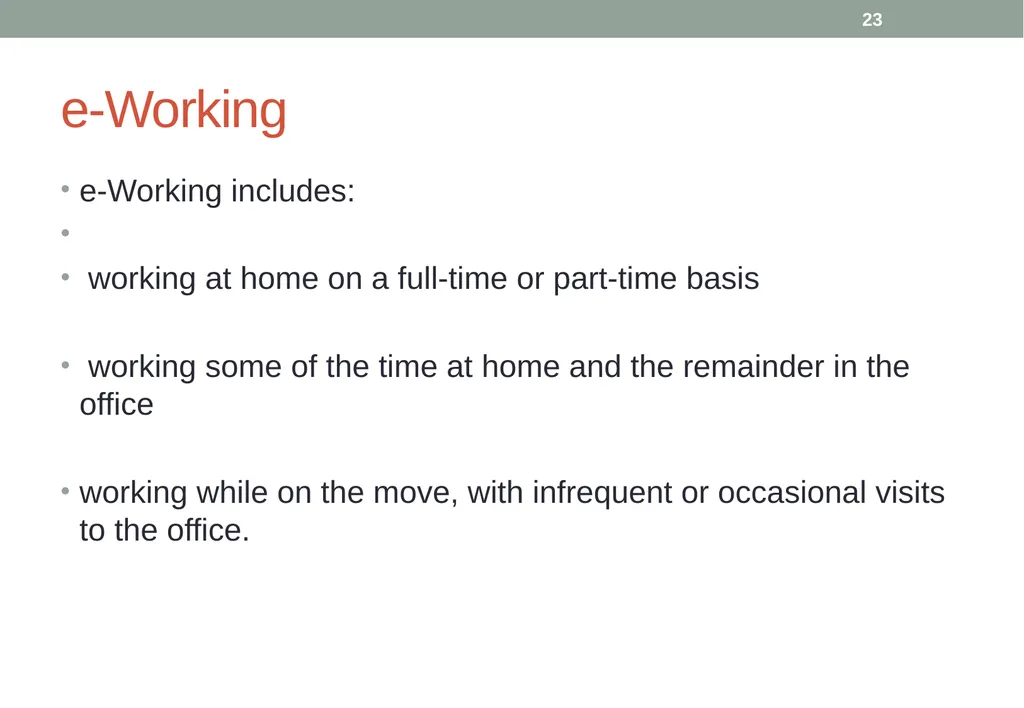
e-Working e-Working includes:
working at home on a full-time or part-time basis
working some of the time at home and the remainder in the office
working while on the move, with infrequent or occasional visits to the office. 23<br>
working at home on a full-time or part-time basis
working some of the time at home and the remainder in the office
working while on the move, with infrequent or occasional visits to the office. 23<br>
24
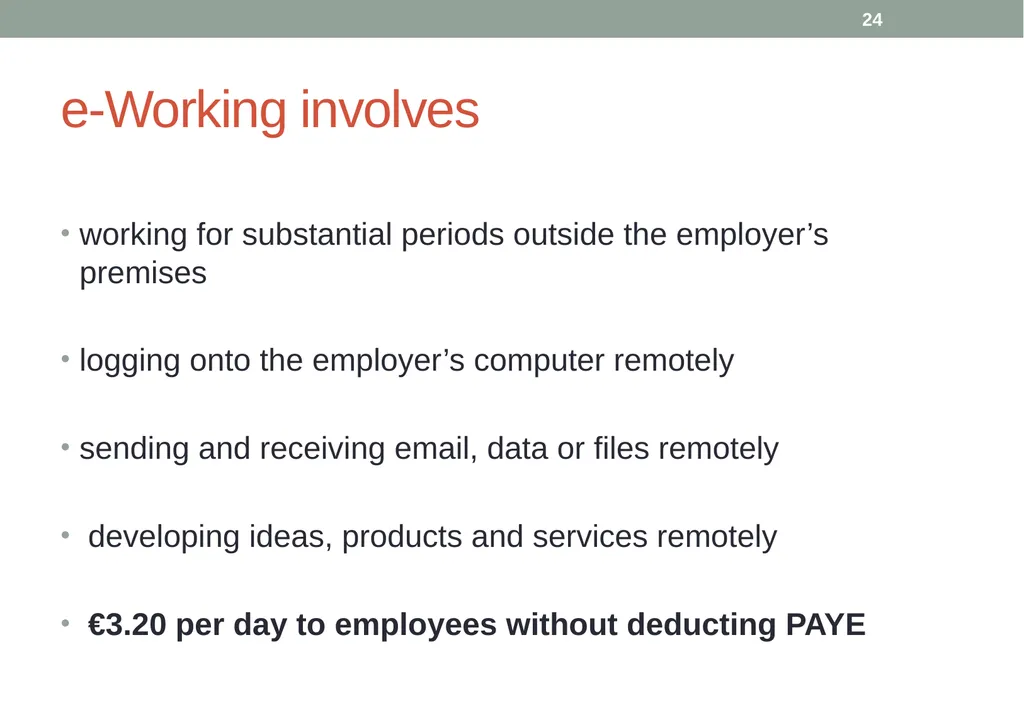
e-Working involves working for substantial periods outside the employer’s premises
logging onto the employer’s computer remotely
sending and receiving email, data or files remotely
developing ideas, products and services remotely
€3.20 per day to employees without deducting PAYE 24<br>
logging onto the employer’s computer remotely
sending and receiving email, data or files remotely
developing ideas, products and services remotely
€3.20 per day to employees without deducting PAYE 24<br>
25
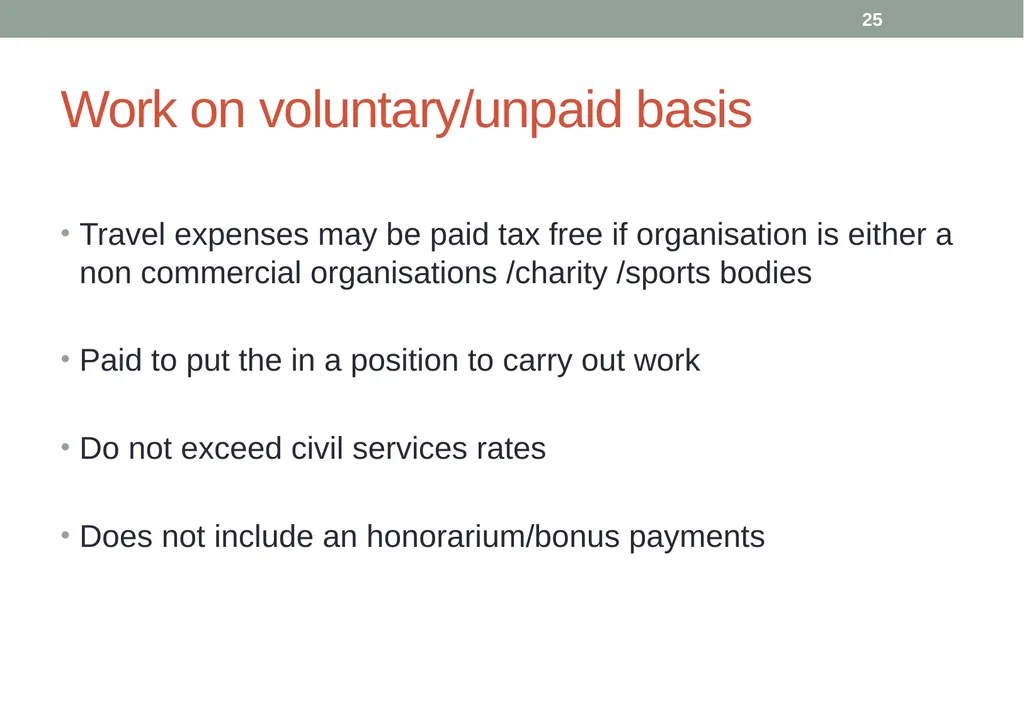
Work on voluntary/unpaid basis Travel expenses may be paid tax free if organisation is either a non commercial organisations /charity /sports bodies
Paid to put the in a position to carry out work
Do not exceed civil services rates
Does not include an honorarium/bonus payments 25<br>
Paid to put the in a position to carry out work
Do not exceed civil services rates
Does not include an honorarium/bonus payments 25<br>
26
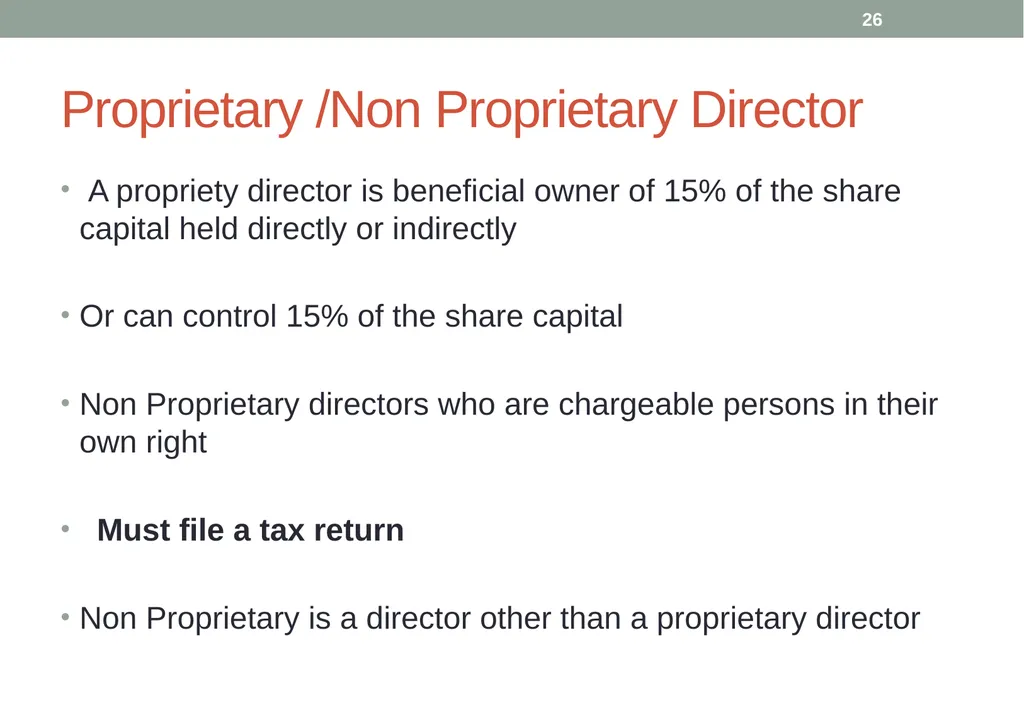
Proprietary /Non Proprietary Director A propriety director is beneficial owner of 15% of the share capital held directly or indirectly
Or can control 15% of the share capital
Non Proprietary directors who are chargeable persons in their own right
Must file a tax return
Non Proprietary is a director other than a proprietary director 26<br>
Or can control 15% of the share capital
Non Proprietary directors who are chargeable persons in their own right
Must file a tax return
Non Proprietary is a director other than a proprietary director 26<br>
27
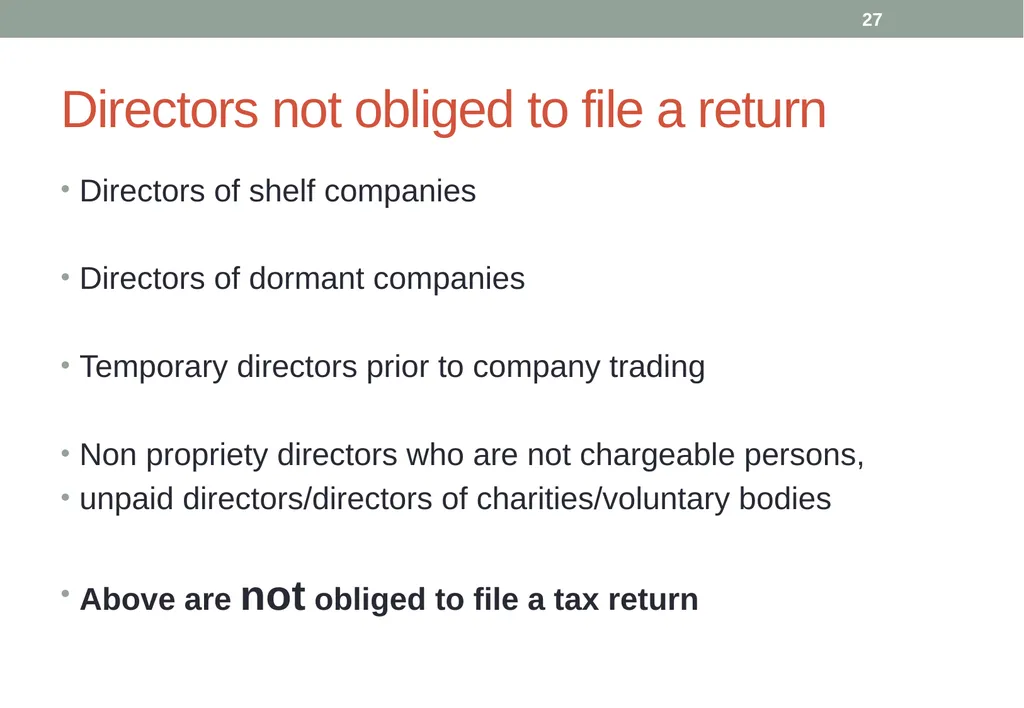
Directors not obliged to file a return Directors of shelf companies
Directors of dormant companies
Temporary directors prior to company trading
Non propriety directors who are not chargeable persons,
unpaid directors/directors of charities/voluntary bodies
Above are not obliged to file a tax return 27<br>
Directors of dormant companies
Temporary directors prior to company trading
Non propriety directors who are not chargeable persons,
unpaid directors/directors of charities/voluntary bodies
Above are not obliged to file a tax return 27<br>
28
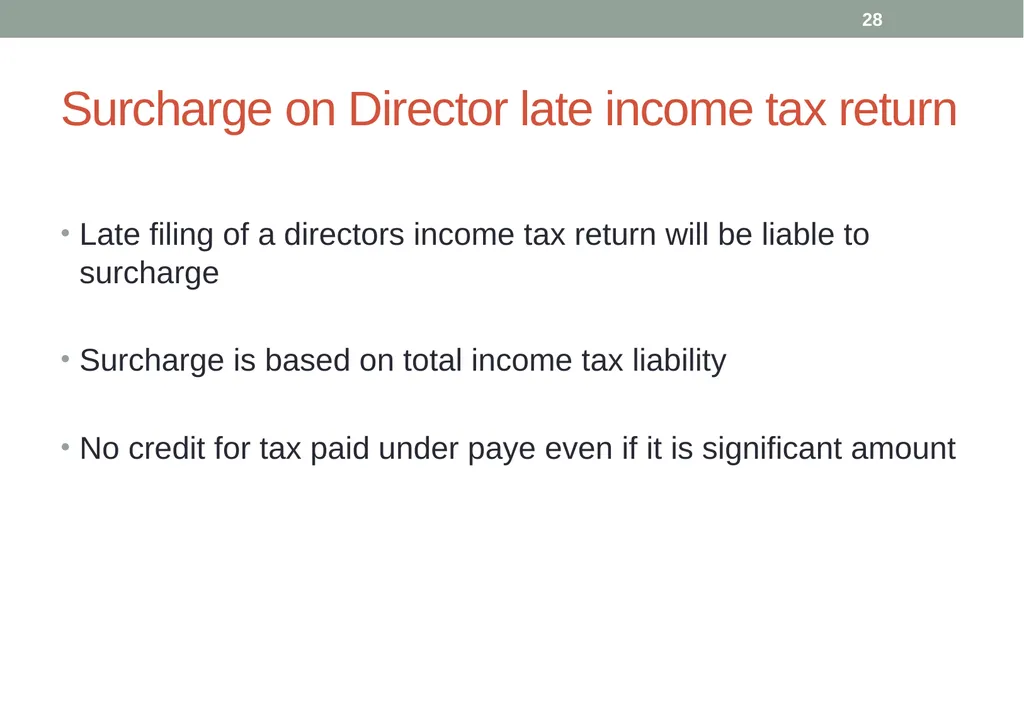
Surcharge on Director late income tax return Late filing of a directors income tax return will be liable to surcharge
Surcharge is based on total income tax liability
No credit for tax paid under paye even if it is significant amount 28<br>
Surcharge is based on total income tax liability
No credit for tax paid under paye even if it is significant amount 28<br>
29
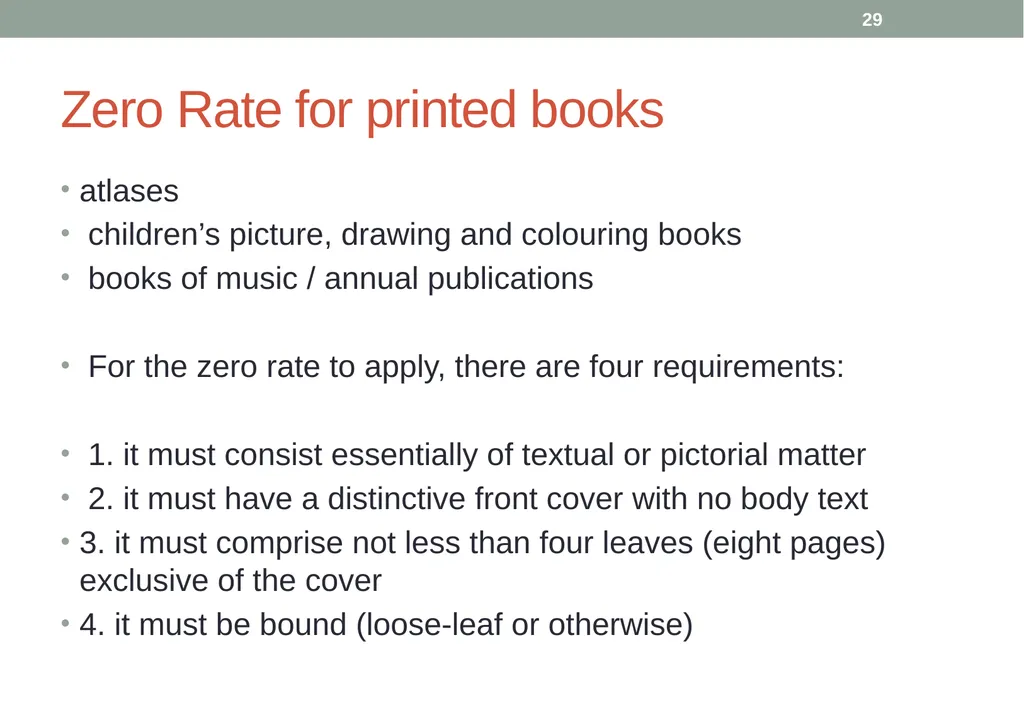
Zero Rate for printed books atlases
children’s picture, drawing and colouring books
books of music / annual publications
For the zero rate to apply, there are four requirements:
1. it must consist essentially of textual or pictorial matter
2. it must have a distinctive front cover with no body text
3. it must comprise not less than four leaves (eight pages) exclusive of the cover
4. it must be bound (loose-leaf or otherwise) 29<br>
children’s picture, drawing and colouring books
books of music / annual publications
For the zero rate to apply, there are four requirements:
1. it must consist essentially of textual or pictorial matter
2. it must have a distinctive front cover with no body text
3. it must comprise not less than four leaves (eight pages) exclusive of the cover
4. it must be bound (loose-leaf or otherwise) 29<br>
30
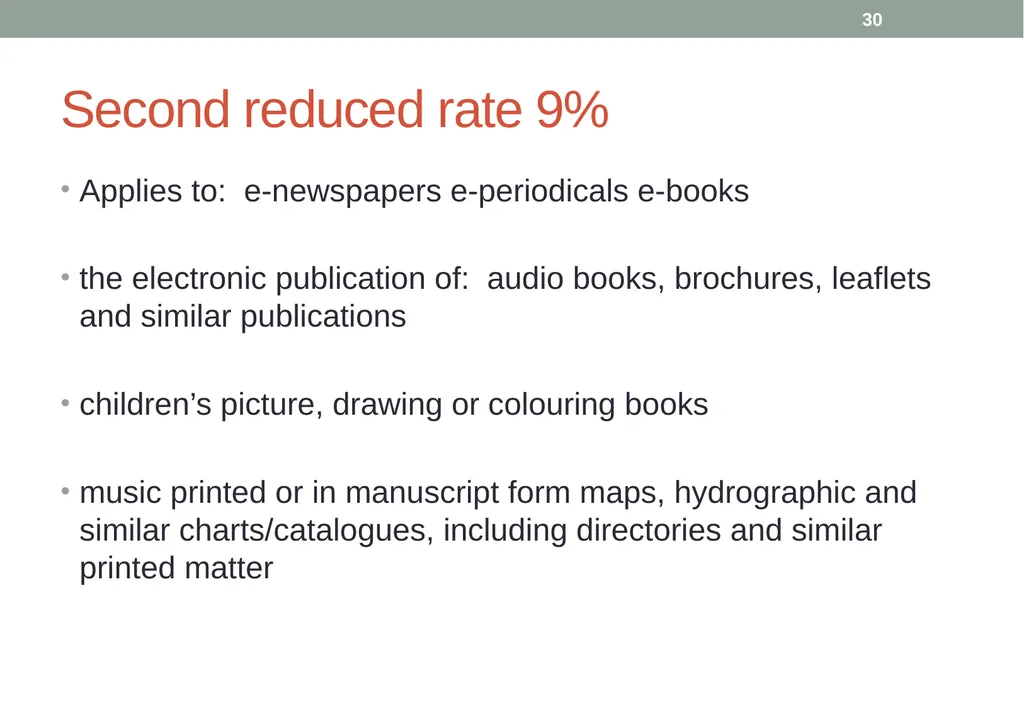
Second reduced rate 9% Applies to: e-newspapers e-periodicals e-books
the electronic publication of: audio books, brochures, leaflets and similar publications
children’s picture, drawing or colouring books
music printed or in manuscript form maps, hydrographic and similar charts/catalogues, including directories and similar printed matter 30<br>
the electronic publication of: audio books, brochures, leaflets and similar publications
children’s picture, drawing or colouring books
music printed or in manuscript form maps, hydrographic and similar charts/catalogues, including directories and similar printed matter 30<br>
31
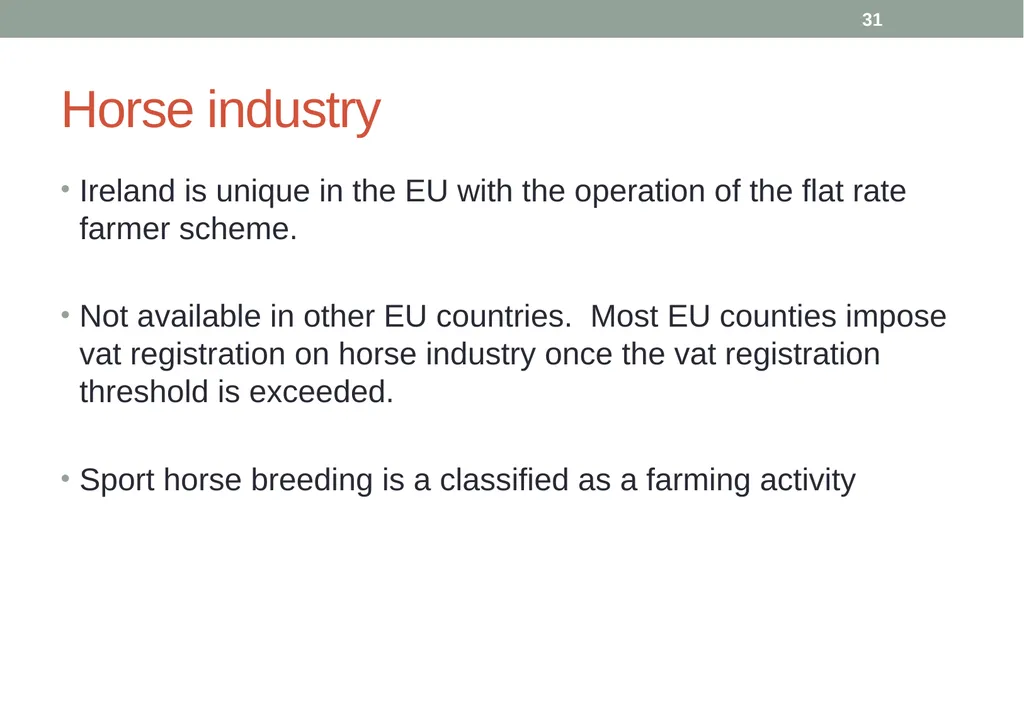
Horse industry Ireland is unique in the EU with the operation of the flat rate farmer scheme.
Not available in other EU countries. Most EU counties impose vat registration on horse industry once the vat registration threshold is exceeded.
Sport horse breeding is a classified as a farming activity 31<br>
Not available in other EU countries. Most EU counties impose vat registration on horse industry once the vat registration threshold is exceeded.
Sport horse breeding is a classified as a farming activity 31<br>
32
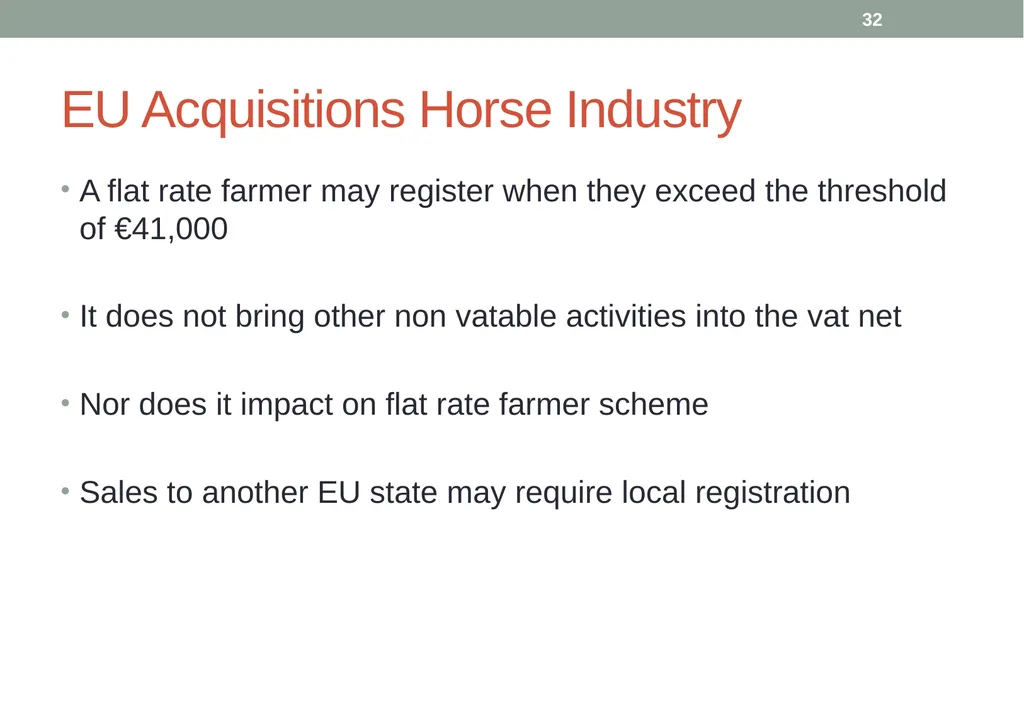
EU Acquisitions Horse Industry A flat rate farmer may register when they exceed the threshold of €41,000
It does not bring other non vatable activities into the vat net
Nor does it impact on flat rate farmer scheme
Sales to another EU state may require local registration 32<br>
It does not bring other non vatable activities into the vat net
Nor does it impact on flat rate farmer scheme
Sales to another EU state may require local registration 32<br>
33
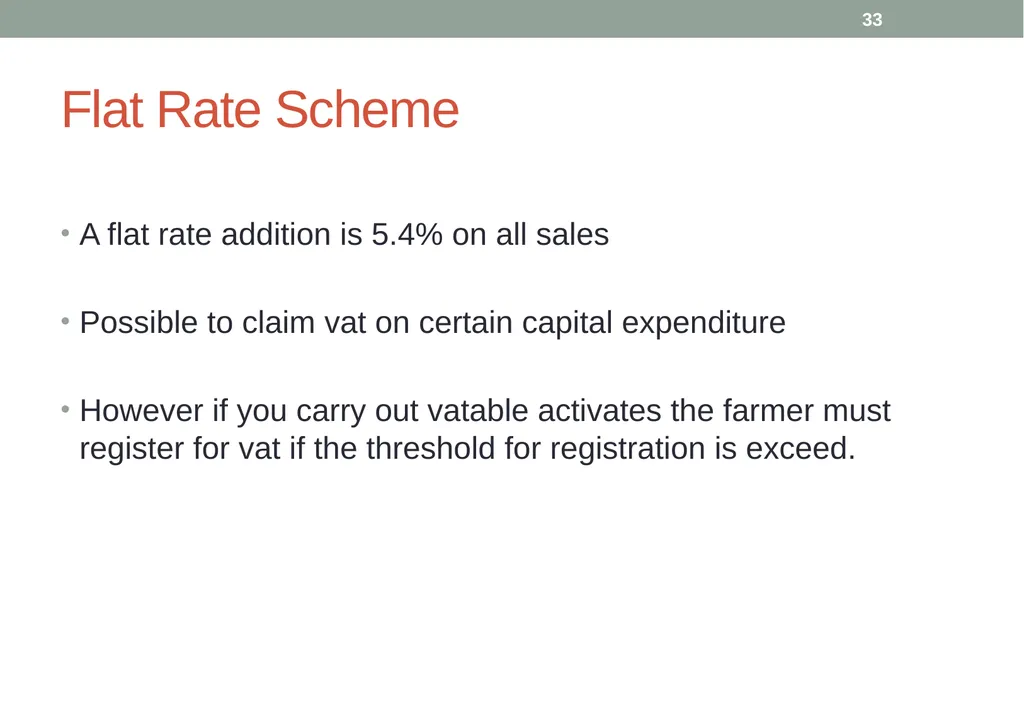
Flat Rate Scheme A flat rate addition is 5.4% on all sales
Possible to claim vat on certain capital expenditure
However if you carry out vatable activates the farmer must register for vat if the threshold for registration is exceed. 33<br>
Possible to claim vat on certain capital expenditure
However if you carry out vatable activates the farmer must register for vat if the threshold for registration is exceed. 33<br>
34
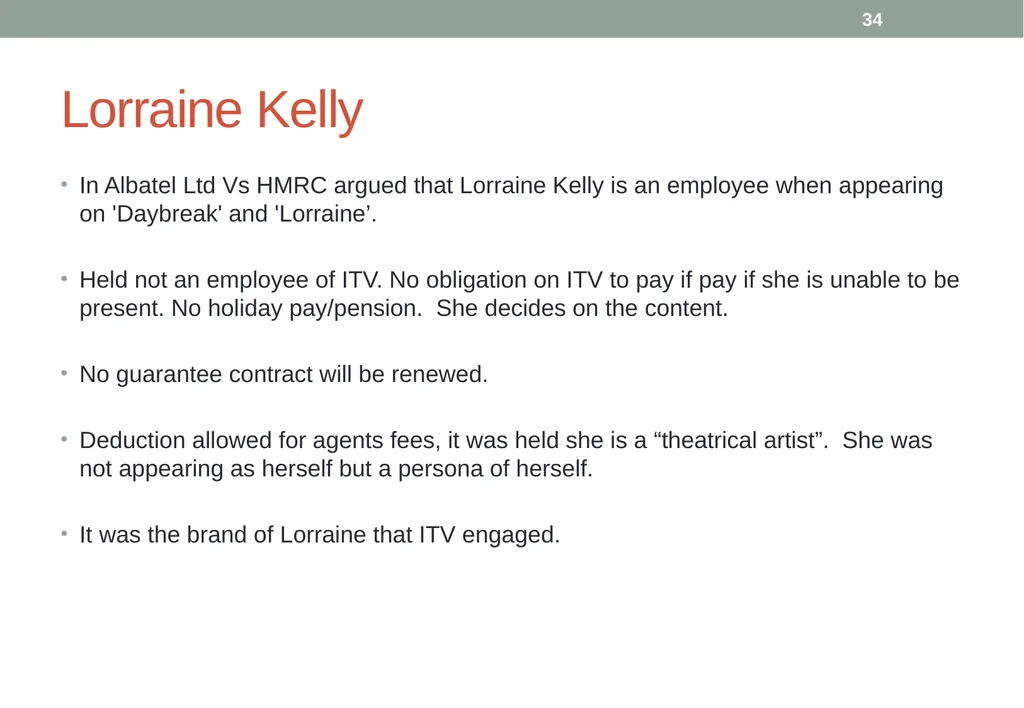
Lorraine Kelly In Albatel Ltd Vs HMRC argued that Lorraine Kelly is an employee when appearing on 'Daybreak' and 'Lorraine’.
Held not an employee of ITV. No obligation on ITV to pay if pay if she is unable to be present. No holiday pay/pension. She decides on the content.
No guarantee contract will be renewed.
Deduction allowed for agents fees, it was held she is a “theatrical artist”. She was not appearing as herself but a persona of herself.
It was the brand of Lorraine that ITV engaged. 34<br>
Held not an employee of ITV. No obligation on ITV to pay if pay if she is unable to be present. No holiday pay/pension. She decides on the content.
No guarantee contract will be renewed.
Deduction allowed for agents fees, it was held she is a “theatrical artist”. She was not appearing as herself but a persona of herself.
It was the brand of Lorraine that ITV engaged. 34<br>
35
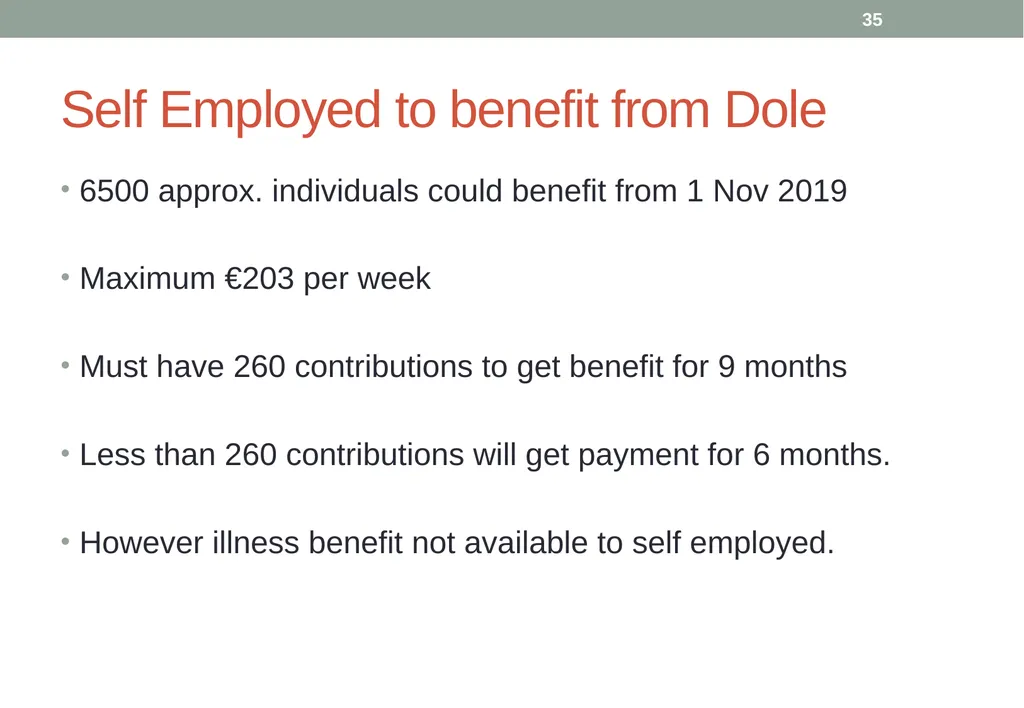
Self Employed to benefit from Dole 6500 approx. individuals could benefit from 1 Nov 2019
Maximum €203 per week
Must have 260 contributions to get benefit for 9 months
Less than 260 contributions will get payment for 6 months.
However illness benefit not available to self employed. 35<br>
Maximum €203 per week
Must have 260 contributions to get benefit for 9 months
Less than 260 contributions will get payment for 6 months.
However illness benefit not available to self employed. 35<br>
36
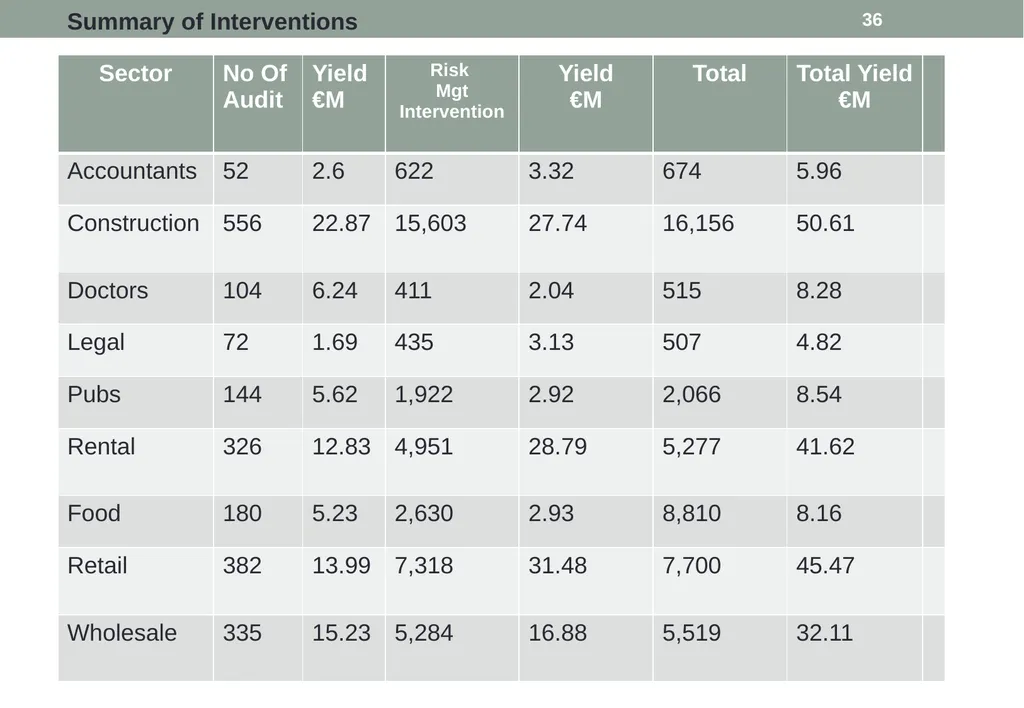
36 Summary of Interventions<br>
37
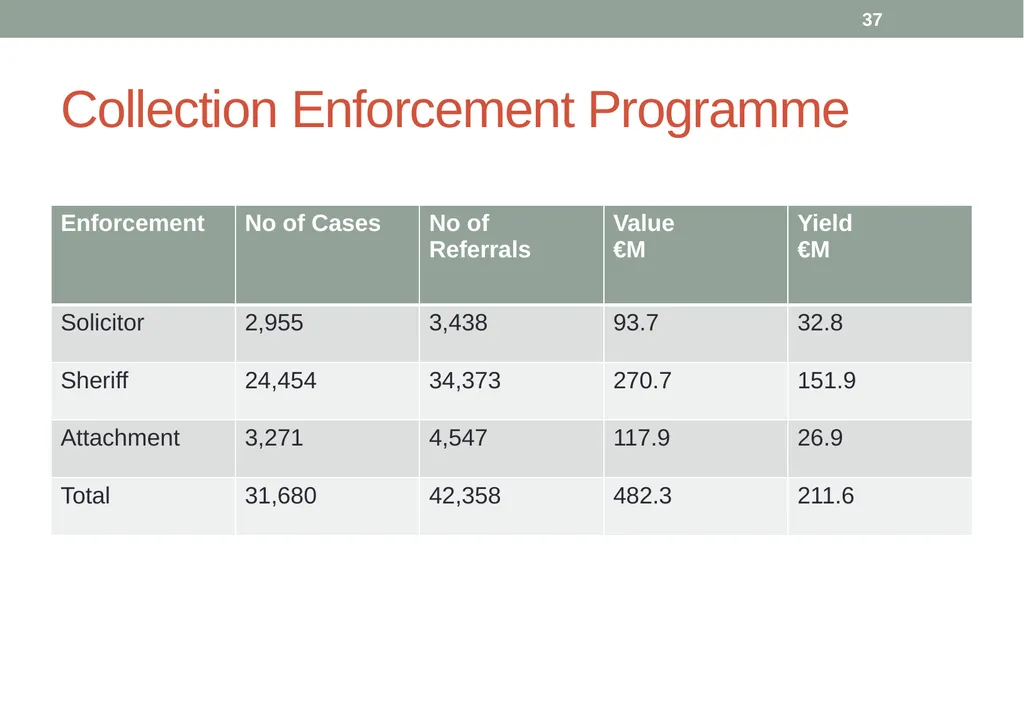
Collection Enforcement Programme 37<br>
38
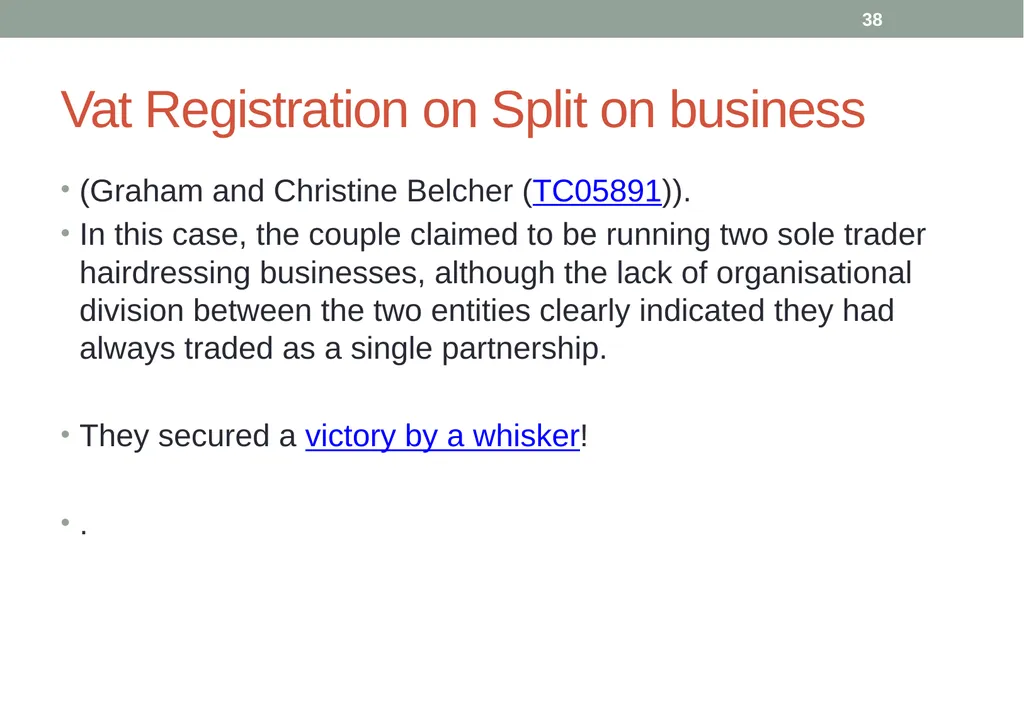
Vat Registration on Split on business (Graham and Christine Belcher (TC05891)).
In this case, the couple claimed to be running two sole trader hairdressing businesses, although the lack of organisational division between the two entities clearly indicated they had always traded as a single partnership.
They secured a victory by a whisker!
. 38<br>
In this case, the couple claimed to be running two sole trader hairdressing businesses, although the lack of organisational division between the two entities clearly indicated they had always traded as a single partnership.
They secured a victory by a whisker!
. 38<br>
39
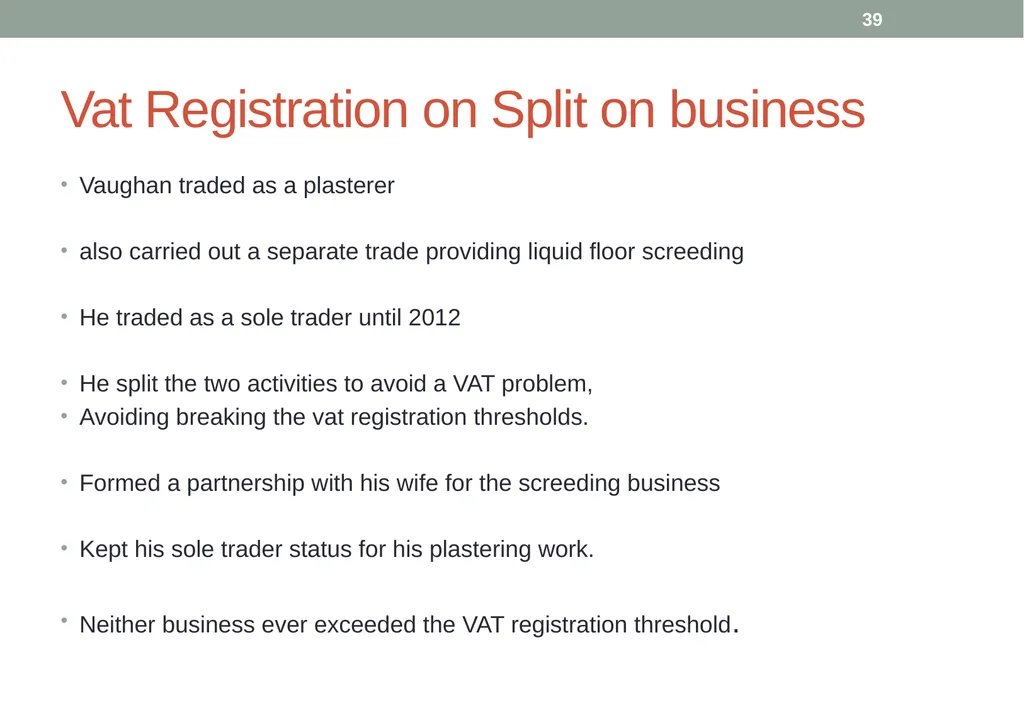
Vat Registration on Split on business Vaughan traded as a plasterer
also carried out a separate trade providing liquid floor screeding
He traded as a sole trader until 2012
He split the two activities to avoid a VAT problem,
Avoiding breaking the vat registration thresholds.
Formed a partnership with his wife for the screeding business
Kept his sole trader status for his plastering work.
Neither business ever exceeded the VAT registration threshold. 39<br>
also carried out a separate trade providing liquid floor screeding
He traded as a sole trader until 2012
He split the two activities to avoid a VAT problem,
Avoiding breaking the vat registration thresholds.
Formed a partnership with his wife for the screeding business
Kept his sole trader status for his plastering work.
Neither business ever exceeded the VAT registration threshold. 39<br>
40
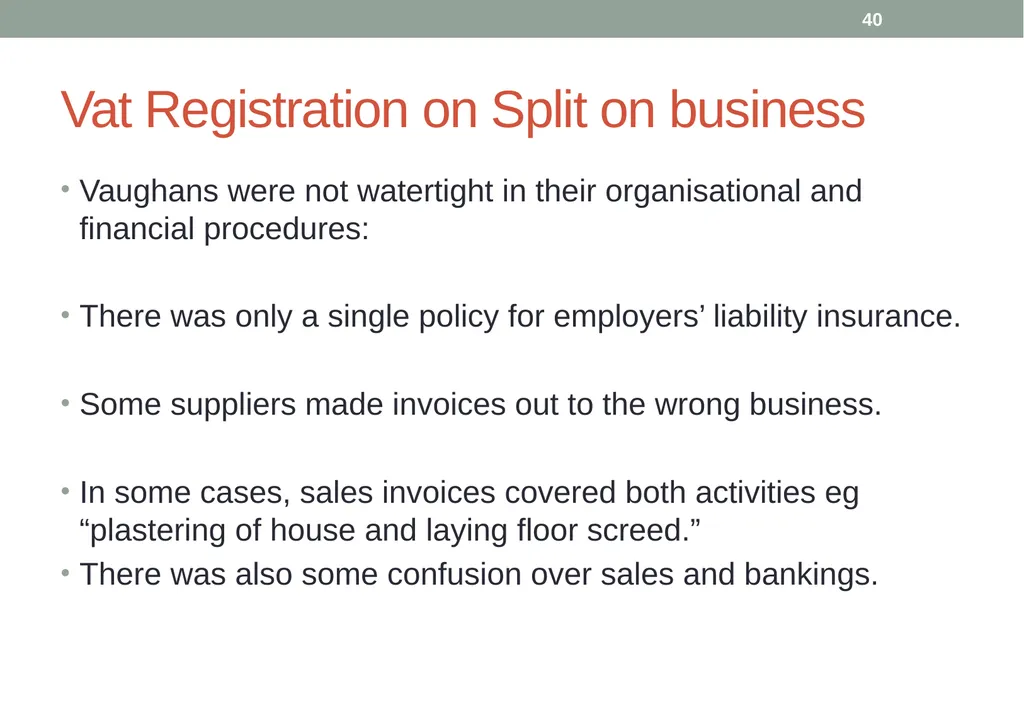
Vat Registration on Split on business Vaughans were not watertight in their organisational and financial procedures:
There was only a single policy for employers’ liability insurance.
Some suppliers made invoices out to the wrong business.
In some cases, sales invoices covered both activities eg “plastering of house and laying floor screed.”
There was also some confusion over sales and bankings. 40<br>
There was only a single policy for employers’ liability insurance.
Some suppliers made invoices out to the wrong business.
In some cases, sales invoices covered both activities eg “plastering of house and laying floor screed.”
There was also some confusion over sales and bankings. 40<br>
41
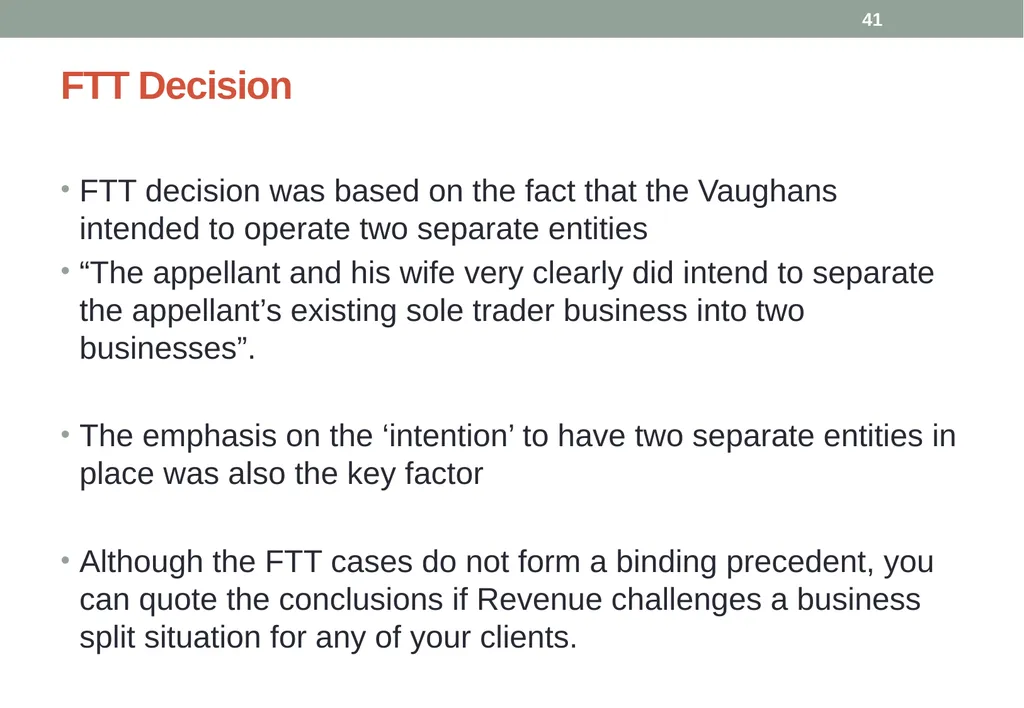
FTT Decision FTT decision was based on the fact that the Vaughans intended to operate two separate entities
“The appellant and his wife very clearly did intend to separate the appellant’s existing sole trader business into two businesses”.
The emphasis on the ‘intention’ to have two separate entities in place was also the key factor
Although the FTT cases do not form a binding precedent, you can quote the conclusions if Revenue challenges a business split situation for any of your clients. 41<br>
“The appellant and his wife very clearly did intend to separate the appellant’s existing sole trader business into two businesses”.
The emphasis on the ‘intention’ to have two separate entities in place was also the key factor
Although the FTT cases do not form a binding precedent, you can quote the conclusions if Revenue challenges a business split situation for any of your clients. 41<br>
42
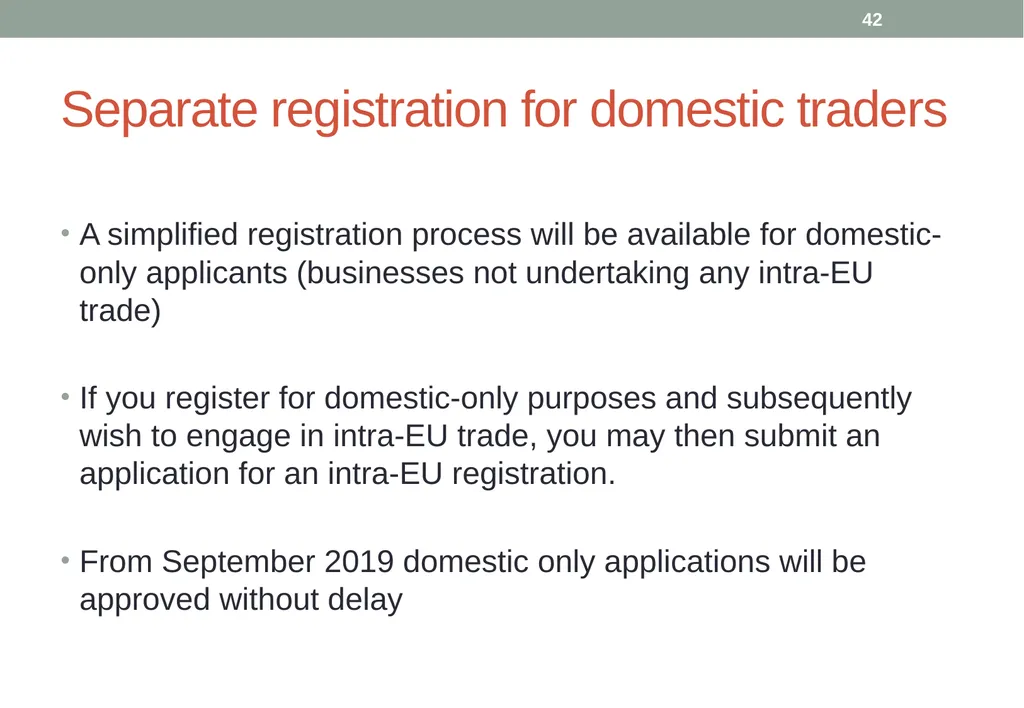
Separate registration for domestic traders A simplified registration process will be available for domestic-only applicants (businesses not undertaking any intra-EU trade)
If you register for domestic-only purposes and subsequently wish to engage in intra-EU trade, you may then submit an application for an intra-EU registration.
From September 2019 domestic only applications will be approved without delay 42<br>
If you register for domestic-only purposes and subsequently wish to engage in intra-EU trade, you may then submit an application for an intra-EU registration.
From September 2019 domestic only applications will be approved without delay 42<br>
43
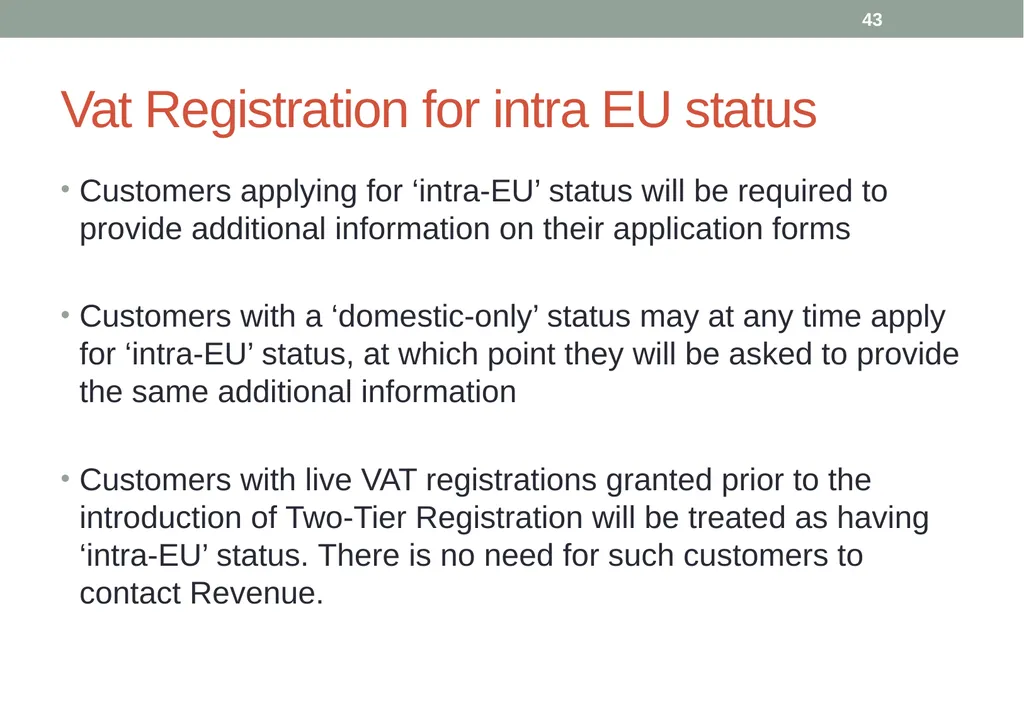
Vat Registration for intra EU status Customers applying for ‘intra-EU’ status will be required to provide additional information on their application forms
Customers with a ‘domestic-only’ status may at any time apply for ‘intra-EU’ status, at which point they will be asked to provide the same additional information
Customers with live VAT registrations granted prior to the introduction of Two-Tier Registration will be treated as having ‘intra-EU’ status. There is no need for such customers to contact Revenue. 43<br>
Customers with a ‘domestic-only’ status may at any time apply for ‘intra-EU’ status, at which point they will be asked to provide the same additional information
Customers with live VAT registrations granted prior to the introduction of Two-Tier Registration will be treated as having ‘intra-EU’ status. There is no need for such customers to contact Revenue. 43<br>
44
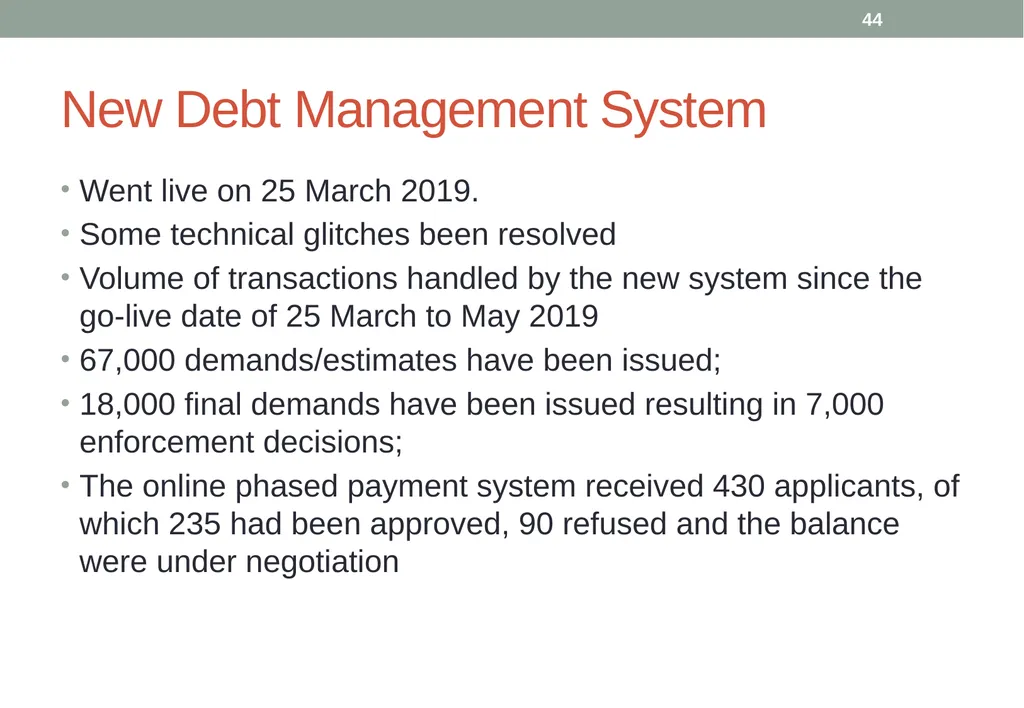
New Debt Management System Went live on 25 March 2019.
Some technical glitches been resolved
Volume of transactions handled by the new system since the go-live date of 25 March to May 2019
67,000 demands/estimates have been issued;
18,000 final demands have been issued resulting in 7,000 enforcement decisions;
The online phased payment system received 430 applicants, of which 235 had been approved, 90 refused and the balance were under negotiation 44<br>
Some technical glitches been resolved
Volume of transactions handled by the new system since the go-live date of 25 March to May 2019
67,000 demands/estimates have been issued;
18,000 final demands have been issued resulting in 7,000 enforcement decisions;
The online phased payment system received 430 applicants, of which 235 had been approved, 90 refused and the balance were under negotiation 44<br>
45
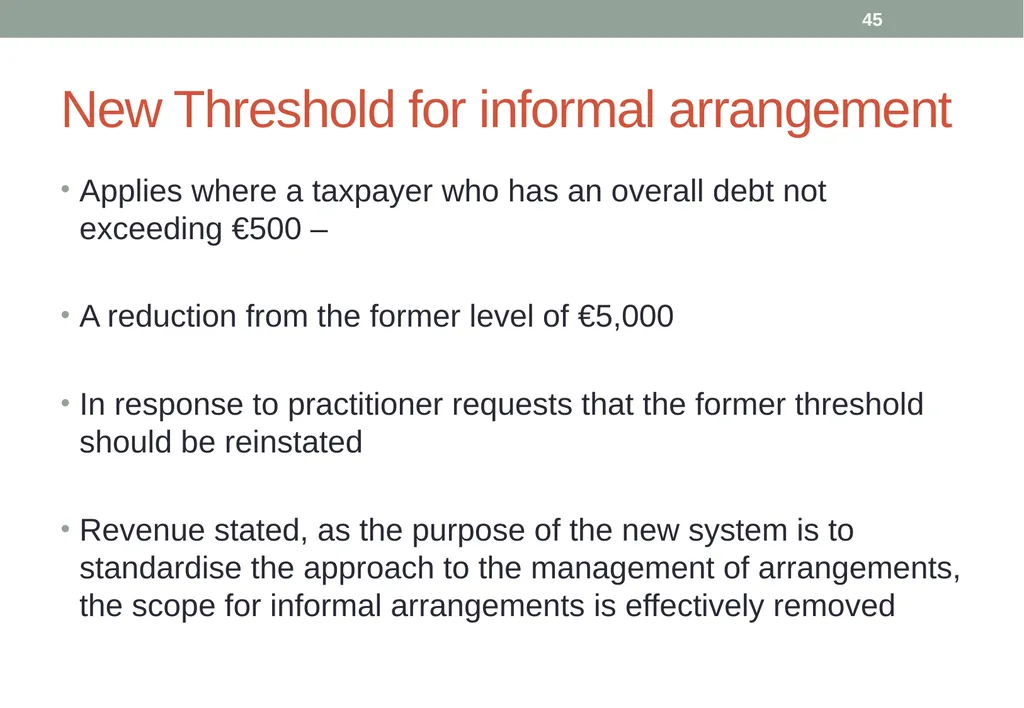
New Threshold for informal arrangement Applies where a taxpayer who has an overall debt not exceeding €500 –
A reduction from the former level of €5,000
In response to practitioner requests that the former threshold should be reinstated
Revenue stated, as the purpose of the new system is to standardise the approach to the management of arrangements, the scope for informal arrangements is effectively removed 45<br>
A reduction from the former level of €5,000
In response to practitioner requests that the former threshold should be reinstated
Revenue stated, as the purpose of the new system is to standardise the approach to the management of arrangements, the scope for informal arrangements is effectively removed 45<br>
46
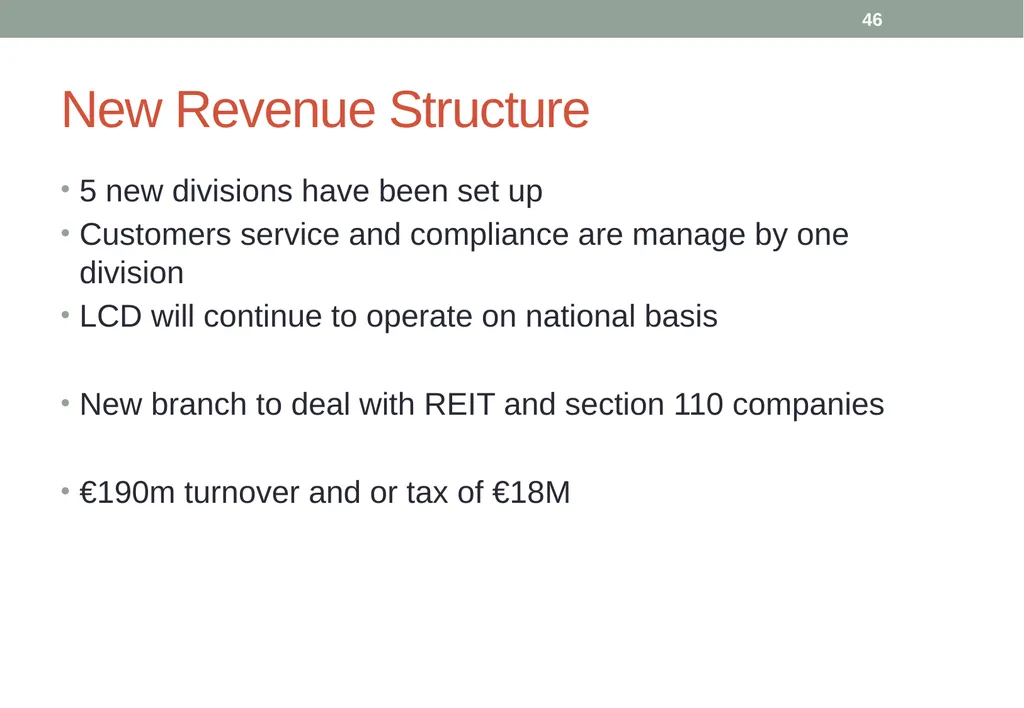
New Revenue Structure 5 new divisions have been set up
Customers service and compliance are manage by one division
LCD will continue to operate on national basis
New branch to deal with REIT and section 110 companies
€190m turnover and or tax of €18M 46<br>
Customers service and compliance are manage by one division
LCD will continue to operate on national basis
New branch to deal with REIT and section 110 companies
€190m turnover and or tax of €18M 46<br>
47
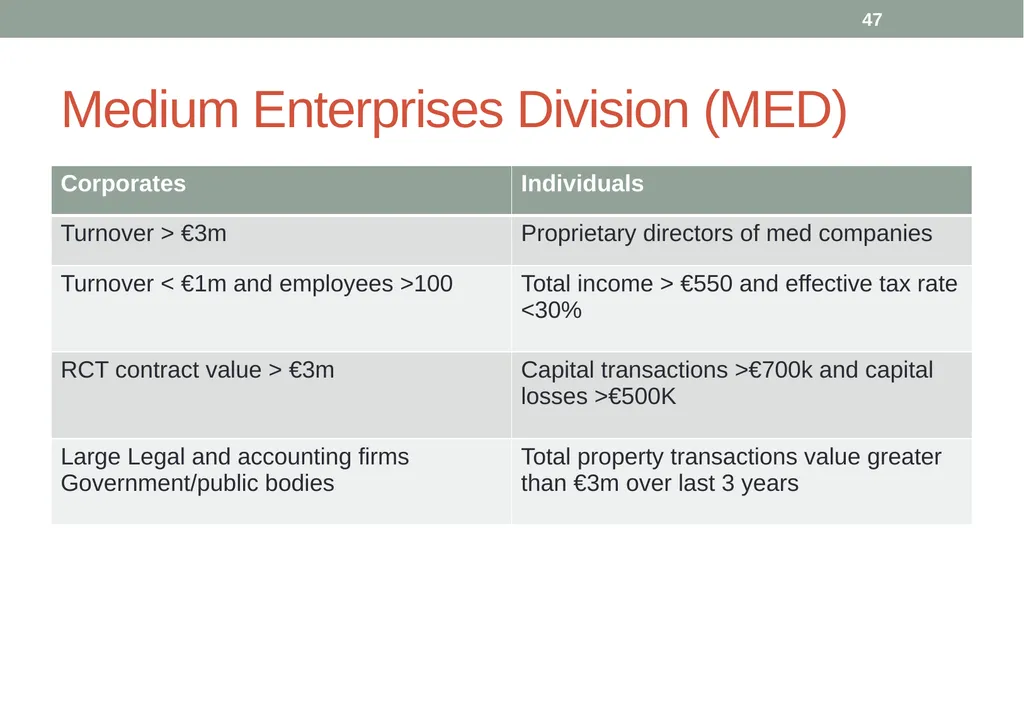
Medium Enterprises Division (MED) 47<br>
48
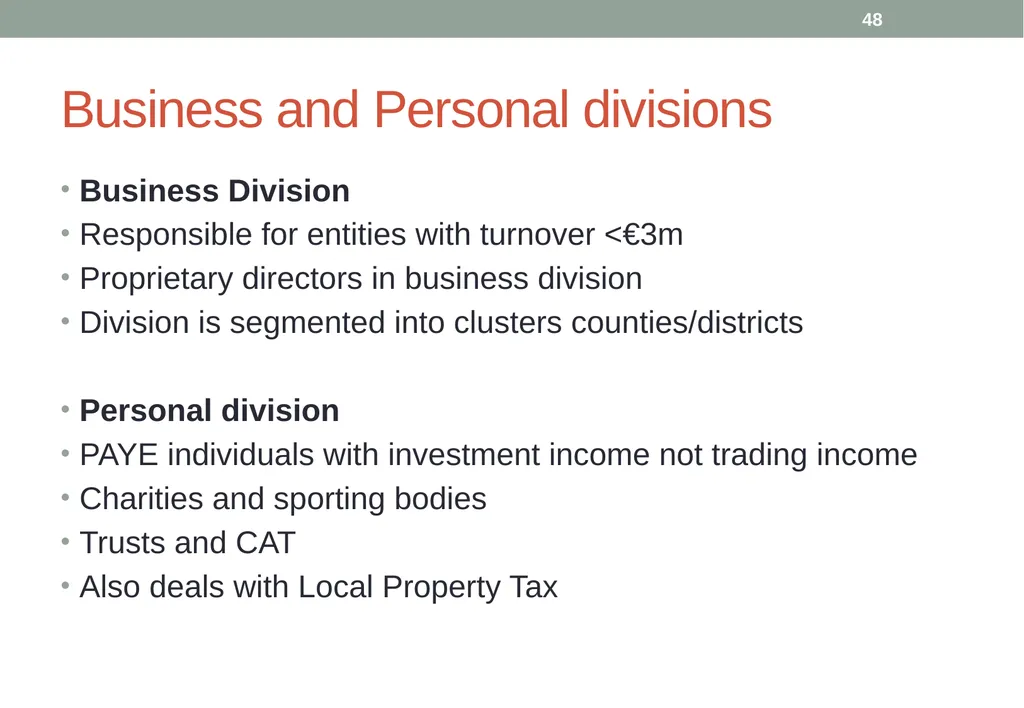
Business and Personal divisions Business Division
Responsible for entities with turnover <€3m
Proprietary directors in business division
Division is segmented into clusters counties/districts
Personal division
PAYE individuals with investment income not trading income
Charities and sporting bodies
Trusts and CAT
Also deals with Local Property Tax 48<br>
Responsible for entities with turnover <€3m
Proprietary directors in business division
Division is segmented into clusters counties/districts
Personal division
PAYE individuals with investment income not trading income
Charities and sporting bodies
Trusts and CAT
Also deals with Local Property Tax 48<br>
49
What it all means More focused interventions and more national projects
Division profiling its cases to prioritise risks
Departure from dealing with local office/auditor
Revenue manager multiple revenue offices
More decisions at assistant principal level 49<br>
Division profiling its cases to prioritise risks
Departure from dealing with local office/auditor
Revenue manager multiple revenue offices
More decisions at assistant principal level 49<br>
50
Revenue Telephone Services Representations to ComReg and Revenue on cost of 1890 •
Replacement of 1890 with internet based phonelines using “01” prefix
Calls treated the same as landlines in phone bundles
National phonelines
Revenue can see the number of calls in the queue
Add staff during peak demand
Handle large volume of calls 50<br>
Replacement of 1890 with internet based phonelines using “01” prefix
Calls treated the same as landlines in phone bundles
National phonelines
Revenue can see the number of calls in the queue
Add staff during peak demand
Handle large volume of calls 50<br>
51
Tax Wedge A tax wedge is the difference between before-tax and after-tax wages.
It measures how much Government receives in tax
The OECD average tax wedge in 2018 was 36.1 per cent (Single workers)
Belgium (52.7 per cent), Germany (49.5 per cent), Italy (47.9 per cent),
Austria and France (47.6 per cent).
The lowest Chile (7 per cent) New Zealand (18.4 per cent) and Mexico (19.7 per cent).
In Ireland an average tax wedge of 32.7 per cent in 2018. 51<br>
It measures how much Government receives in tax
The OECD average tax wedge in 2018 was 36.1 per cent (Single workers)
Belgium (52.7 per cent), Germany (49.5 per cent), Italy (47.9 per cent),
Austria and France (47.6 per cent).
The lowest Chile (7 per cent) New Zealand (18.4 per cent) and Mexico (19.7 per cent).
In Ireland an average tax wedge of 32.7 per cent in 2018. 51<br>
52
Form 11 for 2018 Additional information has been added to the pre-populated 2018 ROS Form 11 in relation to:
Rental income by HAP, RAS based on revenue information
New questions on RCT
New questions on Farmer EU aid
Seven year exemptions panel changes 52<br>
Rental income by HAP, RAS based on revenue information
New questions on RCT
New questions on Farmer EU aid
Seven year exemptions panel changes 52<br>
53
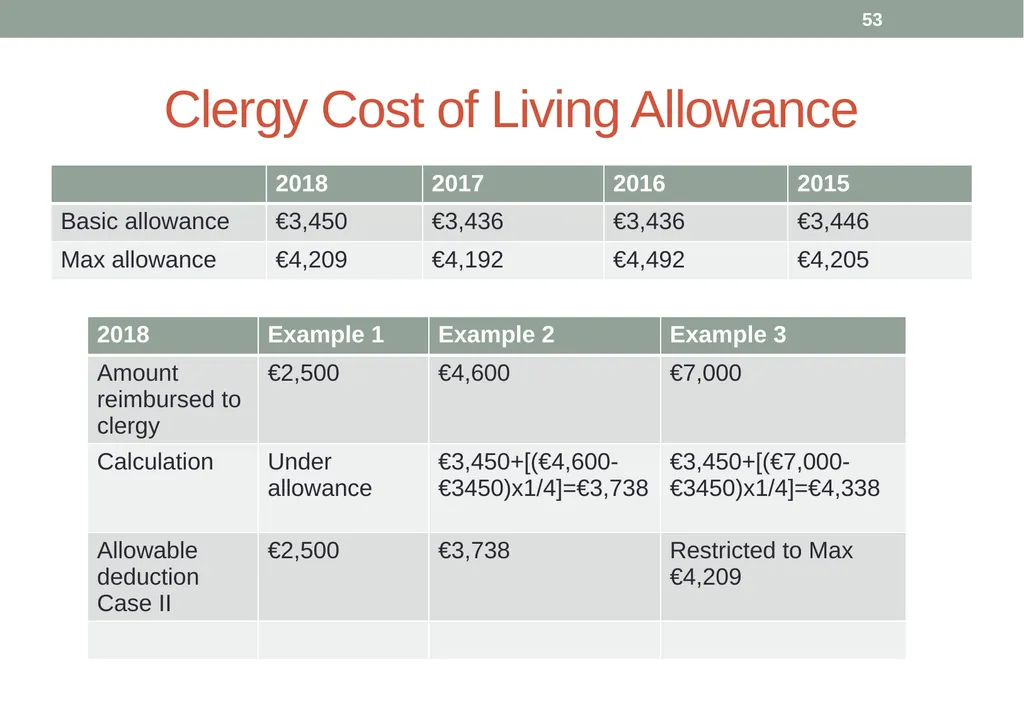
Clergy Cost of Living Allowance 53<br>
54
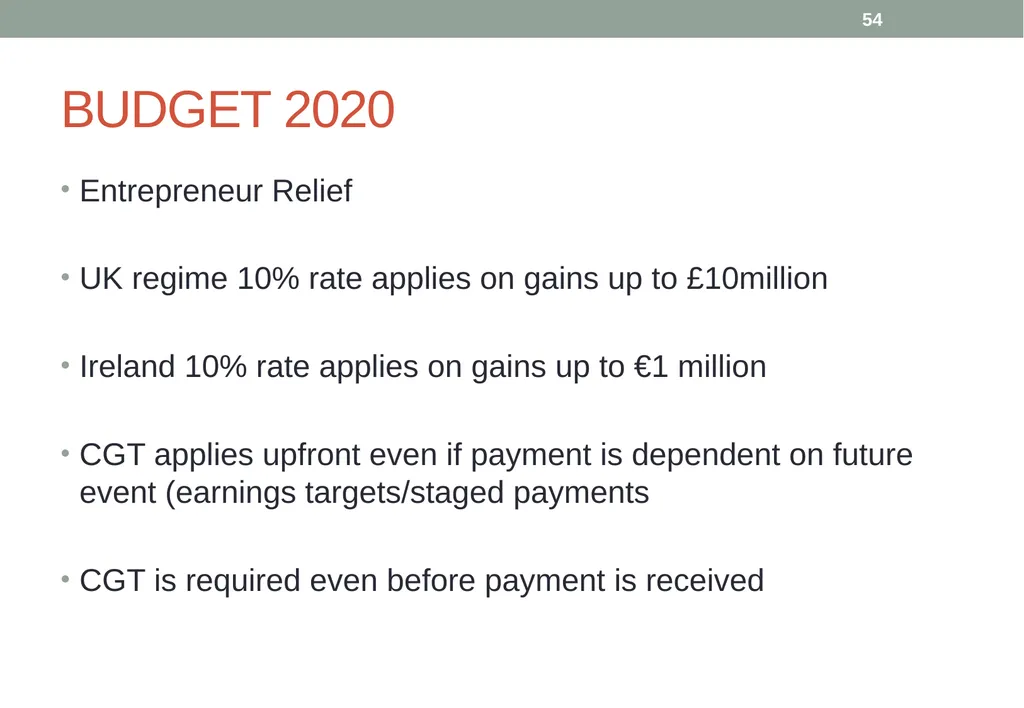
BUDGET 2020 Entrepreneur Relief
UK regime 10% rate applies on gains up to £10million
Ireland 10% rate applies on gains up to €1 million
CGT applies upfront even if payment is dependent on future event (earnings targets/staged payments
CGT is required even before payment is received 54<br>
UK regime 10% rate applies on gains up to £10million
Ireland 10% rate applies on gains up to €1 million
CGT applies upfront even if payment is dependent on future event (earnings targets/staged payments
CGT is required even before payment is received 54<br>
55
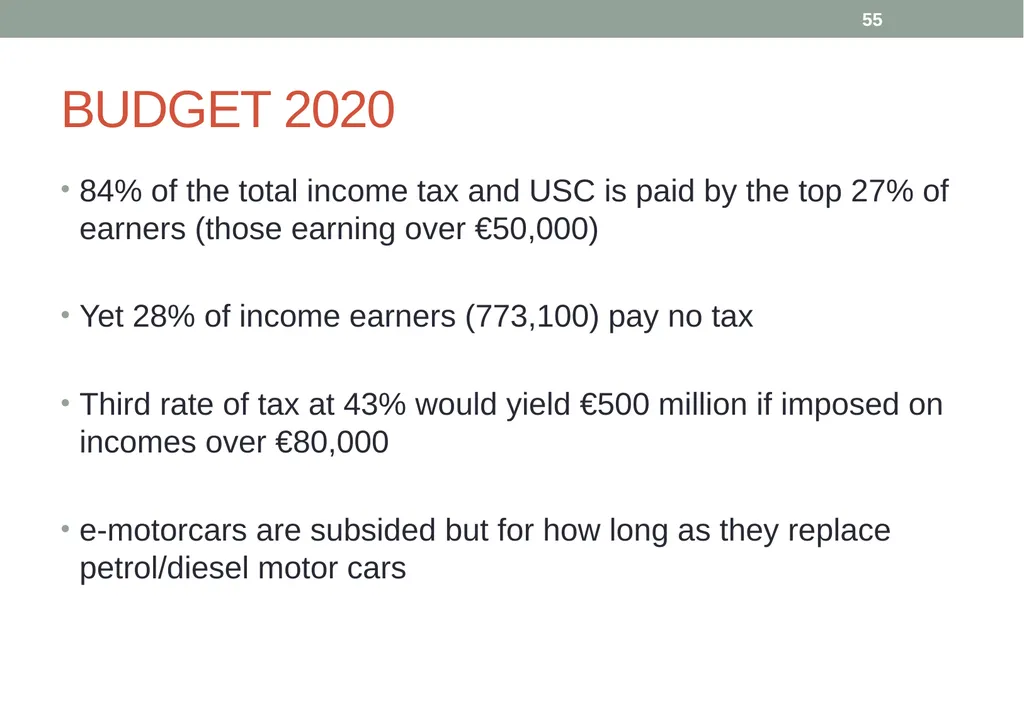
BUDGET 2020 84% of the total income tax and USC is paid by the top 27% of earners (those earning over €50,000)
Yet 28% of income earners (773,100) pay no tax
Third rate of tax at 43% would yield €500 million if imposed on incomes over €80,000
e-motorcars are subsided but for how long as they replace petrol/diesel motor cars 55<br>
Yet 28% of income earners (773,100) pay no tax
Third rate of tax at 43% would yield €500 million if imposed on incomes over €80,000
e-motorcars are subsided but for how long as they replace petrol/diesel motor cars 55<br>
56
Part of Your Team Brendan Allen
C.T.A. F.C.C.A. F.C.P.A.
Scarton House,
Priory Court,
Kildare, Co. Kildare
E-mail: brendan.allen@okellysutton.ie
PHONE 045 530777
087 236 9920<br>
C.T.A. F.C.C.A. F.C.P.A.
Scarton House,
Priory Court,
Kildare, Co. Kildare
E-mail: brendan.allen@okellysutton.ie
PHONE 045 530777
087 236 9920<br>