
A Primary Care Approach to CKD Management Learning
SB
Published · 43 slides · 0 views

1 / 1






Description
A Primary Care Approach to CKD Management Learning Objectives Facilitate timely testing and intervention in patients at-risk for chronic kidney disease (CKD). Apply appropriate clinical measures to manage risk and increase patient safety in
Related Topics
Share
Embed code
Download this presentation From Below
"A Primary Care Approach to CKD Management Learning" is the property of its rightful owner. Permission is granted to download and print the materials on this website for personal, non-commercial use only, and to display it on your personal computer provided you do not modify the materials and that you retain all copyright notices contained in the materials. By downloading content from our website, you accept the terms of this agreement.
Presentation Transcript
01
A Primary Care Approach to CKD Management<br>
02
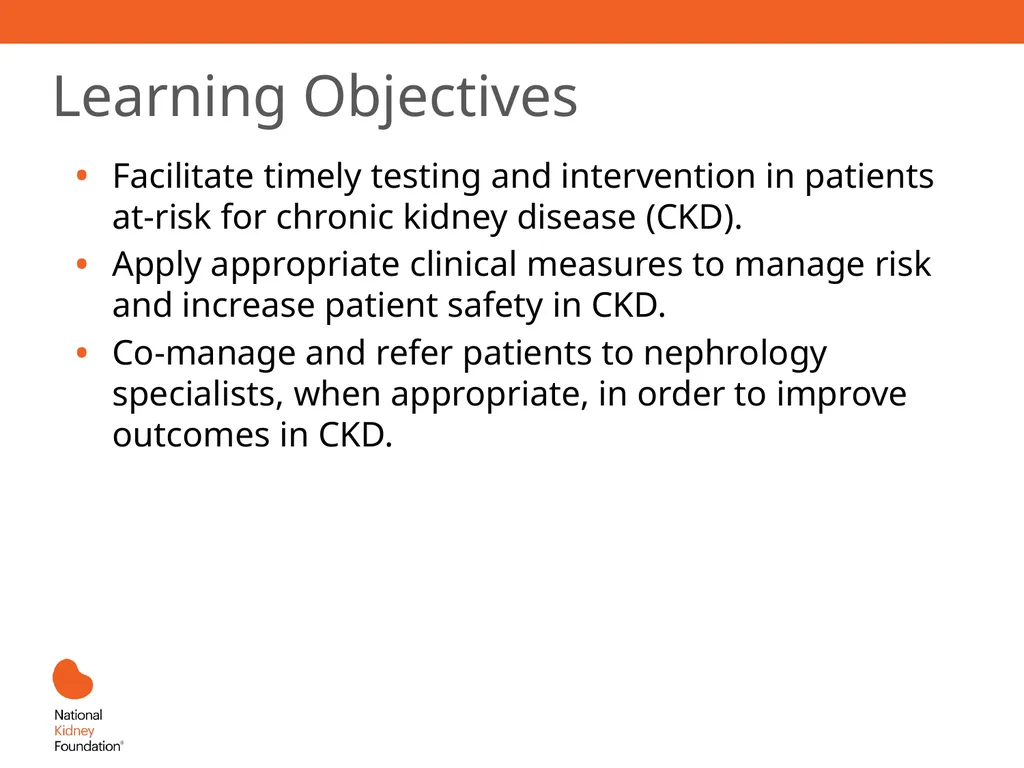
Learning Objectives Facilitate timely testing and intervention in patients at-risk for chronic kidney disease (CKD).
Apply appropriate clinical measures to manage risk and increase patient safety in CKD.
Co-manage and refer patients to nephrology specialists, when appropriate, in order to improve outcomes in CKD.<br>
Apply appropriate clinical measures to manage risk and increase patient safety in CKD.
Co-manage and refer patients to nephrology specialists, when appropriate, in order to improve outcomes in CKD.<br>
03
A 50-year-old Hispanic female was diagnosed with type 2 diabetes at age 30. She has taken medications as prescribed since diagnosis. The fact that she has confirmed diabetes puts this patient at:
A. Higher risk for kidney failure and CVD
B. Higher risk for kidney failure only
C. Higher risk for CVD only
D. None of the above Case Question 1<br>
A. Higher risk for kidney failure and CVD
B. Higher risk for kidney failure only
C. Higher risk for CVD only
D. None of the above Case Question 1<br>
04
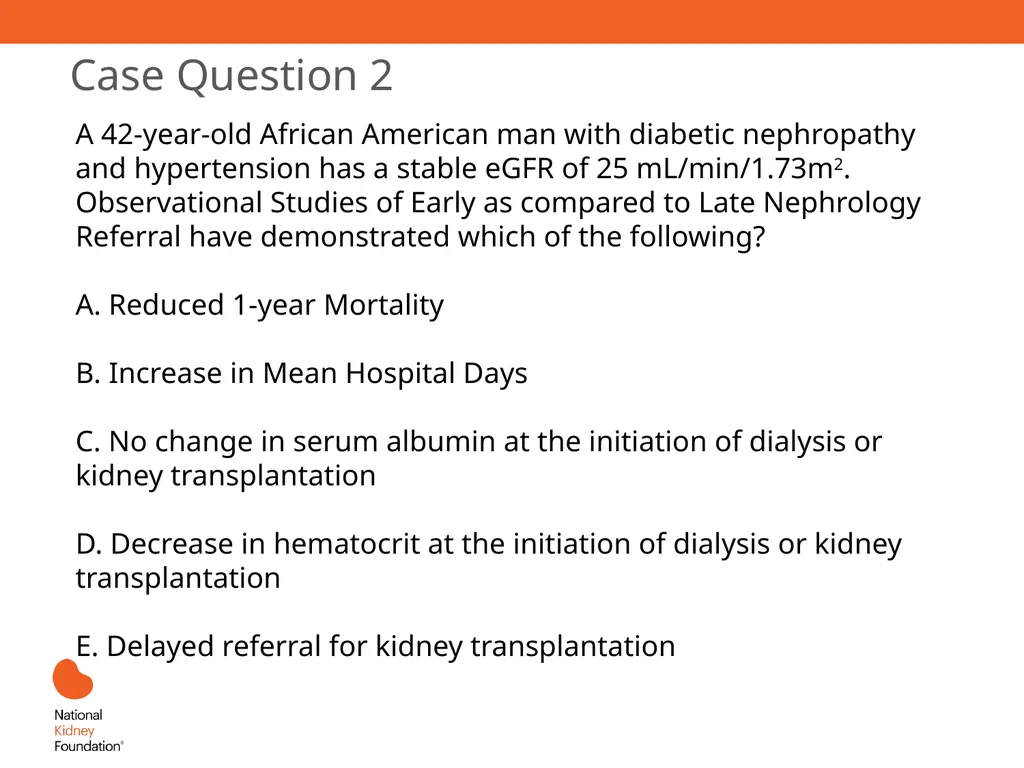
A 42-year-old African American man with diabetic nephropathy and hypertension has a stable eGFR of 25 mL/min/1.73m2. Observational Studies of Early as compared to Late Nephrology Referral have demonstrated which of the following?
A. Reduced 1-year Mortality
B. Increase in Mean Hospital Days
C. No change in serum albumin at the initiation of dialysis or kidney transplantation
D. Decrease in hematocrit at the initiation of dialysis or kidney transplantation
E. Delayed referral for kidney transplantation Case Question 2<br>
A. Reduced 1-year Mortality
B. Increase in Mean Hospital Days
C. No change in serum albumin at the initiation of dialysis or kidney transplantation
D. Decrease in hematocrit at the initiation of dialysis or kidney transplantation
E. Delayed referral for kidney transplantation Case Question 2<br>
05
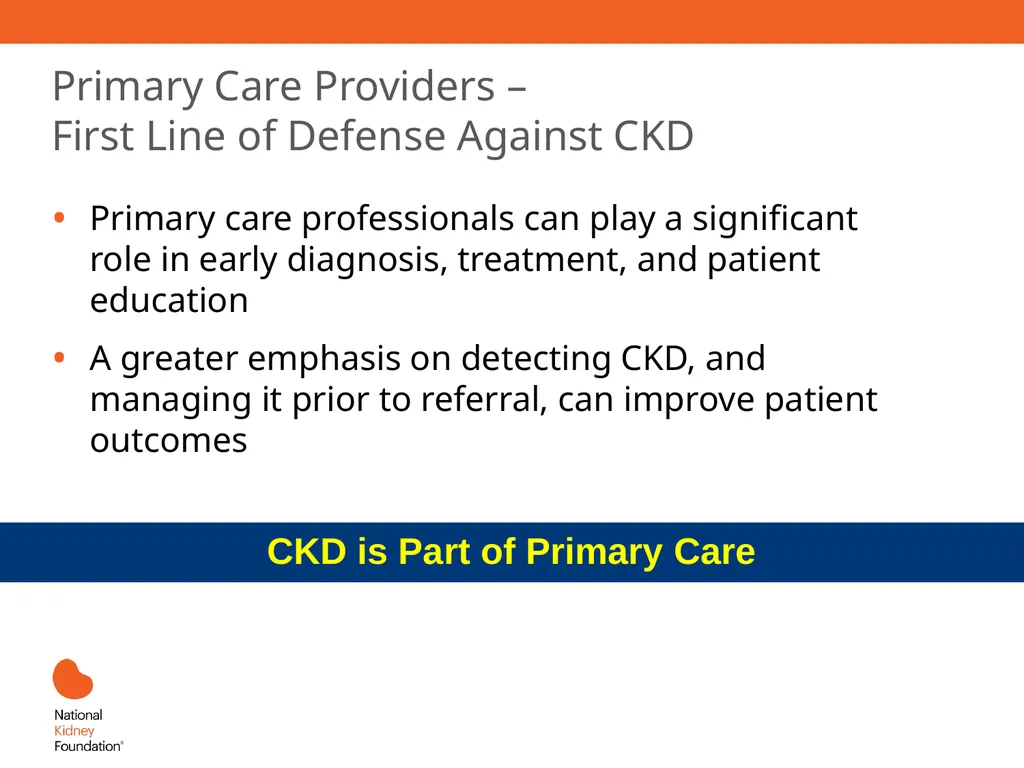
Primary Care Providers –
First Line of Defense Against CKD Primary care professionals can play a significant role in early diagnosis, treatment, and patient education
A greater emphasis on detecting CKD, and managing it prior to referral, can improve patient outcomes CKD is Part of Primary Care<br>
A greater emphasis on detecting CKD, and managing it prior to referral, can improve patient outcomes CKD is Part of Primary Care<br>
06
The Public Burden of CKD<br>
07
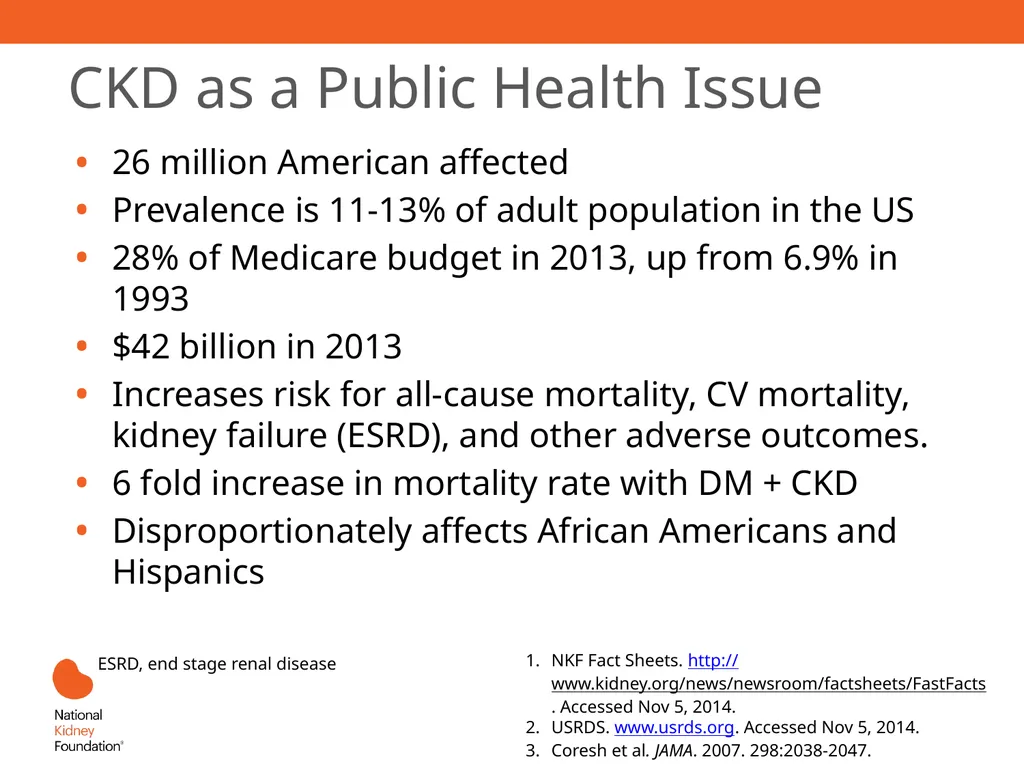
CKD as a Public Health Issue 26 million American affected
Prevalence is 11-13% of adult population in the US
28% of Medicare budget in 2013, up from 6.9% in 1993
$42 billion in 2013
Increases risk for all-cause mortality, CV mortality, kidney failure (ESRD), and other adverse outcomes.
6 fold increase in mortality rate with DM + CKD
Disproportionately affects African Americans and Hispanics NKF Fact Sheets. http://www.kidney.org/news/newsroom/factsheets/FastFacts. Accessed Nov 5, 2014.
USRDS. www.usrds.org. Accessed Nov 5, 2014.
Coresh et al. JAMA. 2007. 298:2038-2047. ESRD, end stage renal disease<br>
Prevalence is 11-13% of adult population in the US
28% of Medicare budget in 2013, up from 6.9% in 1993
$42 billion in 2013
Increases risk for all-cause mortality, CV mortality, kidney failure (ESRD), and other adverse outcomes.
6 fold increase in mortality rate with DM + CKD
Disproportionately affects African Americans and Hispanics NKF Fact Sheets. http://www.kidney.org/news/newsroom/factsheets/FastFacts. Accessed Nov 5, 2014.
USRDS. www.usrds.org. Accessed Nov 5, 2014.
Coresh et al. JAMA. 2007. 298:2038-2047. ESRD, end stage renal disease<br>
08
CKD-CVD-Diabetes Link: CKD is a Disease Multiplier<br>
09
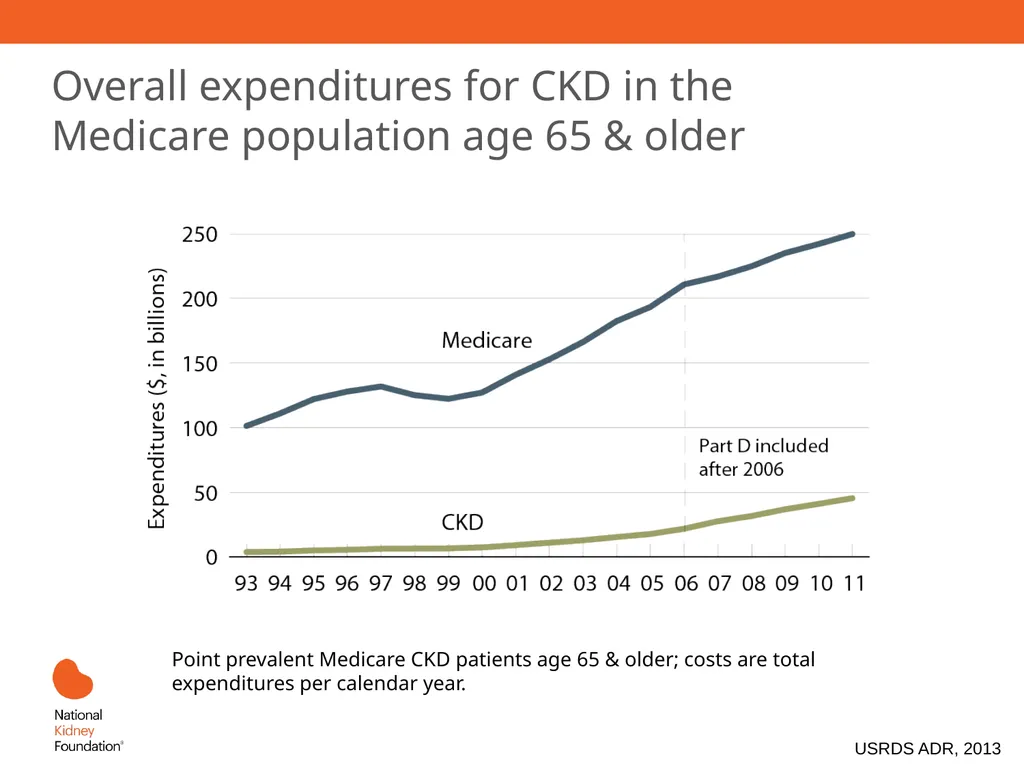
Overall expenditures for CKD in the
Medicare population age 65 & older Point prevalent Medicare CKD patients age 65 & older; costs are total expenditures per calendar year. USRDS ADR, 2013<br>
10
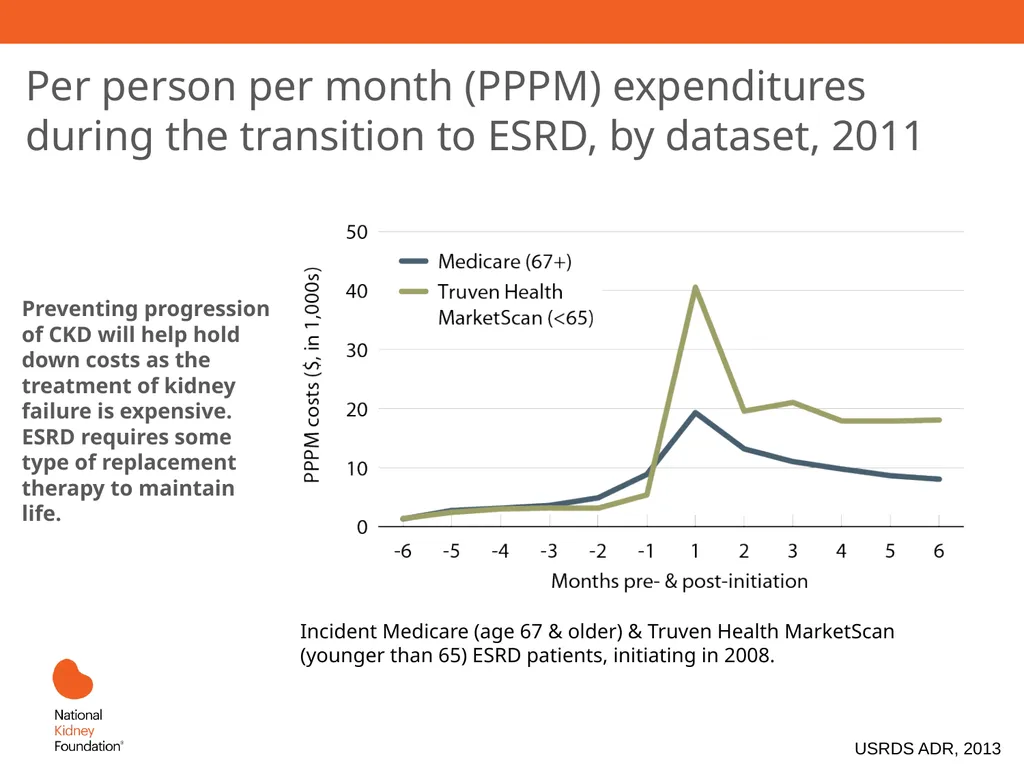
Per person per month (PPPM) expenditures during the transition to ESRD, by dataset, 2011 Incident Medicare (age 67 & older) & Truven Health MarketScan (younger than 65) ESRD patients, initiating in 2008. USRDS ADR, 2013 Preventing progression of CKD will help hold down costs as the treatment of kidney failure is expensive. ESRD requires some type of replacement therapy to maintain life.<br>
11
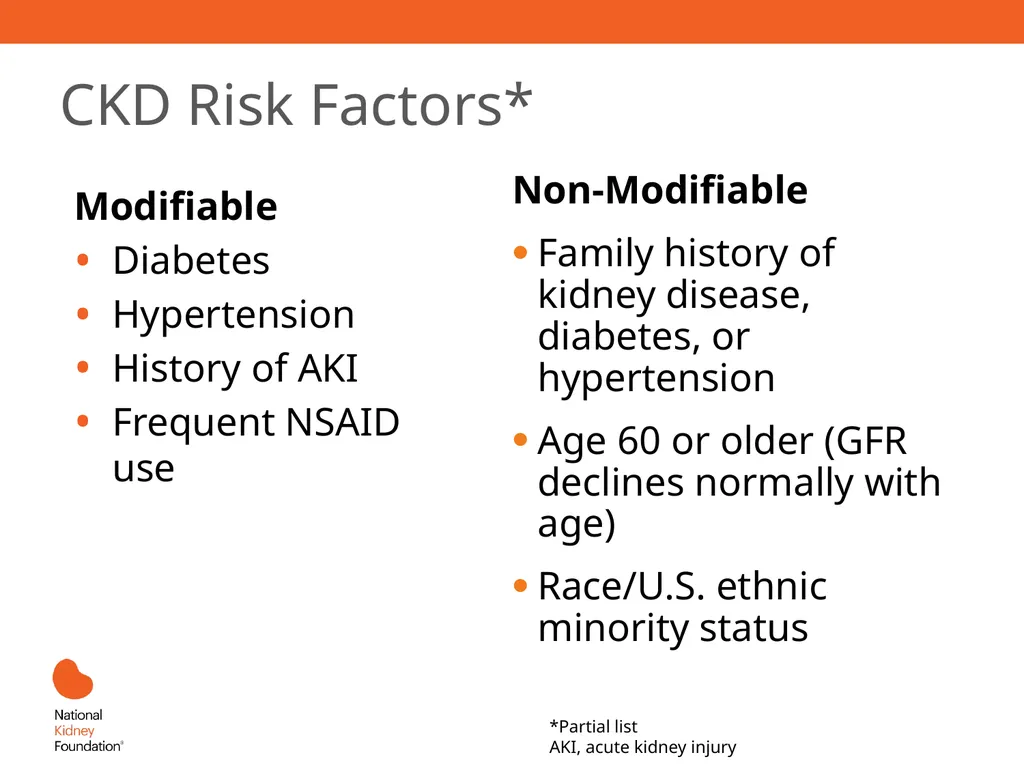
CKD Risk Factors* Modifiable
Diabetes
Hypertension
History of AKI
Frequent NSAID use Non-Modifiable
Family history of kidney disease, diabetes, or hypertension
Age 60 or older (GFR declines normally with age)
Race/U.S. ethnic minority status *Partial list
AKI, acute kidney injury<br>
Diabetes
Hypertension
History of AKI
Frequent NSAID use Non-Modifiable
Family history of kidney disease, diabetes, or hypertension
Age 60 or older (GFR declines normally with age)
Race/U.S. ethnic minority status *Partial list
AKI, acute kidney injury<br>
12
ESRD, end stage renal disease
USRDS ADR, 2007 Diabetes and hypertension are leading causes of kidney failure Incident ESRD rates, by primary diagnosis, adjusted for age, gender, & race.<br>
USRDS ADR, 2007 Diabetes and hypertension are leading causes of kidney failure Incident ESRD rates, by primary diagnosis, adjusted for age, gender, & race.<br>
13
CKD Screening and Evaluation<br>
14
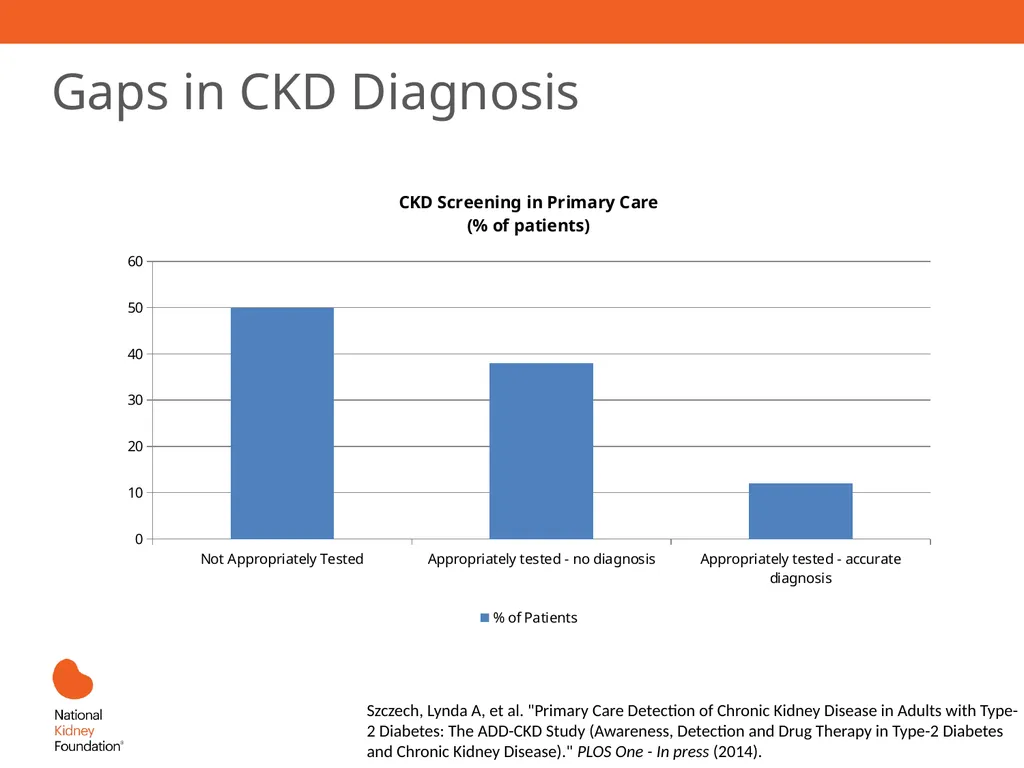
Gaps in CKD Diagnosis Szczech, Lynda A, et al. "Primary Care Detection of Chronic Kidney Disease in Adults with Type-2 Diabetes: The ADD-CKD Study (Awareness, Detection and Drug Therapy in Type-2 Diabetes and Chronic Kidney Disease)." PLOS One - In press (2014).<br>
15
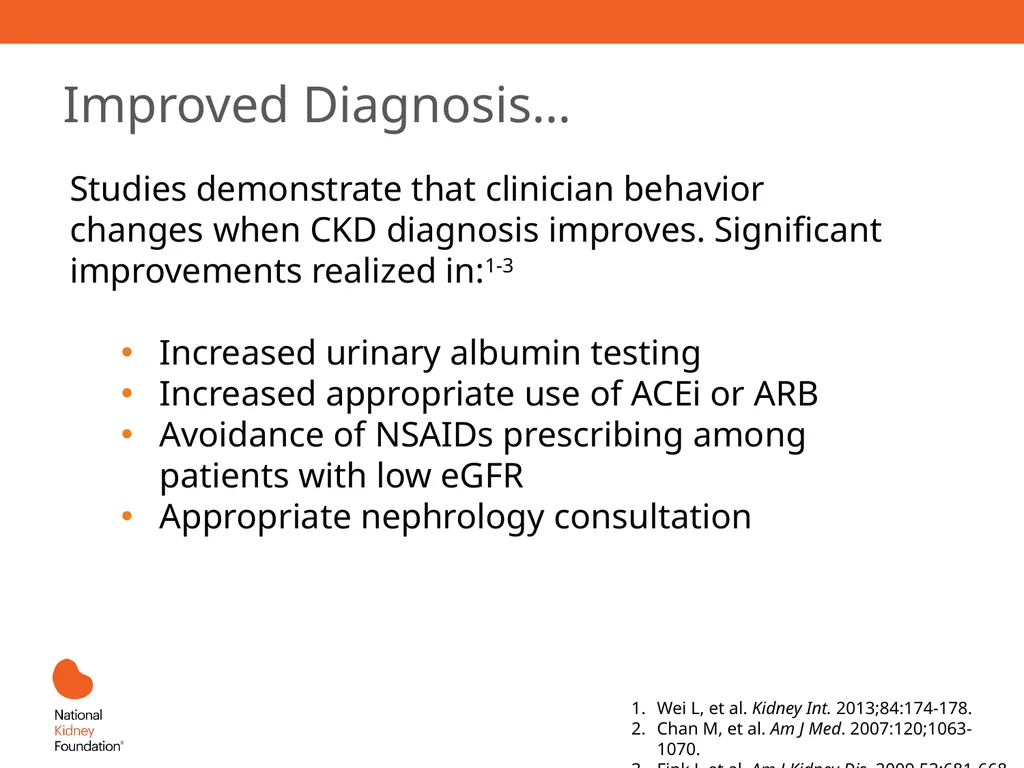
Improved Diagnosis… Studies demonstrate that clinician behavior changes when CKD diagnosis improves. Significant improvements realized in:1-3
Increased urinary albumin testing
Increased appropriate use of ACEi or ARB
Avoidance of NSAIDs prescribing among patients with low eGFR
Appropriate nephrology consultation Wei L, et al. Kidney Int. 2013;84:174-178.
Chan M, et al. Am J Med. 2007:120;1063-1070.
Fink J, et al. Am J Kidney Dis. 2009,53:681-668.<br>
Increased urinary albumin testing
Increased appropriate use of ACEi or ARB
Avoidance of NSAIDs prescribing among patients with low eGFR
Appropriate nephrology consultation Wei L, et al. Kidney Int. 2013;84:174-178.
Chan M, et al. Am J Med. 2007:120;1063-1070.
Fink J, et al. Am J Kidney Dis. 2009,53:681-668.<br>
16
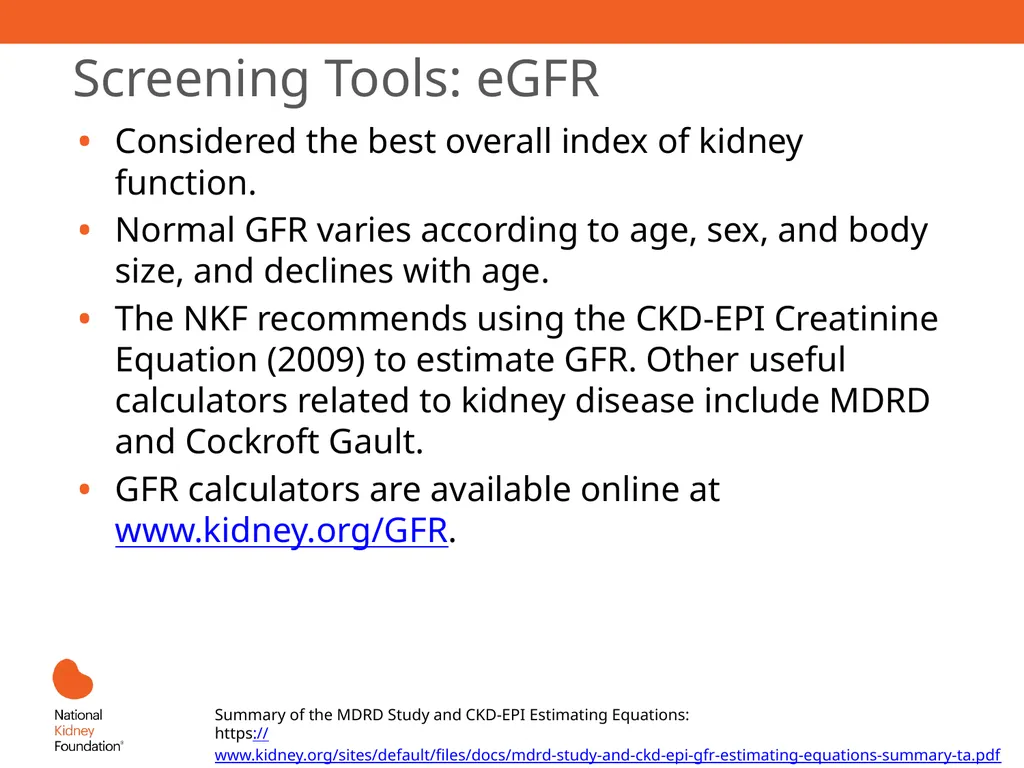
Screening Tools: eGFR Considered the best overall index of kidney function.
Normal GFR varies according to age, sex, and body size, and declines with age.
The NKF recommends using the CKD-EPI Creatinine Equation (2009) to estimate GFR. Other useful calculators related to kidney disease include MDRD and Cockroft Gault.
GFR calculators are available online at www.kidney.org/GFR. Summary of the MDRD Study and CKD-EPI Estimating Equations:
https://www.kidney.org/sites/default/files/docs/mdrd-study-and-ckd-epi-gfr-estimating-equations-summary-ta.pdf<br>
Normal GFR varies according to age, sex, and body size, and declines with age.
The NKF recommends using the CKD-EPI Creatinine Equation (2009) to estimate GFR. Other useful calculators related to kidney disease include MDRD and Cockroft Gault.
GFR calculators are available online at www.kidney.org/GFR. Summary of the MDRD Study and CKD-EPI Estimating Equations:
https://www.kidney.org/sites/default/files/docs/mdrd-study-and-ckd-epi-gfr-estimating-equations-summary-ta.pdf<br>
17
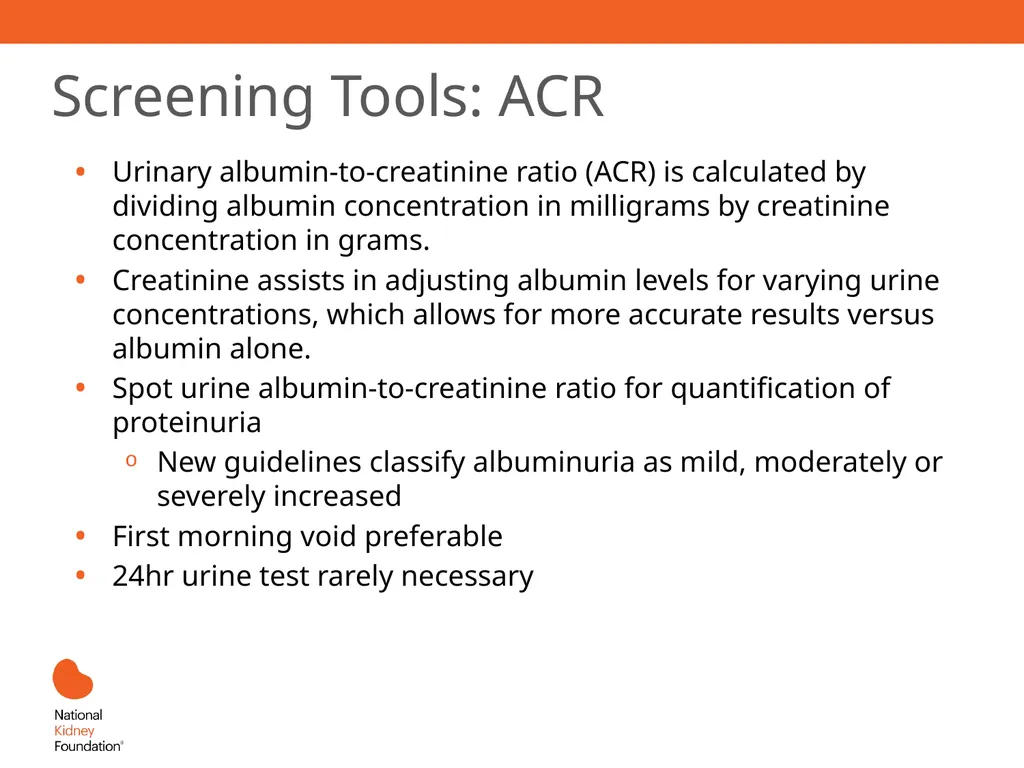
Screening Tools: ACR Urinary albumin-to-creatinine ratio (ACR) is calculated by dividing albumin concentration in milligrams by creatinine concentration in grams.
Creatinine assists in adjusting albumin levels for varying urine concentrations, which allows for more accurate results versus albumin alone.
Spot urine albumin-to-creatinine ratio for quantification of proteinuria
New guidelines classify albuminuria as mild, moderately or severely increased
First morning void preferable
24hr urine test rarely necessary<br>
Creatinine assists in adjusting albumin levels for varying urine concentrations, which allows for more accurate results versus albumin alone.
Spot urine albumin-to-creatinine ratio for quantification of proteinuria
New guidelines classify albuminuria as mild, moderately or severely increased
First morning void preferable
24hr urine test rarely necessary<br>
18
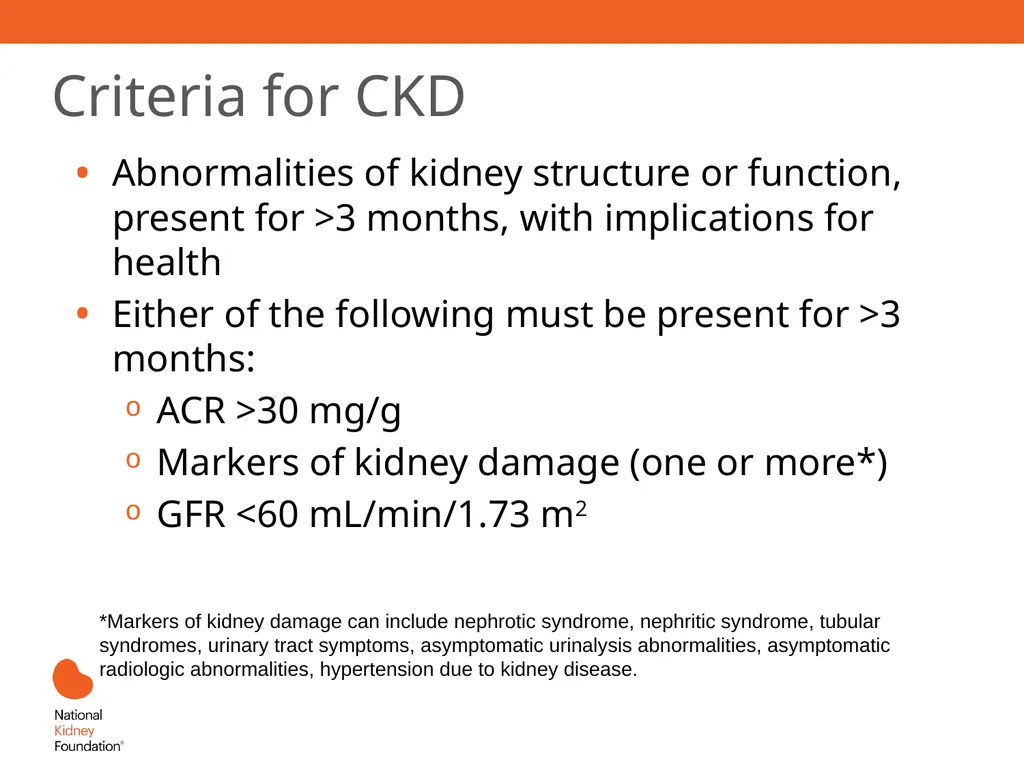
Criteria for CKD Abnormalities of kidney structure or function, present for >3 months, with implications for health
Either of the following must be present for >3 months:
ACR >30 mg/g
Markers of kidney damage (one or more*)
GFR <60 mL/min/1.73 m2 *Markers of kidney damage can include nephrotic syndrome, nephritic syndrome, tubular syndromes, urinary tract symptoms, asymptomatic urinalysis abnormalities, asymptomatic radiologic abnormalities, hypertension due to kidney disease.m²<br>
Either of the following must be present for >3 months:
ACR >30 mg/g
Markers of kidney damage (one or more*)
GFR <60 mL/min/1.73 m2 *Markers of kidney damage can include nephrotic syndrome, nephritic syndrome, tubular syndromes, urinary tract symptoms, asymptomatic urinalysis abnormalities, asymptomatic radiologic abnormalities, hypertension due to kidney disease.m²<br>
19
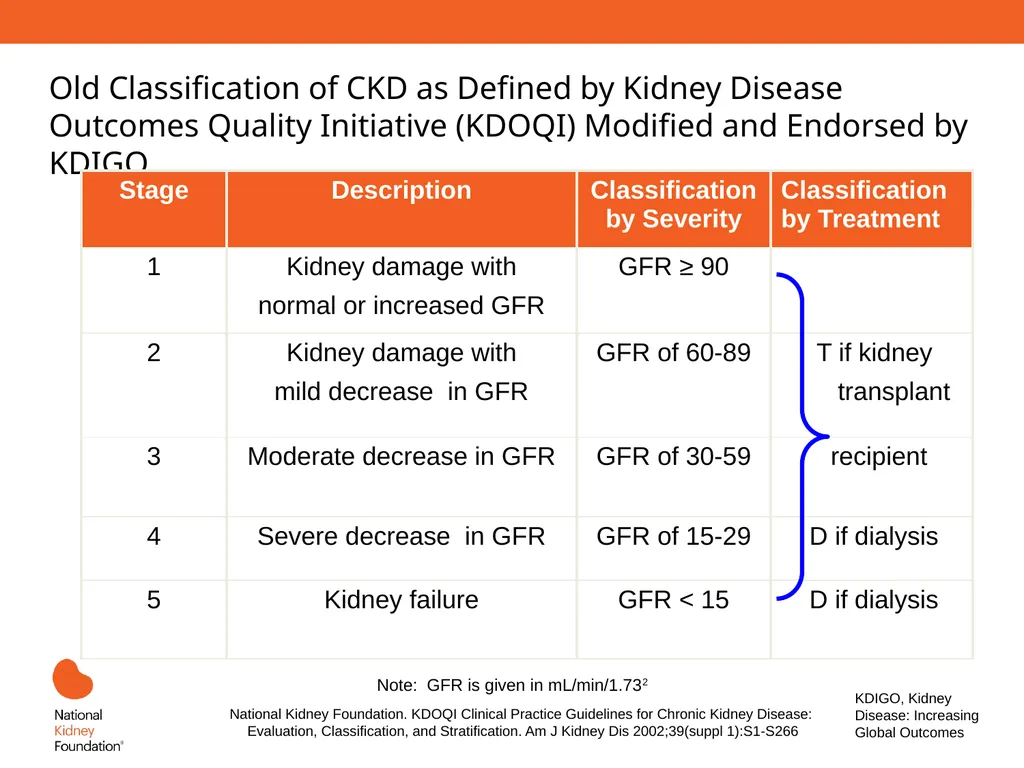
Old Classification of CKD as Defined by Kidney Disease Outcomes Quality Initiative (KDOQI) Modified and Endorsed by KDIGO Note: GFR is given in mL/min/1.732 m² National Kidney Foundation. KDOQI Clinical Practice Guidelines for Chronic Kidney Disease:
Evaluation, Classification, and Stratification. Am J Kidney Dis 2002;39(suppl 1):S1-S266 KDIGO, Kidney Disease: Increasing Global Outcomes<br>
Evaluation, Classification, and Stratification. Am J Kidney Dis 2002;39(suppl 1):S1-S266 KDIGO, Kidney Disease: Increasing Global Outcomes<br>
20
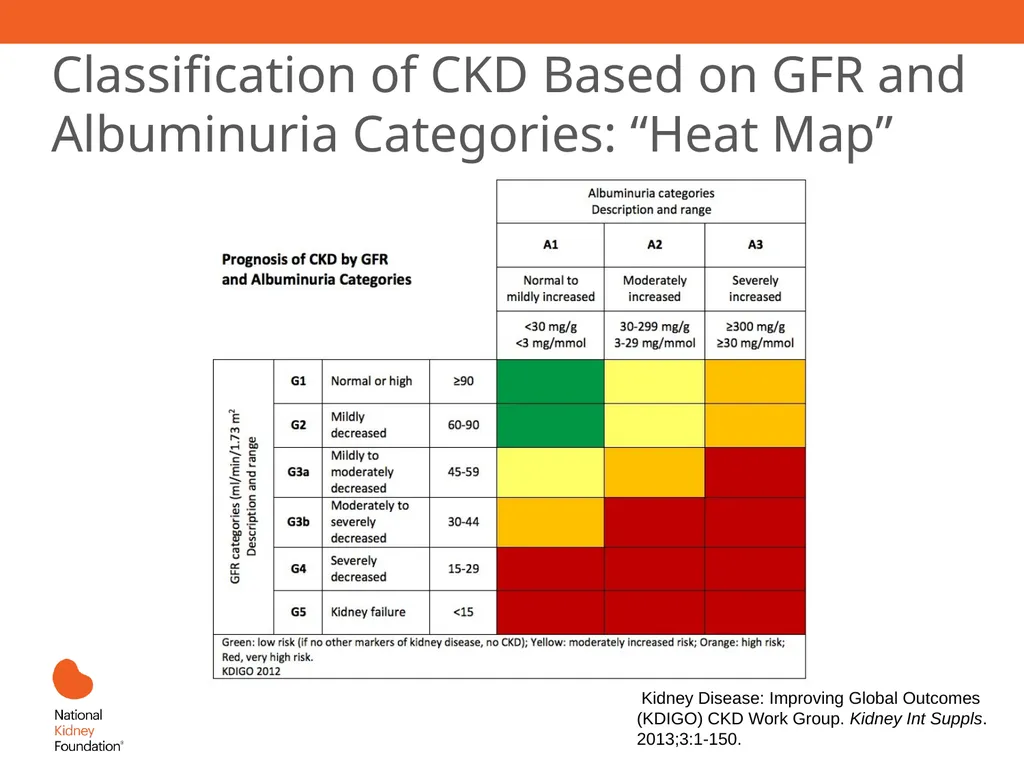
Classification of CKD Based on GFR and Albuminuria Categories: “Heat Map” Kidney Disease: Improving Global Outcomes (KDIGO) CKD Work Group. Kidney Int Suppls. 2013;3:1-150.<br>
21
CKD Management and the PCP<br>
22
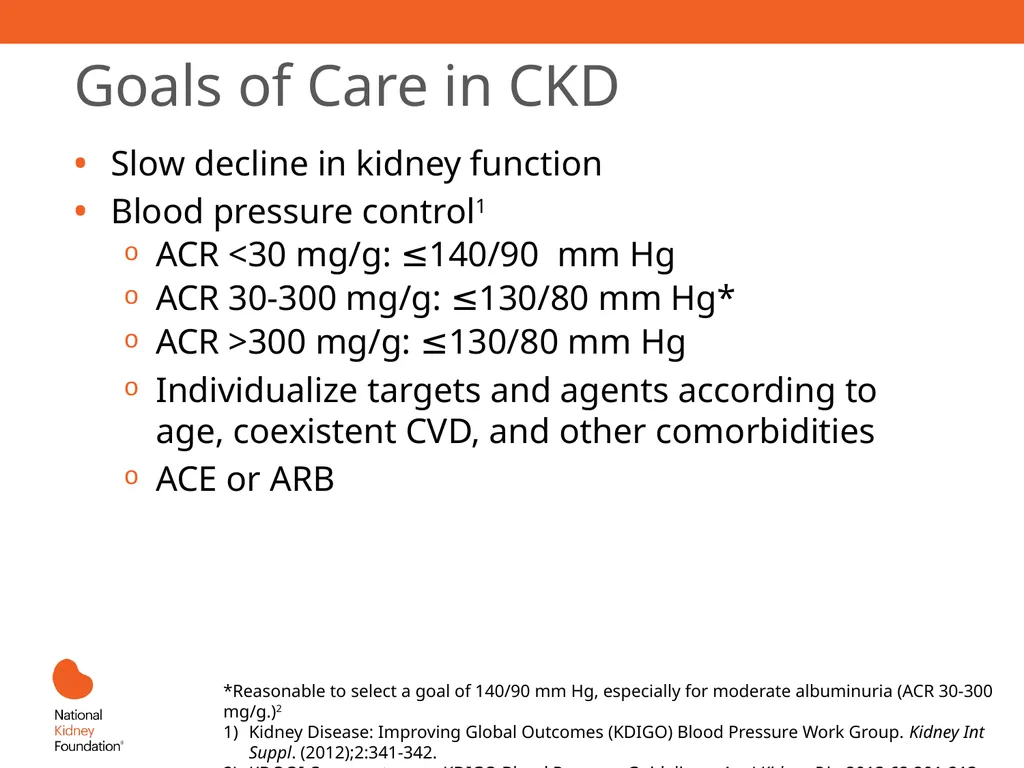
Goals of Care in CKD Slow decline in kidney function
Blood pressure control1
ACR <30 mg/g: ≤140/90 mm Hg
ACR 30-300 mg/g: ≤130/80 mm Hg*
ACR >300 mg/g: ≤130/80 mm Hg
Individualize targets and agents according to age, coexistent CVD, and other comorbidities
ACE or ARB *Reasonable to select a goal of 140/90 mm Hg, especially for moderate albuminuria (ACR 30-300 mg/g.)2
Kidney Disease: Improving Global Outcomes (KDIGO) Blood Pressure Work Group. Kidney Int Suppl. (2012);2:341-342.
KDOQI Commentary on KDIGO Blood Pressure Guidelines. Am J Kidney Dis. 2013;62:201-213.<br>
Blood pressure control1
ACR <30 mg/g: ≤140/90 mm Hg
ACR 30-300 mg/g: ≤130/80 mm Hg*
ACR >300 mg/g: ≤130/80 mm Hg
Individualize targets and agents according to age, coexistent CVD, and other comorbidities
ACE or ARB *Reasonable to select a goal of 140/90 mm Hg, especially for moderate albuminuria (ACR 30-300 mg/g.)2
Kidney Disease: Improving Global Outcomes (KDIGO) Blood Pressure Work Group. Kidney Int Suppl. (2012);2:341-342.
KDOQI Commentary on KDIGO Blood Pressure Guidelines. Am J Kidney Dis. 2013;62:201-213.<br>
23
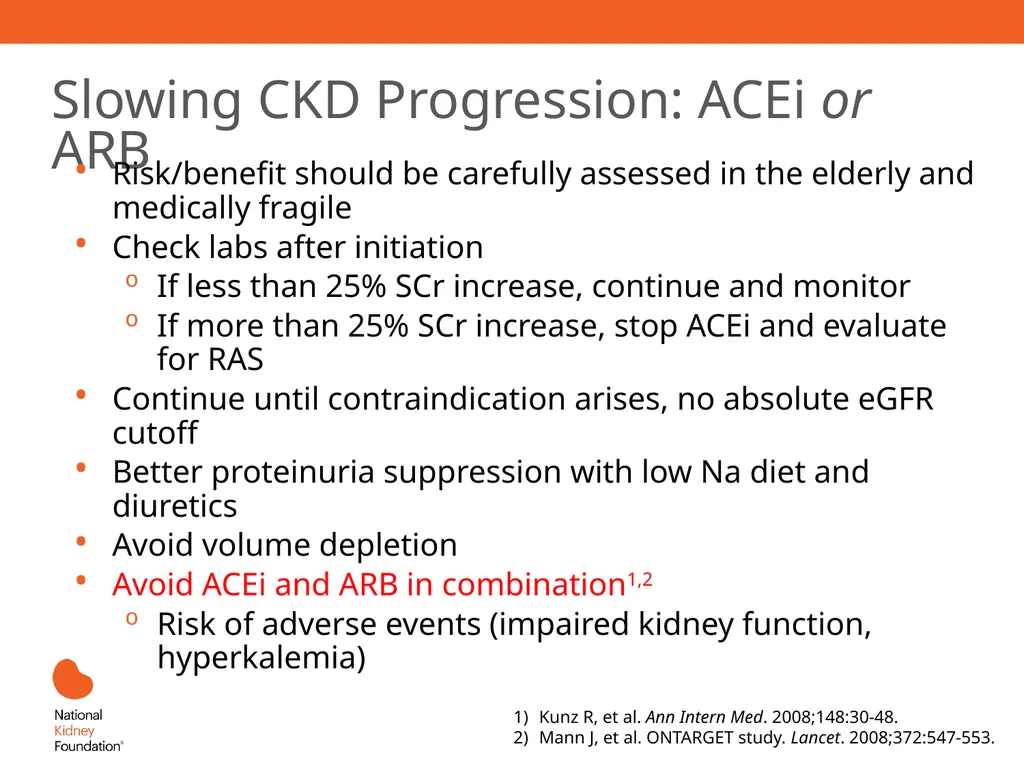
Slowing CKD Progression: ACEi or ARB Risk/benefit should be carefully assessed in the elderly and medically fragile
Check labs after initiation
If less than 25% SCr increase, continue and monitor
If more than 25% SCr increase, stop ACEi and evaluate for RAS
Continue until contraindication arises, no absolute eGFR cutoff
Better proteinuria suppression with low Na diet and diuretics
Avoid volume depletion
Avoid ACEi and ARB in combination1,2
Risk of adverse events (impaired kidney function, hyperkalemia) Kunz R, et al. Ann Intern Med. 2008;148:30-48.
Mann J, et al. ONTARGET study. Lancet. 2008;372:547-553.<br>
Check labs after initiation
If less than 25% SCr increase, continue and monitor
If more than 25% SCr increase, stop ACEi and evaluate for RAS
Continue until contraindication arises, no absolute eGFR cutoff
Better proteinuria suppression with low Na diet and diuretics
Avoid volume depletion
Avoid ACEi and ARB in combination1,2
Risk of adverse events (impaired kidney function, hyperkalemia) Kunz R, et al. Ann Intern Med. 2008;148:30-48.
Mann J, et al. ONTARGET study. Lancet. 2008;372:547-553.<br>
24
Goals of Care in CKD: Glucose Control Target HbA1c ~7.0%
Can be extended above 7.0% with comorbidities or limited life expectancy, and risk of hypoglycemia
Risk of hypoglycemia increases as kidney function becomes impaired
Declining kidney function may necessitate changes to diabetes medications and renally-cleared drugs NKF KDOQI. Diabetes and CKD: 2012 Update. Am J Kidney Dis. 2012 60:850-856.<br>
Can be extended above 7.0% with comorbidities or limited life expectancy, and risk of hypoglycemia
Risk of hypoglycemia increases as kidney function becomes impaired
Declining kidney function may necessitate changes to diabetes medications and renally-cleared drugs NKF KDOQI. Diabetes and CKD: 2012 Update. Am J Kidney Dis. 2012 60:850-856.<br>
25
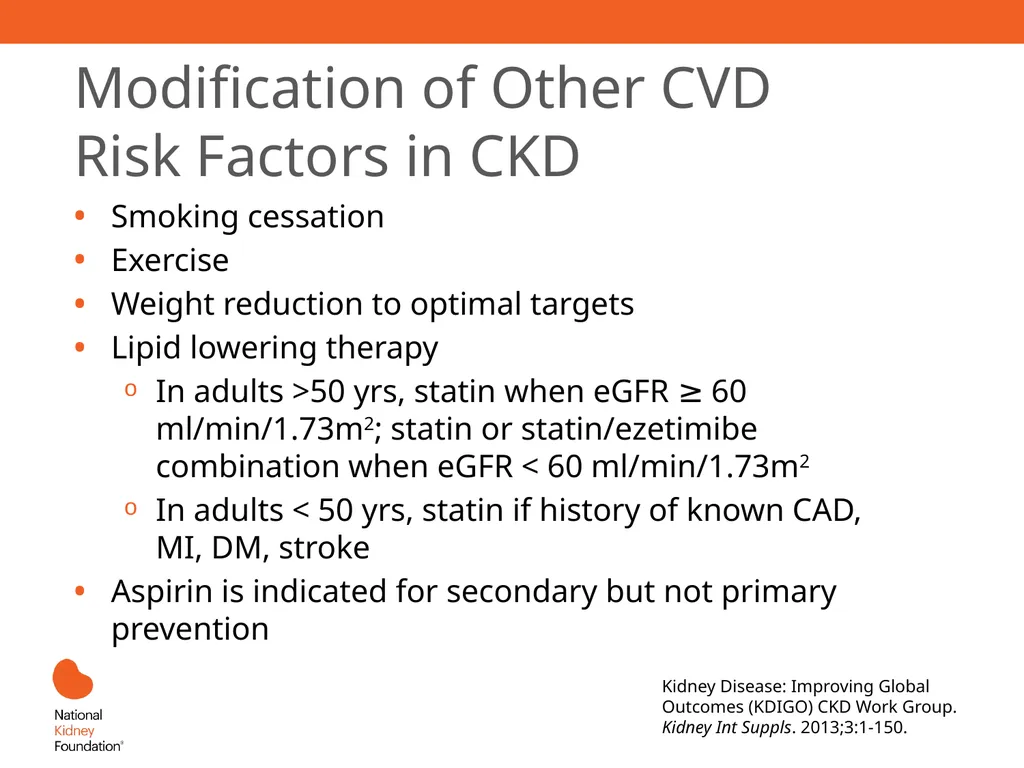
Modification of Other CVD Risk Factors in CKD Smoking cessation
Exercise
Weight reduction to optimal targets
Lipid lowering therapy
In adults >50 yrs, statin when eGFR ≥ 60 ml/min/1.73m2; statin or statin/ezetimibe combination when eGFR < 60 ml/min/1.73m2
In adults < 50 yrs, statin if history of known CAD, MI, DM, stroke
Aspirin is indicated for secondary but not primary prevention Kidney Disease: Improving Global Outcomes (KDIGO) CKD Work Group. Kidney Int Suppls. 2013;3:1-150.<br>
Exercise
Weight reduction to optimal targets
Lipid lowering therapy
In adults >50 yrs, statin when eGFR ≥ 60 ml/min/1.73m2; statin or statin/ezetimibe combination when eGFR < 60 ml/min/1.73m2
In adults < 50 yrs, statin if history of known CAD, MI, DM, stroke
Aspirin is indicated for secondary but not primary prevention Kidney Disease: Improving Global Outcomes (KDIGO) CKD Work Group. Kidney Int Suppls. 2013;3:1-150.<br>
26
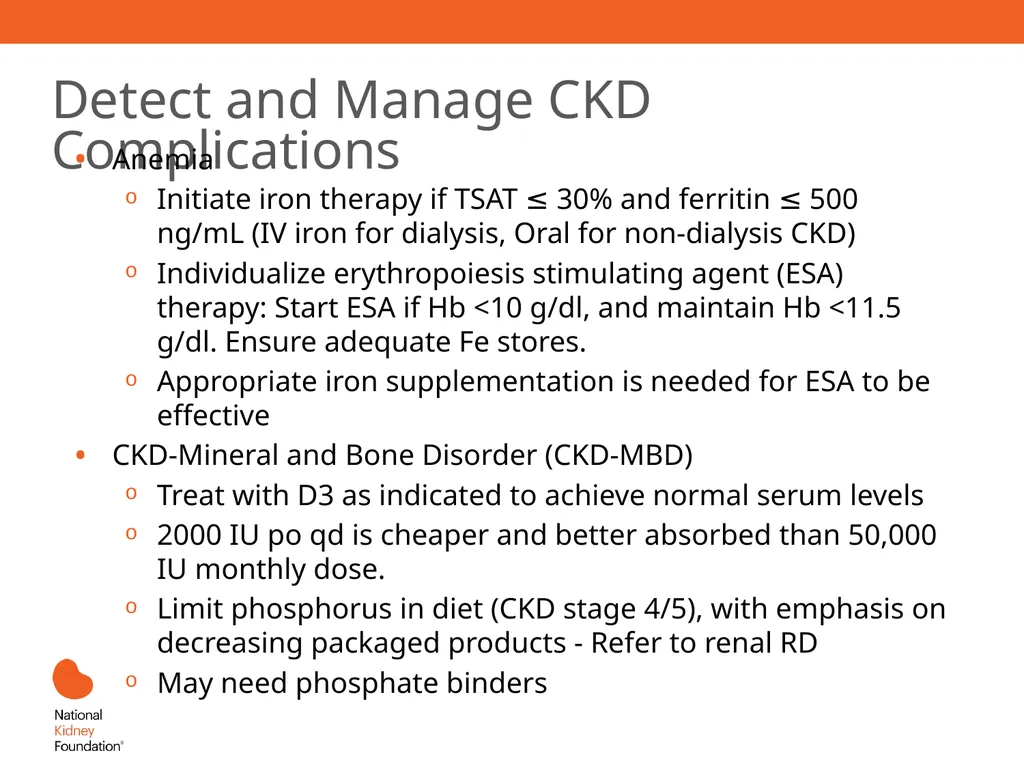
Detect and Manage CKD Complications Anemia
Initiate iron therapy if TSAT ≤ 30% and ferritin ≤ 500 ng/mL (IV iron for dialysis, Oral for non-dialysis CKD)
Individualize erythropoiesis stimulating agent (ESA) therapy: Start ESA if Hb <10 g/dl, and maintain Hb <11.5 g/dl. Ensure adequate Fe stores.
Appropriate iron supplementation is needed for ESA to be effective
CKD-Mineral and Bone Disorder (CKD-MBD)
Treat with D3 as indicated to achieve normal serum levels
2000 IU po qd is cheaper and better absorbed than 50,000 IU monthly dose.
Limit phosphorus in diet (CKD stage 4/5), with emphasis on decreasing packaged products - Refer to renal RD
May need phosphate binders<br>
Initiate iron therapy if TSAT ≤ 30% and ferritin ≤ 500 ng/mL (IV iron for dialysis, Oral for non-dialysis CKD)
Individualize erythropoiesis stimulating agent (ESA) therapy: Start ESA if Hb <10 g/dl, and maintain Hb <11.5 g/dl. Ensure adequate Fe stores.
Appropriate iron supplementation is needed for ESA to be effective
CKD-Mineral and Bone Disorder (CKD-MBD)
Treat with D3 as indicated to achieve normal serum levels
2000 IU po qd is cheaper and better absorbed than 50,000 IU monthly dose.
Limit phosphorus in diet (CKD stage 4/5), with emphasis on decreasing packaged products - Refer to renal RD
May need phosphate binders<br>
27
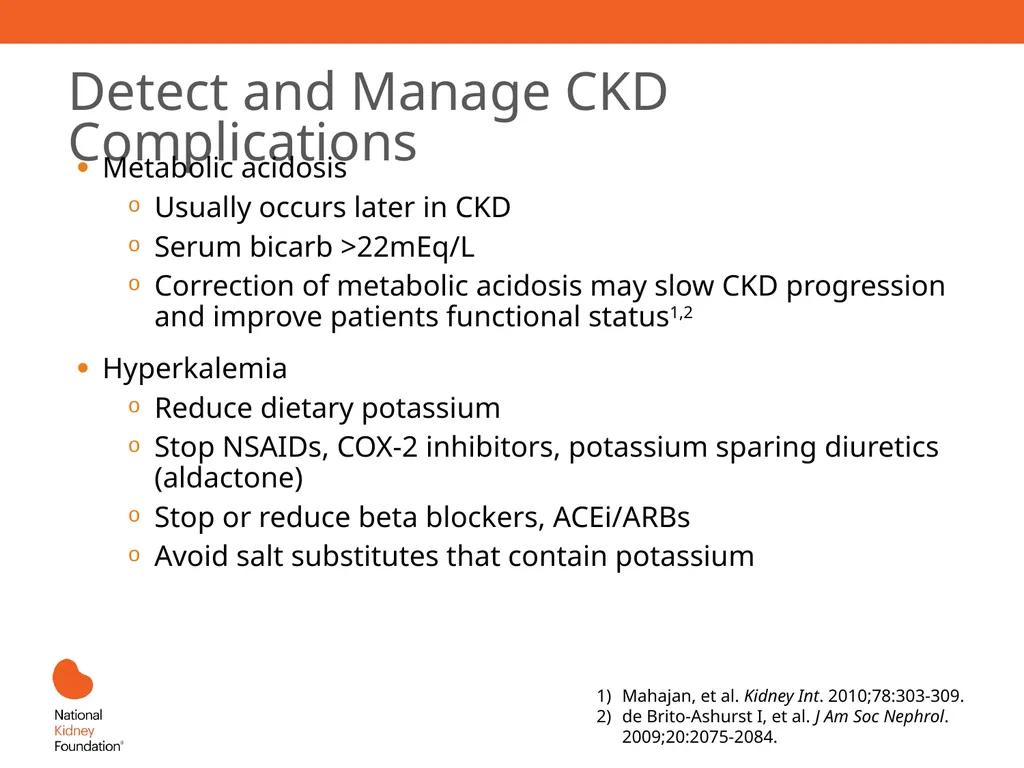
Detect and Manage CKD Complications Metabolic acidosis
Usually occurs later in CKD
Serum bicarb >22mEq/L
Correction of metabolic acidosis may slow CKD progression and improve patients functional status1,2
Hyperkalemia
Reduce dietary potassium
Stop NSAIDs, COX-2 inhibitors, potassium sparing diuretics (aldactone)
Stop or reduce beta blockers, ACEi/ARBs
Avoid salt substitutes that contain potassium Mahajan, et al. Kidney Int. 2010;78:303-309.
de Brito-Ashurst I, et al. J Am Soc Nephrol. 2009;20:2075-2084.<br>
Usually occurs later in CKD
Serum bicarb >22mEq/L
Correction of metabolic acidosis may slow CKD progression and improve patients functional status1,2
Hyperkalemia
Reduce dietary potassium
Stop NSAIDs, COX-2 inhibitors, potassium sparing diuretics (aldactone)
Stop or reduce beta blockers, ACEi/ARBs
Avoid salt substitutes that contain potassium Mahajan, et al. Kidney Int. 2010;78:303-309.
de Brito-Ashurst I, et al. J Am Soc Nephrol. 2009;20:2075-2084.<br>
28
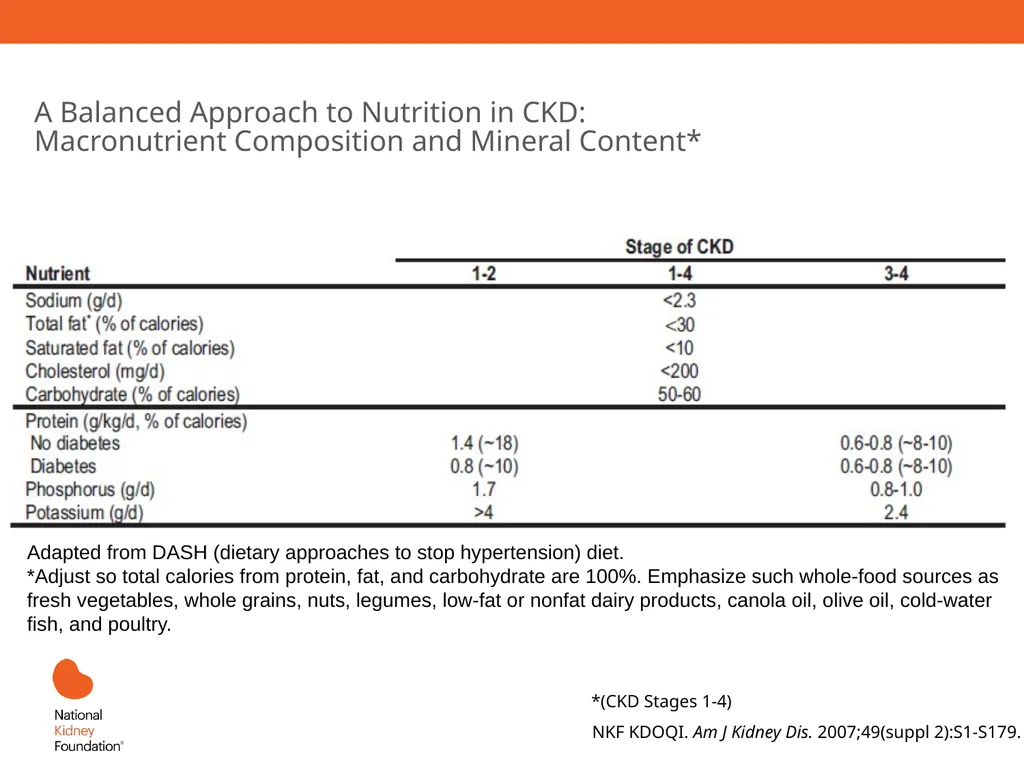
A Balanced Approach to Nutrition in CKD:
Macronutrient Composition and Mineral Content* Adapted from DASH (dietary approaches to stop hypertension) diet.
*Adjust so total calories from protein, fat, and carbohydrate are 100%. Emphasize such whole-food sources as fresh vegetables, whole grains, nuts, legumes, low-fat or nonfat dairy products, canola oil, olive oil, cold-water fish, and poultry. NKF KDOQI. Am J Kidney Dis. 2007;49(suppl 2):S1-S179. *(CKD Stages 1-4)<br>
29
What can primary care providers do? Recognize and test at-risk patients
Educate patients about CKD and treatment
Manage blood pressure and diabetes
Address other CVD risk factors
Monitor eGFR and ACR (encourage labs to report these tests)<br>
Educate patients about CKD and treatment
Manage blood pressure and diabetes
Address other CVD risk factors
Monitor eGFR and ACR (encourage labs to report these tests)<br>
30
What can primary care providers do? Evaluate and manage anemia, malnutrition, CKD-MBD, and other complications in at-risk patients
Refer to dietitian for nutritional guidance
Consider patient safety issues in CKD
Consult or team with a nephrologist (co-management)
Refer patient to nephrology when appropriate<br>
Refer to dietitian for nutritional guidance
Consider patient safety issues in CKD
Consult or team with a nephrologist (co-management)
Refer patient to nephrology when appropriate<br>
31
Co-Management, Patient Safety, and Nephrology Specialist Referral<br>
32
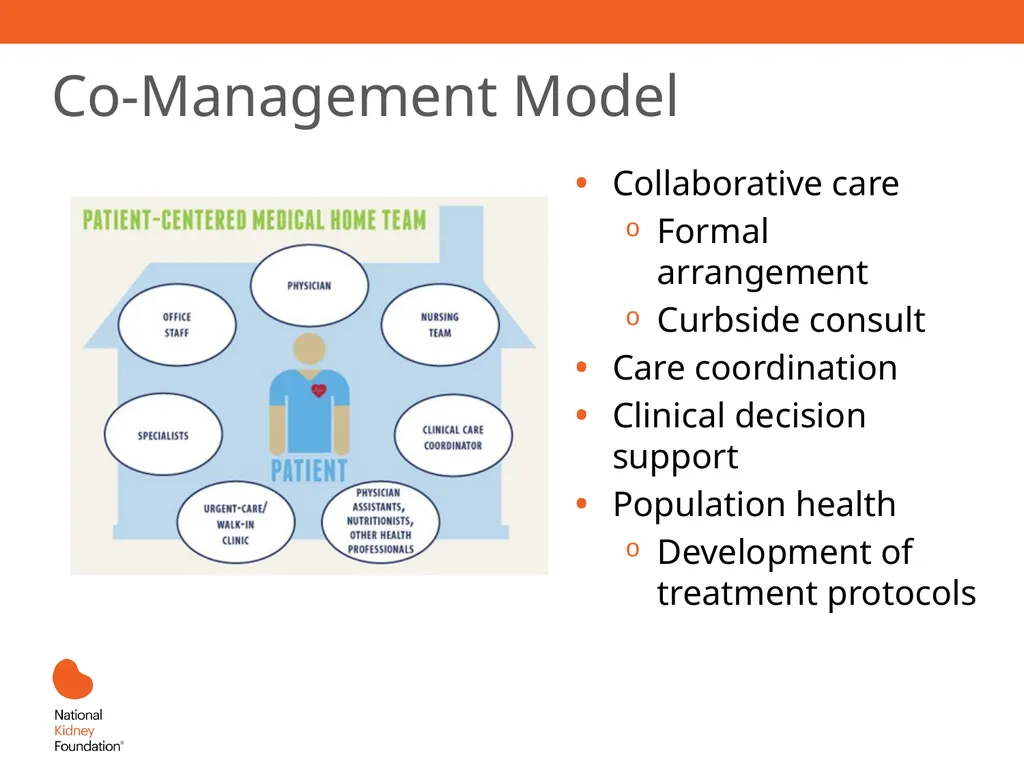
Co-Management Model Collaborative care
Formal arrangement
Curbside consult
Care coordination
Clinical decision support
Population health
Development of treatment protocols<br>
Formal arrangement
Curbside consult
Care coordination
Clinical decision support
Population health
Development of treatment protocols<br>
33
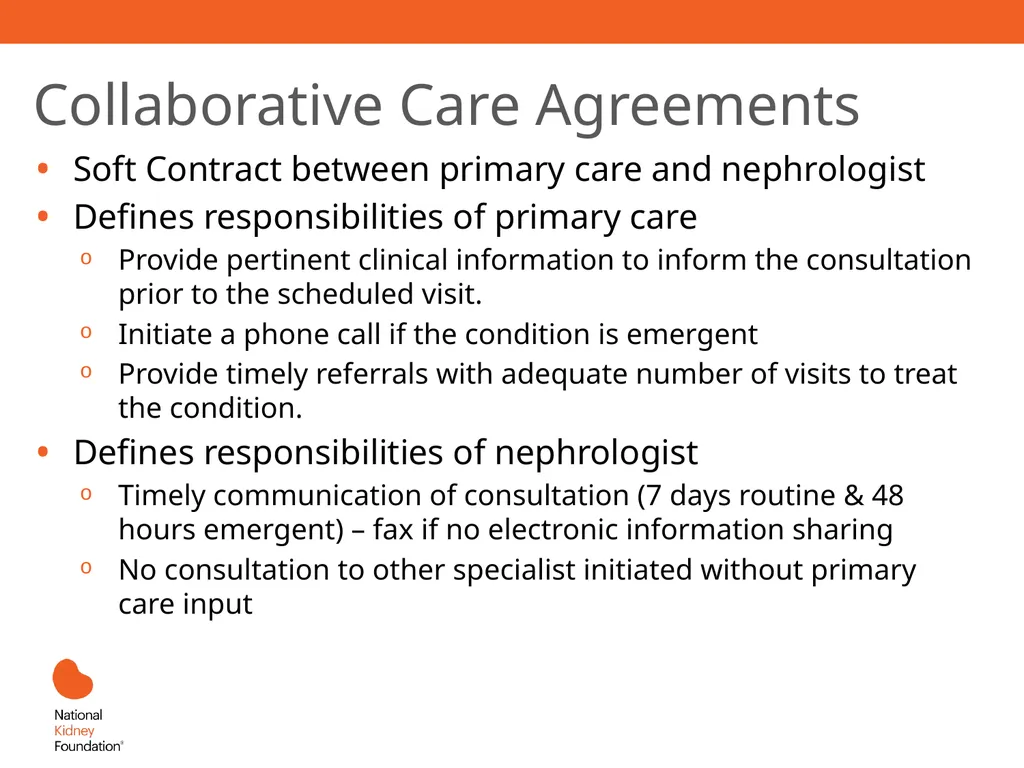
Collaborative Care Agreements Soft Contract between primary care and nephrologist
Defines responsibilities of primary care
Provide pertinent clinical information to inform the consultation prior to the scheduled visit.
Initiate a phone call if the condition is emergent
Provide timely referrals with adequate number of visits to treat the condition.
Defines responsibilities of nephrologist
Timely communication of consultation (7 days routine & 48 hours emergent) – fax if no electronic information sharing
No consultation to other specialist initiated without primary care input<br>
Defines responsibilities of primary care
Provide pertinent clinical information to inform the consultation prior to the scheduled visit.
Initiate a phone call if the condition is emergent
Provide timely referrals with adequate number of visits to treat the condition.
Defines responsibilities of nephrologist
Timely communication of consultation (7 days routine & 48 hours emergent) – fax if no electronic information sharing
No consultation to other specialist initiated without primary care input<br>
34
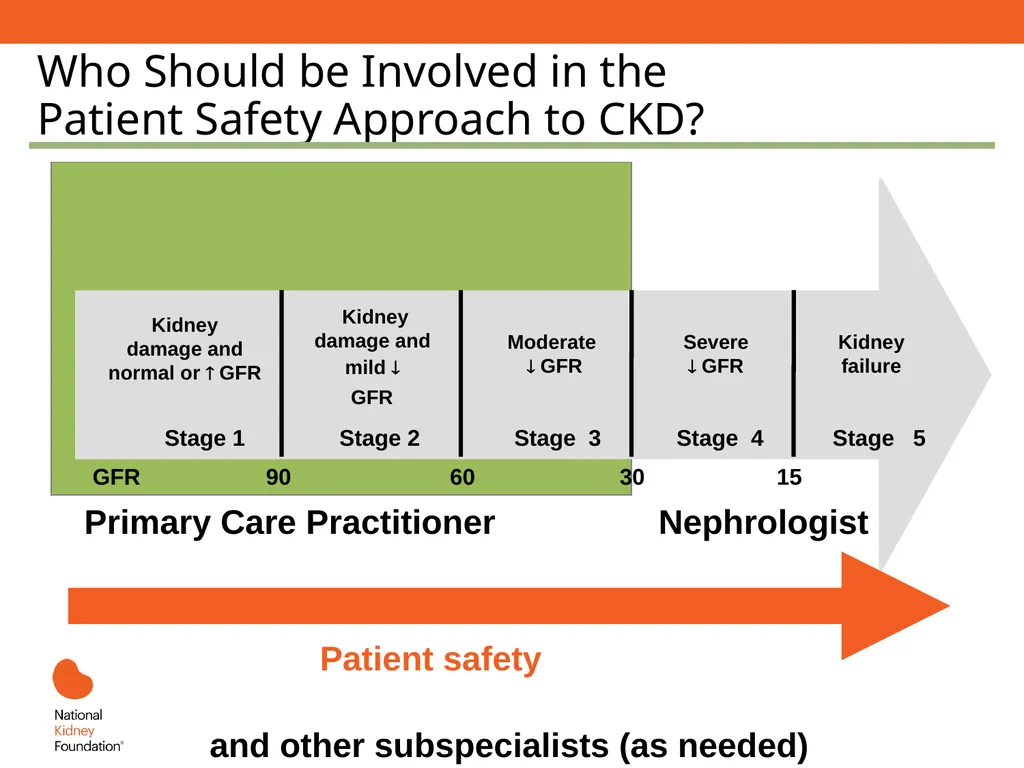
Kidney
damage and normal or GFR Kidney
damage and
mild
GFR Severe GFR Kidney failure Moderate
GFR Stage 1 Stage 2 Stage 3 Stage 4 Stage 5 Nephrologist Primary Care Practitioner The Patient (always)
and other subspecialists (as needed) GFR 90 60 30 15 Who Should be Involved in the
Patient Safety Approach to CKD? Patient safety Consult?<br>
mild
GFR Severe GFR Kidney failure Moderate
GFR Stage 1 Stage 2 Stage 3 Stage 4 Stage 5 Nephrologist Primary Care Practitioner The Patient (always)
and other subspecialists (as needed) GFR 90 60 30 15 Who Should be Involved in the
Patient Safety Approach to CKD? Patient safety Consult?<br>
35
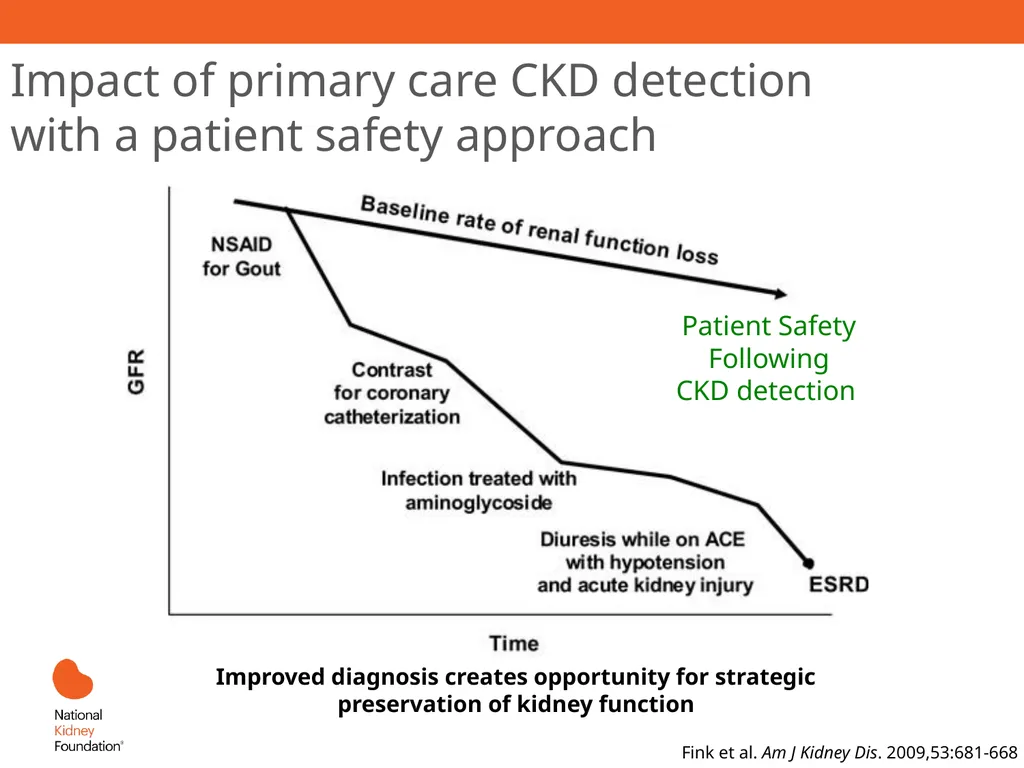
Impact of primary care CKD detection
with a patient safety approach Fink et al. Am J Kidney Dis. 2009,53:681-668 Patient Safety
Following
CKD detection Improved diagnosis creates opportunity for strategic preservation of kidney function<br>
Following
CKD detection Improved diagnosis creates opportunity for strategic preservation of kidney function<br>
36
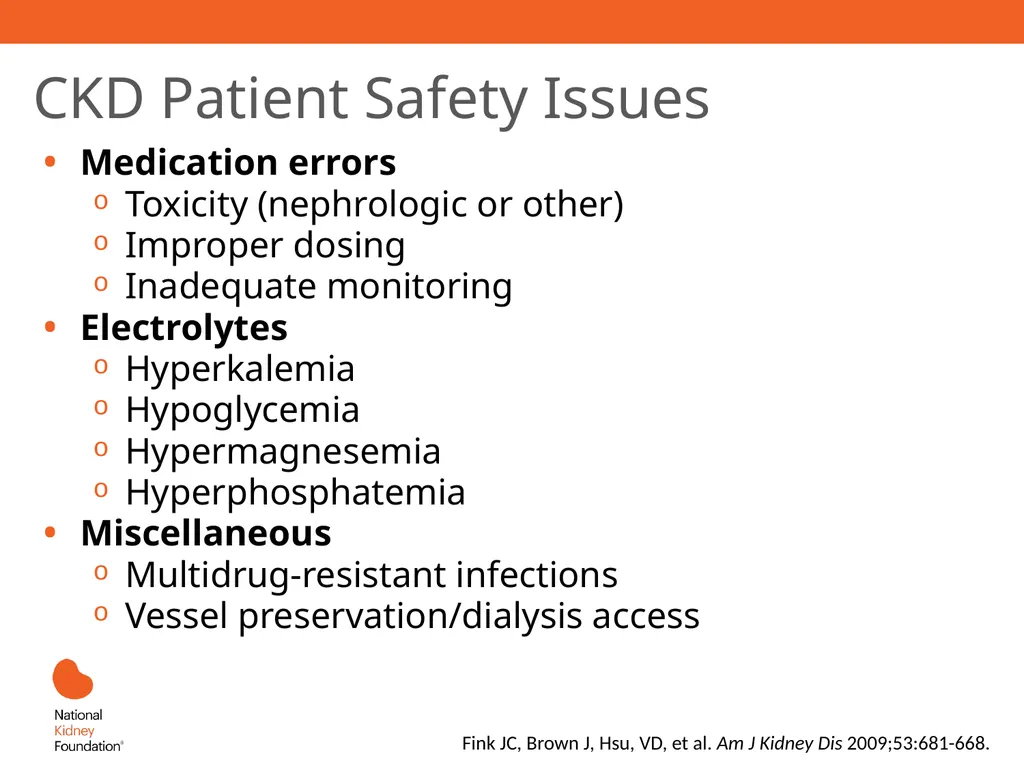
CKD Patient Safety Issues Medication errors
Toxicity (nephrologic or other)
Improper dosing
Inadequate monitoring
Electrolytes
Hyperkalemia
Hypoglycemia
Hypermagnesemia
Hyperphosphatemia
Miscellaneous
Multidrug-resistant infections
Vessel preservation/dialysis access Fink JC, Brown J, Hsu, VD, et al. Am J Kidney Dis 2009;53:681-668.<br>
Toxicity (nephrologic or other)
Improper dosing
Inadequate monitoring
Electrolytes
Hyperkalemia
Hypoglycemia
Hypermagnesemia
Hyperphosphatemia
Miscellaneous
Multidrug-resistant infections
Vessel preservation/dialysis access Fink JC, Brown J, Hsu, VD, et al. Am J Kidney Dis 2009;53:681-668.<br>
37
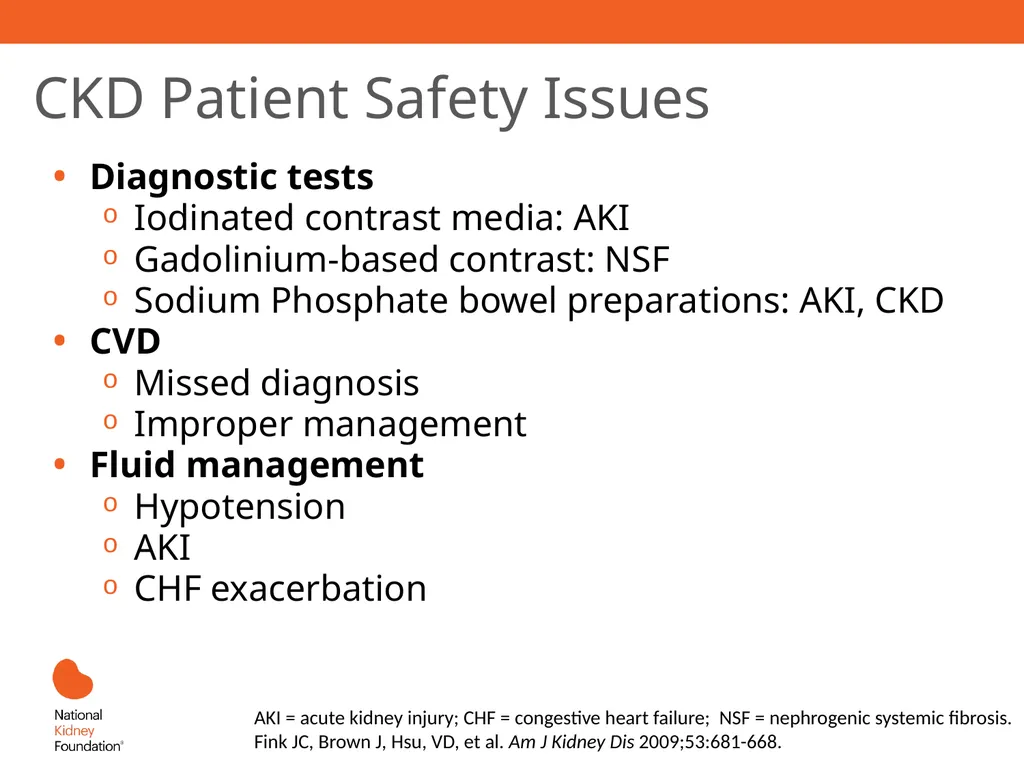
CKD Patient Safety Issues Diagnostic tests
Iodinated contrast media: AKI
Gadolinium-based contrast: NSF
Sodium Phosphate bowel preparations: AKI, CKD
CVD
Missed diagnosis
Improper management
Fluid management
Hypotension
AKI
CHF exacerbation AKI = acute kidney injury; CHF = congestive heart failure; NSF = nephrogenic systemic fibrosis.
Fink JC, Brown J, Hsu, VD, et al. Am J Kidney Dis 2009;53:681-668..<br>
Iodinated contrast media: AKI
Gadolinium-based contrast: NSF
Sodium Phosphate bowel preparations: AKI, CKD
CVD
Missed diagnosis
Improper management
Fluid management
Hypotension
AKI
CHF exacerbation AKI = acute kidney injury; CHF = congestive heart failure; NSF = nephrogenic systemic fibrosis.
Fink JC, Brown J, Hsu, VD, et al. Am J Kidney Dis 2009;53:681-668..<br>
38
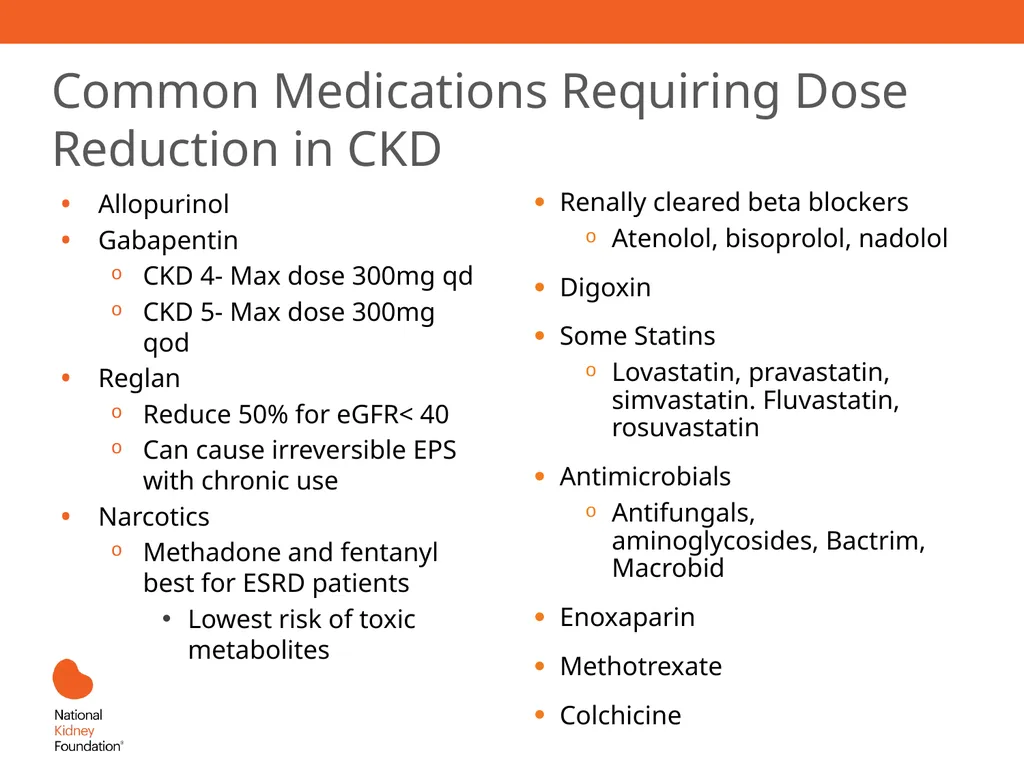
Common Medications Requiring Dose
Reduction in CKD Allopurinol
Gabapentin
CKD 4- Max dose 300mg qd
CKD 5- Max dose 300mg qod
Reglan
Reduce 50% for eGFR< 40
Can cause irreversible EPS with chronic use
Narcotics
Methadone and fentanyl best for ESRD patients
Lowest risk of toxic metabolites Renally cleared beta blockers
Atenolol, bisoprolol, nadolol
Digoxin
Some Statins
Lovastatin, pravastatin, simvastatin. Fluvastatin, rosuvastatin
Antimicrobials
Antifungals, aminoglycosides, Bactrim, Macrobid
Enoxaparin
Methotrexate
Colchicine<br>
Gabapentin
CKD 4- Max dose 300mg qd
CKD 5- Max dose 300mg qod
Reglan
Reduce 50% for eGFR< 40
Can cause irreversible EPS with chronic use
Narcotics
Methadone and fentanyl best for ESRD patients
Lowest risk of toxic metabolites Renally cleared beta blockers
Atenolol, bisoprolol, nadolol
Digoxin
Some Statins
Lovastatin, pravastatin, simvastatin. Fluvastatin, rosuvastatin
Antimicrobials
Antifungals, aminoglycosides, Bactrim, Macrobid
Enoxaparin
Methotrexate
Colchicine<br>
39
Key Points on Medications in CKD CKD patients at high risk for drug-related adverse events
Several classes of drugs renally eliminated
Consider kidney function and current eGFR (not just SCr) when prescribing meds
Minimize pill burden as much as possible
Remind CKD patients to avoid NSAIDs
No Dual RAAS blockade
Any med with >30% renal clearance probably needs dose adjustment for CKD
No bisphosphonates for eGFR <30
Avoid GAD for eGFR <30<br>
Several classes of drugs renally eliminated
Consider kidney function and current eGFR (not just SCr) when prescribing meds
Minimize pill burden as much as possible
Remind CKD patients to avoid NSAIDs
No Dual RAAS blockade
Any med with >30% renal clearance probably needs dose adjustment for CKD
No bisphosphonates for eGFR <30
Avoid GAD for eGFR <30<br>
40
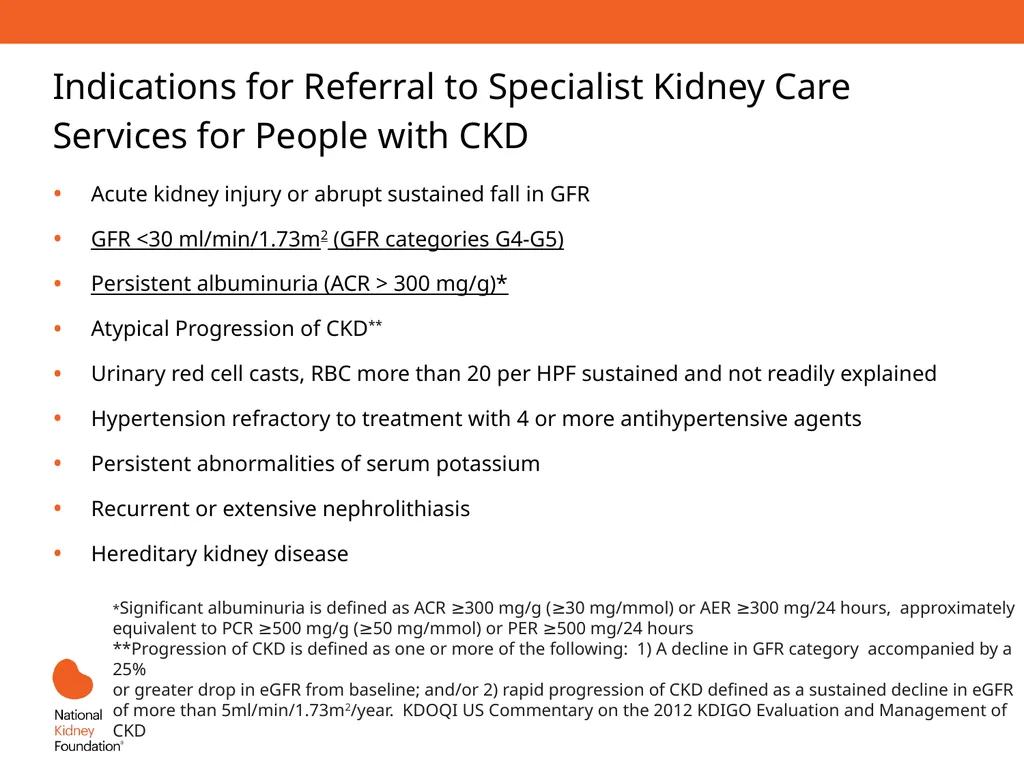
*Significant albuminuria is defined as ACR ≥300 mg/g (≥30 mg/mmol) or AER ≥300 mg/24 hours, approximately
equivalent to PCR ≥500 mg/g (≥50 mg/mmol) or PER ≥500 mg/24 hours
**Progression of CKD is defined as one or more of the following: 1) A decline in GFR category accompanied by a 25%
or greater drop in eGFR from baseline; and/or 2) rapid progression of CKD defined as a sustained decline in eGFR of more than 5ml/min/1.73m2/year. KDOQI US Commentary on the 2012 KDIGO Evaluation and Management of CKD Indications for Referral to Specialist Kidney Care Services for People with CKD Acute kidney injury or abrupt sustained fall in GFR
GFR <30 ml/min/1.73m2 (GFR categories G4-G5)
Persistent albuminuria (ACR > 300 mg/g)*
Atypical Progression of CKD**
Urinary red cell casts, RBC more than 20 per HPF sustained and not readily explained
Hypertension refractory to treatment with 4 or more antihypertensive agents
Persistent abnormalities of serum potassium
Recurrent or extensive nephrolithiasis
Hereditary kidney disease<br>
equivalent to PCR ≥500 mg/g (≥50 mg/mmol) or PER ≥500 mg/24 hours
**Progression of CKD is defined as one or more of the following: 1) A decline in GFR category accompanied by a 25%
or greater drop in eGFR from baseline; and/or 2) rapid progression of CKD defined as a sustained decline in eGFR of more than 5ml/min/1.73m2/year. KDOQI US Commentary on the 2012 KDIGO Evaluation and Management of CKD Indications for Referral to Specialist Kidney Care Services for People with CKD Acute kidney injury or abrupt sustained fall in GFR
GFR <30 ml/min/1.73m2 (GFR categories G4-G5)
Persistent albuminuria (ACR > 300 mg/g)*
Atypical Progression of CKD**
Urinary red cell casts, RBC more than 20 per HPF sustained and not readily explained
Hypertension refractory to treatment with 4 or more antihypertensive agents
Persistent abnormalities of serum potassium
Recurrent or extensive nephrolithiasis
Hereditary kidney disease<br>
41
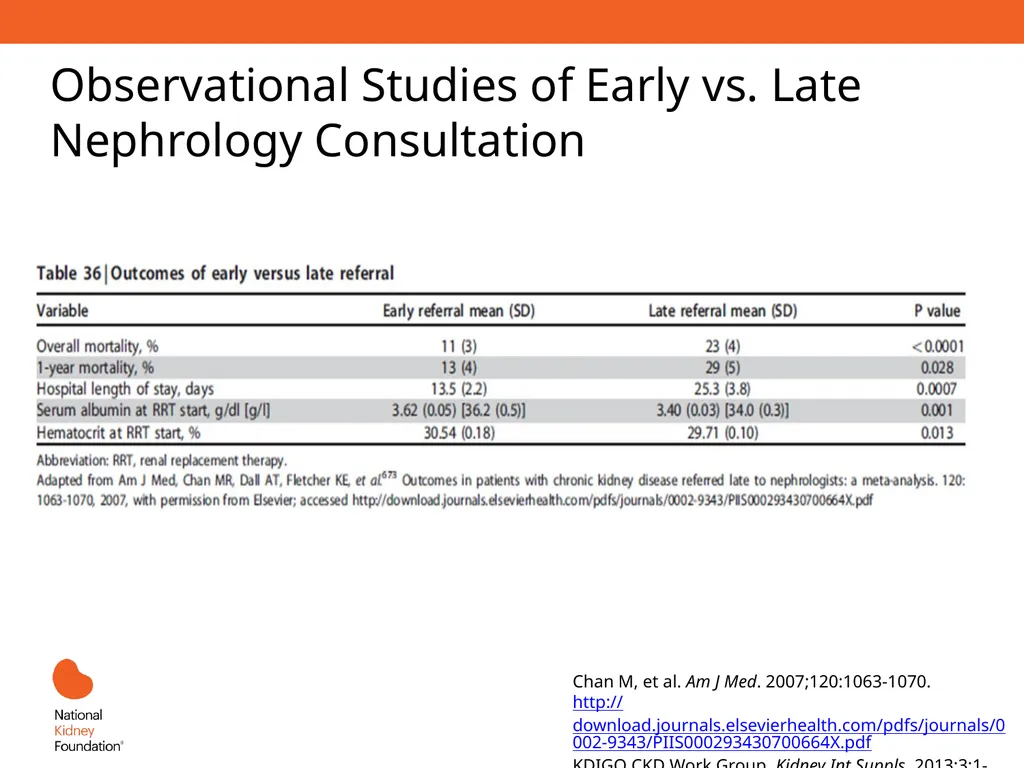
Observational Studies of Early vs. Late
Nephrology Consultation Chan M, et al. Am J Med. 2007;120:1063-1070.
http://download.journals.elsevierhealth.com/pdfs/journals/0002-9343/PIIS000293430700664X.pdf
KDIGO CKD Work Group. Kidney Int Suppls. 2013;3:1-150.<br>
Nephrology Consultation Chan M, et al. Am J Med. 2007;120:1063-1070.
http://download.journals.elsevierhealth.com/pdfs/journals/0002-9343/PIIS000293430700664X.pdf
KDIGO CKD Work Group. Kidney Int Suppls. 2013;3:1-150.<br>
42
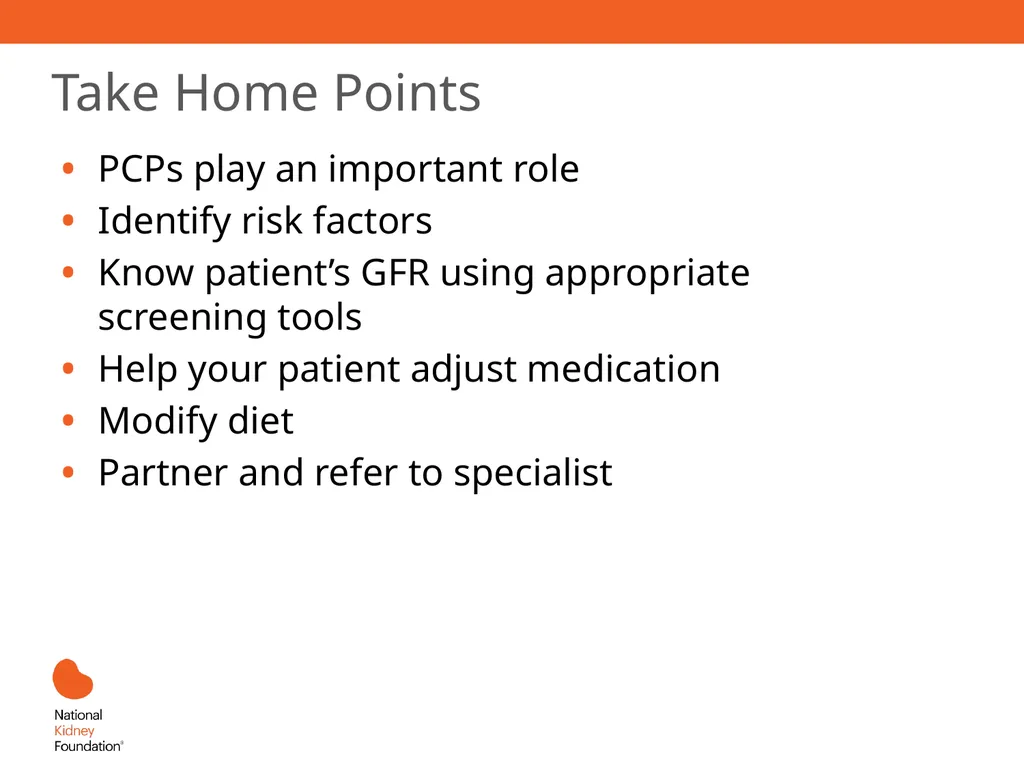
Take Home Points PCPs play an important role
Identify risk factors
Know patient’s GFR using appropriate screening tools
Help your patient adjust medication
Modify diet
Partner and refer to specialist<br>
Identify risk factors
Know patient’s GFR using appropriate screening tools
Help your patient adjust medication
Modify diet
Partner and refer to specialist<br>
43
Additional Online Resources for CKD Learning National Kidney Foundation: www.kidney.org
United States Renal Data Service: www.usrds.org
CDC’s CKD Surveillance Project: http://nccd.cdc.gov/ckd
National Kidney Disease Education Program (NKDEP): http://nkdep.nih.gov<br>
United States Renal Data Service: www.usrds.org
CDC’s CKD Surveillance Project: http://nccd.cdc.gov/ckd
National Kidney Disease Education Program (NKDEP): http://nkdep.nih.gov<br>