
A Regional Commercial Arbitration Council: Is it
LO
Published · 43 slides · 0 views

1 / 1


Description
A Regional Commercial Arbitration Council: Is it an idea whose time has come? Ajay Thomas Why arbitration? The future of arbitration is, therefore, bright, perhaps because the future of litigation is not ? Fali Nariman Why Arbitration?
Related Topics
Share
Embed code
Download this presentation From Below
"A Regional Commercial Arbitration Council: Is it" is the property of its rightful owner. Permission is granted to download and print the materials on this website for personal, non-commercial use only, and to display it on your personal computer provided you do not modify the materials and that you retain all copyright notices contained in the materials. By downloading content from our website, you accept the terms of this agreement.
Presentation Transcript
01
A Regional Commercial Arbitration Council: Is it an idea whose time has come?
Ajay Thomas<br>
Ajay Thomas<br>
02
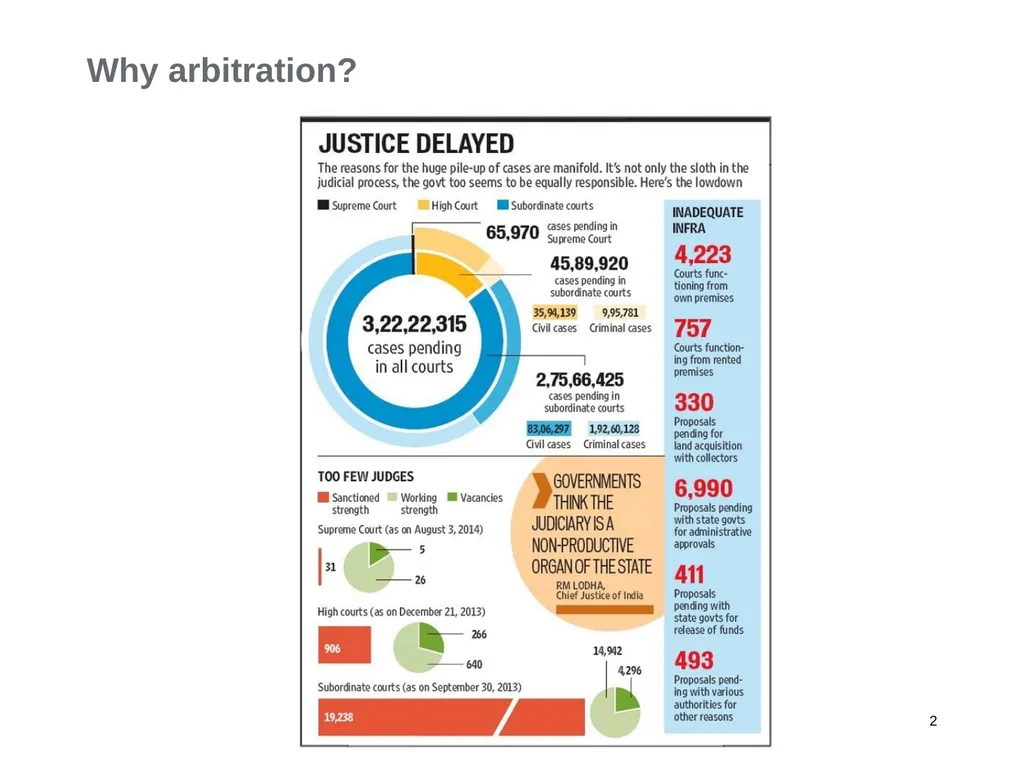
Why arbitration?<br>
03
“The future of arbitration is, therefore, bright, perhaps because the future of litigation is not ?”
Fali Nariman Why Arbitration?<br>
Fali Nariman Why Arbitration?<br>
04
Advantages Privacy and Confidentiality of arbitration proceedings
Flexibility
Ability to choose the tribunal
Specialized expertise of Arbitrators
Finality. Generally no appeal
Neutrality & equality
Enforceability of the award
Case by case resolution of the dispute by the Arbitrators who are not necessarily tied to the law
Arbitration is typically less costly and faster than traditional litigation<br>
Flexibility
Ability to choose the tribunal
Specialized expertise of Arbitrators
Finality. Generally no appeal
Neutrality & equality
Enforceability of the award
Case by case resolution of the dispute by the Arbitrators who are not necessarily tied to the law
Arbitration is typically less costly and faster than traditional litigation<br>
05
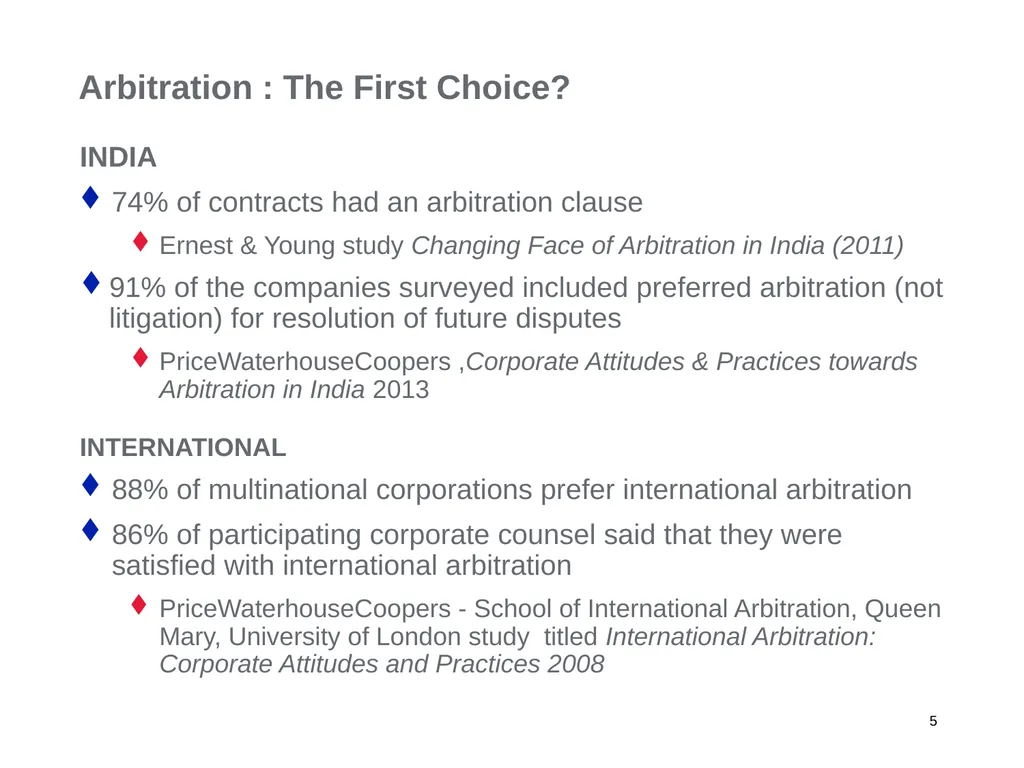
INDIA
74% of contracts had an arbitration clause
Ernest & Young study Changing Face of Arbitration in India (2011)
91% of the companies surveyed included preferred arbitration (not litigation) for resolution of future disputes
PriceWaterhouseCoopers ,Corporate Attitudes & Practices towards Arbitration in India 2013
INTERNATIONAL
88% of multinational corporations prefer international arbitration
86% of participating corporate counsel said that they were satisfied with international arbitration
PriceWaterhouseCoopers - School of International Arbitration, Queen Mary, University of London study titled International Arbitration: Corporate Attitudes and Practices 2008 Arbitration : The First Choice?<br>
74% of contracts had an arbitration clause
Ernest & Young study Changing Face of Arbitration in India (2011)
91% of the companies surveyed included preferred arbitration (not litigation) for resolution of future disputes
PriceWaterhouseCoopers ,Corporate Attitudes & Practices towards Arbitration in India 2013
INTERNATIONAL
88% of multinational corporations prefer international arbitration
86% of participating corporate counsel said that they were satisfied with international arbitration
PriceWaterhouseCoopers - School of International Arbitration, Queen Mary, University of London study titled International Arbitration: Corporate Attitudes and Practices 2008 Arbitration : The First Choice?<br>
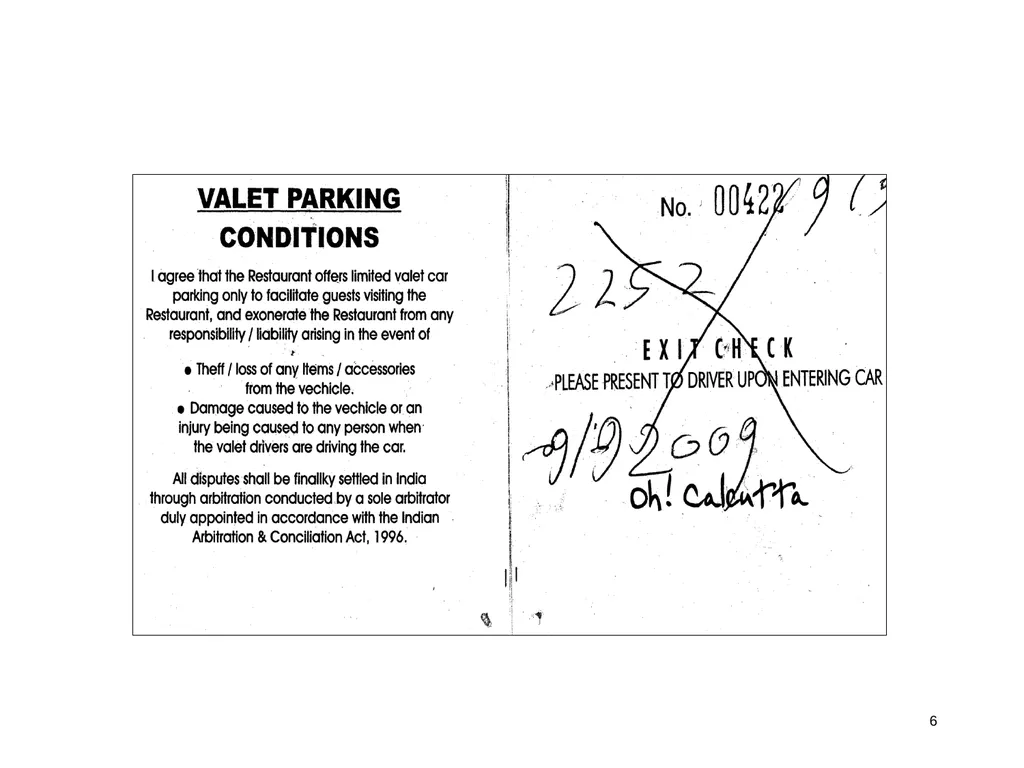
06
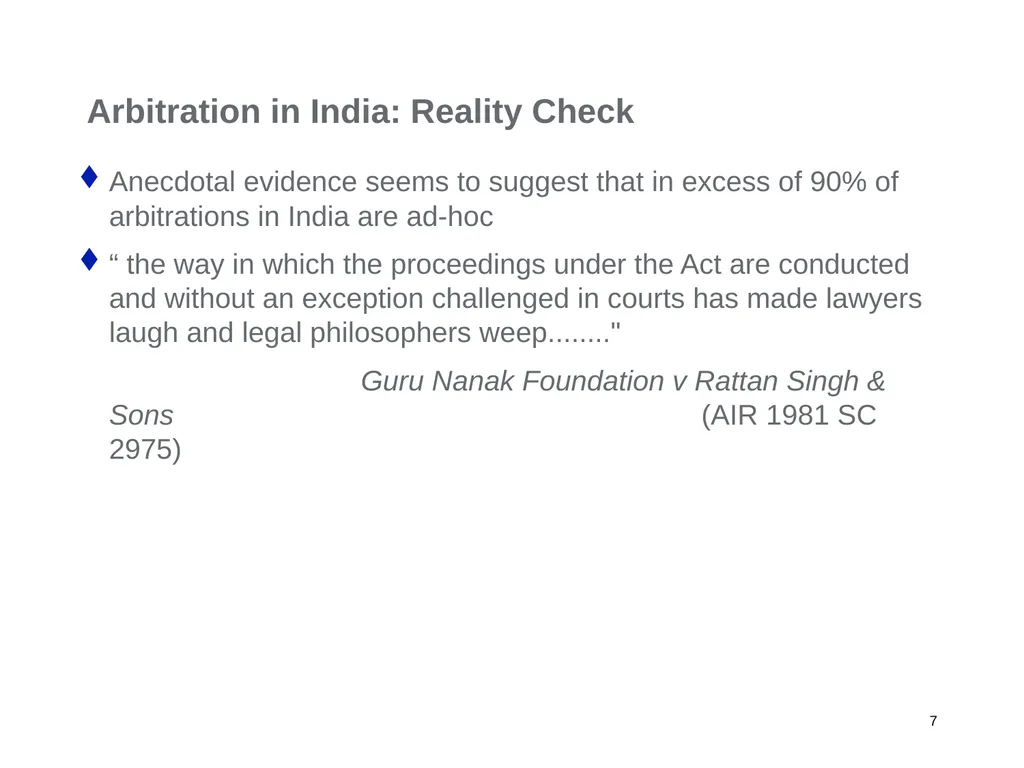
Arbitration in India: Reality Check Anecdotal evidence seems to suggest that in excess of 90% of arbitrations in India are ad-hoc
“ the way in which the proceedings under the Act are conducted and without an exception challenged in courts has made lawyers laugh and legal philosophers weep........"
Guru Nanak Foundation v Rattan Singh & Sons (AIR 1981 SC 2975)<br>
“ the way in which the proceedings under the Act are conducted and without an exception challenged in courts has made lawyers laugh and legal philosophers weep........"
Guru Nanak Foundation v Rattan Singh & Sons (AIR 1981 SC 2975)<br>
07
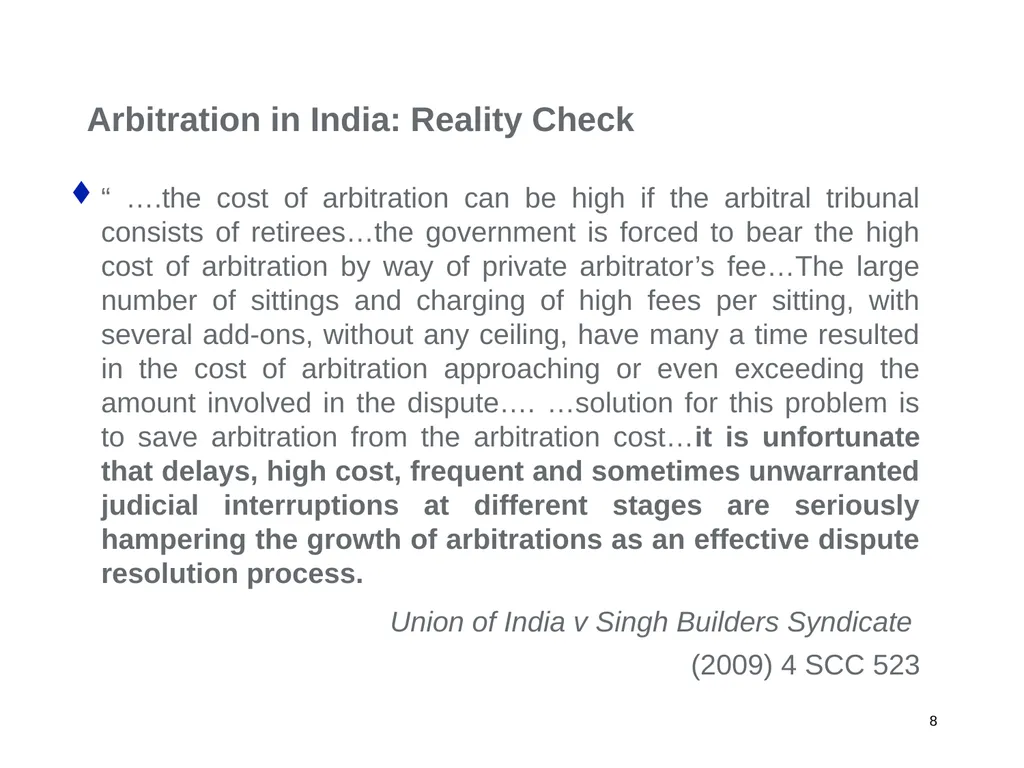
Arbitration in India: Reality Check “ ….the cost of arbitration can be high if the arbitral tribunal consists of retirees…the government is forced to bear the high cost of arbitration by way of private arbitrator’s fee…The large number of sittings and charging of high fees per sitting, with several add-ons, without any ceiling, have many a time resulted in the cost of arbitration approaching or even exceeding the amount involved in the dispute…. …solution for this problem is to save arbitration from the arbitration cost…it is unfortunate that delays, high cost, frequent and sometimes unwarranted judicial interruptions at different stages are seriously hampering the growth of arbitrations as an effective dispute resolution process.
Union of India v Singh Builders Syndicate
(2009) 4 SCC 523<br>
Union of India v Singh Builders Syndicate
(2009) 4 SCC 523<br>
08
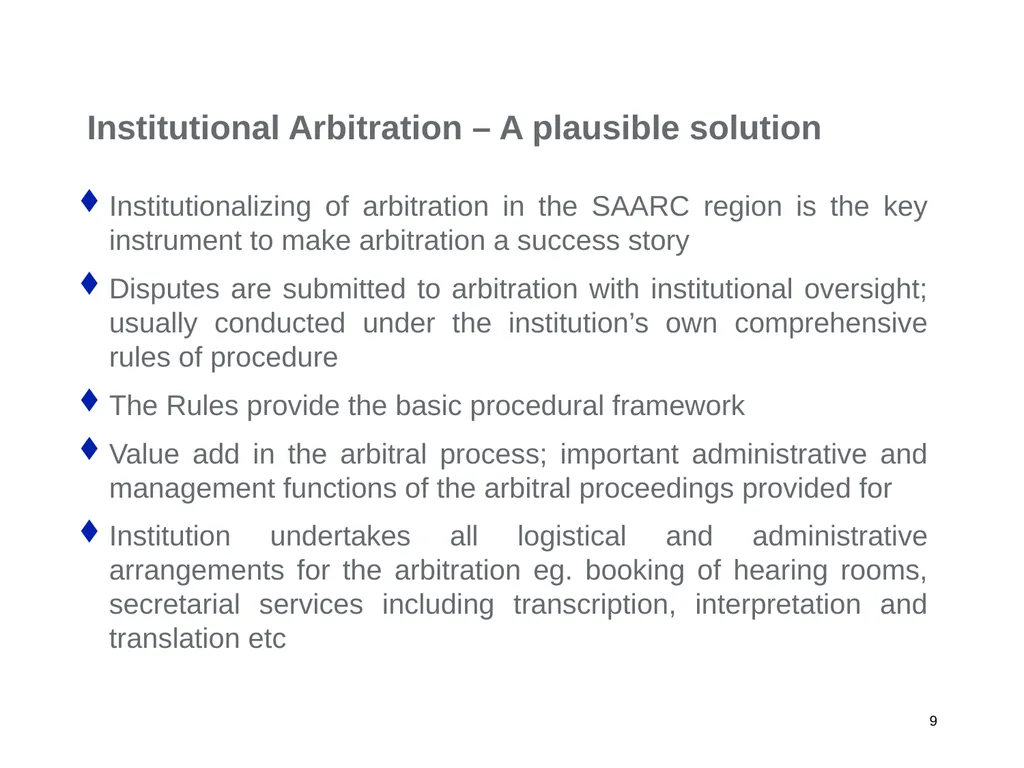
Institutional Arbitration – A plausible solution Institutionalizing of arbitration in the SAARC region is the key instrument to make arbitration a success story
Disputes are submitted to arbitration with institutional oversight; usually conducted under the institution’s own comprehensive rules of procedure
The Rules provide the basic procedural framework
Value add in the arbitral process; important administrative and management functions of the arbitral proceedings provided for
Institution undertakes all logistical and administrative arrangements for the arbitration eg. booking of hearing rooms, secretarial services including transcription, interpretation and translation etc<br>
Disputes are submitted to arbitration with institutional oversight; usually conducted under the institution’s own comprehensive rules of procedure
The Rules provide the basic procedural framework
Value add in the arbitral process; important administrative and management functions of the arbitral proceedings provided for
Institution undertakes all logistical and administrative arrangements for the arbitration eg. booking of hearing rooms, secretarial services including transcription, interpretation and translation etc<br>
09
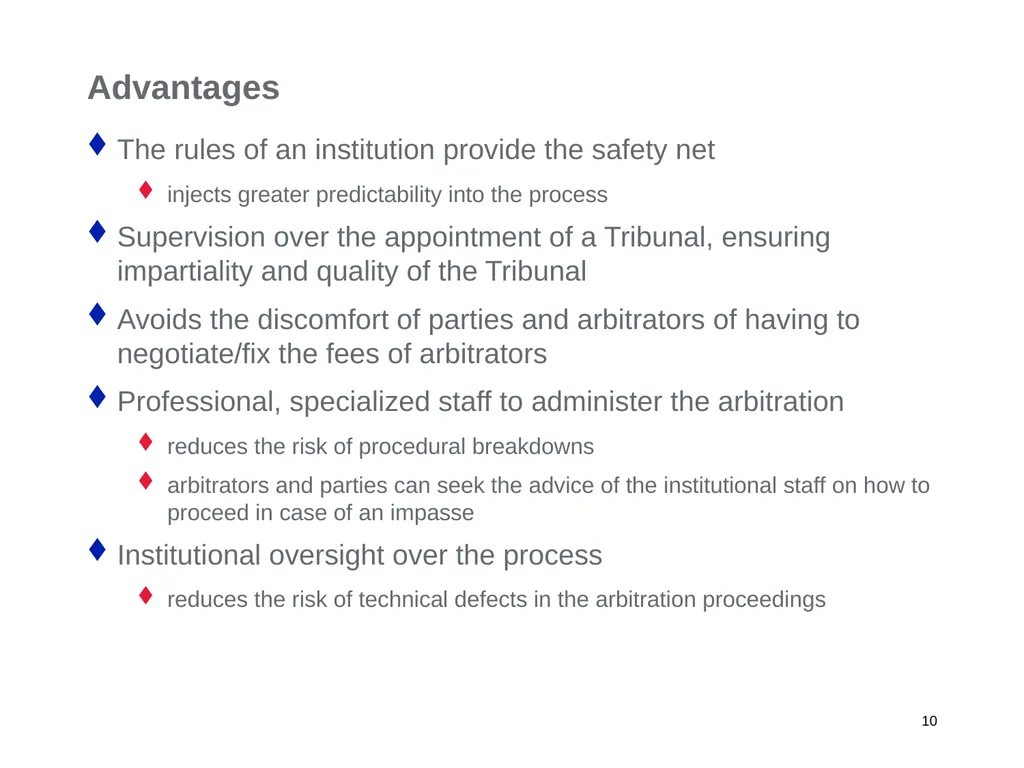
Advantages The rules of an institution provide the safety net
injects greater predictability into the process
Supervision over the appointment of a Tribunal, ensuring impartiality and quality of the Tribunal
Avoids the discomfort of parties and arbitrators of having to negotiate/fix the fees of arbitrators
Professional, specialized staff to administer the arbitration
reduces the risk of procedural breakdowns
arbitrators and parties can seek the advice of the institutional staff on how to proceed in case of an impasse
Institutional oversight over the process
reduces the risk of technical defects in the arbitration proceedings<br>
injects greater predictability into the process
Supervision over the appointment of a Tribunal, ensuring impartiality and quality of the Tribunal
Avoids the discomfort of parties and arbitrators of having to negotiate/fix the fees of arbitrators
Professional, specialized staff to administer the arbitration
reduces the risk of procedural breakdowns
arbitrators and parties can seek the advice of the institutional staff on how to proceed in case of an impasse
Institutional oversight over the process
reduces the risk of technical defects in the arbitration proceedings<br>
10
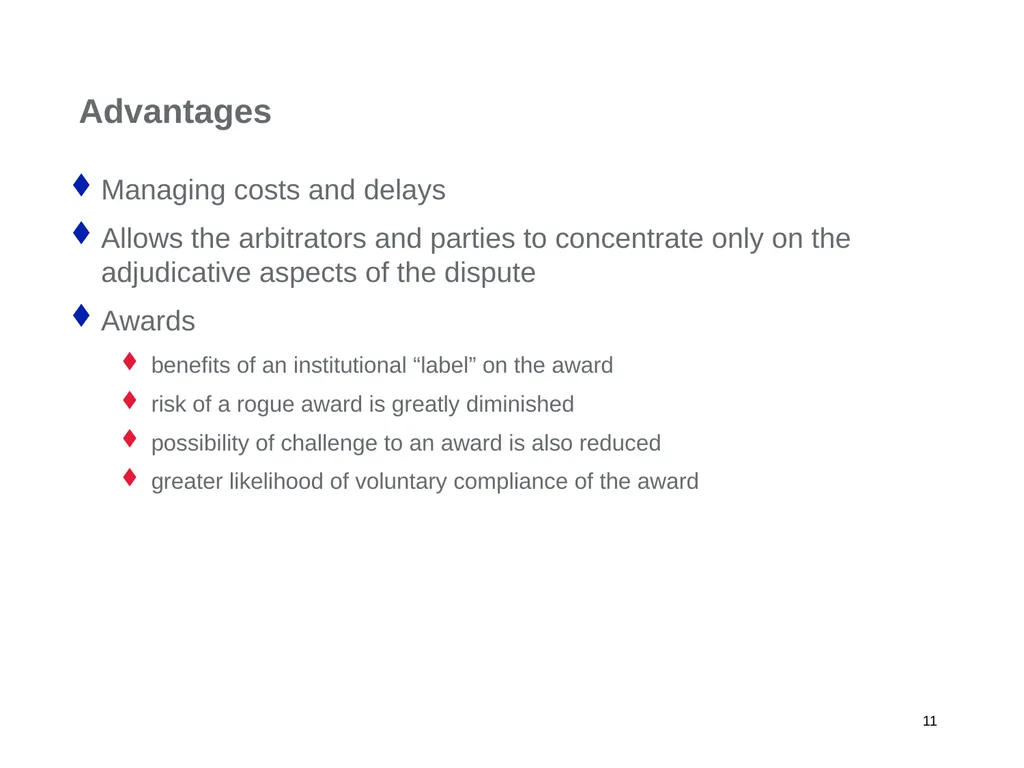
Advantages Managing costs and delays
Allows the arbitrators and parties to concentrate only on the adjudicative aspects of the dispute
Awards
benefits of an institutional “label” on the award
risk of a rogue award is greatly diminished
possibility of challenge to an award is also reduced
greater likelihood of voluntary compliance of the award<br>
Allows the arbitrators and parties to concentrate only on the adjudicative aspects of the dispute
Awards
benefits of an institutional “label” on the award
risk of a rogue award is greatly diminished
possibility of challenge to an award is also reduced
greater likelihood of voluntary compliance of the award<br>
11
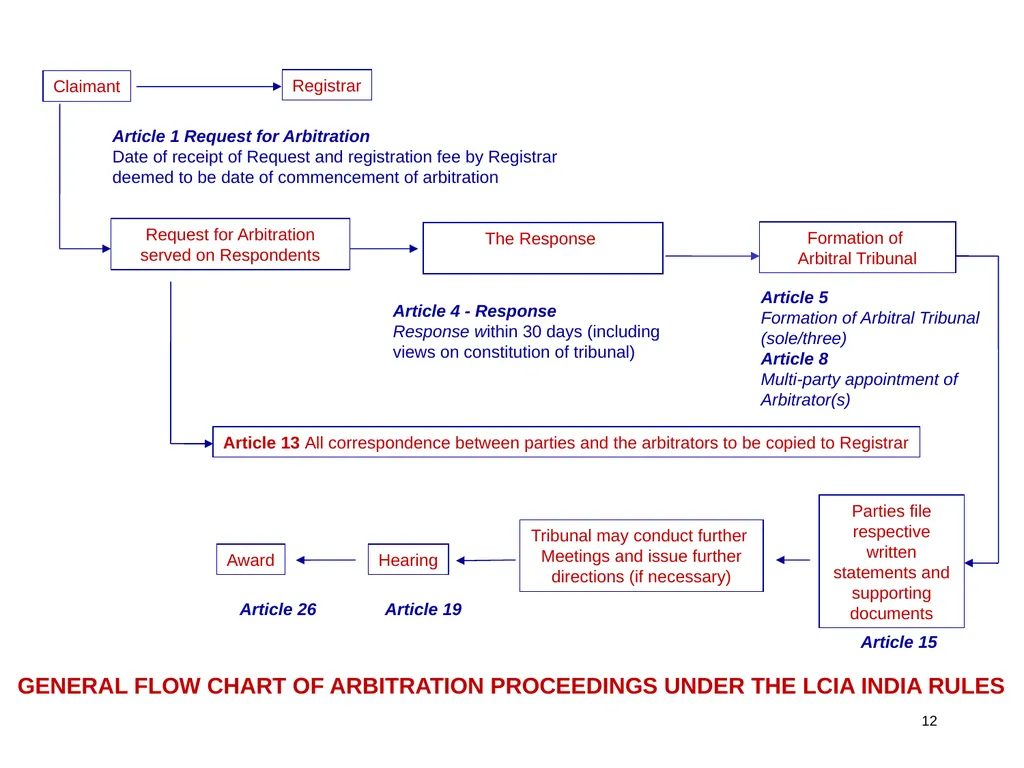
GENERAL FLOW CHART OF ARBITRATION PROCEEDINGS UNDER THE LCIA INDIA RULES Article 13 All correspondence between parties and the arbitrators to be copied to Registrar Article 4 - Response
Response within 30 days (including views on constitution of tribunal) Formation of
Arbitral Tribunal Article 5
Formation of Arbitral Tribunal (sole/three)
Article 8
Multi-party appointment of Arbitrator(s) Award Parties file respective written statements and supporting documents Article 15 Tribunal may conduct further
Meetings and issue further directions (if necessary) Hearing Article 19 The Response Article 26<br>
Response within 30 days (including views on constitution of tribunal) Formation of
Arbitral Tribunal Article 5
Formation of Arbitral Tribunal (sole/three)
Article 8
Multi-party appointment of Arbitrator(s) Award Parties file respective written statements and supporting documents Article 15 Tribunal may conduct further
Meetings and issue further directions (if necessary) Hearing Article 19 The Response Article 26<br>
12
Parties’ greatest concerns in arbitration The ultimate outcome – Win or lose?
Time - How long?
Costs - How much?<br>
Time - How long?
Costs - How much?<br>
13
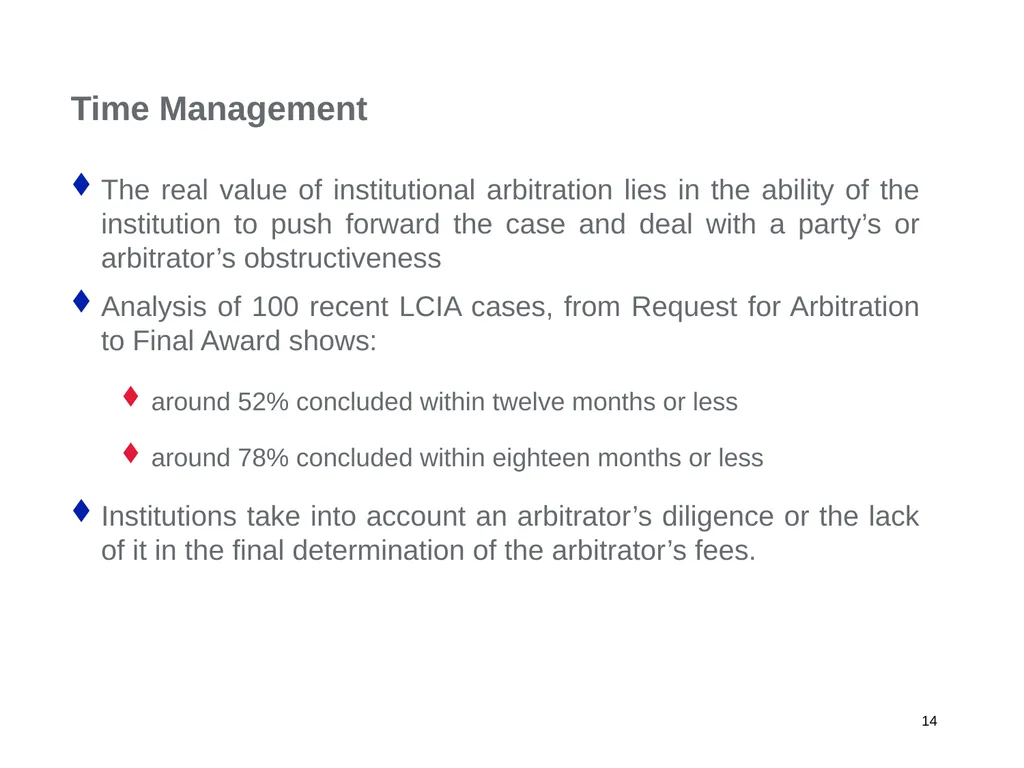
Time Management The real value of institutional arbitration lies in the ability of the institution to push forward the case and deal with a party’s or arbitrator’s obstructiveness
Analysis of 100 recent LCIA cases, from Request for Arbitration to Final Award shows:
around 52% concluded within twelve months or less
around 78% concluded within eighteen months or less
Institutions take into account an arbitrator’s diligence or the lack of it in the final determination of the arbitrator’s fees.<br>
Analysis of 100 recent LCIA cases, from Request for Arbitration to Final Award shows:
around 52% concluded within twelve months or less
around 78% concluded within eighteen months or less
Institutions take into account an arbitrator’s diligence or the lack of it in the final determination of the arbitrator’s fees.<br>
14
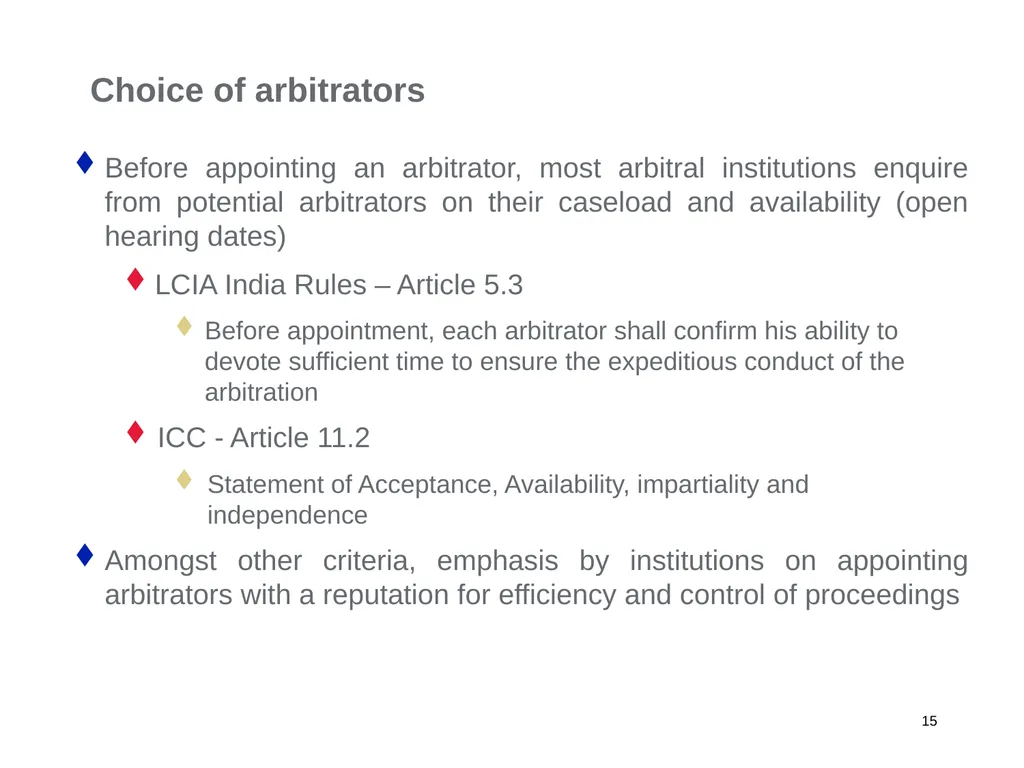
Choice of arbitrators Before appointing an arbitrator, most arbitral institutions enquire from potential arbitrators on their caseload and availability (open hearing dates)
LCIA India Rules – Article 5.3
Before appointment, each arbitrator shall confirm his ability to devote sufficient time to ensure the expeditious conduct of the arbitration
ICC - Article 11.2
Statement of Acceptance, Availability, impartiality and independence
Amongst other criteria, emphasis by institutions on appointing arbitrators with a reputation for efficiency and control of proceedings<br>
LCIA India Rules – Article 5.3
Before appointment, each arbitrator shall confirm his ability to devote sufficient time to ensure the expeditious conduct of the arbitration
ICC - Article 11.2
Statement of Acceptance, Availability, impartiality and independence
Amongst other criteria, emphasis by institutions on appointing arbitrators with a reputation for efficiency and control of proceedings<br>
15
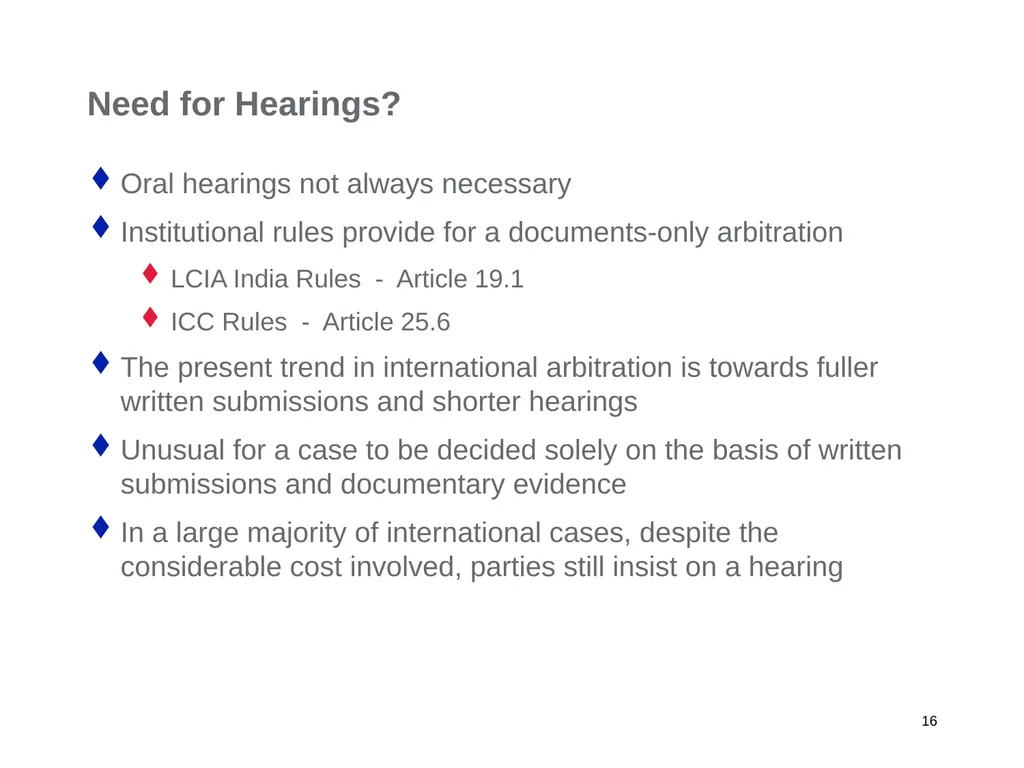
Need for Hearings? Oral hearings not always necessary
Institutional rules provide for a documents-only arbitration
LCIA India Rules - Article 19.1
ICC Rules - Article 25.6
The present trend in international arbitration is towards fuller written submissions and shorter hearings
Unusual for a case to be decided solely on the basis of written submissions and documentary evidence
In a large majority of international cases, despite the considerable cost involved, parties still insist on a hearing<br>
Institutional rules provide for a documents-only arbitration
LCIA India Rules - Article 19.1
ICC Rules - Article 25.6
The present trend in international arbitration is towards fuller written submissions and shorter hearings
Unusual for a case to be decided solely on the basis of written submissions and documentary evidence
In a large majority of international cases, despite the considerable cost involved, parties still insist on a hearing<br>
16
Use of Information Technology Tele-conference
Video conference
Real-time transcription of hearings<br>
Video conference
Real-time transcription of hearings<br>
17
Allocation of Costs Allocation of costs is a very useful tool to
Encourage efficient behaviour, and
Discourage unreasonable behaviour
A key issue that may influence a tribunal’s decision on costs is the conduct of the parties/unreasonable behaviour during the course of the arbitration proceedings
Unreasonable behavior may include:
Unwarranted claims and defences
Dilatory tactics
Excessive document requests
Unreasonable objections to document requests
Failure to comply with procedural orders
Party’s failure to accept reasonable early settlement offers<br>
Encourage efficient behaviour, and
Discourage unreasonable behaviour
A key issue that may influence a tribunal’s decision on costs is the conduct of the parties/unreasonable behaviour during the course of the arbitration proceedings
Unreasonable behavior may include:
Unwarranted claims and defences
Dilatory tactics
Excessive document requests
Unreasonable objections to document requests
Failure to comply with procedural orders
Party’s failure to accept reasonable early settlement offers<br>
18
Allocation of Costs Cost awards can be used as a procedure to policing or sanctioning orderly conduct by parties in arbitrations
For e.g. A party might be forced to rethink its decision to submit excessive document production requests, if advised by the tribunal that this could lead to the award of cost involved to the other side
Rules of most arbitral institutions contain specific provisions relating to the award of costs in arbitrations
LCIA India Rules - Article 28
ICC Rules - Article 37<br>
For e.g. A party might be forced to rethink its decision to submit excessive document production requests, if advised by the tribunal that this could lead to the award of cost involved to the other side
Rules of most arbitral institutions contain specific provisions relating to the award of costs in arbitrations
LCIA India Rules - Article 28
ICC Rules - Article 37<br>
19
Cost of Arbitration Arbitrators fees
Arbitrators expenses
Expenses relating to witness and expert evidence
Administrative fees of institutions
Registration Fee – generally not refundable
Lawyers fees
Cost of facilities & support services
hearing rooms
translators
transcription<br>
Arbitrators expenses
Expenses relating to witness and expert evidence
Administrative fees of institutions
Registration Fee – generally not refundable
Lawyers fees
Cost of facilities & support services
hearing rooms
translators
transcription<br>
20
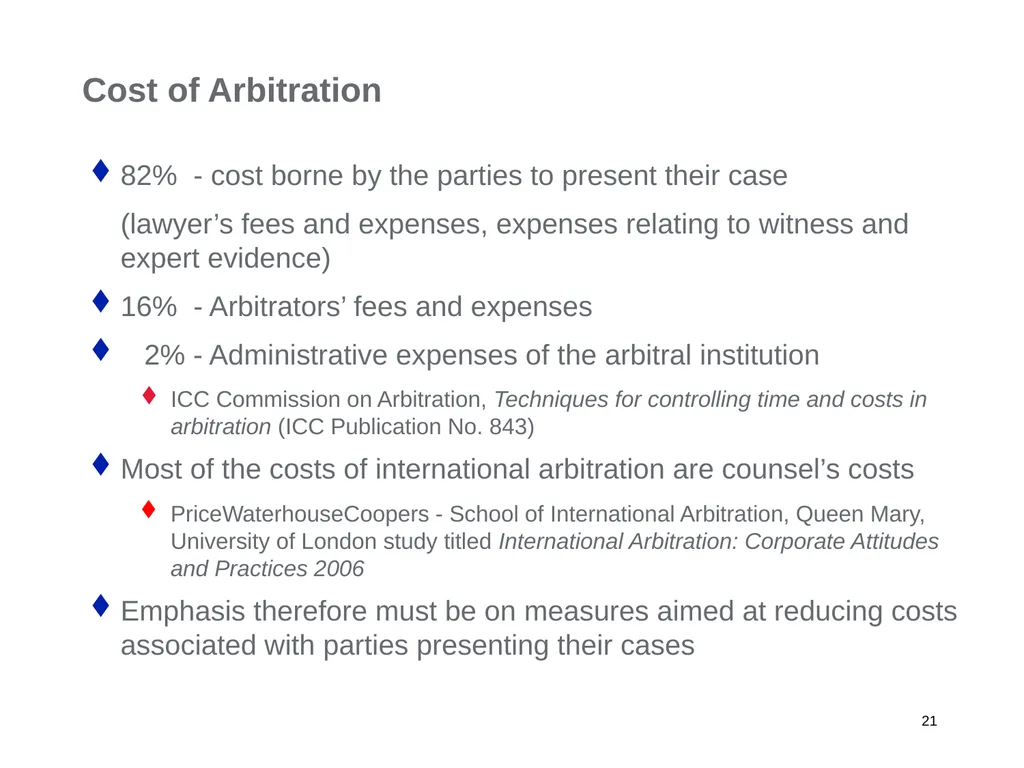
Cost of Arbitration 82% - cost borne by the parties to present their case
(lawyer’s fees and expenses, expenses relating to witness and expert evidence)
16% - Arbitrators’ fees and expenses
2% - Administrative expenses of the arbitral institution
ICC Commission on Arbitration, Techniques for controlling time and costs in arbitration (ICC Publication No. 843)
Most of the costs of international arbitration are counsel’s costs
PriceWaterhouseCoopers - School of International Arbitration, Queen Mary, University of London study titled International Arbitration: Corporate Attitudes and Practices 2006
Emphasis therefore must be on measures aimed at reducing costs associated with parties presenting their cases<br>
(lawyer’s fees and expenses, expenses relating to witness and expert evidence)
16% - Arbitrators’ fees and expenses
2% - Administrative expenses of the arbitral institution
ICC Commission on Arbitration, Techniques for controlling time and costs in arbitration (ICC Publication No. 843)
Most of the costs of international arbitration are counsel’s costs
PriceWaterhouseCoopers - School of International Arbitration, Queen Mary, University of London study titled International Arbitration: Corporate Attitudes and Practices 2006
Emphasis therefore must be on measures aimed at reducing costs associated with parties presenting their cases<br>
21
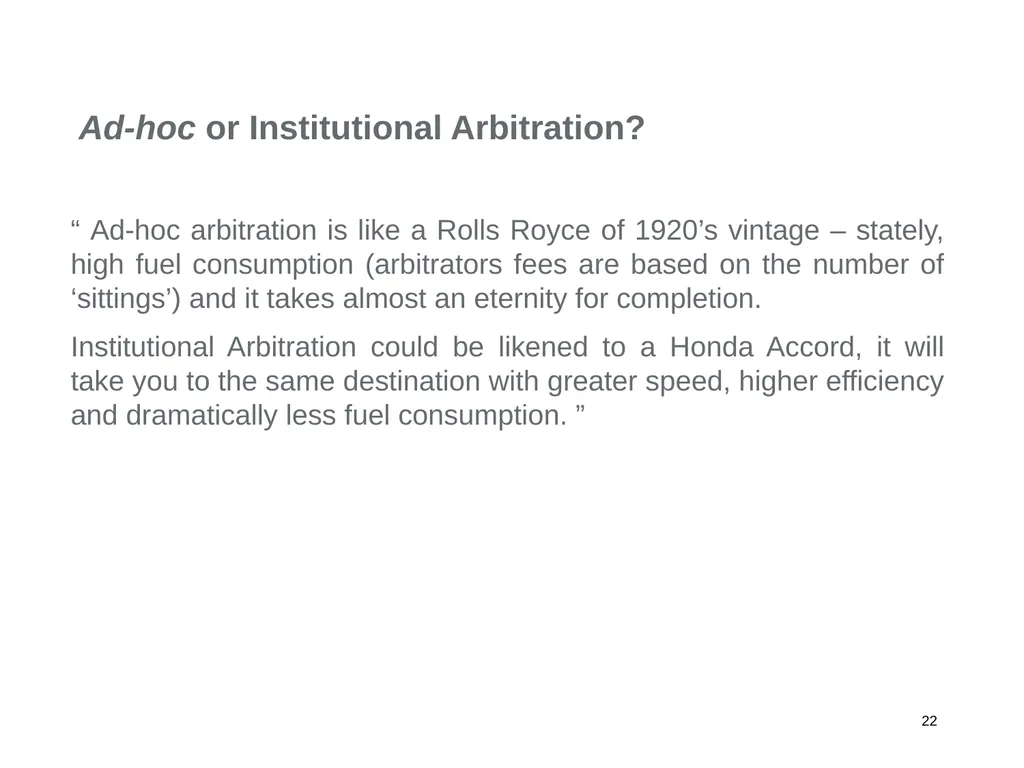
Ad-hoc or Institutional Arbitration? “ Ad-hoc arbitration is like a Rolls Royce of 1920’s vintage – stately, high fuel consumption (arbitrators fees are based on the number of ‘sittings’) and it takes almost an eternity for completion.
Institutional Arbitration could be likened to a Honda Accord, it will take you to the same destination with greater speed, higher efficiency and dramatically less fuel consumption. ”<br>
Institutional Arbitration could be likened to a Honda Accord, it will take you to the same destination with greater speed, higher efficiency and dramatically less fuel consumption. ”<br>
22
The rise and rise of Institutional Arbitration<br>
23
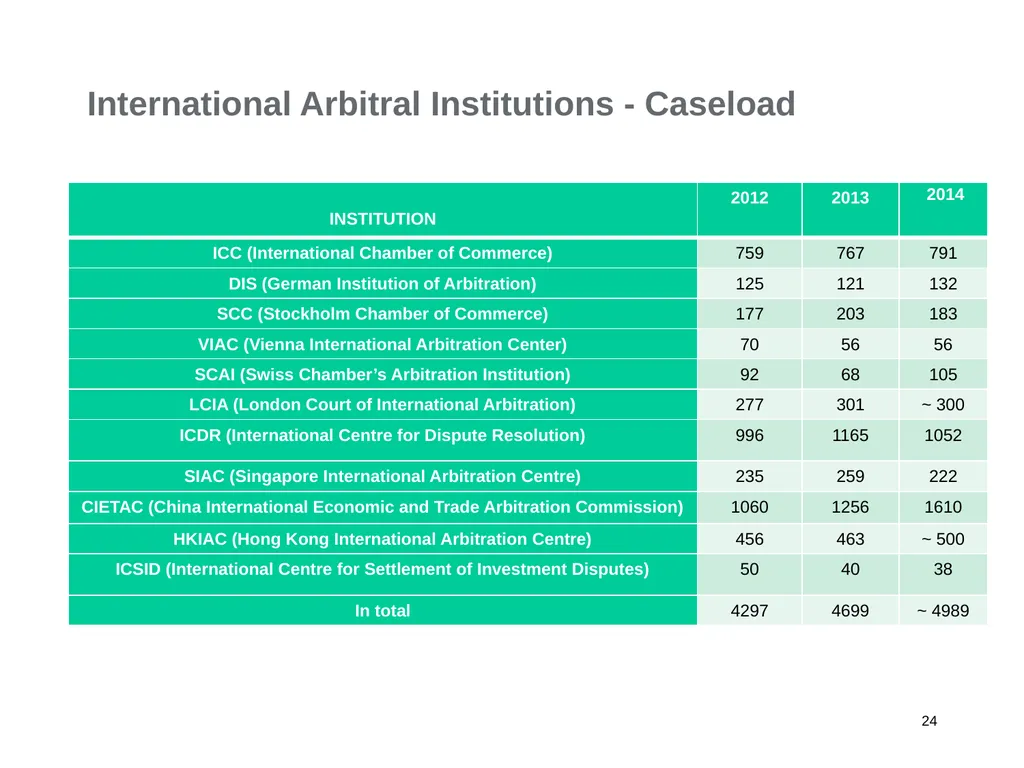
International Arbitral Institutions - Caseload<br>
24
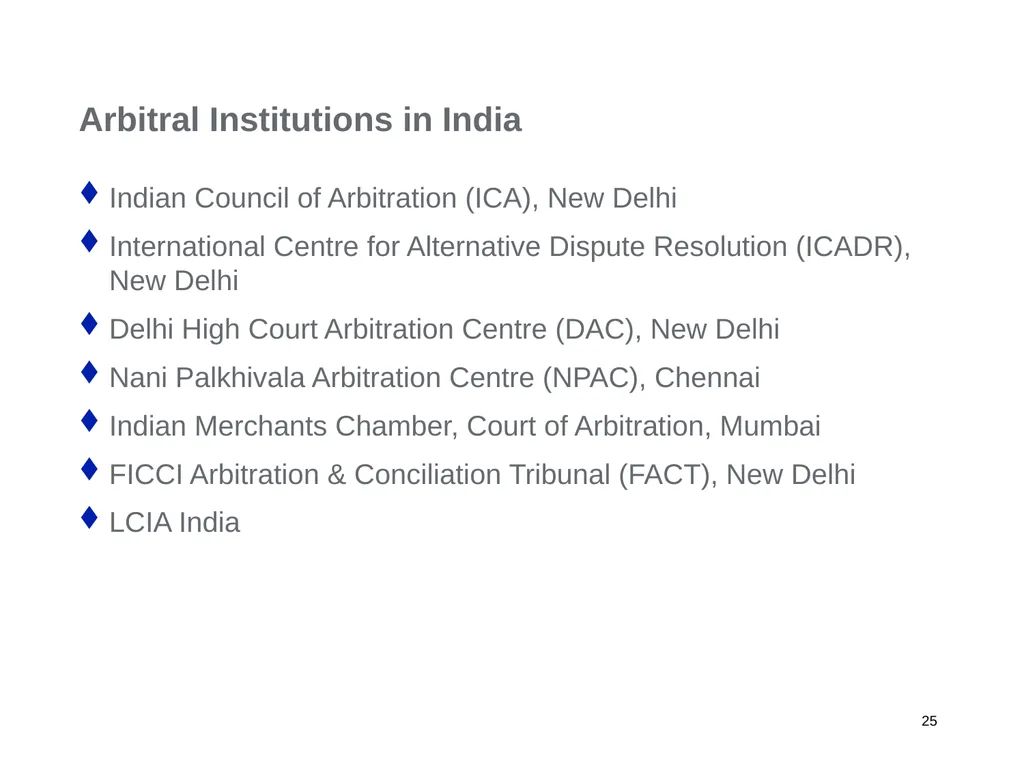
Arbitral Institutions in India Indian Council of Arbitration (ICA), New Delhi
International Centre for Alternative Dispute Resolution (ICADR), New Delhi
Delhi High Court Arbitration Centre (DAC), New Delhi
Nani Palkhivala Arbitration Centre (NPAC), Chennai
Indian Merchants Chamber, Court of Arbitration, Mumbai
FICCI Arbitration & Conciliation Tribunal (FACT), New Delhi
LCIA India<br>
International Centre for Alternative Dispute Resolution (ICADR), New Delhi
Delhi High Court Arbitration Centre (DAC), New Delhi
Nani Palkhivala Arbitration Centre (NPAC), Chennai
Indian Merchants Chamber, Court of Arbitration, Mumbai
FICCI Arbitration & Conciliation Tribunal (FACT), New Delhi
LCIA India<br>
25
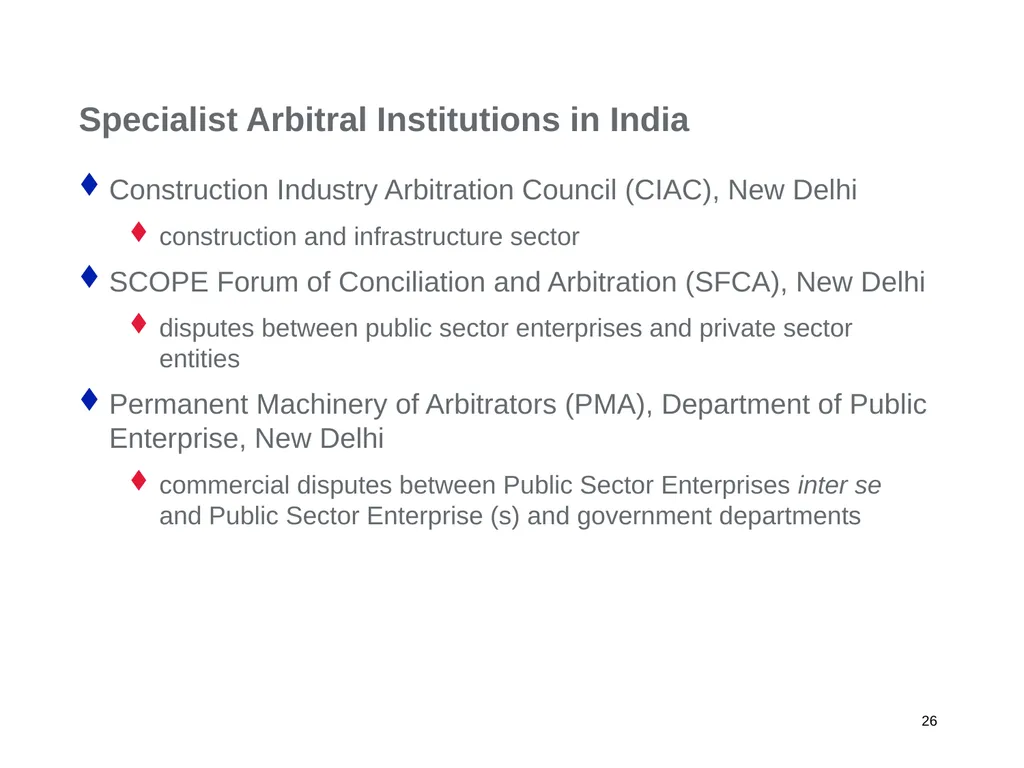
Specialist Arbitral Institutions in India Construction Industry Arbitration Council (CIAC), New Delhi
construction and infrastructure sector
SCOPE Forum of Conciliation and Arbitration (SFCA), New Delhi
disputes between public sector enterprises and private sector entities
Permanent Machinery of Arbitrators (PMA), Department of Public Enterprise, New Delhi
commercial disputes between Public Sector Enterprises inter se and Public Sector Enterprise (s) and government departments<br>
construction and infrastructure sector
SCOPE Forum of Conciliation and Arbitration (SFCA), New Delhi
disputes between public sector enterprises and private sector entities
Permanent Machinery of Arbitrators (PMA), Department of Public Enterprise, New Delhi
commercial disputes between Public Sector Enterprises inter se and Public Sector Enterprise (s) and government departments<br>
26
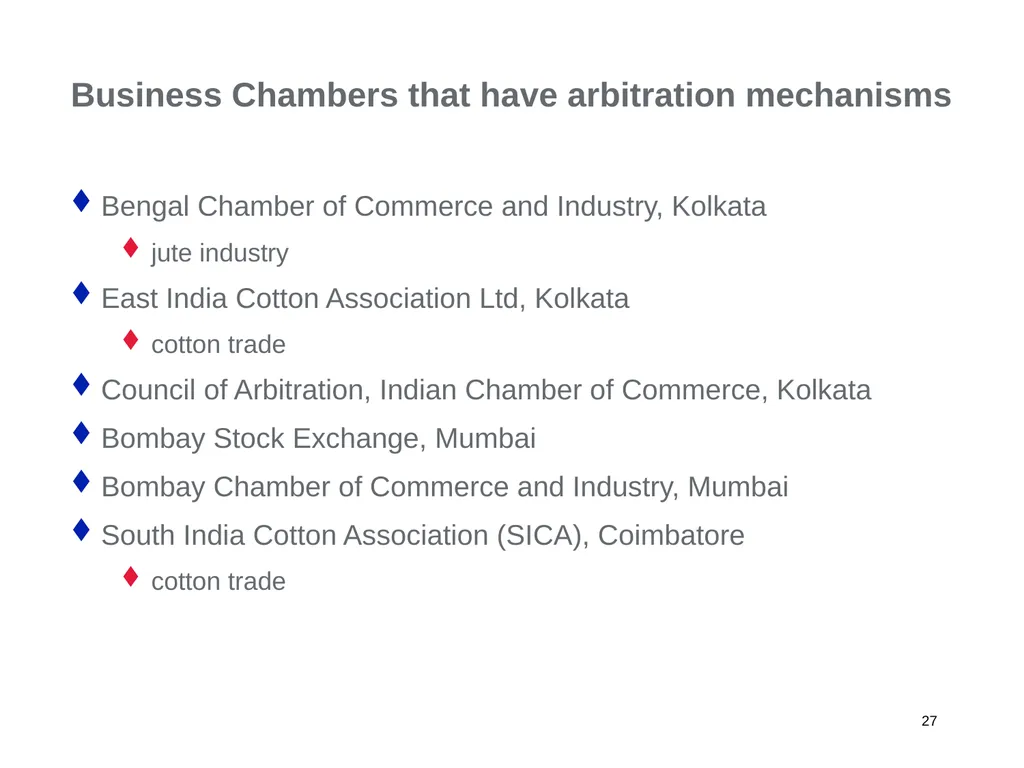
Business Chambers that have arbitration mechanisms Bengal Chamber of Commerce and Industry, Kolkata
jute industry
East India Cotton Association Ltd, Kolkata
cotton trade
Council of Arbitration, Indian Chamber of Commerce, Kolkata
Bombay Stock Exchange, Mumbai
Bombay Chamber of Commerce and Industry, Mumbai
South India Cotton Association (SICA), Coimbatore
cotton trade<br>
jute industry
East India Cotton Association Ltd, Kolkata
cotton trade
Council of Arbitration, Indian Chamber of Commerce, Kolkata
Bombay Stock Exchange, Mumbai
Bombay Chamber of Commerce and Industry, Mumbai
South India Cotton Association (SICA), Coimbatore
cotton trade<br>
27
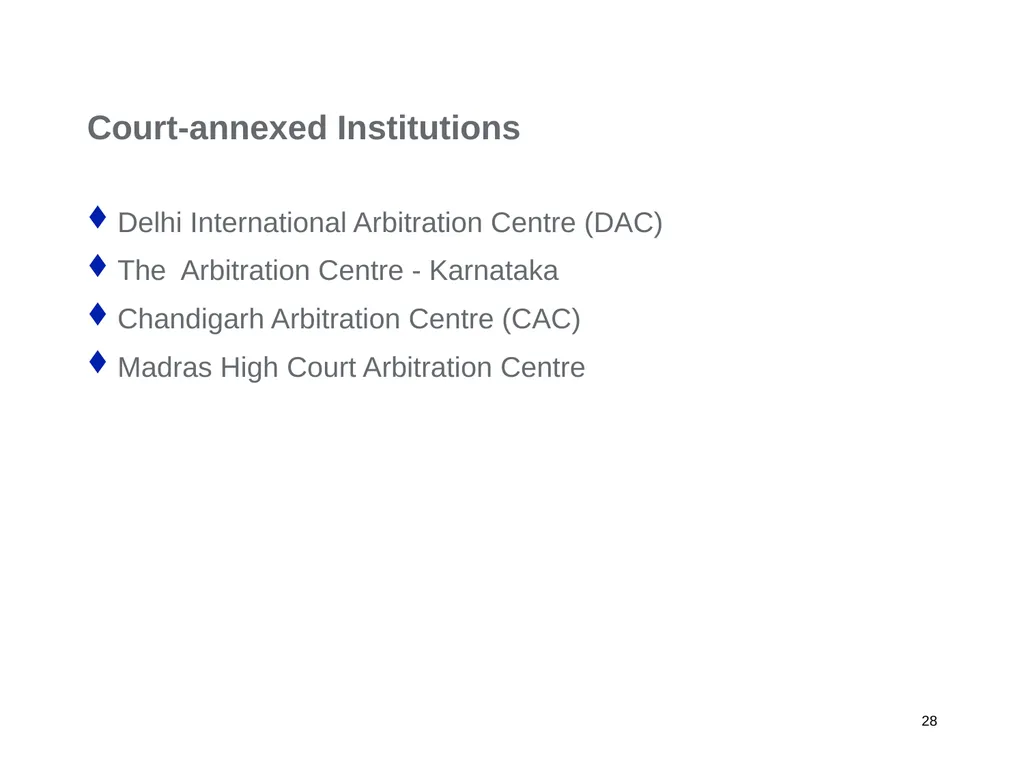
Court-annexed Institutions Delhi International Arbitration Centre (DAC)
The Arbitration Centre - Karnataka
Chandigarh Arbitration Centre (CAC)
Madras High Court Arbitration Centre<br>
The Arbitration Centre - Karnataka
Chandigarh Arbitration Centre (CAC)
Madras High Court Arbitration Centre<br>
28
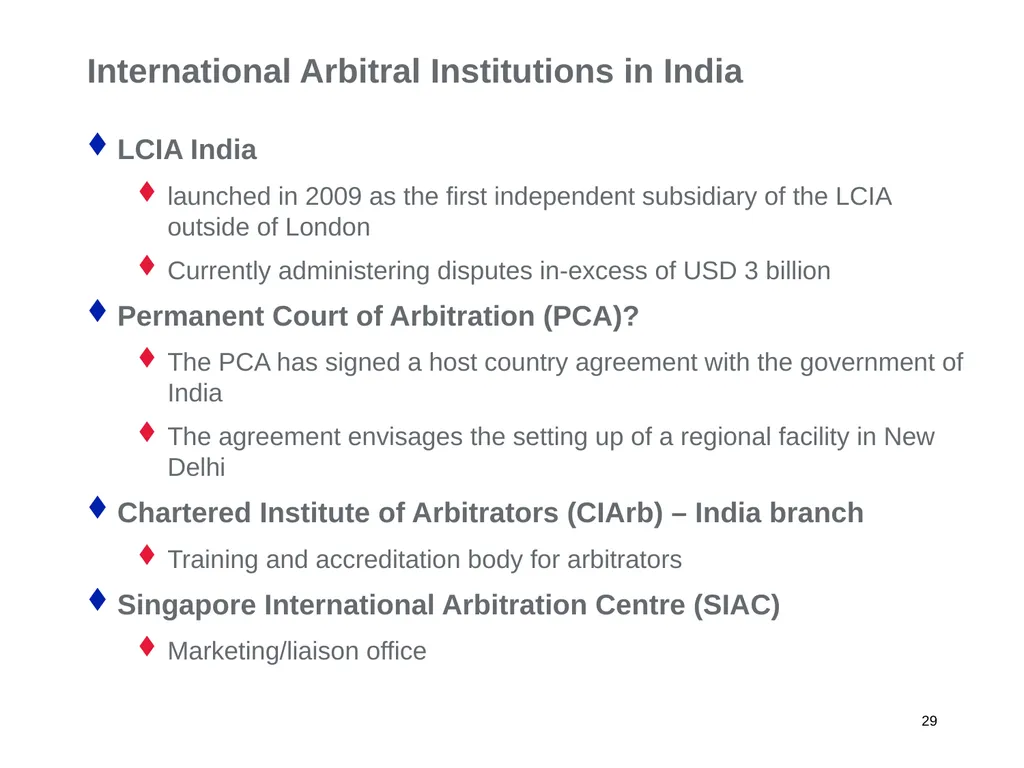
International Arbitral Institutions in India LCIA India
launched in 2009 as the first independent subsidiary of the LCIA outside of London
Currently administering disputes in-excess of USD 3 billion
Permanent Court of Arbitration (PCA)?
The PCA has signed a host country agreement with the government of India
The agreement envisages the setting up of a regional facility in New Delhi
Chartered Institute of Arbitrators (CIArb) – India branch
Training and accreditation body for arbitrators
Singapore International Arbitration Centre (SIAC)
Marketing/liaison office<br>
launched in 2009 as the first independent subsidiary of the LCIA outside of London
Currently administering disputes in-excess of USD 3 billion
Permanent Court of Arbitration (PCA)?
The PCA has signed a host country agreement with the government of India
The agreement envisages the setting up of a regional facility in New Delhi
Chartered Institute of Arbitrators (CIArb) – India branch
Training and accreditation body for arbitrators
Singapore International Arbitration Centre (SIAC)
Marketing/liaison office<br>
29
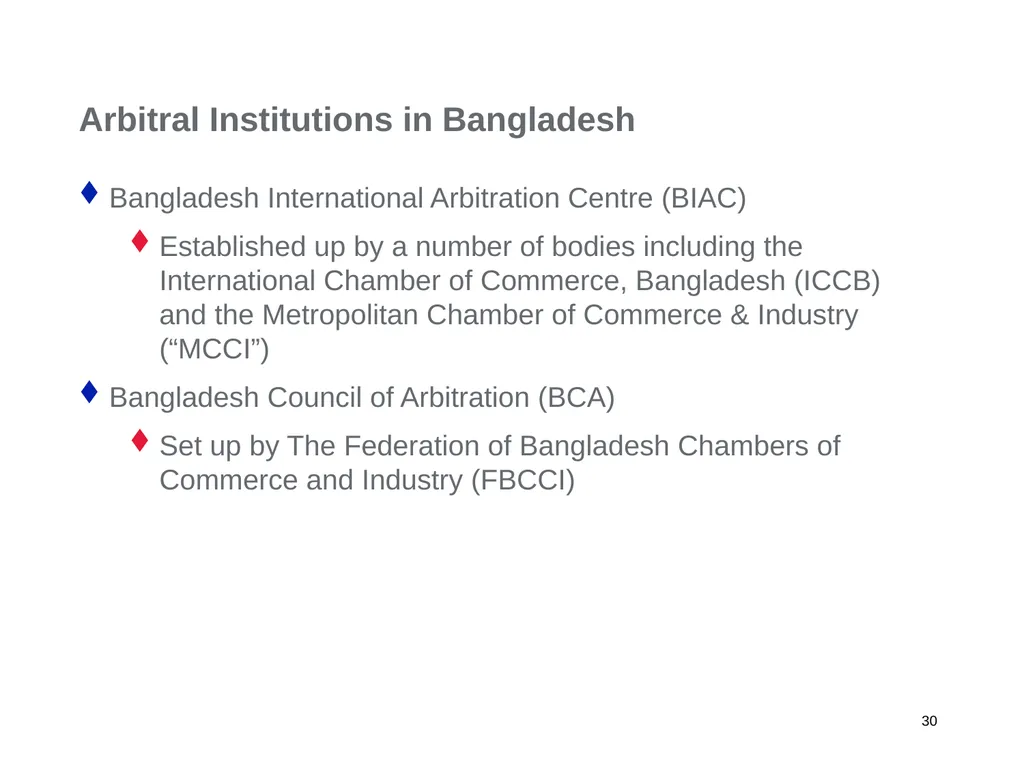
Arbitral Institutions in Bangladesh Bangladesh International Arbitration Centre (BIAC)
Established up by a number of bodies including the International Chamber of Commerce, Bangladesh (ICCB) and the Metropolitan Chamber of Commerce & Industry (“MCCI”)
Bangladesh Council of Arbitration (BCA)
Set up by The Federation of Bangladesh Chambers of Commerce and Industry (FBCCI)<br>
Established up by a number of bodies including the International Chamber of Commerce, Bangladesh (ICCB) and the Metropolitan Chamber of Commerce & Industry (“MCCI”)
Bangladesh Council of Arbitration (BCA)
Set up by The Federation of Bangladesh Chambers of Commerce and Industry (FBCCI)<br>
30
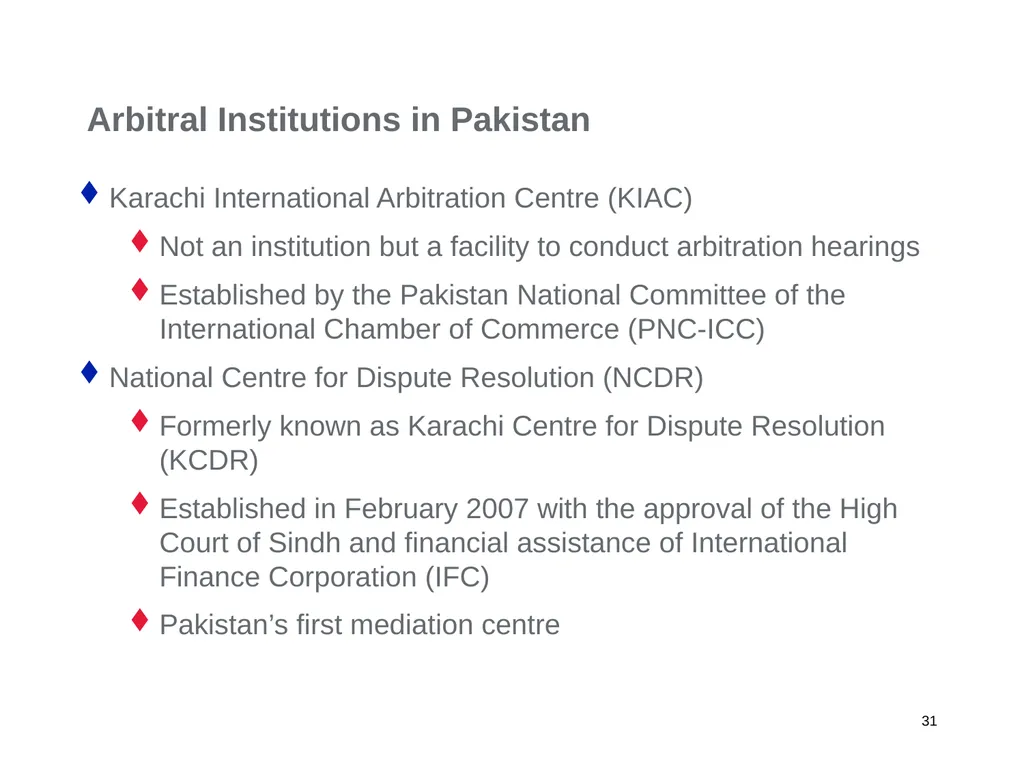
Arbitral Institutions in Pakistan Karachi International Arbitration Centre (KIAC)
Not an institution but a facility to conduct arbitration hearings
Established by the Pakistan National Committee of the International Chamber of Commerce (PNC-ICC)
National Centre for Dispute Resolution (NCDR)
Formerly known as Karachi Centre for Dispute Resolution (KCDR)
Established in February 2007 with the approval of the High Court of Sindh and financial assistance of International Finance Corporation (IFC)
Pakistan’s first mediation centre<br>
Not an institution but a facility to conduct arbitration hearings
Established by the Pakistan National Committee of the International Chamber of Commerce (PNC-ICC)
National Centre for Dispute Resolution (NCDR)
Formerly known as Karachi Centre for Dispute Resolution (KCDR)
Established in February 2007 with the approval of the High Court of Sindh and financial assistance of International Finance Corporation (IFC)
Pakistan’s first mediation centre<br>
31
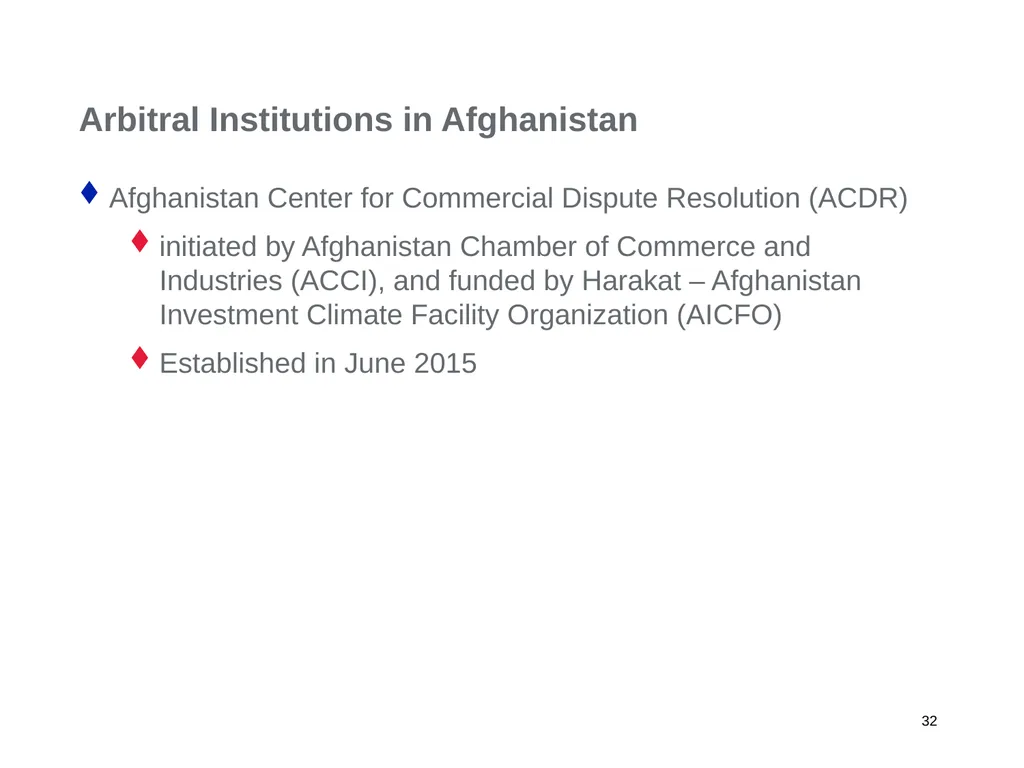
Arbitral Institutions in Afghanistan Afghanistan Center for Commercial Dispute Resolution (ACDR)
initiated by Afghanistan Chamber of Commerce and Industries (ACCI), and funded by Harakat – Afghanistan Investment Climate Facility Organization (AICFO)
Established in June 2015<br>
initiated by Afghanistan Chamber of Commerce and Industries (ACCI), and funded by Harakat – Afghanistan Investment Climate Facility Organization (AICFO)
Established in June 2015<br>
32
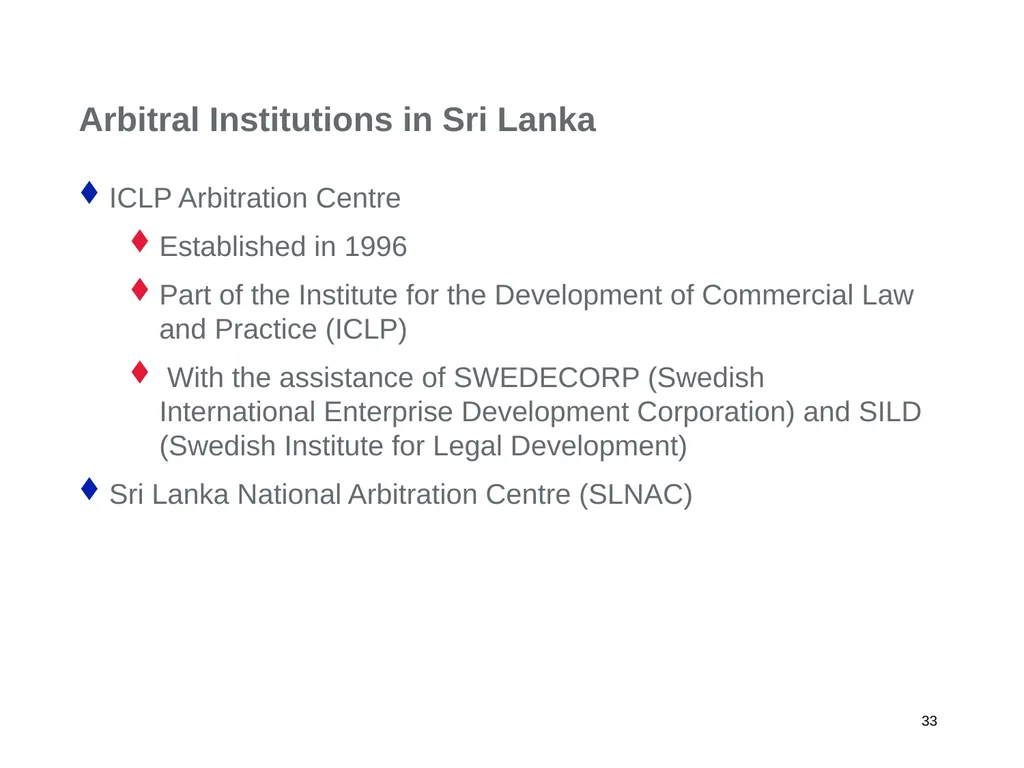
Arbitral Institutions in Sri Lanka ICLP Arbitration Centre
Established in 1996
Part of the Institute for the Development of Commercial Law and Practice (ICLP)
With the assistance of SWEDECORP (Swedish International Enterprise Development Corporation) and SILD (Swedish Institute for Legal Development)
Sri Lanka National Arbitration Centre (SLNAC)<br>
Established in 1996
Part of the Institute for the Development of Commercial Law and Practice (ICLP)
With the assistance of SWEDECORP (Swedish International Enterprise Development Corporation) and SILD (Swedish Institute for Legal Development)
Sri Lanka National Arbitration Centre (SLNAC)<br>
33
Arbitral Institutions in Nepal Nepal Council of Arbitration (NEPCA)
founded in 1991
Based in Kupondole<br>
founded in 1991
Based in Kupondole<br>
34
Arbitral Institutions in Bhutan Chapter 2 (Articles 4 - 24) of the Alternative Dispute Resolution Act of Bhutan, 2013
calls into existence the “Bhutan Alternative Dispute Resolution Centre”, as an independent and non-governmental body<br>
calls into existence the “Bhutan Alternative Dispute Resolution Centre”, as an independent and non-governmental body<br>
35
Arbitral Institutions in Maldives Chapter XI (Articles 75 - 81) of the Arbitration Act, 2013
For the purposes of this Act and in order to execute its duties under this Act, an arbitration center titled “Maldives International Arbitration Center” shall come into existence with the commencement of this Act.
All work leading up to the establishment of the Arbitration Center until the commencement of its operations shall be carried out by the Attorney General.<br>
For the purposes of this Act and in order to execute its duties under this Act, an arbitration center titled “Maldives International Arbitration Center” shall come into existence with the commencement of this Act.
All work leading up to the establishment of the Arbitration Center until the commencement of its operations shall be carried out by the Attorney General.<br>
36
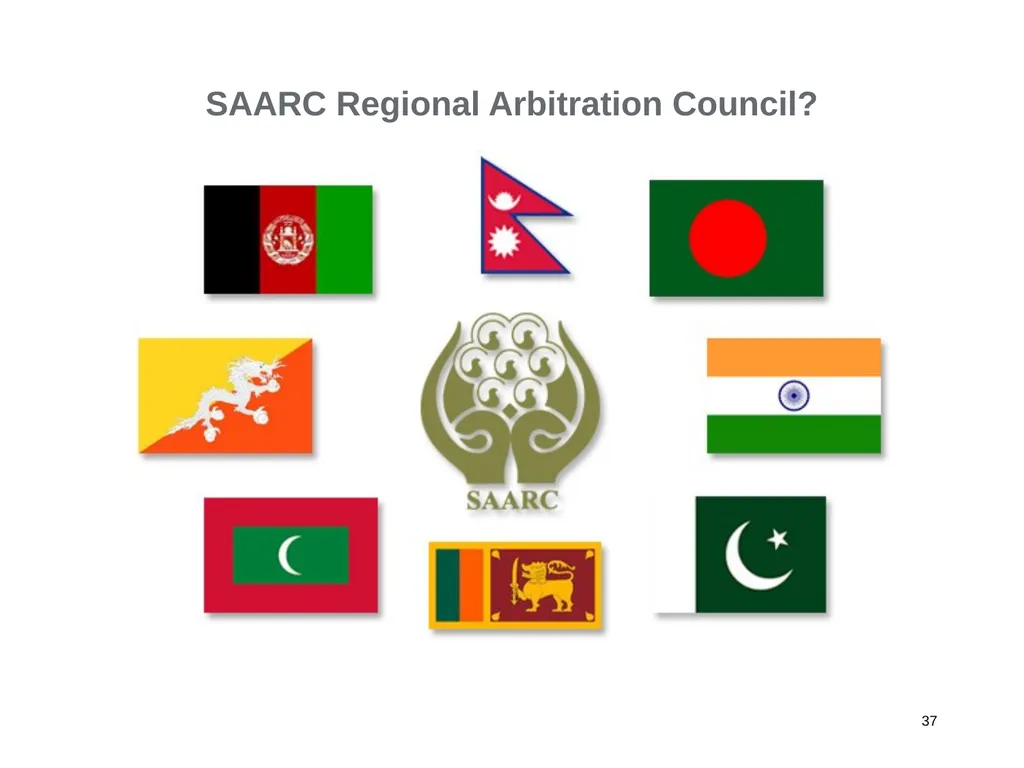
SAARC Regional Arbitration Council?<br>
37
SAARC Arbitration Council<br>
38
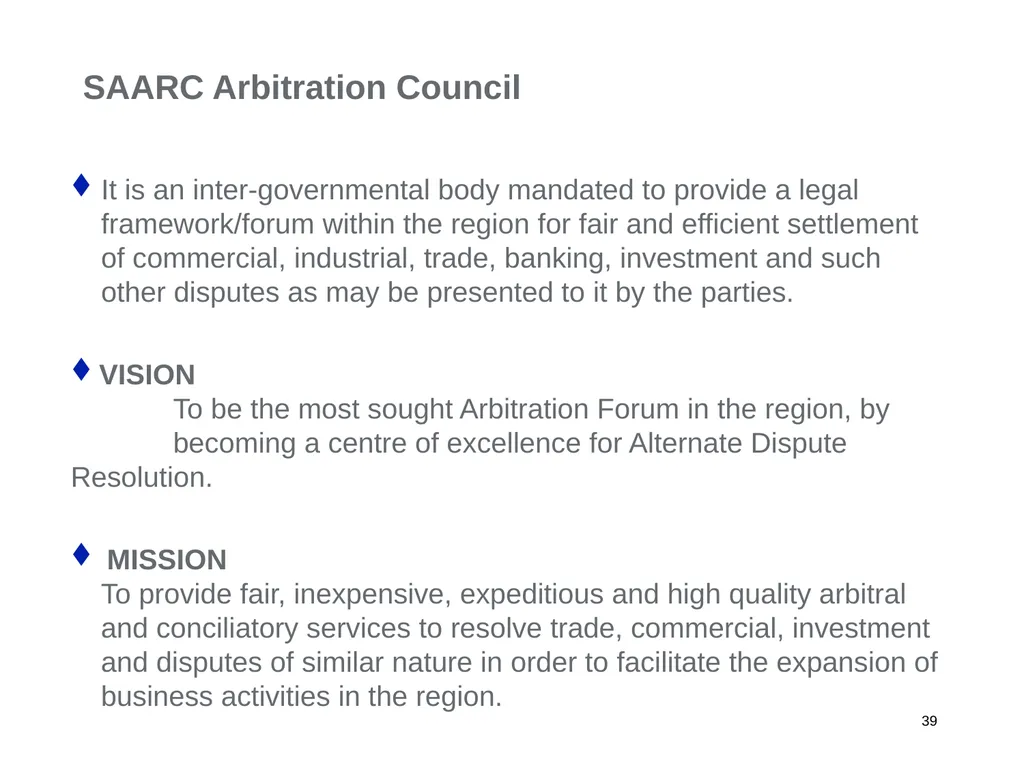
It is an inter-governmental body mandated to provide a legal framework/forum within the region for fair and efficient settlement of commercial, industrial, trade, banking, investment and such other disputes as may be presented to it by the parties.
VISION
To be the most sought Arbitration Forum in the region, by becoming a centre of excellence for Alternate Dispute Resolution.
MISSION To provide fair, inexpensive, expeditious and high quality arbitral and conciliatory services to resolve trade, commercial, investment and disputes of similar nature in order to facilitate the expansion of business activities in the region. SAARC Arbitration Council<br>
VISION
To be the most sought Arbitration Forum in the region, by becoming a centre of excellence for Alternate Dispute Resolution.
MISSION To provide fair, inexpensive, expeditious and high quality arbitral and conciliatory services to resolve trade, commercial, investment and disputes of similar nature in order to facilitate the expansion of business activities in the region. SAARC Arbitration Council<br>
39
1985 - Dhaka: The South Asian States met and decided to establish South Asian Association for Regional Cooperation (SAARC)
2004 - Islamabad: The SAARC Council of Ministers decides to establish Conciliation and Arbitration mechanism for the region under the auspices of SAARC.
2005 - Dhaka: An agreement for establishment of SAARC Arbitration Council (SARCO) was signed
2010: Secretariat established in Islamabad
Headed by a Director General - Thusantha Wijemanna (Sri Lanka) preceded by Syed Sultan Ahmed (Pakistan)
Rules modelled on the UNCIRAL Arbitration Rules Evolution<br>
2004 - Islamabad: The SAARC Council of Ministers decides to establish Conciliation and Arbitration mechanism for the region under the auspices of SAARC.
2005 - Dhaka: An agreement for establishment of SAARC Arbitration Council (SARCO) was signed
2010: Secretariat established in Islamabad
Headed by a Director General - Thusantha Wijemanna (Sri Lanka) preceded by Syed Sultan Ahmed (Pakistan)
Rules modelled on the UNCIRAL Arbitration Rules Evolution<br>
40
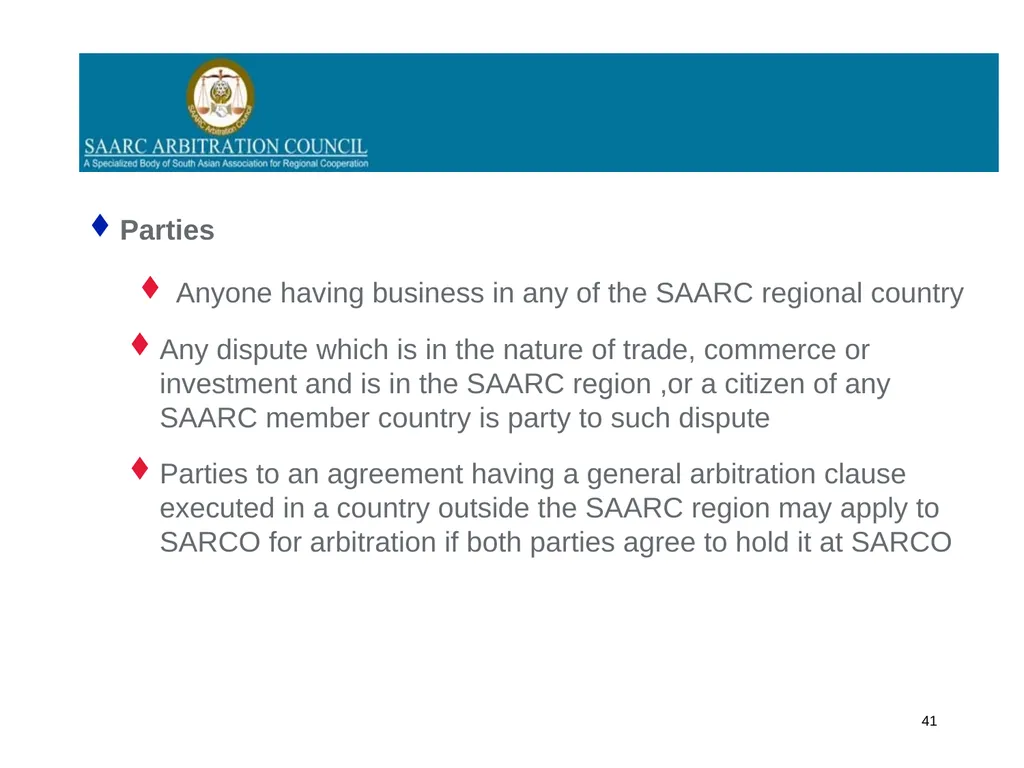
Parties
Anyone having business in any of the SAARC regional country
Any dispute which is in the nature of trade, commerce or investment and is in the SAARC region ,or a citizen of any SAARC member country is party to such dispute
Parties to an agreement having a general arbitration clause executed in a country outside the SAARC region may apply to SARCO for arbitration if both parties agree to hold it at SARCO<br>
Anyone having business in any of the SAARC regional country
Any dispute which is in the nature of trade, commerce or investment and is in the SAARC region ,or a citizen of any SAARC member country is party to such dispute
Parties to an agreement having a general arbitration clause executed in a country outside the SAARC region may apply to SARCO for arbitration if both parties agree to hold it at SARCO<br>
41
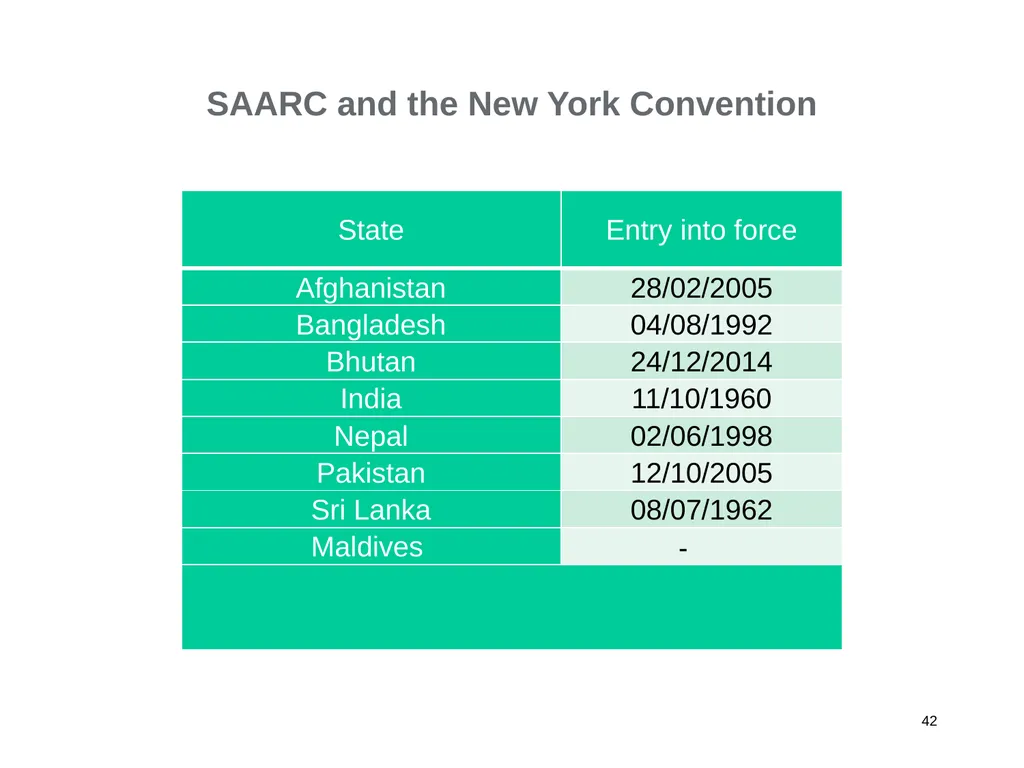
SAARC and the New York Convention<br>
42
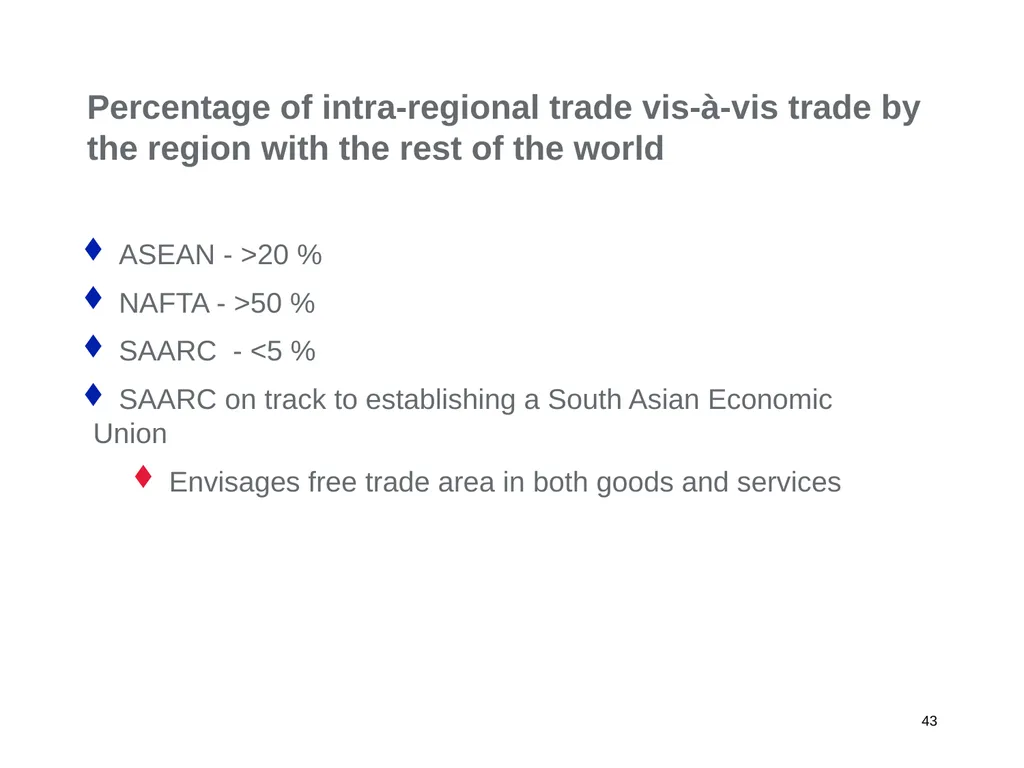
ASEAN - >20 %
NAFTA - >50 %
SAARC - <5 %
SAARC on track to establishing a South Asian Economic Union
Envisages free trade area in both goods and services Percentage of intra-regional trade vis-à-vis trade by the region with the rest of the world<br>
NAFTA - >50 %
SAARC - <5 %
SAARC on track to establishing a South Asian Economic Union
Envisages free trade area in both goods and services Percentage of intra-regional trade vis-à-vis trade by the region with the rest of the world<br>