
A Review for the essay and Presentation: Arguments
PC
Published · 61 slides · 0 views

1 / 1











Description
A Review for the essay and Presentation: Arguments from the articles in the Kit on University and Popular culture University and Society Popular culture Intellectualism Anti-intellectualism A university is an institution of higher education
Related Topics
Share
Embed code
Download this presentation From Below
"A Review for the essay and Presentation: Arguments" is the property of its rightful owner. Permission is granted to download and print the materials on this website for personal, non-commercial use only, and to display it on your personal computer provided you do not modify the materials and that you retain all copyright notices contained in the materials. By downloading content from our website, you accept the terms of this agreement.
Presentation Transcript
01
A Review for the essay and Presentation:
Arguments from the articles in the Kit on University and Popular culture<br>
Arguments from the articles in the Kit on University and Popular culture<br>
02
University and Society
Popular culture
Intellectualism
Anti-intellectualism<br>
Popular culture
Intellectualism
Anti-intellectualism<br>
03
A university is an institution of higher
education and of research, which
grants academic degrees.
University shapes intellectuals
Its tools: disciplines, professors, curricula,
Libraries, readings
Outcome: Shaping individual’s minds,
thoughts, professions and careers.<br>
education and of research, which
grants academic degrees.
University shapes intellectuals
Its tools: disciplines, professors, curricula,
Libraries, readings
Outcome: Shaping individual’s minds,
thoughts, professions and careers.<br>
04
Popular culture shapes public assumptions and opinions on Intellectuals.
e.g.: movies or Ads shape the popular images of professors, students, and schools.<br>
e.g.: movies or Ads shape the popular images of professors, students, and schools.<br>
05
Intellectualism:
Content and methods of one who pursues knowledge in science and art.<br>
Content and methods of one who pursues knowledge in science and art.<br>
06
Anti-intellectualism
describes hostility towards, or a mistrust of intellectuals, and their intellectual pursuits.
expressed in various ways: e.g., attack on the merits of science, education, or literature<br>
describes hostility towards, or a mistrust of intellectuals, and their intellectual pursuits.
expressed in various ways: e.g., attack on the merits of science, education, or literature<br>
07
Anti-intellectualism (contd.)
Reflects an attitude that simply takes "intellectualism" with a grain of salt
Assumes that intellectuals may be vain or narcissistic in their self-image,
“Common people” view intellectuals as a fallible human archetype.<br>
Reflects an attitude that simply takes "intellectualism" with a grain of salt
Assumes that intellectuals may be vain or narcissistic in their self-image,
“Common people” view intellectuals as a fallible human archetype.<br>
08
Where does it exist?
In every country
Most influential in USA
New England Puritan writer John Cotton wrote in 1642:
"The more learned and witty you bee, the more fit to act for Satan will you bee."<br>
In every country
Most influential in USA
New England Puritan writer John Cotton wrote in 1642:
"The more learned and witty you bee, the more fit to act for Satan will you bee."<br>
09
Popular cultural representations: Movies, TV and other pop media
Dimitriadis, G (2006) :
Representations have cumulative power
Conversations privilege certain thought and discourses
Dimitriadis, G. (2006) 'On the Production of Expert Knowledge: Revisiting Edward Said's work on the intellectual', Discourse: Studies in the Cultural Politics of Education, 27:3, 369 – 382.<br>
Dimitriadis, G (2006) :
Representations have cumulative power
Conversations privilege certain thought and discourses
Dimitriadis, G. (2006) 'On the Production of Expert Knowledge: Revisiting Edward Said's work on the intellectual', Discourse: Studies in the Cultural Politics of Education, 27:3, 369 – 382.<br>
10
On university & Popular culture
Morrison (2000): University must examine, evaluate, posit and reinforce values.
Giroux (2002): Corporate culture has intruded into and taken over the university
Tsoukas: Popular public assumption is the authorities’ knowledges (i.e. information) give them the power to manage the society.<br>
Morrison (2000): University must examine, evaluate, posit and reinforce values.
Giroux (2002): Corporate culture has intruded into and taken over the university
Tsoukas: Popular public assumption is the authorities’ knowledges (i.e. information) give them the power to manage the society.<br>
11
On popular media:
Winter, J (2002): The repercussions of the media concentration in Canada for the general public are the loss of editorial autonomy of each paper and its columnists. corporate headquarters, not the editors make news judgments. In this process, dissenting views are censored and repressed.
Yang, M., et al.(2006): Media advertising affects consumers' purchase decisions might not only be conscious but unconscious. Characters’ use of brands and a story association with brands than brands placed in the background are recognized at higher levels of cognition.
Andrejevic, M (2011): Relentless privatization of a publicly funded Internet as a public space has led to the commercial colonization that turned it into an economy based on surveillance. This power of surveillance manages & controls consumers in their behaviour on the web. Commercialization manipulates the social relations between the users and the commercial entity to control users’ access and to commercially benefit from tracking the public that empowered it.<br>
Winter, J (2002): The repercussions of the media concentration in Canada for the general public are the loss of editorial autonomy of each paper and its columnists. corporate headquarters, not the editors make news judgments. In this process, dissenting views are censored and repressed.
Yang, M., et al.(2006): Media advertising affects consumers' purchase decisions might not only be conscious but unconscious. Characters’ use of brands and a story association with brands than brands placed in the background are recognized at higher levels of cognition.
Andrejevic, M (2011): Relentless privatization of a publicly funded Internet as a public space has led to the commercial colonization that turned it into an economy based on surveillance. This power of surveillance manages & controls consumers in their behaviour on the web. Commercialization manipulates the social relations between the users and the commercial entity to control users’ access and to commercially benefit from tracking the public that empowered it.<br>
12
Uses of popular media for health monitoring:
Bauer & Olsen (2009): monitoring and imaging of the body and digital databases – collect data on population health becomes surveillance in new ways.
Surveillance modes: Panoptic, oligoptic and synoptic , together operate in medical observation. Techniques of surveillance monitors the individual patient’s body
As it is deployed in making clinical decisions upon the medical evidence and in preventing health problems. Surveillance being inherent to diagnostics in the present times, it is a key mechanism in governing populations.<br>
Bauer & Olsen (2009): monitoring and imaging of the body and digital databases – collect data on population health becomes surveillance in new ways.
Surveillance modes: Panoptic, oligoptic and synoptic , together operate in medical observation. Techniques of surveillance monitors the individual patient’s body
As it is deployed in making clinical decisions upon the medical evidence and in preventing health problems. Surveillance being inherent to diagnostics in the present times, it is a key mechanism in governing populations.<br>
13
Is Online learning a system for managing and controlling people according to the objectives, i.e., to regulate learning
Stricker et al. (2011): If Online learning is combined with lecture in class may not increase students’ workload much, while improving their course performance
In contrast, several studies have shown that online learning may increase students’ workload, and may lead to a higher dropout rate of online learners (Carr, 2000; Dutton, Dutton, & Perry, 2002).
Is online learning a ‘disciplining’ or self-actualizing process?
Good achievement via self-regulated learning requires a strong will to learn and excellent learning skills (Torrano & González, 2004).<br>
Stricker et al. (2011): If Online learning is combined with lecture in class may not increase students’ workload much, while improving their course performance
In contrast, several studies have shown that online learning may increase students’ workload, and may lead to a higher dropout rate of online learners (Carr, 2000; Dutton, Dutton, & Perry, 2002).
Is online learning a ‘disciplining’ or self-actualizing process?
Good achievement via self-regulated learning requires a strong will to learn and excellent learning skills (Torrano & González, 2004).<br>
14
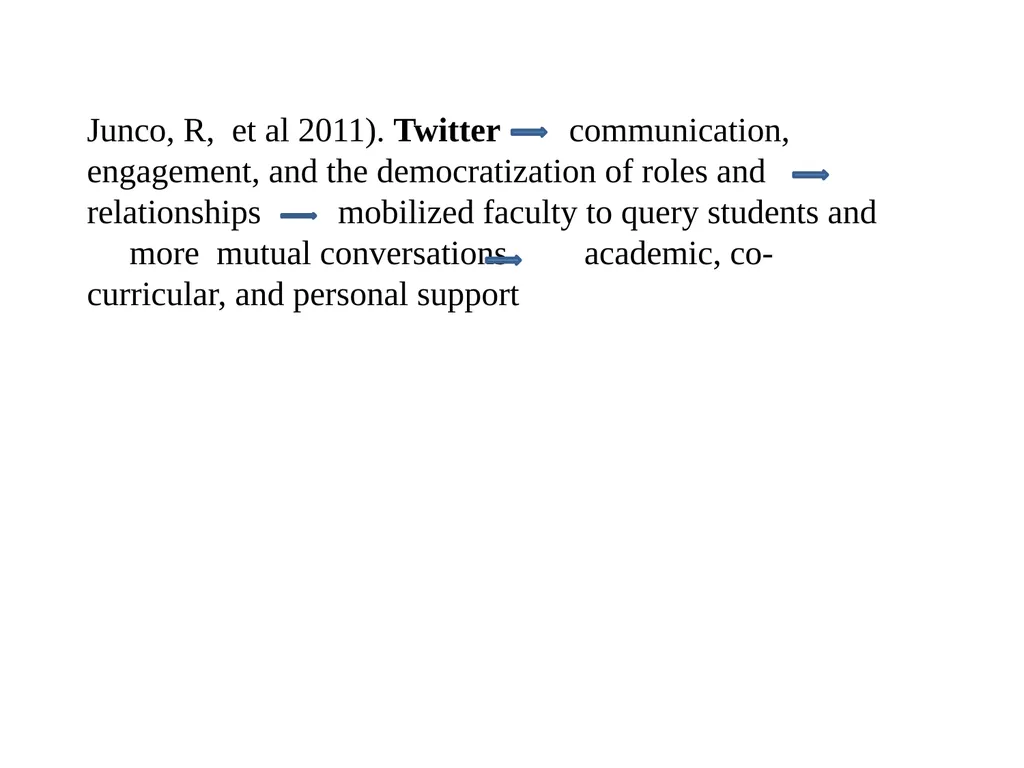
Junco, R, et al 2011). Twitter communication, engagement, and the democratization of roles and relationships mobilized faculty to query students and more mutual conversations academic, co-curricular, and personal support<br>
15
Social Networking (popular media) as an educational tool:
Educational use of social networking technology in higher education (Hsiu-Ting Hung and Steve Chi-Yin Yuen)
SN facilitates:
development of classroom communities
strengthening students’ emotional connectedness
participants’ enhanced engagement and mutual support<br>
Educational use of social networking technology in higher education (Hsiu-Ting Hung and Steve Chi-Yin Yuen)
SN facilitates:
development of classroom communities
strengthening students’ emotional connectedness
participants’ enhanced engagement and mutual support<br>
16
Hung & Yuen (cont’d)
Foucault: Discipline: People are regulated by instruments of power which organize their space (architecture) and time (schedule).
Hung & Yuen: Students’ perceptions of enhanced sense of classroom community were closely related to the information sharing function and the interaction function of the social media.
Foucault: Surveillance: A constant gaze controls the prisoners affecting not only what they do but how they see themselves
Foucault: Discourse: “Practices of obeying certain rules”
Hung & Yuen Social networking for building ‘community of learners’: sharing personal interests -This course site was fun and interesting-feel more connected and closer to them-expect to get feedback<br>
Foucault: Discipline: People are regulated by instruments of power which organize their space (architecture) and time (schedule).
Hung & Yuen: Students’ perceptions of enhanced sense of classroom community were closely related to the information sharing function and the interaction function of the social media.
Foucault: Surveillance: A constant gaze controls the prisoners affecting not only what they do but how they see themselves
Foucault: Discourse: “Practices of obeying certain rules”
Hung & Yuen Social networking for building ‘community of learners’: sharing personal interests -This course site was fun and interesting-feel more connected and closer to them-expect to get feedback<br>
17
http://tvo.org/video/210751/susan-pinker-village-effect
Susan Pinker says real world social circles are essential to our wellbeing and health, and as valuable as exercise and good diet. Susan Pinker sits down with Steve Paikin to discuss what it lost when we rely on social media for our human connections.<br>
Susan Pinker says real world social circles are essential to our wellbeing and health, and as valuable as exercise and good diet. Susan Pinker sits down with Steve Paikin to discuss what it lost when we rely on social media for our human connections.<br>
18
Kelly, P. et al (2007): Individualization, Normalization & Body shaped by knowledge/power
F’s ethical self formation through diversity of conduct:
Determination of ethical substance
Mode of subjection
Ethical work
Purpose of the ethical subject
A ‘Corporate Athlete’: normalized body; health of the body over the role of the mind; profile score of body fitness; corporate health is linked to employees’ health; freedom/ethics of self is practiced in pursuit of management devised (outsourced) goals; one becomes such a person through the discursive practices: being balanced, effective, regular.<br>
F’s ethical self formation through diversity of conduct:
Determination of ethical substance
Mode of subjection
Ethical work
Purpose of the ethical subject
A ‘Corporate Athlete’: normalized body; health of the body over the role of the mind; profile score of body fitness; corporate health is linked to employees’ health; freedom/ethics of self is practiced in pursuit of management devised (outsourced) goals; one becomes such a person through the discursive practices: being balanced, effective, regular.<br>
19
F’s Ethical self: F’s themes for Plagiarism/cheating
Advanced Capitalist society: cut-throat competition, insecurities and uncertainties in the workplace.
‘Individualized’ worker/citizen: They have to exercise/practice their freedom in specific ways that conforms to the expectation of the market place
F’s term ‘Conduct’: equivocal in nature- is it conformity to power as it suits one’s purpose or is it questioned as unethical
Character (Sennett, R. (1998) cited in Kelly (2007)): loyalty, mutual commitment, ethical value of our desires and of our relations with others.
How do we decide what is of lasting value in ourselves in a society that pushes immediate gratification?
F’s process of formation of an ethical self.<br>
Advanced Capitalist society: cut-throat competition, insecurities and uncertainties in the workplace.
‘Individualized’ worker/citizen: They have to exercise/practice their freedom in specific ways that conforms to the expectation of the market place
F’s term ‘Conduct’: equivocal in nature- is it conformity to power as it suits one’s purpose or is it questioned as unethical
Character (Sennett, R. (1998) cited in Kelly (2007)): loyalty, mutual commitment, ethical value of our desires and of our relations with others.
How do we decide what is of lasting value in ourselves in a society that pushes immediate gratification?
F’s process of formation of an ethical self.<br>
20
Judith Butler:
http://www.egs.edu/faculty/judith-butler/articles/foucault-and-the-paradox-of-bodily-inscriptions/
Resist normative power
Gender Trouble: normalization is repeated performance – normative is repetition of the norm
Resist hierarchal binarism
e.g.: drag queens- better women (high normative feminism) compared to women
Subversion by changing a little each time you represent through disruption
Repetitions often fail to perfectly conform to the norms that inspire/require them.
How many of us fail to perform ideal (hetero, white, able-bodied, middle-class) masculinity or femininity? Even most hetero white able-bodied middle-class women fail to perform ideal femininity
In the potential for (intentionally or unintentionally) imperfect repetitions, that disciplinary power produces its own resistances.<br>
http://www.egs.edu/faculty/judith-butler/articles/foucault-and-the-paradox-of-bodily-inscriptions/
Resist normative power
Gender Trouble: normalization is repeated performance – normative is repetition of the norm
Resist hierarchal binarism
e.g.: drag queens- better women (high normative feminism) compared to women
Subversion by changing a little each time you represent through disruption
Repetitions often fail to perfectly conform to the norms that inspire/require them.
How many of us fail to perform ideal (hetero, white, able-bodied, middle-class) masculinity or femininity? Even most hetero white able-bodied middle-class women fail to perform ideal femininity
In the potential for (intentionally or unintentionally) imperfect repetitions, that disciplinary power produces its own resistances.<br>
21
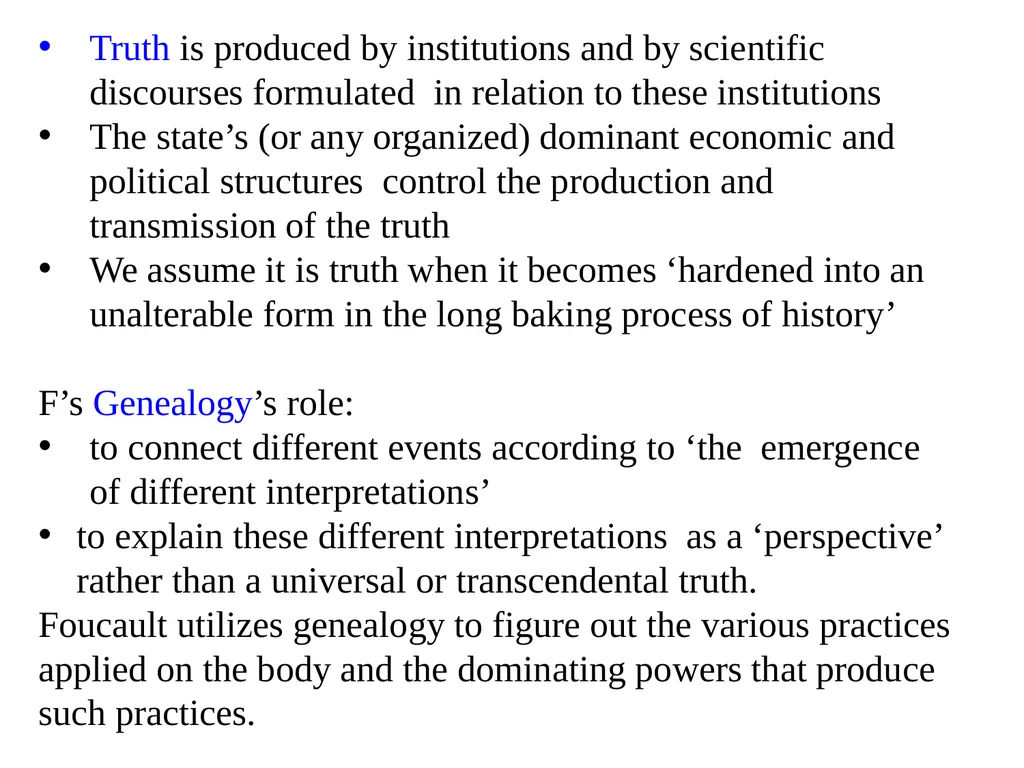
Truth is produced by institutions and by scientific discourses formulated in relation to these institutions
The state’s (or any organized) dominant economic and political structures control the production and transmission of the truth
We assume it is truth when it becomes ‘hardened into an unalterable form in the long baking process of history’
F’s Genealogy’s role:
to connect different events according to ‘the emergence of different interpretations’
to explain these different interpretations as a ‘perspective’ rather than a universal or transcendental truth.
Foucault utilizes genealogy to figure out the various practices applied on the body and the dominating powers that produce such practices.<br>
The state’s (or any organized) dominant economic and political structures control the production and transmission of the truth
We assume it is truth when it becomes ‘hardened into an unalterable form in the long baking process of history’
F’s Genealogy’s role:
to connect different events according to ‘the emergence of different interpretations’
to explain these different interpretations as a ‘perspective’ rather than a universal or transcendental truth.
Foucault utilizes genealogy to figure out the various practices applied on the body and the dominating powers that produce such practices.<br>
22
Foucault:
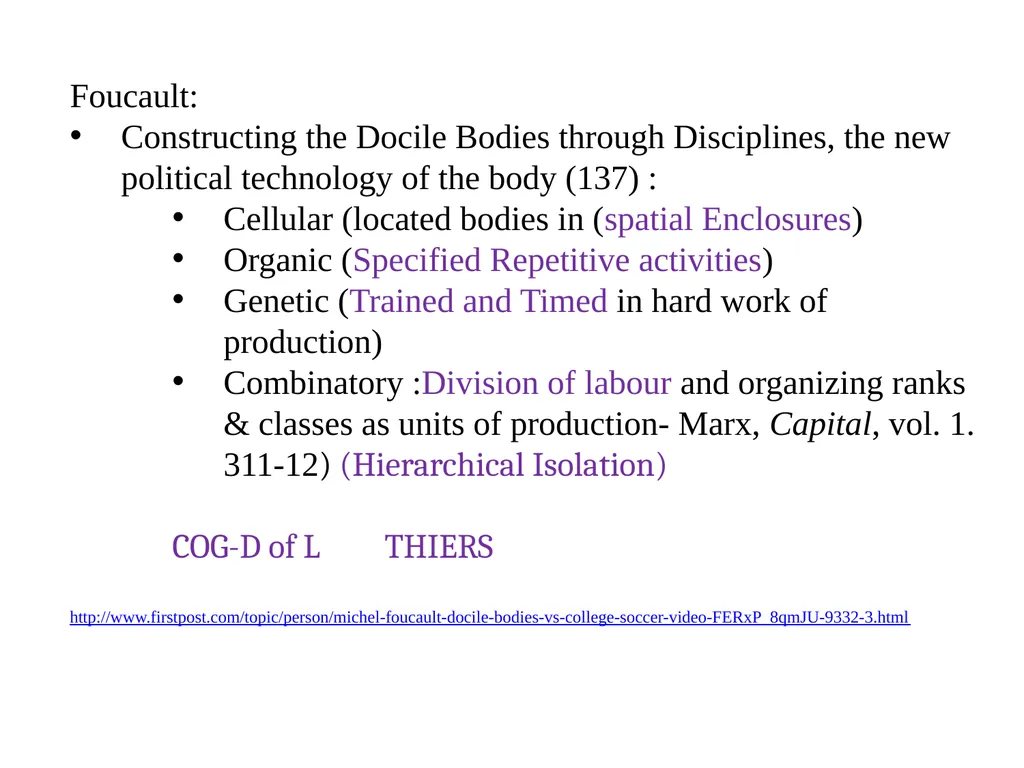
Constructing the Docile Bodies through Disciplines, the new political technology of the body (137) :
Cellular (located bodies in (spatial Enclosures)
Organic (Specified Repetitive activities)
Genetic (Trained and Timed in hard work of production)
Combinatory :Division of labour and organizing ranks & classes as units of production- Marx, Capital, vol. 1. 311-12) (Hierarchical Isolation)
COG-D of L THIERS
http://www.firstpost.com/topic/person/michel-foucault-docile-bodies-vs-college-soccer-video-FERxP_8qmJU-9332-3.html<br>
Constructing the Docile Bodies through Disciplines, the new political technology of the body (137) :
Cellular (located bodies in (spatial Enclosures)
Organic (Specified Repetitive activities)
Genetic (Trained and Timed in hard work of production)
Combinatory :Division of labour and organizing ranks & classes as units of production- Marx, Capital, vol. 1. 311-12) (Hierarchical Isolation)
COG-D of L THIERS
http://www.firstpost.com/topic/person/michel-foucault-docile-bodies-vs-college-soccer-video-FERxP_8qmJU-9332-3.html<br>
23
Source: http://www.tumblr.com/tagged/docile-bodies see examples on blogs
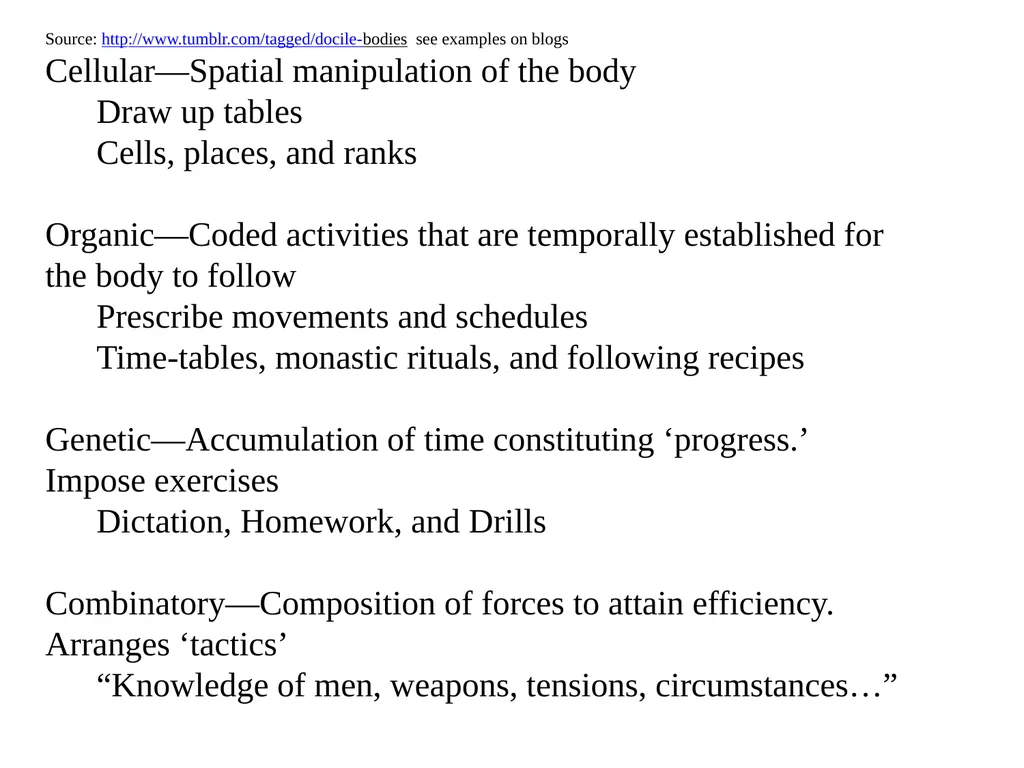
Cellular—Spatial manipulation of the body
Draw up tables
Cells, places, and ranks
Organic—Coded activities that are temporally established for the body to follow
Prescribe movements and schedules
Time-tables, monastic rituals, and following recipes
Genetic—Accumulation of time constituting ‘progress.’
Impose exercises
Dictation, Homework, and Drills
Combinatory—Composition of forces to attain efficiency.
Arranges ‘tactics’
“Knowledge of men, weapons, tensions, circumstances…”<br>
Cellular—Spatial manipulation of the body
Draw up tables
Cells, places, and ranks
Organic—Coded activities that are temporally established for the body to follow
Prescribe movements and schedules
Time-tables, monastic rituals, and following recipes
Genetic—Accumulation of time constituting ‘progress.’
Impose exercises
Dictation, Homework, and Drills
Combinatory—Composition of forces to attain efficiency.
Arranges ‘tactics’
“Knowledge of men, weapons, tensions, circumstances…”<br>
24
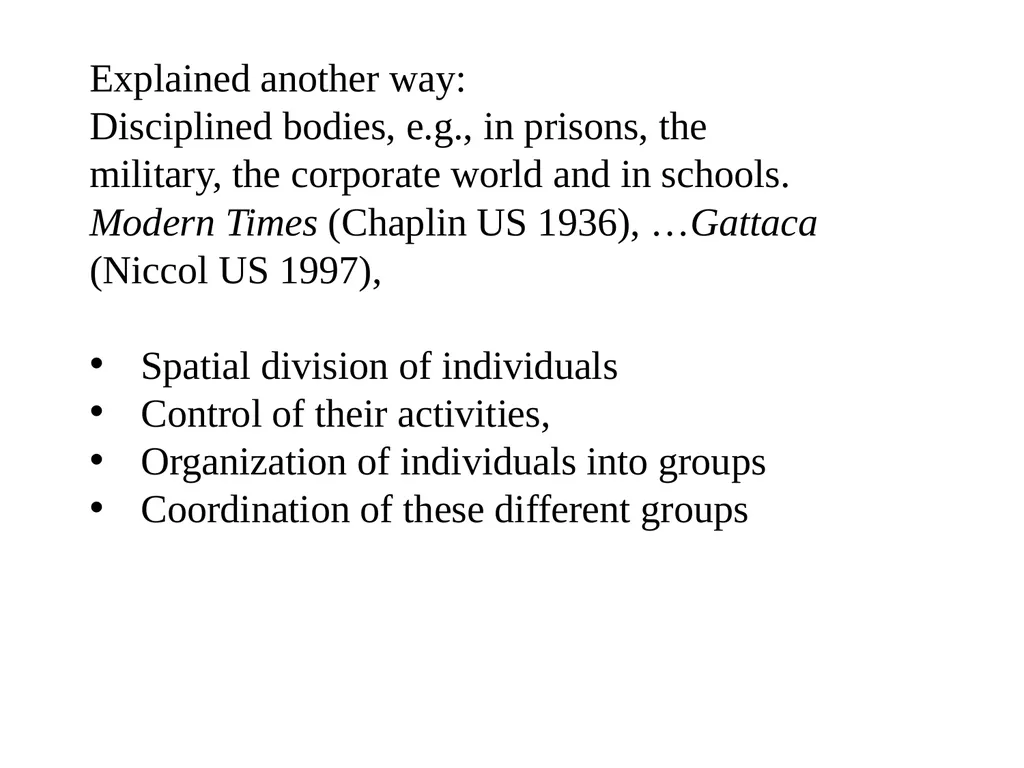
Explained another way:
Disciplined bodies, e.g., in prisons, the military, the corporate world and in schools. Modern Times (Chaplin US 1936), …Gattaca (Niccol US 1997),
Spatial division of individuals
Control of their activities,
Organization of individuals into groups
Coordination of these different groups<br>
Disciplined bodies, e.g., in prisons, the military, the corporate world and in schools. Modern Times (Chaplin US 1936), …Gattaca (Niccol US 1997),
Spatial division of individuals
Control of their activities,
Organization of individuals into groups
Coordination of these different groups<br>
25
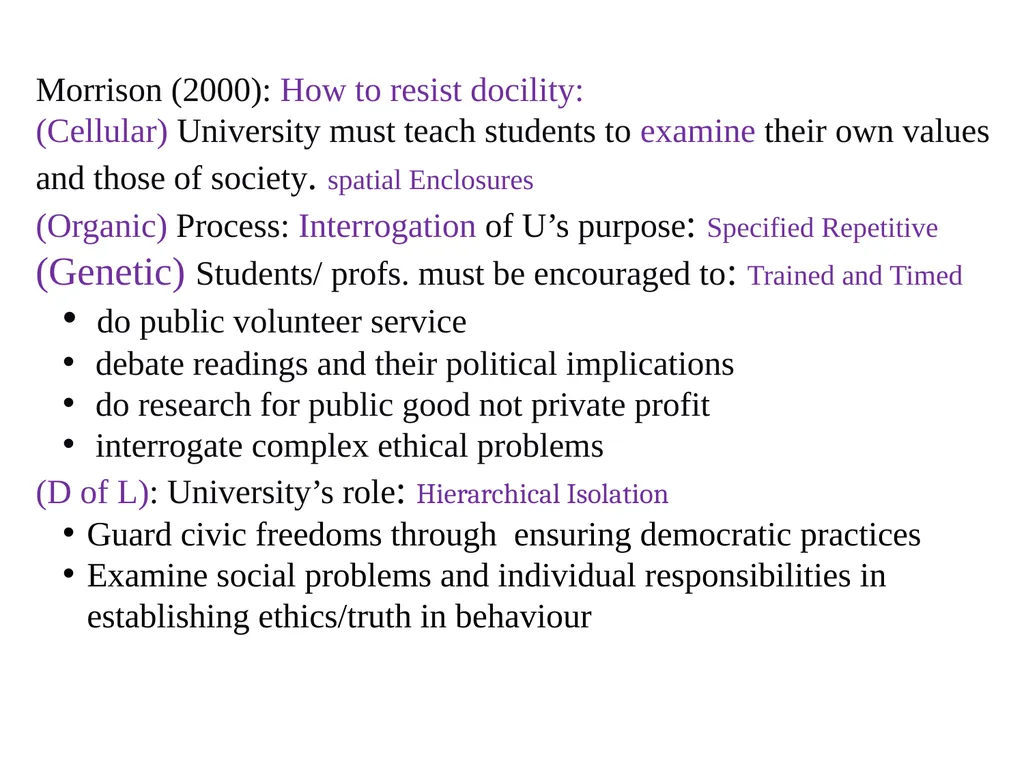
Morrison (2000): How to resist docility:
(Cellular) University must teach students to examine their own values and those of society. spatial Enclosures
(Organic) Process: Interrogation of U’s purpose: Specified Repetitive
(Genetic) Students/ profs. must be encouraged to: Trained and Timed
do public volunteer service
debate readings and their political implications
do research for public good not private profit
interrogate complex ethical problems
(D of L): University’s role: Hierarchical Isolation
Guard civic freedoms through ensuring democratic practices
Examine social problems and individual responsibilities in establishing ethics/truth in behaviour<br>
(Cellular) University must teach students to examine their own values and those of society. spatial Enclosures
(Organic) Process: Interrogation of U’s purpose: Specified Repetitive
(Genetic) Students/ profs. must be encouraged to: Trained and Timed
do public volunteer service
debate readings and their political implications
do research for public good not private profit
interrogate complex ethical problems
(D of L): University’s role: Hierarchical Isolation
Guard civic freedoms through ensuring democratic practices
Examine social problems and individual responsibilities in establishing ethics/truth in behaviour<br>
26
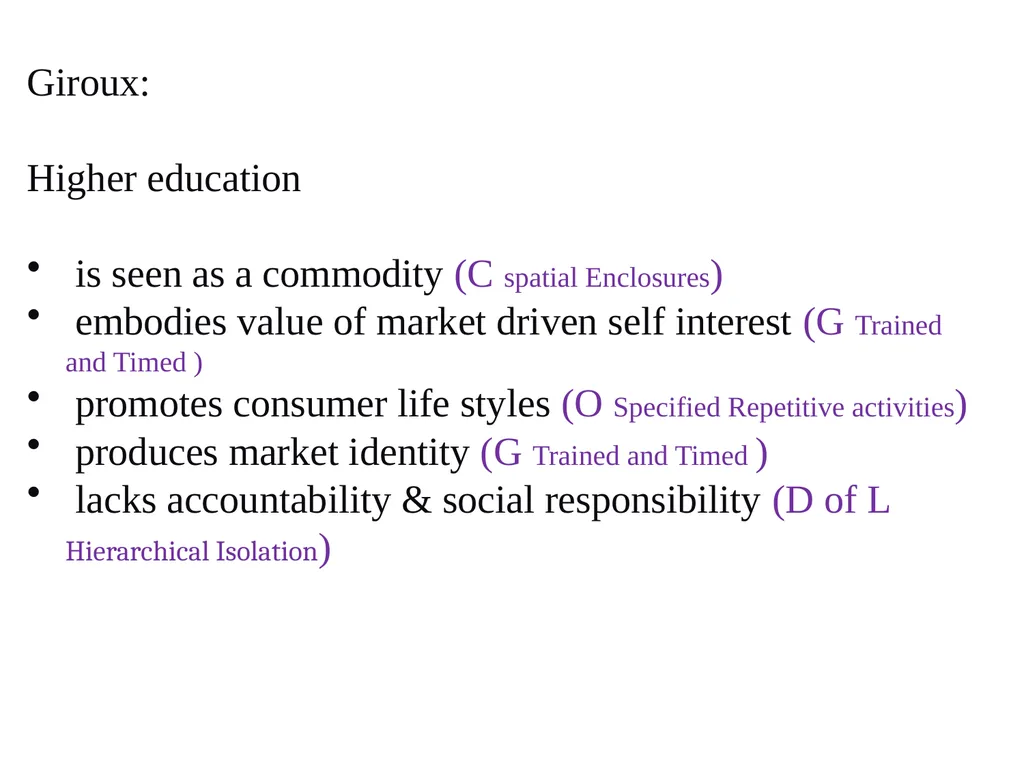
Giroux:
Higher education
is seen as a commodity (C spatial Enclosures)
embodies value of market driven self interest (G Trained and Timed )
promotes consumer life styles (O Specified Repetitive activities)
produces market identity (G Trained and Timed )
lacks accountability & social responsibility (D of L Hierarchical Isolation)<br>
Higher education
is seen as a commodity (C spatial Enclosures)
embodies value of market driven self interest (G Trained and Timed )
promotes consumer life styles (O Specified Repetitive activities)
produces market identity (G Trained and Timed )
lacks accountability & social responsibility (D of L Hierarchical Isolation)<br>
27
Giroux: Corporate funding of and corporate culture in higher education:
Corporate control over what and how we learn/research in univ. reduces ability of the state and civil society spatial Enclosures (univ. not open to shape one’s self or social values)
Driven by profit motive - ‘applied’ (vs. ‘pure’) research Trained and Timed
Experiments at the cost of ethics Specified Repetitive activities
Advances vocational learning vs. pure knowledge Trained and Timed<br>
Corporate control over what and how we learn/research in univ. reduces ability of the state and civil society spatial Enclosures (univ. not open to shape one’s self or social values)
Driven by profit motive - ‘applied’ (vs. ‘pure’) research Trained and Timed
Experiments at the cost of ethics Specified Repetitive activities
Advances vocational learning vs. pure knowledge Trained and Timed<br>
28
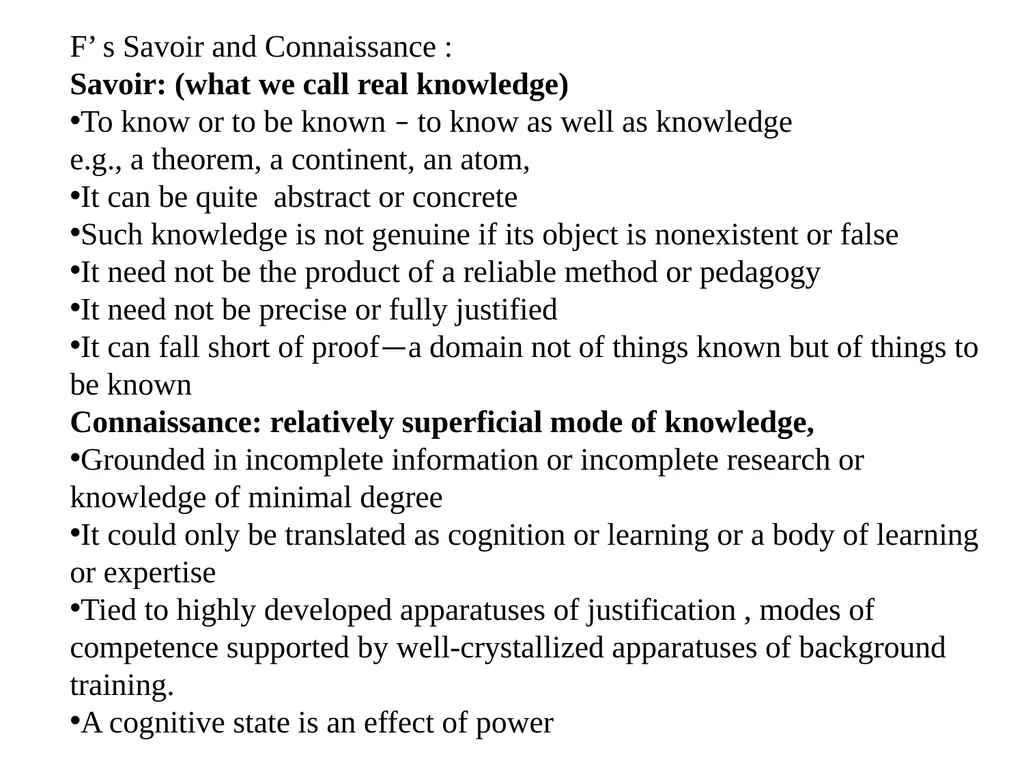
F’ s Savoir and Connaissance :
Savoir: (what we call real knowledge)
To know or to be known – to know as well as knowledge
e.g., a theorem, a continent, an atom,
It can be quite abstract or concrete
Such knowledge is not genuine if its object is nonexistent or false
It need not be the product of a reliable method or pedagogy
It need not be precise or fully justified
It can fall short of proof—a domain not of things known but of things to be known
Connaissance: relatively superficial mode of knowledge,
Grounded in incomplete information or incomplete research or knowledge of minimal degree
It could only be translated as cognition or learning or a body of learning or expertise
Tied to highly developed apparatuses of justification , modes of competence supported by well-crystallized apparatuses of background training.
A cognitive state is an effect of power<br>
Savoir: (what we call real knowledge)
To know or to be known – to know as well as knowledge
e.g., a theorem, a continent, an atom,
It can be quite abstract or concrete
Such knowledge is not genuine if its object is nonexistent or false
It need not be the product of a reliable method or pedagogy
It need not be precise or fully justified
It can fall short of proof—a domain not of things known but of things to be known
Connaissance: relatively superficial mode of knowledge,
Grounded in incomplete information or incomplete research or knowledge of minimal degree
It could only be translated as cognition or learning or a body of learning or expertise
Tied to highly developed apparatuses of justification , modes of competence supported by well-crystallized apparatuses of background training.
A cognitive state is an effect of power<br>
29
Foucault ‘s biopower
It is a technology which appeared in the late eighteenth century for managing populations.
It incorporates disciplinary power.
Disciplinary power is about training the actions of individuals (their bodies)
Biopower is that of official organizations (the state or government) managing the society: births, deaths, reproduction and illnesses of a population.
Refer to the practice of modern states and their regulation of their subjects through "an explosion of numerous and diverse techniques for achieving the subjugations of bodies and the control of populations.” (Foucault).<br>
It is a technology which appeared in the late eighteenth century for managing populations.
It incorporates disciplinary power.
Disciplinary power is about training the actions of individuals (their bodies)
Biopower is that of official organizations (the state or government) managing the society: births, deaths, reproduction and illnesses of a population.
Refer to the practice of modern states and their regulation of their subjects through "an explosion of numerous and diverse techniques for achieving the subjugations of bodies and the control of populations.” (Foucault).<br>
30
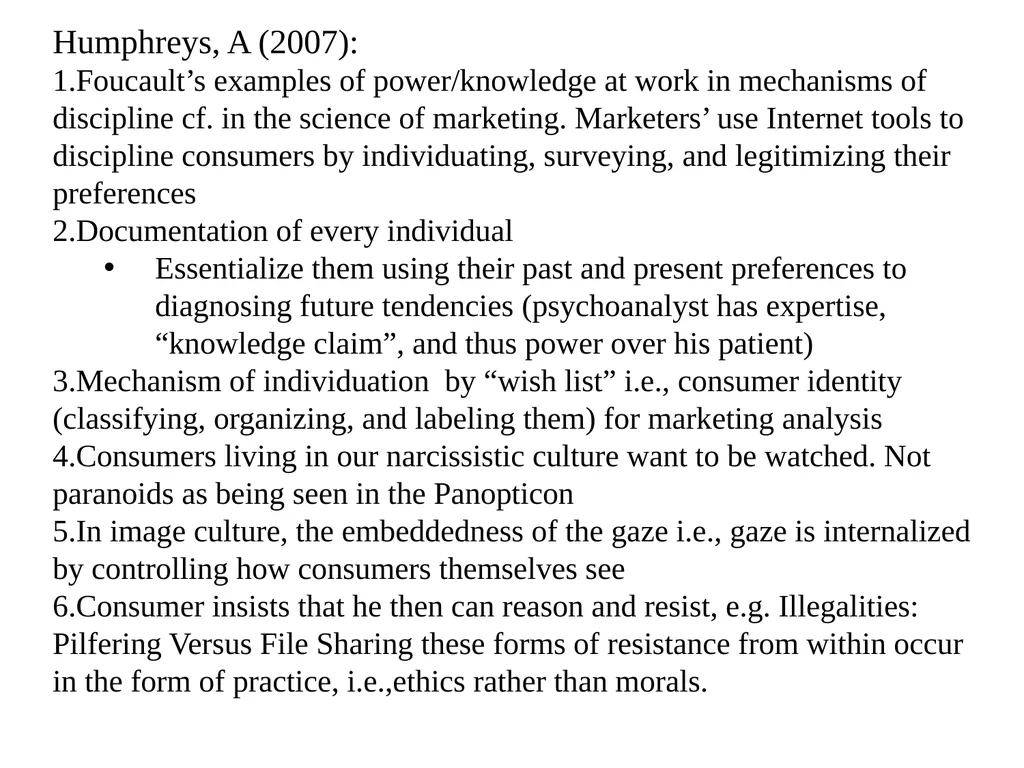
Humphreys, A (2007):
Foucault’s examples of power/knowledge at work in mechanisms of discipline cf. in the science of marketing. Marketers’ use Internet tools to discipline consumers by individuating, surveying, and legitimizing their preferences
Documentation of every individual
Essentialize them using their past and present preferences to diagnosing future tendencies (psychoanalyst has expertise, “knowledge claim”, and thus power over his patient)
Mechanism of individuation by “wish list” i.e., consumer identity (classifying, organizing, and labeling them) for marketing analysis
Consumers living in our narcissistic culture want to be watched. Not paranoids as being seen in the Panopticon
In image culture, the embeddedness of the gaze i.e., gaze is internalized by controlling how consumers themselves see
Consumer insists that he then can reason and resist, e.g. Illegalities: Pilfering Versus File Sharing these forms of resistance from within occur in the form of practice, i.e.,ethics rather than morals.<br>
Foucault’s examples of power/knowledge at work in mechanisms of discipline cf. in the science of marketing. Marketers’ use Internet tools to discipline consumers by individuating, surveying, and legitimizing their preferences
Documentation of every individual
Essentialize them using their past and present preferences to diagnosing future tendencies (psychoanalyst has expertise, “knowledge claim”, and thus power over his patient)
Mechanism of individuation by “wish list” i.e., consumer identity (classifying, organizing, and labeling them) for marketing analysis
Consumers living in our narcissistic culture want to be watched. Not paranoids as being seen in the Panopticon
In image culture, the embeddedness of the gaze i.e., gaze is internalized by controlling how consumers themselves see
Consumer insists that he then can reason and resist, e.g. Illegalities: Pilfering Versus File Sharing these forms of resistance from within occur in the form of practice, i.e.,ethics rather than morals.<br>
31
Foucault: Disciplinary power constructs a Docile Body
Surveilled body
Objectified Body
Controlled Body
Disciplined body
Discipline is the Technology of Power that turns the body docile.
Repetitive, trained:
http://www.youtube.com/watch?v=ZfFhuj1VONw<br>
Surveilled body
Objectified Body
Controlled Body
Disciplined body
Discipline is the Technology of Power that turns the body docile.
Repetitive, trained:
http://www.youtube.com/watch?v=ZfFhuj1VONw<br>
32
Power shapes bodies into : (Foucault, Michel (1995). Discipline and Punish: The Birth of the Prison.)
Objectified Body
From the Classical age : the body as object, a target of power - body is manipulated, shaped trained, made to obey and learn skills & rules - body is used, subjected and analyzed and manipulated
2. Controlled Body:
Works individually in retail - Coercion is used to shape/ ‘improve’ movement, attitudes, gestures; Body’s modes and economy are tailored for efficient control through uninterrupted coercion
3. Disciplined body:
The body is disciplined through surveillance and control in all aspects as to turn it docile. Discipline produces ‘pracitised bodies’ .<br>
Objectified Body
From the Classical age : the body as object, a target of power - body is manipulated, shaped trained, made to obey and learn skills & rules - body is used, subjected and analyzed and manipulated
2. Controlled Body:
Works individually in retail - Coercion is used to shape/ ‘improve’ movement, attitudes, gestures; Body’s modes and economy are tailored for efficient control through uninterrupted coercion
3. Disciplined body:
The body is disciplined through surveillance and control in all aspects as to turn it docile. Discipline produces ‘pracitised bodies’ .<br>
33
Objectified Body
From the Classical age : the body as object, a target of power - body is manipulated, shaped trained, made to obey and learn skills & rules - body is used, subjected and analyzed and manipulated
Keller (2005):Ab/Normal Looking: Voyeurism and surveillance in lesbian pulp novels and US Cold War culture, Feminist Media Studies, 5 (2):177-195.
Popular culture is the space of homogenization - Stereotyping objectifies the matter, person and experience
Voyeurism controls the private, the sexual – Surveillance controls the public, the criminal, and political.
Bond & Playboy - Gaze, the voyeuristic eye, coding woman as its object [Popular culture is] the space of homogenization where stereotyping and the formulaic
mercilessly process the material and experiences it draws into its web ... It is rooted in
popular experience and available for expropriation at one and the same time ... [A]ll
popular cultures ... are] bound to be contradictory ... site[s] (pp. 469-70) of strategic
contestation. (Stuart Hall 1996, )<br>
From the Classical age : the body as object, a target of power - body is manipulated, shaped trained, made to obey and learn skills & rules - body is used, subjected and analyzed and manipulated
Keller (2005):Ab/Normal Looking: Voyeurism and surveillance in lesbian pulp novels and US Cold War culture, Feminist Media Studies, 5 (2):177-195.
Popular culture is the space of homogenization - Stereotyping objectifies the matter, person and experience
Voyeurism controls the private, the sexual – Surveillance controls the public, the criminal, and political.
Bond & Playboy - Gaze, the voyeuristic eye, coding woman as its object [Popular culture is] the space of homogenization where stereotyping and the formulaic
mercilessly process the material and experiences it draws into its web ... It is rooted in
popular experience and available for expropriation at one and the same time ... [A]ll
popular cultures ... are] bound to be contradictory ... site[s] (pp. 469-70) of strategic
contestation. (Stuart Hall 1996, )<br>
34
2. Controlled Body: (Foucault)
Works individually in retail - Coercion is used to shape/ ‘improve’ movement, attitudes, gestures; Body’s modes and economy are tailored for efficient control through uninterrupted coercion
Keller (2005):
Coercion through voyeurism:
Voyeurism in popular culture serves as a method for the dominant culture to control the Other
Voyeurism is also a desire to identify with the Other while simultaneously desiring to guard the boundary between self and Other
Inscribing the self : The gaze controls and punishes: We “come to know how we are constituted and who we are“ through the way we represent and imagine ourselves
Desires are both satiated and punished<br>
Works individually in retail - Coercion is used to shape/ ‘improve’ movement, attitudes, gestures; Body’s modes and economy are tailored for efficient control through uninterrupted coercion
Keller (2005):
Coercion through voyeurism:
Voyeurism in popular culture serves as a method for the dominant culture to control the Other
Voyeurism is also a desire to identify with the Other while simultaneously desiring to guard the boundary between self and Other
Inscribing the self : The gaze controls and punishes: We “come to know how we are constituted and who we are“ through the way we represent and imagine ourselves
Desires are both satiated and punished<br>
35
3. Disciplined body:
The body is disciplined through surveillance and control
in all aspects as to turn it docile. Discipline produces
‘practiced bodies’
Disciplining a result of :
Media systematically objectifies bodies – the public are
socialized to assume an outsider’s view of their body.
They learn to objectify themselves. Thus, surveillance
and monitoring their appearance becomes a habit (“body
Surveillance”) (Aubrey, 2006)<br>
The body is disciplined through surveillance and control
in all aspects as to turn it docile. Discipline produces
‘practiced bodies’
Disciplining a result of :
Media systematically objectifies bodies – the public are
socialized to assume an outsider’s view of their body.
They learn to objectify themselves. Thus, surveillance
and monitoring their appearance becomes a habit (“body
Surveillance”) (Aubrey, 2006)<br>
36
Why Care of the Self?
“In the abuse of power, one exceeds the legitimate exercise of one’s power and imposes one’s fantasies, appetites and desires on others…But one can see…that such a man is the slave of his appetites. And the good ruler is precisely the one who exercises his power as it ought to be exercised, that is, simultaneously exercising his power over himself”<br>
“In the abuse of power, one exceeds the legitimate exercise of one’s power and imposes one’s fantasies, appetites and desires on others…But one can see…that such a man is the slave of his appetites. And the good ruler is precisely the one who exercises his power as it ought to be exercised, that is, simultaneously exercising his power over himself”<br>
37
How Do We Care for the Self?
“Freedom is the ontological condition of ethics. But ethics is the considered form that freedom takes when it is informed by reflection.”
Ontological: the nature of being, existence, or reality<br>
“Freedom is the ontological condition of ethics. But ethics is the considered form that freedom takes when it is informed by reflection.”
Ontological: the nature of being, existence, or reality<br>
38
ASKESIS – the exercises one practices that aid in the cultivation of an ethical self, particularly (but not limited to) acts of self-deprivation and introspection
http://foucault.info/documents/parrhesia/foucault.DT5.techniquesParrhesia.en.html<br>
http://foucault.info/documents/parrhesia/foucault.DT5.techniquesParrhesia.en.html<br>
39
What is Enlightenment?
“The critical ontology of ourselves must be considered not, certainly, as a theory, a doctrine, nor even as a permanent body of knowledge that is accumulating; it must be conceived as an attitude, an ethos, a philosophical life in which the critique of what we are is at one and the same time the historical analysis of the limits imposed upon us and an experiment with the possibility of going beyond them.”<br>
“The critical ontology of ourselves must be considered not, certainly, as a theory, a doctrine, nor even as a permanent body of knowledge that is accumulating; it must be conceived as an attitude, an ethos, a philosophical life in which the critique of what we are is at one and the same time the historical analysis of the limits imposed upon us and an experiment with the possibility of going beyond them.”<br>
40
“In the Apology, one sees Socrates presenting himself to his judges as the teacher of self-concern. He is the man who accosts passersby and says to them:”
“You concern yourself with your wealth, your reputation, and with honors, but you don’t worry about your virtue and your soul.”<br>
“You concern yourself with your wealth, your reputation, and with honors, but you don’t worry about your virtue and your soul.”<br>
41
References:
Foucault, Michel. “The Thought of the Outside” The Essential Foucault. New York: The New Press, 1994. 423-441.
Foucault, Michel. “The Ethics of the Concern of the Self as a Practice of Freedom” Ethics: Subjectivity and Truth. New York: The New Press, 1994. 281-301.
Foucault, Michel. “Technologies of Self” Ethics: Subjectivity and Truth. New York: The New Press, 1994. 221-251.
Foucault, Michel. “What Is Critique?” The Essential Foucault. New York: The New Press, 1994. 263-278.
Foucault, Michel. “What is Enlightenment?” Ethics: Subjectivity and Truth. New York: The New Press, 1994. 303-319.
Foucault, Michel. “Hermeneutic of the Subject” The Essential Foucault. New York: The New Press, 1994. 93-106.<br>
Foucault, Michel. “The Thought of the Outside” The Essential Foucault. New York: The New Press, 1994. 423-441.
Foucault, Michel. “The Ethics of the Concern of the Self as a Practice of Freedom” Ethics: Subjectivity and Truth. New York: The New Press, 1994. 281-301.
Foucault, Michel. “Technologies of Self” Ethics: Subjectivity and Truth. New York: The New Press, 1994. 221-251.
Foucault, Michel. “What Is Critique?” The Essential Foucault. New York: The New Press, 1994. 263-278.
Foucault, Michel. “What is Enlightenment?” Ethics: Subjectivity and Truth. New York: The New Press, 1994. 303-319.
Foucault, Michel. “Hermeneutic of the Subject” The Essential Foucault. New York: The New Press, 1994. 93-106.<br>
42
Globalization and commercialization of medical care (Turner, 2006)
Informational knowledge systems and e-health
Increased power and dominance of bio-medical sciences
Combination of micro-biology and informational knowledge systems proffer new technologies for reproduction, selection of enhanced human traits and genetic engineering
Creation of free markets in body parts through popular media
Medical knowledge is not a product of ethical scientific research made up of the conventional procedures.
Power produces medical research and new knowledge as it is dominated by private corporations<br>
Informational knowledge systems and e-health
Increased power and dominance of bio-medical sciences
Combination of micro-biology and informational knowledge systems proffer new technologies for reproduction, selection of enhanced human traits and genetic engineering
Creation of free markets in body parts through popular media
Medical knowledge is not a product of ethical scientific research made up of the conventional procedures.
Power produces medical research and new knowledge as it is dominated by private corporations<br>
43
Turner: Hospital
Three levels of this ‘spatialization’ of disease (Foucault, 1973)
Disease ontologies are differentiated by resemblance and analogy
Disease is mapped onto the human body, moves from organ to organ, undergoes metamorphosis
Specialization: a disease is circumscribed, medically invested, isolated, divided up into closed, privileged regions, or distributed throughout cure centres, arranged in the most favourable way’ (Foucault, 1973)
Contradictions between the medical ethic of curing the patient and the medical economy, which derives profit from the life-long maintenance of illness.
Corporate & global medical systems transformed the professionalism i.e., medical dominance (state authorizes) and the consulting ethic (needs Public trust) -<br>
Three levels of this ‘spatialization’ of disease (Foucault, 1973)
Disease ontologies are differentiated by resemblance and analogy
Disease is mapped onto the human body, moves from organ to organ, undergoes metamorphosis
Specialization: a disease is circumscribed, medically invested, isolated, divided up into closed, privileged regions, or distributed throughout cure centres, arranged in the most favourable way’ (Foucault, 1973)
Contradictions between the medical ethic of curing the patient and the medical economy, which derives profit from the life-long maintenance of illness.
Corporate & global medical systems transformed the professionalism i.e., medical dominance (state authorizes) and the consulting ethic (needs Public trust) -<br>
44
Azzarito (2010)
Surveillance:
The feminine docile body: ‘woman-as-Panopticon.’
The power of the media as a surveillance mechanism presenting and reiterating ideals of high-status femininity.
The media defines and circumscribes the feminine body as a complement to and/or in opposition to the masculine body in normative ways.<br>
Surveillance:
The feminine docile body: ‘woman-as-Panopticon.’
The power of the media as a surveillance mechanism presenting and reiterating ideals of high-status femininity.
The media defines and circumscribes the feminine body as a complement to and/or in opposition to the masculine body in normative ways.<br>
45
Azzarito (2010) (cont’d):
Objectification:
popular culture constructs unrealistic ideals of women’s bodies
Normal/abnormal: normalizes stereotypes of race and gender
Celebrating slenderness, lack of muscularity and athleticism. Dieting and fitness practices promoted in health, fitness and fashion magazines serve as technologies of the self for achieving ‘perfection,’ an unattainable, monodimensional notion of slenderness with its promise of ideal femininity<br>
Objectification:
popular culture constructs unrealistic ideals of women’s bodies
Normal/abnormal: normalizes stereotypes of race and gender
Celebrating slenderness, lack of muscularity and athleticism. Dieting and fitness practices promoted in health, fitness and fashion magazines serve as technologies of the self for achieving ‘perfection,’ an unattainable, monodimensional notion of slenderness with its promise of ideal femininity<br>
46
Azzarito (2010) (cont’d)
Discourse:
media offers ever more important sites of pedagogizing girls’ construction of their bodies
The Muslim girl’s body remains portrayed not only as a covered body, a ‘silent body,’ but also as an oppressed and constrained female physicality
Racial and other minorities are often misrepresented by the media, esp. in Hollywood movies<br>
Discourse:
media offers ever more important sites of pedagogizing girls’ construction of their bodies
The Muslim girl’s body remains portrayed not only as a covered body, a ‘silent body,’ but also as an oppressed and constrained female physicality
Racial and other minorities are often misrepresented by the media, esp. in Hollywood movies<br>
47
Disciplining:
Media can impact viewers to learn their values, beliefs, attitudes, and behaviors as media content normalize models of these which then are disseminated as popular culture (see, Bandura, 1986, 1989, 1994, 2001).
Popular views of normal/abnormal of : Who the girls/women are: What types of behaviors; What types of motivations; parents & the nature of relationships within families
‘House of certainty’ is set up for controlling gender related activities and physicality<br>
Media can impact viewers to learn their values, beliefs, attitudes, and behaviors as media content normalize models of these which then are disseminated as popular culture (see, Bandura, 1986, 1989, 1994, 2001).
Popular views of normal/abnormal of : Who the girls/women are: What types of behaviors; What types of motivations; parents & the nature of relationships within families
‘House of certainty’ is set up for controlling gender related activities and physicality<br>
48
Dryburg & Fortin (2010) Ballet & Docile body:
Surveillance:
Idealized images of the body in media
‘The ballet studio is a panoptic place,’ the barre as “backstage”, is a place of surveillance by instructors, and self-surveillance by dancers looking in the mirror.
Self-surveillance of the body as well as the adaptation of social behaviour.
The mirror encourages body surveillance and often reminds the dancer that her body does not match the ideal body type
Lateral surveillance manifests itself as competitive observation and comparison of appearance and habits between dancers<br>
Surveillance:
Idealized images of the body in media
‘The ballet studio is a panoptic place,’ the barre as “backstage”, is a place of surveillance by instructors, and self-surveillance by dancers looking in the mirror.
Self-surveillance of the body as well as the adaptation of social behaviour.
The mirror encourages body surveillance and often reminds the dancer that her body does not match the ideal body type
Lateral surveillance manifests itself as competitive observation and comparison of appearance and habits between dancers<br>
49
Objectification
Audience ‘gaze’ of ‘physical appearance’, ‘beautiful lines’ and an ‘ideal body type’.
Body scrutinized more closely after being asked to shed some pounds
Under weight surveillance, dancers tend to think of themselves as a ‘mass of flesh’ (a blob) rather than as an artist<br>
Audience ‘gaze’ of ‘physical appearance’, ‘beautiful lines’ and an ‘ideal body type’.
Body scrutinized more closely after being asked to shed some pounds
Under weight surveillance, dancers tend to think of themselves as a ‘mass of flesh’ (a blob) rather than as an artist<br>
50
3. Discourse:
Narratives in popular cultural magazines, TV fictional shows, movies (1,791 magazine images of models/ celebrities) (McDermott: 2005) :
Physical attractiveness
Media role models
Ballet dancers’ “norm” of accepted ‘physical appearance’, ‘beautiful lines’ and an ‘ideal body type’.<br>
Narratives in popular cultural magazines, TV fictional shows, movies (1,791 magazine images of models/ celebrities) (McDermott: 2005) :
Physical attractiveness
Media role models
Ballet dancers’ “norm” of accepted ‘physical appearance’, ‘beautiful lines’ and an ‘ideal body type’.<br>
51
4. Disciplining:
Conforming to the ad’s or movie’s requirements
Requirements of pleasing viewers (others) to entice the viewer’s Gaze
Willingly marketing the docile body although in an art form that is socially appreciated (Ballet)
Selling the norm of popular cultural body image
dance plays a significant role in feeding dancers’ obsession with their bodies<br>
Conforming to the ad’s or movie’s requirements
Requirements of pleasing viewers (others) to entice the viewer’s Gaze
Willingly marketing the docile body although in an art form that is socially appreciated (Ballet)
Selling the norm of popular cultural body image
dance plays a significant role in feeding dancers’ obsession with their bodies<br>
52
Merskin (2004)
Foucault’s argument: Discourse and presentation of body and sexuality in popular media are narratives of control by social institutions (Lewis, 2002)
Merskin: Thesis:
In fashion advertisements show girls as sexualized images, infantilizes the women for controlling them with legitimacy. These ads procure such images, offer them to the public in order to sell them.<br>
Foucault’s argument: Discourse and presentation of body and sexuality in popular media are narratives of control by social institutions (Lewis, 2002)
Merskin: Thesis:
In fashion advertisements show girls as sexualized images, infantilizes the women for controlling them with legitimacy. These ads procure such images, offer them to the public in order to sell them.<br>
53
Merskin (cont’d)
Impact of advertisers and mass media on young/adolescent girls and their gazers:
Surveillance:
Normalizing adolescent as ‘sexually available’ and seeing them as always having sex on their minds, willing to be dominated, sexually violated and become sexual objects.
Objectification:
Gazing at sexualized girls’ representations subordinates them for male consumers. It turns them into objects of forbidden lust for preadolescent girls<br>
Impact of advertisers and mass media on young/adolescent girls and their gazers:
Surveillance:
Normalizing adolescent as ‘sexually available’ and seeing them as always having sex on their minds, willing to be dominated, sexually violated and become sexual objects.
Objectification:
Gazing at sexualized girls’ representations subordinates them for male consumers. It turns them into objects of forbidden lust for preadolescent girls<br>
54
Merskin (cont’d):
3. Discourse: Narratives in Media-content
Pornographication
Hollywood’s representation of adolescent beauties
‘Teenage tart’ symbolizes adult gaze that sexualizes and seduces adolescents’
Young girls are “dressed up” surveilled as adult women
Representation of the imaginary relation of adolescents and viewers to the real condition of existence”<br>
3. Discourse: Narratives in Media-content
Pornographication
Hollywood’s representation of adolescent beauties
‘Teenage tart’ symbolizes adult gaze that sexualizes and seduces adolescents’
Young girls are “dressed up” surveilled as adult women
Representation of the imaginary relation of adolescents and viewers to the real condition of existence”<br>
55
Stern, B.B., et al (2005):
Soap Opera on TV
Para-social Attachment
Social Learning
Behavioral Modeling<br>
Soap Opera on TV
Para-social Attachment
Social Learning
Behavioral Modeling<br>
56
Knowledge vs. Deception:
Yang M., et al (2006): Variables:
Independent variable: Brand names placed in video games
Dependent variable: (Effect on) College students' implicit and explicit memory for brands
Word-fragment completion test and a brand recognition task:
For the brand names placed in the video games:
Low levels of explicit memory (recognition rest)
Showed implicit memory (word-fragment test)
Interrelated variables: Story or characters’ use enhance brand recognition<br>
Yang M., et al (2006): Variables:
Independent variable: Brand names placed in video games
Dependent variable: (Effect on) College students' implicit and explicit memory for brands
Word-fragment completion test and a brand recognition task:
For the brand names placed in the video games:
Low levels of explicit memory (recognition rest)
Showed implicit memory (word-fragment test)
Interrelated variables: Story or characters’ use enhance brand recognition<br>