
A semantic argument against the existence of
MS
Published · 13 slides · 0 views
1 / 1

Description
A semantic argument against the existence of universally held real properties Emanuel Rutten Faculty of Philosophy VU University Preliminaries A semantic argument is a deductive argument from some theory of meaning. So, the arguments
Related Topics
Share
Embed code
Download this presentation From Below
"A semantic argument against the existence of" is the property of its rightful owner. Permission is granted to download and print the materials on this website for personal, non-commercial use only, and to display it on your personal computer provided you do not modify the materials and that you retain all copyright notices contained in the materials. By downloading content from our website, you accept the terms of this agreement.
Presentation Transcript
01
A semantic argument against the existence of universally held real properties Emanuel Rutten
Faculty of Philosophy
VU University<br>
Faculty of Philosophy
VU University<br>
02
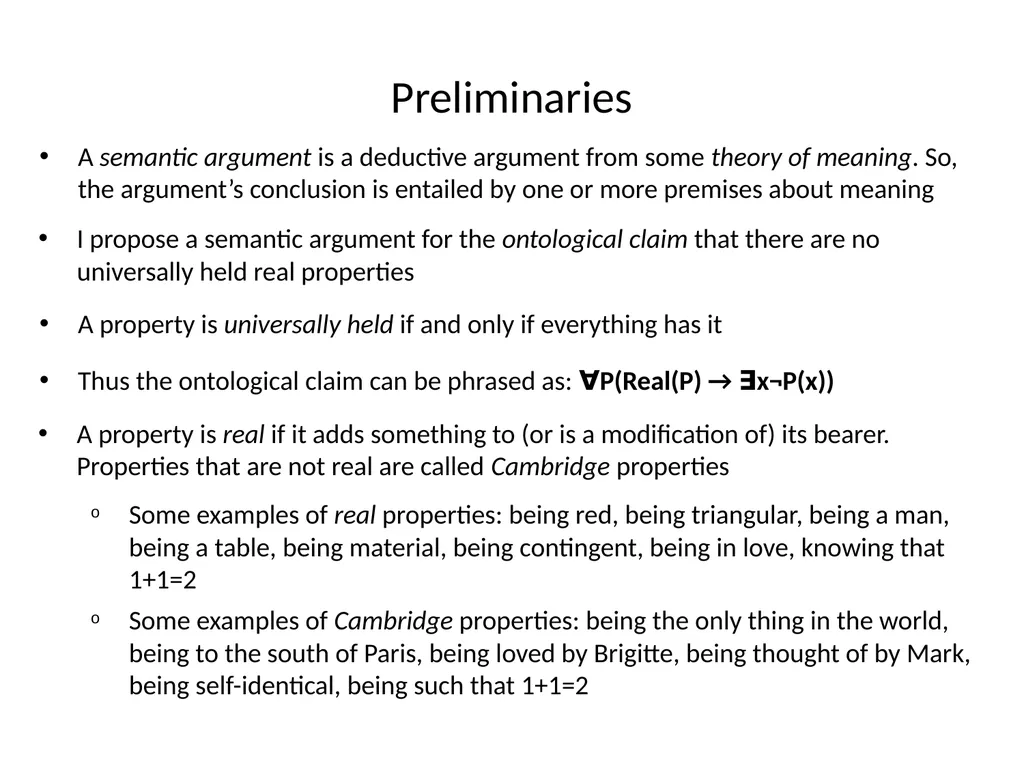
Preliminaries A semantic argument is a deductive argument from some theory of meaning. So, the argument’s conclusion is entailed by one or more premises about meaning A property is real if it adds something to (or is a modification of) its bearer. Properties that are not real are called Cambridge properties Some examples of real properties: being red, being triangular, being a man, being a table, being material, being contingent, being in love, knowing that 1+1=2 Some examples of Cambridge properties: being the only thing in the world, being to the south of Paris, being loved by Brigitte, being thought of by Mark, being self-identical, being such that 1+1=2 I propose a semantic argument for the ontological claim that there are no universally held real properties Thus the ontological claim can be phrased as: ∀P(Real(P) → ∃x¬P(x)) A property is universally held if and only if everything has it<br>
03
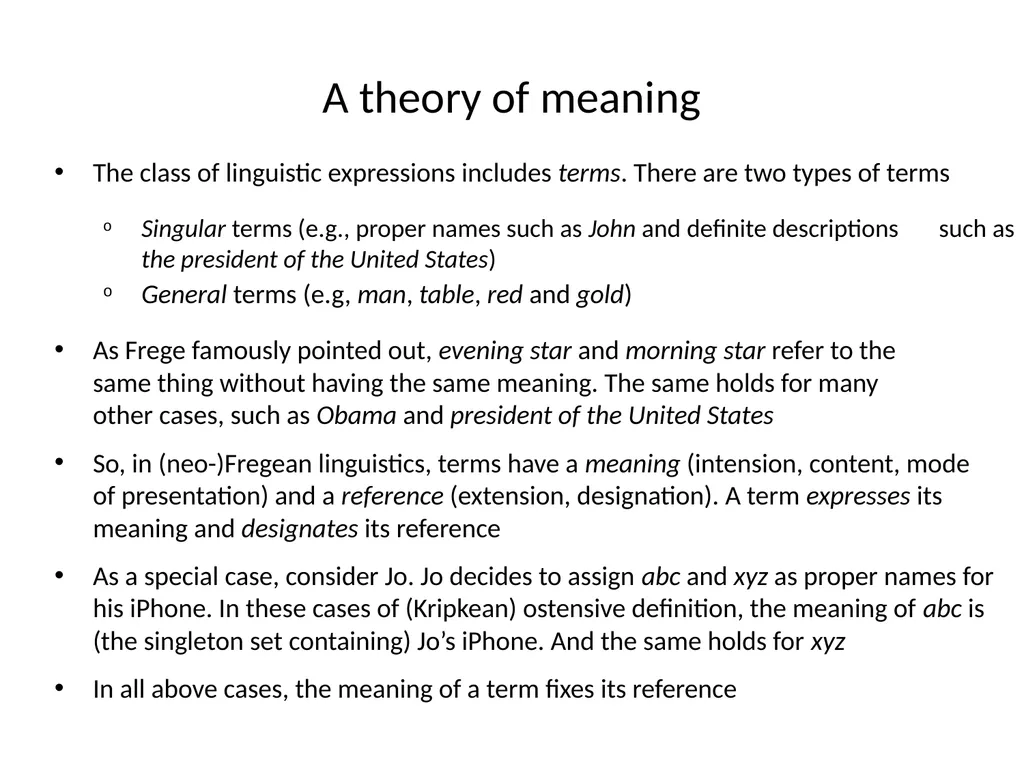
A theory of meaning So, in (neo-)Fregean linguistics, terms have a meaning (intension, content, mode of presentation) and a reference (extension, designation). A term expresses its meaning and designates its reference The class of linguistic expressions includes terms. There are two types of terms As a special case, consider Jo. Jo decides to assign abc and xyz as proper names for his iPhone. In these cases of (Kripkean) ostensive definition, the meaning of abc is (the singleton set containing) Jo’s iPhone. And the same holds for xyz In all above cases, the meaning of a term fixes its reference Singular terms (e.g., proper names such as John and definite descriptions such as the president of the United States) General terms (e.g, man, table, red and gold) As Frege famously pointed out, evening star and morning star refer to the same thing without having the same meaning. The same holds for many other cases, such as Obama and president of the United States<br>
04
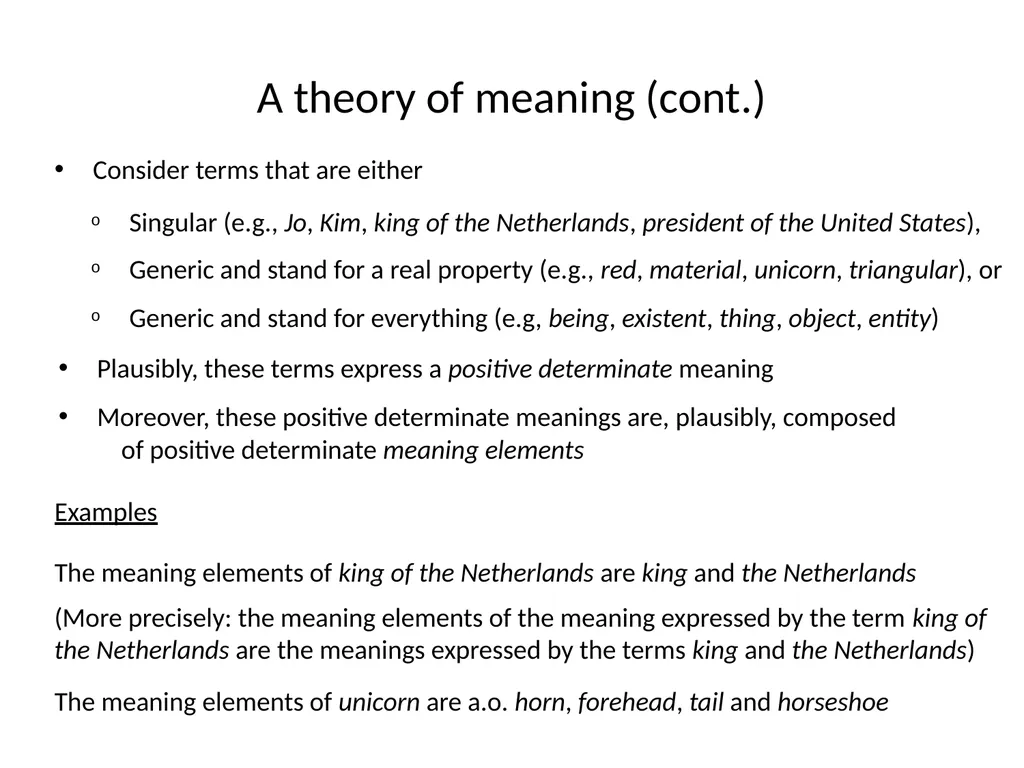
A theory of meaning (cont.) Consider terms that are either The meaning elements of king of the Netherlands are king and the Netherlands (More precisely: the meaning elements of the meaning expressed by the term king of the Netherlands are the meanings expressed by the terms king and the Netherlands) The meaning elements of unicorn are a.o. horn, forehead, tail and horseshoe Singular (e.g., Jo, Kim, king of the Netherlands, president of the United States), Generic and stand for a real property (e.g., red, material, unicorn, triangular), or Generic and stand for everything (e.g, being, existent, thing, object, entity) Plausibly, these terms express a positive determinate meaning Moreover, these positive determinate meanings are, plausibly, composed of positive determinate meaning elements Examples<br>
05
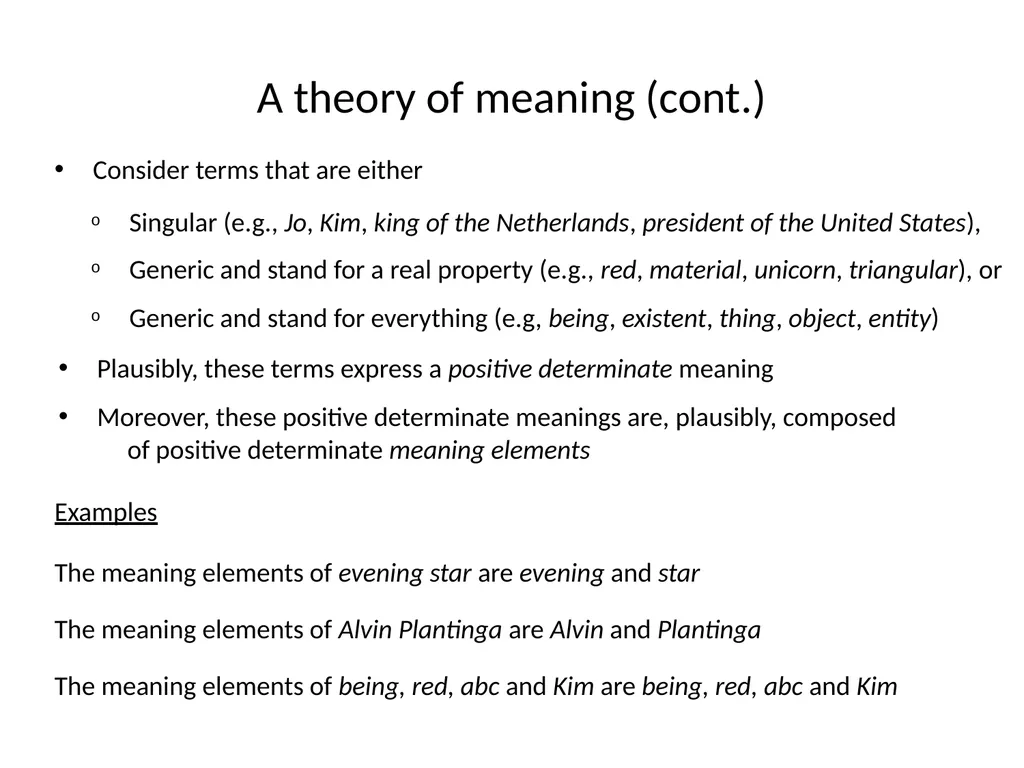
A theory of meaning (cont.) Examples The meaning elements of evening star are evening and star The meaning elements of Alvin Plantinga are Alvin and Plantinga The meaning elements of being, red, abc and Kim are being, red, abc and Kim Consider terms that are either Singular (e.g., Jo, Kim, king of the Netherlands, president of the United States), Generic and stand for a real property (e.g., red, material, unicorn, triangular), or Generic and stand for everything (e.g, being, existent, thing, object, entity) Plausibly, these terms express a positive determinate meaning Moreover, these positive determinate meanings are, plausibly, composed of positive determinate meaning elements<br>
06
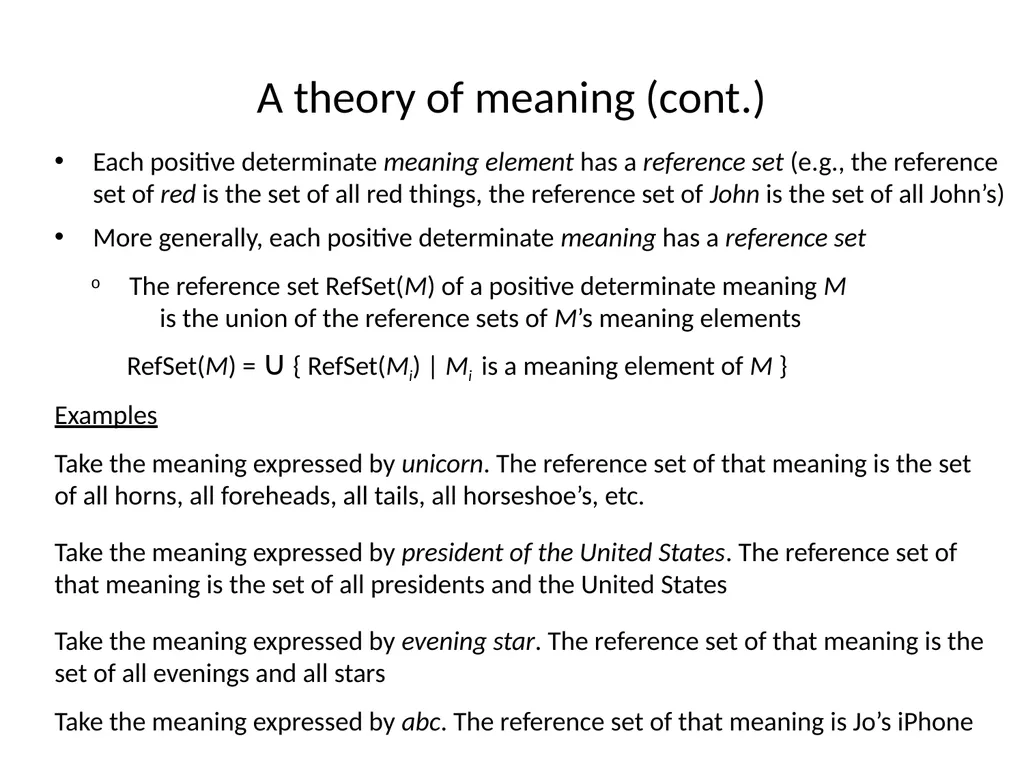
A theory of meaning (cont.) Each positive determinate meaning element has a reference set (e.g., the reference set of red is the set of all red things, the reference set of John is the set of all John’s) More generally, each positive determinate meaning has a reference set Take the meaning expressed by unicorn. The reference set of that meaning is the set of all horns, all foreheads, all tails, all horseshoe’s, etc. Take the meaning expressed by president of the United States. The reference set of that meaning is the set of all presidents and the United States RefSet(M) = ∪ { RefSet(Mi) | Mi is a meaning element of M } Take the meaning expressed by evening star. The reference set of that meaning is the set of all evenings and all stars Take the meaning expressed by abc. The reference set of that meaning is Jo’s iPhone Examples The reference set RefSet(M) of a positive determinate meaning M is the union of the reference sets of M’s meaning elements<br>
07
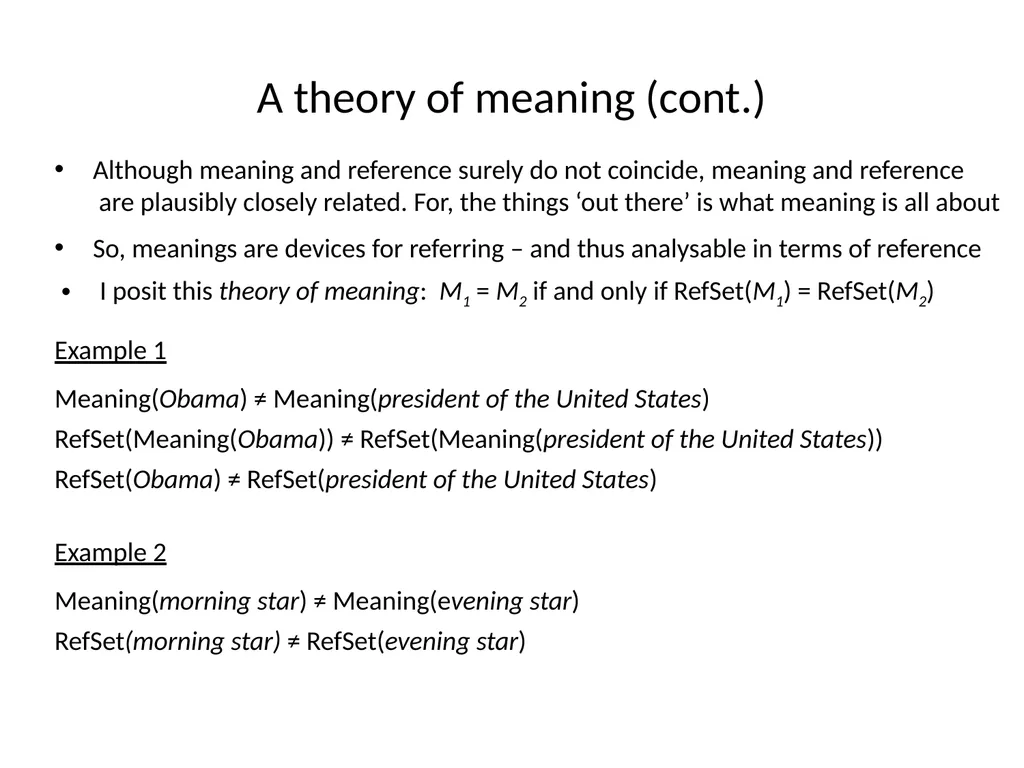
A theory of meaning (cont.) Although meaning and reference surely do not coincide, meaning and reference are plausibly closely related. For, the things ‘out there’ is what meaning is all about Example 2 Meaning(morning star) ≠ Meaning(evening star) RefSet(morning star) ≠ RefSet(evening star) Example 1 Meaning(Obama) ≠ Meaning(president of the United States) RefSet(Meaning(Obama)) ≠ RefSet(Meaning(president of the United States)) RefSet(Obama) ≠ RefSet(president of the United States) I posit this theory of meaning: M1 = M2 if and only if RefSet(M1) = RefSet(M2) So, meanings are devices for referring – and thus analysable in terms of reference<br>
08
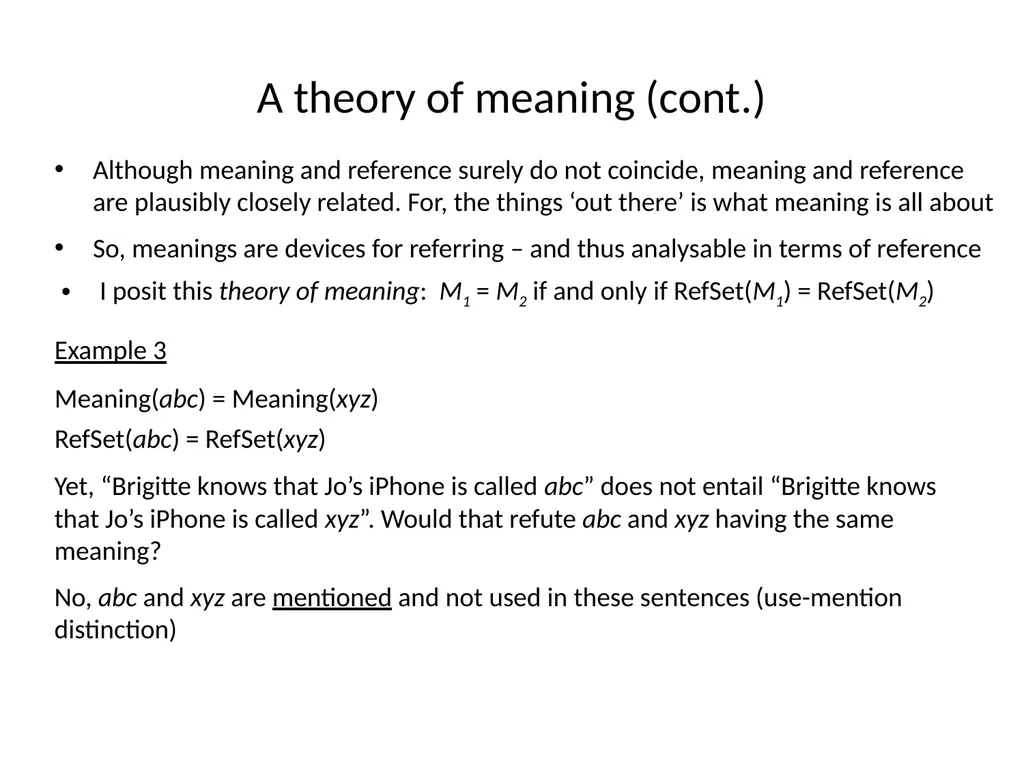
A theory of meaning (cont.) Although meaning and reference surely do not coincide, meaning and reference are plausibly closely related. For, the things ‘out there’ is what meaning is all about RefSet(abc) = RefSet(xyz) Meaning(abc) = Meaning(xyz) Yet, “Brigitte knows that Jo’s iPhone is called abc” does not entail “Brigitte knows that Jo’s iPhone is called xyz”. Would that refute abc and xyz having the same meaning? No, abc and xyz are mentioned and not used in these sentences (use-mention distinction) Example 3 I posit this theory of meaning: M1 = M2 if and only if RefSet(M1) = RefSet(M2) So, meanings are devices for referring – and thus analysable in terms of reference<br>
09
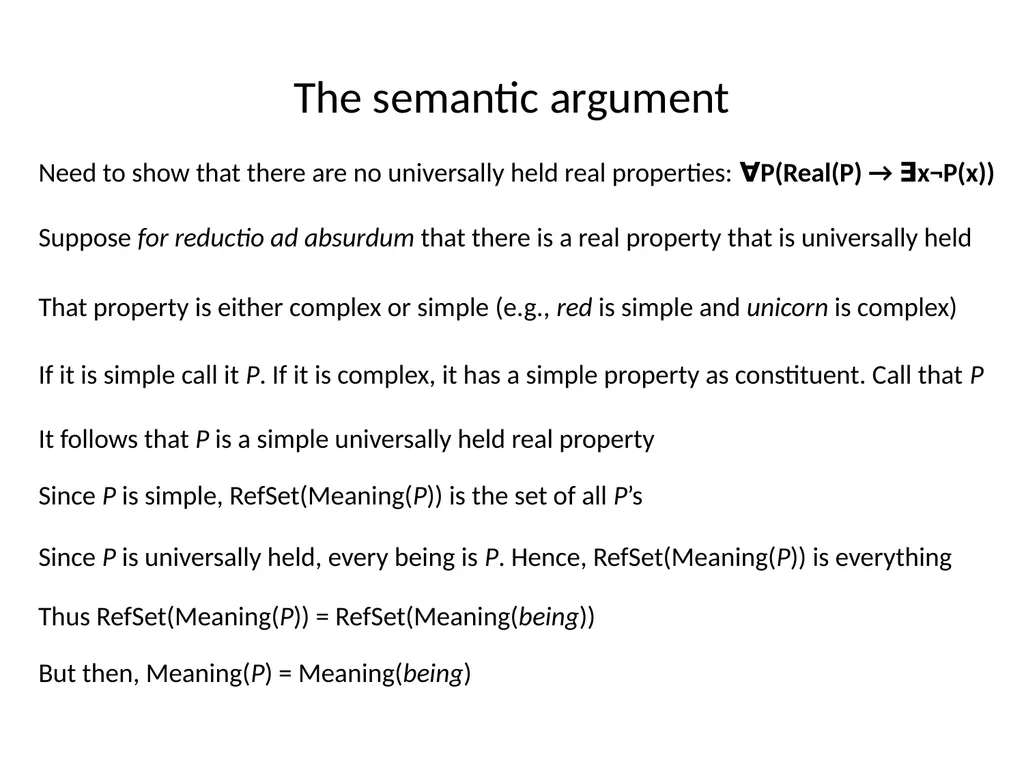
The semantic argument Need to show that there are no universally held real properties: ∀P(Real(P) → ∃x¬P(x)) Suppose for reductio ad absurdum that there is a real property that is universally held Thus RefSet(Meaning(P)) = RefSet(Meaning(being)) That property is either complex or simple (e.g., red is simple and unicorn is complex) If it is simple call it P. If it is complex, it has a simple property as constituent. Call that P It follows that P is a simple universally held real property But then, Meaning(P) = Meaning(being) Since P is simple, RefSet(Meaning(P)) is the set of all P’s Since P is universally held, every being is P. Hence, RefSet(Meaning(P)) is everything<br>
10
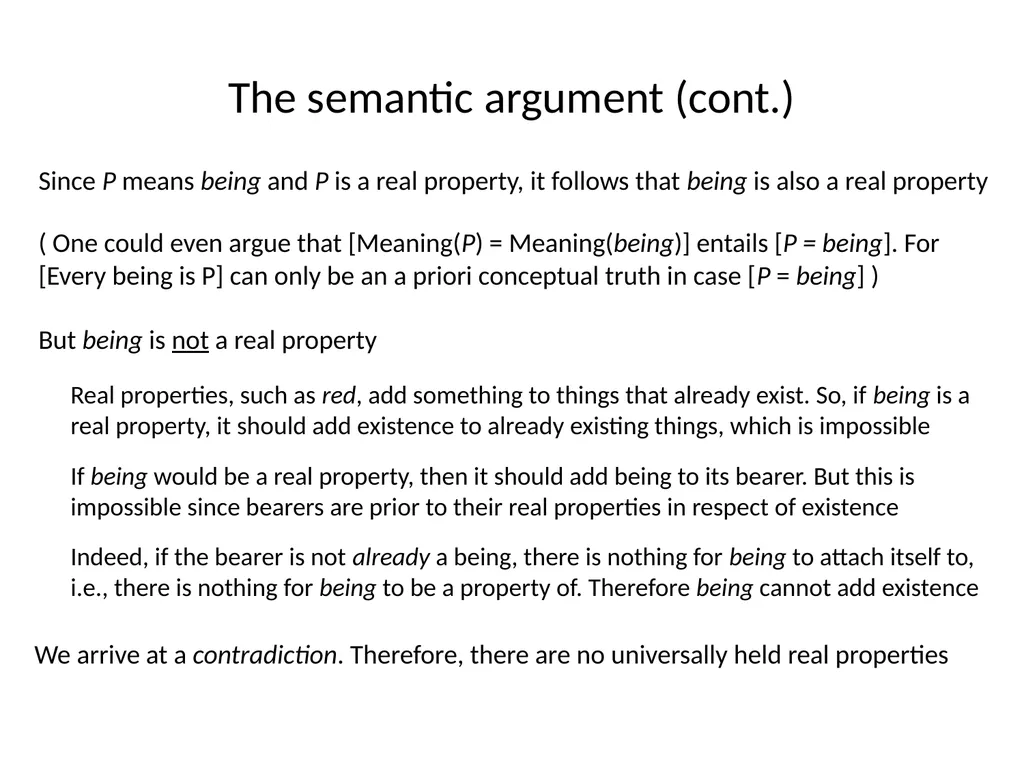
The semantic argument (cont.) Since P means being and P is a real property, it follows that being is also a real property But being is not a real property We arrive at a contradiction. Therefore, there are no universally held real properties ( One could even argue that [Meaning(P) = Meaning(being)] entails [P = being]. For [Every being is P] can only be an a priori conceptual truth in case [P = being] ) If being would be a real property, then it should add being to its bearer. But this is impossible since bearers are prior to their real properties in respect of existence Real properties, such as red, add something to things that already exist. So, if being is a real property, it should add existence to already existing things, which is impossible Indeed, if the bearer is not already a being, there is nothing for being to attach itself to, i.e., there is nothing for being to be a property of. Therefore being cannot add existence<br>
11
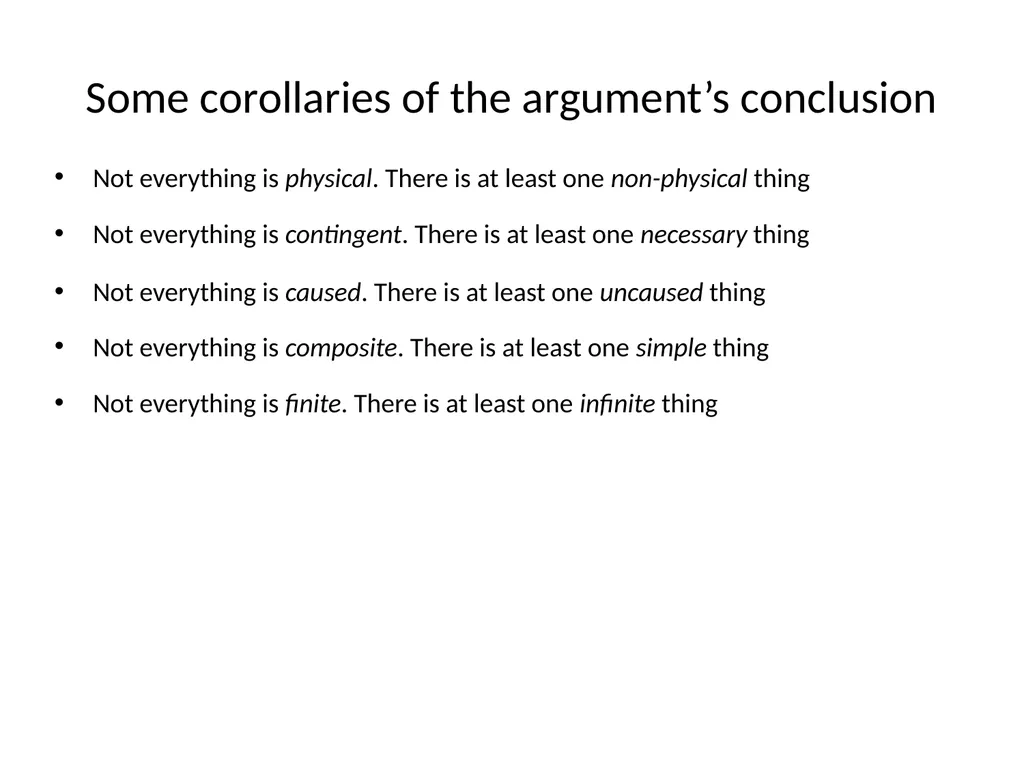
Some corollaries of the argument’s conclusion Not everything is physical. There is at least one non-physical thing Not everything is contingent. There is at least one necessary thing Not everything is caused. There is at least one uncaused thing Not everything is composite. There is at least one simple thing Not everything is finite. There is at least one infinite thing<br>
12
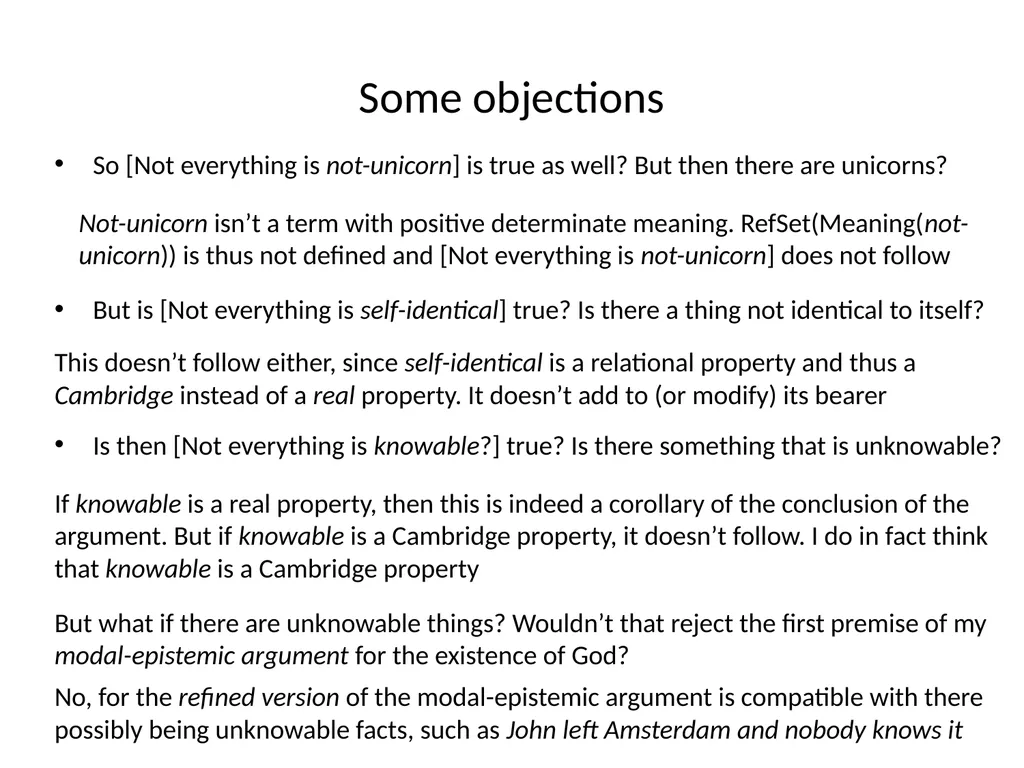
Some objections So [Not everything is not-unicorn] is true as well? But then there are unicorns? Not-unicorn isn’t a term with positive determinate meaning. RefSet(Meaning(not-unicorn)) is thus not defined and [Not everything is not-unicorn] does not follow But is [Not everything is self-identical] true? Is there a thing not identical to itself? This doesn’t follow either, since self-identical is a relational property and thus a Cambridge instead of a real property. It doesn’t add to (or modify) its bearer Is then [Not everything is knowable?] true? Is there something that is unknowable? If knowable is a real property, then this is indeed a corollary of the conclusion of the argument. But if knowable is a Cambridge property, it doesn’t follow. I do in fact think that knowable is a Cambridge property But what if there are unknowable things? Wouldn’t that reject the first premise of my modal-epistemic argument for the existence of God? No, for the refined version of the modal-epistemic argument is compatible with there possibly being unknowable facts, such as John left Amsterdam and nobody knows it<br>
13
Thank You
Slides available at gjerutten.nl<br>
Slides available at gjerutten.nl<br>