
A systematic review of prison-based behavioural
SB
Published · 20 slides · 0 views

1 / 1
Description
A systematic review of prison-based behavioural substance abuse treatment programs for men Authors: Michael Doyle, Anthony Shakeshaft, Jill Guthrie, Mieke Snijder and Tony Butler Scholarships support: Background PhD Chapter one -
Related Topics
Share
Embed code
Download this presentation From Below
"A systematic review of prison-based behavioural" is the property of its rightful owner. Permission is granted to download and print the materials on this website for personal, non-commercial use only, and to display it on your personal computer provided you do not modify the materials and that you retain all copyright notices contained in the materials. By downloading content from our website, you accept the terms of this agreement.
Presentation Transcript
01
A systematic review of prison-based behavioural substance abuse treatment programs for men Authors: Michael Doyle, Anthony Shakeshaft, Jill Guthrie,
Mieke Snijder and Tony Butler Scholarships & support:<br>
Mieke Snijder and Tony Butler Scholarships & support:<br>
02
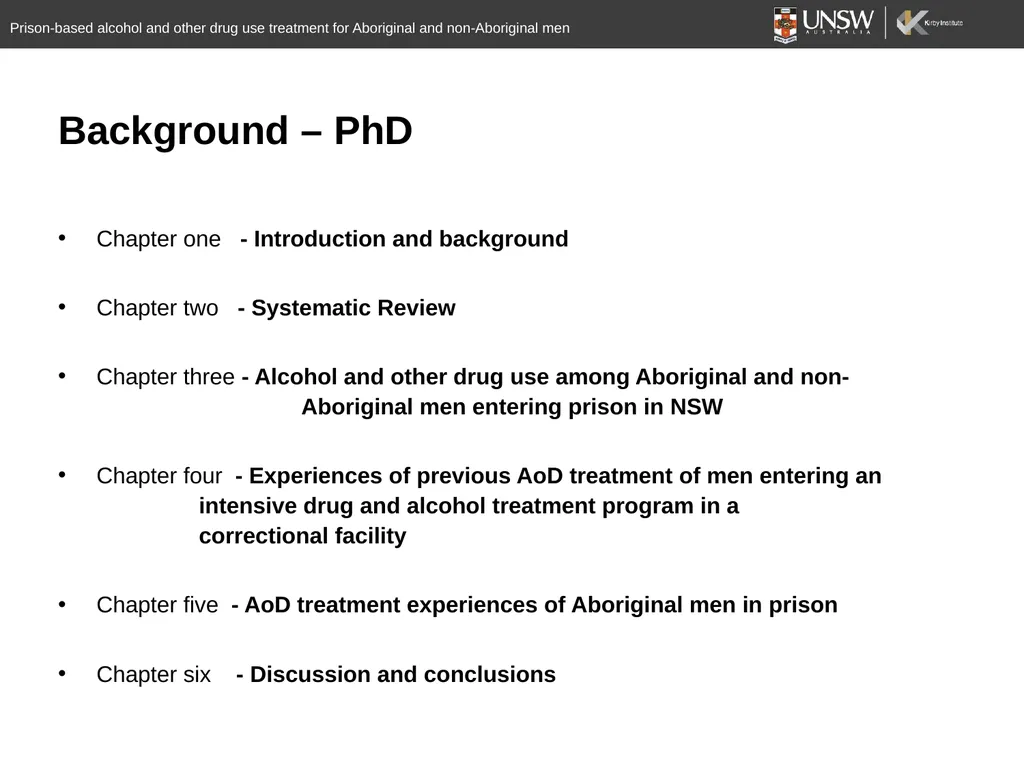
Background – PhD Chapter one - Introduction and background
Chapter two - Systematic Review
Chapter three - Alcohol and other drug use among Aboriginal and non- Aboriginal men entering prison in NSW
Chapter four - Experiences of previous AoD treatment of men entering an intensive drug and alcohol treatment program in a correctional facility
Chapter five - AoD treatment experiences of Aboriginal men in prison
Chapter six - Discussion and conclusions 2 Prison-based alcohol and other drug use treatment for Aboriginal and non-Aboriginal men<br>
Chapter two - Systematic Review
Chapter three - Alcohol and other drug use among Aboriginal and non- Aboriginal men entering prison in NSW
Chapter four - Experiences of previous AoD treatment of men entering an intensive drug and alcohol treatment program in a correctional facility
Chapter five - AoD treatment experiences of Aboriginal men in prison
Chapter six - Discussion and conclusions 2 Prison-based alcohol and other drug use treatment for Aboriginal and non-Aboriginal men<br>
03
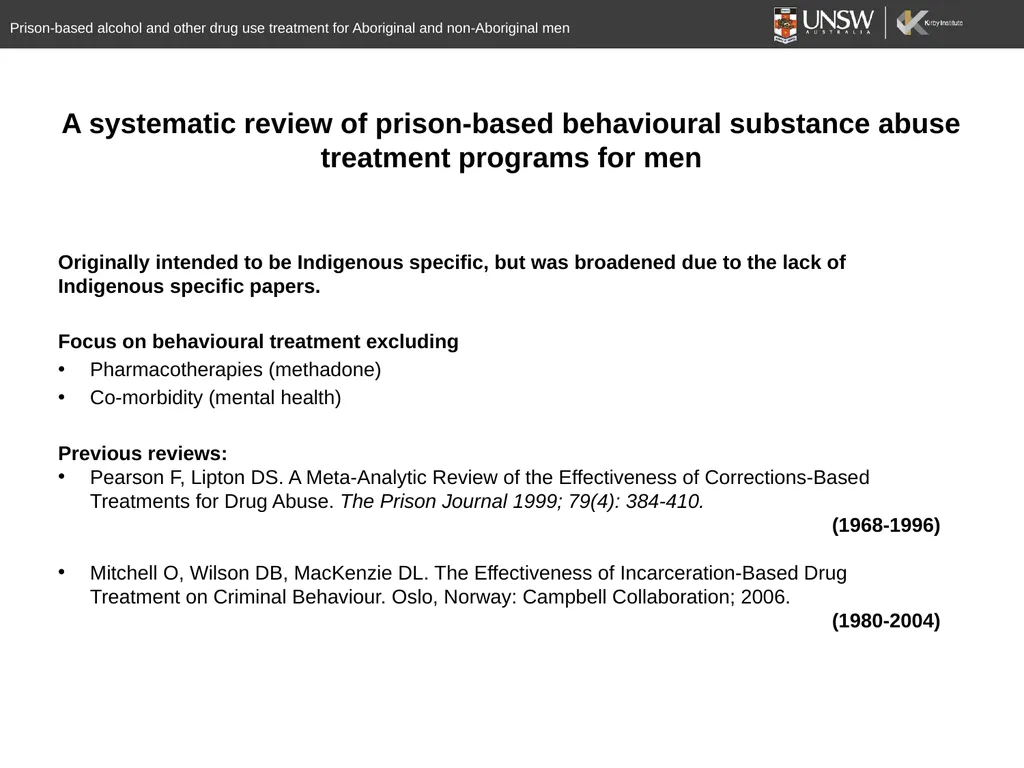
A systematic review of prison-based behavioural substance abuse treatment programs for men Originally intended to be Indigenous specific, but was broadened due to the lack of Indigenous specific papers.
Focus on behavioural treatment excluding
Pharmacotherapies (methadone)
Co-morbidity (mental health)
Previous reviews:
Pearson F, Lipton DS. A Meta-Analytic Review of the Effectiveness of Corrections-Based Treatments for Drug Abuse. The Prison Journal 1999; 79(4): 384-410.
(1968-1996)
Mitchell O, Wilson DB, MacKenzie DL. The Effectiveness of Incarceration-Based Drug Treatment on Criminal Behaviour. Oslo, Norway: Campbell Collaboration; 2006.
(1980-2004) 3 Prison-based alcohol and other drug use treatment for Aboriginal and non-Aboriginal men<br>
Focus on behavioural treatment excluding
Pharmacotherapies (methadone)
Co-morbidity (mental health)
Previous reviews:
Pearson F, Lipton DS. A Meta-Analytic Review of the Effectiveness of Corrections-Based Treatments for Drug Abuse. The Prison Journal 1999; 79(4): 384-410.
(1968-1996)
Mitchell O, Wilson DB, MacKenzie DL. The Effectiveness of Incarceration-Based Drug Treatment on Criminal Behaviour. Oslo, Norway: Campbell Collaboration; 2006.
(1980-2004) 3 Prison-based alcohol and other drug use treatment for Aboriginal and non-Aboriginal men<br>
04
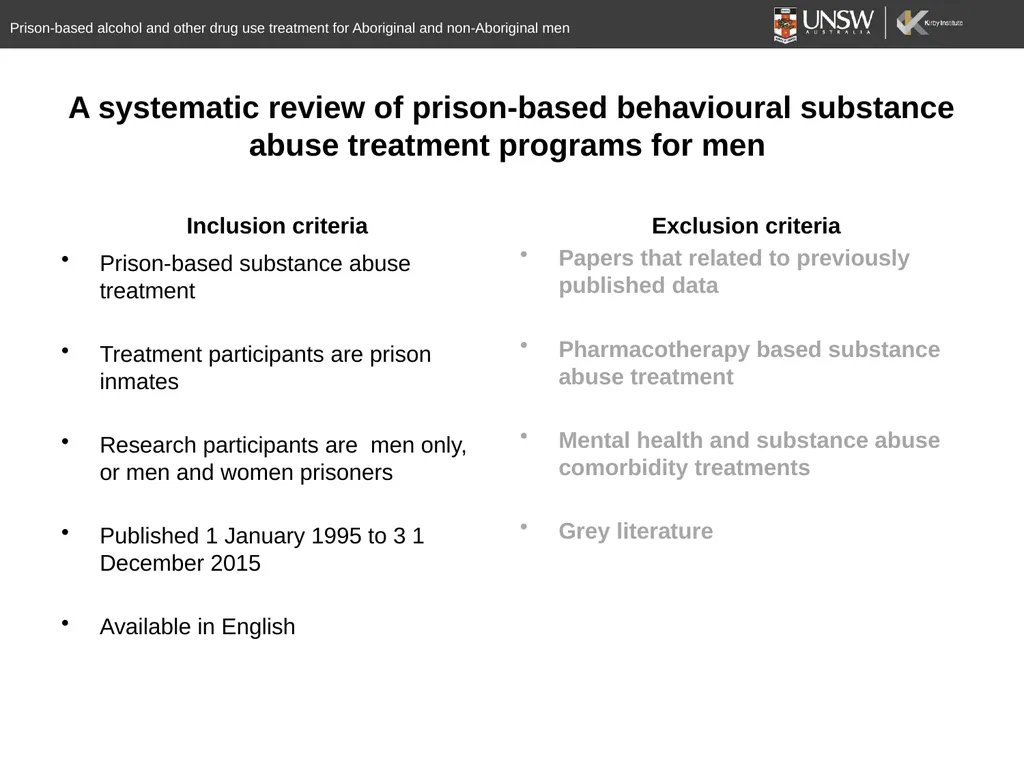
A systematic review of prison-based behavioural substance abuse treatment programs for men Inclusion criteria Prison-based substance abuse treatment
Treatment participants are prison inmates
Research participants are men only, or men and women prisoners
Published 1 January 1995 to 3 1 December 2015
Available in English Exclusion criteria Papers that related to previously published data
Pharmacotherapy based substance abuse treatment
Mental health and substance abuse comorbidity treatments
Grey literature Prison-based alcohol and other drug use treatment for Aboriginal and non-Aboriginal men<br>
Treatment participants are prison inmates
Research participants are men only, or men and women prisoners
Published 1 January 1995 to 3 1 December 2015
Available in English Exclusion criteria Papers that related to previously published data
Pharmacotherapy based substance abuse treatment
Mental health and substance abuse comorbidity treatments
Grey literature Prison-based alcohol and other drug use treatment for Aboriginal and non-Aboriginal men<br>
05
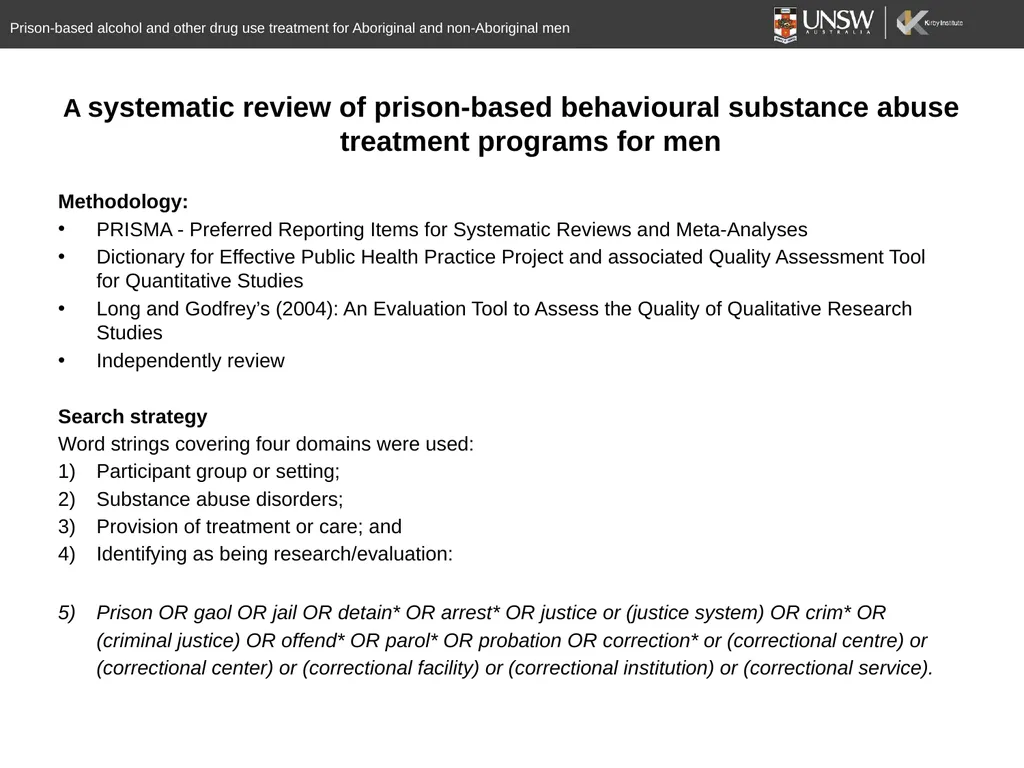
A systematic review of prison-based behavioural substance abuse treatment programs for men Methodology:
PRISMA - Preferred Reporting Items for Systematic Reviews and Meta-Analyses
Dictionary for Effective Public Health Practice Project and associated Quality Assessment Tool for Quantitative Studies
Long and Godfrey’s (2004): An Evaluation Tool to Assess the Quality of Qualitative Research Studies
Independently review
Search strategy
Word strings covering four domains were used:
Participant group or setting;
Substance abuse disorders;
Provision of treatment or care; and
Identifying as being research/evaluation:
Prison OR gaol OR jail OR detain* OR arrest* OR justice or (justice system) OR crim* OR (criminal justice) OR offend* OR parol* OR probation OR correction* or (correctional centre) or (correctional center) or (correctional facility) or (correctional institution) or (correctional service). 5 Prison-based alcohol and other drug use treatment for Aboriginal and non-Aboriginal men<br>
PRISMA - Preferred Reporting Items for Systematic Reviews and Meta-Analyses
Dictionary for Effective Public Health Practice Project and associated Quality Assessment Tool for Quantitative Studies
Long and Godfrey’s (2004): An Evaluation Tool to Assess the Quality of Qualitative Research Studies
Independently review
Search strategy
Word strings covering four domains were used:
Participant group or setting;
Substance abuse disorders;
Provision of treatment or care; and
Identifying as being research/evaluation:
Prison OR gaol OR jail OR detain* OR arrest* OR justice or (justice system) OR crim* OR (criminal justice) OR offend* OR parol* OR probation OR correction* or (correctional centre) or (correctional center) or (correctional facility) or (correctional institution) or (correctional service). 5 Prison-based alcohol and other drug use treatment for Aboriginal and non-Aboriginal men<br>
06
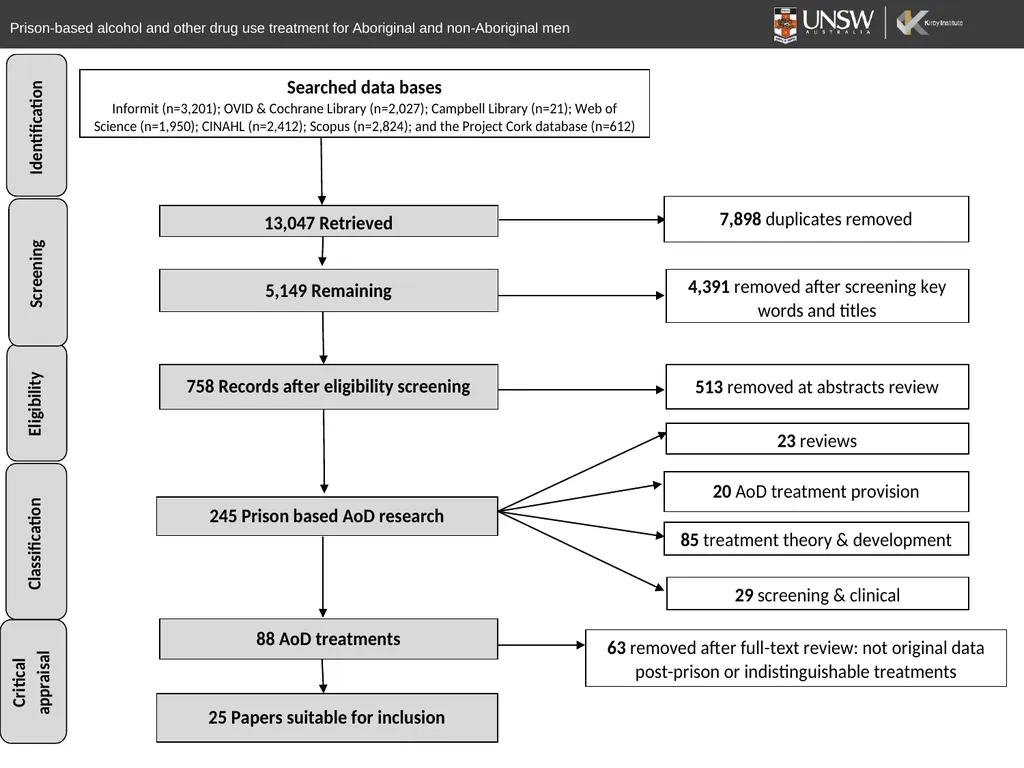
6 Prison-based alcohol and other drug use treatment for Aboriginal and non-Aboriginal men<br>
07
7 Prison-based alcohol and other drug use treatment for Aboriginal and non-Aboriginal men<br>
08
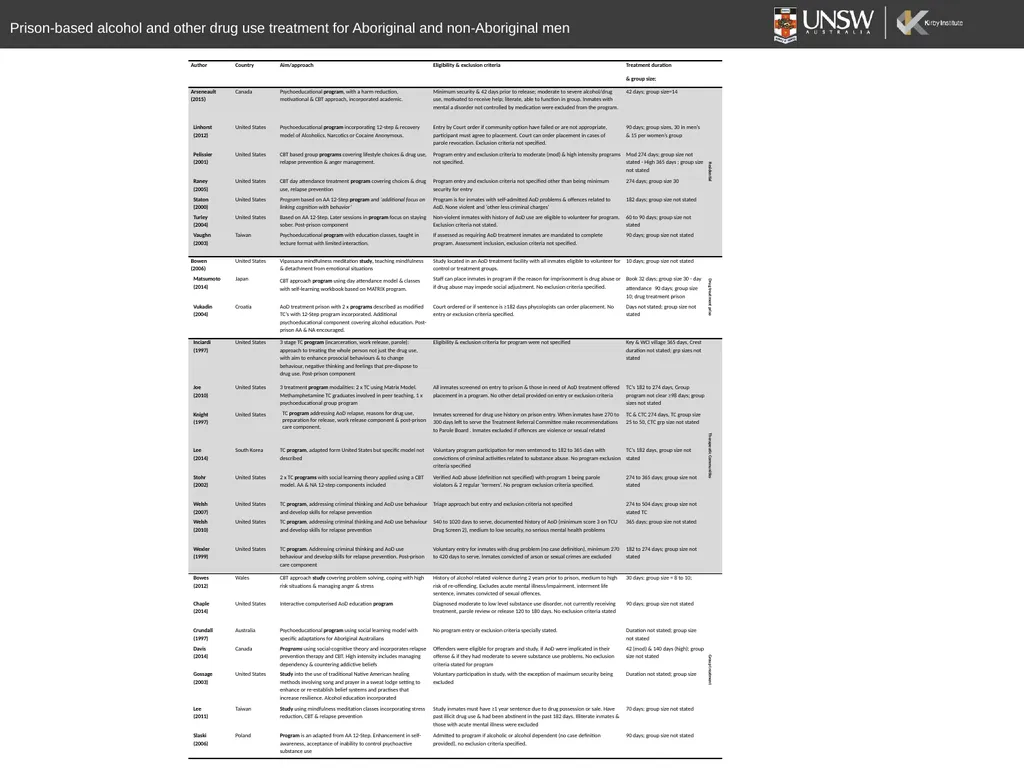
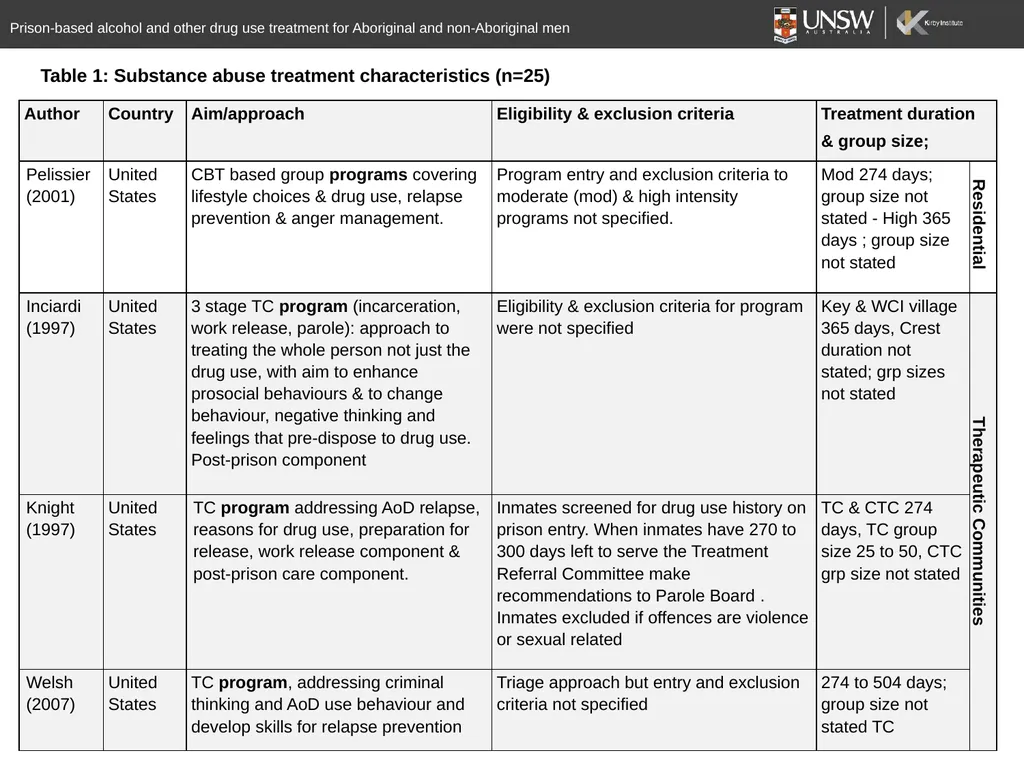
8 Table 1: Substance abuse treatment characteristics (n=25) Prison-based alcohol and other drug use treatment for Aboriginal and non-Aboriginal men<br>
09
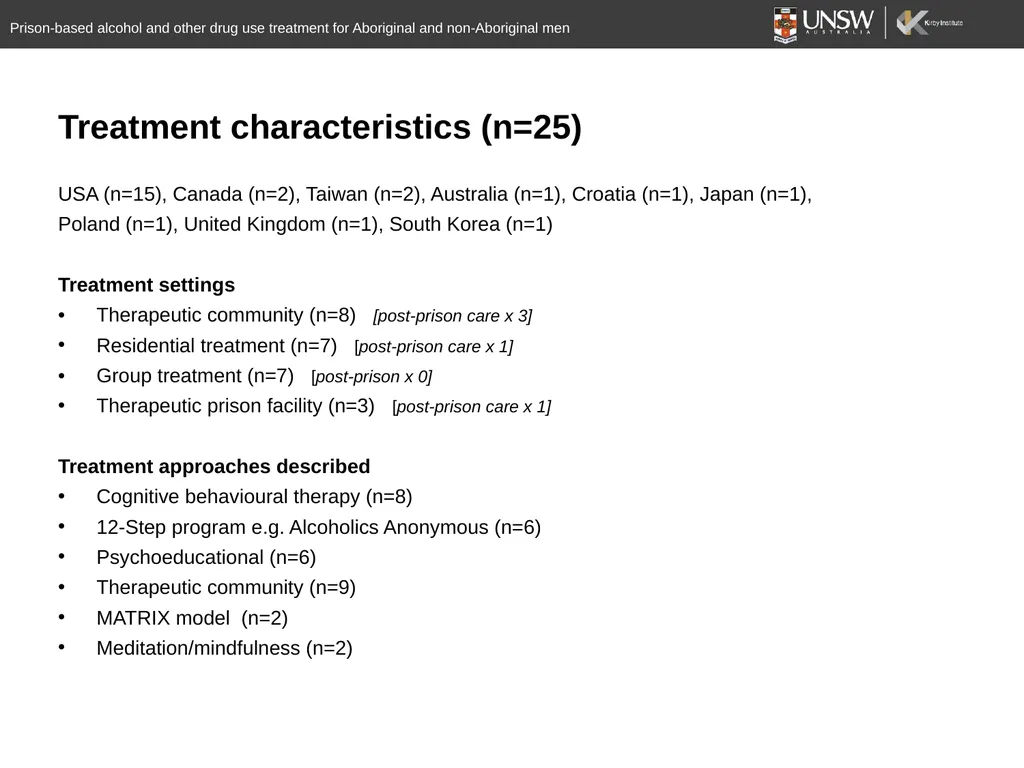
Treatment characteristics (n=25) USA (n=15), Canada (n=2), Taiwan (n=2), Australia (n=1), Croatia (n=1), Japan (n=1),
Poland (n=1), United Kingdom (n=1), South Korea (n=1)
Treatment settings
• Therapeutic community (n=8) [post-prison care x 3]
Residential treatment (n=7) [post-prison care x 1]
• Group treatment (n=7) [post-prison x 0]
Therapeutic prison facility (n=3) [post-prison care x 1]
Treatment approaches described
Cognitive behavioural therapy (n=8)
12-Step program e.g. Alcoholics Anonymous (n=6)
Psychoeducational (n=6)
Therapeutic community (n=9)
MATRIX model (n=2)
Meditation/mindfulness (n=2) 9 Prison-based alcohol and other drug use treatment for Aboriginal and non-Aboriginal men<br>
Poland (n=1), United Kingdom (n=1), South Korea (n=1)
Treatment settings
• Therapeutic community (n=8) [post-prison care x 3]
Residential treatment (n=7) [post-prison care x 1]
• Group treatment (n=7) [post-prison x 0]
Therapeutic prison facility (n=3) [post-prison care x 1]
Treatment approaches described
Cognitive behavioural therapy (n=8)
12-Step program e.g. Alcoholics Anonymous (n=6)
Psychoeducational (n=6)
Therapeutic community (n=9)
MATRIX model (n=2)
Meditation/mindfulness (n=2) 9 Prison-based alcohol and other drug use treatment for Aboriginal and non-Aboriginal men<br>
10
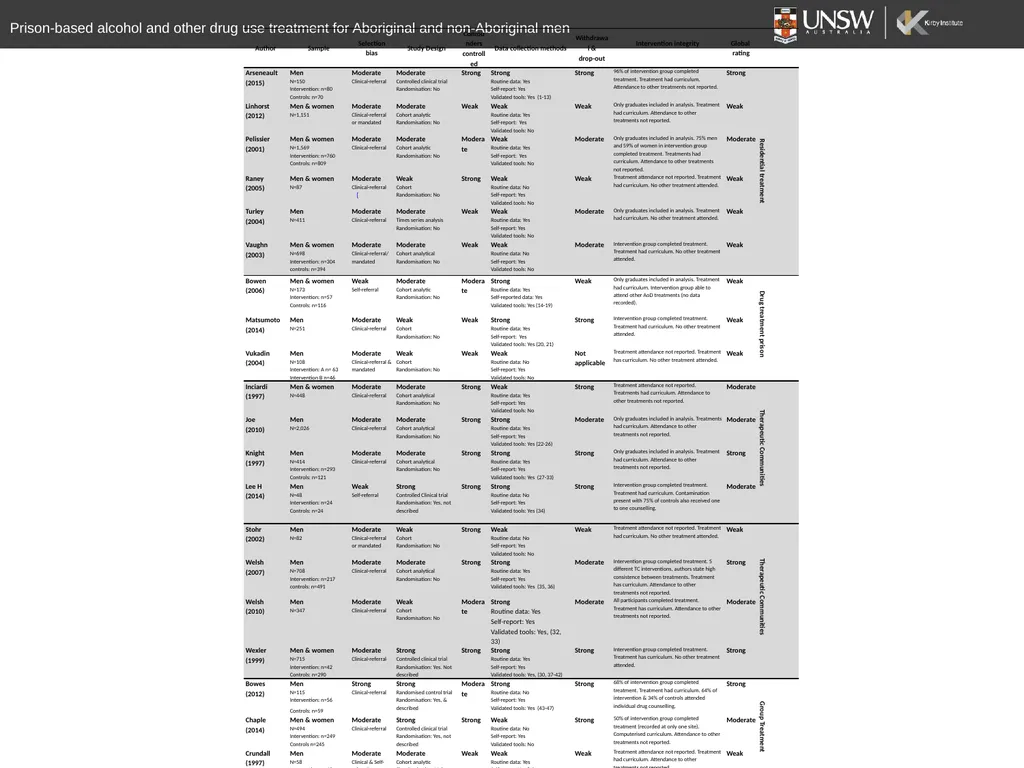
10 Prison-based alcohol and other drug use treatment for Aboriginal and non-Aboriginal men [<br>
11
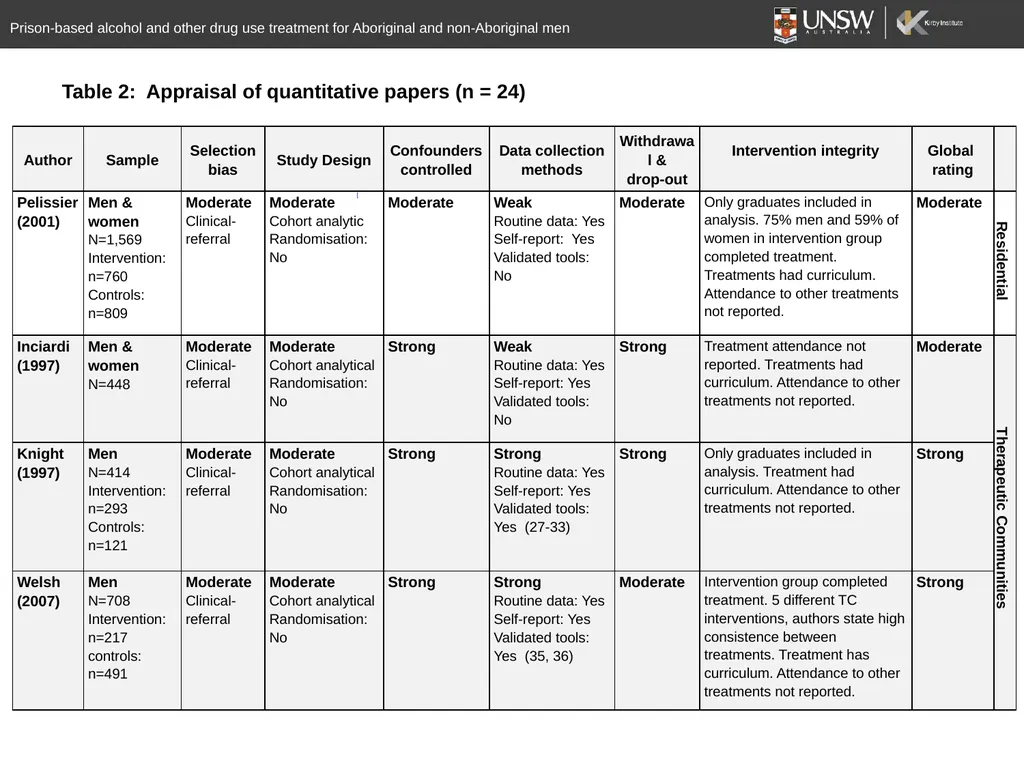
11 Prison-based alcohol and other drug use treatment for Aboriginal and non-Aboriginal men [ Table 2: Appraisal of quantitative papers (n = 24)<br>
12
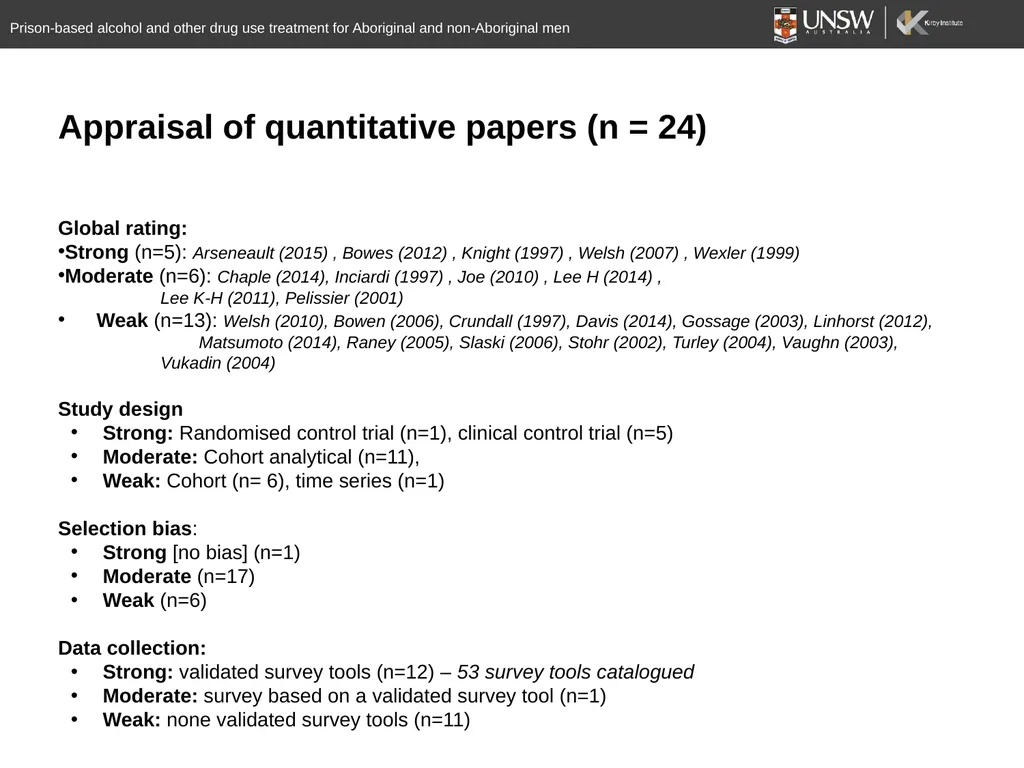
Appraisal of quantitative papers (n = 24) Global rating:
Strong (n=5): Arseneault (2015) , Bowes (2012) , Knight (1997) , Welsh (2007) , Wexler (1999)
Moderate (n=6): Chaple (2014), Inciardi (1997) , Joe (2010) , Lee H (2014) ,
Lee K-H (2011), Pelissier (2001)
Weak (n=13): Welsh (2010), Bowen (2006), Crundall (1997), Davis (2014), Gossage (2003), Linhorst (2012), Matsumoto (2014), Raney (2005), Slaski (2006), Stohr (2002), Turley (2004), Vaughn (2003),
Vukadin (2004)
Study design
Strong: Randomised control trial (n=1), clinical control trial (n=5)
Moderate: Cohort analytical (n=11),
Weak: Cohort (n= 6), time series (n=1)
Selection bias:
Strong [no bias] (n=1)
Moderate (n=17)
Weak (n=6)
Data collection:
Strong: validated survey tools (n=12) – 53 survey tools catalogued
Moderate: survey based on a validated survey tool (n=1)
Weak: none validated survey tools (n=11) 12 Prison-based alcohol and other drug use treatment for Aboriginal and non-Aboriginal men<br>
Strong (n=5): Arseneault (2015) , Bowes (2012) , Knight (1997) , Welsh (2007) , Wexler (1999)
Moderate (n=6): Chaple (2014), Inciardi (1997) , Joe (2010) , Lee H (2014) ,
Lee K-H (2011), Pelissier (2001)
Weak (n=13): Welsh (2010), Bowen (2006), Crundall (1997), Davis (2014), Gossage (2003), Linhorst (2012), Matsumoto (2014), Raney (2005), Slaski (2006), Stohr (2002), Turley (2004), Vaughn (2003),
Vukadin (2004)
Study design
Strong: Randomised control trial (n=1), clinical control trial (n=5)
Moderate: Cohort analytical (n=11),
Weak: Cohort (n= 6), time series (n=1)
Selection bias:
Strong [no bias] (n=1)
Moderate (n=17)
Weak (n=6)
Data collection:
Strong: validated survey tools (n=12) – 53 survey tools catalogued
Moderate: survey based on a validated survey tool (n=1)
Weak: none validated survey tools (n=11) 12 Prison-based alcohol and other drug use treatment for Aboriginal and non-Aboriginal men<br>
13
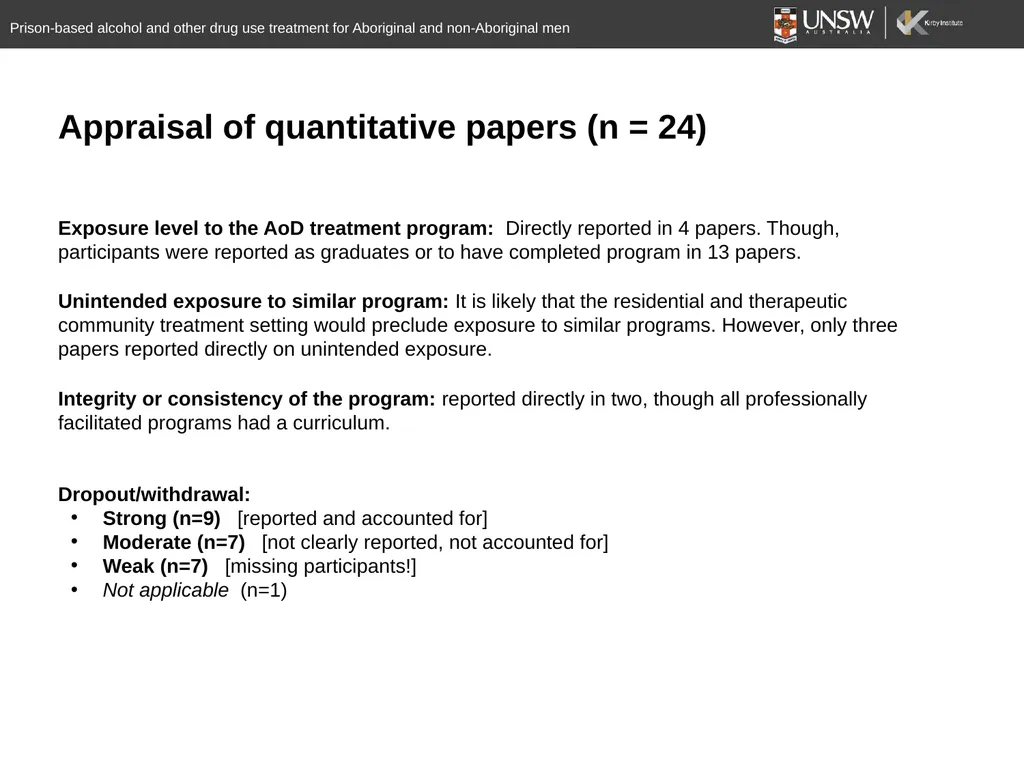
Appraisal of quantitative papers (n = 24) Exposure level to the AoD treatment program: Directly reported in 4 papers. Though, participants were reported as graduates or to have completed program in 13 papers.
Unintended exposure to similar program: It is likely that the residential and therapeutic community treatment setting would preclude exposure to similar programs. However, only three papers reported directly on unintended exposure.
Integrity or consistency of the program: reported directly in two, though all professionally facilitated programs had a curriculum.
Dropout/withdrawal:
Strong (n=9) [reported and accounted for]
Moderate (n=7) [not clearly reported, not accounted for]
Weak (n=7) [missing participants!]
Not applicable (n=1) 13 Prison-based alcohol and other drug use treatment for Aboriginal and non-Aboriginal men<br>
Unintended exposure to similar program: It is likely that the residential and therapeutic community treatment setting would preclude exposure to similar programs. However, only three papers reported directly on unintended exposure.
Integrity or consistency of the program: reported directly in two, though all professionally facilitated programs had a curriculum.
Dropout/withdrawal:
Strong (n=9) [reported and accounted for]
Moderate (n=7) [not clearly reported, not accounted for]
Weak (n=7) [missing participants!]
Not applicable (n=1) 13 Prison-based alcohol and other drug use treatment for Aboriginal and non-Aboriginal men<br>
14
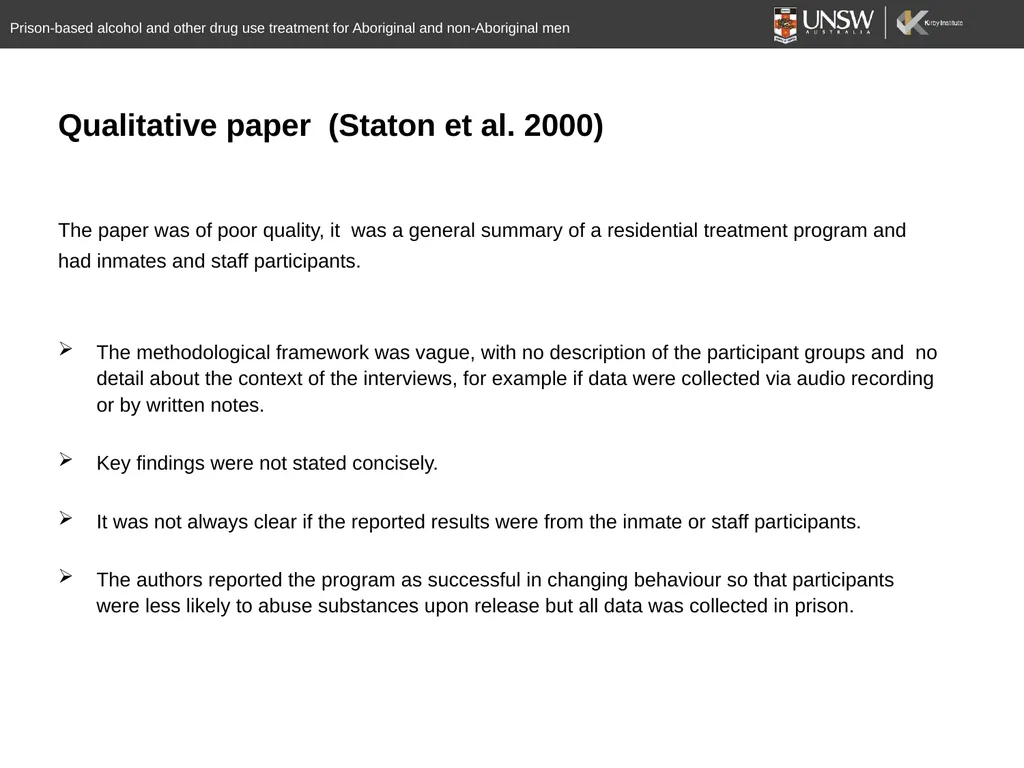
Qualitative paper (Staton et al. 2000) The paper was of poor quality, it was a general summary of a residential treatment program and
had inmates and staff participants.
The methodological framework was vague, with no description of the participant groups and no detail about the context of the interviews, for example if data were collected via audio recording or by written notes.
Key findings were not stated concisely.
It was not always clear if the reported results were from the inmate or staff participants.
The authors reported the program as successful in changing behaviour so that participants were less likely to abuse substances upon release but all data was collected in prison. 14 Prison-based alcohol and other drug use treatment for Aboriginal and non-Aboriginal men<br>
had inmates and staff participants.
The methodological framework was vague, with no description of the participant groups and no detail about the context of the interviews, for example if data were collected via audio recording or by written notes.
Key findings were not stated concisely.
It was not always clear if the reported results were from the inmate or staff participants.
The authors reported the program as successful in changing behaviour so that participants were less likely to abuse substances upon release but all data was collected in prison. 14 Prison-based alcohol and other drug use treatment for Aboriginal and non-Aboriginal men<br>
15
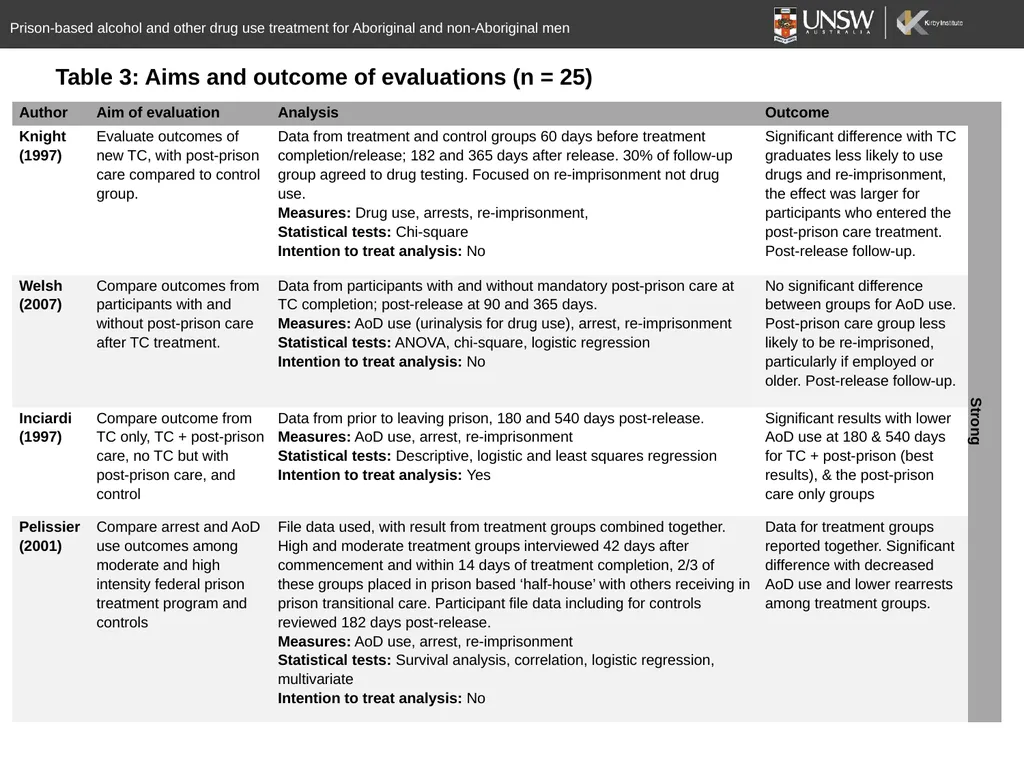
15 Prison-based alcohol and other drug use treatment for Aboriginal and non-Aboriginal men Table 3: Aims and outcome of evaluations (n = 25)<br>
16
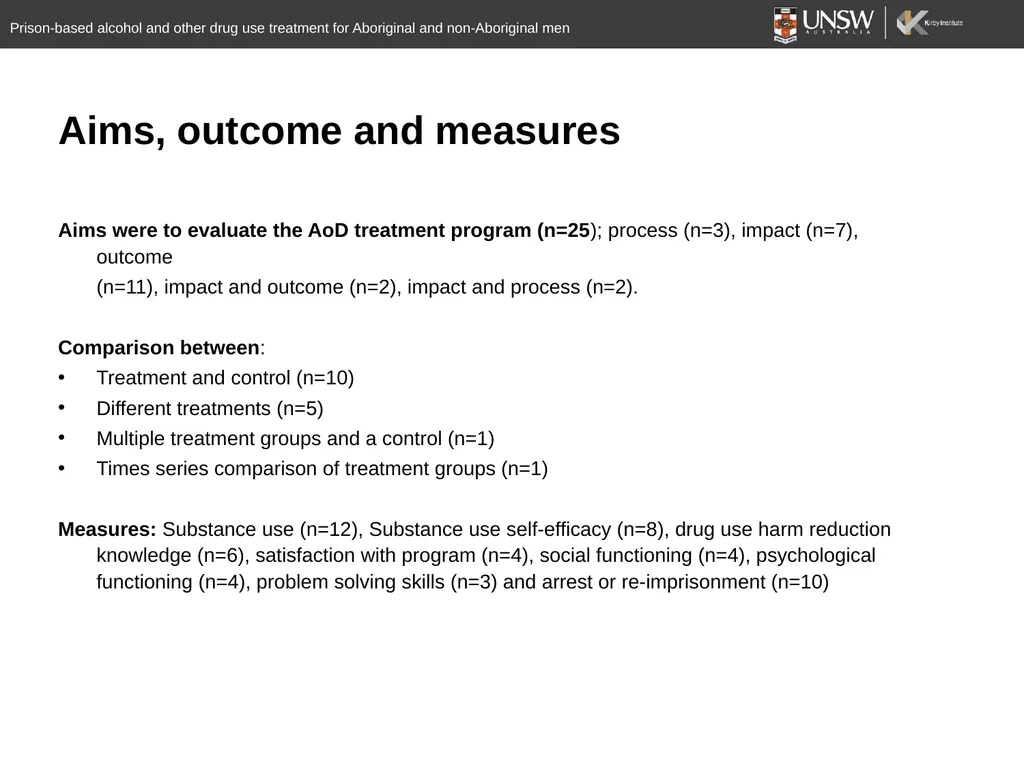
Aims, outcome and measures Aims were to evaluate the AoD treatment program (n=25); process (n=3), impact (n=7), outcome
(n=11), impact and outcome (n=2), impact and process (n=2).
Comparison between:
Treatment and control (n=10)
Different treatments (n=5)
Multiple treatment groups and a control (n=1)
Times series comparison of treatment groups (n=1)
Measures: Substance use (n=12), Substance use self-efficacy (n=8), drug use harm reduction knowledge (n=6), satisfaction with program (n=4), social functioning (n=4), psychological functioning (n=4), problem solving skills (n=3) and arrest or re-imprisonment (n=10) 16 Prison-based alcohol and other drug use treatment for Aboriginal and non-Aboriginal men<br>
(n=11), impact and outcome (n=2), impact and process (n=2).
Comparison between:
Treatment and control (n=10)
Different treatments (n=5)
Multiple treatment groups and a control (n=1)
Times series comparison of treatment groups (n=1)
Measures: Substance use (n=12), Substance use self-efficacy (n=8), drug use harm reduction knowledge (n=6), satisfaction with program (n=4), social functioning (n=4), psychological functioning (n=4), problem solving skills (n=3) and arrest or re-imprisonment (n=10) 16 Prison-based alcohol and other drug use treatment for Aboriginal and non-Aboriginal men<br>
17
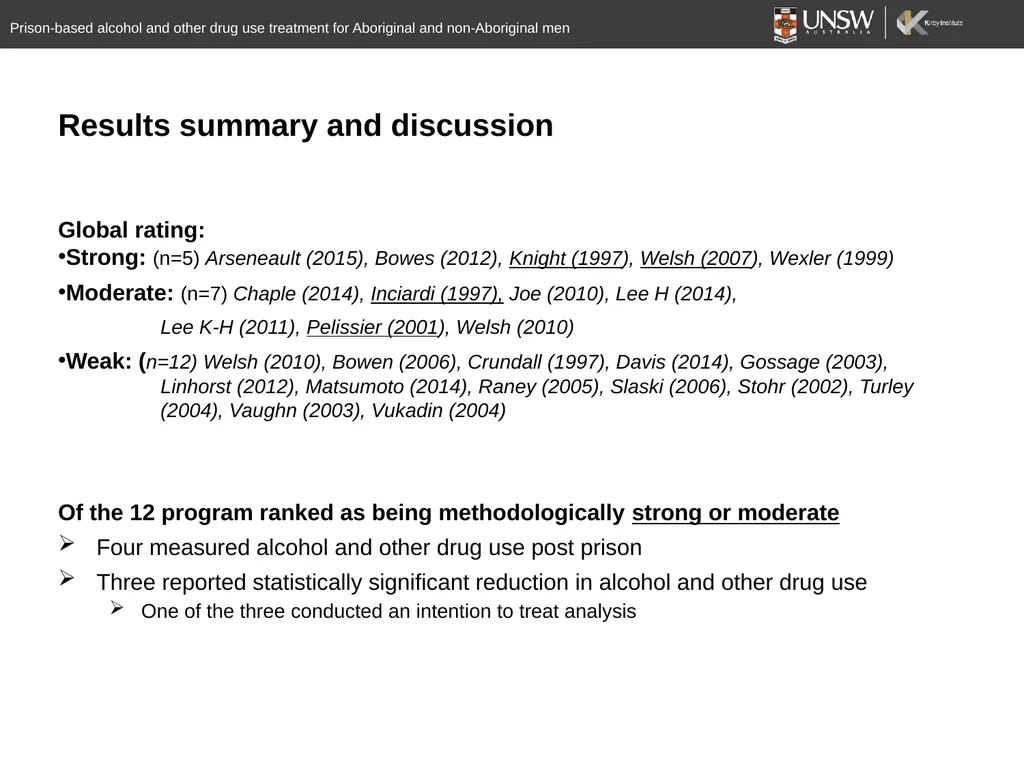
Results summary and discussion Global rating:
Strong: (n=5) Arseneault (2015), Bowes (2012), Knight (1997), Welsh (2007), Wexler (1999)
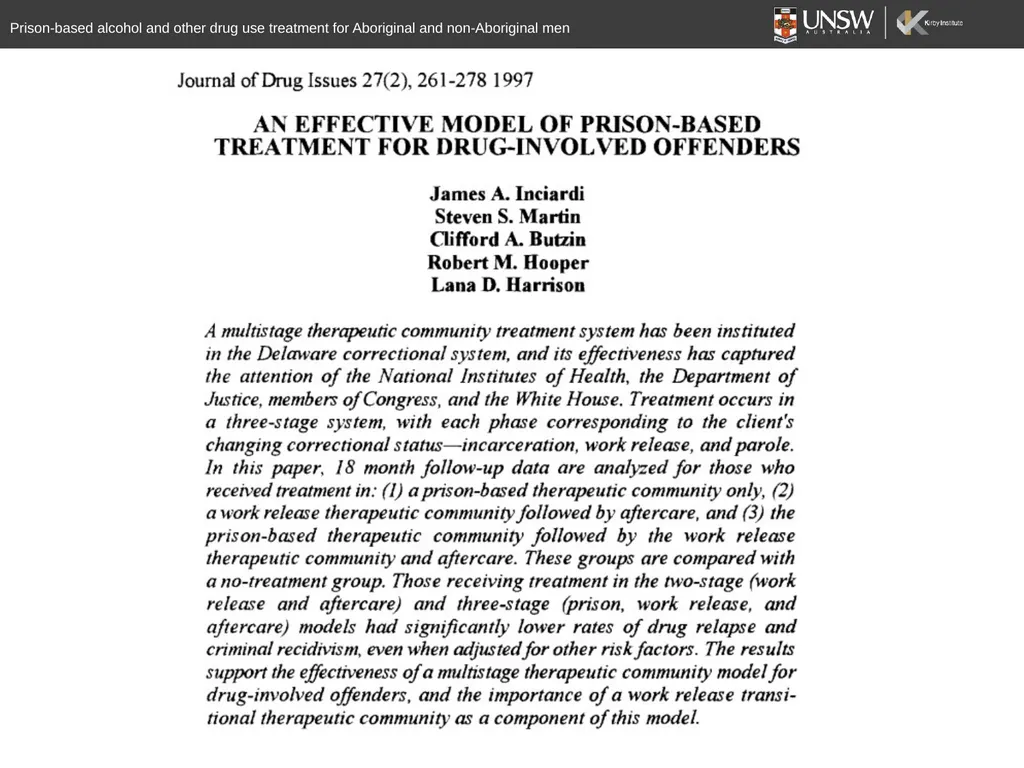
Moderate: (n=7) Chaple (2014), Inciardi (1997), Joe (2010), Lee H (2014),
Lee K-H (2011), Pelissier (2001), Welsh (2010)
Weak: (n=12) Welsh (2010), Bowen (2006), Crundall (1997), Davis (2014), Gossage (2003), Linhorst (2012), Matsumoto (2014), Raney (2005), Slaski (2006), Stohr (2002), Turley (2004), Vaughn (2003), Vukadin (2004)
Of the 12 program ranked as being methodologically strong or moderate
Four measured alcohol and other drug use post prison
Three reported statistically significant reduction in alcohol and other drug use
One of the three conducted an intention to treat analysis 17 Prison-based alcohol and other drug use treatment for Aboriginal and non-Aboriginal men<br>
Strong: (n=5) Arseneault (2015), Bowes (2012), Knight (1997), Welsh (2007), Wexler (1999)
Moderate: (n=7) Chaple (2014), Inciardi (1997), Joe (2010), Lee H (2014),
Lee K-H (2011), Pelissier (2001), Welsh (2010)
Weak: (n=12) Welsh (2010), Bowen (2006), Crundall (1997), Davis (2014), Gossage (2003), Linhorst (2012), Matsumoto (2014), Raney (2005), Slaski (2006), Stohr (2002), Turley (2004), Vaughn (2003), Vukadin (2004)
Of the 12 program ranked as being methodologically strong or moderate
Four measured alcohol and other drug use post prison
Three reported statistically significant reduction in alcohol and other drug use
One of the three conducted an intention to treat analysis 17 Prison-based alcohol and other drug use treatment for Aboriginal and non-Aboriginal men<br>
18
18 Prison-based alcohol and other drug use treatment for Aboriginal and non-Aboriginal men<br>
19
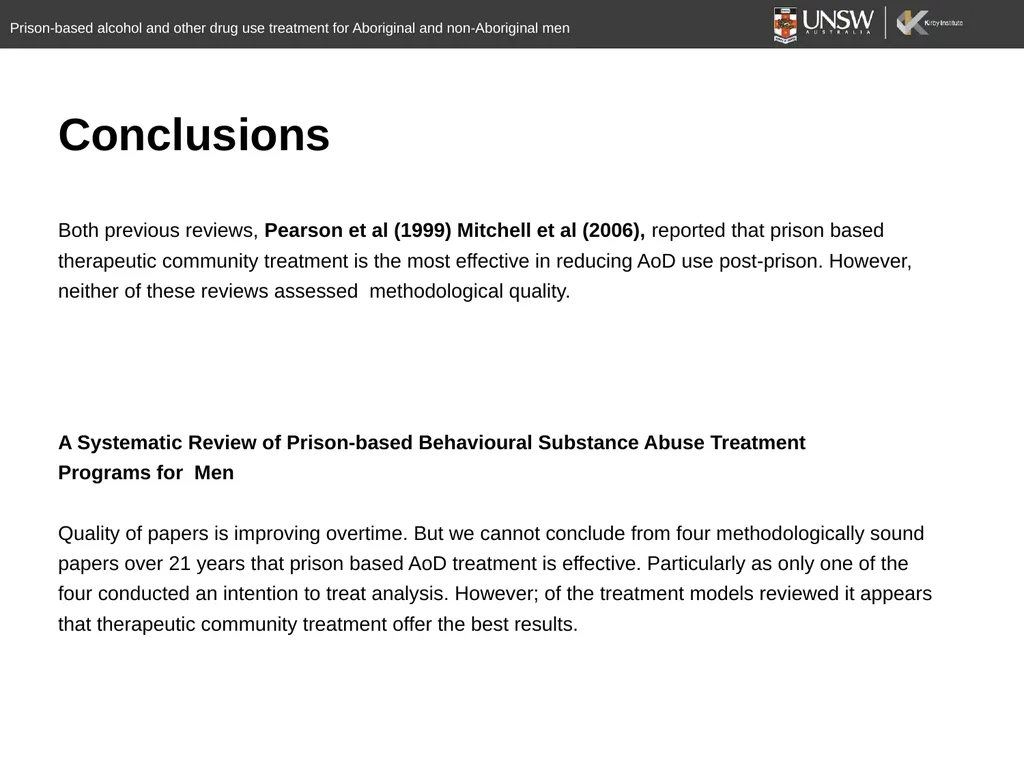
Conclusions Both previous reviews, Pearson et al (1999) Mitchell et al (2006), reported that prison based
therapeutic community treatment is the most effective in reducing AoD use post-prison. However,
neither of these reviews assessed methodological quality.
A Systematic Review of Prison-based Behavioural Substance Abuse Treatment
Programs for Men
Quality of papers is improving overtime. But we cannot conclude from four methodologically sound
papers over 21 years that prison based AoD treatment is effective. Particularly as only one of the
four conducted an intention to treat analysis. However; of the treatment models reviewed it appears
that therapeutic community treatment offer the best results. 19 Prison-based alcohol and other drug use treatment for Aboriginal and non-Aboriginal men<br>
therapeutic community treatment is the most effective in reducing AoD use post-prison. However,
neither of these reviews assessed methodological quality.
A Systematic Review of Prison-based Behavioural Substance Abuse Treatment
Programs for Men
Quality of papers is improving overtime. But we cannot conclude from four methodologically sound
papers over 21 years that prison based AoD treatment is effective. Particularly as only one of the
four conducted an intention to treat analysis. However; of the treatment models reviewed it appears
that therapeutic community treatment offer the best results. 19 Prison-based alcohol and other drug use treatment for Aboriginal and non-Aboriginal men<br>
20
Michael Doyle
Phone 02 9385 9259
Email: mdoyle@kirby.unsw.edu.au 20 Thank you
Any questions? Michael Doyle Phone: 0403 129 210 Email: mdoyle@kirby.unsw.edu.au Prison-based alcohol and other drug use treatment for Aboriginal and non-Aboriginal men<br>
Any questions? Michael Doyle Phone: 0403 129 210 Email: mdoyle@kirby.unsw.edu.au Prison-based alcohol and other drug use treatment for Aboriginal and non-Aboriginal men<br>