
A user guide introduction to the AARRR! funnel
MT
Published · 19 slides · 0 views
1 / 1



Description
A user guide introduction to the AARRR! funnel genieproject.eu Index 1 Brief introduction to the Pirates funnel aka AARRR! model 1.1 What is the AARRR! Model about? A quick introduction to the Pirates funnel 1.2 The AARRR! for
Related Topics
Share
Embed code
Download this presentation From Below
"A user guide introduction to the AARRR! funnel" is the property of its rightful owner. Permission is granted to download and print the materials on this website for personal, non-commercial use only, and to display it on your personal computer provided you do not modify the materials and that you retain all copyright notices contained in the materials. By downloading content from our website, you accept the terms of this agreement.
Presentation Transcript
01
A user guide introduction to the AARRR! funnel genieproject.eu<br>
02
Index 1 Brief introduction to the Pirates’ funnel aka AARRR! model 1.1 What is the AARRR! Model about? A quick introduction to the Pirates’ funnel
1.2 The AARRR! for intrapreneurs - Why even bother…
1.3 The AARRR! Model in its core essentials – Five steps for metrics’ measurement
1.4 Slight variations largely applicate & valorised into practice - The AAARRR! Model 2 Core stages of the Pirates’ funnel aka AARRR! model 2.1 Acquisition – The lead stage
2.2 Activation – Stimulating further the lead contacts
2.3 Retention – Nurturing customer loyalty
2.4 Revenue – Time to make profit
2.5 Referral – Triggering the word-of-mouth effect and positive externalities<br>
1.2 The AARRR! for intrapreneurs - Why even bother…
1.3 The AARRR! Model in its core essentials – Five steps for metrics’ measurement
1.4 Slight variations largely applicate & valorised into practice - The AAARRR! Model 2 Core stages of the Pirates’ funnel aka AARRR! model 2.1 Acquisition – The lead stage
2.2 Activation – Stimulating further the lead contacts
2.3 Retention – Nurturing customer loyalty
2.4 Revenue – Time to make profit
2.5 Referral – Triggering the word-of-mouth effect and positive externalities<br>
03
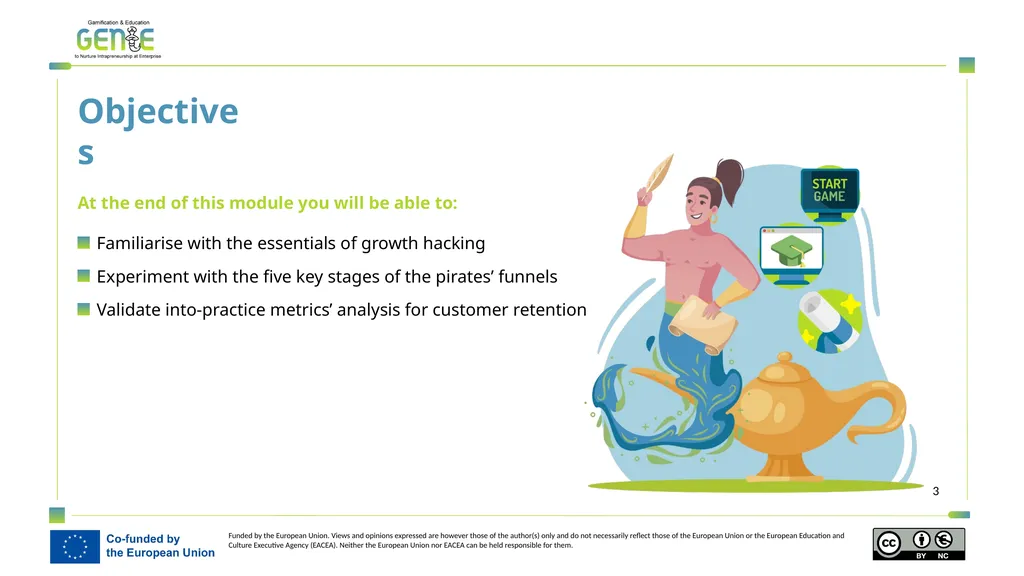
Objectives At the end of this module you will be able to: Familiarise with the essentials of growth hacking
Experiment with the five key stages of the pirates’ funnels
Validate into-practice metrics’ analysis for customer retention<br>
Experiment with the five key stages of the pirates’ funnels
Validate into-practice metrics’ analysis for customer retention<br>
04
Brief introduction to the Pirates’ funnel aka AARRR! model Unit 1 1.1 What is the AARRR! Model about? A quick introduction to the Pirates’ funnel
1.2 The AARRR! for intrapreneurs - Why even bother…
1.3 The AARRR! Model in its core essentials – Five steps for metrics’ measurement
1.4 Slight variations largely applicate & valorised into practice - The AAARRR! Model<br>
1.2 The AARRR! for intrapreneurs - Why even bother…
1.3 The AARRR! Model in its core essentials – Five steps for metrics’ measurement
1.4 Slight variations largely applicate & valorised into practice - The AAARRR! Model<br>
05
1. Brief introduction to the Pirates’ funnel aka AARRR! model 1.1 What is the AARRR! Model about? A quick introduction to the Pirates’ funnel The AARRR! Model is a theoretical framework for Growth Hacking and business acceleration introduced for the first time evert in 2007 by Dave McClure – founder of 500 Startup, one of the most important and renewed Venture Capital worldwide.
The concept of Growth Hacking relates to a methodology based on the gathering, processing and experimenting with data at product and marketing channels level to which newly founded organisations rely on to accelerate as fast as possible their penetration of the market and build their customer base.
The very AARRR! Model heavily relies in fact on quantitative analysis and benchmark of metrics to filter which of the available business / investment alternatives are most suitable and feasible at that given time.
The model allows users to fine-tune and optimize the most relevant marketing matrix for the growth and competitiveness of a project, namely customers’ acquisition and retention.<br>
The concept of Growth Hacking relates to a methodology based on the gathering, processing and experimenting with data at product and marketing channels level to which newly founded organisations rely on to accelerate as fast as possible their penetration of the market and build their customer base.
The very AARRR! Model heavily relies in fact on quantitative analysis and benchmark of metrics to filter which of the available business / investment alternatives are most suitable and feasible at that given time.
The model allows users to fine-tune and optimize the most relevant marketing matrix for the growth and competitiveness of a project, namely customers’ acquisition and retention.<br>
06
1.2 The AARRR! for intrapreneurs – Why even bother… Intrapreneurs share many similarities with startuppers and the (re)application of the AARRR! Model in this different settings might generate significant benefits.
The AARRR! Model might help aspiring intrapreneurs in better understating in the market appetize for their idea (i.e., traction), and in which measure it is feasible for them to transit from the idea stage, through piloting, and into the market.
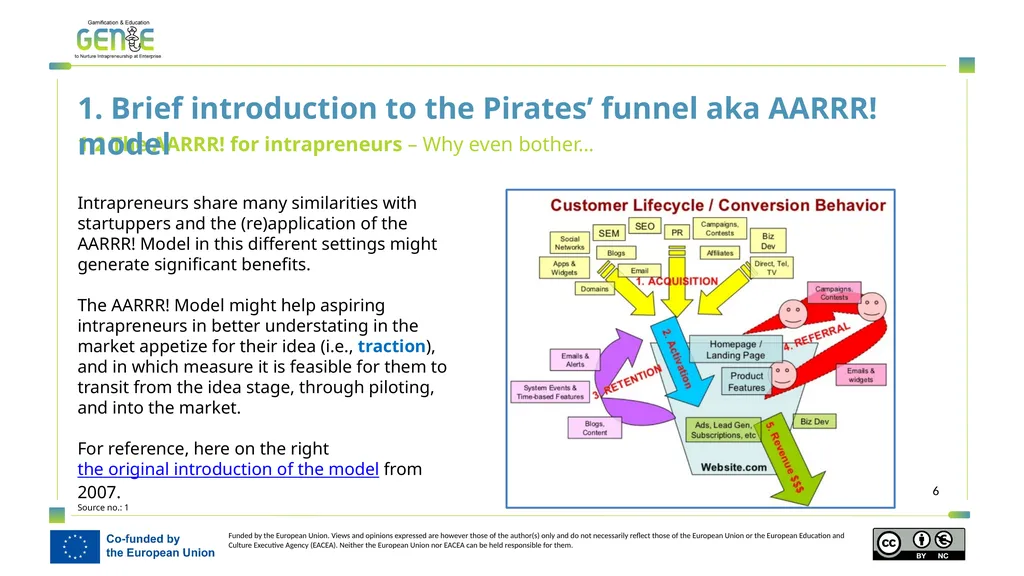
For reference, here on the right the original introduction of the model from 2007. 1. Brief introduction to the Pirates’ funnel aka AARRR! model Source no.: 1<br>
The AARRR! Model might help aspiring intrapreneurs in better understating in the market appetize for their idea (i.e., traction), and in which measure it is feasible for them to transit from the idea stage, through piloting, and into the market.
For reference, here on the right the original introduction of the model from 2007. 1. Brief introduction to the Pirates’ funnel aka AARRR! model Source no.: 1<br>
07
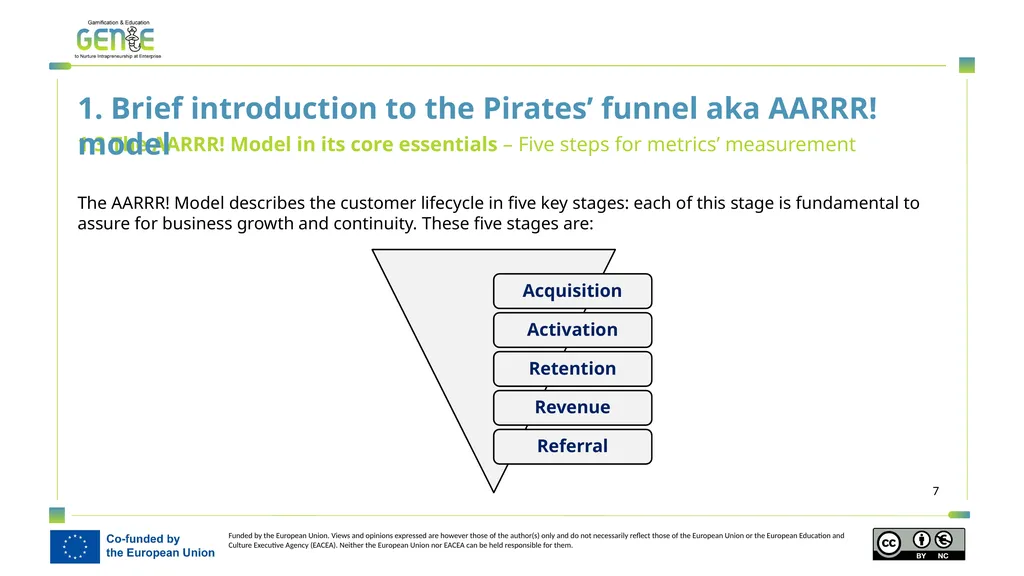
1.3 The AARRR! Model in its core essentials – Five steps for metrics’ measurement The AARRR! Model describes the customer lifecycle in five key stages: each of this stage is fundamental to assure for business growth and continuity. These five stages are: 1. Brief introduction to the Pirates’ funnel aka AARRR! model<br>
08
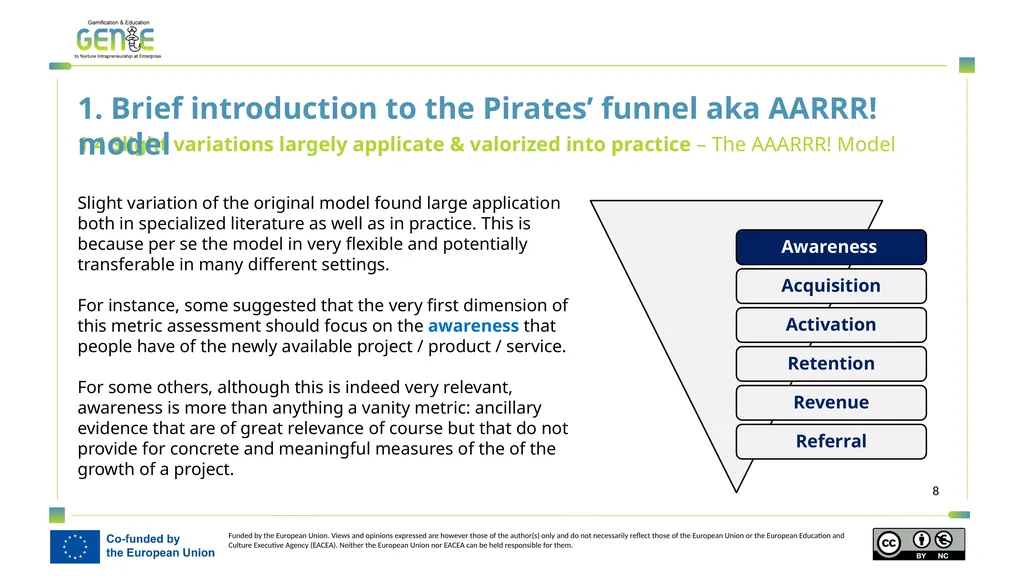
1.4 Slight variations largely applicate & valorized into practice – The AAARRR! Model Slight variation of the original model found large application both in specialized literature as well as in practice. This is because per se the model in very flexible and potentially transferable in many different settings.
For instance, some suggested that the very first dimension of this metric assessment should focus on the awareness that people have of the newly available project / product / service.
For some others, although this is indeed very relevant, awareness is more than anything a vanity metric: ancillary evidence that are of great relevance of course but that do not provide for concrete and meaningful measures of the of the growth of a project. 1. Brief introduction to the Pirates’ funnel aka AARRR! model<br>
For instance, some suggested that the very first dimension of this metric assessment should focus on the awareness that people have of the newly available project / product / service.
For some others, although this is indeed very relevant, awareness is more than anything a vanity metric: ancillary evidence that are of great relevance of course but that do not provide for concrete and meaningful measures of the of the growth of a project. 1. Brief introduction to the Pirates’ funnel aka AARRR! model<br>
09
Core stages of the Pirates’ funnel aka AARRR! model Unit 2 2.1 Acquisition – The lead stage
2.2 Activation – Stimulating further the lead contacts
2.3 Retention – Nurturing customer loyalty
2.4 Revenue – Time to make profit
2.5 Referral – Triggering the word-of-mouth effect and positive externalities<br>
2.2 Activation – Stimulating further the lead contacts
2.3 Retention – Nurturing customer loyalty
2.4 Revenue – Time to make profit
2.5 Referral – Triggering the word-of-mouth effect and positive externalities<br>
10
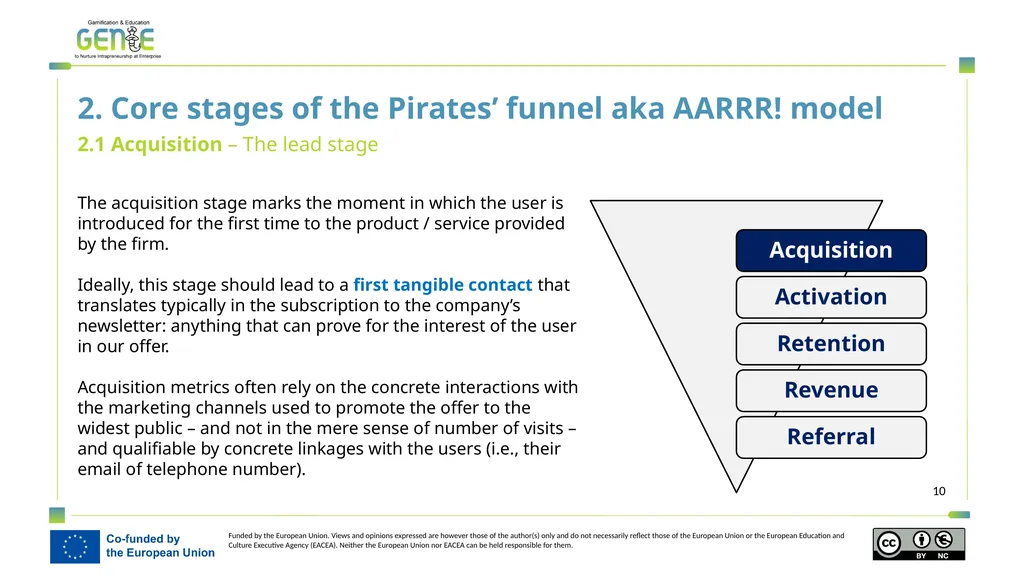
2.1 Acquisition – The lead stage The acquisition stage marks the moment in which the user is introduced for the first time to the product / service provided by the firm.
Ideally, this stage should lead to a first tangible contact that translates typically in the subscription to the company’s newsletter: anything that can prove for the interest of the user in our offer.
Acquisition metrics often rely on the concrete interactions with the marketing channels used to promote the offer to the widest public – and not in the mere sense of number of visits – and qualifiable by concrete linkages with the users (i.e., their email of telephone number). 2. Core stages of the Pirates’ funnel aka AARRR! model<br>
Ideally, this stage should lead to a first tangible contact that translates typically in the subscription to the company’s newsletter: anything that can prove for the interest of the user in our offer.
Acquisition metrics often rely on the concrete interactions with the marketing channels used to promote the offer to the widest public – and not in the mere sense of number of visits – and qualifiable by concrete linkages with the users (i.e., their email of telephone number). 2. Core stages of the Pirates’ funnel aka AARRR! model<br>
11
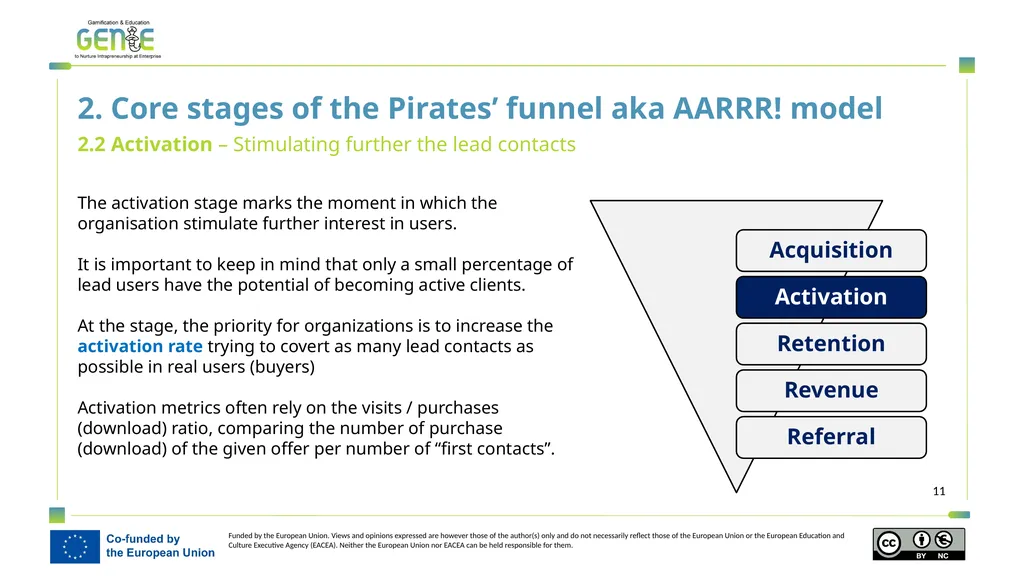
2.2 Activation – Stimulating further the lead contacts The activation stage marks the moment in which the organisation stimulate further interest in users.
It is important to keep in mind that only a small percentage of lead users have the potential of becoming active clients.
At the stage, the priority for organizations is to increase the activation rate trying to covert as many lead contacts as possible in real users (buyers)
Activation metrics often rely on the visits / purchases (download) ratio, comparing the number of purchase (download) of the given offer per number of “first contacts”. 2. Core stages of the Pirates’ funnel aka AARRR! model<br>
It is important to keep in mind that only a small percentage of lead users have the potential of becoming active clients.
At the stage, the priority for organizations is to increase the activation rate trying to covert as many lead contacts as possible in real users (buyers)
Activation metrics often rely on the visits / purchases (download) ratio, comparing the number of purchase (download) of the given offer per number of “first contacts”. 2. Core stages of the Pirates’ funnel aka AARRR! model<br>
12
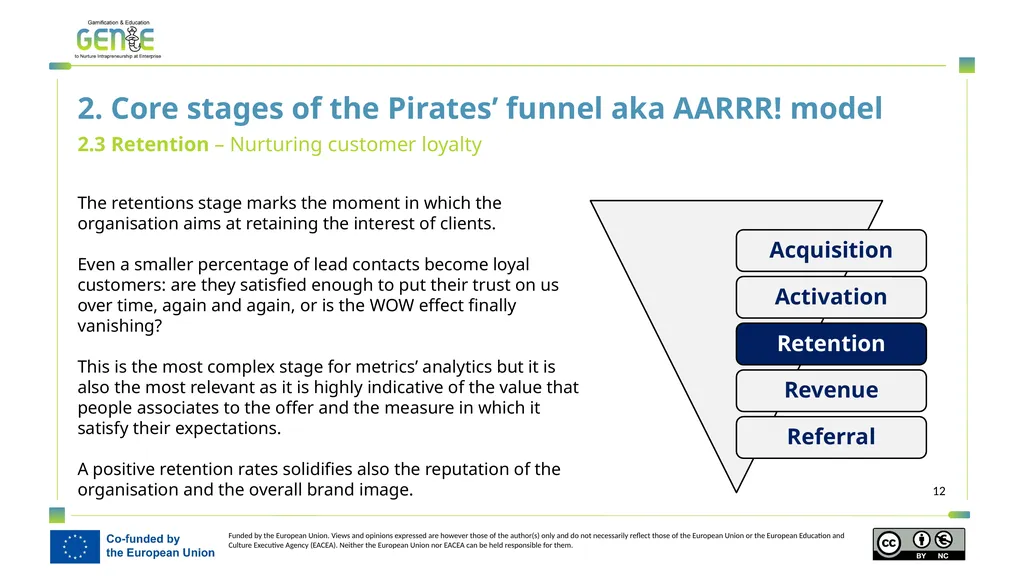
2.3 Retention – Nurturing customer loyalty The retentions stage marks the moment in which the organisation aims at retaining the interest of clients.
Even a smaller percentage of lead contacts become loyal customers: are they satisfied enough to put their trust on us over time, again and again, or is the WOW effect finally vanishing?
This is the most complex stage for metrics’ analytics but it is also the most relevant as it is highly indicative of the value that people associates to the offer and the measure in which it satisfy their expectations.
A positive retention rates solidifies also the reputation of the organisation and the overall brand image. 2. Core stages of the Pirates’ funnel aka AARRR! model<br>
Even a smaller percentage of lead contacts become loyal customers: are they satisfied enough to put their trust on us over time, again and again, or is the WOW effect finally vanishing?
This is the most complex stage for metrics’ analytics but it is also the most relevant as it is highly indicative of the value that people associates to the offer and the measure in which it satisfy their expectations.
A positive retention rates solidifies also the reputation of the organisation and the overall brand image. 2. Core stages of the Pirates’ funnel aka AARRR! model<br>
13
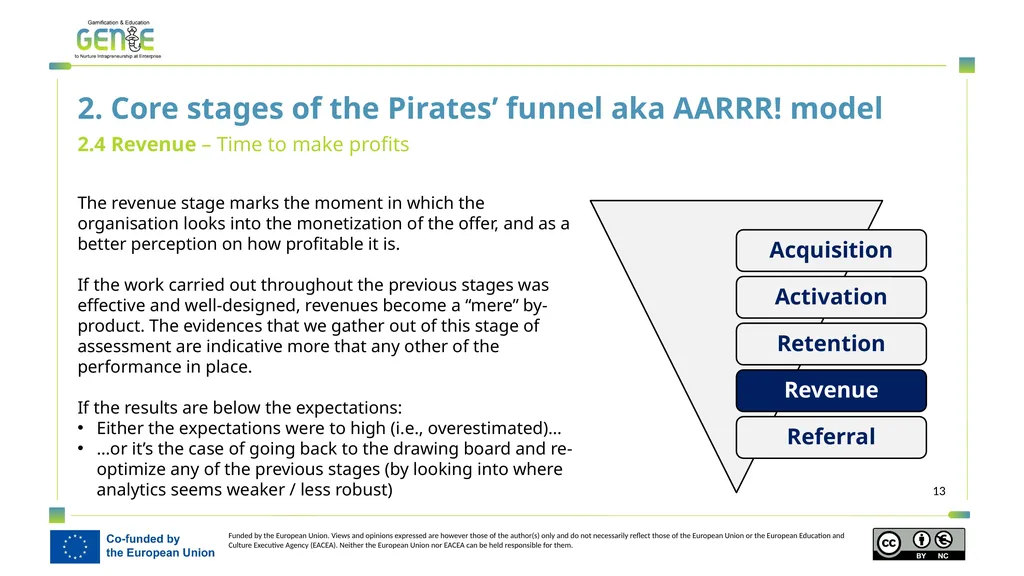
2.4 Revenue – Time to make profits The revenue stage marks the moment in which the organisation looks into the monetization of the offer, and as a better perception on how profitable it is.
If the work carried out throughout the previous stages was effective and well-designed, revenues become a “mere” by-product. The evidences that we gather out of this stage of assessment are indicative more that any other of the performance in place.
If the results are below the expectations:
Either the expectations were to high (i.e., overestimated)…
…or it’s the case of going back to the drawing board and re-optimize any of the previous stages (by looking into where analytics seems weaker / less robust) 2. Core stages of the Pirates’ funnel aka AARRR! model<br>
If the work carried out throughout the previous stages was effective and well-designed, revenues become a “mere” by-product. The evidences that we gather out of this stage of assessment are indicative more that any other of the performance in place.
If the results are below the expectations:
Either the expectations were to high (i.e., overestimated)…
…or it’s the case of going back to the drawing board and re-optimize any of the previous stages (by looking into where analytics seems weaker / less robust) 2. Core stages of the Pirates’ funnel aka AARRR! model<br>
14
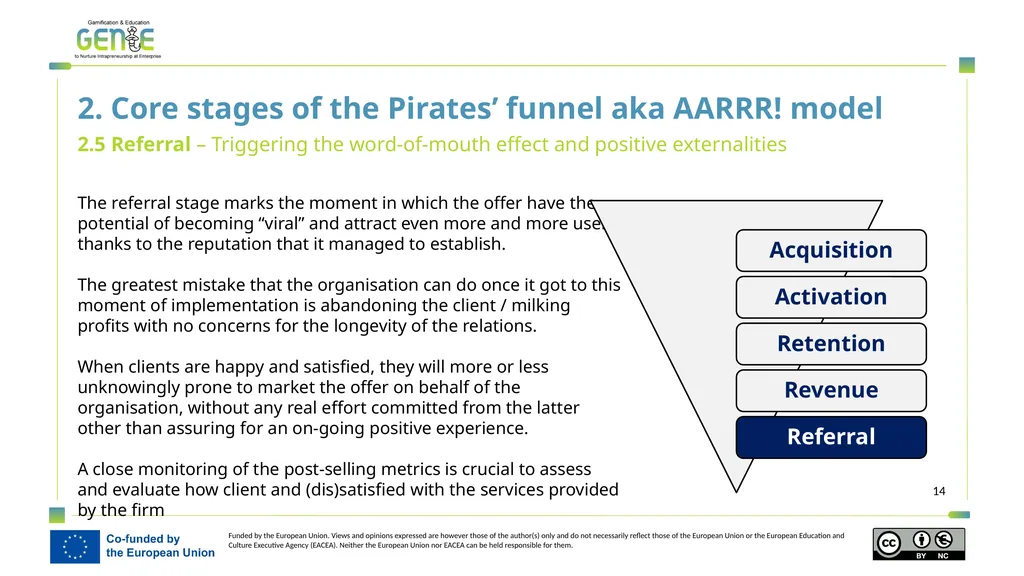
2.5 Referral – Triggering the word-of-mouth effect and positive externalities The referral stage marks the moment in which the offer have the potential of becoming “viral” and attract even more and more users thanks to the reputation that it managed to establish.
The greatest mistake that the organisation can do once it got to this moment of implementation is abandoning the client / milking profits with no concerns for the longevity of the relations.
When clients are happy and satisfied, they will more or less unknowingly prone to market the offer on behalf of the organisation, without any real effort committed from the latter other than assuring for an on-going positive experience.
A close monitoring of the post-selling metrics is crucial to assess and evaluate how client and (dis)satisfied with the services provided by the firm 2. Core stages of the Pirates’ funnel aka AARRR! model<br>
The greatest mistake that the organisation can do once it got to this moment of implementation is abandoning the client / milking profits with no concerns for the longevity of the relations.
When clients are happy and satisfied, they will more or less unknowingly prone to market the offer on behalf of the organisation, without any real effort committed from the latter other than assuring for an on-going positive experience.
A close monitoring of the post-selling metrics is crucial to assess and evaluate how client and (dis)satisfied with the services provided by the firm 2. Core stages of the Pirates’ funnel aka AARRR! model<br>
15
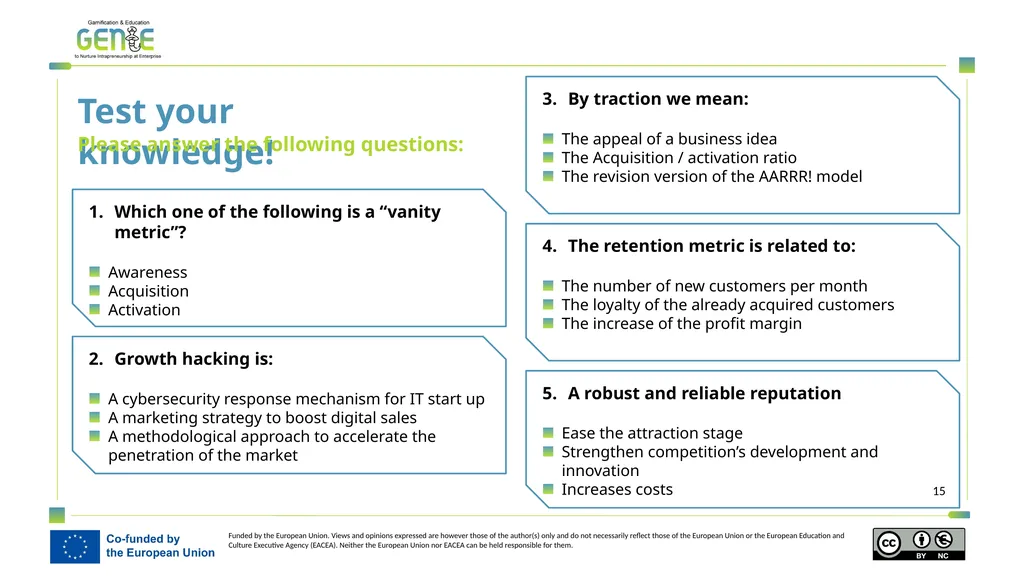
By traction we mean:
The appeal of a business idea
The Acquisition / activation ratio
The revision version of the AARRR! model The retention metric is related to:
The number of new customers per month
The loyalty of the already acquired customers
The increase of the profit margin Test your knowledge! Please answer the following questions: Which one of the following is a “vanity metric”?
Awareness
Acquisition
Activation A robust and reliable reputation
Ease the attraction stage
Strengthen competition’s development and innovation
Increases costs Growth hacking is:
A cybersecurity response mechanism for IT start up
A marketing strategy to boost digital sales
A methodological approach to accelerate the penetration of the market<br>
The appeal of a business idea
The Acquisition / activation ratio
The revision version of the AARRR! model The retention metric is related to:
The number of new customers per month
The loyalty of the already acquired customers
The increase of the profit margin Test your knowledge! Please answer the following questions: Which one of the following is a “vanity metric”?
Awareness
Acquisition
Activation A robust and reliable reputation
Ease the attraction stage
Strengthen competition’s development and innovation
Increases costs Growth hacking is:
A cybersecurity response mechanism for IT start up
A marketing strategy to boost digital sales
A methodological approach to accelerate the penetration of the market<br>
16
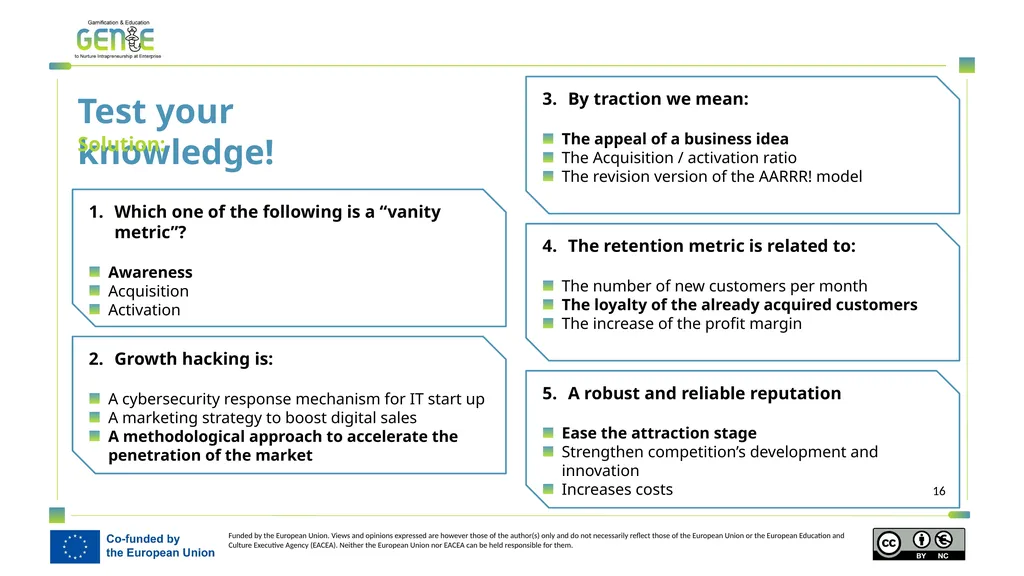
By traction we mean:
The appeal of a business idea
The Acquisition / activation ratio
The revision version of the AARRR! model The retention metric is related to:
The number of new customers per month
The loyalty of the already acquired customers
The increase of the profit margin Test your knowledge! Solution: Which one of the following is a “vanity metric”?
Awareness
Acquisition
Activation A robust and reliable reputation
Ease the attraction stage
Strengthen competition’s development and innovation
Increases costs Growth hacking is:
A cybersecurity response mechanism for IT start up
A marketing strategy to boost digital sales
A methodological approach to accelerate the penetration of the market<br>
The appeal of a business idea
The Acquisition / activation ratio
The revision version of the AARRR! model The retention metric is related to:
The number of new customers per month
The loyalty of the already acquired customers
The increase of the profit margin Test your knowledge! Solution: Which one of the following is a “vanity metric”?
Awareness
Acquisition
Activation A robust and reliable reputation
Ease the attraction stage
Strengthen competition’s development and innovation
Increases costs Growth hacking is:
A cybersecurity response mechanism for IT start up
A marketing strategy to boost digital sales
A methodological approach to accelerate the penetration of the market<br>
17
Summing up Well done! Now you know more about: Growth Hacking and acceleration of customer retention
(A)AARRR! Model and metrics for business growth
From awareness to referral: penetration of the market, WOW effect and analytics of competitiveness<br>
(A)AARRR! Model and metrics for business growth
From awareness to referral: penetration of the market, WOW effect and analytics of competitiveness<br>
18
Bibliography Startup Metrics for Pirates: AARRR! - Dave McClure, Ignite Seattle (2007) https://www.youtube.com/watch?v=irjgfW0BIrw
Stanford Seminar - Entrepreneurial Thought Leaders: Dave McClure of 500 Startups, Stanford Online (2014) https://www.youtube.com/watch?v=MXuwRICnMW0<br>
Stanford Seminar - Entrepreneurial Thought Leaders: Dave McClure of 500 Startups, Stanford Online (2014) https://www.youtube.com/watch?v=MXuwRICnMW0<br>
19
Thank you! genieproject.eu<br>