
About First Credit Bureau First Credit Bureau
OM
Published · 23 slides · 0 views

1 / 1



Description
About First Credit Bureau First Credit Bureau (FCB) was established in September 2, 2004 by seven Kazakh banks, one financial group and CreditInfo Group. FCB performs centralized collection, storage and processing of information, as well as
Related Topics
Share
Embed code
Download this presentation From Below
"About First Credit Bureau First Credit Bureau" is the property of its rightful owner. Permission is granted to download and print the materials on this website for personal, non-commercial use only, and to display it on your personal computer provided you do not modify the materials and that you retain all copyright notices contained in the materials. By downloading content from our website, you accept the terms of this agreement.
Presentation Transcript
01
About First Credit Bureau First Credit Bureau (FCB) was established in September 2, 2004 by seven Kazakh banks, one financial group and CreditInfo Group. FCB performs centralized collection, storage and processing of information, as well as formation and issuance of credit reports. FCB information providers include more than seventy organizations in Kazakhstan, which enables to form a significant database, boasting more than 6 million credit histories and containing information on more than 21.4 million credit contracts.
From November 2012 FCB is lead by new management with new vision on product diversification and provision of more value added services. 2<br>
From November 2012 FCB is lead by new management with new vision on product diversification and provision of more value added services. 2<br>
02
Retail Lending Market Review As a reaction to increase of unsecured (without collateral) lending National Bank of Kazakhstan introduced legal restrictions on unsecured lending, which entered into force from April 1, 2014.
According to new legislation banks have a right to disburse unsecured loan only if borrowers average monthly installments on all loans will not exceed 50% of the borrower's monthly income. The Debt Ratio must be calculated only for borrowers with incomes less than two times the average income.
The NBK has also taken steps to limit the growth rate on unsecured loans by setting limits of a maximum of 30% per year for each bank.
FCB felt that there must have been done a publicly available research and analysis of the dynamics behind unsecured lending boom, so we prepared the analysis and got some surprising findings. 3<br>
03
Kazakhstan Retail Lending Market Review April 2014 4<br>
04
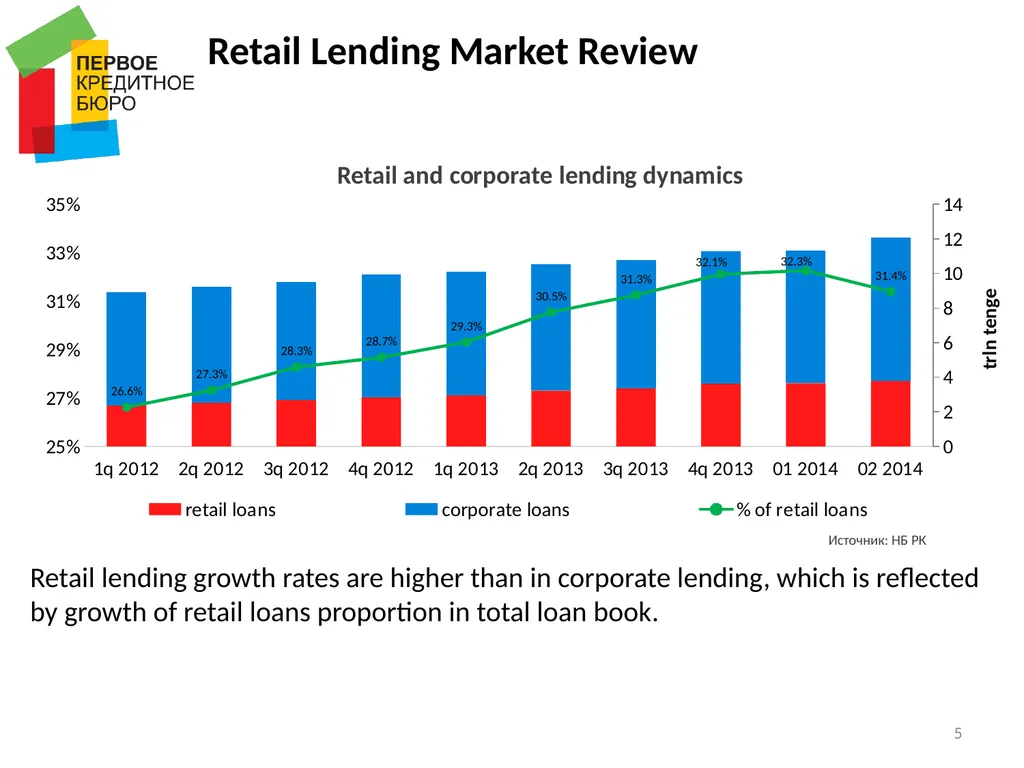
Retail Lending Market Review Retail lending growth rates are higher than in corporate lending, which is reflected by growth of retail loans proportion in total loan book. Источник: НБ РК 5<br>
05
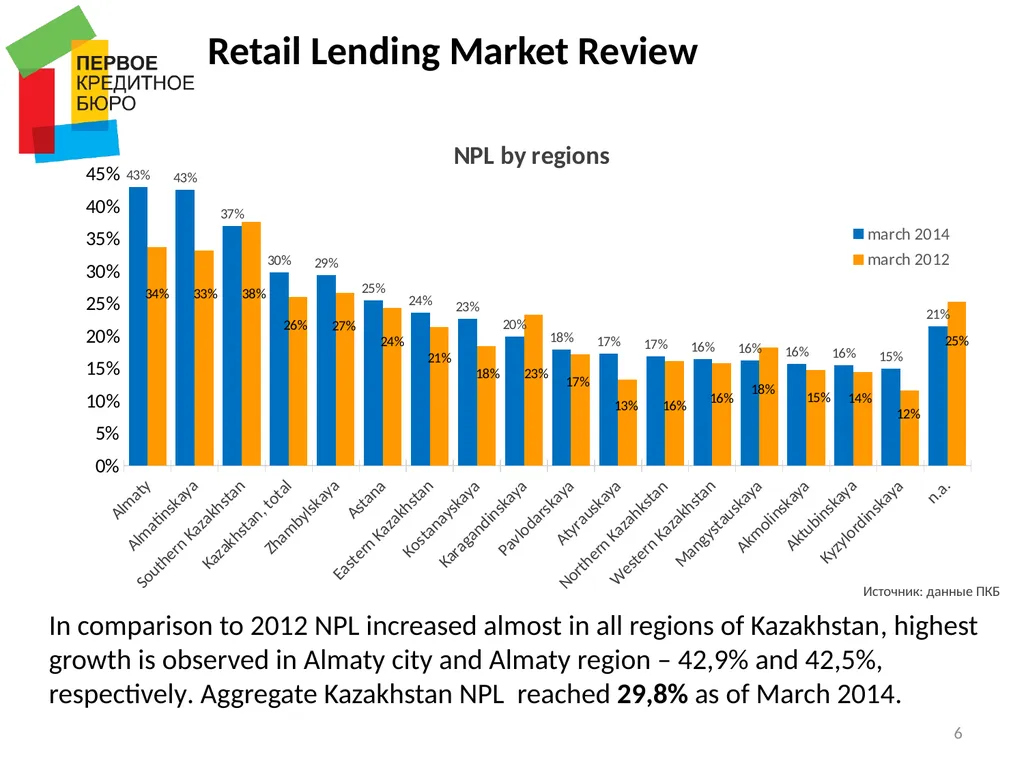
Retail Lending Market Review Источник: данные ПКБ In comparison to 2012 NPL increased almost in all regions of Kazakhstan, highest growth is observed in Almaty city and Almaty region – 42,9% and 42,5%, respectively. Aggregate Kazakhstan NPL reached 29,8% as of March 2014. 6<br>
06
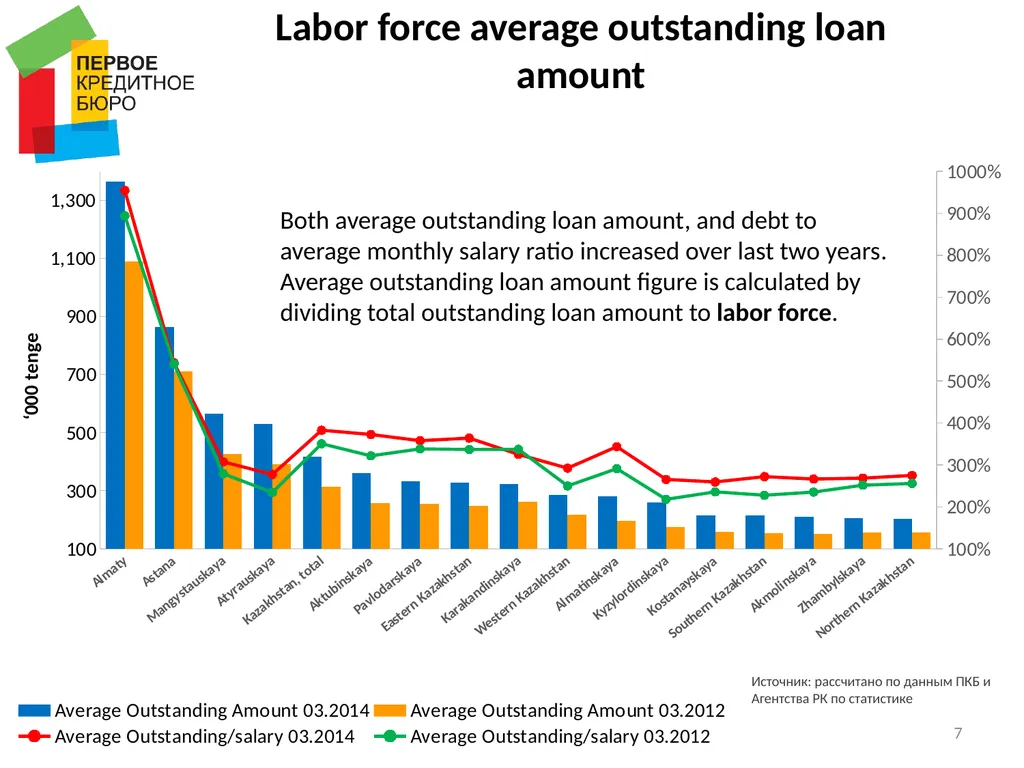
Labor force average outstanding loan amount Both average outstanding loan amount, and debt to average monthly salary ratio increased over last two years. Average outstanding loan amount figure is calculated by dividing total outstanding loan amount to labor force. Источник: рассчитано по данным ПКБ и Агентства РК по статистике 7<br>
07
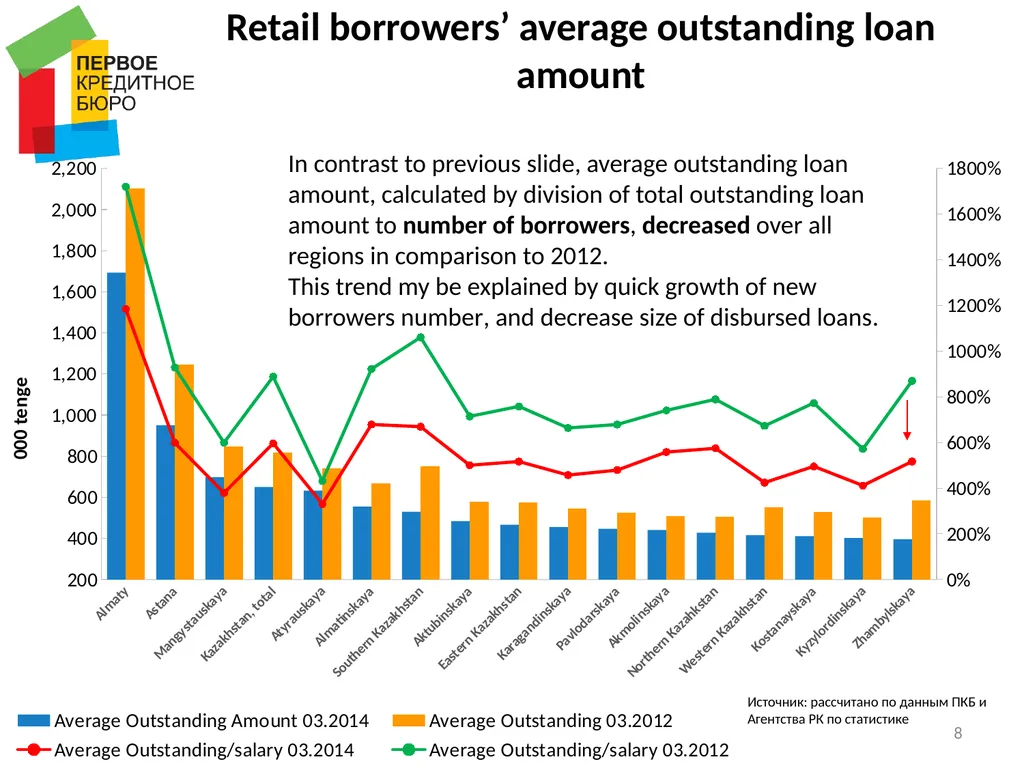
Retail borrowers’ average outstanding loan amount In contrast to previous slide, average outstanding loan amount, calculated by division of total outstanding loan amount to number of borrowers, decreased over all regions in comparison to 2012.
This trend my be explained by quick growth of new borrowers number, and decrease size of disbursed loans. Источник: рассчитано по данным ПКБ и Агентства РК по статистике 8<br>
This trend my be explained by quick growth of new borrowers number, and decrease size of disbursed loans. Источник: рассчитано по данным ПКБ и Агентства РК по статистике 8<br>
08
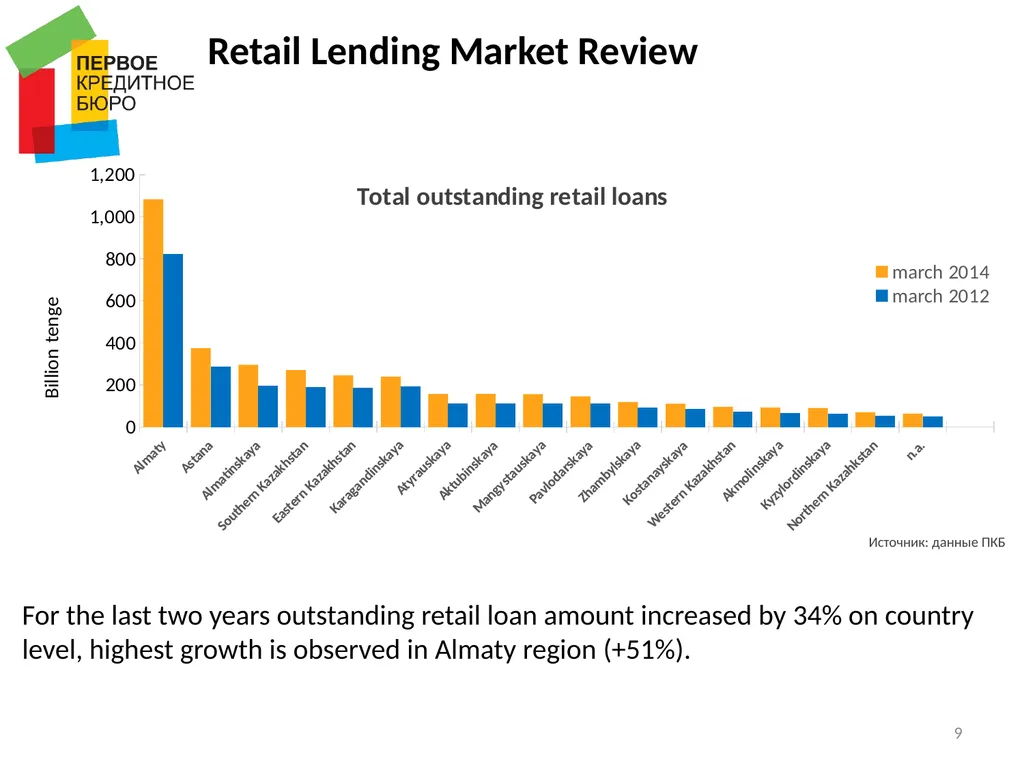
Retail Lending Market Review Источник: данные ПКБ For the last two years outstanding retail loan amount increased by 34% on country level, highest growth is observed in Almaty region (+51%). 9<br>
09
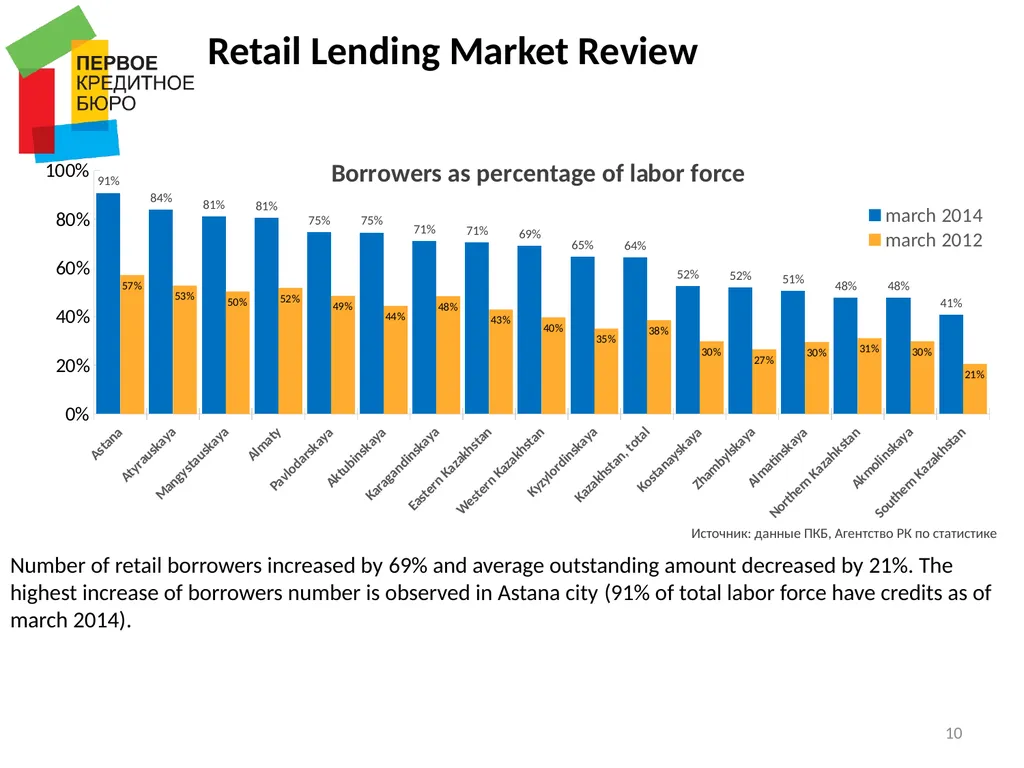
Number of retail borrowers increased by 69% and average outstanding amount decreased by 21%. The highest increase of borrowers number is observed in Astana city (91% of total labor force have credits as of march 2014). Retail Lending Market Review Источник: данные ПКБ, Агентство РК по статистике 10<br>
10
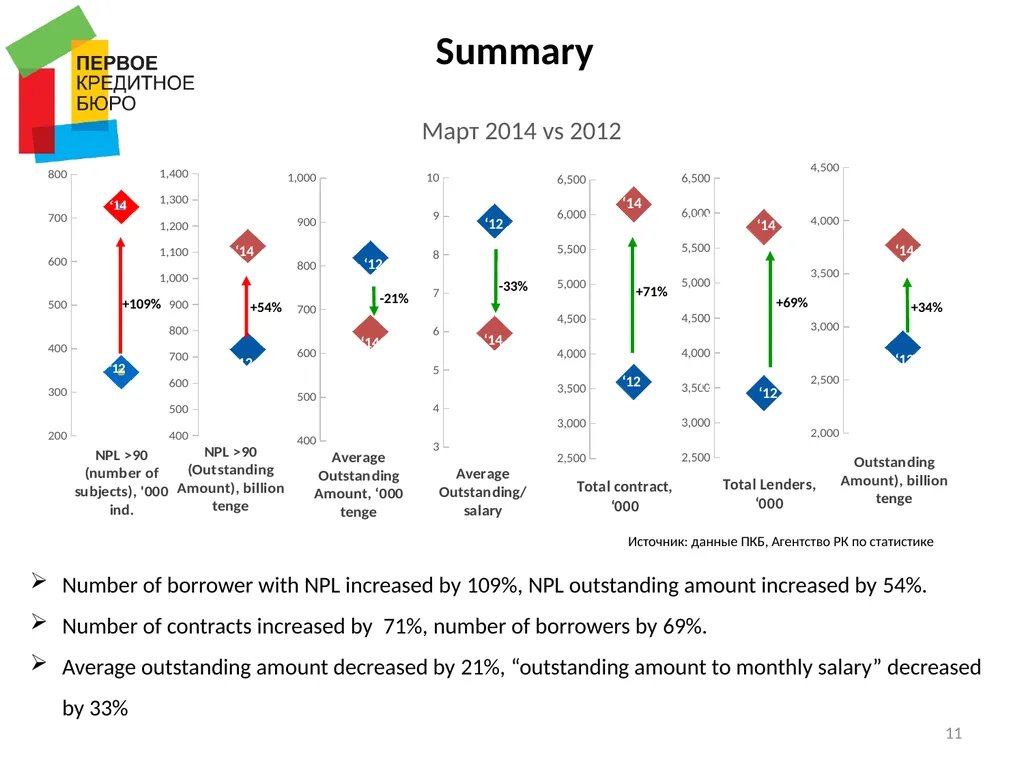
Number of borrower with NPL increased by 109%, NPL outstanding amount increased by 54%.
Number of contracts increased by 71%, number of borrowers by 69%.
Average outstanding amount decreased by 21%, “outstanding amount to monthly salary” decreased by 33% Summary +109% +54% -21% -33% +71% +69% +34% Март 2014 vs 2012 Источник: данные ПКБ, Агентство РК по статистике ‘14 ‘12 ‘14 ‘12 ‘12 ‘14 ‘12 ‘14 ‘12 ‘12 ‘14 ‘12 ‘14 ‘12 ‘12 ‘14 11<br>
11
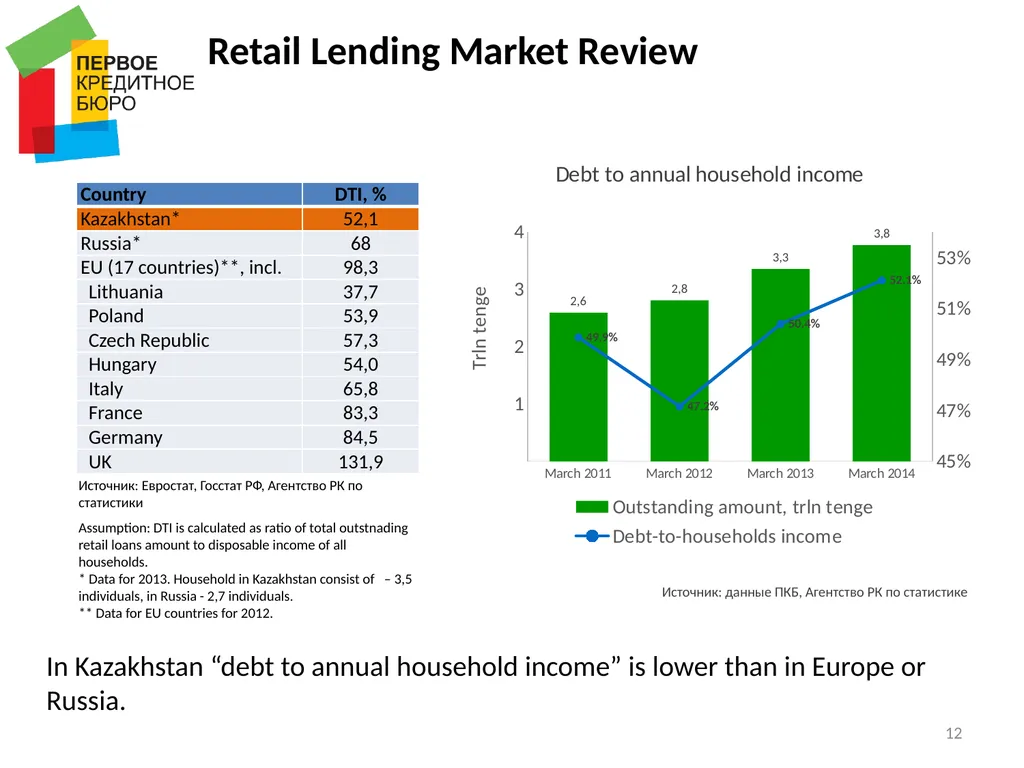
Retail Lending Market Review Источник: данные ПКБ, Агентство РК по статистике Источник: Евростат, Госстат РФ, Агентство РК по статистики
Assumption: DTI is calculated as ratio of total outstnading retail loans amount to disposable income of all households.
* Data for 2013. Household in Kazakhstan consist of – 3,5 individuals, in Russia - 2,7 individuals.
** Data for EU countries for 2012. In Kazakhstan “debt to annual household income” is lower than in Europe or Russia. 12<br>
12
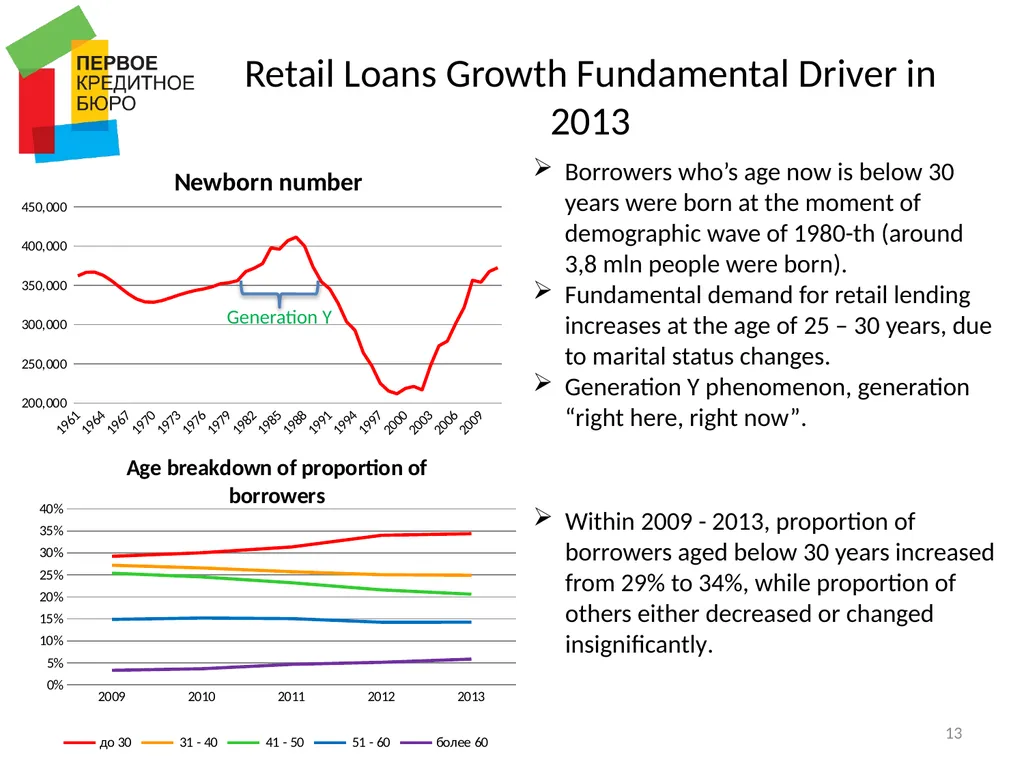
Retail Loans Growth Fundamental Driver in 2013 Generation Y Borrowers who’s age now is below 30 years were born at the moment of demographic wave of 1980-th (around 3,8 mln people were born).
Fundamental demand for retail lending increases at the age of 25 – 30 years, due to marital status changes.
Generation Y phenomenon, generation “right here, right now”. Within 2009 - 2013, proportion of borrowers aged below 30 years increased from 29% to 34%, while proportion of others either decreased or changed insignificantly. 13<br>
13
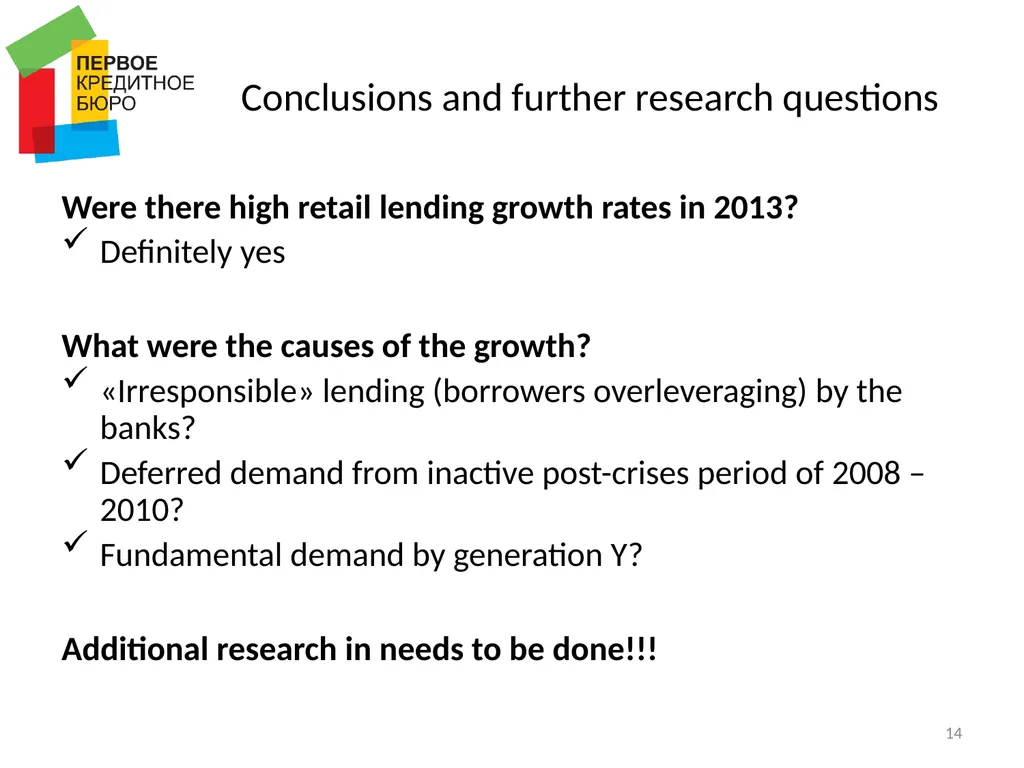
Were there high retail lending growth rates in 2013?
Definitely yes
What were the causes of the growth?
«Irresponsible» lending (borrowers overleveraging) by the banks?
Deferred demand from inactive post-crises period of 2008 – 2010?
Fundamental demand by generation Y?
Additional research in needs to be done!!! Conclusions and further research questions 14<br>
14
DTI and borrower default relationship research April 2014 15<br>
15
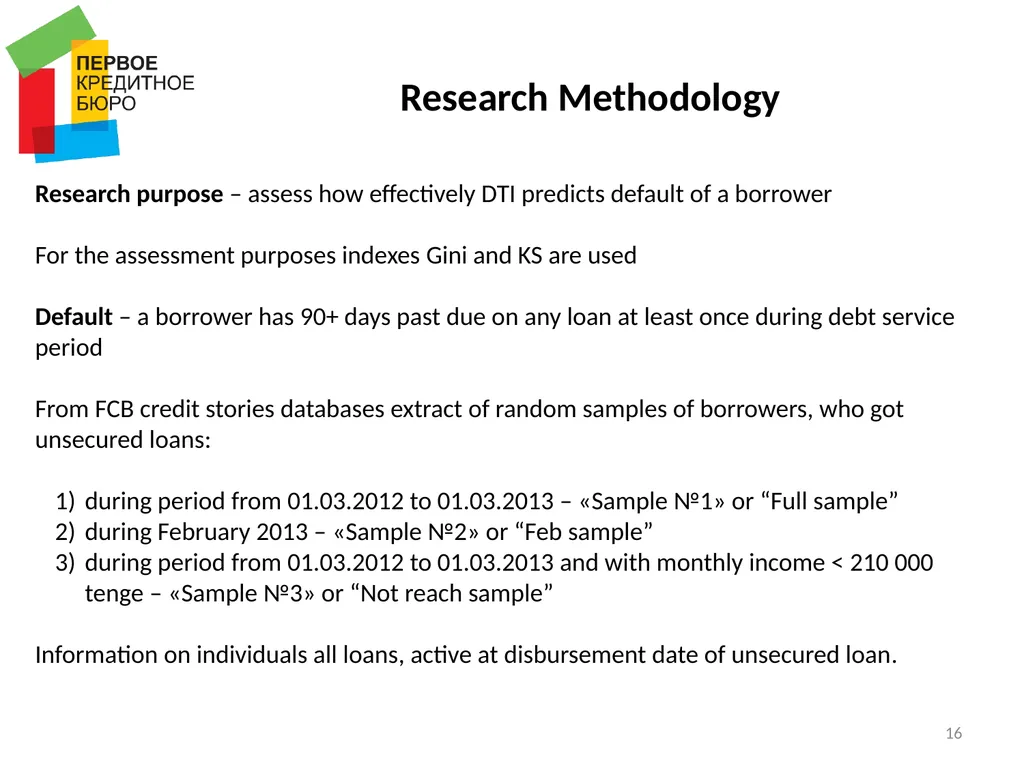
Research Methodology Research purpose – assess how effectively DTI predicts default of a borrower
For the assessment purposes indexes Gini and KS are used
Default – a borrower has 90+ days past due on any loan at least once during debt service period
From FCB credit stories databases extract of random samples of borrowers, who got unsecured loans:
during period from 01.03.2012 to 01.03.2013 – «Sample №1» or “Full sample”
during February 2013 – «Sample №2» or “Feb sample”
during period from 01.03.2012 to 01.03.2013 and with monthly income < 210 000 tenge – «Sample №3» or “Not reach sample”
Information on individuals all loans, active at disbursement date of unsecured loan. 16<br>
16
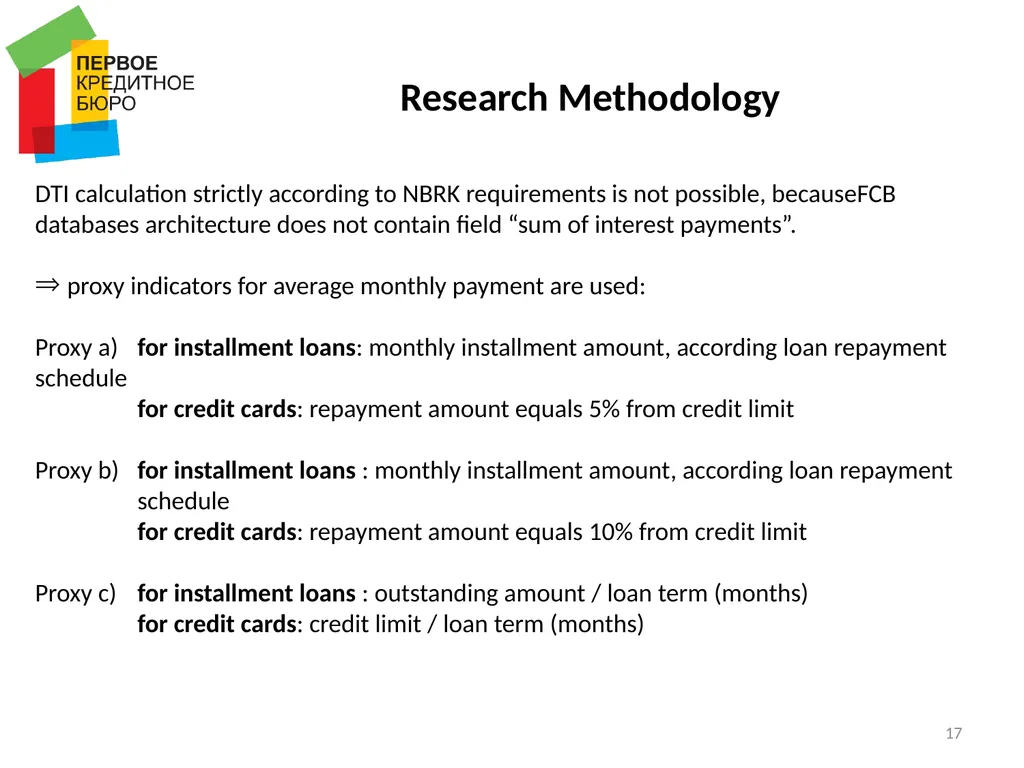
Research Methodology DTI calculation strictly according to NBRK requirements is not possible, becauseFCB databases architecture does not contain field “sum of interest payments”.
proxy indicators for average monthly payment are used:
Proxy a) for installment loans: monthly installment amount, according loan repayment schedule
for credit cards: repayment amount equals 5% from credit limit
Proxy b) for installment loans : monthly installment amount, according loan repayment schedule
for credit cards: repayment amount equals 10% from credit limit
Proxy c) for installment loans : outstanding amount / loan term (months)
for credit cards: credit limit / loan term (months) 17<br>
17
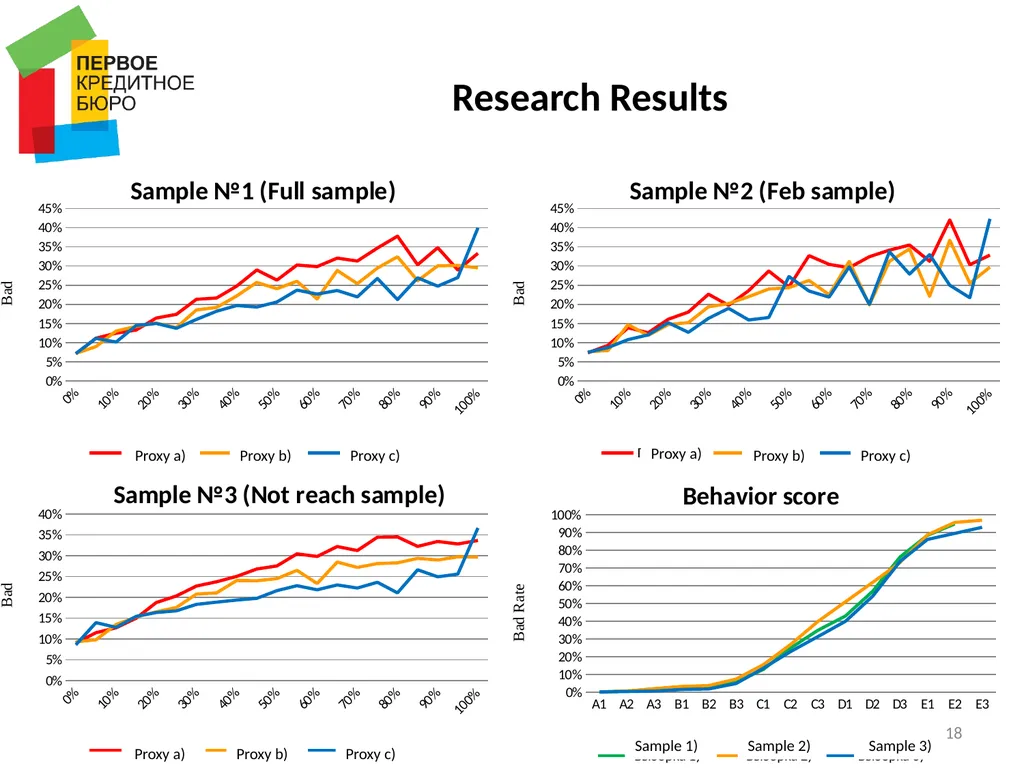
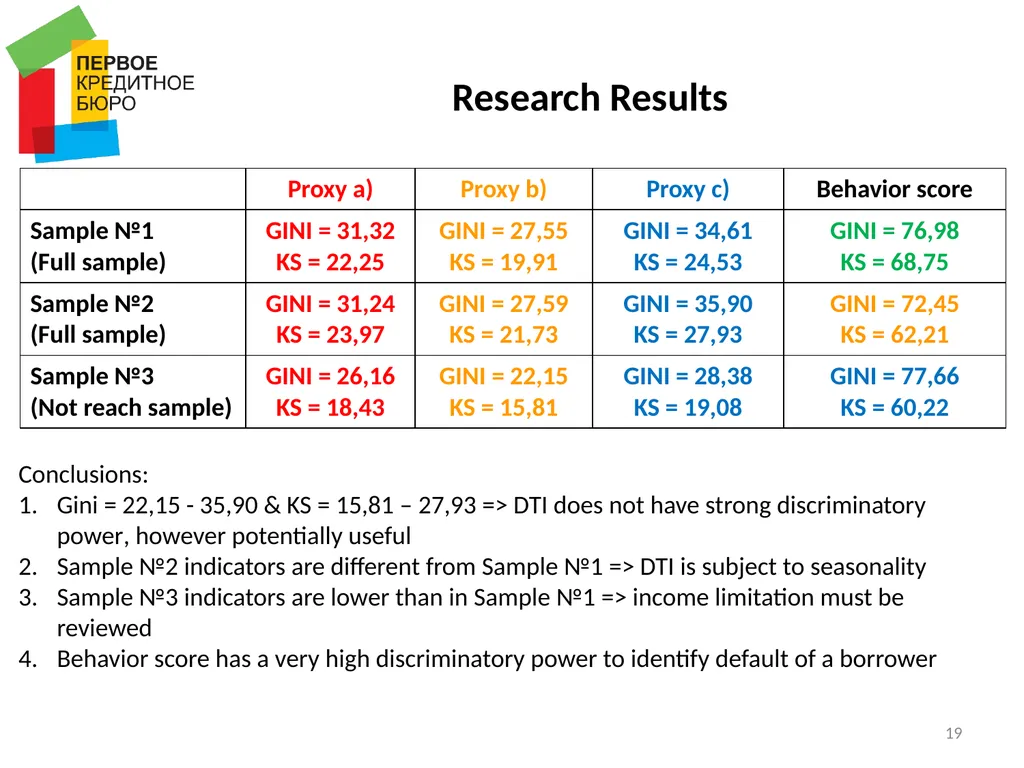
Research Results 18 Proxy a) Proxy a) Proxy a) Proxy c) Proxy b) Proxy b) Proxy b) Proxy c) Proxy c) Sample 3) Sample 2) Sample 1)<br>
18
Conclusions:
Gini = 22,15 - 35,90 & KS = 15,81 – 27,93 => DTI does not have strong discriminatory power, however potentially useful
Sample №2 indicators are different from Sample №1 => DTI is subject to seasonality
Sample №3 indicators are lower than in Sample №1 => income limitation must be reviewed
Behavior score has a very high discriminatory power to identify default of a borrower Research Results 19<br>
19
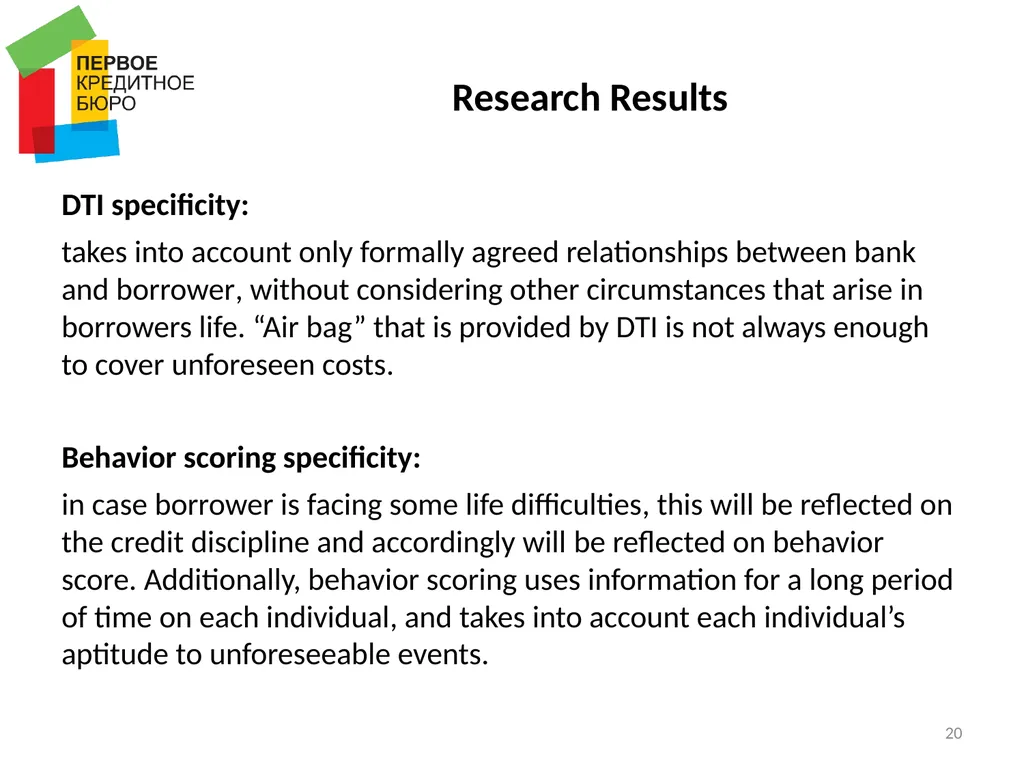
DTI specificity:
takes into account only formally agreed relationships between bank and borrower, without considering other circumstances that arise in borrowers life. “Air bag” that is provided by DTI is not always enough to cover unforeseen costs.
Behavior scoring specificity:
in case borrower is facing some life difficulties, this will be reflected on the credit discipline and accordingly will be reflected on behavior score. Additionally, behavior scoring uses information for a long period of time on each individual, and takes into account each individual’s aptitude to unforeseeable events. Research Results 20<br>
20
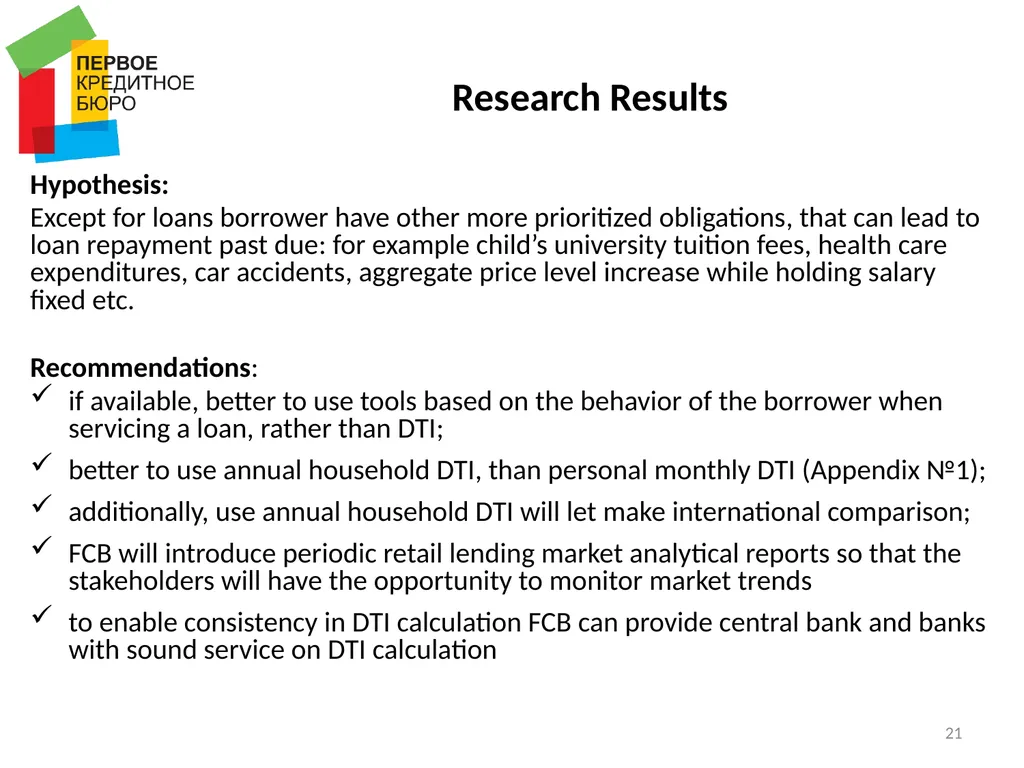
Research Results Hypothesis:
Except for loans borrower have other more prioritized obligations, that can lead to loan repayment past due: for example child’s university tuition fees, health care expenditures, car accidents, aggregate price level increase while holding salary fixed etc.
Recommendations:
if available, better to use tools based on the behavior of the borrower when servicing a loan, rather than DTI;
better to use annual household DTI, than personal monthly DTI (Appendix №1);
additionally, use annual household DTI will let make international comparison;
FCB will introduce periodic retail lending market analytical reports so that the stakeholders will have the opportunity to monitor market trends
to enable consistency in DTI calculation FCB can provide central bank and banks with sound service on DTI calculation 21<br>
21
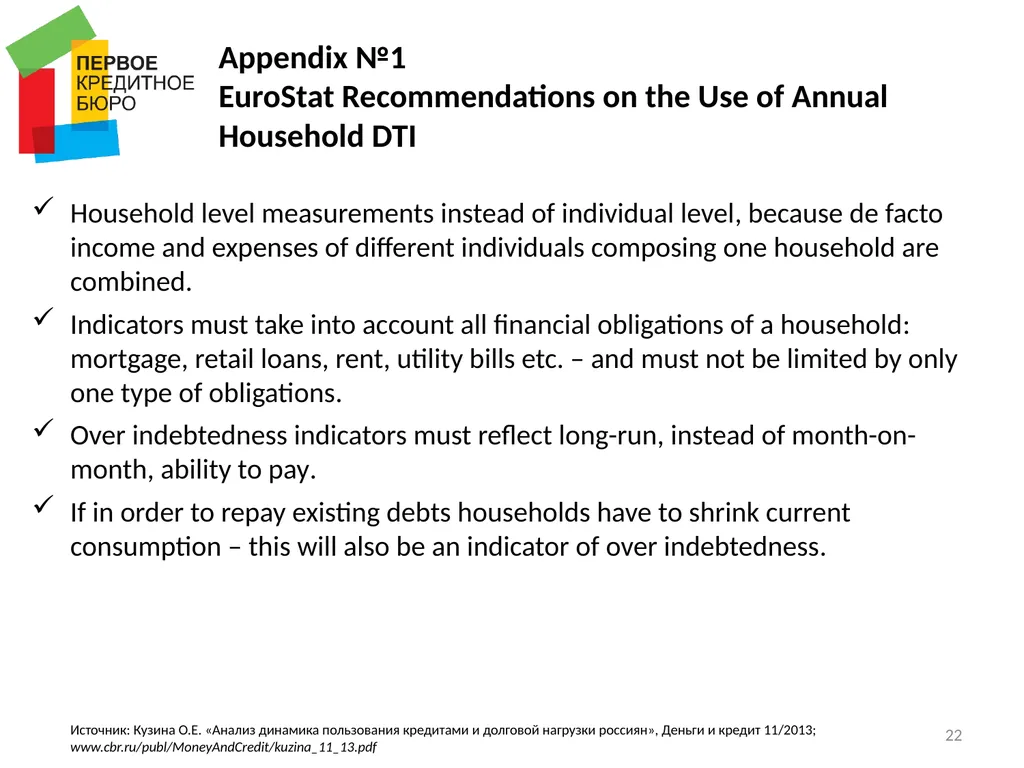
Household level measurements instead of individual level, because de facto income and expenses of different individuals composing one household are combined.
Indicators must take into account all financial obligations of a household: mortgage, retail loans, rent, utility bills etc. – and must not be limited by only one type of obligations.
Over indebtedness indicators must reflect long-run, instead of month-on-month, ability to pay.
If in order to repay existing debts households have to shrink current consumption – this will also be an indicator of over indebtedness. Appendix №1 EuroStat Recommendations on the Use of Annual Household DTI Источник: Кузина О.Е. «Анализ динамика пользования кредитами и долговой нагрузки россиян», Деньги и кредит 11/2013; www.cbr.ru/publ/MoneyAndCredit/kuzina_11_13.pdf 22<br>
22
Thank you for your time and attention!<br>