
Abuse, neglect and prevention in skilled nursing
LV
Published · 25 slides · 0 views

1 / 1

Description
Abuse, neglect and prevention in skilled nursing facilities Trinity Rehab Therapy services will provide the medically related services to attain or maintain the highest practicable physical, mental and psychosocial well being of each
Related Topics
Share
Embed code
Download this presentation From Below
"Abuse, neglect and prevention in skilled nursing" is the property of its rightful owner. Permission is granted to download and print the materials on this website for personal, non-commercial use only, and to display it on your personal computer provided you do not modify the materials and that you retain all copyright notices contained in the materials. By downloading content from our website, you accept the terms of this agreement.
Presentation Transcript
01
Abuse, neglect and prevention in skilled nursing facilities Trinity Rehab<br>
02
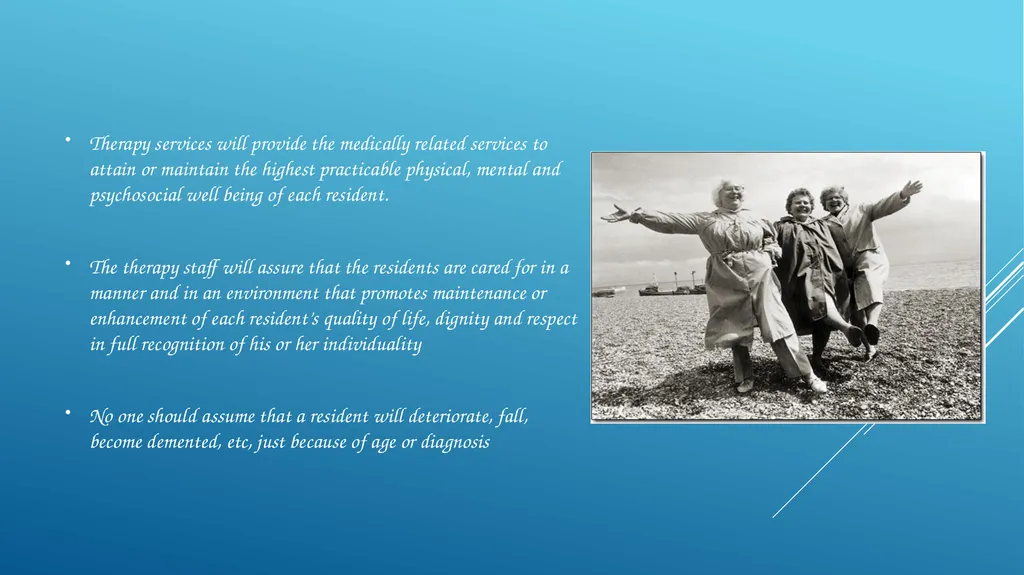
Therapy services will provide the medically related services to attain or maintain the highest practicable physical, mental and psychosocial well being of each resident.
The therapy staff will assure that the residents are cared for in a manner and in an environment that promotes maintenance or enhancement of each resident’s quality of life, dignity and respect in full recognition of his or her individuality
No one should assume that a resident will deteriorate, fall, become demented, etc, just because of age or diagnosis<br>
The therapy staff will assure that the residents are cared for in a manner and in an environment that promotes maintenance or enhancement of each resident’s quality of life, dignity and respect in full recognition of his or her individuality
No one should assume that a resident will deteriorate, fall, become demented, etc, just because of age or diagnosis<br>
03
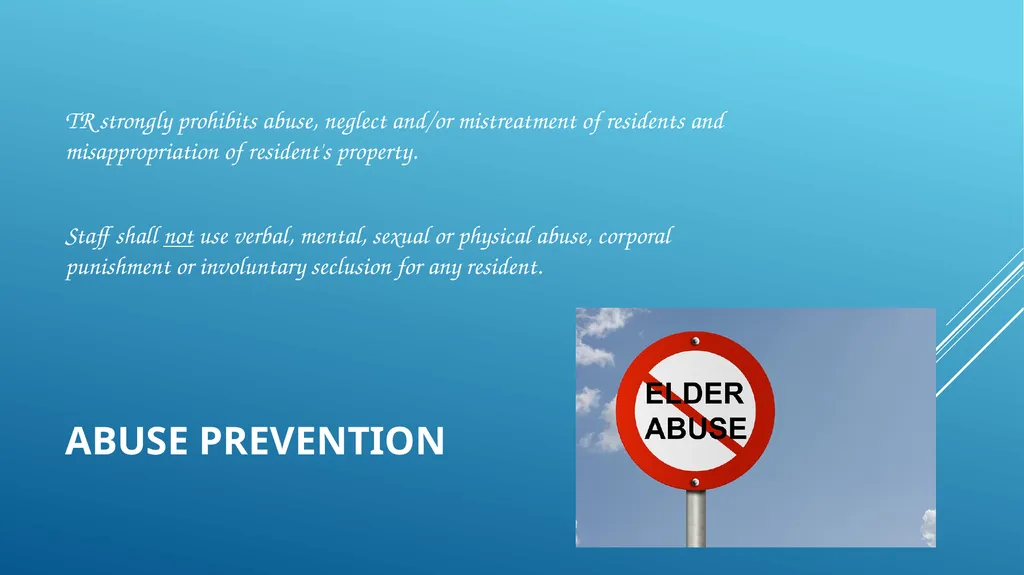
Abuse prevention TR strongly prohibits abuse, neglect and/or mistreatment of residents and misappropriation of resident's property.
Staff shall not use verbal, mental, sexual or physical abuse, corporal punishment or involuntary seclusion for any resident.<br>
Staff shall not use verbal, mental, sexual or physical abuse, corporal punishment or involuntary seclusion for any resident.<br>
04
Definition of abuse “Abuse is the willful infliction of injury, unreasonable confinement, intimidation, or punishment with resulting physical harm, pain or mental anguish. Abuse also includes the deprivation by an individual, including a caretaker, of goods or services that are necessary to attain or maintain physical, mental, and psychosocial wellbeing. This presumes that instances of abuse of all residents, irrespective of any mental or physical condition, cause physical harm, pain or mental anguish. It includes verbal abuse, sexual abuse, physical abuse, and mental abuse including abuse facilitated or enabled through the use of technology. Willful, as used in this definition of abuse, means the individual must have acted deliberately, not that the individual must have intended to inflict injury or harm.”<br>
05
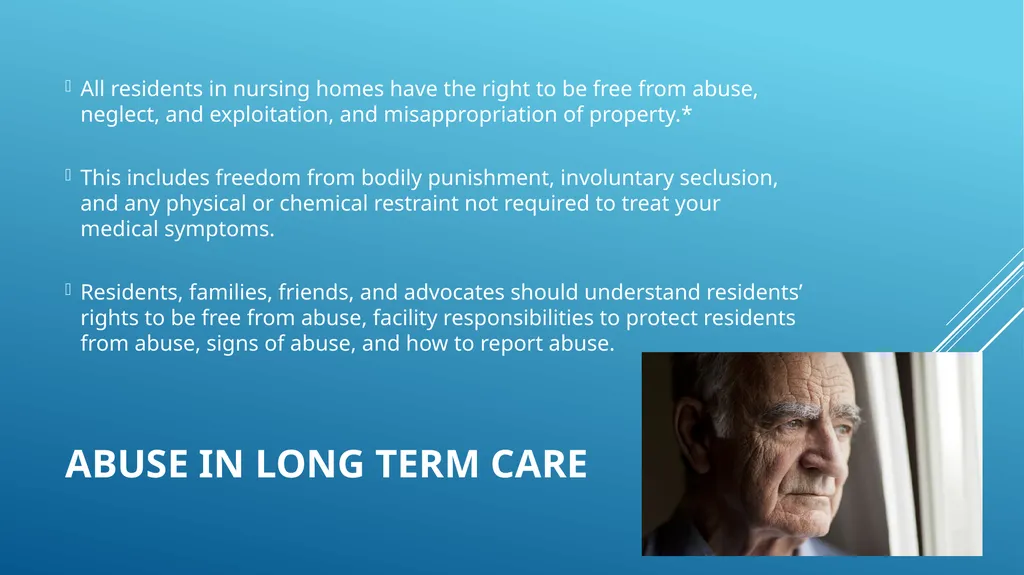
Abuse in long term care All residents in nursing homes have the right to be free from abuse, neglect, and exploitation, and misappropriation of property.*
This includes freedom from bodily punishment, involuntary seclusion, and any physical or chemical restraint not required to treat your medical symptoms.
Residents, families, friends, and advocates should understand residents’ rights to be free from abuse, facility responsibilities to protect residents from abuse, signs of abuse, and how to report abuse.<br>
This includes freedom from bodily punishment, involuntary seclusion, and any physical or chemical restraint not required to treat your medical symptoms.
Residents, families, friends, and advocates should understand residents’ rights to be free from abuse, facility responsibilities to protect residents from abuse, signs of abuse, and how to report abuse.<br>
06
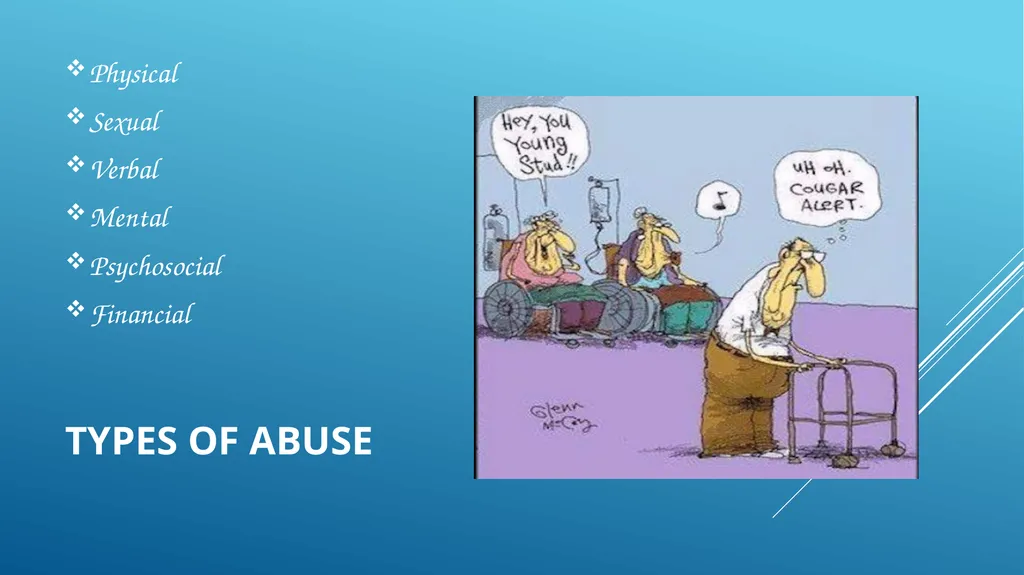
Types of abuse Physical
Sexual
Verbal
Mental
Psychosocial
Financial<br>
Sexual
Verbal
Mental
Psychosocial
Financial<br>
07
Examples of abuse A CNA takes a video of a cognitively impaired resident eating lunch in the facility dining room. In the video, the resident is seen eating mashed potatoes with her fingers. When the video is shown to other staff, they think the video is funny. The CNA later posts the video to her social media page titled “Miss Piggy”.
This is ABUSE! A housekeeper likes to “pick and play” with a male resident even though the resident has asked the housekeeper to stop. The resident feels humiliated and embarrassed.
This is ABUSE!<br>
This is ABUSE! A housekeeper likes to “pick and play” with a male resident even though the resident has asked the housekeeper to stop. The resident feels humiliated and embarrassed.
This is ABUSE!<br>
08
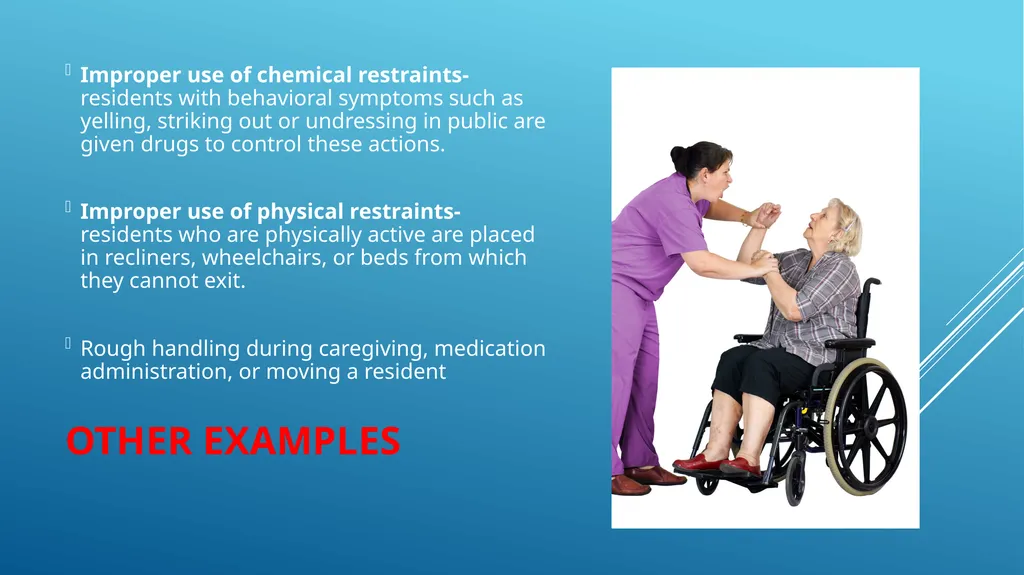
Other examples Improper use of chemical restraints- residents with behavioral symptoms such as yelling, striking out or undressing in public are given drugs to control these actions.
Improper use of physical restraints- residents who are physically active are placed in recliners, wheelchairs, or beds from which they cannot exit.
Rough handling during caregiving, medication administration, or moving a resident<br>
Improper use of physical restraints- residents who are physically active are placed in recliners, wheelchairs, or beds from which they cannot exit.
Rough handling during caregiving, medication administration, or moving a resident<br>
09
Other examples Deliberatively failing to provide care or assistance necessary to prevent harm.
Pushing, hitting, pinching, or grabbing a resident.
Not allowing a resident to go to the bathroom.
Isolating a resident from others or confining a resident to his/her room as a means of punishment or restricting a resident’s movement.
Taking or using photographs or recordings that would demean or humiliate a resident, including posting on social media.<br>
Pushing, hitting, pinching, or grabbing a resident.
Not allowing a resident to go to the bathroom.
Isolating a resident from others or confining a resident to his/her room as a means of punishment or restricting a resident’s movement.
Taking or using photographs or recordings that would demean or humiliate a resident, including posting on social media.<br>
10
Misappropriation of a resident’s property Using a resident’s money or personal property without their consent.
A resident’s possessions may hold great sentimental value.
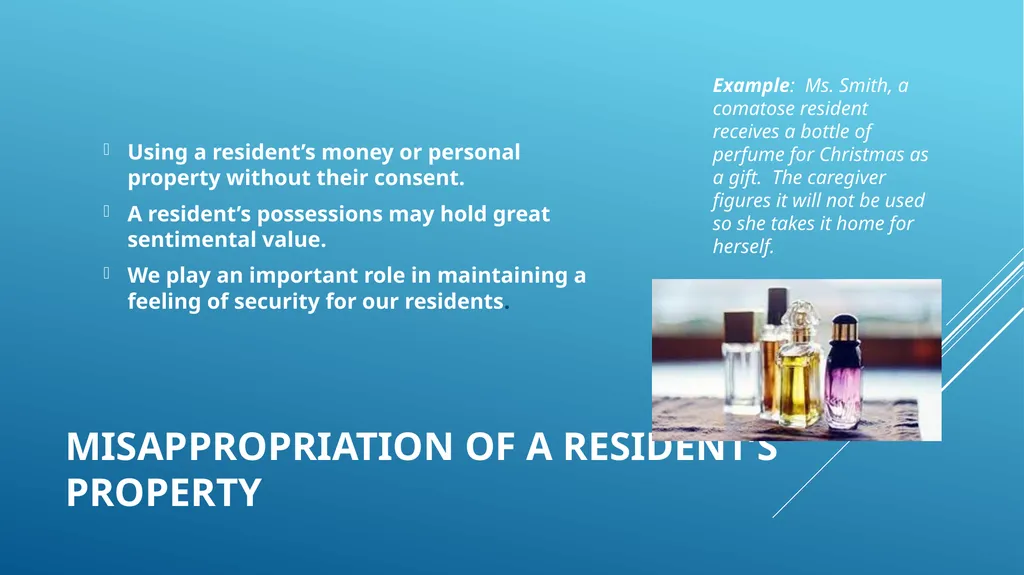
We play an important role in maintaining a feeling of security for our residents. Example: Ms. Smith, a comatose resident receives a bottle of perfume for Christmas as a gift. The caregiver figures it will not be used so she takes it home for herself.<br>
A resident’s possessions may hold great sentimental value.
We play an important role in maintaining a feeling of security for our residents. Example: Ms. Smith, a comatose resident receives a bottle of perfume for Christmas as a gift. The caregiver figures it will not be used so she takes it home for herself.<br>
11
Signs of abuse Unexplained injuries such as wounds, cuts, or bruises.
Restraint or grip markings.
Sudden or unexplained changes in the resident’s behaviors and/or activities, such as fear of a person, activity or place, or feelings of guilt or shame.<br>
Restraint or grip markings.
Sudden or unexplained changes in the resident’s behaviors and/or activities, such as fear of a person, activity or place, or feelings of guilt or shame.<br>
12
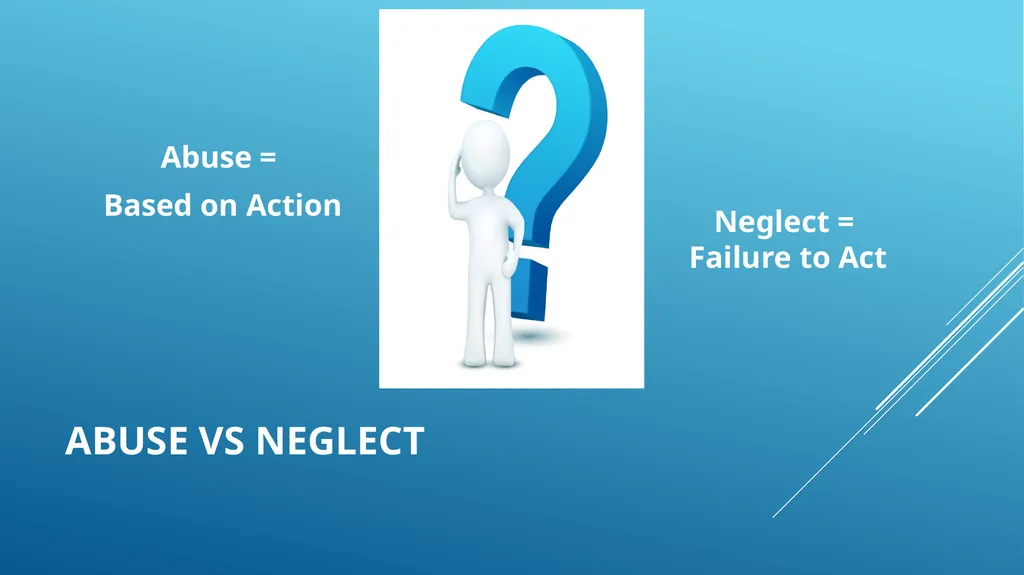
Abuse vs neglect Abuse =
Based on Action Neglect =
Failure to Act<br>
Based on Action Neglect =
Failure to Act<br>
13
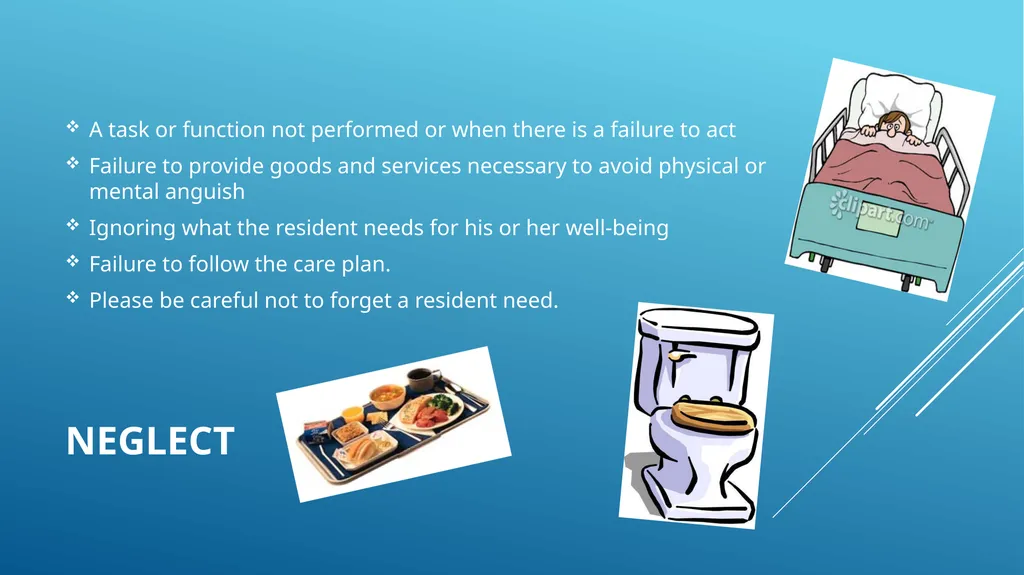
neglect A task or function not performed or when there is a failure to act
Failure to provide goods and services necessary to avoid physical or mental anguish
Ignoring what the resident needs for his or her well-being
Failure to follow the care plan.
Please be careful not to forget a resident need.<br>
Failure to provide goods and services necessary to avoid physical or mental anguish
Ignoring what the resident needs for his or her well-being
Failure to follow the care plan.
Please be careful not to forget a resident need.<br>
14
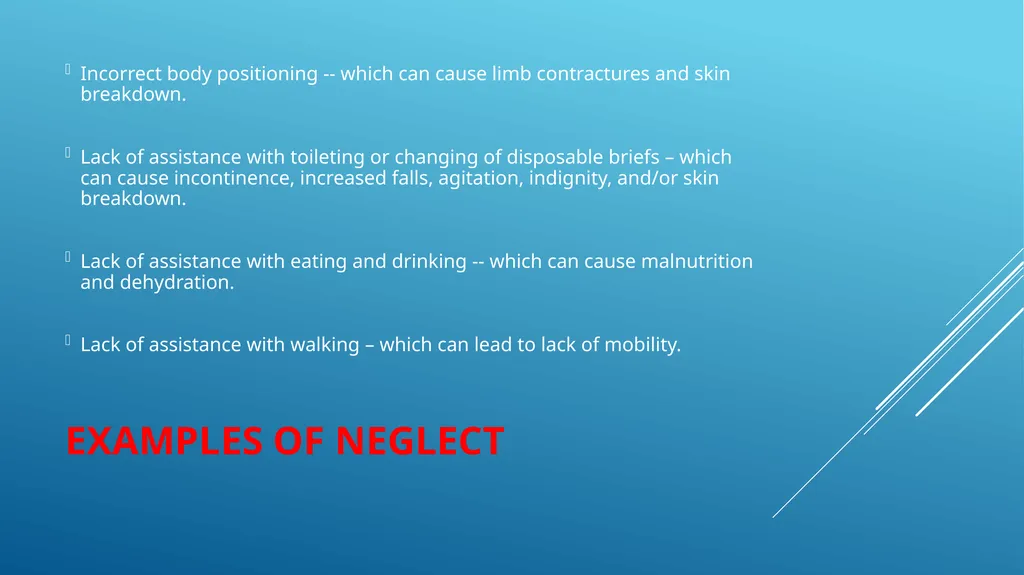
Examples of neglect Incorrect body positioning -- which can cause limb contractures and skin breakdown.
Lack of assistance with toileting or changing of disposable briefs – which can cause incontinence, increased falls, agitation, indignity, and/or skin breakdown.
Lack of assistance with eating and drinking -- which can cause malnutrition and dehydration.
Lack of assistance with walking – which can lead to lack of mobility.<br>
Lack of assistance with toileting or changing of disposable briefs – which can cause incontinence, increased falls, agitation, indignity, and/or skin breakdown.
Lack of assistance with eating and drinking -- which can cause malnutrition and dehydration.
Lack of assistance with walking – which can lead to lack of mobility.<br>
15
Examples of neglect Lack of assistance with personal hygiene and appearance.
Ignoring call bells or cries for help.
Failure to or delayed contact to medical personnel when a resident has a significant change in condition.
Untreated bed sores.
Residents who wander away from the facility.<br>
Ignoring call bells or cries for help.
Failure to or delayed contact to medical personnel when a resident has a significant change in condition.
Untreated bed sores.
Residents who wander away from the facility.<br>
16
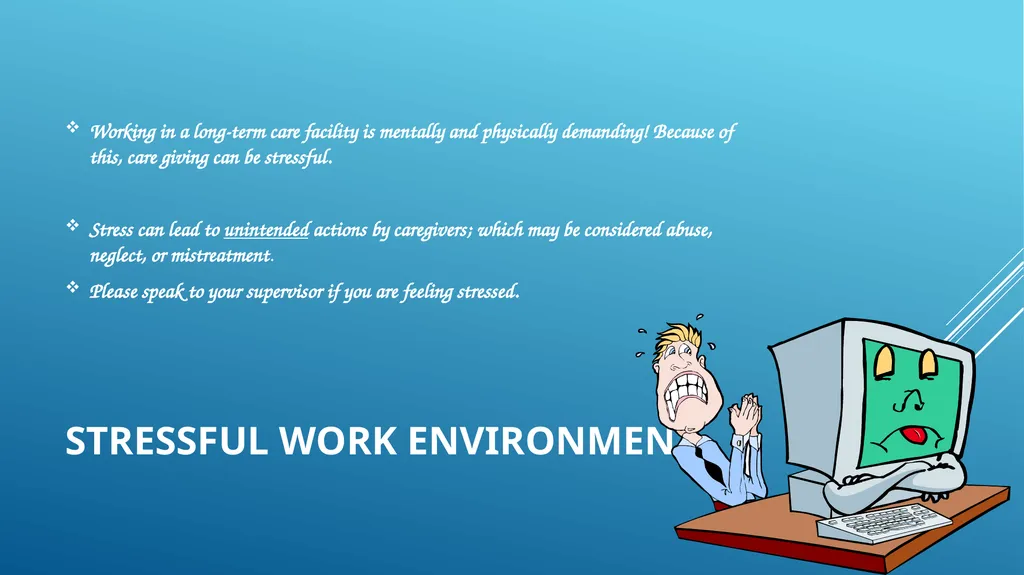
Stressful work environment Working in a long-term care facility is mentally and physically demanding! Because of this, care giving can be stressful.
Stress can lead to unintended actions by caregivers; which may be considered abuse, neglect, or mistreatment.
Please speak to your supervisor if you are feeling stressed.<br>
Stress can lead to unintended actions by caregivers; which may be considered abuse, neglect, or mistreatment.
Please speak to your supervisor if you are feeling stressed.<br>
17
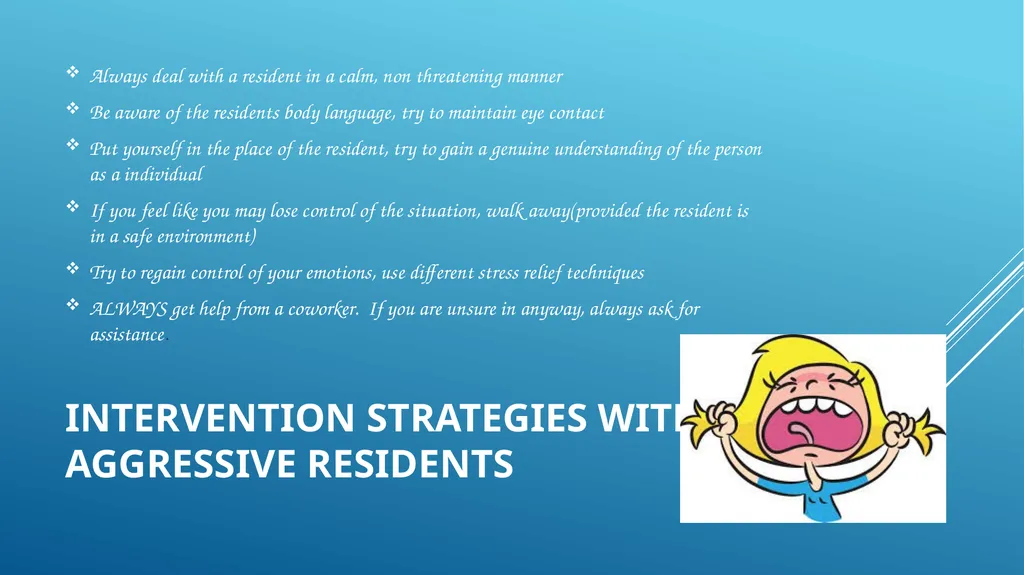
Intervention Strategies with aggressive RESIDENTS Always deal with a resident in a calm, non threatening manner
Be aware of the residents body language, try to maintain eye contact
Put yourself in the place of the resident, try to gain a genuine understanding of the person as a individual
If you feel like you may lose control of the situation, walk away(provided the resident is in a safe environment)
Try to regain control of your emotions, use different stress relief techniques
ALWAYS get help from a coworker. If you are unsure in anyway, always ask for assistance.<br>
Be aware of the residents body language, try to maintain eye contact
Put yourself in the place of the resident, try to gain a genuine understanding of the person as a individual
If you feel like you may lose control of the situation, walk away(provided the resident is in a safe environment)
Try to regain control of your emotions, use different stress relief techniques
ALWAYS get help from a coworker. If you are unsure in anyway, always ask for assistance.<br>
18
NC bill of rights for nursing home residents The North Carolina Nursing Home Patients’ Bill of Rights protect, among other things, the following rights of residents:
To receive care that is appropriate, adequate, and in compliance with the law
To be treated with consideration and respect
To receive a bill itemizing charges for treatment received
Privacy
To be free of abuse and of physical or chemical restraints
To receive a reasonable response from the nursing home to all requests
To associate and communicate privately with friends of their own choosing
To be free from work in the facility, and,
To retain their personal possessions<br>
To receive care that is appropriate, adequate, and in compliance with the law
To be treated with consideration and respect
To receive a bill itemizing charges for treatment received
Privacy
To be free of abuse and of physical or chemical restraints
To receive a reasonable response from the nursing home to all requests
To associate and communicate privately with friends of their own choosing
To be free from work in the facility, and,
To retain their personal possessions<br>
19
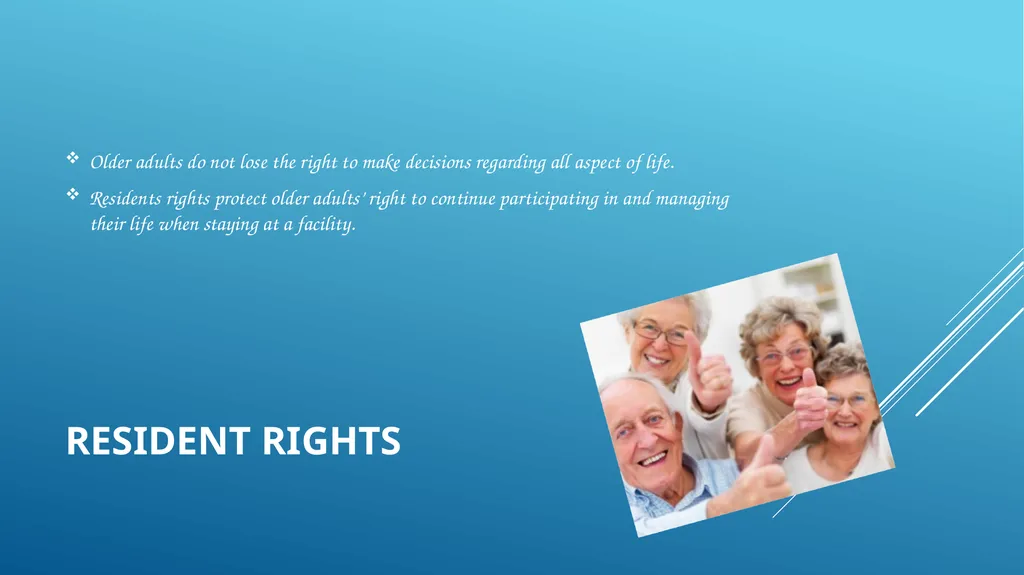
Resident rights Older adults do not lose the right to make decisions regarding all aspect of life.
Residents rights protect older adults’ right to continue participating in and managing their life when staying at a facility.<br>
Residents rights protect older adults’ right to continue participating in and managing their life when staying at a facility.<br>
20
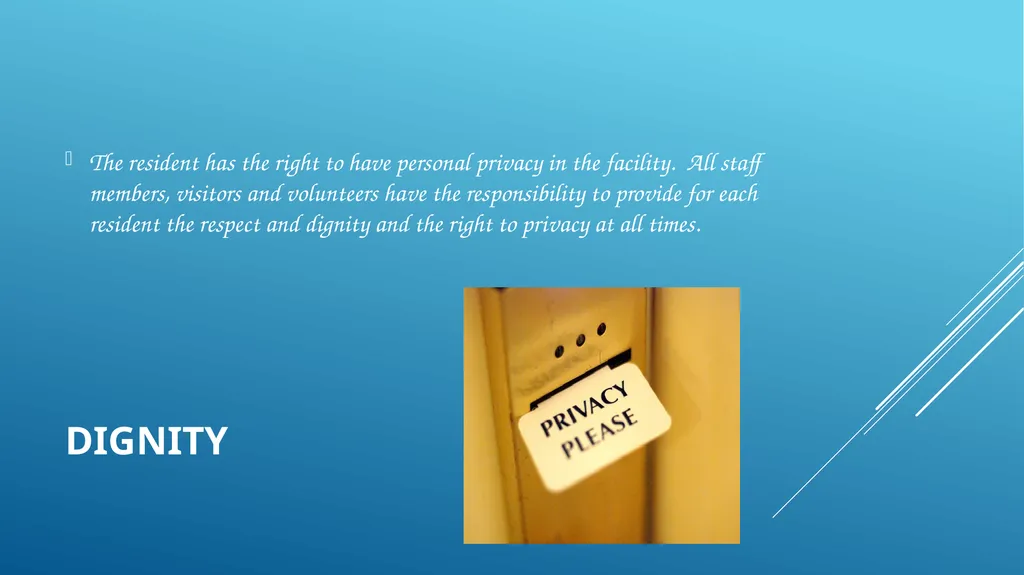
dignity The resident has the right to have personal privacy in the facility. All staff members, visitors and volunteers have the responsibility to provide for each resident the respect and dignity and the right to privacy at all times.<br>
21
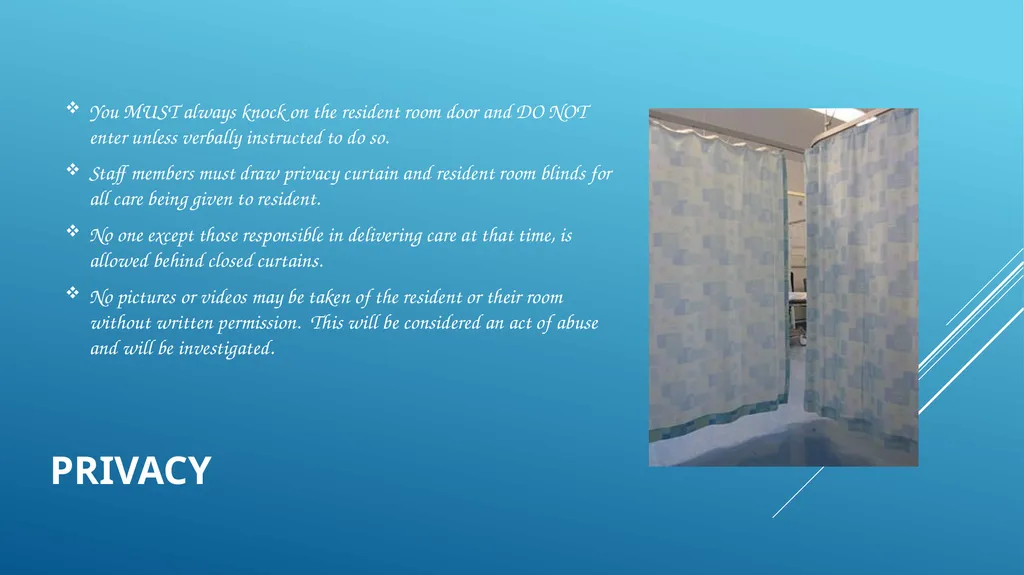
privacy You MUST always knock on the resident room door and DO NOT enter unless verbally instructed to do so.
Staff members must draw privacy curtain and resident room blinds for all care being given to resident.
No one except those responsible in delivering care at that time, is allowed behind closed curtains.
No pictures or videos may be taken of the resident or their room without written permission. This will be considered an act of abuse and will be investigated.<br>
Staff members must draw privacy curtain and resident room blinds for all care being given to resident.
No one except those responsible in delivering care at that time, is allowed behind closed curtains.
No pictures or videos may be taken of the resident or their room without written permission. This will be considered an act of abuse and will be investigated.<br>
22
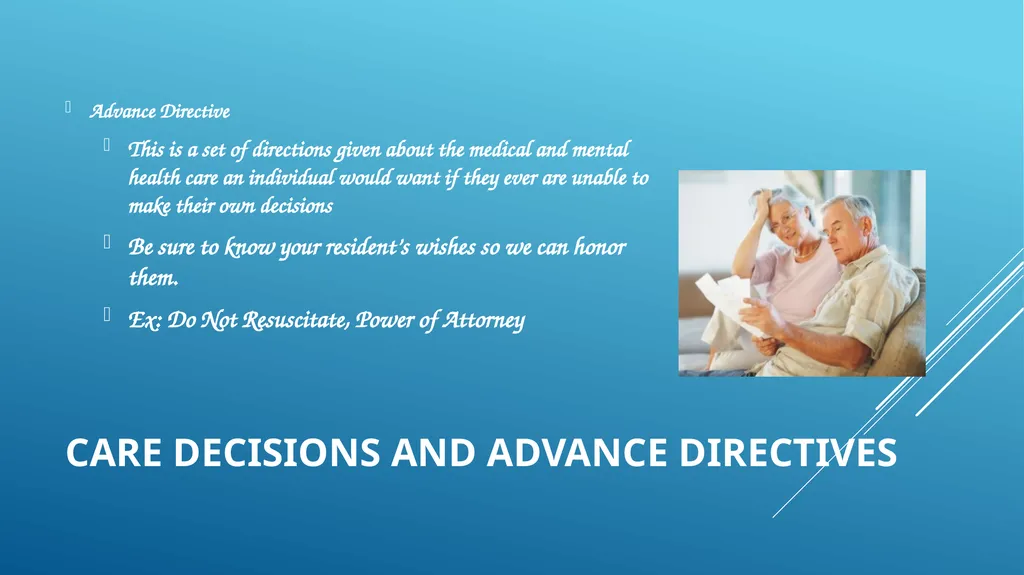
Care decisions and advance directives Advance Directive
This is a set of directions given about the medical and mental health care an individual would want if they ever are unable to make their own decisions
Be sure to know your resident’s wishes so we can honor them.
Ex: Do Not Resuscitate, Power of Attorney<br>
This is a set of directions given about the medical and mental health care an individual would want if they ever are unable to make their own decisions
Be sure to know your resident’s wishes so we can honor them.
Ex: Do Not Resuscitate, Power of Attorney<br>
23
Discharge planning If any resident or family member inquires about discharge from the facility, please refer them to the facility Director of Social Services.
The decision to discharge from the facility must be made by the interdisciplinary team – NOT JUST THERAPY<br>
The decision to discharge from the facility must be made by the interdisciplinary team – NOT JUST THERAPY<br>
24
How to report If you see or hear about abuse or neglect, you must:
Make sure the resident is safe if the act just occurred.
Immediately inform therapy program manager.
The manager will immediately notify the facility DON and Administrator.
May be required to provide a statement as part of the investigation.
TR Corporate Compliance Plan: Report to Clinical Specialist and/or Compliance Officer<br>
Make sure the resident is safe if the act just occurred.
Immediately inform therapy program manager.
The manager will immediately notify the facility DON and Administrator.
May be required to provide a statement as part of the investigation.
TR Corporate Compliance Plan: Report to Clinical Specialist and/or Compliance Officer<br>
25
For questions or assistance Clinical Specialists
Brad Myers: 252-229-5761
Heather Klein: 910-929-5014
Stacy Rivera: 984-249-8215
HR Manager
Tammy Worden: 910-891-1599
Compliance Officer
Jamie Sutherland: 910-891-1599<br>
Brad Myers: 252-229-5761
Heather Klein: 910-929-5014
Stacy Rivera: 984-249-8215
HR Manager
Tammy Worden: 910-891-1599
Compliance Officer
Jamie Sutherland: 910-891-1599<br>