Academic Corporate Relations: Essential Elements Sacha Patera, PhD NACRO Benchmarking Committee Co-Chair Associate Director of Corporate Relations Northwestern University Emily Abbott NACRO Benchmarking Committee Co-Chair Associate Director
Related Topics
Share
Embed code
Download this presentation From Below
"Academic Corporate Relations: Essential Elements" is the property of its rightful owner. Permission is granted to
download and print the materials on this website for personal, non-commercial use only, and to display it
on your personal computer provided you do not modify the materials and that you retain all copyright
notices contained in the materials. By downloading content from our website, you accept the terms of this
agreement.
Presentation Transcript
01
Academic Corporate Relations: Essential Elements Sacha Patera, PhD
NACRO Benchmarking Committee Co-Chair
Associate Director of Corporate Relations
Northwestern University
Emily Abbott
NACRO Benchmarking Committee Co-Chair
Associate Director of Corporate Relations
California Institute of Technology NACRO Conference 2011
Aug 1-3, 2011
Ann Arbor MI<br>
02
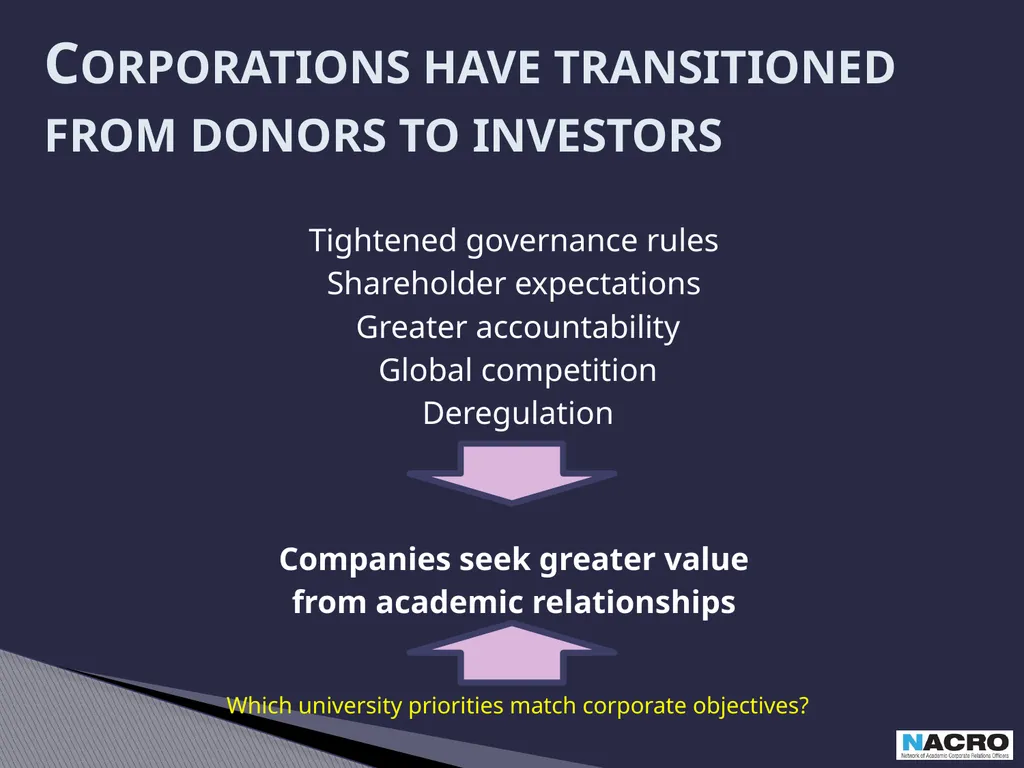
Tightened governance rules
Shareholder expectations
Greater accountability
Global competition
Deregulation
Companies seek greater value
from academic relationships
Which university priorities match corporate objectives? Corporations have transitioned from donors to investors<br>
03
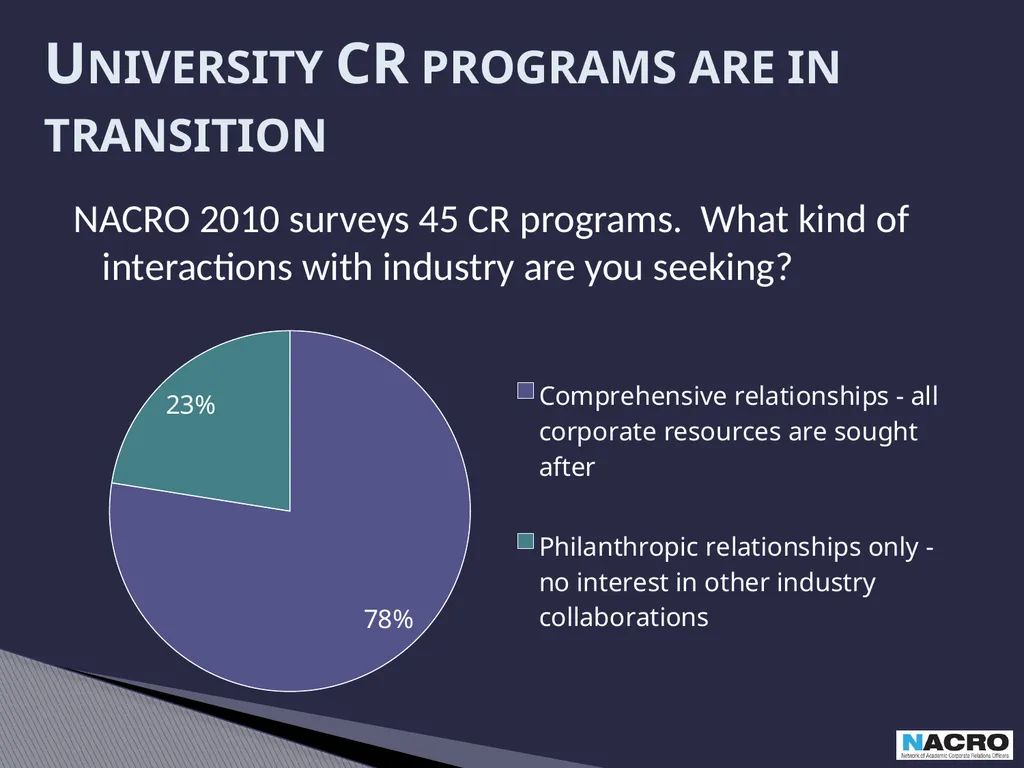
NACRO 2010 surveys 45 CR programs. What kind of interactions with industry are you seeking? University CR programs are in transition<br>
04
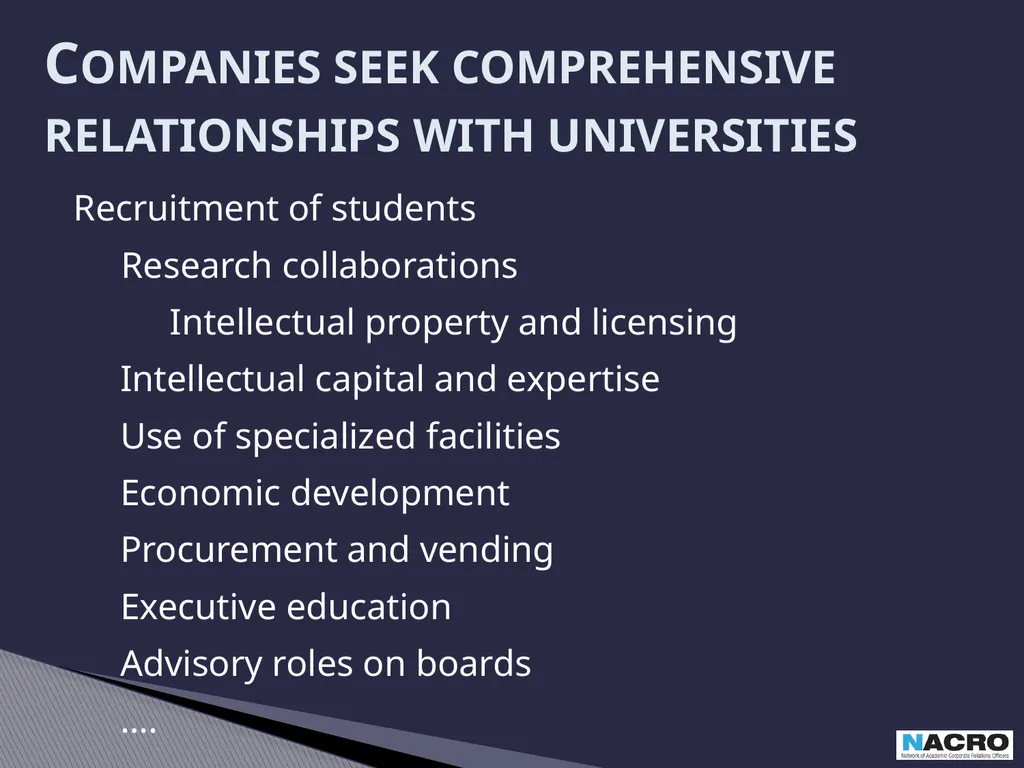
Companies seek comprehensive relationships with universities Recruitment of students
Research collaborations
Intellectual property and licensing
Intellectual capital and expertise
Use of specialized facilities
Economic development
Procurement and vending
Executive education
Advisory roles on boards
….<br>
05
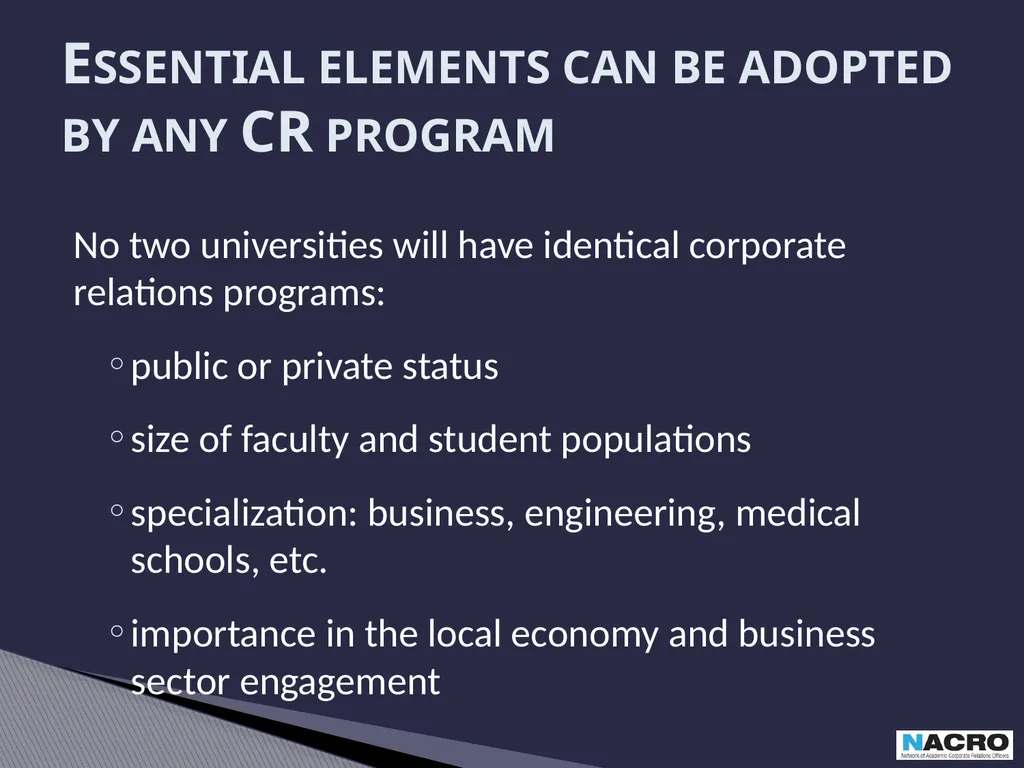
No two universities will have identical corporate relations programs:
public or private status
size of faculty and student populations
specialization: business, engineering, medical schools, etc.
importance in the local economy and business sector engagement Essential elements can be adopted by any CR program<br>
06
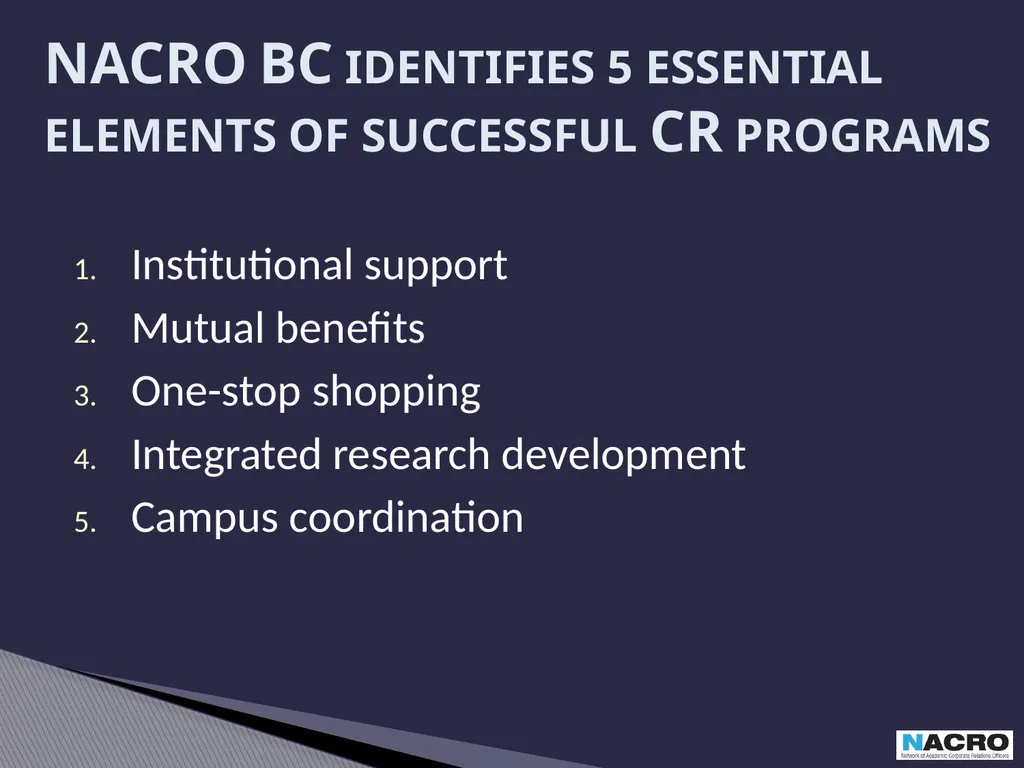
Institutional support
Mutual benefits
One-stop shopping
Integrated research development
Campus coordination NACRO BC identifies 5 essential elements of successful CR programs<br>
07
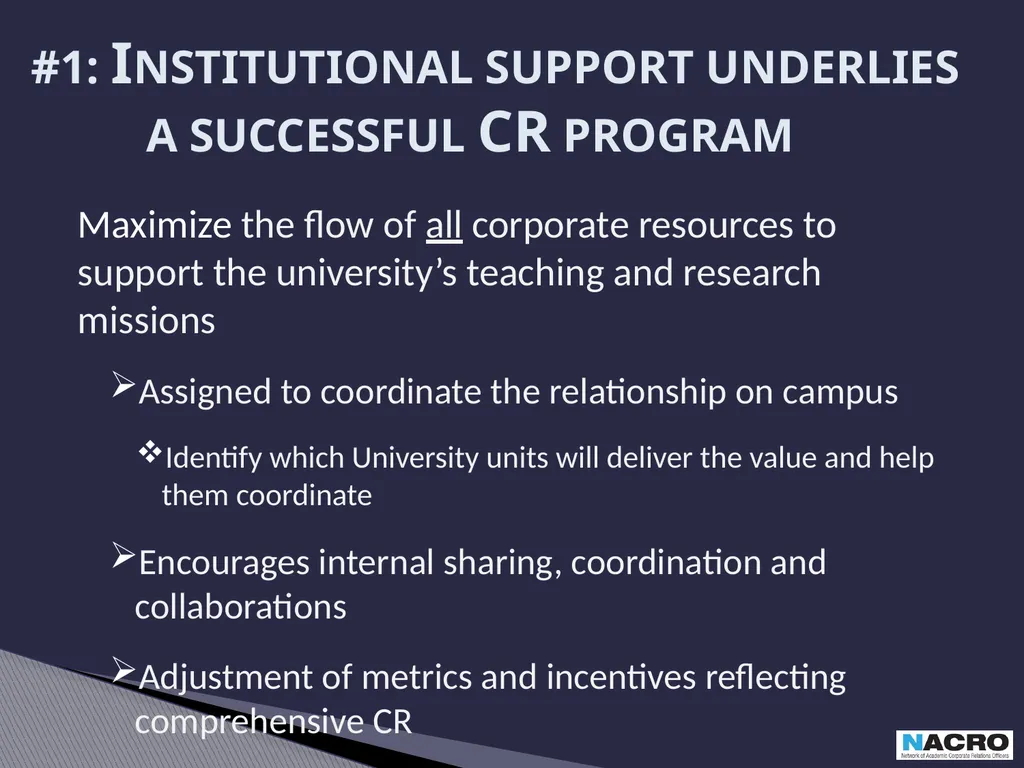
Maximize the flow of all corporate resources to support the university’s teaching and research missions
Assigned to coordinate the relationship on campus
Identify which University units will deliver the value and help them coordinate
Encourages internal sharing, coordination and collaborations
Adjustment of metrics and incentives reflecting comprehensive CR #1: Institutional support underlies a successful CR program<br>
08
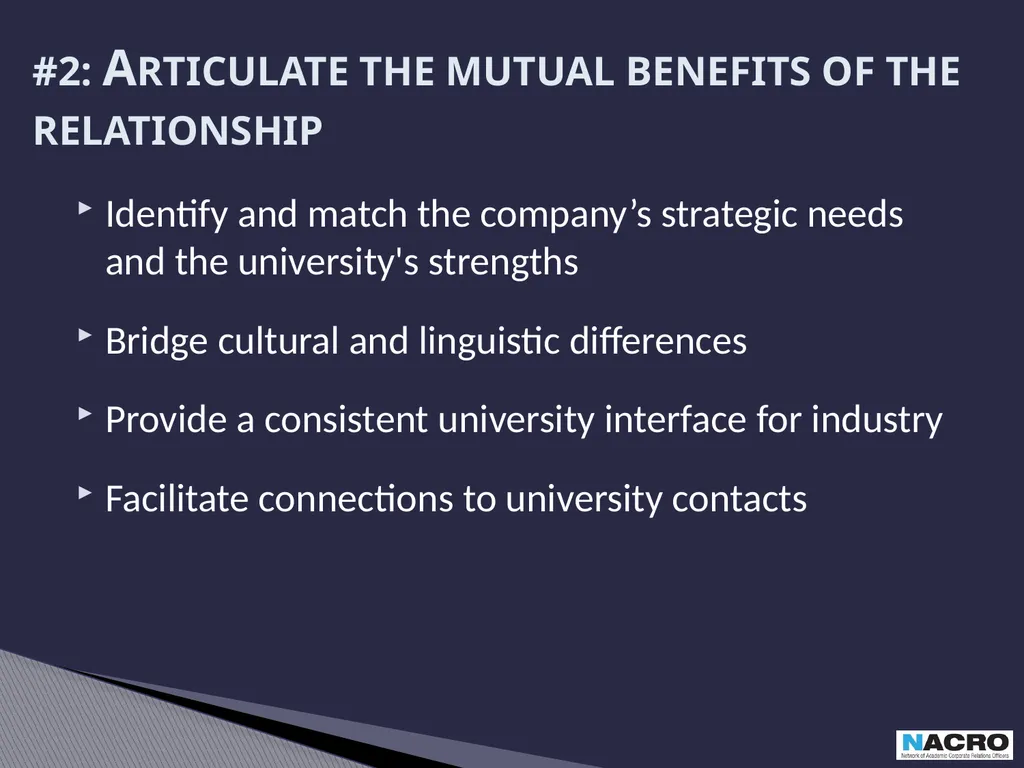
Identify and match the company’s strategic needs and the university's strengths
Bridge cultural and linguistic differences
Provide a consistent university interface for industry
Facilitate connections to university contacts #2: Articulate the mutual benefits of the relationship<br>
09
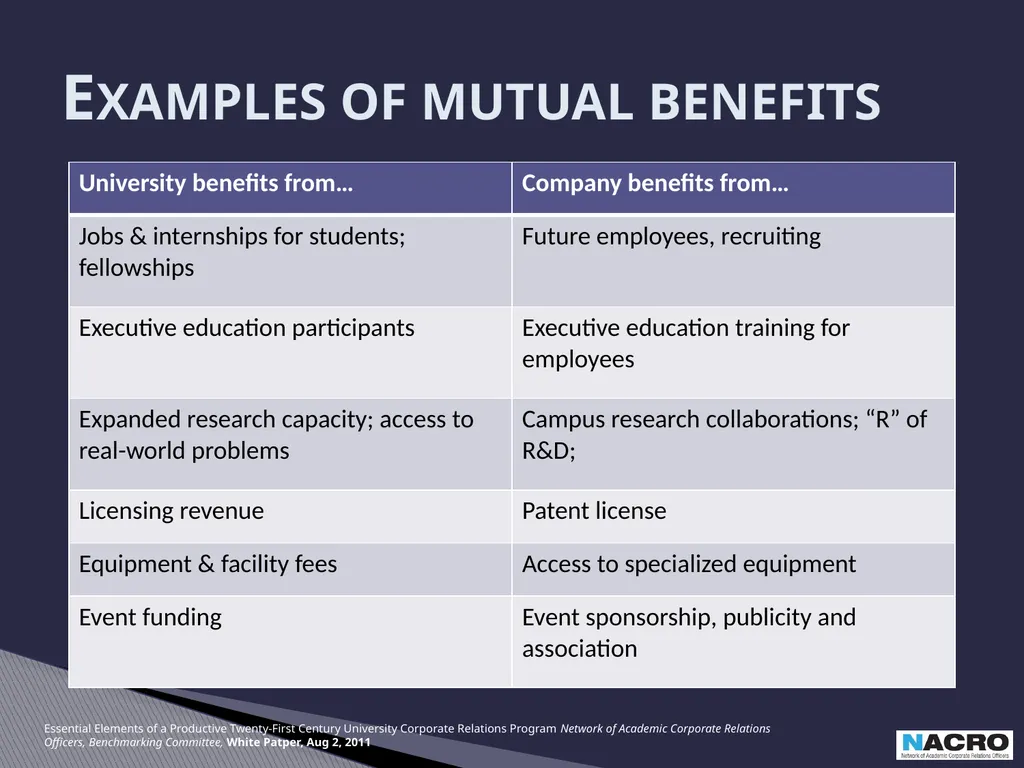
Examples of mutual benefits Essential Elements of a Productive Twenty-First Century University Corporate Relations Program Network of Academic Corporate Relations Officers, Benchmarking Committee, White Patper, Aug 2, 2011<br>
10
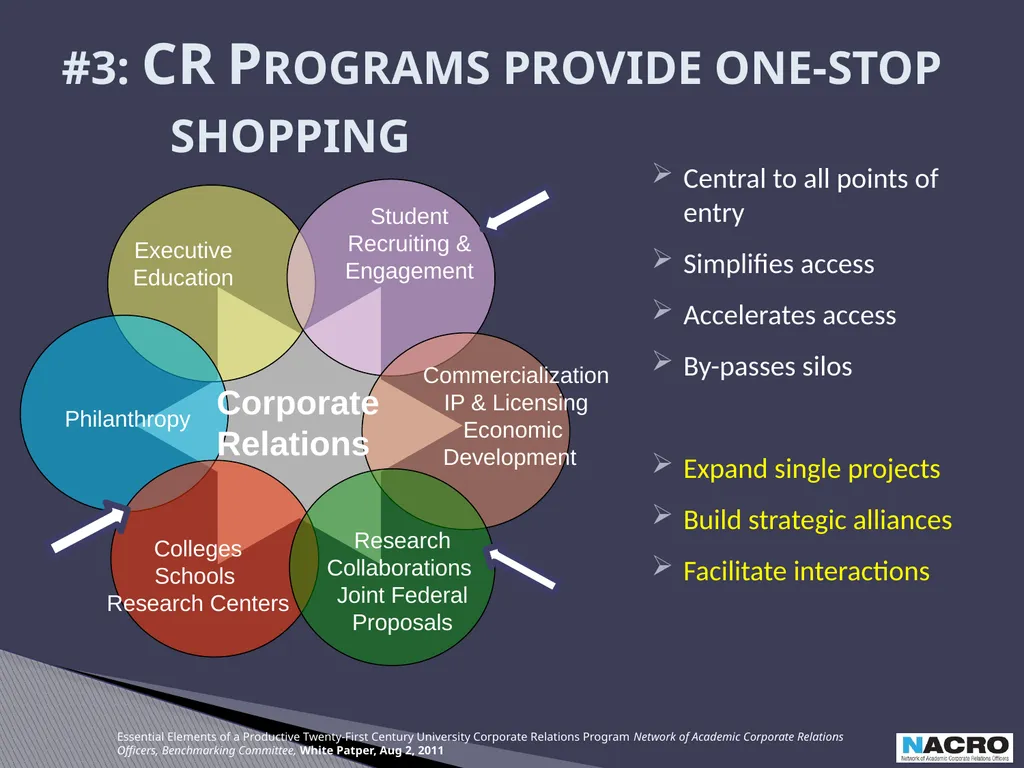
#3: CR Programs provide one-stop shopping Essential Elements of a Productive Twenty-First Century University Corporate Relations Program Network of Academic Corporate Relations Officers, Benchmarking Committee, White Patper, Aug 2, 2011 Central to all points of entry
Simplifies access
Accelerates access
By-passes silos
Expand single projects
Build strategic alliances
Facilitate interactions<br>
11
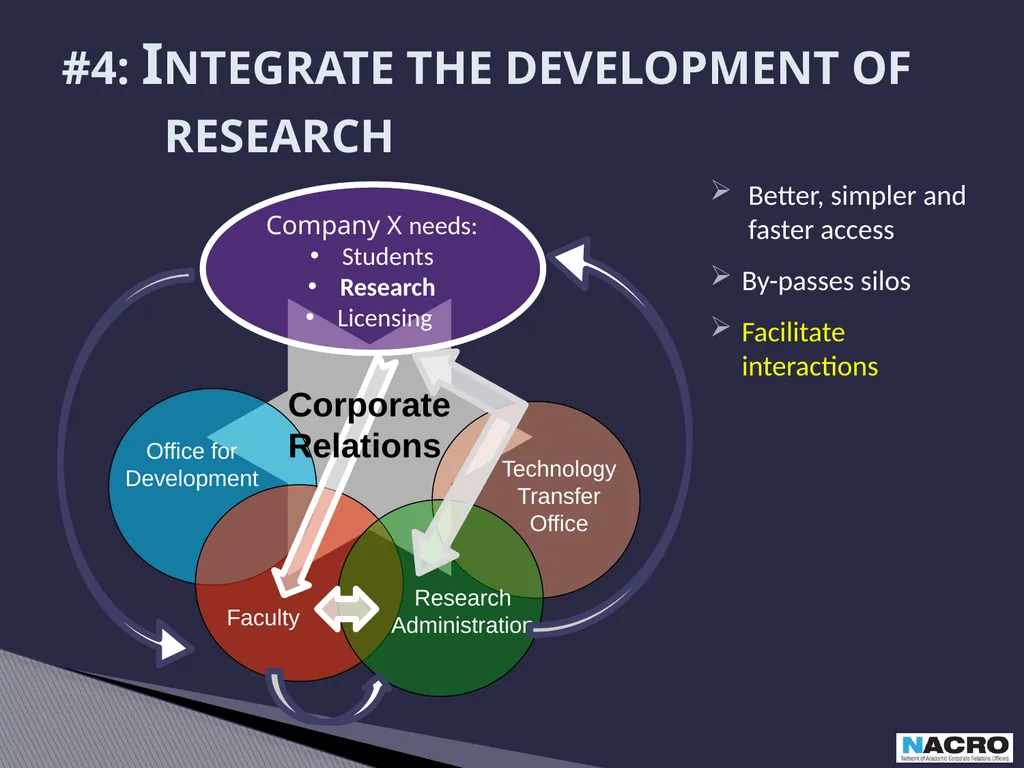
#4: Integrate the development of research Research Administration Office for Development Faculty Company X needs:
Students
Research
Licensing Technology Transfer Office Corporate
Relations Better, simpler and faster access
By-passes silos
Facilitate interactions<br>
12
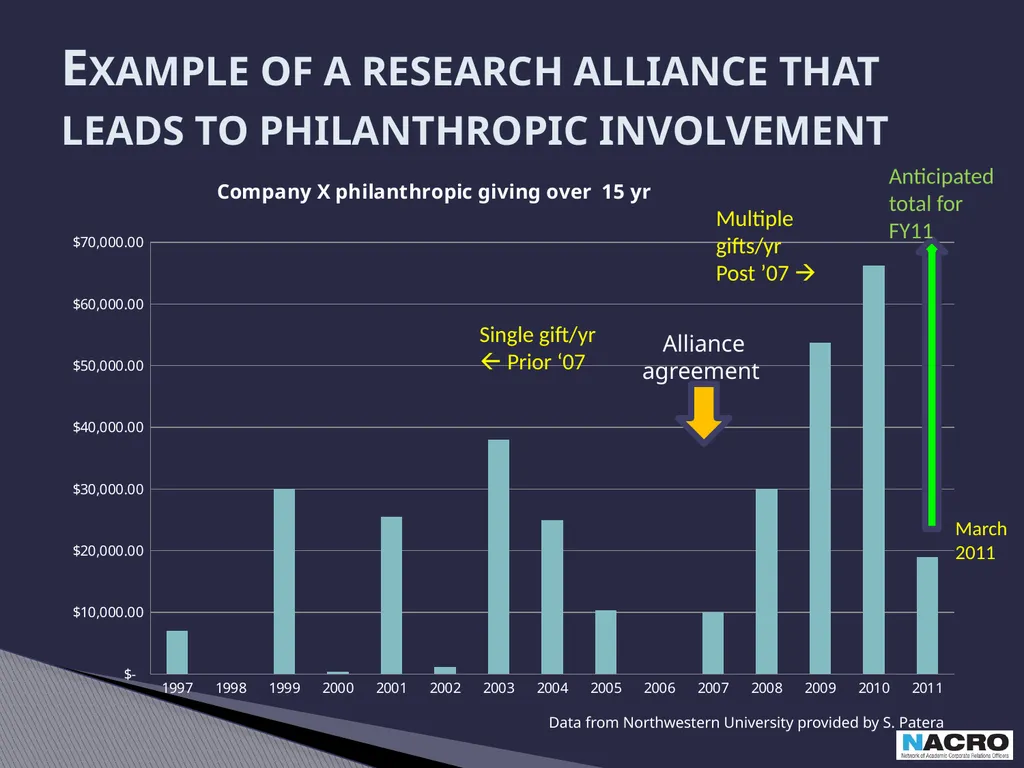
Example of a research alliance that leads to philanthropic involvement March 2011 Data from Northwestern University provided by S. Patera Anticipated total for FY11 Single gift/yr
Prior ‘07 Multiple gifts/yr
Post ’07 <br>
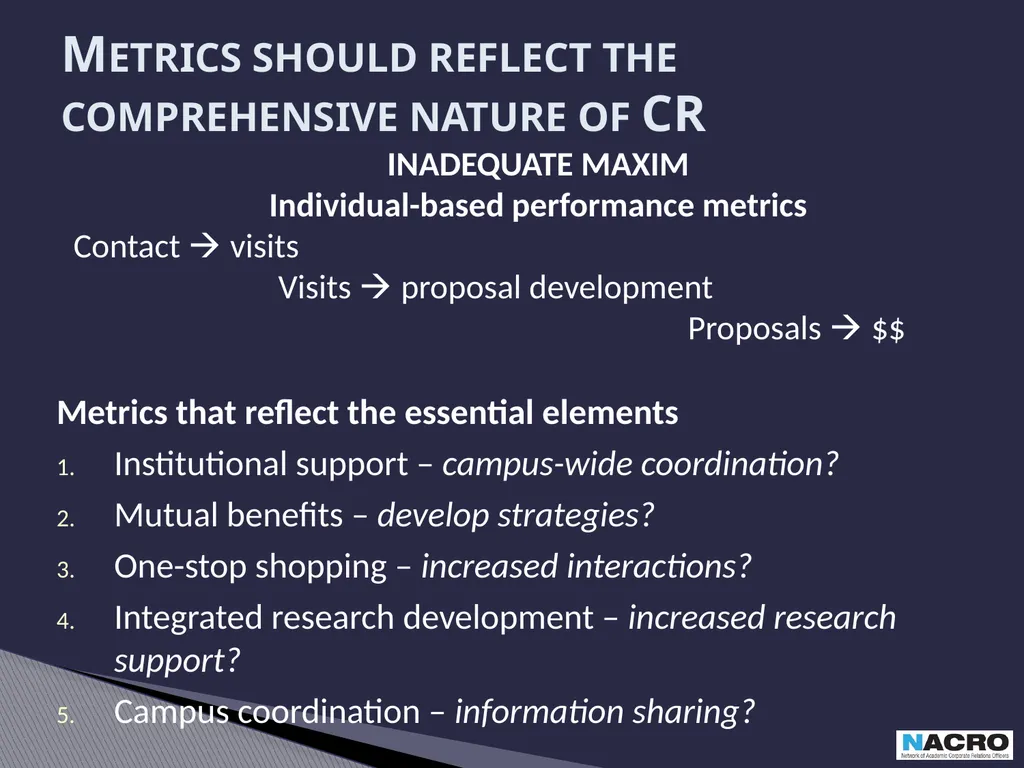
Metrics that reflect the essential elements
Institutional support – campus-wide coordination?
Mutual benefits – develop strategies?
One-stop shopping – increased interactions?
Integrated research development – increased research support?
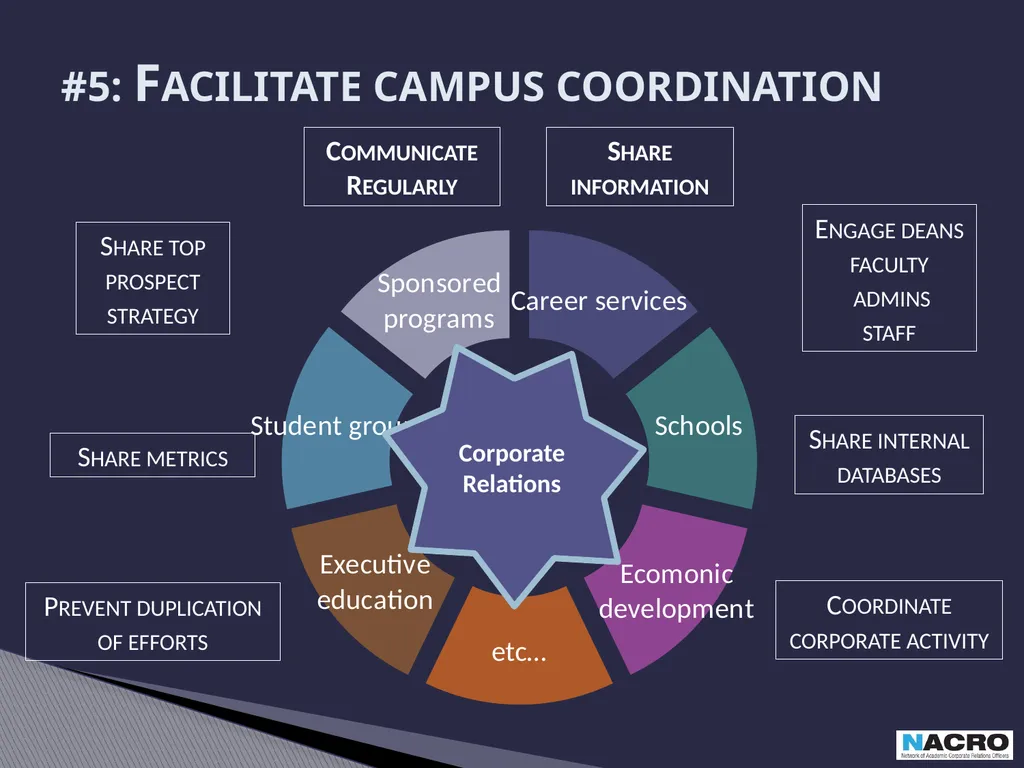
Campus coordination – information sharing? Metrics should reflect the comprehensive nature of CR INADEQUATE MAXIM
Individual-based performance metrics
Contact visits
Visits proposal development
Proposals $$<br>
15
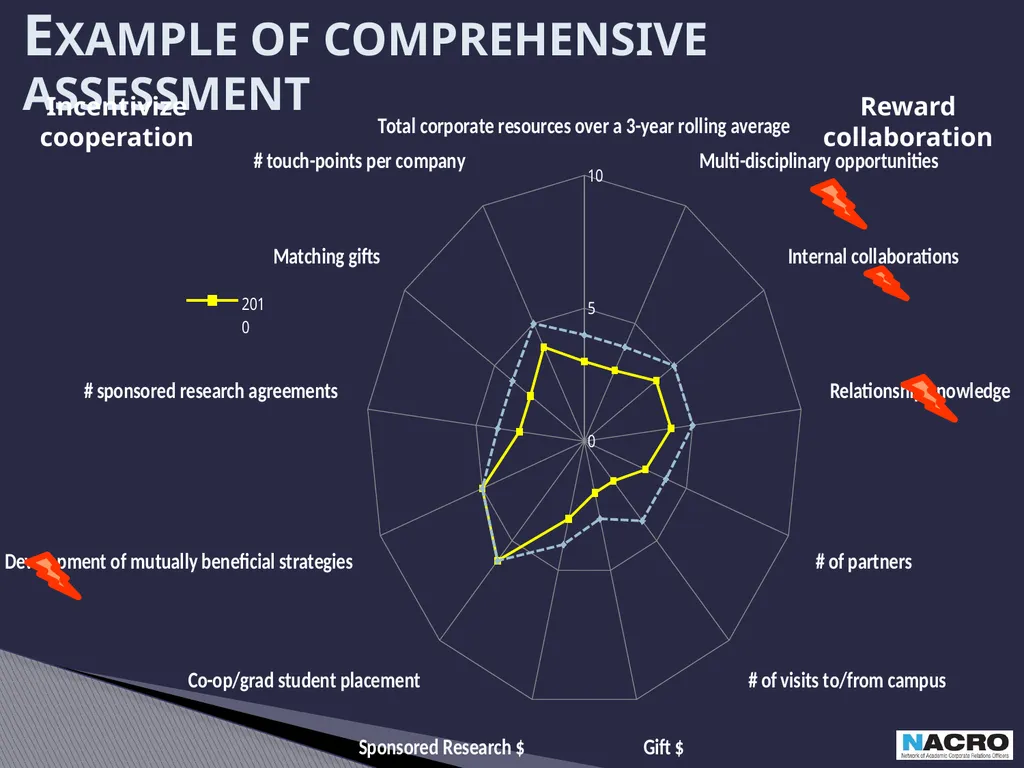
Example of comprehensive assessment Incentivize cooperation Reward collaboration<br>
16
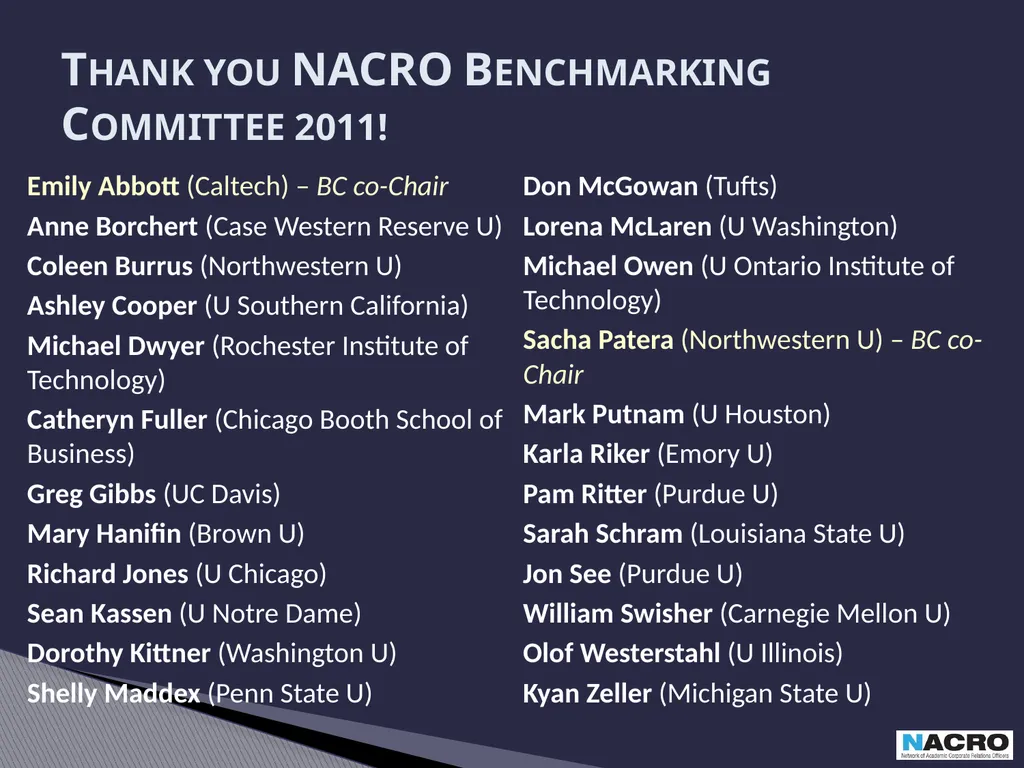
Emily Abbott (Caltech) – BC co-Chair
Anne Borchert (Case Western Reserve U)
Coleen Burrus (Northwestern U)
Ashley Cooper (U Southern California)
Michael Dwyer (Rochester Institute of Technology)
Catheryn Fuller (Chicago Booth School of Business)
Greg Gibbs (UC Davis)
Mary Hanifin (Brown U)
Richard Jones (U Chicago)
Sean Kassen (U Notre Dame)
Dorothy Kittner (Washington U)
Shelly Maddex (Penn State U)
Don McGowan (Tufts)
Lorena McLaren (U Washington)
Michael Owen (U Ontario Institute of Technology)
Sacha Patera (Northwestern U) – BC co-Chair
Mark Putnam (U Houston)
Karla Riker (Emory U)
Pam Ritter (Purdue U)
Sarah Schram (Louisiana State U)
Jon See (Purdue U)
William Swisher (Carnegie Mellon U)
Olof Westerstahl (U Illinois)
Kyan Zeller (Michigan State U) Thank you NACRO Benchmarking Committee 2011!<br>