
Academic writing for Honours Academic writing It


Description: Academic writing for Honours Academic writing It is a concise, focused and well structured writing which define intellectual boundaries of a particular discipline Its evidence is in a form of references which support what is written to
Related Topics
Download Presentation
"Academic writing for Honours Academic writing It" is the property of its rightful owner. Permission is granted to download and print the materials on this website for personal, non-commercial use only, and to display it on your personal computer provided you do not modify the materials and that you retain all copyright notices contained in the materials. By downloading content from our website, you accept the terms of this agreement.
Presentation Transcript
slide1. Academic writing for Honours<br>
slide2. Academic writing It is a concise, focused and well structured writing which define intellectual boundaries of a particular discipline
Its evidence is in a form of references which support what is written to propose theories and ideas
It uses of the third-person rather than first-person perspective
It has a clear on focus the research problem under investigation,
The first step to writing academically is to clearly define the purpose of the writing and the audience<br>
slide3. Arrange your points in logical order Have a clear idea of what you want to say
Create a list of your main points
Think about what the reader needs to know
Once you have a clear idea of what is required for your project and you can start planning your research and gathering evidence
Find academic information from reliable, reviewed and published resources (journals, books, conference proceedings).
Avoid publications from predatory publishers<br>
slide4. Write in structured paragraphs Use paragraphs to structure your ideas
Each of the points or theme forms a different paragraph
From the first or second sentence make your point clear so that a reader can follow the line of reasoning
The rest of the paragraph should explain the point or theme in detail and provide relevant evidence/references
Evidence can be data, facts, quotations, arguments, statistics, research and theories<br>
slide5. Use formal language You are expected to use formal language and not not confrontational or dismissive language
Each subject discipline has certain writing styles and terms, that you will be used to as you progress with your degree
Do not use of long sentences and complicated vocabulary
Avoid using colloquialisms or slang terms or regional dialects<br>
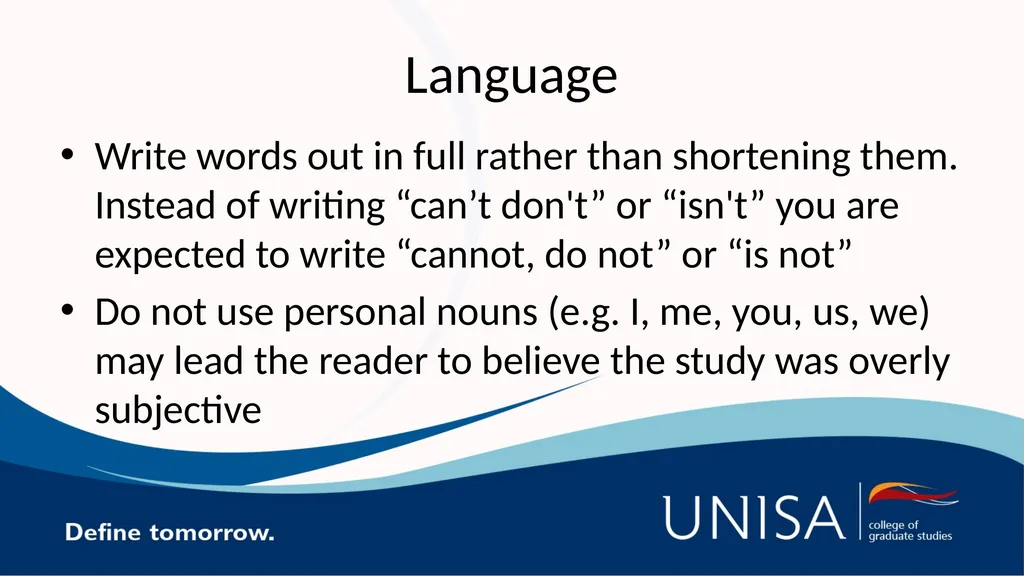
slide6. Language Write words out in full rather than shortening them. Instead of writing “can’t don't” or “isn't” you are expected to write “cannot, do not” or “is not”
Do not use personal nouns (e.g. I, me, you, us, we) may lead the reader to believe the study was overly subjective<br>
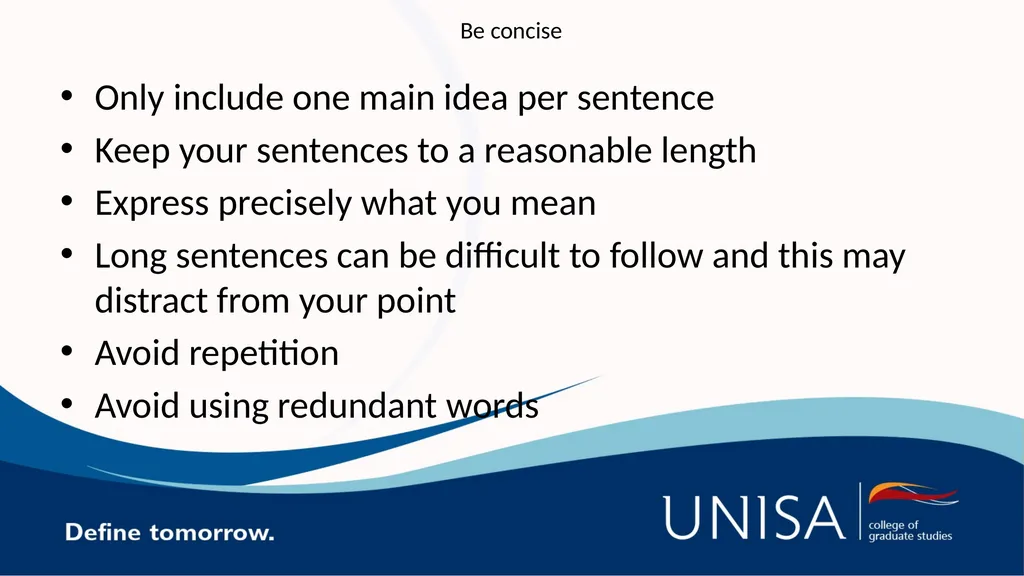
slide7. Be concise Only include one main idea per sentence
Keep your sentences to a reasonable length
Express precisely what you mean
Long sentences can be difficult to follow and this may distract from your point
Avoid repetition
Avoid using redundant words<br>
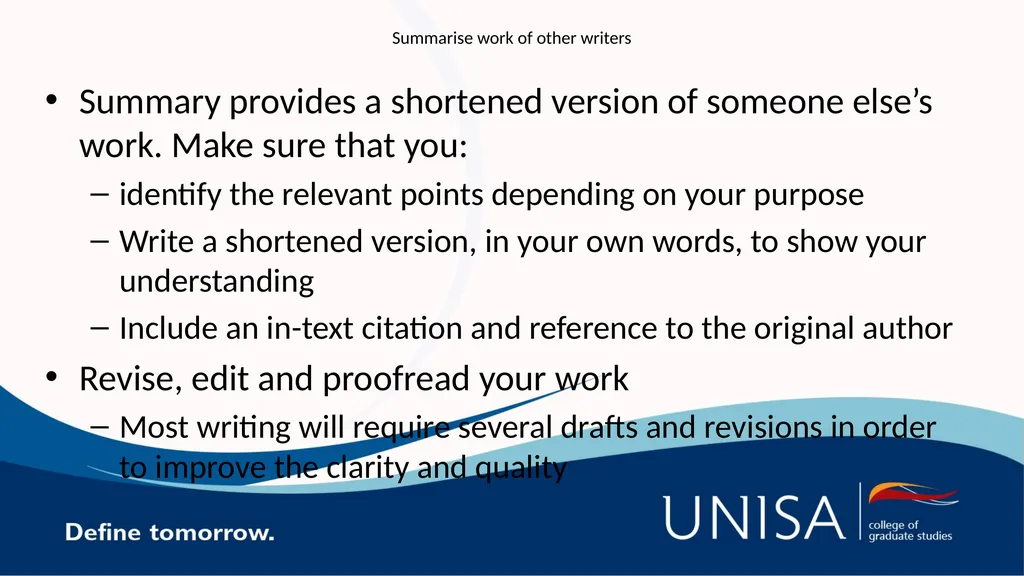
slide8. Summarise work of other writers Summary provides a shortened version of someone else’s work. Make sure that you:
identify the relevant points depending on your purpose
Write a shortened version, in your own words, to show your understanding
Include an in-text citation and reference to the original author
Revise, edit and proofread your work
Most writing will require several drafts and revisions in order to improve the clarity and quality<br>
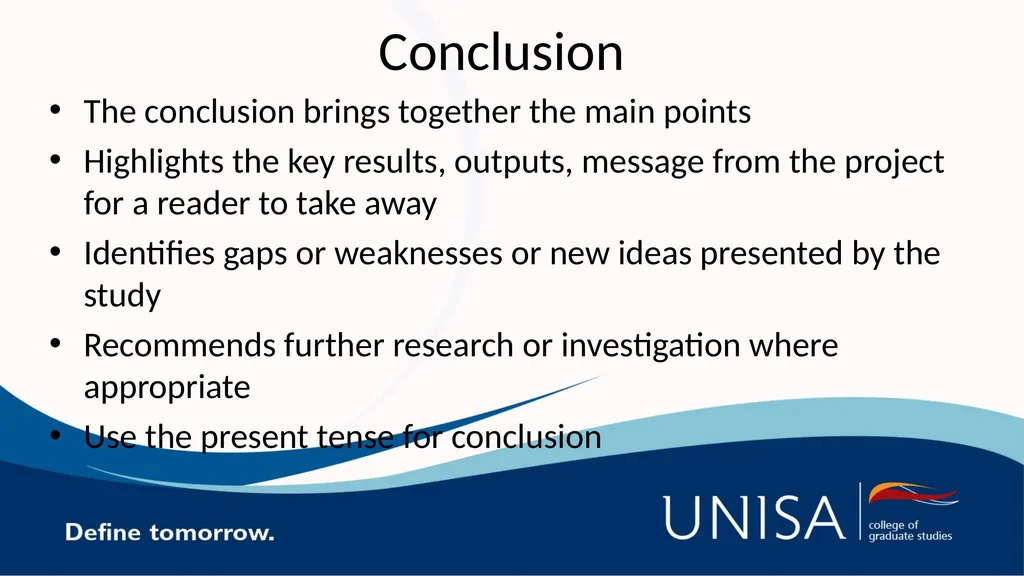
slide9. Conclusion The conclusion brings together the main points
Highlights the key results, outputs, message from the project for a reader to take away
Identifies gaps or weaknesses or new ideas presented by the study
Recommends further research or investigation where appropriate
Use the present tense for conclusion<br>
slide10. Referencing Cite sources and provide a list of references
Citing sources allow readers to identify the resources so they can independently verify and assess the quality of findings and conclusions based on your review of the literature<br>
slide2. Academic writing It is a concise, focused and well structured writing which define intellectual boundaries of a particular discipline
Its evidence is in a form of references which support what is written to propose theories and ideas
It uses of the third-person rather than first-person perspective
It has a clear on focus the research problem under investigation,
The first step to writing academically is to clearly define the purpose of the writing and the audience<br>
slide3. Arrange your points in logical order Have a clear idea of what you want to say
Create a list of your main points
Think about what the reader needs to know
Once you have a clear idea of what is required for your project and you can start planning your research and gathering evidence
Find academic information from reliable, reviewed and published resources (journals, books, conference proceedings).
Avoid publications from predatory publishers<br>
slide4. Write in structured paragraphs Use paragraphs to structure your ideas
Each of the points or theme forms a different paragraph
From the first or second sentence make your point clear so that a reader can follow the line of reasoning
The rest of the paragraph should explain the point or theme in detail and provide relevant evidence/references
Evidence can be data, facts, quotations, arguments, statistics, research and theories<br>
slide5. Use formal language You are expected to use formal language and not not confrontational or dismissive language
Each subject discipline has certain writing styles and terms, that you will be used to as you progress with your degree
Do not use of long sentences and complicated vocabulary
Avoid using colloquialisms or slang terms or regional dialects<br>
slide6. Language Write words out in full rather than shortening them. Instead of writing “can’t don't” or “isn't” you are expected to write “cannot, do not” or “is not”
Do not use personal nouns (e.g. I, me, you, us, we) may lead the reader to believe the study was overly subjective<br>
slide7. Be concise Only include one main idea per sentence
Keep your sentences to a reasonable length
Express precisely what you mean
Long sentences can be difficult to follow and this may distract from your point
Avoid repetition
Avoid using redundant words<br>
slide8. Summarise work of other writers Summary provides a shortened version of someone else’s work. Make sure that you:
identify the relevant points depending on your purpose
Write a shortened version, in your own words, to show your understanding
Include an in-text citation and reference to the original author
Revise, edit and proofread your work
Most writing will require several drafts and revisions in order to improve the clarity and quality<br>
slide9. Conclusion The conclusion brings together the main points
Highlights the key results, outputs, message from the project for a reader to take away
Identifies gaps or weaknesses or new ideas presented by the study
Recommends further research or investigation where appropriate
Use the present tense for conclusion<br>
slide10. Referencing Cite sources and provide a list of references
Citing sources allow readers to identify the resources so they can independently verify and assess the quality of findings and conclusions based on your review of the literature<br>