Access to High-Quality SNF Care for Medicare Advantage Enrollees with Dementia Presenter: Mingyu Qi Collaborators: R. Tamara Konetzka, PhD (PI); Betsy Q. Cliff, PhD, Nadia Ghazali The University of Chicago Motivation Post-acute care is a
"Access to High-Quality SNF Care for Medicare" is the property of its rightful owner. Permission is granted to
download and print the materials on this website for personal, non-commercial use only, and to display it
on your personal computer provided you do not modify the materials and that you retain all copyright
notices contained in the materials. By downloading content from our website, you accept the terms of this
agreement.
Presentation Transcript
01
Access to High-Quality SNF Care for Medicare Advantage Enrollees with Dementia Presenter: Mingyu Qi
Collaborators: R. Tamara Konetzka, PhD (PI); Betsy Q. Cliff, PhD, Nadia Ghazali
The University of Chicago<br>
02
Motivation Post-acute care is a focal point for concerns about access to high-quality care under Medicare Advantage (MA), especially in Skilled Nursing Facilities (SNFs).
May be especially salient for beneficiaries with ADRD (who use post-acute care at twice the rate of those without ADRD).
Limited/mixed evidence overall on utilization and quality.<br>
03
Existing Evidence Access to care:
Park et al. (2020) find that utilization of many services is lower for Medicare beneficiaries with ADRD enrolled in MA than in TM.
Quality of care:
Meyers et al. (2018) examine the SNFs used by MA enrollees during 2012-2014, finding them to be of lower quality than those used by Traditional Medicare (TM) enrollees, even in highly rated MA plans.
MA enrollment among beneficiaries with ADRD:
Medicare beneficiaries with ADRD have increasingly enrolled in MA, in proportion to beneficiaries without ADRD (James et al., 2023).<br>
04
Research Questions Among Medicare beneficiaries with ADRD who are discharged from an acute-care hospital, how does MA enrollment affect SNF utilization relative to other options (other or no post-acute care)?
Among Medicare beneficiaries with ADRD who are discharged from an acute-care hospital to a SNF, how does MA enrollment affect the quality of SNF the beneficiary is admitted to?<br>
05
Contributions Newer data reflecting higher MA penetration over time, 2016-2022
(In process of adding more years!)
Attention to extensive margin effects as well as intensive margin
Marginal patient using SNF may be different over time in sickness or demographics
Attention to market characteristics and choice set
If high-MA areas only have low-quality SNFs, connection between MA enrollment and SNF quality may be spurious
The level of MA plan competition and SNF competition may influence SNF quality
Focus on enrollees with ADRD<br>
06
Exploratory Market-level Analysis Goal: Explore the landscape of the association between MA penetration and SNF quality at the Hospital Service Area (HSA) level
Data: Nursing Home Compare and Medicare Master Beneficiary Summary File (MBSF), 2016-2019
Methods:
Unadjusted descriptive analysis
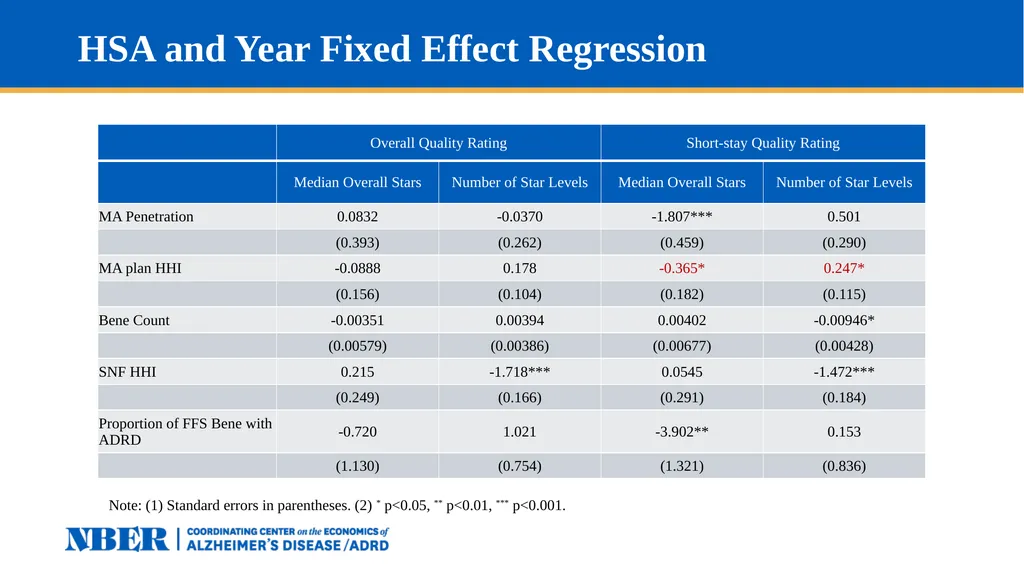
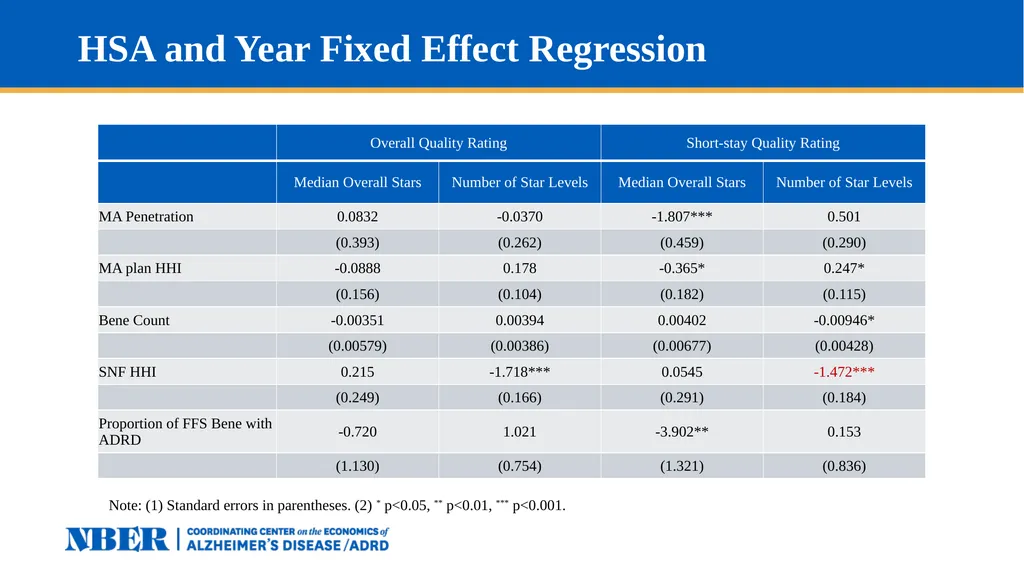
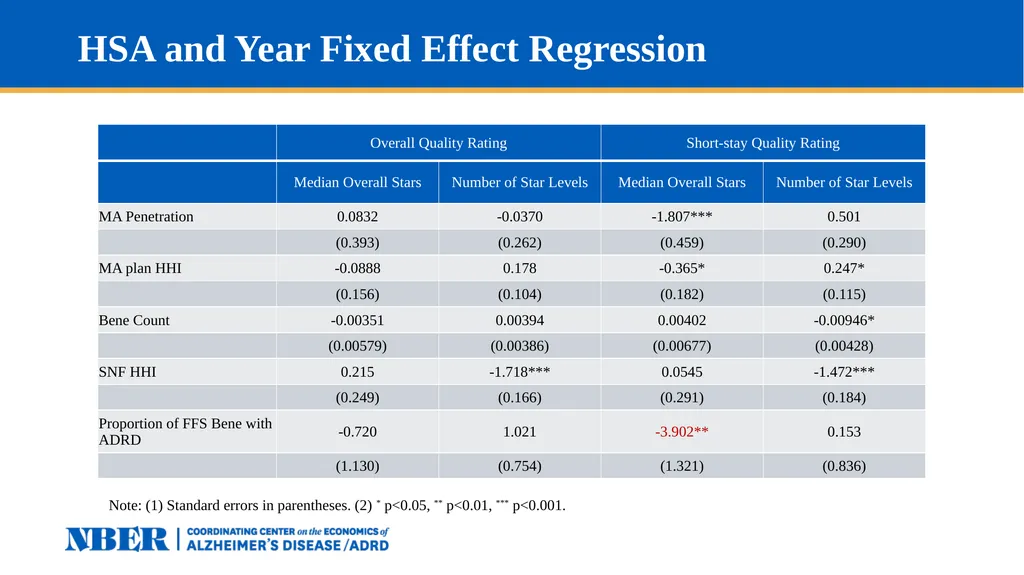
Multivariable regressions with HSA and year fixed effects<br>
07
MA Penetration Proportion of all Medicare beneficiaries in an HSA enrolled in MA
Calculated each year from MBSF<br>
08
HSA-level SNF Quality Measures All drawn from CMS Nursing Home Care Compare
5-star ratings, where 1=lowest and 5=highest quality
Three quality measure ratings: short-stay, long-stay, and overall
Short-stay: length of stay <= 100 days or covered under Medicare SNF benefit
Long-stay: length of stay > 100 days
Overall rating combines the short-stay and long-stay quality ratings<br>
09
HSA-level SNF Quality Measures Overall SNF quality in the HSA
Median number of overall stars
Total number of star levels available (range)
Probability that only low-quality SNFs available (1-2 stars)
Short-stay SNF quality in the HSA
Median number of overall stars
Total number of star levels available (range)
Probability that only low-quality SNFs available (1-2 stars)<br>
10
Unadjusted Statistics 1 On average, the SNF short-stay quality rating increases as MA penetration rises.<br>
11
Unadjusted Statistics 2 Both the ranges of overall and short-stay quality ratings appear to widen as MA penetration rises.<br>
12
Unadjusted Statistics 3 On average, HSAs with higher MA penetration are less likely to have exclusively low-quality SNFs.<br>
13
Unadjusted Statistics 4 On average, both MA plan competition and SNF competition increase with higher MA penetration.<br>
14
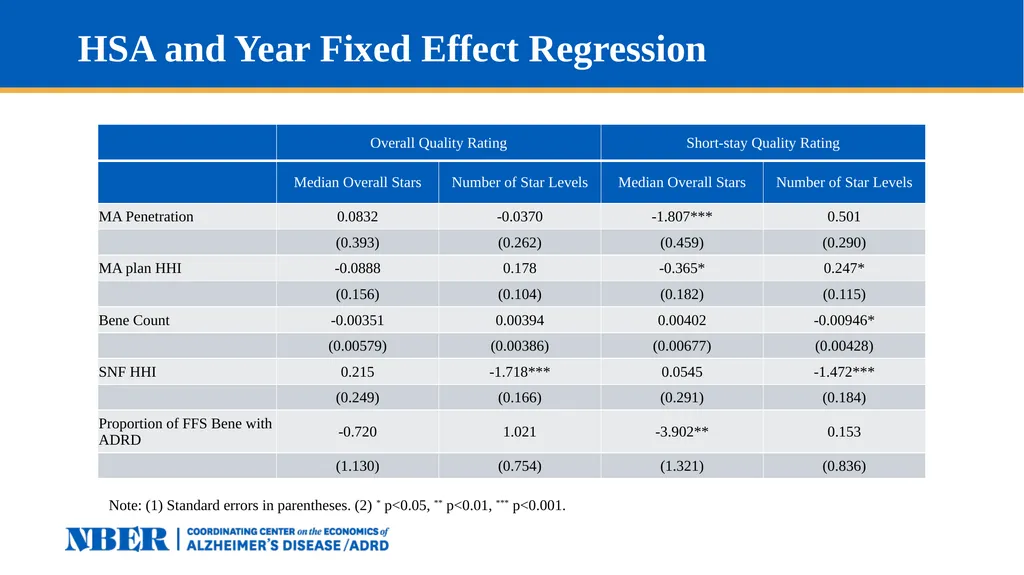
HSA and Year Fixed Effect Regression Note: (1) Standard errors in parentheses. (2) * p<0.05, ** p<0.01, *** p<0.001.<br>
15
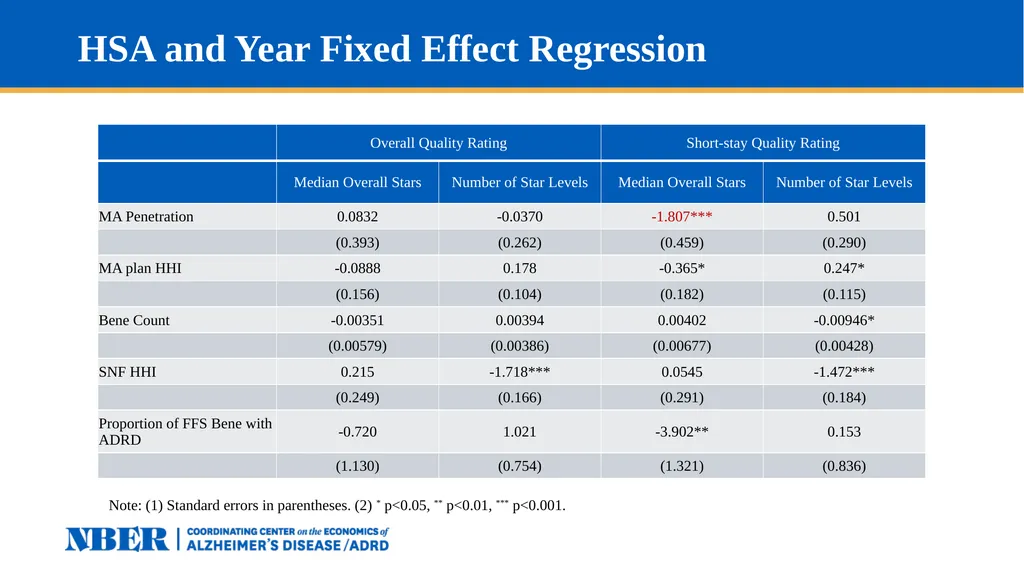
HSA and Year Fixed Effect Regression Note: (1) Standard errors in parentheses. (2) * p<0.05, ** p<0.01, *** p<0.001.<br>
16
HSA and Year Fixed Effect Regression Note: (1) Standard errors in parentheses. (2) * p<0.05, ** p<0.01, *** p<0.001.<br>
17
HSA and Year Fixed Effect Regression Note: (1) Standard errors in parentheses. (2) * p<0.05, ** p<0.01, *** p<0.001.<br>
18
HSA and Year Fixed Effect Regression Note: (1) Standard errors in parentheses. (2) * p<0.05, ** p<0.01, *** p<0.001.<br>
19
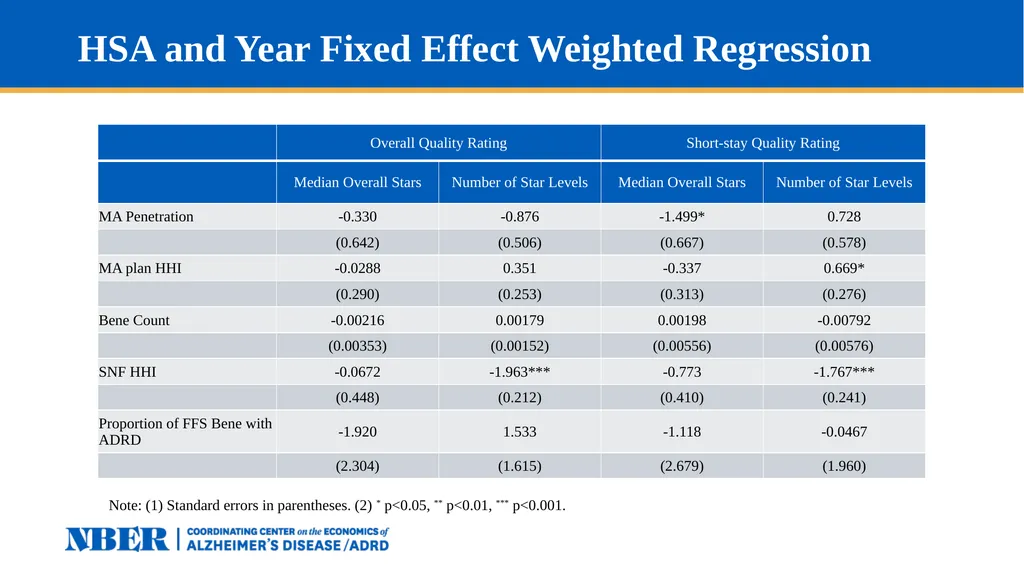
HSA and Year Fixed Effect Weighted Regression Note: (1) Standard errors in parentheses. (2) * p<0.05, ** p<0.01, *** p<0.001.<br>
20
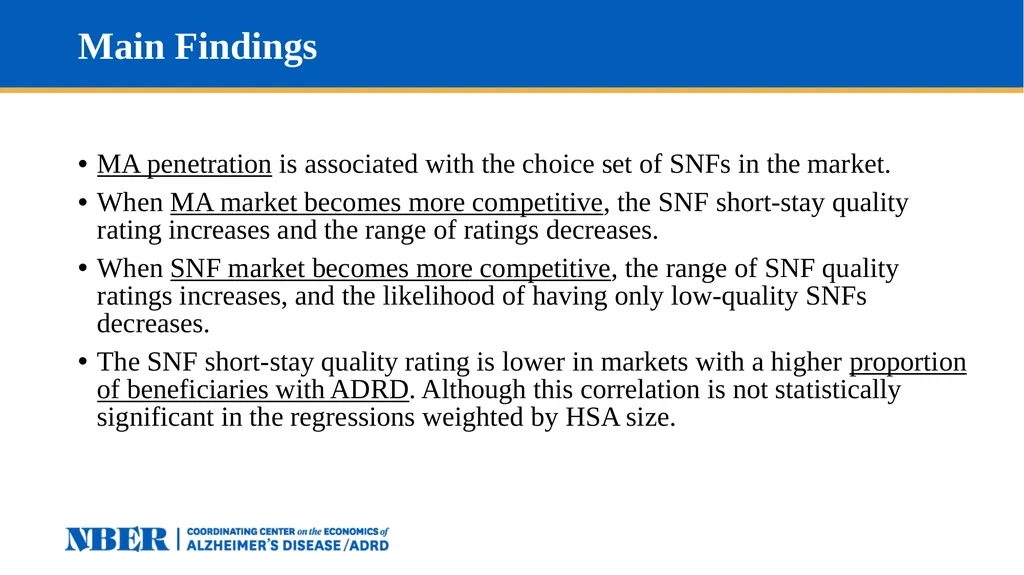
Main Findings MA penetration is associated with the choice set of SNFs in the market.
When MA market becomes more competitive, the SNF short-stay quality rating increases and the range of ratings decreases.
When SNF market becomes more competitive, the range of SNF quality ratings increases, and the likelihood of having only low-quality SNFs decreases.
The SNF short-stay quality rating is lower in markets with a higher proportion of beneficiaries with ADRD. Although this correlation is not statistically significant in the regressions weighted by HSA size.<br>
21
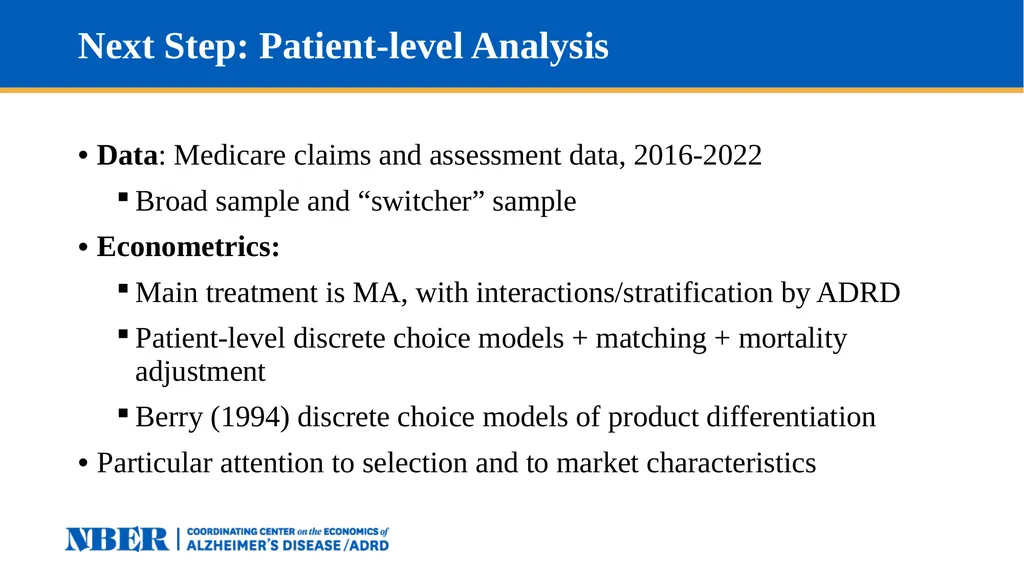
Next Step: Patient-level Analysis Data: Medicare claims and assessment data, 2016-2022
Broad sample and “switcher” sample
Econometrics:
Main treatment is MA, with interactions/stratification by ADRD
Patient-level discrete choice models + matching + mortality adjustment
Berry (1994) discrete choice models of product differentiation
Particular attention to selection and to market characteristics<br>