
Accounting concept and convention by Prof. sachin
LD
Published · 34 slides · 0 views

1 / 1

Description
Accounting concept and convention by Prof. sachin jadhav Point of discussion Meaning Definition of Book - Keeping Features of Book - keeping Objectives of Book - keeping Meaning Definition of Accountancy Branches of Accounting Basic
Related Topics
Share
Embed code
Download this presentation From Below
"Accounting concept and convention by Prof. sachin" is the property of its rightful owner. Permission is granted to download and print the materials on this website for personal, non-commercial use only, and to display it on your personal computer provided you do not modify the materials and that you retain all copyright notices contained in the materials. By downloading content from our website, you accept the terms of this agreement.
Presentation Transcript
01
Accounting concept and convention
by Prof. sachin jadhav<br>
by Prof. sachin jadhav<br>
02
Point of discussion… Meaning & Definition of Book - Keeping
Features of Book - keeping Objectives of Book - keeping
Meaning & Definition of Accountancy
Branches of Accounting
Basic accounting Terminologies<br>
Features of Book - keeping Objectives of Book - keeping
Meaning & Definition of Accountancy
Branches of Accounting
Basic accounting Terminologies<br>
03
Meaning & Definition… Book keeping is a process of recording business transitions in the books of
accounts in a very systematic manner
According to J.R. Batilobi :
“ Book – Keeping is an art of recording business dealings in a set of books.”
According to Nocth Cott :
“ Book – Keeping is an art of recording in the books of accounts the monetary aspects of commercial or financial transactions.”<br>
accounts in a very systematic manner
According to J.R. Batilobi :
“ Book – Keeping is an art of recording business dealings in a set of books.”
According to Nocth Cott :
“ Book – Keeping is an art of recording in the books of accounts the monetary aspects of commercial or financial transactions.”<br>
04
Features of Book keeping 1、It is the process of recording business transition
2、Monetary transactions are only recorded
3、Recording is made in given set of books of accounts 4、For specific period
5、Art of recording business transactions scientifically<br>
2、Monetary transactions are only recorded
3、Recording is made in given set of books of accounts 4、For specific period
5、Art of recording business transactions scientifically<br>
05
Objectives of Book keeping … Permanent record
To know the P&L
To know the total amount of Capital To know the total assets and liabilities To know the progress of the business
To know Legal requirement and tax liabilites<br>
To know the P&L
To know the total amount of Capital To know the total assets and liabilities To know the progress of the business
To know Legal requirement and tax liabilites<br>
06
Meaning & Definition of Accountancy Accountancy includes Book keeping & classifying, summarizing and
interpreting of the business transactions.
According to Kohler :
“ Accountancy refers to the entire body of theory and process of accounting.”
According to Robert N. Anthony :
“ Nearly every business enterprise has an accounting system. It is
a means of collecting, summarizing, analyzing and reporting in
monetary terms information about the business transactions,”<br>
interpreting of the business transactions.
According to Kohler :
“ Accountancy refers to the entire body of theory and process of accounting.”
According to Robert N. Anthony :
“ Nearly every business enterprise has an accounting system. It is
a means of collecting, summarizing, analyzing and reporting in
monetary terms information about the business transactions,”<br>
07
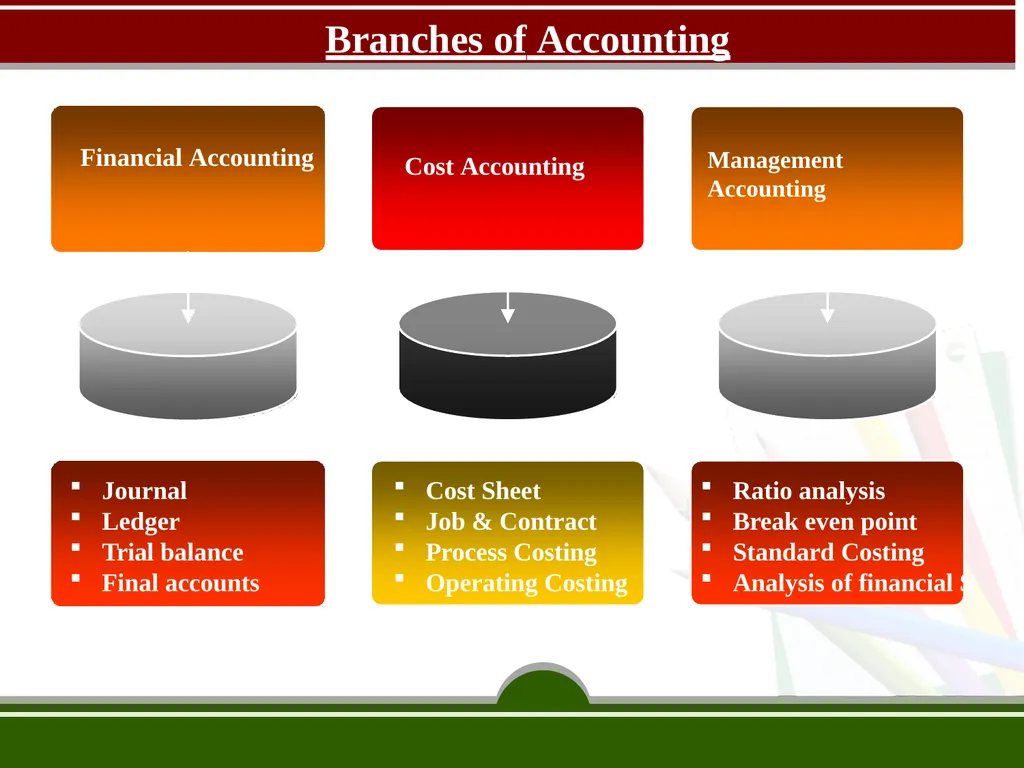
Branches of Accounting Financial Accounting Cost Accounting Management Accounting Journal
Ledger
Trial balance
Final accounts Cost Sheet
Job & Contract
Process Costing
Operating Costing Ratio analysis
Break even point
Standard Costing
Analysis of financial S<br>
Ledger
Trial balance
Final accounts Cost Sheet
Job & Contract
Process Costing
Operating Costing Ratio analysis
Break even point
Standard Costing
Analysis of financial S<br>
08
Basic accounting Terminologies Business Transaction
Entry & Narration
Goods
Profit & Loss
Assets, Liabilities & Net worth
Capital & Drawing
Expenditure and types of expenditure
Discount
Good will
Bad debts
Debtors and creditors
Solvent & Insolvent
Accounting Year
Folio, Insurance, Freight Deposit<br>
Entry & Narration
Goods
Profit & Loss
Assets, Liabilities & Net worth
Capital & Drawing
Expenditure and types of expenditure
Discount
Good will
Bad debts
Debtors and creditors
Solvent & Insolvent
Accounting Year
Folio, Insurance, Freight Deposit<br>
09
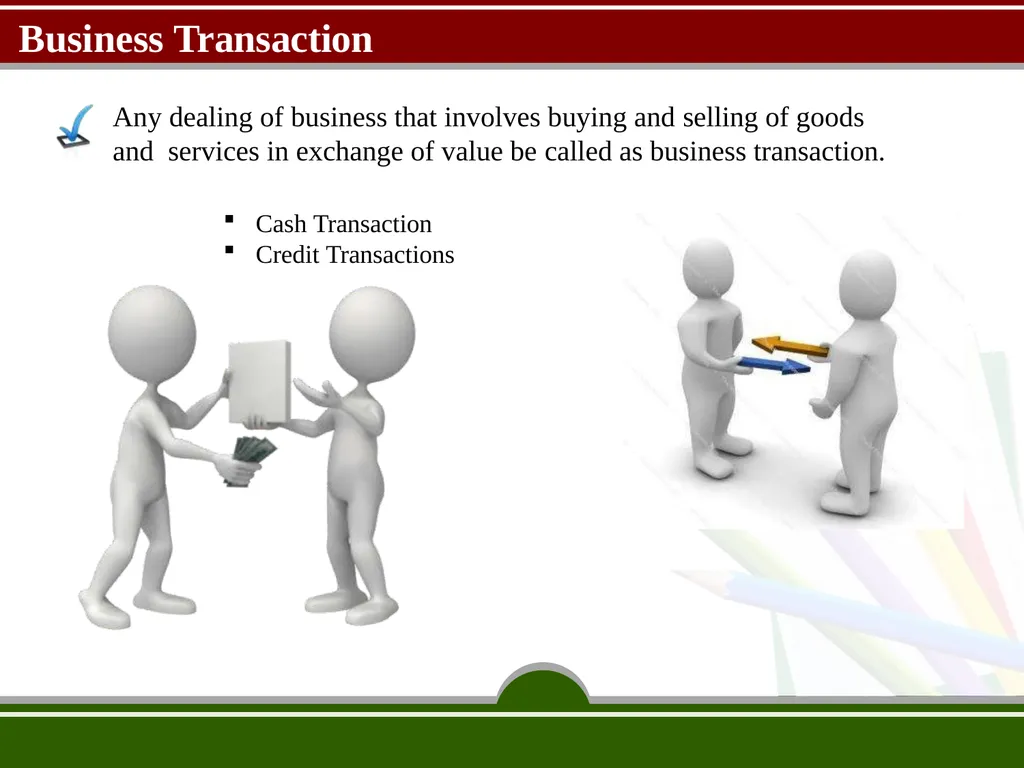
Business Transaction Any dealing of business that involves buying and selling of goods and services in exchange of value be called as business transaction.
Cash Transaction
Credit Transactions<br>
Cash Transaction
Credit Transactions<br>
10
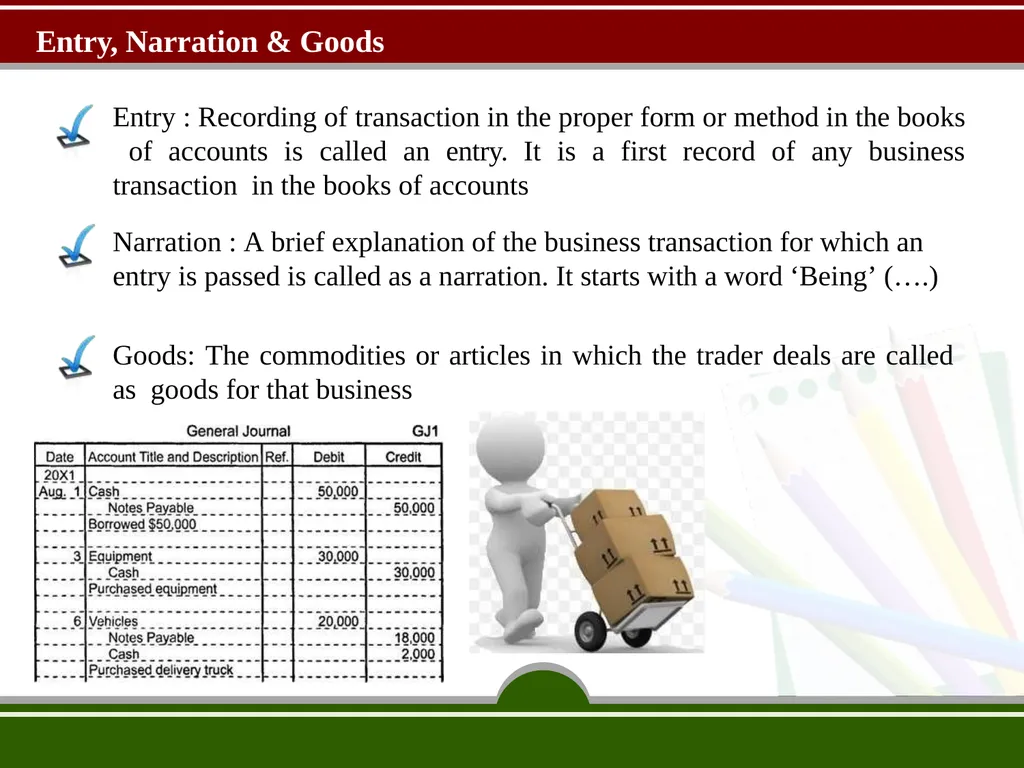
Entry, Narration & Goods Entry : Recording of transaction in the proper form or method in the books of accounts is called an entry. It is a first record of any business transaction in the books of accounts
Narration : A brief explanation of the business transaction for which an
entry is passed is called as a narration. It starts with a word ‘Being’ (….)
Goods: The commodities or articles in which the trader deals are called as goods for that business<br>
Narration : A brief explanation of the business transaction for which an
entry is passed is called as a narration. It starts with a word ‘Being’ (….)
Goods: The commodities or articles in which the trader deals are called as goods for that business<br>
11
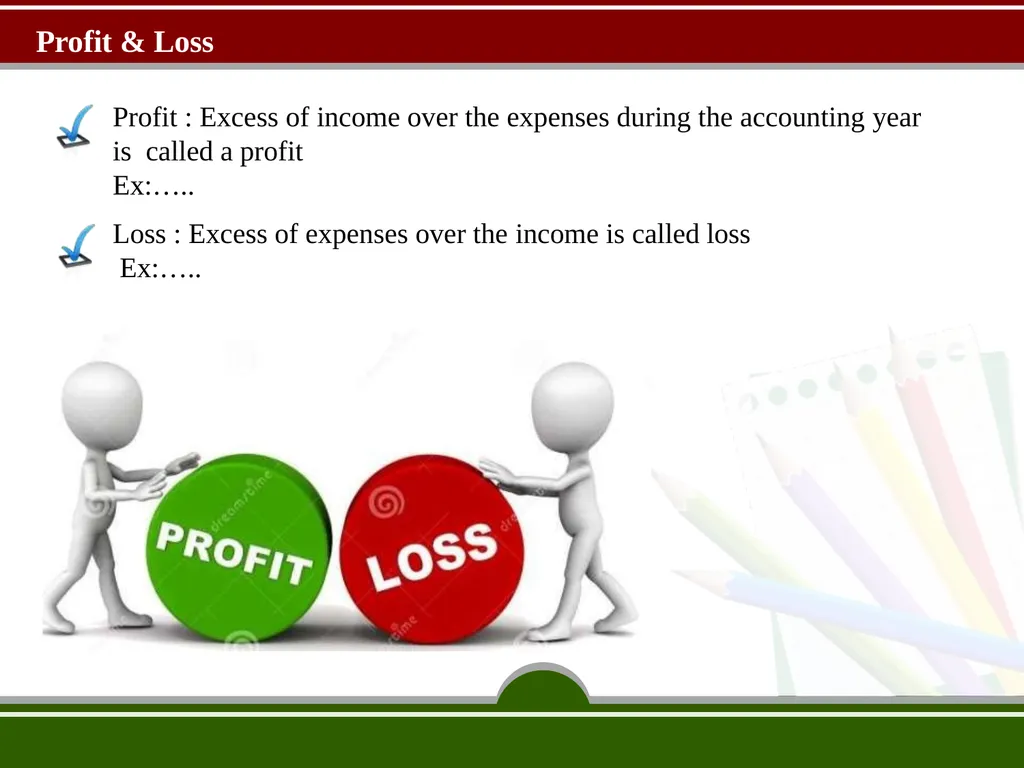
Profit & Loss Profit : Excess of income over the expenses during the accounting year is called a profit
Ex:…..
Loss : Excess of expenses over the income is called loss Ex:…..<br>
Ex:…..
Loss : Excess of expenses over the income is called loss Ex:…..<br>
12
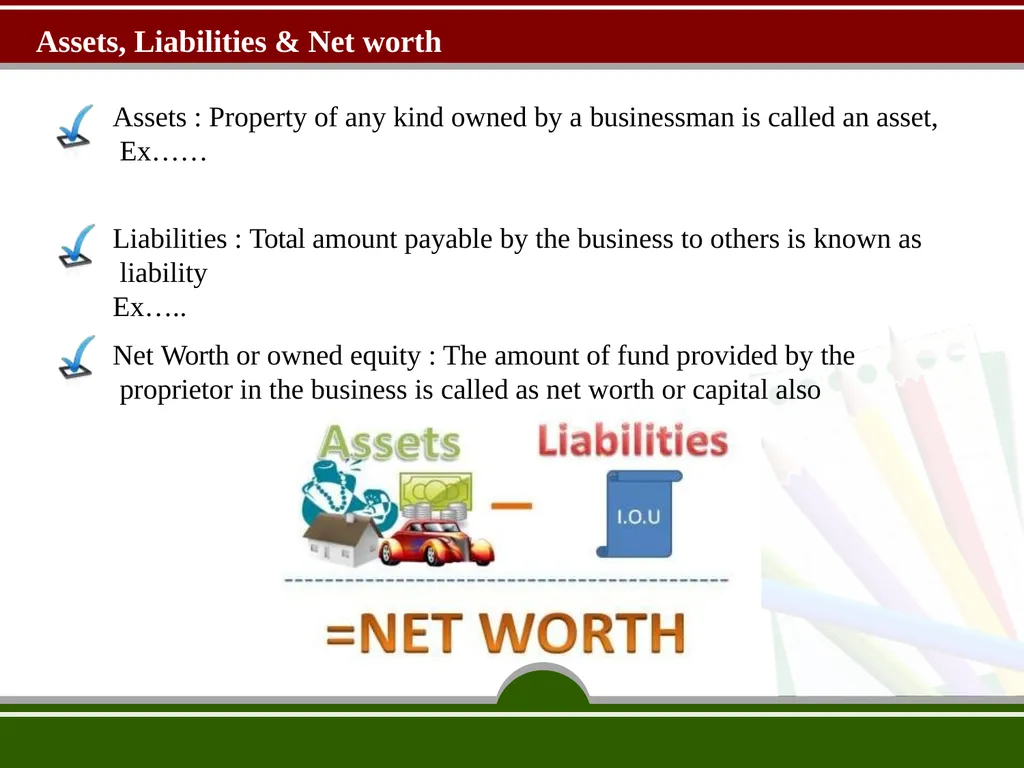
Assets, Liabilities & Net worth Assets : Property of any kind owned by a businessman is called an asset, Ex……
Liabilities : Total amount payable by the business to others is known as liability
Ex…..
Net Worth or owned equity : The amount of fund provided by the proprietor in the business is called as net worth or capital also<br>
Liabilities : Total amount payable by the business to others is known as liability
Ex…..
Net Worth or owned equity : The amount of fund provided by the proprietor in the business is called as net worth or capital also<br>
13
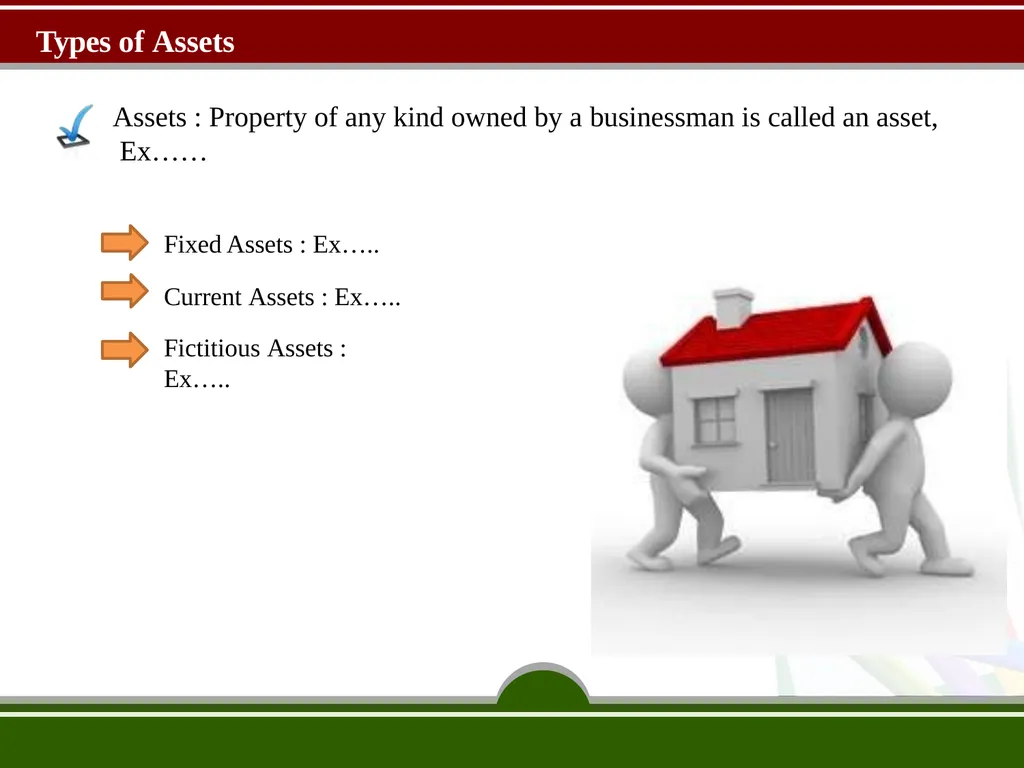
Types of Assets Assets : Property of any kind owned by a businessman is called an asset, Ex……
Fixed Assets : Ex….. Current Assets : Ex…..
Fictitious Assets : Ex…..<br>
Fixed Assets : Ex….. Current Assets : Ex…..
Fictitious Assets : Ex…..<br>
14
Accounting concept Accounting principles are those rules which are to be adopted by the accountants
Accounting is the language of business. This are general guidelines for
sound accounting practices
Reliable financial statements
Generally acceptable basis of measurement
Valid and appropriate assumptions
Uniformity in presentation
Valid and appropriate assumptions
Proper information to all<br>
Accounting is the language of business. This are general guidelines for
sound accounting practices
Reliable financial statements
Generally acceptable basis of measurement
Valid and appropriate assumptions
Uniformity in presentation
Valid and appropriate assumptions
Proper information to all<br>
15
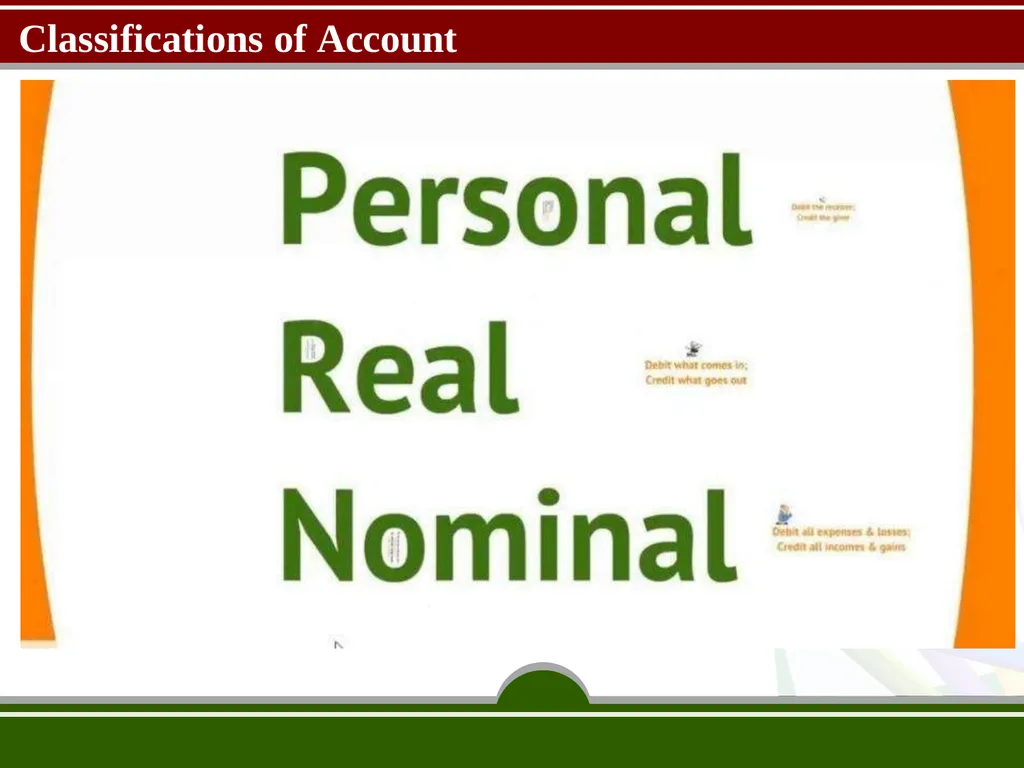
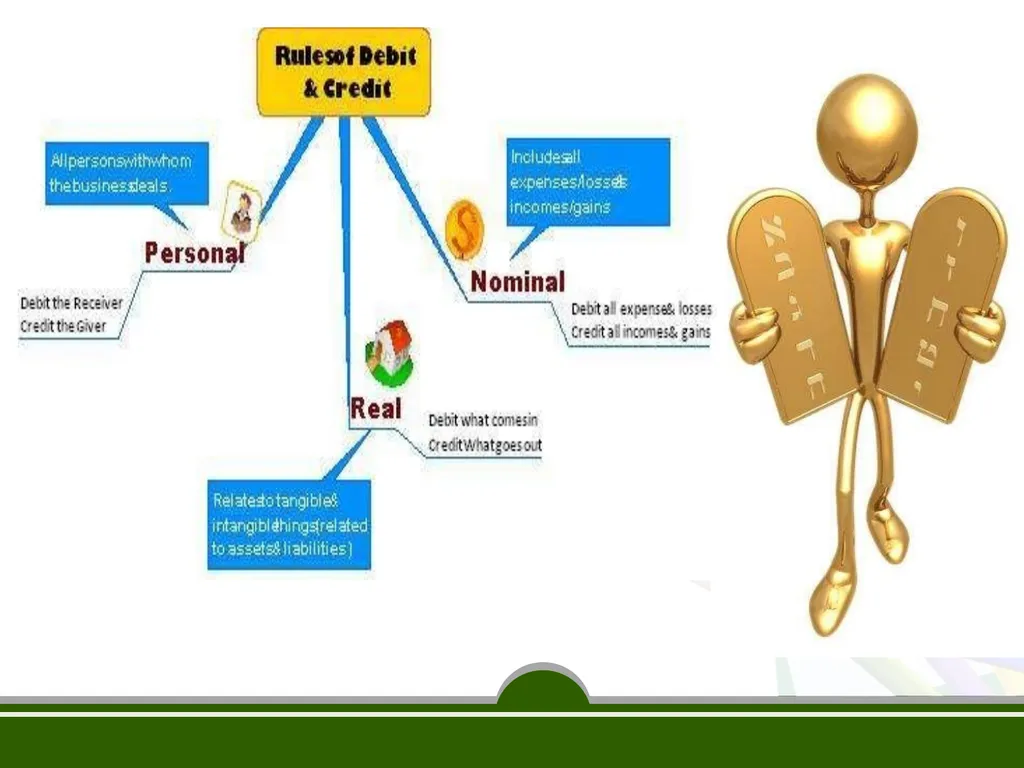
Classifications of Account<br>
16
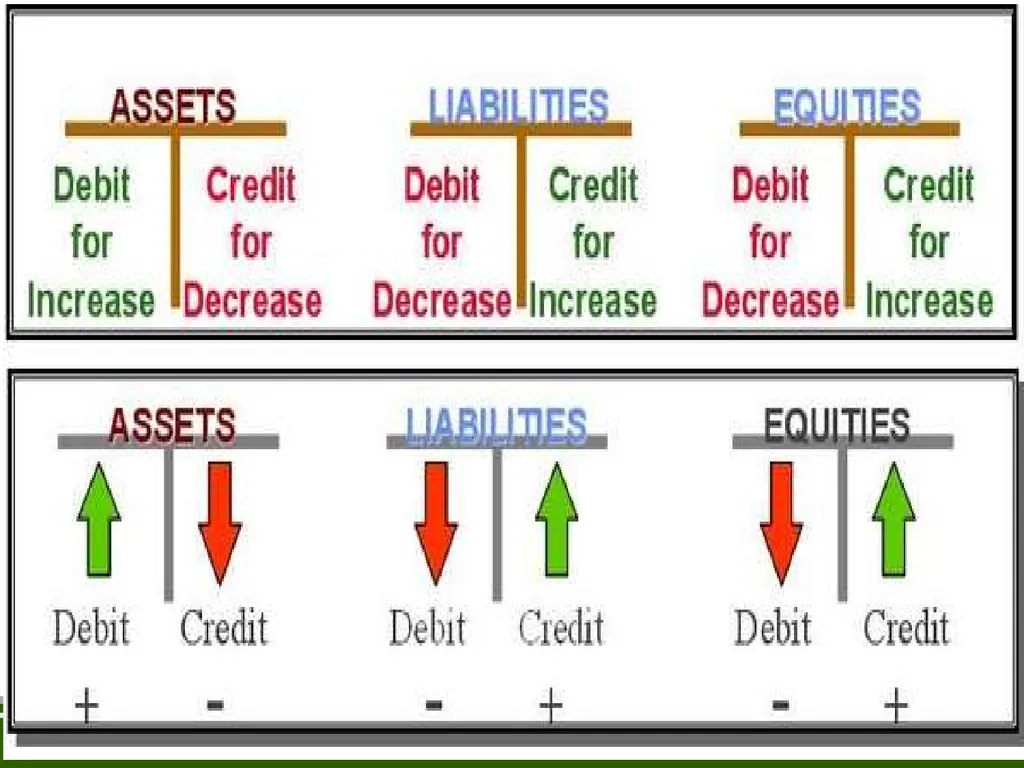
Analysis of Transactions<br>
17
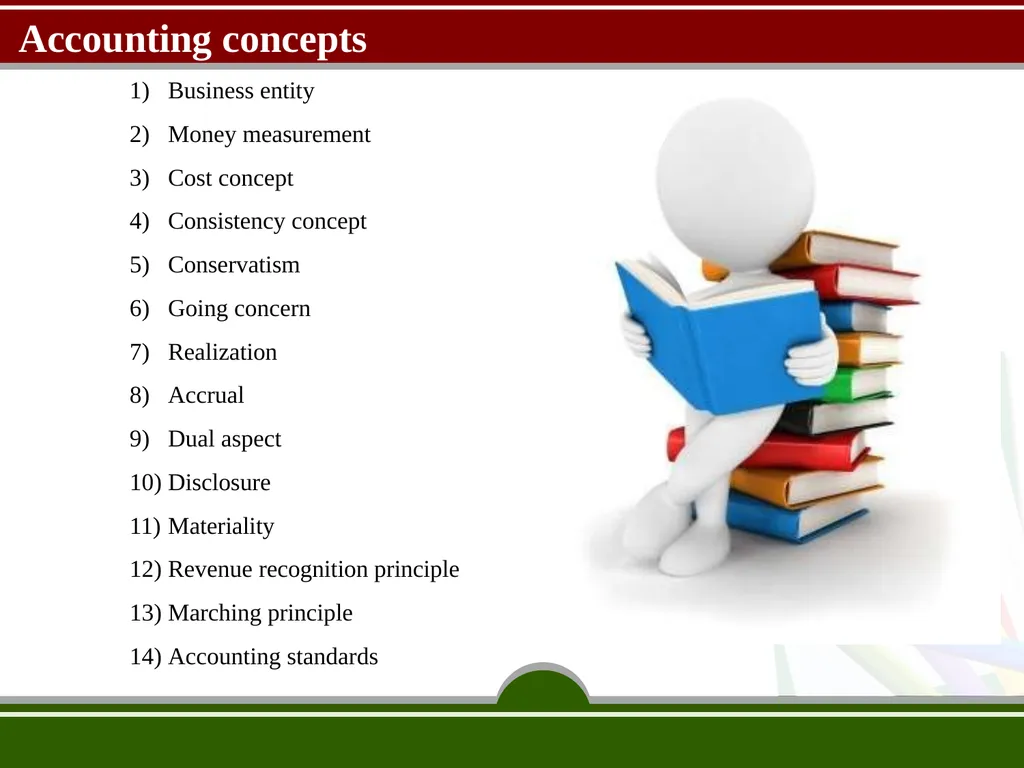
Accounting concepts Business entity
Money measurement
Cost concept
Consistency concept
Conservatism
Going concern
Realization
Accrual
Dual aspect
Disclosure
Materiality
Revenue recognition principle
Marching principle
Accounting standards<br>
Money measurement
Cost concept
Consistency concept
Conservatism
Going concern
Realization
Accrual
Dual aspect
Disclosure
Materiality
Revenue recognition principle
Marching principle
Accounting standards<br>
18
Business entity concept: This concept assumes that, for accounting purposes, the business enterprise and its owners are two separate independent entities. Thus, the business and personal transactions of its owner are separate.
For example, when the owner invests money in the business, it is recorded as liability of the business to the owner. Similarly, when the owner takes away from the business cash/goods for his/her personal use, it is not treated as business expense.<br>
For example, when the owner invests money in the business, it is recorded as liability of the business to the owner. Similarly, when the owner takes away from the business cash/goods for his/her personal use, it is not treated as business expense.<br>
19
Money Measurement concept: This concept assumes that all business transactions must be in terms of money.
In our country such transactions are in terms of rupees. Thus, as per the money measurement concept, transactions which can be expressed in terms of money are recorded in the books of accounts<br>
In our country such transactions are in terms of rupees. Thus, as per the money measurement concept, transactions which can be expressed in terms of money are recorded in the books of accounts<br>
20
Going concern concept This concept states that a business firm will continue to carry on its activities for an Future period of time.
Simply stated, it means that every business entity has continuity of life. Thus, it will not be dissolved in the near future. This is an important assumption of accounting, as it provides a basis for showing the value of assets in the balance sheet.<br>
Simply stated, it means that every business entity has continuity of life. Thus, it will not be dissolved in the near future. This is an important assumption of accounting, as it provides a basis for showing the value of assets in the balance sheet.<br>
21
Accounting period concept: The life of an entity is divided into short economic time periods on which reporting statements are fashioned. All the transactions are recorded in the books of accounts on the assumption that profits on these transactions are to be ascertained for a specified period. This is known as accounting period concept.
Thus, this concept requires that a balance sheet and profit and loss account should be prepared at regular intervals for different purposes like, calculation of
profit, ascertaining financial position etc.<br>
Thus, this concept requires that a balance sheet and profit and loss account should be prepared at regular intervals for different purposes like, calculation of
profit, ascertaining financial position etc.<br>
22
Accounting cost concept Accounting cost concept states that all assets are recorded in the books of accounts at their purchase price, which includes cost of acquisition, transportation and installation and not at its market price. It means that fixed assets like building, plant and machinery, furniture, etc are recorded in the books of accounts at a price paid for them.
For example, a machine was purchased by XYZ Limited for Rs.500000, for manufacturing shoes. An amount of Rs.1,000 were spent on transporting the machine to the factory site. In addition, Rs.2000 were spent on its installation. The total amount at which the machine will be recorded in the books of accounts would be the sum of all these items i.e. Rs.503000. This cost is also known as historical cost.<br>
For example, a machine was purchased by XYZ Limited for Rs.500000, for manufacturing shoes. An amount of Rs.1,000 were spent on transporting the machine to the factory site. In addition, Rs.2000 were spent on its installation. The total amount at which the machine will be recorded in the books of accounts would be the sum of all these items i.e. Rs.503000. This cost is also known as historical cost.<br>
23
Matching Concept: The matching concept states that the revenue and the expenses incurred to earn the revenues must belong to the same accounting period. So once the revenue is realised, the next step is to allocate it to the relevant accounting period.
The matching concept implies that all revenues earned during an accounting year, whether received/not received during that year and all cost incurred, whether paid/not paid during the year should be taken into account while ascertaining profit or loss for that year.<br>
The matching concept implies that all revenues earned during an accounting year, whether received/not received during that year and all cost incurred, whether paid/not paid during the year should be taken into account while ascertaining profit or loss for that year.<br>
24
Dual aspect concept Dual aspect is the foundation or basic principle of accounting. It provides the very basis of recording business transactions in the books of accounts. This concept assumes that every transaction has a dual effect, i.e. it affects two accounts in their respective opposite sides. Therefore, the transaction should be recorded at two places. It means, both the aspects of the transaction must be recorded in the books of accounts. For example, goods purchased for cash has two aspects which are (i) Giving of cash (ii) Receiving of goods.
These two aspects are to be recorded. Thus, the duality concept is commonly expressed in terms of fundamental accounting equation
Assets = Liabilities + Capital<br>
These two aspects are to be recorded. Thus, the duality concept is commonly expressed in terms of fundamental accounting equation
Assets = Liabilities + Capital<br>
25
Realisation concept This concept holds to the view that profit can only be taken into account when realization has occurred. According to this concept revenue is recognized when a sale is made. Sale is considered to be made at the point when the property in goods passes to the buyer and he becomes legally liable to pay.
Revenue is said to have been realized when cash has been received or right to receive cash on the sale of goods or services or both has been created<br>
Revenue is said to have been realized when cash has been received or right to receive cash on the sale of goods or services or both has been created<br>
26
Conservatism The convention is the based on principle that,
“Anticipate no profit, but provide for all possible losses”. It provides guidance for recording transactions in the books of accounts. It is based on the policy of playing safe in regard to showing profit. The main objective of this convention is to show minimum profit. Profit should not be overstated.
If profit shows more than actual, it may lead to distribution of dividend out of capital. This is not a fair policy and it will lead to the reduction in the capital of the enterprise<br>
“Anticipate no profit, but provide for all possible losses”. It provides guidance for recording transactions in the books of accounts. It is based on the policy of playing safe in regard to showing profit. The main objective of this convention is to show minimum profit. Profit should not be overstated.
If profit shows more than actual, it may lead to distribution of dividend out of capital. This is not a fair policy and it will lead to the reduction in the capital of the enterprise<br>
27
Consistency The convention of consistency means that same accounting principles should be used for preparing financial statements year after year. For example: if a stock is valued at “cost or market price whichever is less”, this principle should be followed year after year.
Example : under deprecation used fixed installment method.<br>
Example : under deprecation used fixed installment method.<br>
28
Materiality The convention of materiality states that, to make financial statements meaningful, only material fact i.e. important and relevant information should be supplied to the users of accounting information. The question that arises here is what is a material fact. The materiality of a fact depends on its nature and the amount involved.
Material fact means the information of which will influence the decision of its user..<br>
Material fact means the information of which will influence the decision of its user..<br>
29
Inflation Accounting DEFINITION OF INFLATION ACCOUNTING:
A state in which the value of money is falling that is prices are rising.
A process of steadily rising prices resulting in diminishing purchasing power of a given nominal sum of money.
Objective:
1) The user or decision maker gets an information which shows the
performance.
2) To facilitate the comparison of the performance of two different
periods it is necessary that the figures are adjusted for inflation.
3) The monetary items, income & expenses do not show the correct
purchasing power of money therefore, their values should be adjusted.<br>
A state in which the value of money is falling that is prices are rising.
A process of steadily rising prices resulting in diminishing purchasing power of a given nominal sum of money.
Objective:
1) The user or decision maker gets an information which shows the
performance.
2) To facilitate the comparison of the performance of two different
periods it is necessary that the figures are adjusted for inflation.
3) The monetary items, income & expenses do not show the correct
purchasing power of money therefore, their values should be adjusted.<br>
30
ADVANTAGES It enables the maintenance of capital intact which is essential in a limited liability business.
Profit/loss is determined by matching the cost & the revenue at current values which are comparable.
The assets are shown at real values uniformly instead of at distorted values.
Trade unions, employees, shareholders & public are not misled by giving an exaggerated profit figures.
By showing the current values of fixed assets it enables the establishment of realistic price for the company’s shares<br>
Profit/loss is determined by matching the cost & the revenue at current values which are comparable.
The assets are shown at real values uniformly instead of at distorted values.
Trade unions, employees, shareholders & public are not misled by giving an exaggerated profit figures.
By showing the current values of fixed assets it enables the establishment of realistic price for the company’s shares<br>
31
DISADVANTAGES Depreciation being the process of distribution of original cost, charging anything in excess does not fit into the concept of depreciation.
Replacement cost is an indefinite figure closured by future technological developments & the time period at which the asset will be scrapped.
Charging depreciation on replacement cost basis will be acceptable to income-tax authorities & hence there is no purpose in doing the exercise.<br>
Replacement cost is an indefinite figure closured by future technological developments & the time period at which the asset will be scrapped.
Charging depreciation on replacement cost basis will be acceptable to income-tax authorities & hence there is no purpose in doing the exercise.<br>