
Accreditation Learning Community July 25, 2018
TG
Published · 24 slides · 0 views
1 / 1
Description
Accreditation Learning Community July 25, 2018 1:00-2:00pm Dial-In Number: 1 877 916 8051 Access Code: 539-9866 PHHS Block Grant Announcement Current cycle will be extended for 1 year to give the Commissioner time to revamp the menu LHDs
Related Topics
Share
Embed code
Download this presentation From Below
"Accreditation Learning Community July 25, 2018" is the property of its rightful owner. Permission is granted to download and print the materials on this website for personal, non-commercial use only, and to display it on your personal computer provided you do not modify the materials and that you retain all copyright notices contained in the materials. By downloading content from our website, you accept the terms of this agreement.
Presentation Transcript
01
Accreditation Learning Community July 25, 2018
1:00-2:00pm
Dial-In Number: 1 877 916 8051
Access Code: 539-9866<br>
1:00-2:00pm
Dial-In Number: 1 877 916 8051
Access Code: 539-9866<br>
02
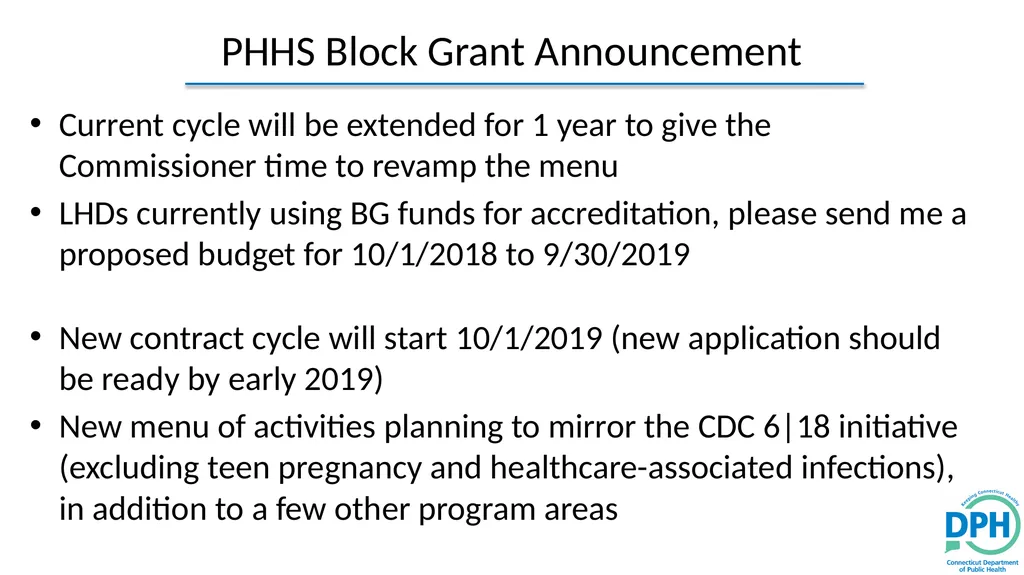
PHHS Block Grant Announcement Current cycle will be extended for 1 year to give the Commissioner time to revamp the menu
LHDs currently using BG funds for accreditation, please send me a proposed budget for 10/1/2018 to 9/30/2019
New contract cycle will start 10/1/2019 (new application should be ready by early 2019)
New menu of activities planning to mirror the CDC 6|18 initiative (excluding teen pregnancy and healthcare-associated infections), in addition to a few other program areas<br>
03
Developing a Strategic Plan
(Measure 5.3.1 and Measure 5.3.2)<br>
04
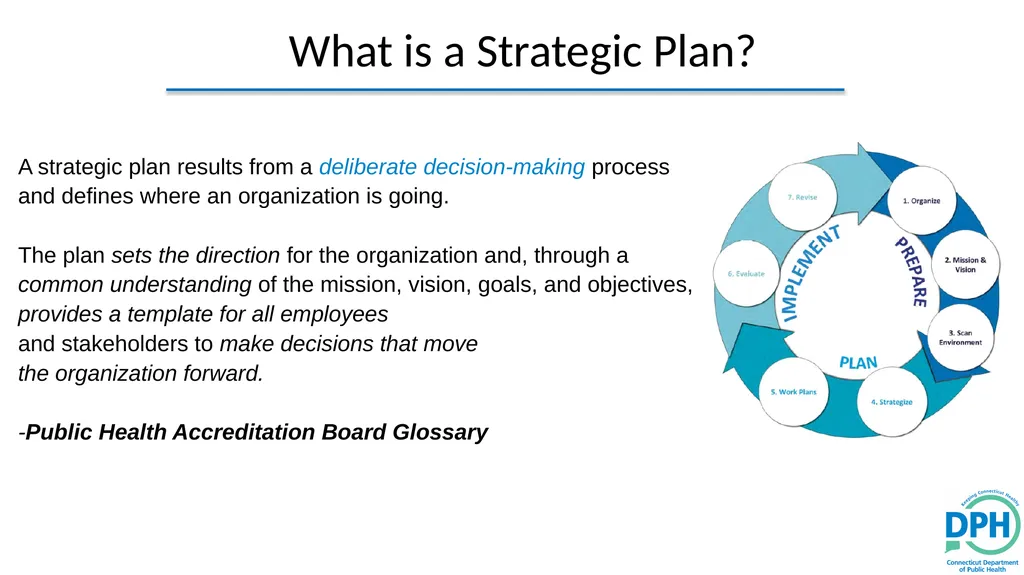
What is a Strategic Plan? A strategic plan results from a deliberate decision-making process and defines where an organization is going.
The plan sets the direction for the organization and, through a common understanding of the mission, vision, goals, and objectives, provides a template for all employees
and stakeholders to make decisions that move
the organization forward.
-Public Health Accreditation Board Glossary<br>
The plan sets the direction for the organization and, through a common understanding of the mission, vision, goals, and objectives, provides a template for all employees
and stakeholders to make decisions that move
the organization forward.
-Public Health Accreditation Board Glossary<br>
05
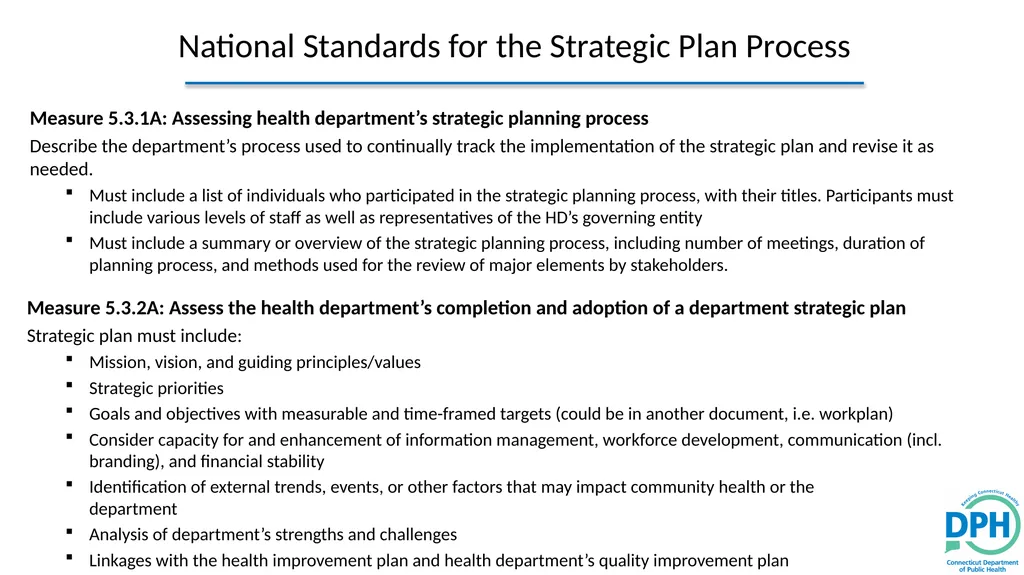
National Standards for the Strategic Plan Process Measure 5.3.1A: Assessing health department’s strategic planning process
Describe the department’s process used to continually track the implementation of the strategic plan and revise it as needed.
Must include a list of individuals who participated in the strategic planning process, with their titles. Participants must include various levels of staff as well as representatives of the HD’s governing entity
Must include a summary or overview of the strategic planning process, including number of meetings, duration of planning process, and methods used for the review of major elements by stakeholders.
Measure 5.3.2A: Assess the health department’s completion and adoption of a department strategic plan
Strategic plan must include:
Mission, vision, and guiding principles/values
Strategic priorities
Goals and objectives with measurable and time-framed targets (could be in another document, i.e. workplan)
Consider capacity for and enhancement of information management, workforce development, communication (incl. branding), and financial stability
Identification of external trends, events, or other factors that may impact community health or the department
Analysis of department’s strengths and challenges
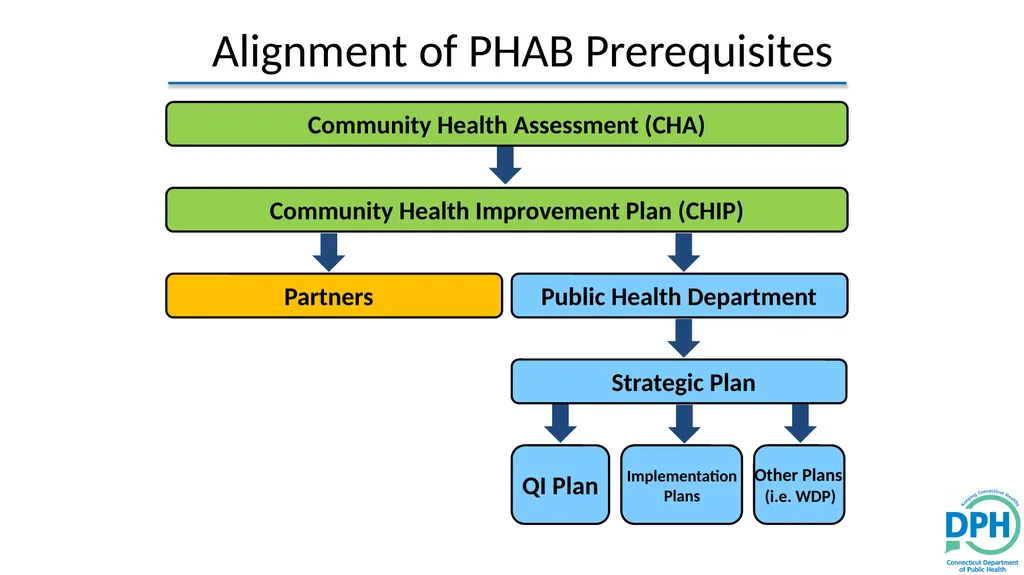
Linkages with the health improvement plan and health department’s quality improvement plan<br>
06
Alignment of PHAB Prerequisites<br>
07
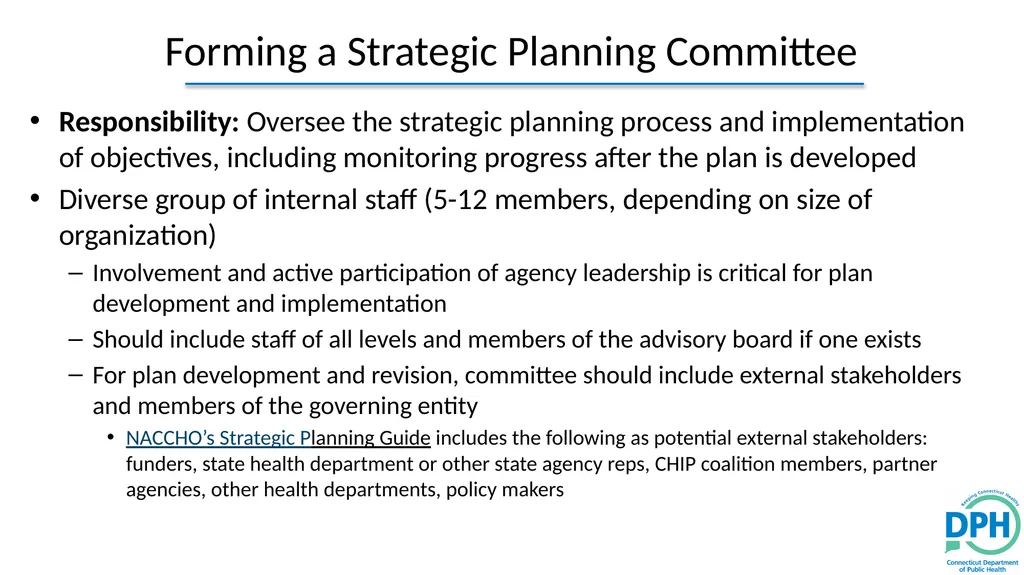
Forming a Strategic Planning Committee Responsibility: Oversee the strategic planning process and implementation of objectives, including monitoring progress after the plan is developed
Diverse group of internal staff (5-12 members, depending on size of organization)
Involvement and active participation of agency leadership is critical for plan development and implementation
Should include staff of all levels and members of the advisory board if one exists
For plan development and revision, committee should include external stakeholders and members of the governing entity
NACCHO’s Strategic Planning Guide includes the following as potential external stakeholders: funders, state health department or other state agency reps, CHIP coalition members, partner agencies, other health departments, policy makers<br>
08
Some Points on Strategic Planning Strategic plans are strategic – consider 3-4 priorities
Strategic plans are living documents that are used, reviewed and revised
Strategic planning is not an isolated process. It requires broad input and support (i.e. from stakeholders, governing entity, all levels of staff)
Strategic planning builds on other plans and assessments (i.e. SHA/SHIP, chronic disease plan, quality plan, health equity plan, etc.)
Perfect plans can be the enemy of the good – plan it and act on it. It will be good enough!
The agency strategic plan is for all staff!<br>
09
Vision Statement
“What We Want to Achieve” DPH’s Vision
Healthy People In Healthy Connecticut Communities<br>
Healthy People In Healthy Connecticut Communities<br>
10
Mission Statement
“Why We Exist” DPH’s Mission
To protect and improve the health and safety of the people of Connecticut by:
Assuring the conditions in which people can be healthy;
Preventing disease, injury, and disability, and
Promoting the equal enjoyment of the highest attainable standard of health, which is a human right and a priority of the state.<br>
11
Value Statements
“What Defines Us” DPH’s Values
Performance-based: We learn from our past efforts and use performance measures and data to focus our future efforts
Equitable: We foster policies and programs that promote fairness, social justice, equity, and cultural competence
Professional: We respect and uphold the high standards, skills, competence, and integrity of our professions
Collaborative: We work together and with others who share a similar vision for the mutual benefit of the community
Accountable: We are responsive and transparent to the public in our actions and communications.
Innovative: We are creative and seek out new ways to solve problems
Service-oriented: We respect, listen, and respond to our customers<br>
12
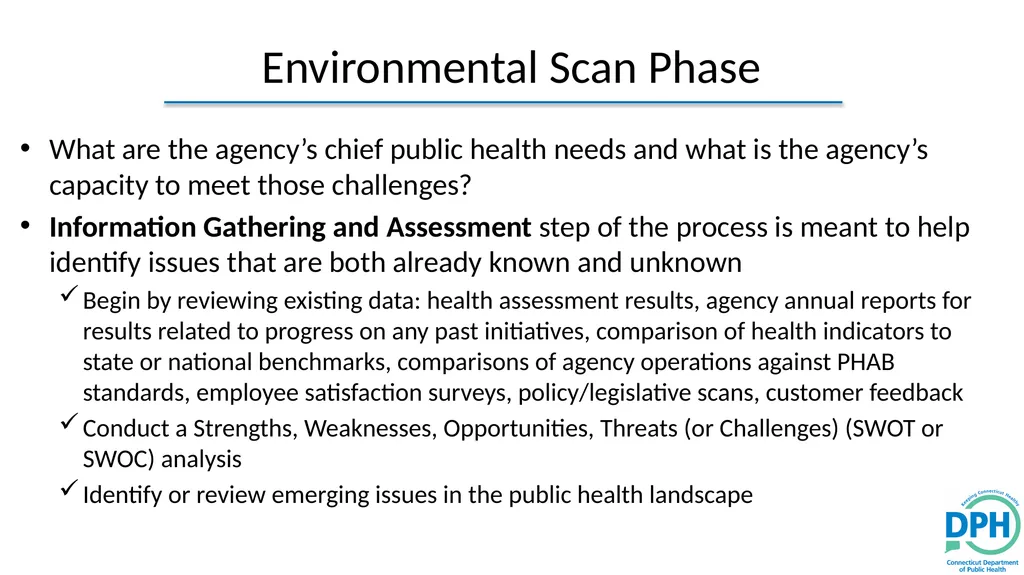
Environmental Scan Phase What are the agency’s chief public health needs and what is the agency’s capacity to meet those challenges?
Information Gathering and Assessment step of the process is meant to help identify issues that are both already known and unknown
Begin by reviewing existing data: health assessment results, agency annual reports for results related to progress on any past initiatives, comparison of health indicators to state or national benchmarks, comparisons of agency operations against PHAB standards, employee satisfaction surveys, policy/legislative scans, customer feedback
Conduct a Strengths, Weaknesses, Opportunities, Threats (or Challenges) (SWOT or SWOC) analysis
Identify or review emerging issues in the public health landscape<br>
13
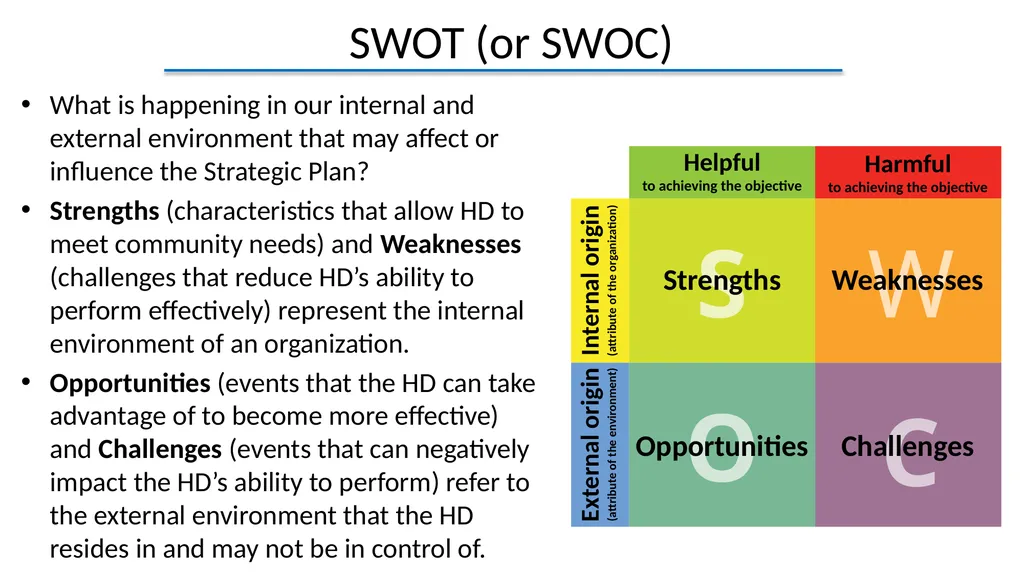
SWOT (or SWOC) What is happening in our internal and external environment that may affect or influence the Strategic Plan?
Strengths (characteristics that allow HD to meet community needs) and Weaknesses (challenges that reduce HD’s ability to perform effectively) represent the internal environment of an organization.
Opportunities (events that the HD can take advantage of to become more effective) and Challenges (events that can negatively impact the HD’s ability to perform) refer to the external environment that the HD resides in and may not be in control of.<br>
14
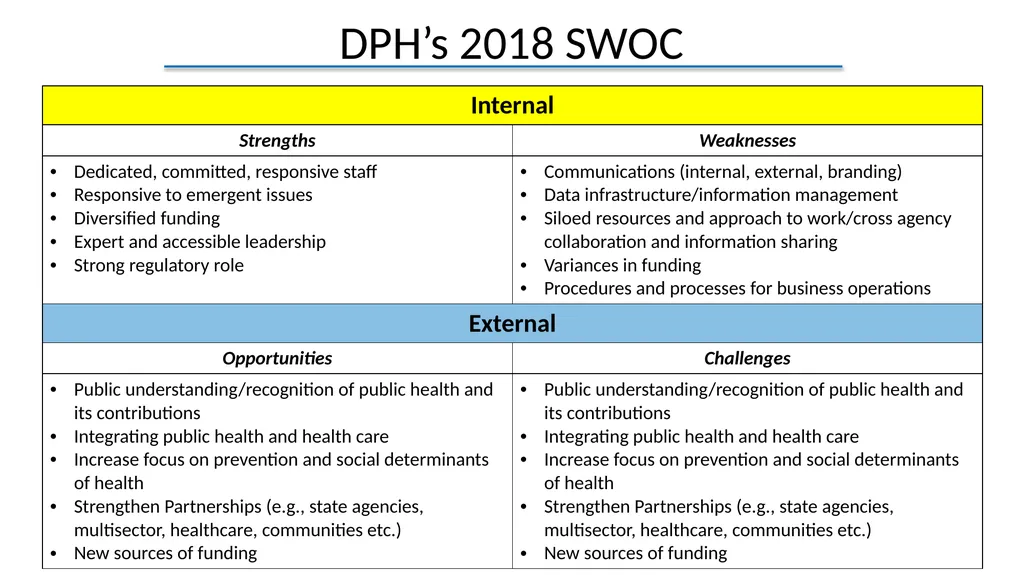
DPH’s 2018 SWOC<br>
15
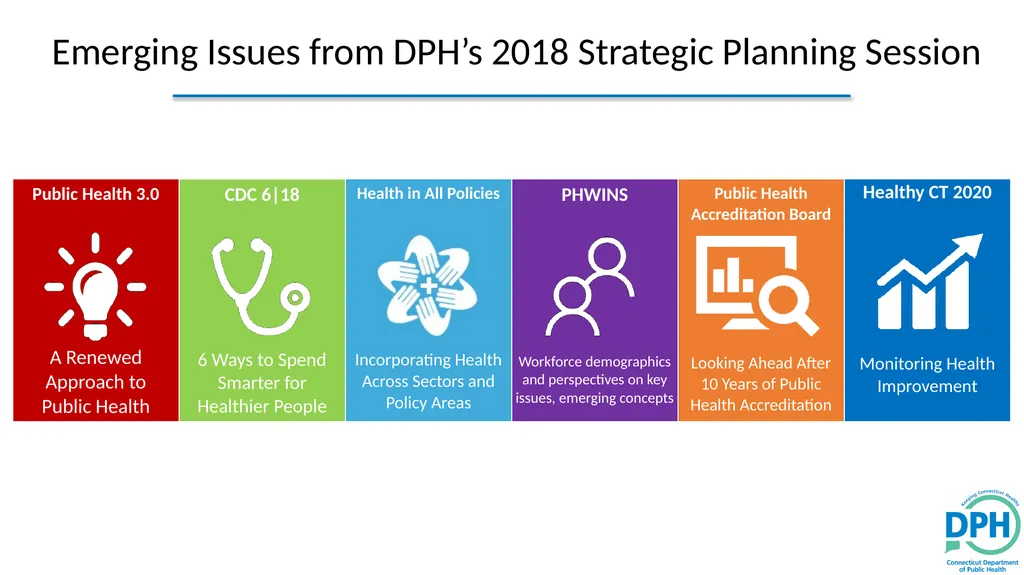
Emerging Issues from DPH’s 2018 Strategic Planning Session<br>
16
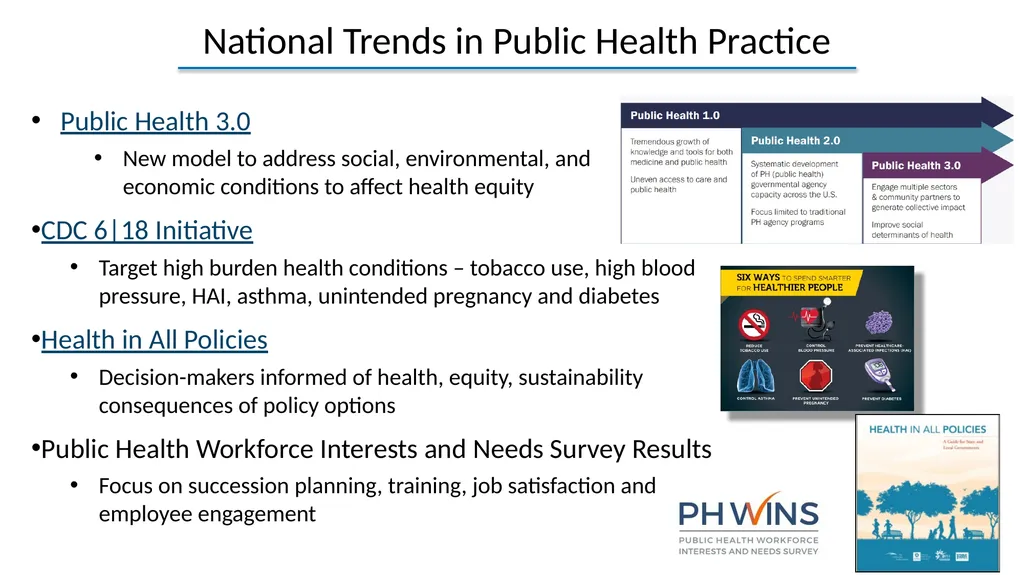
National Trends in Public Health Practice Public Health 3.0
New model to address social, environmental, and economic conditions to affect health equity
CDC 6|18 Initiative
Target high burden health conditions – tobacco use, high blood pressure, HAI, asthma, unintended pregnancy and diabetes
Health in All Policies
Decision-makers informed of health, equity, sustainability consequences of policy options
Public Health Workforce Interests and Needs Survey Results
Focus on succession planning, training, job satisfaction and employee engagement<br>
17
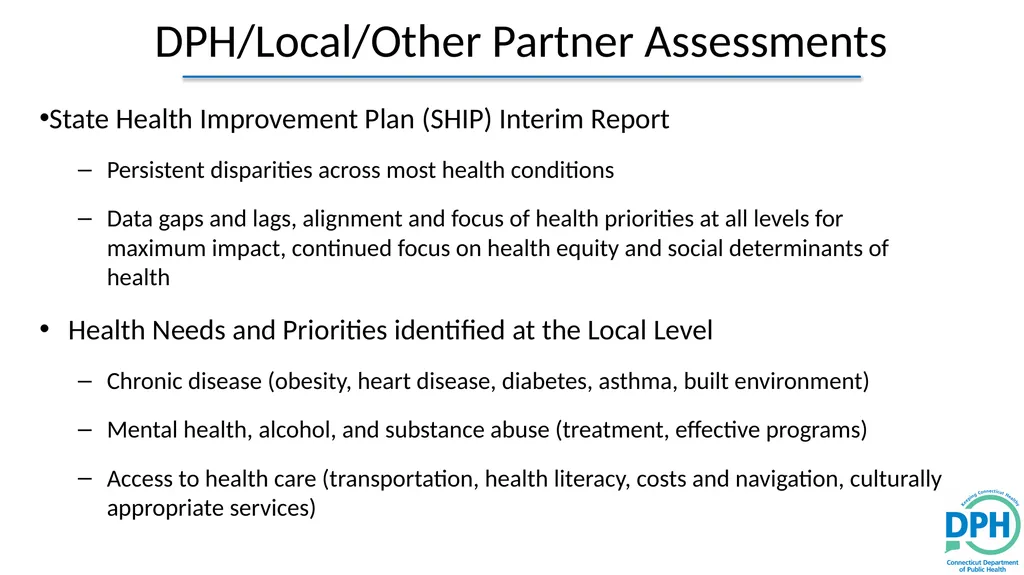
DPH/Local/Other Partner Assessments State Health Improvement Plan (SHIP) Interim Report
Persistent disparities across most health conditions
Data gaps and lags, alignment and focus of health priorities at all levels for maximum impact, continued focus on health equity and social determinants of health
Health Needs and Priorities identified at the Local Level
Chronic disease (obesity, heart disease, diabetes, asthma, built environment)
Mental health, alcohol, and substance abuse (treatment, effective programs)
Access to health care (transportation, health literacy, costs and navigation, culturally appropriate services)<br>
18
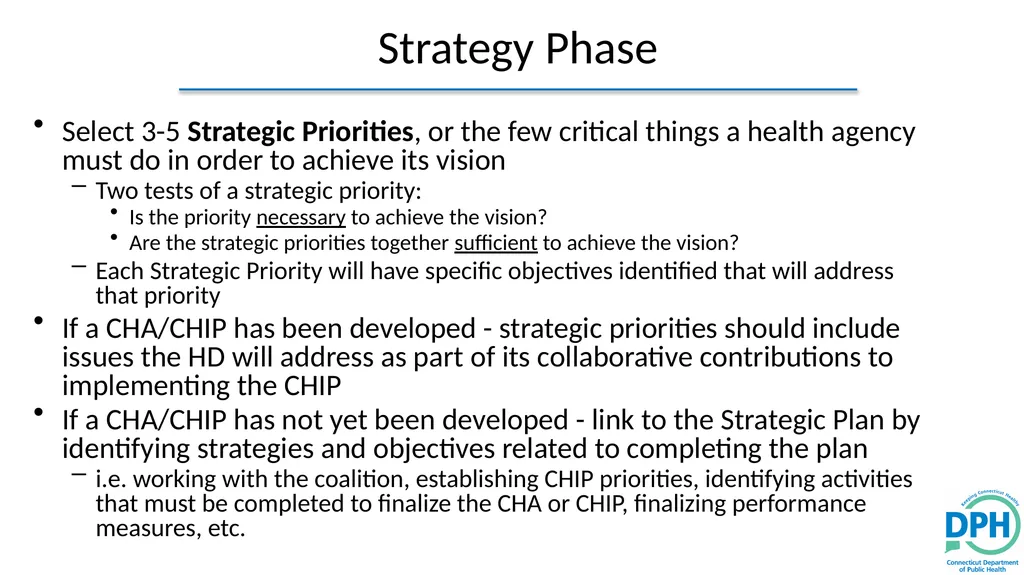
Strategy Phase Select 3-5 Strategic Priorities, or the few critical things a health agency must do in order to achieve its vision
Two tests of a strategic priority:
Is the priority necessary to achieve the vision?
Are the strategic priorities together sufficient to achieve the vision?
Each Strategic Priority will have specific objectives identified that will address that priority
If a CHA/CHIP has been developed - strategic priorities should include issues the HD will address as part of its collaborative contributions to implementing the CHIP
If a CHA/CHIP has not yet been developed - link to the Strategic Plan by identifying strategies and objectives related to completing the plan
i.e. working with the coalition, establishing CHIP priorities, identifying activities that must be completed to finalize the CHA or CHIP, finalizing performance measures, etc.<br>
19
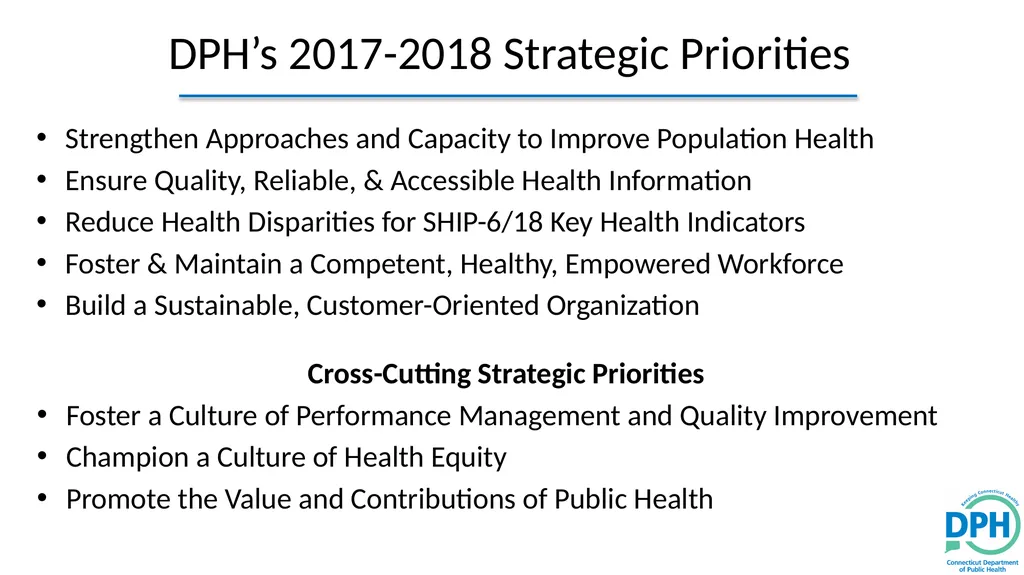
DPH’s 2017-2018 Strategic Priorities Strengthen Approaches and Capacity to Improve Population Health
Ensure Quality, Reliable, & Accessible Health Information
Reduce Health Disparities for SHIP-6/18 Key Health Indicators
Foster & Maintain a Competent, Healthy, Empowered Workforce
Build a Sustainable, Customer-Oriented Organization Cross-Cutting Strategic Priorities
Foster a Culture of Performance Management and Quality Improvement
Champion a Culture of Health Equity
Promote the Value and Contributions of Public Health<br>
20
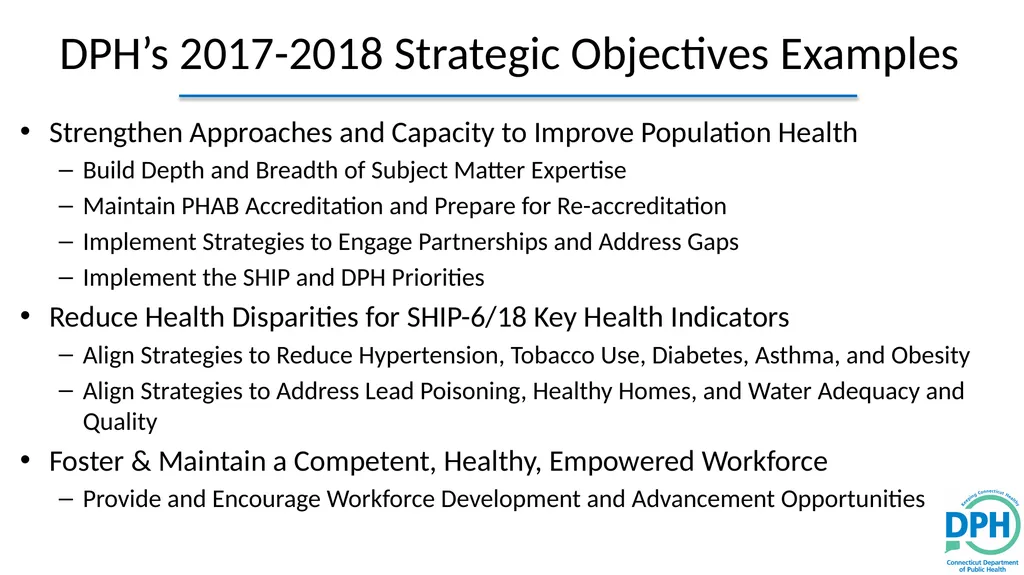
DPH’s 2017-2018 Strategic Objectives Examples Strengthen Approaches and Capacity to Improve Population Health
Build Depth and Breadth of Subject Matter Expertise
Maintain PHAB Accreditation and Prepare for Re-accreditation
Implement Strategies to Engage Partnerships and Address Gaps
Implement the SHIP and DPH Priorities
Reduce Health Disparities for SHIP-6/18 Key Health Indicators
Align Strategies to Reduce Hypertension, Tobacco Use, Diabetes, Asthma, and Obesity
Align Strategies to Address Lead Poisoning, Healthy Homes, and Water Adequacy and Quality
Foster & Maintain a Competent, Healthy, Empowered Workforce
Provide and Encourage Workforce Development and Advancement Opportunities<br>
21
Journal of Public Health Management and Practice – May/June 2018 https://journals.lww.com/jphmp/toc/2018/05001
PHAB’s 10 Years of Lessons Learned planning for and administering national public health accreditation and the impact it has had/is having on public health practice
Supplement has four sections:
Quality Improvement and Performance Management
Partnerships
Administration and Management
Future Directions
Two particular articles related to strategic planning
Kent County Health Department: Using an Agency Strategic Plan to Drive Improvement (Case Report in Administration and Management section)
Driving Change and Reinforcing Expectations by Linking Accreditation with Programmatic and Strategic Priorities (Commentary in Future Directions section)<br>
22
Kent County Health Department:
Using an Agency Strategic Plan to Drive Improvement HD hired an external consultant to facilitate information gathering and establishment of a staff-driven strategic planning committee
Completed first Strategic Plan based on PHAB standards in 2013 and in an effort to be inclusive, the plan reflected all programs, new initiatives, and mandated programs/services
2 years of progress monitoring determined that either little or no progress on goals, objectives and strategies on new initiatives was occurring, while mandated programs were constantly being reported as “continued work” or progress is ongoing
Due to slow progress on goals, the HD revised their plan 2 years after the first, and removed goals, objectives and strategies associated with long-term activities because the HD knew mandated services would always be ongoing<br>
23
Kent County Health Department:
Using an Agency Strategic Plan to Drive Improvement The revised plan became more reflective of activities that encourage quality improvement and enhancement of agency operations
Many goals, objectives, strategies in the revised plan were selected specifically to address gaps in the HD’s initial accreditation feedback
Following the revision, there is a stronger emphasis on QI as it relates to the Strategic Plan and potential QI projects are identified during quarterly progress monitoring meetings
Other Lessons Learned from Case Report
Consider addressing gaps in your HD’s PHAB Readiness Checklist in the Strategic Plan through strategies and objectives (these are certainly measurable)
Connect strategic plan to other agency initiatives, such as QI Plan, Workforce Development Plan, Performance Management System
Strategic Plan is a living document that is regularly revisited and revised
An external consultant is often helpful the first time a Strategic Plan is written, but future revisions and meaningful updates can be done by an internal staff person/committee<br>
24
Next Meeting:
August 22| 1-2pm
Topic: Implementation of Strategic Plan Up Next…<br>
August 22| 1-2pm
Topic: Implementation of Strategic Plan Up Next…<br>