
Activation and Smart Safety Nets in the Western
AM
Published · 40 slides · 0 views

1 / 1




Description
Activation and Smart Safety Nets in the Western Balkans Boryana Gotcheva Aylin Isik-Dikmelik Vienna, March 4, 2014 Outline Why activation? What is the challenge? What is activation? The Western Balkans Activation and Smart Safety Nets
Related Topics
Share
Embed code
Download this presentation From Below
"Activation and Smart Safety Nets in the Western" is the property of its rightful owner. Permission is granted to download and print the materials on this website for personal, non-commercial use only, and to display it on your personal computer provided you do not modify the materials and that you retain all copyright notices contained in the materials. By downloading content from our website, you accept the terms of this agreement.
Presentation Transcript
01
Activation and Smart Safety Nets
in the Western Balkans
Boryana Gotcheva & Aylin Isik-Dikmelik
Vienna, March 4, 2014<br>
02
Outline Why activation? What is the challenge?
What is activation?
The Western Balkans Activation and Smart Safety Nets Study:
Content
Outputs
Analytical framework
Going forward<br>
What is activation?
The Western Balkans Activation and Smart Safety Nets Study:
Content
Outputs
Analytical framework
Going forward<br>
03
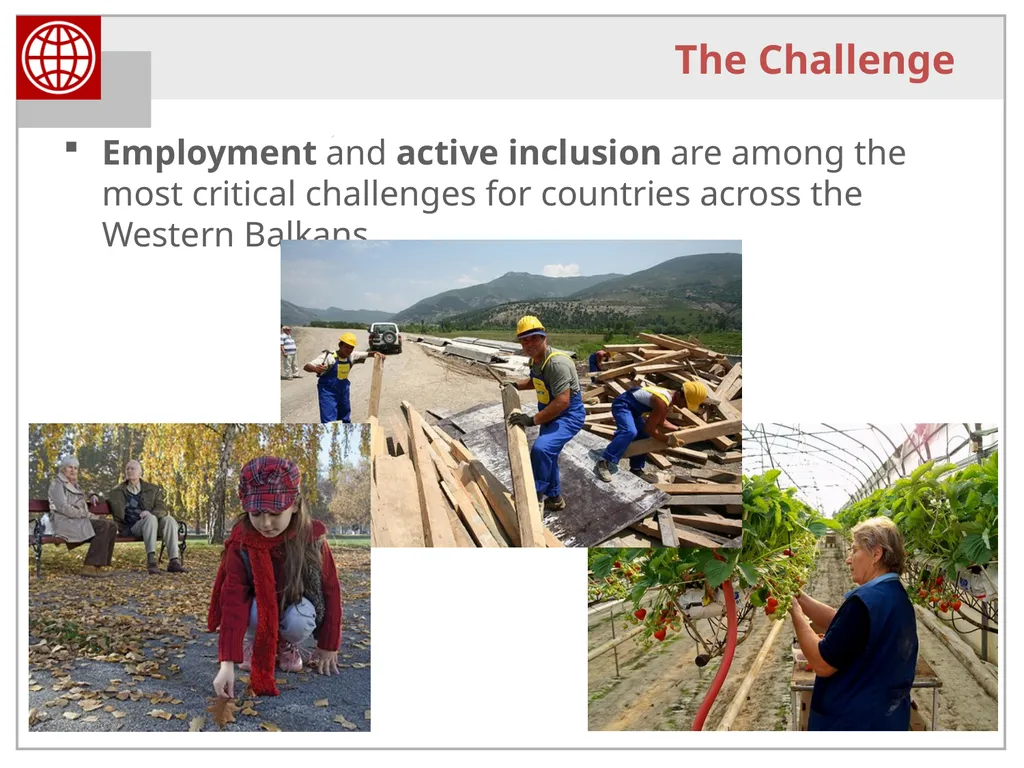
The Challenge Employment and active inclusion are among the most critical challenges for countries across the Western Balkans<br>
04
Daunting jobs challenge with low activity and employment rates … Employment (age 15+), Q4, 2011<br>
05
…and unemployment rates that are among the highest in Europe<br>
06
What is activation? Activation has a ‘history’ across the world
Shift from “passive” to “active” social policies
Primary focus on employability and labor market re-attachment
The “European” model of activation policies generally place employment integration at the very heart of social policy
This implies:
Greater emphasis on work as a way to ensure that individuals in their prime age are not excluded from mainstream society
Greater effort by the social and employment services in helping inactive, unemployed and benefit recipients overcome the obstacles to entering into paid work
Greater effort by the inactive, unemployed, and recipients to enter or re-enter the job market<br>
Shift from “passive” to “active” social policies
Primary focus on employability and labor market re-attachment
The “European” model of activation policies generally place employment integration at the very heart of social policy
This implies:
Greater emphasis on work as a way to ensure that individuals in their prime age are not excluded from mainstream society
Greater effort by the social and employment services in helping inactive, unemployed and benefit recipients overcome the obstacles to entering into paid work
Greater effort by the inactive, unemployed, and recipients to enter or re-enter the job market<br>
07
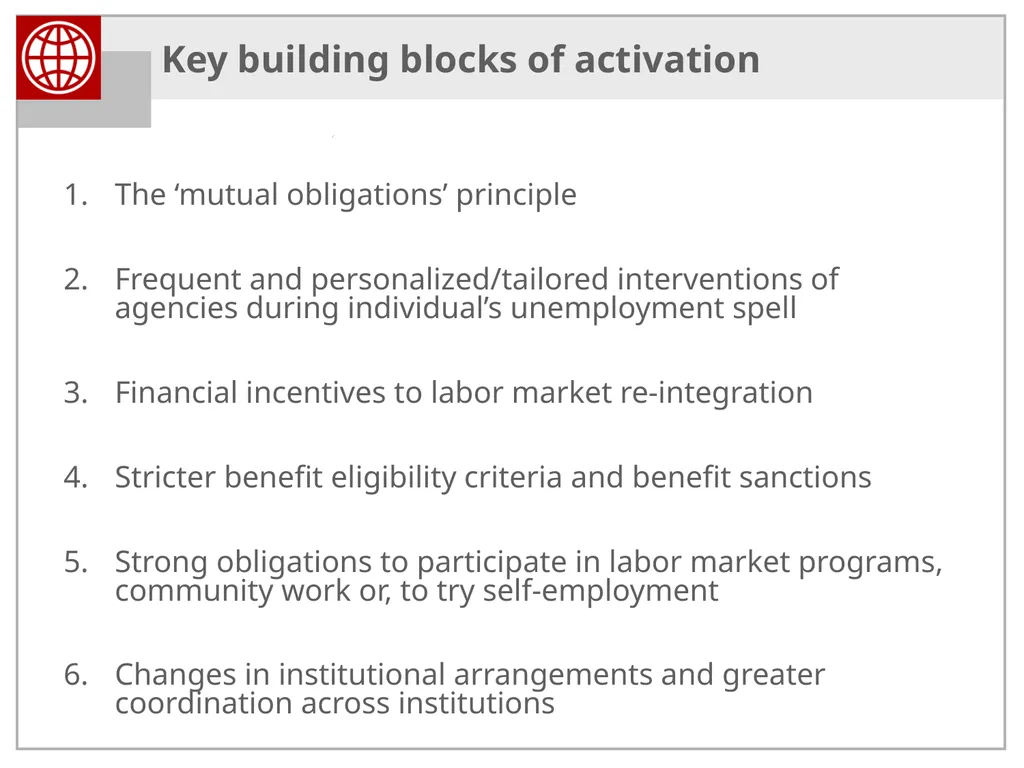
Key building blocks of activation The ‘mutual obligations’ principle
Frequent and personalized/tailored interventions of agencies during individual’s unemployment spell
Financial incentives to labor market re-integration
Stricter benefit eligibility criteria and benefit sanctions
Strong obligations to participate in labor market programs, community work or, to try self-employment
Changes in institutional arrangements and greater coordination across institutions<br>
Frequent and personalized/tailored interventions of agencies during individual’s unemployment spell
Financial incentives to labor market re-integration
Stricter benefit eligibility criteria and benefit sanctions
Strong obligations to participate in labor market programs, community work or, to try self-employment
Changes in institutional arrangements and greater coordination across institutions<br>
08
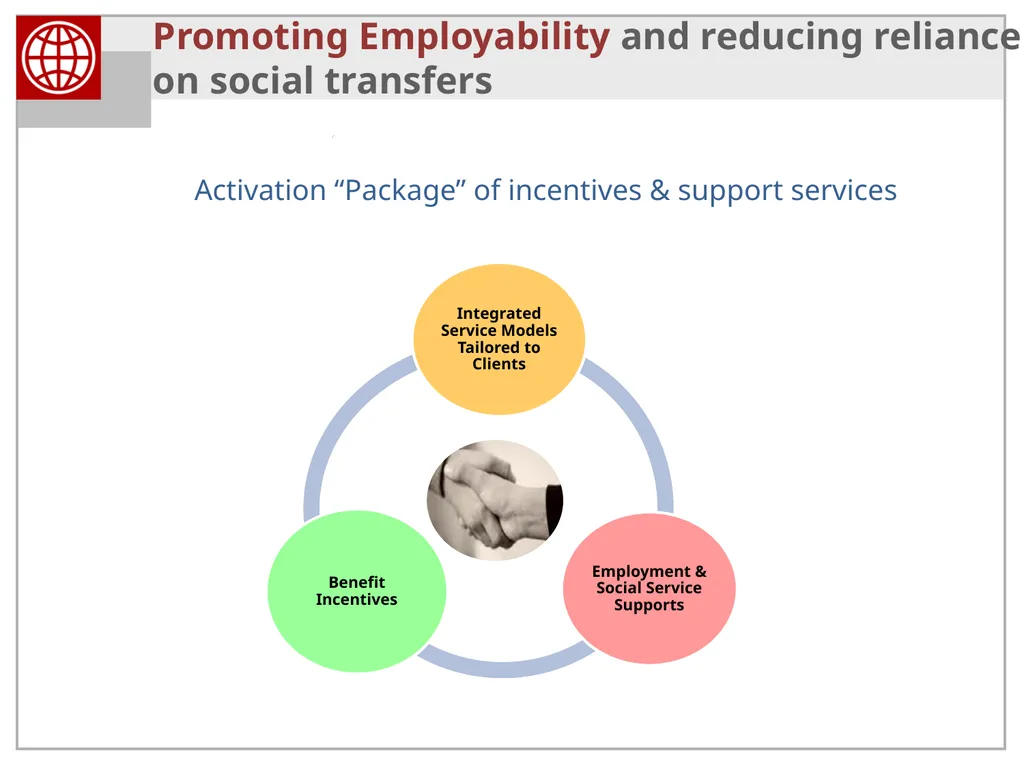
Promoting Employability and reducing reliance on social transfers Activation “Package” of incentives & support services<br>
09
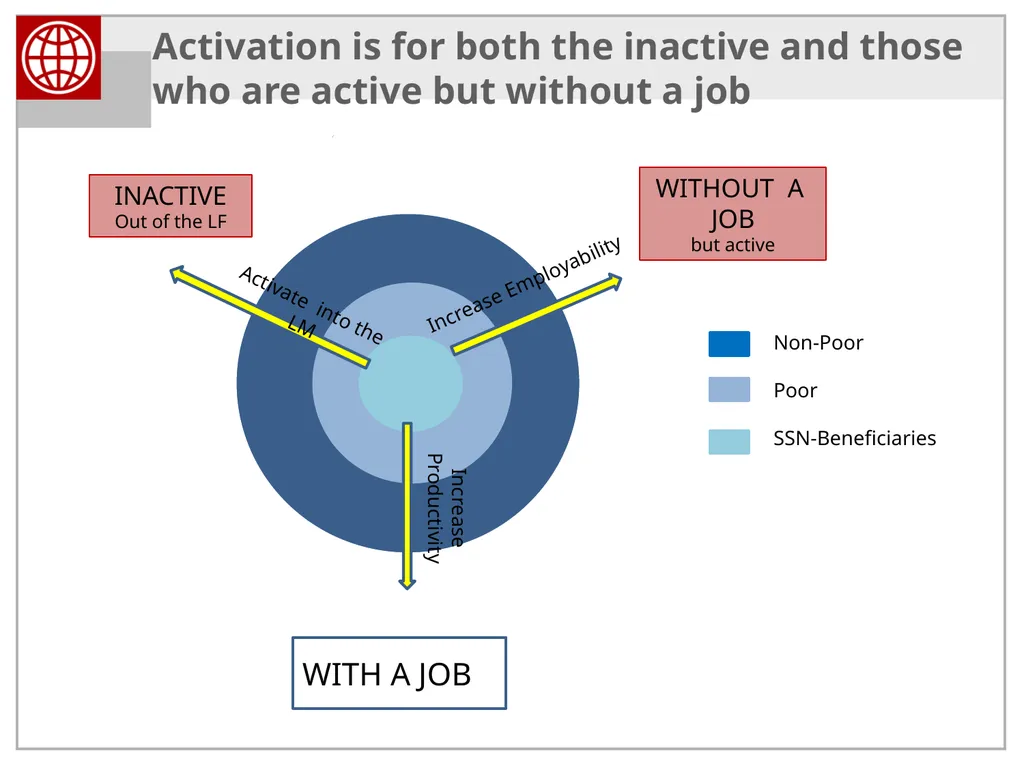
Activation is for both the inactive and those who are active but without a job Non-Poor
Poor
SSN-Beneficiaries INACTIVE
Out of the LF WITHOUT A JOB
but active Increase Employability Increase Productivity Activate into the LM WITH A JOB<br>
Poor
SSN-Beneficiaries INACTIVE
Out of the LF WITHOUT A JOB
but active Increase Employability Increase Productivity Activate into the LM WITH A JOB<br>
10
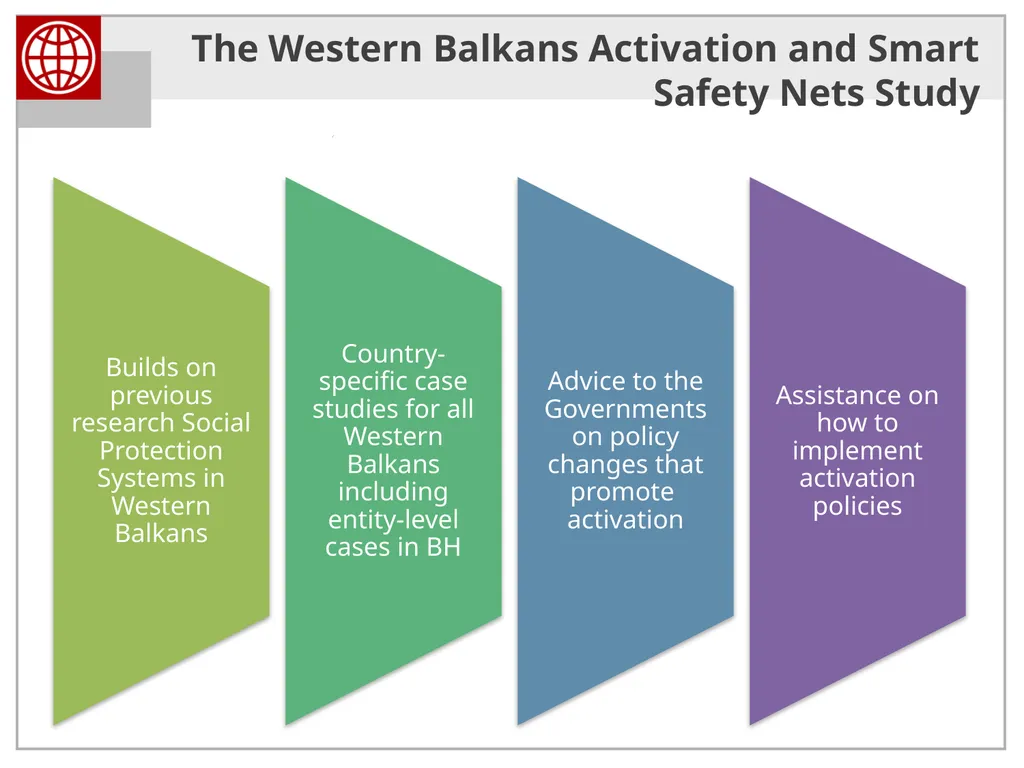
The Western Balkans Activation and Smart Safety Nets Study<br>
11
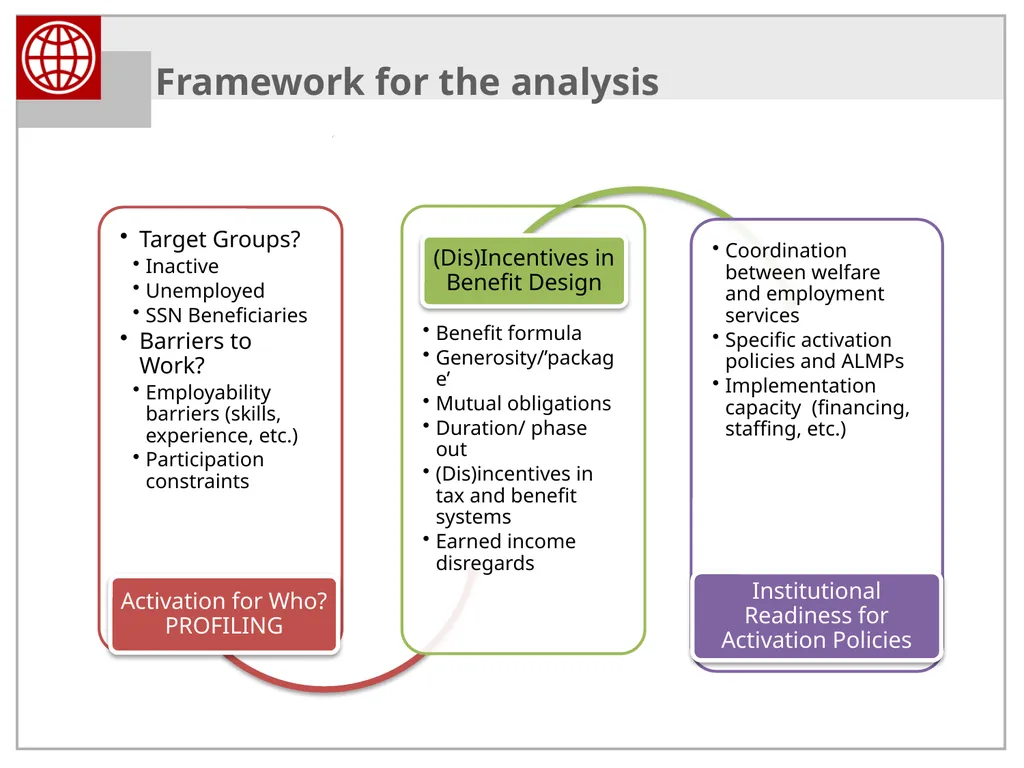
Framework for the analysis<br>
12
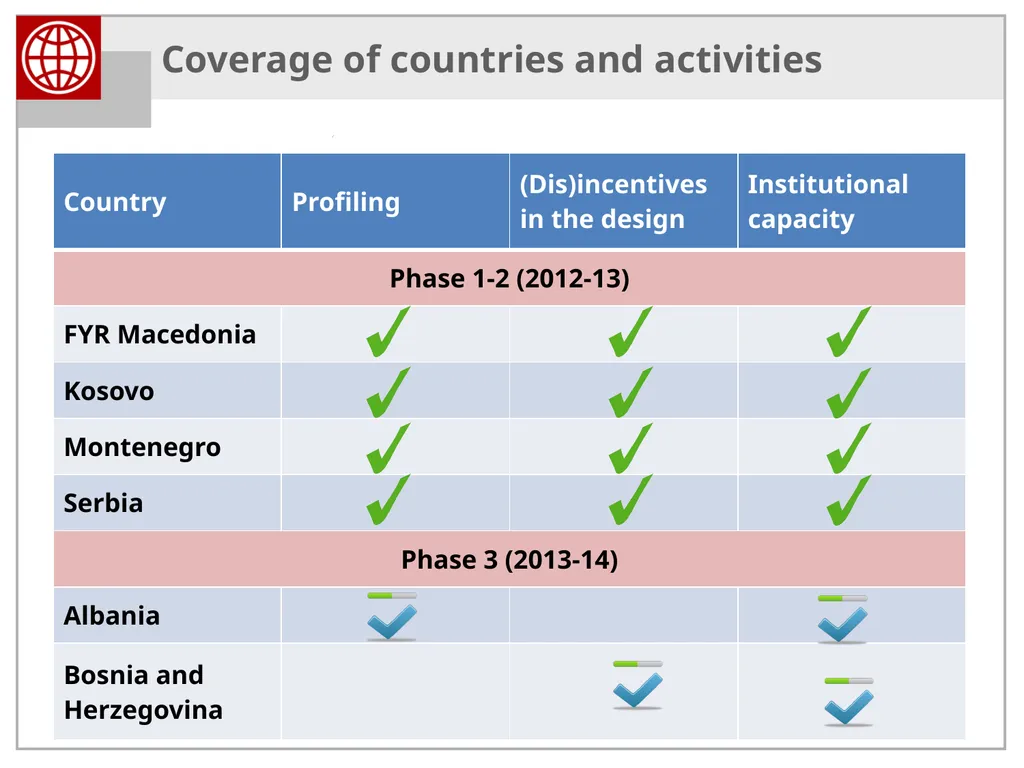
Coverage of countries and activities<br>
13
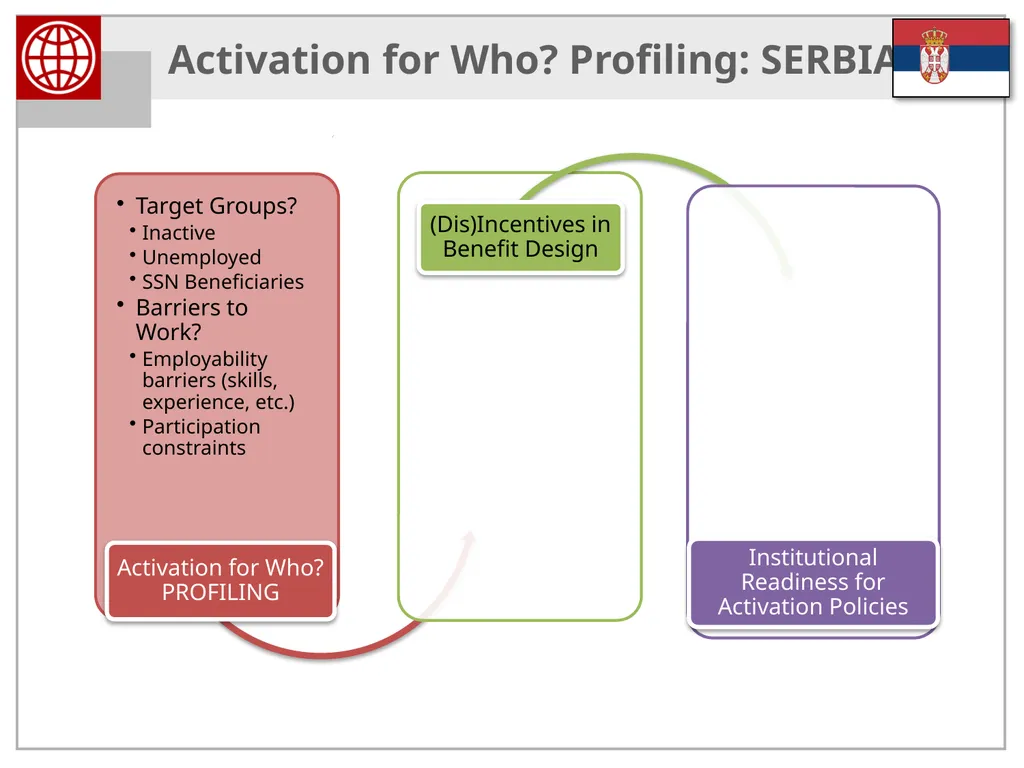
Activation for Who? Profiling: SERBIA<br>
14
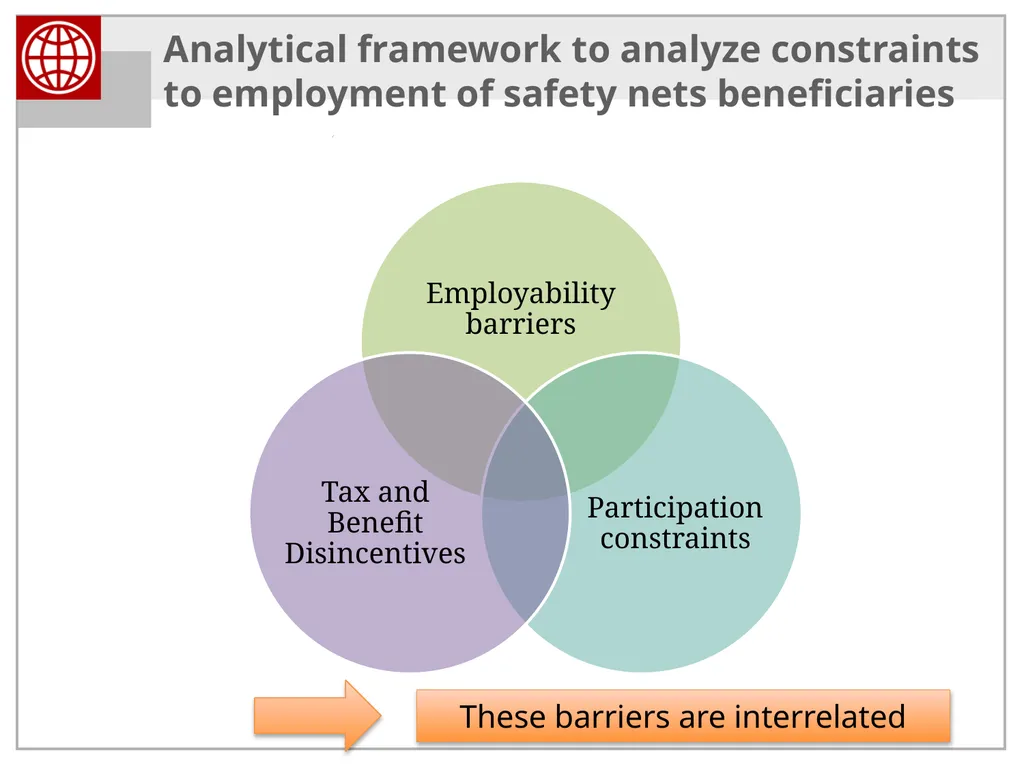
Analytical framework to analyze constraints to employment of safety nets beneficiaries These barriers are interrelated<br>
15
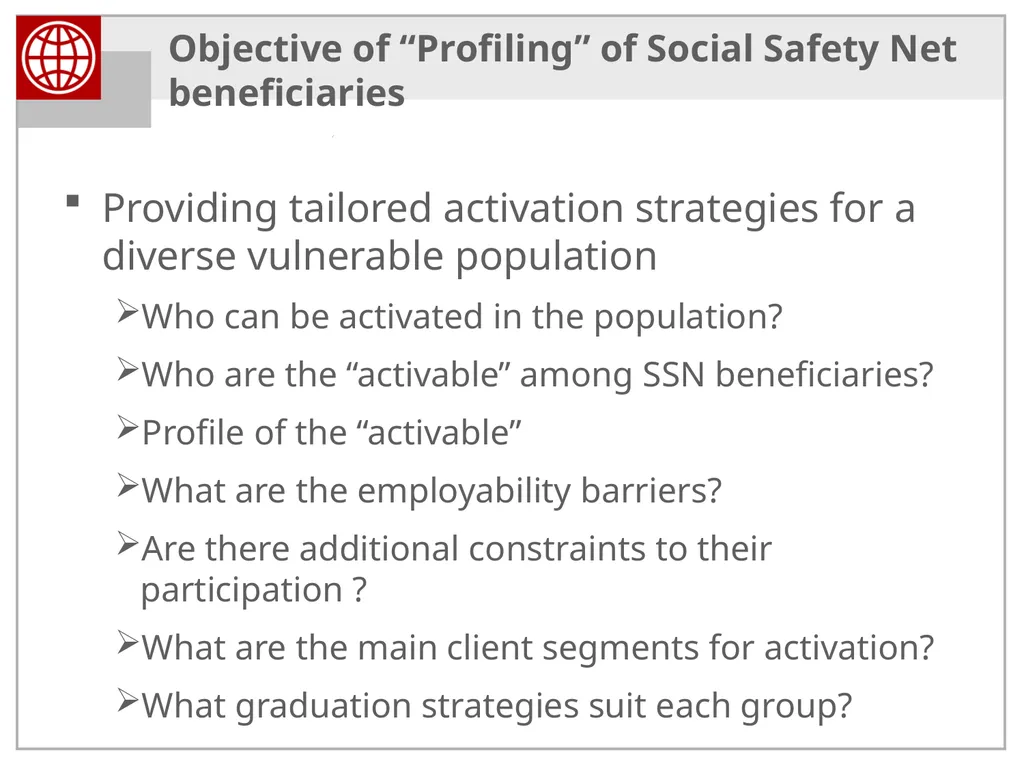
Objective of “Profiling” of Social Safety Net beneficiaries Providing tailored activation strategies for a diverse vulnerable population
Who can be activated in the population?
Who are the “activable” among SSN beneficiaries?
Profile of the “activable”
What are the employability barriers?
Are there additional constraints to their participation ?
What are the main client segments for activation?
What graduation strategies suit each group?<br>
Who can be activated in the population?
Who are the “activable” among SSN beneficiaries?
Profile of the “activable”
What are the employability barriers?
Are there additional constraints to their participation ?
What are the main client segments for activation?
What graduation strategies suit each group?<br>
16
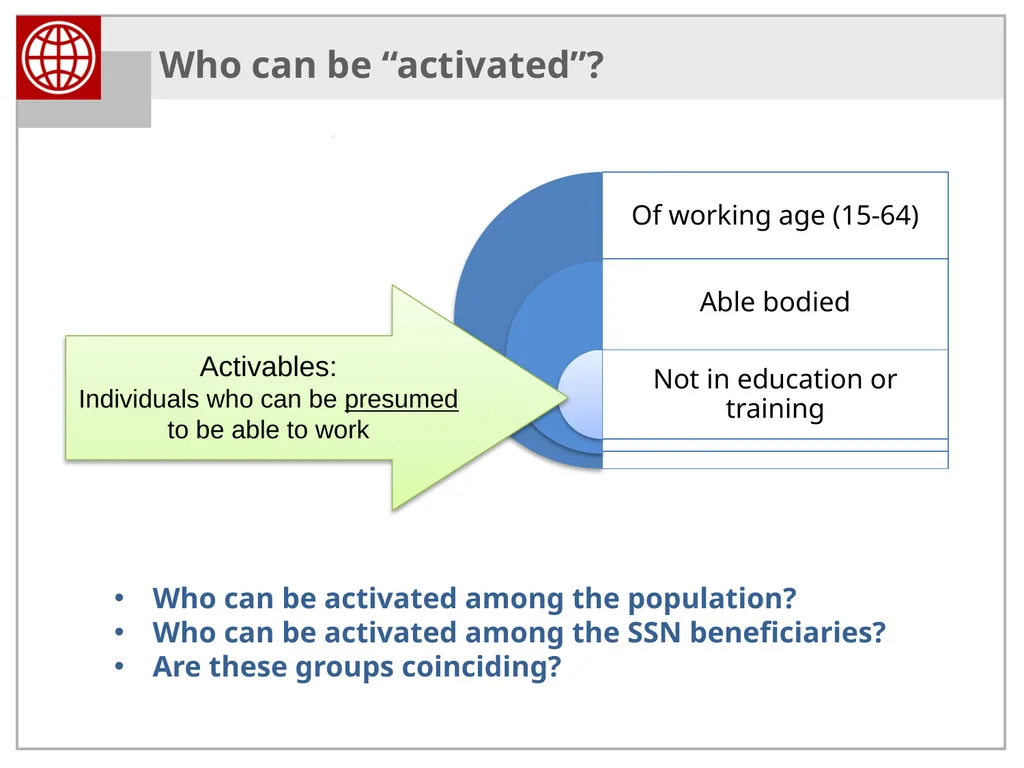
Who can be “activated”? Activables:
Individuals who can be presumed to be able to work Who can be activated among the population?
Who can be activated among the SSN beneficiaries?
Are these groups coinciding?<br>
Who can be activated among the SSN beneficiaries?
Are these groups coinciding?<br>
17
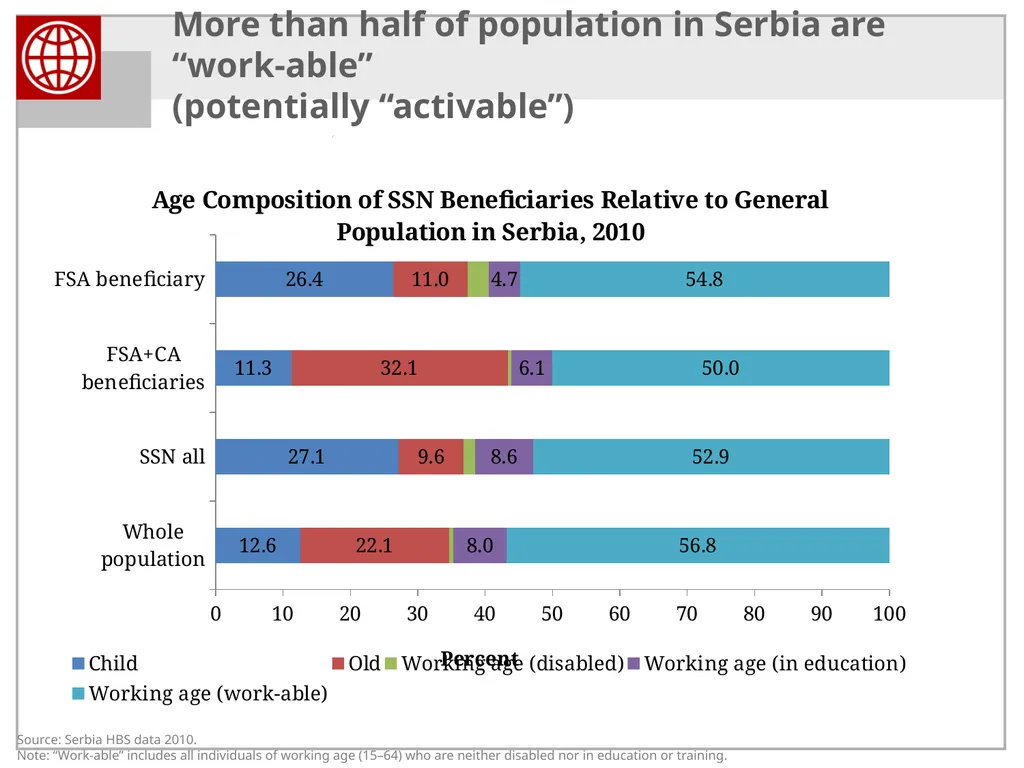
More than half of population in Serbia are “work-able”
(potentially “activable”) Source: Serbia HBS data 2010.
Note: “Work-able” includes all individuals of working age (15–64) who are neither disabled nor in education or training.<br>
Note: “Work-able” includes all individuals of working age (15–64) who are neither disabled nor in education or training.<br>
18
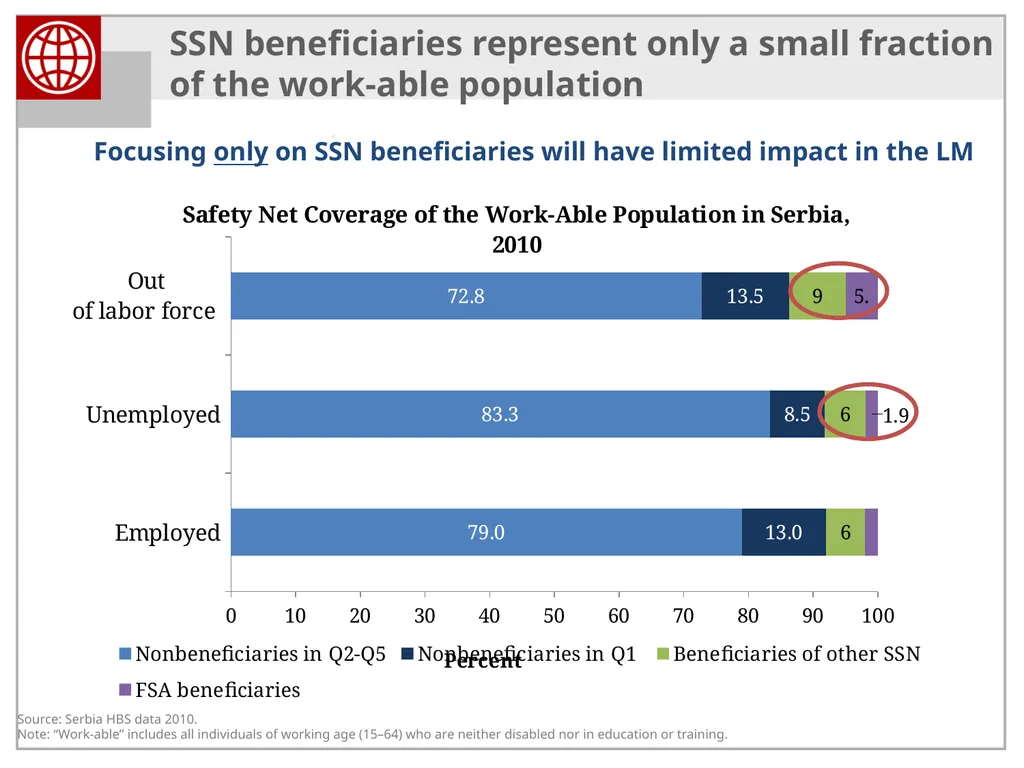
SSN beneficiaries represent only a small fraction of the work-able population Source: Serbia HBS data 2010.
Note: “Work-able” includes all individuals of working age (15–64) who are neither disabled nor in education or training. Focusing only on SSN beneficiaries will have limited impact in the LM<br>
Note: “Work-able” includes all individuals of working age (15–64) who are neither disabled nor in education or training. Focusing only on SSN beneficiaries will have limited impact in the LM<br>
19
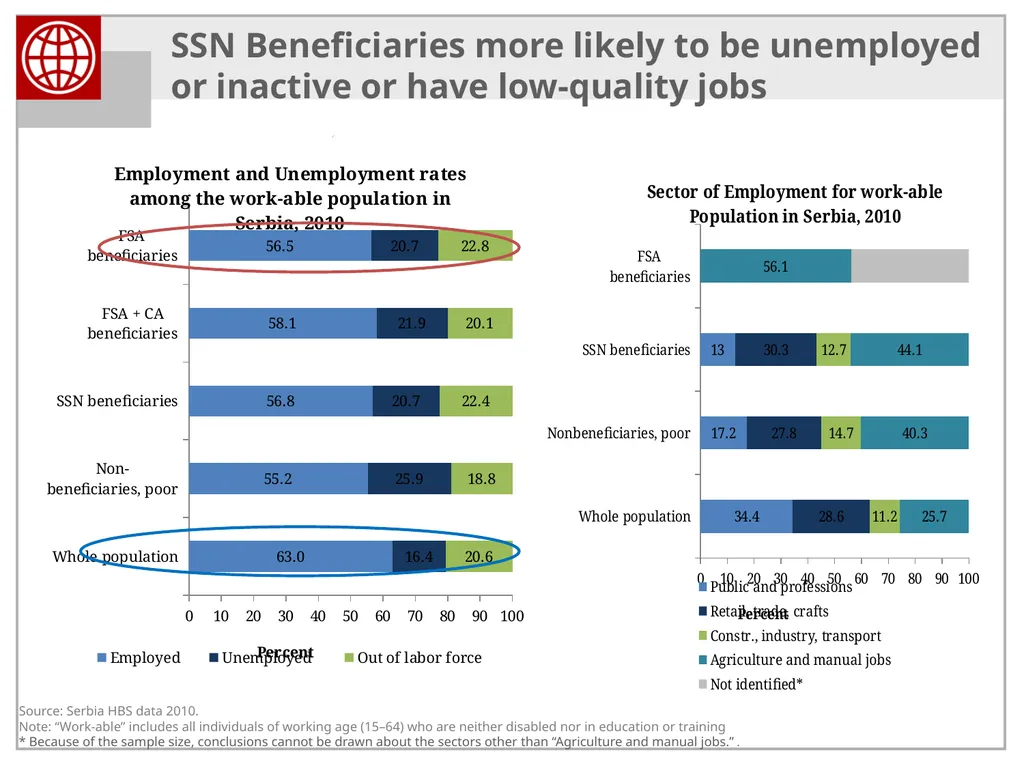
SSN Beneficiaries more likely to be unemployed or inactive or have low-quality jobs Source: Serbia HBS data 2010.
Note: “Work-able” includes all individuals of working age (15–64) who are neither disabled nor in education or training
* Because of the sample size, conclusions cannot be drawn about the sectors other than “Agriculture and manual jobs.” .<br>
Note: “Work-able” includes all individuals of working age (15–64) who are neither disabled nor in education or training
* Because of the sample size, conclusions cannot be drawn about the sectors other than “Agriculture and manual jobs.” .<br>
20
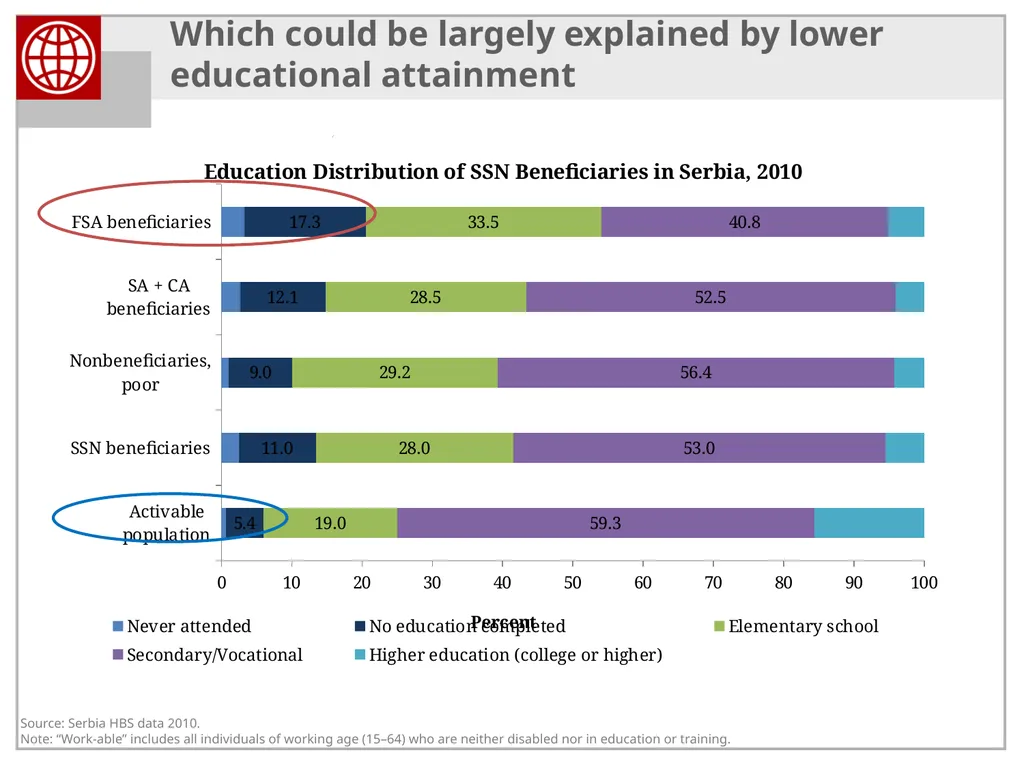
Which could be largely explained by lower educational attainment Source: Serbia HBS data 2010.
Note: “Work-able” includes all individuals of working age (15–64) who are neither disabled nor in education or training.<br>
Note: “Work-able” includes all individuals of working age (15–64) who are neither disabled nor in education or training.<br>
21
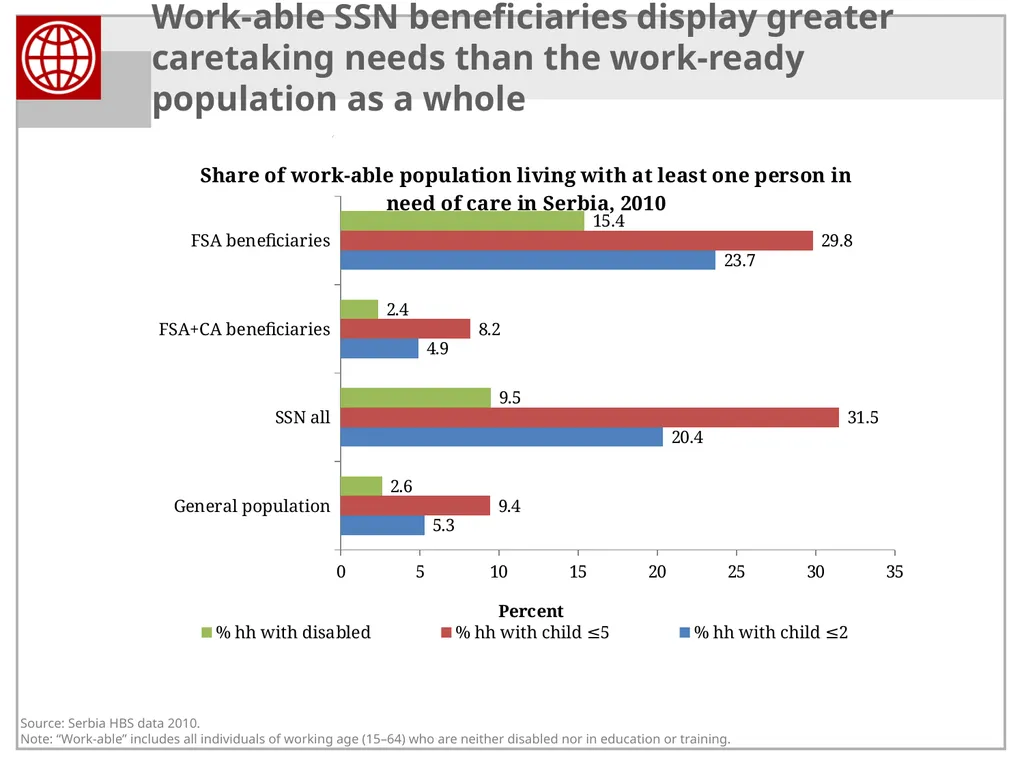
Work-able SSN beneficiaries display greater caretaking needs than the work-ready population as a whole Source: Serbia HBS data 2010.
Note: “Work-able” includes all individuals of working age (15–64) who are neither disabled nor in education or training.<br>
Note: “Work-able” includes all individuals of working age (15–64) who are neither disabled nor in education or training.<br>
22
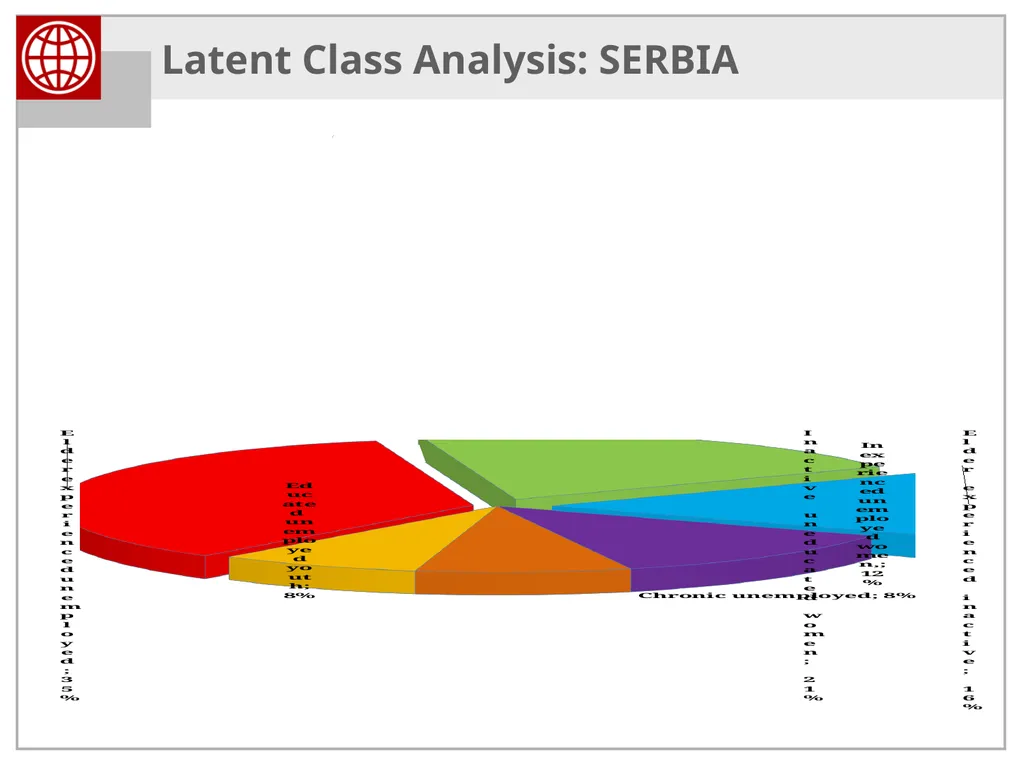
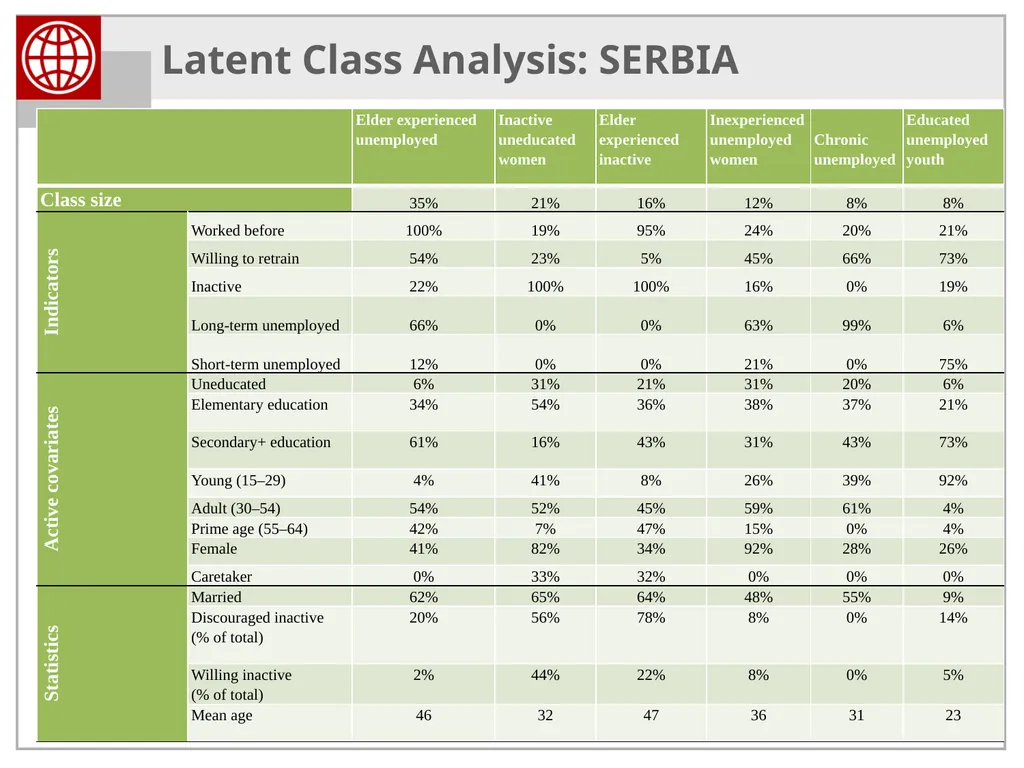
Latent Class Analysis: SERBIA<br>
23
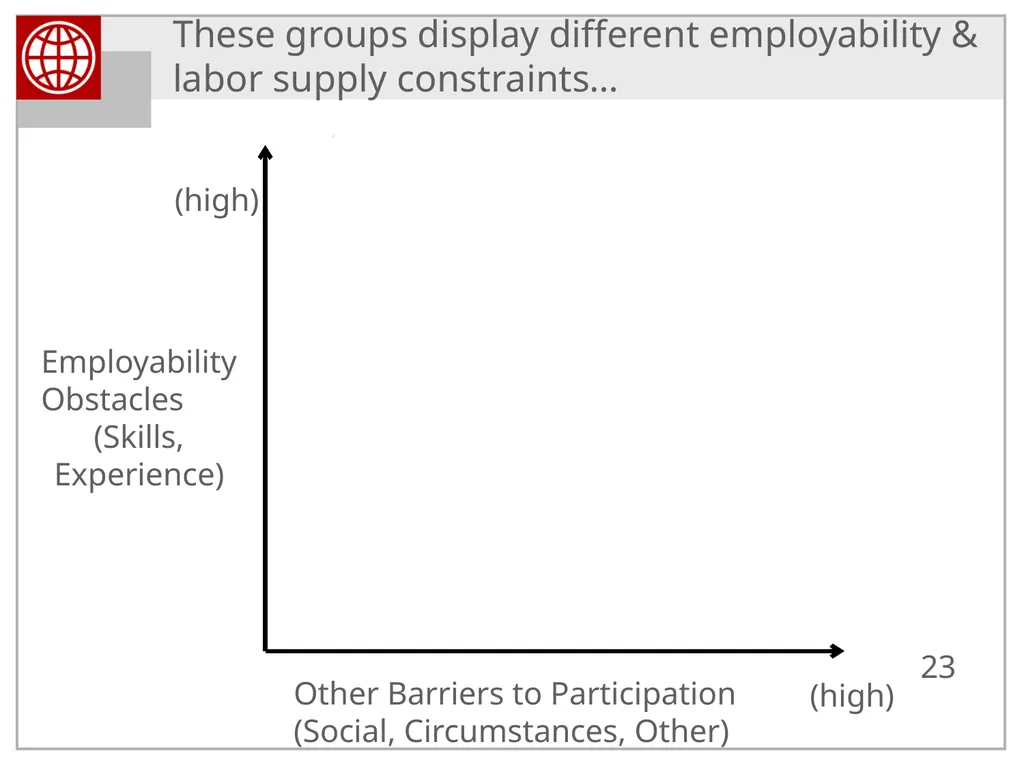
These groups display different employability & labor supply constraints… 23<br>
24
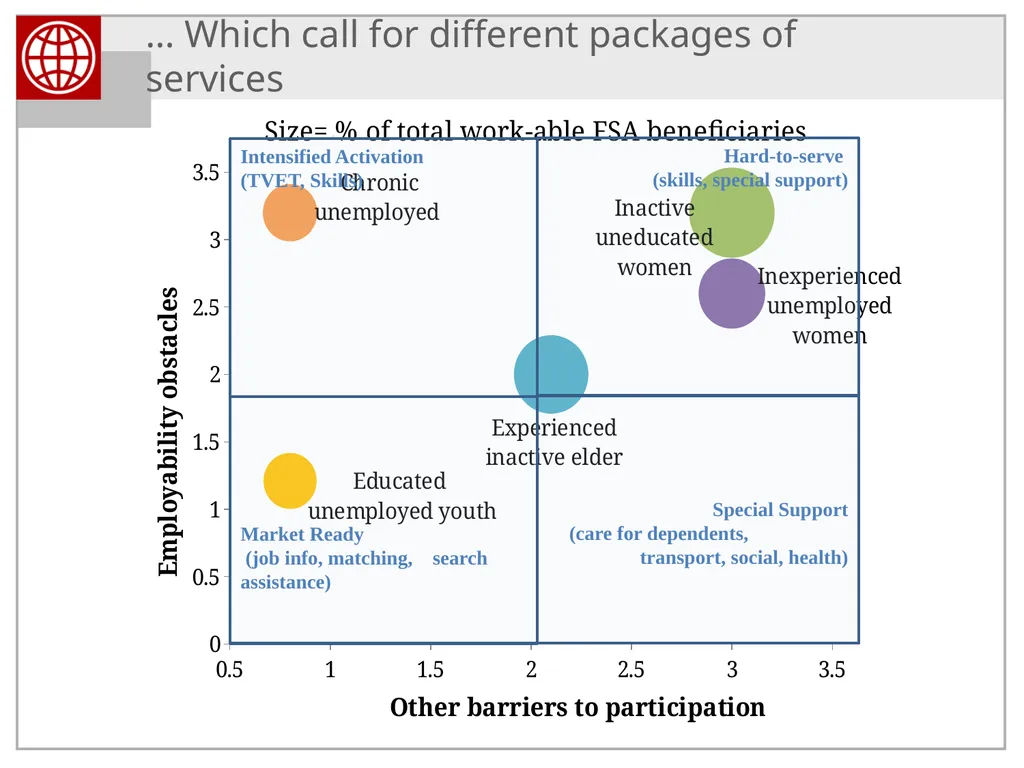
… Which call for different packages of services Market Ready
(job info, matching, search assistance) Intensified Activation
(TVET, Skills) Hard-to-serve
(skills, special support) Special Support
(care for dependents, transport, social, health)<br>
(care for dependents, transport, social, health)<br>
25
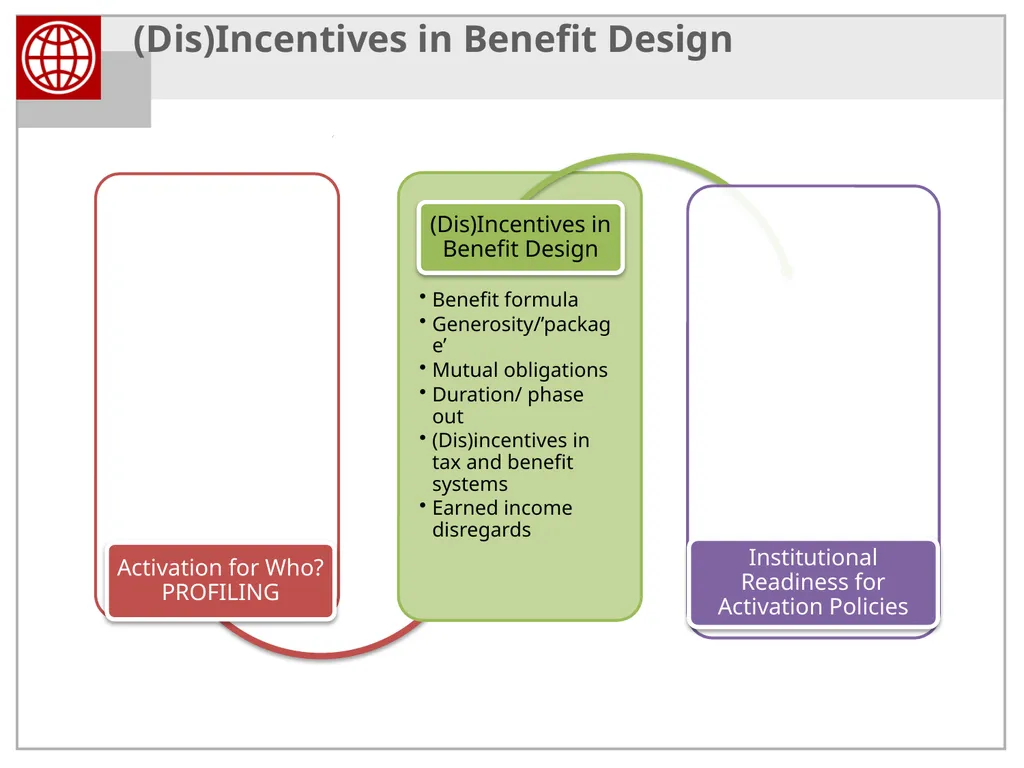
(Dis)Incentives in Benefit Design<br>
26
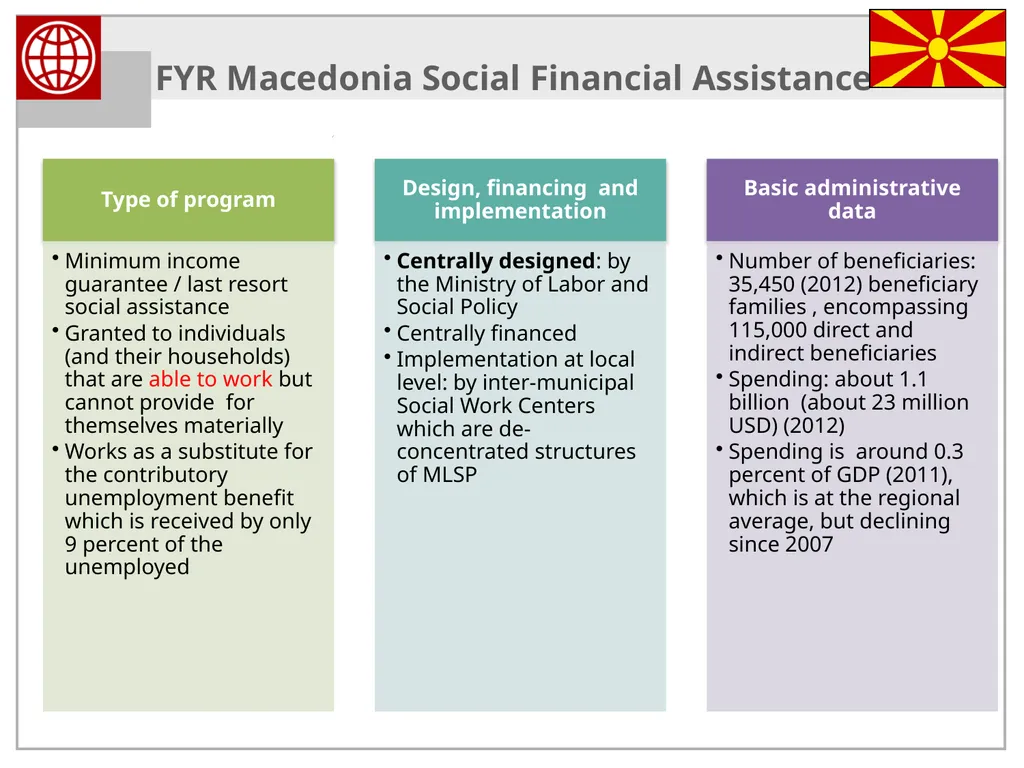
FYR Macedonia Social Financial Assistance<br>
27
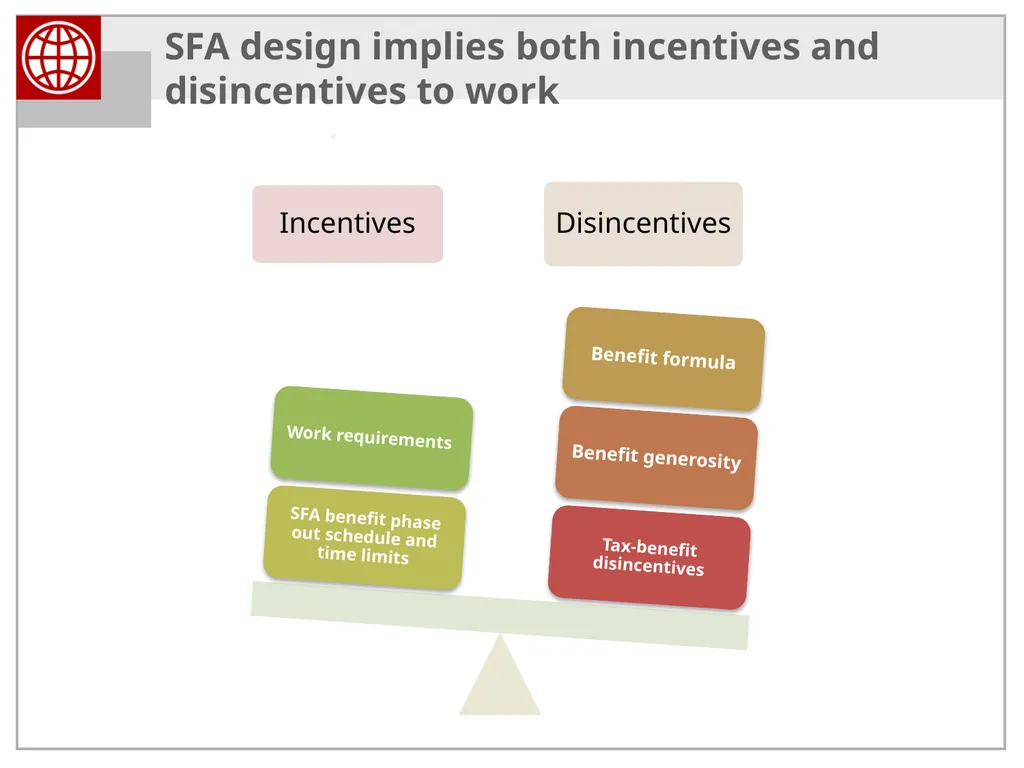
SFA design implies both incentives and disincentives to work<br>
28
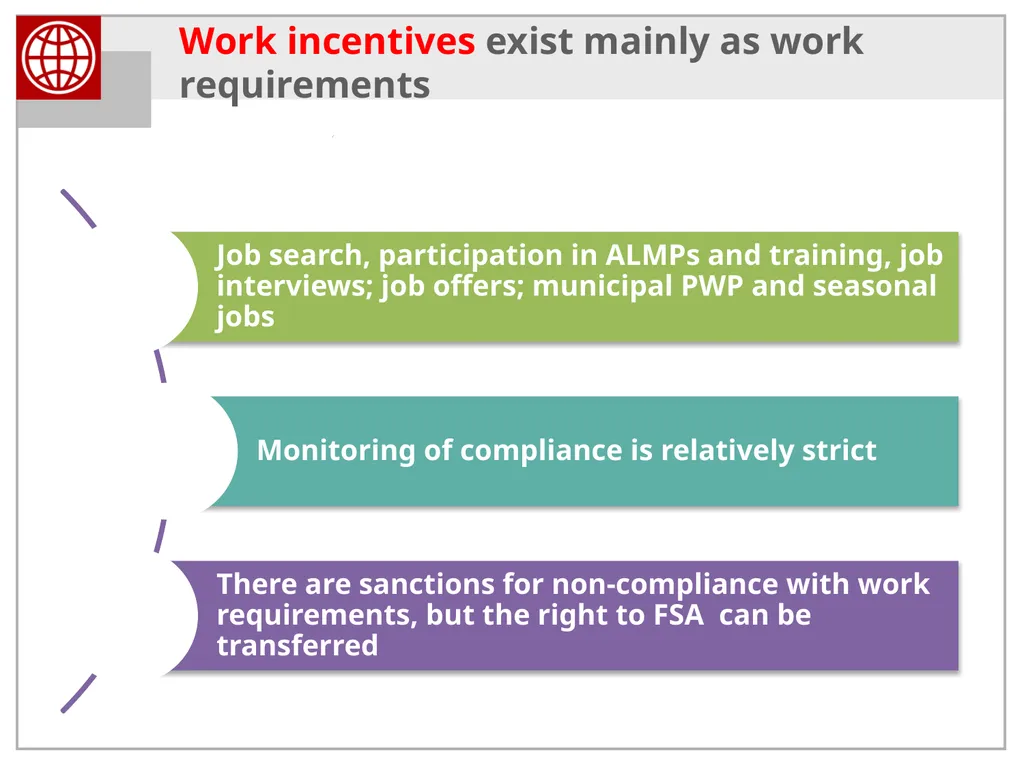
Work incentives exist mainly as work requirements<br>
29
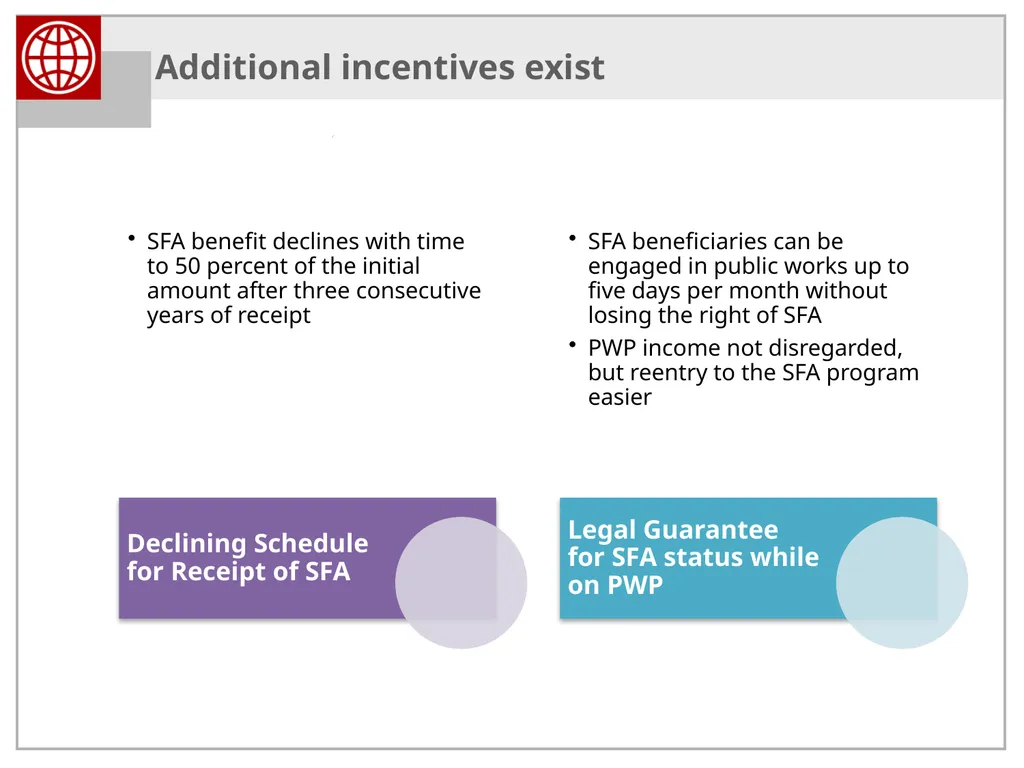
Additional incentives exist<br>
30
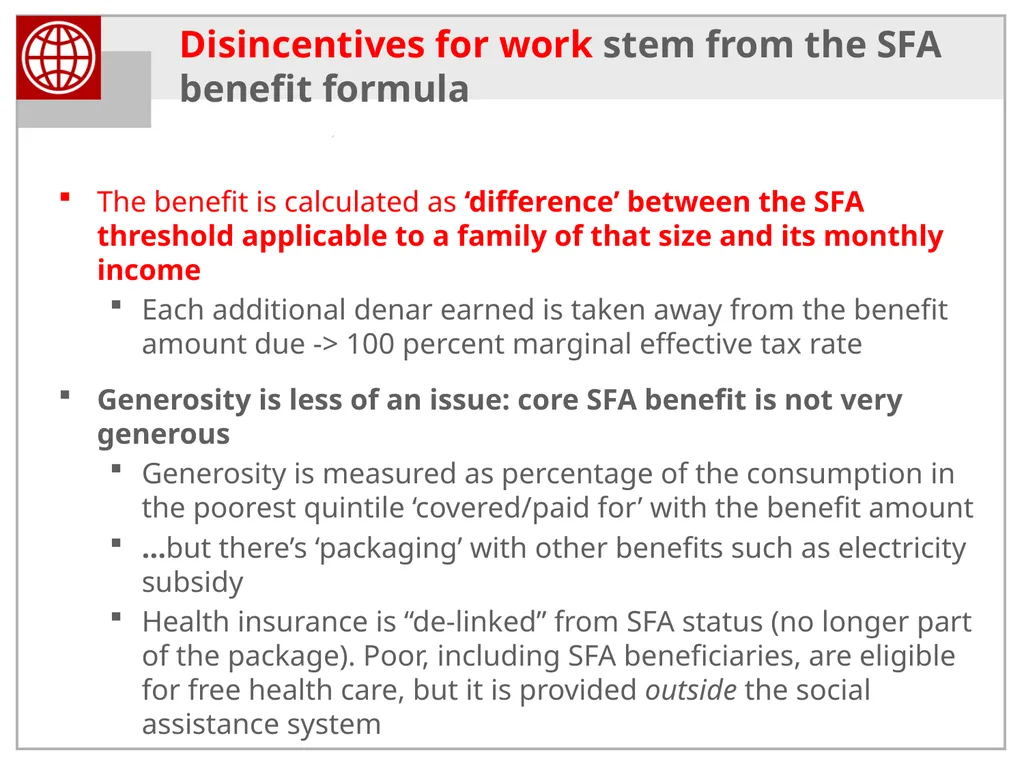
Disincentives for work stem from the SFA benefit formula The benefit is calculated as ‘difference’ between the SFA threshold applicable to a family of that size and its monthly income
Each additional denar earned is taken away from the benefit amount due -> 100 percent marginal effective tax rate
Generosity is less of an issue: core SFA benefit is not very generous
Generosity is measured as percentage of the consumption in the poorest quintile ‘covered/paid for’ with the benefit amount
…but there’s ‘packaging’ with other benefits such as electricity subsidy
Health insurance is “de-linked” from SFA status (no longer part of the package). Poor, including SFA beneficiaries, are eligible for free health care, but it is provided outside the social assistance system<br>
Each additional denar earned is taken away from the benefit amount due -> 100 percent marginal effective tax rate
Generosity is less of an issue: core SFA benefit is not very generous
Generosity is measured as percentage of the consumption in the poorest quintile ‘covered/paid for’ with the benefit amount
…but there’s ‘packaging’ with other benefits such as electricity subsidy
Health insurance is “de-linked” from SFA status (no longer part of the package). Poor, including SFA beneficiaries, are eligible for free health care, but it is provided outside the social assistance system<br>
31
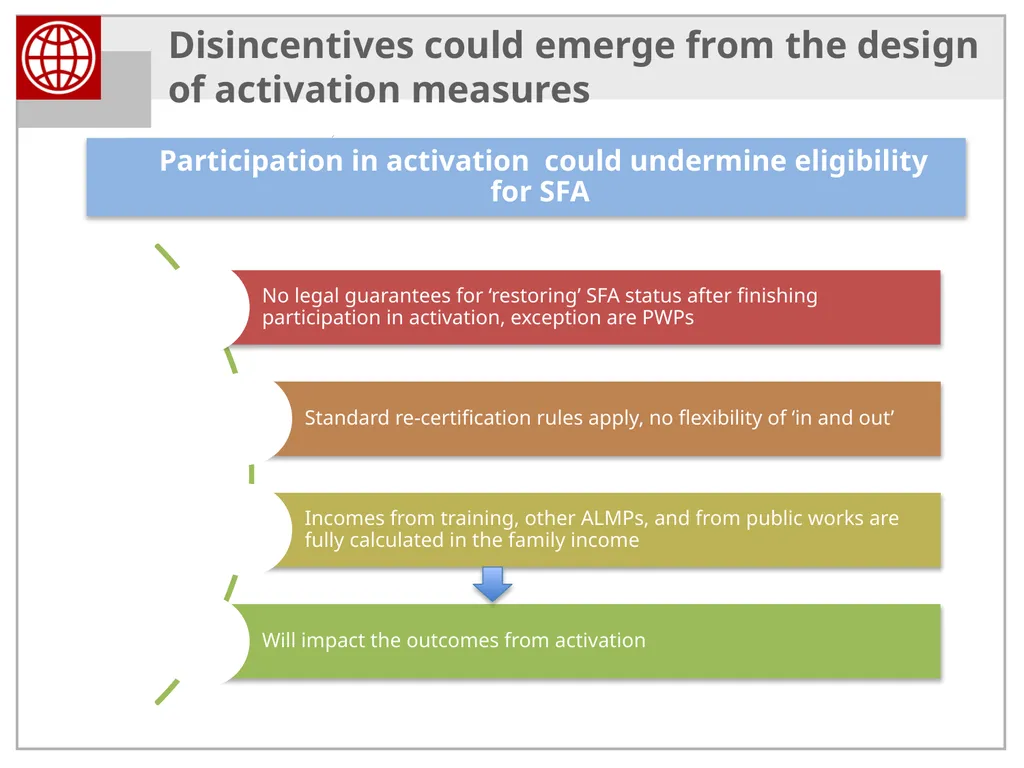
Disincentives could emerge from the design of activation measures<br>
32
Overall, modern social assistance programs for work able poor have more incentives for activation<br>
33
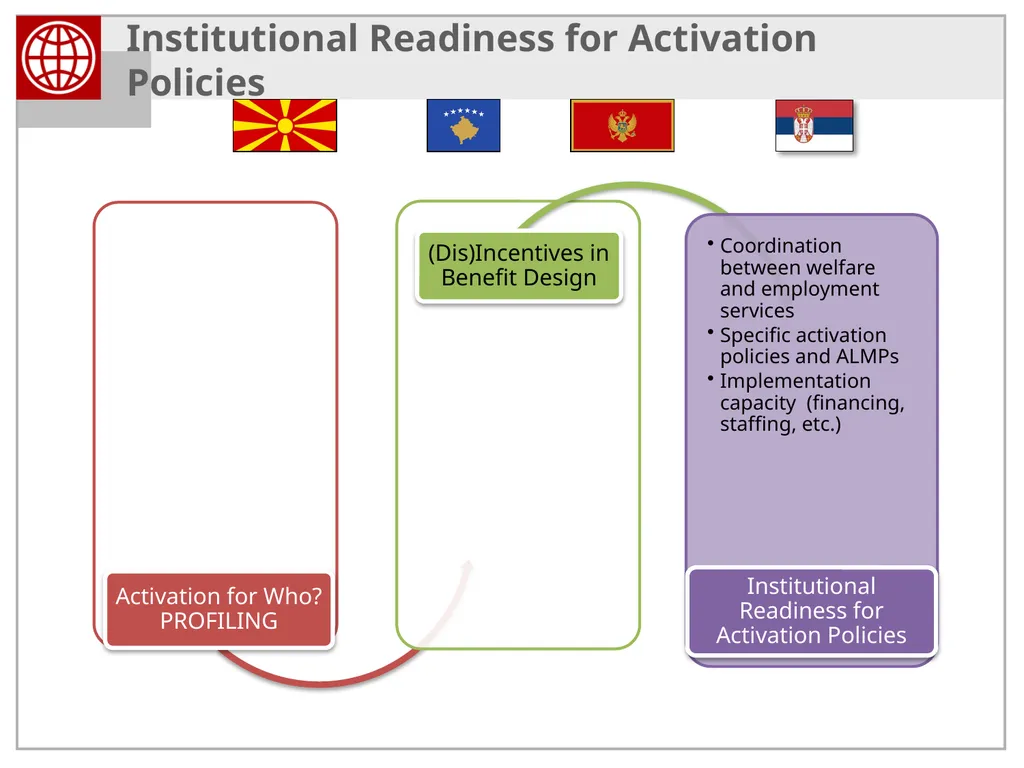
Institutional Readiness for Activation Policies<br>
34
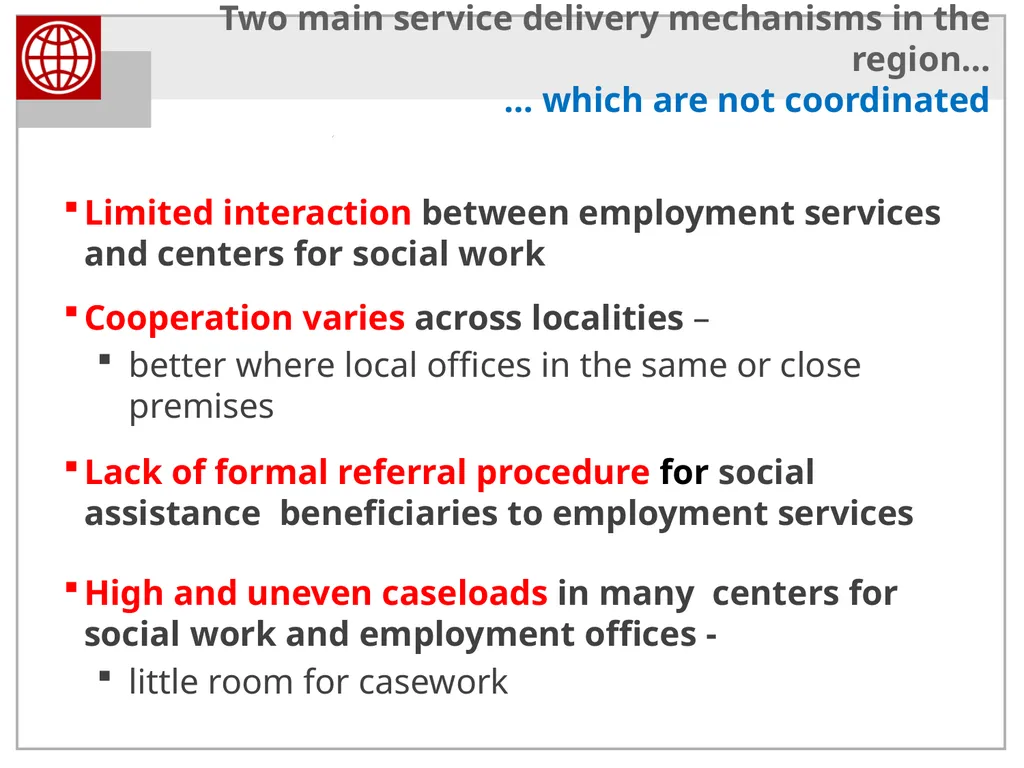
Two main service delivery mechanisms in the region…
… which are not coordinated Limited interaction between employment services and centers for social work
Cooperation varies across localities –
better where local offices in the same or close premises
Lack of formal referral procedure for social assistance beneficiaries to employment services
High and uneven caseloads in many centers for social work and employment offices -
little room for casework<br>
Cooperation varies across localities –
better where local offices in the same or close premises
Lack of formal referral procedure for social assistance beneficiaries to employment services
High and uneven caseloads in many centers for social work and employment offices -
little room for casework<br>
35
Labor market institutions in place, but capacity for activation on a large scale still insufficient Limited capacity for individualized interventions
Due to the high client to staff ratio
Financing constraints for active measures
Low level of spending on active policies ranging only 0.1-0.2% GDP – significantly lower than the EU-27 average
Lack of outsourcing of the job placement and/or counseling services to non-state providers
The regulatory framework for outsourcing is not fully developed<br>
Due to the high client to staff ratio
Financing constraints for active measures
Low level of spending on active policies ranging only 0.1-0.2% GDP – significantly lower than the EU-27 average
Lack of outsourcing of the job placement and/or counseling services to non-state providers
The regulatory framework for outsourcing is not fully developed<br>
36
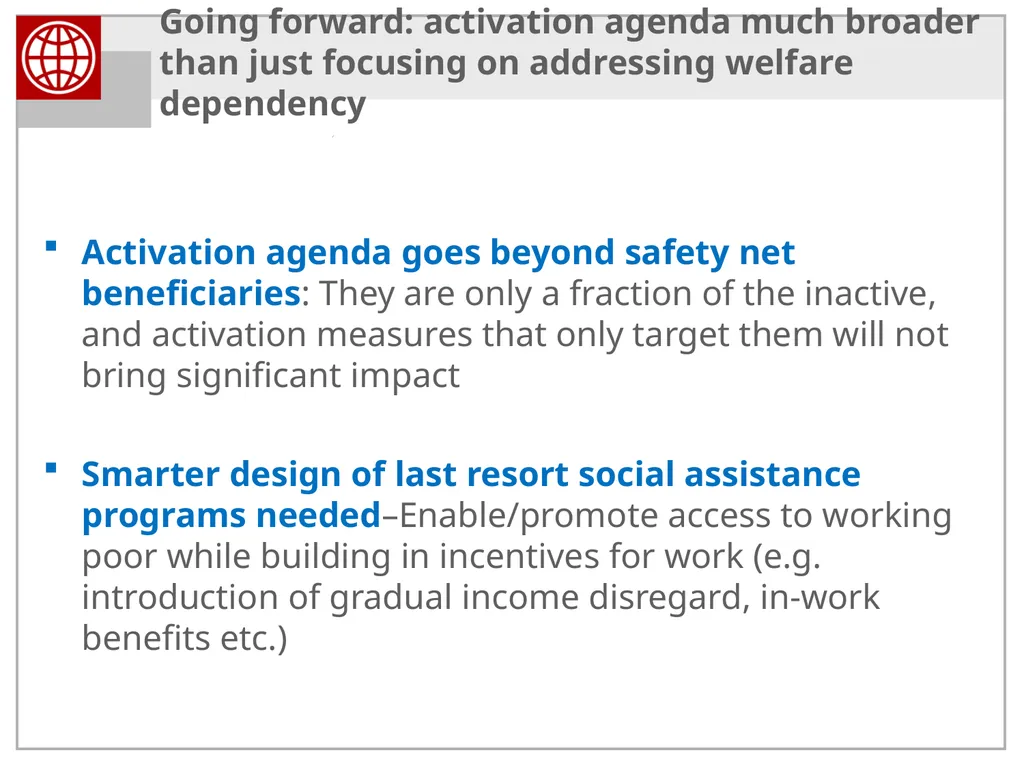
Going forward: activation agenda much broader than just focusing on addressing welfare dependency Activation agenda goes beyond safety net beneficiaries: They are only a fraction of the inactive, and activation measures that only target them will not bring significant impact
Smarter design of last resort social assistance programs needed–Enable/promote access to working poor while building in incentives for work (e.g. introduction of gradual income disregard, in-work benefits etc.)<br>
Smarter design of last resort social assistance programs needed–Enable/promote access to working poor while building in incentives for work (e.g. introduction of gradual income disregard, in-work benefits etc.)<br>
37
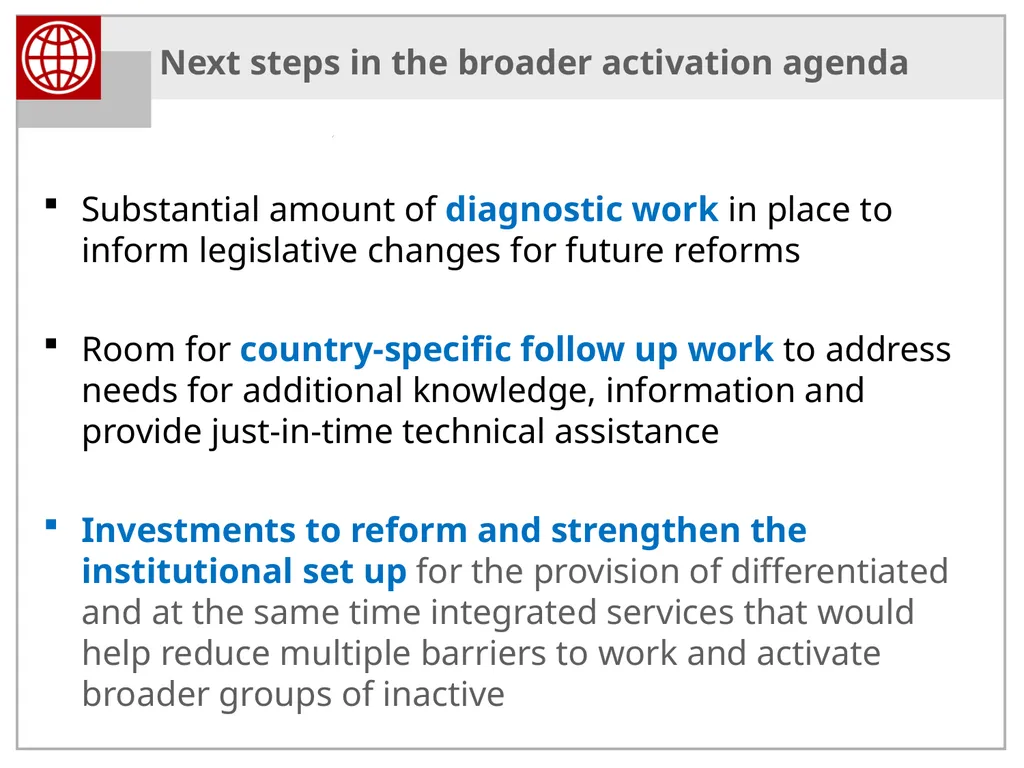
Next steps in the broader activation agenda Substantial amount of diagnostic work in place to inform legislative changes for future reforms
Room for country-specific follow up work to address needs for additional knowledge, information and provide just-in-time technical assistance
Investments to reform and strengthen the institutional set up for the provision of differentiated and at the same time integrated services that would help reduce multiple barriers to work and activate broader groups of inactive<br>
Room for country-specific follow up work to address needs for additional knowledge, information and provide just-in-time technical assistance
Investments to reform and strengthen the institutional set up for the provision of differentiated and at the same time integrated services that would help reduce multiple barriers to work and activate broader groups of inactive<br>
38
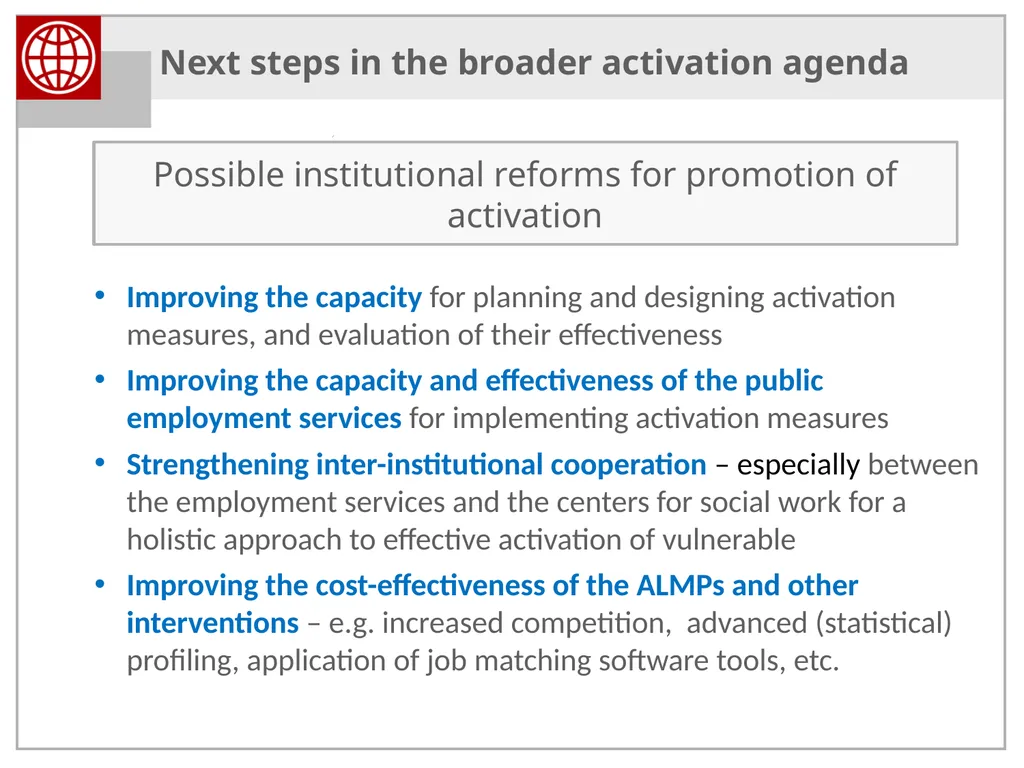
Next steps in the broader activation agenda Improving the capacity for planning and designing activation measures, and evaluation of their effectiveness
Improving the capacity and effectiveness of the public employment services for implementing activation measures
Strengthening inter-institutional cooperation – especially between the employment services and the centers for social work for a holistic approach to effective activation of vulnerable
Improving the cost-effectiveness of the ALMPs and other interventions – e.g. increased competition, advanced (statistical) profiling, application of job matching software tools, etc. Possible institutional reforms for promotion of activation<br>
Improving the capacity and effectiveness of the public employment services for implementing activation measures
Strengthening inter-institutional cooperation – especially between the employment services and the centers for social work for a holistic approach to effective activation of vulnerable
Improving the cost-effectiveness of the ALMPs and other interventions – e.g. increased competition, advanced (statistical) profiling, application of job matching software tools, etc. Possible institutional reforms for promotion of activation<br>
39
THANK YOU! Boryana Gotcheva bgotcheva@worldbank.org
Aylin Isik-Dikmelik aisikdikmelik@worldbank.org<br>
40
Latent Class Analysis: SERBIA Source: Calculations from MOP/FSA Beneficiaries Survey 2011.<br>