
Activity 2.2.10 Government Conclusion for Internal
TA
Published · 42 slides · 0 views

1 / 1



Description
Activity 2.2.10 Government Conclusion for Internal audit function Annual Report on the Functioning of the 2020 Public Internal Financial Control System. 2. All ministries are entrusted, to submit to the Government, a Plan for Organization
Related Topics
Share
Embed code
Download this presentation From Below
"Activity 2.2.10 Government Conclusion for Internal" is the property of its rightful owner. Permission is granted to download and print the materials on this website for personal, non-commercial use only, and to display it on your personal computer provided you do not modify the materials and that you retain all copyright notices contained in the materials. By downloading content from our website, you accept the terms of this agreement.
Presentation Transcript
01
Activity 2.2.10 Government Conclusion for Internal audit function<br>
02
Annual Report on the Functioning of the 2020 Public Internal Financial Control System.
2. All ministries are entrusted, to submit to the Government, a Plan for Organization of the Internal Audit, being prepared on the basis of carried out functional analysis of the ministry as parent budget user, having in mind the number of employees and the budget of the ministry itself, the affiliated bodies , the second line budget users and the public enterprises and state-owned joint stock companies under their competence, wherein they will have to perform internal audit, if they do not have their own internal audit unit or if in case the unit is non-functional. 2<br>
2. All ministries are entrusted, to submit to the Government, a Plan for Organization of the Internal Audit, being prepared on the basis of carried out functional analysis of the ministry as parent budget user, having in mind the number of employees and the budget of the ministry itself, the affiliated bodies , the second line budget users and the public enterprises and state-owned joint stock companies under their competence, wherein they will have to perform internal audit, if they do not have their own internal audit unit or if in case the unit is non-functional. 2<br>
03
Annual Report on the Functioning of the 2020 Public Internal Financial Control System 3. Upon approving the Plan for Organization of Internal Audit by the Government, based on the previously received positive opinion by the Ministry of Finance,
the ministries should make modifications and amendments to the acts for organization and systematization as regards the internal audit units, the staffing of which should be completed by 31st December 2022. 3<br>
the ministries should make modifications and amendments to the acts for organization and systematization as regards the internal audit units, the staffing of which should be completed by 31st December 2022. 3<br>
04
Annual Report on the Functioning of the 2020 Public Internal Financial Control System 4. Ministries, whose internal audit units have neither head nor internal auditors (Ministry of Culture, Ministry of Economy, Ministry of Information Society and Administration and Ministry of Political System and Inter-Community Relations) are entrusted with staffing the internal audit units by 31st January 2022 with at least two internal auditors. 4<br>
05
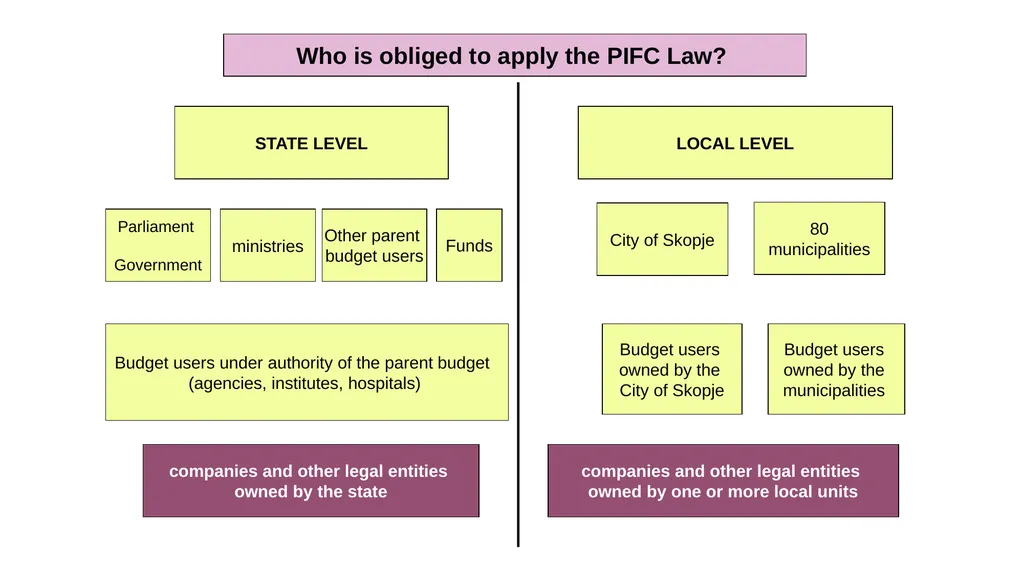
Who is obliged to apply the PIFC Law? STATE LEVEL ministries Funds Budget users under authority of the parent budget
(agencies, institutes, hospitals) LOCAL LEVEL Other parent
budget users companies and other legal entities
owned by the state companies and other legal entities
owned by one or more local units City of Skopje 80
municipalities Parliament
Government Budget users
owned by the
City of Skopje Budget users
owned by the
municipalities<br>
(agencies, institutes, hospitals) LOCAL LEVEL Other parent
budget users companies and other legal entities
owned by the state companies and other legal entities
owned by one or more local units City of Skopje 80
municipalities Parliament
Government Budget users
owned by the
City of Skopje Budget users
owned by the
municipalities<br>
06
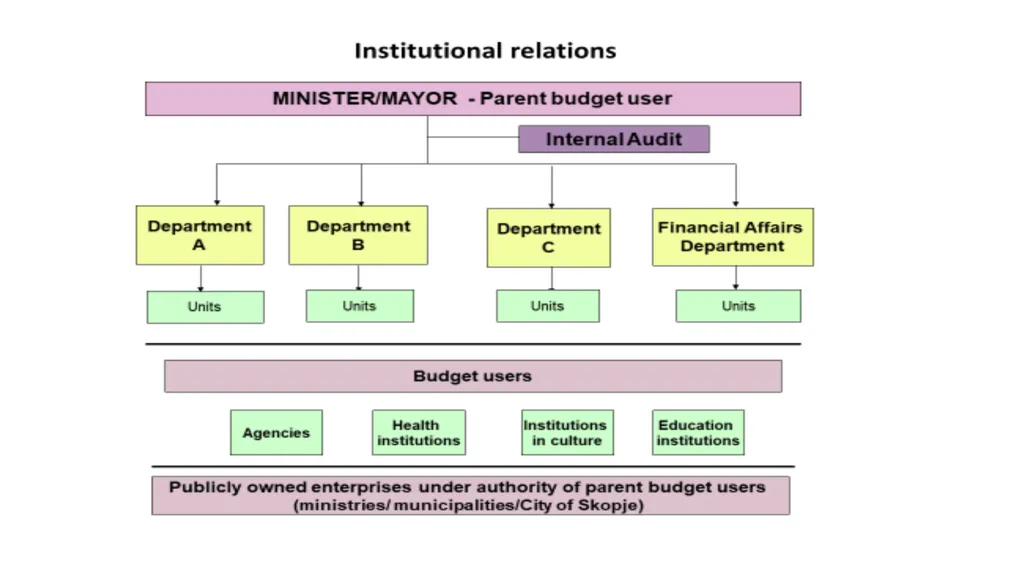
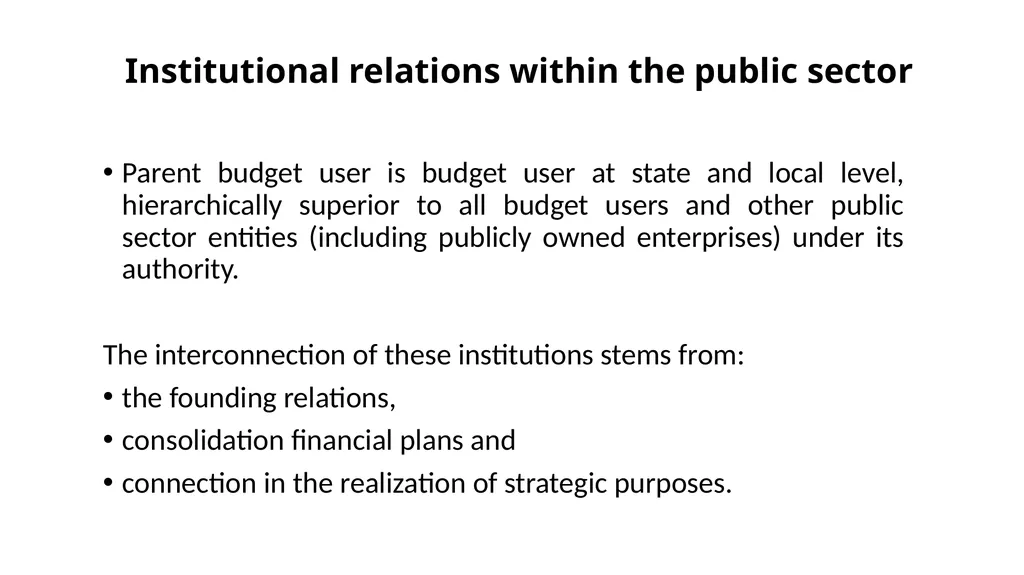
Institutional relations within the public sector Parent budget user is budget user at state and local level, hierarchically superior to all budget users and other public sector entities (including publicly owned enterprises) under its authority.
The interconnection of these institutions stems from:
the founding relations,
consolidation financial plans and
connection in the realization of strategic purposes.<br>
The interconnection of these institutions stems from:
the founding relations,
consolidation financial plans and
connection in the realization of strategic purposes.<br>
07
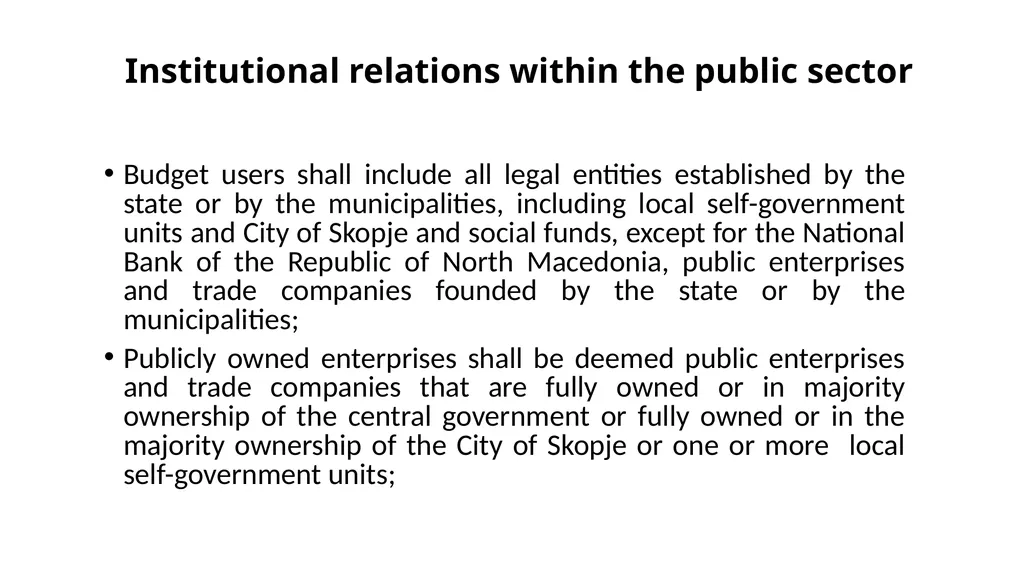
Institutional relations within the public sector Budget users shall include all legal entities established by the state or by the municipalities, including local self-government units and City of Skopje and social funds, except for the National Bank of the Republic of North Macedonia, public enterprises and trade companies founded by the state or by the municipalities;
Publicly owned enterprises shall be deemed public enterprises and trade companies that are fully owned or in majority ownership of the central government or fully owned or in the majority ownership of the City of Skopje or one or more local self-government units;<br>
Publicly owned enterprises shall be deemed public enterprises and trade companies that are fully owned or in majority ownership of the central government or fully owned or in the majority ownership of the City of Skopje or one or more local self-government units;<br>
08
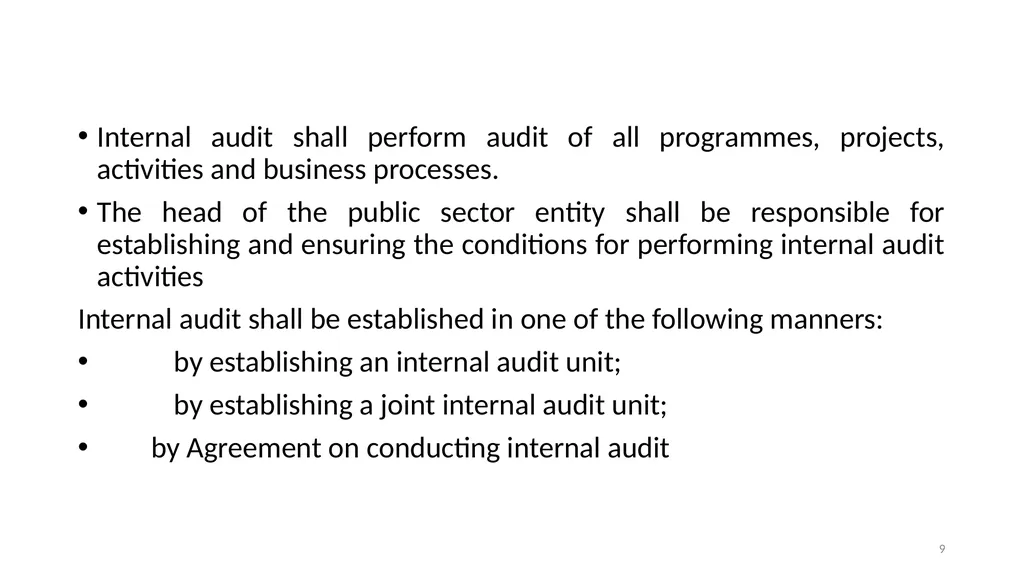
Internal audit shall perform audit of all programmes, projects, activities and business processes.
The head of the public sector entity shall be responsible for establishing and ensuring the conditions for performing internal audit activities
Internal audit shall be established in one of the following manners:
by establishing an internal audit unit;
by establishing a joint internal audit unit;
by Agreement on conducting internal audit 9<br>
The head of the public sector entity shall be responsible for establishing and ensuring the conditions for performing internal audit activities
Internal audit shall be established in one of the following manners:
by establishing an internal audit unit;
by establishing a joint internal audit unit;
by Agreement on conducting internal audit 9<br>
09
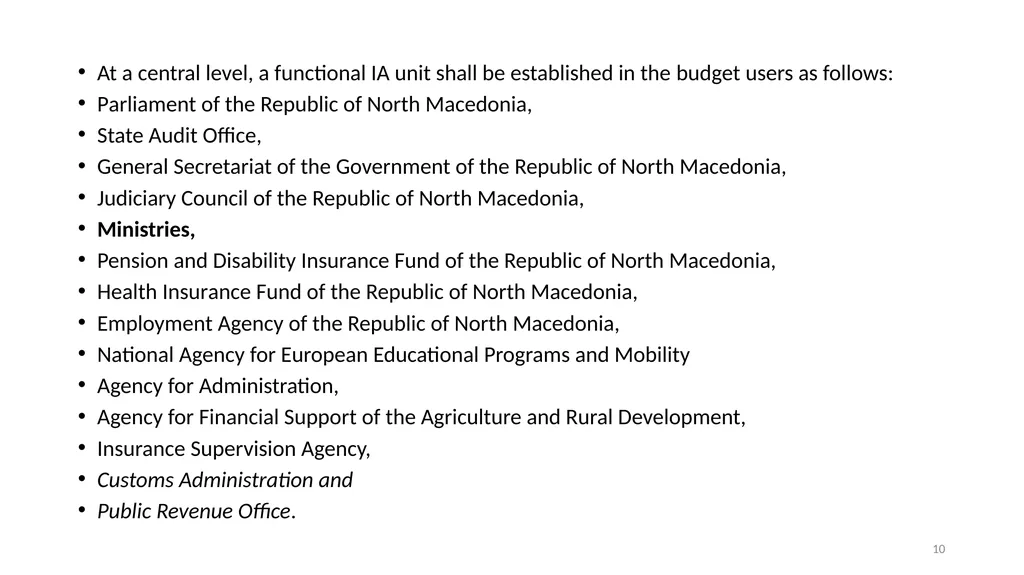
At a central level, a functional IA unit shall be established in the budget users as follows:
Раrliаmеnt of the Republic of North Macedonia,
State Audit Office,
General Secretariat of the Government of the Republic of North Macedonia,
Judiсiаrу Соunсil of the Republic of North Macedonia,
Ministries,
Pension and Disability Insurance Fund of the Republic of North Macedonia,
Неаlth Insurаnсе Fund of the Republic of North Macedonia,
Employment Agency of the Republic of North Macedonia,
National Agency for European Educational Programs and Mobility
Agency for Administration,
Agency for Financial Support of the Agriculture and Rural Development,
Insurance Supervision Agency,
Customs Administration and
Public Revenue Office. 10<br>
Раrliаmеnt of the Republic of North Macedonia,
State Audit Office,
General Secretariat of the Government of the Republic of North Macedonia,
Judiсiаrу Соunсil of the Republic of North Macedonia,
Ministries,
Pension and Disability Insurance Fund of the Republic of North Macedonia,
Неаlth Insurаnсе Fund of the Republic of North Macedonia,
Employment Agency of the Republic of North Macedonia,
National Agency for European Educational Programs and Mobility
Agency for Administration,
Agency for Financial Support of the Agriculture and Rural Development,
Insurance Supervision Agency,
Customs Administration and
Public Revenue Office. 10<br>
10
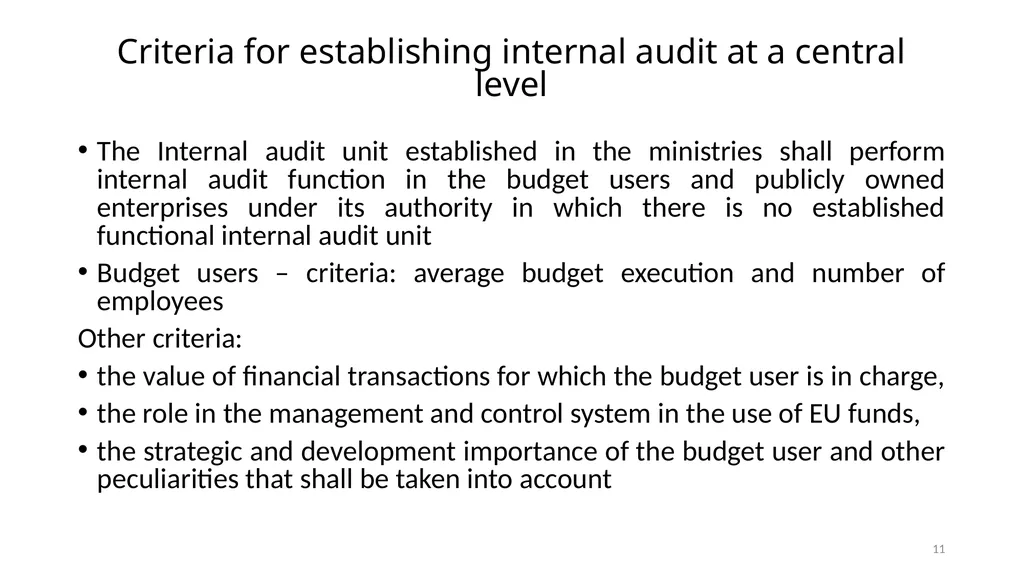
Criteria for establishing internal audit at a central level The Internal audit unit established in the ministries shall perform internal audit function in the budget users and publicly owned enterprises under its authority in which there is no established functional internal audit unit
Budget users – criteria: average budget execution and number of employees
Other criteria:
the value of financial transactions for which the budget user is in charge,
the role in the management and control system in the use of EU funds,
the strategic and development importance of the budget user and other peculiarities that shall be taken into account 11<br>
Budget users – criteria: average budget execution and number of employees
Other criteria:
the value of financial transactions for which the budget user is in charge,
the role in the management and control system in the use of EU funds,
the strategic and development importance of the budget user and other peculiarities that shall be taken into account 11<br>
11
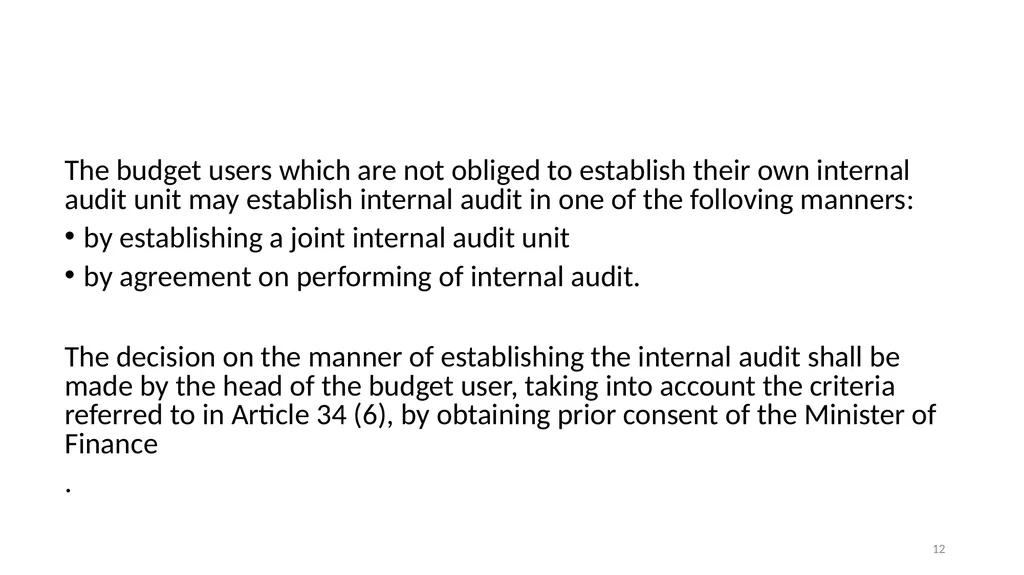
The budget users which are not obliged to establish their own internal audit unit may establish internal audit in one of the folloving manners:
by establishing a joint internal audit unit
by agreement on performing of internal audit.
The decision on the manner of establishing the internal audit shall be made by the head of the budget user, taking into account the criteria referred to in Article 34 (6), by obtaining prior consent of the Minister of Finance
. 12<br>
by establishing a joint internal audit unit
by agreement on performing of internal audit.
The decision on the manner of establishing the internal audit shall be made by the head of the budget user, taking into account the criteria referred to in Article 34 (6), by obtaining prior consent of the Minister of Finance
. 12<br>
12
The joint Internal Audit Unit referred to in Article 36 paragraph (1), line 1 of this Law shall be established as an independent internal organizational unit within one of the budget users. The funding and other issues important for the work of the joint internal audit unit shall be regulated by an agreement on mutual relations between the budget users for which internal audit work is performed.
(2) The joint internal audit unit must have at least two internal auditors, including the head of internal audit. 13<br>
(2) The joint internal audit unit must have at least two internal auditors, including the head of internal audit. 13<br>
13
Agreement on performing internal audit The internal audit function shall be established by an agreement on performing internal audit with the public sector entity which has established an internal audit unit or with a certified internal auditor listed in the register of internal auditors.
The agreement on performing the internal audit shall be signed by the proposer of the agreement and the public sector entity or certified internal auditor and it shall be submitted to the Central Harmonisation Unit within 15 days of its signing. 14<br>
The agreement on performing the internal audit shall be signed by the proposer of the agreement and the public sector entity or certified internal auditor and it shall be submitted to the Central Harmonisation Unit within 15 days of its signing. 14<br>
14
Government - owned enterprises with an average revenue of at least 500 million denars in the last three years and at least 50 employees shall be obliged to establish its own internal audit unit.
Government -owned enterprises which do not fullfil the criteria shall be covered by internal audit function established on the level of its parent budget user. 15<br>
Government -owned enterprises which do not fullfil the criteria shall be covered by internal audit function established on the level of its parent budget user. 15<br>
15
Minimum number of employees in Internal audit units The head of the public sector entity shall establish an internal audit unit in line with the following criteria:
with at least one (1) internal auditor and head of internal audit unit if thе average budgеt execution/financial plan in the public sector entity is between 100 and 500 milion denars in the last three years, and number of employees is at least 50.
with at least two (2) internal auditors and a head of internal audit unit if the average execution in the public sector entity is between 500 million denars and 2 billion denars in the last three years, and the number of employees is at least 80.
with at least three (3) internal auditors and a head of internal audit unit, if the average execution in the public sector entity is more than 2 billion denars in the last three years, and number of employees is at least 150.
The number of internal auditors may be higher than the minimum and it shall be determined by each public sector entity, taking into account the scope of work and objectives set, the number of public sector entities for which internal audit is performed, the number of employees and the financial resources available to the public sector entity. 16<br>
with at least one (1) internal auditor and head of internal audit unit if thе average budgеt execution/financial plan in the public sector entity is between 100 and 500 milion denars in the last three years, and number of employees is at least 50.
with at least two (2) internal auditors and a head of internal audit unit if the average execution in the public sector entity is between 500 million denars and 2 billion denars in the last three years, and the number of employees is at least 80.
with at least three (3) internal auditors and a head of internal audit unit, if the average execution in the public sector entity is more than 2 billion denars in the last three years, and number of employees is at least 150.
The number of internal auditors may be higher than the minimum and it shall be determined by each public sector entity, taking into account the scope of work and objectives set, the number of public sector entities for which internal audit is performed, the number of employees and the financial resources available to the public sector entity. 16<br>
16
7.
Key actors in the coordination and development of FMC at public sector level 17<br>
17
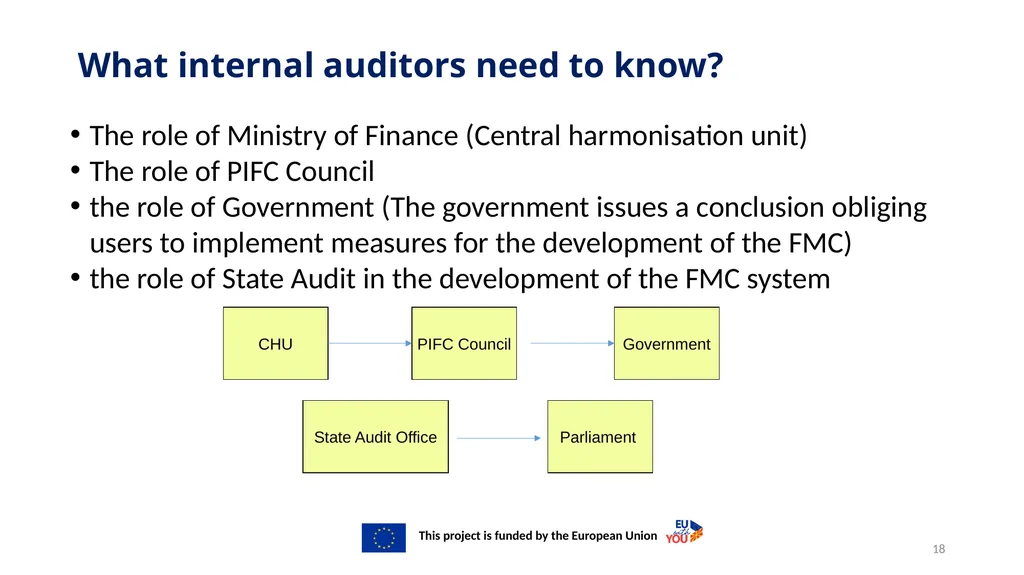
What internal auditors need to know? The role of Ministry of Finance (Central harmonisation unit)
The role of PIFC Council
the role of Government (The government issues a conclusion obliging users to implement measures for the development of the FMC)
the role of State Audit in the development of the FMC system 18 State Audit Office Parliament CHU PIFC Council Government<br>
The role of PIFC Council
the role of Government (The government issues a conclusion obliging users to implement measures for the development of the FMC)
the role of State Audit in the development of the FMC system 18 State Audit Office Parliament CHU PIFC Council Government<br>
18
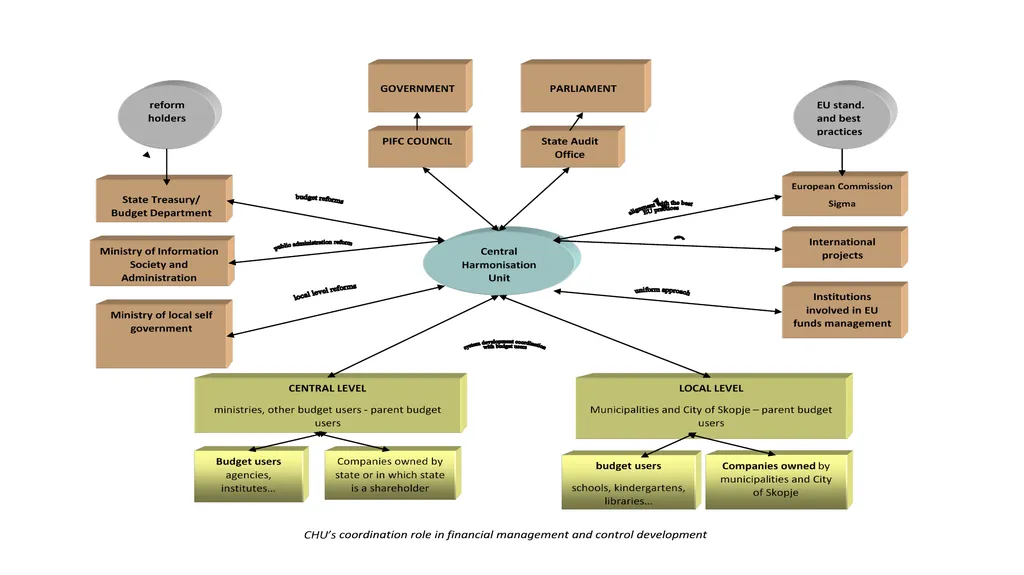
The role of the Central Harmonisation Unit preparation of laws and by-laws in the field of FMC and internal audit,
coordination of the development of PIFC system with ministries competent for administrative reforms and other public sector entities,
preparing methodology and standards for development of FMC and internal audit,
coordination of trainings for managers and persons involved in the coordination of the development of FMC and internal audit
preparing the Consolidated annual report on functioning of PIFC system,
establishing and maintaining the register of the internal audit units, internal auditors and certified internal auditors for the public sector,
establishing and maintaining the register of organizational units for financial matters and heads of organizational units for financial matters,
performing quality review of the development of the internal control system for the purpose of appropriate monitoring of the development within the budget users and gathering information for improvement,
performing the quality checks of internal audit activities.<br>
coordination of the development of PIFC system with ministries competent for administrative reforms and other public sector entities,
preparing methodology and standards for development of FMC and internal audit,
coordination of trainings for managers and persons involved in the coordination of the development of FMC and internal audit
preparing the Consolidated annual report on functioning of PIFC system,
establishing and maintaining the register of the internal audit units, internal auditors and certified internal auditors for the public sector,
establishing and maintaining the register of organizational units for financial matters and heads of organizational units for financial matters,
performing quality review of the development of the internal control system for the purpose of appropriate monitoring of the development within the budget users and gathering information for improvement,
performing the quality checks of internal audit activities.<br>
19
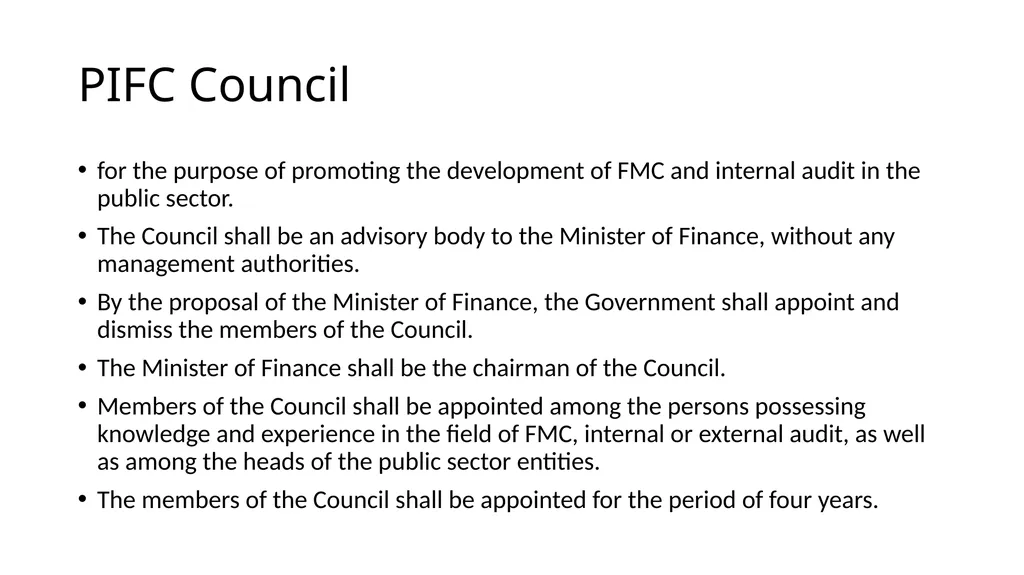
PIFC Council for the purpose of promoting the development of FMC and internal audit in the public sector.
The Council shall be an advisory body to the Minister of Finance, without any management authorities.
By the proposal of the Minister of Finance, the Government shall appoint and dismiss the members of the Council.
The Minister of Finance shall be the chairman of the Council.
Members of the Council shall be appointed among the persons possessing knowledge and experience in the field of FMC, internal or external audit, as well as among the heads of the public sector entities.
The members of the Council shall be appointed for the period of four years.<br>
The Council shall be an advisory body to the Minister of Finance, without any management authorities.
By the proposal of the Minister of Finance, the Government shall appoint and dismiss the members of the Council.
The Minister of Finance shall be the chairman of the Council.
Members of the Council shall be appointed among the persons possessing knowledge and experience in the field of FMC, internal or external audit, as well as among the heads of the public sector entities.
The members of the Council shall be appointed for the period of four years.<br>
20
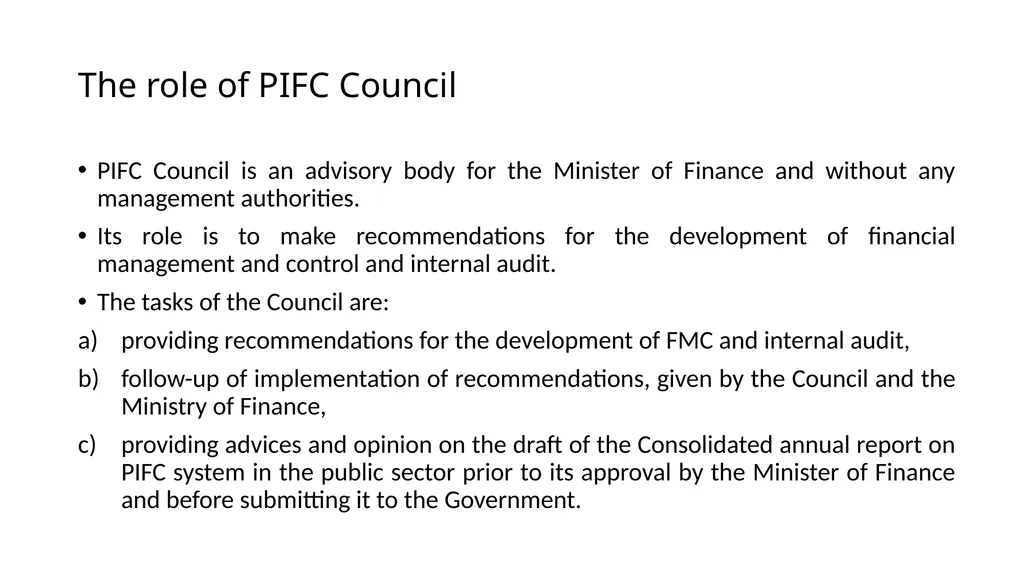
The role of PIFC Council PIFC Council is an advisory body for the Minister of Finance and without any management authorities.
Its role is to make recommendations for the development of financial management and control and internal audit.
The tasks of the Council are:
providing recommendations for the development of FMC and internal audit,
follow-up of implementation of recommendations, given by the Council and the Ministry of Finance,
providing advices and opinion on the draft of the Consolidated annual report on PIFC system in the public sector prior to its approval by the Minister of Finance and before submitting it to the Government.<br>
Its role is to make recommendations for the development of financial management and control and internal audit.
The tasks of the Council are:
providing recommendations for the development of FMC and internal audit,
follow-up of implementation of recommendations, given by the Council and the Ministry of Finance,
providing advices and opinion on the draft of the Consolidated annual report on PIFC system in the public sector prior to its approval by the Minister of Finance and before submitting it to the Government.<br>
21
8.
Key actors in the development of FMC in public sector entities<br>
22
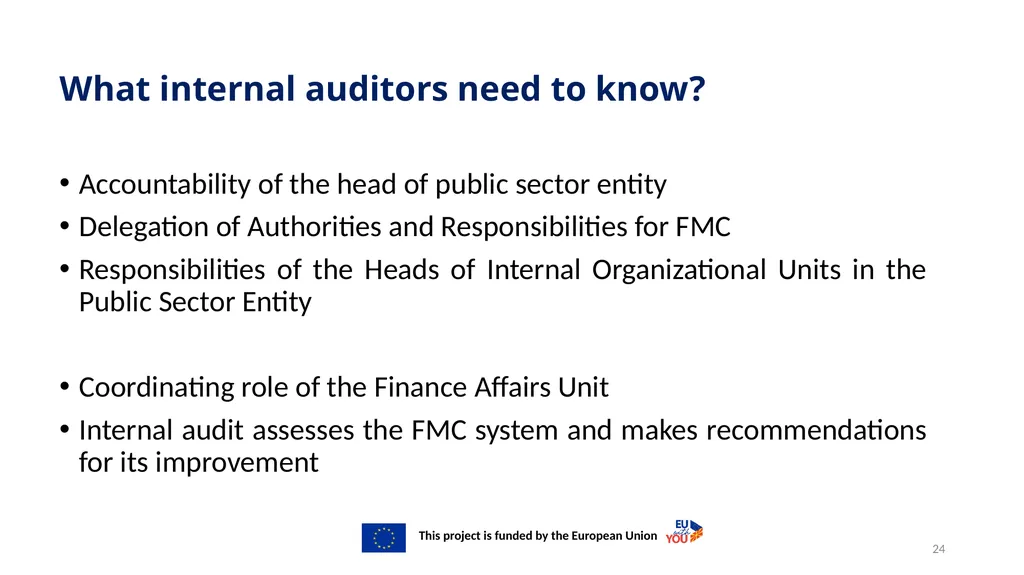
Accountability of the head of public sector entity
Delegation of Authorities and Responsibilities for FMC
Responsibilities of the Heads of Internal Organizational Units in the Public Sector Entity
Coordinating role of the Finance Affairs Unit
Internal audit assesses the FMC system and makes recommendations for its improvement 24 What internal auditors need to know?<br>
Delegation of Authorities and Responsibilities for FMC
Responsibilities of the Heads of Internal Organizational Units in the Public Sector Entity
Coordinating role of the Finance Affairs Unit
Internal audit assesses the FMC system and makes recommendations for its improvement 24 What internal auditors need to know?<br>
23
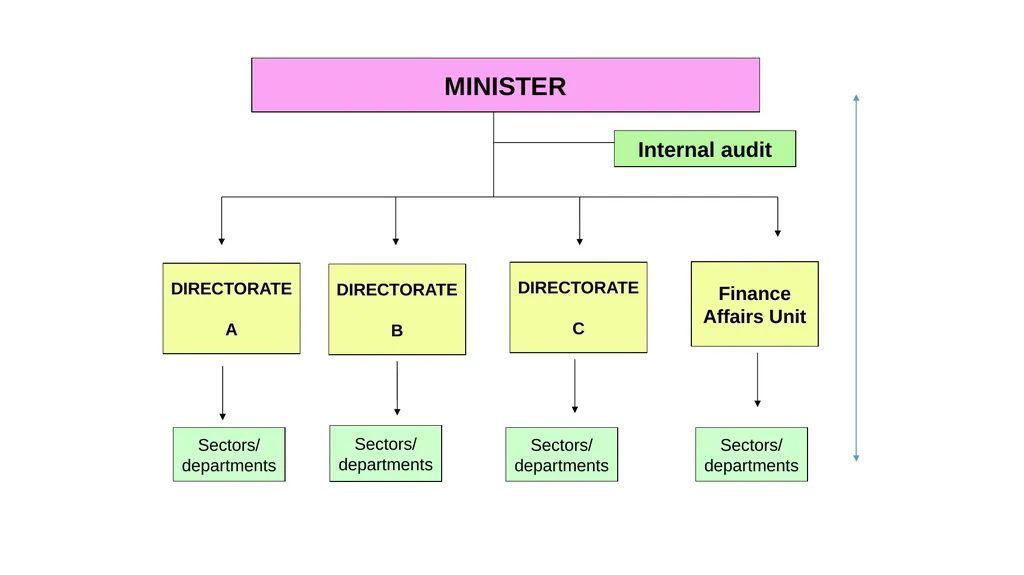
MINISTER DIRECTORATE
A Sectors/
departments Finance
Affairs Unit Internal audit DIRECTORATE
B DIRECTORATE
C Sectors/
departments Sectors/
departments Sectors/
departments<br>
A Sectors/
departments Finance
Affairs Unit Internal audit DIRECTORATE
B DIRECTORATE
C Sectors/
departments Sectors/
departments Sectors/
departments<br>
24
Accountability of the head of public sector entity preparation and implementation of strategic and other plans, as well as programmes for achieving the objectives,
compliance of strategic and other plans and programmes with the financial plan;
internal organization that should be in line with tasks, with clearly defined authorities and responsibilities for efficient and effective implementation of objectives and use of allocated financial funds;
establishment of a reporting system in accordance with delegated authorities and responsibilities for the purpose of monitoring of results and effects achieved with given funds,
risk management;
setting up controls to ensure the proper, ethical, economical, efficient and effective management of revenues/inflows, expenditures/outflows, assets and obligations;
establishment of efficient and effective information and communication systems, including accounting system,
monitoring and assessment of efficiency and effectiveness of the internal control system.<br>
compliance of strategic and other plans and programmes with the financial plan;
internal organization that should be in line with tasks, with clearly defined authorities and responsibilities for efficient and effective implementation of objectives and use of allocated financial funds;
establishment of a reporting system in accordance with delegated authorities and responsibilities for the purpose of monitoring of results and effects achieved with given funds,
risk management;
setting up controls to ensure the proper, ethical, economical, efficient and effective management of revenues/inflows, expenditures/outflows, assets and obligations;
establishment of efficient and effective information and communication systems, including accounting system,
monitoring and assessment of efficiency and effectiveness of the internal control system.<br>
25
Accountability of the head of public sector entity Draft new PIFC Law
The head of the parent budget user shall regulate the manner of cooperation and reporting with the budget users and publicly owned enterprises under authority thereof.
The head of the budget user in performing the activities shall adhere to the procedures and instructions issued by the parent budget user.<br>
The head of the parent budget user shall regulate the manner of cooperation and reporting with the budget users and publicly owned enterprises under authority thereof.
The head of the budget user in performing the activities shall adhere to the procedures and instructions issued by the parent budget user.<br>
26
Delegation of authorities and responsibilities The head of the entity may delegate authorities and responsibilities which does not exclude the head from ultimate acountability.
The ultimate accountability of the head cannot be a justification, i.e. does not free from accountability the other managers in part of their responsibility
For a good setup of the accountability system it is of crucial importance to clearly define authorities and responsibilities not only for the execution of key functions, but also for achievement of set objectives, results, and manners of budget funds management.
When delegating authorities and responsibilities, the principle of segregation of duties shall be applied in a manner that does not allow an official to be at the same time responsible for: approval of undertaking financial commitments), approval of payment execution and accounting.<br>
The ultimate accountability of the head cannot be a justification, i.e. does not free from accountability the other managers in part of their responsibility
For a good setup of the accountability system it is of crucial importance to clearly define authorities and responsibilities not only for the execution of key functions, but also for achievement of set objectives, results, and manners of budget funds management.
When delegating authorities and responsibilities, the principle of segregation of duties shall be applied in a manner that does not allow an official to be at the same time responsible for: approval of undertaking financial commitments), approval of payment execution and accounting.<br>
27
Responsibilities of the heads of internal organizational units setting objectives that must be aligned with the set objectives and funds at the entity level;
identifying performance indicators for monitoring and reporting on achieved results;
achieving objectives in accordance with strategic and other plans and programmes, approved financial plan and relevant laws and other regulations;
risk management which could have an impact on the realization of objectives;
development and implementation of control activites in business processes, programmes, projects and activities in order to achieve objectives of the organizational unit and to ensure proper, ethical, economical, effective and efficient management of financial funds alocated to the organisational unit;
monitoring and evaluation of achieved results and effects
constant monitoring and self-assessment of the efficiency and effectiveness of FMC
continuous improvement of processes for achieving better efficiency and effectiveness.<br>
identifying performance indicators for monitoring and reporting on achieved results;
achieving objectives in accordance with strategic and other plans and programmes, approved financial plan and relevant laws and other regulations;
risk management which could have an impact on the realization of objectives;
development and implementation of control activites in business processes, programmes, projects and activities in order to achieve objectives of the organizational unit and to ensure proper, ethical, economical, effective and efficient management of financial funds alocated to the organisational unit;
monitoring and evaluation of achieved results and effects
constant monitoring and self-assessment of the efficiency and effectiveness of FMC
continuous improvement of processes for achieving better efficiency and effectiveness.<br>
28
Responsibilities of the heads of internal organizational units The heads of the internal organizational units in the parent budget user shall cooperate with the budget users under authority thereof.
In terms of FMC, a coordinated approach between parent budget user and other institution under its authority, implies a clear set up of:
authorities and responsibilities;
modes of cooperation;
modes of reporting;
supervising functions exercised by the parent budget users over the budget users and other entities under its authority.
The heads of the internal organizational units in the budget users shall be responsible to the head of the budget user for the development of FMC in a manner appropriate to the scope of business, following the instructions and guidelines of the parent budget user.<br>
In terms of FMC, a coordinated approach between parent budget user and other institution under its authority, implies a clear set up of:
authorities and responsibilities;
modes of cooperation;
modes of reporting;
supervising functions exercised by the parent budget users over the budget users and other entities under its authority.
The heads of the internal organizational units in the budget users shall be responsible to the head of the budget user for the development of FMC in a manner appropriate to the scope of business, following the instructions and guidelines of the parent budget user.<br>
29
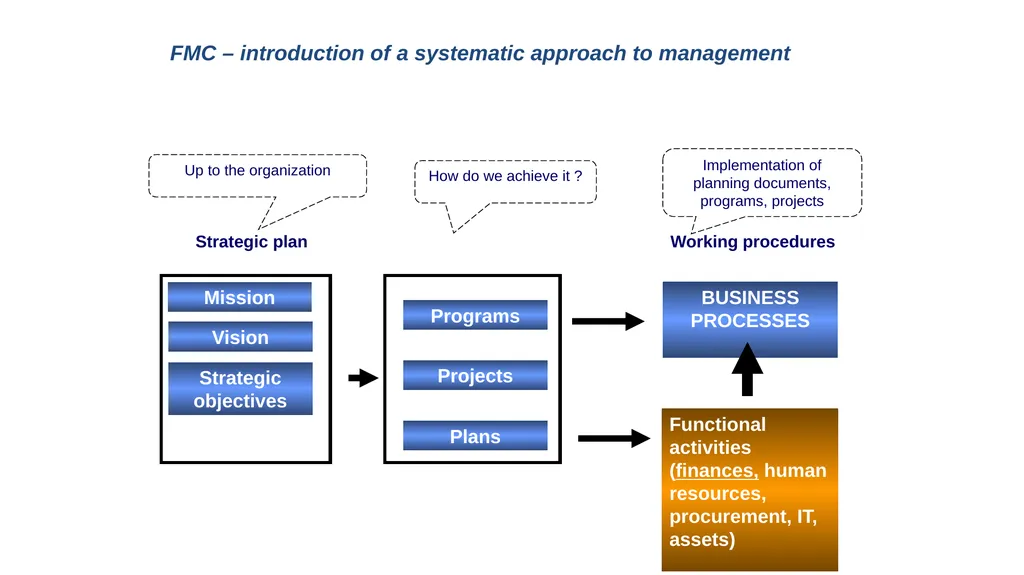
FMC – introduction of a systematic approach to management BUSINESS PROCESSES Functional activities
(finances, human resources, procurement, IT, assets) Mission Vision Strategic objectives Strategic plan Programs Projects Plans How do we achieve it ? Up to the organization Implementation of planning documents, programs, projects Working procedures<br>
(finances, human resources, procurement, IT, assets) Mission Vision Strategic objectives Strategic plan Programs Projects Plans How do we achieve it ? Up to the organization Implementation of planning documents, programs, projects Working procedures<br>
30
Link between the FMC and budget system FMC is in the function of ensuring proper, ethical, economical, efficient and effective management of budget funds.
Does the existing system of internal controls in your institution provide the above?<br>
Does the existing system of internal controls in your institution provide the above?<br>
31
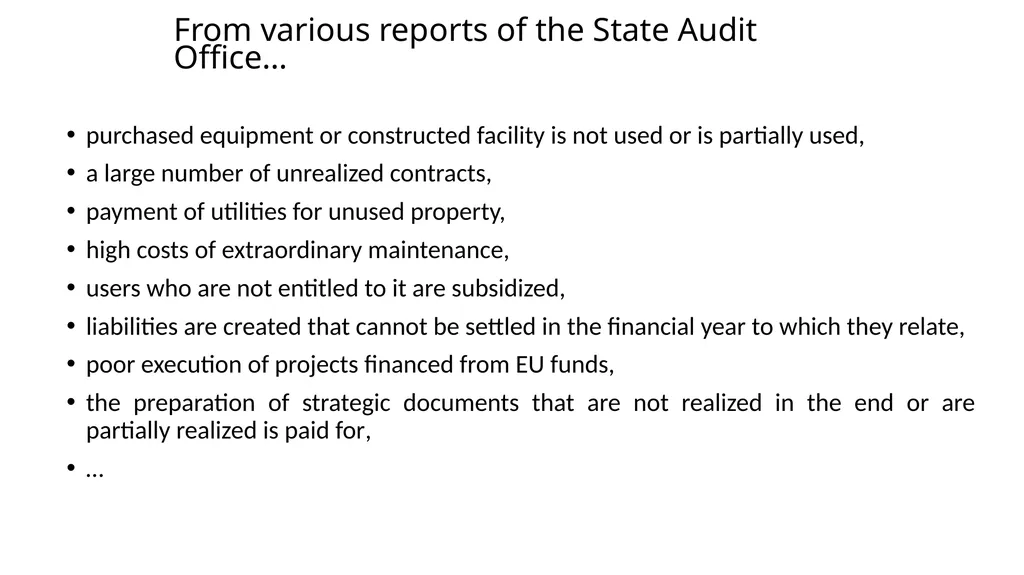
From various reports of the State Audit Office… purchased equipment or constructed facility is not used or is partially used,
a large number of unrealized contracts,
payment of utilities for unused property,
high costs of extraordinary maintenance,
users who are not entitled to it are subsidized,
liabilities are created that cannot be settled in the financial year to which they relate,
poor execution of projects financed from EU funds,
the preparation of strategic documents that are not realized in the end or are partially realized is paid for,
…<br>
a large number of unrealized contracts,
payment of utilities for unused property,
high costs of extraordinary maintenance,
users who are not entitled to it are subsidized,
liabilities are created that cannot be settled in the financial year to which they relate,
poor execution of projects financed from EU funds,
the preparation of strategic documents that are not realized in the end or are partially realized is paid for,
…<br>
32
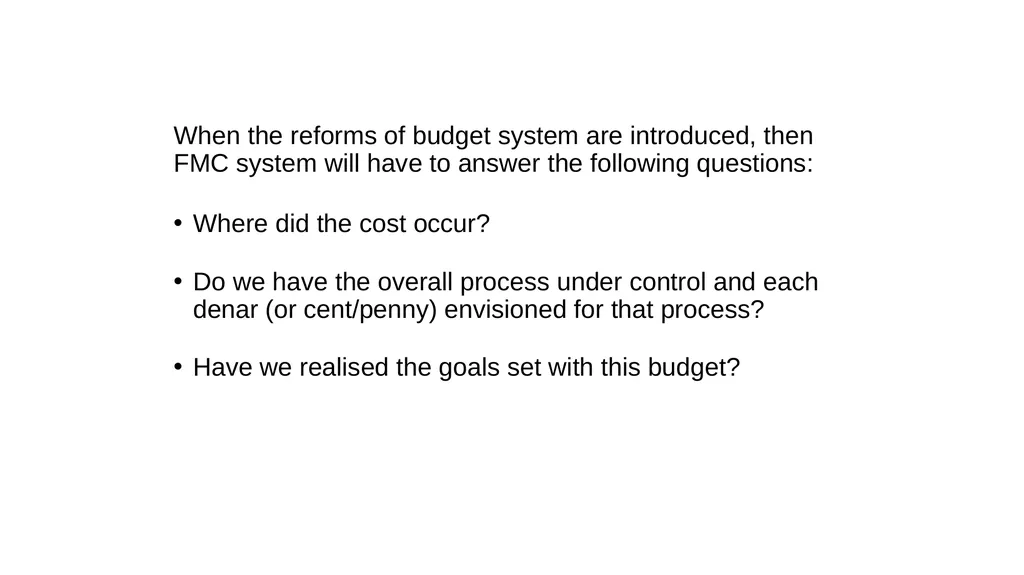
When the reforms of budget system are introduced, then FMC system will have to answer the following questions:
Where did the cost occur?
Do we have the overall process under control and each denar (or cent/penny) envisioned for that process?
Have we realised the goals set with this budget?<br>
Where did the cost occur?
Do we have the overall process under control and each denar (or cent/penny) envisioned for that process?
Have we realised the goals set with this budget?<br>
33
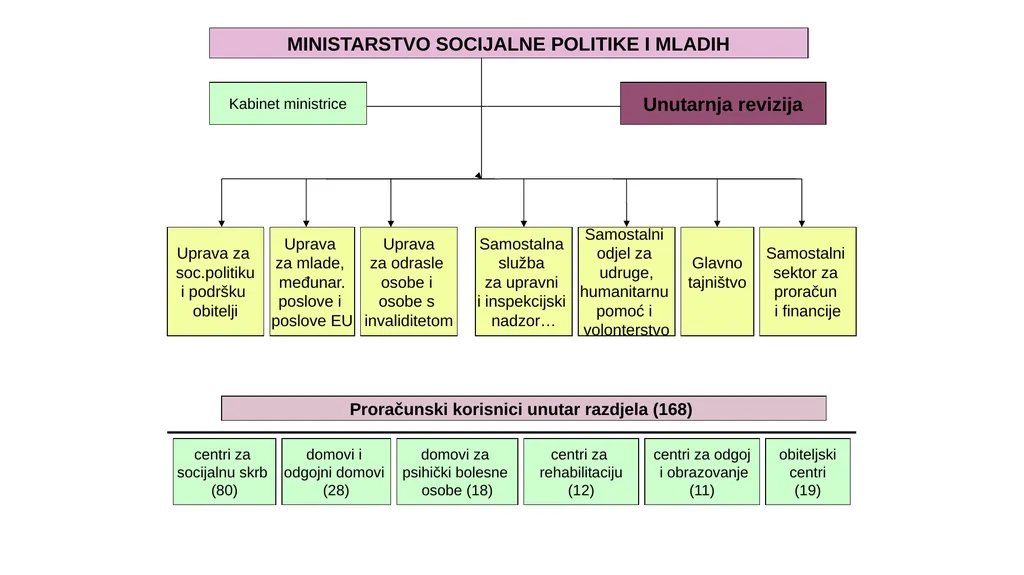
MINISTARSTVO SOCIJALNE POLITIKE I MLADIH Uprava za
soc.politiku
i podršku
obitelji Uprava
za mlade,
međunar.
poslove i
poslove EU Samostalni
sektor za
proračun
i financije Unutarnja revizija centri za
socijalnu skrb
(80) centri za odgoj
i obrazovanje
(11) Proračunski korisnici unutar razdjela (168) Glavno
tajništvo domovi i
odgojni domovi
(28) obiteljski
centri
(19) centri za
rehabilitaciju
(12) domovi za
psihički bolesne
osobe (18) Kabinet ministrice Uprava
za odrasle
osobe i
osobe s
invaliditetom Samostalna
služba
za upravni
i inspekcijski
nadzor… Samostalni
odjel za
udruge,
humanitarnu
pomoć i
volonterstvo<br>
soc.politiku
i podršku
obitelji Uprava
za mlade,
međunar.
poslove i
poslove EU Samostalni
sektor za
proračun
i financije Unutarnja revizija centri za
socijalnu skrb
(80) centri za odgoj
i obrazovanje
(11) Proračunski korisnici unutar razdjela (168) Glavno
tajništvo domovi i
odgojni domovi
(28) obiteljski
centri
(19) centri za
rehabilitaciju
(12) domovi za
psihički bolesne
osobe (18) Kabinet ministrice Uprava
za odrasle
osobe i
osobe s
invaliditetom Samostalna
služba
za upravni
i inspekcijski
nadzor… Samostalni
odjel za
udruge,
humanitarnu
pomoć i
volonterstvo<br>
34
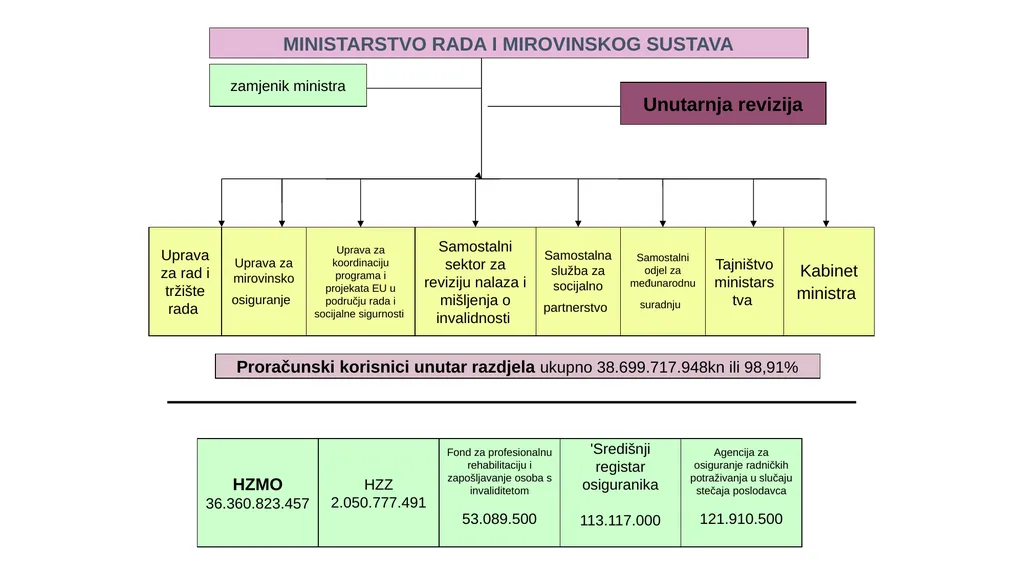
MINISTARSTVO RADA I MIROVINSKOG SUSTAVA Uprava za rad i tržište rada Uprava za mirovinsko osiguranje Tajništvo ministarstva Unutarnja revizija Samostalni odjel za međunarodnu suradnju Uprava za koordinaciju programa i projekata EU u području rada i socijalne sigurnosti Samostalna služba za socijalno partnerstvo Samostalni sektor za reviziju nalaza i mišljenja o invalidnosti zamjenik ministra Kabinet ministra Proračunski korisnici unutar razdjela ukupno 38.699.717.948kn ili 98,91% HZMO
36.360.823.457 HZZ
2.050.777.491 Fond za profesionalnu rehabilitaciju i zapošljavanje osoba s invaliditetom
53.089.500 'Središnji registar osiguranika
113.117.000 Agencija za osiguranje radničkih potraživanja u slučaju stečaja poslodavca
121.910.500<br>
36.360.823.457 HZZ
2.050.777.491 Fond za profesionalnu rehabilitaciju i zapošljavanje osoba s invaliditetom
53.089.500 'Središnji registar osiguranika
113.117.000 Agencija za osiguranje radničkih potraživanja u slučaju stečaja poslodavca
121.910.500<br>
35
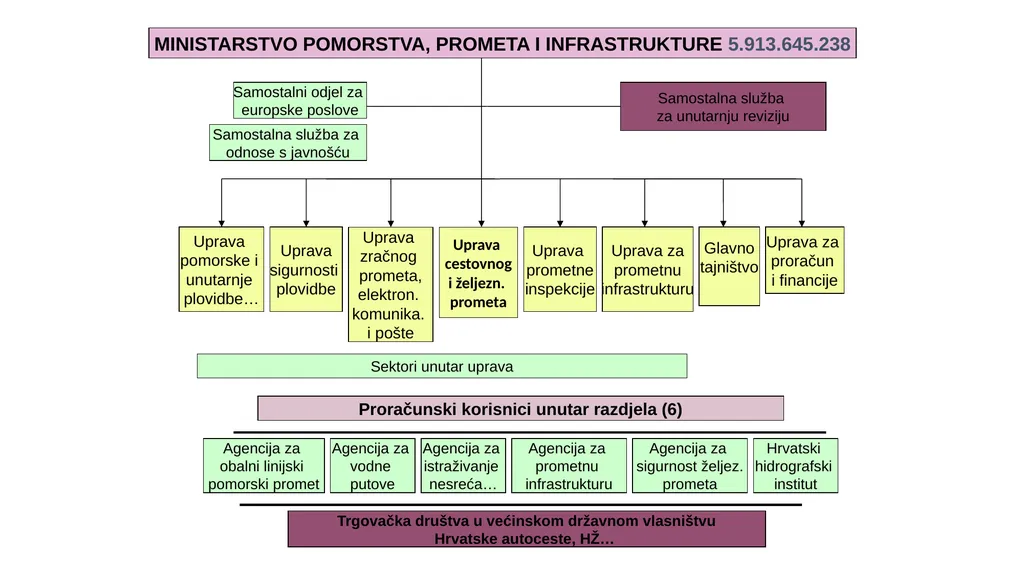
MINISTARSTVO POMORSTVA, PROMETA I INFRASTRUKTURE 5.913.645.238 Uprava
pomorske i
unutarnje
plovidbe… Uprava
sigurnosti
plovidbe Uprava
cestovnog
i željezn.
prometa Uprava za
proračun
i financije Samostalna služba
za unutarnju reviziju Agencija za
obalni linijski
pomorski promet Agencija za
sigurnost željez.
prometa Proračunski korisnici unutar razdjela (6) Trgovačka društva u većinskom državnom vlasništvu
Hrvatske autoceste, HŽ… Glavno
tajništvo Agencija za
vodne
putove Hrvatski
hidrografski
institut Agencija za
prometnu
infrastrukturu Agencija za
istraživanje
nesreća… Samostalni odjel za
europske poslove Uprava
zračnog
prometa,
elektron.
komunika.
i pošte Uprava
prometne
inspekcije Uprava za
prometnu
infrastrukturu Samostalna služba za
odnose s javnošću Sektori unutar uprava<br>
pomorske i
unutarnje
plovidbe… Uprava
sigurnosti
plovidbe Uprava
cestovnog
i željezn.
prometa Uprava za
proračun
i financije Samostalna služba
za unutarnju reviziju Agencija za
obalni linijski
pomorski promet Agencija za
sigurnost željez.
prometa Proračunski korisnici unutar razdjela (6) Trgovačka društva u većinskom državnom vlasništvu
Hrvatske autoceste, HŽ… Glavno
tajništvo Agencija za
vodne
putove Hrvatski
hidrografski
institut Agencija za
prometnu
infrastrukturu Agencija za
istraživanje
nesreća… Samostalni odjel za
europske poslove Uprava
zračnog
prometa,
elektron.
komunika.
i pošte Uprava
prometne
inspekcije Uprava za
prometnu
infrastrukturu Samostalna služba za
odnose s javnošću Sektori unutar uprava<br>
36
Suradnja između jedinica za unutarnju reviziju Jedinica za UR ustrojena u korisniku proračuna razine glave org. klasifikacije, odnosno u proračunskom i izvanproračunskom korisniku JLP(R)S, u obvezi je surađivati s jedinicom za unutarnju reviziju nadležnog ministarstva odnosno s jedinicom za unutarnju reviziju JLP(R)S.
Suradnja uključuje:
koordinaciju izrade strateških i godišnjih planova obavljanja unutarnje revizije
obavljanje horizontalnih i vertikalnih revizija<br>
Suradnja uključuje:
koordinaciju izrade strateških i godišnjih planova obavljanja unutarnje revizije
obavljanje horizontalnih i vertikalnih revizija<br>
37
Organizacija jedinice za unutarnju reviziju – manje institucije ČELNIK Odjel za unutarnju reviziju
VODITELJ ODJELA
VIŠI UNUT. REVIZOR
UNUTARNJI REVIZOR Ustrojstvena jedinica
C Ustrojstvena jedinica
B Ustrojstvena jedinica
A<br>
VODITELJ ODJELA
VIŠI UNUT. REVIZOR
UNUTARNJI REVIZOR Ustrojstvena jedinica
C Ustrojstvena jedinica
B Ustrojstvena jedinica
A<br>
38
Organizacija UR prema revizijskom okruženju Služba za unutarnju reviziju
VODITELJ SLUŽBE Odjel za unutarnju reviziju sustava državne riznice i fondova Europske unije
VODITELJ ODJELA
VIŠI UNUT. REVIZOR
VIŠI UNUT. REVIZOR
UNUTARNJI REVIZOR
POM.UNUTARNJI REVIZOR Odjel za unutarnju reviziju carinskog sustava
VODITELJ ODJELA
VIŠI UNUT. REVIZOR
VIŠI UNUT. REVIZOR
VIŠI UNUT. REVIZOR Odjel za unutarnju reviziju poreznog sustava
VODITELJ ODJELA
VIŠI UNUT. REVIZOR
VIŠI UNUT. REVIZOR
VIŠI UNUT. REVIZOR Administrativni tajnik Npr. Ministarstvo financija<br>
VODITELJ SLUŽBE Odjel za unutarnju reviziju sustava državne riznice i fondova Europske unije
VODITELJ ODJELA
VIŠI UNUT. REVIZOR
VIŠI UNUT. REVIZOR
UNUTARNJI REVIZOR
POM.UNUTARNJI REVIZOR Odjel za unutarnju reviziju carinskog sustava
VODITELJ ODJELA
VIŠI UNUT. REVIZOR
VIŠI UNUT. REVIZOR
VIŠI UNUT. REVIZOR Odjel za unutarnju reviziju poreznog sustava
VODITELJ ODJELA
VIŠI UNUT. REVIZOR
VIŠI UNUT. REVIZOR
VIŠI UNUT. REVIZOR Administrativni tajnik Npr. Ministarstvo financija<br>
39
Organizacija UR prema vrsti revizije/revizijskom okruženju Samostalna služba za unutarnju reviziju
VODITELJ SLUŽBE Odjel za revizije poslovnih sustava i EU fondova
VODITELJ ODJELA
VIŠI UNUTARNJI REVIZOR
… Odjel za revizije veterinarstva i sigurnosti hrane
VODITELJ ODJELA
VIŠI UNUTARNJI REVIZOR
… Npr. Ministarstvo poljoprivrede<br>
VODITELJ SLUŽBE Odjel za revizije poslovnih sustava i EU fondova
VODITELJ ODJELA
VIŠI UNUTARNJI REVIZOR
… Odjel za revizije veterinarstva i sigurnosti hrane
VODITELJ ODJELA
VIŠI UNUTARNJI REVIZOR
… Npr. Ministarstvo poljoprivrede<br>
40
THANK YOU FOR ATTENTION<br>