
Adapted Physical Education 101 Presented by the
T
Published · 26 slides · 0 views
1 / 1
Description
Adapted Physical Education 101 Presented by the NC-APE-Advisory Council Adapted Physical Education is Also known as Specially Designed Physical Education Special education Not a related service Related - PT, OT, Speech A direct service
Related Topics
Share
Embed code
Download this presentation From Below
"Adapted Physical Education 101 Presented by the" is the property of its rightful owner. Permission is granted to download and print the materials on this website for personal, non-commercial use only, and to display it on your personal computer provided you do not modify the materials and that you retain all copyright notices contained in the materials. By downloading content from our website, you accept the terms of this agreement.
Presentation Transcript
01
Adapted Physical
Education 101 Presented by the
NC-APE-Advisory Council<br>
NC-APE-Advisory Council<br>
02
Adapted Physical Education is… Also known as Specially Designed Physical Education
Special education
Not a related service
Related - PT, OT, Speech
A direct service
Just like math, English, science, social studies, etc.
Required by law for students that demonstrate a need for specially designed instruction.<br>
Special education
Not a related service
Related - PT, OT, Speech
A direct service
Just like math, English, science, social studies, etc.
Required by law for students that demonstrate a need for specially designed instruction.<br>
03
Adapted vs. Adaptive Adapted - verb denoting the process of modifying (e.g. they adapted the activity, equipment, or facilities) or an adjective referring to a program or service delivery outcome (e.g. adapted games were used; the program was adapted.
Adaptive - adjective that describes behaviors, skills, or functions.........
Education and service delivery are adapted, behaviors are adaptive.<br>
Adaptive - adjective that describes behaviors, skills, or functions.........
Education and service delivery are adapted, behaviors are adaptive.<br>
04
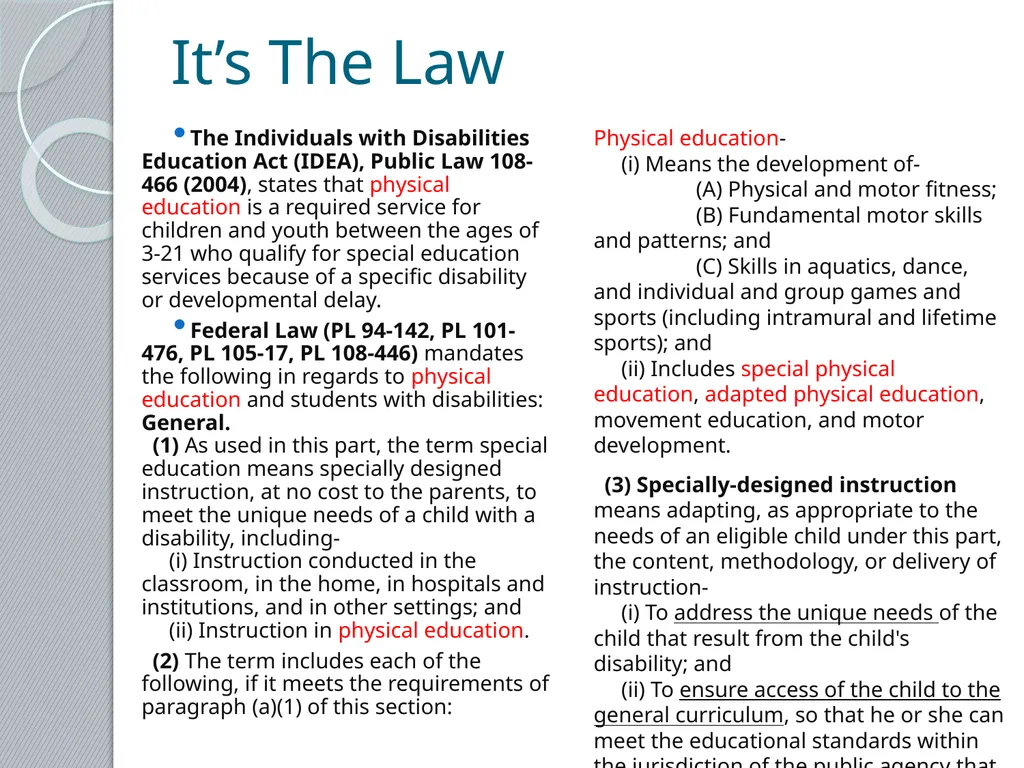
It’s The Law The Individuals with Disabilities Education Act (IDEA), Public Law 108-466 (2004), states that physical education is a required service for children and youth between the ages of 3-21 who qualify for special education services because of a specific disability or developmental delay.
Federal Law (PL 94-142, PL 101-476, PL 105-17, PL 108-446) mandates the following in regards to physical education and students with disabilities: General. (1) As used in this part, the term special education means specially designed instruction, at no cost to the parents, to meet the unique needs of a child with a disability, including- (i) Instruction conducted in the classroom, in the home, in hospitals and institutions, and in other settings; and (ii) Instruction in physical education.
(2) The term includes each of the following, if it meets the requirements of paragraph (a)(1) of this section: Physical education- (i) Means the development of-
(A) Physical and motor fitness;
(B) Fundamental motor skills and patterns; and
(C) Skills in aquatics, dance, and individual and group games and sports (including intramural and lifetime sports); and (ii) Includes special physical education, adapted physical education, movement education, and motor development.
(3) Specially-designed instruction means adapting, as appropriate to the needs of an eligible child under this part, the content, methodology, or delivery of instruction- (i) To address the unique needs of the child that result from the child's disability; and (ii) To ensure access of the child to the general curriculum, so that he or she can meet the educational standards within the jurisdiction of the public agency that apply to all children.<br>
Federal Law (PL 94-142, PL 101-476, PL 105-17, PL 108-446) mandates the following in regards to physical education and students with disabilities: General. (1) As used in this part, the term special education means specially designed instruction, at no cost to the parents, to meet the unique needs of a child with a disability, including- (i) Instruction conducted in the classroom, in the home, in hospitals and institutions, and in other settings; and (ii) Instruction in physical education.
(2) The term includes each of the following, if it meets the requirements of paragraph (a)(1) of this section: Physical education- (i) Means the development of-
(A) Physical and motor fitness;
(B) Fundamental motor skills and patterns; and
(C) Skills in aquatics, dance, and individual and group games and sports (including intramural and lifetime sports); and (ii) Includes special physical education, adapted physical education, movement education, and motor development.
(3) Specially-designed instruction means adapting, as appropriate to the needs of an eligible child under this part, the content, methodology, or delivery of instruction- (i) To address the unique needs of the child that result from the child's disability; and (ii) To ensure access of the child to the general curriculum, so that he or she can meet the educational standards within the jurisdiction of the public agency that apply to all children.<br>
05
Translation… Physical education services, specially designed if necessary, must be made available to every child with a disability receiving free appropriate public education (FAPE).
Adapted PE is direct special education required by law, it is not a local option or decision.<br>
Adapted PE is direct special education required by law, it is not a local option or decision.<br>
06
Who Can Provide APE? All teachers licensed in PE.
How prepared are you?
One class in undergrad,
Partner/Buddy to one student,
Controlled environment,
Appropriate equipment,
25 years ago,
Before your knees went bad,
In the snow, uphill, both ways.
Best practice - employ a physical educator with MAEd in APE and/or CAPE certification to plan and implement your APE program.<br>
How prepared are you?
One class in undergrad,
Partner/Buddy to one student,
Controlled environment,
Appropriate equipment,
25 years ago,
Before your knees went bad,
In the snow, uphill, both ways.
Best practice - employ a physical educator with MAEd in APE and/or CAPE certification to plan and implement your APE program.<br>
07
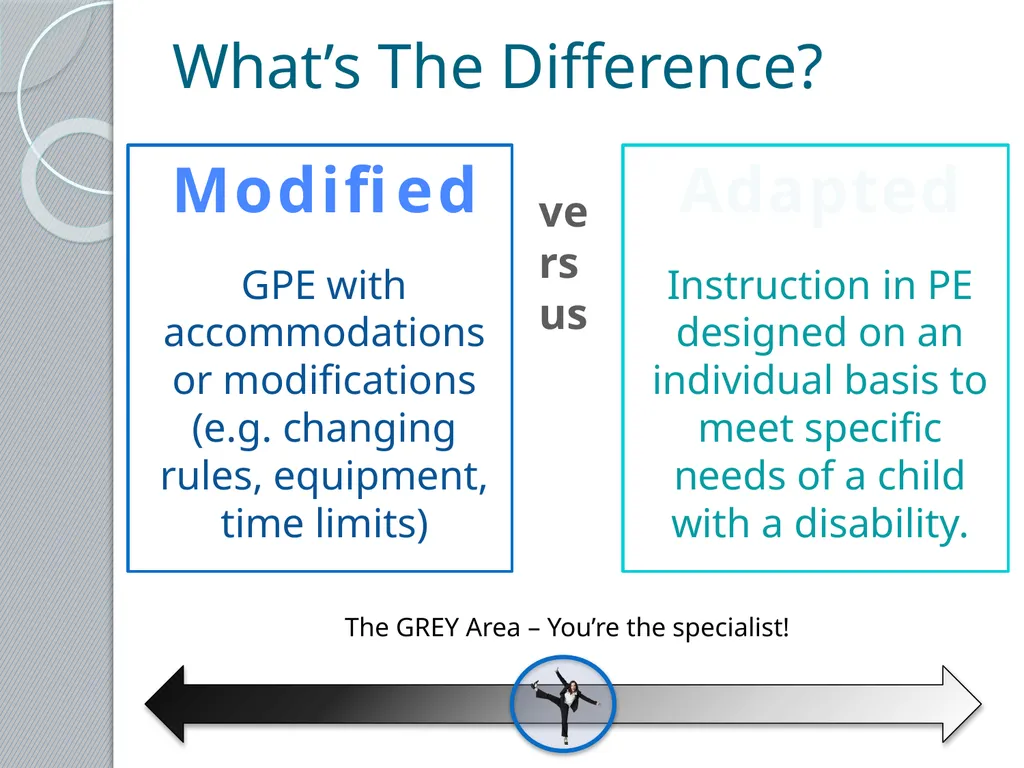
Modified
GPE with accommodations or modifications (e.g. changing rules, equipment, time limits) Adapted
Instruction in PE designed on an individual basis to meet specific needs of a child with a disability. versus What’s The Difference? The GREY Area – You’re the specialist!<br>
GPE with accommodations or modifications (e.g. changing rules, equipment, time limits) Adapted
Instruction in PE designed on an individual basis to meet specific needs of a child with a disability. versus What’s The Difference? The GREY Area – You’re the specialist!<br>
08
Determining Eligibility for APE If a child with a disability cannot access the general PE curriculum and/or participate safely and successfully during PE, individualized instruction designed to meet the unique needs of the student, must be provided.
Whether a student receives APE is an IEP team decision, driven by data.
The IEP team should include someone with firsthand knowledge about the student’s abilities and needs for participating in and learning the Healthful Living/PE Essential Standard.
Guess who???<br>
Whether a student receives APE is an IEP team decision, driven by data.
The IEP team should include someone with firsthand knowledge about the student’s abilities and needs for participating in and learning the Healthful Living/PE Essential Standard.
Guess who???<br>
09
Yep…that’s you.<br>
10
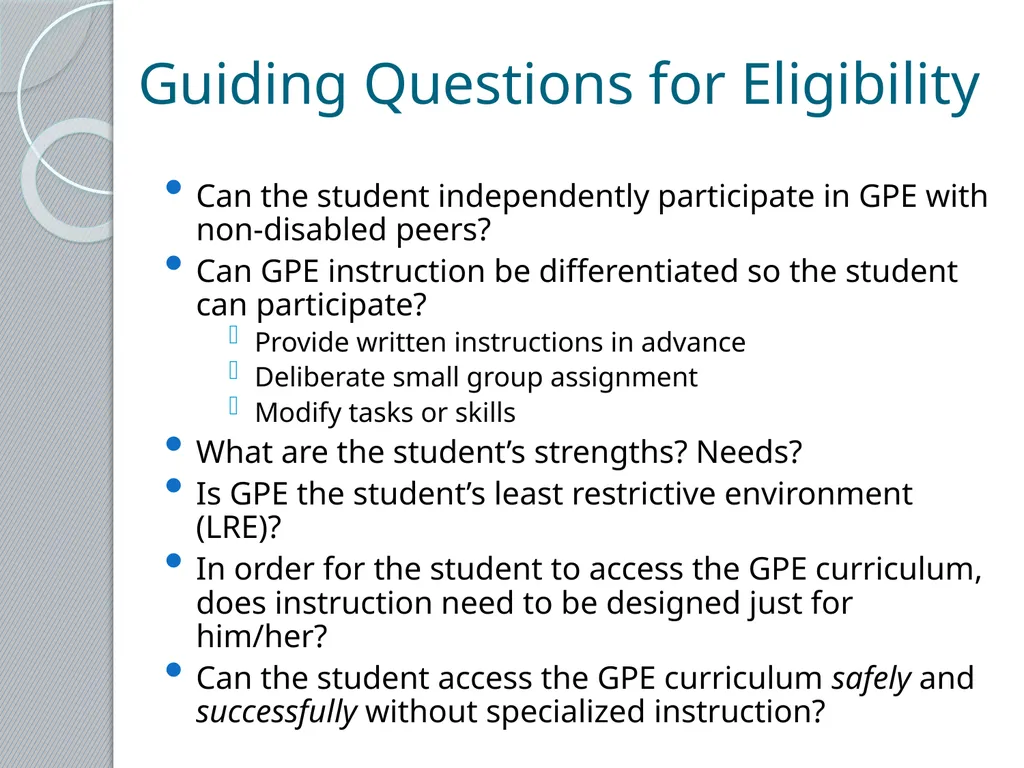
Guiding Questions for Eligibility Can the student independently participate in GPE with non-disabled peers?
Can GPE instruction be differentiated so the student can participate?
Provide written instructions in advance
Deliberate small group assignment
Modify tasks or skills
What are the student’s strengths? Needs?
Is GPE the student’s least restrictive environment (LRE)?
In order for the student to access the GPE curriculum, does instruction need to be designed just for him/her?
Can the student access the GPE curriculum safely and successfully without specialized instruction?<br>
Can GPE instruction be differentiated so the student can participate?
Provide written instructions in advance
Deliberate small group assignment
Modify tasks or skills
What are the student’s strengths? Needs?
Is GPE the student’s least restrictive environment (LRE)?
In order for the student to access the GPE curriculum, does instruction need to be designed just for him/her?
Can the student access the GPE curriculum safely and successfully without specialized instruction?<br>
11
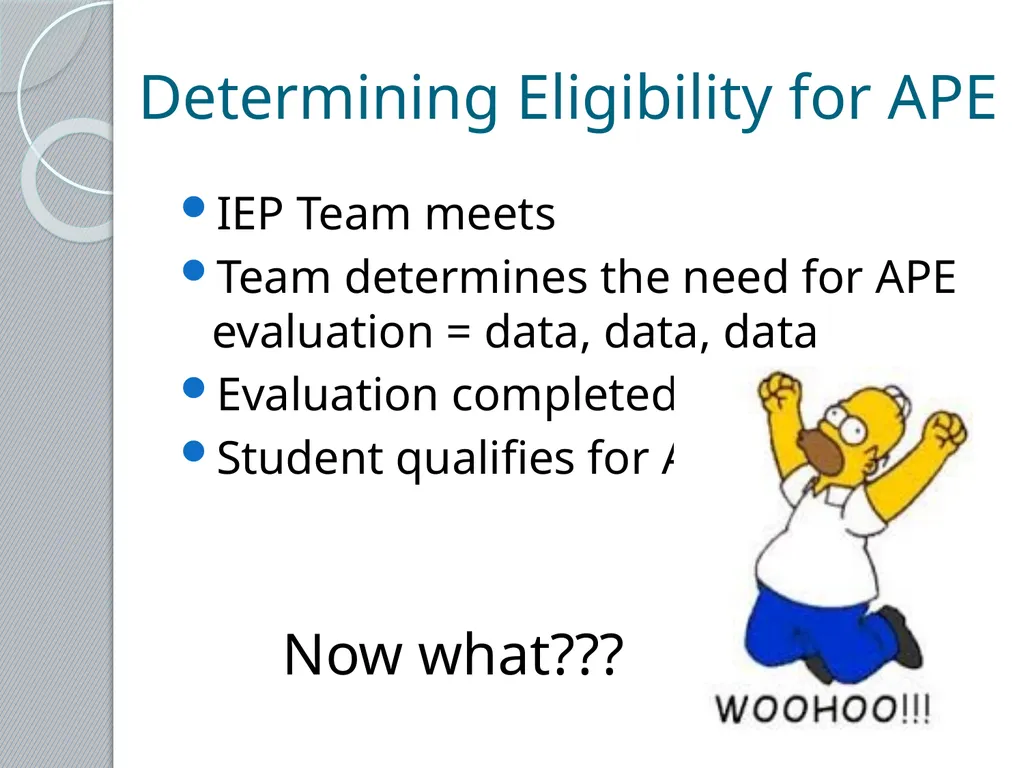
Determining Eligibility for APE IEP Team meets
Team determines the need for APE evaluation = data, data, data
Evaluation completed
Student qualifies for APE
Now what???<br>
Team determines the need for APE evaluation = data, data, data
Evaluation completed
Student qualifies for APE
Now what???<br>
12
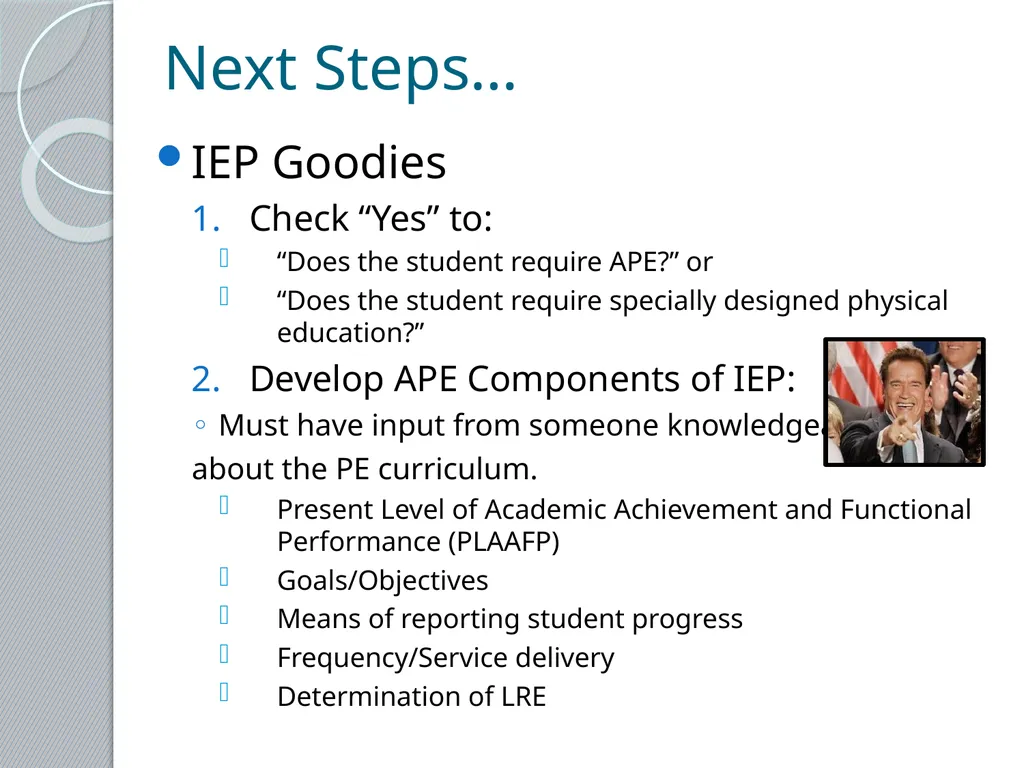
Next Steps… IEP Goodies
Check “Yes” to:
“Does the student require APE?” or
“Does the student require specially designed physical education?”
Develop APE Components of IEP:
Must have input from someone knowledgeable
about the PE curriculum.
Present Level of Academic Achievement and Functional Performance (PLAAFP)
Goals/Objectives
Means of reporting student progress
Frequency/Service delivery
Determination of LRE<br>
Check “Yes” to:
“Does the student require APE?” or
“Does the student require specially designed physical education?”
Develop APE Components of IEP:
Must have input from someone knowledgeable
about the PE curriculum.
Present Level of Academic Achievement and Functional Performance (PLAAFP)
Goals/Objectives
Means of reporting student progress
Frequency/Service delivery
Determination of LRE<br>
13
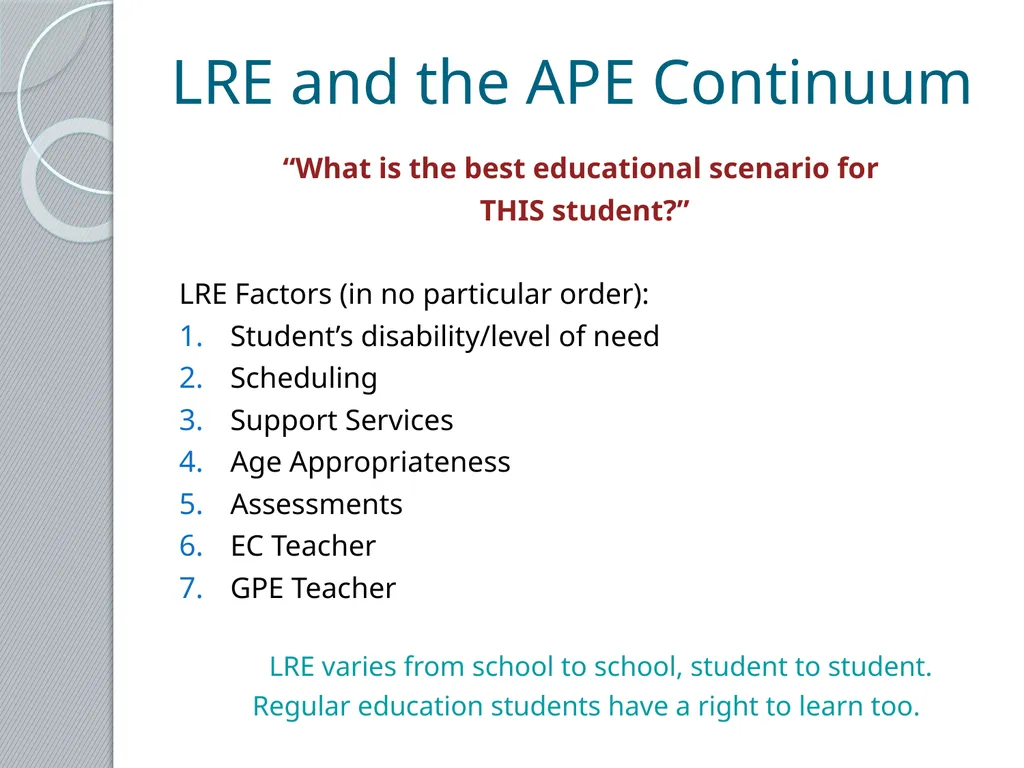
LRE and the APE Continuum “What is the best educational scenario for
THIS student?”
LRE Factors (in no particular order):
Student’s disability/level of need
Scheduling
Support Services
Age Appropriateness
Assessments
EC Teacher
GPE Teacher
LRE varies from school to school, student to student.
Regular education students have a right to learn too.<br>
THIS student?”
LRE Factors (in no particular order):
Student’s disability/level of need
Scheduling
Support Services
Age Appropriateness
Assessments
EC Teacher
GPE Teacher
LRE varies from school to school, student to student.
Regular education students have a right to learn too.<br>
14
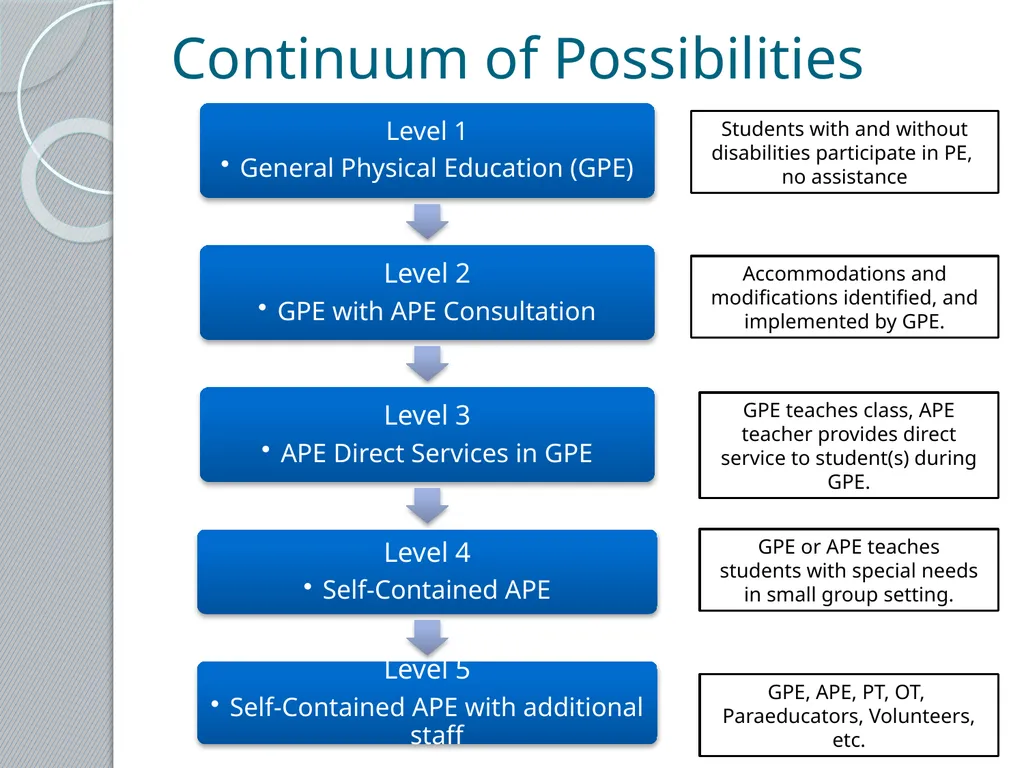
Continuum of Possibilities Accommodations and modifications identified, and implemented by GPE. GPE or APE teaches
students with special needs in small group setting. GPE teaches class, APE teacher provides direct service to student(s) during GPE. GPE, APE, PT, OT, Paraeducators, Volunteers, etc. Students with and without disabilities participate in PE,
no assistance<br>
students with special needs in small group setting. GPE teaches class, APE teacher provides direct service to student(s) during GPE. GPE, APE, PT, OT, Paraeducators, Volunteers, etc. Students with and without disabilities participate in PE,
no assistance<br>
15
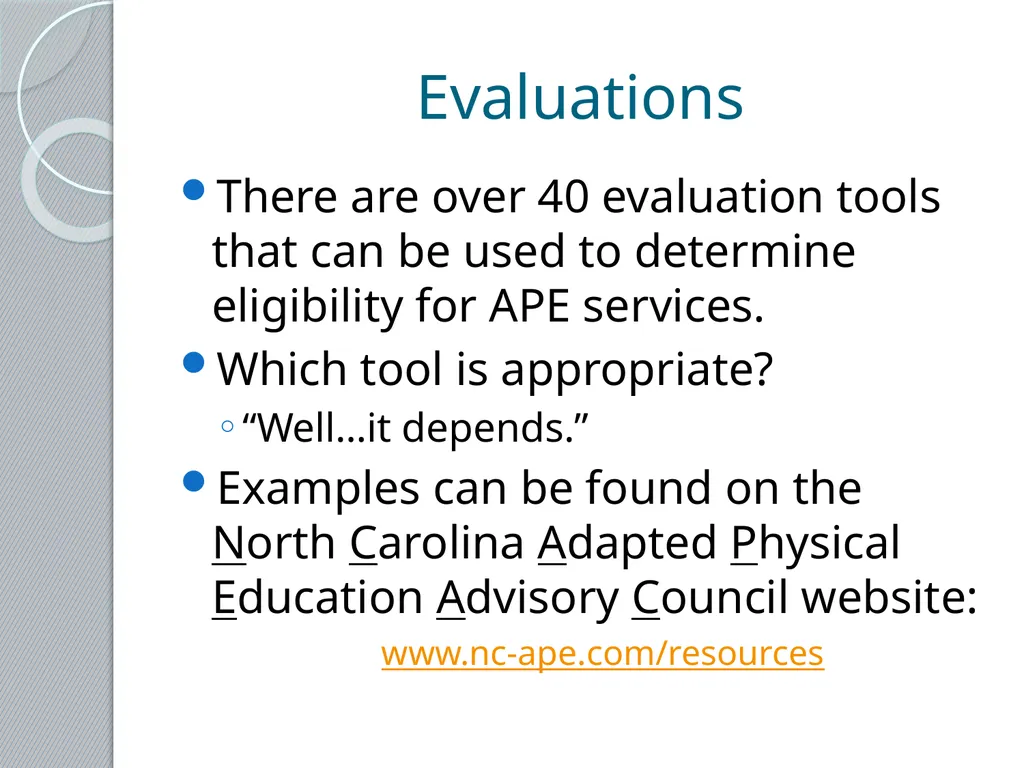
Evaluations There are over 40 evaluation tools that can be used to determine eligibility for APE services.
Which tool is appropriate?
“Well…it depends.”
Examples can be found on the North Carolina Adapted Physical Education Advisory Council website:
www.nc-ape.com/resources<br>
Which tool is appropriate?
“Well…it depends.”
Examples can be found on the North Carolina Adapted Physical Education Advisory Council website:
www.nc-ape.com/resources<br>
16
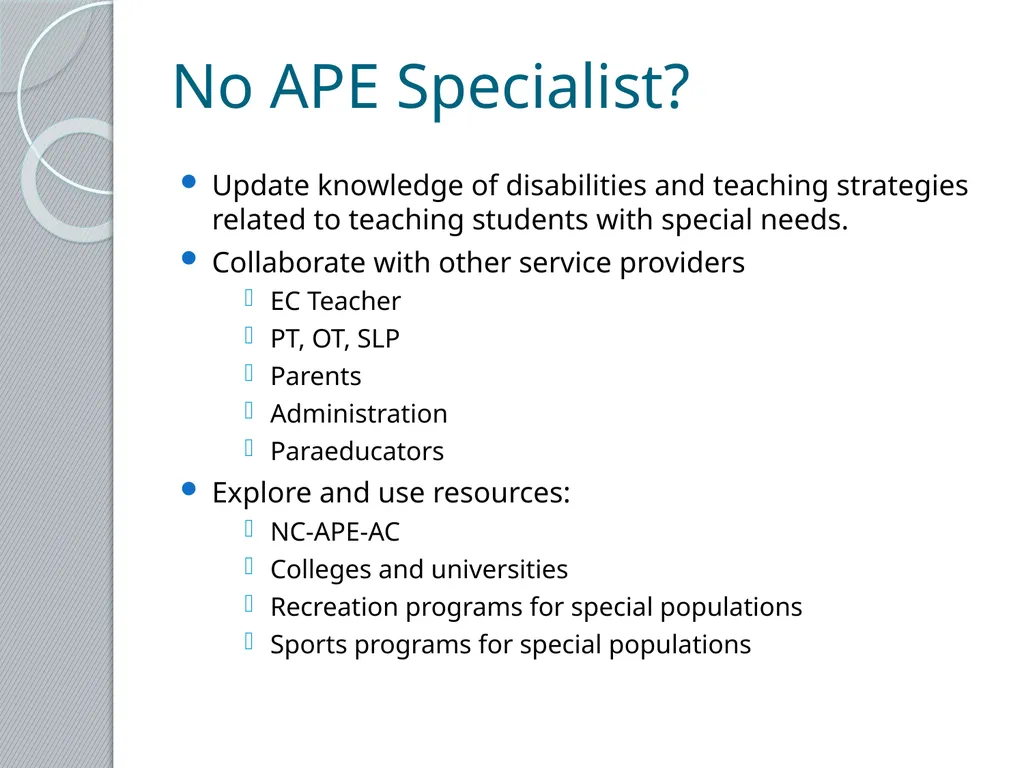
No APE Specialist? Update knowledge of disabilities and teaching strategies related to teaching students with special needs.
Collaborate with other service providers
EC Teacher
PT, OT, SLP
Parents
Administration
Paraeducators
Explore and use resources:
NC-APE-AC
Colleges and universities
Recreation programs for special populations
Sports programs for special populations<br>
Collaborate with other service providers
EC Teacher
PT, OT, SLP
Parents
Administration
Paraeducators
Explore and use resources:
NC-APE-AC
Colleges and universities
Recreation programs for special populations
Sports programs for special populations<br>
17
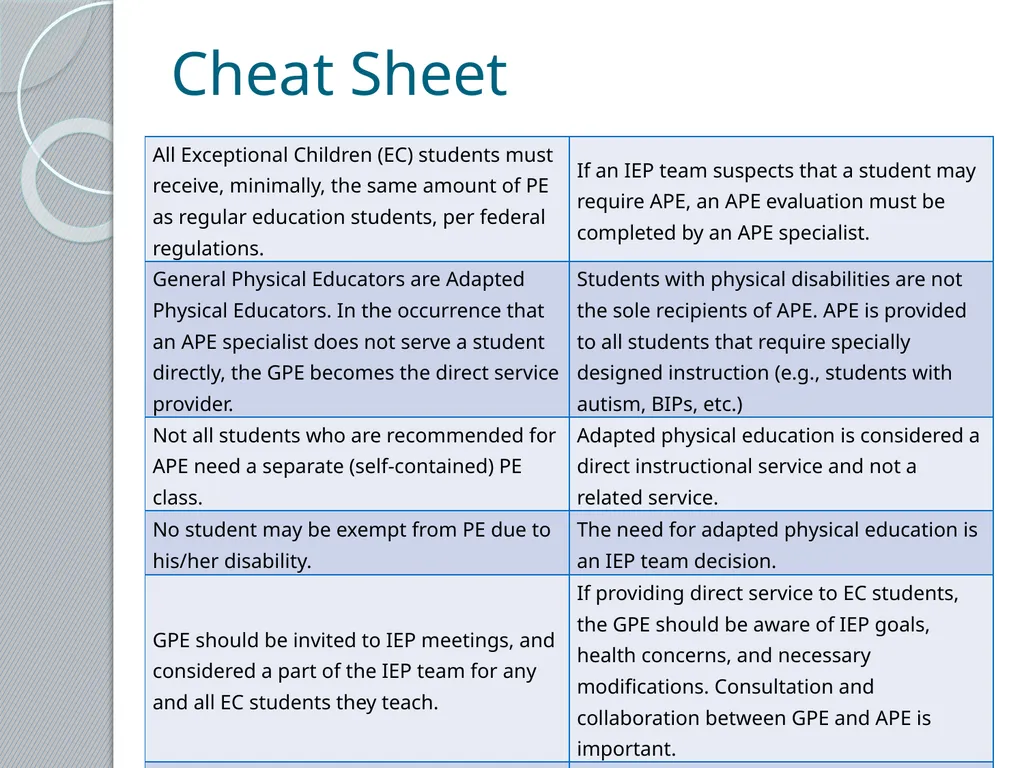
Cheat Sheet<br>
18
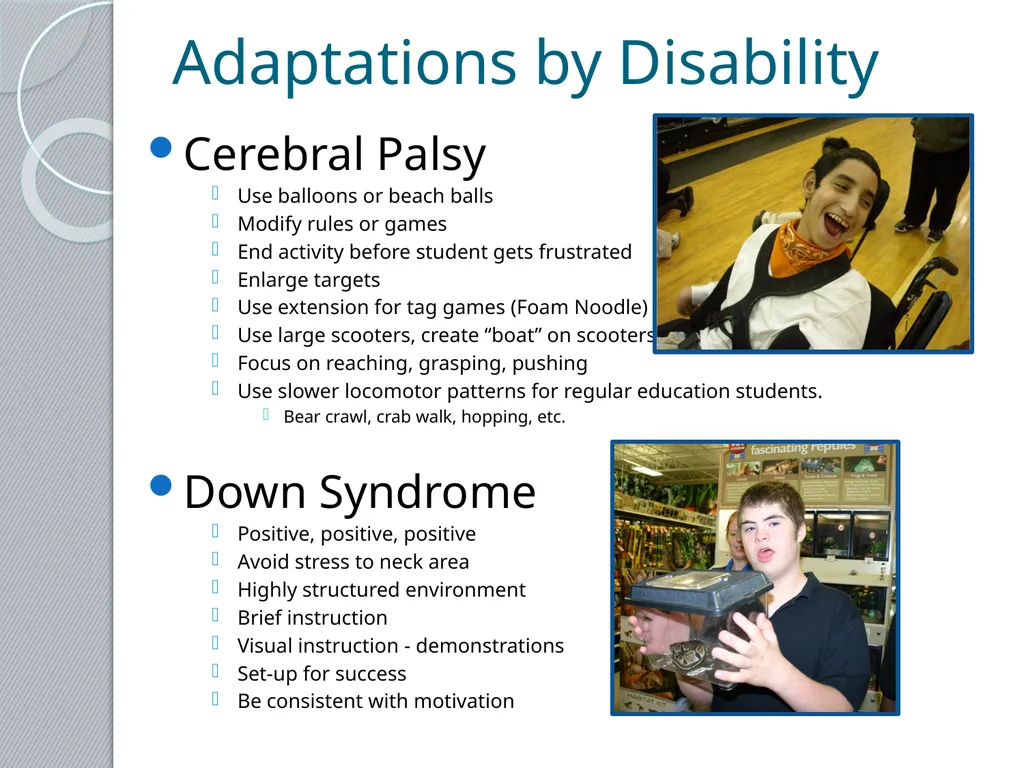
Cerebral Palsy
Use balloons or beach balls
Modify rules or games
End activity before student gets frustrated
Enlarge targets
Use extension for tag games (Foam Noodle)
Use large scooters, create “boat” on scooters
Focus on reaching, grasping, pushing
Use slower locomotor patterns for regular education students.
Bear crawl, crab walk, hopping, etc.
Down Syndrome
Positive, positive, positive
Avoid stress to neck area
Highly structured environment
Brief instruction
Visual instruction - demonstrations
Set-up for success
Be consistent with motivation Adaptations by Disability<br>
Use balloons or beach balls
Modify rules or games
End activity before student gets frustrated
Enlarge targets
Use extension for tag games (Foam Noodle)
Use large scooters, create “boat” on scooters
Focus on reaching, grasping, pushing
Use slower locomotor patterns for regular education students.
Bear crawl, crab walk, hopping, etc.
Down Syndrome
Positive, positive, positive
Avoid stress to neck area
Highly structured environment
Brief instruction
Visual instruction - demonstrations
Set-up for success
Be consistent with motivation Adaptations by Disability<br>
19
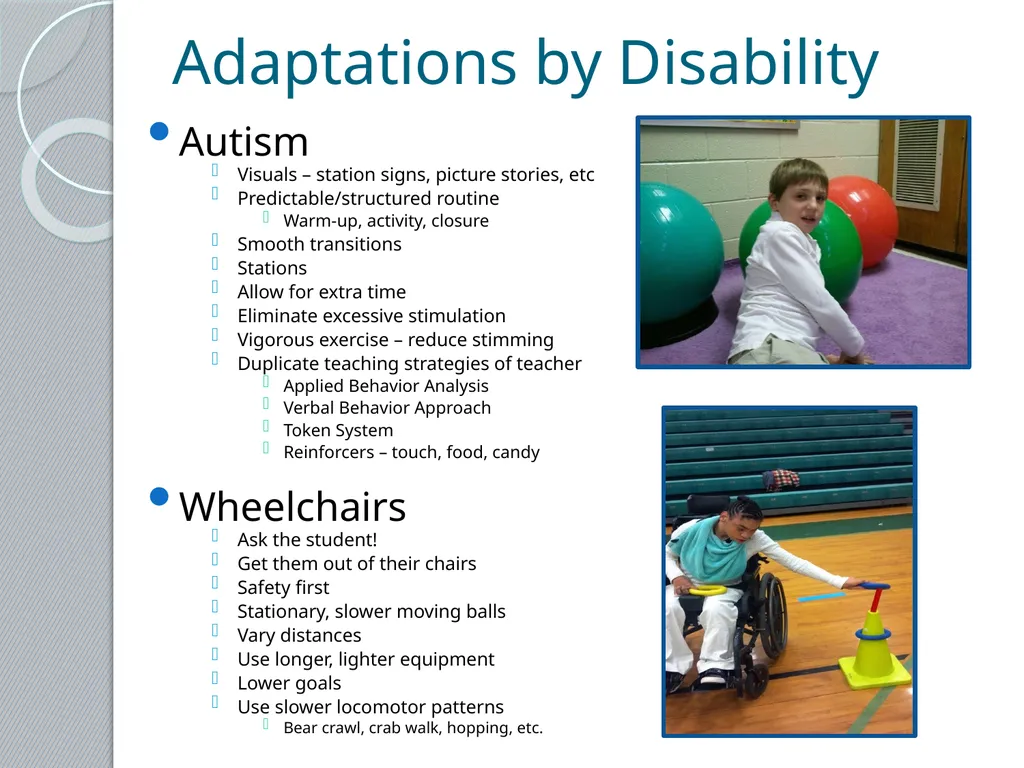
Autism
Visuals – station signs, picture stories, etc
Predictable/structured routine
Warm-up, activity, closure
Smooth transitions
Stations
Allow for extra time
Eliminate excessive stimulation
Vigorous exercise – reduce stimming
Duplicate teaching strategies of teacher
Applied Behavior Analysis
Verbal Behavior Approach
Token System
Reinforcers – touch, food, candy
Wheelchairs
Ask the student!
Get them out of their chairs
Safety first
Stationary, slower moving balls
Vary distances
Use longer, lighter equipment
Lower goals
Use slower locomotor patterns
Bear crawl, crab walk, hopping, etc. Adaptations by Disability<br>
Visuals – station signs, picture stories, etc
Predictable/structured routine
Warm-up, activity, closure
Smooth transitions
Stations
Allow for extra time
Eliminate excessive stimulation
Vigorous exercise – reduce stimming
Duplicate teaching strategies of teacher
Applied Behavior Analysis
Verbal Behavior Approach
Token System
Reinforcers – touch, food, candy
Wheelchairs
Ask the student!
Get them out of their chairs
Safety first
Stationary, slower moving balls
Vary distances
Use longer, lighter equipment
Lower goals
Use slower locomotor patterns
Bear crawl, crab walk, hopping, etc. Adaptations by Disability<br>
20
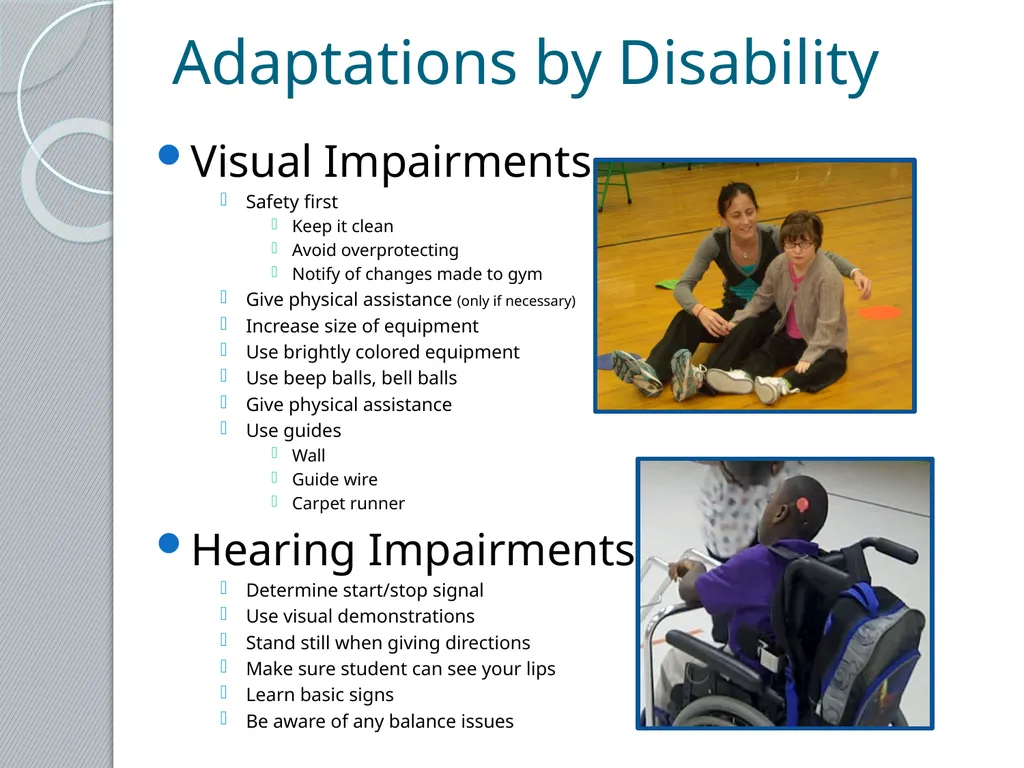
Visual Impairments
Safety first
Keep it clean
Avoid overprotecting
Notify of changes made to gym
Give physical assistance (only if necessary)
Increase size of equipment
Use brightly colored equipment
Use beep balls, bell balls
Give physical assistance
Use guides
Wall
Guide wire
Carpet runner
Hearing Impairments
Determine start/stop signal
Use visual demonstrations
Stand still when giving directions
Make sure student can see your lips
Learn basic signs
Be aware of any balance issues Adaptations by Disability<br>
Safety first
Keep it clean
Avoid overprotecting
Notify of changes made to gym
Give physical assistance (only if necessary)
Increase size of equipment
Use brightly colored equipment
Use beep balls, bell balls
Give physical assistance
Use guides
Wall
Guide wire
Carpet runner
Hearing Impairments
Determine start/stop signal
Use visual demonstrations
Stand still when giving directions
Make sure student can see your lips
Learn basic signs
Be aware of any balance issues Adaptations by Disability<br>
21
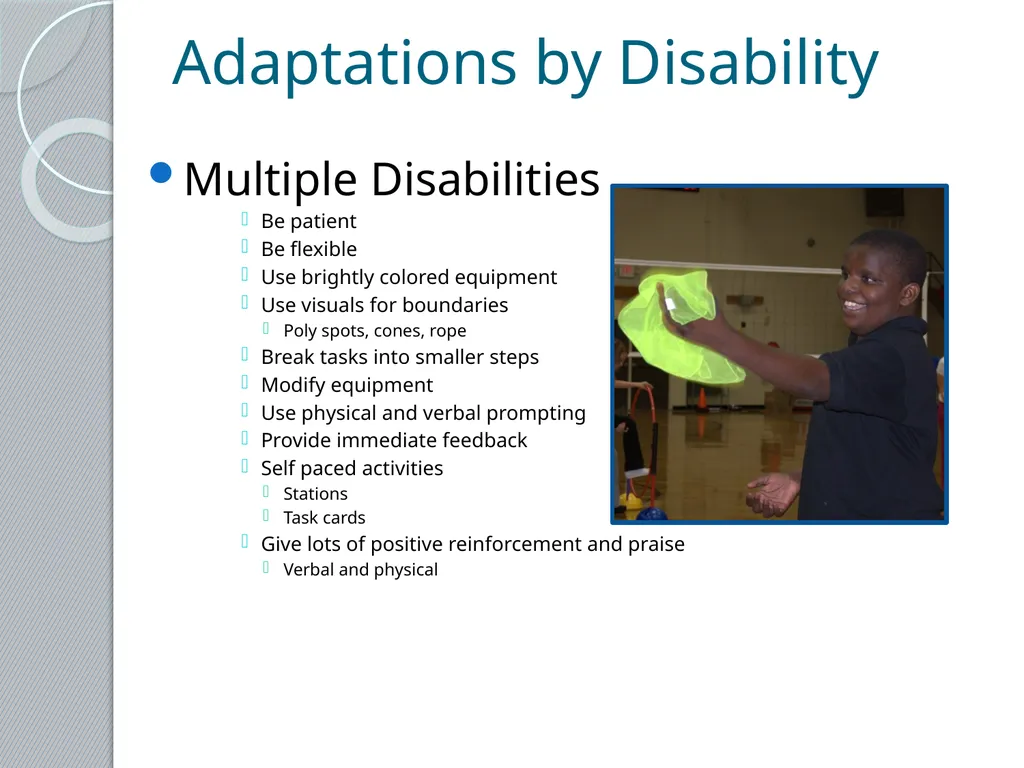
Multiple Disabilities
Be patient
Be flexible
Use brightly colored equipment
Use visuals for boundaries
Poly spots, cones, rope
Break tasks into smaller steps
Modify equipment
Use physical and verbal prompting
Provide immediate feedback
Self paced activities
Stations
Task cards
Give lots of positive reinforcement and praise
Verbal and physical Adaptations by Disability<br>
Be patient
Be flexible
Use brightly colored equipment
Use visuals for boundaries
Poly spots, cones, rope
Break tasks into smaller steps
Modify equipment
Use physical and verbal prompting
Provide immediate feedback
Self paced activities
Stations
Task cards
Give lots of positive reinforcement and praise
Verbal and physical Adaptations by Disability<br>
22
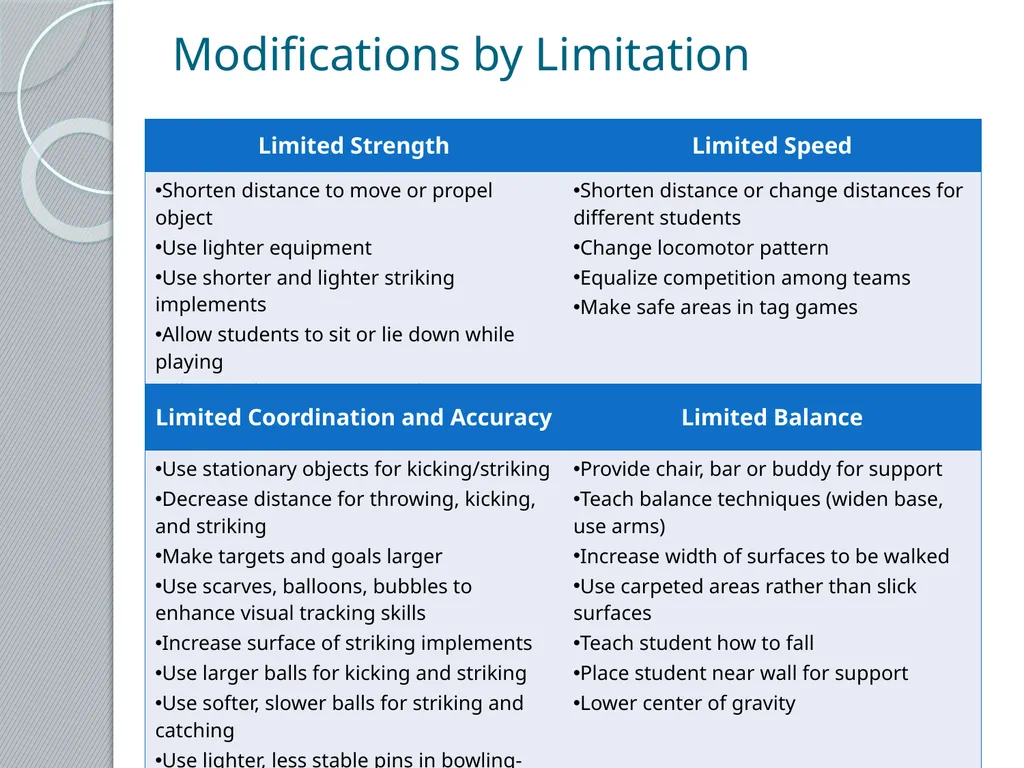
Modifications by Limitation<br>
23
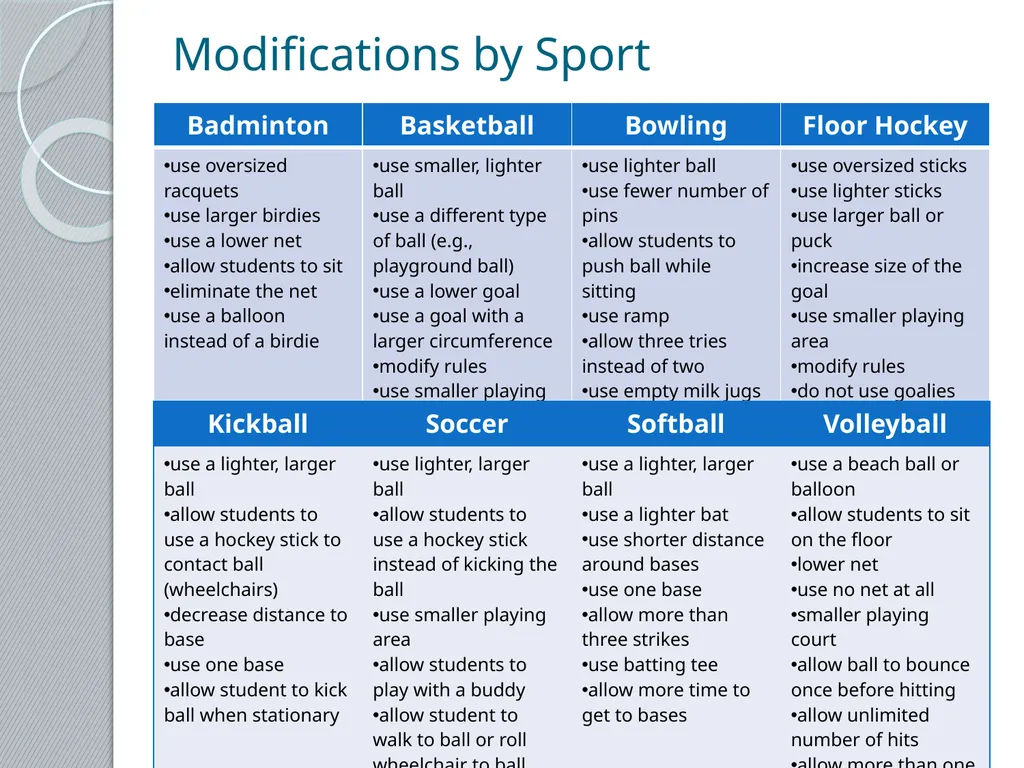
Modifications by Sport<br>
24
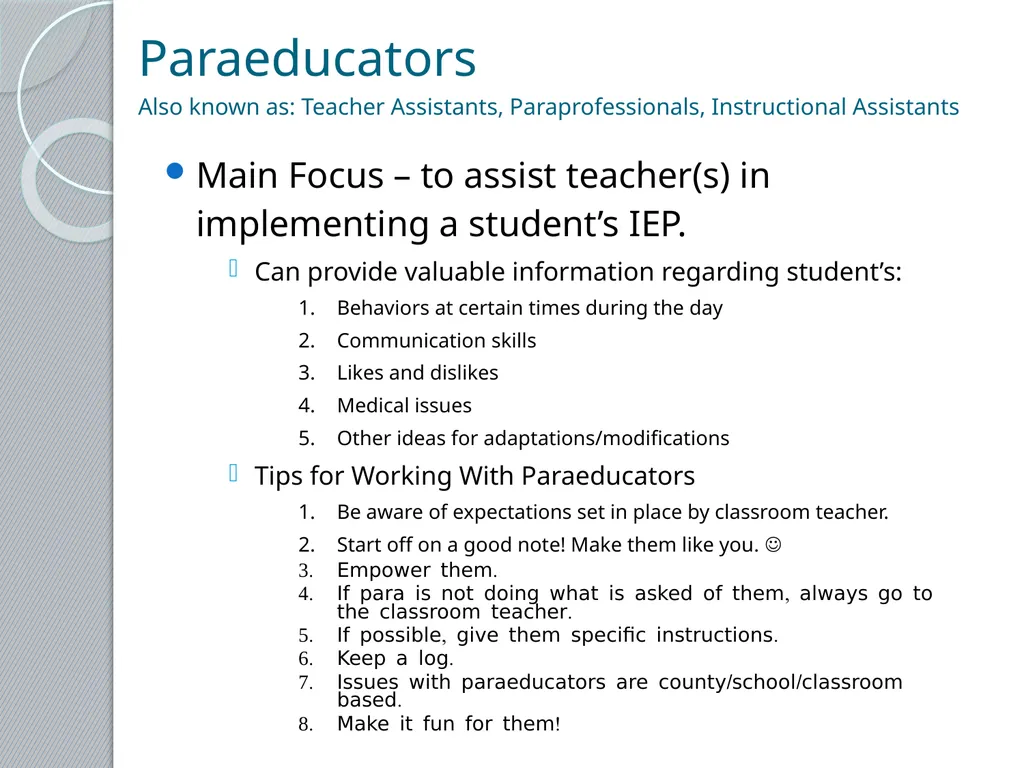
Main Focus – to assist teacher(s) in implementing a student’s IEP.
Can provide valuable information regarding student’s:
Behaviors at certain times during the day
Communication skills
Likes and dislikes
Medical issues
Other ideas for adaptations/modifications
Tips for Working With Paraeducators
Be aware of expectations set in place by classroom teacher.
Start off on a good note! Make them like you.
Empower them.
If para is not doing what is asked of them, always go to the classroom teacher.
If possible, give them specific instructions.
Keep a log.
Issues with paraeducators are county/school/classroom based.
Make it fun for them! Paraeducators Also known as: Teacher Assistants, Paraprofessionals, Instructional Assistants<br>
Can provide valuable information regarding student’s:
Behaviors at certain times during the day
Communication skills
Likes and dislikes
Medical issues
Other ideas for adaptations/modifications
Tips for Working With Paraeducators
Be aware of expectations set in place by classroom teacher.
Start off on a good note! Make them like you.
Empower them.
If para is not doing what is asked of them, always go to the classroom teacher.
If possible, give them specific instructions.
Keep a log.
Issues with paraeducators are county/school/classroom based.
Make it fun for them! Paraeducators Also known as: Teacher Assistants, Paraprofessionals, Instructional Assistants<br>
25
Be Enthusiastic!
Educate Yourself
Workshops
Professional literature
Webinars
Professional organizations
Observe in the Classroom
Teaching strategies
Behavior techniques
Reinforcers
Build Relationships
Students
Paraeducators
Teachers
Plan Ahead
All parties will benefit
Embrace Change
Adapt curriculum
Paradigm shift
Appreciate Mini-Victories
Lining up correctly
Eye contact
Waiting their turn
Smiles
Ask Questions
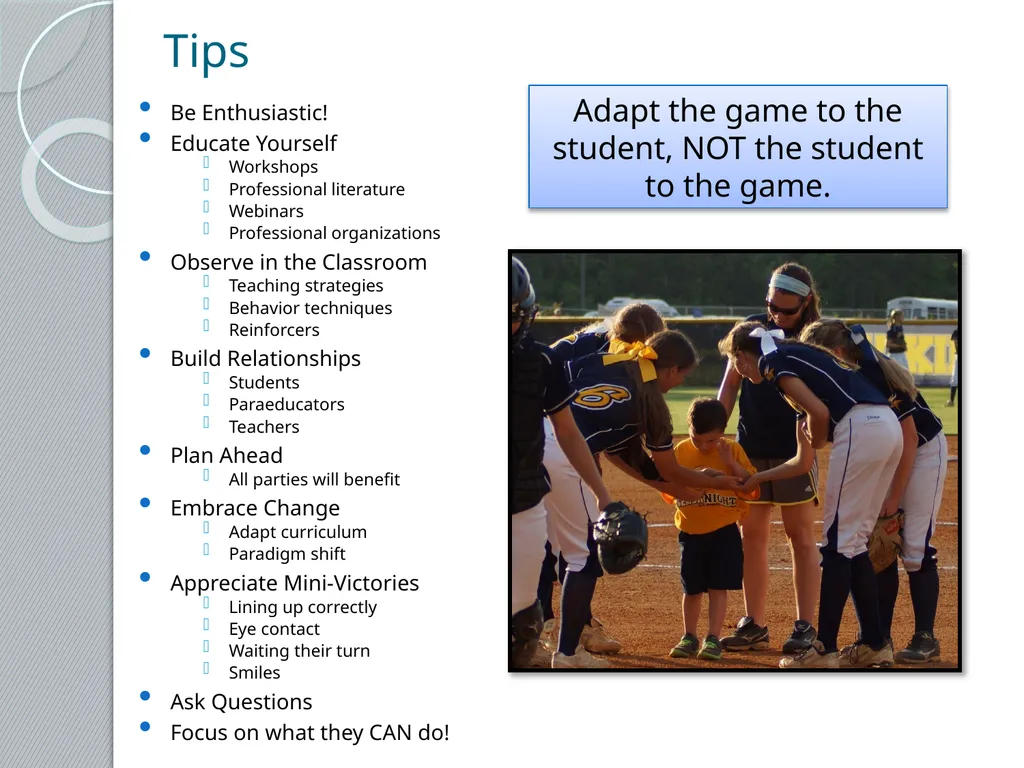
Focus on what they CAN do! Adapt the game to the student, NOT the student to the game. Tips<br>
Educate Yourself
Workshops
Professional literature
Webinars
Professional organizations
Observe in the Classroom
Teaching strategies
Behavior techniques
Reinforcers
Build Relationships
Students
Paraeducators
Teachers
Plan Ahead
All parties will benefit
Embrace Change
Adapt curriculum
Paradigm shift
Appreciate Mini-Victories
Lining up correctly
Eye contact
Waiting their turn
Smiles
Ask Questions
Focus on what they CAN do! Adapt the game to the student, NOT the student to the game. Tips<br>
26
Questions? Contact us directly through email and/or phone! Contact information can be found here…
www.NC-APE.com<br>
www.NC-APE.com<br>