
ADHD in Transitional Age Youth Developed by:
TG
Published · 61 slides · 0 views

1 / 1




Description
ADHD in Transitional Age Youth Developed by: Raymond Gonzales MD. Objectives Recognize Transitional Age Youth (TAY) at risk for Attention Deficit Hyperactivity Disorder (ADHD) Differentiate ADHD from other diagnoses Identify common barriers
Related Topics
Share
Embed code
Download this presentation From Below
"ADHD in Transitional Age Youth Developed by:" is the property of its rightful owner. Permission is granted to download and print the materials on this website for personal, non-commercial use only, and to display it on your personal computer provided you do not modify the materials and that you retain all copyright notices contained in the materials. By downloading content from our website, you accept the terms of this agreement.
Presentation Transcript
01
ADHD in
Transitional Age Youth Developed by:
Raymond Gonzales MD.<br>
Raymond Gonzales MD.<br>
02
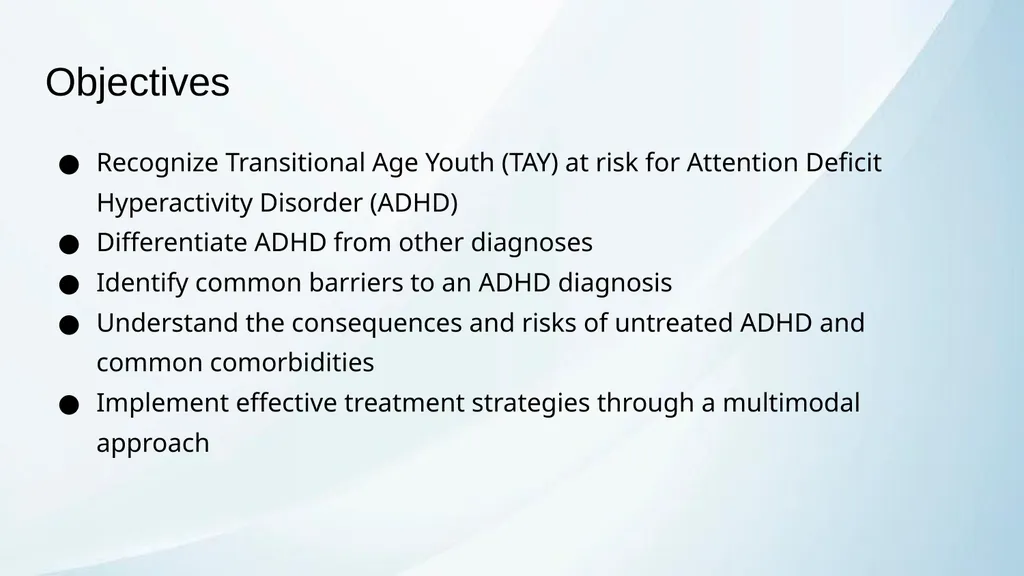
Objectives Recognize Transitional Age Youth (TAY) at risk for Attention Deficit Hyperactivity Disorder (ADHD)
Differentiate ADHD from other diagnoses
Identify common barriers to an ADHD diagnosis
Understand the consequences and risks of untreated ADHD and common comorbidities
Implement effective treatment strategies through a multimodal approach<br>
Differentiate ADHD from other diagnoses
Identify common barriers to an ADHD diagnosis
Understand the consequences and risks of untreated ADHD and common comorbidities
Implement effective treatment strategies through a multimodal approach<br>
03
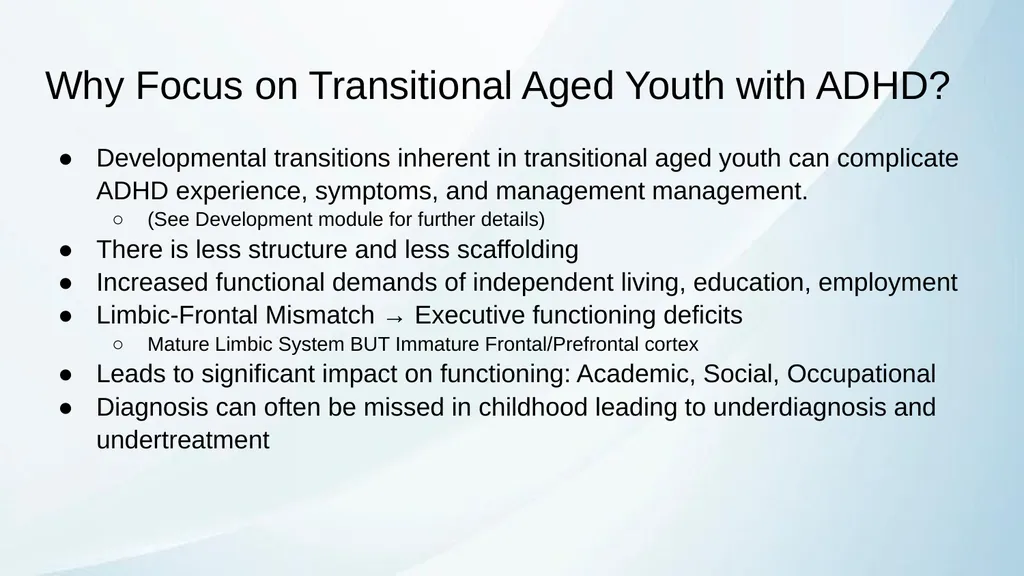
Why Focus on Transitional Aged Youth with ADHD? Developmental transitions inherent in transitional aged youth can complicate ADHD experience, symptoms, and management management.
(See Development module for further details)
There is less structure and less scaffolding
Increased functional demands of independent living, education, employment
Limbic-Frontal Mismatch → Executive functioning deficits
Mature Limbic System BUT Immature Frontal/Prefrontal cortex
Leads to significant impact on functioning: Academic, Social, Occupational
Diagnosis can often be missed in childhood leading to underdiagnosis and undertreatment<br>
(See Development module for further details)
There is less structure and less scaffolding
Increased functional demands of independent living, education, employment
Limbic-Frontal Mismatch → Executive functioning deficits
Mature Limbic System BUT Immature Frontal/Prefrontal cortex
Leads to significant impact on functioning: Academic, Social, Occupational
Diagnosis can often be missed in childhood leading to underdiagnosis and undertreatment<br>
04
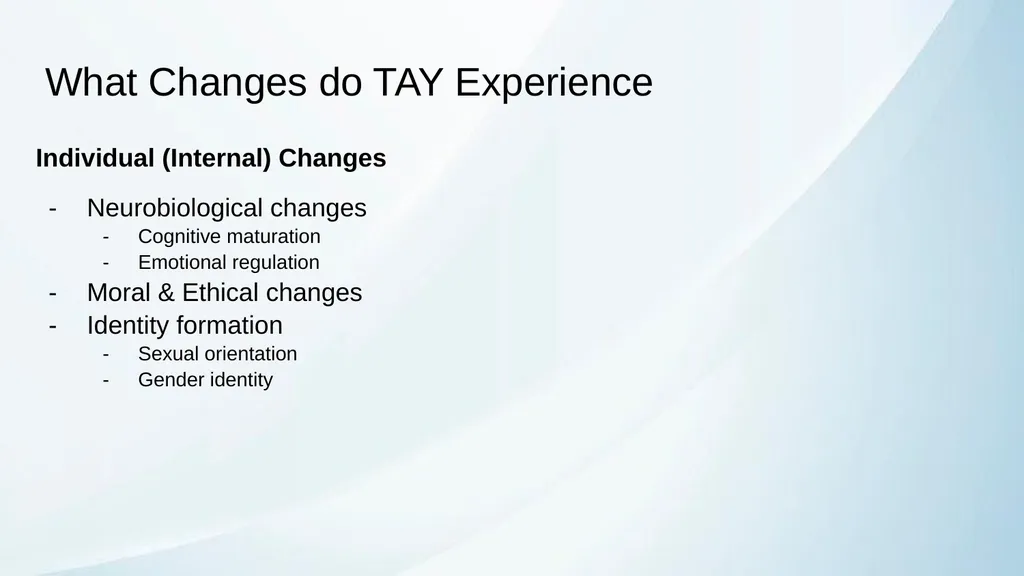
What Changes do TAY Experience Individual (Internal) Changes
Neurobiological changes
Cognitive maturation
Emotional regulation
Moral & Ethical changes
Identity formation
Sexual orientation
Gender identity<br>
Neurobiological changes
Cognitive maturation
Emotional regulation
Moral & Ethical changes
Identity formation
Sexual orientation
Gender identity<br>
05
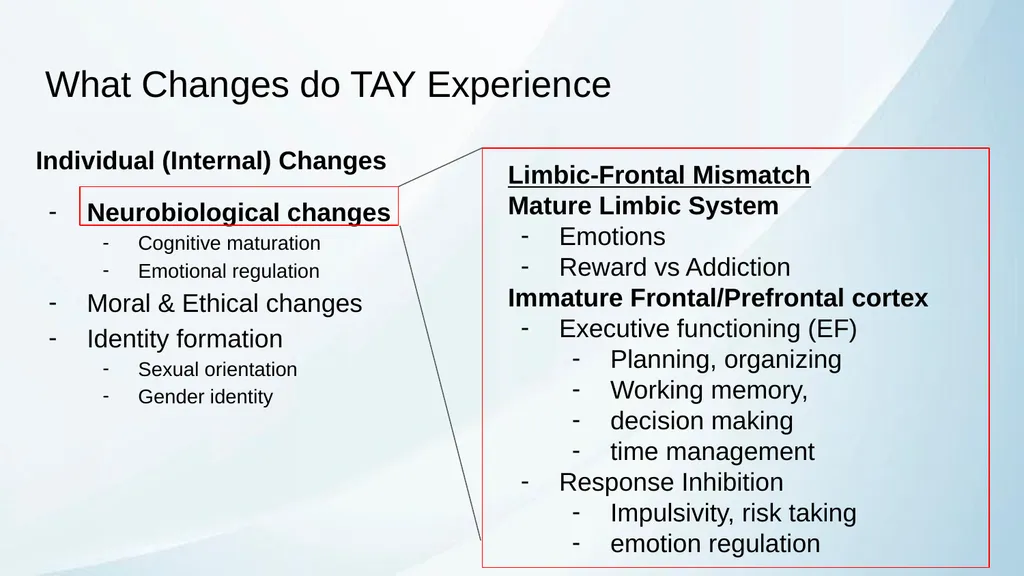
What Changes do TAY Experience Individual (Internal) Changes
Neurobiological changes
Cognitive maturation
Emotional regulation
Moral & Ethical changes
Identity formation
Sexual orientation
Gender identity Limbic-Frontal Mismatch Mature Limbic System
Emotions
Reward vs Addiction
Immature Frontal/Prefrontal cortex
Executive functioning (EF)
Planning, organizing
Working memory,
decision making
time management
Response Inhibition
Impulsivity, risk taking
emotion regulation<br>
Neurobiological changes
Cognitive maturation
Emotional regulation
Moral & Ethical changes
Identity formation
Sexual orientation
Gender identity Limbic-Frontal Mismatch Mature Limbic System
Emotions
Reward vs Addiction
Immature Frontal/Prefrontal cortex
Executive functioning (EF)
Planning, organizing
Working memory,
decision making
time management
Response Inhibition
Impulsivity, risk taking
emotion regulation<br>
06
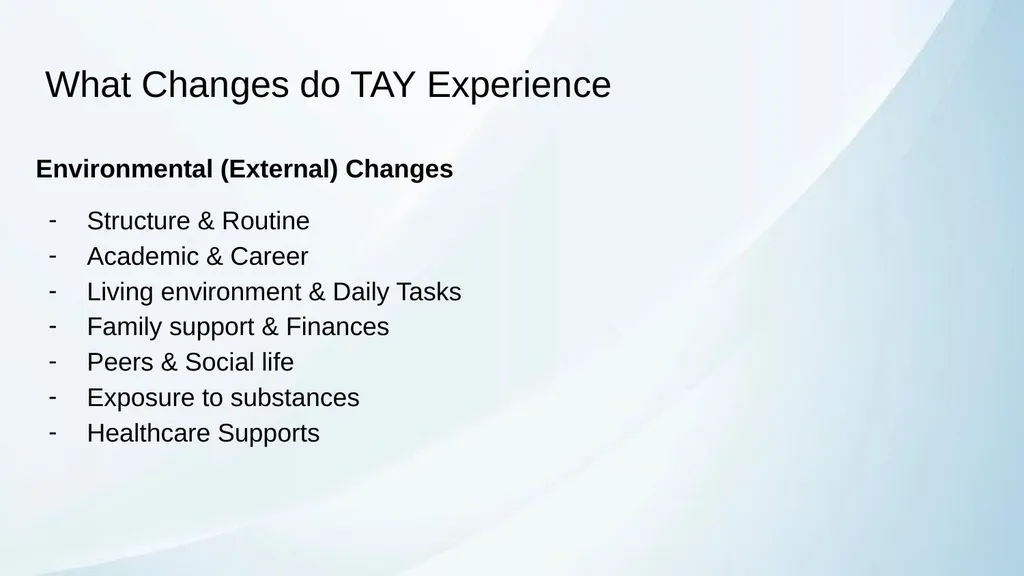
What Changes do TAY Experience Environmental (External) Changes
Structure & Routine
Academic & Career
Living environment & Daily Tasks
Family support & Finances
Peers & Social life
Exposure to substances
Healthcare Supports<br>
Structure & Routine
Academic & Career
Living environment & Daily Tasks
Family support & Finances
Peers & Social life
Exposure to substances
Healthcare Supports<br>
07
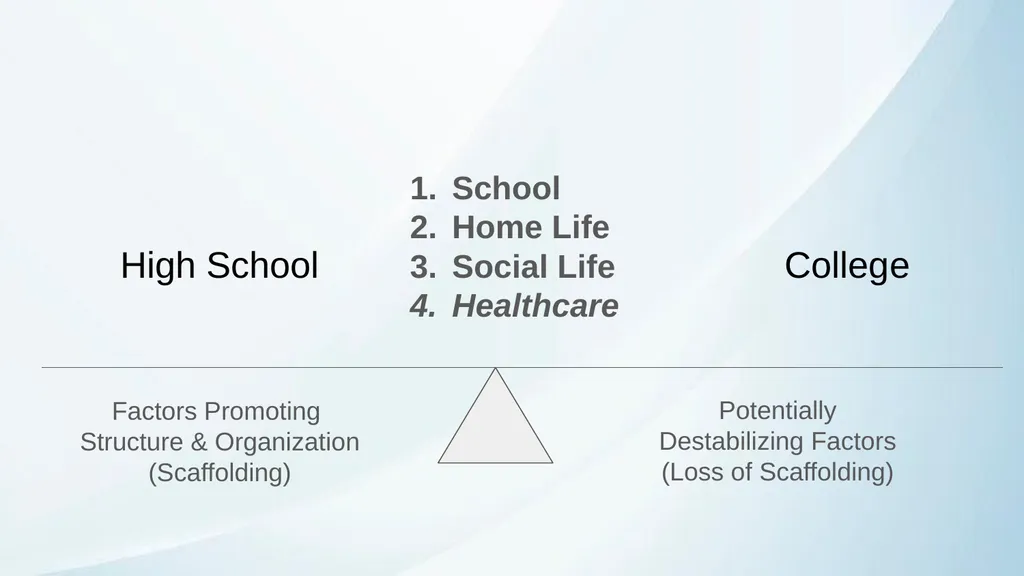
High School Factors Promoting
Structure & Organization
(Scaffolding) Potentially Destabilizing Factors
(Loss of Scaffolding) College School
Home Life
Social Life
Healthcare<br>
(Scaffolding) Potentially Destabilizing Factors
(Loss of Scaffolding) College School
Home Life
Social Life
Healthcare<br>
08
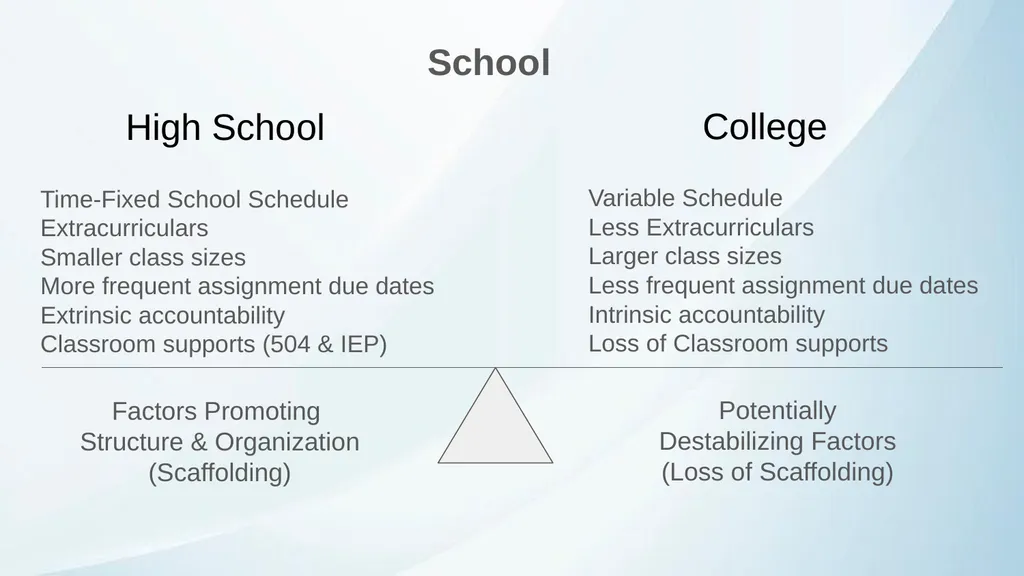
Time-Fixed School Schedule
Extracurriculars
Smaller class sizes
More frequent assignment due dates
Extrinsic accountability
Classroom supports (504 & IEP) High School Factors Promoting Structure & Organization
(Scaffolding) Variable Schedule
Less Extracurriculars
Larger class sizes
Less frequent assignment due dates
Intrinsic accountability
Loss of Classroom supports Potentially Destabilizing Factors
(Loss of Scaffolding) College School<br>
Extracurriculars
Smaller class sizes
More frequent assignment due dates
Extrinsic accountability
Classroom supports (504 & IEP) High School Factors Promoting Structure & Organization
(Scaffolding) Variable Schedule
Less Extracurriculars
Larger class sizes
Less frequent assignment due dates
Intrinsic accountability
Loss of Classroom supports Potentially Destabilizing Factors
(Loss of Scaffolding) College School<br>
09
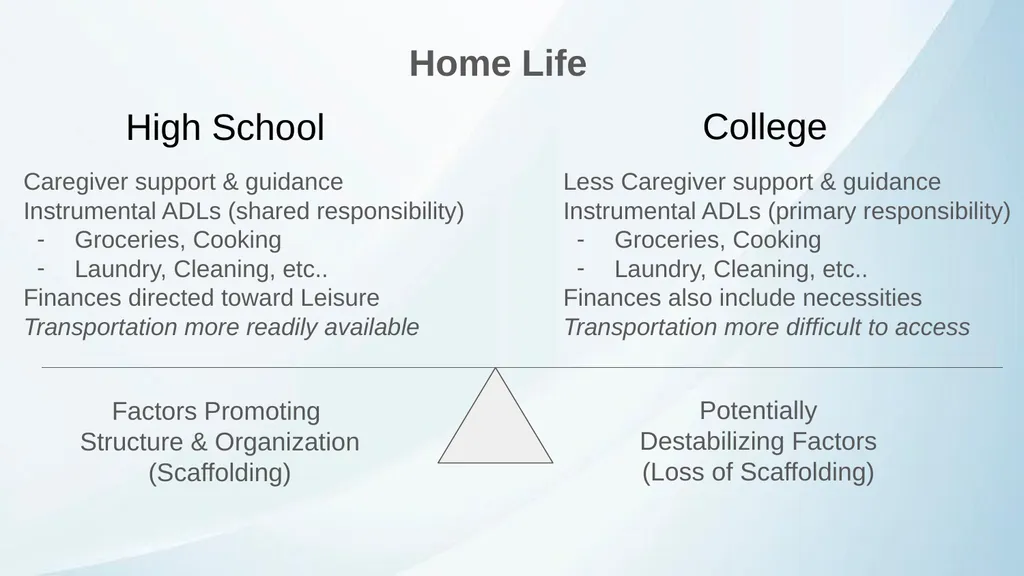
Caregiver support & guidance
Instrumental ADLs (shared responsibility)
Groceries, Cooking
Laundry, Cleaning, etc..
Finances directed toward Leisure Transportation more readily available High School Factors Promoting Structure & Organization
(Scaffolding) Potentially Destabilizing Factors
(Loss of Scaffolding) College Less Caregiver support & guidance
Instrumental ADLs (primary responsibility)
Groceries, Cooking
Laundry, Cleaning, etc..
Finances also include necessities
Transportation more difficult to access Home Life<br>
Instrumental ADLs (shared responsibility)
Groceries, Cooking
Laundry, Cleaning, etc..
Finances directed toward Leisure Transportation more readily available High School Factors Promoting Structure & Organization
(Scaffolding) Potentially Destabilizing Factors
(Loss of Scaffolding) College Less Caregiver support & guidance
Instrumental ADLs (primary responsibility)
Groceries, Cooking
Laundry, Cleaning, etc..
Finances also include necessities
Transportation more difficult to access Home Life<br>
10
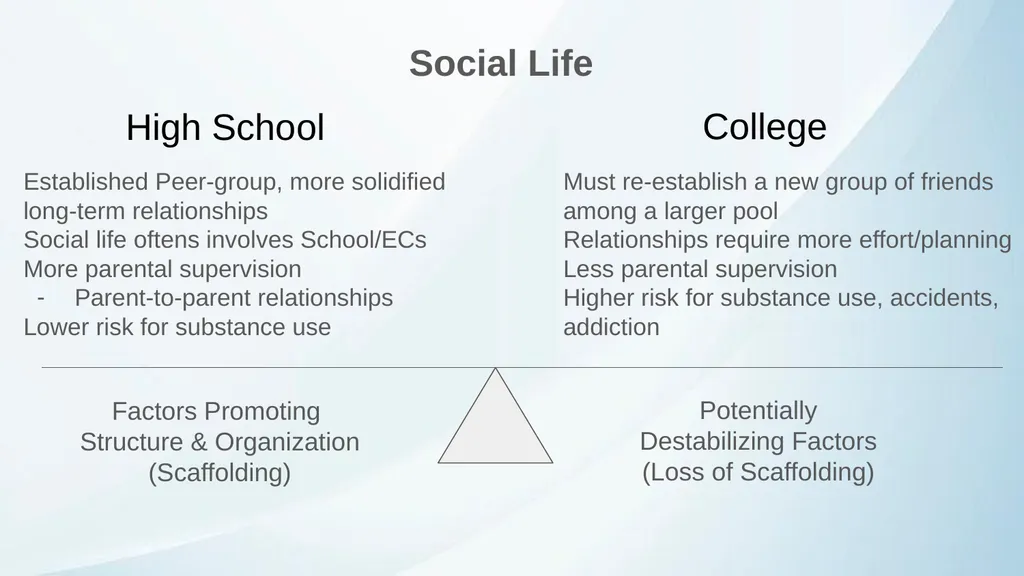
Established Peer-group, more solidified long-term relationships
Social life oftens involves School/ECs
More parental supervision
Parent-to-parent relationships
Lower risk for substance use High School Factors Promoting Structure & Organization
(Scaffolding) Potentially Destabilizing Factors
(Loss of Scaffolding) College Must re-establish a new group of friends among a larger pool
Relationships require more effort/planning
Less parental supervision
Higher risk for substance use, accidents, addiction Social Life<br>
Social life oftens involves School/ECs
More parental supervision
Parent-to-parent relationships
Lower risk for substance use High School Factors Promoting Structure & Organization
(Scaffolding) Potentially Destabilizing Factors
(Loss of Scaffolding) College Must re-establish a new group of friends among a larger pool
Relationships require more effort/planning
Less parental supervision
Higher risk for substance use, accidents, addiction Social Life<br>
11
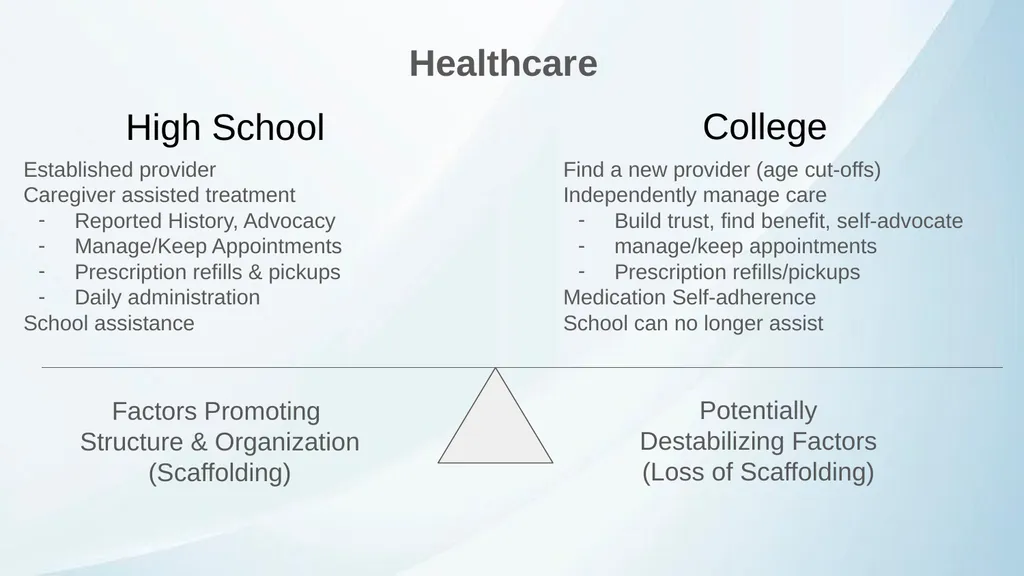
Established provider
Caregiver assisted treatment
Reported History, Advocacy
Manage/Keep Appointments
Prescription refills & pickups
Daily administration
School assistance High School Factors Promoting Structure & Organization
(Scaffolding) Potentially Destabilizing Factors
(Loss of Scaffolding) College Find a new provider (age cut-offs)
Independently manage care
Build trust, find benefit, self-advocate
manage/keep appointments
Prescription refills/pickups
Medication Self-adherence
School can no longer assist Healthcare<br>
Caregiver assisted treatment
Reported History, Advocacy
Manage/Keep Appointments
Prescription refills & pickups
Daily administration
School assistance High School Factors Promoting Structure & Organization
(Scaffolding) Potentially Destabilizing Factors
(Loss of Scaffolding) College Find a new provider (age cut-offs)
Independently manage care
Build trust, find benefit, self-advocate
manage/keep appointments
Prescription refills/pickups
Medication Self-adherence
School can no longer assist Healthcare<br>
12
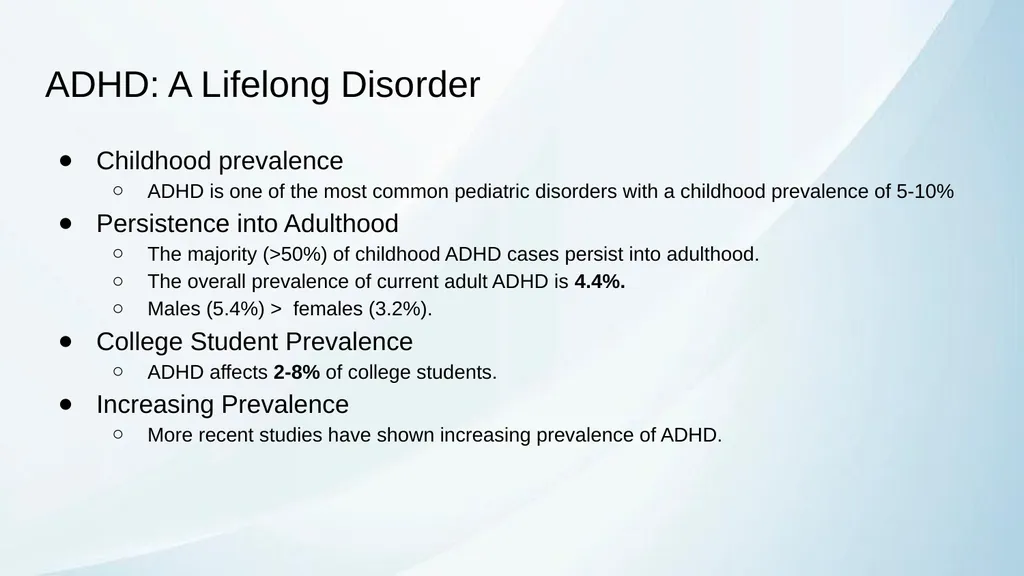
ADHD: A Lifelong Disorder Childhood prevalence
ADHD is one of the most common pediatric disorders with a childhood prevalence of 5-10%
Persistence into Adulthood
The majority (>50%) of childhood ADHD cases persist into adulthood.
The overall prevalence of current adult ADHD is 4.4%.
Males (5.4%) > females (3.2%).
College Student Prevalence
ADHD affects 2-8% of college students.
Increasing Prevalence
More recent studies have shown increasing prevalence of ADHD.<br>
ADHD is one of the most common pediatric disorders with a childhood prevalence of 5-10%
Persistence into Adulthood
The majority (>50%) of childhood ADHD cases persist into adulthood.
The overall prevalence of current adult ADHD is 4.4%.
Males (5.4%) > females (3.2%).
College Student Prevalence
ADHD affects 2-8% of college students.
Increasing Prevalence
More recent studies have shown increasing prevalence of ADHD.<br>
13
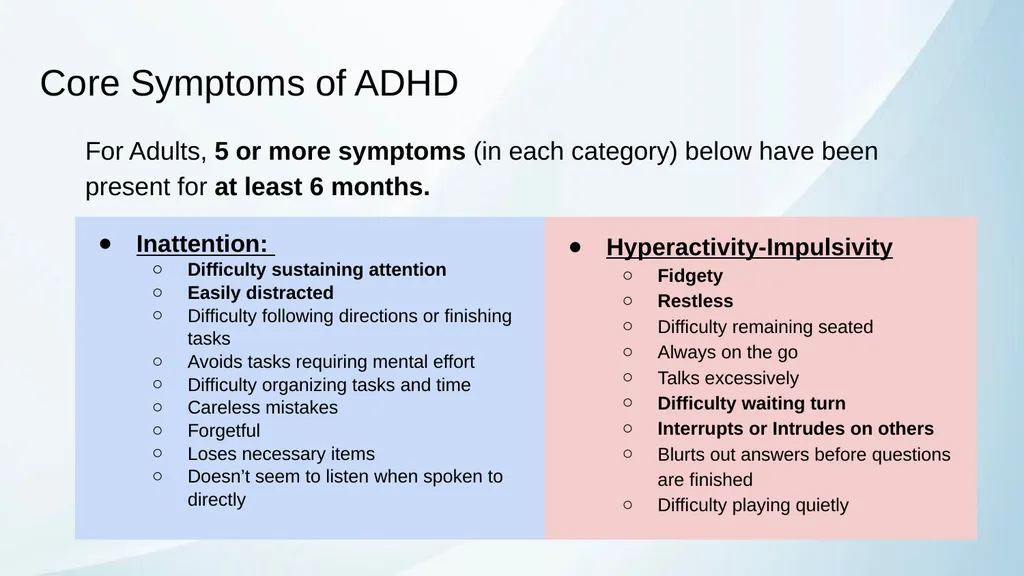
Core Symptoms of ADHD Inattention:
Difficulty sustaining attention
Easily distracted
Difficulty following directions or finishing tasks
Avoids tasks requiring mental effort
Difficulty organizing tasks and time
Careless mistakes
Forgetful
Loses necessary items
Doesn’t seem to listen when spoken to directly Hyperactivity-Impulsivity
Fidgety
Restless
Difficulty remaining seated
Always on the go
Talks excessively
Difficulty waiting turn
Interrupts or Intrudes on others
Blurts out answers before questions are finished
Difficulty playing quietly For Adults, 5 or more symptoms (in each category) below have been present for at least 6 months.<br>
Difficulty sustaining attention
Easily distracted
Difficulty following directions or finishing tasks
Avoids tasks requiring mental effort
Difficulty organizing tasks and time
Careless mistakes
Forgetful
Loses necessary items
Doesn’t seem to listen when spoken to directly Hyperactivity-Impulsivity
Fidgety
Restless
Difficulty remaining seated
Always on the go
Talks excessively
Difficulty waiting turn
Interrupts or Intrudes on others
Blurts out answers before questions are finished
Difficulty playing quietly For Adults, 5 or more symptoms (in each category) below have been present for at least 6 months.<br>
14
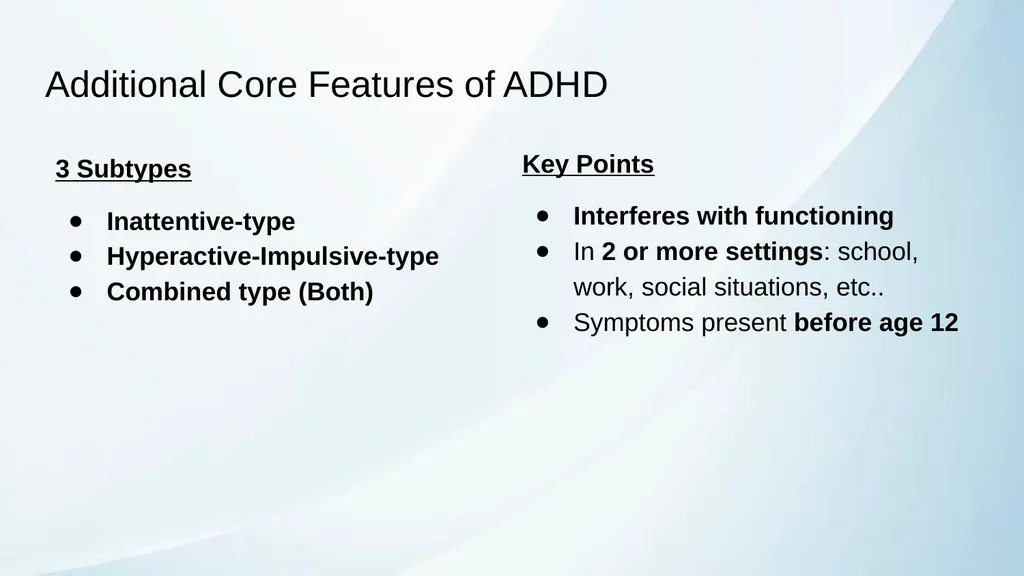
Additional Core Features of ADHD 3 Subtypes
Inattentive-type
Hyperactive-Impulsive-type
Combined type (Both) Key Points
Interferes with functioning
In 2 or more settings: school, work, social situations, etc..
Symptoms present before age 12<br>
Inattentive-type
Hyperactive-Impulsive-type
Combined type (Both) Key Points
Interferes with functioning
In 2 or more settings: school, work, social situations, etc..
Symptoms present before age 12<br>
15
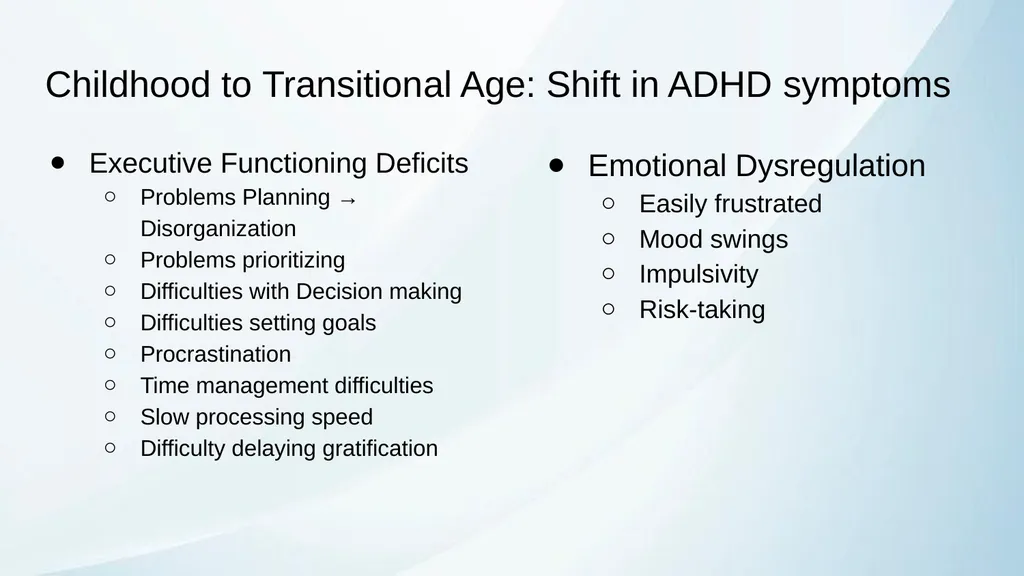
Childhood to Transitional Age: Shift in ADHD symptoms Executive Functioning Deficits
Problems Planning → Disorganization
Problems prioritizing
Difficulties with Decision making
Difficulties setting goals
Procrastination
Time management difficulties
Slow processing speed
Difficulty delaying gratification Emotional Dysregulation
Easily frustrated
Mood swings
Impulsivity
Risk-taking<br>
Problems Planning → Disorganization
Problems prioritizing
Difficulties with Decision making
Difficulties setting goals
Procrastination
Time management difficulties
Slow processing speed
Difficulty delaying gratification Emotional Dysregulation
Easily frustrated
Mood swings
Impulsivity
Risk-taking<br>
16
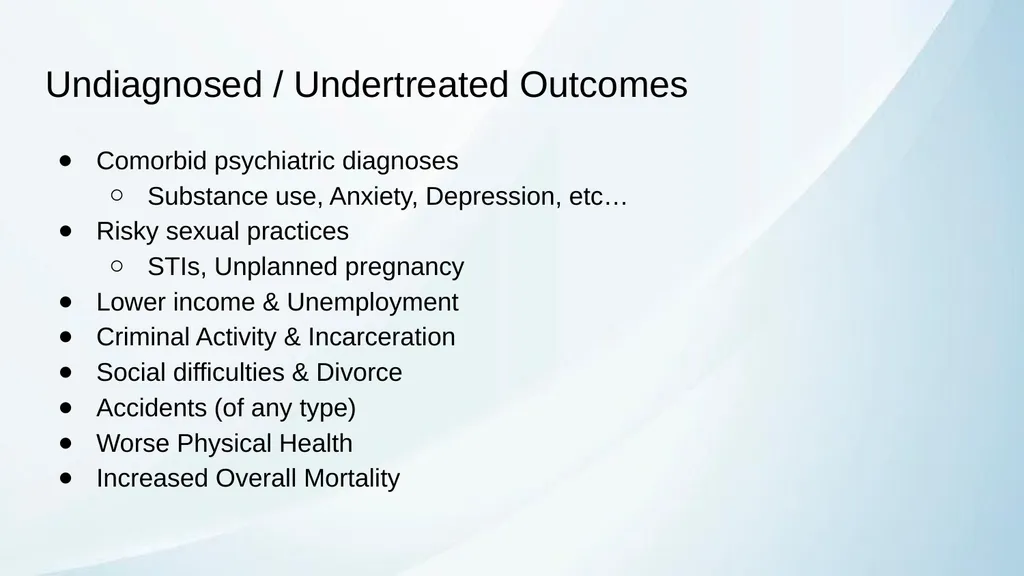
Undiagnosed / Undertreated Outcomes Comorbid psychiatric diagnoses
Substance use, Anxiety, Depression, etc…
Risky sexual practices
STIs, Unplanned pregnancy
Lower income & Unemployment
Criminal Activity & Incarceration
Social difficulties & Divorce
Accidents (of any type)
Worse Physical Health
Increased Overall Mortality<br>
Substance use, Anxiety, Depression, etc…
Risky sexual practices
STIs, Unplanned pregnancy
Lower income & Unemployment
Criminal Activity & Incarceration
Social difficulties & Divorce
Accidents (of any type)
Worse Physical Health
Increased Overall Mortality<br>
17
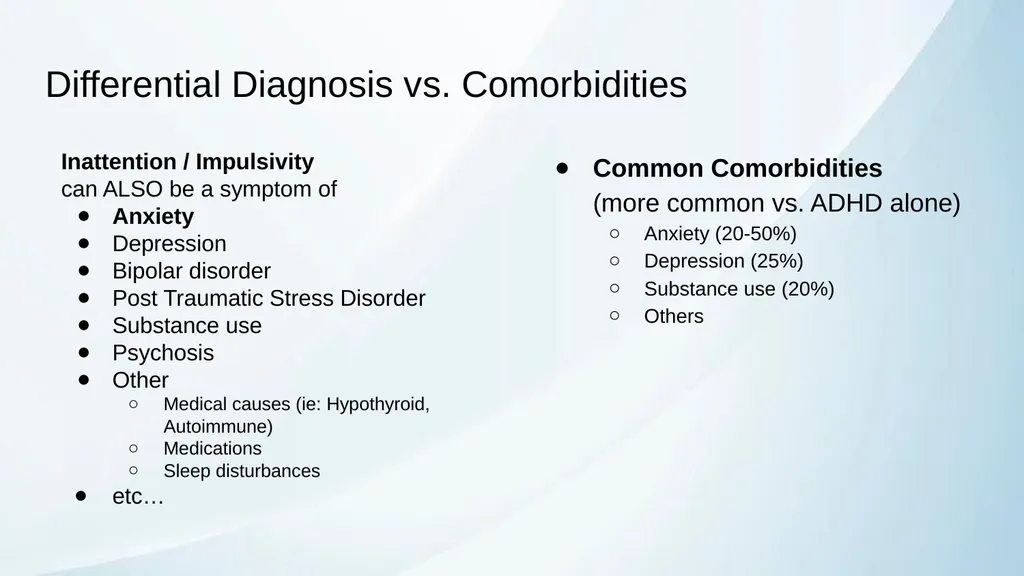
Differential Diagnosis vs. Comorbidities Inattention / Impulsivity
can ALSO be a symptom of
Anxiety
Depression
Bipolar disorder
Post Traumatic Stress Disorder
Substance use
Psychosis
Other
Medical causes (ie: Hypothyroid, Autoimmune)
Medications
Sleep disturbances
etc… Common Comorbidities (more common vs. ADHD alone)
Anxiety (20-50%)
Depression (25%)
Substance use (20%)
Others<br>
Anxiety
Depression
Bipolar disorder
Post Traumatic Stress Disorder
Substance use
Psychosis
Other
Medical causes (ie: Hypothyroid, Autoimmune)
Medications
Sleep disturbances
etc… Common Comorbidities (more common vs. ADHD alone)
Anxiety (20-50%)
Depression (25%)
Substance use (20%)
Others<br>
18
Differential Diagnosis: Anxiety vs. ADHD Inattention / Impulsivity
can ALSO be a symptom of
Anxiety
Depression
Bipolar disorder
Post Traumatic Stress Disorder
Substance use
Psychosis
Other
Medical causes (ie: Hypothyroid, Autoimmune)
Medications
Sleep disturbances Key Differences
Anxiety: Inattention is due to excess worry, rumination, avoidance. Anxiety tends to be out of proportion to stressor. Worries about many different things.
ADHD: Inattention even when not worried usually due to preference of novel stimuli / stimulating/enjoyable activities. Disorganization, Procrastination. May worry about problems that arise due to ADHD symptoms.
Comorbid Anxiety + ADHD<br>
Anxiety
Depression
Bipolar disorder
Post Traumatic Stress Disorder
Substance use
Psychosis
Other
Medical causes (ie: Hypothyroid, Autoimmune)
Medications
Sleep disturbances Key Differences
Anxiety: Inattention is due to excess worry, rumination, avoidance. Anxiety tends to be out of proportion to stressor. Worries about many different things.
ADHD: Inattention even when not worried usually due to preference of novel stimuli / stimulating/enjoyable activities. Disorganization, Procrastination. May worry about problems that arise due to ADHD symptoms.
Comorbid Anxiety + ADHD<br>
19
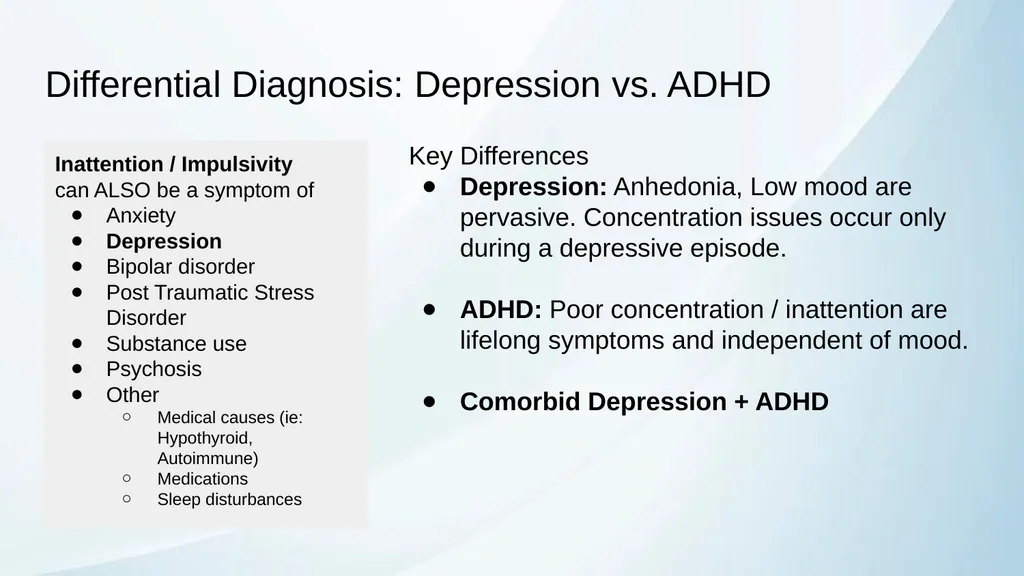
Differential Diagnosis: Depression vs. ADHD Inattention / Impulsivity
can ALSO be a symptom of
Anxiety
Depression
Bipolar disorder
Post Traumatic Stress Disorder
Substance use
Psychosis
Other
Medical causes (ie: Hypothyroid, Autoimmune)
Medications
Sleep disturbances Key Differences
Depression: Anhedonia, Low mood are pervasive. Concentration issues occur only during a depressive episode.
ADHD: Poor concentration / inattention are lifelong symptoms and independent of mood.
Comorbid Depression + ADHD<br>
Anxiety
Depression
Bipolar disorder
Post Traumatic Stress Disorder
Substance use
Psychosis
Other
Medical causes (ie: Hypothyroid, Autoimmune)
Medications
Sleep disturbances Key Differences
Depression: Anhedonia, Low mood are pervasive. Concentration issues occur only during a depressive episode.
ADHD: Poor concentration / inattention are lifelong symptoms and independent of mood.
Comorbid Depression + ADHD<br>
20
Differential Diagnosis: Bipolar vs. ADHD Inattention / Impulsivity
can ALSO be a symptom of
Anxiety
Depression
Bipolar disorder
Post Traumatic Stress Disorder
Substance use
Psychosis
Other
Medical causes (ie: Hypothyroid, Autoimmune)
Medications
Sleep disturbances Key Differences
Bipolar: Mania with expansive, elated mood. Inattention and impulsivity are episodic co-occuring with manic/hypomanic episode.
ADHD: Inattention are impulsivity are lifelong and pervasive. Independent of mood and mood swings.
Comorbid Bipolar + ADHD<br>
Anxiety
Depression
Bipolar disorder
Post Traumatic Stress Disorder
Substance use
Psychosis
Other
Medical causes (ie: Hypothyroid, Autoimmune)
Medications
Sleep disturbances Key Differences
Bipolar: Mania with expansive, elated mood. Inattention and impulsivity are episodic co-occuring with manic/hypomanic episode.
ADHD: Inattention are impulsivity are lifelong and pervasive. Independent of mood and mood swings.
Comorbid Bipolar + ADHD<br>
21
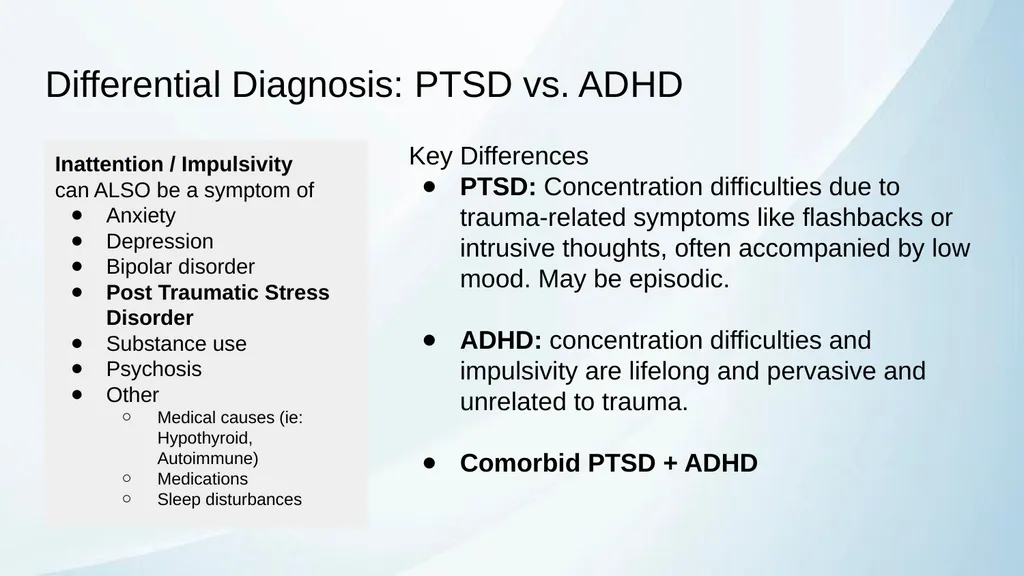
Differential Diagnosis: PTSD vs. ADHD Inattention / Impulsivity
can ALSO be a symptom of
Anxiety
Depression
Bipolar disorder
Post Traumatic Stress Disorder
Substance use
Psychosis
Other
Medical causes (ie: Hypothyroid, Autoimmune)
Medications
Sleep disturbances Key Differences
PTSD: Concentration difficulties due to trauma-related symptoms like flashbacks or intrusive thoughts, often accompanied by low mood. May be episodic.
ADHD: concentration difficulties and impulsivity are lifelong and pervasive and unrelated to trauma.
Comorbid PTSD + ADHD<br>
Anxiety
Depression
Bipolar disorder
Post Traumatic Stress Disorder
Substance use
Psychosis
Other
Medical causes (ie: Hypothyroid, Autoimmune)
Medications
Sleep disturbances Key Differences
PTSD: Concentration difficulties due to trauma-related symptoms like flashbacks or intrusive thoughts, often accompanied by low mood. May be episodic.
ADHD: concentration difficulties and impulsivity are lifelong and pervasive and unrelated to trauma.
Comorbid PTSD + ADHD<br>
22
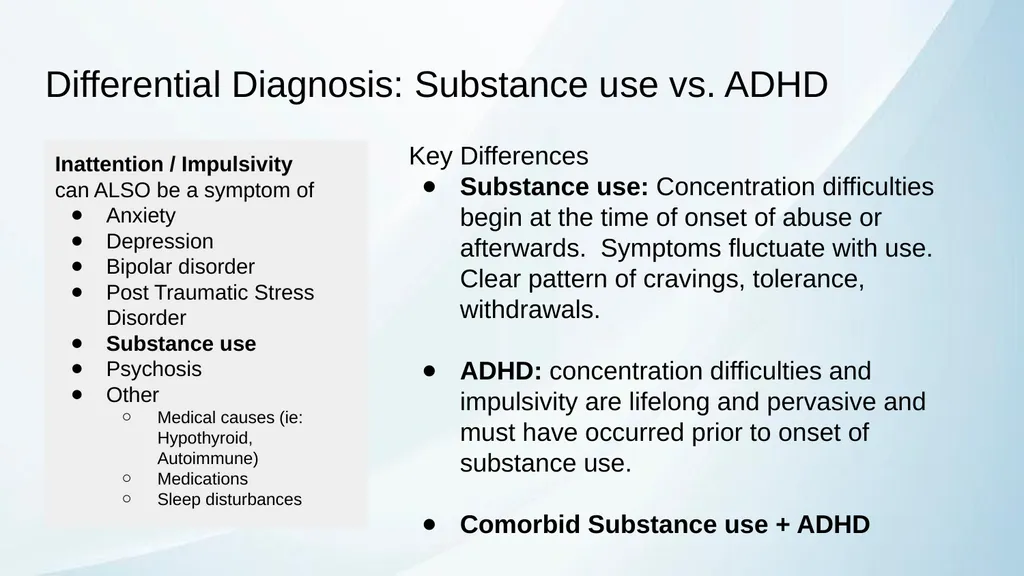
Differential Diagnosis: Substance use vs. ADHD Inattention / Impulsivity
can ALSO be a symptom of
Anxiety
Depression
Bipolar disorder
Post Traumatic Stress Disorder
Substance use
Psychosis
Other
Medical causes (ie: Hypothyroid, Autoimmune)
Medications
Sleep disturbances Key Differences
Substance use: Concentration difficulties begin at the time of onset of abuse or afterwards. Symptoms fluctuate with use. Clear pattern of cravings, tolerance, withdrawals.
ADHD: concentration difficulties and impulsivity are lifelong and pervasive and must have occurred prior to onset of substance use.
Comorbid Substance use + ADHD<br>
Anxiety
Depression
Bipolar disorder
Post Traumatic Stress Disorder
Substance use
Psychosis
Other
Medical causes (ie: Hypothyroid, Autoimmune)
Medications
Sleep disturbances Key Differences
Substance use: Concentration difficulties begin at the time of onset of abuse or afterwards. Symptoms fluctuate with use. Clear pattern of cravings, tolerance, withdrawals.
ADHD: concentration difficulties and impulsivity are lifelong and pervasive and must have occurred prior to onset of substance use.
Comorbid Substance use + ADHD<br>
23
Differential Diagnosis: Psychosis vs. ADHD Inattention / Impulsivity
can ALSO be a symptom of
Anxiety
Depression
Bipolar disorder
Post Traumatic Stress Disorder
Substance use
Psychosis
Other
Medical causes (ie: Hypothyroid, Autoimmune)
Medications
Sleep disturbances Key Differences
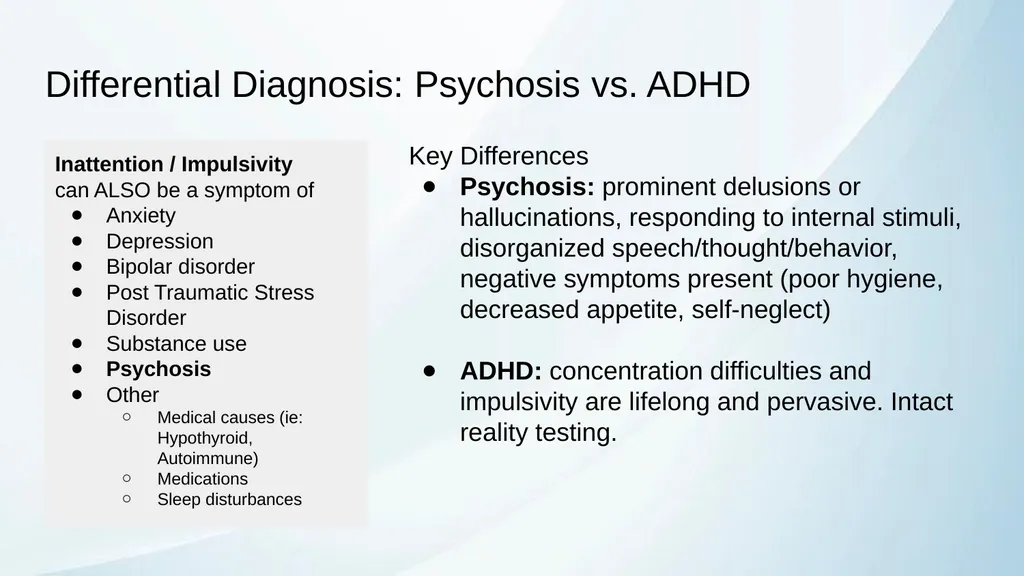
Psychosis: prominent delusions or hallucinations, responding to internal stimuli, disorganized speech/thought/behavior, negative symptoms present (poor hygiene, decreased appetite, self-neglect)
ADHD: concentration difficulties and impulsivity are lifelong and pervasive. Intact reality testing.<br>
Anxiety
Depression
Bipolar disorder
Post Traumatic Stress Disorder
Substance use
Psychosis
Other
Medical causes (ie: Hypothyroid, Autoimmune)
Medications
Sleep disturbances Key Differences
Psychosis: prominent delusions or hallucinations, responding to internal stimuli, disorganized speech/thought/behavior, negative symptoms present (poor hygiene, decreased appetite, self-neglect)
ADHD: concentration difficulties and impulsivity are lifelong and pervasive. Intact reality testing.<br>
24
Differential Diagnosis: Other things to consider Inattention / Impulsivity
can ALSO be a symptom of
Anxiety
Depression
Bipolar disorder
Post Traumatic Stress Disorder
Substance use
Psychosis
Other
Medical causes (ie: Hypothyroid, Autoimmune)
Medications
Sleep disturbances Other causes
If other causes are suspected, consider treating these causes first before considering an ADHD diagnosis
Sleep difficulties are commonly comorbid
25-50%<br>
Anxiety
Depression
Bipolar disorder
Post Traumatic Stress Disorder
Substance use
Psychosis
Other
Medical causes (ie: Hypothyroid, Autoimmune)
Medications
Sleep disturbances Other causes
If other causes are suspected, consider treating these causes first before considering an ADHD diagnosis
Sleep difficulties are commonly comorbid
25-50%<br>
25
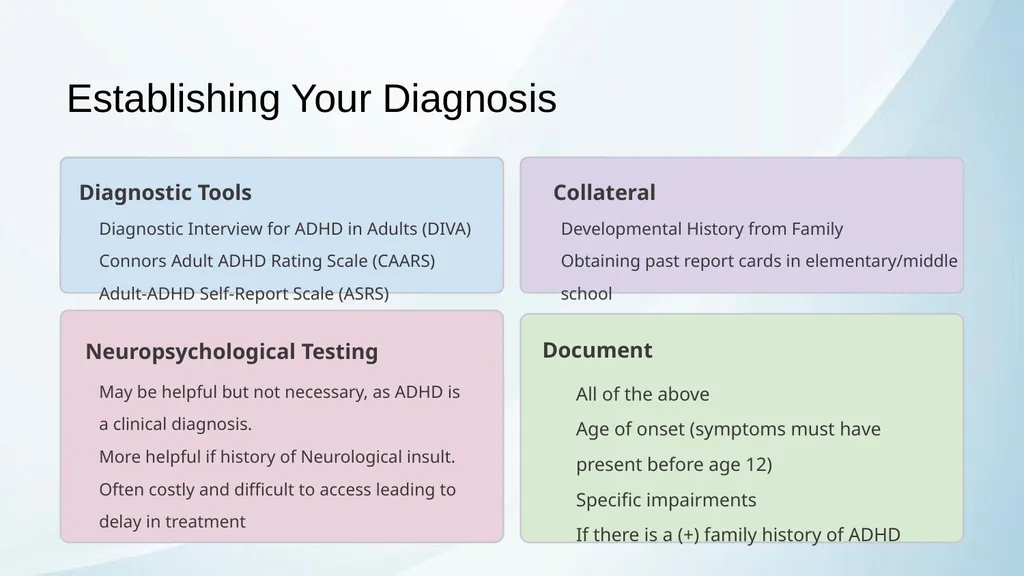
Establishing Your Diagnosis Diagnostic Tools Diagnostic Interview for ADHD in Adults (DIVA)
Connors Adult ADHD Rating Scale (CAARS)
Adult-ADHD Self-Report Scale (ASRS) Collateral Developmental History from Family Obtaining past report cards in elementary/middle school Document All of the above Age of onset (symptoms must have present before age 12)
Specific impairments
If there is a (+) family history of ADHD Neuropsychological Testing May be helpful but not necessary, as ADHD is a clinical diagnosis. More helpful if history of Neurological insult.
Often costly and difficult to access leading to delay in treatment<br>
Adult-ADHD Self-Report Scale (ASRS) Collateral Developmental History from Family Obtaining past report cards in elementary/middle school Document All of the above Age of onset (symptoms must have present before age 12)
Specific impairments
If there is a (+) family history of ADHD Neuropsychological Testing May be helpful but not necessary, as ADHD is a clinical diagnosis. More helpful if history of Neurological insult.
Often costly and difficult to access leading to delay in treatment<br>
26
Treatment Options: Non-pharmalogic CBT for ADHD
Executive Function Coaching
Psychoeducation
Mindfulness-based Interventions
Peer support / Mentoring programs
Organizational Tools & Apps
Sleep Hygiene Interventions
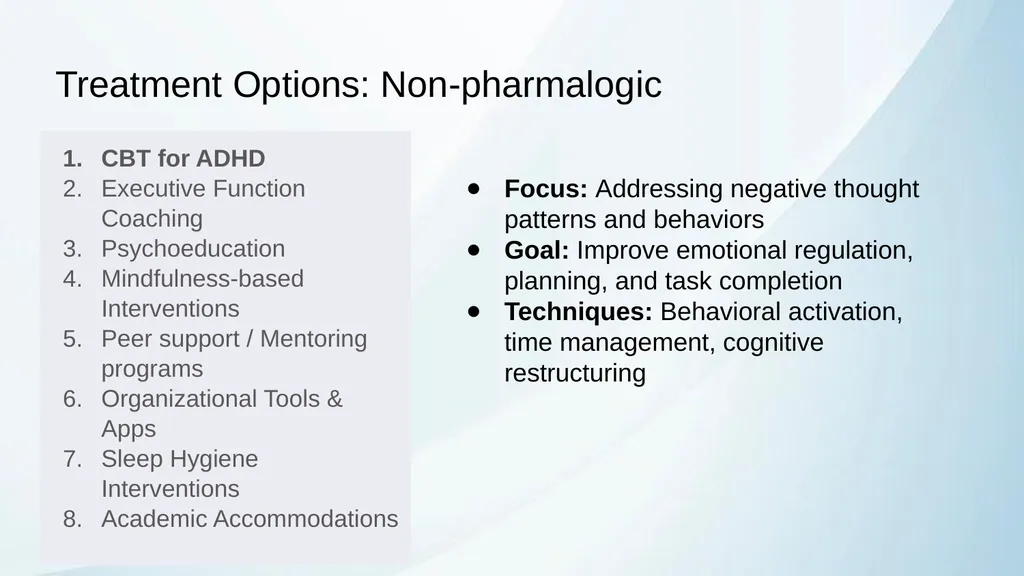
Academic Accommodations Focus: Addressing negative thought patterns and behaviors
Goal: Improve emotional regulation, planning, and task completion
Techniques: Behavioral activation, time management, cognitive restructuring<br>
Executive Function Coaching
Psychoeducation
Mindfulness-based Interventions
Peer support / Mentoring programs
Organizational Tools & Apps
Sleep Hygiene Interventions
Academic Accommodations Focus: Addressing negative thought patterns and behaviors
Goal: Improve emotional regulation, planning, and task completion
Techniques: Behavioral activation, time management, cognitive restructuring<br>
27
Treatment Options: Non-pharmalogic CBT for ADHD
Executive Function Coaching
Psychoeducation
Mindfulness-based Interventions
Peer support / Mentoring programs
Organizational Tools & Apps
Sleep Hygiene Interventions
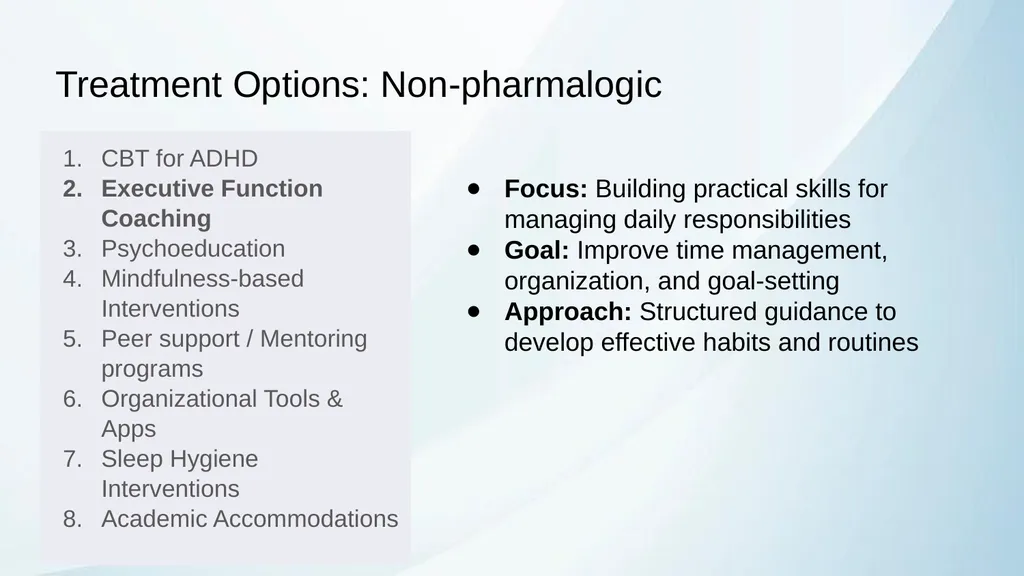
Academic Accommodations Focus: Building practical skills for managing daily responsibilities
Goal: Improve time management, organization, and goal-setting
Approach: Structured guidance to develop effective habits and routines<br>
Executive Function Coaching
Psychoeducation
Mindfulness-based Interventions
Peer support / Mentoring programs
Organizational Tools & Apps
Sleep Hygiene Interventions
Academic Accommodations Focus: Building practical skills for managing daily responsibilities
Goal: Improve time management, organization, and goal-setting
Approach: Structured guidance to develop effective habits and routines<br>
28
Treatment Options: Non-pharmalogic CBT for ADHD
Executive Function Coaching
Psychoeducation
Mindfulness-based Interventions
Peer support / Mentoring programs
Organizational Tools & Apps
Sleep Hygiene Interventions
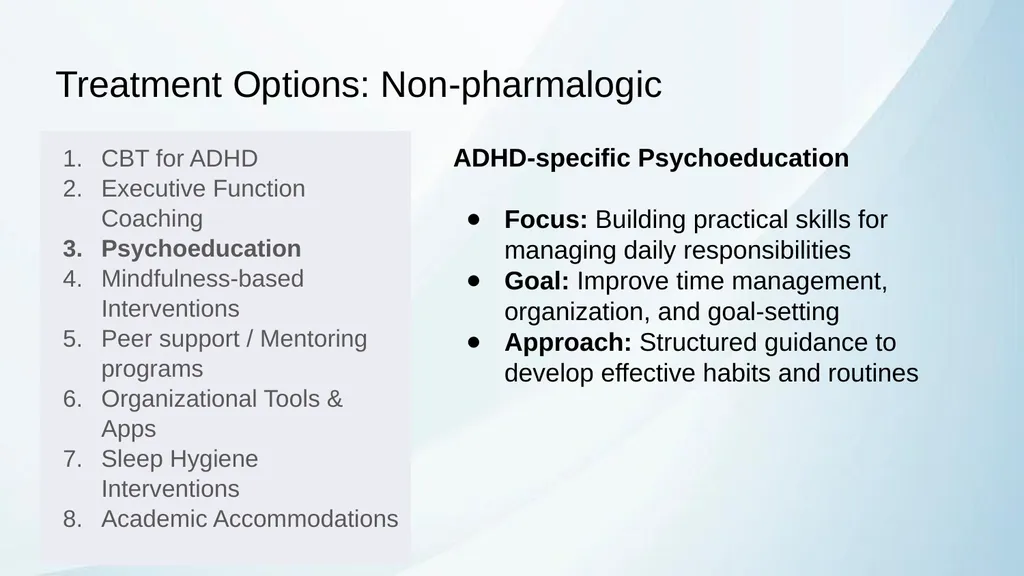
Academic Accommodations ADHD-specific Psychoeducation
Focus: Building practical skills for managing daily responsibilities
Goal: Improve time management, organization, and goal-setting
Approach: Structured guidance to develop effective habits and routines<br>
Executive Function Coaching
Psychoeducation
Mindfulness-based Interventions
Peer support / Mentoring programs
Organizational Tools & Apps
Sleep Hygiene Interventions
Academic Accommodations ADHD-specific Psychoeducation
Focus: Building practical skills for managing daily responsibilities
Goal: Improve time management, organization, and goal-setting
Approach: Structured guidance to develop effective habits and routines<br>
29
Treatment Options: Non-pharmalogic CBT for ADHD
Executive Function Coaching
Psychoeducation
Mindfulness-based Interventions
Peer support / Mentoring programs
Organizational Tools & Apps
Sleep Hygiene Interventions
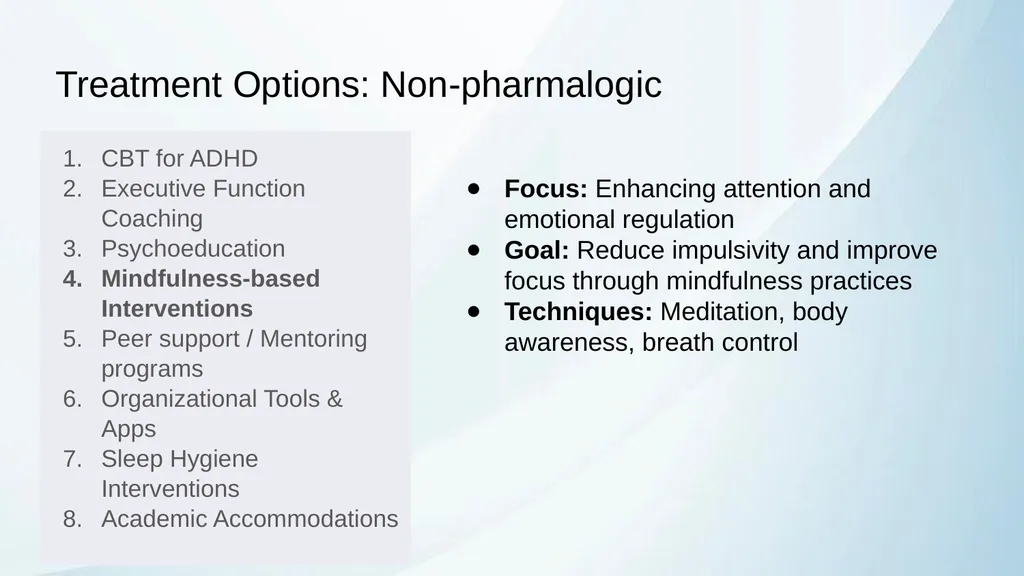
Academic Accommodations Focus: Enhancing attention and emotional regulation
Goal: Reduce impulsivity and improve focus through mindfulness practices
Techniques: Meditation, body awareness, breath control<br>
Executive Function Coaching
Psychoeducation
Mindfulness-based Interventions
Peer support / Mentoring programs
Organizational Tools & Apps
Sleep Hygiene Interventions
Academic Accommodations Focus: Enhancing attention and emotional regulation
Goal: Reduce impulsivity and improve focus through mindfulness practices
Techniques: Meditation, body awareness, breath control<br>
30
Treatment Options: Non-pharmalogic CBT for ADHD
Executive Function Coaching
Psychoeducation
Mindfulness-based Interventions
Peer support / Mentoring programs
Organizational Tools & Apps
Sleep Hygiene Interventions
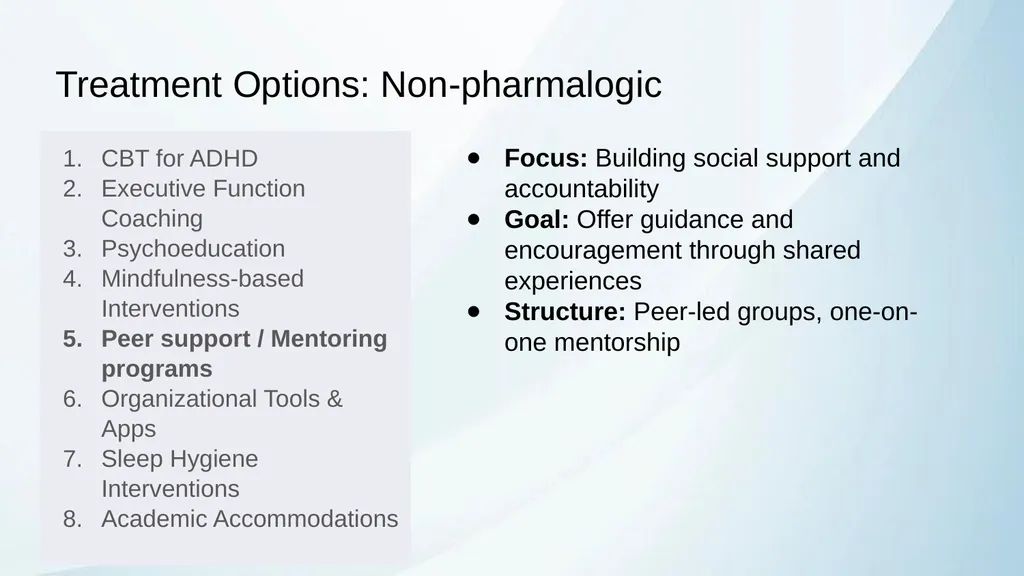
Academic Accommodations Focus: Building social support and accountability
Goal: Offer guidance and encouragement through shared experiences
Structure: Peer-led groups, one-on-one mentorship<br>
Executive Function Coaching
Psychoeducation
Mindfulness-based Interventions
Peer support / Mentoring programs
Organizational Tools & Apps
Sleep Hygiene Interventions
Academic Accommodations Focus: Building social support and accountability
Goal: Offer guidance and encouragement through shared experiences
Structure: Peer-led groups, one-on-one mentorship<br>
31
Treatment Options: Non-pharmalogic CBT for ADHD
Executive Function Coaching
Psychoeducation
Mindfulness-based Interventions
Peer support / Mentoring programs
Organizational Tools & Apps
Sleep Hygiene Interventions
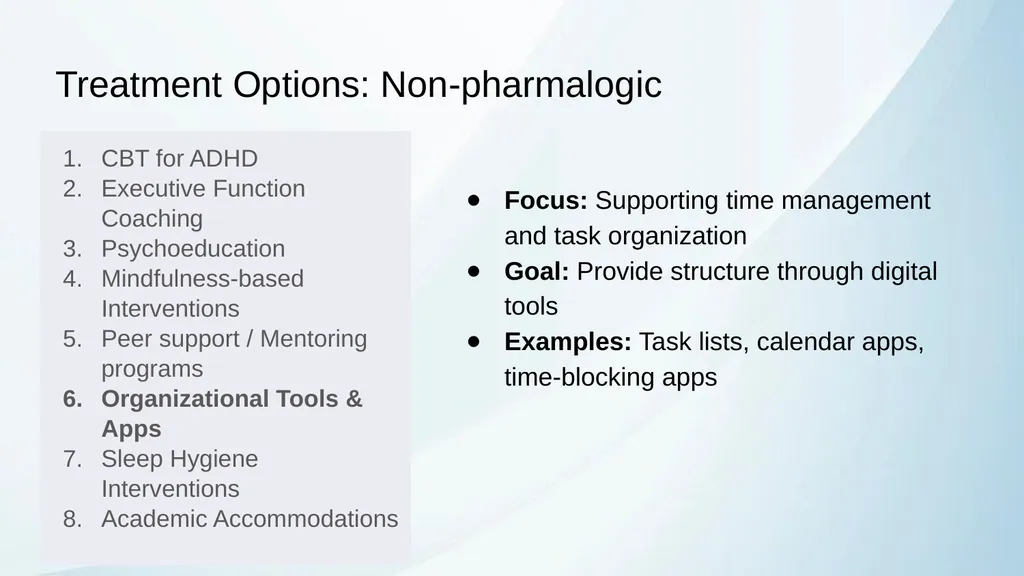
Academic Accommodations Focus: Supporting time management and task organization
Goal: Provide structure through digital tools
Examples: Task lists, calendar apps, time-blocking apps<br>
Executive Function Coaching
Psychoeducation
Mindfulness-based Interventions
Peer support / Mentoring programs
Organizational Tools & Apps
Sleep Hygiene Interventions
Academic Accommodations Focus: Supporting time management and task organization
Goal: Provide structure through digital tools
Examples: Task lists, calendar apps, time-blocking apps<br>
32
Treatment Options: Non-pharmalogic CBT for ADHD
Executive Function Coaching
Psychoeducation
Mindfulness-based Interventions
Peer support / Mentoring programs
Organizational Tools & Apps
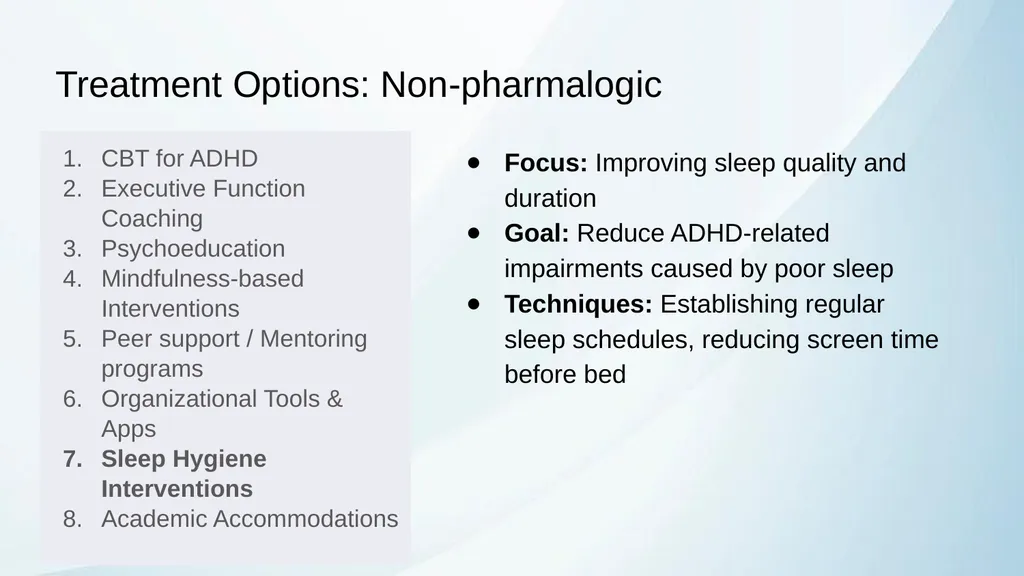
Sleep Hygiene Interventions
Academic Accommodations Focus: Improving sleep quality and duration
Goal: Reduce ADHD-related impairments caused by poor sleep
Techniques: Establishing regular sleep schedules, reducing screen time before bed<br>
Executive Function Coaching
Psychoeducation
Mindfulness-based Interventions
Peer support / Mentoring programs
Organizational Tools & Apps
Sleep Hygiene Interventions
Academic Accommodations Focus: Improving sleep quality and duration
Goal: Reduce ADHD-related impairments caused by poor sleep
Techniques: Establishing regular sleep schedules, reducing screen time before bed<br>
33
Treatment Options: Non-pharmalogic CBT for ADHD
Executive Function Coaching
Psychoeducation
Mindfulness-based Interventions
Peer support / Mentoring programs
Organizational Tools & Apps
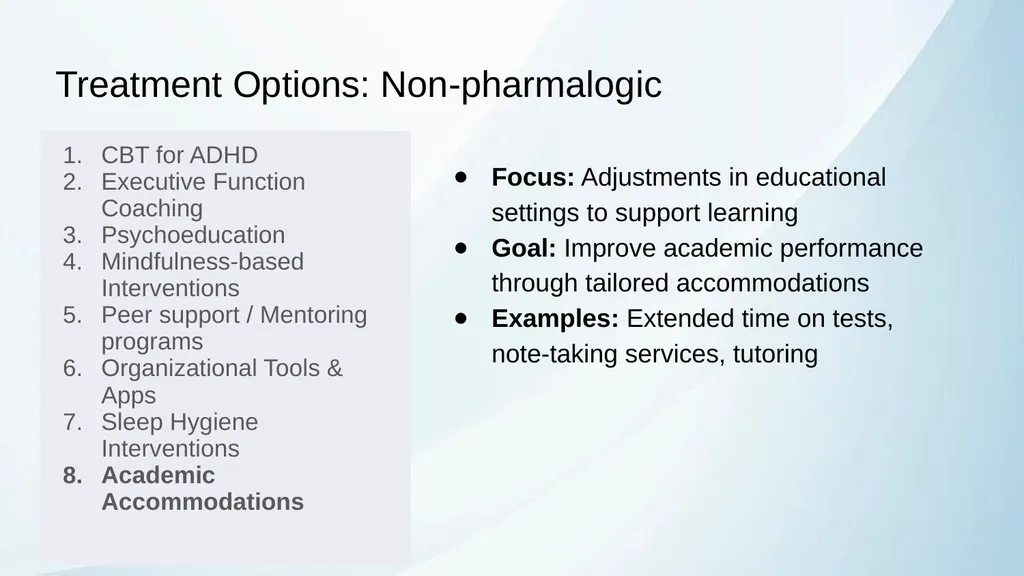
Sleep Hygiene Interventions
Academic Accommodations Focus: Adjustments in educational settings to support learning
Goal: Improve academic performance through tailored accommodations
Examples: Extended time on tests, note-taking services, tutoring<br>
Executive Function Coaching
Psychoeducation
Mindfulness-based Interventions
Peer support / Mentoring programs
Organizational Tools & Apps
Sleep Hygiene Interventions
Academic Accommodations Focus: Adjustments in educational settings to support learning
Goal: Improve academic performance through tailored accommodations
Examples: Extended time on tests, note-taking services, tutoring<br>
34
Treatment Options: Medication Stimulants
Methylphenidate(s)
Amphetamine(s)
Non-Stimulants
Alpha-agonists
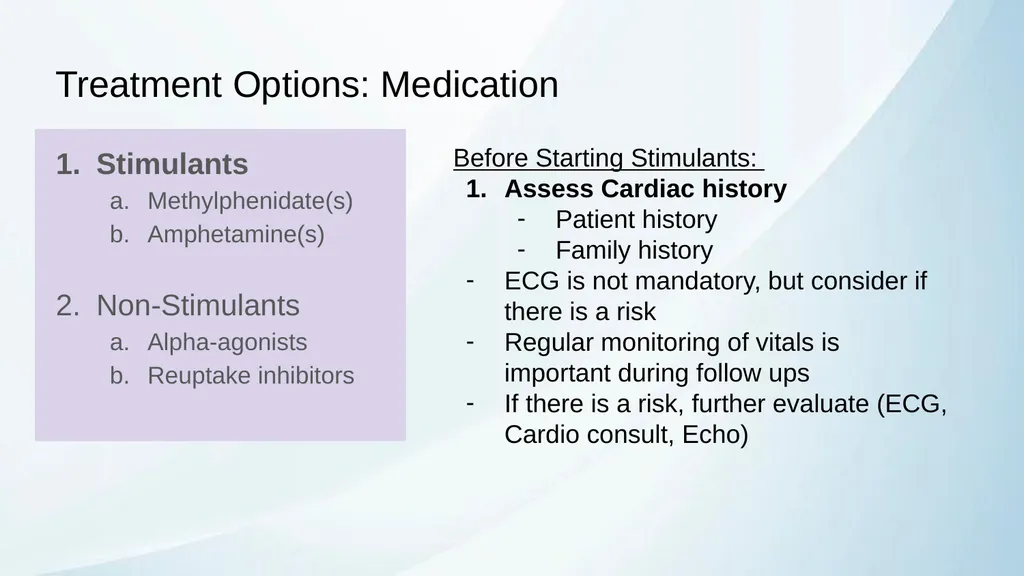
Reuptake inhibitors Before Starting Stimulants:
Assess Cardiac history
Patient history
Family history
ECG is not mandatory, but consider if there is a risk
Regular monitoring of vitals is important during follow ups
If there is a risk, further evaluate (ECG, Cardio consult, Echo)<br>
Methylphenidate(s)
Amphetamine(s)
Non-Stimulants
Alpha-agonists
Reuptake inhibitors Before Starting Stimulants:
Assess Cardiac history
Patient history
Family history
ECG is not mandatory, but consider if there is a risk
Regular monitoring of vitals is important during follow ups
If there is a risk, further evaluate (ECG, Cardio consult, Echo)<br>
35
Treatment Options: Medication Stimulants
Methylphenidate (M)
Amphetamine (A)
Non-Stimulants
Alpha-agonists
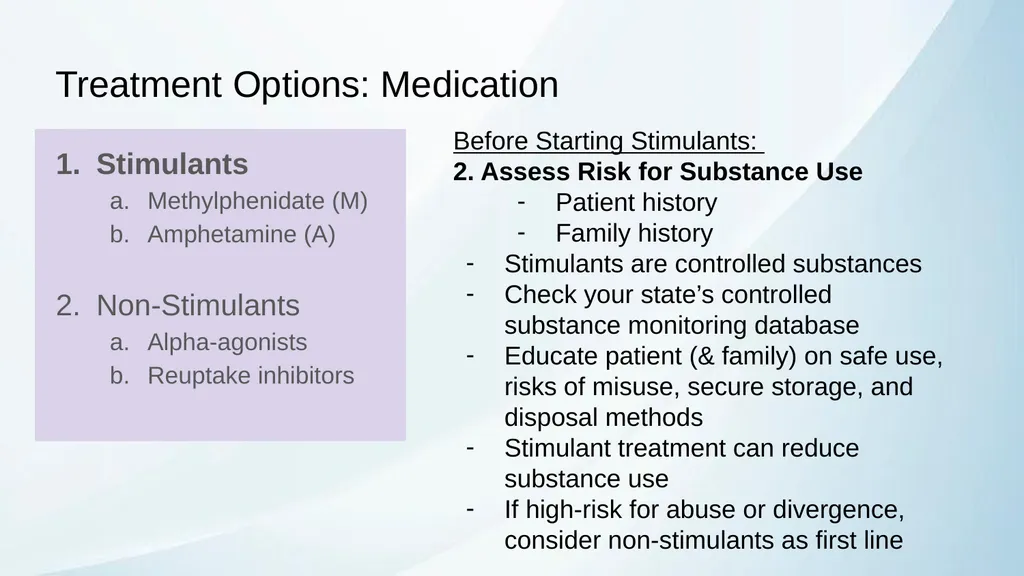
Reuptake inhibitors Before Starting Stimulants:
2. Assess Risk for Substance Use
Patient history
Family history
Stimulants are controlled substances
Check your state’s controlled substance monitoring database
Educate patient (& family) on safe use, risks of misuse, secure storage, and disposal methods
Stimulant treatment can reduce substance use
If high-risk for abuse or divergence, consider non-stimulants as first line<br>
Methylphenidate (M)
Amphetamine (A)
Non-Stimulants
Alpha-agonists
Reuptake inhibitors Before Starting Stimulants:
2. Assess Risk for Substance Use
Patient history
Family history
Stimulants are controlled substances
Check your state’s controlled substance monitoring database
Educate patient (& family) on safe use, risks of misuse, secure storage, and disposal methods
Stimulant treatment can reduce substance use
If high-risk for abuse or divergence, consider non-stimulants as first line<br>
36
Treatment Options: Medication Stimulants
Methylphenidate (M)
Amphetamine (A)
Non-Stimulants
Alpha-agonists
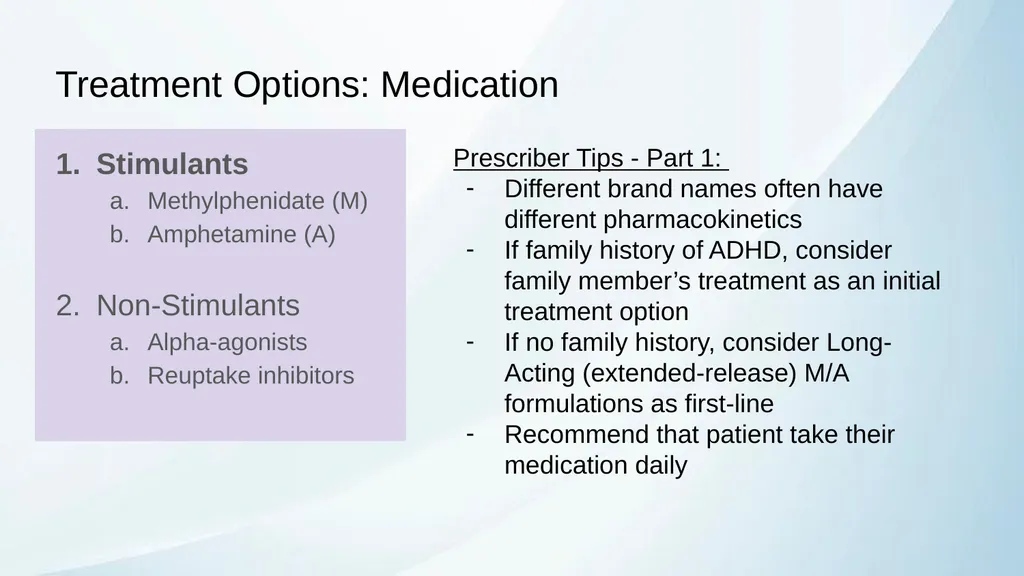
Reuptake inhibitors Prescriber Tips - Part 1:
Different brand names often have different pharmacokinetics
If family history of ADHD, consider family member’s treatment as an initial treatment option
If no family history, consider Long-Acting (extended-release) M/A formulations as first-line
Recommend that patient take their medication daily<br>
Methylphenidate (M)
Amphetamine (A)
Non-Stimulants
Alpha-agonists
Reuptake inhibitors Prescriber Tips - Part 1:
Different brand names often have different pharmacokinetics
If family history of ADHD, consider family member’s treatment as an initial treatment option
If no family history, consider Long-Acting (extended-release) M/A formulations as first-line
Recommend that patient take their medication daily<br>
37
Treatment Options: Medication Stimulants
Methylphenidate (M)
Amphetamine (A)
Non-Stimulants
Alpha-agonists
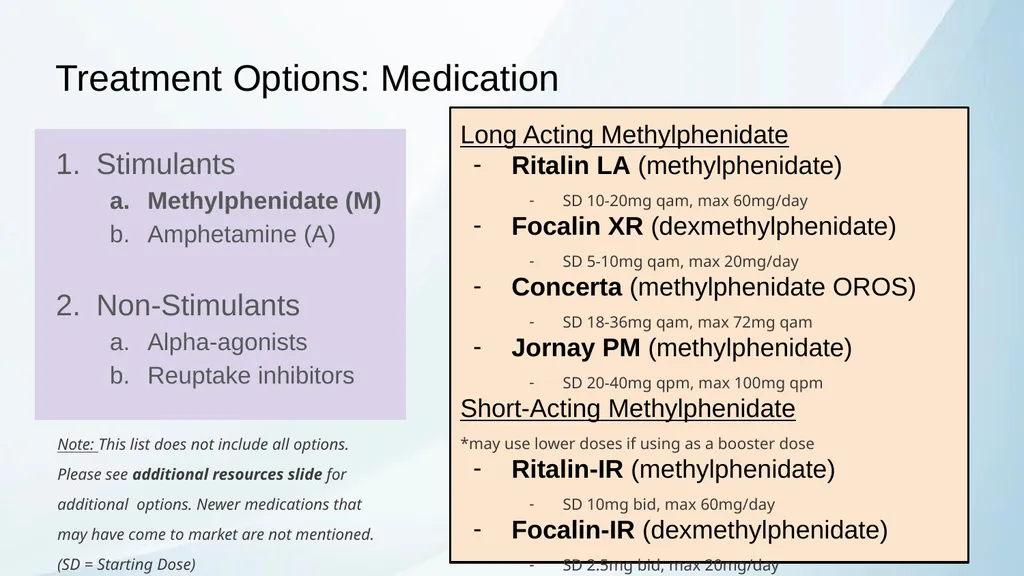
Reuptake inhibitors Long Acting Methylphenidate
Ritalin LA (methylphenidate)
SD 10-20mg qam, max 60mg/day
Focalin XR (dexmethylphenidate)
SD 5-10mg qam, max 20mg/day
Concerta (methylphenidate OROS)
SD 18-36mg qam, max 72mg qam
Jornay PM (methylphenidate)
SD 20-40mg qpm, max 100mg qpm
Short-Acting Methylphenidate
*may use lower doses if using as a booster dose
Ritalin-IR (methylphenidate)
SD 10mg bid, max 60mg/day
Focalin-IR (dexmethylphenidate)
SD 2.5mg bid, max 20mg/day Note: This list does not include all options. Please see additional resources slide for additional options. Newer medications that may have come to market are not mentioned. (SD = Starting Dose)<br>
Methylphenidate (M)
Amphetamine (A)
Non-Stimulants
Alpha-agonists
Reuptake inhibitors Long Acting Methylphenidate
Ritalin LA (methylphenidate)
SD 10-20mg qam, max 60mg/day
Focalin XR (dexmethylphenidate)
SD 5-10mg qam, max 20mg/day
Concerta (methylphenidate OROS)
SD 18-36mg qam, max 72mg qam
Jornay PM (methylphenidate)
SD 20-40mg qpm, max 100mg qpm
Short-Acting Methylphenidate
*may use lower doses if using as a booster dose
Ritalin-IR (methylphenidate)
SD 10mg bid, max 60mg/day
Focalin-IR (dexmethylphenidate)
SD 2.5mg bid, max 20mg/day Note: This list does not include all options. Please see additional resources slide for additional options. Newer medications that may have come to market are not mentioned. (SD = Starting Dose)<br>
38
Treatment Options: Medication Stimulants
Methylphenidate (M)
Amphetamine (A)
Non-Stimulants
Alpha-agonists
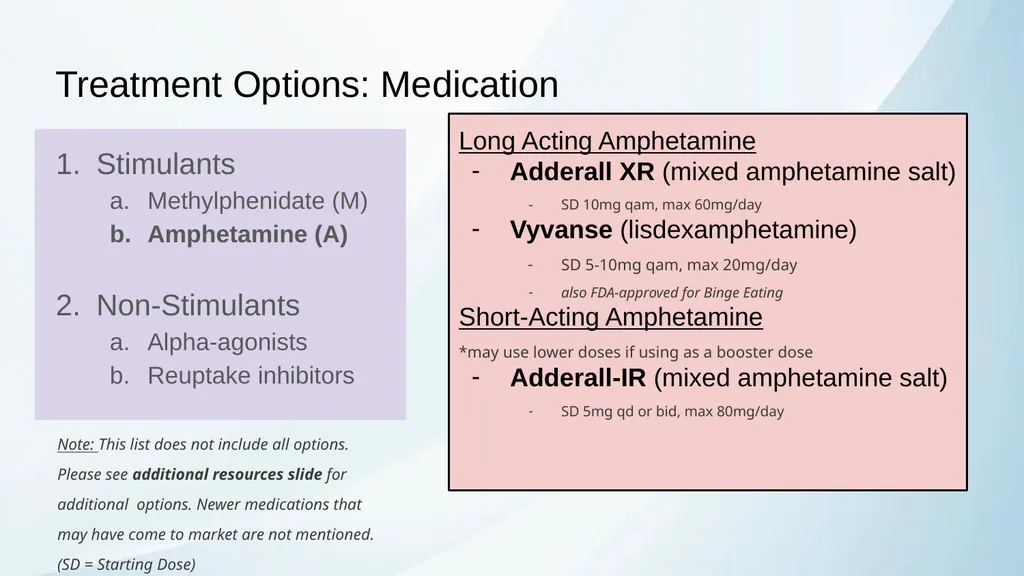
Reuptake inhibitors Long Acting Amphetamine
Adderall XR (mixed amphetamine salt)
SD 10mg qam, max 60mg/day
Vyvanse (lisdexamphetamine)
SD 5-10mg qam, max 20mg/day
also FDA-approved for Binge Eating
Short-Acting Amphetamine
*may use lower doses if using as a booster dose
Adderall-IR (mixed amphetamine salt)
SD 5mg qd or bid, max 80mg/day Note: This list does not include all options. Please see additional resources slide for additional options. Newer medications that may have come to market are not mentioned. (SD = Starting Dose)<br>
Methylphenidate (M)
Amphetamine (A)
Non-Stimulants
Alpha-agonists
Reuptake inhibitors Long Acting Amphetamine
Adderall XR (mixed amphetamine salt)
SD 10mg qam, max 60mg/day
Vyvanse (lisdexamphetamine)
SD 5-10mg qam, max 20mg/day
also FDA-approved for Binge Eating
Short-Acting Amphetamine
*may use lower doses if using as a booster dose
Adderall-IR (mixed amphetamine salt)
SD 5mg qd or bid, max 80mg/day Note: This list does not include all options. Please see additional resources slide for additional options. Newer medications that may have come to market are not mentioned. (SD = Starting Dose)<br>
39
Treatment Options: Medication Stimulants
Methylphenidate (M)
Amphetamine (A)
Non-Stimulants
Alpha-agonists
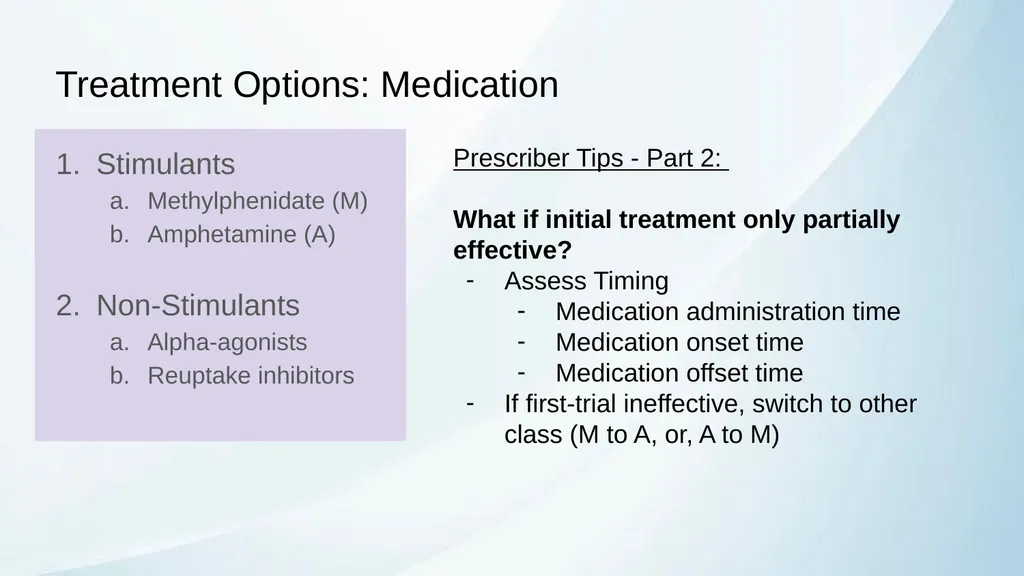
Reuptake inhibitors Prescriber Tips - Part 2:
What if initial treatment only partially effective?
Assess Timing
Medication administration time
Medication onset time
Medication offset time
If first-trial ineffective, switch to other class (M to A, or, A to M)<br>
Methylphenidate (M)
Amphetamine (A)
Non-Stimulants
Alpha-agonists
Reuptake inhibitors Prescriber Tips - Part 2:
What if initial treatment only partially effective?
Assess Timing
Medication administration time
Medication onset time
Medication offset time
If first-trial ineffective, switch to other class (M to A, or, A to M)<br>
40
Treatment Options: Medication Stimulants
Methylphenidate (M)
Amphetamine (A)
Non-Stimulants
Alpha-agonists
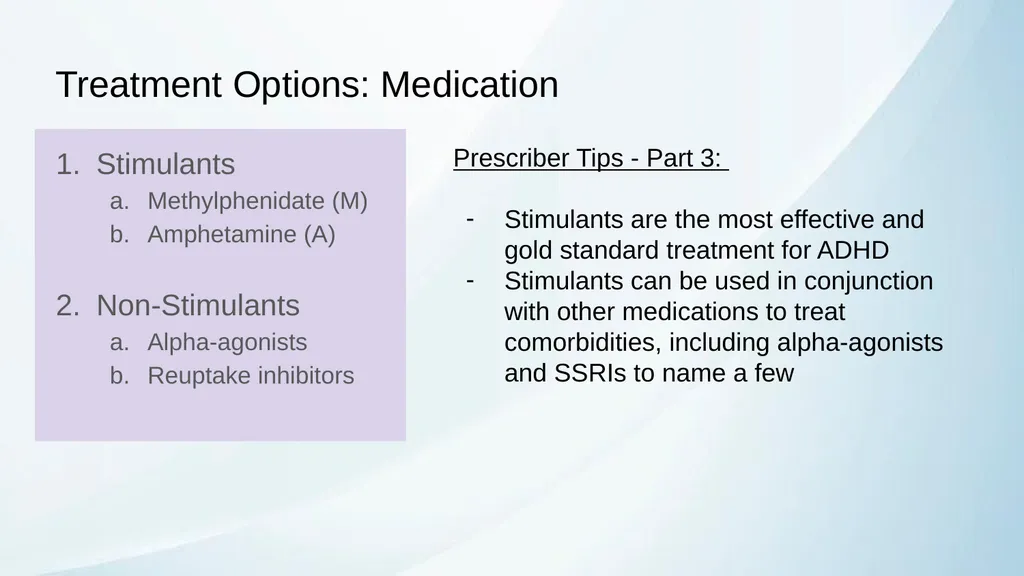
Reuptake inhibitors Prescriber Tips - Part 3:
Stimulants are the most effective and gold standard treatment for ADHD
Stimulants can be used in conjunction with other medications to treat comorbidities, including alpha-agonists and SSRIs to name a few<br>
Methylphenidate (M)
Amphetamine (A)
Non-Stimulants
Alpha-agonists
Reuptake inhibitors Prescriber Tips - Part 3:
Stimulants are the most effective and gold standard treatment for ADHD
Stimulants can be used in conjunction with other medications to treat comorbidities, including alpha-agonists and SSRIs to name a few<br>
41
Treatment Options: Medication Stimulants
Methylphenidate (M)
Amphetamine (A)
Non-Stimulants
Alpha-agonists
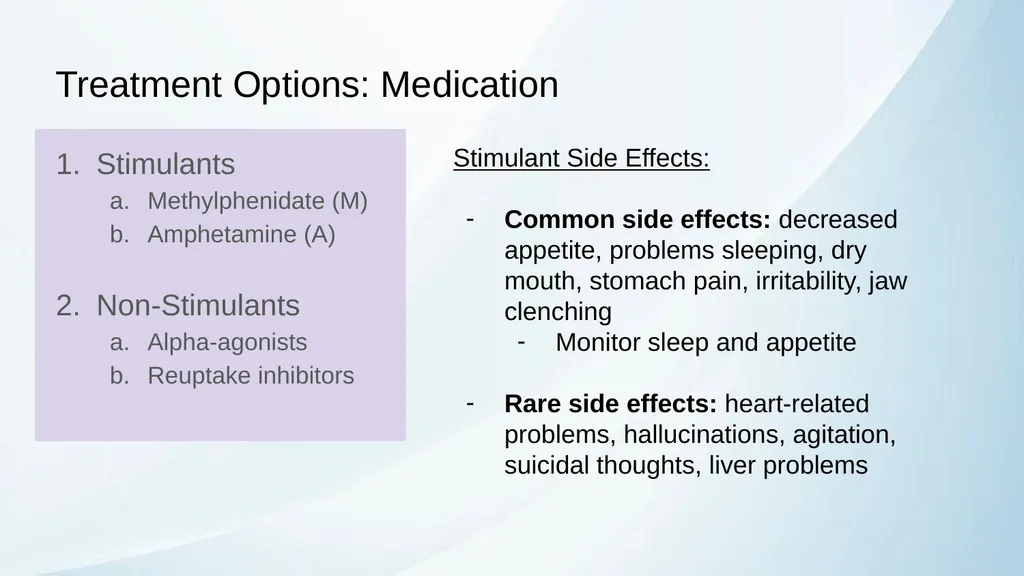
Reuptake inhibitors Stimulant Side Effects:
Common side effects: decreased appetite, problems sleeping, dry mouth, stomach pain, irritability, jaw clenching
Monitor sleep and appetite
Rare side effects: heart-related problems, hallucinations, agitation, suicidal thoughts, liver problems<br>
Methylphenidate (M)
Amphetamine (A)
Non-Stimulants
Alpha-agonists
Reuptake inhibitors Stimulant Side Effects:
Common side effects: decreased appetite, problems sleeping, dry mouth, stomach pain, irritability, jaw clenching
Monitor sleep and appetite
Rare side effects: heart-related problems, hallucinations, agitation, suicidal thoughts, liver problems<br>
42
Treatment Options: Medication Stimulants
Methylphenidate (M)
Amphetamine (A)
Non-Stimulants
Alpha-agonists
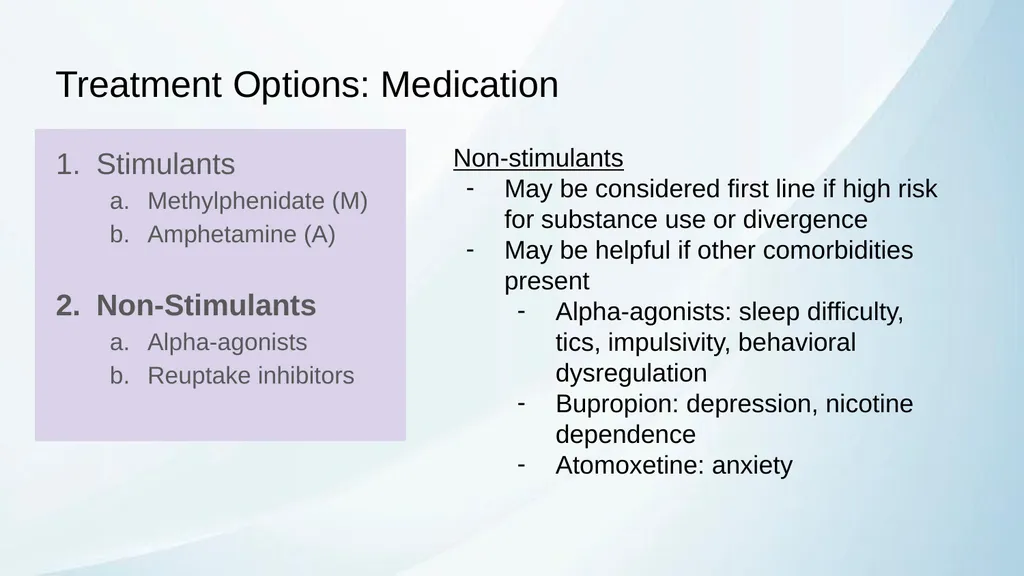
Reuptake inhibitors Non-stimulants
May be considered first line if high risk for substance use or divergence
May be helpful if other comorbidities present
Alpha-agonists: sleep difficulty, tics, impulsivity, behavioral dysregulation
Bupropion: depression, nicotine dependence
Atomoxetine: anxiety<br>
Methylphenidate (M)
Amphetamine (A)
Non-Stimulants
Alpha-agonists
Reuptake inhibitors Non-stimulants
May be considered first line if high risk for substance use or divergence
May be helpful if other comorbidities present
Alpha-agonists: sleep difficulty, tics, impulsivity, behavioral dysregulation
Bupropion: depression, nicotine dependence
Atomoxetine: anxiety<br>
43
Treatment Options: Medication Stimulants
Methylphenidate (M)
Amphetamine (A)
Non-Stimulants
Alpha-agonists
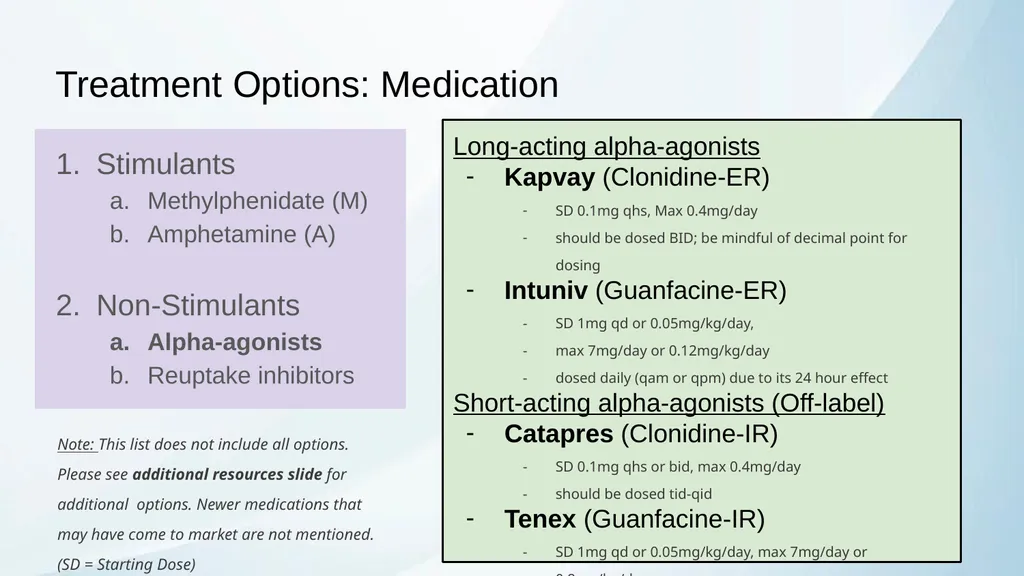
Reuptake inhibitors Long-acting alpha-agonists
Kapvay (Clonidine-ER)
SD 0.1mg qhs, Max 0.4mg/day
should be dosed BID; be mindful of decimal point for dosing
Intuniv (Guanfacine-ER)
SD 1mg qd or 0.05mg/kg/day,
max 7mg/day or 0.12mg/kg/day
dosed daily (qam or qpm) due to its 24 hour effect
Short-acting alpha-agonists (Off-label)
Catapres (Clonidine-IR)
SD 0.1mg qhs or bid, max 0.4mg/day
should be dosed tid-qid
Tenex (Guanfacine-IR)
SD 1mg qd or 0.05mg/kg/day, max 7mg/day or 0.8mg/kg/day
dosed qd-bid Note: This list does not include all options. Please see additional resources slide for additional options. Newer medications that may have come to market are not mentioned. (SD = Starting Dose)<br>
Methylphenidate (M)
Amphetamine (A)
Non-Stimulants
Alpha-agonists
Reuptake inhibitors Long-acting alpha-agonists
Kapvay (Clonidine-ER)
SD 0.1mg qhs, Max 0.4mg/day
should be dosed BID; be mindful of decimal point for dosing
Intuniv (Guanfacine-ER)
SD 1mg qd or 0.05mg/kg/day,
max 7mg/day or 0.12mg/kg/day
dosed daily (qam or qpm) due to its 24 hour effect
Short-acting alpha-agonists (Off-label)
Catapres (Clonidine-IR)
SD 0.1mg qhs or bid, max 0.4mg/day
should be dosed tid-qid
Tenex (Guanfacine-IR)
SD 1mg qd or 0.05mg/kg/day, max 7mg/day or 0.8mg/kg/day
dosed qd-bid Note: This list does not include all options. Please see additional resources slide for additional options. Newer medications that may have come to market are not mentioned. (SD = Starting Dose)<br>
44
Treatment Options: Medication Stimulants
Methylphenidate (M)
Amphetamine (A)
Non-Stimulants
Alpha-agonists
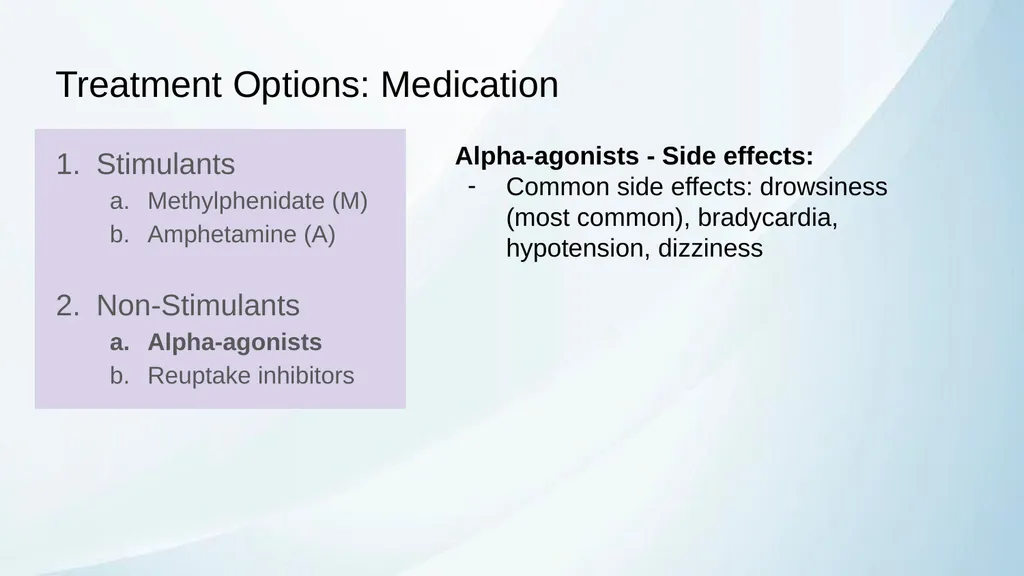
Reuptake inhibitors Alpha-agonists - Side effects:
Common side effects: drowsiness (most common), bradycardia, hypotension, dizziness<br>
Methylphenidate (M)
Amphetamine (A)
Non-Stimulants
Alpha-agonists
Reuptake inhibitors Alpha-agonists - Side effects:
Common side effects: drowsiness (most common), bradycardia, hypotension, dizziness<br>
45
Treatment Options: Medication Stimulants
Methylphenidate (M)
Amphetamine (A)
Non-Stimulants
Alpha-agonists
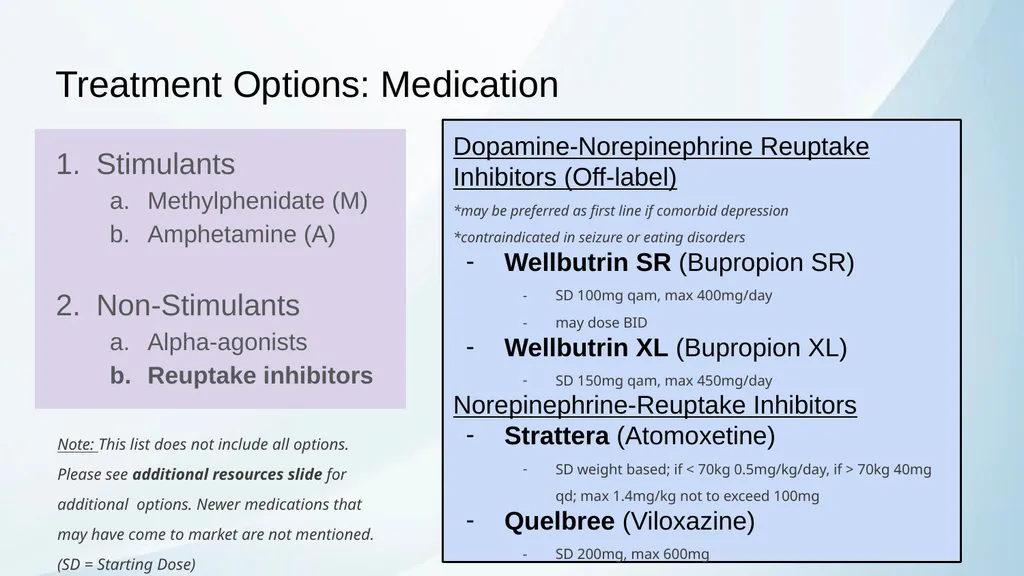
Reuptake inhibitors Dopamine-Norepinephrine Reuptake Inhibitors (Off-label)
*may be preferred as first line if comorbid depression
*contraindicated in seizure or eating disorders
Wellbutrin SR (Bupropion SR)
SD 100mg qam, max 400mg/day
may dose BID
Wellbutrin XL (Bupropion XL)
SD 150mg qam, max 450mg/day
Norepinephrine-Reuptake Inhibitors
Strattera (Atomoxetine)
SD weight based; if < 70kg 0.5mg/kg/day, if > 70kg 40mg qd; max 1.4mg/kg not to exceed 100mg
Quelbree (Viloxazine)
SD 200mg, max 600mg Note: This list does not include all options. Please see additional resources slide for additional options. Newer medications that may have come to market are not mentioned. (SD = Starting Dose)<br>
Methylphenidate (M)
Amphetamine (A)
Non-Stimulants
Alpha-agonists
Reuptake inhibitors Dopamine-Norepinephrine Reuptake Inhibitors (Off-label)
*may be preferred as first line if comorbid depression
*contraindicated in seizure or eating disorders
Wellbutrin SR (Bupropion SR)
SD 100mg qam, max 400mg/day
may dose BID
Wellbutrin XL (Bupropion XL)
SD 150mg qam, max 450mg/day
Norepinephrine-Reuptake Inhibitors
Strattera (Atomoxetine)
SD weight based; if < 70kg 0.5mg/kg/day, if > 70kg 40mg qd; max 1.4mg/kg not to exceed 100mg
Quelbree (Viloxazine)
SD 200mg, max 600mg Note: This list does not include all options. Please see additional resources slide for additional options. Newer medications that may have come to market are not mentioned. (SD = Starting Dose)<br>
46
Treatment Options: Medication Stimulants
Methylphenidate (M)
Amphetamine (A)
Non-Stimulants
Alpha-agonists
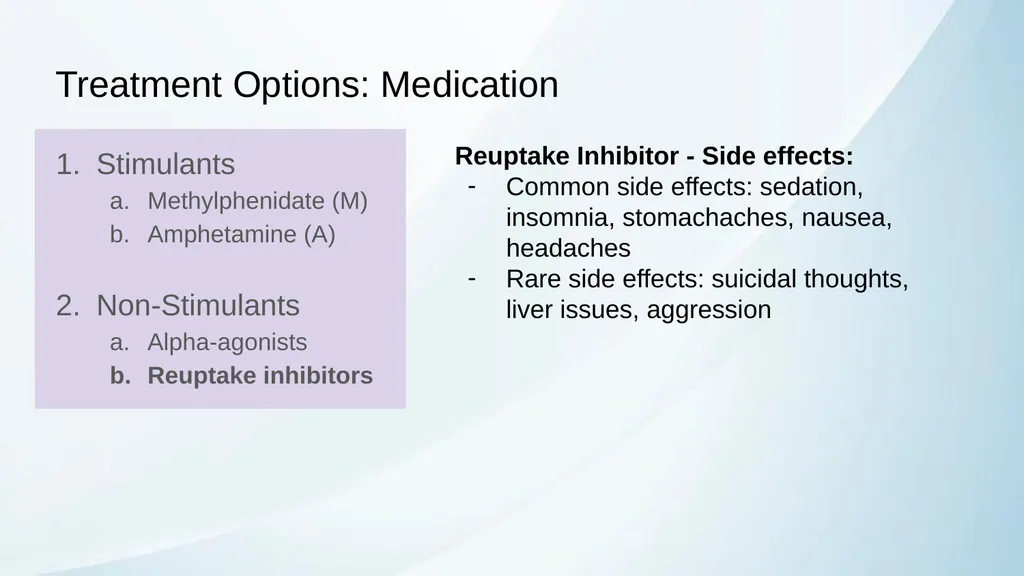
Reuptake inhibitors Reuptake Inhibitor - Side effects:
Common side effects: sedation, insomnia, stomachaches, nausea, headaches
Rare side effects: suicidal thoughts, liver issues, aggression<br>
Methylphenidate (M)
Amphetamine (A)
Non-Stimulants
Alpha-agonists
Reuptake inhibitors Reuptake Inhibitor - Side effects:
Common side effects: sedation, insomnia, stomachaches, nausea, headaches
Rare side effects: suicidal thoughts, liver issues, aggression<br>
47
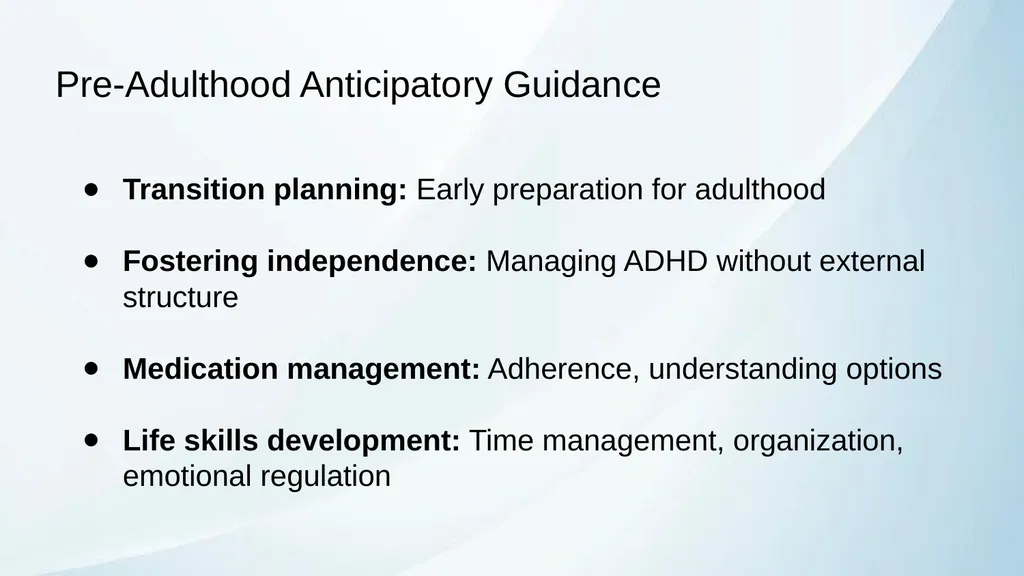
Pre-Adulthood Anticipatory Guidance Transition planning: Early preparation for adulthood
Fostering independence: Managing ADHD without external structure
Medication management: Adherence, understanding options
Life skills development: Time management, organization, emotional regulation<br>
Fostering independence: Managing ADHD without external structure
Medication management: Adherence, understanding options
Life skills development: Time management, organization, emotional regulation<br>
48
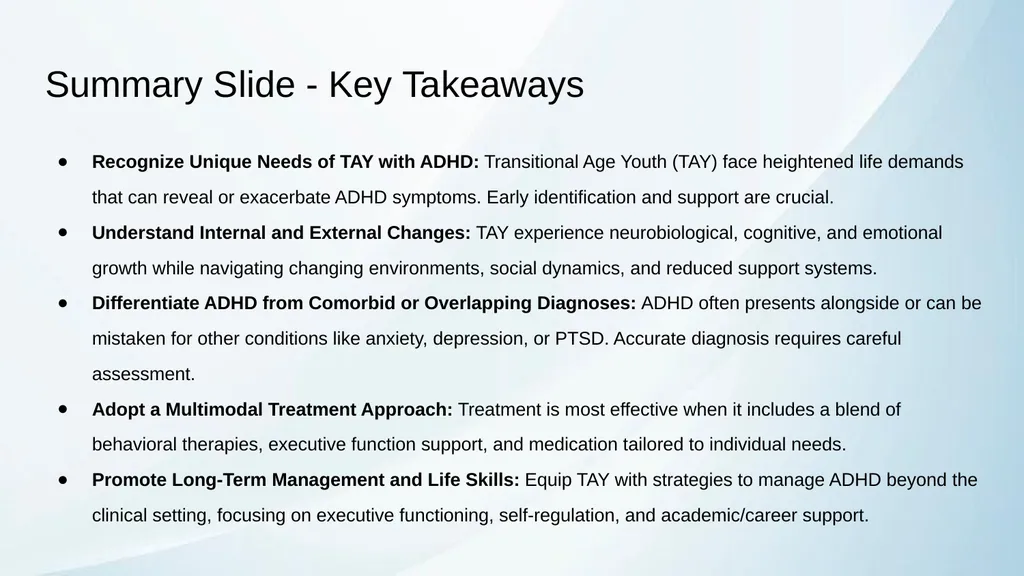
Summary Slide - Key Takeaways Recognize Unique Needs of TAY with ADHD: Transitional Age Youth (TAY) face heightened life demands that can reveal or exacerbate ADHD symptoms. Early identification and support are crucial.
Understand Internal and External Changes: TAY experience neurobiological, cognitive, and emotional growth while navigating changing environments, social dynamics, and reduced support systems.
Differentiate ADHD from Comorbid or Overlapping Diagnoses: ADHD often presents alongside or can be mistaken for other conditions like anxiety, depression, or PTSD. Accurate diagnosis requires careful assessment.
Adopt a Multimodal Treatment Approach: Treatment is most effective when it includes a blend of behavioral therapies, executive function support, and medication tailored to individual needs.
Promote Long-Term Management and Life Skills: Equip TAY with strategies to manage ADHD beyond the clinical setting, focusing on executive functioning, self-regulation, and academic/career support.<br>
Understand Internal and External Changes: TAY experience neurobiological, cognitive, and emotional growth while navigating changing environments, social dynamics, and reduced support systems.
Differentiate ADHD from Comorbid or Overlapping Diagnoses: ADHD often presents alongside or can be mistaken for other conditions like anxiety, depression, or PTSD. Accurate diagnosis requires careful assessment.
Adopt a Multimodal Treatment Approach: Treatment is most effective when it includes a blend of behavioral therapies, executive function support, and medication tailored to individual needs.
Promote Long-Term Management and Life Skills: Equip TAY with strategies to manage ADHD beyond the clinical setting, focusing on executive functioning, self-regulation, and academic/career support.<br>
49
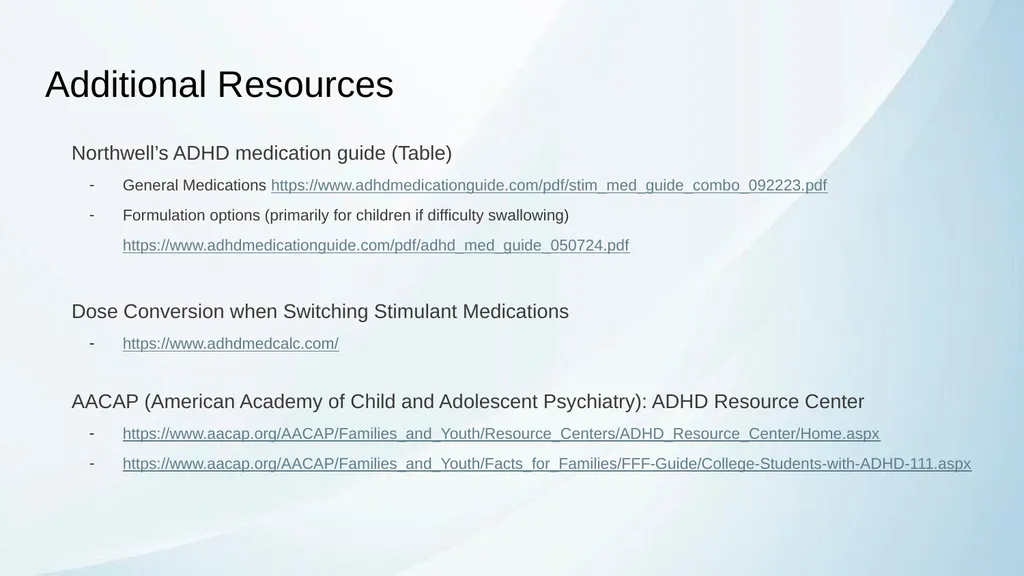
Additional Resources Northwell’s ADHD medication guide (Table)
General Medications https://www.adhdmedicationguide.com/pdf/stim_med_guide_combo_092223.pdf
Formulation options (primarily for children if difficulty swallowing) https://www.adhdmedicationguide.com/pdf/adhd_med_guide_050724.pdf
Dose Conversion when Switching Stimulant Medications
https://www.adhdmedcalc.com/
AACAP (American Academy of Child and Adolescent Psychiatry): ADHD Resource Center
https://www.aacap.org/AACAP/Families_and_Youth/Resource_Centers/ADHD_Resource_Center/Home.aspx
https://www.aacap.org/AACAP/Families_and_Youth/Facts_for_Families/FFF-Guide/College-Students-with-ADHD-111.aspx<br>
General Medications https://www.adhdmedicationguide.com/pdf/stim_med_guide_combo_092223.pdf
Formulation options (primarily for children if difficulty swallowing) https://www.adhdmedicationguide.com/pdf/adhd_med_guide_050724.pdf
Dose Conversion when Switching Stimulant Medications
https://www.adhdmedcalc.com/
AACAP (American Academy of Child and Adolescent Psychiatry): ADHD Resource Center
https://www.aacap.org/AACAP/Families_and_Youth/Resource_Centers/ADHD_Resource_Center/Home.aspx
https://www.aacap.org/AACAP/Families_and_Youth/Facts_for_Families/FFF-Guide/College-Students-with-ADHD-111.aspx<br>
50
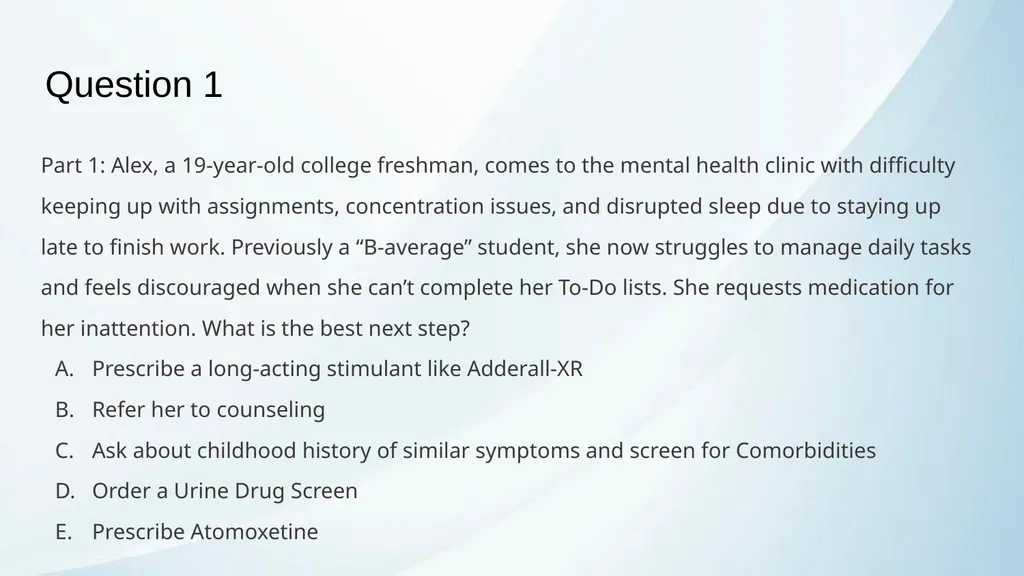
Question 1 Part 1: Alex, a 19-year-old college freshman, comes to the mental health clinic with difficulty keeping up with assignments, concentration issues, and disrupted sleep due to staying up late to finish work. Previously a “B-average” student, she now struggles to manage daily tasks and feels discouraged when she can’t complete her To-Do lists. She requests medication for her inattention. What is the best next step?
Prescribe a long-acting stimulant like Adderall-XR
Refer her to counseling
Ask about childhood history of similar symptoms and screen for Comorbidities
Order a Urine Drug Screen
Prescribe Atomoxetine<br>
Prescribe a long-acting stimulant like Adderall-XR
Refer her to counseling
Ask about childhood history of similar symptoms and screen for Comorbidities
Order a Urine Drug Screen
Prescribe Atomoxetine<br>
51
Question 1 Part 1: Alex, a 19-year-old college freshman, comes to the mental health clinic with difficulty keeping up with assignments, concentration issues, and disrupted sleep due to staying up late to finish work. Previously a “B-average” student, she now struggles to manage daily tasks and feels discouraged when she can’t complete her To-Do lists. She requests medication for her inattention. What is the best next step?
Prescribe a long-acting stimulant like Adderall-XR
Refer her to counseling
Ask about childhood history of similar symptoms and screen for Comorbidities
Order a Urine Drug Screen
Prescribe Atomoxetine<br>
Prescribe a long-acting stimulant like Adderall-XR
Refer her to counseling
Ask about childhood history of similar symptoms and screen for Comorbidities
Order a Urine Drug Screen
Prescribe Atomoxetine<br>
52
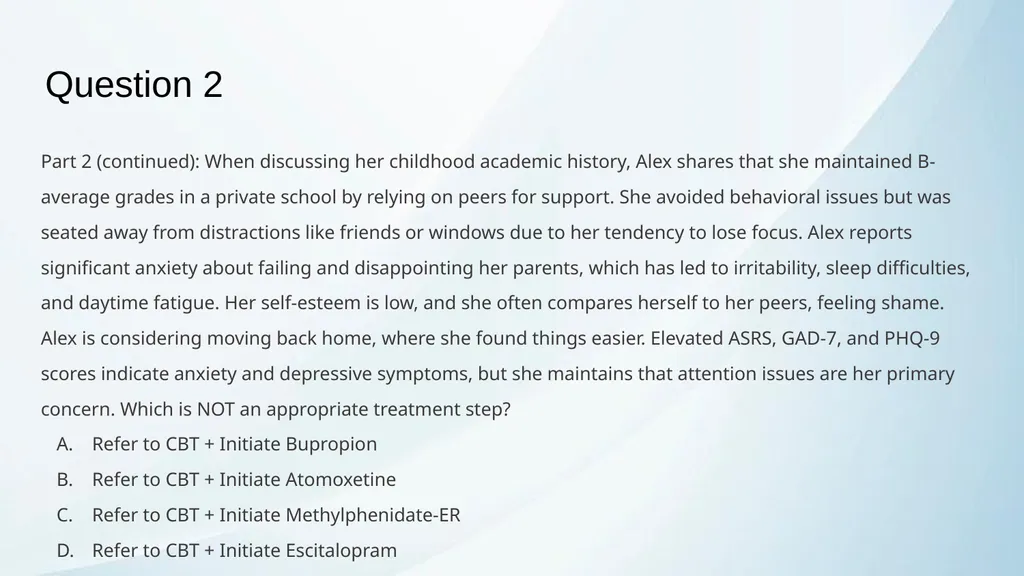
Question 2 Part 2 (continued): When discussing her childhood academic history, Alex shares that she maintained B-average grades in a private school by relying on peers for support. She avoided behavioral issues but was seated away from distractions like friends or windows due to her tendency to lose focus. Alex reports significant anxiety about failing and disappointing her parents, which has led to irritability, sleep difficulties, and daytime fatigue. Her self-esteem is low, and she often compares herself to her peers, feeling shame. Alex is considering moving back home, where she found things easier. Elevated ASRS, GAD-7, and PHQ-9 scores indicate anxiety and depressive symptoms, but she maintains that attention issues are her primary concern. Which is NOT an appropriate treatment step?
Refer to CBT + Initiate Bupropion
Refer to CBT + Initiate Atomoxetine
Refer to CBT + Initiate Methylphenidate-ER
Refer to CBT + Initiate Escitalopram
Refer to CBT + Initiate Clonidine-ER<br>
Refer to CBT + Initiate Bupropion
Refer to CBT + Initiate Atomoxetine
Refer to CBT + Initiate Methylphenidate-ER
Refer to CBT + Initiate Escitalopram
Refer to CBT + Initiate Clonidine-ER<br>
53
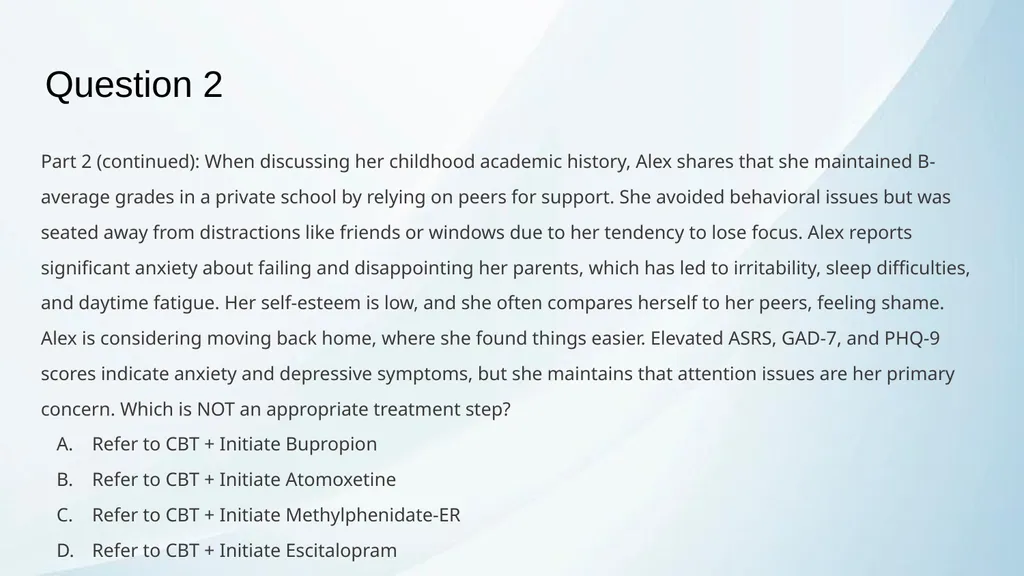
Question 2 Part 2 (continued): When discussing her childhood academic history, Alex shares that she maintained B-average grades in a private school by relying on peers for support. She avoided behavioral issues but was seated away from distractions like friends or windows due to her tendency to lose focus. Alex reports significant anxiety about failing and disappointing her parents, which has led to irritability, sleep difficulties, and daytime fatigue. Her self-esteem is low, and she often compares herself to her peers, feeling shame. Alex is considering moving back home, where she found things easier. Elevated ASRS, GAD-7, and PHQ-9 scores indicate anxiety and depressive symptoms, but she maintains that attention issues are her primary concern. Which is NOT an appropriate treatment step?
Refer to CBT + Initiate Bupropion
Refer to CBT + Initiate Atomoxetine
Refer to CBT + Initiate Methylphenidate-ER
Refer to CBT + Initiate Escitalopram
Refer to CBT + Initiate Clonidine-ER<br>
Refer to CBT + Initiate Bupropion
Refer to CBT + Initiate Atomoxetine
Refer to CBT + Initiate Methylphenidate-ER
Refer to CBT + Initiate Escitalopram
Refer to CBT + Initiate Clonidine-ER<br>
54
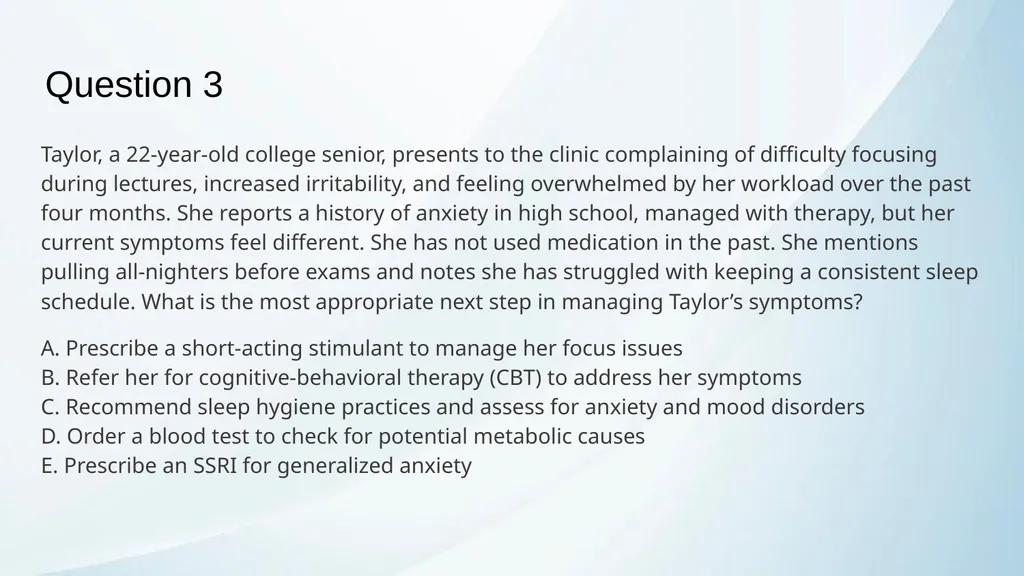
Question 3 Taylor, a 22-year-old college senior, presents to the clinic complaining of difficulty focusing during lectures, increased irritability, and feeling overwhelmed by her workload over the past four months. She reports a history of anxiety in high school, managed with therapy, but her current symptoms feel different. She has not used medication in the past. She mentions pulling all-nighters before exams and notes she has struggled with keeping a consistent sleep schedule. What is the most appropriate next step in managing Taylor’s symptoms?
A. Prescribe a short-acting stimulant to manage her focus issues B. Refer her for cognitive-behavioral therapy (CBT) to address her symptoms C. Recommend sleep hygiene practices and assess for anxiety and mood disorders D. Order a blood test to check for potential metabolic causes E. Prescribe an SSRI for generalized anxiety<br>
A. Prescribe a short-acting stimulant to manage her focus issues B. Refer her for cognitive-behavioral therapy (CBT) to address her symptoms C. Recommend sleep hygiene practices and assess for anxiety and mood disorders D. Order a blood test to check for potential metabolic causes E. Prescribe an SSRI for generalized anxiety<br>
55
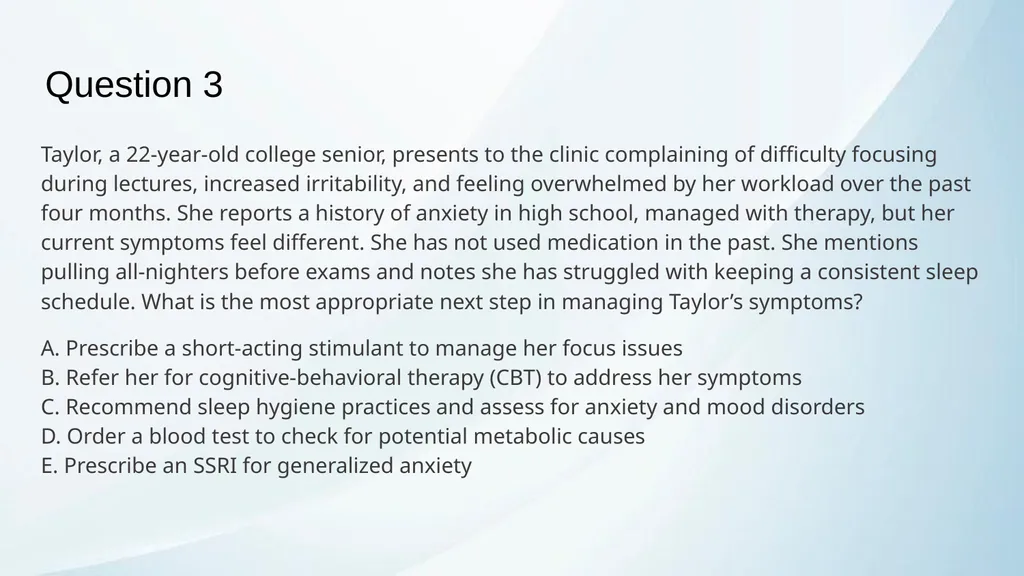
Question 3 Taylor, a 22-year-old college senior, presents to the clinic complaining of difficulty focusing during lectures, increased irritability, and feeling overwhelmed by her workload over the past four months. She reports a history of anxiety in high school, managed with therapy, but her current symptoms feel different. She has not used medication in the past. She mentions pulling all-nighters before exams and notes she has struggled with keeping a consistent sleep schedule. What is the most appropriate next step in managing Taylor’s symptoms?
A. Prescribe a short-acting stimulant to manage her focus issues B. Refer her for cognitive-behavioral therapy (CBT) to address her symptoms C. Recommend sleep hygiene practices and assess for anxiety and mood disorders D. Order a blood test to check for potential metabolic causes E. Prescribe an SSRI for generalized anxiety<br>
A. Prescribe a short-acting stimulant to manage her focus issues B. Refer her for cognitive-behavioral therapy (CBT) to address her symptoms C. Recommend sleep hygiene practices and assess for anxiety and mood disorders D. Order a blood test to check for potential metabolic causes E. Prescribe an SSRI for generalized anxiety<br>
56
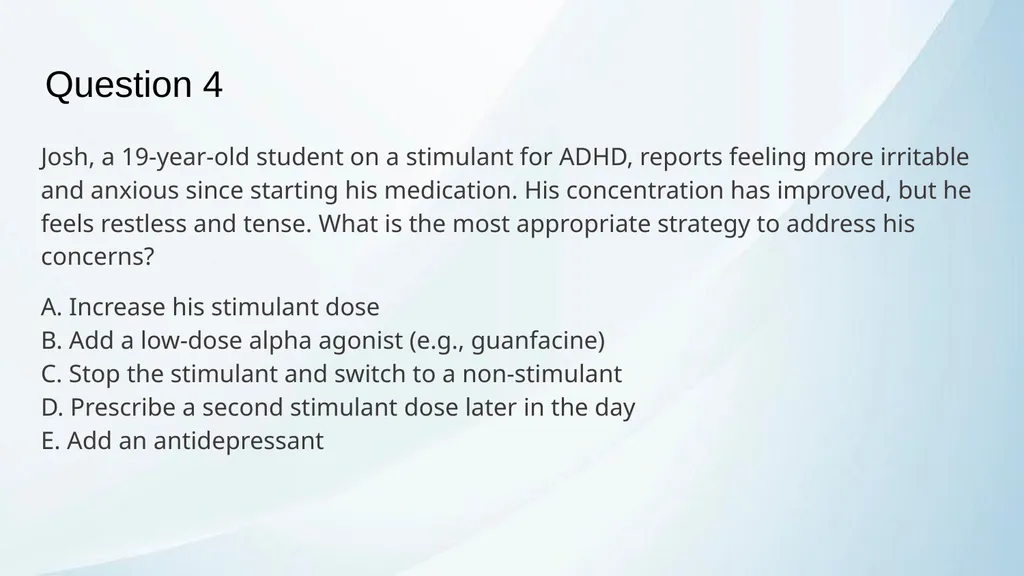
Question 4 Josh, a 19-year-old student on a stimulant for ADHD, reports feeling more irritable and anxious since starting his medication. His concentration has improved, but he feels restless and tense. What is the most appropriate strategy to address his concerns?
A. Increase his stimulant dose B. Add a low-dose alpha agonist (e.g., guanfacine) C. Stop the stimulant and switch to a non-stimulant D. Prescribe a second stimulant dose later in the day E. Add an antidepressant<br>
A. Increase his stimulant dose B. Add a low-dose alpha agonist (e.g., guanfacine) C. Stop the stimulant and switch to a non-stimulant D. Prescribe a second stimulant dose later in the day E. Add an antidepressant<br>
57
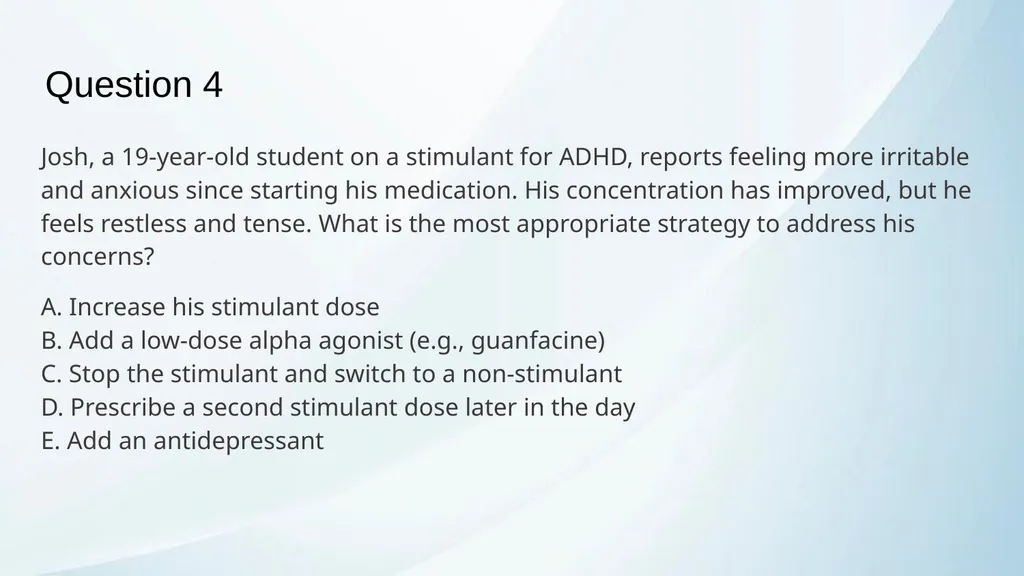
Question 4 Josh, a 19-year-old student on a stimulant for ADHD, reports feeling more irritable and anxious since starting his medication. His concentration has improved, but he feels restless and tense. What is the most appropriate strategy to address his concerns?
A. Increase his stimulant dose B. Add a low-dose alpha agonist (e.g., guanfacine) C. Stop the stimulant and switch to a non-stimulant D. Prescribe a second stimulant dose later in the day E. Add an antidepressant<br>
A. Increase his stimulant dose B. Add a low-dose alpha agonist (e.g., guanfacine) C. Stop the stimulant and switch to a non-stimulant D. Prescribe a second stimulant dose later in the day E. Add an antidepressant<br>
58
Thank You!<br>
59
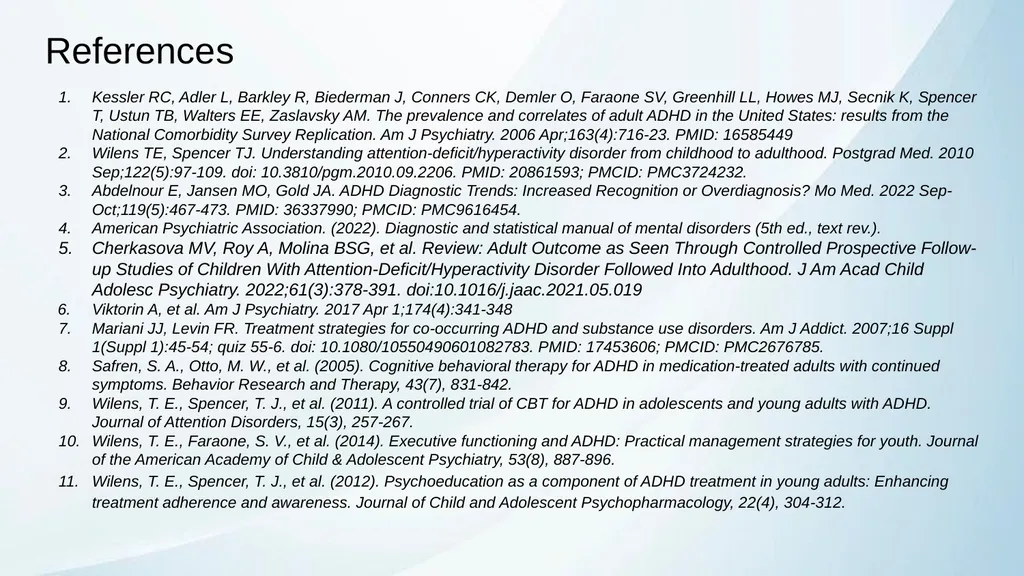
References Kessler RC, Adler L, Barkley R, Biederman J, Conners CK, Demler O, Faraone SV, Greenhill LL, Howes MJ, Secnik K, Spencer T, Ustun TB, Walters EE, Zaslavsky AM. The prevalence and correlates of adult ADHD in the United States: results from the National Comorbidity Survey Replication. Am J Psychiatry. 2006 Apr;163(4):716-23. PMID: 16585449
Wilens TE, Spencer TJ. Understanding attention-deficit/hyperactivity disorder from childhood to adulthood. Postgrad Med. 2010 Sep;122(5):97-109. doi: 10.3810/pgm.2010.09.2206. PMID: 20861593; PMCID: PMC3724232.
Abdelnour E, Jansen MO, Gold JA. ADHD Diagnostic Trends: Increased Recognition or Overdiagnosis? Mo Med. 2022 Sep-Oct;119(5):467-473. PMID: 36337990; PMCID: PMC9616454.
American Psychiatric Association. (2022). Diagnostic and statistical manual of mental disorders (5th ed., text rev.).
Cherkasova MV, Roy A, Molina BSG, et al. Review: Adult Outcome as Seen Through Controlled Prospective Follow-up Studies of Children With Attention-Deficit/Hyperactivity Disorder Followed Into Adulthood. J Am Acad Child Adolesc Psychiatry. 2022;61(3):378-391. doi:10.1016/j.jaac.2021.05.019
Viktorin A, et al. Am J Psychiatry. 2017 Apr 1;174(4):341-348
Mariani JJ, Levin FR. Treatment strategies for co-occurring ADHD and substance use disorders. Am J Addict. 2007;16 Suppl 1(Suppl 1):45-54; quiz 55-6. doi: 10.1080/10550490601082783. PMID: 17453606; PMCID: PMC2676785.
Safren, S. A., Otto, M. W., et al. (2005). Cognitive behavioral therapy for ADHD in medication-treated adults with continued symptoms. Behavior Research and Therapy, 43(7), 831-842.
Wilens, T. E., Spencer, T. J., et al. (2011). A controlled trial of CBT for ADHD in adolescents and young adults with ADHD. Journal of Attention Disorders, 15(3), 257-267.
Wilens, T. E., Faraone, S. V., et al. (2014). Executive functioning and ADHD: Practical management strategies for youth. Journal of the American Academy of Child & Adolescent Psychiatry, 53(8), 887-896.
Wilens, T. E., Spencer, T. J., et al. (2012). Psychoeducation as a component of ADHD treatment in young adults: Enhancing treatment adherence and awareness. Journal of Child and Adolescent Psychopharmacology, 22(4), 304-312.<br>
Wilens TE, Spencer TJ. Understanding attention-deficit/hyperactivity disorder from childhood to adulthood. Postgrad Med. 2010 Sep;122(5):97-109. doi: 10.3810/pgm.2010.09.2206. PMID: 20861593; PMCID: PMC3724232.
Abdelnour E, Jansen MO, Gold JA. ADHD Diagnostic Trends: Increased Recognition or Overdiagnosis? Mo Med. 2022 Sep-Oct;119(5):467-473. PMID: 36337990; PMCID: PMC9616454.
American Psychiatric Association. (2022). Diagnostic and statistical manual of mental disorders (5th ed., text rev.).
Cherkasova MV, Roy A, Molina BSG, et al. Review: Adult Outcome as Seen Through Controlled Prospective Follow-up Studies of Children With Attention-Deficit/Hyperactivity Disorder Followed Into Adulthood. J Am Acad Child Adolesc Psychiatry. 2022;61(3):378-391. doi:10.1016/j.jaac.2021.05.019
Viktorin A, et al. Am J Psychiatry. 2017 Apr 1;174(4):341-348
Mariani JJ, Levin FR. Treatment strategies for co-occurring ADHD and substance use disorders. Am J Addict. 2007;16 Suppl 1(Suppl 1):45-54; quiz 55-6. doi: 10.1080/10550490601082783. PMID: 17453606; PMCID: PMC2676785.
Safren, S. A., Otto, M. W., et al. (2005). Cognitive behavioral therapy for ADHD in medication-treated adults with continued symptoms. Behavior Research and Therapy, 43(7), 831-842.
Wilens, T. E., Spencer, T. J., et al. (2011). A controlled trial of CBT for ADHD in adolescents and young adults with ADHD. Journal of Attention Disorders, 15(3), 257-267.
Wilens, T. E., Faraone, S. V., et al. (2014). Executive functioning and ADHD: Practical management strategies for youth. Journal of the American Academy of Child & Adolescent Psychiatry, 53(8), 887-896.
Wilens, T. E., Spencer, T. J., et al. (2012). Psychoeducation as a component of ADHD treatment in young adults: Enhancing treatment adherence and awareness. Journal of Child and Adolescent Psychopharmacology, 22(4), 304-312.<br>
60
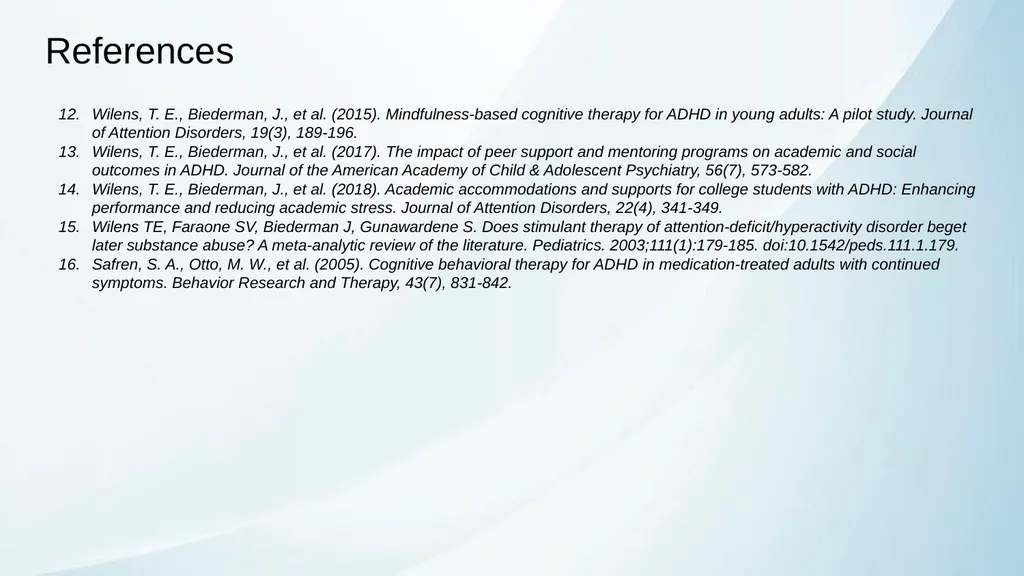
References Wilens, T. E., Biederman, J., et al. (2015). Mindfulness-based cognitive therapy for ADHD in young adults: A pilot study. Journal of Attention Disorders, 19(3), 189-196.
Wilens, T. E., Biederman, J., et al. (2017). The impact of peer support and mentoring programs on academic and social outcomes in ADHD. Journal of the American Academy of Child & Adolescent Psychiatry, 56(7), 573-582.
Wilens, T. E., Biederman, J., et al. (2018). Academic accommodations and supports for college students with ADHD: Enhancing performance and reducing academic stress. Journal of Attention Disorders, 22(4), 341-349.
Wilens TE, Faraone SV, Biederman J, Gunawardene S. Does stimulant therapy of attention-deficit/hyperactivity disorder beget later substance abuse? A meta-analytic review of the literature. Pediatrics. 2003;111(1):179-185. doi:10.1542/peds.111.1.179.
Safren, S. A., Otto, M. W., et al. (2005). Cognitive behavioral therapy for ADHD in medication-treated adults with continued symptoms. Behavior Research and Therapy, 43(7), 831-842.<br>
Wilens, T. E., Biederman, J., et al. (2017). The impact of peer support and mentoring programs on academic and social outcomes in ADHD. Journal of the American Academy of Child & Adolescent Psychiatry, 56(7), 573-582.
Wilens, T. E., Biederman, J., et al. (2018). Academic accommodations and supports for college students with ADHD: Enhancing performance and reducing academic stress. Journal of Attention Disorders, 22(4), 341-349.
Wilens TE, Faraone SV, Biederman J, Gunawardene S. Does stimulant therapy of attention-deficit/hyperactivity disorder beget later substance abuse? A meta-analytic review of the literature. Pediatrics. 2003;111(1):179-185. doi:10.1542/peds.111.1.179.
Safren, S. A., Otto, M. W., et al. (2005). Cognitive behavioral therapy for ADHD in medication-treated adults with continued symptoms. Behavior Research and Therapy, 43(7), 831-842.<br>
61
TAY curriculum survey Please complete the survey below about this curriculum module. Completion helps us track how the curriculum is being used and make changes over time to best meet the needs of various learners.
Transitional age youth have the highest point prevalence of mental health disorders of any age group, and are also cared for across the healthcare landscape. Our hope is to provide expert-curated, evidence-based information to clinicians of all disciplines who care for transitional age youth.
https://forms.gle/oWCMJPHJrNA1sBn67<br>
Transitional age youth have the highest point prevalence of mental health disorders of any age group, and are also cared for across the healthcare landscape. Our hope is to provide expert-curated, evidence-based information to clinicians of all disciplines who care for transitional age youth.
https://forms.gle/oWCMJPHJrNA1sBn67<br>