
Adjustment to Budget Vote & Revised APP (2020/21)
TD
Published · 46 slides · 0 views

1 / 1




Description
Adjustment to Budget Vote Revised APP (202021) of the National School of Government Presentation to the Portfolio Committee on Public Service and Administration The National School of Government 08 July 2020 Outline of the Presentation
Related Topics
Share
Embed code
Download this presentation From Below
"Adjustment to Budget Vote & Revised APP (2020/21)" is the property of its rightful owner. Permission is granted to download and print the materials on this website for personal, non-commercial use only, and to display it on your personal computer provided you do not modify the materials and that you retain all copyright notices contained in the materials. By downloading content from our website, you accept the terms of this agreement.
Presentation Transcript
01
Adjustment to Budget Vote & Revised APP (2020/21) of the
National School of Government
Presentation to the Portfolio Committee on Public Service and Administration The National School of Government
08 July 2020<br>
08 July 2020<br>
02
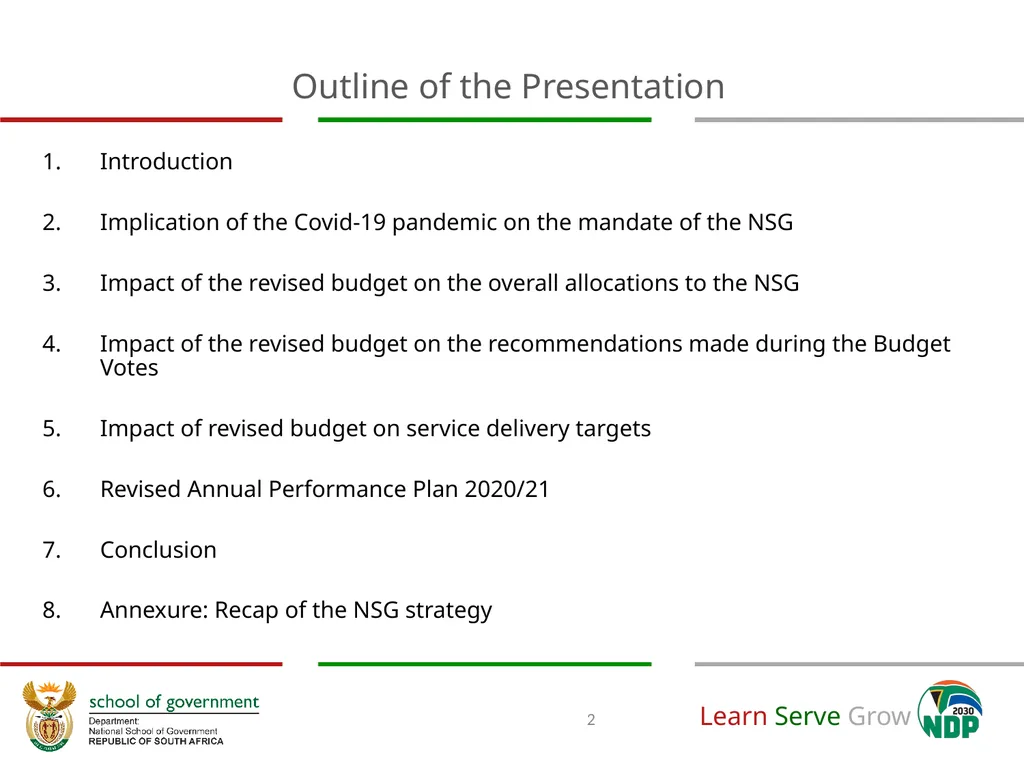
Outline of the Presentation Introduction
Implication of the Covid-19 pandemic on the mandate of the NSG
Impact of the revised budget on the overall allocations to the NSG
Impact of the revised budget on the recommendations made during the Budget Votes
Impact of revised budget on service delivery targets
Revised Annual Performance Plan 2020/21
Conclusion
Annexure: Recap of the NSG strategy 2<br>
Implication of the Covid-19 pandemic on the mandate of the NSG
Impact of the revised budget on the overall allocations to the NSG
Impact of the revised budget on the recommendations made during the Budget Votes
Impact of revised budget on service delivery targets
Revised Annual Performance Plan 2020/21
Conclusion
Annexure: Recap of the NSG strategy 2<br>
03
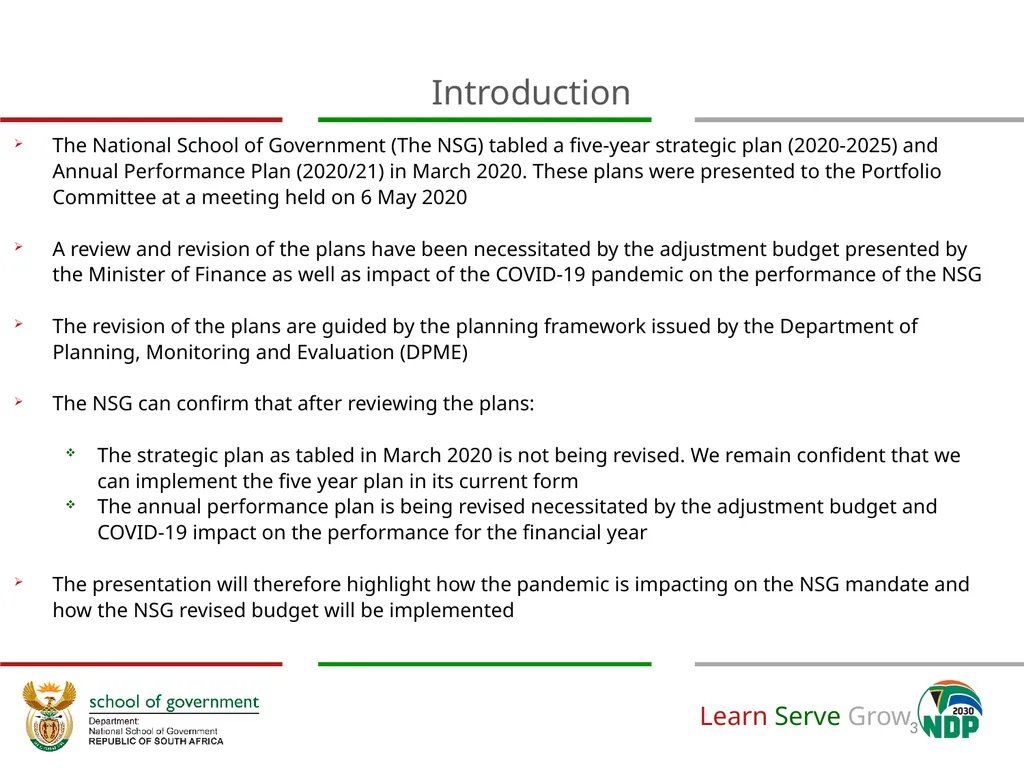
3 Introduction The National School of Government (The NSG) tabled a five-year strategic plan (2020-2025) and Annual Performance Plan (2020/21) in March 2020. These plans were presented to the Portfolio Committee at a meeting held on 6 May 2020
A review and revision of the plans have been necessitated by the adjustment budget presented by the Minister of Finance as well as impact of the COVID-19 pandemic on the performance of the NSG
The revision of the plans are guided by the planning framework issued by the Department of Planning, Monitoring and Evaluation (DPME)
The NSG can confirm that after reviewing the plans:
The strategic plan as tabled in March 2020 is not being revised. We remain confident that we can implement the five year plan in its current form
The annual performance plan is being revised necessitated by the adjustment budget and COVID-19 impact on the performance for the financial year
The presentation will therefore highlight how the pandemic is impacting on the NSG mandate and how the NSG revised budget will be implemented<br>
A review and revision of the plans have been necessitated by the adjustment budget presented by the Minister of Finance as well as impact of the COVID-19 pandemic on the performance of the NSG
The revision of the plans are guided by the planning framework issued by the Department of Planning, Monitoring and Evaluation (DPME)
The NSG can confirm that after reviewing the plans:
The strategic plan as tabled in March 2020 is not being revised. We remain confident that we can implement the five year plan in its current form
The annual performance plan is being revised necessitated by the adjustment budget and COVID-19 impact on the performance for the financial year
The presentation will therefore highlight how the pandemic is impacting on the NSG mandate and how the NSG revised budget will be implemented<br>
04
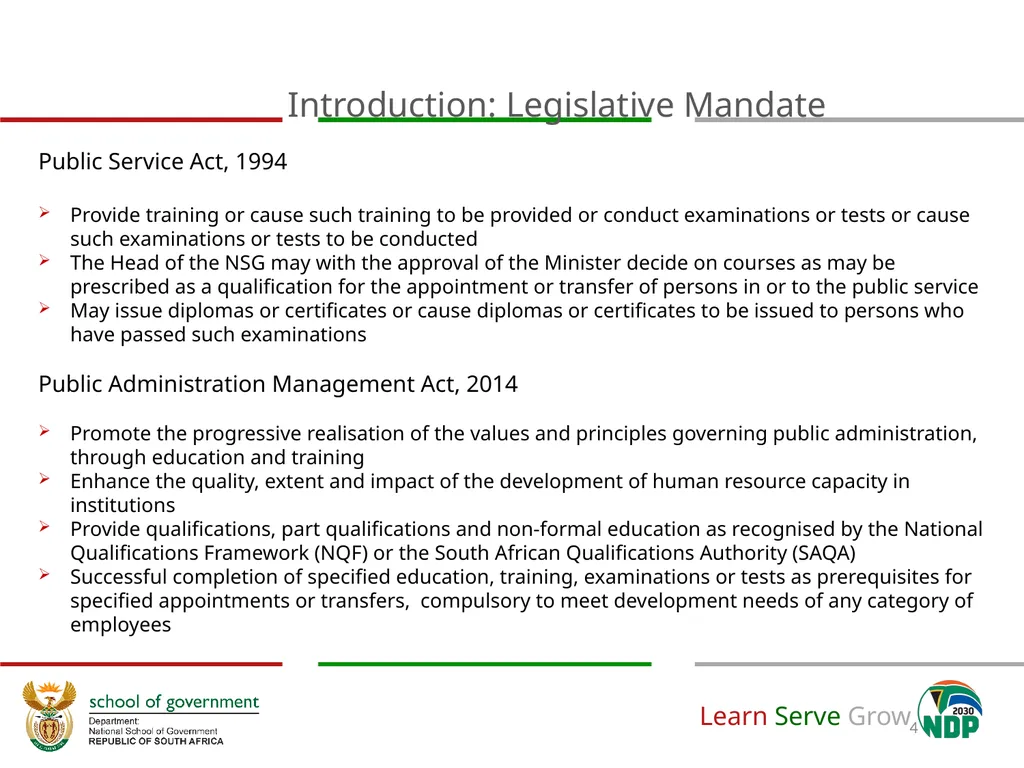
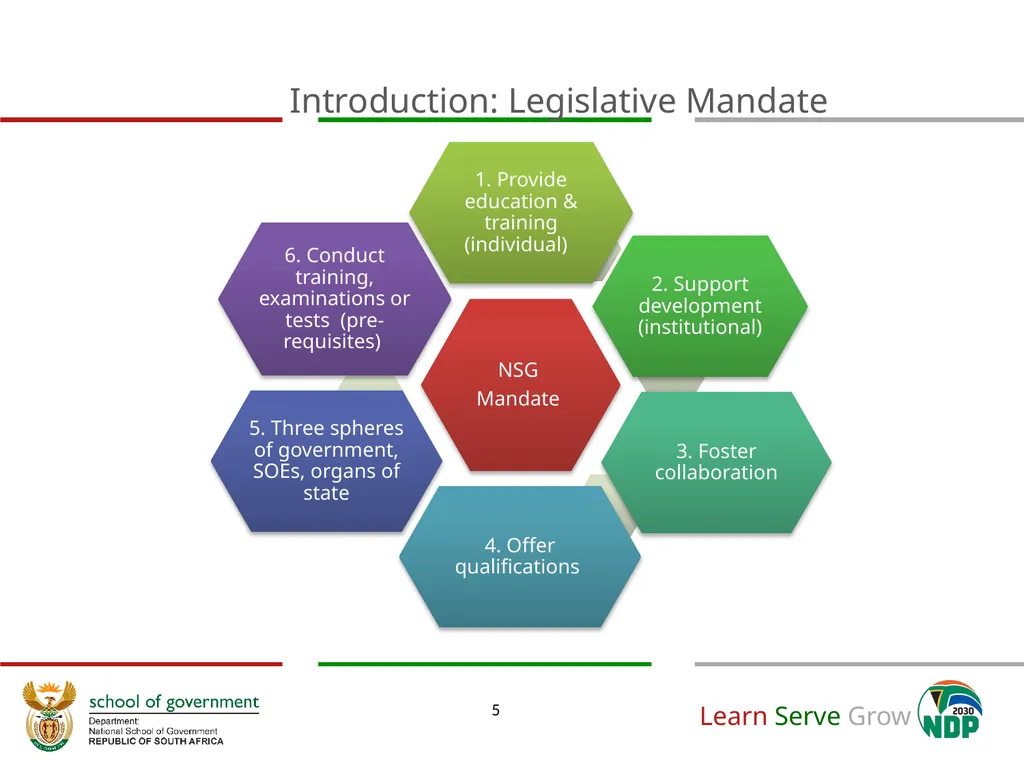
4 Public Service Act, 1994
Provide training or cause such training to be provided or conduct examinations or tests or cause such examinations or tests to be conducted
The Head of the NSG may with the approval of the Minister decide on courses as may be prescribed as a qualification for the appointment or transfer of persons in or to the public service
May issue diplomas or certificates or cause diplomas or certificates to be issued to persons who have passed such examinations
Public Administration Management Act, 2014
Promote the progressive realisation of the values and principles governing public administration, through education and training
Enhance the quality, extent and impact of the development of human resource capacity in institutions
Provide qualifications, part qualifications and non-formal education as recognised by the National Qualifications Framework (NQF) or the South African Qualifications Authority (SAQA)
Successful completion of specified education, training, examinations or tests as prerequisites for specified appointments or transfers, compulsory to meet development needs of any category of employees Introduction: Legislative Mandate<br>
Provide training or cause such training to be provided or conduct examinations or tests or cause such examinations or tests to be conducted
The Head of the NSG may with the approval of the Minister decide on courses as may be prescribed as a qualification for the appointment or transfer of persons in or to the public service
May issue diplomas or certificates or cause diplomas or certificates to be issued to persons who have passed such examinations
Public Administration Management Act, 2014
Promote the progressive realisation of the values and principles governing public administration, through education and training
Enhance the quality, extent and impact of the development of human resource capacity in institutions
Provide qualifications, part qualifications and non-formal education as recognised by the National Qualifications Framework (NQF) or the South African Qualifications Authority (SAQA)
Successful completion of specified education, training, examinations or tests as prerequisites for specified appointments or transfers, compulsory to meet development needs of any category of employees Introduction: Legislative Mandate<br>
05
5 Introduction: Legislative Mandate<br>
06
Implications of the Covid-19 pandemic and Adjustment Budget on the mandate of the NSG 6<br>
07
7 Implication of the Covid-19 pandemic on the mandate of the NSG The implementation of the mandate (constitutionally and legislatively) places the NSG at the forefront of strengthening state capacity and will require interventions and initiatives across the three spheres of government, legislative sectors as well as state owned enterprises
In supporting Priority 1 (a capable, ethical and developmental state) the NSG must be sufficiently resourced and capacitated to deliver education, training and development interventions
However, in fulfilling the mandate, the NSG has to recover costs for revenue generation to augment the Training Trading Account (TTA) for financial viability and institutional sustainability: 20% of NSG revenue comes from the fiscus (voted funds) and 80% is self-generated
We already highlighted a deficit occasioned by the cancellation of training (pandemic and state of national disaster) in the past 4 months – this was before the adjustment budget. This has a significant impact on the NSG to be able to sustain itself as the current budget and reserves cannot absorb the impact of losses
We can also indicate that in the first quarter of this financial year, no face-to-face training was delivered – only online learning
Many face-to-face programmes e.g. Winter School on Economic Governance, Thought Leadership Series, Executive Induction, have had to be reconsidered for later dates or shifted to online platforms<br>
In supporting Priority 1 (a capable, ethical and developmental state) the NSG must be sufficiently resourced and capacitated to deliver education, training and development interventions
However, in fulfilling the mandate, the NSG has to recover costs for revenue generation to augment the Training Trading Account (TTA) for financial viability and institutional sustainability: 20% of NSG revenue comes from the fiscus (voted funds) and 80% is self-generated
We already highlighted a deficit occasioned by the cancellation of training (pandemic and state of national disaster) in the past 4 months – this was before the adjustment budget. This has a significant impact on the NSG to be able to sustain itself as the current budget and reserves cannot absorb the impact of losses
We can also indicate that in the first quarter of this financial year, no face-to-face training was delivered – only online learning
Many face-to-face programmes e.g. Winter School on Economic Governance, Thought Leadership Series, Executive Induction, have had to be reconsidered for later dates or shifted to online platforms<br>
08
8 Implication of the Covid-19 pandemic on the mandate of the NSG The NSG offers the majority of its ETD interventions through face-to-face learning, and has initially set an overall target of 43 600 for the 2020/21 financial year, with a revenue target of R132 million
The revenue generation is calculated on a scenario of a maximum of 20 learners per class. In keeping with social distancing and personal protection protocols, the NSG will have to ensure smaller class sizes for face to face training, and ensure adequate screening of learners
The effect of the COVID-19 pandemic will impact on the NSG’s ability to reach these training numbers and generate revenue, especially for face-to-face learning. We are likely to see the second quarter also being impacted
The NSG has to therefore revise downwards the training numbers and the revenue generation
The other option for the NSG is online learning. However, this will still not enable the NSG to generate significant revenue, as the online learning tariffs are lower than the face to face training tariffs. Furthermore, upgrading the current ICT infrastructure may not be able to be in place to recover lost time.<br>
The revenue generation is calculated on a scenario of a maximum of 20 learners per class. In keeping with social distancing and personal protection protocols, the NSG will have to ensure smaller class sizes for face to face training, and ensure adequate screening of learners
The effect of the COVID-19 pandemic will impact on the NSG’s ability to reach these training numbers and generate revenue, especially for face-to-face learning. We are likely to see the second quarter also being impacted
The NSG has to therefore revise downwards the training numbers and the revenue generation
The other option for the NSG is online learning. However, this will still not enable the NSG to generate significant revenue, as the online learning tariffs are lower than the face to face training tariffs. Furthermore, upgrading the current ICT infrastructure may not be able to be in place to recover lost time.<br>
09
NSG Response to COVID-19 pandemic 9 In pre-empting these challenges and implications, the Minister for Public Service and Administration approved a response plan from the NSG, and will include some of the following interventions:
Review the current NSG programmes and courses that can be translated to online platforms to increase blended learning offerings
Aggregating the NSG enterprise resources systems to focus on blended learning capabilities
Increasing the NSG bandwidth capability to support initiatives like webinars (Re-engaging SITA on a proposal for a private sector data line)
Massive marketing and communication drive to promote blended learning in the public sector
Revising the current eLearning course tariff (re-engaging National Treasury on other financial issues)
Finalising the ministerial directive on compulsory programmes, and for all departmental training budgets to be prioritised towards these programmes
Strengthening our levers for partnerships with higher education institutions and other providers<br>
Review the current NSG programmes and courses that can be translated to online platforms to increase blended learning offerings
Aggregating the NSG enterprise resources systems to focus on blended learning capabilities
Increasing the NSG bandwidth capability to support initiatives like webinars (Re-engaging SITA on a proposal for a private sector data line)
Massive marketing and communication drive to promote blended learning in the public sector
Revising the current eLearning course tariff (re-engaging National Treasury on other financial issues)
Finalising the ministerial directive on compulsory programmes, and for all departmental training budgets to be prioritised towards these programmes
Strengthening our levers for partnerships with higher education institutions and other providers<br>
10
NSG Response to COVID-19 pandemic 10 There is a need for radical change from the current NSG business model to a more technology-based open distance learning model. This model will shift us away from the primarily physical classroom learning to a technology based learning
The NSG has to invest significantly in an ICT enabled environment to be able to offer its learnings virtually
A need to redefine the business processes and the way we do our work in the future, including the automation and digitisation of many of the business processes
A new business model and new way of working will also compel us to align the organisational structure accordingly, and build in virtual and remote working conditions
Development and/or acquisition of new skills and capabilities and a new organisational culture – particularly in how managers relate to staff, and how different business units engage with each other. The NSG will have to undertake a re-skilling drive of its employees to operate effectively in the new business environment<br>
The NSG has to invest significantly in an ICT enabled environment to be able to offer its learnings virtually
A need to redefine the business processes and the way we do our work in the future, including the automation and digitisation of many of the business processes
A new business model and new way of working will also compel us to align the organisational structure accordingly, and build in virtual and remote working conditions
Development and/or acquisition of new skills and capabilities and a new organisational culture – particularly in how managers relate to staff, and how different business units engage with each other. The NSG will have to undertake a re-skilling drive of its employees to operate effectively in the new business environment<br>
11
NSG Response to COVID-19: Scenarios for Class Size 11<br>
12
Impact of the revised budget on the overall allocations to the NSG 12<br>
13
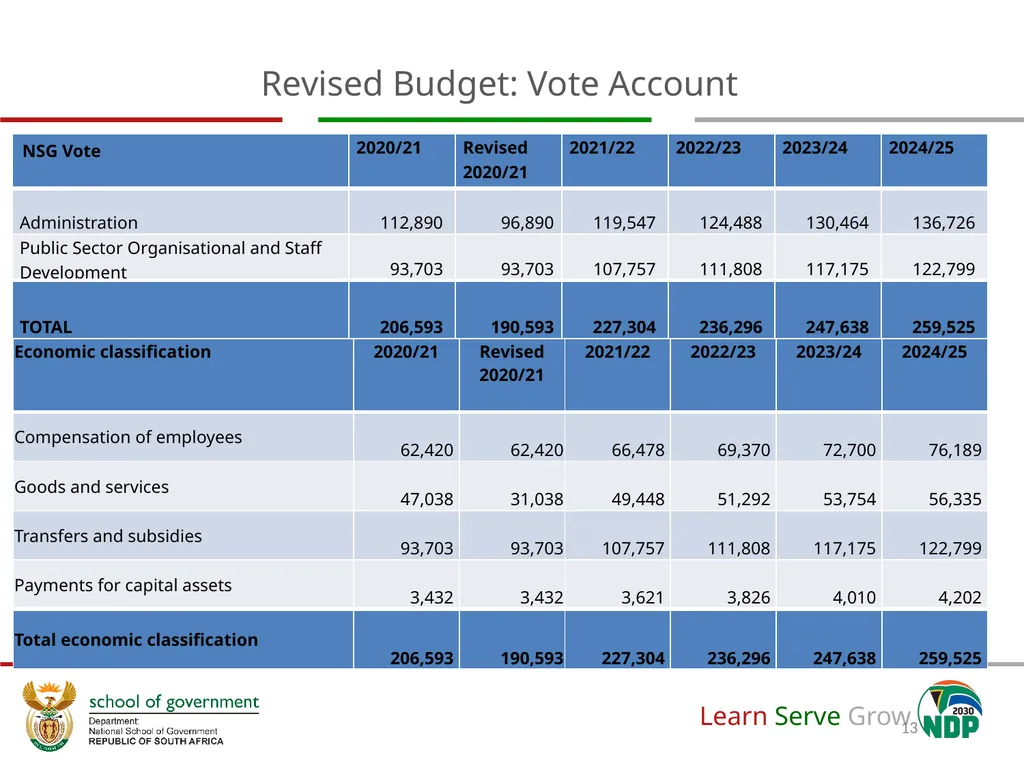
13 Revised Budget: Vote Account<br>
14
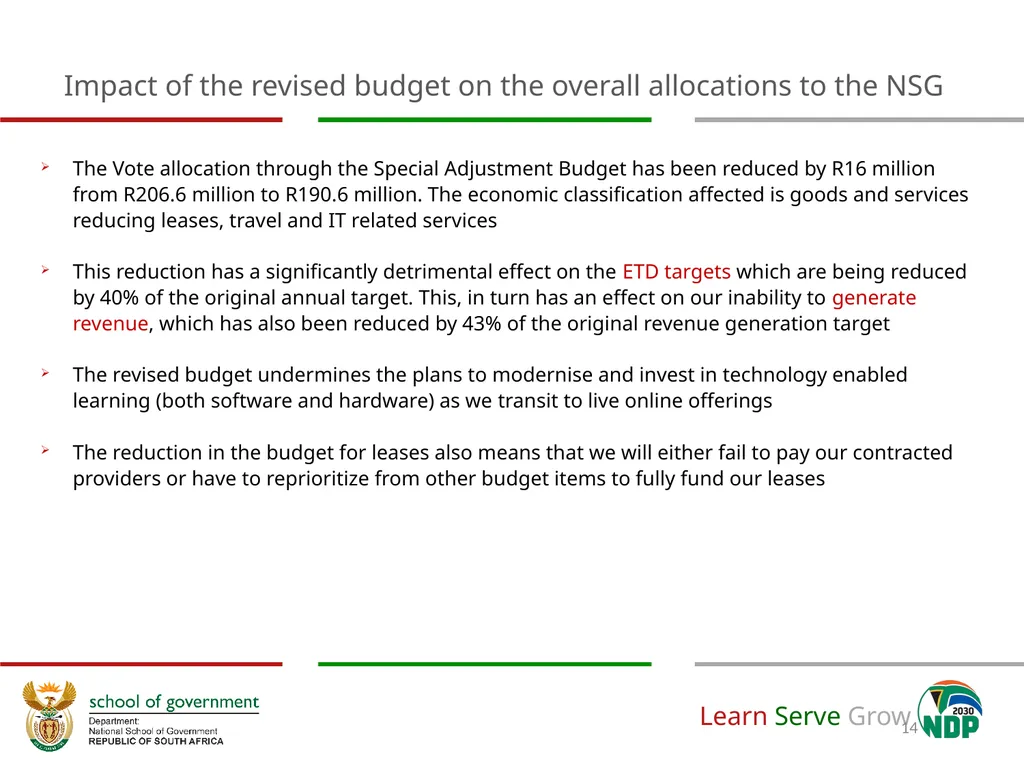
14 Impact of the revised budget on the overall allocations to the NSG The Vote allocation through the Special Adjustment Budget has been reduced by R16 million from R206.6 million to R190.6 million. The economic classification affected is goods and services reducing leases, travel and IT related services
This reduction has a significantly detrimental effect on the ETD targets which are being reduced by 40% of the original annual target. This, in turn has an effect on our inability to generate revenue, which has also been reduced by 43% of the original revenue generation target
The revised budget undermines the plans to modernise and invest in technology enabled learning (both software and hardware) as we transit to live online offerings
The reduction in the budget for leases also means that we will either fail to pay our contracted providers or have to reprioritize from other budget items to fully fund our leases<br>
This reduction has a significantly detrimental effect on the ETD targets which are being reduced by 40% of the original annual target. This, in turn has an effect on our inability to generate revenue, which has also been reduced by 43% of the original revenue generation target
The revised budget undermines the plans to modernise and invest in technology enabled learning (both software and hardware) as we transit to live online offerings
The reduction in the budget for leases also means that we will either fail to pay our contracted providers or have to reprioritize from other budget items to fully fund our leases<br>
15
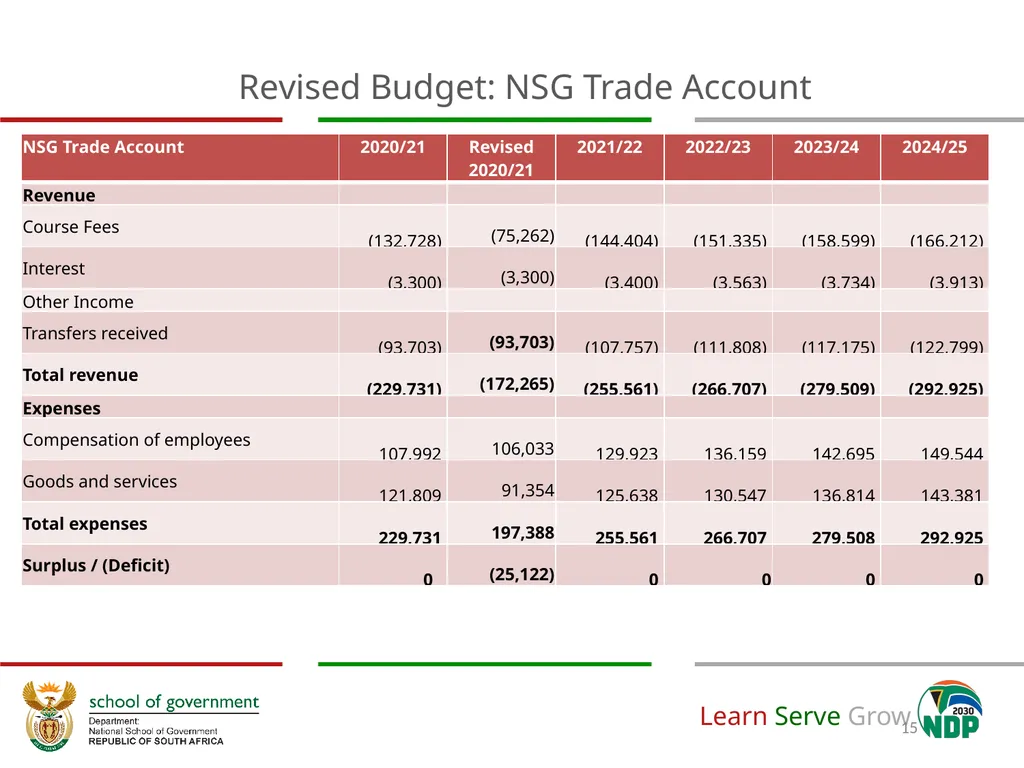
15 Revised Budget: NSG Trade Account<br>
16
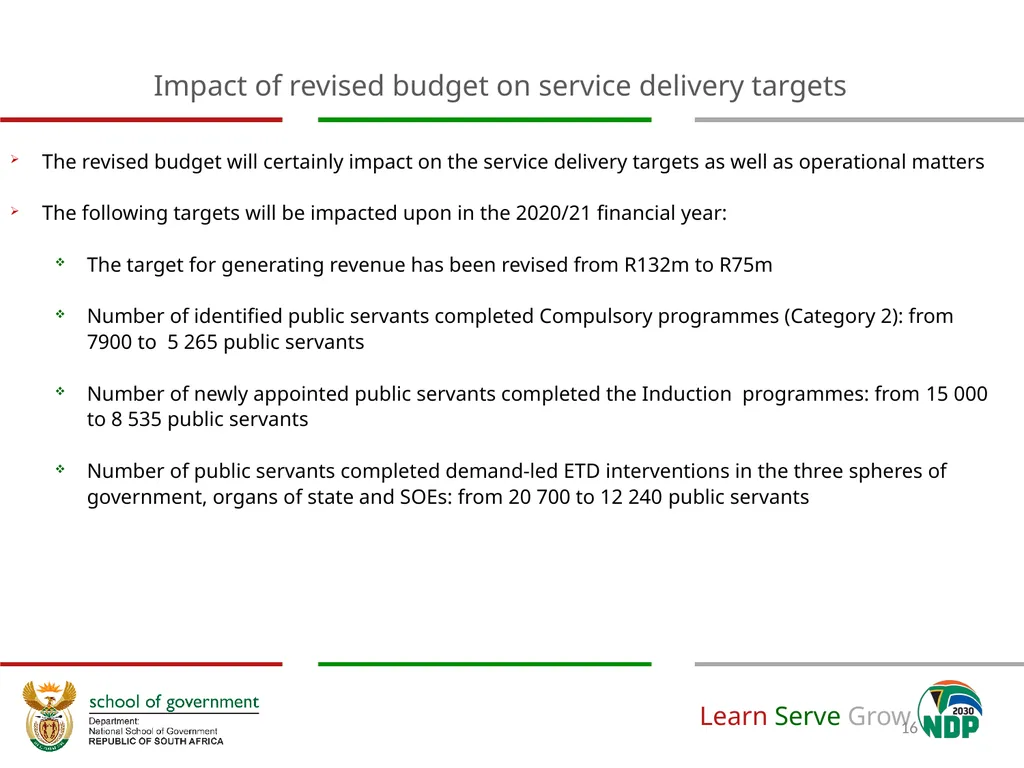
16 Impact of revised budget on service delivery targets The revised budget will certainly impact on the service delivery targets as well as operational matters
The following targets will be impacted upon in the 2020/21 financial year:
The target for generating revenue has been revised from R132m to R75m
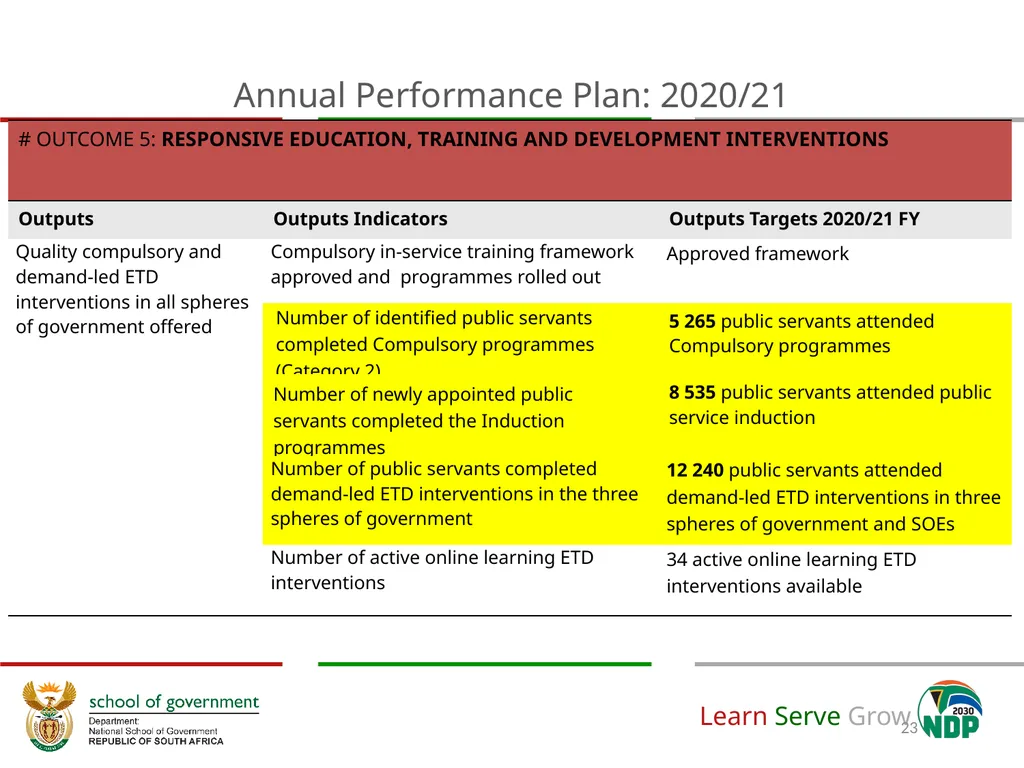
Number of identified public servants completed Compulsory programmes (Category 2): from 7900 to 5 265 public servants
Number of newly appointed public servants completed the Induction programmes: from 15 000 to 8 535 public servants
Number of public servants completed demand-led ETD interventions in the three spheres of government, organs of state and SOEs: from 20 700 to 12 240 public servants<br>
The following targets will be impacted upon in the 2020/21 financial year:
The target for generating revenue has been revised from R132m to R75m
Number of identified public servants completed Compulsory programmes (Category 2): from 7900 to 5 265 public servants
Number of newly appointed public servants completed the Induction programmes: from 15 000 to 8 535 public servants
Number of public servants completed demand-led ETD interventions in the three spheres of government, organs of state and SOEs: from 20 700 to 12 240 public servants<br>
17
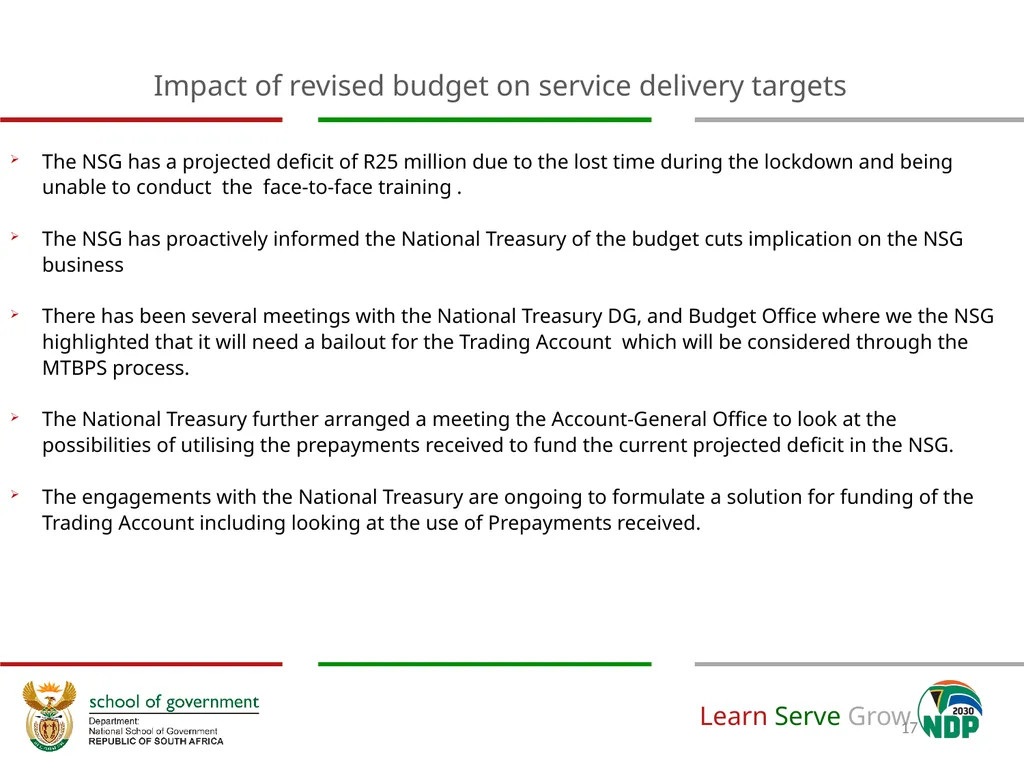
17 Impact of revised budget on service delivery targets The NSG has a projected deficit of R25 million due to the lost time during the lockdown and being unable to conduct the face-to-face training .
The NSG has proactively informed the National Treasury of the budget cuts implication on the NSG business
There has been several meetings with the National Treasury DG, and Budget Office where we the NSG highlighted that it will need a bailout for the Trading Account which will be considered through the MTBPS process.
The National Treasury further arranged a meeting the Account-General Office to look at the possibilities of utilising the prepayments received to fund the current projected deficit in the NSG.
The engagements with the National Treasury are ongoing to formulate a solution for funding of the Trading Account including looking at the use of Prepayments received.<br>
The NSG has proactively informed the National Treasury of the budget cuts implication on the NSG business
There has been several meetings with the National Treasury DG, and Budget Office where we the NSG highlighted that it will need a bailout for the Trading Account which will be considered through the MTBPS process.
The National Treasury further arranged a meeting the Account-General Office to look at the possibilities of utilising the prepayments received to fund the current projected deficit in the NSG.
The engagements with the National Treasury are ongoing to formulate a solution for funding of the Trading Account including looking at the use of Prepayments received.<br>
18
Revised Annual Performance Plan (2020/21) 18<br>
19
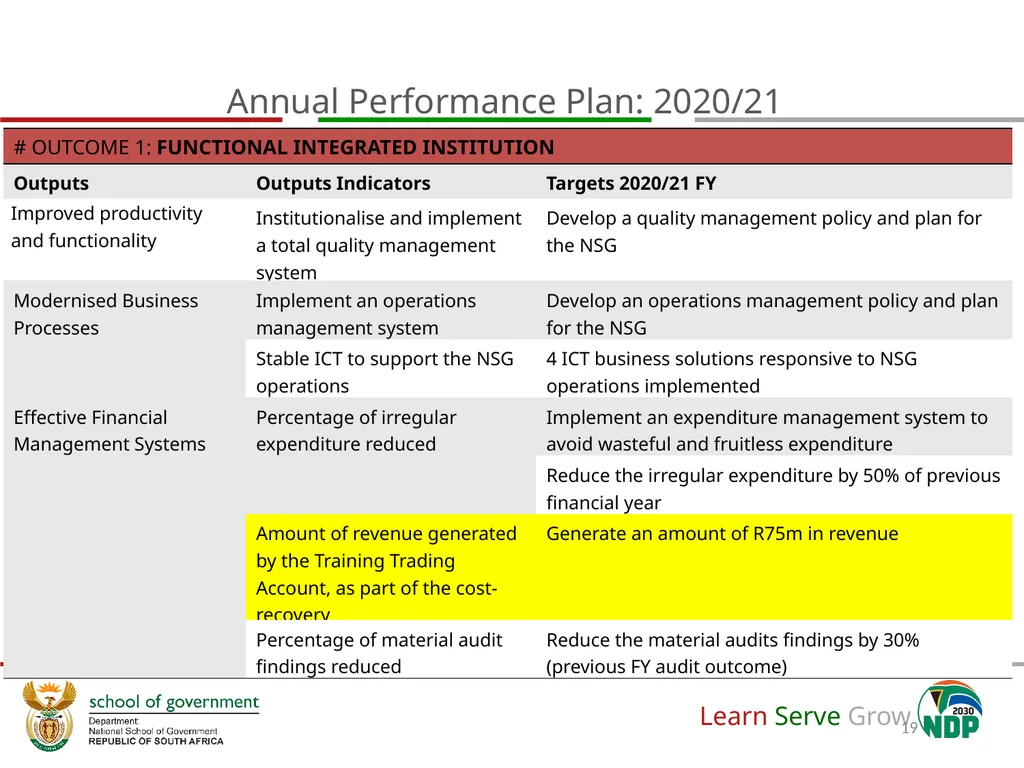
19 Annual Performance Plan: 2020/21<br>
20
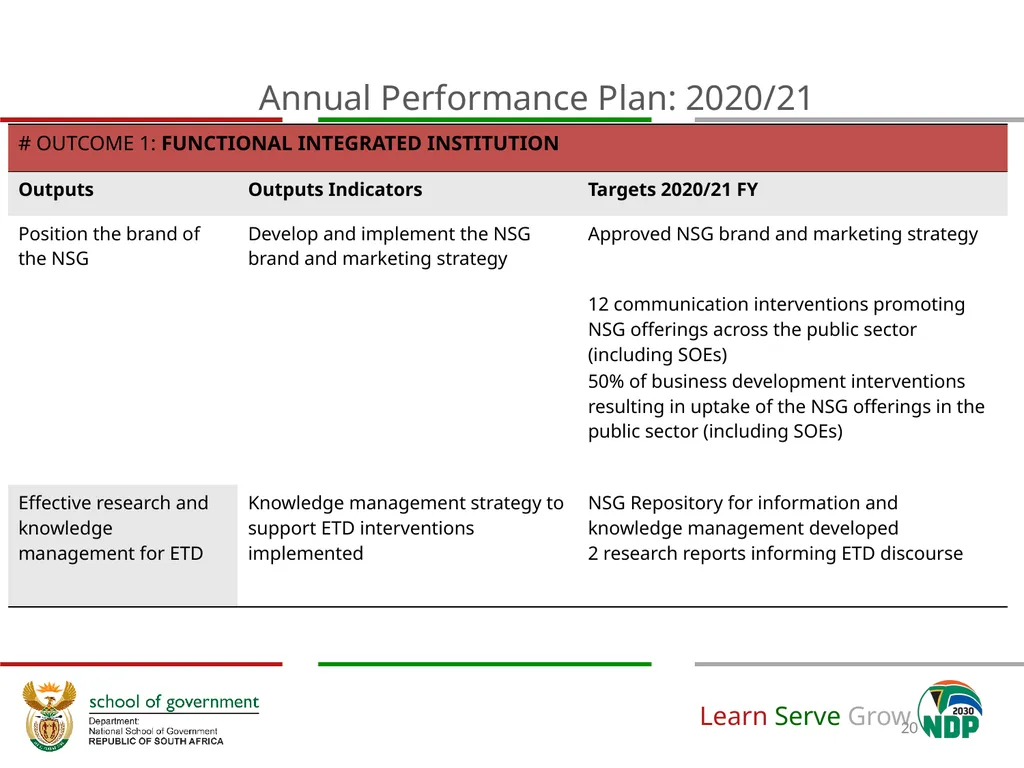
20 Annual Performance Plan: 2020/21<br>
21
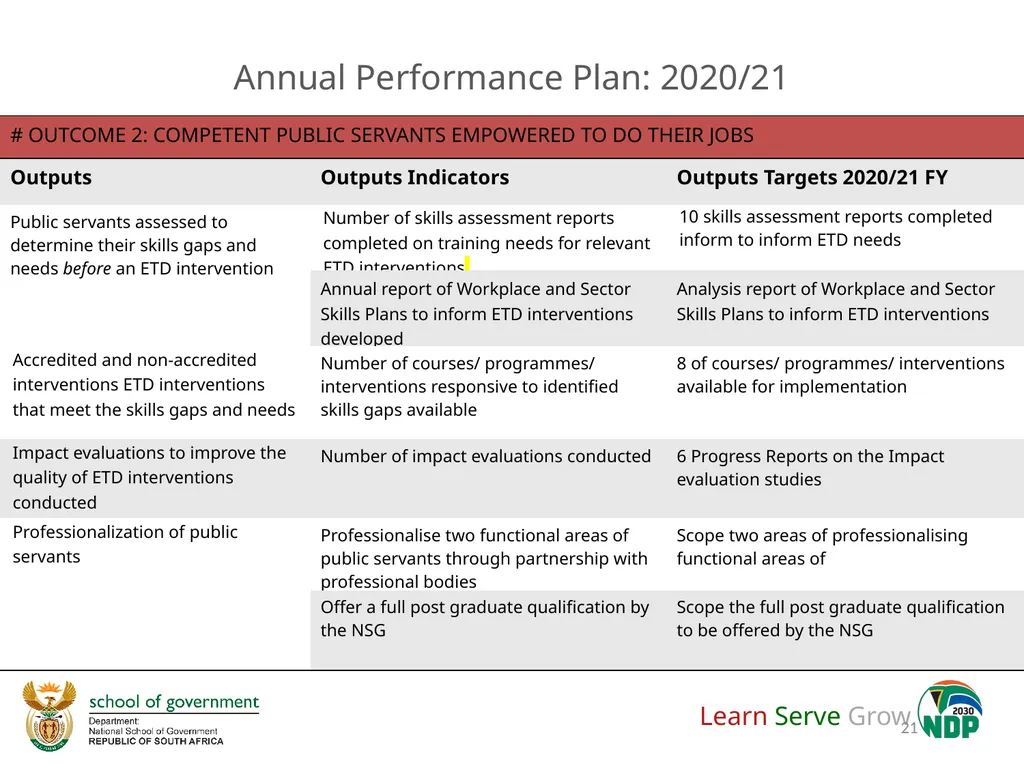
Annual Performance Plan: 2020/21 21<br>
22
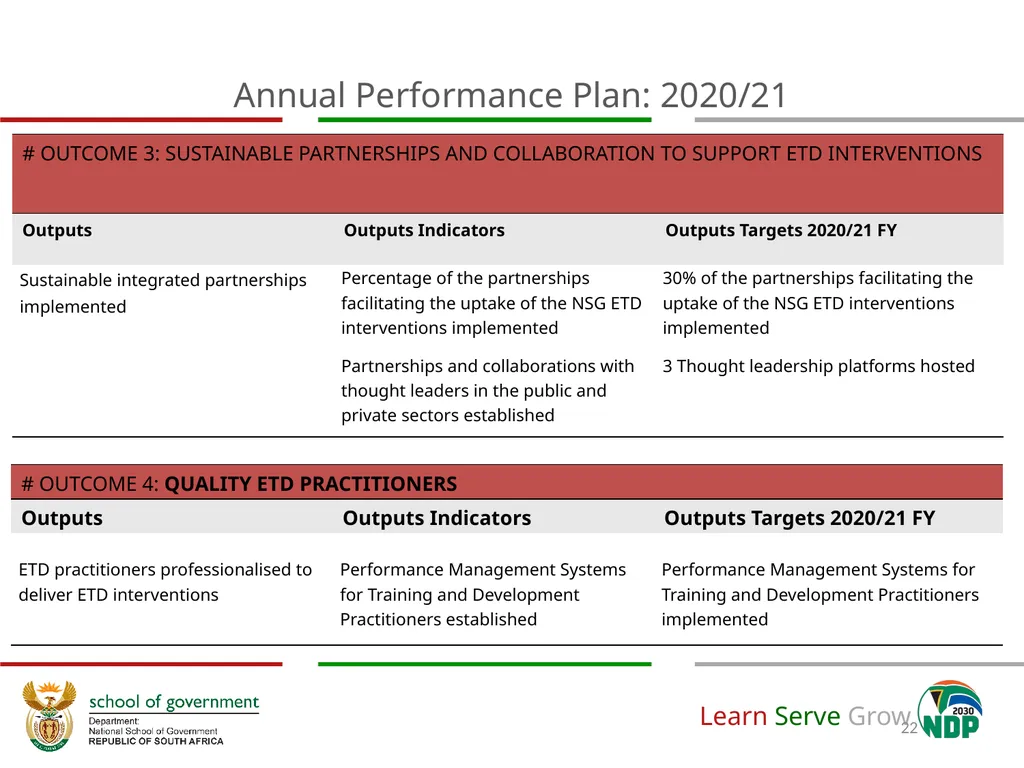
Annual Performance Plan: 2020/21 22<br>
23
Annual Performance Plan: 2020/21 23<br>
24
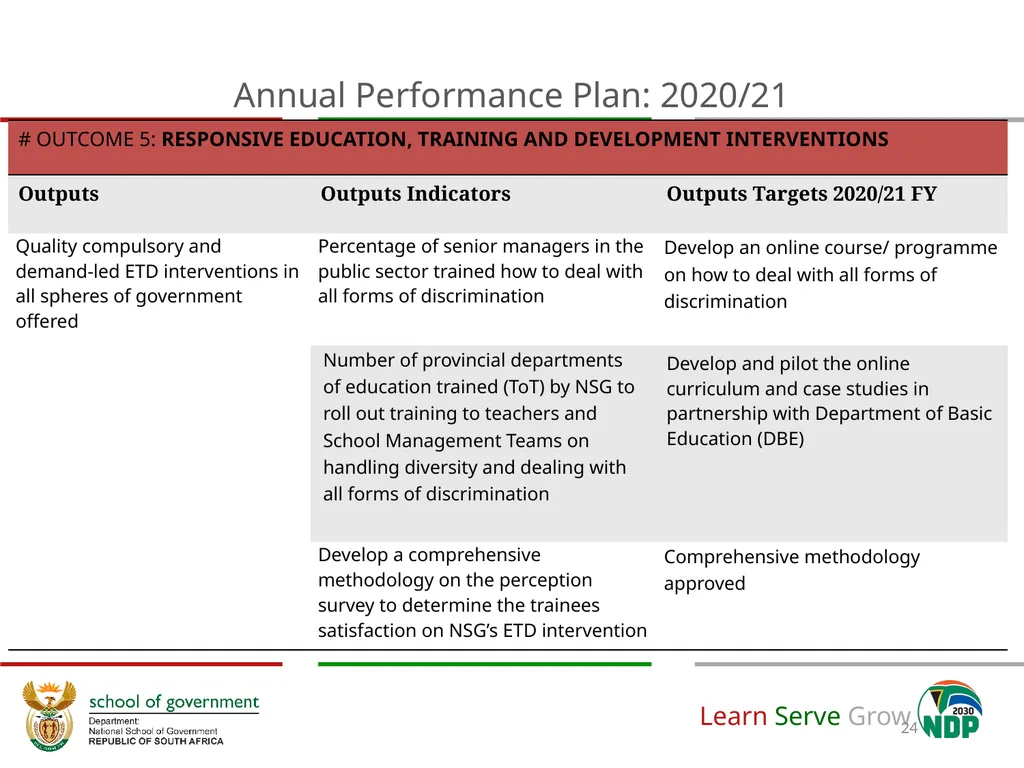
Annual Performance Plan: 2020/21 24<br>
25
Conclusion 25<br>
26
Conclusion 26<br>
27
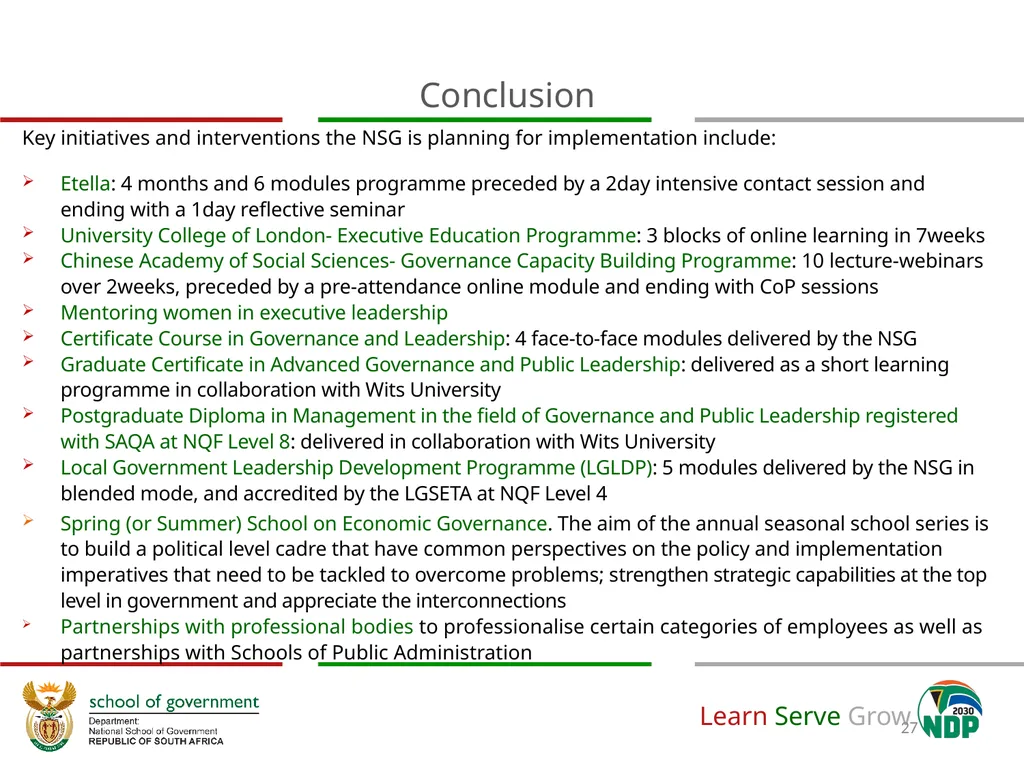
Conclusion 27 Key initiatives and interventions the NSG is planning for implementation include:
Etella: 4 months and 6 modules programme preceded by a 2day intensive contact session and ending with a 1day reflective seminar
University College of London- Executive Education Programme: 3 blocks of online learning in 7weeks
Chinese Academy of Social Sciences- Governance Capacity Building Programme: 10 lecture-webinars over 2weeks, preceded by a pre-attendance online module and ending with CoP sessions
Mentoring women in executive leadership
Certificate Course in Governance and Leadership: 4 face-to-face modules delivered by the NSG
Graduate Certificate in Advanced Governance and Public Leadership: delivered as a short learning programme in collaboration with Wits University
Postgraduate Diploma in Management in the field of Governance and Public Leadership registered with SAQA at NQF Level 8: delivered in collaboration with Wits University
Local Government Leadership Development Programme (LGLDP): 5 modules delivered by the NSG in blended mode, and accredited by the LGSETA at NQF Level 4
Spring (or Summer) School on Economic Governance. The aim of the annual seasonal school series is to build a political level cadre that have common perspectives on the policy and implementation imperatives that need to be tackled to overcome problems; strengthen strategic capabilities at the top level in government and appreciate the interconnections
Partnerships with professional bodies to professionalise certain categories of employees as well as partnerships with Schools of Public Administration<br>
Etella: 4 months and 6 modules programme preceded by a 2day intensive contact session and ending with a 1day reflective seminar
University College of London- Executive Education Programme: 3 blocks of online learning in 7weeks
Chinese Academy of Social Sciences- Governance Capacity Building Programme: 10 lecture-webinars over 2weeks, preceded by a pre-attendance online module and ending with CoP sessions
Mentoring women in executive leadership
Certificate Course in Governance and Leadership: 4 face-to-face modules delivered by the NSG
Graduate Certificate in Advanced Governance and Public Leadership: delivered as a short learning programme in collaboration with Wits University
Postgraduate Diploma in Management in the field of Governance and Public Leadership registered with SAQA at NQF Level 8: delivered in collaboration with Wits University
Local Government Leadership Development Programme (LGLDP): 5 modules delivered by the NSG in blended mode, and accredited by the LGSETA at NQF Level 4
Spring (or Summer) School on Economic Governance. The aim of the annual seasonal school series is to build a political level cadre that have common perspectives on the policy and implementation imperatives that need to be tackled to overcome problems; strengthen strategic capabilities at the top level in government and appreciate the interconnections
Partnerships with professional bodies to professionalise certain categories of employees as well as partnerships with Schools of Public Administration<br>
28
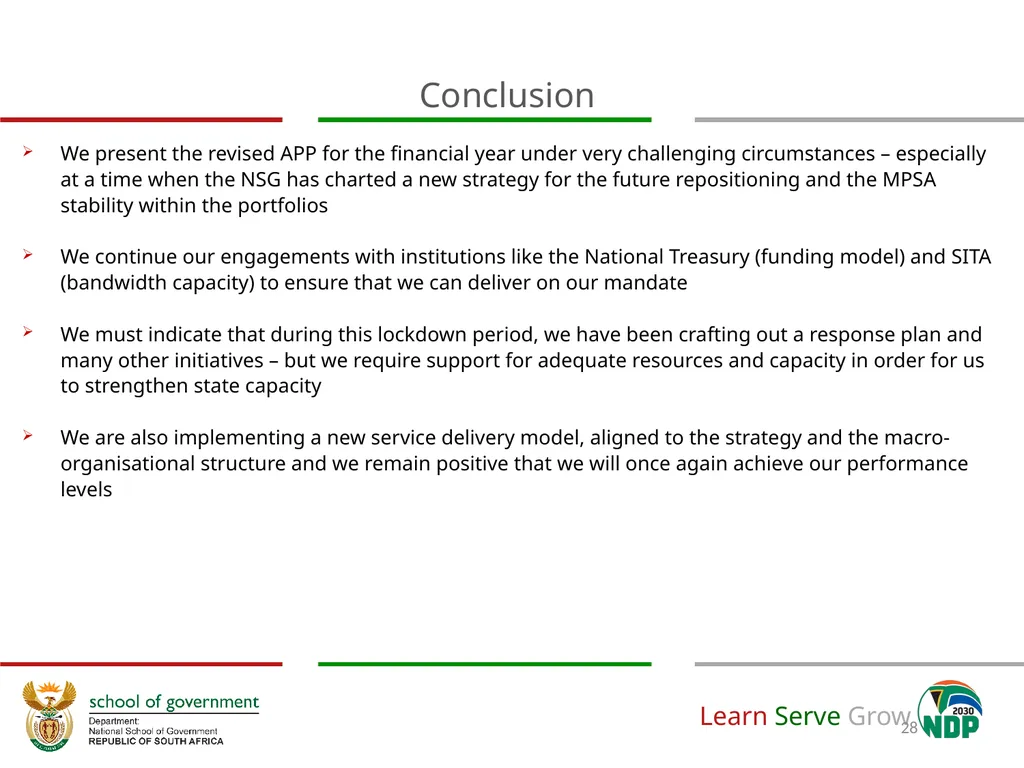
Conclusion 28 We present the revised APP for the financial year under very challenging circumstances – especially at a time when the NSG has charted a new strategy for the future repositioning and the MPSA stability within the portfolios
We continue our engagements with institutions like the National Treasury (funding model) and SITA (bandwidth capacity) to ensure that we can deliver on our mandate
We must indicate that during this lockdown period, we have been crafting out a response plan and many other initiatives – but we require support for adequate resources and capacity in order for us to strengthen state capacity
We are also implementing a new service delivery model, aligned to the strategy and the macro-organisational structure and we remain positive that we will once again achieve our performance levels<br>
We continue our engagements with institutions like the National Treasury (funding model) and SITA (bandwidth capacity) to ensure that we can deliver on our mandate
We must indicate that during this lockdown period, we have been crafting out a response plan and many other initiatives – but we require support for adequate resources and capacity in order for us to strengthen state capacity
We are also implementing a new service delivery model, aligned to the strategy and the macro-organisational structure and we remain positive that we will once again achieve our performance levels<br>
29
Annexure: A recap of the NSG strategy 29<br>
30
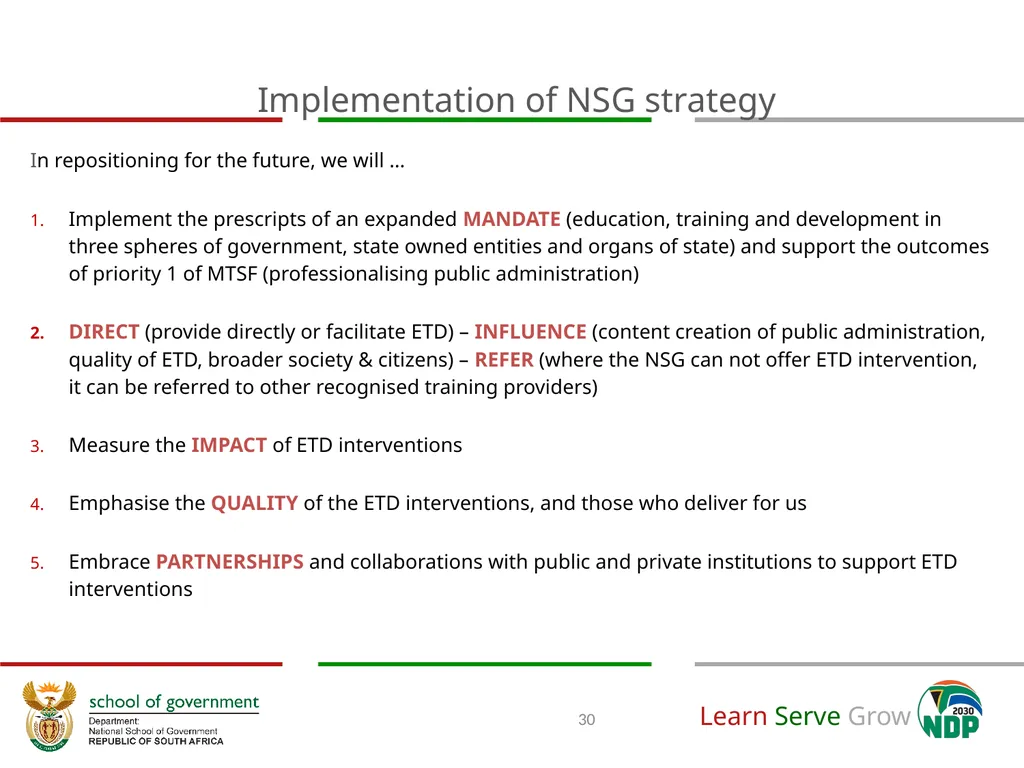
Implementation of NSG strategy In repositioning for the future, we will …
Implement the prescripts of an expanded MANDATE (education, training and development in three spheres of government, state owned entities and organs of state) and support the outcomes of priority 1 of MTSF (professionalising public administration)
DIRECT (provide directly or facilitate ETD) – INFLUENCE (content creation of public administration, quality of ETD, broader society & citizens) – REFER (where the NSG can not offer ETD intervention, it can be referred to other recognised training providers)
Measure the IMPACT of ETD interventions
Emphasise the QUALITY of the ETD interventions, and those who deliver for us
Embrace PARTNERSHIPS and collaborations with public and private institutions to support ETD interventions 30<br>
Implement the prescripts of an expanded MANDATE (education, training and development in three spheres of government, state owned entities and organs of state) and support the outcomes of priority 1 of MTSF (professionalising public administration)
DIRECT (provide directly or facilitate ETD) – INFLUENCE (content creation of public administration, quality of ETD, broader society & citizens) – REFER (where the NSG can not offer ETD intervention, it can be referred to other recognised training providers)
Measure the IMPACT of ETD interventions
Emphasise the QUALITY of the ETD interventions, and those who deliver for us
Embrace PARTNERSHIPS and collaborations with public and private institutions to support ETD interventions 30<br>
31
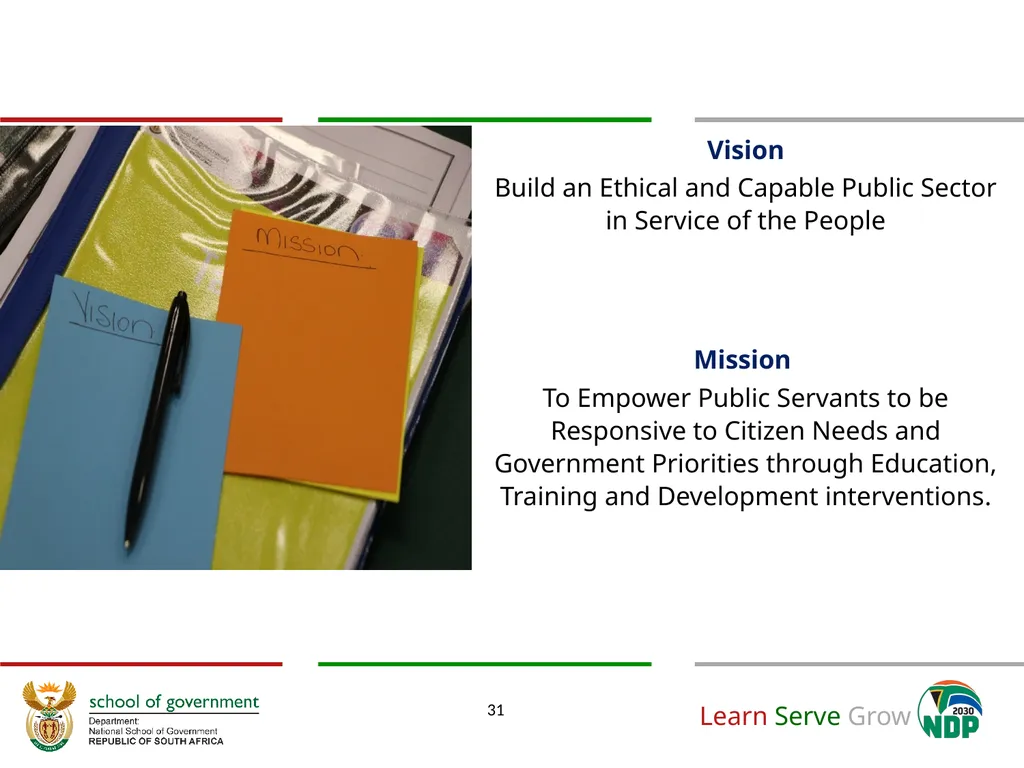
Vision
Build an Ethical and Capable Public Sector in Service of the People
Mission
To Empower Public Servants to be Responsive to Citizen Needs and Government Priorities through Education, Training and Development interventions. 31<br>
Build an Ethical and Capable Public Sector in Service of the People
Mission
To Empower Public Servants to be Responsive to Citizen Needs and Government Priorities through Education, Training and Development interventions. 31<br>
32
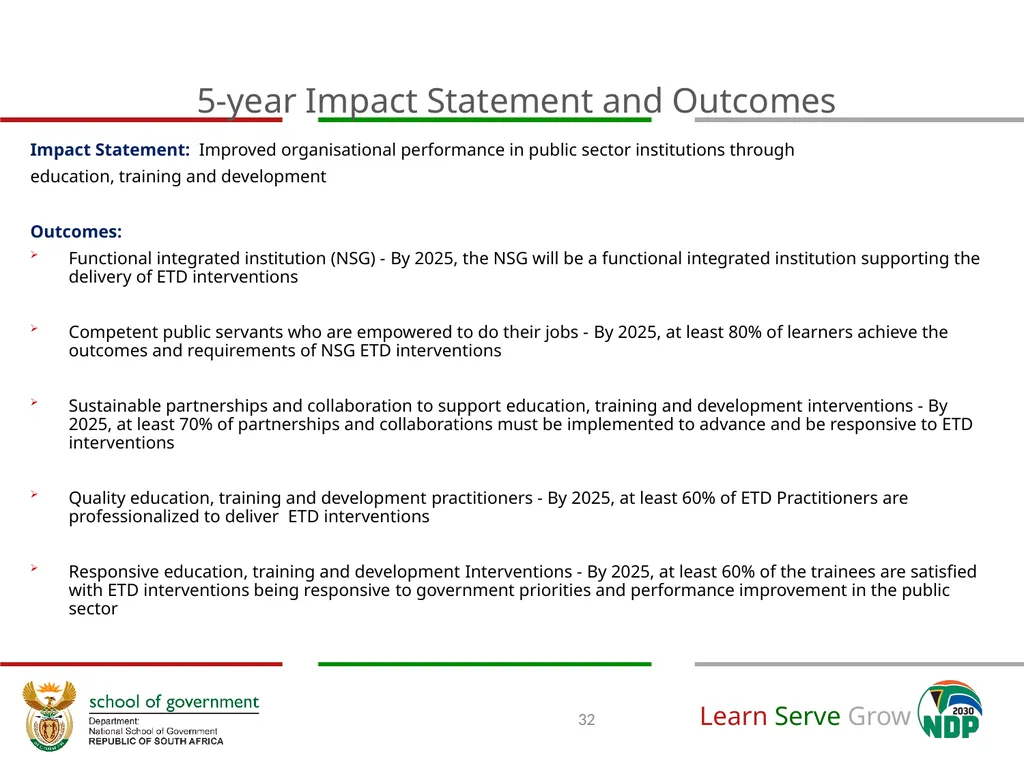
5-year Impact Statement and Outcomes Impact Statement: Improved organisational performance in public sector institutions through
education, training and development
Outcomes:
Functional integrated institution (NSG) - By 2025, the NSG will be a functional integrated institution supporting the delivery of ETD interventions
Competent public servants who are empowered to do their jobs - By 2025, at least 80% of learners achieve the outcomes and requirements of NSG ETD interventions
Sustainable partnerships and collaboration to support education, training and development interventions - By 2025, at least 70% of partnerships and collaborations must be implemented to advance and be responsive to ETD interventions
Quality education, training and development practitioners - By 2025, at least 60% of ETD Practitioners are professionalized to deliver ETD interventions
Responsive education, training and development Interventions - By 2025, at least 60% of the trainees are satisfied with ETD interventions being responsive to government priorities and performance improvement in the public sector 32<br>
education, training and development
Outcomes:
Functional integrated institution (NSG) - By 2025, the NSG will be a functional integrated institution supporting the delivery of ETD interventions
Competent public servants who are empowered to do their jobs - By 2025, at least 80% of learners achieve the outcomes and requirements of NSG ETD interventions
Sustainable partnerships and collaboration to support education, training and development interventions - By 2025, at least 70% of partnerships and collaborations must be implemented to advance and be responsive to ETD interventions
Quality education, training and development practitioners - By 2025, at least 60% of ETD Practitioners are professionalized to deliver ETD interventions
Responsive education, training and development Interventions - By 2025, at least 60% of the trainees are satisfied with ETD interventions being responsive to government priorities and performance improvement in the public sector 32<br>
33
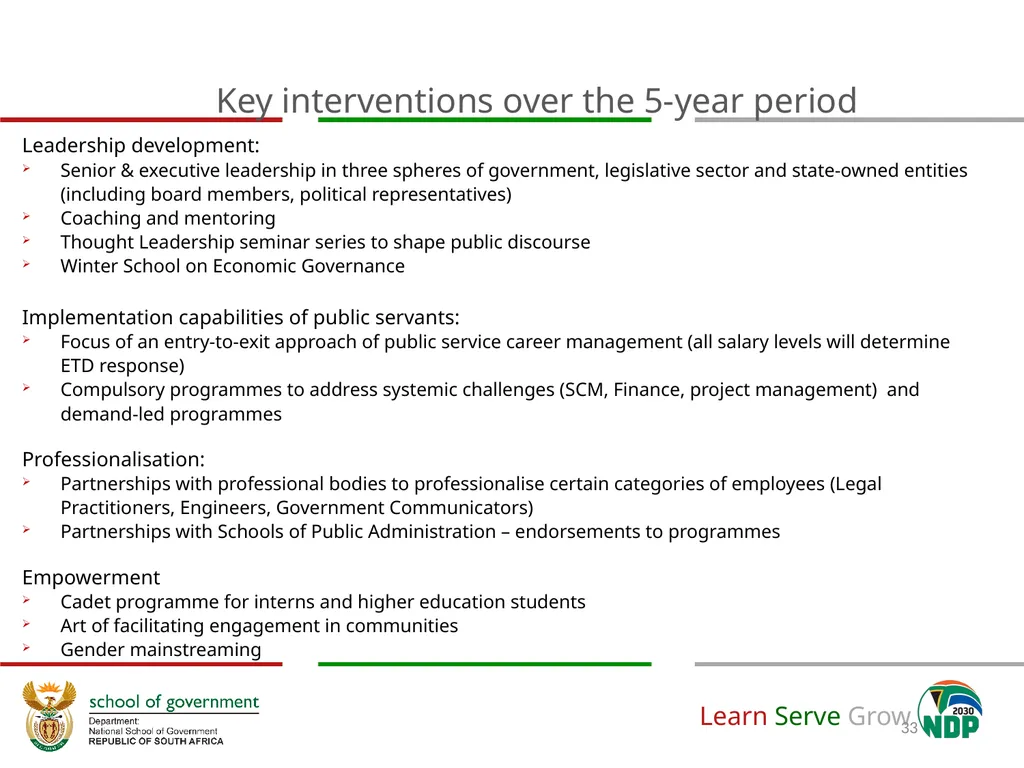
33 Key interventions over the 5-year period Leadership development:
Senior & executive leadership in three spheres of government, legislative sector and state-owned entities (including board members, political representatives)
Coaching and mentoring
Thought Leadership seminar series to shape public discourse
Winter School on Economic Governance
Implementation capabilities of public servants:
Focus of an entry-to-exit approach of public service career management (all salary levels will determine ETD response)
Compulsory programmes to address systemic challenges (SCM, Finance, project management) and demand-led programmes
Professionalisation:
Partnerships with professional bodies to professionalise certain categories of employees (Legal Practitioners, Engineers, Government Communicators)
Partnerships with Schools of Public Administration – endorsements to programmes
Empowerment
Cadet programme for interns and higher education students
Art of facilitating engagement in communities
Gender mainstreaming<br>
Senior & executive leadership in three spheres of government, legislative sector and state-owned entities (including board members, political representatives)
Coaching and mentoring
Thought Leadership seminar series to shape public discourse
Winter School on Economic Governance
Implementation capabilities of public servants:
Focus of an entry-to-exit approach of public service career management (all salary levels will determine ETD response)
Compulsory programmes to address systemic challenges (SCM, Finance, project management) and demand-led programmes
Professionalisation:
Partnerships with professional bodies to professionalise certain categories of employees (Legal Practitioners, Engineers, Government Communicators)
Partnerships with Schools of Public Administration – endorsements to programmes
Empowerment
Cadet programme for interns and higher education students
Art of facilitating engagement in communities
Gender mainstreaming<br>
34
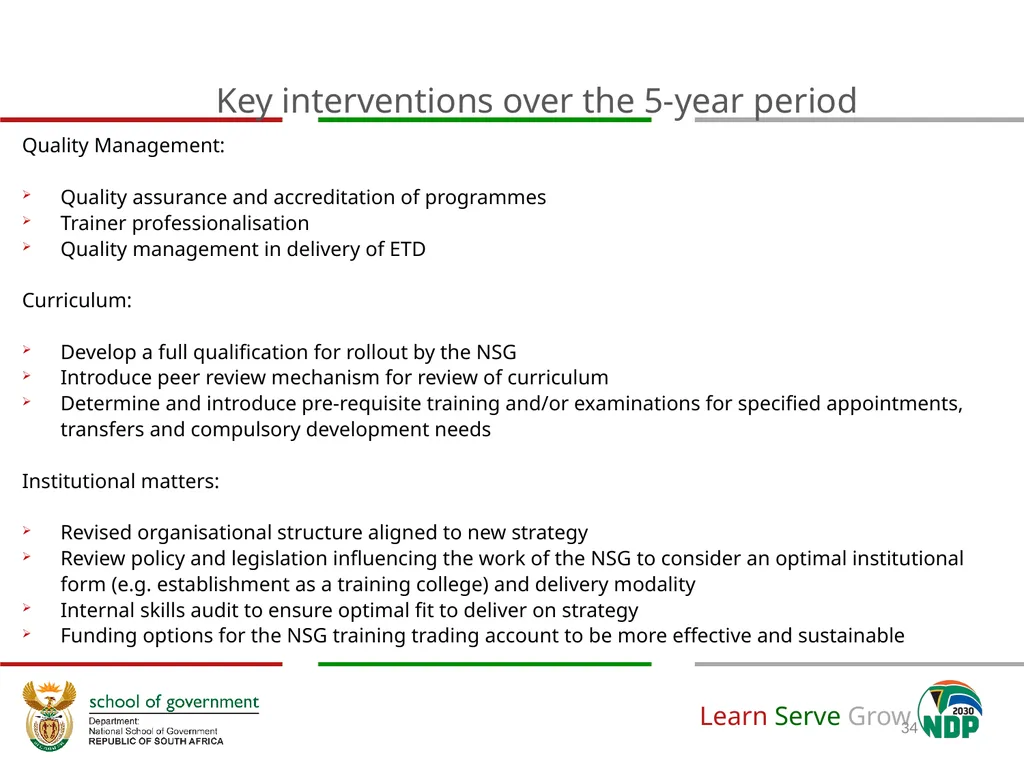
34 Key interventions over the 5-year period Quality Management:
Quality assurance and accreditation of programmes
Trainer professionalisation
Quality management in delivery of ETD
Curriculum:
Develop a full qualification for rollout by the NSG
Introduce peer review mechanism for review of curriculum
Determine and introduce pre-requisite training and/or examinations for specified appointments, transfers and compulsory development needs
Institutional matters:
Revised organisational structure aligned to new strategy
Review policy and legislation influencing the work of the NSG to consider an optimal institutional form (e.g. establishment as a training college) and delivery modality
Internal skills audit to ensure optimal fit to deliver on strategy
Funding options for the NSG training trading account to be more effective and sustainable<br>
Quality assurance and accreditation of programmes
Trainer professionalisation
Quality management in delivery of ETD
Curriculum:
Develop a full qualification for rollout by the NSG
Introduce peer review mechanism for review of curriculum
Determine and introduce pre-requisite training and/or examinations for specified appointments, transfers and compulsory development needs
Institutional matters:
Revised organisational structure aligned to new strategy
Review policy and legislation influencing the work of the NSG to consider an optimal institutional form (e.g. establishment as a training college) and delivery modality
Internal skills audit to ensure optimal fit to deliver on strategy
Funding options for the NSG training trading account to be more effective and sustainable<br>
35
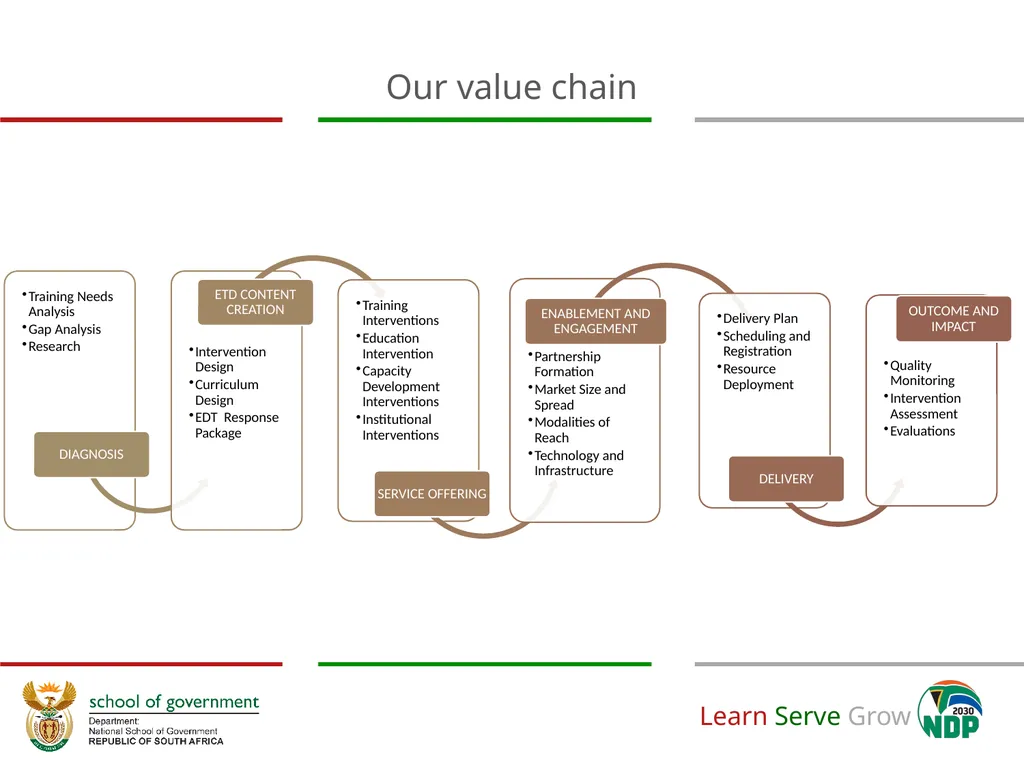
Our value chain<br>
36
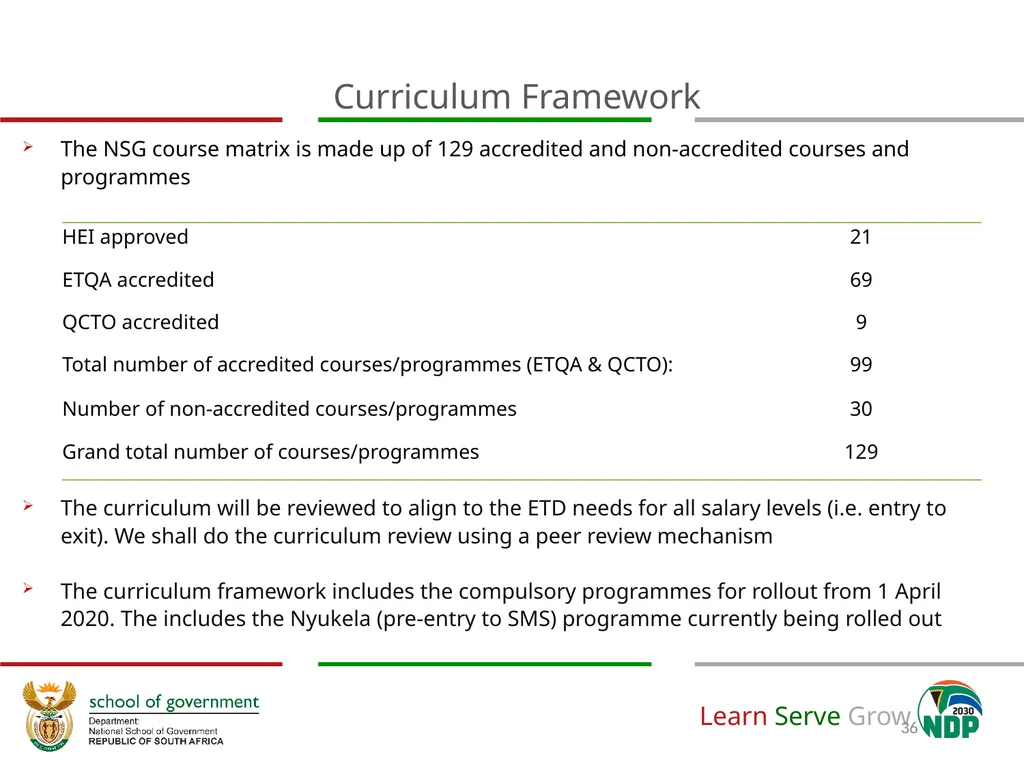
Curriculum Framework The NSG course matrix is made up of 129 accredited and non-accredited courses and programmes
The curriculum will be reviewed to align to the ETD needs for all salary levels (i.e. entry to exit). We shall do the curriculum review using a peer review mechanism
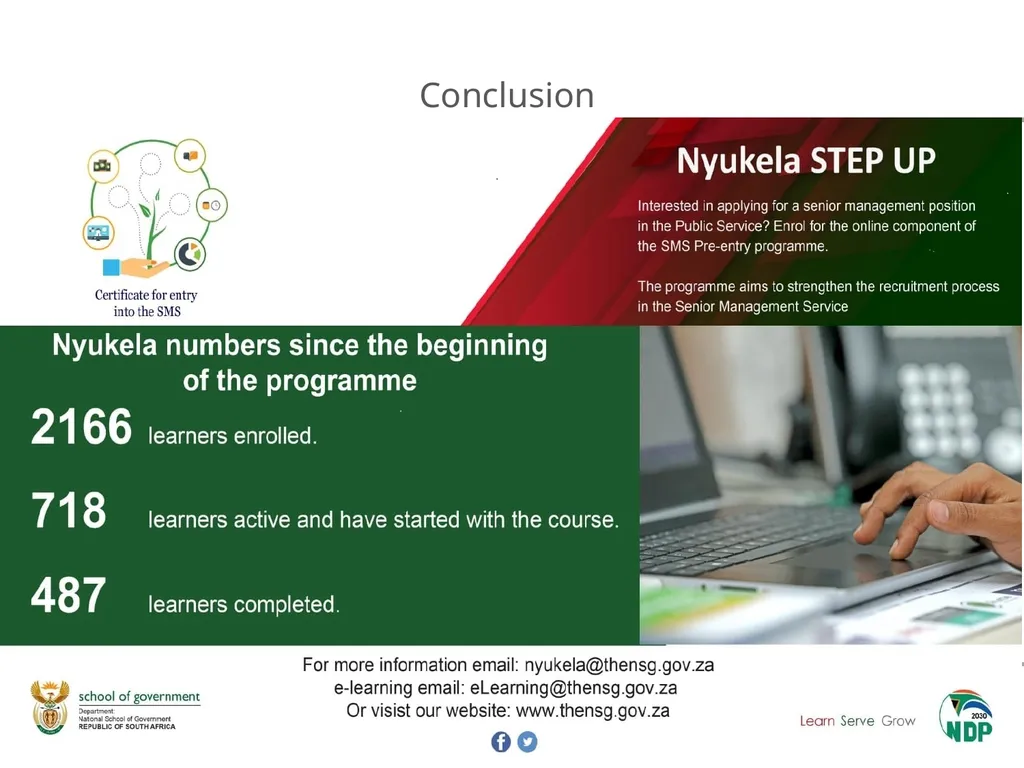
The curriculum framework includes the compulsory programmes for rollout from 1 April 2020. The includes the Nyukela (pre-entry to SMS) programme currently being rolled out 36<br>
The curriculum will be reviewed to align to the ETD needs for all salary levels (i.e. entry to exit). We shall do the curriculum review using a peer review mechanism
The curriculum framework includes the compulsory programmes for rollout from 1 April 2020. The includes the Nyukela (pre-entry to SMS) programme currently being rolled out 36<br>
37
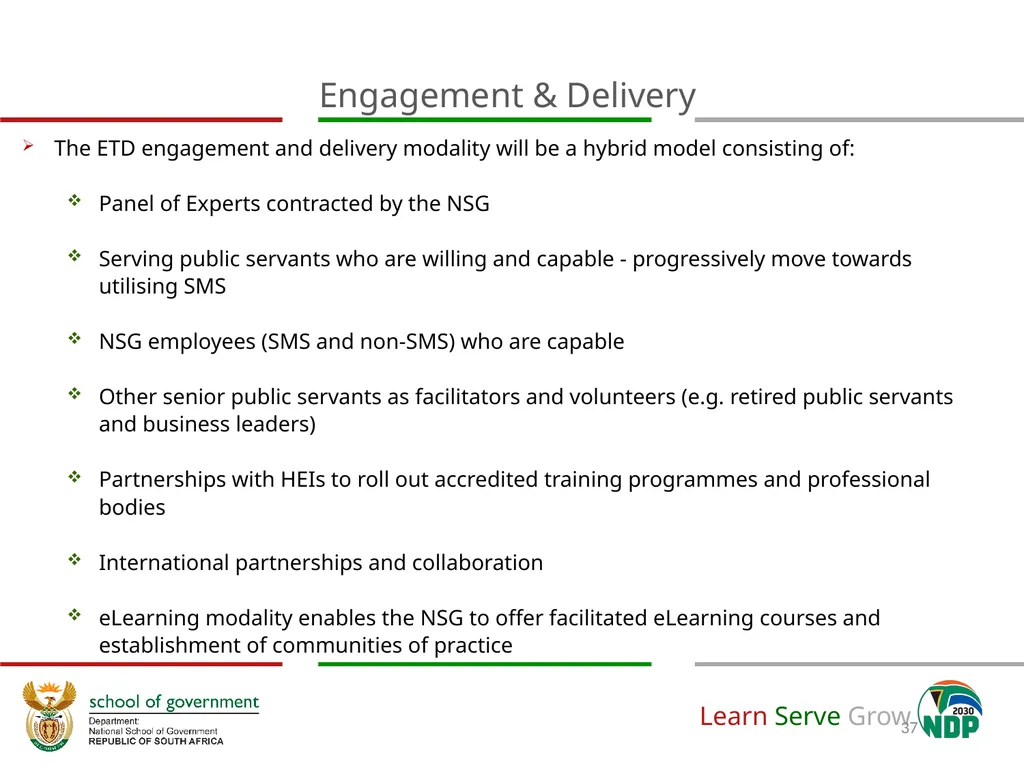
Engagement & Delivery 37 The ETD engagement and delivery modality will be a hybrid model consisting of:
Panel of Experts contracted by the NSG
Serving public servants who are willing and capable - progressively move towards utilising SMS
NSG employees (SMS and non-SMS) who are capable
Other senior public servants as facilitators and volunteers (e.g. retired public servants and business leaders)
Partnerships with HEIs to roll out accredited training programmes and professional bodies
International partnerships and collaboration
eLearning modality enables the NSG to offer facilitated eLearning courses and establishment of communities of practice<br>
Panel of Experts contracted by the NSG
Serving public servants who are willing and capable - progressively move towards utilising SMS
NSG employees (SMS and non-SMS) who are capable
Other senior public servants as facilitators and volunteers (e.g. retired public servants and business leaders)
Partnerships with HEIs to roll out accredited training programmes and professional bodies
International partnerships and collaboration
eLearning modality enables the NSG to offer facilitated eLearning courses and establishment of communities of practice<br>
38
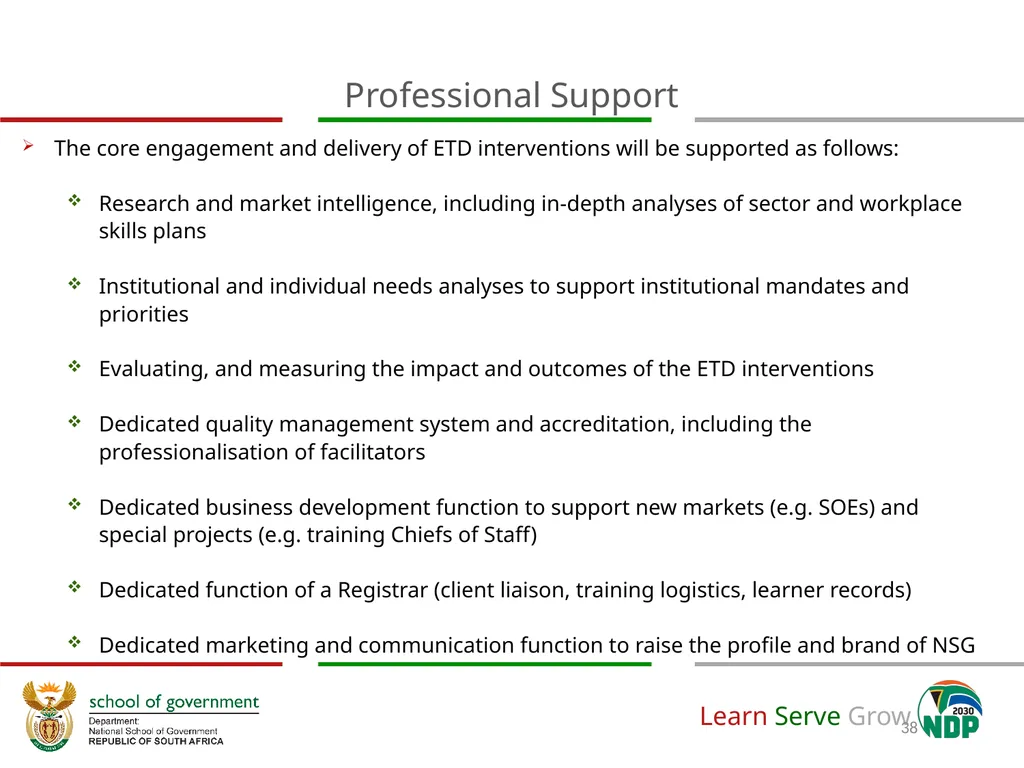
Professional Support 38 The core engagement and delivery of ETD interventions will be supported as follows:
Research and market intelligence, including in-depth analyses of sector and workplace skills plans
Institutional and individual needs analyses to support institutional mandates and priorities
Evaluating, and measuring the impact and outcomes of the ETD interventions
Dedicated quality management system and accreditation, including the professionalisation of facilitators
Dedicated business development function to support new markets (e.g. SOEs) and special projects (e.g. training Chiefs of Staff)
Dedicated function of a Registrar (client liaison, training logistics, learner records)
Dedicated marketing and communication function to raise the profile and brand of NSG<br>
Research and market intelligence, including in-depth analyses of sector and workplace skills plans
Institutional and individual needs analyses to support institutional mandates and priorities
Evaluating, and measuring the impact and outcomes of the ETD interventions
Dedicated quality management system and accreditation, including the professionalisation of facilitators
Dedicated business development function to support new markets (e.g. SOEs) and special projects (e.g. training Chiefs of Staff)
Dedicated function of a Registrar (client liaison, training logistics, learner records)
Dedicated marketing and communication function to raise the profile and brand of NSG<br>
39
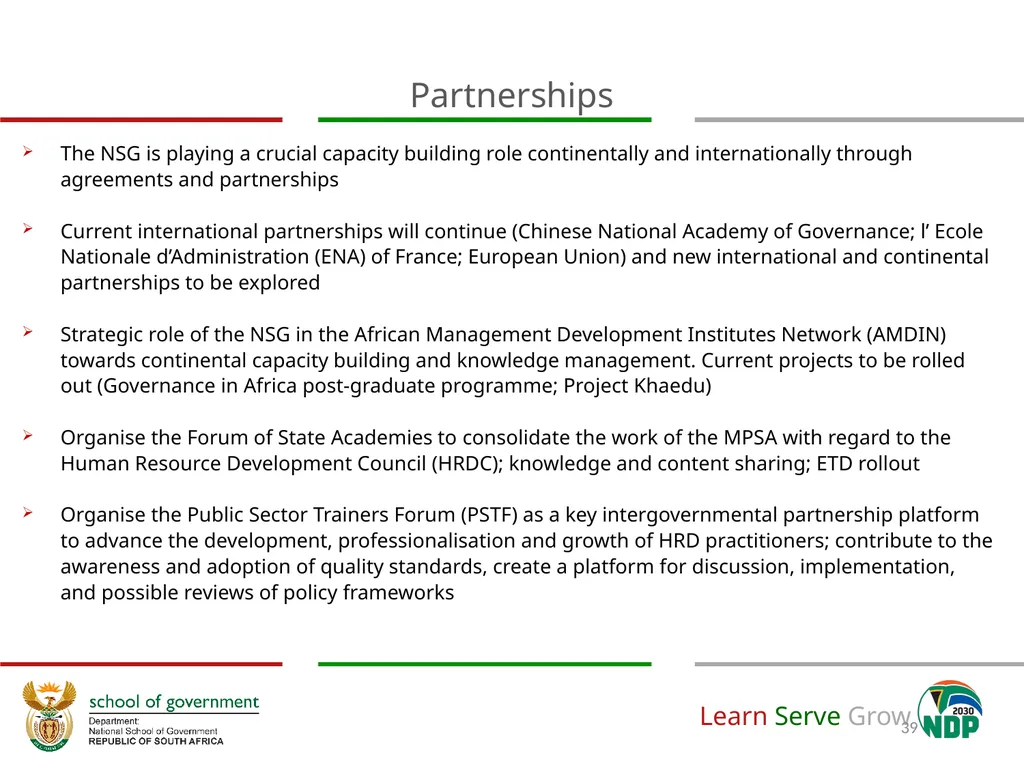
Partnerships 39 The NSG is playing a crucial capacity building role continentally and internationally through agreements and partnerships
Current international partnerships will continue (Chinese National Academy of Governance; l’ Ecole Nationale d’Administration (ENA) of France; European Union) and new international and continental partnerships to be explored
Strategic role of the NSG in the African Management Development Institutes Network (AMDIN) towards continental capacity building and knowledge management. Current projects to be rolled out (Governance in Africa post-graduate programme; Project Khaedu)
Organise the Forum of State Academies to consolidate the work of the MPSA with regard to the Human Resource Development Council (HRDC); knowledge and content sharing; ETD rollout
Organise the Public Sector Trainers Forum (PSTF) as a key intergovernmental partnership platform to advance the development, professionalisation and growth of HRD practitioners; contribute to the awareness and adoption of quality standards, create a platform for discussion, implementation, and possible reviews of policy frameworks<br>
Current international partnerships will continue (Chinese National Academy of Governance; l’ Ecole Nationale d’Administration (ENA) of France; European Union) and new international and continental partnerships to be explored
Strategic role of the NSG in the African Management Development Institutes Network (AMDIN) towards continental capacity building and knowledge management. Current projects to be rolled out (Governance in Africa post-graduate programme; Project Khaedu)
Organise the Forum of State Academies to consolidate the work of the MPSA with regard to the Human Resource Development Council (HRDC); knowledge and content sharing; ETD rollout
Organise the Public Sector Trainers Forum (PSTF) as a key intergovernmental partnership platform to advance the development, professionalisation and growth of HRD practitioners; contribute to the awareness and adoption of quality standards, create a platform for discussion, implementation, and possible reviews of policy frameworks<br>
40
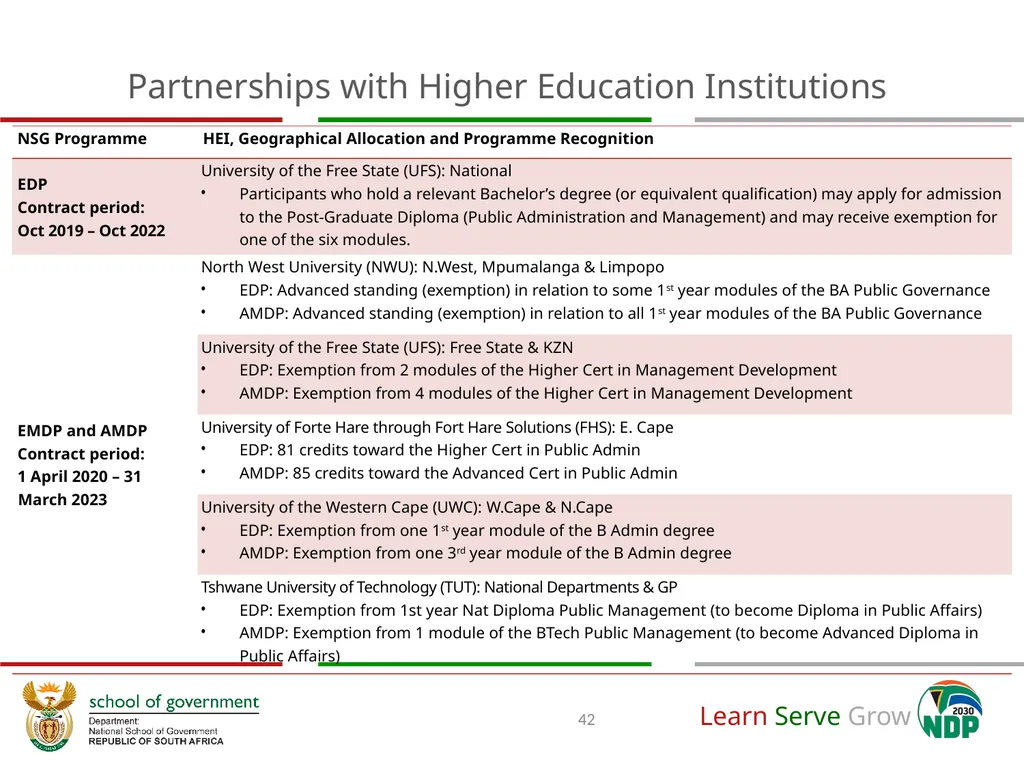
Partnerships with Higher Education Institutions 40 The NSG established an Integrated Management Development Programme (IMDP) model that provides a comprehensive and coherent professional development framework for all public sector supervisors, managers and leaders
The IMDP is not only about theoretical perspectives of management; it is a model that promotes the application of sound management and leadership principles in a context of people-oriented development and service
The IMDP is delivered in partnership with Higher Education Institutions.<br>
The IMDP is not only about theoretical perspectives of management; it is a model that promotes the application of sound management and leadership principles in a context of people-oriented development and service
The IMDP is delivered in partnership with Higher Education Institutions.<br>
41
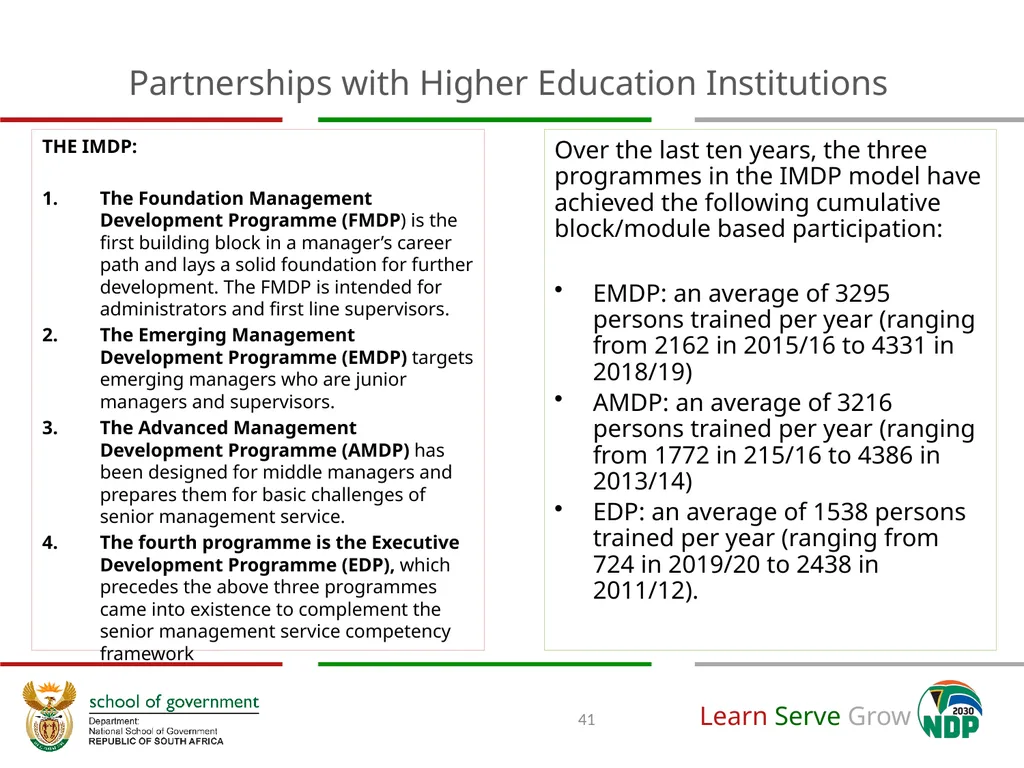
Partnerships with Higher Education Institutions THE IMDP:
The Foundation Management Development Programme (FMDP) is the first building block in a manager’s career path and lays a solid foundation for further development. The FMDP is intended for administrators and first line supervisors.
The Emerging Management Development Programme (EMDP) targets emerging managers who are junior managers and supervisors.
The Advanced Management Development Programme (AMDP) has been designed for middle managers and prepares them for basic challenges of senior management service.
The fourth programme is the Executive Development Programme (EDP), which precedes the above three programmes came into existence to complement the senior management service competency framework Over the last ten years, the three programmes in the IMDP model have achieved the following cumulative block/module based participation:
EMDP: an average of 3295 persons trained per year (ranging from 2162 in 2015/16 to 4331 in 2018/19)
AMDP: an average of 3216 persons trained per year (ranging from 1772 in 215/16 to 4386 in 2013/14)
EDP: an average of 1538 persons trained per year (ranging from 724 in 2019/20 to 2438 in 2011/12). 41<br>
The Foundation Management Development Programme (FMDP) is the first building block in a manager’s career path and lays a solid foundation for further development. The FMDP is intended for administrators and first line supervisors.
The Emerging Management Development Programme (EMDP) targets emerging managers who are junior managers and supervisors.
The Advanced Management Development Programme (AMDP) has been designed for middle managers and prepares them for basic challenges of senior management service.
The fourth programme is the Executive Development Programme (EDP), which precedes the above three programmes came into existence to complement the senior management service competency framework Over the last ten years, the three programmes in the IMDP model have achieved the following cumulative block/module based participation:
EMDP: an average of 3295 persons trained per year (ranging from 2162 in 2015/16 to 4331 in 2018/19)
AMDP: an average of 3216 persons trained per year (ranging from 1772 in 215/16 to 4386 in 2013/14)
EDP: an average of 1538 persons trained per year (ranging from 724 in 2019/20 to 2438 in 2011/12). 41<br>
42
42 Partnerships with Higher Education Institutions<br>
43
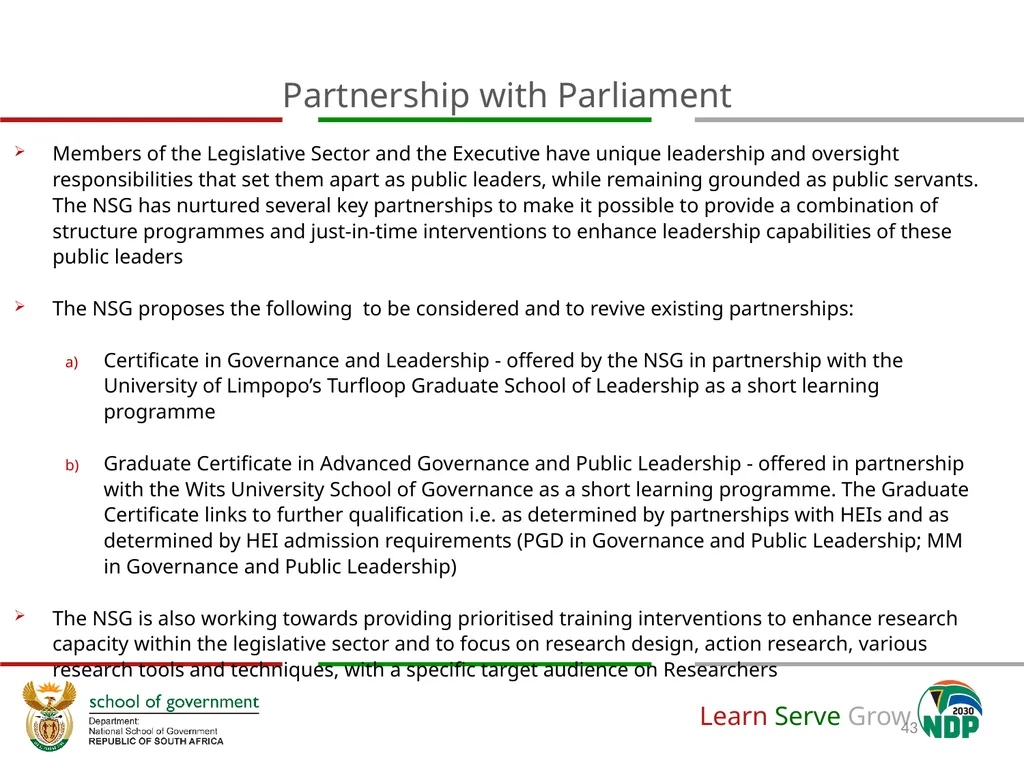
Partnership with Parliament 43 Members of the Legislative Sector and the Executive have unique leadership and oversight responsibilities that set them apart as public leaders, while remaining grounded as public servants. The NSG has nurtured several key partnerships to make it possible to provide a combination of structure programmes and just-in-time interventions to enhance leadership capabilities of these public leaders
The NSG proposes the following to be considered and to revive existing partnerships:
Certificate in Governance and Leadership - offered by the NSG in partnership with the University of Limpopo’s Turfloop Graduate School of Leadership as a short learning programme
Graduate Certificate in Advanced Governance and Public Leadership - offered in partnership with the Wits University School of Governance as a short learning programme. The Graduate Certificate links to further qualification i.e. as determined by partnerships with HEIs and as determined by HEI admission requirements (PGD in Governance and Public Leadership; MM in Governance and Public Leadership)
The NSG is also working towards providing prioritised training interventions to enhance research capacity within the legislative sector and to focus on research design, action research, various research tools and techniques, with a specific target audience on Researchers<br>
The NSG proposes the following to be considered and to revive existing partnerships:
Certificate in Governance and Leadership - offered by the NSG in partnership with the University of Limpopo’s Turfloop Graduate School of Leadership as a short learning programme
Graduate Certificate in Advanced Governance and Public Leadership - offered in partnership with the Wits University School of Governance as a short learning programme. The Graduate Certificate links to further qualification i.e. as determined by partnerships with HEIs and as determined by HEI admission requirements (PGD in Governance and Public Leadership; MM in Governance and Public Leadership)
The NSG is also working towards providing prioritised training interventions to enhance research capacity within the legislative sector and to focus on research design, action research, various research tools and techniques, with a specific target audience on Researchers<br>
44
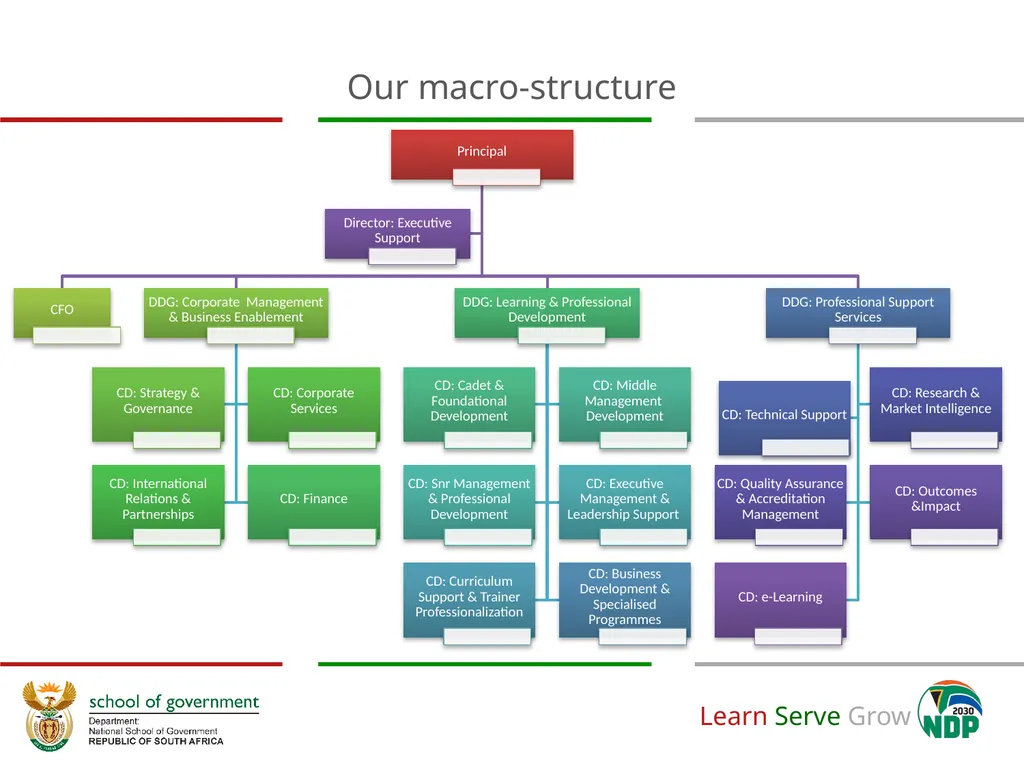
Our macro-structure<br>
45
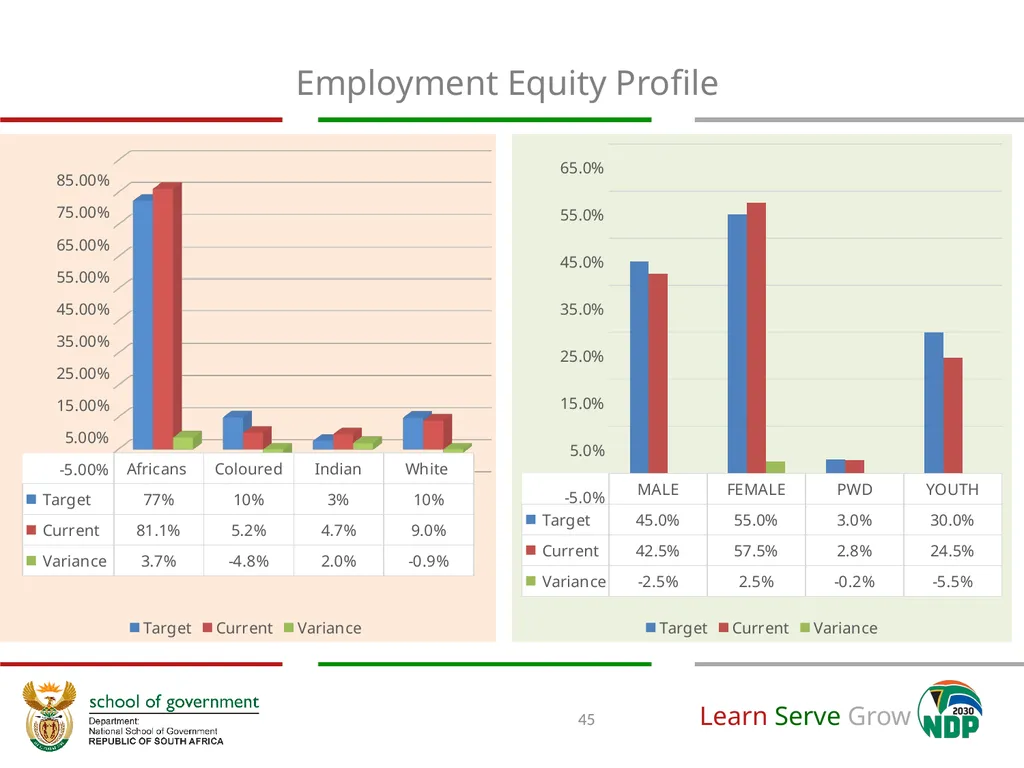
Employment Equity Profile 45<br>
46
Thank you 46 The NSG:
Learn: expanding learning opportunities for public servants to master state craft
Serve: building the capacity (and culture) of public servants to serve society effectively
Grow: helping public servants to combine learning and service (experience) to grow professionally<br>
Learn: expanding learning opportunities for public servants to master state craft
Serve: building the capacity (and culture) of public servants to serve society effectively
Grow: helping public servants to combine learning and service (experience) to grow professionally<br>