
Advanced Vehicle Technology: Alternative-Fuel





Description: Advanced Vehicle Technology: Alternative-Fuel Vehicles CHAPTER 7 Knowledge Objectives (1 of 3) Describe these alternative-fuel sources and explain the unique extrication hazards they present: Flexible fuel Hybrid electric Electric Natural
Related Topics
Download Presentation
"Advanced Vehicle Technology: Alternative-Fuel" is the property of its rightful owner. Permission is granted to download and print the materials on this website for personal, non-commercial use only, and to display it on your personal computer provided you do not modify the materials and that you retain all copyright notices contained in the materials. By downloading content from our website, you accept the terms of this agreement.
Presentation Transcript
slide1. Advanced Vehicle Technology: Alternative-Fuel Vehicles CHAPTER 7<br>
slide2. Knowledge Objectives (1 of 3) Describe these alternative-fuel sources and explain the unique extrication hazards they present:
Flexible fuel
Hybrid electric
Electric
Natural gas
Liquefied petroleum gas
Biodiesel
Hydrogen fuel cell<br>
slide3. Knowledge Objectives (2 of 3) Define the following terms and explain their importance in vehicle rescue incidents:
Emergency Response Guide (ERG)
Pressure relief device
Vehicle identification badge
Temperature relief device
Identify dangers common to all alternative-fuel vehicle extrication operations.
List standard safety precautions for alternative vehicle extrication.<br>
slide4. Knowledge Objectives (3 of 3) Describe the benefits of using the Emergency Response Guide (ERG) for alternative-fuel vehicle extrication.
List classes of hybrid vehicles and explain unique dangers associated with each.
Identify typical voltage cable color coding for electric and hybrid vehicles.
Identify fire suppression and safety measures at an alternative-fuel vehicle extrication incident.
Explain the reasons for using atmospheric monitoring equipment at an alternative-fuel vehicle incident.<br>
slide5. Introduction (1 of 5) There are many alternative fuels in use today.
Rescue personnel must be familiar with these.
Hazards include:
Multiple batteries
High-voltage power cables
Advanced air bag protection systems
Alloyed metals
Reinforced passenger compartments
Advanced energy management systems<br>
slide6. Introduction (2 of 5) Upon conducting a size-up, the officer must immediately recognize the various types of alternative fuels present and establish safety/hazard control zones.
Difficult to keep up with advances in vehicle technology.
Dealers of alternative vehicles can provide information.
Emergency response guides and the Internet are also good sources of information.<br>
slide7. Introduction (3 of 5) Using the same emergency procedures on every incident is impractical and dangerous.
Each vehicle system will have some unique steps.
Some emergency steps are universal.
The best practice model is to preplan by studying and training.<br>
slide8. Introduction (4 of 5) If a known IDLH hazard is presented with an alternative-fuel vehicle:
Set the hazard control zones appropriate to the hazard.
Look for visible vapor clouds.
Listen for a loud hissing noise, which may indicate product release.
Incidents requiring fire suppression may require a large-diameter hose and master stream device in defensive mode.<br>
slide9. Introduction (5 of 5) Safety procedures can be very specific to the type of fuel encountered and must be strictly adhered to.
However, some safety procedures are universal.
Be aware that various vehicles will have additional or unique emergency procedures specific to that vehicle.
Not all steps are completed in succession; some are simultaneous.<br>
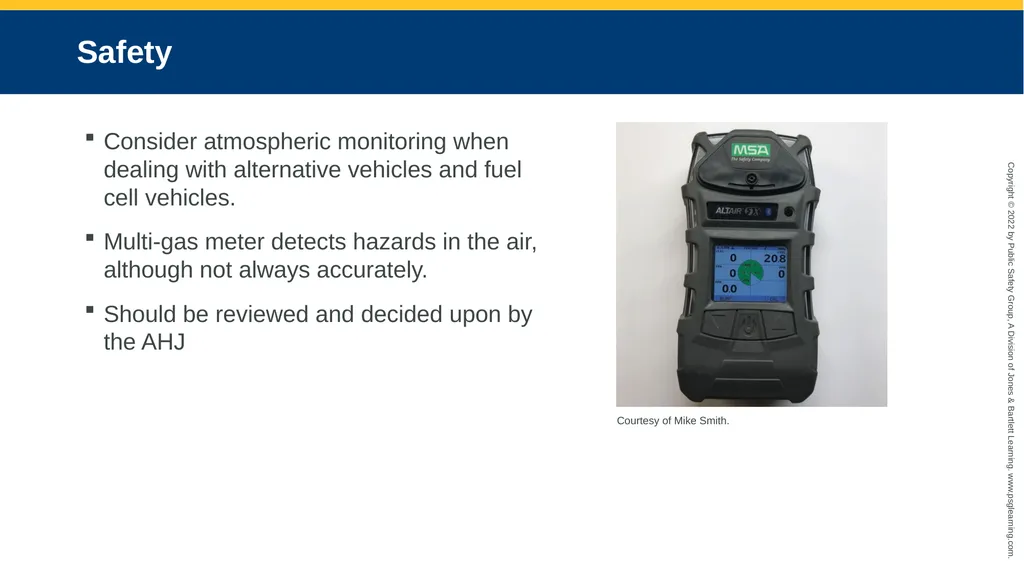
slide10. Safety Consider atmospheric monitoring when dealing with alternative vehicles and fuel cell vehicles.
Multi-gas meter detects hazards in the air, although not always accurately.
Should be reviewed and decided upon by the AHJ Courtesy of Mike Smith.<br>
slide11. Alternative Fuels (1 of 5) Alternative-fuel vehicles use fuels other than gasoline or diesel.
Ethanol
Methanol
Natural gas
LPG
Biodiesel
Hydrogen
Electricity<br>
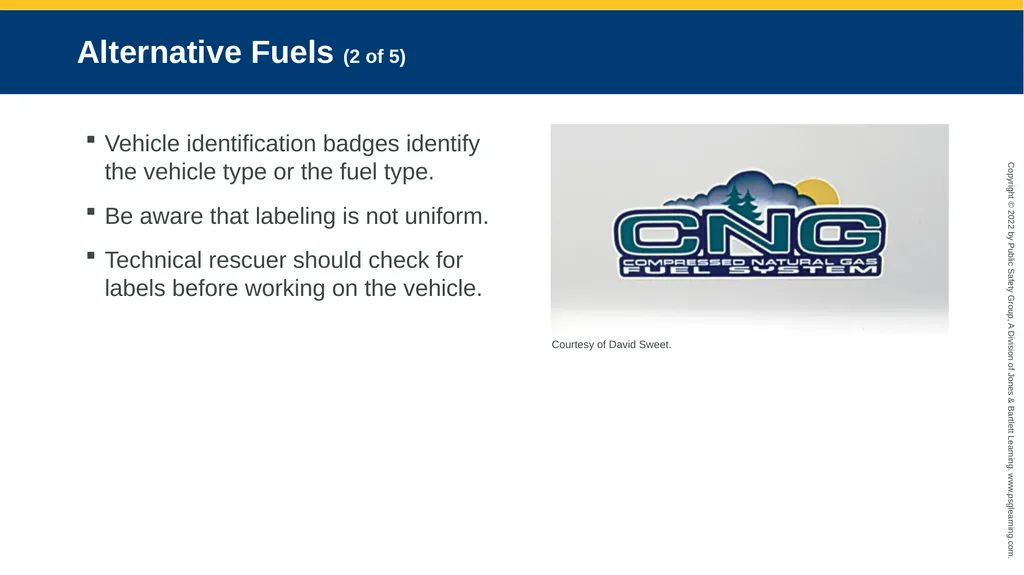
slide12. Alternative Fuels (2 of 5) Vehicle identification badges identify the vehicle type or the fuel type.
Be aware that labeling is not uniform.
Technical rescuer should check for labels before working on the vehicle. Courtesy of David Sweet.<br>
slide13. Alternative Fuels (3 of 5) Ethanol
An alcohol-based fuel processed from crops
Can be blended in different percentages
Used to fuel flexible fuel vehicles (FFVs)
Methanol
Processed from wood sources
Also used as a flex fuel
Widely used outside the United States<br>
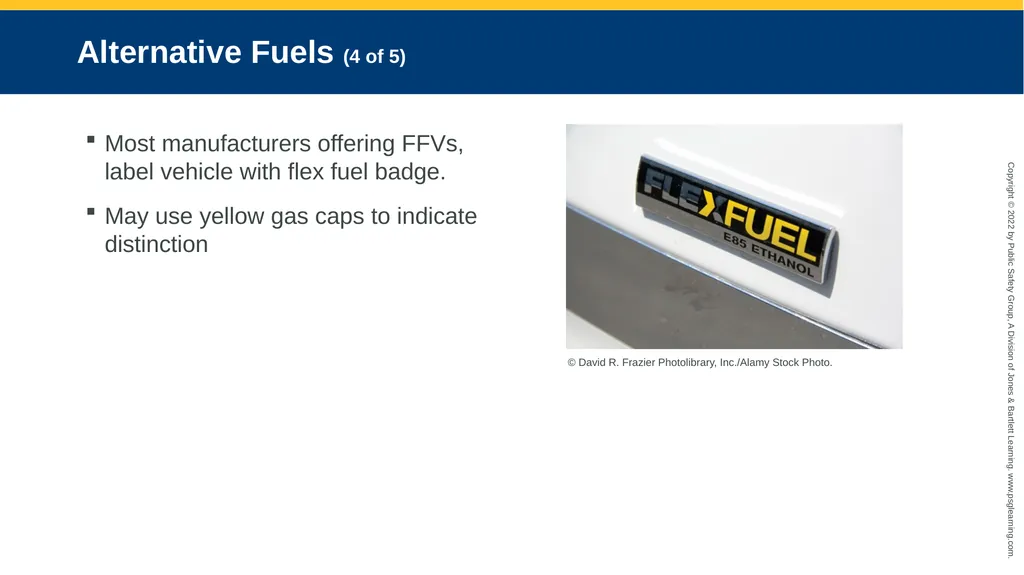
slide14. Alternative Fuels (4 of 5) Most manufacturers offering FFVs, label vehicle with flex fuel badge.
May use yellow gas caps to indicate distinction © David R. Frazier Photolibrary, Inc./Alamy Stock Photo.<br>
slide15. Alternative Fuels (5 of 5) Ethanol and methanol require alcohol-resistant foam to extinguish fires.
Vapor suppression and diking procedures may be needed to contain runoff.
Both fuels separate from the gasoline when water is applied.
With the exception of a vehicle fire, emergency procedures will be the same as a standard conventional vehicle.<br>
slide16. Alternative Fuels: Natural Gas Fossil fuel composed of methane that is used as compressed natural gas or liquefied natural gas
Not widely produced in the United States
Liquefied natural gas (LNG) is a colorless, odorless, nontoxic gas that floats on water.
Changes to gas when released
Using water on LNG will cause rapid boil-off.
Fuel tanks must be double-walled and well-insulated.<br>
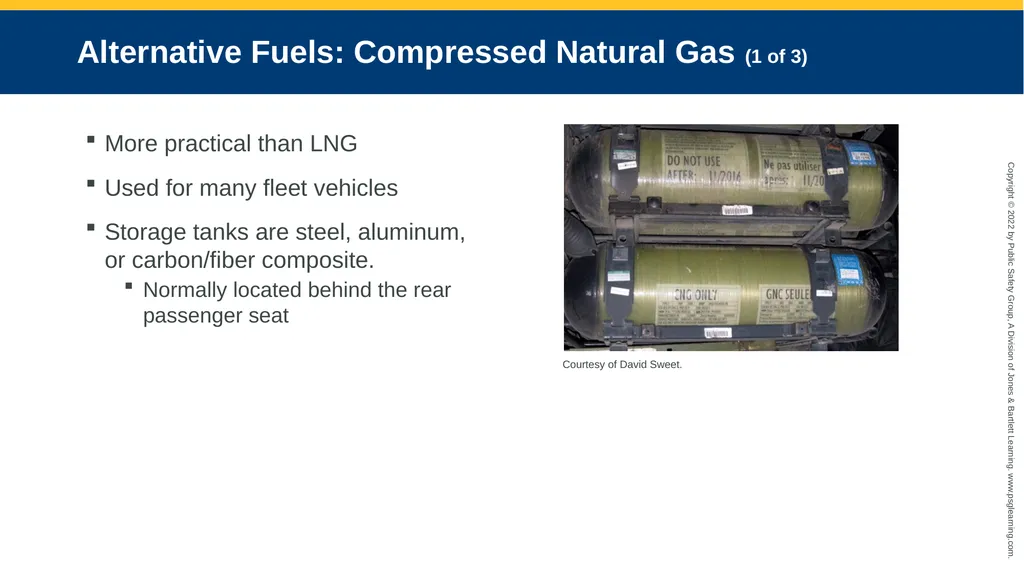
slide17. Alternative Fuels: Compressed Natural Gas (1 of 3) More practical than LNG
Used for many fleet vehicles
Storage tanks are steel, aluminum, or carbon/fiber composite.
Normally located behind the rear passenger seat Courtesy of David Sweet.<br>
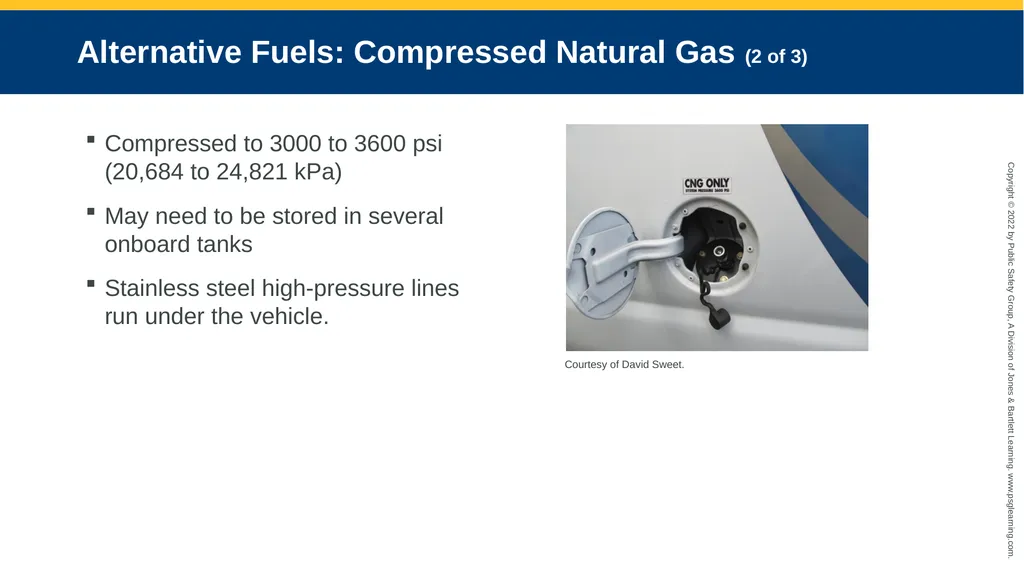
slide18. Alternative Fuels: Compressed Natural Gas (2 of 3) Compressed to 3000 to 3600 psi (20,684 to 24,821 kPa)
May need to be stored in several onboard tanks
Stainless steel high-pressure lines run under the vehicle. Courtesy of David Sweet.<br>
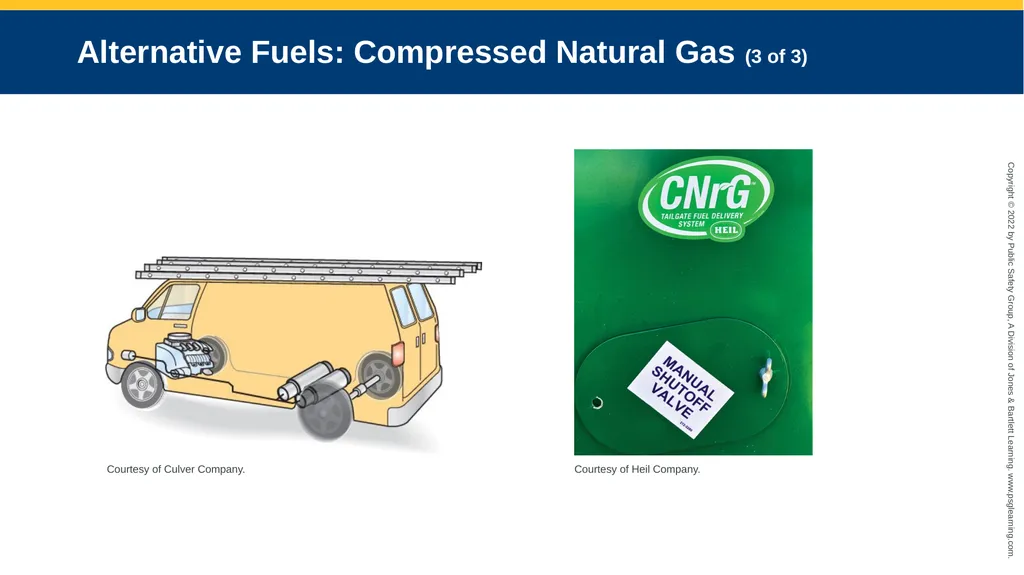
slide19. Alternative Fuels: Compressed Natural Gas (3 of 3) Courtesy of Culver Company. Courtesy of Heil Company.<br>
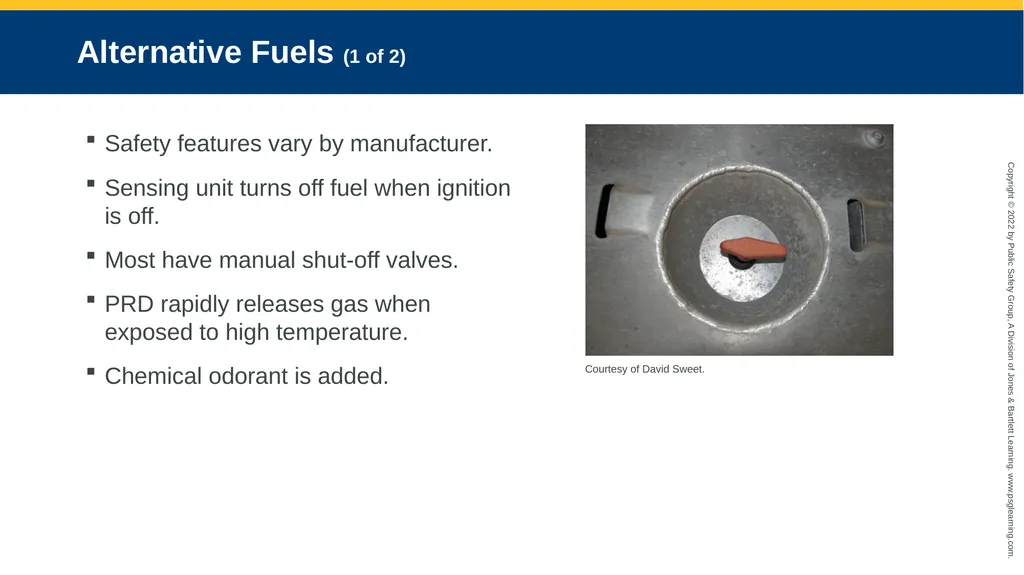
slide20. Alternative Fuels (1 of 2) Safety features vary by manufacturer.
Sensing unit turns off fuel when ignition is off.
Most have manual shut-off valves.
PRD rapidly releases gas when exposed to high temperature.
Chemical odorant is added. Courtesy of David Sweet.<br>
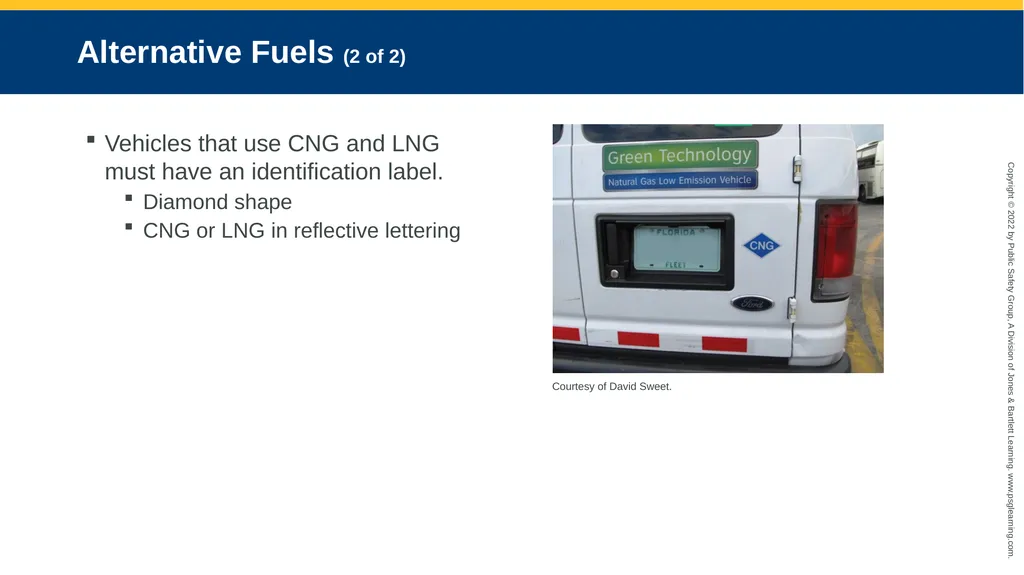
slide21. Alternative Fuels (2 of 2) Vehicles that use CNG and LNG must have an identification label.
Diamond shape
CNG or LNG in reflective lettering Courtesy of David Sweet.<br>
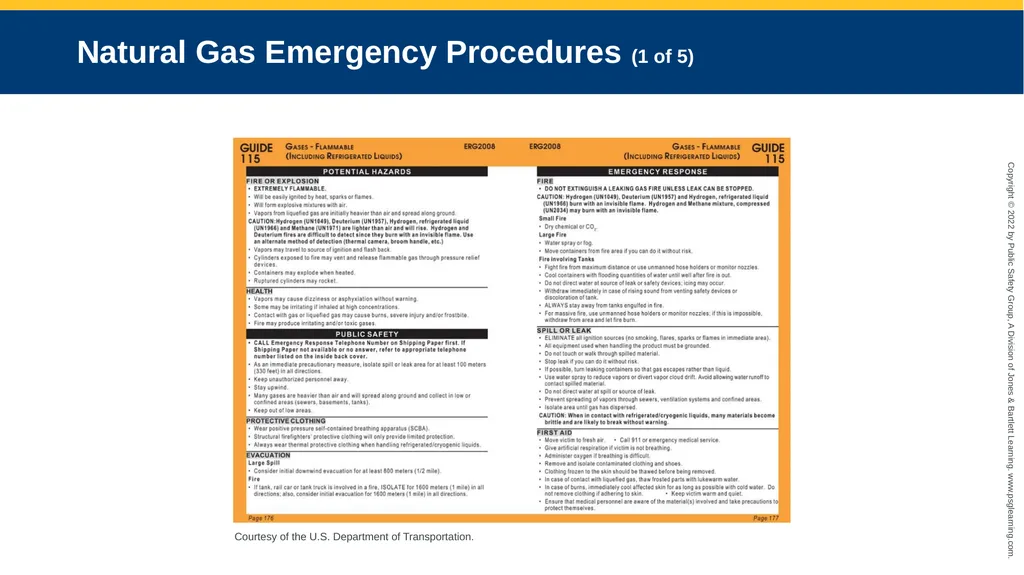
slide22. Natural Gas Emergency Procedures (1 of 5) Courtesy of the U.S. Department of Transportation.<br>
slide23. Natural Gas Emergency Procedures (2 of 5) Don appropriate PPE and clear area of bystanders and hazards.
Establish hazard control zones.
Conduct inner and outer surveys: approach from upwind and uphill.
Use a multi-gas meter.
Look for vehicle identification badge.
Deploy two 1¾-in. (44-mm) charged hose lines to protect personnel.<br>
slide24. Natural Gas Emergency Procedures (3 of 5) Ensure the vehicle’s ignition is turned off, the keys are out of the ignition, and the vehicle is placed in park.
Stabilize the vehicle from movement with cribbing.
Attempt necessary component adjustments before disabling power to the vehicle.
Disconnect the 12-volt DC battery starting with the negative line first.
Manually turn off the gas at the tanks by shutting off the valves.<br>
slide25. Natural Gas Emergency Procedures (4 of 5) If AHJ decides to, remove main fuse from the vehicle to ensure the electrical system is disabled.
For CNG to be combustible, it must fall within its flammability range (5–15 percent).
For PRDs that are releasing product with visible flame, cool the tank or eliminate flame impingement rather than attempt to extinguish the flame.
Until the leak can be isolated and eliminated, it is safer to let the product burn itself out.<br>
slide26. Natural Gas Emergency Procedures (5 of 5) Before attempting extrication, examine the vehicle carefully for fuel line locations before attempting any cutting.
Take extra precaution with
Dash displacement techniques
Cutting and dropping the floorboard under the brake and gas pedals<br>
slide27. Alternative Fuels: LPG (1 of 2) Fossil fuel produced from natural gas
1.5 times heavier than air
Fuel tanks are built according to the standards set by the American Society of Mechanical Engineers.
Constructed from carbon steel
Cannot exceed 200 gal (757 L)
Mandatory 20 percent reduction in product
Chemical odorant is added.
Equipped with PRD<br>
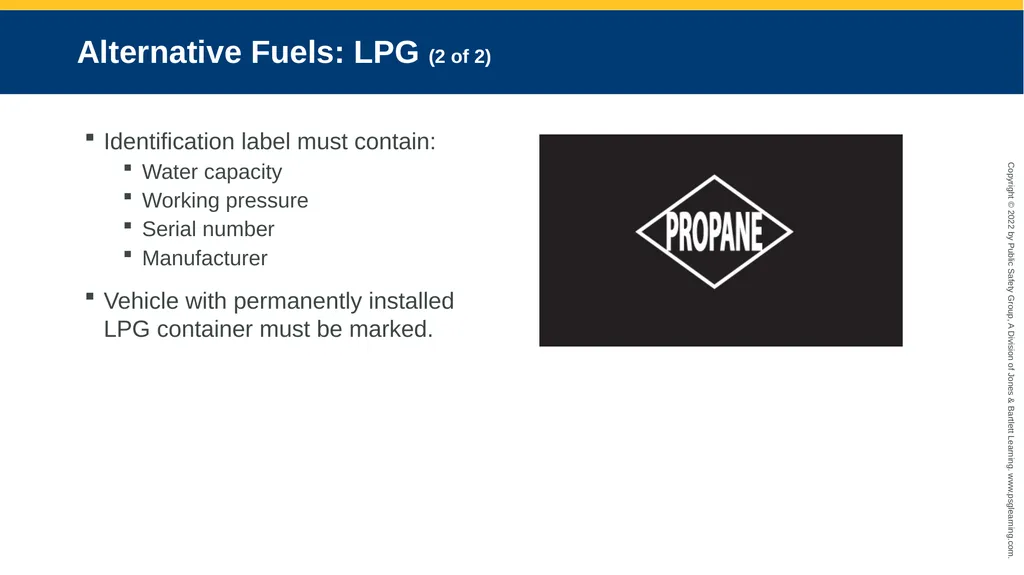
slide28. Alternative Fuels: LPG (2 of 2) Identification label must contain:
Water capacity
Working pressure
Serial number
Manufacturer
Vehicle with permanently installed LPG container must be marked.<br>
slide29. LPG Emergency Procedures (1 of 4) Remember, propane disperses well beyond its vapor cloud and will seek out ignition sources, which can cause a flashback to the leak.
Don appropriate PPE, including SCBA, and clear area of bystanders and hazards.
Establish hazard control zones.
Conduct inner and outer surveys; propane will accumulate in lower areas.
Use a combustible gas meter.<br>
slide30. LPG Emergency Procedures (2 of 4) Look for vehicle identification badge.
Deploy two 1¾-in. (44-mm) charged hose lines.
Ensure ignition is off, the keys are out of the ignition, and the vehicle is placed in park.
Stabilize the vehicle.
Attempt necessary adjustments.
Disconnect the 12-volt DC battery.
Turn off the gas at the tanks.
Remove main fuse from the vehicle.<br>
slide31. LPG Emergency Procedures (3 of 4) Propane can present unique challenges.
Continuous flame impingement will cause overpressurization and eventual failure, resulting in a BLEVE.
Hose streams must be directed toward the vapor space of the tank.
Fire must not be extinguished until
Tank is cooled.
Leak is stopped.
Main shut-off valve is turned off.<br>
slide32. LPG Emergency Procedures (4 of 4) When attempting extrication, same precautions for CNG vehicles should be used.
Examine fuel line locations before cutting.
Techniques that involve cutting and dropping the floorboard area under the brake and gas pedal should not be attempted.<br>
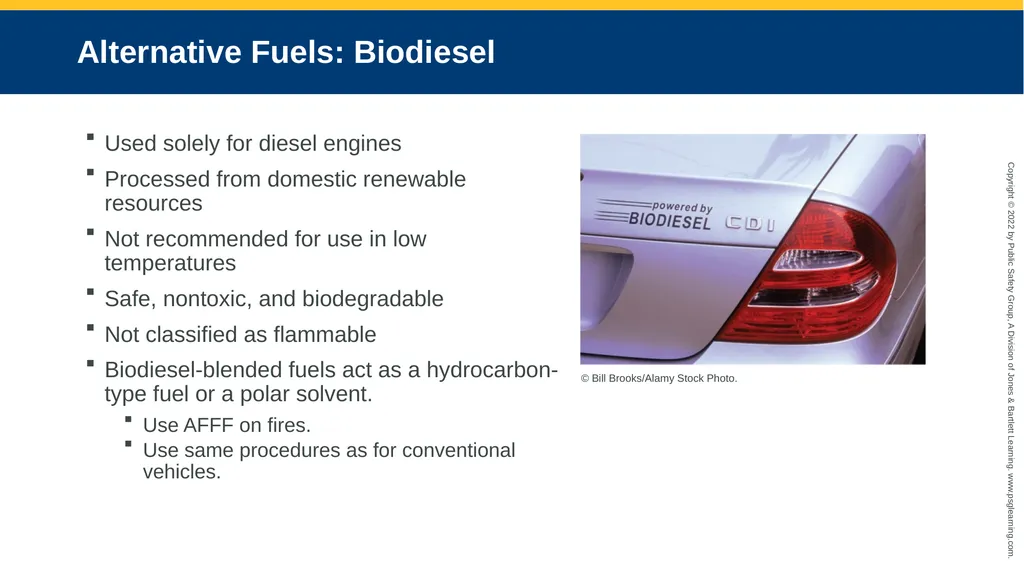
slide33. Alternative Fuels: Biodiesel Used solely for diesel engines
Processed from domestic renewable resources
Not recommended for use in low temperatures
Safe, nontoxic, and biodegradable
Not classified as flammable
Biodiesel-blended fuels act as a hydrocarbon-type fuel or a polar solvent.
Use AFFF on fires.
Use same procedures as for conventional vehicles. © Bill Brooks/Alamy Stock Photo.<br>
slide34. Biodiesel Emergency Procedures Look for identification badge.
Similar to those for a conventional vehicle
Can still burn
Use a foam blanket with AR-AFFF.
Implement diking procedures<br>
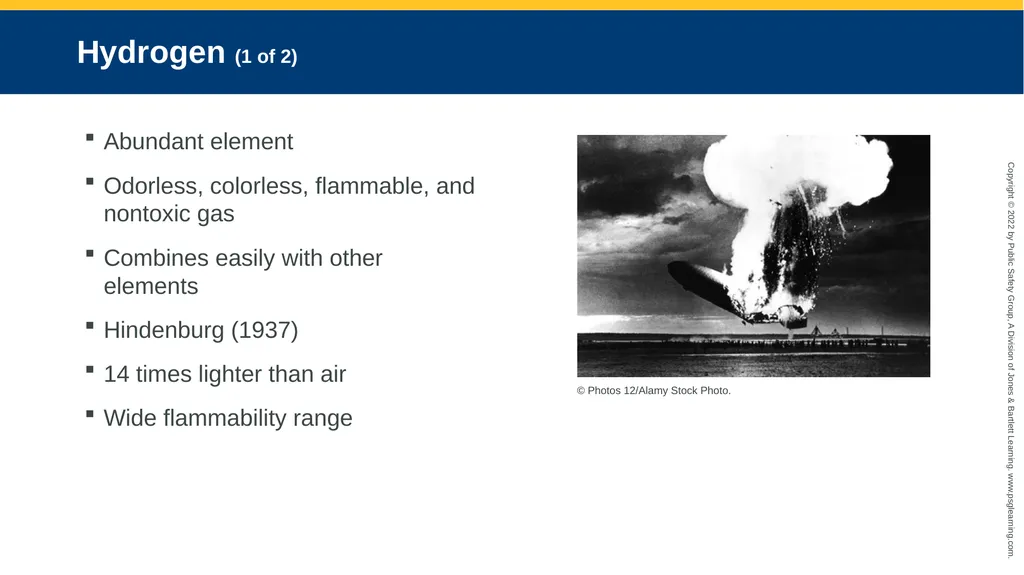
slide35. Hydrogen (1 of 2) Abundant element
Odorless, colorless, flammable, and nontoxic gas
Combines easily with other elements
Hindenburg (1937)
14 times lighter than air
Wide flammability range © Photos 12/Alamy Stock Photo.<br>
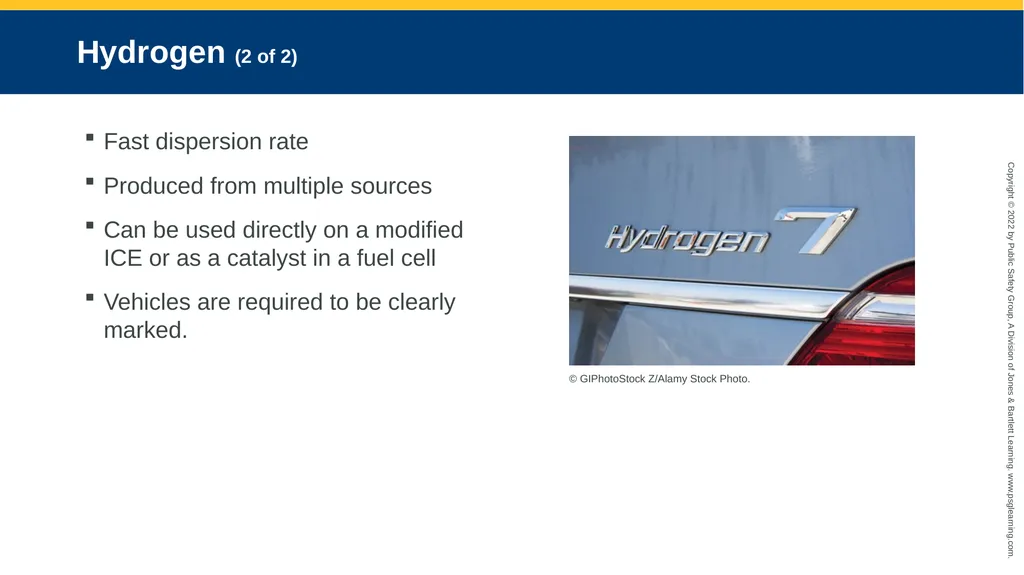
slide36. Hydrogen (2 of 2) Fast dispersion rate
Produced from multiple sources
Can be used directly on a modified ICE or as a catalyst in a fuel cell
Vehicles are required to be clearly marked. © GIPhotoStock Z/Alamy Stock Photo.<br>
slide37. Hydrogen Storage Tanks Stored as a liquid; must be cooled to –423°F (–253°C) or it will boil off as a gas.
Compressed and stored in high-pressure storage tanks with pressures of 3600 psi, 5000 psi, and 10,000 psi (24,821, 34,474, and 68,948 kPa)
Chemically combined in hydride form with certain metals; stored more compactly and efficiently than in gas form
Stored in microscopic pores of carbon nanotubes
Must meet federal government’s Federal Motor Vehicle Safety Standard 304<br>
slide38. Types of Fuel Tanks Type 1: composed of steel; most common
Type 2: composed of steel or aluminum with a partial hoop wrap that goes around the cylinder
Type 3: same as Type 2 except that wrapping encompasses the entire tank
Type 4: nonmetallic liner (usually plastic)<br>
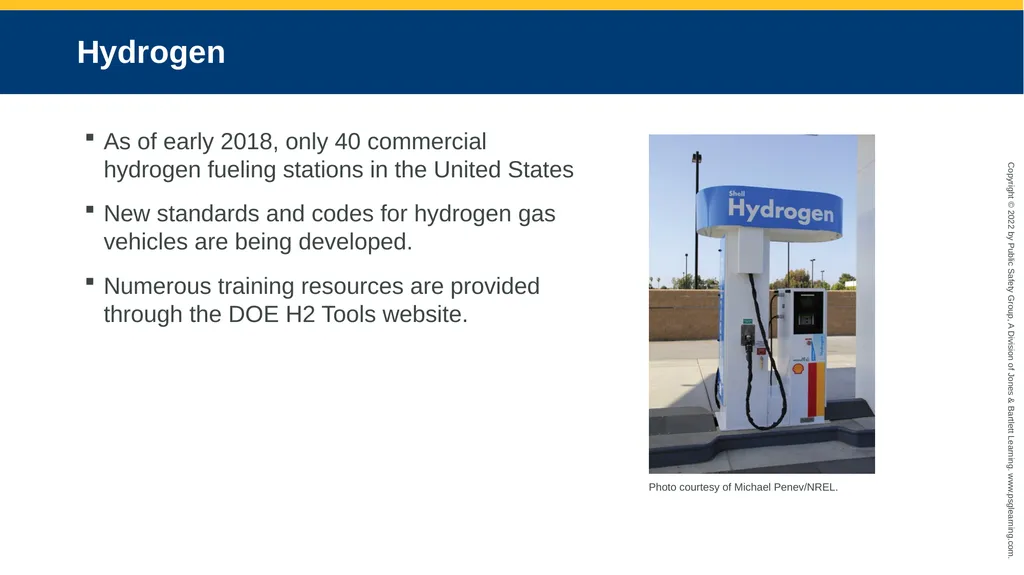
slide39. Hydrogen As of early 2018, only 40 commercial hydrogen fueling stations in the United States
New standards and codes for hydrogen gas vehicles are being developed.
Numerous training resources are provided through the DOE H2 Tools website. Photo courtesy of Michael Penev/NREL.<br>
slide40. Hydrogen Emergency Procedures (1 of 2) Don appropriate PPE and clear area.
Establish control zones.
Conduct inner and outer surveys.
Use a hydrogen-specific gas meter.
Look for identification badge.
Deploy two charged hose lines.
Ensure ignition is off, keys are out, and vehicle is parked.
Stabilize the vehicle.<br>
slide41. Hydrogen Emergency Procedures (2 of 2) Attempt necessary adjustments before disabling power.
Disconnect the 12-volt DC battery.
Turn off the gas at the tanks.
Remove main fuse from the vehicle.
Use service disconnects.
Thermal imaging camera can identify hydrogen fire.
Isolate and eliminate the leak or shut down the fuel tank before extinguishing the fire.
Often safer to let the product burn itself out<br>
slide42. Hydrogen Fuel Cell Vehicles (1 of 2) Uses hydrogen stored in an onboard tank combined with outside oxygen to produce electricity
By-products are water and heat.
Two to three times more efficient than conventional vehicles
Little or no greenhouse gas emissions
The space industry has used this technology for many years.<br>
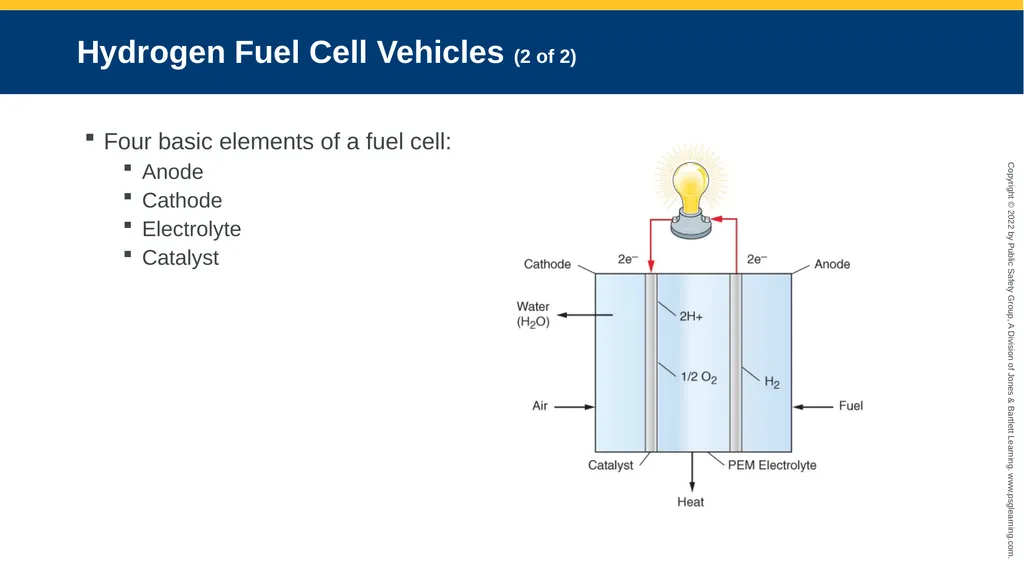
slide43. Hydrogen Fuel Cell Vehicles (2 of 2) Four basic elements of a fuel cell:
Anode
Cathode
Electrolyte
Catalyst<br>
slide44. Polymer Exchange Membrane PEM is placed between anode and cathode; it exchanges positive electrons.
Positive ions pass through the PEM and combine with the cathode.
Water is created and is used for cooling or emitted from the tailpipe.
Negative ions provide electrical current to the vehicle.
Heat is also created, which requires coolant.
This process encompasses just one fuel cell.<br>
slide45. Hydrogen Fuel-Cell Vehicle Electrical Design Hybrid system separated by two sources of power
Basic components of a fuel-cell vehicle:
Fuel cell module pack/stack
Electric motor
Generator
Hydrogen storage system
Battery pack
Fuel cell consists of over 300–400 cells.
Most come equipped with regenerative braking system.<br>
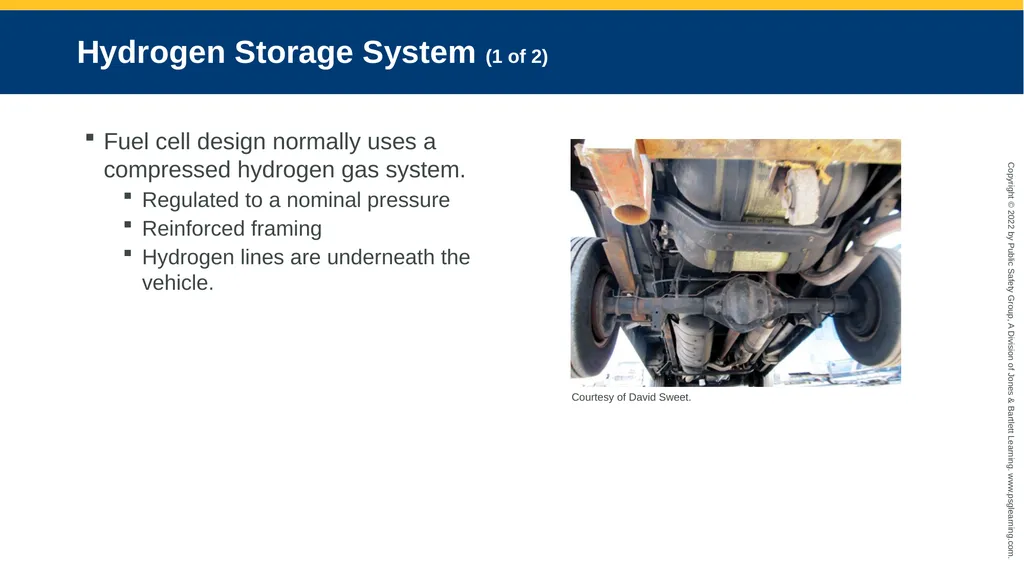
slide46. Hydrogen Storage System (1 of 2) Fuel cell design normally uses a compressed hydrogen gas system.
Regulated to a nominal pressure
Reinforced framing
Hydrogen lines are underneath the vehicle. Courtesy of David Sweet.<br>
slide47. Hydrogen Storage System (2 of 2) All hydrogen storage tanks come with a PRD or temperature relief device (TRD).
Rapidly releases product when overheated
Can take up to several minutes
Do not direct a water stream into liquid hydrogen.
May freeze the PRD and block product release
May cause a rapid boil-off<br>
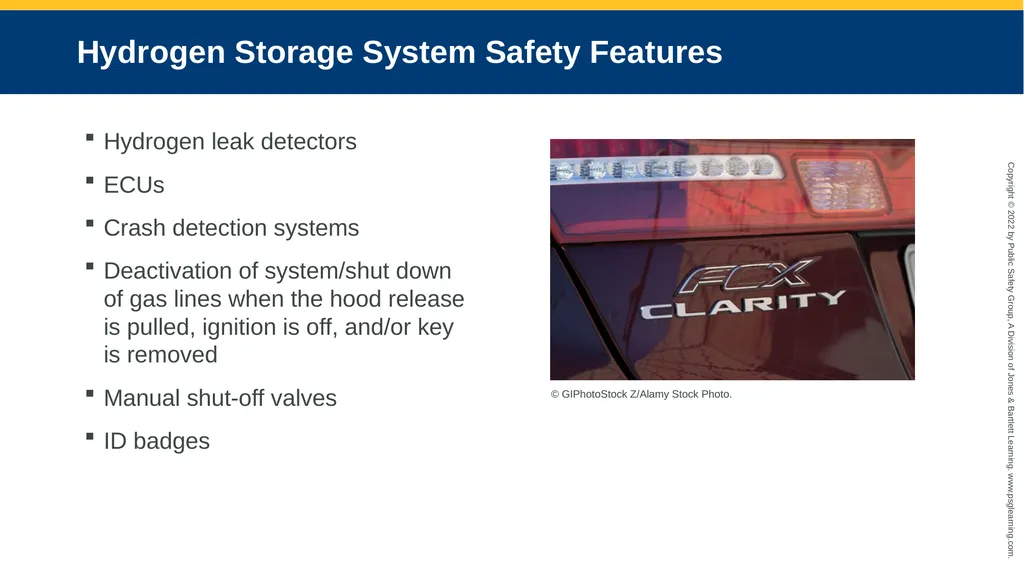
slide48. Hydrogen Storage System Safety Features Hydrogen leak detectors
ECUs
Crash detection systems
Deactivation of system/shut down of gas lines when the hood release is pulled, ignition is off, and/or key is removed
Manual shut-off valves
ID badges © GIPhotoStock Z/Alamy Stock Photo.<br>
slide49. Hydrogen Fuel Cell Emergency Procedures (1 of 4) Don appropriate PPE and clear area.
Establish control zones.
Conduct inner and outer surveys.
Use a hydrogen-specific gas meter.
Look for identification badge.
Deploy two charged hose lines.
Never assume the ignition is turned off.
Stabilize the vehicle.<br>
slide50. Hydrogen Fuel Cell Emergency Procedures (2 of 4) Manually engage the hood release device.
Attempt necessary adjustments.
Disconnect the 12-volt DC battery.
Remove main fuse from the vehicle.
Manually shut off the cylinder tank valve.
Use service disconnects as indicated.<br>
slide51. Hydrogen Fuel Cell Emergency Procedures (3 of 4) Medium- to high-voltage wires run along the undercarriage of the vehicle on the opposite side of the hydrogen gas lines.
Can vary with different models
Protected by framing and/or protective casing
Have ground-fault and short-circuit protection
Fully discharging the voltage can take 5 to 10 minutes.
Precautions must be observed when the vehicle is overturned on its roof.<br>
slide52. Hydrogen Fuel Cell Emergency Procedures (4 of 4) Tunneling technique: remember that the battery packs are normally placed under the rear seat or trunk area.
Dash displacement technique: remember that medium- to high-voltage wires run along the undercarriage.
Disconnect any power before attempting extrication.
Do not cut into any medium- to high-voltage wire or hydrogen gas lines.
Floorboard drop technique: do not attempt regardless of fuel system type or power supply status.<br>
slide53. Hybrid Electric Vehicles (1 of 3) Two or more power sources; one is electric
Several types of vehicles on the roadway today are designed with a HEV propulsion system.
Hybrid technology has existed for over a century.
Economical and produce lower emissions
Power from nickel-metal hydride or lithium battery © Transtock, Inc./Alamy Stock Photo.<br>
slide54. Hybrid Electric Vehicles (2 of 3) Full hybrids use electric motor, ICE, or a combination of both.
Mild hybrids use electric power in conjunction with the ICE.
Start/stop mild hybrid
Motor/generator is not used to propel the vehicle.
Integrated motor assist (IMA) mild hybrid
Motor/generator will assist ICE with acceleration.<br>
slide55. Hybrid Electric Vehicles (3 of 3) Some have additional batteries in the trunk.
Works off a low-to-medium-voltage range (36–42 volts DC).
Regenerative energy braking system
Standard 12-volt lead acid battery Courtesy of Mike Smith.<br>
slide56. PHEV Ability to recharge the battery system by using a plug-in cord
Can run off general house current
Can run solely on electric power over short distances
A rescuer responding to a fire must disconnect the power from the vehicle or the residence.<br>
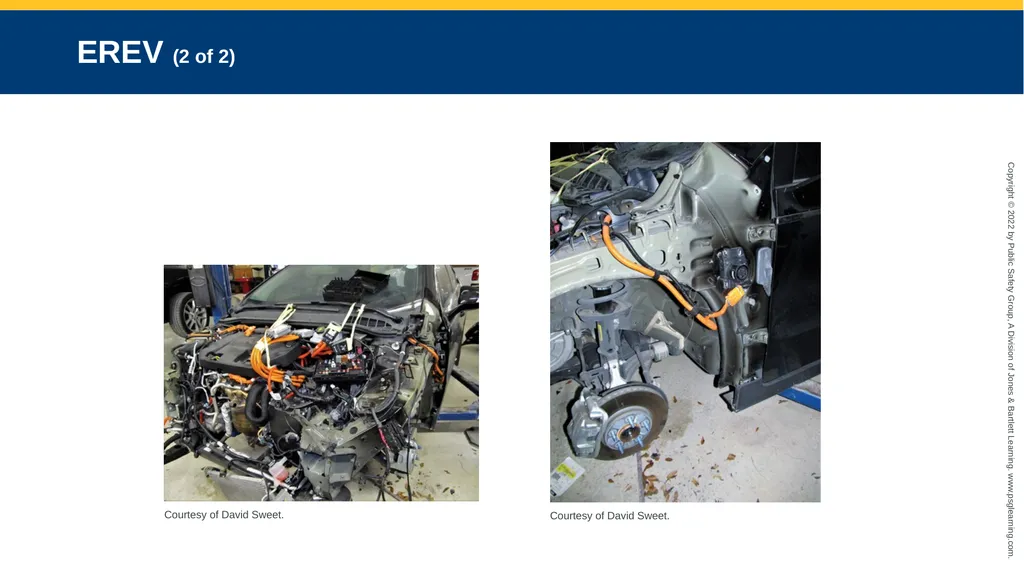
slide57. EREV (1 of 2) Series-type propulsion allows the vehicle to run on all battery or all electric power.
On-board gasoline engine extends mile range.
Can be plugged into a power grid to recharge
High-voltage wiring configurations can be problematic for dash displacement.
Ensure system is disabled.<br>
slide58. EREV (2 of 2) Courtesy of David Sweet. Courtesy of David Sweet.<br>
slide59. Voltage Color Coding Low or medium voltage cable: blue
High voltage cable: orange
No standard for medium-voltage cables
All cables must be evaluated and respected for their voltage capacity.<br>
slide60. HEV Drive Systems (1 of 2) Series drive system
Electric motor turns the vehicle’s transmission to provide propulsion.
ICE does not provide propulsion.
Only supplies power to the electric motor<br>
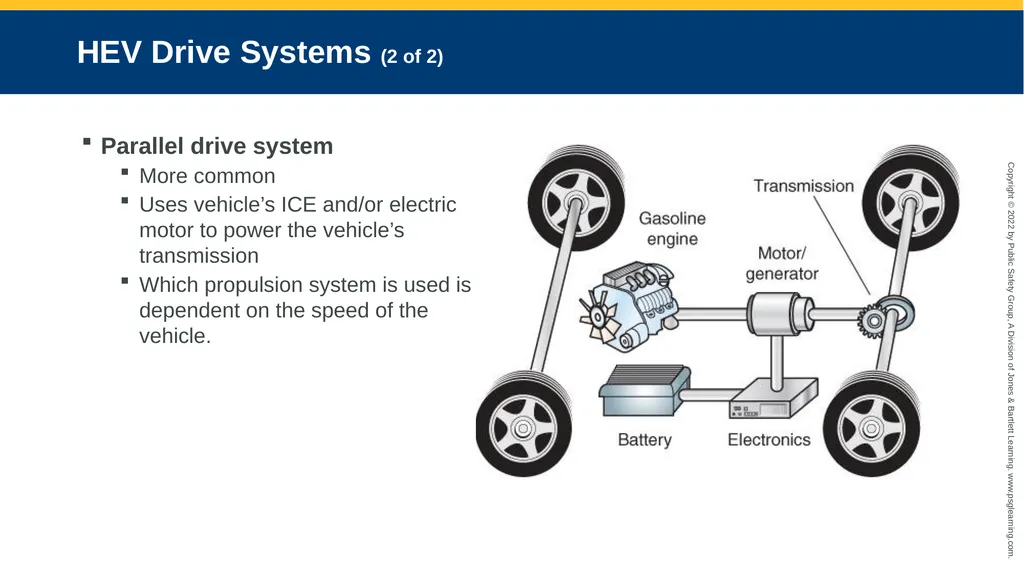
slide61. HEV Drive Systems (2 of 2) Parallel drive system
More common
Uses vehicle’s ICE and/or electric motor to power the vehicle’s transmission
Which propulsion system is used is dependent on the speed of the vehicle.<br>
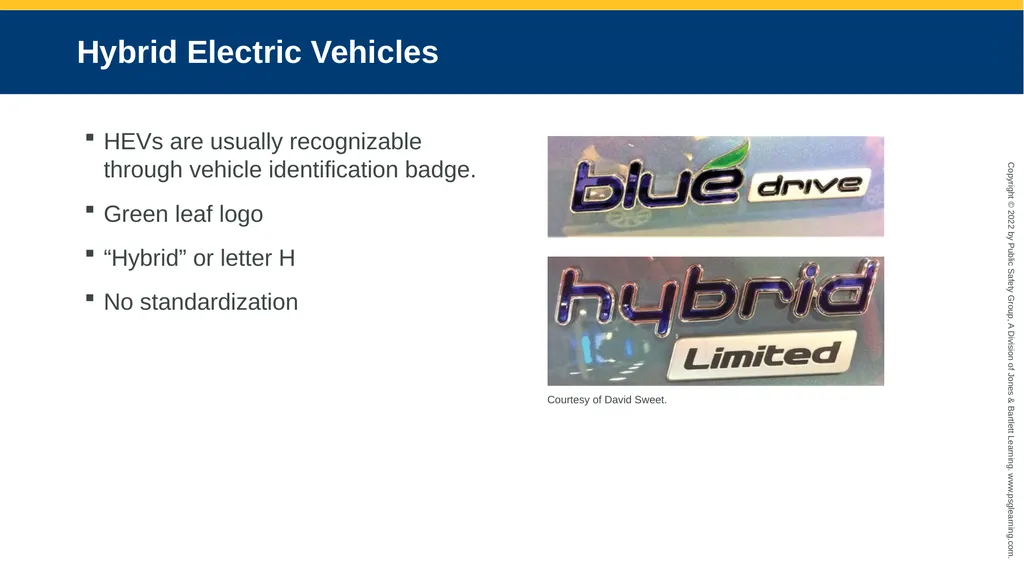
slide62. Hybrid Electric Vehicles HEVs are usually recognizable through vehicle identification badge.
Green leaf logo
“Hybrid” or letter H
No standardization Courtesy of David Sweet.<br>
slide63. HEV Emergency Procedures (1 of 6) All hybrid vehicles have built-in safety features that shut down high- and medium-voltage lines in different situations.
Always assume the vehicle is still energized.
Inertia relays open when detecting a collision and disable system.
Ground faults will detect leaks, line breaches, or short circuits and disable the high-voltage system.
Thermal detection devices will shut down the high-voltage system if the temperature rises.<br>
slide64. HEV Emergency Procedures (2 of 6) Medium- to high-voltage wires are protected by framing or protective casing.
If there is a break in the line, a relay will kick in, isolating and disabling the voltage.
Fully discharging the voltage can take 5–30 minutes.
Ways to disable the high-voltage system:
Turn the main engine key off and remove.
Pull the main fuse or all fuses.
Do not try to manually disconnect the battery pack.<br>
slide65. HEV Emergency Procedures (3 of 6) Don appropriate PPE and clear area.
Establish control zones.
Conduct inner and outer surveys.
Look for identification badge.
Deploy one charged hose line.
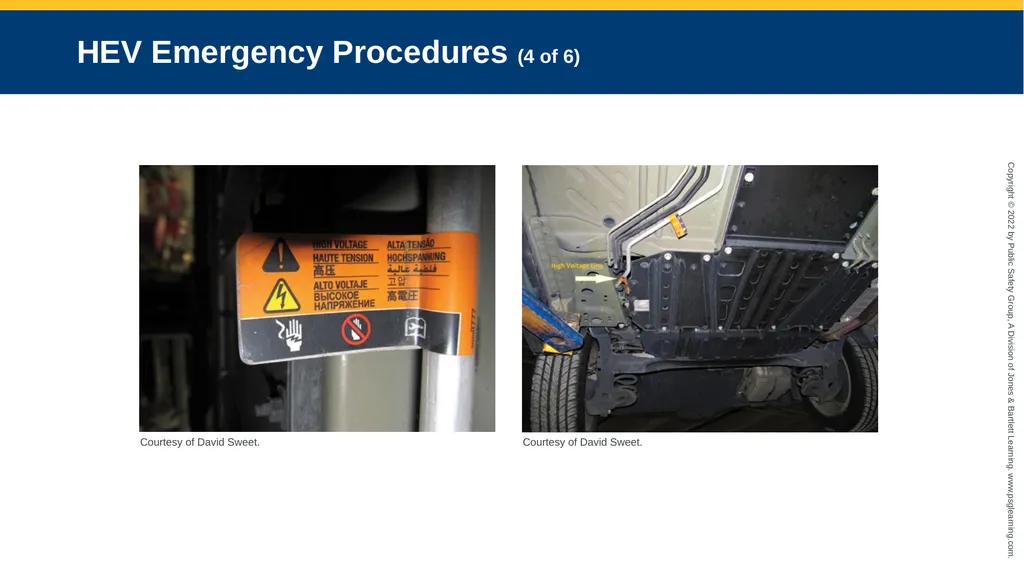
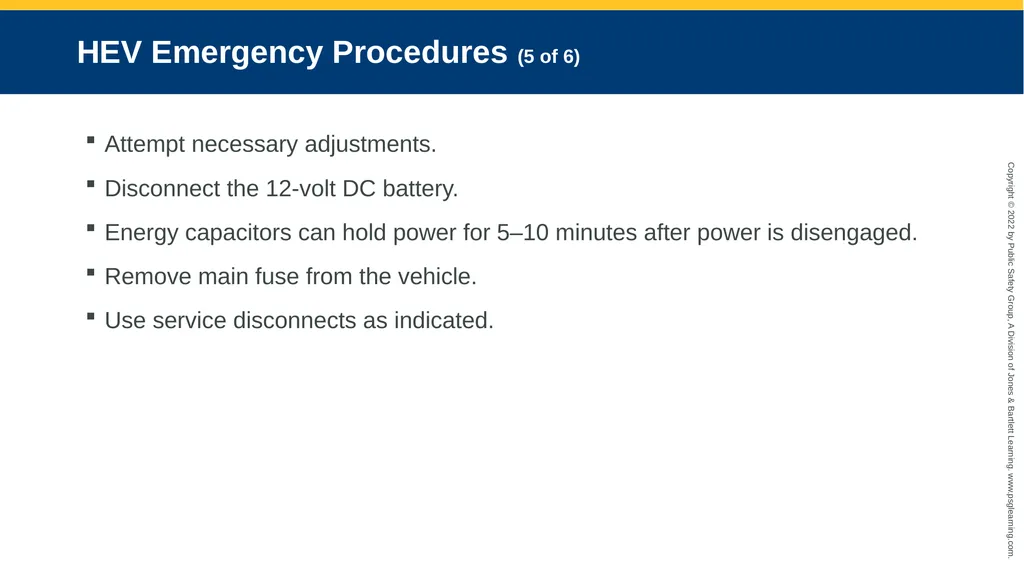
Never assume the vehicle is turned off.
Turn engine key off and remove the keys.
Stabilize the vehicle.<br>
slide66. HEV Emergency Procedures (4 of 6) Courtesy of David Sweet. Courtesy of David Sweet.<br>
slide67. HEV Emergency Procedures (5 of 6) Attempt necessary adjustments.
Disconnect the 12-volt DC battery.
Energy capacitors can hold power for 5–10 minutes after power is disengaged.
Remove main fuse from the vehicle.
Use service disconnects as indicated.<br>
slide68. HEV Emergency Procedures (6 of 6) Precautions must be observed when vehicle is overturned on its roof.
Battery packs are normally placed under the rear seat or trunk area.
Medium- to high-voltage wires run along the undercarriage.
Disconnect any power before extrication.
Floorboard drop technique: do not attempt regardless of fuel system type or whether the power supply has been secured.<br>
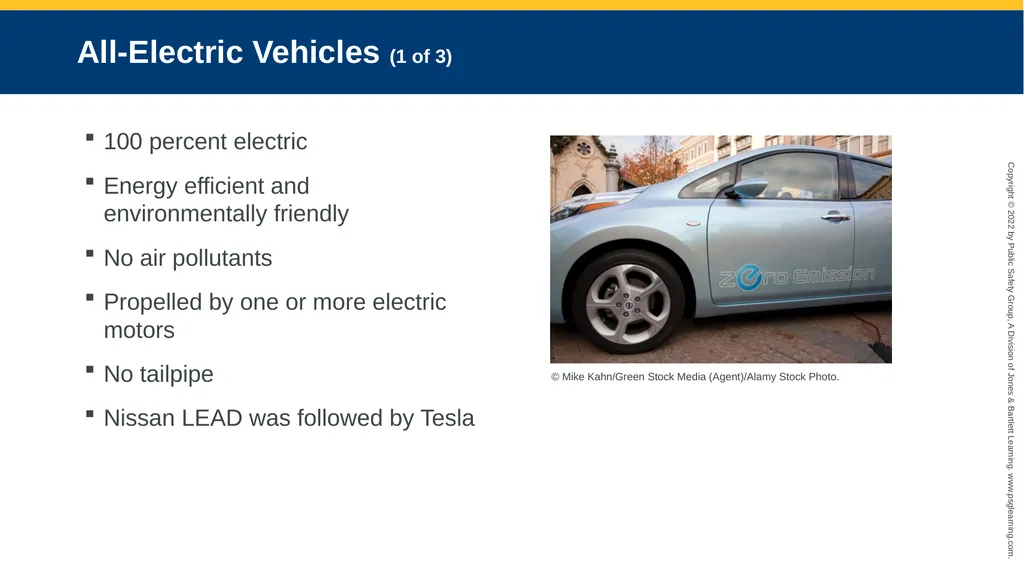
slide69. All-Electric Vehicles (1 of 3) 100 percent electric
Energy efficient and environmentally friendly
No air pollutants
Propelled by one or more electric motors
No tailpipe
Nissan LEAD was followed by Tesla © Mike Kahn/Green Stock Media (Agent)/Alamy Stock Photo.<br>
slide70. All-Electric Vehicles (2 of 3) Use regenerative braking to recharge the laminated lithium ion battery (24 kWh)
Can be plugged in to be recharged
Commonly charged from conventional power outlets or charging stations
Fully recharging a battery pack can take up to 20 hours.
Battery is encased in steel in the undercarriage.<br>
slide71. All-Electric Vehicles (3 of 3) A 12-volt DC battery is located under the hood to supply power to low-voltage devices.
Many can travel 100–200 miles without charging.
Range may be affected by temperature, speed, topography, driving style, and cargo.
EVs can be recognized through vehicle identification badging.<br>
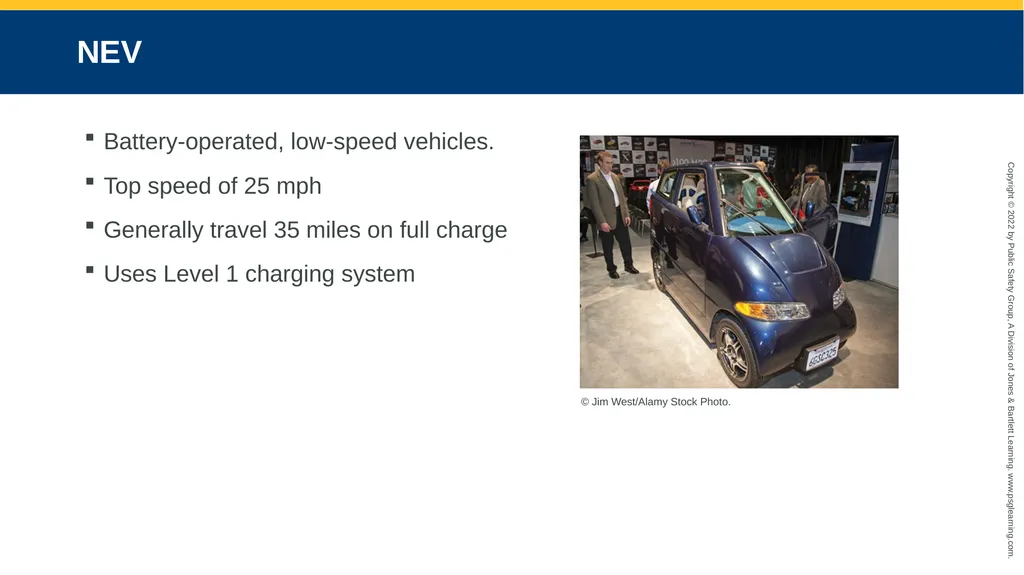
slide72. NEV Battery-operated, low-speed vehicles.
Top speed of 25 mph
Generally travel 35 miles on full charge
Uses Level 1 charging system © Jim West/Alamy Stock Photo.<br>
slide73. EV Emergency Procedures (1 of 2) Don appropriate PPE and clear area.
Establish control zones.
Conduct inner and outer surveys.
Look for identification badge.
Deploy one charged hose line.
Never assume the ignition is turned off.
Turn engine key off and remove the keys.<br>
slide74. EV Emergency Procedures (2 of 2) Ensure remote heating/air conditioner is deactivated.
Ensure that the charging is disconnected.
Stabilize the vehicle.
Attempt necessary adjustments.
Disconnect the 12-volt battery.
Remove the main fuse.
Use service disconnects as indicated.<br>
slide75. Ongoing Education Technical rescuer must adapt and change with advancing vehicle technology.
Alternative-fueled vehicles will become dominant.
SOPs should be developed.
Everyone should be trained to the basic level of competency in dealing with this technology.
Stay current on new developments.
Continual training and education
Download manufacturer emergency response guides.<br>
slide76. Summary (1 of 5) Alternative-fuel vehicles are vehicles that use fuels other than petroleum or a combination of petroleum and another fuel for power.
The Energy Policy Act of 1992 outlines a list of fuels that can be classified as alternative fuels for vehicles.
Most vehicle manufacturers identify the vehicle or fuel type through a label known as a vehicle identification badge. Currently, no standardized labeling system is used to identify hydrogen fuel-cell vehicles.<br>
slide77. Summary (2 of 5) Flexible fuel vehicles can run on gasoline alone or use the E85 blend of up to 85 percent ethanol and 15 percent gasoline.
Natural gas is a fossil fuel primarily composed of methane that can be used as a CNG or LNG.
A safety feature for high-pressure cylinders is the PRD, which is designed to rapidly release all the gas when exposed to high temperatures, such as during a fire.
LPG, also known as propane, is produced from the processing of natural gas and is also produced as part of the refining process of crude oil. Propane is the third most common engine fuel today, after gasoline and diesel.<br>
slide78. Summary (3 of 5) Biodiesel is a fuel used solely for diesel engines that is processed from domestic renewable resources, such as plant oils; grease; animal fats; used cooking oil; and, more recently, algae. Biodiesel can be used by itself as a diesel fuel or blended with petroleum diesel.
Hydrogen is one of the most abundant elements on Earth. As a fuel, hydrogen can be compressed and stored in high-pressure storage tanks with pressures of 3600, 5000, and 10,000 psi (24,821, 34,474, and 68,948 kPa).
Hydrogen can be chemically combined in hydride form with certain metals, which can store it more compactly and efficiently than in a gas form.<br>
slide79. Summary (4 of 5) A fuel cell is an electrochemical device that uses a catalyst-facilitated chemical reaction of hydrogen and oxygen to create electricity, which is then used to power an electric motor.
The basic components of a fuel-cell vehicle system are a fuel-cell module pack/stack, electric motor, generator, hydrogen storage system, and battery pack.
An HEV is a vehicle that combines two or more power sources for propulsion, one of which is electric power. A full hybrid vehicle can use its electric motor or its ICE or both to propel itself.<br>
slide80. Summary (5 of 5) In contrast to the full hybrid, the mild hybrid vehicle cannot propel itself on electric power alone; it must use electric power and the ICE.
The EV, or BEV, is 100 percent electric and propelled by one or more electric motors, which are powered by rechargeable battery packs. The EV does not have a tailpipe because it does not emit exhaust.<br>
slide2. Knowledge Objectives (1 of 3) Describe these alternative-fuel sources and explain the unique extrication hazards they present:
Flexible fuel
Hybrid electric
Electric
Natural gas
Liquefied petroleum gas
Biodiesel
Hydrogen fuel cell<br>
slide3. Knowledge Objectives (2 of 3) Define the following terms and explain their importance in vehicle rescue incidents:
Emergency Response Guide (ERG)
Pressure relief device
Vehicle identification badge
Temperature relief device
Identify dangers common to all alternative-fuel vehicle extrication operations.
List standard safety precautions for alternative vehicle extrication.<br>
slide4. Knowledge Objectives (3 of 3) Describe the benefits of using the Emergency Response Guide (ERG) for alternative-fuel vehicle extrication.
List classes of hybrid vehicles and explain unique dangers associated with each.
Identify typical voltage cable color coding for electric and hybrid vehicles.
Identify fire suppression and safety measures at an alternative-fuel vehicle extrication incident.
Explain the reasons for using atmospheric monitoring equipment at an alternative-fuel vehicle incident.<br>
slide5. Introduction (1 of 5) There are many alternative fuels in use today.
Rescue personnel must be familiar with these.
Hazards include:
Multiple batteries
High-voltage power cables
Advanced air bag protection systems
Alloyed metals
Reinforced passenger compartments
Advanced energy management systems<br>
slide6. Introduction (2 of 5) Upon conducting a size-up, the officer must immediately recognize the various types of alternative fuels present and establish safety/hazard control zones.
Difficult to keep up with advances in vehicle technology.
Dealers of alternative vehicles can provide information.
Emergency response guides and the Internet are also good sources of information.<br>
slide7. Introduction (3 of 5) Using the same emergency procedures on every incident is impractical and dangerous.
Each vehicle system will have some unique steps.
Some emergency steps are universal.
The best practice model is to preplan by studying and training.<br>
slide8. Introduction (4 of 5) If a known IDLH hazard is presented with an alternative-fuel vehicle:
Set the hazard control zones appropriate to the hazard.
Look for visible vapor clouds.
Listen for a loud hissing noise, which may indicate product release.
Incidents requiring fire suppression may require a large-diameter hose and master stream device in defensive mode.<br>
slide9. Introduction (5 of 5) Safety procedures can be very specific to the type of fuel encountered and must be strictly adhered to.
However, some safety procedures are universal.
Be aware that various vehicles will have additional or unique emergency procedures specific to that vehicle.
Not all steps are completed in succession; some are simultaneous.<br>
slide10. Safety Consider atmospheric monitoring when dealing with alternative vehicles and fuel cell vehicles.
Multi-gas meter detects hazards in the air, although not always accurately.
Should be reviewed and decided upon by the AHJ Courtesy of Mike Smith.<br>
slide11. Alternative Fuels (1 of 5) Alternative-fuel vehicles use fuels other than gasoline or diesel.
Ethanol
Methanol
Natural gas
LPG
Biodiesel
Hydrogen
Electricity<br>
slide12. Alternative Fuels (2 of 5) Vehicle identification badges identify the vehicle type or the fuel type.
Be aware that labeling is not uniform.
Technical rescuer should check for labels before working on the vehicle. Courtesy of David Sweet.<br>
slide13. Alternative Fuels (3 of 5) Ethanol
An alcohol-based fuel processed from crops
Can be blended in different percentages
Used to fuel flexible fuel vehicles (FFVs)
Methanol
Processed from wood sources
Also used as a flex fuel
Widely used outside the United States<br>
slide14. Alternative Fuels (4 of 5) Most manufacturers offering FFVs, label vehicle with flex fuel badge.
May use yellow gas caps to indicate distinction © David R. Frazier Photolibrary, Inc./Alamy Stock Photo.<br>
slide15. Alternative Fuels (5 of 5) Ethanol and methanol require alcohol-resistant foam to extinguish fires.
Vapor suppression and diking procedures may be needed to contain runoff.
Both fuels separate from the gasoline when water is applied.
With the exception of a vehicle fire, emergency procedures will be the same as a standard conventional vehicle.<br>
slide16. Alternative Fuels: Natural Gas Fossil fuel composed of methane that is used as compressed natural gas or liquefied natural gas
Not widely produced in the United States
Liquefied natural gas (LNG) is a colorless, odorless, nontoxic gas that floats on water.
Changes to gas when released
Using water on LNG will cause rapid boil-off.
Fuel tanks must be double-walled and well-insulated.<br>
slide17. Alternative Fuels: Compressed Natural Gas (1 of 3) More practical than LNG
Used for many fleet vehicles
Storage tanks are steel, aluminum, or carbon/fiber composite.
Normally located behind the rear passenger seat Courtesy of David Sweet.<br>
slide18. Alternative Fuels: Compressed Natural Gas (2 of 3) Compressed to 3000 to 3600 psi (20,684 to 24,821 kPa)
May need to be stored in several onboard tanks
Stainless steel high-pressure lines run under the vehicle. Courtesy of David Sweet.<br>
slide19. Alternative Fuels: Compressed Natural Gas (3 of 3) Courtesy of Culver Company. Courtesy of Heil Company.<br>
slide20. Alternative Fuels (1 of 2) Safety features vary by manufacturer.
Sensing unit turns off fuel when ignition is off.
Most have manual shut-off valves.
PRD rapidly releases gas when exposed to high temperature.
Chemical odorant is added. Courtesy of David Sweet.<br>
slide21. Alternative Fuels (2 of 2) Vehicles that use CNG and LNG must have an identification label.
Diamond shape
CNG or LNG in reflective lettering Courtesy of David Sweet.<br>
slide22. Natural Gas Emergency Procedures (1 of 5) Courtesy of the U.S. Department of Transportation.<br>
slide23. Natural Gas Emergency Procedures (2 of 5) Don appropriate PPE and clear area of bystanders and hazards.
Establish hazard control zones.
Conduct inner and outer surveys: approach from upwind and uphill.
Use a multi-gas meter.
Look for vehicle identification badge.
Deploy two 1¾-in. (44-mm) charged hose lines to protect personnel.<br>
slide24. Natural Gas Emergency Procedures (3 of 5) Ensure the vehicle’s ignition is turned off, the keys are out of the ignition, and the vehicle is placed in park.
Stabilize the vehicle from movement with cribbing.
Attempt necessary component adjustments before disabling power to the vehicle.
Disconnect the 12-volt DC battery starting with the negative line first.
Manually turn off the gas at the tanks by shutting off the valves.<br>
slide25. Natural Gas Emergency Procedures (4 of 5) If AHJ decides to, remove main fuse from the vehicle to ensure the electrical system is disabled.
For CNG to be combustible, it must fall within its flammability range (5–15 percent).
For PRDs that are releasing product with visible flame, cool the tank or eliminate flame impingement rather than attempt to extinguish the flame.
Until the leak can be isolated and eliminated, it is safer to let the product burn itself out.<br>
slide26. Natural Gas Emergency Procedures (5 of 5) Before attempting extrication, examine the vehicle carefully for fuel line locations before attempting any cutting.
Take extra precaution with
Dash displacement techniques
Cutting and dropping the floorboard under the brake and gas pedals<br>
slide27. Alternative Fuels: LPG (1 of 2) Fossil fuel produced from natural gas
1.5 times heavier than air
Fuel tanks are built according to the standards set by the American Society of Mechanical Engineers.
Constructed from carbon steel
Cannot exceed 200 gal (757 L)
Mandatory 20 percent reduction in product
Chemical odorant is added.
Equipped with PRD<br>
slide28. Alternative Fuels: LPG (2 of 2) Identification label must contain:
Water capacity
Working pressure
Serial number
Manufacturer
Vehicle with permanently installed LPG container must be marked.<br>
slide29. LPG Emergency Procedures (1 of 4) Remember, propane disperses well beyond its vapor cloud and will seek out ignition sources, which can cause a flashback to the leak.
Don appropriate PPE, including SCBA, and clear area of bystanders and hazards.
Establish hazard control zones.
Conduct inner and outer surveys; propane will accumulate in lower areas.
Use a combustible gas meter.<br>
slide30. LPG Emergency Procedures (2 of 4) Look for vehicle identification badge.
Deploy two 1¾-in. (44-mm) charged hose lines.
Ensure ignition is off, the keys are out of the ignition, and the vehicle is placed in park.
Stabilize the vehicle.
Attempt necessary adjustments.
Disconnect the 12-volt DC battery.
Turn off the gas at the tanks.
Remove main fuse from the vehicle.<br>
slide31. LPG Emergency Procedures (3 of 4) Propane can present unique challenges.
Continuous flame impingement will cause overpressurization and eventual failure, resulting in a BLEVE.
Hose streams must be directed toward the vapor space of the tank.
Fire must not be extinguished until
Tank is cooled.
Leak is stopped.
Main shut-off valve is turned off.<br>
slide32. LPG Emergency Procedures (4 of 4) When attempting extrication, same precautions for CNG vehicles should be used.
Examine fuel line locations before cutting.
Techniques that involve cutting and dropping the floorboard area under the brake and gas pedal should not be attempted.<br>
slide33. Alternative Fuels: Biodiesel Used solely for diesel engines
Processed from domestic renewable resources
Not recommended for use in low temperatures
Safe, nontoxic, and biodegradable
Not classified as flammable
Biodiesel-blended fuels act as a hydrocarbon-type fuel or a polar solvent.
Use AFFF on fires.
Use same procedures as for conventional vehicles. © Bill Brooks/Alamy Stock Photo.<br>
slide34. Biodiesel Emergency Procedures Look for identification badge.
Similar to those for a conventional vehicle
Can still burn
Use a foam blanket with AR-AFFF.
Implement diking procedures<br>
slide35. Hydrogen (1 of 2) Abundant element
Odorless, colorless, flammable, and nontoxic gas
Combines easily with other elements
Hindenburg (1937)
14 times lighter than air
Wide flammability range © Photos 12/Alamy Stock Photo.<br>
slide36. Hydrogen (2 of 2) Fast dispersion rate
Produced from multiple sources
Can be used directly on a modified ICE or as a catalyst in a fuel cell
Vehicles are required to be clearly marked. © GIPhotoStock Z/Alamy Stock Photo.<br>
slide37. Hydrogen Storage Tanks Stored as a liquid; must be cooled to –423°F (–253°C) or it will boil off as a gas.
Compressed and stored in high-pressure storage tanks with pressures of 3600 psi, 5000 psi, and 10,000 psi (24,821, 34,474, and 68,948 kPa)
Chemically combined in hydride form with certain metals; stored more compactly and efficiently than in gas form
Stored in microscopic pores of carbon nanotubes
Must meet federal government’s Federal Motor Vehicle Safety Standard 304<br>
slide38. Types of Fuel Tanks Type 1: composed of steel; most common
Type 2: composed of steel or aluminum with a partial hoop wrap that goes around the cylinder
Type 3: same as Type 2 except that wrapping encompasses the entire tank
Type 4: nonmetallic liner (usually plastic)<br>
slide39. Hydrogen As of early 2018, only 40 commercial hydrogen fueling stations in the United States
New standards and codes for hydrogen gas vehicles are being developed.
Numerous training resources are provided through the DOE H2 Tools website. Photo courtesy of Michael Penev/NREL.<br>
slide40. Hydrogen Emergency Procedures (1 of 2) Don appropriate PPE and clear area.
Establish control zones.
Conduct inner and outer surveys.
Use a hydrogen-specific gas meter.
Look for identification badge.
Deploy two charged hose lines.
Ensure ignition is off, keys are out, and vehicle is parked.
Stabilize the vehicle.<br>
slide41. Hydrogen Emergency Procedures (2 of 2) Attempt necessary adjustments before disabling power.
Disconnect the 12-volt DC battery.
Turn off the gas at the tanks.
Remove main fuse from the vehicle.
Use service disconnects.
Thermal imaging camera can identify hydrogen fire.
Isolate and eliminate the leak or shut down the fuel tank before extinguishing the fire.
Often safer to let the product burn itself out<br>
slide42. Hydrogen Fuel Cell Vehicles (1 of 2) Uses hydrogen stored in an onboard tank combined with outside oxygen to produce electricity
By-products are water and heat.
Two to three times more efficient than conventional vehicles
Little or no greenhouse gas emissions
The space industry has used this technology for many years.<br>
slide43. Hydrogen Fuel Cell Vehicles (2 of 2) Four basic elements of a fuel cell:
Anode
Cathode
Electrolyte
Catalyst<br>
slide44. Polymer Exchange Membrane PEM is placed between anode and cathode; it exchanges positive electrons.
Positive ions pass through the PEM and combine with the cathode.
Water is created and is used for cooling or emitted from the tailpipe.
Negative ions provide electrical current to the vehicle.
Heat is also created, which requires coolant.
This process encompasses just one fuel cell.<br>
slide45. Hydrogen Fuel-Cell Vehicle Electrical Design Hybrid system separated by two sources of power
Basic components of a fuel-cell vehicle:
Fuel cell module pack/stack
Electric motor
Generator
Hydrogen storage system
Battery pack
Fuel cell consists of over 300–400 cells.
Most come equipped with regenerative braking system.<br>
slide46. Hydrogen Storage System (1 of 2) Fuel cell design normally uses a compressed hydrogen gas system.
Regulated to a nominal pressure
Reinforced framing
Hydrogen lines are underneath the vehicle. Courtesy of David Sweet.<br>
slide47. Hydrogen Storage System (2 of 2) All hydrogen storage tanks come with a PRD or temperature relief device (TRD).
Rapidly releases product when overheated
Can take up to several minutes
Do not direct a water stream into liquid hydrogen.
May freeze the PRD and block product release
May cause a rapid boil-off<br>
slide48. Hydrogen Storage System Safety Features Hydrogen leak detectors
ECUs
Crash detection systems
Deactivation of system/shut down of gas lines when the hood release is pulled, ignition is off, and/or key is removed
Manual shut-off valves
ID badges © GIPhotoStock Z/Alamy Stock Photo.<br>
slide49. Hydrogen Fuel Cell Emergency Procedures (1 of 4) Don appropriate PPE and clear area.
Establish control zones.
Conduct inner and outer surveys.
Use a hydrogen-specific gas meter.
Look for identification badge.
Deploy two charged hose lines.
Never assume the ignition is turned off.
Stabilize the vehicle.<br>
slide50. Hydrogen Fuel Cell Emergency Procedures (2 of 4) Manually engage the hood release device.
Attempt necessary adjustments.
Disconnect the 12-volt DC battery.
Remove main fuse from the vehicle.
Manually shut off the cylinder tank valve.
Use service disconnects as indicated.<br>
slide51. Hydrogen Fuel Cell Emergency Procedures (3 of 4) Medium- to high-voltage wires run along the undercarriage of the vehicle on the opposite side of the hydrogen gas lines.
Can vary with different models
Protected by framing and/or protective casing
Have ground-fault and short-circuit protection
Fully discharging the voltage can take 5 to 10 minutes.
Precautions must be observed when the vehicle is overturned on its roof.<br>
slide52. Hydrogen Fuel Cell Emergency Procedures (4 of 4) Tunneling technique: remember that the battery packs are normally placed under the rear seat or trunk area.
Dash displacement technique: remember that medium- to high-voltage wires run along the undercarriage.
Disconnect any power before attempting extrication.
Do not cut into any medium- to high-voltage wire or hydrogen gas lines.
Floorboard drop technique: do not attempt regardless of fuel system type or power supply status.<br>
slide53. Hybrid Electric Vehicles (1 of 3) Two or more power sources; one is electric
Several types of vehicles on the roadway today are designed with a HEV propulsion system.
Hybrid technology has existed for over a century.
Economical and produce lower emissions
Power from nickel-metal hydride or lithium battery © Transtock, Inc./Alamy Stock Photo.<br>
slide54. Hybrid Electric Vehicles (2 of 3) Full hybrids use electric motor, ICE, or a combination of both.
Mild hybrids use electric power in conjunction with the ICE.
Start/stop mild hybrid
Motor/generator is not used to propel the vehicle.
Integrated motor assist (IMA) mild hybrid
Motor/generator will assist ICE with acceleration.<br>
slide55. Hybrid Electric Vehicles (3 of 3) Some have additional batteries in the trunk.
Works off a low-to-medium-voltage range (36–42 volts DC).
Regenerative energy braking system
Standard 12-volt lead acid battery Courtesy of Mike Smith.<br>
slide56. PHEV Ability to recharge the battery system by using a plug-in cord
Can run off general house current
Can run solely on electric power over short distances
A rescuer responding to a fire must disconnect the power from the vehicle or the residence.<br>
slide57. EREV (1 of 2) Series-type propulsion allows the vehicle to run on all battery or all electric power.
On-board gasoline engine extends mile range.
Can be plugged into a power grid to recharge
High-voltage wiring configurations can be problematic for dash displacement.
Ensure system is disabled.<br>
slide58. EREV (2 of 2) Courtesy of David Sweet. Courtesy of David Sweet.<br>
slide59. Voltage Color Coding Low or medium voltage cable: blue
High voltage cable: orange
No standard for medium-voltage cables
All cables must be evaluated and respected for their voltage capacity.<br>
slide60. HEV Drive Systems (1 of 2) Series drive system
Electric motor turns the vehicle’s transmission to provide propulsion.
ICE does not provide propulsion.
Only supplies power to the electric motor<br>
slide61. HEV Drive Systems (2 of 2) Parallel drive system
More common
Uses vehicle’s ICE and/or electric motor to power the vehicle’s transmission
Which propulsion system is used is dependent on the speed of the vehicle.<br>
slide62. Hybrid Electric Vehicles HEVs are usually recognizable through vehicle identification badge.
Green leaf logo
“Hybrid” or letter H
No standardization Courtesy of David Sweet.<br>
slide63. HEV Emergency Procedures (1 of 6) All hybrid vehicles have built-in safety features that shut down high- and medium-voltage lines in different situations.
Always assume the vehicle is still energized.
Inertia relays open when detecting a collision and disable system.
Ground faults will detect leaks, line breaches, or short circuits and disable the high-voltage system.
Thermal detection devices will shut down the high-voltage system if the temperature rises.<br>
slide64. HEV Emergency Procedures (2 of 6) Medium- to high-voltage wires are protected by framing or protective casing.
If there is a break in the line, a relay will kick in, isolating and disabling the voltage.
Fully discharging the voltage can take 5–30 minutes.
Ways to disable the high-voltage system:
Turn the main engine key off and remove.
Pull the main fuse or all fuses.
Do not try to manually disconnect the battery pack.<br>
slide65. HEV Emergency Procedures (3 of 6) Don appropriate PPE and clear area.
Establish control zones.
Conduct inner and outer surveys.
Look for identification badge.
Deploy one charged hose line.
Never assume the vehicle is turned off.
Turn engine key off and remove the keys.
Stabilize the vehicle.<br>
slide66. HEV Emergency Procedures (4 of 6) Courtesy of David Sweet. Courtesy of David Sweet.<br>
slide67. HEV Emergency Procedures (5 of 6) Attempt necessary adjustments.
Disconnect the 12-volt DC battery.
Energy capacitors can hold power for 5–10 minutes after power is disengaged.
Remove main fuse from the vehicle.
Use service disconnects as indicated.<br>
slide68. HEV Emergency Procedures (6 of 6) Precautions must be observed when vehicle is overturned on its roof.
Battery packs are normally placed under the rear seat or trunk area.
Medium- to high-voltage wires run along the undercarriage.
Disconnect any power before extrication.
Floorboard drop technique: do not attempt regardless of fuel system type or whether the power supply has been secured.<br>
slide69. All-Electric Vehicles (1 of 3) 100 percent electric
Energy efficient and environmentally friendly
No air pollutants
Propelled by one or more electric motors
No tailpipe
Nissan LEAD was followed by Tesla © Mike Kahn/Green Stock Media (Agent)/Alamy Stock Photo.<br>
slide70. All-Electric Vehicles (2 of 3) Use regenerative braking to recharge the laminated lithium ion battery (24 kWh)
Can be plugged in to be recharged
Commonly charged from conventional power outlets or charging stations
Fully recharging a battery pack can take up to 20 hours.
Battery is encased in steel in the undercarriage.<br>
slide71. All-Electric Vehicles (3 of 3) A 12-volt DC battery is located under the hood to supply power to low-voltage devices.
Many can travel 100–200 miles without charging.
Range may be affected by temperature, speed, topography, driving style, and cargo.
EVs can be recognized through vehicle identification badging.<br>
slide72. NEV Battery-operated, low-speed vehicles.
Top speed of 25 mph
Generally travel 35 miles on full charge
Uses Level 1 charging system © Jim West/Alamy Stock Photo.<br>
slide73. EV Emergency Procedures (1 of 2) Don appropriate PPE and clear area.
Establish control zones.
Conduct inner and outer surveys.
Look for identification badge.
Deploy one charged hose line.
Never assume the ignition is turned off.
Turn engine key off and remove the keys.<br>
slide74. EV Emergency Procedures (2 of 2) Ensure remote heating/air conditioner is deactivated.
Ensure that the charging is disconnected.
Stabilize the vehicle.
Attempt necessary adjustments.
Disconnect the 12-volt battery.
Remove the main fuse.
Use service disconnects as indicated.<br>
slide75. Ongoing Education Technical rescuer must adapt and change with advancing vehicle technology.
Alternative-fueled vehicles will become dominant.
SOPs should be developed.
Everyone should be trained to the basic level of competency in dealing with this technology.
Stay current on new developments.
Continual training and education
Download manufacturer emergency response guides.<br>
slide76. Summary (1 of 5) Alternative-fuel vehicles are vehicles that use fuels other than petroleum or a combination of petroleum and another fuel for power.
The Energy Policy Act of 1992 outlines a list of fuels that can be classified as alternative fuels for vehicles.
Most vehicle manufacturers identify the vehicle or fuel type through a label known as a vehicle identification badge. Currently, no standardized labeling system is used to identify hydrogen fuel-cell vehicles.<br>
slide77. Summary (2 of 5) Flexible fuel vehicles can run on gasoline alone or use the E85 blend of up to 85 percent ethanol and 15 percent gasoline.
Natural gas is a fossil fuel primarily composed of methane that can be used as a CNG or LNG.
A safety feature for high-pressure cylinders is the PRD, which is designed to rapidly release all the gas when exposed to high temperatures, such as during a fire.
LPG, also known as propane, is produced from the processing of natural gas and is also produced as part of the refining process of crude oil. Propane is the third most common engine fuel today, after gasoline and diesel.<br>
slide78. Summary (3 of 5) Biodiesel is a fuel used solely for diesel engines that is processed from domestic renewable resources, such as plant oils; grease; animal fats; used cooking oil; and, more recently, algae. Biodiesel can be used by itself as a diesel fuel or blended with petroleum diesel.
Hydrogen is one of the most abundant elements on Earth. As a fuel, hydrogen can be compressed and stored in high-pressure storage tanks with pressures of 3600, 5000, and 10,000 psi (24,821, 34,474, and 68,948 kPa).
Hydrogen can be chemically combined in hydride form with certain metals, which can store it more compactly and efficiently than in a gas form.<br>
slide79. Summary (4 of 5) A fuel cell is an electrochemical device that uses a catalyst-facilitated chemical reaction of hydrogen and oxygen to create electricity, which is then used to power an electric motor.
The basic components of a fuel-cell vehicle system are a fuel-cell module pack/stack, electric motor, generator, hydrogen storage system, and battery pack.
An HEV is a vehicle that combines two or more power sources for propulsion, one of which is electric power. A full hybrid vehicle can use its electric motor or its ICE or both to propel itself.<br>
slide80. Summary (5 of 5) In contrast to the full hybrid, the mild hybrid vehicle cannot propel itself on electric power alone; it must use electric power and the ICE.
The EV, or BEV, is 100 percent electric and propelled by one or more electric motors, which are powered by rechargeable battery packs. The EV does not have a tailpipe because it does not emit exhaust.<br>