Advances in Measurements for High-Speed Flows Paul M. Danehy Senior Technologist for Advanced Measurement Systems Advanced Measurement and Data Systems Branch NASA Langley Research Center Hampton, Virginia, USA Gordon Research Conference
"Advances in Measurements for High-Speed Flows Paul" is the property of its rightful owner. Permission is granted to
download and print the materials on this website for personal, non-commercial use only, and to display it
on your personal computer provided you do not modify the materials and that you retain all copyright
notices contained in the materials. By downloading content from our website, you accept the terms of this
agreement.
Presentation Transcript
01
Advances in Measurements for High-Speed Flows Paul M. Danehy
Senior Technologist for Advanced Measurement Systems
Advanced Measurement and Data Systems Branch
NASA Langley Research Center
Hampton, Virginia, USA Gordon Research Conference (GRC) on Laser Diagnostics in Energy and Combustion Science July 11, 2023<br>
02
Advances in Measurements for High-Speed Flows 2<br>
03
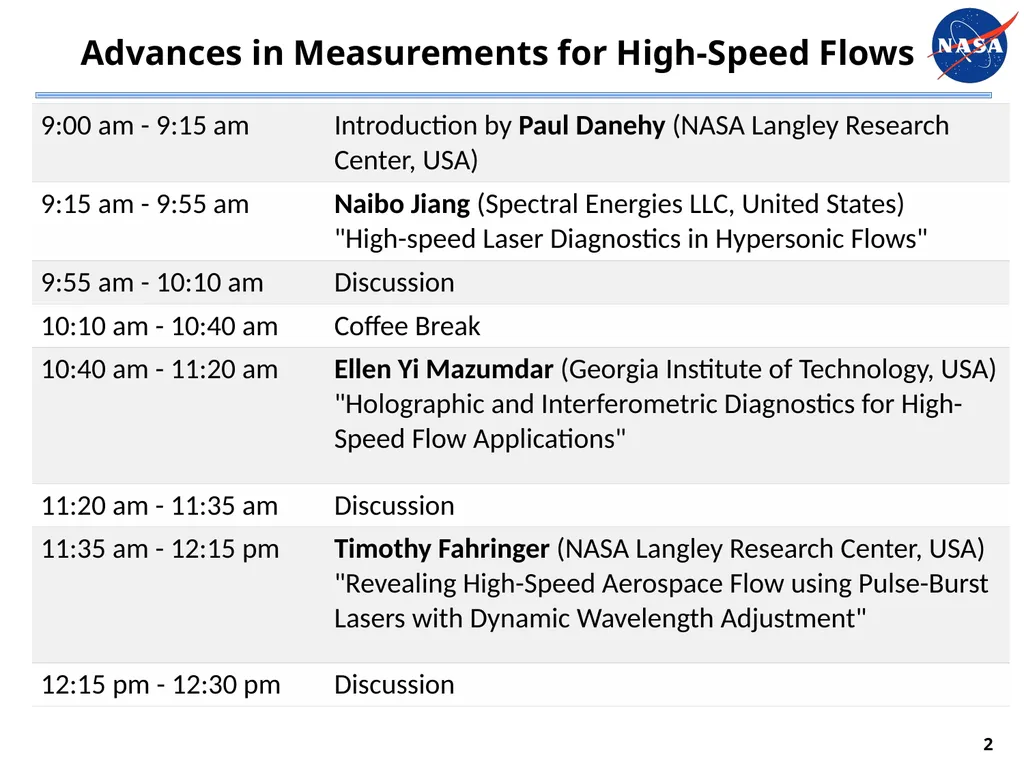
Example High-Speed Flows @ NASA Transonic/Supersonic Flows: large and sudden changes in P, T, r, u, v, w https://www.nasa.gov/centers/armstrong/features/supersonic-shockwave-interaction.html AirBOS from J.T. Heineck of NASA’s Ames Research Center T-38s<br>
04
Example High-Speed Flows @ NASA Transonic/Supersonic Flows: large and sudden changes in P, T, r, u, v, w
Hypersonic Flows: same parameters as supersonic plus thermal nonequilibrium: Trot, Tvib, Telec or chemical nonequilibrium: nNO, nN, nO. nN2, nO2
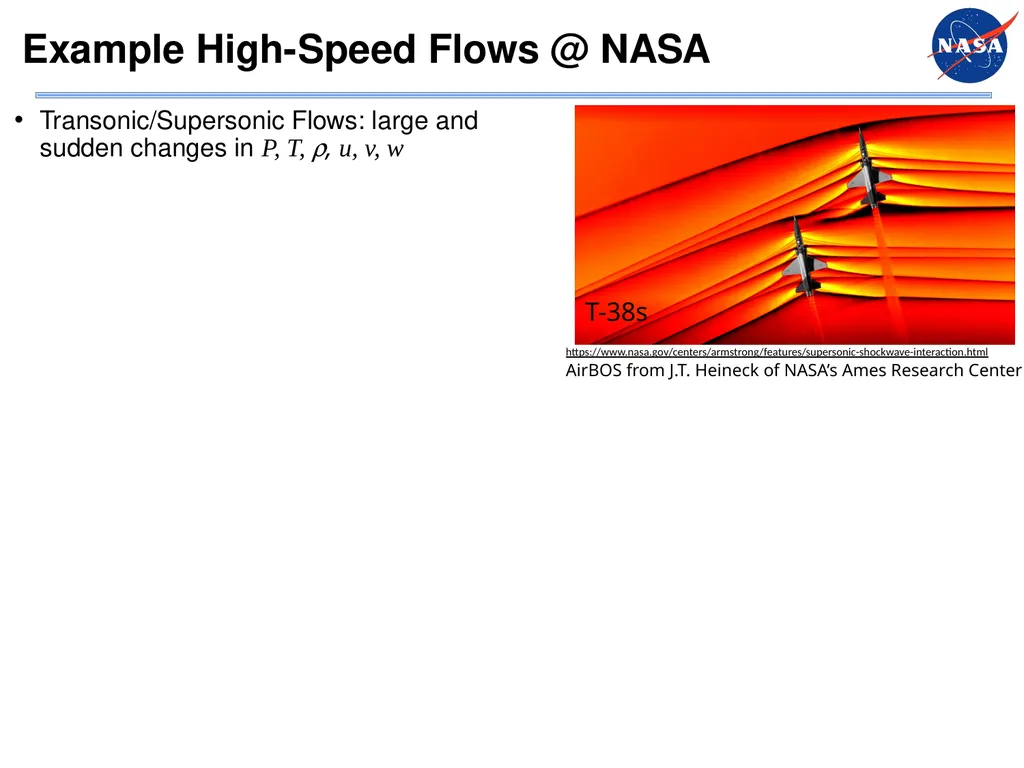
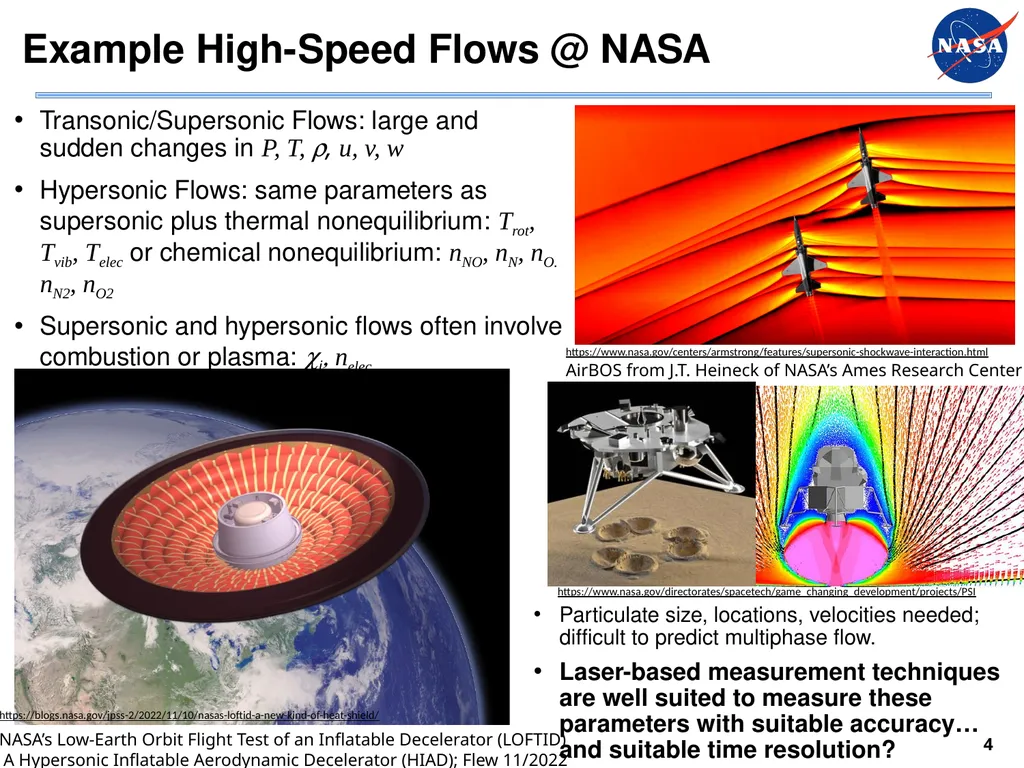
Supersonic and hypersonic flows often involve combustion or plasma: ci, nelec 4 https://www.nasa.gov/centers/armstrong/features/supersonic-shockwave-interaction.html AirBOS from J.T. Heineck of NASA’s Ames Research Center Laser-based measurement techniques are well suited to measure these parameters with suitable accuracy… and suitable time resolution? NASA’s Low-Earth Orbit Flight Test of an Inflatable Decelerator (LOFTID)
A Hypersonic Inflatable Aerodynamic Decelerator (HIAD); Flew 11/2022 https://blogs.nasa.gov/jpss-2/2022/11/10/nasas-loftid-a-new-kind-of-heat-shield/ https://www.nasa.gov/directorates/spacetech/game_changing_development/projects/PSI Particulate size, locations, velocities needed; difficult to predict multiphase flow.<br>
05
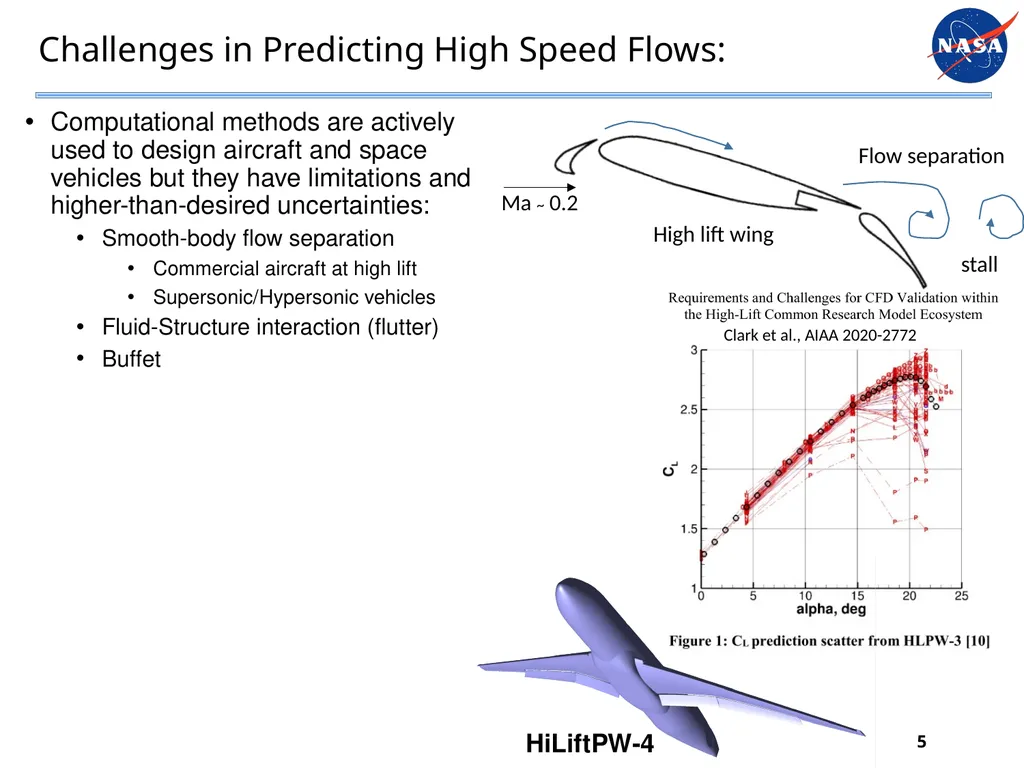
Challenges in Predicting High Speed Flows: 5 HiLiftPW-4 High lift wing Ma ~ 0.2 Flow separation
stall Clark et al., AIAA 2020-2772 Computational methods are actively used to design aircraft and space vehicles but they have limitations and higher-than-desired uncertainties:
Smooth-body flow separation
Commercial aircraft at high lift
Supersonic/Hypersonic vehicles
Fluid-Structure interaction (flutter)
Buffet<br>
06
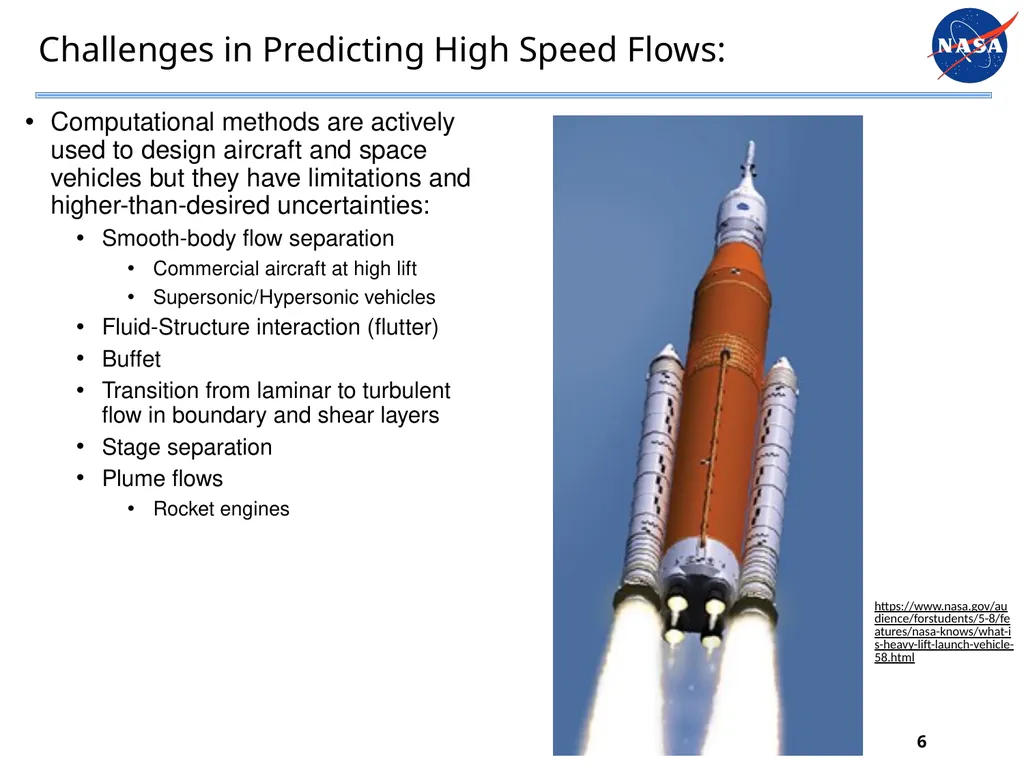
Challenges in Predicting High Speed Flows: Computational methods are actively used to design aircraft and space vehicles but they have limitations and higher-than-desired uncertainties:
Smooth-body flow separation
Commercial aircraft at high lift
Supersonic/Hypersonic vehicles
Fluid-Structure interaction (flutter)
Buffet
Transition from laminar to turbulent flow in boundary and shear layers
Stage separation
Plume flows
Rocket engines 6 https://www.nasa.gov/audience/forstudents/5-8/features/nasa-knows/what-is-heavy-lift-launch-vehicle-58.html<br>
07
Challenges in Predicting High Speed Flows: Computational methods are actively used to design aircraft and space vehicles but they have limitations and higher-than-desired uncertainties:
Smooth-body flow separation
Commercial aircraft at high lift
Supersonic/Hypersonic vehicles
Fluid-Structure interaction (flutter)
Buffet
Transition from laminar to turbulent flow in boundary and shear layers
Stage separation
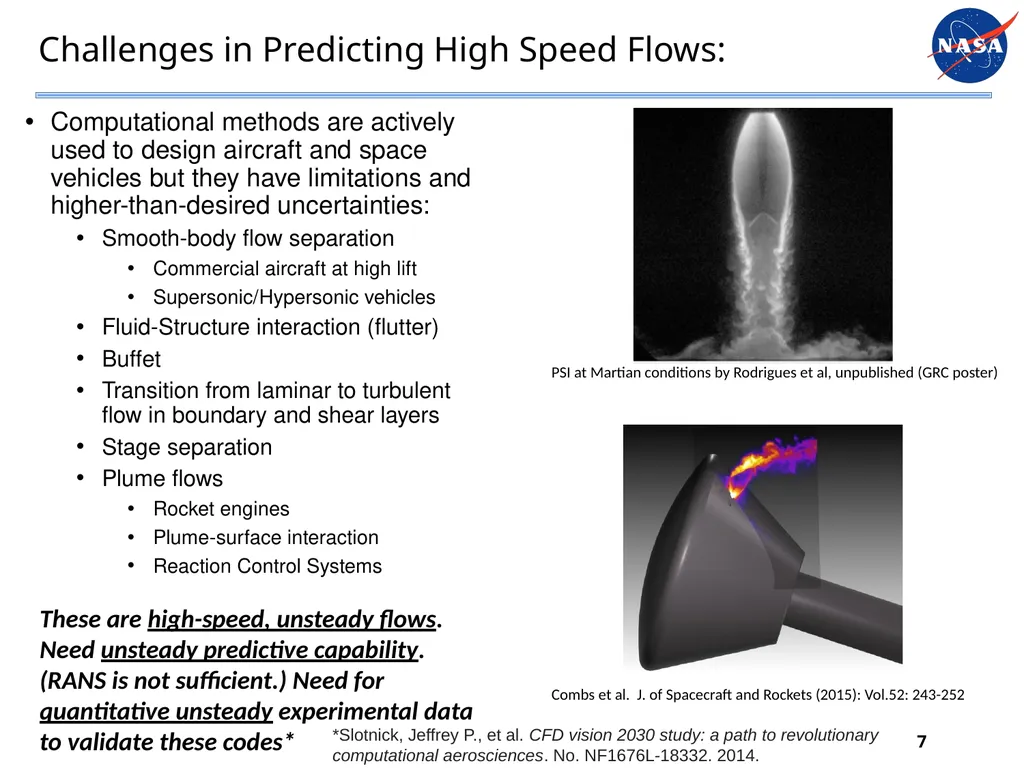
Plume flows
Rocket engines
Plume-surface interaction
Reaction Control Systems 7 These are high-speed, unsteady flows. Need unsteady predictive capability. (RANS is not sufficient.) Need for quantitative unsteady experimental data to validate these codes* Combs et al. J. of Spacecraft and Rockets (2015): Vol.52: 243-252 *Slotnick, Jeffrey P., et al. CFD vision 2030 study: a path to revolutionary computational aerosciences. No. NF1676L-18332. 2014. PSI at Martian conditions by Rodrigues et al, unpublished (GRC poster)<br>
08
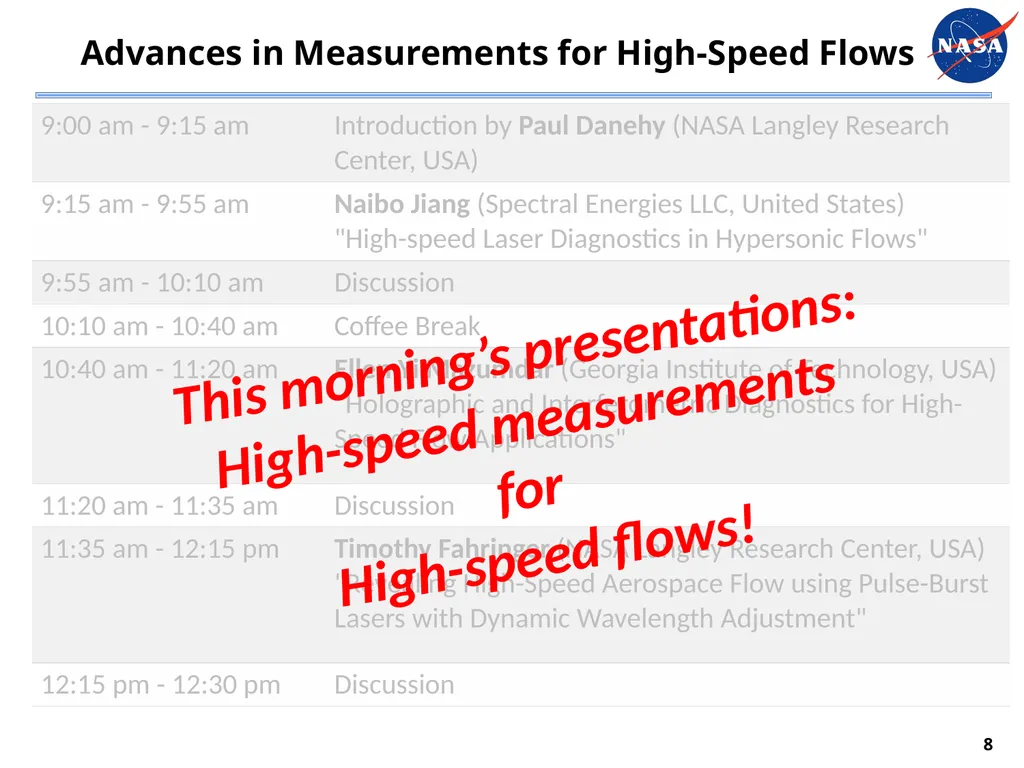
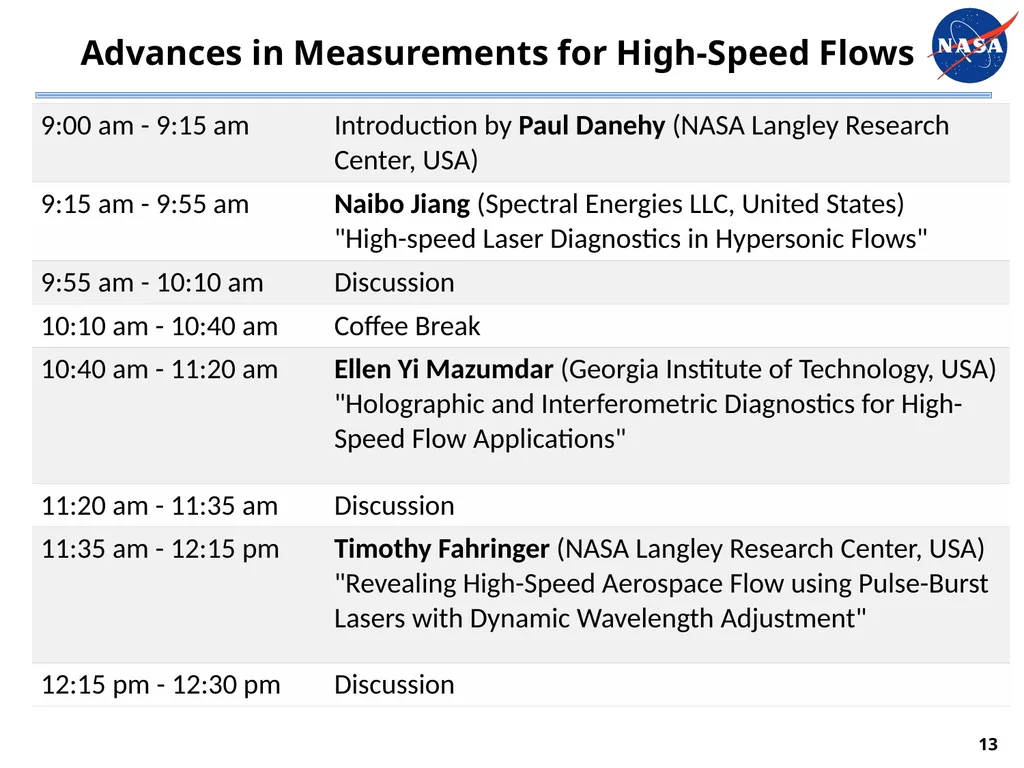
Advances in Measurements for High-Speed Flows 8 This morning’s presentations:
High-speed measurements for
High-speed flows!<br>
09
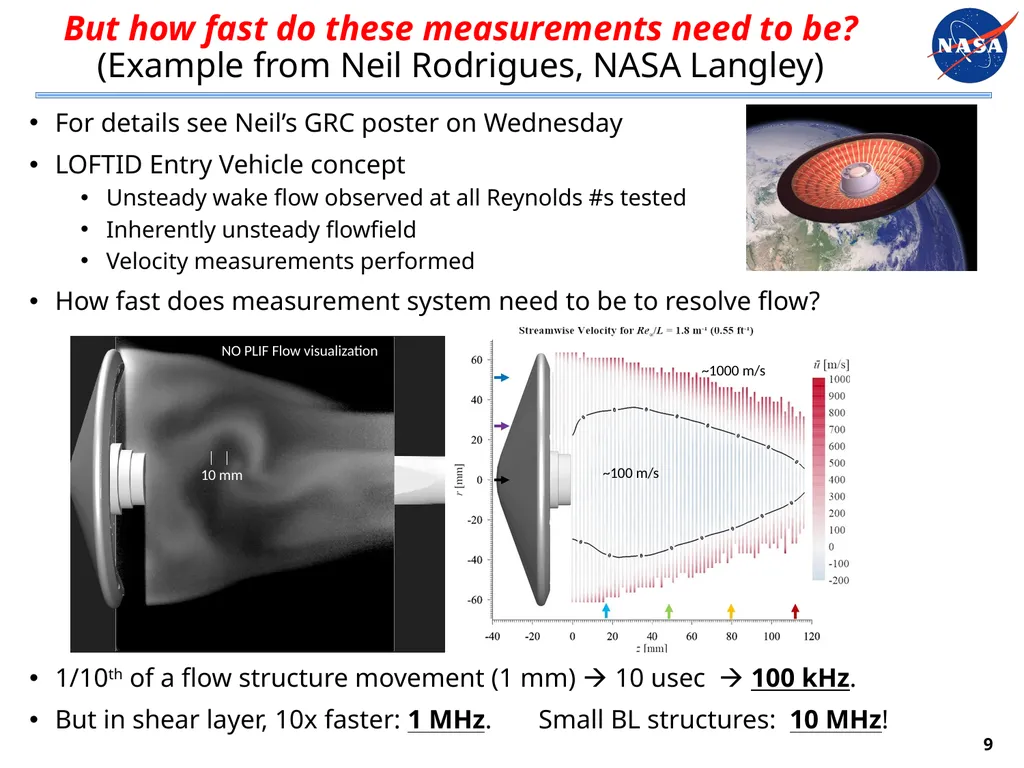
But how fast do these measurements need to be? (Example from Neil Rodrigues, NASA Langley) For details see Neil’s GRC poster on Wednesday
LOFTID Entry Vehicle concept
Unsteady wake flow observed at all Reynolds #s tested
Inherently unsteady flowfield
Velocity measurements performed
How fast does measurement system need to be to resolve flow?
1/10th of a flow structure movement (1 mm) 10 usec 100 kHz.
But in shear layer, 10x faster: 1 MHz. Small BL structures: 10 MHz! 9 10 mm ~100 m/s ~1000 m/s NO PLIF Flow visualization<br>
10
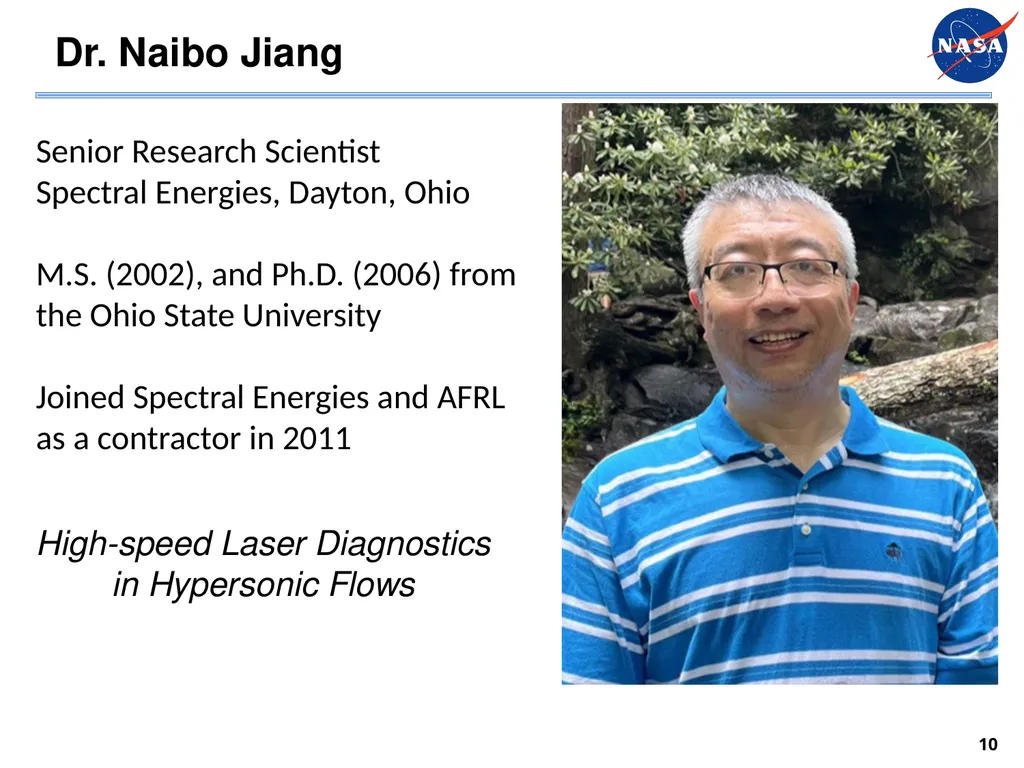
Dr. Naibo Jiang 10 Senior Research Scientist
Spectral Energies, Dayton, Ohio
M.S. (2002), and Ph.D. (2006) from the Ohio State University
Joined Spectral Energies and AFRL as a contractor in 2011 High-speed Laser Diagnostics in Hypersonic Flows<br>
11
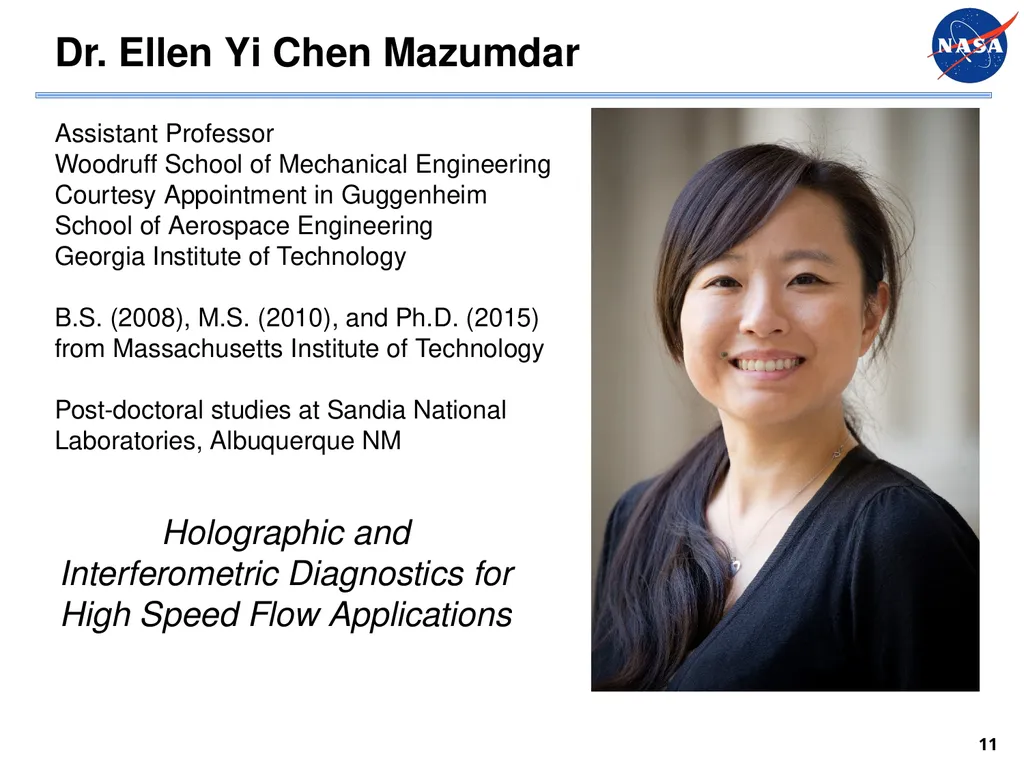
Dr. Ellen Yi Chen Mazumdar 11 Assistant Professor
Woodruff School of Mechanical Engineering
Courtesy Appointment in Guggenheim School of Aerospace Engineering
Georgia Institute of Technology
B.S. (2008), M.S. (2010), and Ph.D. (2015) from Massachusetts Institute of Technology
Post-doctoral studies at Sandia National Laboratories, Albuquerque NM Holographic and
Interferometric Diagnostics for
High Speed Flow Applications<br>
12
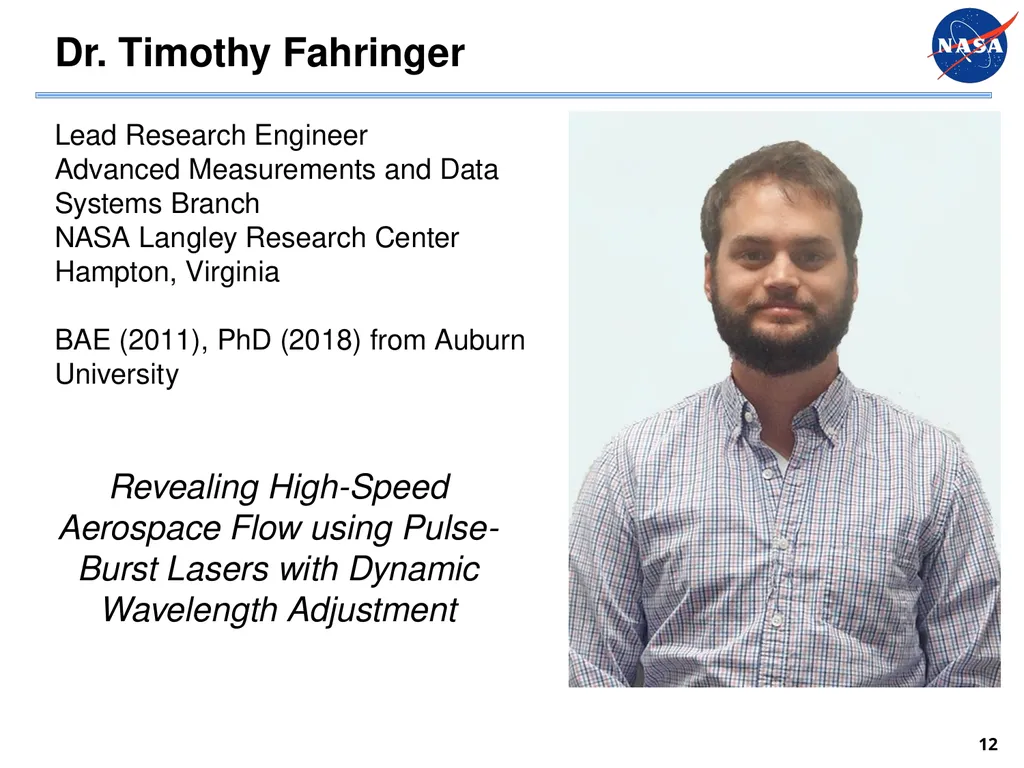
Dr. Timothy Fahringer 12 Lead Research Engineer
Advanced Measurements and Data Systems Branch
NASA Langley Research Center
Hampton, Virginia
BAE (2011), PhD (2018) from Auburn University Revealing High-Speed Aerospace Flow using Pulse-Burst Lasers with Dynamic Wavelength Adjustment<br>
13
Advances in Measurements for High-Speed Flows 13<br>