
Advocacy Standard: Scheme Development Stakeholder


Description: Advocacy Standard: Scheme Development Stakeholder Presentation Capacity Services Online and in-person NovemberDecember 2024 What will cover today? Overview of Advocacy Scheme Development Project Advocacy Scheme Drafting Process Draft
Related Topics
Download Presentation
"Advocacy Standard: Scheme Development Stakeholder" is the property of its rightful owner. Permission is granted to download and print the materials on this website for personal, non-commercial use only, and to display it on your personal computer provided you do not modify the materials and that you retain all copyright notices contained in the materials. By downloading content from our website, you accept the terms of this agreement.
Presentation Transcript
slide1. Advocacy Standard: Scheme Development Stakeholder Presentation
Capacity Services
Online and in-person November/December 2024<br>
slide2. What will cover today? Overview of Advocacy Scheme Development Project
Advocacy Scheme Drafting Process & Draft Scheme V1.5
Presentation and discussion of a selection of key concepts in draft Scheme<br>
slide3. Acronyms and Terms OPAN – Older Persons Advocacy Network
DANA – Disability Advocacy Network Australia
DoHAC – Department of Health and Aged Care
DSS – Department of Social Services
JASANZ – Joint Accreditation System of Australia and New Zealand
CB – Certification Body - conduct audits against Standards
AS 5391:2024 Advocacy in Ageing and Disability – title of the Standard developed for OPAN and DANA
Advocacy Services – term used in AS 5391:2024 to identify the providers of Individual Advocacy subject to the Standard
NSDS – National Standards for Disability Services, currently used to certify Commonwealth funded Advocacy Services<br>
slide4. Advocacy Scheme Development Project The Advocacy in Ageing and Disability Standard (AS 5391:2024) was published in May 2024.
Since publication, OPAN and DANA have been working with the Joint Accreditation System of Australia and New Zealand (JASANZ) to develop a scheme to enable Advocacy Services to be certified against the requirements of the Standard.
OPAN and DANA, are the Scheme owners driving this project and have contracted Capacity Services to provide support with project management and to conduct these online consultations with Advocacy Service providers and people with lived experience as Advocacy Service users.<br>
slide5. Advocacy Scheme Development Project OPAN and DANA committed to working collaboratively on the development of the Standard and now the Scheme because:
there was no specific Standard or Scheme designed for Advocacy Services in Australia
it was recognised that some Advocacy Services deliver advocacy under multiple funding streams and are subject to multiple quality auditing requirements.
It is the intention of OPAN and DANA to implement this Scheme in place of (not as well as) current certification schemes which Advocacy Services are subject to.<br>
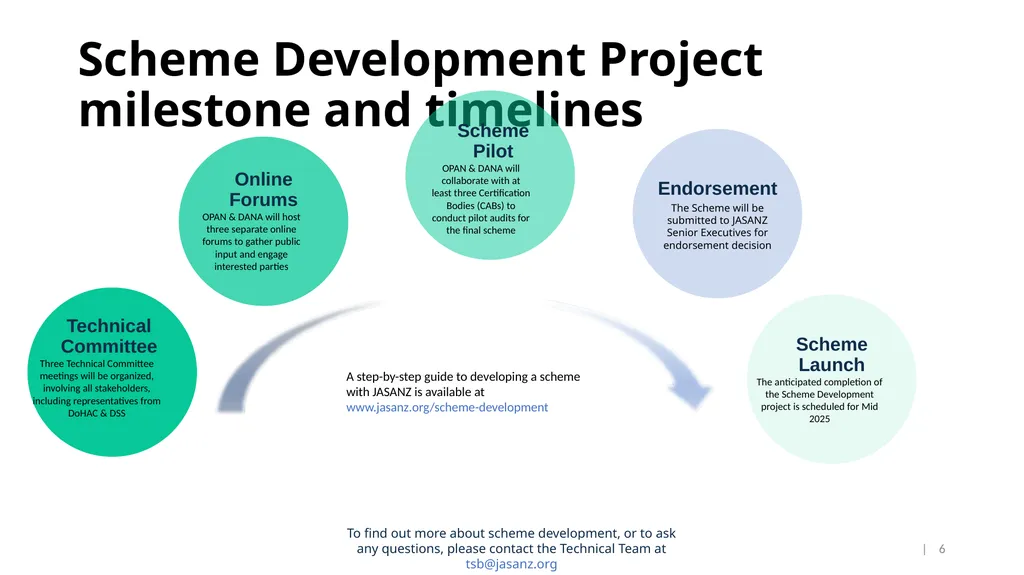
slide6. Scheme Development Project milestone and timelines To find out more about scheme development, or to ask any questions, please contact the Technical Team at tsb@jasanz.org | 6 Technical Committee
Three Technical Committee meetings will be organized, involving all stakeholders, including representatives from DoHAC & DSS Online Forums
OPAN & DANA will host three separate online forums to gather public input and engage interested parties Scheme Pilot
OPAN & DANA will collaborate with at least three Certification Bodies (CABs) to conduct pilot audits for the final scheme Scheme Launch
The anticipated completion of the Scheme Development project is scheduled for Mid 2025 Endorsement
The Scheme will be submitted to JASANZ Senior Executives for endorsement decision A step-by-step guide to developing a scheme with JASANZ is available at www.jasanz.org/scheme-development<br>
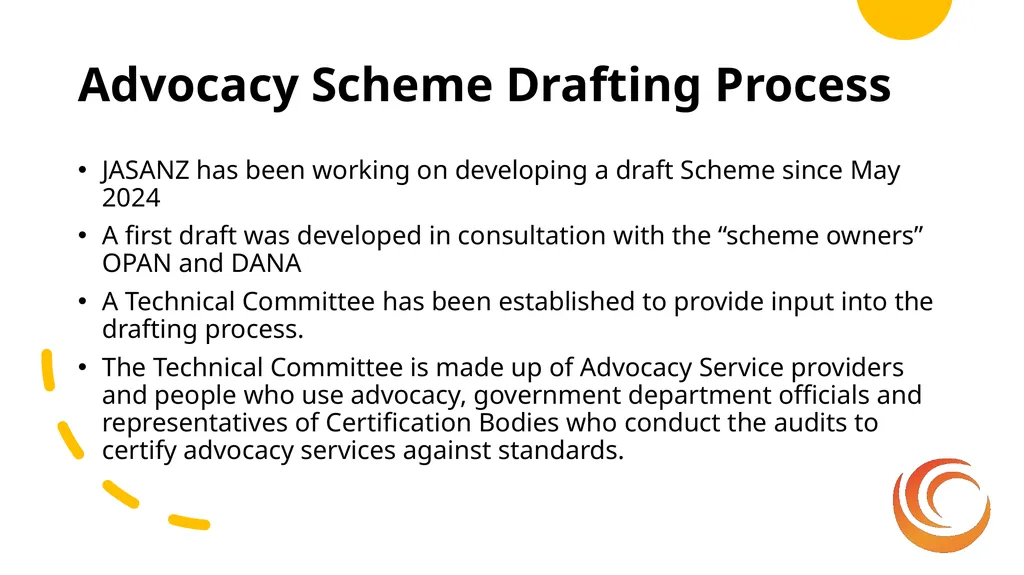
slide7. Advocacy Scheme Drafting Process JASANZ has been working on developing a draft Scheme since May 2024
A first draft was developed in consultation with the “scheme owners” OPAN and DANA
A Technical Committee has been established to provide input into the drafting process.
The Technical Committee is made up of Advocacy Service providers and people who use advocacy, government department officials and representatives of Certification Bodies who conduct the audits to certify advocacy services against standards.<br>
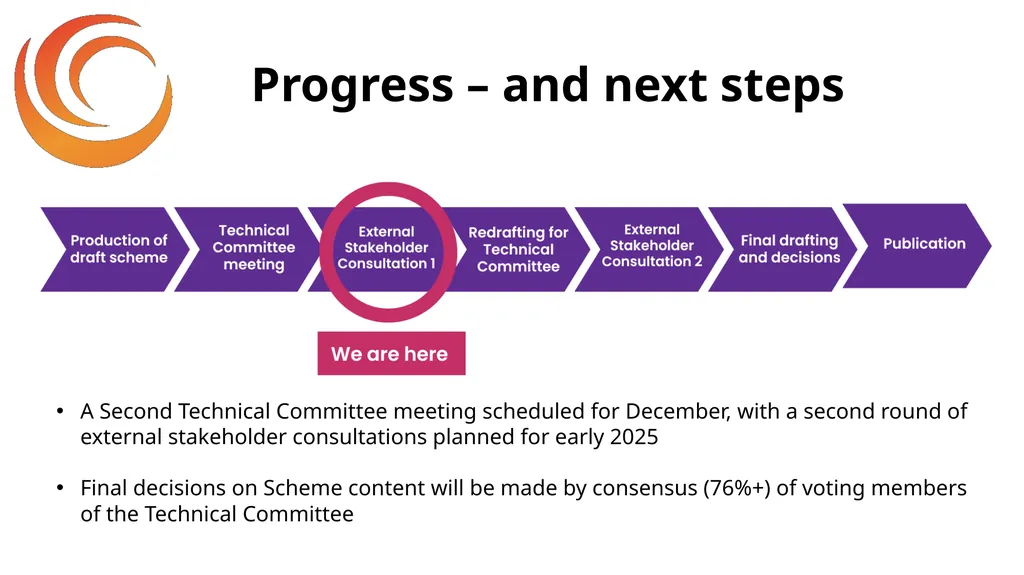
slide8. Progress – and next steps A Second Technical Committee meeting scheduled for December, with a second round of external stakeholder consultations planned for early 2025
Final decisions on Scheme content will be made by consensus (76%+) of voting members of the Technical Committee<br>
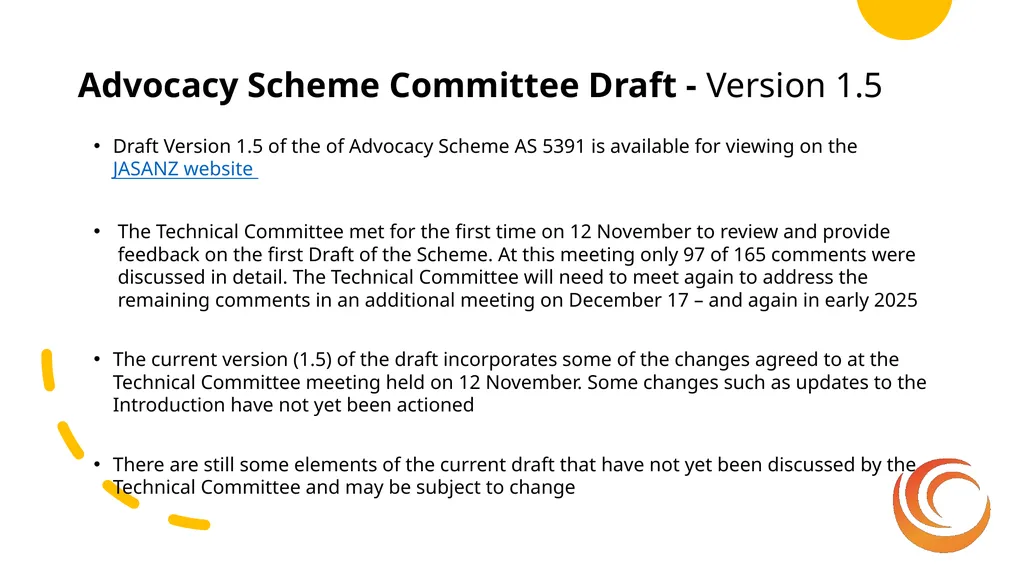
slide9. Advocacy Scheme Committee Draft - Version 1.5 Draft Version 1.5 of the of Advocacy Scheme AS 5391 is available for viewing on the JASANZ website
The Technical Committee met for the first time on 12 November to review and provide feedback on the first Draft of the Scheme. At this meeting only 97 of 165 comments were discussed in detail. The Technical Committee will need to meet again to address the remaining comments in an additional meeting on December 17 – and again in early 2025
The current version (1.5) of the draft incorporates some of the changes agreed to at the Technical Committee meeting held on 12 November. Some changes such as updates to the Introduction have not yet been actioned
There are still some elements of the current draft that have not yet been discussed by the Technical Committee and may be subject to change<br>
slide10. Advocacy Scheme Committee Draft - Version 1.5 The scheme is developed using an internationally standardised format (ISO/SEC 17065) – format used in Australia to monitor compliance in health and human services including NSDS
The Scheme will incorporate requirements expressed by the sector as necessary to accurately determine quality in Advocacy Services
OPAN and DANA encourage you to read the current draft in full and provide written feedback after these sessions.
OPAN and DANA recognise that not everyone will have the time to read the draft thoroughly and provide written feedback and that is why we are presenting on and consulting with you on some of the key elements of the Scheme today.<br>
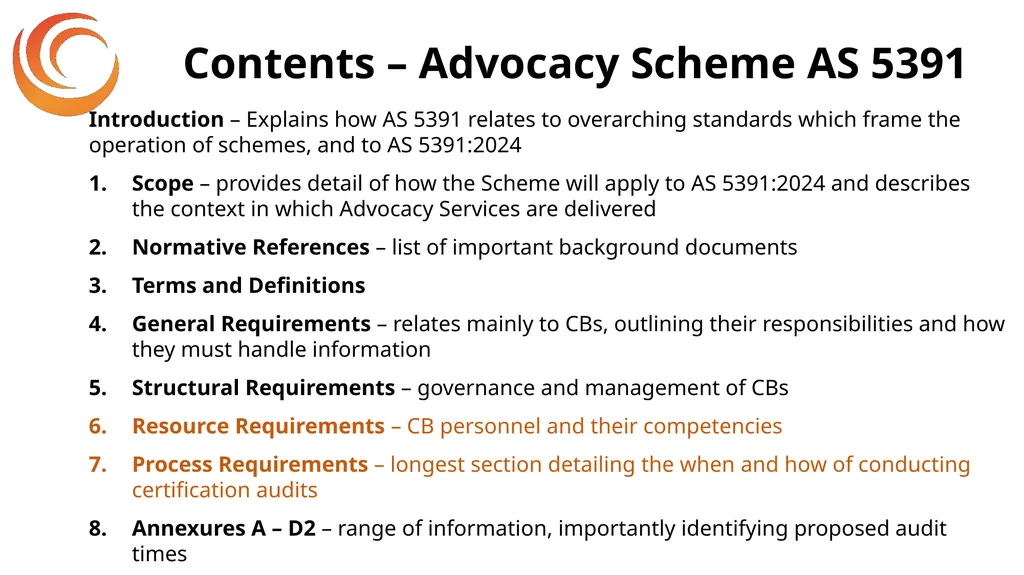
slide11. Contents – Advocacy Scheme AS 5391 Introduction – Explains how AS 5391 relates to overarching standards which frame the operation of schemes, and to AS 5391:2024
Scope – provides detail of how the Scheme will apply to AS 5391:2024 and describes the context in which Advocacy Services are delivered
Normative References – list of important background documents
Terms and Definitions
General Requirements – relates mainly to CBs, outlining their responsibilities and how they must handle information
Structural Requirements – governance and management of CBs
Resource Requirements – CB personnel and their competencies
Process Requirements – longest section detailing the when and how of conducting certification audits
Annexures A – D2 – range of information, importantly identifying proposed audit times<br>
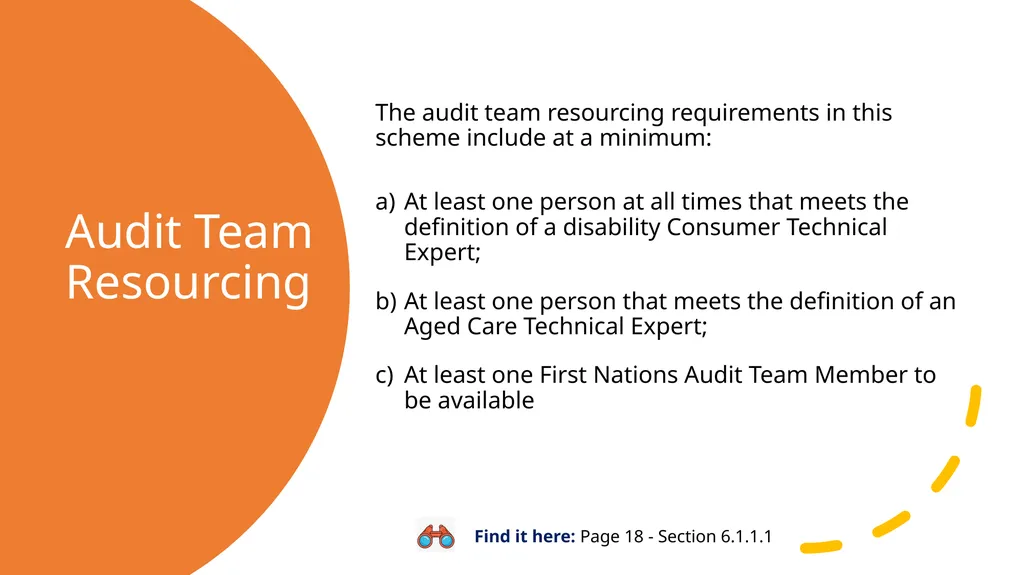
slide12. Audit Team Resourcing Find it here: Page 18 - Section 6.1.1.1 The audit team resourcing requirements in this scheme include at a minimum:
At least one person at all times that meets the definition of a disability Consumer Technical Expert;
At least one person that meets the definition of an Aged Care Technical Expert;
At least one First Nations Audit Team Member to be available<br>
slide13. Considerations
Concerns have been raised about current difficulty in sourcing suitably qualified and trained people with lived experience to take part and also lead audit teams Discussion: What are your thoughts on the current requirements in the draft?<br>
slide14. Competency Criteria for Audit Team Competency criteria for audit team members shall also include the following knowledge and skills:
awareness of the legislative, regulatory and standards requirements applicable to the delivery of Advocacy Services;
awareness of the diversity of Persons receiving Advocacy and their needs in relation to the audit process;
awareness of the principles of quality and improvement;
awareness of the diversity of organisational structures and context in the Advocacy Services and how this impacts on management practices;
understanding of the complaints mechanisms and independent Advocacy/support options available to Persons using Advocacy Services;
ability to communicate effectively in writing or orally or using alternative communication systems as required to involve all relevant parties in the audit process. Find it here: Page 19 – Section 6.1.2.1<br>
slide15. Considerations
There is an opportunity for OPAN and DANA to lead training on Advocacy for Certifications Bodies Discussion:
What knowledge or experience should be required of the audit team ?<br>
slide16. Audit Cycle The audit program for the initial certification shall include a two-stage initial audit:
a mid-term (surveillance) audit conducted between 18 and 30 months after (re)certification, and
a recertification audit in the fourth year prior to expiration of certification.
The first four-year certification cycle begins with the certification decision.
Subsequent cycles begin with the recertification decision.
The determination of the audit program shall consider the size of the Advocacy Service, the scope and complexity of its Advocacy Service as well as demonstrated level of service effectiveness and the results of any previous audits.
Annex B provides guidance about how audit timeframes can be generated Find it here: Page 21– Section 7.1.1.1 (9.1.3.2)<br>
slide17. Considerations
OPAN and DANA have proposed this cycle timeframe to allow some flexibility in timeframes particularly over periods where Advocacy Services may be transitioning to this Scheme.
Certification bodies have raised concerns that 4 years is too long in between audits and this could increase their risk, make the scheme less financially viable for their business, and making it difficult to maintain knowledge of the Standard and the Scheme Discussion: What are your thoughts on the proposed audit cycle timeframes ?<br>
slide18. Sampling Find it here: Page 46 – Section – Annex B 9.3 When planning the audit, the CB shall negotiate a strategy for sampling Persons in consultation with the Advocacy Service and relevant stakeholders. The strategy should cover:
proposed sample numbers;
sampling approach, including methods of communication and sampling methods (face-to-face interview, focus groups, telephone survey, mail or on-line survey, other reasonable adjustments to address any communication barriers);
support needs of Persons (if applicable), including when, where and how Person feedback is to be obtained.<br>
slide19. Sampling . Find it here: Page 46 – Section Annex B B.94-B.95 The Certification Bodies should select the sample of Persons (and their family, friends, and supporters) who have received a service over the last 18 to 24 months.
The selection preferably should be made from a de-identified list provided by the Advocacy Service, however other means of identifying participants may be used, such as service records or directories, with access to these facilitated by the Advocacy Service.
At the minimum, it would be expected that at least five Persons and at least two family, friends, and supporters are interviewed per site per audit. For sites with fewer than five Persons, the starting goal should be to sample all Persons (‘100% sampling’).<br>
slide20. Sampling . Find it here: Page 27– Section 7.4.4.6.10 The CB should aim to have one to one direct contact with 50% of the proposed Persons, family and friends selected for interview and/or records review in this scheme (includes telephone and videoconference).
One to one face to face interviews are preferable to remote interviews, where practicable.
If the 50% ratio cannot be achieved, the CB shall clearly document its justification for the sampling approaches used.
The remaining 50% may be sampled using other methods including:
(a) Videoconferencing / other online audio visual communication
(b) Focus group
(c) Written survey
(d) Other innovative ways to involve Persons.<br>
slide21. Sampling . Find it here: Page 26-27– Section 7.4.4.6.2 -7.4.4.6.4 & 7.4.4.6.8 The sampling strategy be prioritised to those Advocacy Service types or service processes that are of the ‘highest risk’ in terms of abuse, neglect, dissatisfaction, and/or that are suspected of not maximising the potential satisfaction of Persons.
The sampling strategy should prioritise the involvement of Persons, and outline in brief the opportunities of the Advocacy Service (given its capacities) to help redress the broad range of disadvantages and discrimination affecting the Person’s situation (which may also include that of their family and community) including but not limited to challenges in aged care, justice system, and disability service settings.
The sampling strategy shall explicitly state: The number of times the audit participants had previously been sampled.
At a minimum, two Advocacy plans should be selected for evaluation during the audit sampling process, and comment provided on the extent that they are tailored to the Persons and understood.<br>
slide22. Considerations
Client sampling processes are still being discussed
OPAN and DANA are advocating for the sample to come from clients with a open case in the last three months
There are calls for the process to consider the impact that requests to participate in the audit process may have on some Advocacy clients Discussion:
What are your thoughts on the proposed approach to client sampling?
In your experience, what client sampling approaches work well?
How can a representative sample be established?
Is it OK to consider remote and virtual interviews as well as in-person?<br>
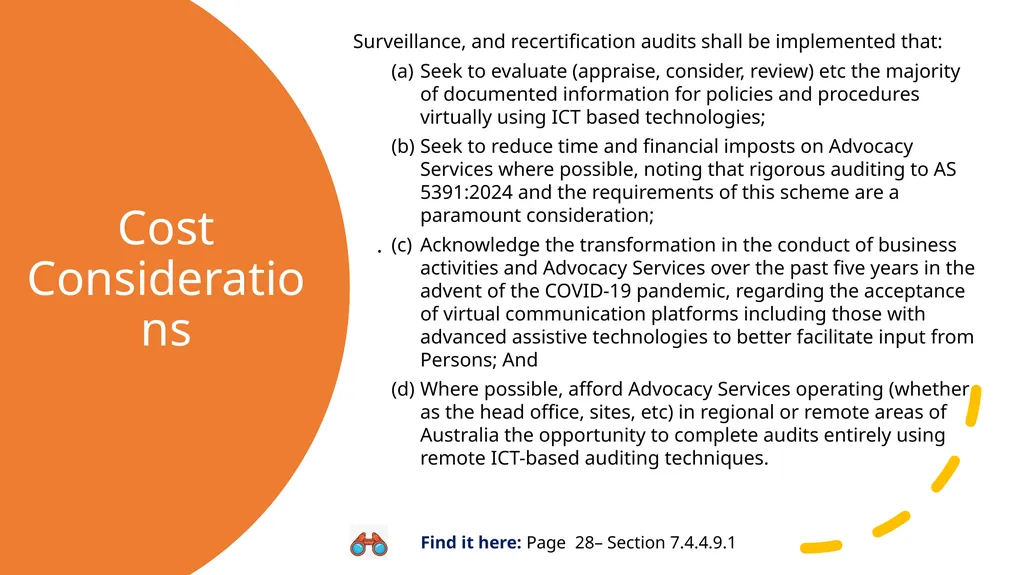
slide23. Cost Considerations . Surveillance, and recertification audits shall be implemented that:
Seek to evaluate (appraise, consider, review) etc the majority of documented information for policies and procedures virtually using ICT based technologies;
Seek to reduce time and financial imposts on Advocacy Services where possible, noting that rigorous auditing to AS 5391:2024 and the requirements of this scheme are a paramount consideration;
Acknowledge the transformation in the conduct of business activities and Advocacy Services over the past five years in the advent of the COVID-19 pandemic, regarding the acceptance of virtual communication platforms including those with advanced assistive technologies to better facilitate input from Persons; And
Where possible, afford Advocacy Services operating (whether as the head office, sites, etc) in regional or remote areas of Australia the opportunity to complete audits entirely using remote ICT-based auditing techniques. Find it here: Page 28– Section 7.4.4.9.1<br>
slide24. Considerations
Where an audit cycle has been completed entirely using remote ICT-based auditing, Certification Bodies shall consider additional integrity activities to confirm the validity of their audit findings as an input into recertification audit planning. Discussion:
What are your thoughts on face-to-face audits vs remote audits?
What are you views on site visits as part of the audit process?
Are there any other cost concerns you would like to raise?<br>
slide25. Final Thoughts … Consider how this Scheme might be applied to the Advocacy Service you run or use, and what resources might be required to meet the requirements.
Where applicable, how does this Scheme compare to the one you are required to be certified under currently?
To what extent would de-identified data your Advocacy Service already produces be useful as evidence of quality against the requirements of AS 5391:2024?<br>
slide26. In Conclusion Please note this consultation has not addressed all components of the Draft Scheme
We encourage you to the review the full draft and provide comment to michael@capacityservices.com.au by 10 December 2024
If your have limited time to review the draft we suggest you prioritise review of Section 7 – Process Requirements<br>
slide27. Capacity Services Michael Bleasdale Contact: Michael Bleasdale
michael@capacityservices.com.au
0499 900 006<br>
Capacity Services
Online and in-person November/December 2024<br>
slide2. What will cover today? Overview of Advocacy Scheme Development Project
Advocacy Scheme Drafting Process & Draft Scheme V1.5
Presentation and discussion of a selection of key concepts in draft Scheme<br>
slide3. Acronyms and Terms OPAN – Older Persons Advocacy Network
DANA – Disability Advocacy Network Australia
DoHAC – Department of Health and Aged Care
DSS – Department of Social Services
JASANZ – Joint Accreditation System of Australia and New Zealand
CB – Certification Body - conduct audits against Standards
AS 5391:2024 Advocacy in Ageing and Disability – title of the Standard developed for OPAN and DANA
Advocacy Services – term used in AS 5391:2024 to identify the providers of Individual Advocacy subject to the Standard
NSDS – National Standards for Disability Services, currently used to certify Commonwealth funded Advocacy Services<br>
slide4. Advocacy Scheme Development Project The Advocacy in Ageing and Disability Standard (AS 5391:2024) was published in May 2024.
Since publication, OPAN and DANA have been working with the Joint Accreditation System of Australia and New Zealand (JASANZ) to develop a scheme to enable Advocacy Services to be certified against the requirements of the Standard.
OPAN and DANA, are the Scheme owners driving this project and have contracted Capacity Services to provide support with project management and to conduct these online consultations with Advocacy Service providers and people with lived experience as Advocacy Service users.<br>
slide5. Advocacy Scheme Development Project OPAN and DANA committed to working collaboratively on the development of the Standard and now the Scheme because:
there was no specific Standard or Scheme designed for Advocacy Services in Australia
it was recognised that some Advocacy Services deliver advocacy under multiple funding streams and are subject to multiple quality auditing requirements.
It is the intention of OPAN and DANA to implement this Scheme in place of (not as well as) current certification schemes which Advocacy Services are subject to.<br>
slide6. Scheme Development Project milestone and timelines To find out more about scheme development, or to ask any questions, please contact the Technical Team at tsb@jasanz.org | 6 Technical Committee
Three Technical Committee meetings will be organized, involving all stakeholders, including representatives from DoHAC & DSS Online Forums
OPAN & DANA will host three separate online forums to gather public input and engage interested parties Scheme Pilot
OPAN & DANA will collaborate with at least three Certification Bodies (CABs) to conduct pilot audits for the final scheme Scheme Launch
The anticipated completion of the Scheme Development project is scheduled for Mid 2025 Endorsement
The Scheme will be submitted to JASANZ Senior Executives for endorsement decision A step-by-step guide to developing a scheme with JASANZ is available at www.jasanz.org/scheme-development<br>
slide7. Advocacy Scheme Drafting Process JASANZ has been working on developing a draft Scheme since May 2024
A first draft was developed in consultation with the “scheme owners” OPAN and DANA
A Technical Committee has been established to provide input into the drafting process.
The Technical Committee is made up of Advocacy Service providers and people who use advocacy, government department officials and representatives of Certification Bodies who conduct the audits to certify advocacy services against standards.<br>
slide8. Progress – and next steps A Second Technical Committee meeting scheduled for December, with a second round of external stakeholder consultations planned for early 2025
Final decisions on Scheme content will be made by consensus (76%+) of voting members of the Technical Committee<br>
slide9. Advocacy Scheme Committee Draft - Version 1.5 Draft Version 1.5 of the of Advocacy Scheme AS 5391 is available for viewing on the JASANZ website
The Technical Committee met for the first time on 12 November to review and provide feedback on the first Draft of the Scheme. At this meeting only 97 of 165 comments were discussed in detail. The Technical Committee will need to meet again to address the remaining comments in an additional meeting on December 17 – and again in early 2025
The current version (1.5) of the draft incorporates some of the changes agreed to at the Technical Committee meeting held on 12 November. Some changes such as updates to the Introduction have not yet been actioned
There are still some elements of the current draft that have not yet been discussed by the Technical Committee and may be subject to change<br>
slide10. Advocacy Scheme Committee Draft - Version 1.5 The scheme is developed using an internationally standardised format (ISO/SEC 17065) – format used in Australia to monitor compliance in health and human services including NSDS
The Scheme will incorporate requirements expressed by the sector as necessary to accurately determine quality in Advocacy Services
OPAN and DANA encourage you to read the current draft in full and provide written feedback after these sessions.
OPAN and DANA recognise that not everyone will have the time to read the draft thoroughly and provide written feedback and that is why we are presenting on and consulting with you on some of the key elements of the Scheme today.<br>
slide11. Contents – Advocacy Scheme AS 5391 Introduction – Explains how AS 5391 relates to overarching standards which frame the operation of schemes, and to AS 5391:2024
Scope – provides detail of how the Scheme will apply to AS 5391:2024 and describes the context in which Advocacy Services are delivered
Normative References – list of important background documents
Terms and Definitions
General Requirements – relates mainly to CBs, outlining their responsibilities and how they must handle information
Structural Requirements – governance and management of CBs
Resource Requirements – CB personnel and their competencies
Process Requirements – longest section detailing the when and how of conducting certification audits
Annexures A – D2 – range of information, importantly identifying proposed audit times<br>
slide12. Audit Team Resourcing Find it here: Page 18 - Section 6.1.1.1 The audit team resourcing requirements in this scheme include at a minimum:
At least one person at all times that meets the definition of a disability Consumer Technical Expert;
At least one person that meets the definition of an Aged Care Technical Expert;
At least one First Nations Audit Team Member to be available<br>
slide13. Considerations
Concerns have been raised about current difficulty in sourcing suitably qualified and trained people with lived experience to take part and also lead audit teams Discussion: What are your thoughts on the current requirements in the draft?<br>
slide14. Competency Criteria for Audit Team Competency criteria for audit team members shall also include the following knowledge and skills:
awareness of the legislative, regulatory and standards requirements applicable to the delivery of Advocacy Services;
awareness of the diversity of Persons receiving Advocacy and their needs in relation to the audit process;
awareness of the principles of quality and improvement;
awareness of the diversity of organisational structures and context in the Advocacy Services and how this impacts on management practices;
understanding of the complaints mechanisms and independent Advocacy/support options available to Persons using Advocacy Services;
ability to communicate effectively in writing or orally or using alternative communication systems as required to involve all relevant parties in the audit process. Find it here: Page 19 – Section 6.1.2.1<br>
slide15. Considerations
There is an opportunity for OPAN and DANA to lead training on Advocacy for Certifications Bodies Discussion:
What knowledge or experience should be required of the audit team ?<br>
slide16. Audit Cycle The audit program for the initial certification shall include a two-stage initial audit:
a mid-term (surveillance) audit conducted between 18 and 30 months after (re)certification, and
a recertification audit in the fourth year prior to expiration of certification.
The first four-year certification cycle begins with the certification decision.
Subsequent cycles begin with the recertification decision.
The determination of the audit program shall consider the size of the Advocacy Service, the scope and complexity of its Advocacy Service as well as demonstrated level of service effectiveness and the results of any previous audits.
Annex B provides guidance about how audit timeframes can be generated Find it here: Page 21– Section 7.1.1.1 (9.1.3.2)<br>
slide17. Considerations
OPAN and DANA have proposed this cycle timeframe to allow some flexibility in timeframes particularly over periods where Advocacy Services may be transitioning to this Scheme.
Certification bodies have raised concerns that 4 years is too long in between audits and this could increase their risk, make the scheme less financially viable for their business, and making it difficult to maintain knowledge of the Standard and the Scheme Discussion: What are your thoughts on the proposed audit cycle timeframes ?<br>
slide18. Sampling Find it here: Page 46 – Section – Annex B 9.3 When planning the audit, the CB shall negotiate a strategy for sampling Persons in consultation with the Advocacy Service and relevant stakeholders. The strategy should cover:
proposed sample numbers;
sampling approach, including methods of communication and sampling methods (face-to-face interview, focus groups, telephone survey, mail or on-line survey, other reasonable adjustments to address any communication barriers);
support needs of Persons (if applicable), including when, where and how Person feedback is to be obtained.<br>
slide19. Sampling . Find it here: Page 46 – Section Annex B B.94-B.95 The Certification Bodies should select the sample of Persons (and their family, friends, and supporters) who have received a service over the last 18 to 24 months.
The selection preferably should be made from a de-identified list provided by the Advocacy Service, however other means of identifying participants may be used, such as service records or directories, with access to these facilitated by the Advocacy Service.
At the minimum, it would be expected that at least five Persons and at least two family, friends, and supporters are interviewed per site per audit. For sites with fewer than five Persons, the starting goal should be to sample all Persons (‘100% sampling’).<br>
slide20. Sampling . Find it here: Page 27– Section 7.4.4.6.10 The CB should aim to have one to one direct contact with 50% of the proposed Persons, family and friends selected for interview and/or records review in this scheme (includes telephone and videoconference).
One to one face to face interviews are preferable to remote interviews, where practicable.
If the 50% ratio cannot be achieved, the CB shall clearly document its justification for the sampling approaches used.
The remaining 50% may be sampled using other methods including:
(a) Videoconferencing / other online audio visual communication
(b) Focus group
(c) Written survey
(d) Other innovative ways to involve Persons.<br>
slide21. Sampling . Find it here: Page 26-27– Section 7.4.4.6.2 -7.4.4.6.4 & 7.4.4.6.8 The sampling strategy be prioritised to those Advocacy Service types or service processes that are of the ‘highest risk’ in terms of abuse, neglect, dissatisfaction, and/or that are suspected of not maximising the potential satisfaction of Persons.
The sampling strategy should prioritise the involvement of Persons, and outline in brief the opportunities of the Advocacy Service (given its capacities) to help redress the broad range of disadvantages and discrimination affecting the Person’s situation (which may also include that of their family and community) including but not limited to challenges in aged care, justice system, and disability service settings.
The sampling strategy shall explicitly state: The number of times the audit participants had previously been sampled.
At a minimum, two Advocacy plans should be selected for evaluation during the audit sampling process, and comment provided on the extent that they are tailored to the Persons and understood.<br>
slide22. Considerations
Client sampling processes are still being discussed
OPAN and DANA are advocating for the sample to come from clients with a open case in the last three months
There are calls for the process to consider the impact that requests to participate in the audit process may have on some Advocacy clients Discussion:
What are your thoughts on the proposed approach to client sampling?
In your experience, what client sampling approaches work well?
How can a representative sample be established?
Is it OK to consider remote and virtual interviews as well as in-person?<br>
slide23. Cost Considerations . Surveillance, and recertification audits shall be implemented that:
Seek to evaluate (appraise, consider, review) etc the majority of documented information for policies and procedures virtually using ICT based technologies;
Seek to reduce time and financial imposts on Advocacy Services where possible, noting that rigorous auditing to AS 5391:2024 and the requirements of this scheme are a paramount consideration;
Acknowledge the transformation in the conduct of business activities and Advocacy Services over the past five years in the advent of the COVID-19 pandemic, regarding the acceptance of virtual communication platforms including those with advanced assistive technologies to better facilitate input from Persons; And
Where possible, afford Advocacy Services operating (whether as the head office, sites, etc) in regional or remote areas of Australia the opportunity to complete audits entirely using remote ICT-based auditing techniques. Find it here: Page 28– Section 7.4.4.9.1<br>
slide24. Considerations
Where an audit cycle has been completed entirely using remote ICT-based auditing, Certification Bodies shall consider additional integrity activities to confirm the validity of their audit findings as an input into recertification audit planning. Discussion:
What are your thoughts on face-to-face audits vs remote audits?
What are you views on site visits as part of the audit process?
Are there any other cost concerns you would like to raise?<br>
slide25. Final Thoughts … Consider how this Scheme might be applied to the Advocacy Service you run or use, and what resources might be required to meet the requirements.
Where applicable, how does this Scheme compare to the one you are required to be certified under currently?
To what extent would de-identified data your Advocacy Service already produces be useful as evidence of quality against the requirements of AS 5391:2024?<br>
slide26. In Conclusion Please note this consultation has not addressed all components of the Draft Scheme
We encourage you to the review the full draft and provide comment to michael@capacityservices.com.au by 10 December 2024
If your have limited time to review the draft we suggest you prioritise review of Section 7 – Process Requirements<br>
slide27. Capacity Services Michael Bleasdale Contact: Michael Bleasdale
michael@capacityservices.com.au
0499 900 006<br>