
AI Redefined Given what we have studied in this
PT
Published · 17 slides · 0 views

1 / 1
Description
AI Redefined Given what we have studied in this course, the author offers a new definition AI is the study of the mechanisms underlying intelligent behavior through the construction and evaluation of artifacts designed to enact those
Related Topics
Share
Embed code
Download this presentation From Below
"AI Redefined Given what we have studied in this" is the property of its rightful owner. Permission is granted to download and print the materials on this website for personal, non-commercial use only, and to display it on your personal computer provided you do not modify the materials and that you retain all copyright notices contained in the materials. By downloading content from our website, you accept the terms of this agreement.
Presentation Transcript
01
AI Redefined Given what we have studied in this course, the author offers a new definition
AI is the study of the mechanisms underlying intelligent behavior through the construction and evaluation of artifacts designed to enact those mechanisms
There are several noteworthy things about this definition
we only commit to intelligent behavior
evaluation is a critical component for the definition – we are no longer relying just on the Turing Test, but instead we look to evaluate the performance of any AI system – although the definition does not tell us how to perform that evaluation
the emphasis here is on artifacts – working systems<br>
AI is the study of the mechanisms underlying intelligent behavior through the construction and evaluation of artifacts designed to enact those mechanisms
There are several noteworthy things about this definition
we only commit to intelligent behavior
evaluation is a critical component for the definition – we are no longer relying just on the Turing Test, but instead we look to evaluate the performance of any AI system – although the definition does not tell us how to perform that evaluation
the emphasis here is on artifacts – working systems<br>
02
AI as a Field From the definition, we see that AI is (or should be) less concerned about a central or single theory of mind
it is more empirically targeted – working systems
Thus, AI is an engineering pursuit
the creation of working systems
The need for evaluation makes AI a science
while creating systems is well and good, without analyzing the systems to understand why they work or do not work, AI will be working in a void
This definition denotes a paradigm shift away from
philosophy of mind – we do not need to study mind to create mind, human mind might help with models but the formal studies found in philosophy have done little to help
psychology of the human mind – we may gain some understanding of what to do through experimentation but again, this sort of pursuit has led AI astray<br>
it is more empirically targeted – working systems
Thus, AI is an engineering pursuit
the creation of working systems
The need for evaluation makes AI a science
while creating systems is well and good, without analyzing the systems to understand why they work or do not work, AI will be working in a void
This definition denotes a paradigm shift away from
philosophy of mind – we do not need to study mind to create mind, human mind might help with models but the formal studies found in philosophy have done little to help
psychology of the human mind – we may gain some understanding of what to do through experimentation but again, this sort of pursuit has led AI astray<br>
03
PSS Hypothesis Redux Recall in our first lecture, we considered the PSS Hypothesis – a PSS has the necessary and sufficient means to exhibit intelligent action
the focus on this hypothesis led AI to research
use of symbols to model the world
design of search strategies to apply operators on the given symbols
use of heuristics to guide the search
the use of an empirical approach to research – build (construct) and test to prove your point
While this has helped form a basis for AI, it has also misled AI as much as earlier reliance on philosophy and psychology
do we need symbolic knowledge? neural networks show otherwise
do we need heuristic search strategies? model based approaches (whether structural/functional, Bayesian or HMM based seem to indicate less need for this)<br>
the focus on this hypothesis led AI to research
use of symbols to model the world
design of search strategies to apply operators on the given symbols
use of heuristics to guide the search
the use of an empirical approach to research – build (construct) and test to prove your point
While this has helped form a basis for AI, it has also misled AI as much as earlier reliance on philosophy and psychology
do we need symbolic knowledge? neural networks show otherwise
do we need heuristic search strategies? model based approaches (whether structural/functional, Bayesian or HMM based seem to indicate less need for this)<br>
04
Why Has AI Not Succeeded? The author continues by examining the challenges of
symbolic AI – lack of grounding of symbols, lack of a social context by which symbols are learned in humans, systems constructed using symbolic AI approaches remain too brittle (striving for single interpretations rather than multiple interpretations or contexts, having limited amounts of knowledge)
subsymbolic AI – neural network nodes are not equivalent to neurons, the number of nodes differs substantially from a brain, even of the smallest creatures, while neural networks can be used to construct context-sensitive memories, the actual storage of memories (situations, cases, events) remains beyond our abilities because we do not know how memories are formed in the brain<br>
symbolic AI – lack of grounding of symbols, lack of a social context by which symbols are learned in humans, systems constructed using symbolic AI approaches remain too brittle (striving for single interpretations rather than multiple interpretations or contexts, having limited amounts of knowledge)
subsymbolic AI – neural network nodes are not equivalent to neurons, the number of nodes differs substantially from a brain, even of the smallest creatures, while neural networks can be used to construct context-sensitive memories, the actual storage of memories (situations, cases, events) remains beyond our abilities because we do not know how memories are formed in the brain<br>
05
What Should AI Research? This is an open question
what we tend to find is that there is less emphasis in AI research on a grand unifying theme or holy grail and far more emphasis on solving fundable problems
Some of the more common approaches found in AI research are to
expand the capabilities of neural networks by identifying new algorithms, combining NNs with approaches like GAs and FL
agent-based approaches
mathematical model-based approaches (for instance, HMMs)
ontologies to provide problem independent knowledge sources
learning from the ground up<br>
what we tend to find is that there is less emphasis in AI research on a grand unifying theme or holy grail and far more emphasis on solving fundable problems
Some of the more common approaches found in AI research are to
expand the capabilities of neural networks by identifying new algorithms, combining NNs with approaches like GAs and FL
agent-based approaches
mathematical model-based approaches (for instance, HMMs)
ontologies to provide problem independent knowledge sources
learning from the ground up<br>
06
Research Topic: The Semantic Web How can we automate the process of using the knowledge available on the Internet?
we need to make the knowledge available in accessible forms (ontologies)
we need to provide a suite of problem solvers that can
find the knowledge they need
make decisions based on the knowledge found
communicate with other problem solvers when the needed knowledge is not available, or when they have a specific subproblem to spawn
communication might require social interactions beyond simple message passing (for instance, polling of many sources, determining if an agent is trustworthy)
migrate to other processors
either because their current processor is busy, or more usefully, because the knowledge needed is located elsewhere (this capability is optional)<br>
we need to make the knowledge available in accessible forms (ontologies)
we need to provide a suite of problem solvers that can
find the knowledge they need
make decisions based on the knowledge found
communicate with other problem solvers when the needed knowledge is not available, or when they have a specific subproblem to spawn
communication might require social interactions beyond simple message passing (for instance, polling of many sources, determining if an agent is trustworthy)
migrate to other processors
either because their current processor is busy, or more usefully, because the knowledge needed is located elsewhere (this capability is optional)<br>
07
Research Topic: Autonomous Vehicles How can a vehicle be programmed to carry out a “mission” on its own with little or no human intervention?
requires mission planning, path planning, sensing (and sensor interpretation) decision making, reactive planning, failure handling
all of these steps must be done in real-time except mission planning and path planning which can be done prior to the start of the mission
Each type of vehicle has its own unique challenges
airplanes and submarines deal with 3-D, have fewer obstacles to contend with, but also have draft/current
automobiles have to deal with other road traffic, off-road vehicles have to deal with rough terrain
indoor robots deal with human traffic, furniture, walls, etc
many of these vehicles do not use cameras for input but sonar and/or radar instead<br>
requires mission planning, path planning, sensing (and sensor interpretation) decision making, reactive planning, failure handling
all of these steps must be done in real-time except mission planning and path planning which can be done prior to the start of the mission
Each type of vehicle has its own unique challenges
airplanes and submarines deal with 3-D, have fewer obstacles to contend with, but also have draft/current
automobiles have to deal with other road traffic, off-road vehicles have to deal with rough terrain
indoor robots deal with human traffic, furniture, walls, etc
many of these vehicles do not use cameras for input but sonar and/or radar instead<br>
08
Research Topic: Evolving Intelligence Rodney Brooks from MIT claims that AI needs to evolve through self-learning
in his lab, he has a number of robots placed into an environment
the robots start with a base behavior that is layered
at the lowest layer, behaviors are hard-coded
at higher layers, behaviors can be manipulated through unsupervised learning algorithms so that if a robot does something wrong (falls off a table, runs into a wall), it learns not to do that
eventually, the robots learn useful behaviors like purposeful guidance and goal-directed behaviors
the robots operate somewhat like autonomous agents in that each layer consists of one or more agents that communicate with other agents at the same and different layers<br>
in his lab, he has a number of robots placed into an environment
the robots start with a base behavior that is layered
at the lowest layer, behaviors are hard-coded
at higher layers, behaviors can be manipulated through unsupervised learning algorithms so that if a robot does something wrong (falls off a table, runs into a wall), it learns not to do that
eventually, the robots learn useful behaviors like purposeful guidance and goal-directed behaviors
the robots operate somewhat like autonomous agents in that each layer consists of one or more agents that communicate with other agents at the same and different layers<br>
09
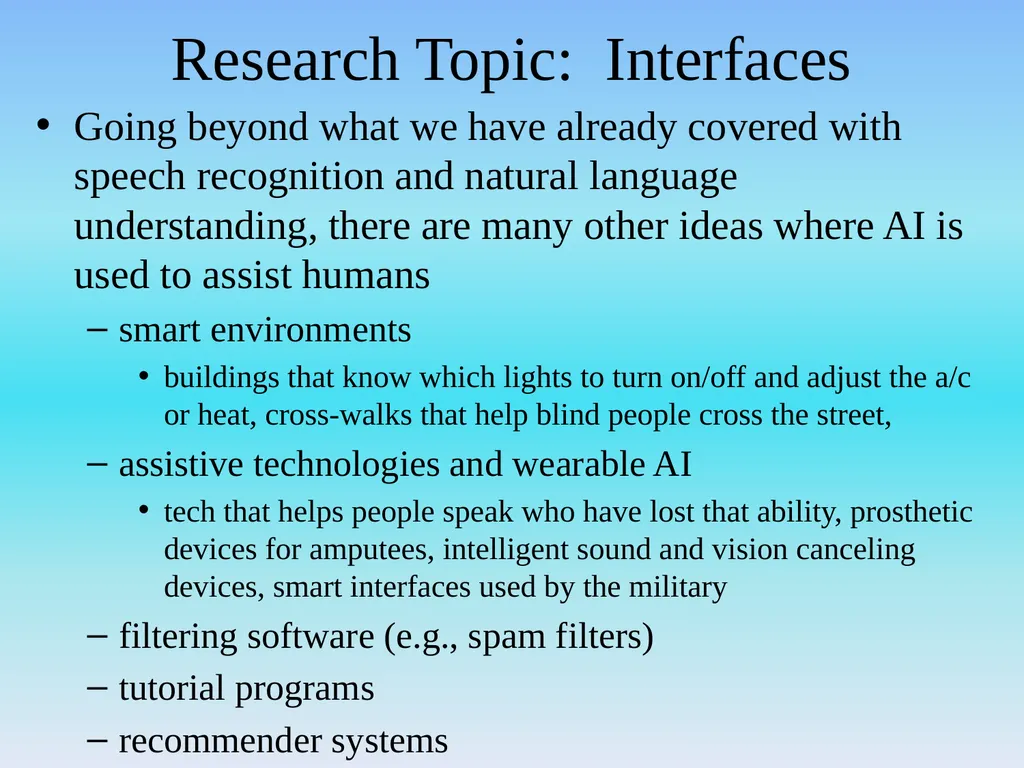
Research Topic: Interfaces Going beyond what we have already covered with speech recognition and natural language understanding, there are many other ideas where AI is used to assist humans
smart environments
buildings that know which lights to turn on/off and adjust the a/c or heat, cross-walks that help blind people cross the street,
assistive technologies and wearable AI
tech that helps people speak who have lost that ability, prosthetic devices for amputees, intelligent sound and vision canceling devices, smart interfaces used by the military
filtering software (e.g., spam filters)
tutorial programs
recommender systems<br>
smart environments
buildings that know which lights to turn on/off and adjust the a/c or heat, cross-walks that help blind people cross the street,
assistive technologies and wearable AI
tech that helps people speak who have lost that ability, prosthetic devices for amputees, intelligent sound and vision canceling devices, smart interfaces used by the military
filtering software (e.g., spam filters)
tutorial programs
recommender systems<br>
10
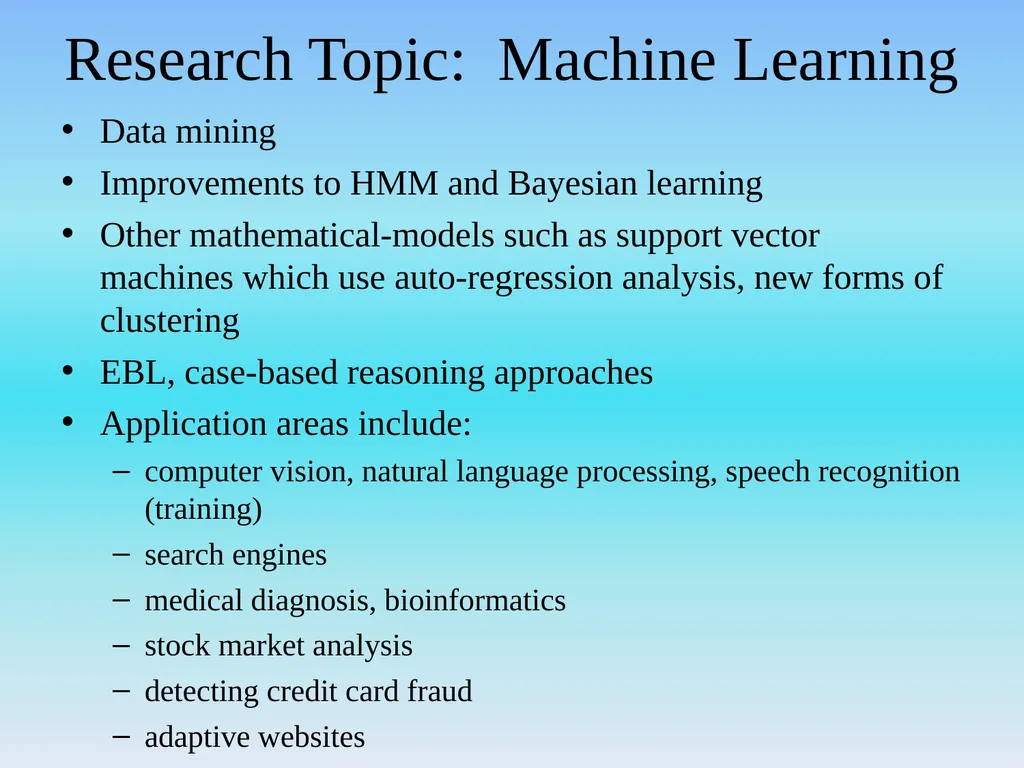
Research Topic: Machine Learning Data mining
Improvements to HMM and Bayesian learning
Other mathematical-models such as support vector machines which use auto-regression analysis, new forms of clustering
EBL, case-based reasoning approaches
Application areas include:
computer vision, natural language processing, speech recognition (training)
search engines
medical diagnosis, bioinformatics
stock market analysis
detecting credit card fraud
adaptive websites<br>
Improvements to HMM and Bayesian learning
Other mathematical-models such as support vector machines which use auto-regression analysis, new forms of clustering
EBL, case-based reasoning approaches
Application areas include:
computer vision, natural language processing, speech recognition (training)
search engines
medical diagnosis, bioinformatics
stock market analysis
detecting credit card fraud
adaptive websites<br>
11
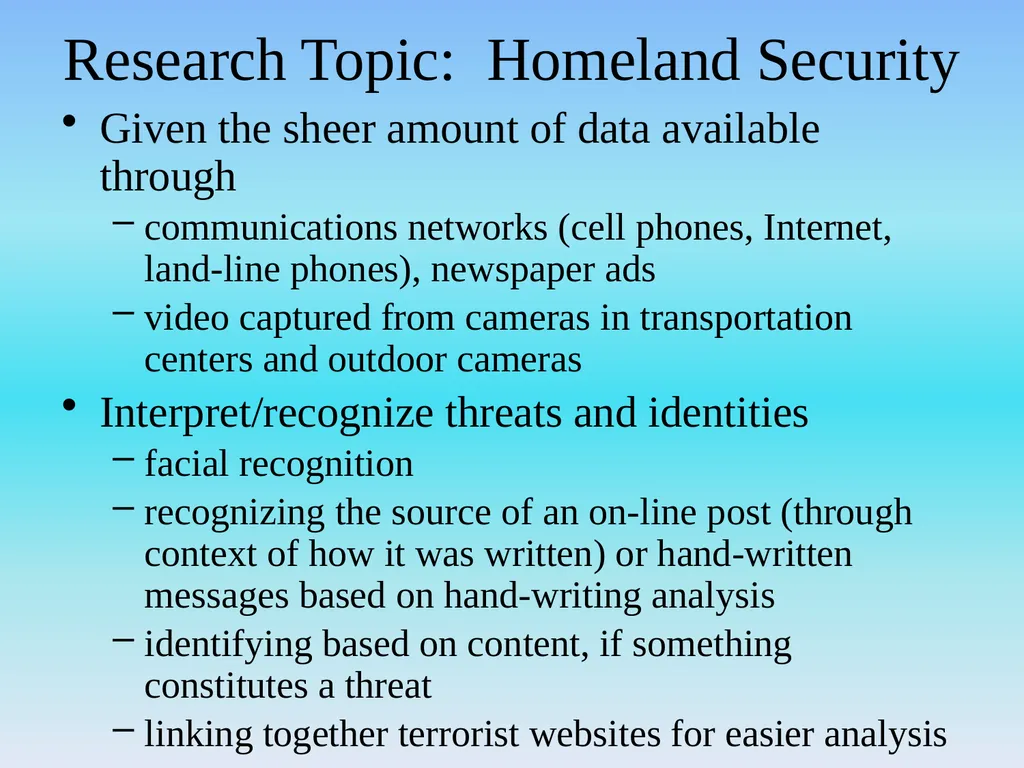
Research Topic: Homeland Security Given the sheer amount of data available through
communications networks (cell phones, Internet, land-line phones), newspaper ads
video captured from cameras in transportation centers and outdoor cameras
Interpret/recognize threats and identities
facial recognition
recognizing the source of an on-line post (through context of how it was written) or hand-written messages based on hand-writing analysis
identifying based on content, if something constitutes a threat
linking together terrorist websites for easier analysis<br>
communications networks (cell phones, Internet, land-line phones), newspaper ads
video captured from cameras in transportation centers and outdoor cameras
Interpret/recognize threats and identities
facial recognition
recognizing the source of an on-line post (through context of how it was written) or hand-written messages based on hand-writing analysis
identifying based on content, if something constitutes a threat
linking together terrorist websites for easier analysis<br>
12
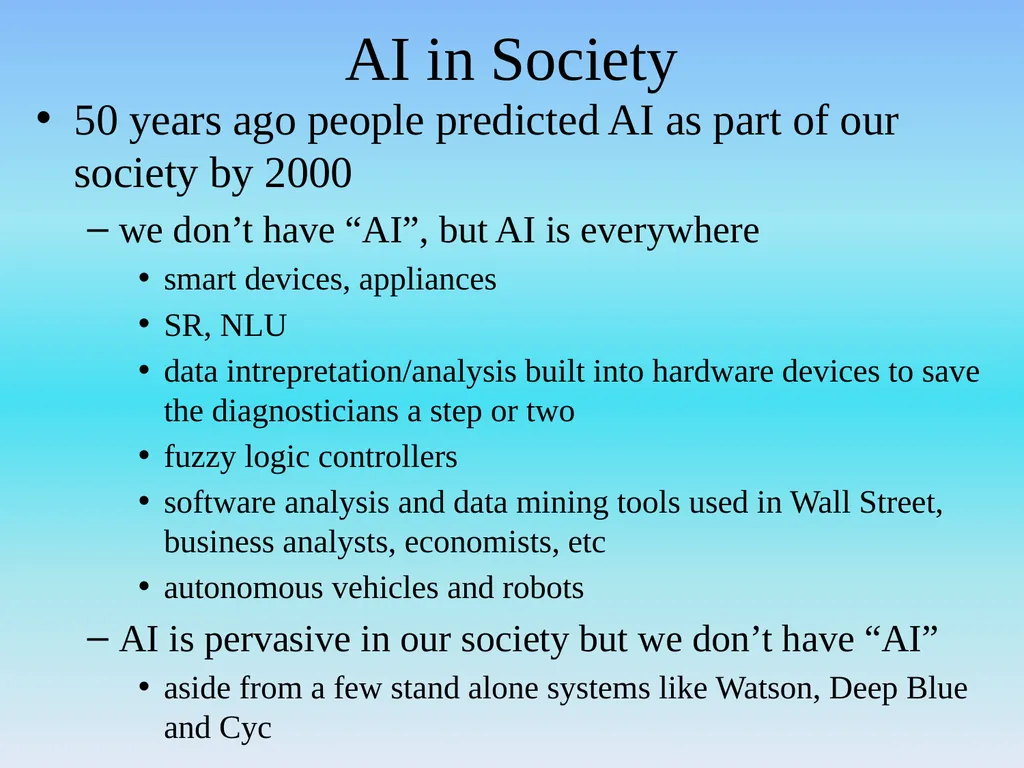
AI in Society 50 years ago people predicted AI as part of our society by 2000
we don’t have “AI”, but AI is everywhere
smart devices, appliances
SR, NLU
data intrepretation/analysis built into hardware devices to save the diagnosticians a step or two
fuzzy logic controllers
software analysis and data mining tools used in Wall Street, business analysts, economists, etc
autonomous vehicles and robots
AI is pervasive in our society but we don’t have “AI”
aside from a few stand alone systems like Watson, Deep Blue and Cyc<br>
we don’t have “AI”, but AI is everywhere
smart devices, appliances
SR, NLU
data intrepretation/analysis built into hardware devices to save the diagnosticians a step or two
fuzzy logic controllers
software analysis and data mining tools used in Wall Street, business analysts, economists, etc
autonomous vehicles and robots
AI is pervasive in our society but we don’t have “AI”
aside from a few stand alone systems like Watson, Deep Blue and Cyc<br>
13
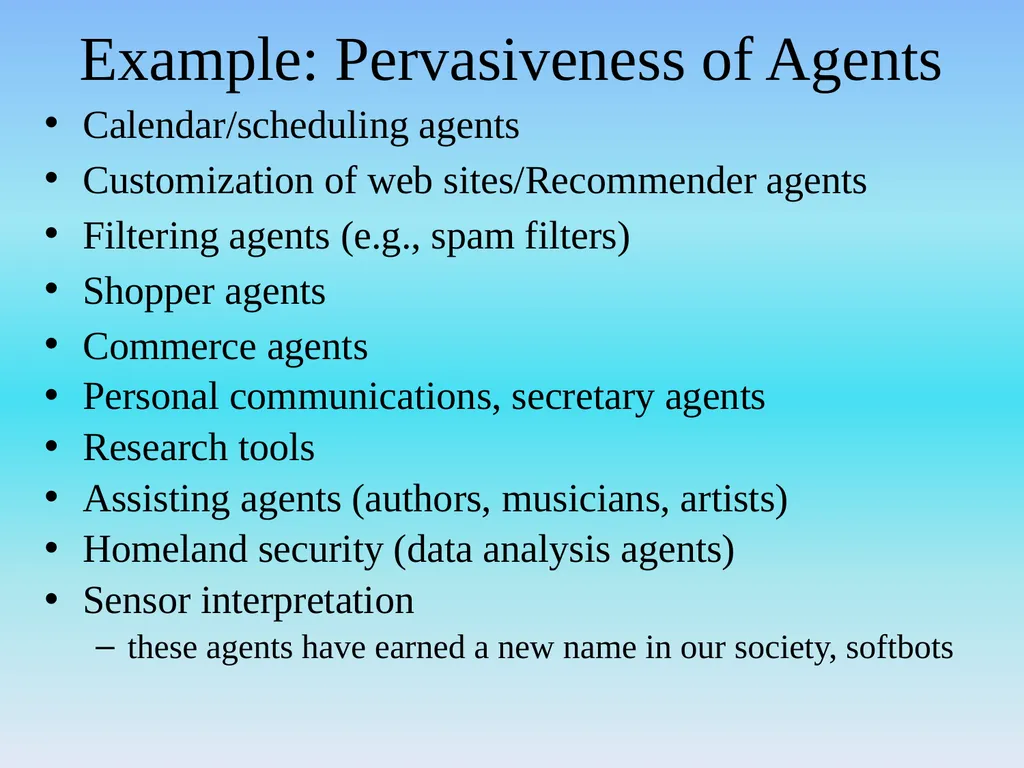
Example: Pervasiveness of Agents Calendar/scheduling agents
Customization of web sites/Recommender agents
Filtering agents (e.g., spam filters)
Shopper agents
Commerce agents
Personal communications, secretary agents
Research tools
Assisting agents (authors, musicians, artists)
Homeland security (data analysis agents)
Sensor interpretation
these agents have earned a new name in our society, softbots<br>
Customization of web sites/Recommender agents
Filtering agents (e.g., spam filters)
Shopper agents
Commerce agents
Personal communications, secretary agents
Research tools
Assisting agents (authors, musicians, artists)
Homeland security (data analysis agents)
Sensor interpretation
these agents have earned a new name in our society, softbots<br>
14
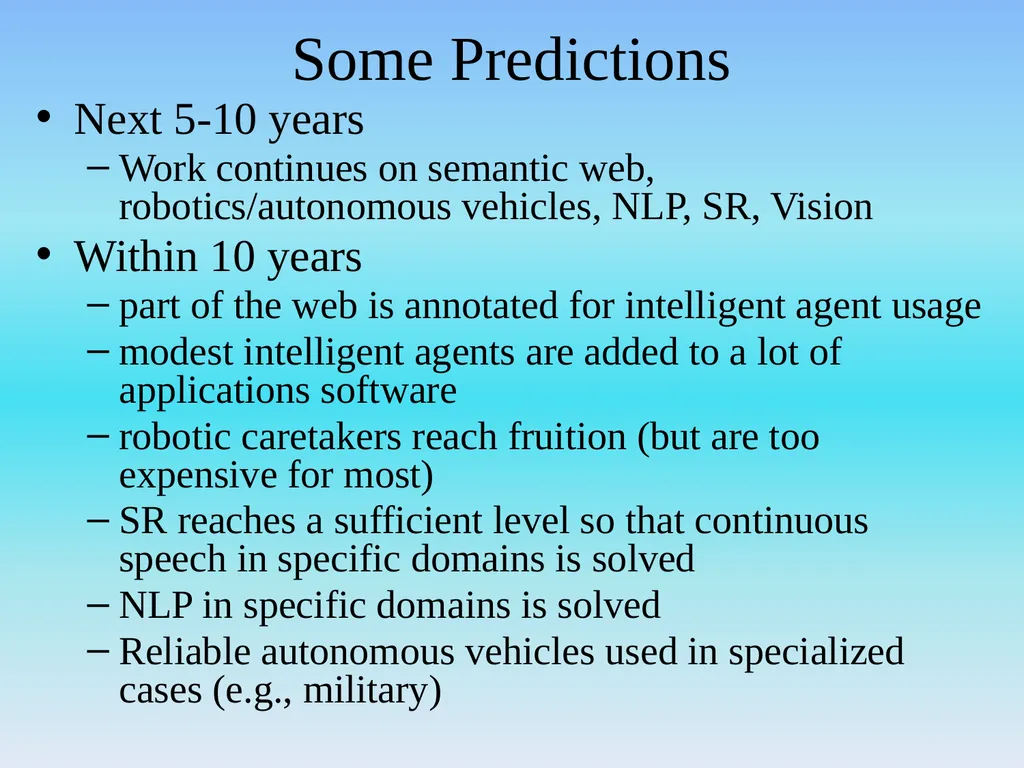
Some Predictions Next 5-10 years
Work continues on semantic web, robotics/autonomous vehicles, NLP, SR, Vision
Within 10 years
part of the web is annotated for intelligent agent usage
modest intelligent agents are added to a lot of applications software
robotic caretakers reach fruition (but are too expensive for most)
SR reaches a sufficient level so that continuous speech in specific domains is solved
NLP in specific domains is solved
Reliable autonomous vehicles used in specialized cases (e.g., military)<br>
Work continues on semantic web, robotics/autonomous vehicles, NLP, SR, Vision
Within 10 years
part of the web is annotated for intelligent agent usage
modest intelligent agents are added to a lot of applications software
robotic caretakers reach fruition (but are too expensive for most)
SR reaches a sufficient level so that continuous speech in specific domains is solved
NLP in specific domains is solved
Reliable autonomous vehicles used in specialized cases (e.g., military)<br>
15
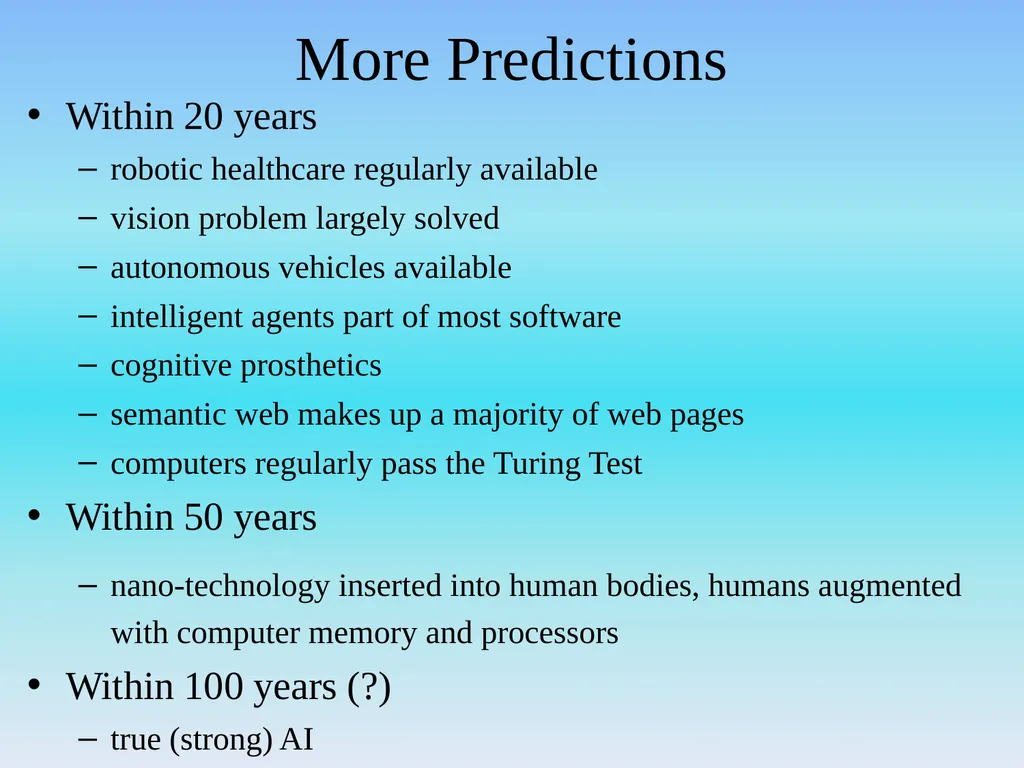
More Predictions Within 20 years
robotic healthcare regularly available
vision problem largely solved
autonomous vehicles available
intelligent agents part of most software
cognitive prosthetics
semantic web makes up a majority of web pages
computers regularly pass the Turing Test
Within 50 years
nano-technology inserted into human bodies, humans augmented with computer memory and processors
Within 100 years (?)
true (strong) AI<br>
robotic healthcare regularly available
vision problem largely solved
autonomous vehicles available
intelligent agents part of most software
cognitive prosthetics
semantic web makes up a majority of web pages
computers regularly pass the Turing Test
Within 50 years
nano-technology inserted into human bodies, humans augmented with computer memory and processors
Within 100 years (?)
true (strong) AI<br>
16
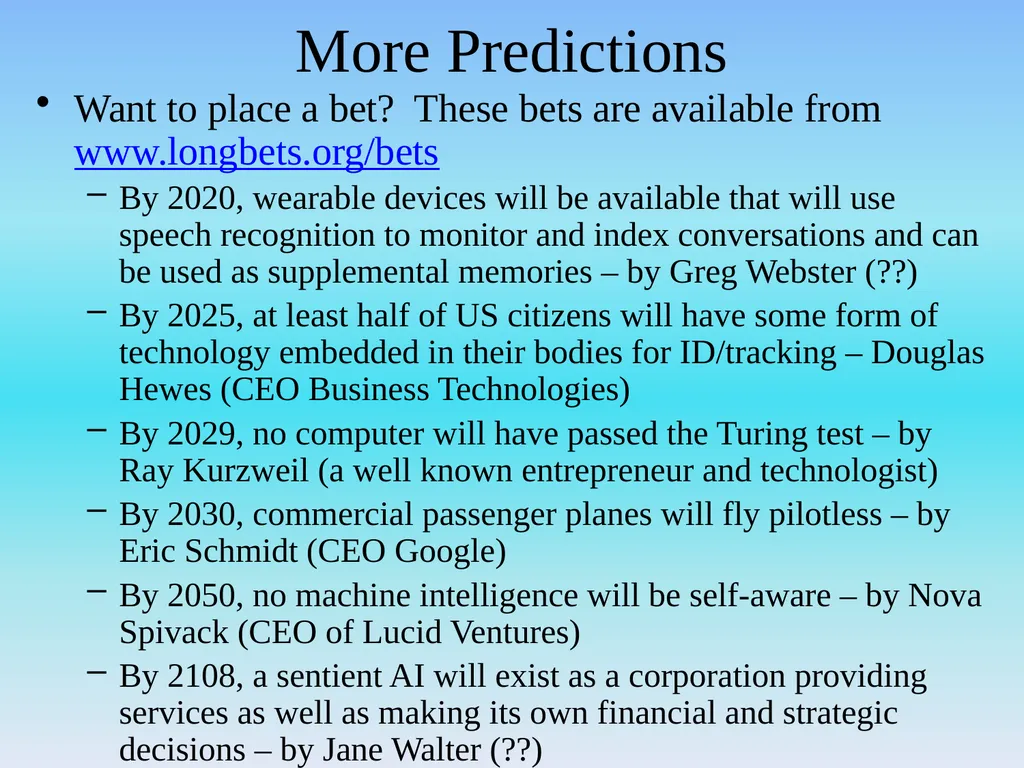
More Predictions Want to place a bet? These bets are available from www.longbets.org/bets
By 2020, wearable devices will be available that will use speech recognition to monitor and index conversations and can be used as supplemental memories – by Greg Webster (??)
By 2025, at least half of US citizens will have some form of technology embedded in their bodies for ID/tracking – Douglas Hewes (CEO Business Technologies)
By 2029, no computer will have passed the Turing test – by Ray Kurzweil (a well known entrepreneur and technologist)
By 2030, commercial passenger planes will fly pilotless – by Eric Schmidt (CEO Google)
By 2050, no machine intelligence will be self-aware – by Nova Spivack (CEO of Lucid Ventures)
By 2108, a sentient AI will exist as a corporation providing services as well as making its own financial and strategic decisions – by Jane Walter (??)<br>
By 2020, wearable devices will be available that will use speech recognition to monitor and index conversations and can be used as supplemental memories – by Greg Webster (??)
By 2025, at least half of US citizens will have some form of technology embedded in their bodies for ID/tracking – Douglas Hewes (CEO Business Technologies)
By 2029, no computer will have passed the Turing test – by Ray Kurzweil (a well known entrepreneur and technologist)
By 2030, commercial passenger planes will fly pilotless – by Eric Schmidt (CEO Google)
By 2050, no machine intelligence will be self-aware – by Nova Spivack (CEO of Lucid Ventures)
By 2108, a sentient AI will exist as a corporation providing services as well as making its own financial and strategic decisions – by Jane Walter (??)<br>
17
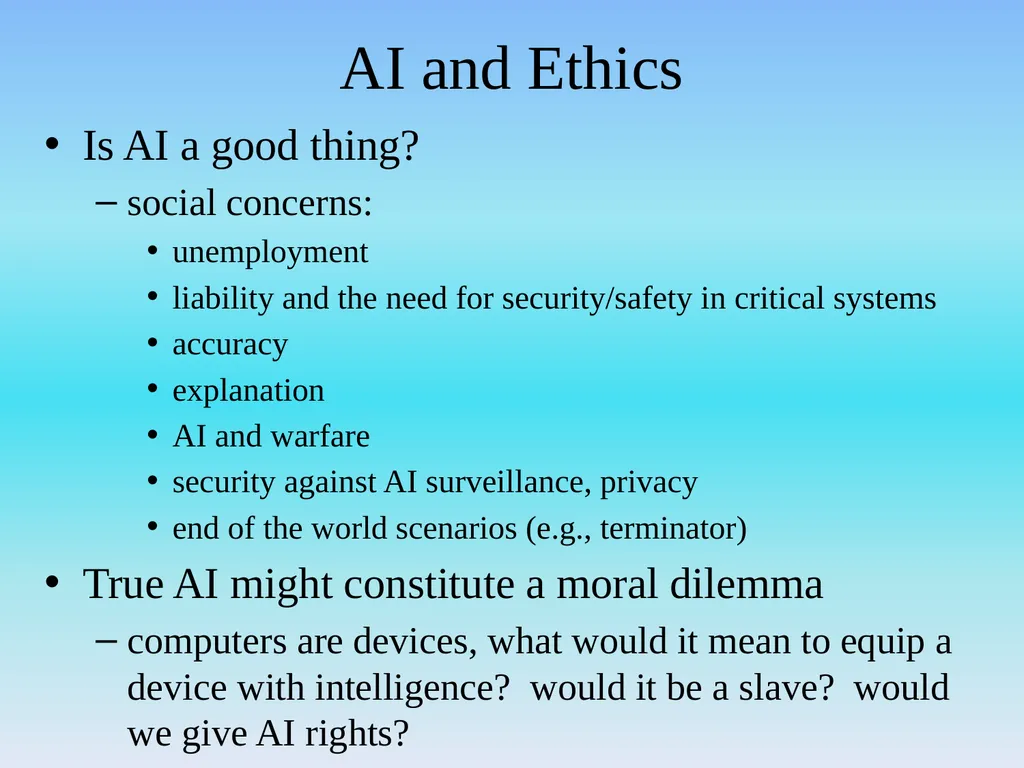
AI and Ethics Is AI a good thing?
social concerns:
unemployment
liability and the need for security/safety in critical systems
accuracy
explanation
AI and warfare
security against AI surveillance, privacy
end of the world scenarios (e.g., terminator)
True AI might constitute a moral dilemma
computers are devices, what would it mean to equip a device with intelligence? would it be a slave? would we give AI rights?<br>
social concerns:
unemployment
liability and the need for security/safety in critical systems
accuracy
explanation
AI and warfare
security against AI surveillance, privacy
end of the world scenarios (e.g., terminator)
True AI might constitute a moral dilemma
computers are devices, what would it mean to equip a device with intelligence? would it be a slave? would we give AI rights?<br>