
AICE: GP-9/Pavich 2012-2013 Writing the AICE
MJ
Published · 70 slides · 0 views

1 / 1
Description
AICE: GP-9Pavich 2012-2013 Writing the AICE General Paper: AN OVERVIEW Credits: Jill Pavich, NBCT edupavichyahoo.com AICE: General Paper (8004), grade 9 Boca Raton Community High School PowerPoint Credits (2012): Jill Pavich, NBCT Boca
Related Topics
Share
Embed code
Download this presentation From Below
"AICE: GP-9/Pavich 2012-2013 Writing the AICE" is the property of its rightful owner. Permission is granted to download and print the materials on this website for personal, non-commercial use only, and to display it on your personal computer provided you do not modify the materials and that you retain all copyright notices contained in the materials. By downloading content from our website, you accept the terms of this agreement.
Presentation Transcript
01
AICE: GP-9/Pavich
2012-2013 Writing the AICE General Paper: AN OVERVIEW Credits: Jill Pavich, NBCT edupavich@yahoo.com
AICE: General Paper (8004), grade 9 @ Boca Raton Community High School<br>
2012-2013 Writing the AICE General Paper: AN OVERVIEW Credits: Jill Pavich, NBCT edupavich@yahoo.com
AICE: General Paper (8004), grade 9 @ Boca Raton Community High School<br>
02
PowerPoint Credits (2012): Jill Pavich, NBCT
Boca Raton Community High School, team collaboration
Sources:
Teaching the General Paper: Strategies That Work, By Teachers, For Teachers. National Institute of Education, Nanyang Technological University. Edited by Caroline Ho, Peter Teo, Tay May Yin (2006) Currently out of print
Cambridge International Exams, AICE Program at Cambridge University
www.cie.org.uk/qualifications/academic/uppersec/alevel<br>
Boca Raton Community High School, team collaboration
Sources:
Teaching the General Paper: Strategies That Work, By Teachers, For Teachers. National Institute of Education, Nanyang Technological University. Edited by Caroline Ho, Peter Teo, Tay May Yin (2006) Currently out of print
Cambridge International Exams, AICE Program at Cambridge University
www.cie.org.uk/qualifications/academic/uppersec/alevel<br>
03
Day 1
Initial activity Learning the Ways of GP <br>
Initial activity Learning the Ways of GP <br>
04
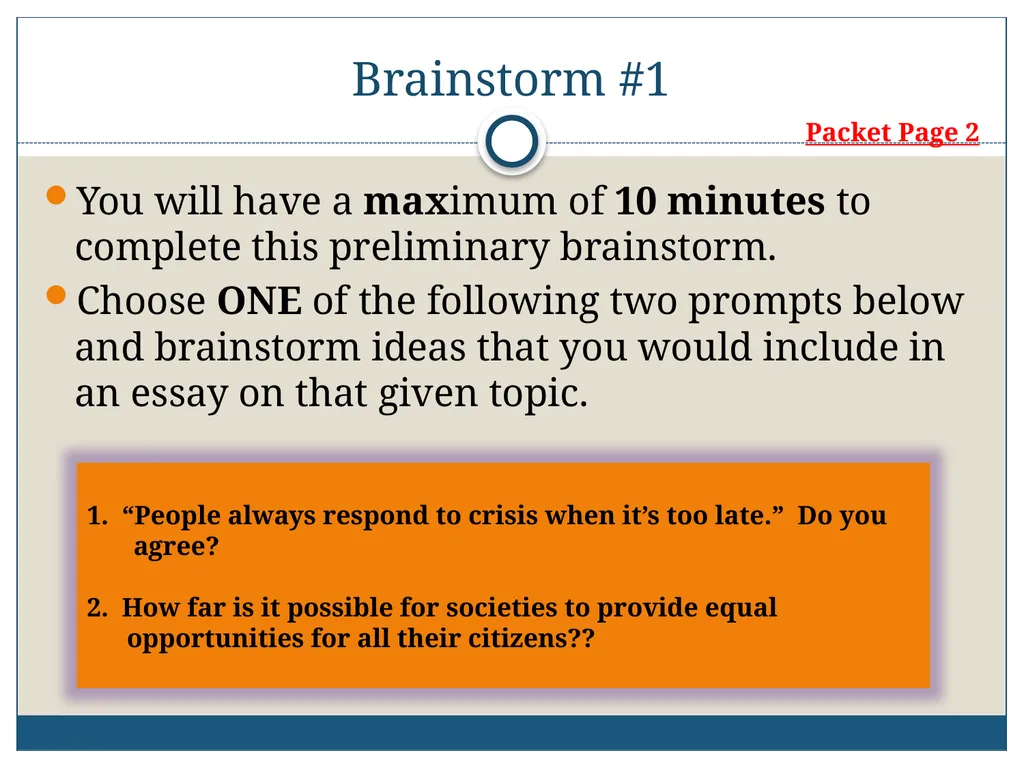
Brainstorm #1 You will have a maximum of 10 minutes to complete this preliminary brainstorm.
Choose ONE of the following two prompts below and brainstorm ideas that you would include in an essay on that given topic. 1. “People always respond to crisis when it’s too late.” Do you agree?
2. How far is it possible for societies to provide equal opportunities for all their citizens?? Packet Page 2<br>
Choose ONE of the following two prompts below and brainstorm ideas that you would include in an essay on that given topic. 1. “People always respond to crisis when it’s too late.” Do you agree?
2. How far is it possible for societies to provide equal opportunities for all their citizens?? Packet Page 2<br>
05
Brainstorm #1: Take a look at your brainstorm; now share some of your ideas with the class.
Consider the ideas we’ve shared…what ideas (those we’ve listed on the board), would sound super clever in an essay? Which are our favorites?
Why? What characteristics do these ideas have in common that would make them the “best” points to raise in an essay?<br>
Consider the ideas we’ve shared…what ideas (those we’ve listed on the board), would sound super clever in an essay? Which are our favorites?
Why? What characteristics do these ideas have in common that would make them the “best” points to raise in an essay?<br>
06
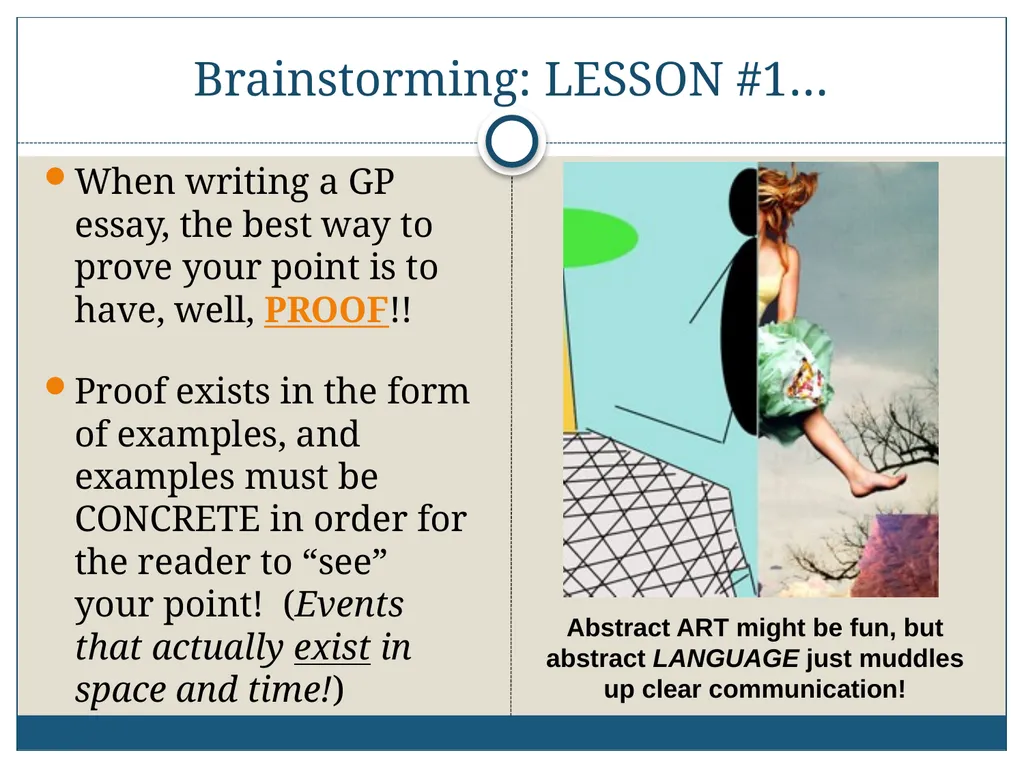
Brainstorming: LESSON #1… When writing a GP essay, the best way to prove your point is to have, well, PROOF!!
Proof exists in the form of examples, and examples must be CONCRETE in order for the reader to “see” your point! (Events that actually exist in space and time!) Abstract ART might be fun, but abstract LANGUAGE just muddles up clear communication!<br>
Proof exists in the form of examples, and examples must be CONCRETE in order for the reader to “see” your point! (Events that actually exist in space and time!) Abstract ART might be fun, but abstract LANGUAGE just muddles up clear communication!<br>
07
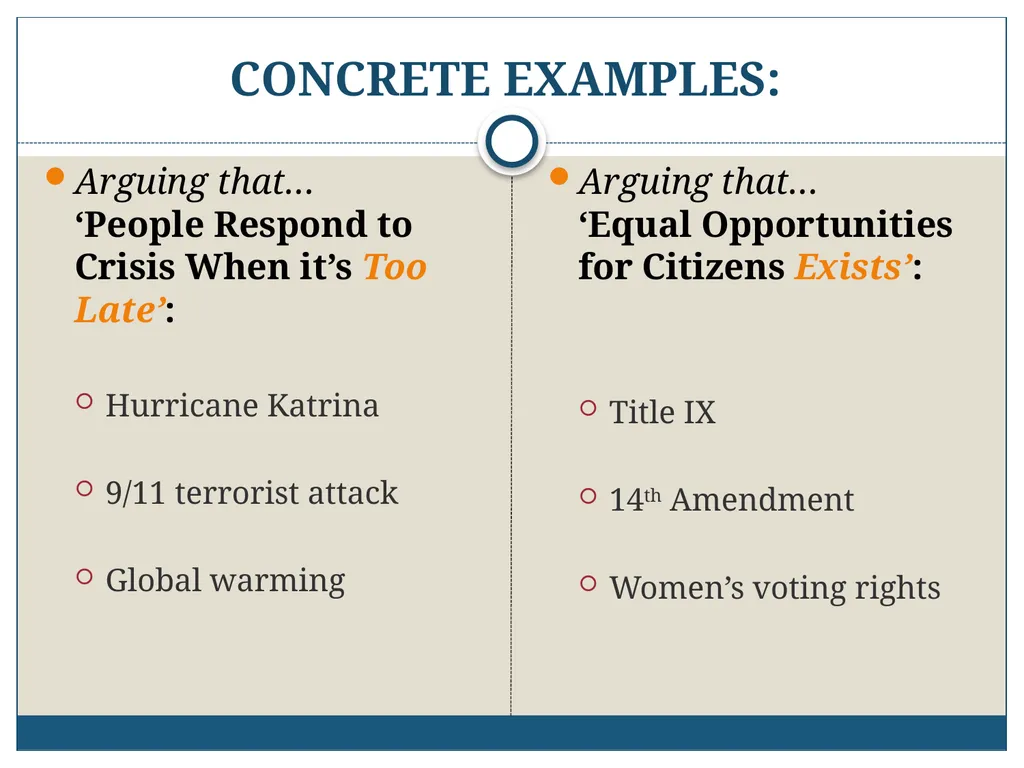
CONCRETE EXAMPLES: Arguing that… ‘People Respond to Crisis When it’s Too Late’:
Hurricane Katrina
9/11 terrorist attack
Global warming Arguing that… ‘Equal Opportunities for Citizens Exists’:
Title IX
14th Amendment
Women’s voting rights<br>
Hurricane Katrina
9/11 terrorist attack
Global warming Arguing that… ‘Equal Opportunities for Citizens Exists’:
Title IX
14th Amendment
Women’s voting rights<br>
08
CONCRETE EXAMPLES Con’t: TURN TO YOUR PARTNER:
Now come up with as many concrete examples as you can to prove the opposite side of the arguments we discussed on the previous slide.
“It’s possible for people to respond to crisis BEFORE it’s too late. For example…”
“Society DOESN’T always provide equal opportunity for all citizens. For instance, …”<br>
Now come up with as many concrete examples as you can to prove the opposite side of the arguments we discussed on the previous slide.
“It’s possible for people to respond to crisis BEFORE it’s too late. For example…”
“Society DOESN’T always provide equal opportunity for all citizens. For instance, …”<br>
09
DayS 2-3
The cambridge test…
what does it look like?
What does it want from me? What is “GP” ???<br>
The cambridge test…
what does it look like?
What does it want from me? What is “GP” ???<br>
10
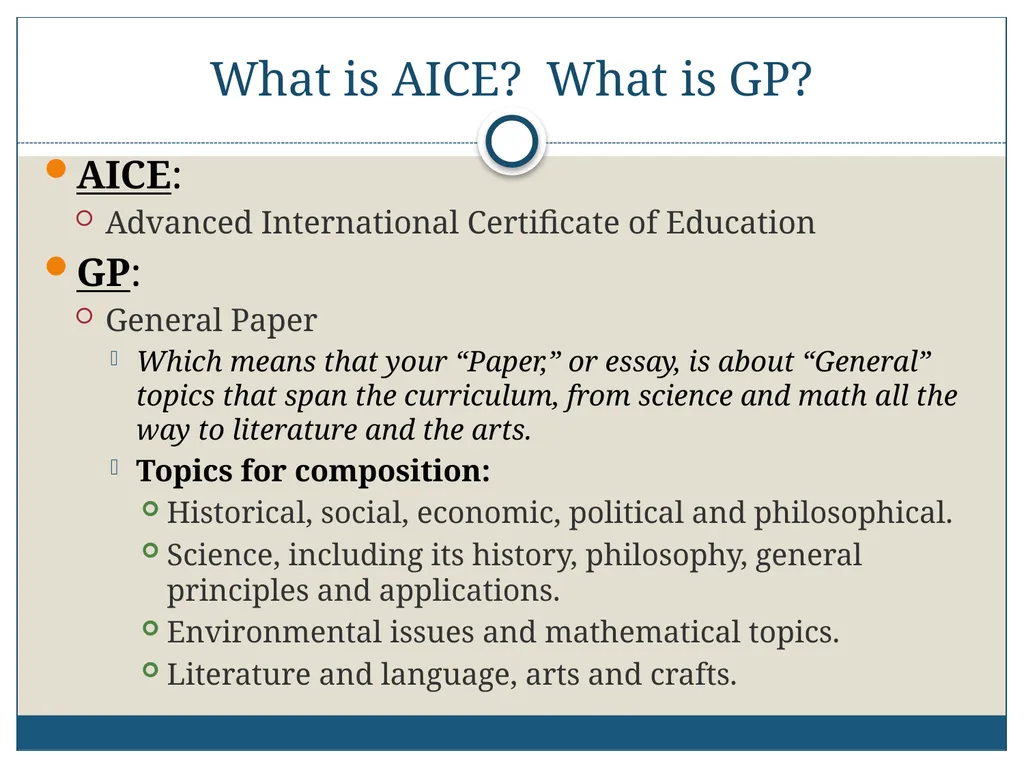
What is AICE? What is GP? AICE:
Advanced International Certificate of Education
GP:
General Paper
Which means that your “Paper,” or essay, is about “General” topics that span the curriculum, from science and math all the way to literature and the arts.
Topics for composition:
Historical, social, economic, political and philosophical.
Science, including its history, philosophy, general principles and applications.
Environmental issues and mathematical topics.
Literature and language, arts and crafts.<br>
Advanced International Certificate of Education
GP:
General Paper
Which means that your “Paper,” or essay, is about “General” topics that span the curriculum, from science and math all the way to literature and the arts.
Topics for composition:
Historical, social, economic, political and philosophical.
Science, including its history, philosophy, general principles and applications.
Environmental issues and mathematical topics.
Literature and language, arts and crafts.<br>
11
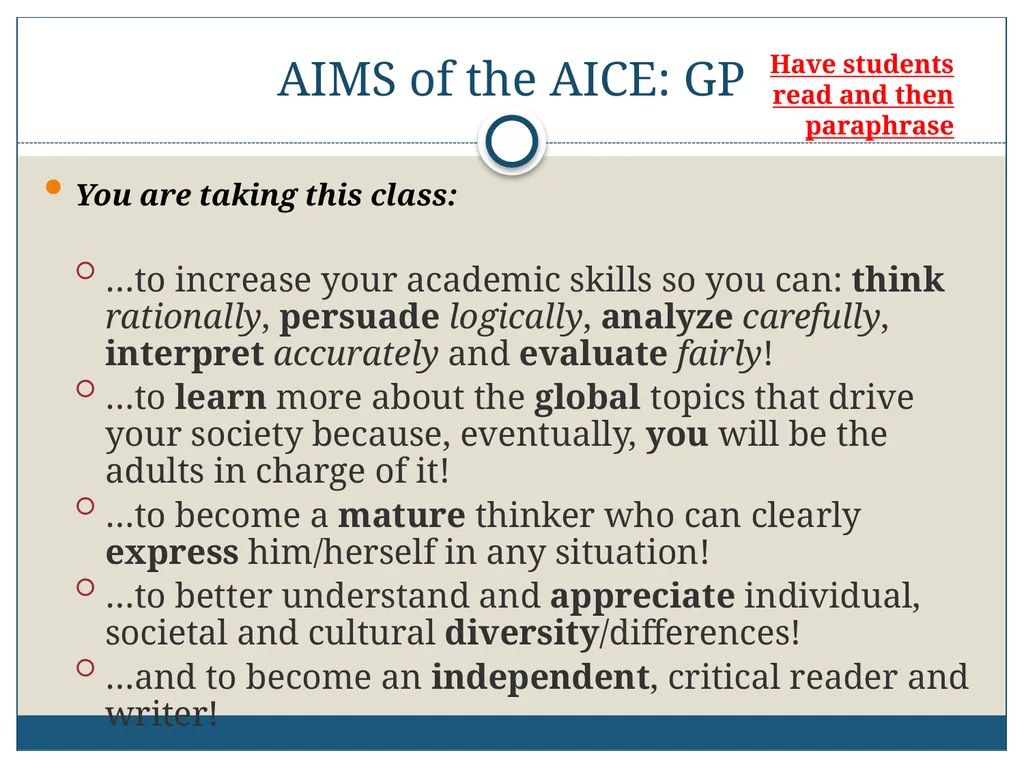
AIMS of the AICE: GP You are taking this class:
…to increase your academic skills so you can: think rationally, persuade logically, analyze carefully, interpret accurately and evaluate fairly!
…to learn more about the global topics that drive your society because, eventually, you will be the adults in charge of it!
…to become a mature thinker who can clearly express him/herself in any situation!
…to better understand and appreciate individual, societal and cultural diversity/differences!
…and to become an independent, critical reader and writer! Have students read and then paraphrase<br>
…to increase your academic skills so you can: think rationally, persuade logically, analyze carefully, interpret accurately and evaluate fairly!
…to learn more about the global topics that drive your society because, eventually, you will be the adults in charge of it!
…to become a mature thinker who can clearly express him/herself in any situation!
…to better understand and appreciate individual, societal and cultural diversity/differences!
…and to become an independent, critical reader and writer! Have students read and then paraphrase<br>
12
AIMS OF THE GP… What is the point of this class again?
Put it into your own words…
Those of you that can articulate it back to me best will WIN my favor for the day (and maybe a bonus point or two or some other guilty treat ;-)<br>
Put it into your own words…
Those of you that can articulate it back to me best will WIN my favor for the day (and maybe a bonus point or two or some other guilty treat ;-)<br>
13
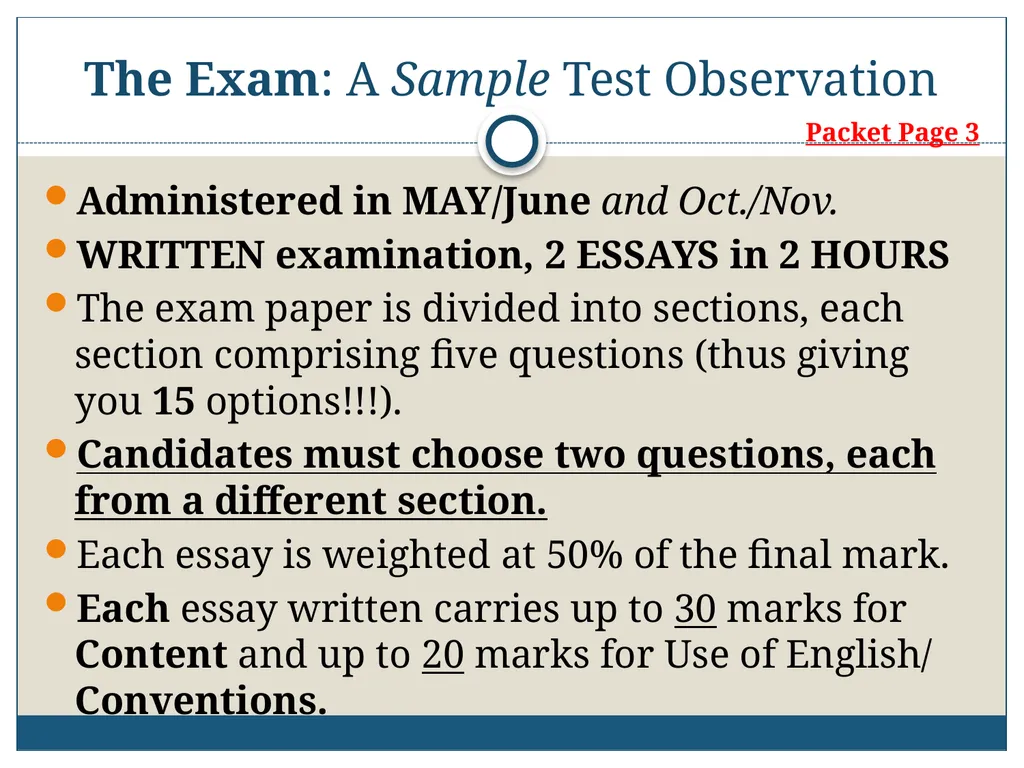
The Exam: A Sample Test Observation Administered in MAY/June and Oct./Nov.
WRITTEN examination, 2 ESSAYS in 2 HOURS
The exam paper is divided into sections, each section comprising five questions (thus giving you 15 options!!!).
Candidates must choose two questions, each from a different section.
Each essay is weighted at 50% of the final mark.
Each essay written carries up to 30 marks for Content and up to 20 marks for Use of English/ Conventions. Packet Page 3<br>
WRITTEN examination, 2 ESSAYS in 2 HOURS
The exam paper is divided into sections, each section comprising five questions (thus giving you 15 options!!!).
Candidates must choose two questions, each from a different section.
Each essay is weighted at 50% of the final mark.
Each essay written carries up to 30 marks for Content and up to 20 marks for Use of English/ Conventions. Packet Page 3<br>
14
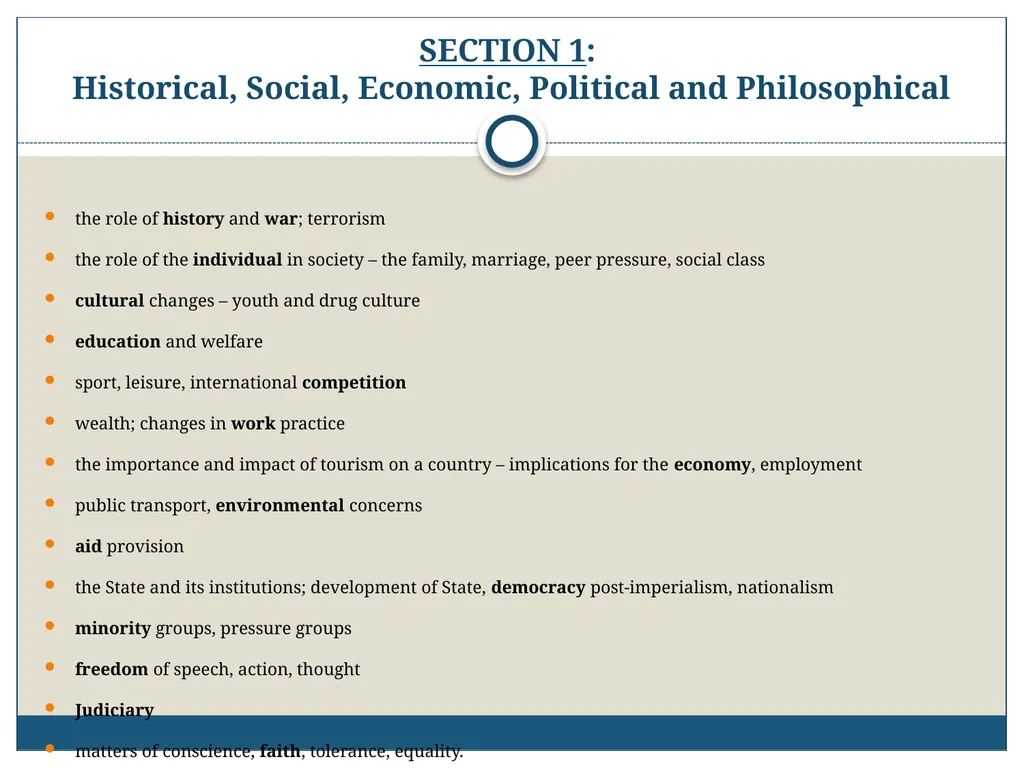
SECTION 1:
Historical, Social, Economic, Political and Philosophical the role of history and war; terrorism
the role of the individual in society – the family, marriage, peer pressure, social class
cultural changes – youth and drug culture
education and welfare
sport, leisure, international competition
wealth; changes in work practice
the importance and impact of tourism on a country – implications for the economy, employment
public transport, environmental concerns
aid provision
the State and its institutions; development of State, democracy post-imperialism, nationalism
minority groups, pressure groups
freedom of speech, action, thought
Judiciary
matters of conscience, faith, tolerance, equality.<br>
the role of the individual in society – the family, marriage, peer pressure, social class
cultural changes – youth and drug culture
education and welfare
sport, leisure, international competition
wealth; changes in work practice
the importance and impact of tourism on a country – implications for the economy, employment
public transport, environmental concerns
aid provision
the State and its institutions; development of State, democracy post-imperialism, nationalism
minority groups, pressure groups
freedom of speech, action, thought
Judiciary
matters of conscience, faith, tolerance, equality.<br>
15
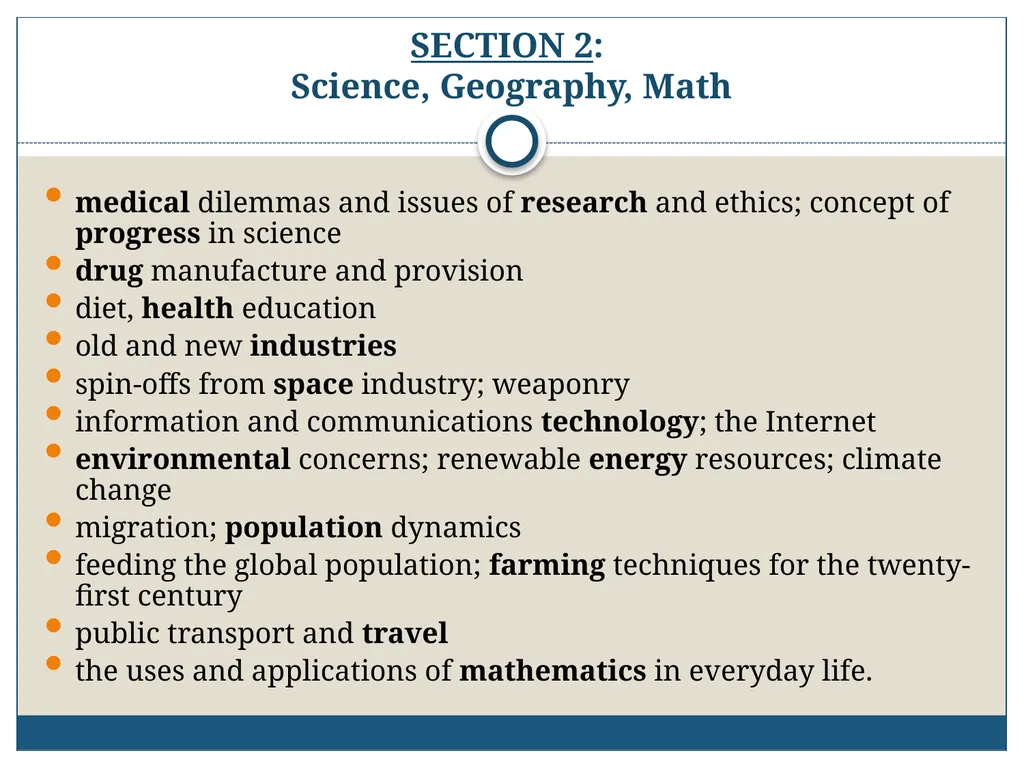
SECTION 2:
Science, Geography, Math medical dilemmas and issues of research and ethics; concept of progress in science
drug manufacture and provision
diet, health education
old and new industries
spin-offs from space industry; weaponry
information and communications technology; the Internet
environmental concerns; renewable energy resources; climate change
migration; population dynamics
feeding the global population; farming techniques for the twenty-first century
public transport and travel
the uses and applications of mathematics in everyday life.<br>
drug manufacture and provision
diet, health education
old and new industries
spin-offs from space industry; weaponry
information and communications technology; the Internet
environmental concerns; renewable energy resources; climate change
migration; population dynamics
feeding the global population; farming techniques for the twenty-first century
public transport and travel
the uses and applications of mathematics in everyday life.<br>
16
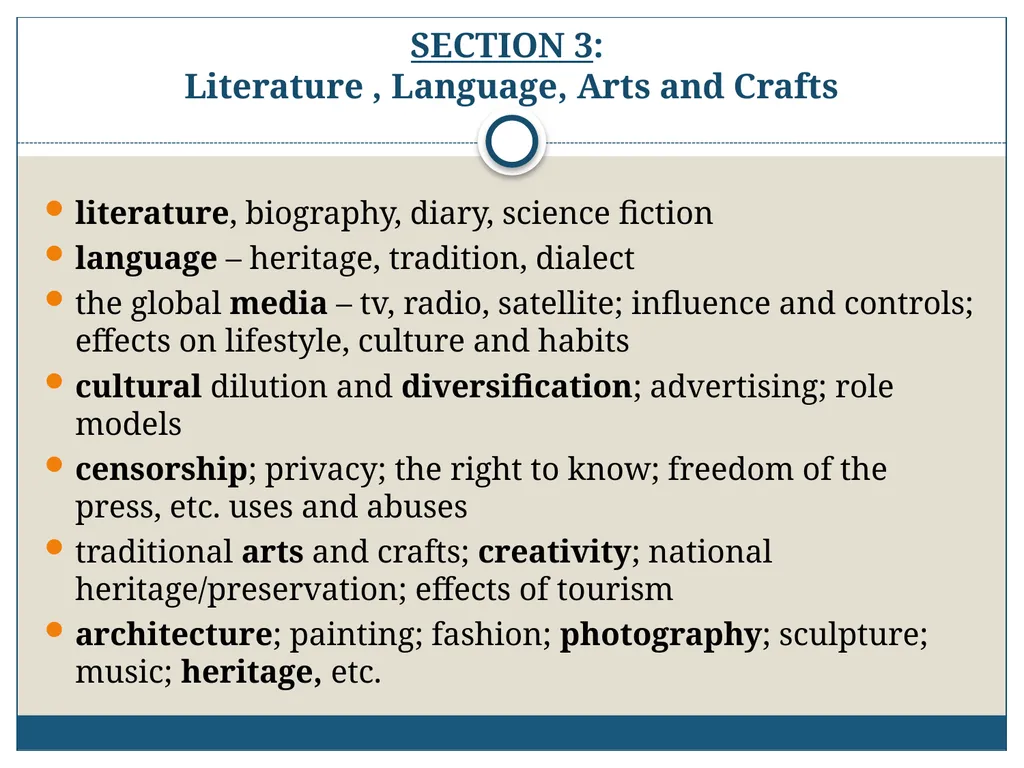
SECTION 3:
Literature , Language, Arts and Crafts literature, biography, diary, science fiction
language – heritage, tradition, dialect
the global media – tv, radio, satellite; influence and controls; effects on lifestyle, culture and habits
cultural dilution and diversification; advertising; role models
censorship; privacy; the right to know; freedom of the press, etc. uses and abuses
traditional arts and crafts; creativity; national heritage/preservation; effects of tourism
architecture; painting; fashion; photography; sculpture; music; heritage, etc.<br>
language – heritage, tradition, dialect
the global media – tv, radio, satellite; influence and controls; effects on lifestyle, culture and habits
cultural dilution and diversification; advertising; role models
censorship; privacy; the right to know; freedom of the press, etc. uses and abuses
traditional arts and crafts; creativity; national heritage/preservation; effects of tourism
architecture; painting; fashion; photography; sculpture; music; heritage, etc.<br>
17
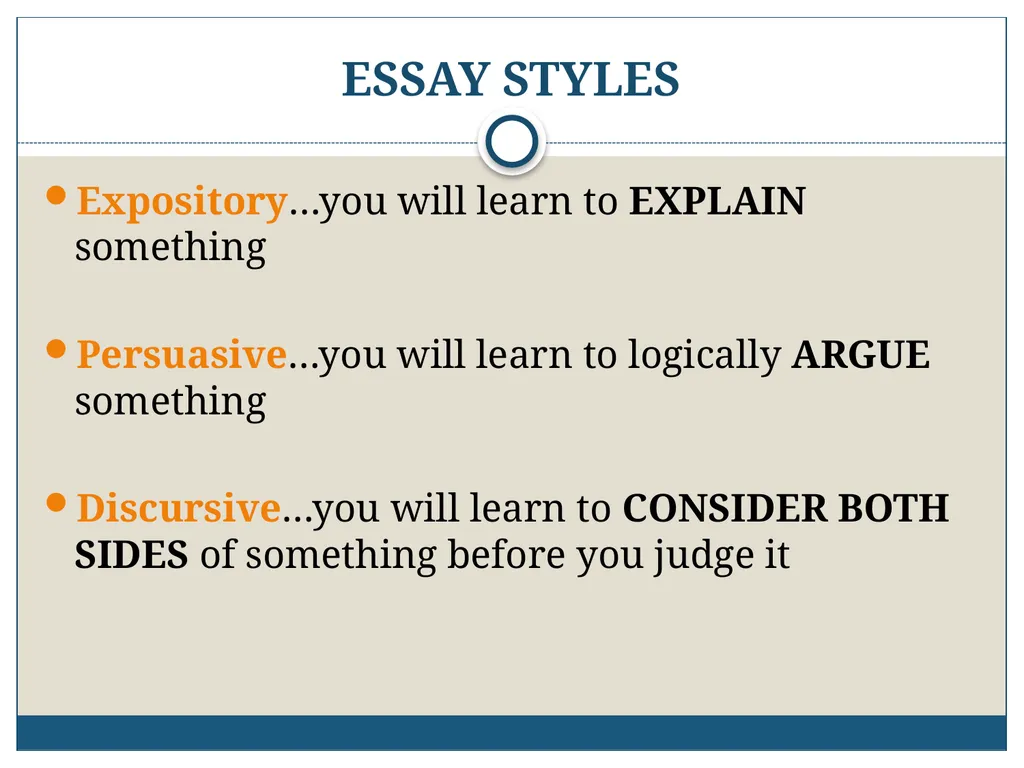
ESSAY STYLES Expository…you will learn to EXPLAIN something
Persuasive…you will learn to logically ARGUE something
Discursive…you will learn to CONSIDER BOTH SIDES of something before you judge it<br>
Persuasive…you will learn to logically ARGUE something
Discursive…you will learn to CONSIDER BOTH SIDES of something before you judge it<br>
18
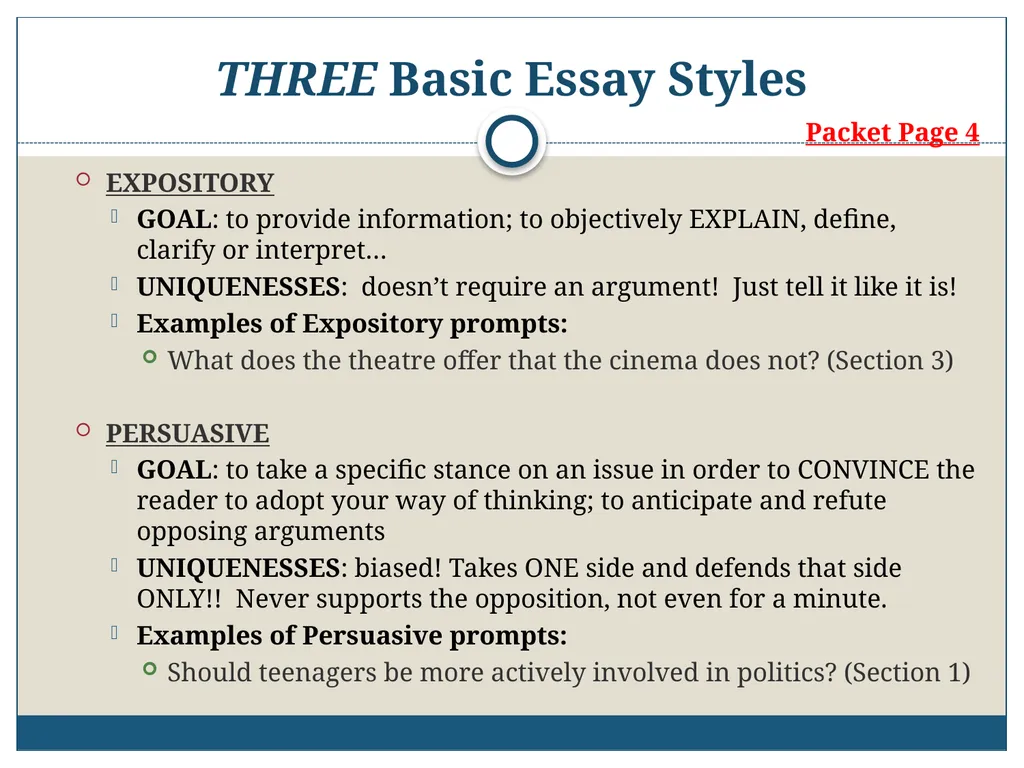
THREE Basic Essay Styles EXPOSITORY
GOAL: to provide information; to objectively EXPLAIN, define, clarify or interpret…
UNIQUENESSES: doesn’t require an argument! Just tell it like it is!
Examples of Expository prompts:
What does the theatre offer that the cinema does not? (Section 3)
PERSUASIVE
GOAL: to take a specific stance on an issue in order to CONVINCE the reader to adopt your way of thinking; to anticipate and refute opposing arguments
UNIQUENESSES: biased! Takes ONE side and defends that side ONLY!! Never supports the opposition, not even for a minute.
Examples of Persuasive prompts:
Should teenagers be more actively involved in politics? (Section 1) Packet Page 4<br>
GOAL: to provide information; to objectively EXPLAIN, define, clarify or interpret…
UNIQUENESSES: doesn’t require an argument! Just tell it like it is!
Examples of Expository prompts:
What does the theatre offer that the cinema does not? (Section 3)
PERSUASIVE
GOAL: to take a specific stance on an issue in order to CONVINCE the reader to adopt your way of thinking; to anticipate and refute opposing arguments
UNIQUENESSES: biased! Takes ONE side and defends that side ONLY!! Never supports the opposition, not even for a minute.
Examples of Persuasive prompts:
Should teenagers be more actively involved in politics? (Section 1) Packet Page 4<br>
19
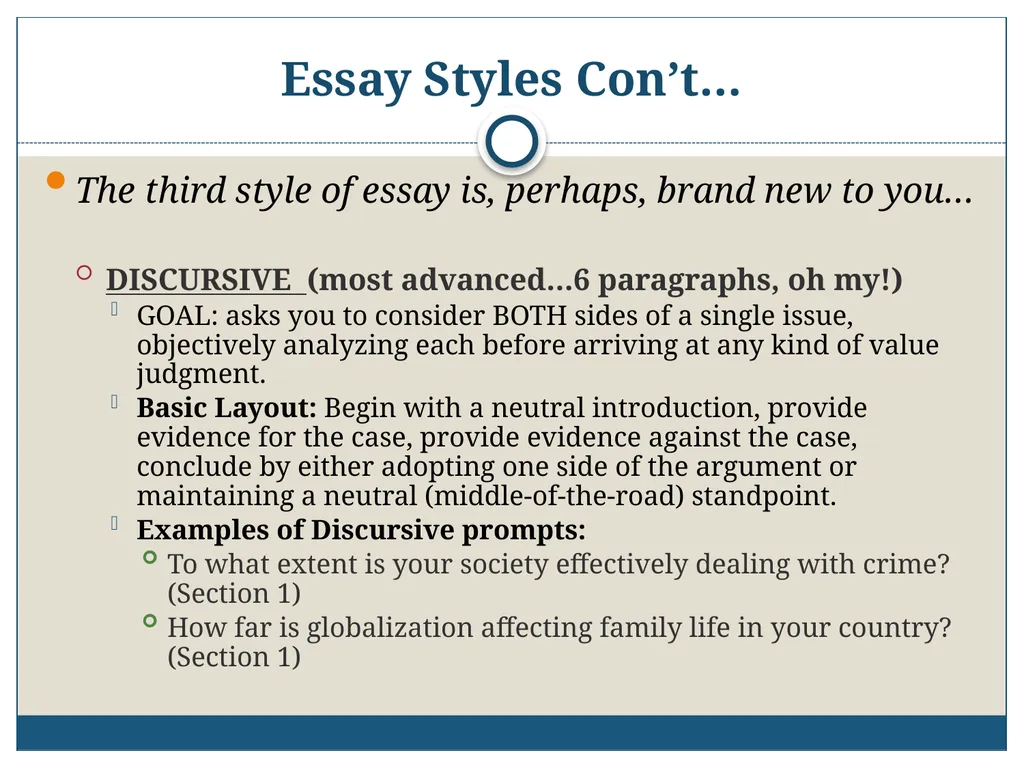
Essay Styles Con’t… The third style of essay is, perhaps, brand new to you…
DISCURSIVE (most advanced…6 paragraphs, oh my!)
GOAL: asks you to consider BOTH sides of a single issue, objectively analyzing each before arriving at any kind of value judgment.
Basic Layout: Begin with a neutral introduction, provide evidence for the case, provide evidence against the case, conclude by either adopting one side of the argument or maintaining a neutral (middle-of-the-road) standpoint.
Examples of Discursive prompts:
To what extent is your society effectively dealing with crime? (Section 1)
How far is globalization affecting family life in your country? (Section 1)<br>
DISCURSIVE (most advanced…6 paragraphs, oh my!)
GOAL: asks you to consider BOTH sides of a single issue, objectively analyzing each before arriving at any kind of value judgment.
Basic Layout: Begin with a neutral introduction, provide evidence for the case, provide evidence against the case, conclude by either adopting one side of the argument or maintaining a neutral (middle-of-the-road) standpoint.
Examples of Discursive prompts:
To what extent is your society effectively dealing with crime? (Section 1)
How far is globalization affecting family life in your country? (Section 1)<br>
20
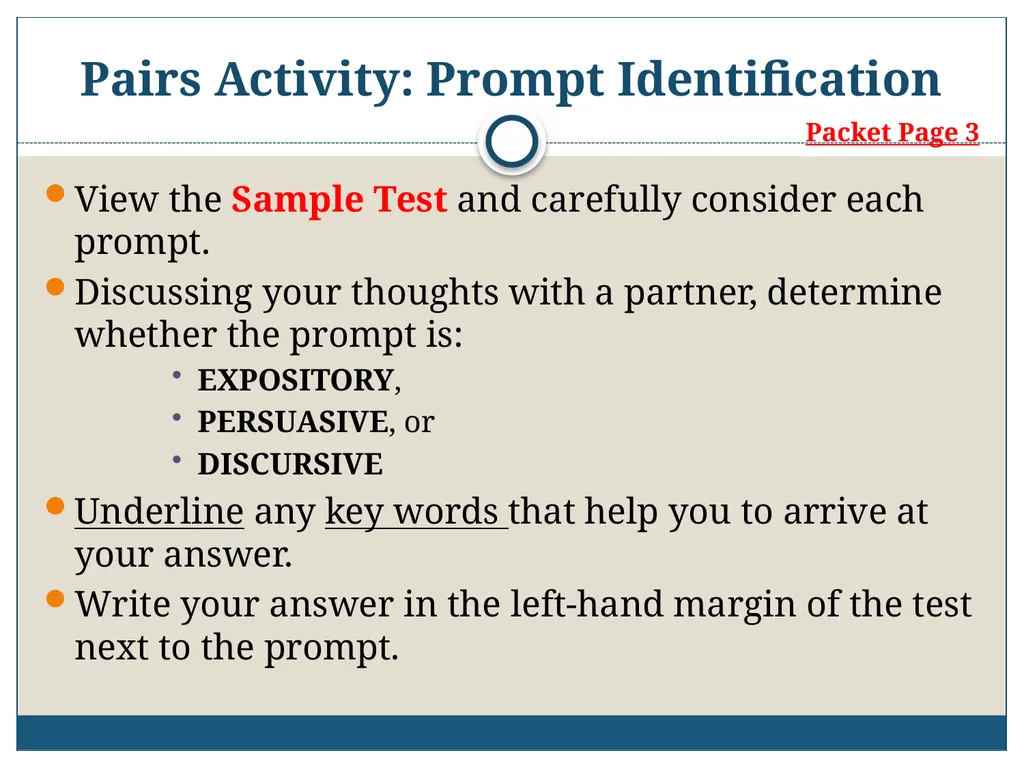
Pairs Activity: Prompt Identification View the Sample Test and carefully consider each prompt.
Discussing your thoughts with a partner, determine whether the prompt is:
EXPOSITORY,
PERSUASIVE, or
DISCURSIVE
Underline any key words that help you to arrive at your answer.
Write your answer in the left-hand margin of the test next to the prompt. Packet Page 3<br>
Discussing your thoughts with a partner, determine whether the prompt is:
EXPOSITORY,
PERSUASIVE, or
DISCURSIVE
Underline any key words that help you to arrive at your answer.
Write your answer in the left-hand margin of the test next to the prompt. Packet Page 3<br>
21
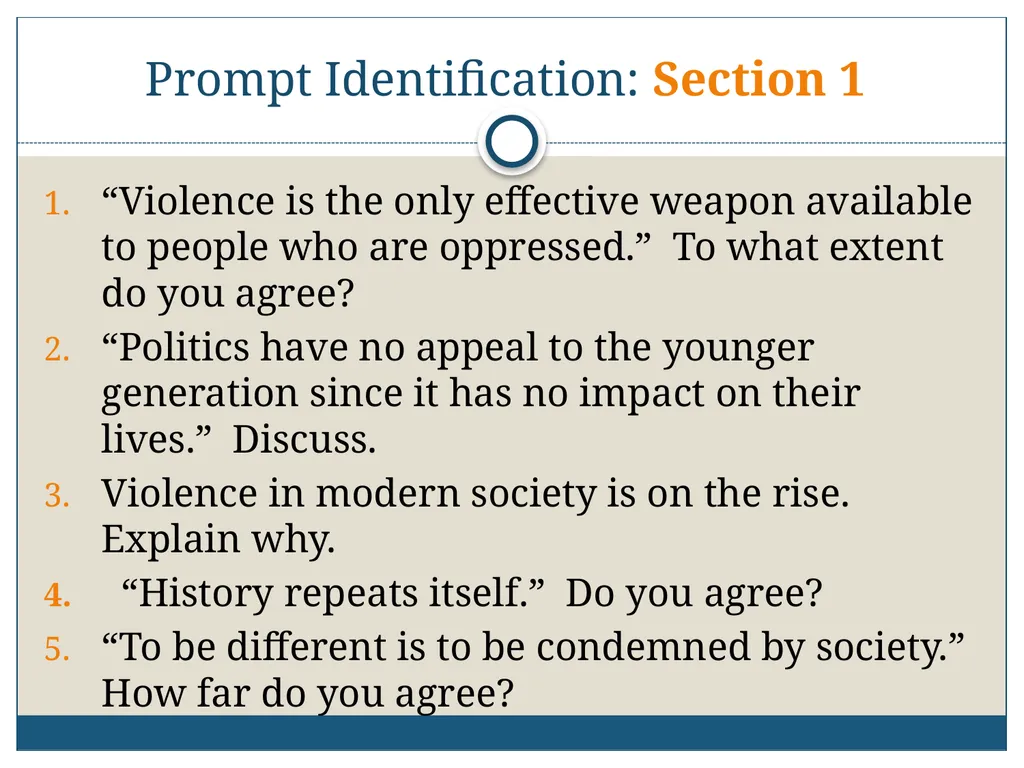
Prompt Identification: Section 1 “Violence is the only effective weapon available to people who are oppressed.” To what extent do you agree?
“Politics have no appeal to the younger generation since it has no impact on their lives.” Discuss.
Violence in modern society is on the rise. Explain why.
“History repeats itself.” Do you agree?
“To be different is to be condemned by society.” How far do you agree?<br>
“Politics have no appeal to the younger generation since it has no impact on their lives.” Discuss.
Violence in modern society is on the rise. Explain why.
“History repeats itself.” Do you agree?
“To be different is to be condemned by society.” How far do you agree?<br>
22
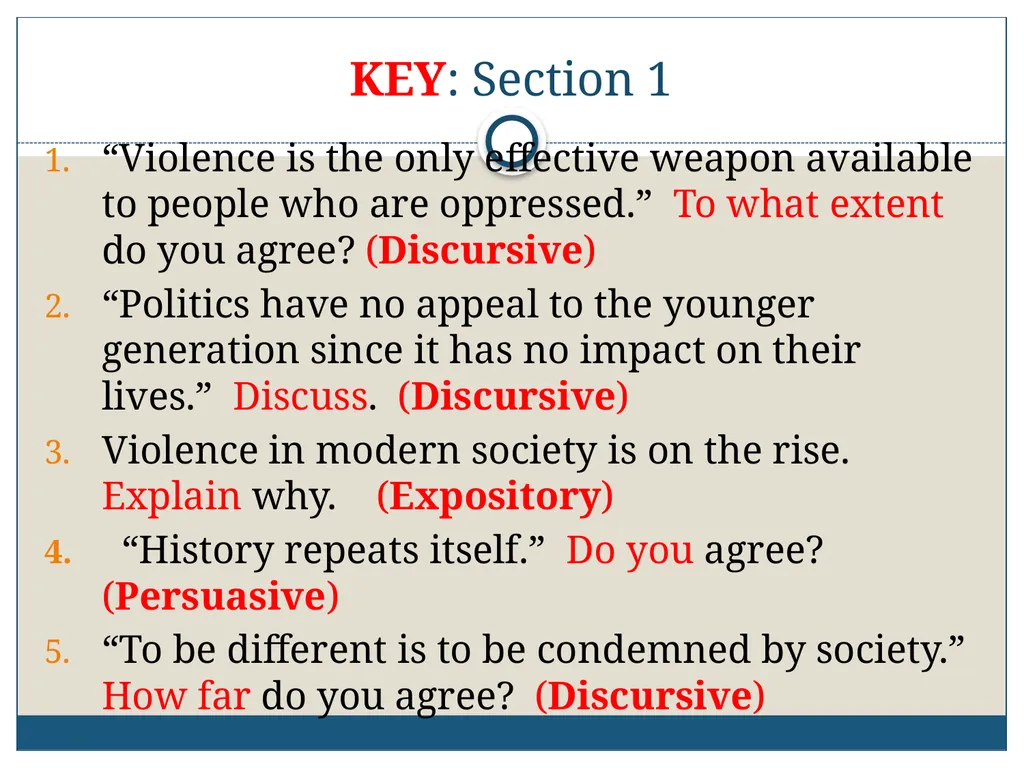
KEY: Section 1 “Violence is the only effective weapon available to people who are oppressed.” To what extent do you agree? (Discursive)
“Politics have no appeal to the younger generation since it has no impact on their lives.” Discuss. (Discursive)
Violence in modern society is on the rise. Explain why. (Expository)
“History repeats itself.” Do you agree? (Persuasive)
“To be different is to be condemned by society.” How far do you agree? (Discursive)<br>
“Politics have no appeal to the younger generation since it has no impact on their lives.” Discuss. (Discursive)
Violence in modern society is on the rise. Explain why. (Expository)
“History repeats itself.” Do you agree? (Persuasive)
“To be different is to be condemned by society.” How far do you agree? (Discursive)<br>
23
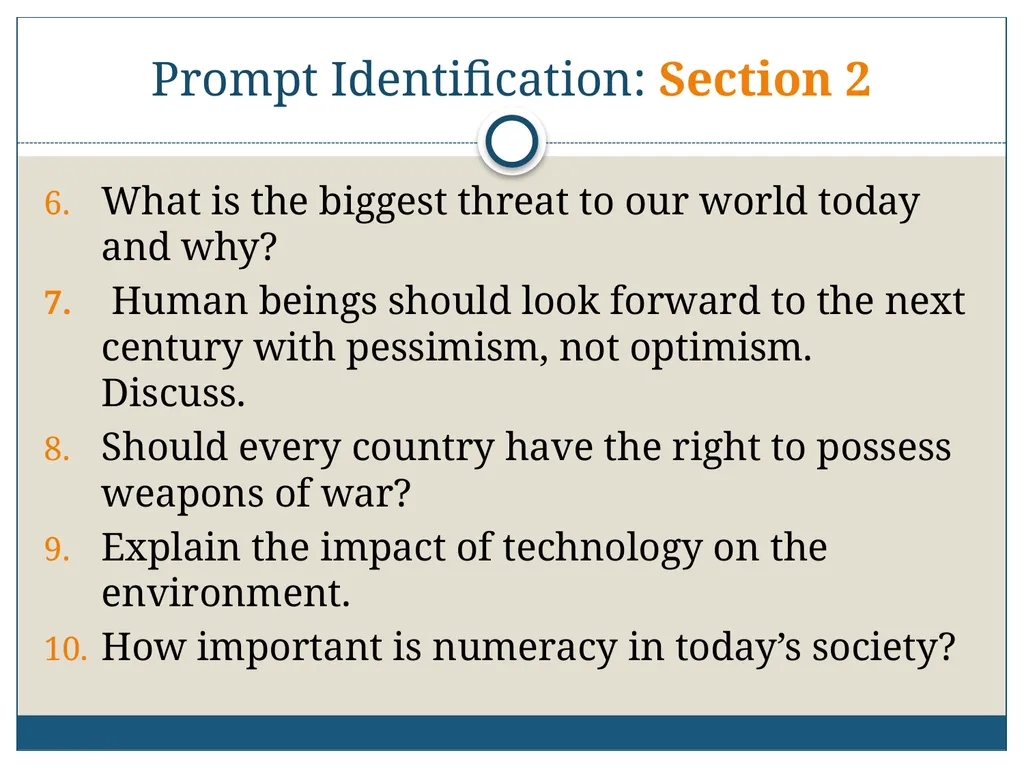
Prompt Identification: Section 2 What is the biggest threat to our world today and why?
Human beings should look forward to the next century with pessimism, not optimism. Discuss.
Should every country have the right to possess weapons of war?
Explain the impact of technology on the environment.
How important is numeracy in today’s society?<br>
Human beings should look forward to the next century with pessimism, not optimism. Discuss.
Should every country have the right to possess weapons of war?
Explain the impact of technology on the environment.
How important is numeracy in today’s society?<br>
24
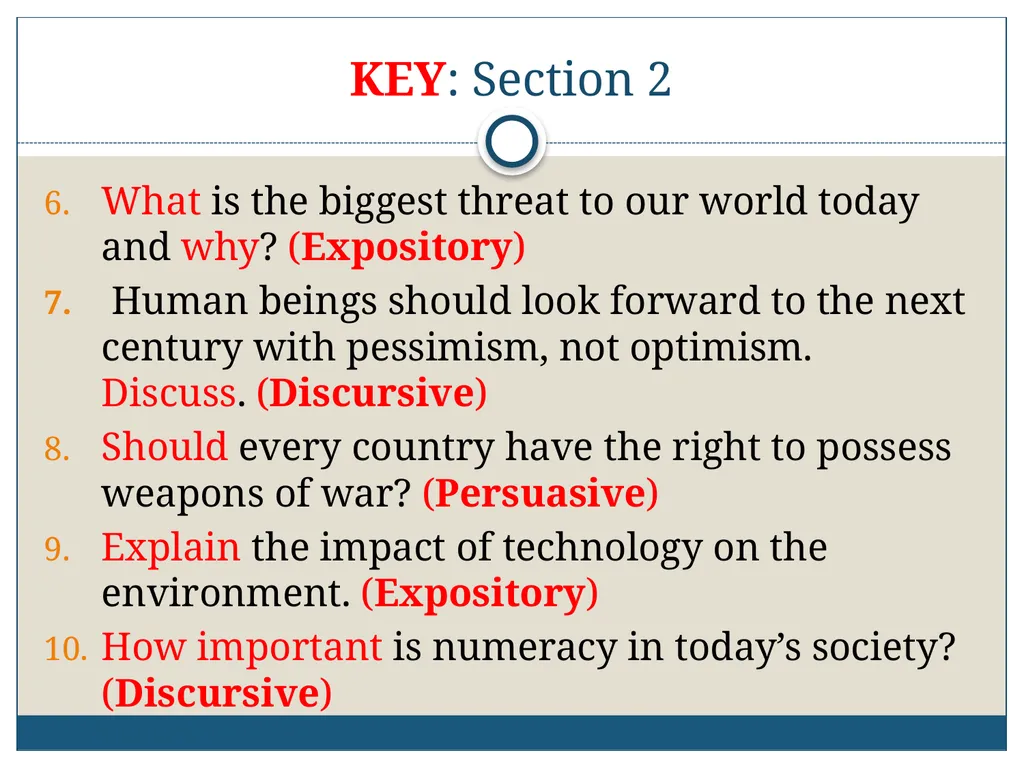
KEY: Section 2 What is the biggest threat to our world today and why? (Expository)
Human beings should look forward to the next century with pessimism, not optimism. Discuss. (Discursive)
Should every country have the right to possess weapons of war? (Persuasive)
Explain the impact of technology on the environment. (Expository)
How important is numeracy in today’s society? (Discursive)<br>
Human beings should look forward to the next century with pessimism, not optimism. Discuss. (Discursive)
Should every country have the right to possess weapons of war? (Persuasive)
Explain the impact of technology on the environment. (Expository)
How important is numeracy in today’s society? (Discursive)<br>
25
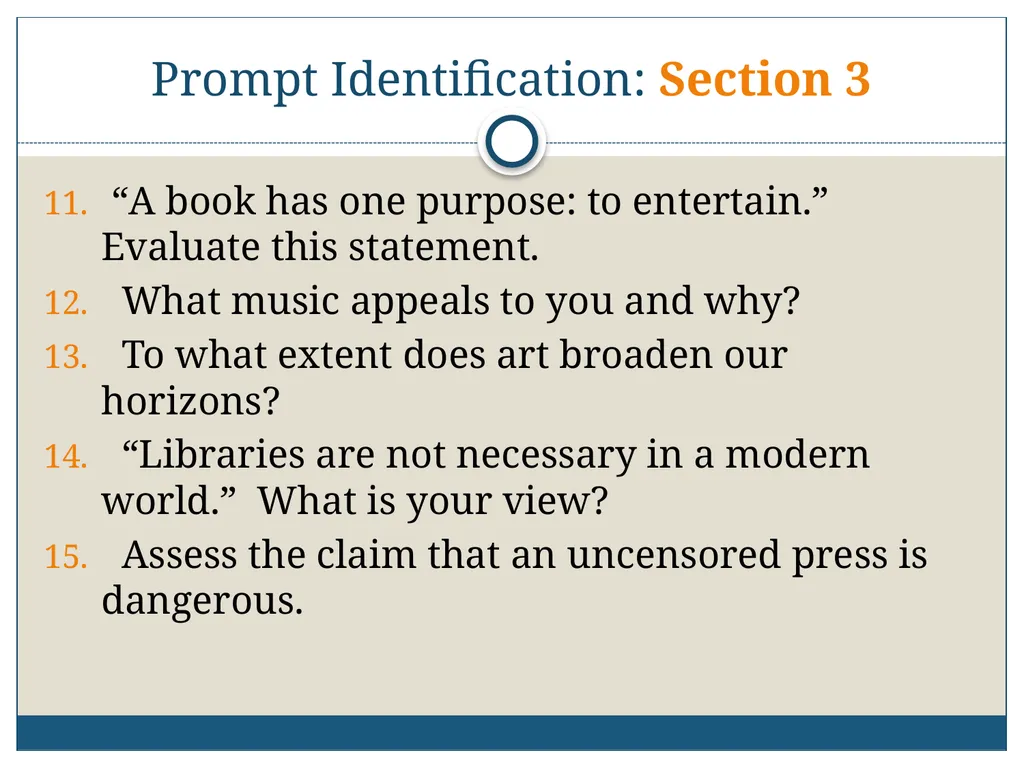
Prompt Identification: Section 3 “A book has one purpose: to entertain.” Evaluate this statement.
What music appeals to you and why?
To what extent does art broaden our horizons?
“Libraries are not necessary in a modern world.” What is your view?
Assess the claim that an uncensored press is dangerous.<br>
What music appeals to you and why?
To what extent does art broaden our horizons?
“Libraries are not necessary in a modern world.” What is your view?
Assess the claim that an uncensored press is dangerous.<br>
26
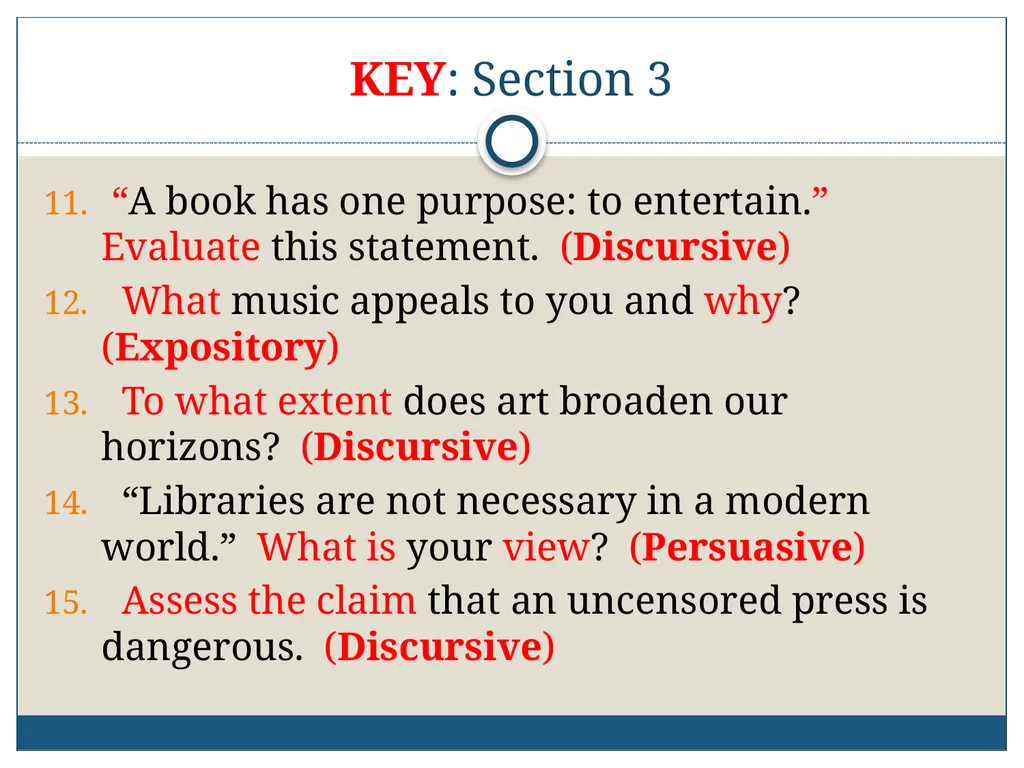
KEY: Section 3 “A book has one purpose: to entertain.” Evaluate this statement. (Discursive)
What music appeals to you and why? (Expository)
To what extent does art broaden our horizons? (Discursive)
“Libraries are not necessary in a modern world.” What is your view? (Persuasive)
Assess the claim that an uncensored press is dangerous. (Discursive)<br>
What music appeals to you and why? (Expository)
To what extent does art broaden our horizons? (Discursive)
“Libraries are not necessary in a modern world.” What is your view? (Persuasive)
Assess the claim that an uncensored press is dangerous. (Discursive)<br>
27
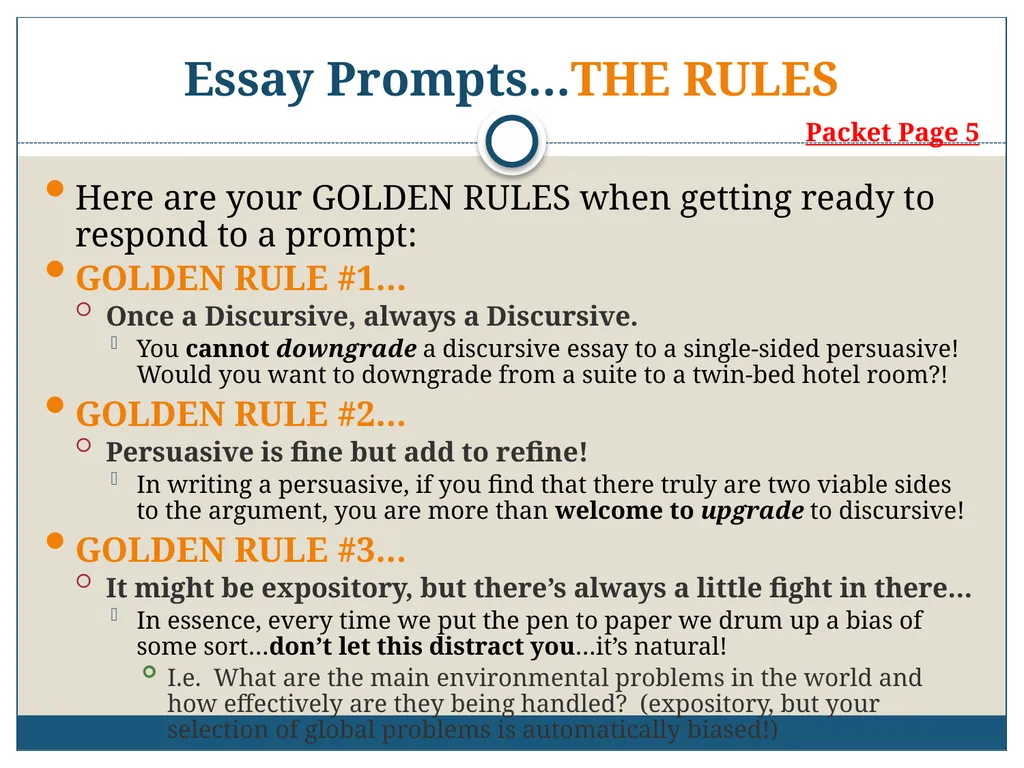
Essay Prompts…THE RULES Here are your GOLDEN RULES when getting ready to respond to a prompt:
GOLDEN RULE #1…
Once a Discursive, always a Discursive.
You cannot downgrade a discursive essay to a single-sided persuasive! Would you want to downgrade from a suite to a twin-bed hotel room?!
GOLDEN RULE #2…
Persuasive is fine but add to refine!
In writing a persuasive, if you find that there truly are two viable sides to the argument, you are more than welcome to upgrade to discursive!
GOLDEN RULE #3…
It might be expository, but there’s always a little fight in there…
In essence, every time we put the pen to paper we drum up a bias of some sort…don’t let this distract you…it’s natural!
I.e. What are the main environmental problems in the world and how effectively are they being handled? (expository, but your selection of global problems is automatically biased!) Packet Page 5<br>
GOLDEN RULE #1…
Once a Discursive, always a Discursive.
You cannot downgrade a discursive essay to a single-sided persuasive! Would you want to downgrade from a suite to a twin-bed hotel room?!
GOLDEN RULE #2…
Persuasive is fine but add to refine!
In writing a persuasive, if you find that there truly are two viable sides to the argument, you are more than welcome to upgrade to discursive!
GOLDEN RULE #3…
It might be expository, but there’s always a little fight in there…
In essence, every time we put the pen to paper we drum up a bias of some sort…don’t let this distract you…it’s natural!
I.e. What are the main environmental problems in the world and how effectively are they being handled? (expository, but your selection of global problems is automatically biased!) Packet Page 5<br>
28
DAY 4
How to Interpret the prompt
What does it want me to talk about? Learning the Ways of GP <br>
How to Interpret the prompt
What does it want me to talk about? Learning the Ways of GP <br>
29
Interpreting the Prompt Just because you’ve managed to decode the style of the essay doesn’t mean the hard part of selecting a prompt is over just yet…now you must be clear on what the prompt is asking you to say...<br>
30
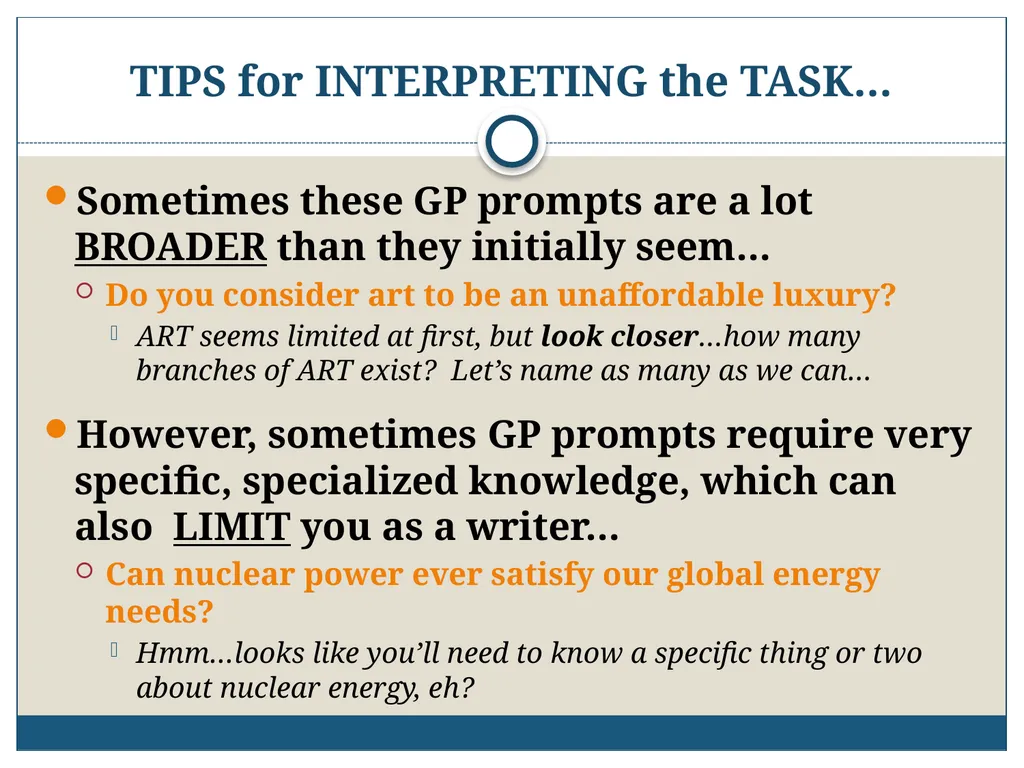
TIPS for INTERPRETING the TASK… Sometimes these GP prompts are a lot BROADER than they initially seem…
Do you consider art to be an unaffordable luxury?
ART seems limited at first, but look closer…how many branches of ART exist? Let’s name as many as we can…
However, sometimes GP prompts require very specific, specialized knowledge, which can also LIMIT you as a writer…
Can nuclear power ever satisfy our global energy needs?
Hmm…looks like you’ll need to know a specific thing or two about nuclear energy, eh?<br>
Do you consider art to be an unaffordable luxury?
ART seems limited at first, but look closer…how many branches of ART exist? Let’s name as many as we can…
However, sometimes GP prompts require very specific, specialized knowledge, which can also LIMIT you as a writer…
Can nuclear power ever satisfy our global energy needs?
Hmm…looks like you’ll need to know a specific thing or two about nuclear energy, eh?<br>
31
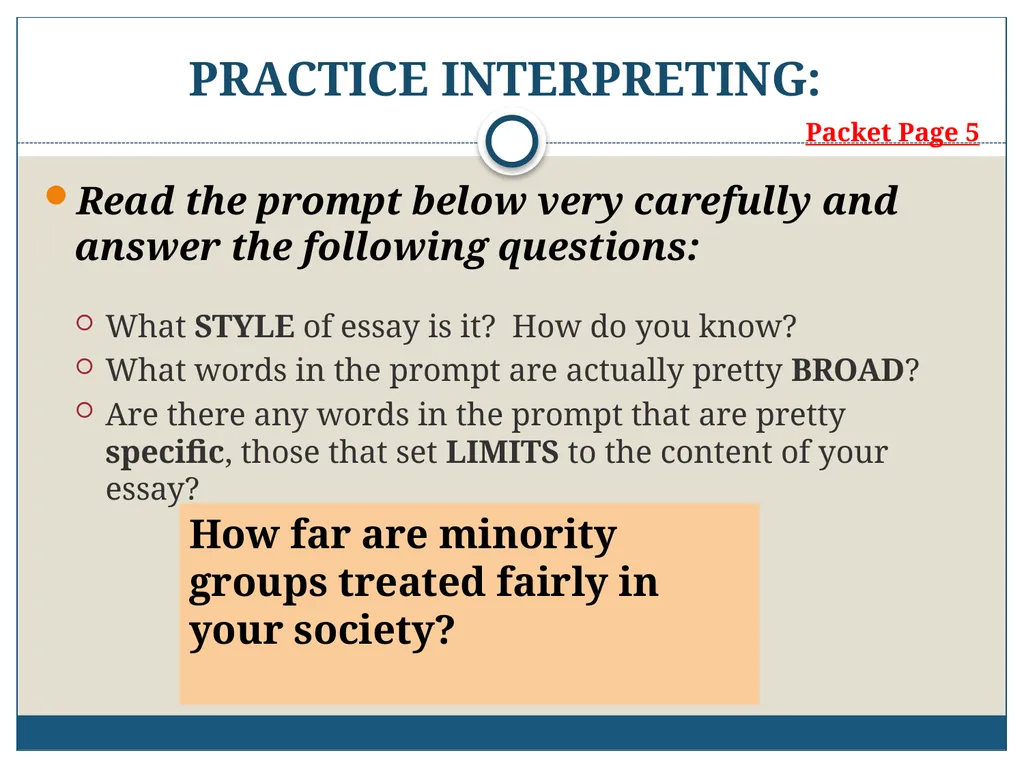
PRACTICE INTERPRETING: Read the prompt below very carefully and answer the following questions:
What STYLE of essay is it? How do you know?
What words in the prompt are actually pretty BROAD?
Are there any words in the prompt that are pretty specific, those that set LIMITS to the content of your essay? How far are minority groups treated fairly in your society? Packet Page 5<br>
What STYLE of essay is it? How do you know?
What words in the prompt are actually pretty BROAD?
Are there any words in the prompt that are pretty specific, those that set LIMITS to the content of your essay? How far are minority groups treated fairly in your society? Packet Page 5<br>
32
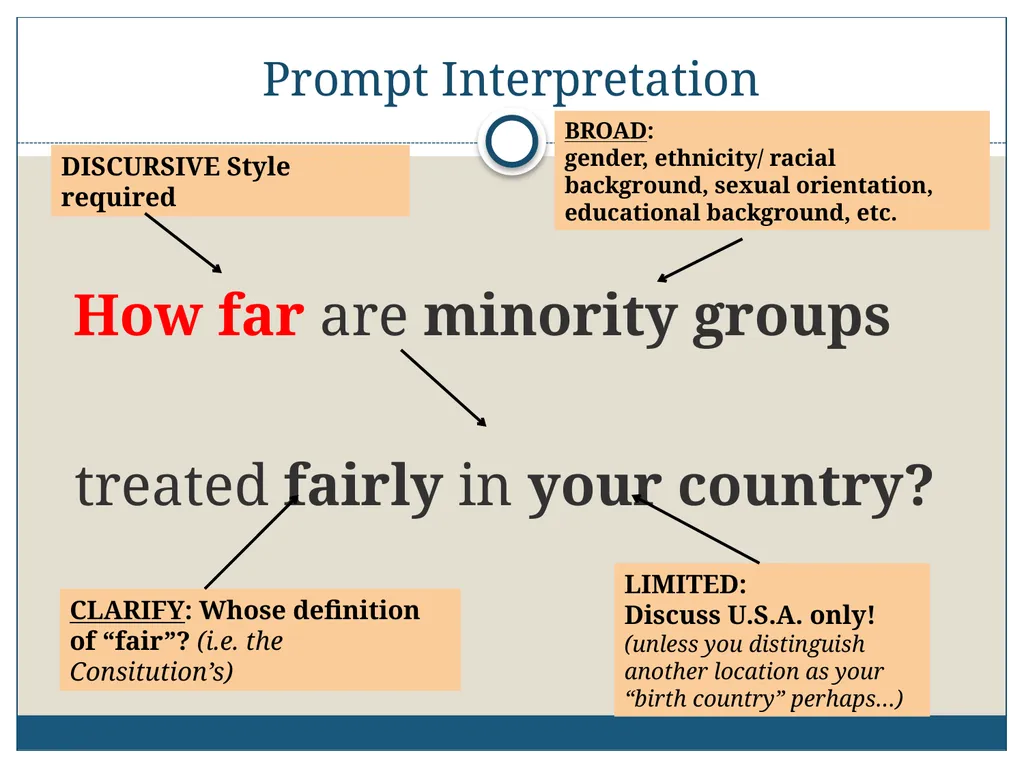
Prompt Interpretation How far are minority groups treated fairly in your country? DISCURSIVE Style required BROAD:
gender, ethnicity/ racial background, sexual orientation, educational background, etc. LIMITED:
Discuss U.S.A. only! (unless you distinguish another location as your “birth country” perhaps…) CLARIFY: Whose definition of “fair”? (i.e. the Consitution’s)<br>
gender, ethnicity/ racial background, sexual orientation, educational background, etc. LIMITED:
Discuss U.S.A. only! (unless you distinguish another location as your “birth country” perhaps…) CLARIFY: Whose definition of “fair”? (i.e. the Consitution’s)<br>
33
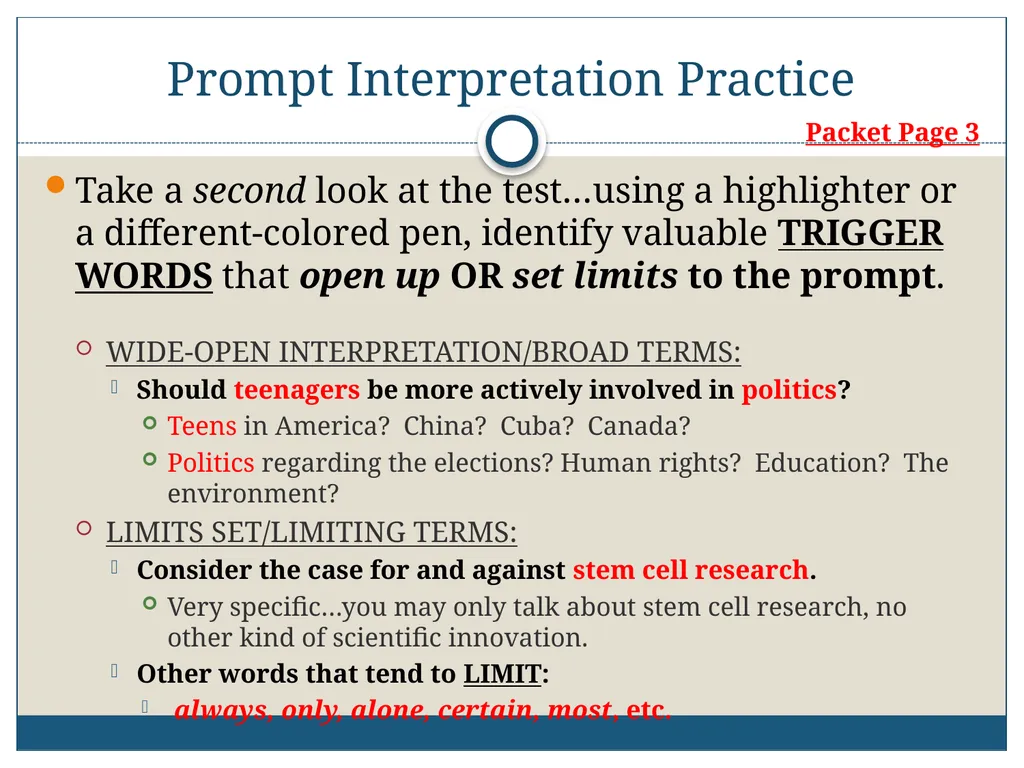
Prompt Interpretation Practice Take a second look at the test…using a highlighter or a different-colored pen, identify valuable TRIGGER WORDS that open up OR set limits to the prompt.
WIDE-OPEN INTERPRETATION/BROAD TERMS:
Should teenagers be more actively involved in politics?
Teens in America? China? Cuba? Canada?
Politics regarding the elections? Human rights? Education? The environment?
LIMITS SET/LIMITING TERMS:
Consider the case for and against stem cell research.
Very specific…you may only talk about stem cell research, no other kind of scientific innovation.
Other words that tend to LIMIT:
always, only, alone, certain, most, etc. Packet Page 3<br>
WIDE-OPEN INTERPRETATION/BROAD TERMS:
Should teenagers be more actively involved in politics?
Teens in America? China? Cuba? Canada?
Politics regarding the elections? Human rights? Education? The environment?
LIMITS SET/LIMITING TERMS:
Consider the case for and against stem cell research.
Very specific…you may only talk about stem cell research, no other kind of scientific innovation.
Other words that tend to LIMIT:
always, only, alone, certain, most, etc. Packet Page 3<br>
34
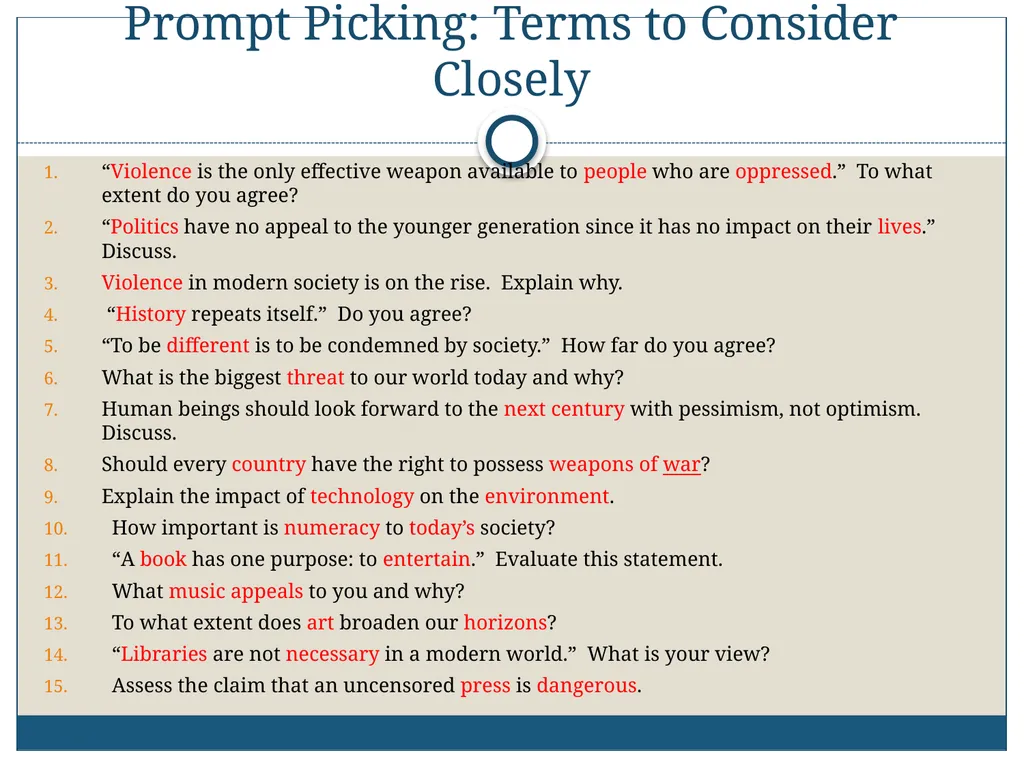
Prompt Picking: Terms to Consider Closely “Violence is the only effective weapon available to people who are oppressed.” To what extent do you agree?
“Politics have no appeal to the younger generation since it has no impact on their lives.” Discuss.
Violence in modern society is on the rise. Explain why.
“History repeats itself.” Do you agree?
“To be different is to be condemned by society.” How far do you agree?
What is the biggest threat to our world today and why?
Human beings should look forward to the next century with pessimism, not optimism. Discuss.
Should every country have the right to possess weapons of war?
Explain the impact of technology on the environment.
How important is numeracy to today’s society?
“A book has one purpose: to entertain.” Evaluate this statement.
What music appeals to you and why?
To what extent does art broaden our horizons?
“Libraries are not necessary in a modern world.” What is your view?
Assess the claim that an uncensored press is dangerous.<br>
“Politics have no appeal to the younger generation since it has no impact on their lives.” Discuss.
Violence in modern society is on the rise. Explain why.
“History repeats itself.” Do you agree?
“To be different is to be condemned by society.” How far do you agree?
What is the biggest threat to our world today and why?
Human beings should look forward to the next century with pessimism, not optimism. Discuss.
Should every country have the right to possess weapons of war?
Explain the impact of technology on the environment.
How important is numeracy to today’s society?
“A book has one purpose: to entertain.” Evaluate this statement.
What music appeals to you and why?
To what extent does art broaden our horizons?
“Libraries are not necessary in a modern world.” What is your view?
Assess the claim that an uncensored press is dangerous.<br>
35
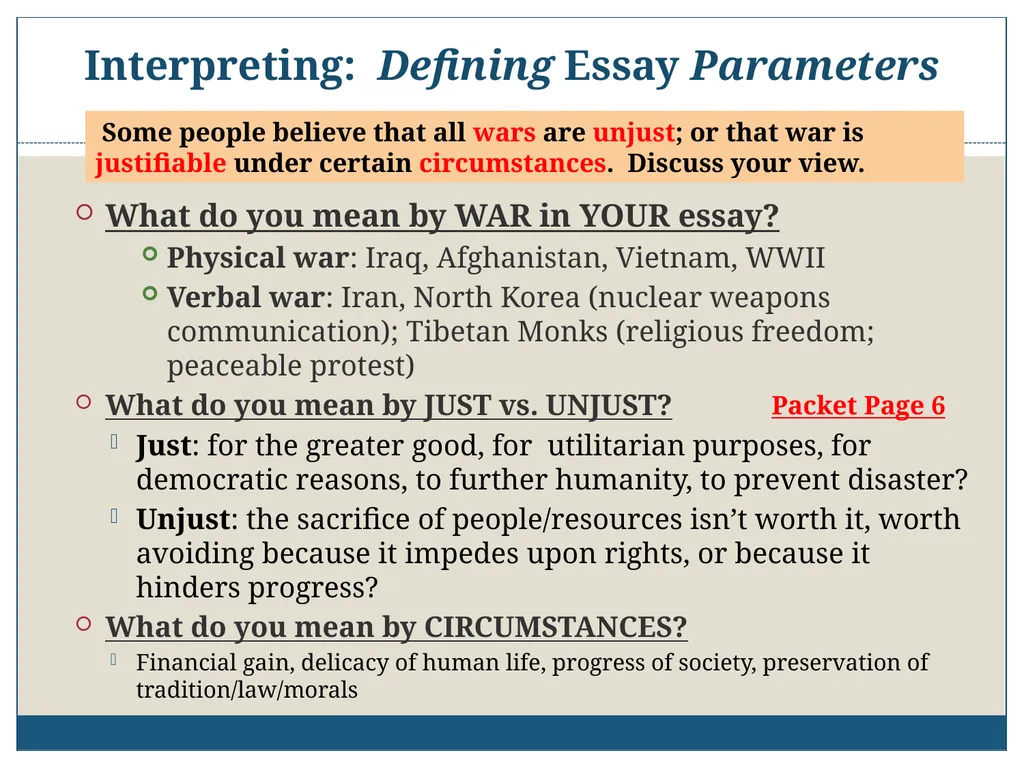
Interpreting: Defining Essay Parameters What do you mean by WAR in YOUR essay?
Physical war: Iraq, Afghanistan, Vietnam, WWII
Verbal war: Iran, North Korea (nuclear weapons communication); Tibetan Monks (religious freedom; peaceable protest)
What do you mean by JUST vs. UNJUST?
Just: for the greater good, for utilitarian purposes, for democratic reasons, to further humanity, to prevent disaster?
Unjust: the sacrifice of people/resources isn’t worth it, worth avoiding because it impedes upon rights, or because it hinders progress?
What do you mean by CIRCUMSTANCES?
Financial gain, delicacy of human life, progress of society, preservation of tradition/law/morals Some people believe that all wars are unjust; or that war is justifiable under certain circumstances. Discuss your view. Packet Page 6<br>
Physical war: Iraq, Afghanistan, Vietnam, WWII
Verbal war: Iran, North Korea (nuclear weapons communication); Tibetan Monks (religious freedom; peaceable protest)
What do you mean by JUST vs. UNJUST?
Just: for the greater good, for utilitarian purposes, for democratic reasons, to further humanity, to prevent disaster?
Unjust: the sacrifice of people/resources isn’t worth it, worth avoiding because it impedes upon rights, or because it hinders progress?
What do you mean by CIRCUMSTANCES?
Financial gain, delicacy of human life, progress of society, preservation of tradition/law/morals Some people believe that all wars are unjust; or that war is justifiable under certain circumstances. Discuss your view. Packet Page 6<br>
36
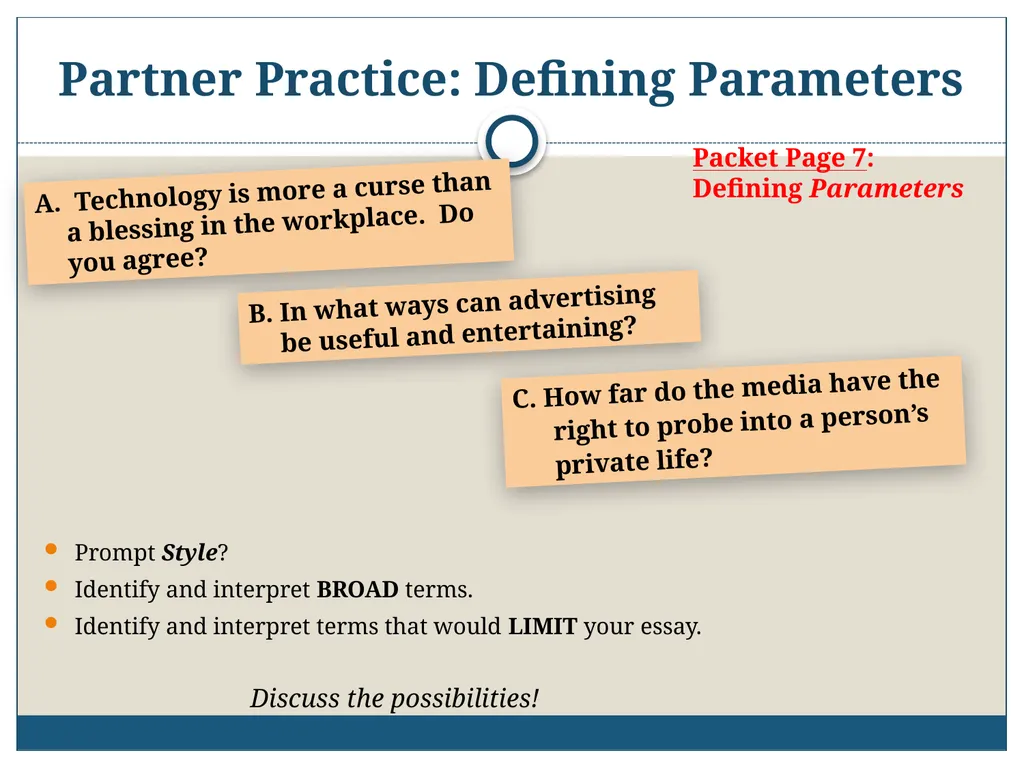
Partner Practice: Defining Parameters Prompt Style?
Identify and interpret BROAD terms.
Identify and interpret terms that would LIMIT your essay.
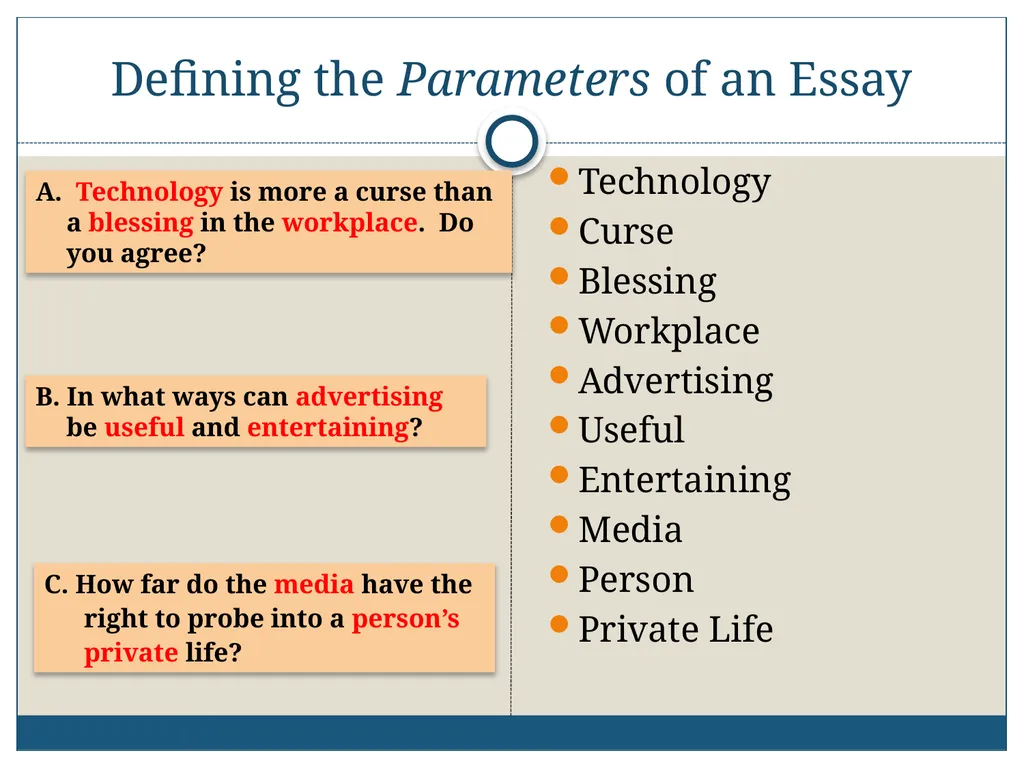
Discuss the possibilities! A. Technology is more a curse than a blessing in the workplace. Do you agree? B. In what ways can advertising be useful and entertaining? C. How far do the media have the
right to probe into a person’s
private life? Packet Page 7: Defining Parameters<br>
Identify and interpret BROAD terms.
Identify and interpret terms that would LIMIT your essay.
Discuss the possibilities! A. Technology is more a curse than a blessing in the workplace. Do you agree? B. In what ways can advertising be useful and entertaining? C. How far do the media have the
right to probe into a person’s
private life? Packet Page 7: Defining Parameters<br>
37
Defining the Parameters of an Essay vv Technology
Curse
Blessing
Workplace
Advertising
Useful
Entertaining
Media
Person
Private Life A. Technology is more a curse than a blessing in the workplace. Do you agree? B. In what ways can advertising be useful and entertaining? C. How far do the media have the
right to probe into a person’s
private life?<br>
Curse
Blessing
Workplace
Advertising
Useful
Entertaining
Media
Person
Private Life A. Technology is more a curse than a blessing in the workplace. Do you agree? B. In what ways can advertising be useful and entertaining? C. How far do the media have the
right to probe into a person’s
private life?<br>
38
Day 5…
Cambridge’s “recycling” program
The essay rubric
Learning reflection activities Tips and Scoring<br>
Cambridge’s “recycling” program
The essay rubric
Learning reflection activities Tips and Scoring<br>
39
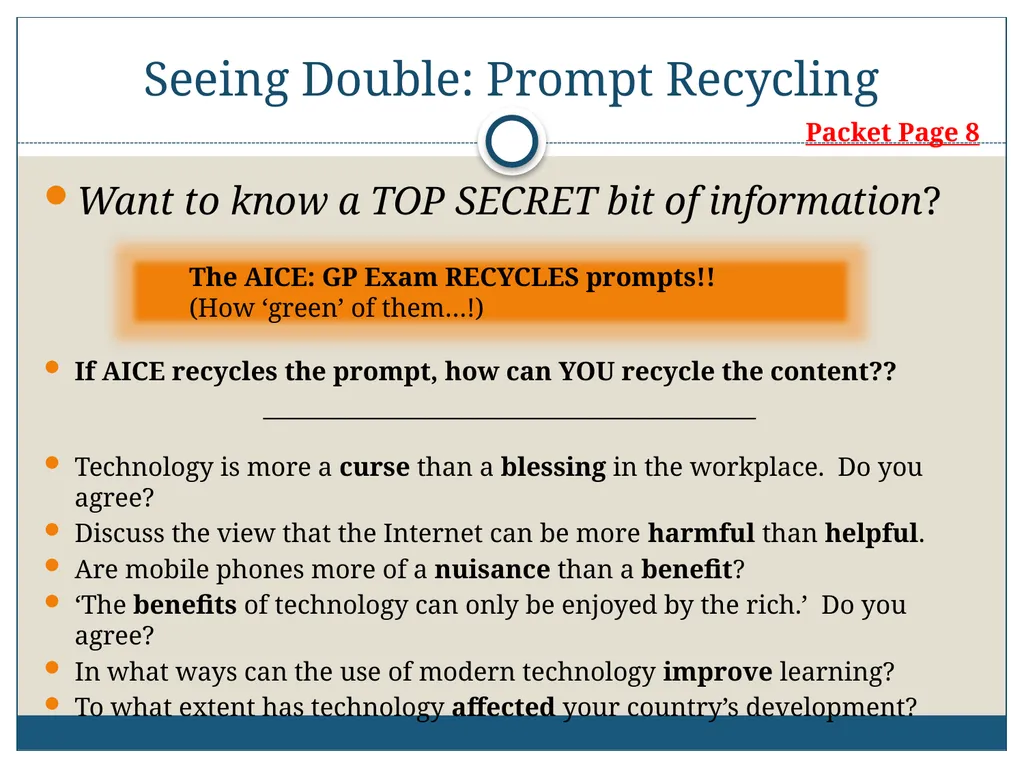
Seeing Double: Prompt Recycling Want to know a TOP SECRET bit of information?
If AICE recycles the prompt, how can YOU recycle the content??
__________________________________________
Technology is more a curse than a blessing in the workplace. Do you agree?
Discuss the view that the Internet can be more harmful than helpful.
Are mobile phones more of a nuisance than a benefit?
‘The benefits of technology can only be enjoyed by the rich.’ Do you agree?
In what ways can the use of modern technology improve learning?
To what extent has technology affected your country’s development? The AICE: GP Exam RECYCLES prompts!! (How ‘green’ of them…!) Packet Page 8<br>
If AICE recycles the prompt, how can YOU recycle the content??
__________________________________________
Technology is more a curse than a blessing in the workplace. Do you agree?
Discuss the view that the Internet can be more harmful than helpful.
Are mobile phones more of a nuisance than a benefit?
‘The benefits of technology can only be enjoyed by the rich.’ Do you agree?
In what ways can the use of modern technology improve learning?
To what extent has technology affected your country’s development? The AICE: GP Exam RECYCLES prompts!! (How ‘green’ of them…!) Packet Page 8<br>
40
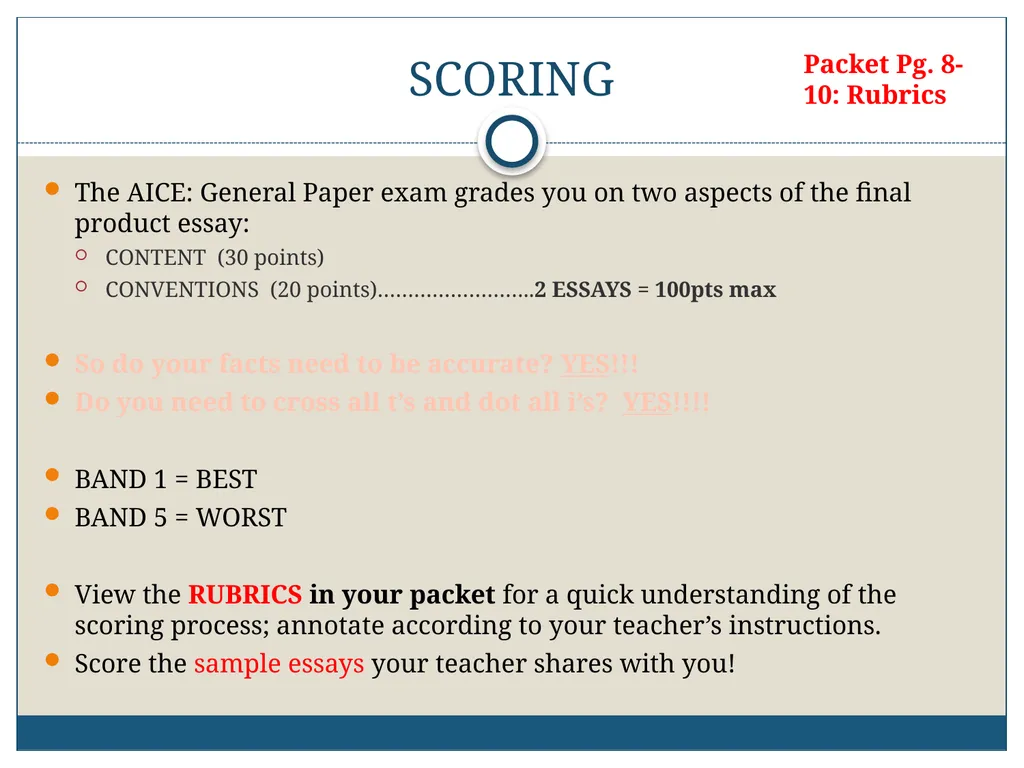
SCORING The AICE: General Paper exam grades you on two aspects of the final product essay:
CONTENT (30 points)
CONVENTIONS (20 points)……………………..2 ESSAYS = 100pts max
So do your facts need to be accurate? YES!!!
Do you need to cross all t’s and dot all i’s? YES!!!!
BAND 1 = BEST
BAND 5 = WORST
View the RUBRICS in your packet for a quick understanding of the scoring process; annotate according to your teacher’s instructions.
Score the sample essays your teacher shares with you! Packet Pg. 8-10: Rubrics<br>
CONTENT (30 points)
CONVENTIONS (20 points)……………………..2 ESSAYS = 100pts max
So do your facts need to be accurate? YES!!!
Do you need to cross all t’s and dot all i’s? YES!!!!
BAND 1 = BEST
BAND 5 = WORST
View the RUBRICS in your packet for a quick understanding of the scoring process; annotate according to your teacher’s instructions.
Score the sample essays your teacher shares with you! Packet Pg. 8-10: Rubrics<br>
41
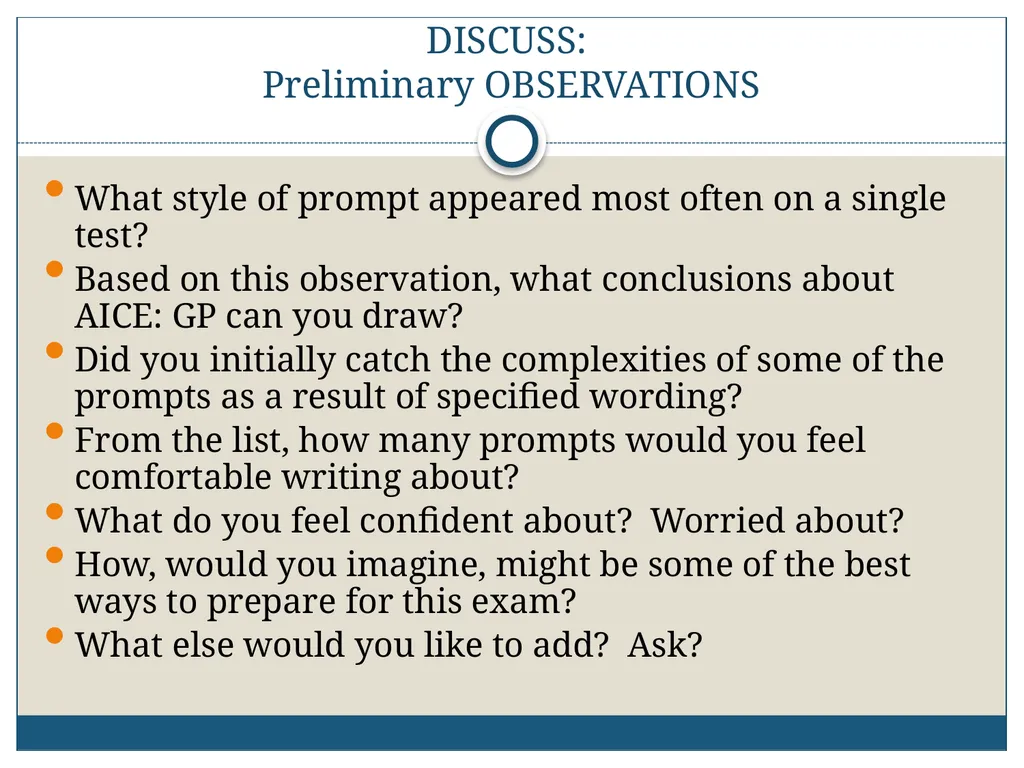
DISCUSS:
Preliminary OBSERVATIONS What style of prompt appeared most often on a single test?
Based on this observation, what conclusions about AICE: GP can you draw?
Did you initially catch the complexities of some of the prompts as a result of specified wording?
From the list, how many prompts would you feel comfortable writing about?
What do you feel confident about? Worried about?
How, would you imagine, might be some of the best ways to prepare for this exam?
What else would you like to add? Ask?<br>
Based on this observation, what conclusions about AICE: GP can you draw?
Did you initially catch the complexities of some of the prompts as a result of specified wording?
From the list, how many prompts would you feel comfortable writing about?
What do you feel confident about? Worried about?
How, would you imagine, might be some of the best ways to prepare for this exam?
What else would you like to add? Ask?<br>
42
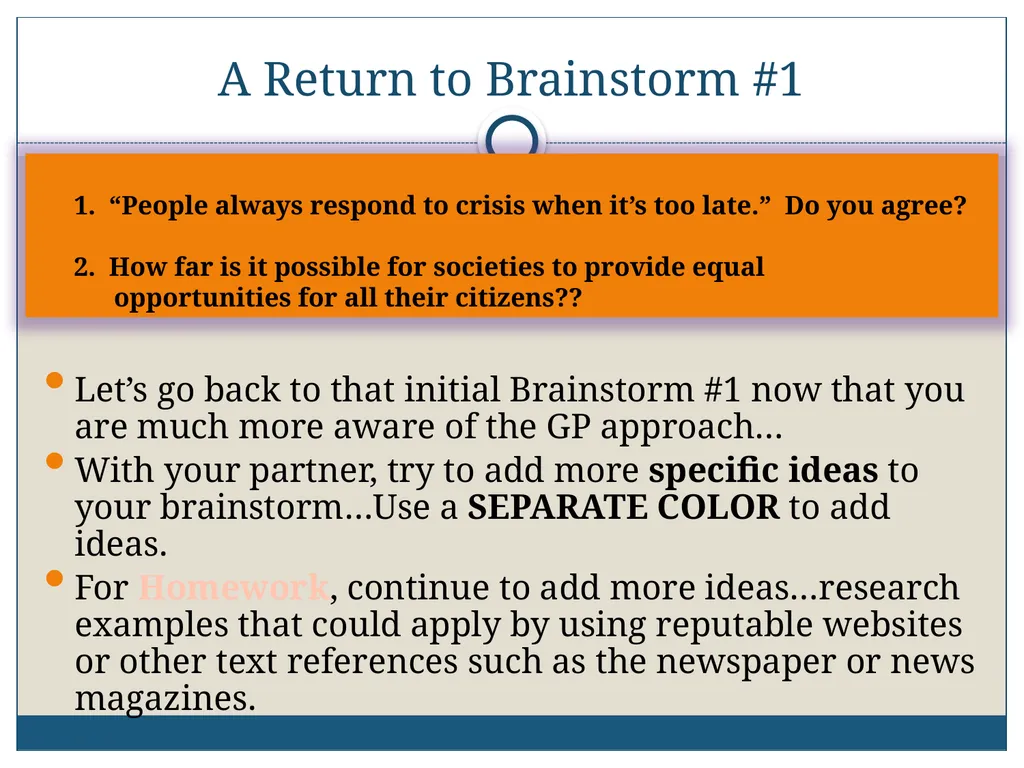
A Return to Brainstorm #1 Let’s go back to that initial Brainstorm #1 now that you are much more aware of the GP approach…
With your partner, try to add more specific ideas to your brainstorm…Use a SEPARATE COLOR to add ideas.
For Homework, continue to add more ideas…research examples that could apply by using reputable websites or other text references such as the newspaper or news magazines. 1. “People always respond to crisis when it’s too late.” Do you agree?
2. How far is it possible for societies to provide equal opportunities for all their citizens??<br>
With your partner, try to add more specific ideas to your brainstorm…Use a SEPARATE COLOR to add ideas.
For Homework, continue to add more ideas…research examples that could apply by using reputable websites or other text references such as the newspaper or news magazines. 1. “People always respond to crisis when it’s too late.” Do you agree?
2. How far is it possible for societies to provide equal opportunities for all their citizens??<br>
43
Writing the
DISCURSIVE
essay:
Let’s Get Started!! AICE/8004: General Paper-9 LP’s:approx. 1wk<br>
DISCURSIVE
essay:
Let’s Get Started!! AICE/8004: General Paper-9 LP’s:approx. 1wk<br>
44
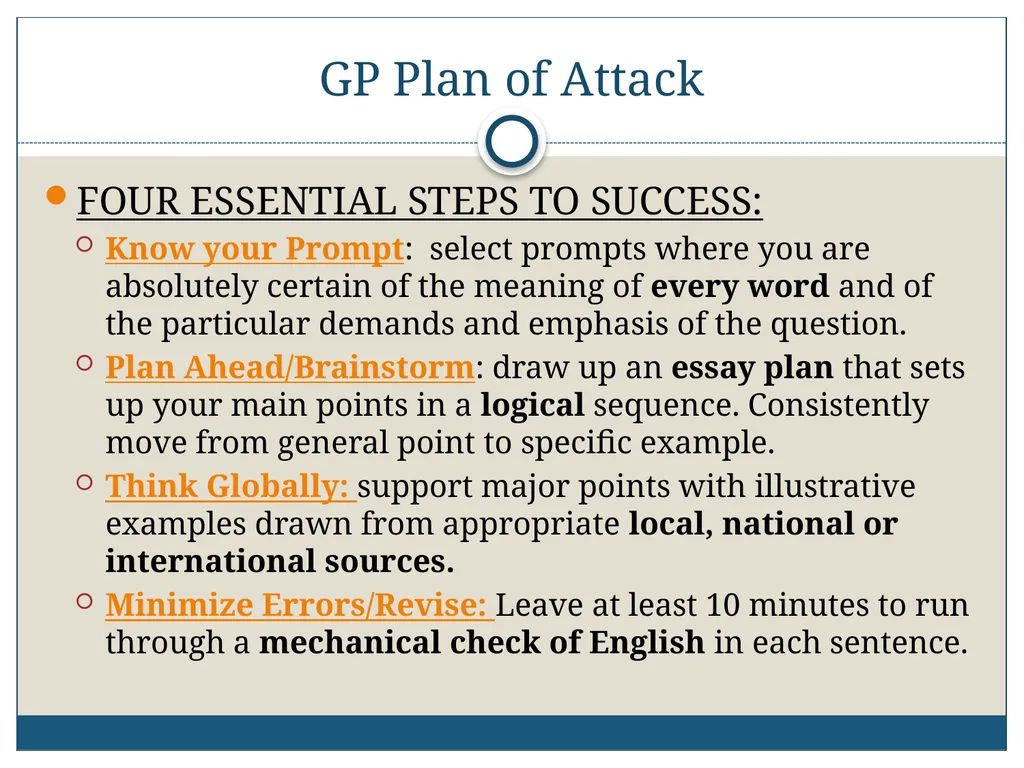
GP Plan of Attack FOUR ESSENTIAL STEPS TO SUCCESS:
Know your Prompt: select prompts where you are absolutely certain of the meaning of every word and of the particular demands and emphasis of the question.
Plan Ahead/Brainstorm: draw up an essay plan that sets up your main points in a logical sequence. Consistently move from general point to specific example.
Think Globally: support major points with illustrative examples drawn from appropriate local, national or international sources.
Minimize Errors/Revise: Leave at least 10 minutes to run through a mechanical check of English in each sentence.<br>
Know your Prompt: select prompts where you are absolutely certain of the meaning of every word and of the particular demands and emphasis of the question.
Plan Ahead/Brainstorm: draw up an essay plan that sets up your main points in a logical sequence. Consistently move from general point to specific example.
Think Globally: support major points with illustrative examples drawn from appropriate local, national or international sources.
Minimize Errors/Revise: Leave at least 10 minutes to run through a mechanical check of English in each sentence.<br>
45
The Discursive Essay:
* * * BRAINSTORMING<br>
46
TEST YOUR PROMPT CHOICES FIRST… Once you’ve broken down the broad/limiting word choice of the prompt, run a quick test to make SURE you have enough to say about the prompt…
On the prompt sheet itself, draw up a few quick T-Charts to determine how many ideas you have; THEN you can begin logically organizing them through the “official” discursive brainstorm process we’re about to learn…<br>
On the prompt sheet itself, draw up a few quick T-Charts to determine how many ideas you have; THEN you can begin logically organizing them through the “official” discursive brainstorm process we’re about to learn…<br>
47
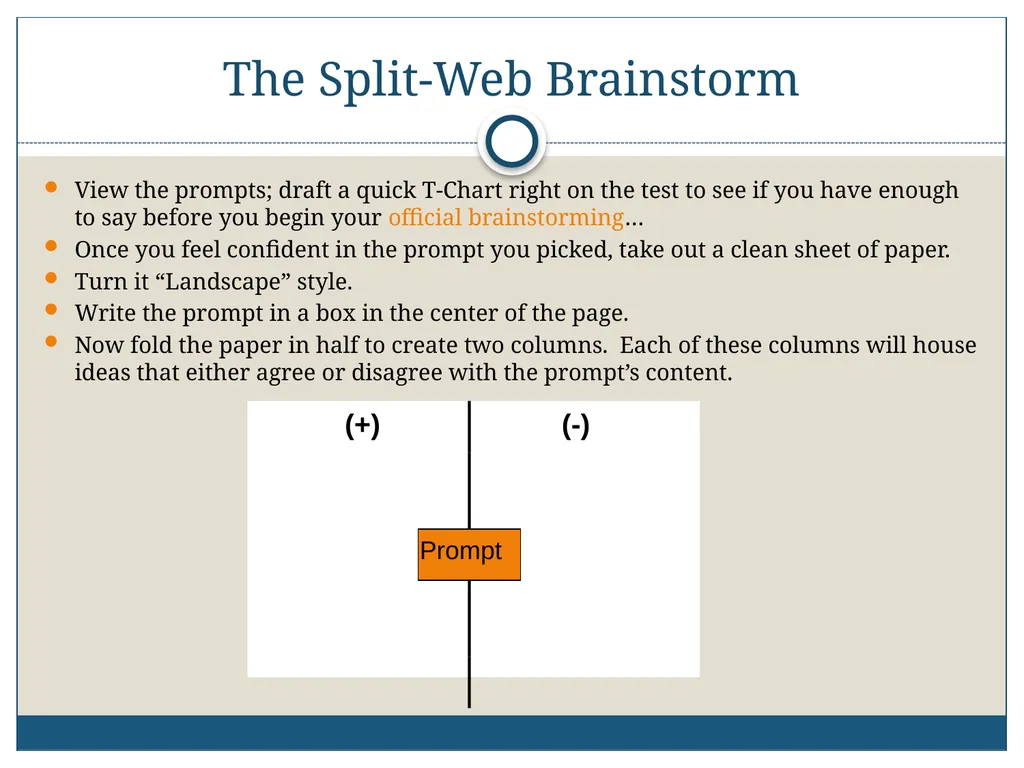
The Split-Web Brainstorm View the prompts; draft a quick T-Chart right on the test to see if you have enough to say before you begin your official brainstorming…
Once you feel confident in the prompt you picked, take out a clean sheet of paper.
Turn it “Landscape” style.
Write the prompt in a box in the center of the page.
Now fold the paper in half to create two columns. Each of these columns will house ideas that either agree or disagree with the prompt’s content. (+) (-) Prompt<br>
Once you feel confident in the prompt you picked, take out a clean sheet of paper.
Turn it “Landscape” style.
Write the prompt in a box in the center of the page.
Now fold the paper in half to create two columns. Each of these columns will house ideas that either agree or disagree with the prompt’s content. (+) (-) Prompt<br>
48
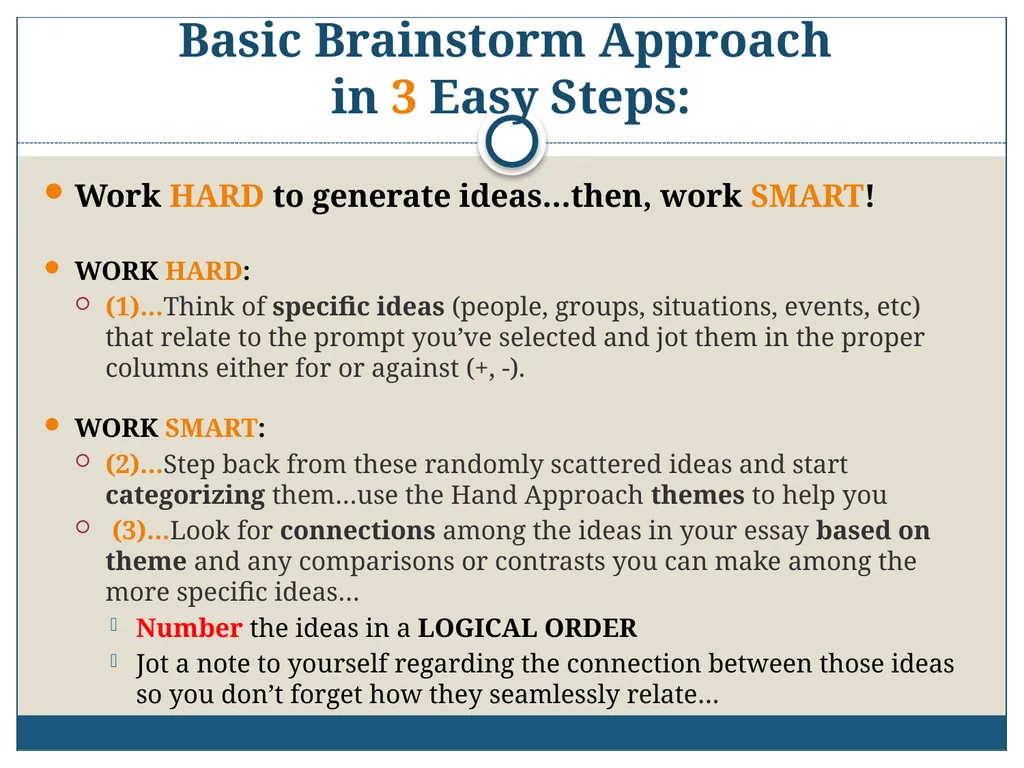
Basic Brainstorm Approach
in 3 Easy Steps: Work HARD to generate ideas…then, work SMART!
WORK HARD:
(1)…Think of specific ideas (people, groups, situations, events, etc) that relate to the prompt you’ve selected and jot them in the proper columns either for or against (+, -).
WORK SMART:
(2)…Step back from these randomly scattered ideas and start categorizing them…use the Hand Approach themes to help you
(3)…Look for connections among the ideas in your essay based on theme and any comparisons or contrasts you can make among the more specific ideas…
Number the ideas in a LOGICAL ORDER
Jot a note to yourself regarding the connection between those ideas so you don’t forget how they seamlessly relate…<br>
WORK HARD:
(1)…Think of specific ideas (people, groups, situations, events, etc) that relate to the prompt you’ve selected and jot them in the proper columns either for or against (+, -).
WORK SMART:
(2)…Step back from these randomly scattered ideas and start categorizing them…use the Hand Approach themes to help you
(3)…Look for connections among the ideas in your essay based on theme and any comparisons or contrasts you can make among the more specific ideas…
Number the ideas in a LOGICAL ORDER
Jot a note to yourself regarding the connection between those ideas so you don’t forget how they seamlessly relate…<br>
49
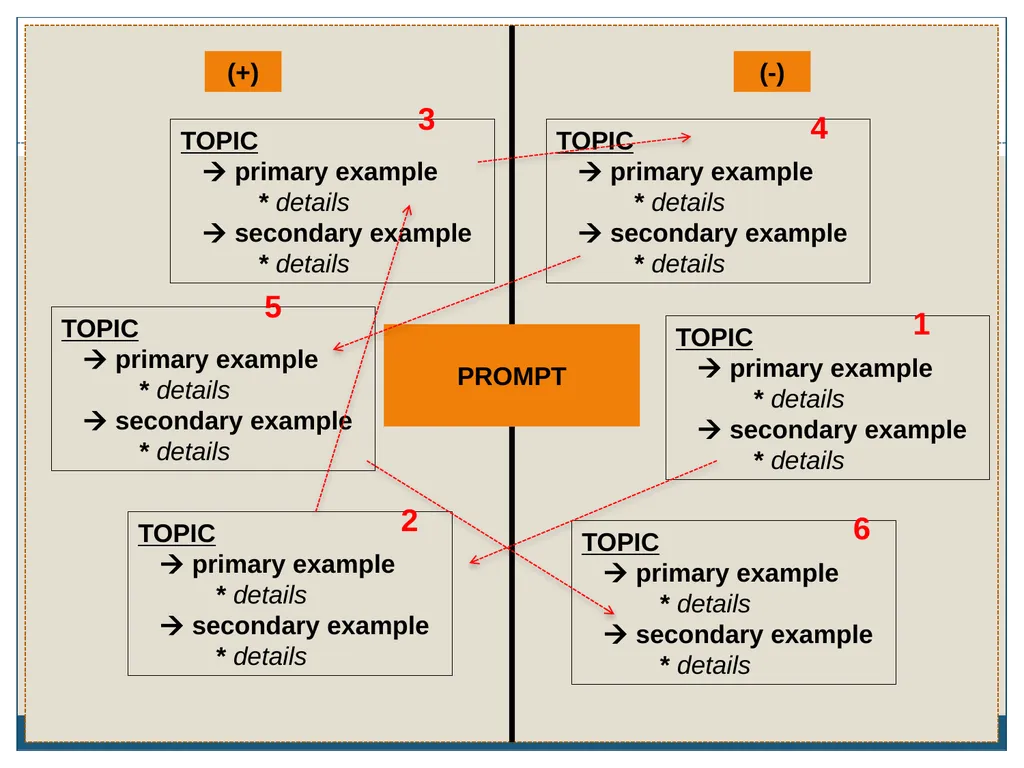
Animated Generic Brainstorm: In the next slide, notice there are many random ideas scattered about the brainstorm at first. Initially, you will be jotting down ideas at random also. (WORK HARD to think of ideas)
The key is to step back from them once they’re out and begin seeing bigger picture connections among them…how can you move “seamlessly” from one idea to the next…what “big ideas” or themes do your examples have in common that will help you meaningfully shift from paragraph to paragraph? (WORK SMART by finding meaning among your thoughts)<br>
The key is to step back from them once they’re out and begin seeing bigger picture connections among them…how can you move “seamlessly” from one idea to the next…what “big ideas” or themes do your examples have in common that will help you meaningfully shift from paragraph to paragraph? (WORK SMART by finding meaning among your thoughts)<br>
50
PROMPT (-) (+) TOPIC
primary example
* details
secondary example
* details TOPIC
primary example
* details
secondary example
* details TOPIC
primary example
* details
secondary example
* details TOPIC
primary example
* details
secondary example
* details TOPIC
primary example
* details
secondary example
* details TOPIC
primary example
* details
secondary example
* details 4 5 3 2 1 6<br>
primary example
* details
secondary example
* details TOPIC
primary example
* details
secondary example
* details TOPIC
primary example
* details
secondary example
* details TOPIC
primary example
* details
secondary example
* details TOPIC
primary example
* details
secondary example
* details TOPIC
primary example
* details
secondary example
* details 4 5 3 2 1 6<br>
51
NOW YOU TRY…PREPARE TO WRITE: IDENTIFY and INTERPRET the prompt to get a feel for your opportunities and limits set by the directions.
Run a quick T-CHART TEST next to the prompt to ensure that you have enough ideas to expend your time more thoroughly on this topic.
Begin setting the PARAMETERS/LIMITS of your essay by using the Discursive Brainstorm Format.
LOGICALLY ORGANIZE the ideas.
BEGIN writing !!<br>
Run a quick T-CHART TEST next to the prompt to ensure that you have enough ideas to expend your time more thoroughly on this topic.
Begin setting the PARAMETERS/LIMITS of your essay by using the Discursive Brainstorm Format.
LOGICALLY ORGANIZE the ideas.
BEGIN writing !!<br>
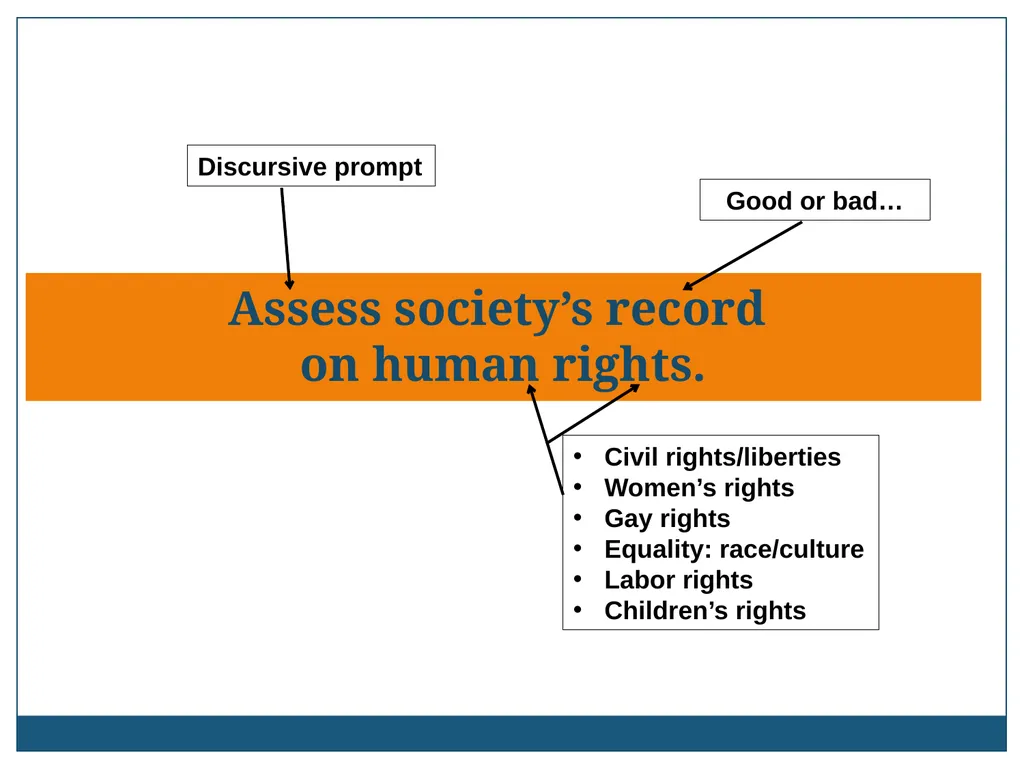
52
Assess society’s record
on human rights.<br>
53
Assess society’s record
on human rights. Discursive prompt Good or bad… Civil rights/liberties
Women’s rights
Gay rights
Equality: race/culture
Labor rights
Children’s rights<br>
Women’s rights
Gay rights
Equality: race/culture
Labor rights
Children’s rights<br>
54
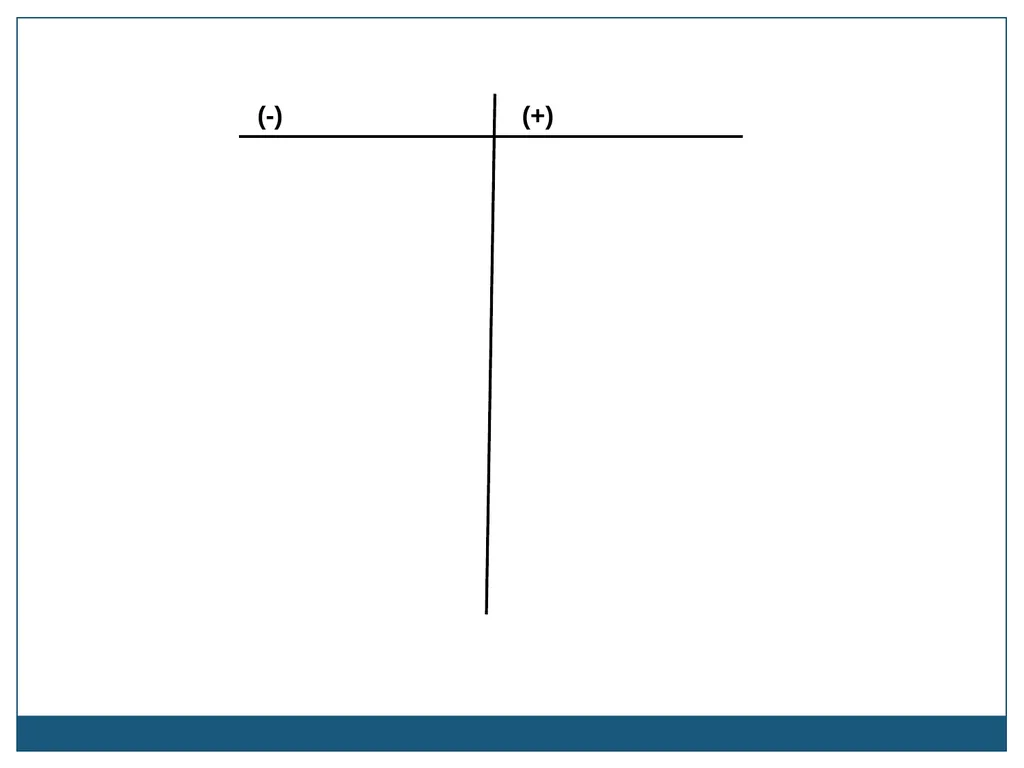
(-) (+)<br>
55
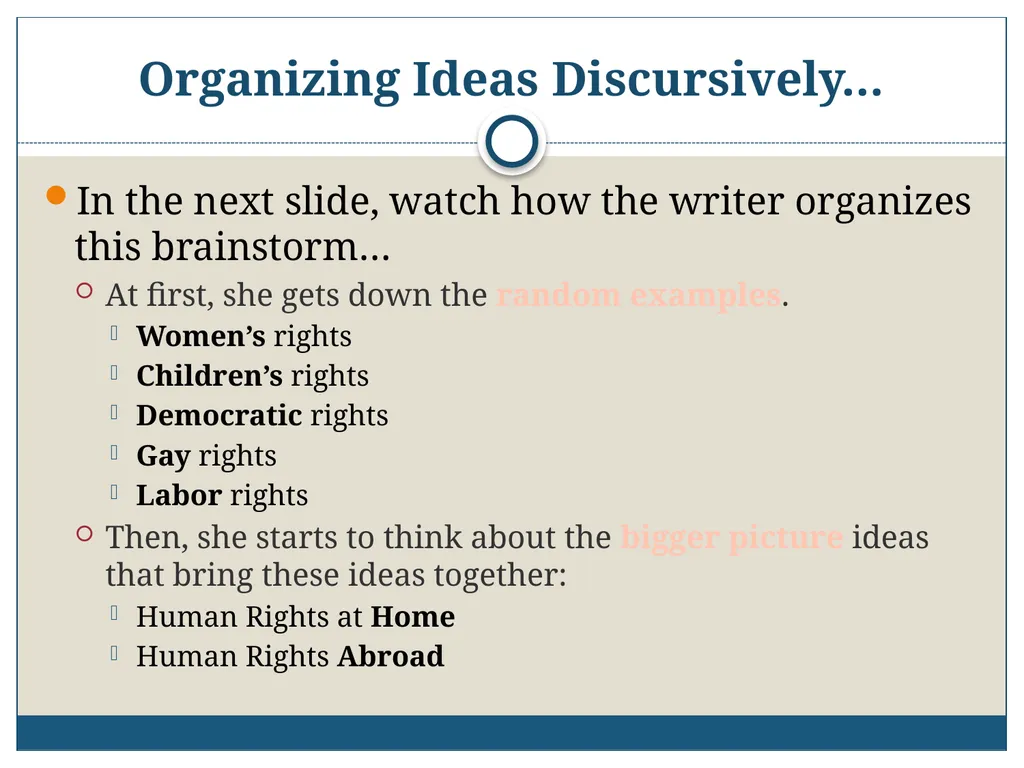
Organizing Ideas Discursively… In the next slide, watch how the writer organizes this brainstorm…
At first, she gets down the random examples.
Women’s rights
Children’s rights
Democratic rights
Gay rights
Labor rights
Then, she starts to think about the bigger picture ideas that bring these ideas together:
Human Rights at Home
Human Rights Abroad<br>
At first, she gets down the random examples.
Women’s rights
Children’s rights
Democratic rights
Gay rights
Labor rights
Then, she starts to think about the bigger picture ideas that bring these ideas together:
Human Rights at Home
Human Rights Abroad<br>
56
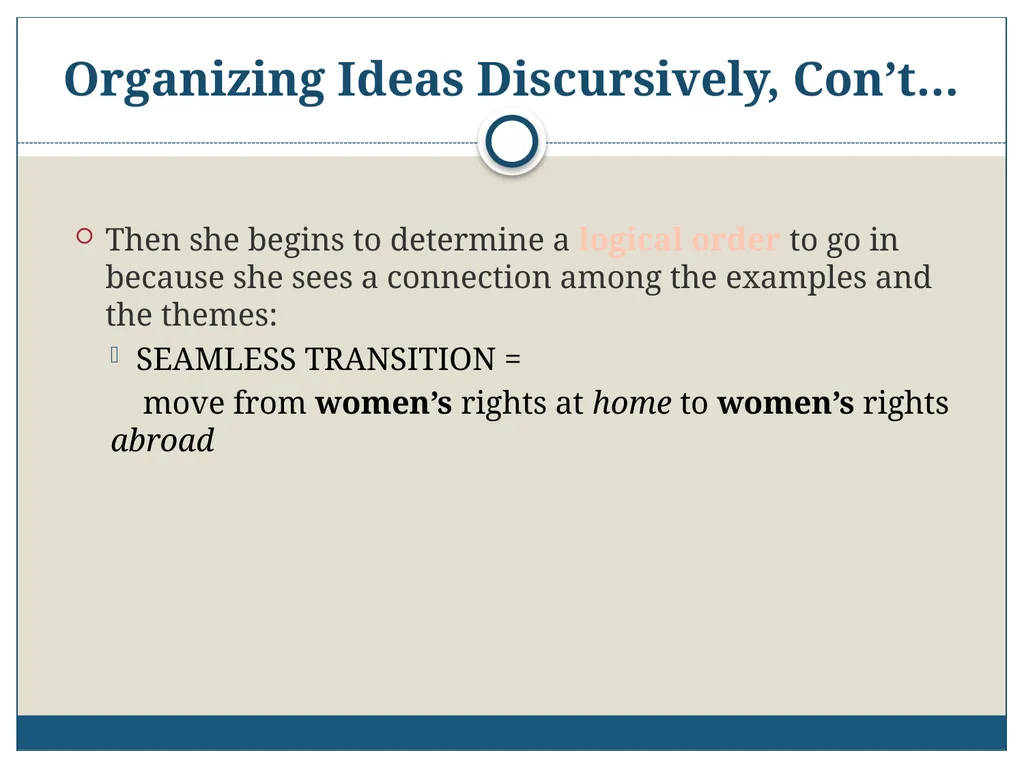
Organizing Ideas Discursively, Con’t… Then she begins to determine a logical order to go in because she sees a connection among the examples and the themes:
SEAMLESS TRANSITION =
move from women’s rights at home to women’s rights abroad<br>
SEAMLESS TRANSITION =
move from women’s rights at home to women’s rights abroad<br>
57
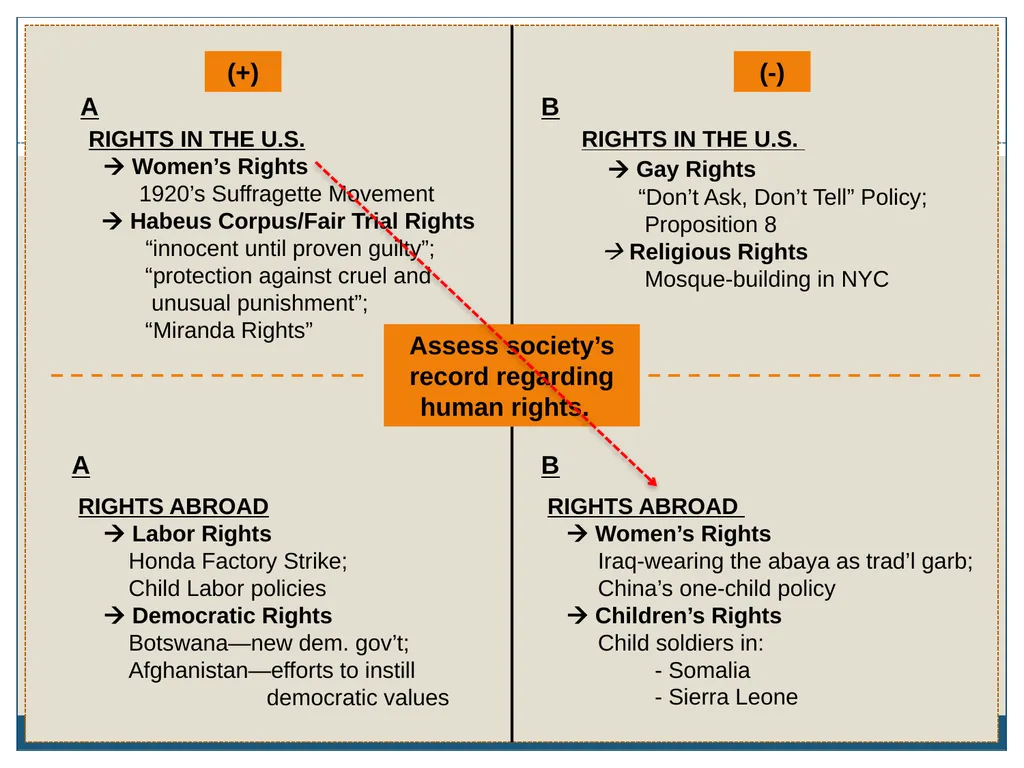
Assess society’s record regarding human rights. (-) (+) A A B B RIGHTS IN THE U.S.
Women’s Rights
1920’s Suffragette Movement
Habeus Corpus/Fair Trial Rights
“innocent until proven guilty”;
“protection against cruel and unusual punishment”;
“Miranda Rights” RIGHTS ABROAD
Labor Rights
Honda Factory Strike;
Child Labor policies
Democratic Rights
Botswana—new dem. gov’t;
Afghanistan—efforts to instill democratic values RIGHTS ABROAD
Women’s Rights
Iraq-wearing the abaya as trad’l garb;
China’s one-child policy
Children’s Rights
Child soldiers in:
- Somalia
- Sierra Leone RIGHTS IN THE U.S.
Gay Rights
“Don’t Ask, Don’t Tell” Policy;
Proposition 8
Religious Rights
Mosque-building in NYC<br>
Women’s Rights
1920’s Suffragette Movement
Habeus Corpus/Fair Trial Rights
“innocent until proven guilty”;
“protection against cruel and unusual punishment”;
“Miranda Rights” RIGHTS ABROAD
Labor Rights
Honda Factory Strike;
Child Labor policies
Democratic Rights
Botswana—new dem. gov’t;
Afghanistan—efforts to instill democratic values RIGHTS ABROAD
Women’s Rights
Iraq-wearing the abaya as trad’l garb;
China’s one-child policy
Children’s Rights
Child soldiers in:
- Somalia
- Sierra Leone RIGHTS IN THE U.S.
Gay Rights
“Don’t Ask, Don’t Tell” Policy;
Proposition 8
Religious Rights
Mosque-building in NYC<br>
58
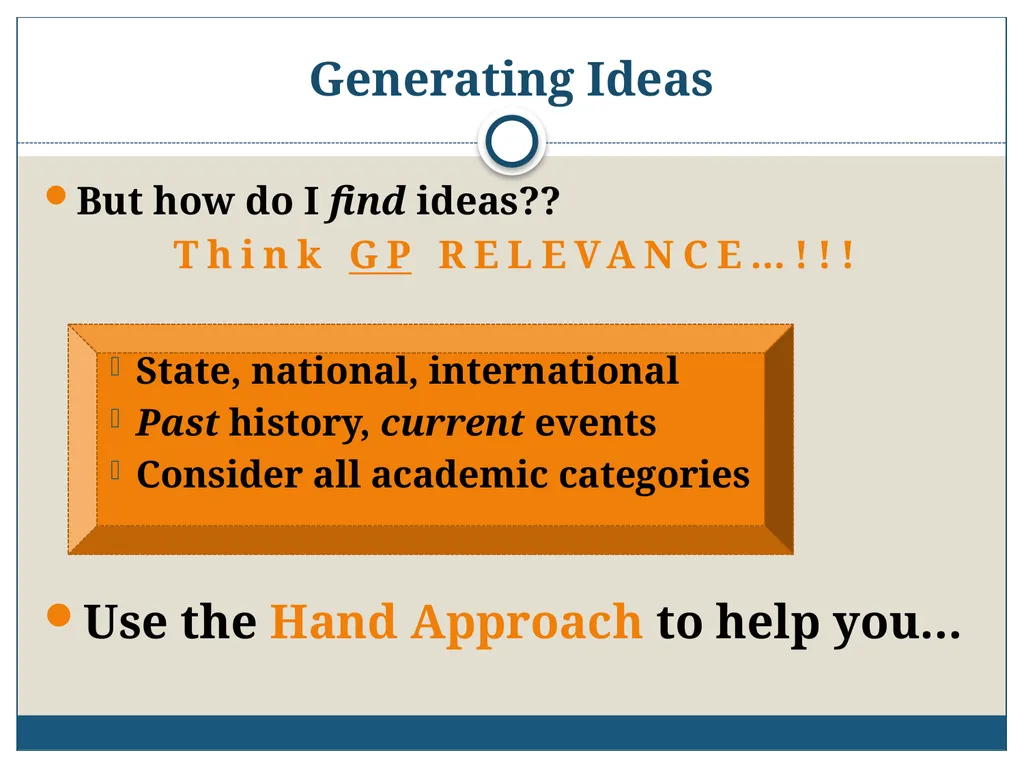
Generating Ideas But how do I find ideas??
Think GP RELEVANCE…!!!
State, national, international
Past history, current events
Consider all academic categories
Use the Hand Approach to help you…<br>
Think GP RELEVANCE…!!!
State, national, international
Past history, current events
Consider all academic categories
Use the Hand Approach to help you…<br>
59
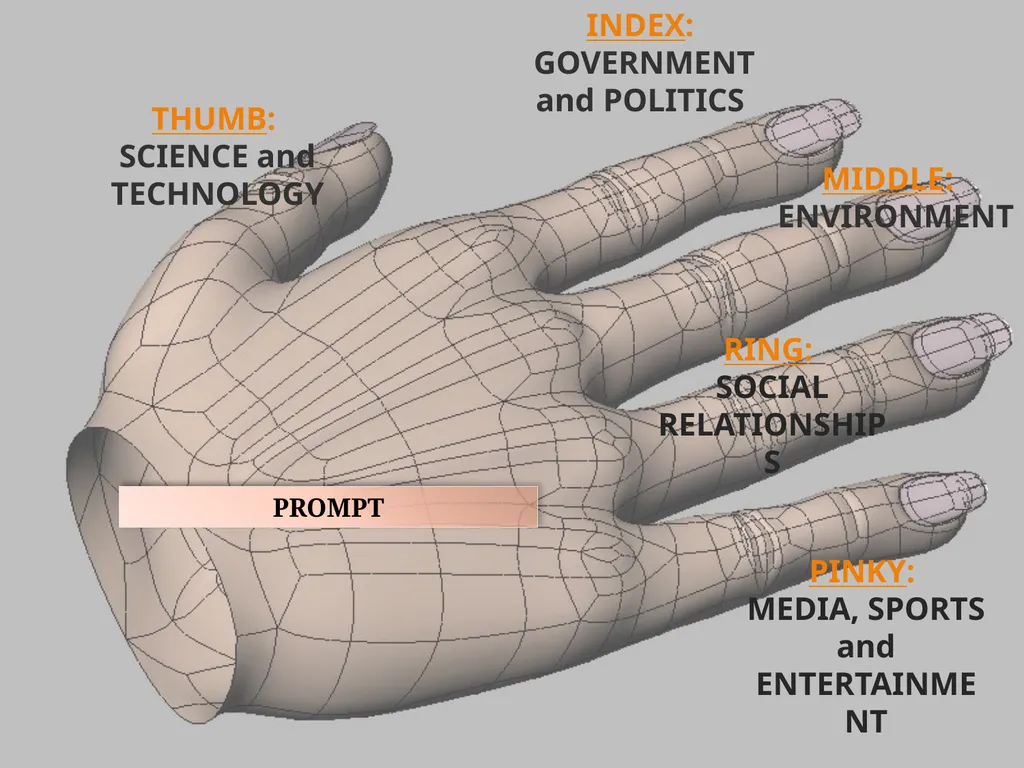
THUMB:
SCIENCE and TECHNOLOGY INDEX:
GOVERNMENT and POLITICS MIDDLE:
ENVIRONMENT RING:
SOCIAL RELATIONSHIPS PINKY:
MEDIA, SPORTS and ENTERTAINMENT PROMPT<br>
SCIENCE and TECHNOLOGY INDEX:
GOVERNMENT and POLITICS MIDDLE:
ENVIRONMENT RING:
SOCIAL RELATIONSHIPS PINKY:
MEDIA, SPORTS and ENTERTAINMENT PROMPT<br>
60
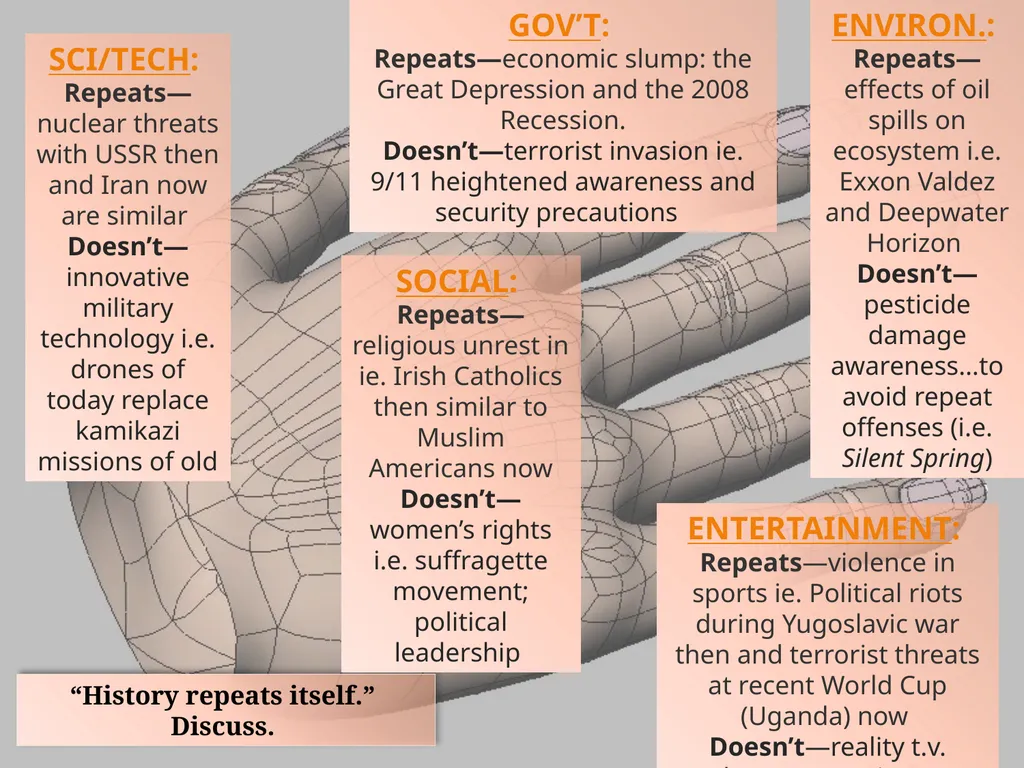
“History repeats itself.” Discuss.<br>
61
“History repeats itself.” Discuss. SCI/TECH:
Repeats—nuclear threats with USSR then and Iran now are similar
Doesn’t—innovative military technology i.e. drones of today replace kamikazi missions of old GOV’T:
Repeats—economic slump: the Great Depression and the 2008 Recession.
Doesn’t—terrorist invasion ie. 9/11 heightened awareness and security precautions ENVIRON.:
Repeats—effects of oil spills on ecosystem i.e. Exxon Valdez and Deepwater Horizon
Doesn’t—pesticide damage awareness…to avoid repeat offenses (i.e. Silent Spring) SOCIAL:
Repeats—religious unrest in ie. Irish Catholics then similar to Muslim Americans now
Doesn’t—women’s rights i.e. suffragette movement; political leadership ENTERTAINMENT:
Repeats—violence in sports ie. Political riots during Yugoslavic war then and terrorist threats at recent World Cup (Uganda) now
Doesn’t—reality t.v. phenomenon in 21st century<br>
Repeats—nuclear threats with USSR then and Iran now are similar
Doesn’t—innovative military technology i.e. drones of today replace kamikazi missions of old GOV’T:
Repeats—economic slump: the Great Depression and the 2008 Recession.
Doesn’t—terrorist invasion ie. 9/11 heightened awareness and security precautions ENVIRON.:
Repeats—effects of oil spills on ecosystem i.e. Exxon Valdez and Deepwater Horizon
Doesn’t—pesticide damage awareness…to avoid repeat offenses (i.e. Silent Spring) SOCIAL:
Repeats—religious unrest in ie. Irish Catholics then similar to Muslim Americans now
Doesn’t—women’s rights i.e. suffragette movement; political leadership ENTERTAINMENT:
Repeats—violence in sports ie. Political riots during Yugoslavic war then and terrorist threats at recent World Cup (Uganda) now
Doesn’t—reality t.v. phenomenon in 21st century<br>
62
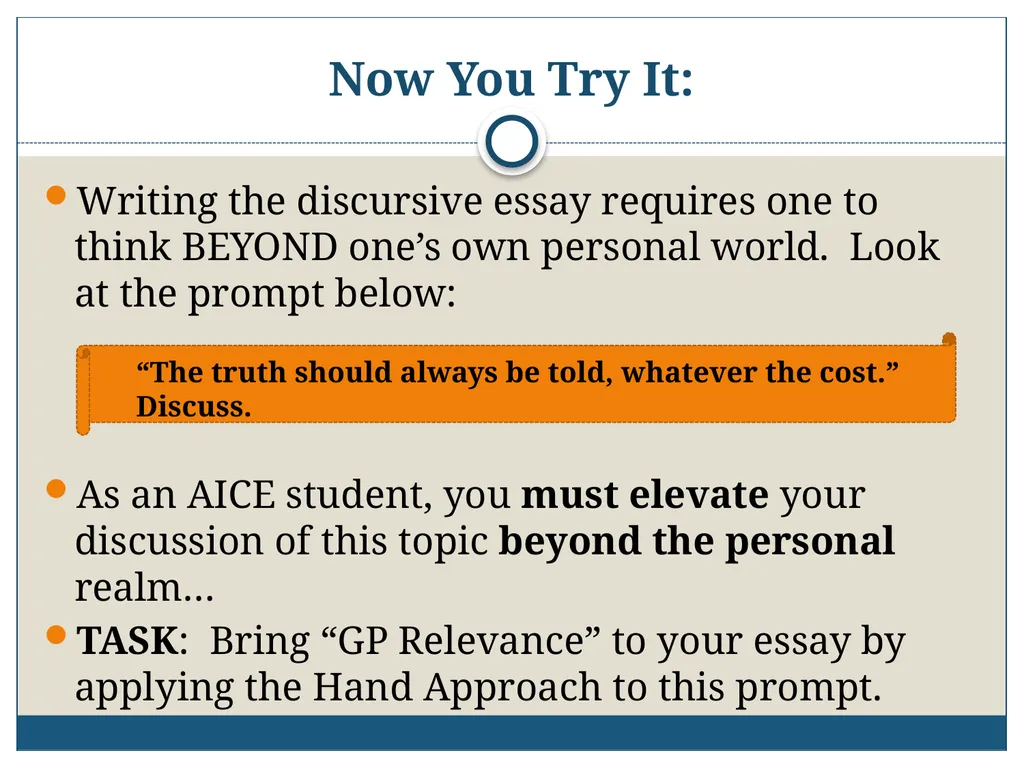
Now You Try It: Writing the discursive essay requires one to think BEYOND one’s own personal world. Look at the prompt below:
“The truth should always be told, whatever the cost.” Discuss.
As an AICE student, you must elevate your discussion of this topic beyond the personal realm…
TASK: Bring “GP Relevance” to your essay by applying the Hand Approach to this prompt.<br>
“The truth should always be told, whatever the cost.” Discuss.
As an AICE student, you must elevate your discussion of this topic beyond the personal realm…
TASK: Bring “GP Relevance” to your essay by applying the Hand Approach to this prompt.<br>
63
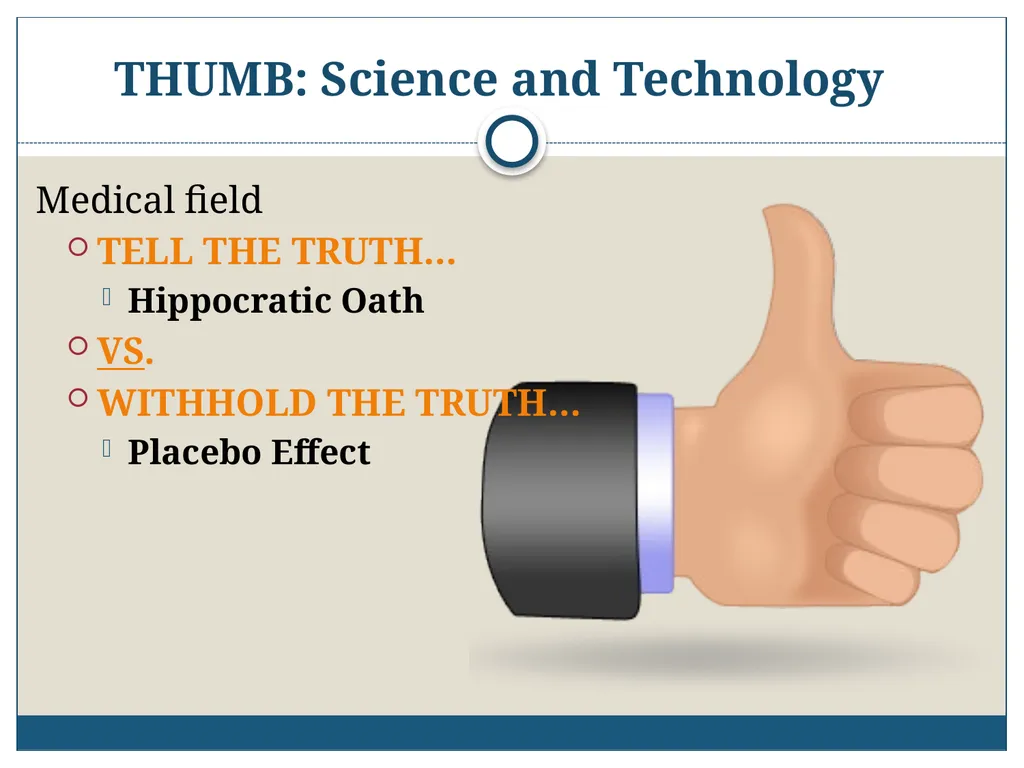
THUMB: Science and Technology Medical field
TELL THE TRUTH…
Hippocratic Oath
VS.
WITHHOLD THE TRUTH…
Placebo Effect<br>
TELL THE TRUTH…
Hippocratic Oath
VS.
WITHHOLD THE TRUTH…
Placebo Effect<br>
64
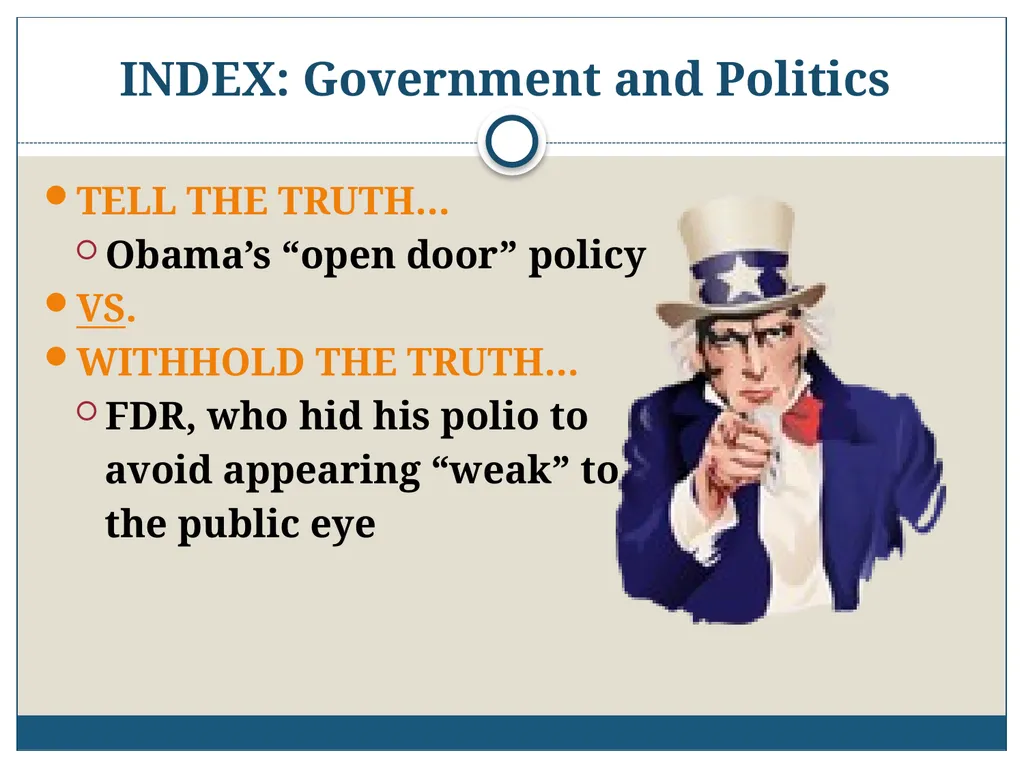
INDEX: Government and Politics TELL THE TRUTH…
Obama’s “open door” policy
VS.
WITHHOLD THE TRUTH…
FDR, who hid his polio to
avoid appearing “weak” to
the public eye<br>
Obama’s “open door” policy
VS.
WITHHOLD THE TRUTH…
FDR, who hid his polio to
avoid appearing “weak” to
the public eye<br>
65
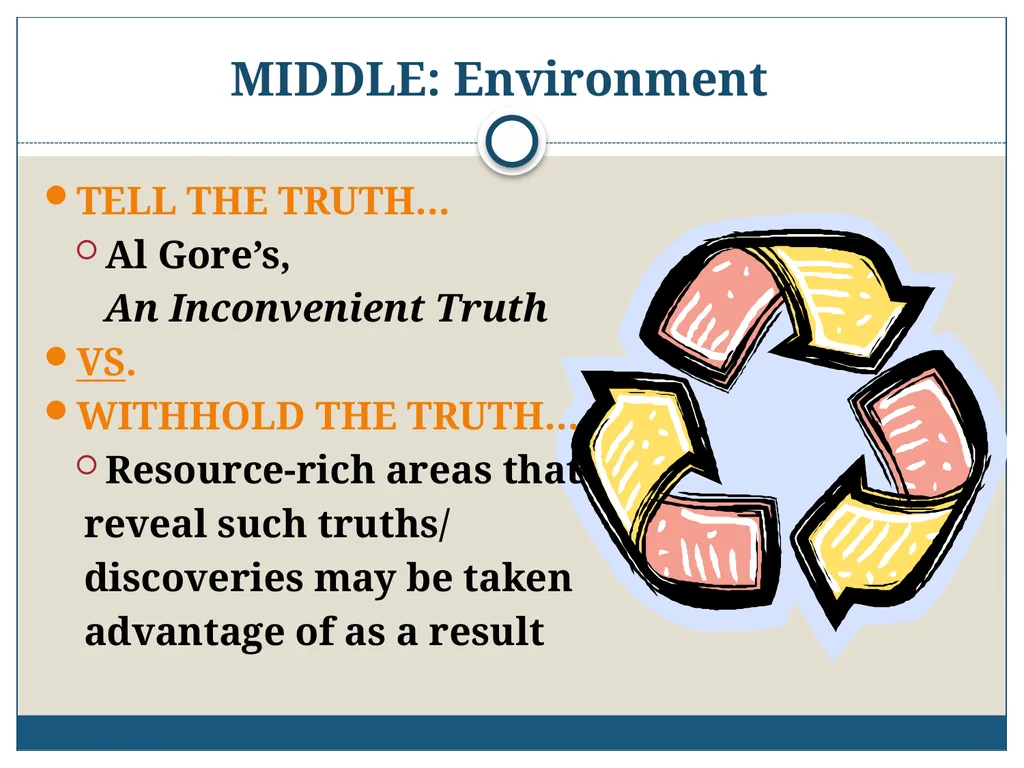
MIDDLE: Environment TELL THE TRUTH…
Al Gore’s,
An Inconvenient Truth
VS.
WITHHOLD THE TRUTH…
Resource-rich areas that
reveal such truths/
discoveries may be taken
advantage of as a result<br>
Al Gore’s,
An Inconvenient Truth
VS.
WITHHOLD THE TRUTH…
Resource-rich areas that
reveal such truths/
discoveries may be taken
advantage of as a result<br>
66
RING: Social Relationships TELL THE TRUTH…
AIDS patients
VS.
WITHHOLD THE TRUTH…
“Don’t Ask, Don’t Tell” Policy
(note: recently abolished…)<br>
AIDS patients
VS.
WITHHOLD THE TRUTH…
“Don’t Ask, Don’t Tell” Policy
(note: recently abolished…)<br>
67
PINKY: Media, Sports and Entertainment TELL THE TRUTH…
Libel/Slander
VS.
WITHHOLD THE TRUTH…
Gambling for sport and
the “poker face”<br>
Libel/Slander
VS.
WITHHOLD THE TRUTH…
Gambling for sport and
the “poker face”<br>
68
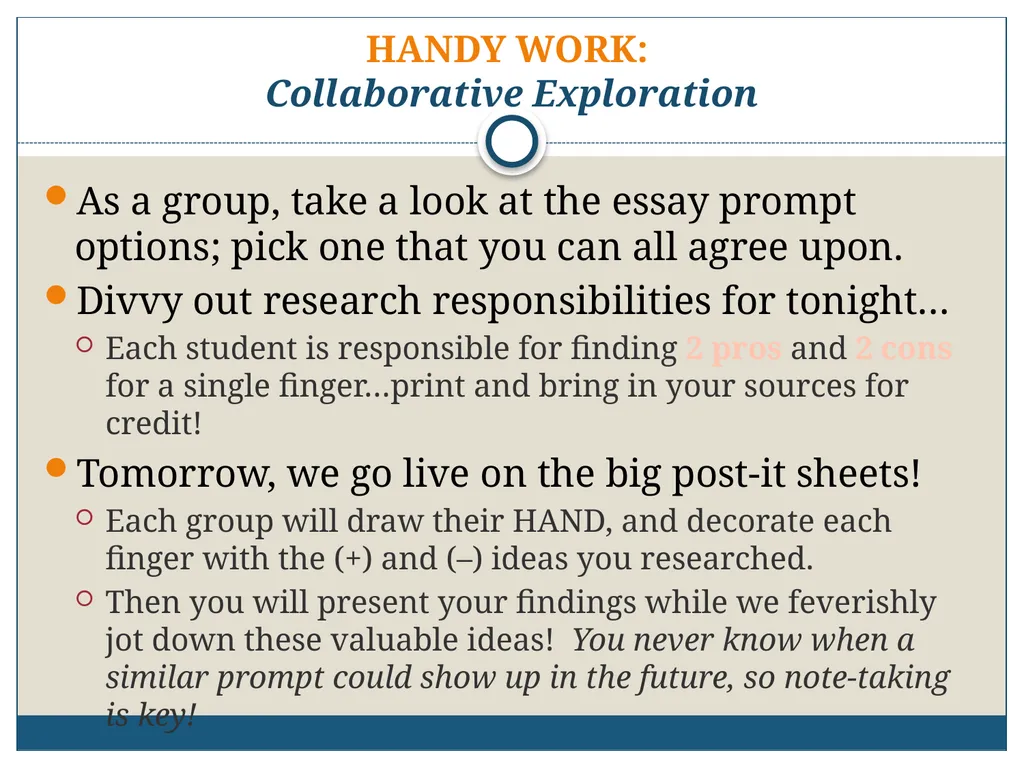
HANDY WORK:
Collaborative Exploration As a group, take a look at the essay prompt options; pick one that you can all agree upon.
Divvy out research responsibilities for tonight…
Each student is responsible for finding 2 pros and 2 cons for a single finger…print and bring in your sources for credit!
Tomorrow, we go live on the big post-it sheets!
Each group will draw their HAND, and decorate each finger with the (+) and (–) ideas you researched.
Then you will present your findings while we feverishly jot down these valuable ideas! You never know when a similar prompt could show up in the future, so note-taking is key!<br>
Divvy out research responsibilities for tonight…
Each student is responsible for finding 2 pros and 2 cons for a single finger…print and bring in your sources for credit!
Tomorrow, we go live on the big post-it sheets!
Each group will draw their HAND, and decorate each finger with the (+) and (–) ideas you researched.
Then you will present your findings while we feverishly jot down these valuable ideas! You never know when a similar prompt could show up in the future, so note-taking is key!<br>
69
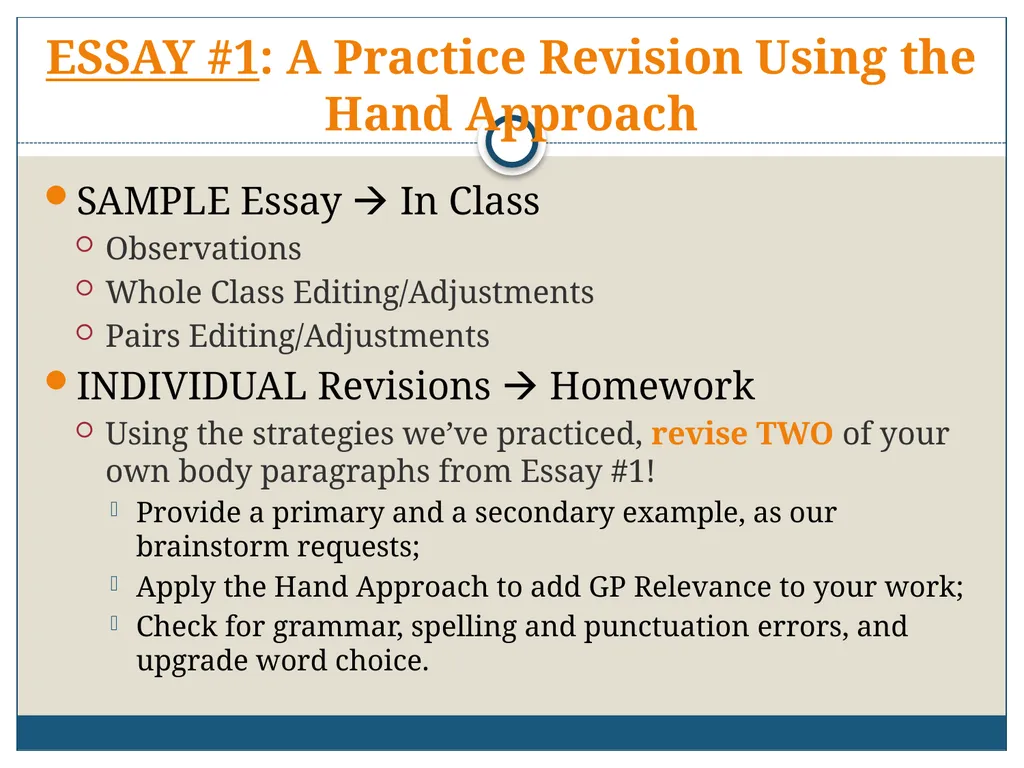
ESSAY #1: A Practice Revision Using the Hand Approach SAMPLE Essay In Class
Observations
Whole Class Editing/Adjustments
Pairs Editing/Adjustments
INDIVIDUAL Revisions Homework
Using the strategies we’ve practiced, revise TWO of your own body paragraphs from Essay #1!
Provide a primary and a secondary example, as our brainstorm requests;
Apply the Hand Approach to add GP Relevance to your work;
Check for grammar, spelling and punctuation errors, and upgrade word choice.<br>
Observations
Whole Class Editing/Adjustments
Pairs Editing/Adjustments
INDIVIDUAL Revisions Homework
Using the strategies we’ve practiced, revise TWO of your own body paragraphs from Essay #1!
Provide a primary and a secondary example, as our brainstorm requests;
Apply the Hand Approach to add GP Relevance to your work;
Check for grammar, spelling and punctuation errors, and upgrade word choice.<br>
70
Now we know what the question is asking us (by breaking down the prompt)
And we know how to generate ideas (that are “GP relevant”)…
NEXT STEP?
We will learn how to actually put this direction and these ideas into an essay!!! Get ready to rock, GP-style! WHAT DID WE LEARN?<br>
And we know how to generate ideas (that are “GP relevant”)…
NEXT STEP?
We will learn how to actually put this direction and these ideas into an essay!!! Get ready to rock, GP-style! WHAT DID WE LEARN?<br>