Air Pollution Perceptions and Responses: A Nigerian Public Perspective By Kevwe Olomu Key global environmental health risk 4th main risk factor for preventable deaths and disabilities globally Air pollution, a major problem that cannot be
"Air Pollution Perceptions and Responses: A" is the property of its rightful owner. Permission is granted to
download and print the materials on this website for personal, non-commercial use only, and to display it
on your personal computer provided you do not modify the materials and that you retain all copyright
notices contained in the materials. By downloading content from our website, you accept the terms of this
agreement.
Presentation Transcript
01
Air Pollution Perceptions and Responses: A Nigerian Public Perspective By
Kevwe Olomu<br>
02
Key global environmental health risk
4th main risk factor for preventable deaths and disabilities globally
Air pollution, a major problem that cannot be eradicated
It can be controlled and mitigated to reduce adverse effects through the adoption of air quality management plans and interventions.
Insights into the public’s knowledge and understanding of air pollution issues, how local communities make sense of the associated risks, attitudes that could be deep-rooted by a lack of understanding of air pollution problems, provide a good foundation for developing acceptable interventions aimed at improving air quality
Proper understanding of perceptions and attitudes toward air pollution, and how they can potentially drive pro-environmental behaviours is imperative. Study Background<br>
03
Explore public perceptions of and responses to air pollution Study Aim<br>
04
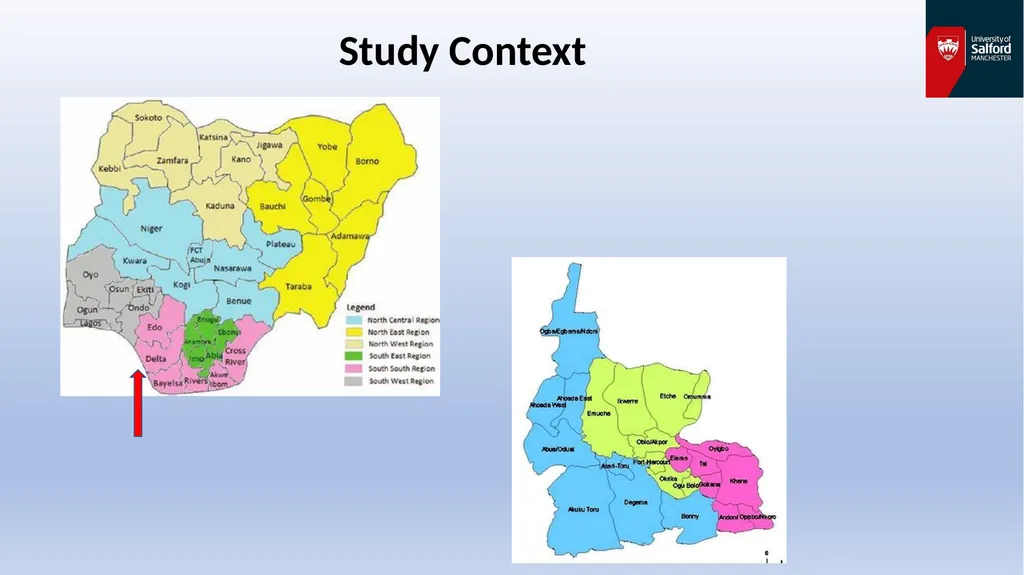
Study Context<br>
05
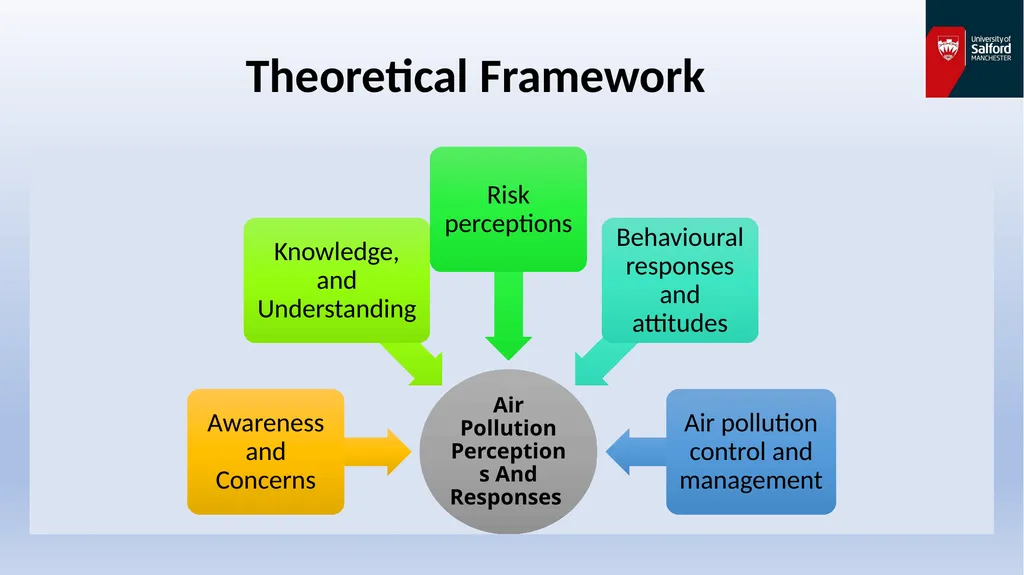
Theoretical Framework<br>
06
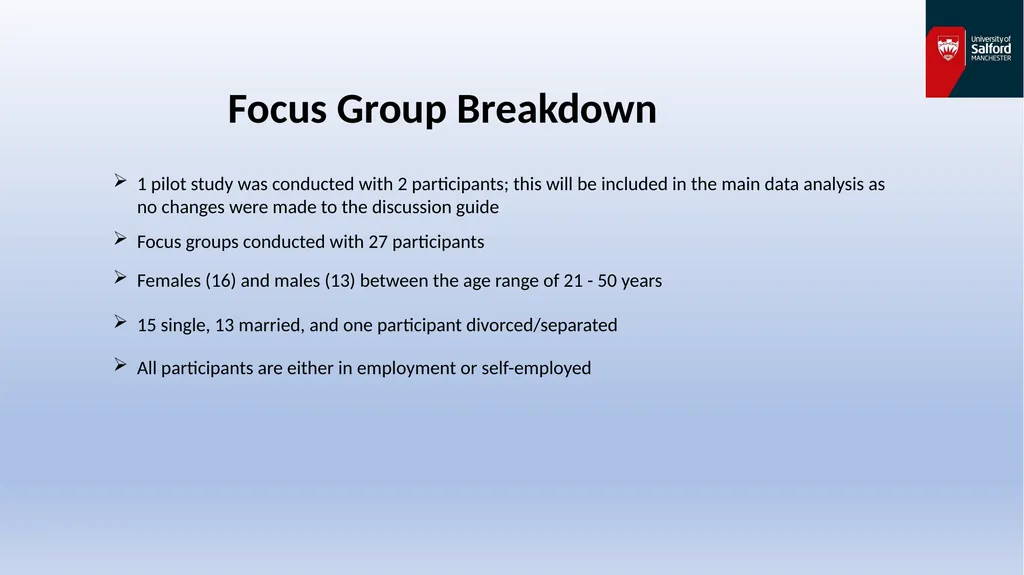
Focus Group Breakdown 1 pilot study was conducted with 2 participants; this will be included in the main data analysis as no changes were made to the discussion guide Focus groups conducted with 27 participants Females (16) and males (13) between the age range of 21 - 50 years 15 single, 13 married, and one participant divorced/separated All participants are either in employment or self-employed<br>
07
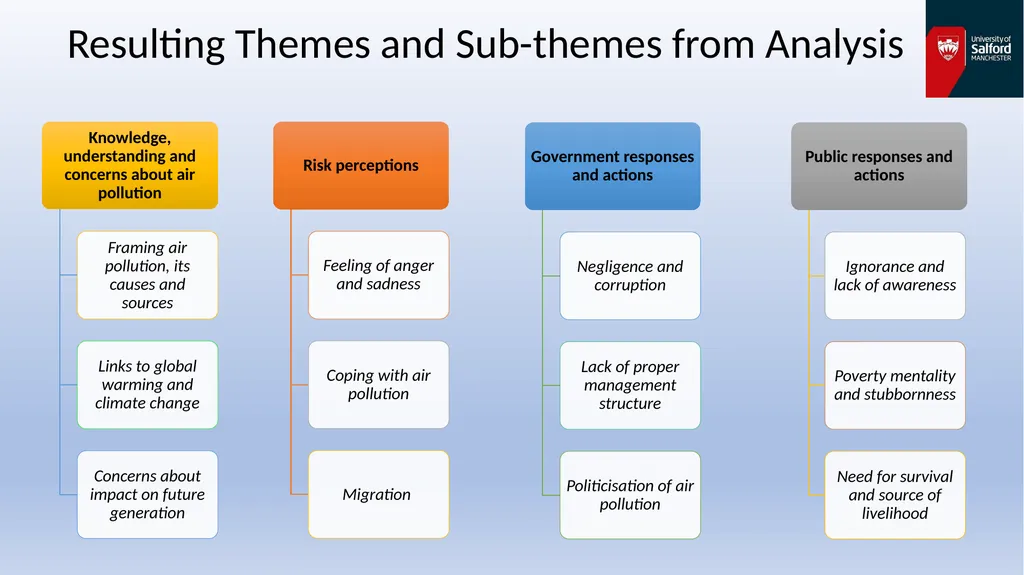
Resulting Themes and Sub-themes from Analysis<br>
08
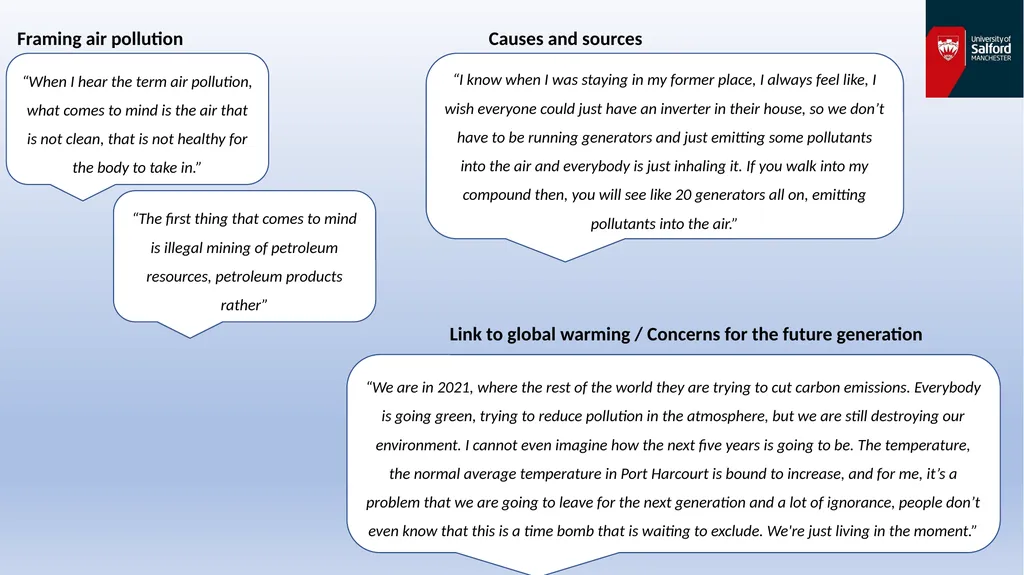
“When I hear the term air pollution, what comes to mind is the air that is not clean, that is not healthy for the body to take in.” “The first thing that comes to mind is illegal mining of petroleum resources, petroleum products rather” “I know when I was staying in my former place, I always feel like, I wish everyone could just have an inverter in their house, so we don’t have to be running generators and just emitting some pollutants into the air and everybody is just inhaling it. If you walk into my compound then, you will see like 20 generators all on, emitting pollutants into the air.” “We are in 2021, where the rest of the world they are trying to cut carbon emissions. Everybody is going green, trying to reduce pollution in the atmosphere, but we are still destroying our environment. I cannot even imagine how the next five years is going to be. The temperature, the normal average temperature in Port Harcourt is bound to increase, and for me, it’s a problem that we are going to leave for the next generation and a lot of ignorance, people don’t even know that this is a time bomb that is waiting to exclude. We're just living in the moment.” Framing air pollution Causes and sources Link to global warming / Concerns for the future generation<br>
09
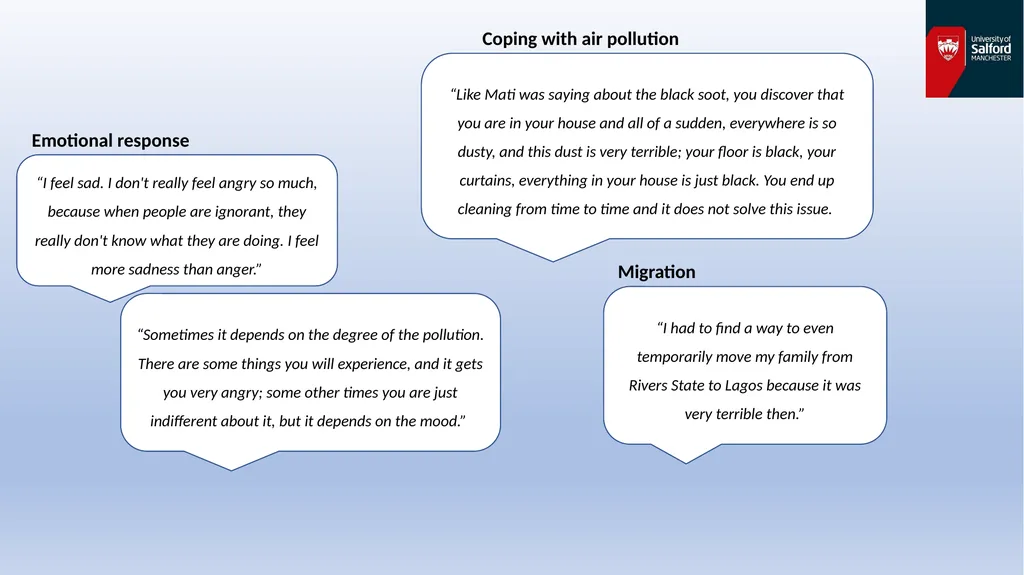
“I feel sad. I don't really feel angry so much, because when people are ignorant, they really don't know what they are doing. I feel more sadness than anger.” Emotional response Coping with air pollution “Sometimes it depends on the degree of the pollution. There are some things you will experience, and it gets you very angry; some other times you are just indifferent about it, but it depends on the mood.” “Like Mati was saying about the black soot, you discover that you are in your house and all of a sudden, everywhere is so dusty, and this dust is very terrible; your floor is black, your curtains, everything in your house is just black. You end up cleaning from time to time and it does not solve this issue. Migration “I had to find a way to even temporarily move my family from Rivers State to Lagos because it was very terrible then.”<br>
10
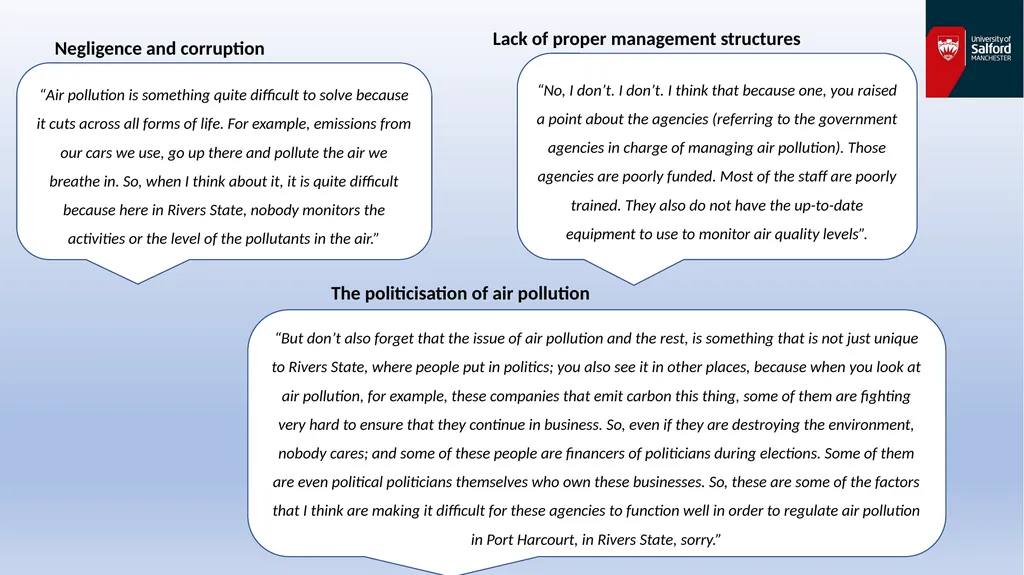
“Air pollution is something quite difficult to solve because it cuts across all forms of life. For example, emissions from our cars we use, go up there and pollute the air we breathe in. So, when I think about it, it is quite difficult because here in Rivers State, nobody monitors the activities or the level of the pollutants in the air.” Negligence and corruption Lack of proper management structures “No, I don’t. I don’t. I think that because one, you raised a point about the agencies (referring to the government agencies in charge of managing air pollution). Those agencies are poorly funded. Most of the staff are poorly trained. They also do not have the up-to-date equipment to use to monitor air quality levels”. The politicisation of air pollution “But don’t also forget that the issue of air pollution and the rest, is something that is not just unique to Rivers State, where people put in politics; you also see it in other places, because when you look at air pollution, for example, these companies that emit carbon this thing, some of them are fighting very hard to ensure that they continue in business. So, even if they are destroying the environment, nobody cares; and some of these people are financers of politicians during elections. Some of them are even political politicians themselves who own these businesses. So, these are some of the factors that I think are making it difficult for these agencies to function well in order to regulate air pollution in Port Harcourt, in Rivers State, sorry.”<br>
11
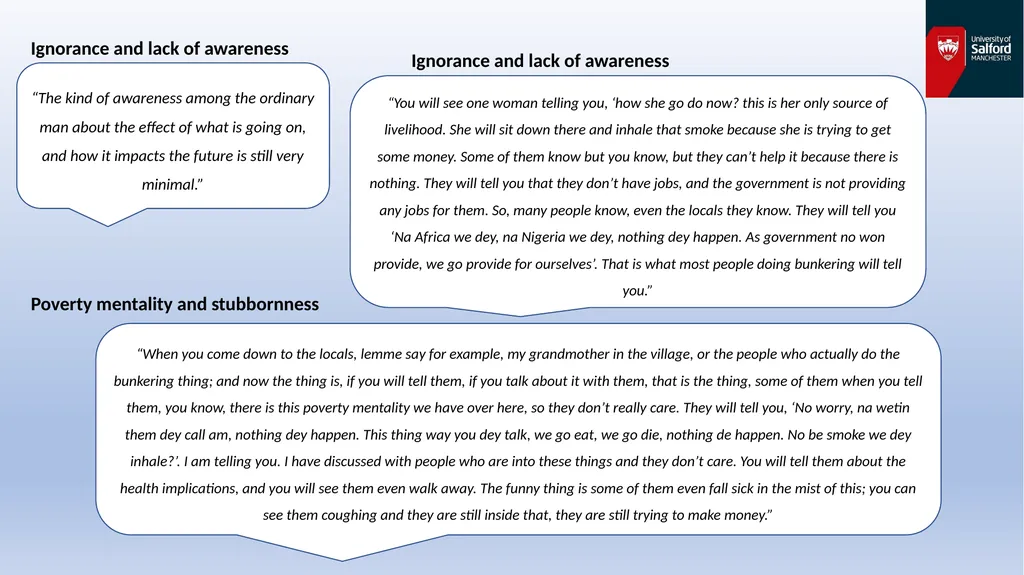
“The kind of awareness among the ordinary man about the effect of what is going on, and how it impacts the future is still very minimal.” Ignorance and lack of awareness Poverty mentality and stubbornness “When you come down to the locals, lemme say for example, my grandmother in the village, or the people who actually do the bunkering thing; and now the thing is, if you will tell them, if you talk about it with them, that is the thing, some of them when you tell them, you know, there is this poverty mentality we have over here, so they don’t really care. They will tell you, ‘No worry, na wetin them dey call am, nothing dey happen. This thing way you dey talk, we go eat, we go die, nothing de happen. No be smoke we dey inhale?’. I am telling you. I have discussed with people who are into these things and they don’t care. You will tell them about the health implications, and you will see them even walk away. The funny thing is some of them even fall sick in the mist of this; you can see them coughing and they are still inside that, they are still trying to make money.” “You will see one woman telling you, ‘how she go do now? this is her only source of livelihood. She will sit down there and inhale that smoke because she is trying to get some money. Some of them know but you know, but they can’t help it because there is nothing. They will tell you that they don’t have jobs, and the government is not providing any jobs for them. So, many people know, even the locals they know. They will tell you ‘Na Africa we dey, na Nigeria we dey, nothing dey happen. As government no won provide, we go provide for ourselves’. That is what most people doing bunkering will tell you.” Ignorance and lack of awareness<br>
12
Recommendations Sensitisation of the public on current practices that contributes to air pollution Creating alternatives for the livelihood of people dependent on air pollution More participation and collaboration between government and experts Embrace newer technologies that can reduce emissions<br>
13
End of presentation<br>
14
Thank you for listening Email: k.g.olomu@edu.salford.ac.uk
Twitter: https://www.twitter.com/Kevwe_Olomu
LinkedIn: https://www.linkedin.com/in/kevwe-olomu-55295a4a/
Supervisors
Andrew Clark – a.p.clark@salford.ac.uk
Rosie Anthony – r.v.e.Anthony@salford.ac.uk<br>