
Algae An alga (singular for algae) is a plant-like
YM
Published · 37 slides · 0 views

1 / 1



Description
Algae An alga (singular for algae) is a plant-like organism that uses sunlight to produce energy in a process called photosynthesis. Algae are extremely important organisms because they are considered to be the primary oxygen-producing
Related Topics
Share
Embed code
Download this presentation From Below
"Algae An alga (singular for algae) is a plant-like" is the property of its rightful owner. Permission is granted to download and print the materials on this website for personal, non-commercial use only, and to display it on your personal computer provided you do not modify the materials and that you retain all copyright notices contained in the materials. By downloading content from our website, you accept the terms of this agreement.
Presentation Transcript
01
Algae
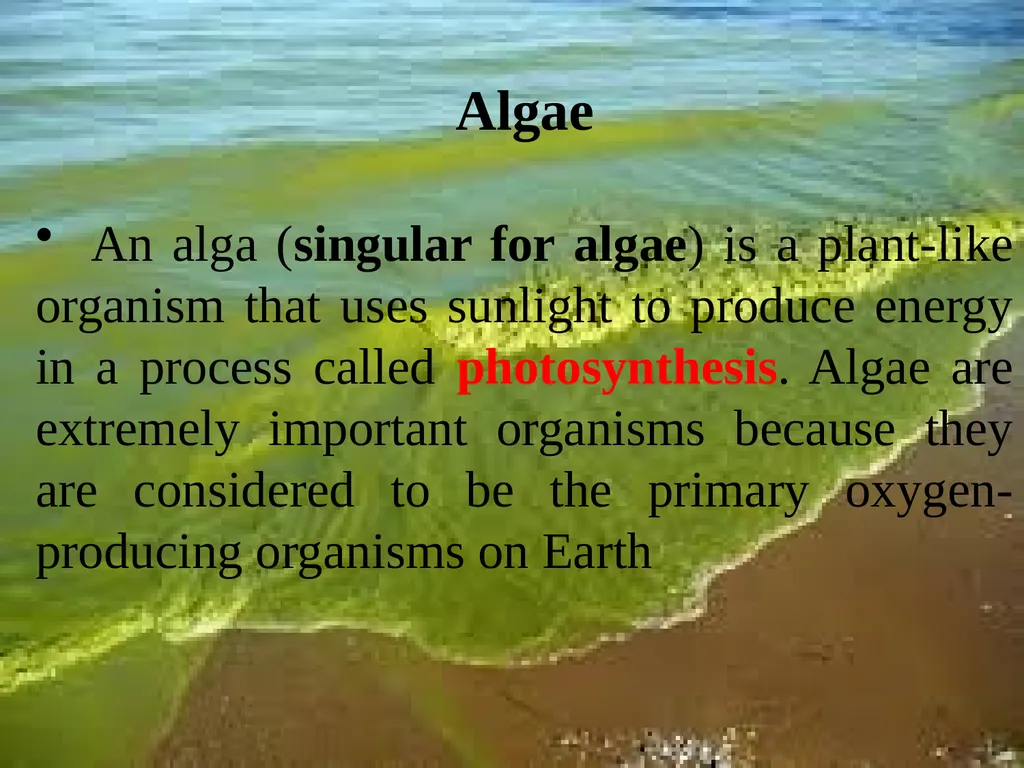
An alga (singular for algae) is a plant-like organism that uses sunlight to produce energy in a process called photosynthesis. Algae are extremely important organisms because they are considered to be the primary oxygen-producing organisms on Earth<br>
An alga (singular for algae) is a plant-like organism that uses sunlight to produce energy in a process called photosynthesis. Algae are extremely important organisms because they are considered to be the primary oxygen-producing organisms on Earth<br>
02
Definition
The word "phyco" is derived from a Greek word "phykos" that means seaweed. Phycology is the study of the cells, structure, function, life cycles, ecology and other properties of algae. It is also called algology.
Algae are thallophytic ;their vegetative body is not organized in root and leafy stems like that of the kormophytes . many algae are living in solitary cells , colonies ,filaments , or primitive vegetation bodies and do not have a vascular system . in contrast to the phanerogams (plant producing seeds ),<br>
The word "phyco" is derived from a Greek word "phykos" that means seaweed. Phycology is the study of the cells, structure, function, life cycles, ecology and other properties of algae. It is also called algology.
Algae are thallophytic ;their vegetative body is not organized in root and leafy stems like that of the kormophytes . many algae are living in solitary cells , colonies ,filaments , or primitive vegetation bodies and do not have a vascular system . in contrast to the phanerogams (plant producing seeds ),<br>
03
Therefore its definition is :
-Algae are hetrogenous
-Very sample
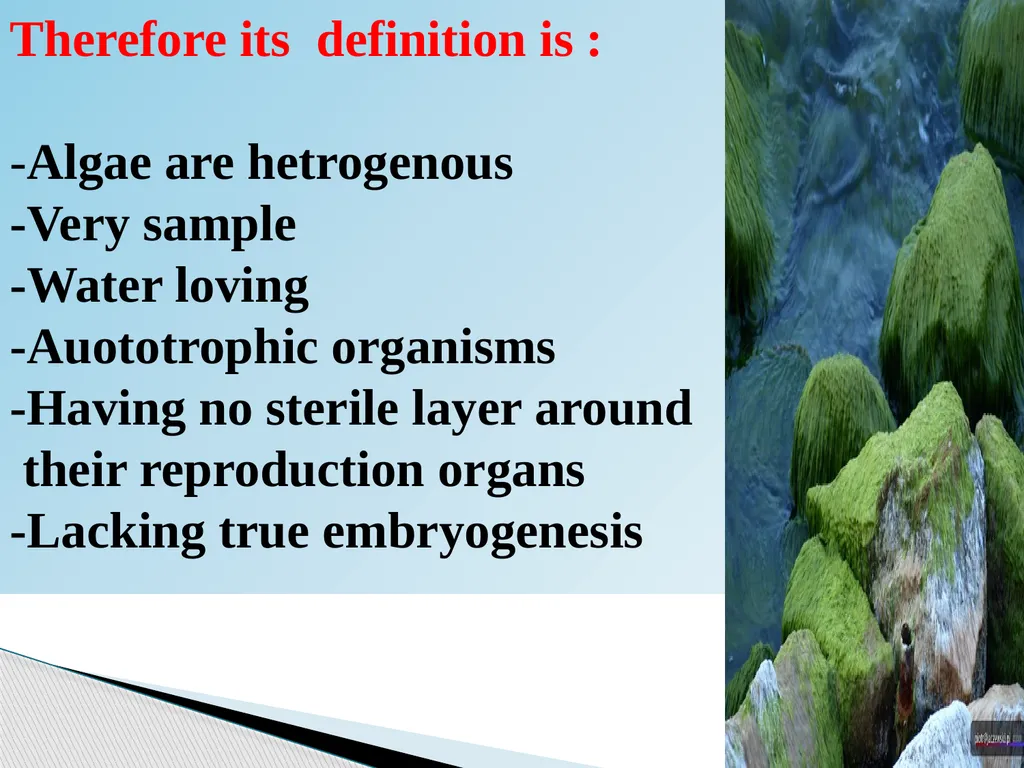
-Water loving
-Auototrophic organisms
-Having no sterile layer around
their reproduction organs
-Lacking true embryogenesis<br>
-Algae are hetrogenous
-Very sample
-Water loving
-Auototrophic organisms
-Having no sterile layer around
their reproduction organs
-Lacking true embryogenesis<br>
04
:Classic classification
Algae is a hetrogenons assemblage of individuals ,being distributed in tow kingdoms :
Monera
Protista
protoctista<br>
Algae is a hetrogenons assemblage of individuals ,being distributed in tow kingdoms :
Monera
Protista
protoctista<br>
05
Following a conception of sub division of living organisms into five kingdoms (Monera, protoctista, fungi, animalia, and plantae).
The prokaryotic algae
(blue green algae ,cyanobacteria, cyanoprokaryota) are placed in the monera (Eubacteria) and the eukaryotic algae in the protoctista . the algae do not belong to kingdom of plantae . Nevertheless , it is widely accepted (because of the photosynthesis characteristic )to interpret algae as (lower plants)in distinction to the vascular (higher plants).
The eukaryotic algae
posses membrane –bound organelles such as nuclei, mitochondria and plastids . the prokaryotic cyanobacteria do not exhibit such organelles:;their DNA and photosynthetic thylakoids lie free in the cytoplasm.<br>
The prokaryotic algae
(blue green algae ,cyanobacteria, cyanoprokaryota) are placed in the monera (Eubacteria) and the eukaryotic algae in the protoctista . the algae do not belong to kingdom of plantae . Nevertheless , it is widely accepted (because of the photosynthesis characteristic )to interpret algae as (lower plants)in distinction to the vascular (higher plants).
The eukaryotic algae
posses membrane –bound organelles such as nuclei, mitochondria and plastids . the prokaryotic cyanobacteria do not exhibit such organelles:;their DNA and photosynthetic thylakoids lie free in the cytoplasm.<br>
06
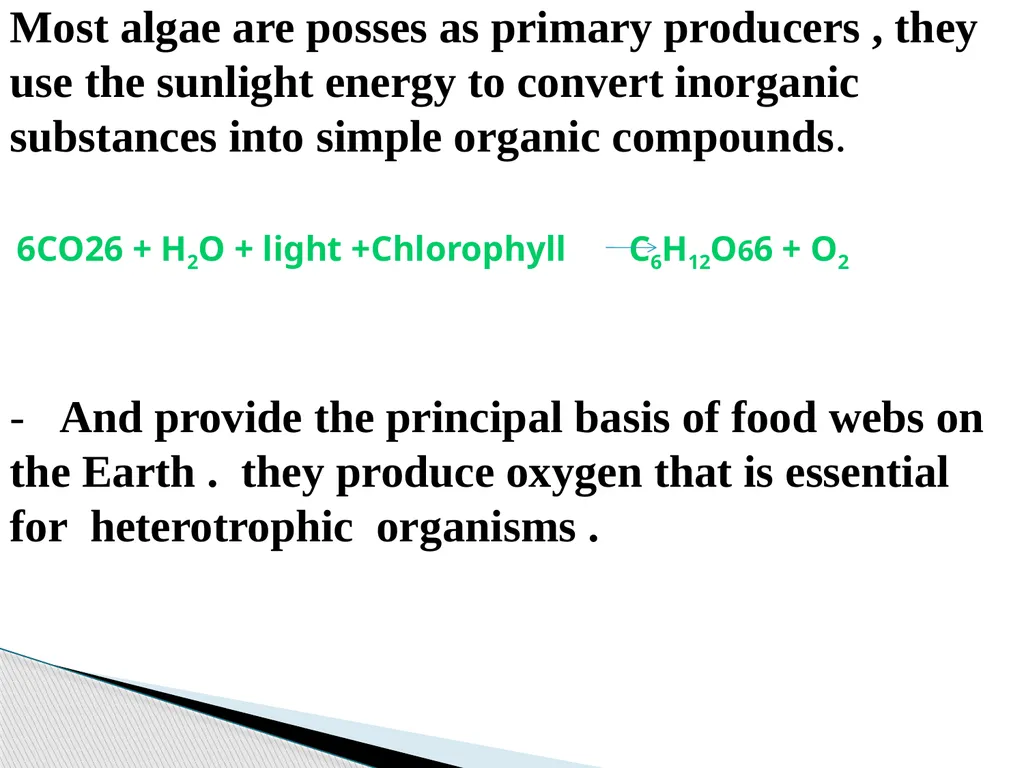
Most algae are posses as primary producers , they use the sunlight energy to convert inorganic substances into simple organic compounds.
6CO26 + H2O + light +Chlorophyll C6H12O66 + O2
- And provide the principal basis of food webs on the Earth . they produce oxygen that is essential for heterotrophic organisms .<br>
6CO26 + H2O + light +Chlorophyll C6H12O66 + O2
- And provide the principal basis of food webs on the Earth . they produce oxygen that is essential for heterotrophic organisms .<br>
07
How to distinguished algae from plants
Algae and plants produce the same
Storge compunds
Use similar defense strategies against parasites and predators
Strong morphological similarity exists between algae and plants
Then how to distinguish ?????……..
Because similarities between plants and algae are much fewer than there differences
1-plants show a very high degree of differentiation with root ,leaves, stem and xylem /phloem vascular network
2-reproductives organs are surrounding by a jacket of sterile cells<br>
Algae and plants produce the same
Storge compunds
Use similar defense strategies against parasites and predators
Strong morphological similarity exists between algae and plants
Then how to distinguish ?????……..
Because similarities between plants and algae are much fewer than there differences
1-plants show a very high degree of differentiation with root ,leaves, stem and xylem /phloem vascular network
2-reproductives organs are surrounding by a jacket of sterile cells<br>
08
algae do not have any of these
1-they do not have root, leaf and stems.
2- they don’t form true embryo
3- do not have a vascular system . 3-they have a multicellular diploid embryo stage that remains developmentally and nutritionally dependent on the parent's gametophyte for significant period
4-producing tissue that differentiate in a wide variety of shapes.<br>
1-they do not have root, leaf and stems.
2- they don’t form true embryo
3- do not have a vascular system . 3-they have a multicellular diploid embryo stage that remains developmentally and nutritionally dependent on the parent's gametophyte for significant period
4-producing tissue that differentiate in a wide variety of shapes.<br>
09
:Distribution and abundance
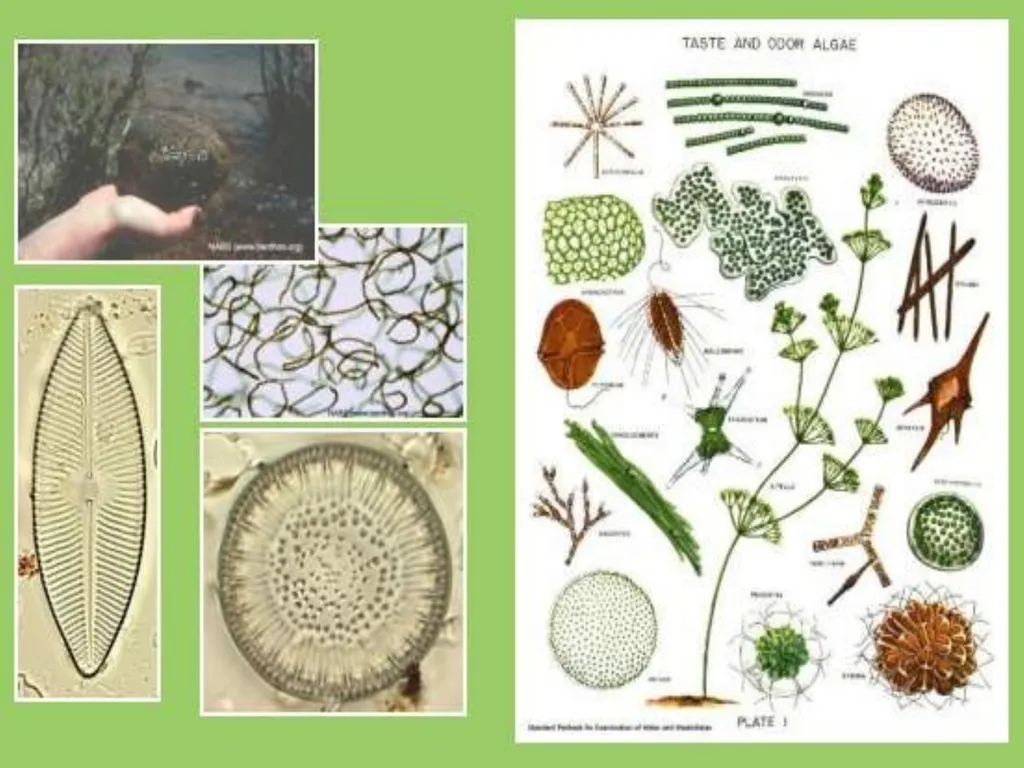
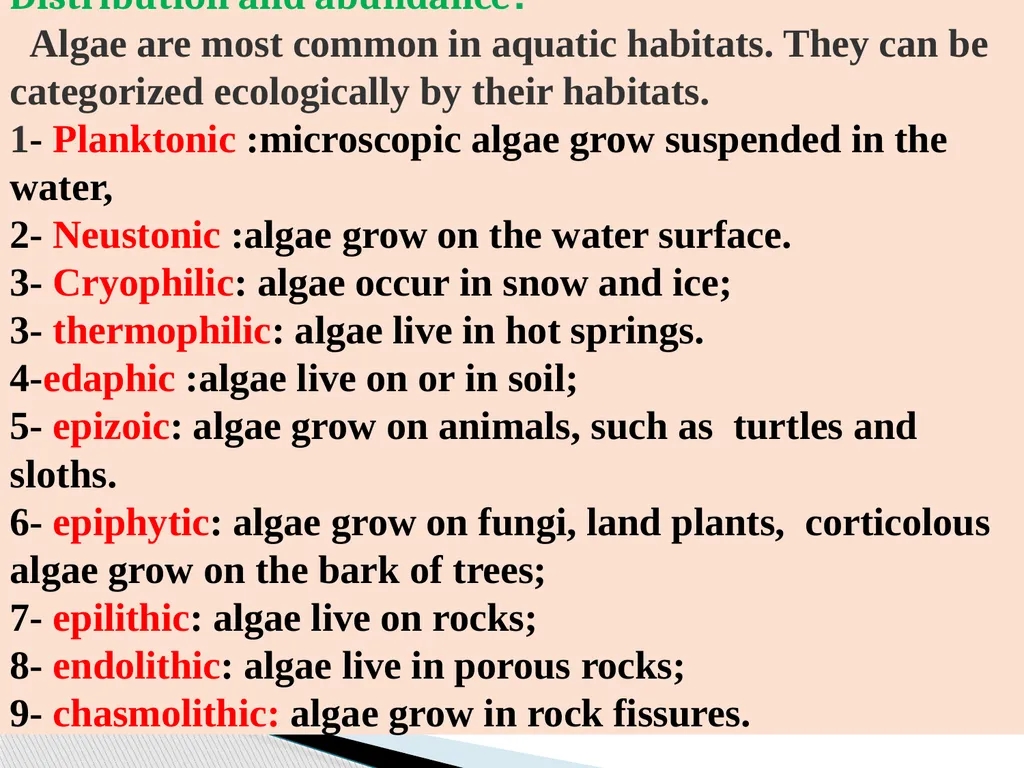
Algae are most common in aquatic habitats. They can be categorized ecologically by their habitats.
1- Planktonic :microscopic algae grow suspended in the water,
2- Neustonic :algae grow on the water surface.
3- Cryophilic: algae occur in snow and ice;
3- thermophilic: algae live in hot springs.
4-edaphic :algae live on or in soil;
5- epizoic: algae grow on animals, such as turtles and sloths.
6- epiphytic: algae grow on fungi, land plants, corticolous algae grow on the bark of trees;
7- epilithic: algae live on rocks;
8- endolithic: algae live in porous rocks;
9- chasmolithic: algae grow in rock fissures.<br>
Algae are most common in aquatic habitats. They can be categorized ecologically by their habitats.
1- Planktonic :microscopic algae grow suspended in the water,
2- Neustonic :algae grow on the water surface.
3- Cryophilic: algae occur in snow and ice;
3- thermophilic: algae live in hot springs.
4-edaphic :algae live on or in soil;
5- epizoic: algae grow on animals, such as turtles and sloths.
6- epiphytic: algae grow on fungi, land plants, corticolous algae grow on the bark of trees;
7- epilithic: algae live on rocks;
8- endolithic: algae live in porous rocks;
9- chasmolithic: algae grow in rock fissures.<br>
10
Some algae live inside other organisms, and in a general sense these are called endosymbionts. Specifically, endozoic endosymbionts live in protozoa or other, larger animals, whereas endophytic endosymbionts live in fungi, plants, or other algae.<br>
11
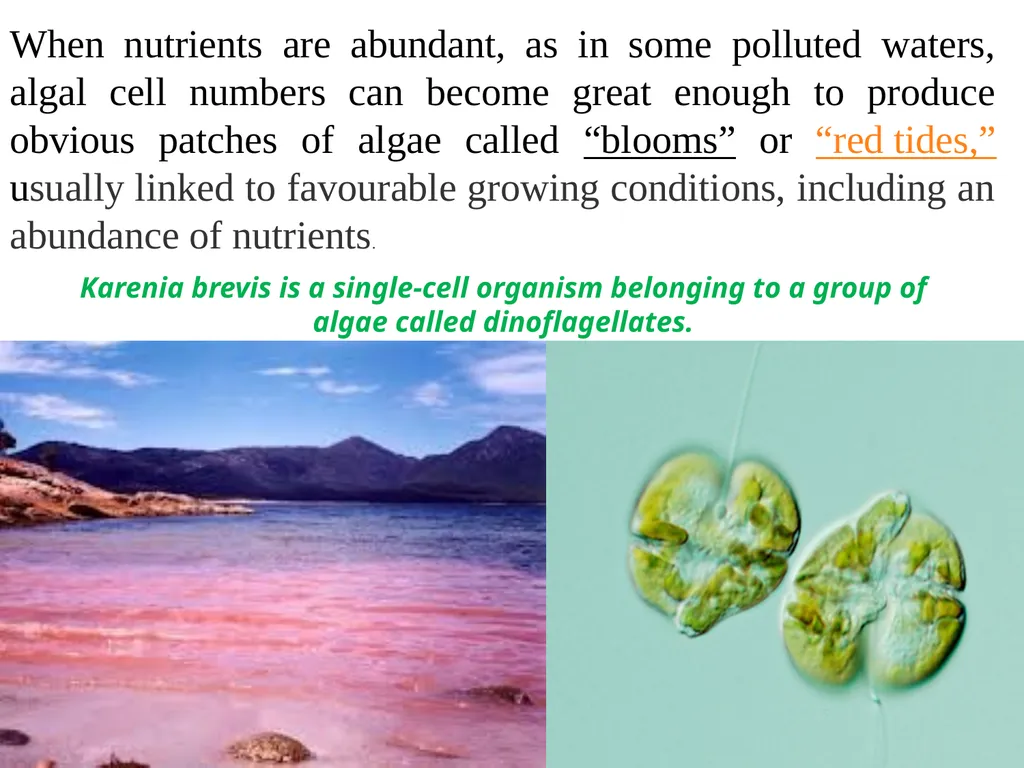
When nutrients are abundant, as in some polluted waters, algal cell numbers can become great enough to produce obvious patches of algae called “blooms” or “red tides,” usually linked to favourable growing conditions, including an abundance of nutrients. Karenia brevis is a single-cell organism belonging to a group of algae called dinoflagellates.<br>
12
Size range and diversity of structure
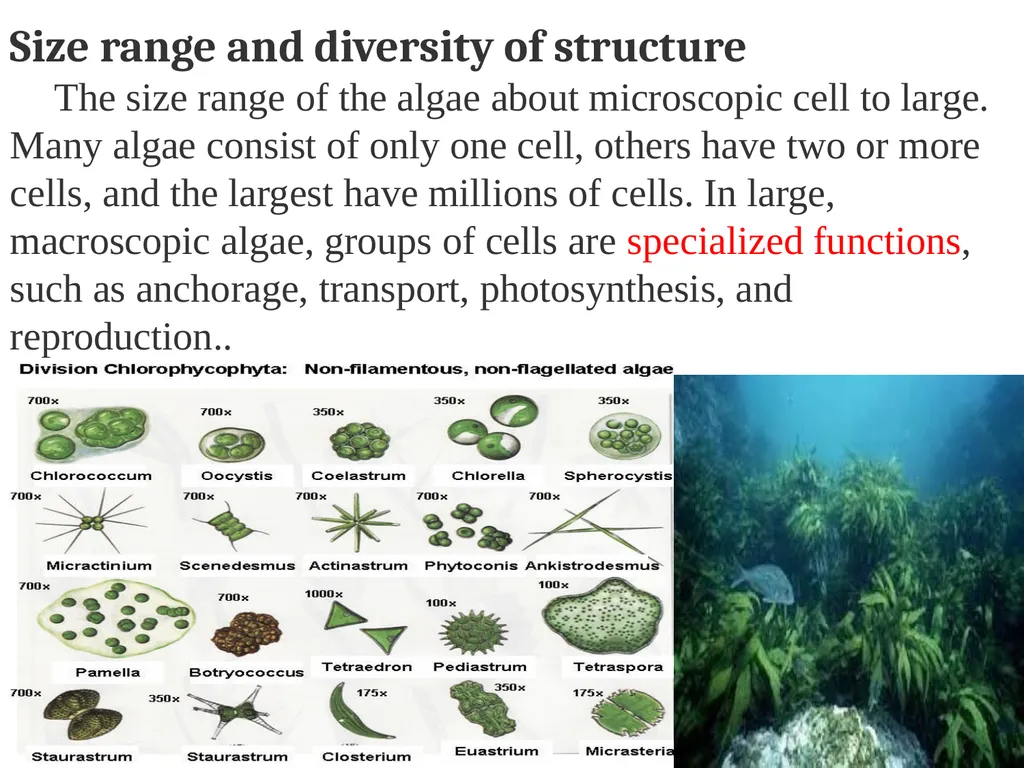
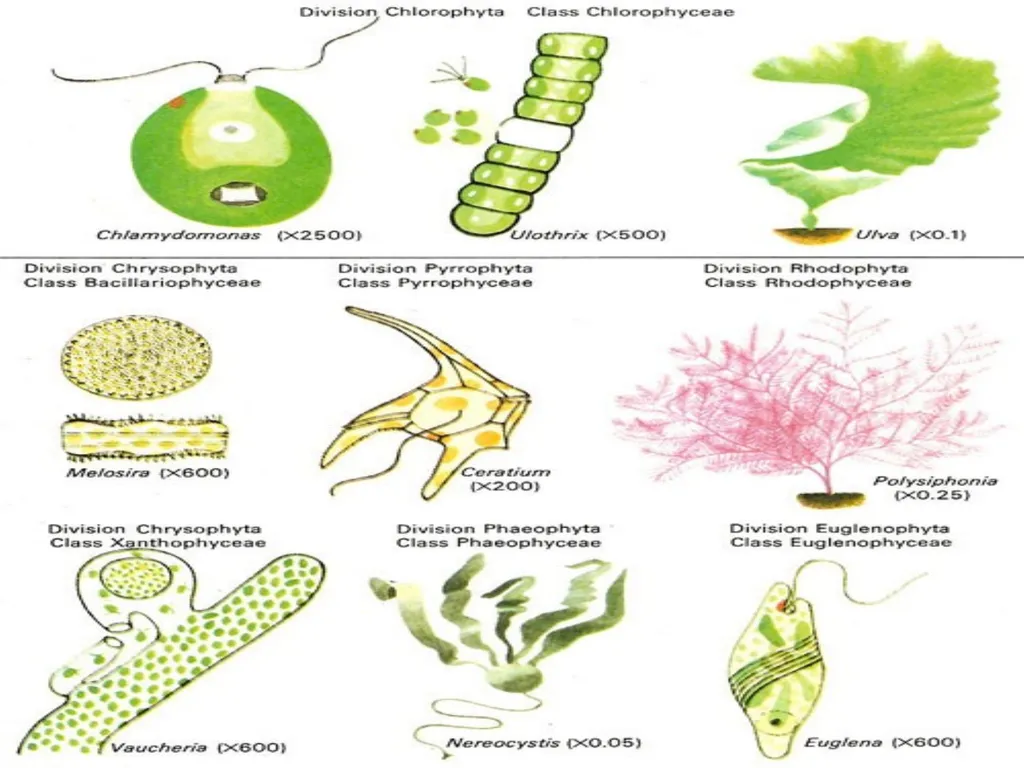
The size range of the algae about microscopic cell to large. Many algae consist of only one cell, others have two or more cells, and the largest have millions of cells. In large, macroscopic algae, groups of cells are specialized functions, such as anchorage, transport, photosynthesis, and reproduction..<br>
The size range of the algae about microscopic cell to large. Many algae consist of only one cell, others have two or more cells, and the largest have millions of cells. In large, macroscopic algae, groups of cells are specialized functions, such as anchorage, transport, photosynthesis, and reproduction..<br>
13
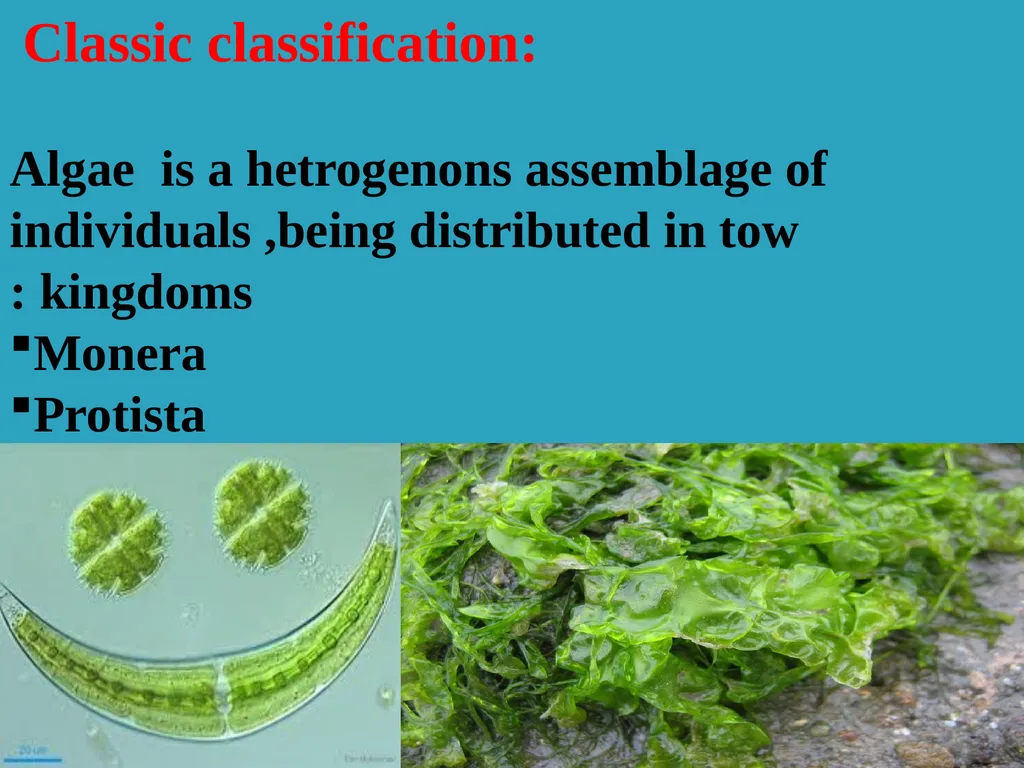
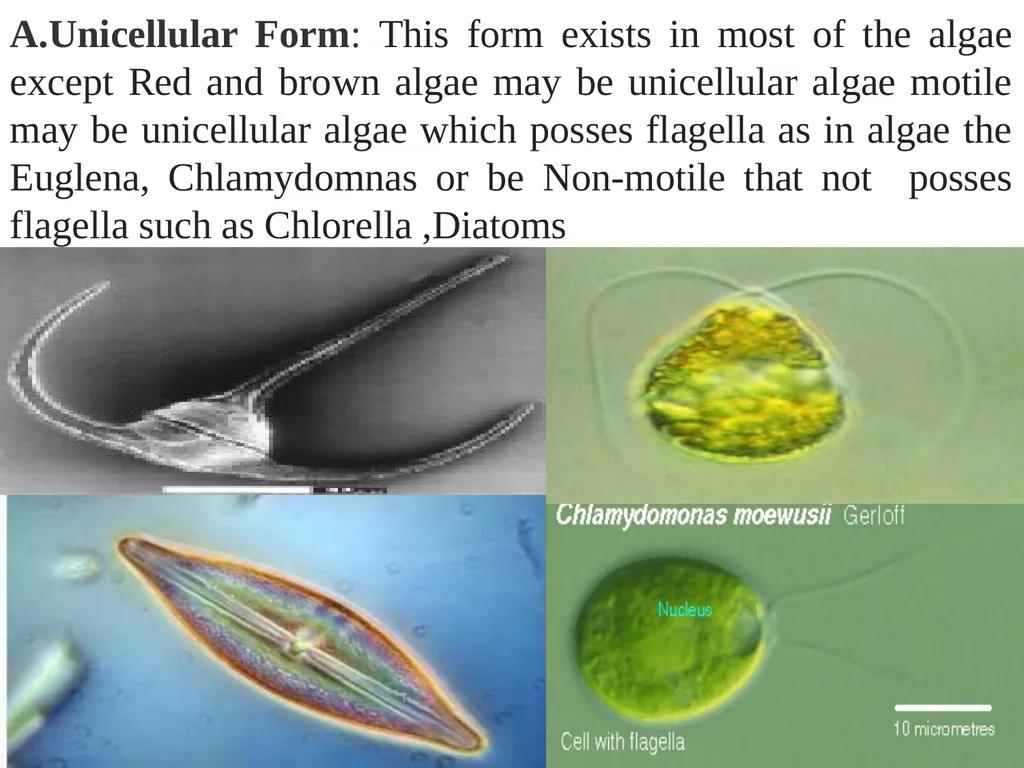
A.Unicellular Form: This form exists in most of the algae except Red and brown algae may be unicellular algae motile may be unicellular algae which posses flagella as in algae the Euglena, Chlamydomnas or be Non-motile that not posses flagella such as Chlorella ,Diatoms<br>
14
B-multicellulare thalli have five types:
Colonial
Aggregation
Filamentous
Siphoneous
parenchymatous Colonial
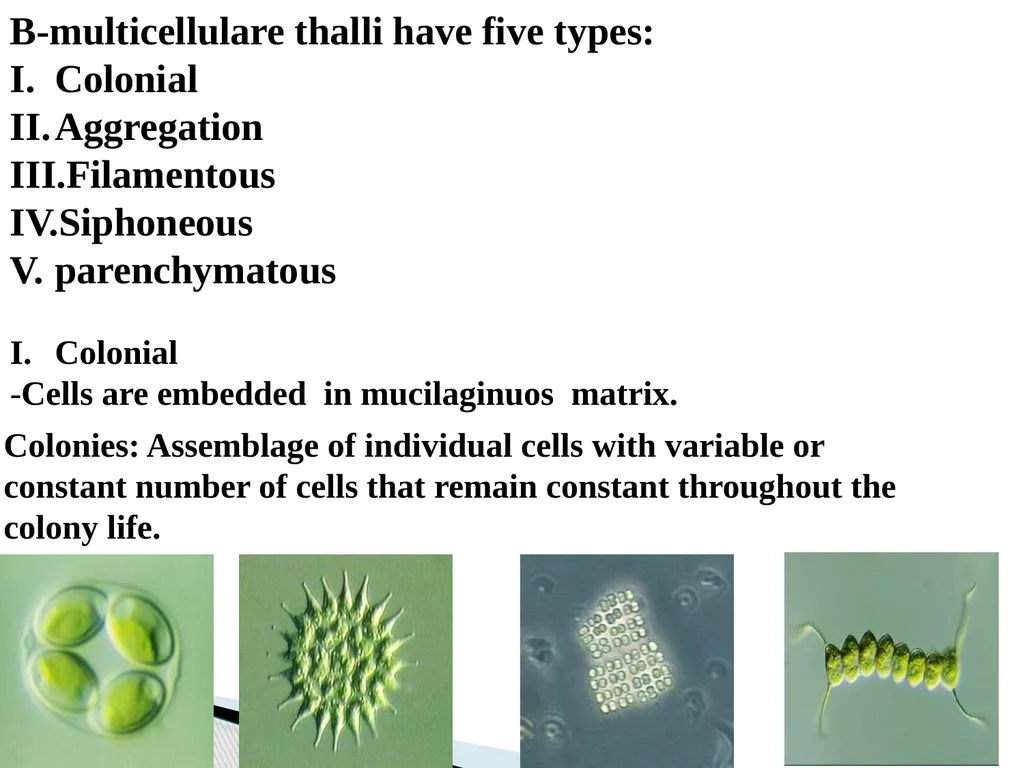
-Cells are embedded in mucilaginuos matrix. Colonies: Assemblage of individual cells with variable or constant number of cells that remain constant throughout the colony life.<br>
Colonial
Aggregation
Filamentous
Siphoneous
parenchymatous Colonial
-Cells are embedded in mucilaginuos matrix. Colonies: Assemblage of individual cells with variable or constant number of cells that remain constant throughout the colony life.<br>
15
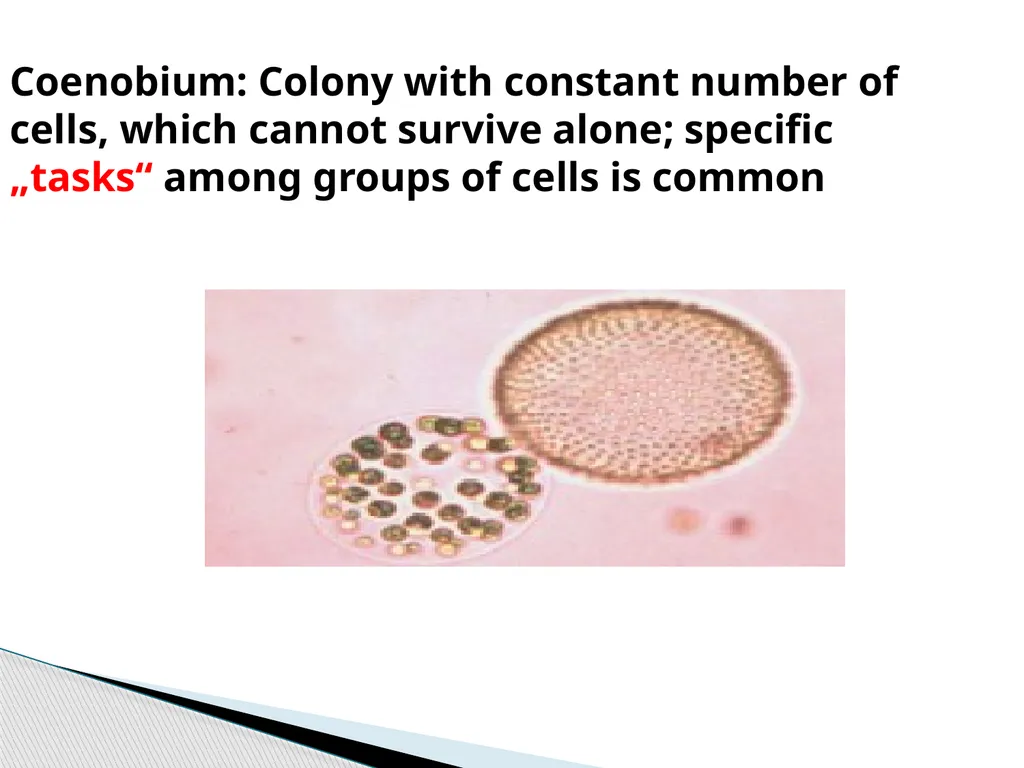
Coenobium: Colony with constant number of cells, which cannot survive alone; specific „tasks“ among groups of cells is common<br>
16
2-Aggregration
An aggregation of the cells are not of constants size and shape; moreover; vegetative cells division takes placed so that there is in increase in cell number during the growth Most common type of aggregation is the plamelloid form in which the cells are embedded in an irregular mass of muciage 3-filmentous
Filamentous forms are also characterized by vegetative cells division but unlike the irregular aggregation in liner rows. -threads or filaments are either unbranched or branched in one which shows differentiation into prostrate portion an erect system. Filaments: daughter cells remain attached after cell division and form a cell chain; adjacent cells share cell wall (distinguish them from linear colonies!); maybe unbranched (uniseriate) or branched (mutiseriate)<br>
An aggregation of the cells are not of constants size and shape; moreover; vegetative cells division takes placed so that there is in increase in cell number during the growth Most common type of aggregation is the plamelloid form in which the cells are embedded in an irregular mass of muciage 3-filmentous
Filamentous forms are also characterized by vegetative cells division but unlike the irregular aggregation in liner rows. -threads or filaments are either unbranched or branched in one which shows differentiation into prostrate portion an erect system. Filaments: daughter cells remain attached after cell division and form a cell chain; adjacent cells share cell wall (distinguish them from linear colonies!); maybe unbranched (uniseriate) or branched (mutiseriate)<br>
17
4-Coenocytic or siphonaceaous one large, multinucleate cell without cross walls Parenchymatous and pseudoparenchymatous algae: mostly macro-scopic algae with tissue of undifferentiated cells and growth originating from a meristem with cell division in three dimensions; pseudoparenchymatous superficially ressemble parenchyma but are composed of appressed filaments 5-Parenchymatous and pseudoparenchymatous algae: mostly macro-scopic algae with tissue of undifferentiated cells and growth originating from a meristem with cell division in three dimensions; pseudoparenchymatous superficially ressemble parenchyma but are composed of appressed filaments<br>
18
B-multicellular form;
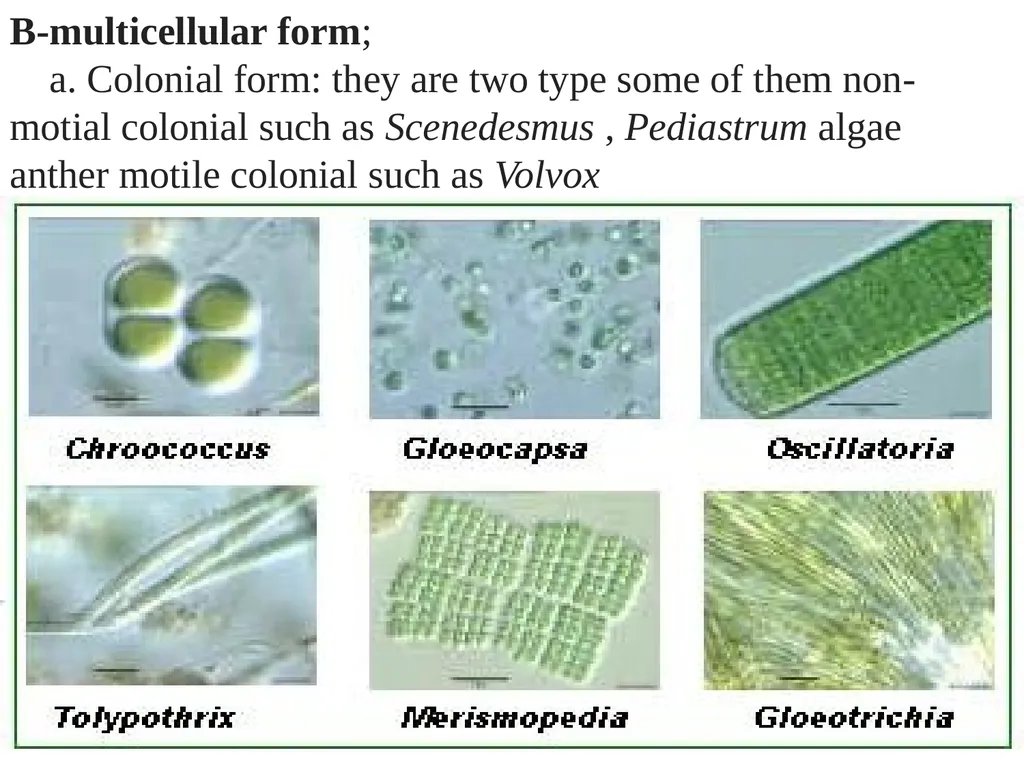
a. Colonial form: they are two type some of them non- motial colonial such as Scenedesmus , Pediastrum algae anther motile colonial such as Volvox<br>
a. Colonial form: they are two type some of them non- motial colonial such as Scenedesmus , Pediastrum algae anther motile colonial such as Volvox<br>
19
b. Filamentous forms
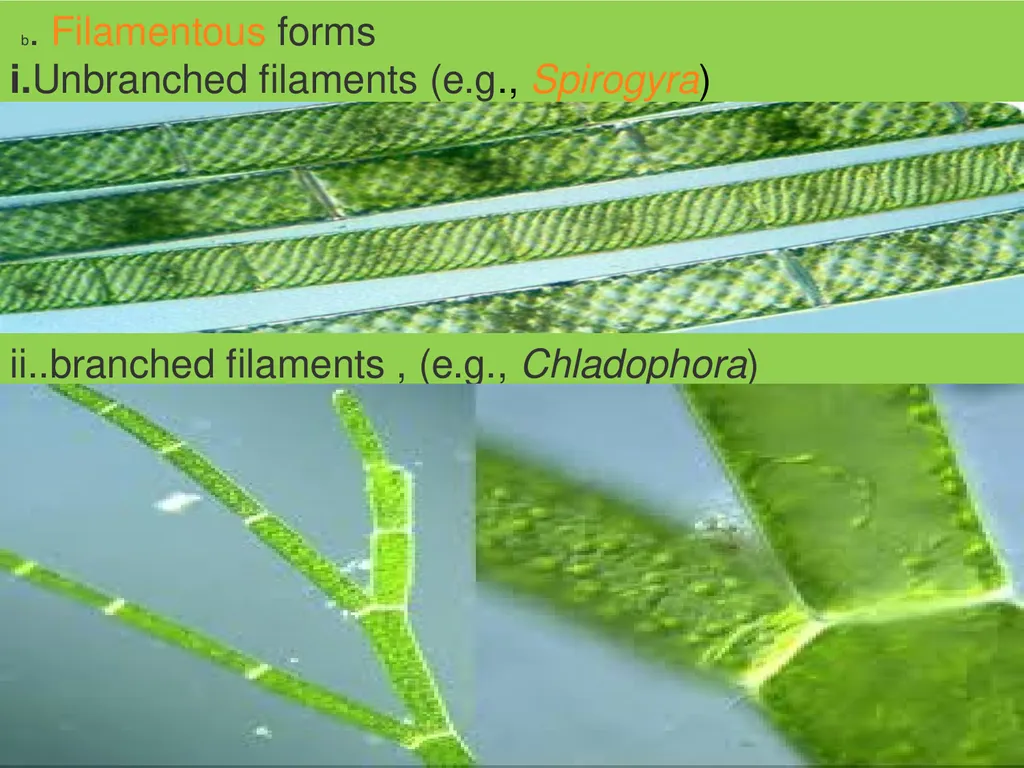
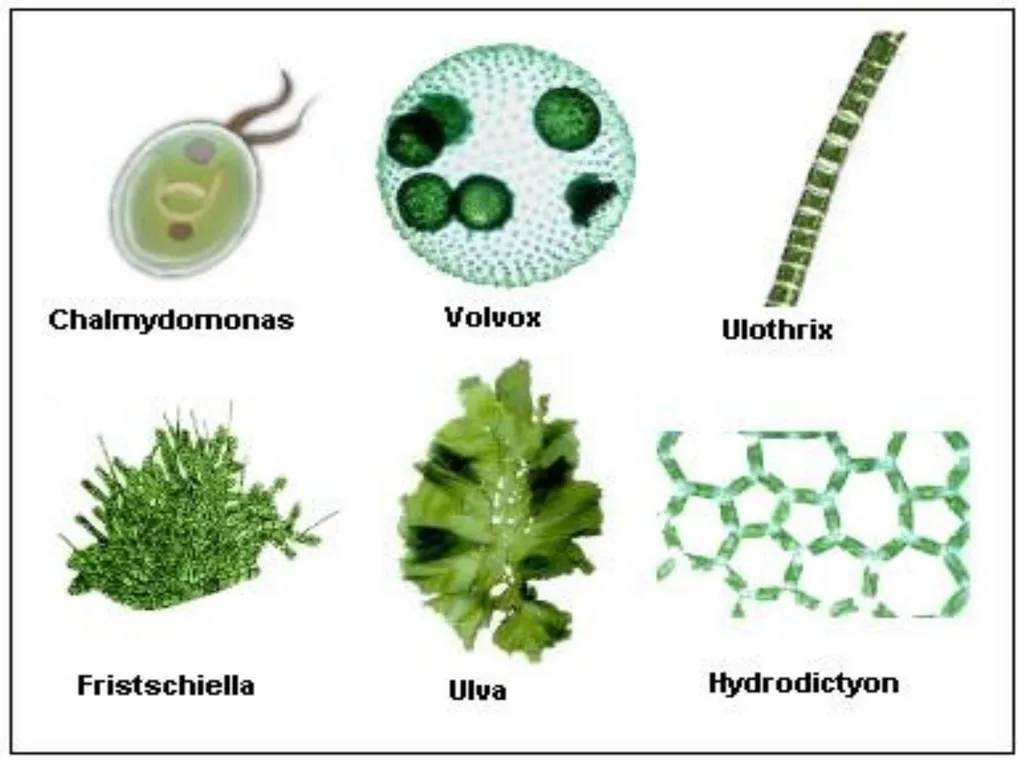
i.Unbranched filaments (e.g., Spirogyra) ii..branched filaments , (e.g., Chladophora)<br>
i.Unbranched filaments (e.g., Spirogyra) ii..branched filaments , (e.g., Chladophora)<br>
20
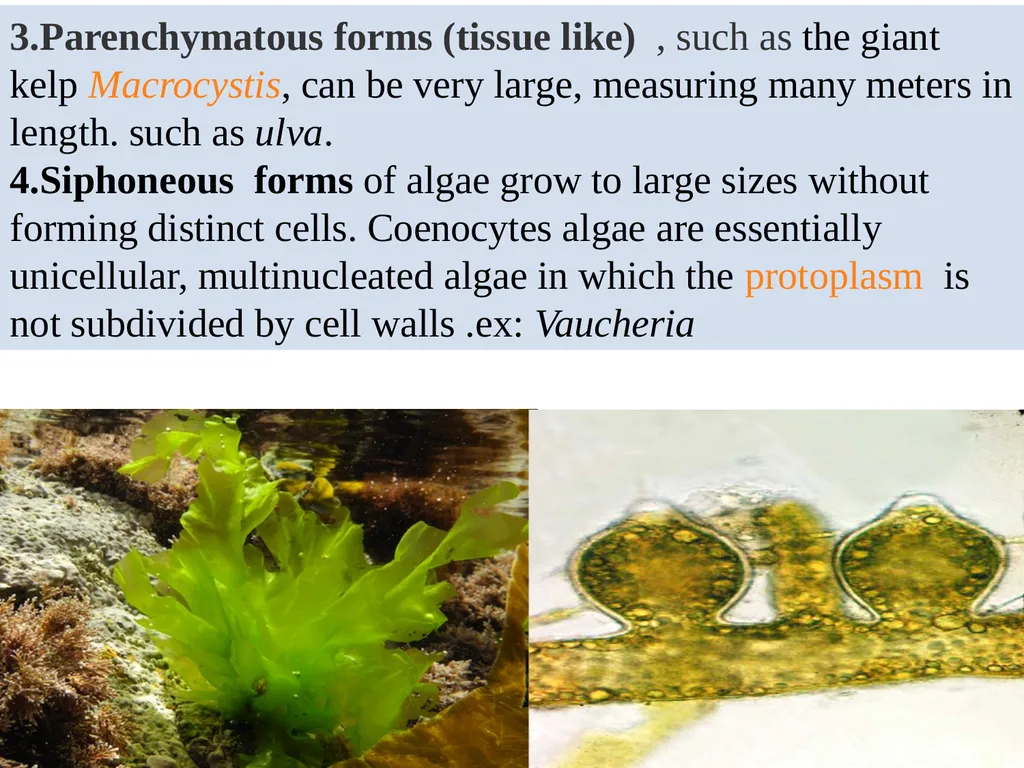
3.Parenchymatous forms (tissue like) , such as the giant kelp Macrocystis, can be very large, measuring many meters in length. such as ulva.
4.Siphoneous forms of algae grow to large sizes without forming distinct cells. Coenocytes algae are essentially unicellular, multinucleated algae in which the protoplasm is not subdivided by cell walls .ex: Vaucheria<br>
4.Siphoneous forms of algae grow to large sizes without forming distinct cells. Coenocytes algae are essentially unicellular, multinucleated algae in which the protoplasm is not subdivided by cell walls .ex: Vaucheria<br>
21
5. In many red algae (e.g., Palmaria), numerous adjacent filaments joined laterally create the gross morphological form of the alga
6.Some algae have flagella and swim through the water. These flagellates range from single cells, such as Ochromonas, to colonial organisms with thousands of cells, such as Volvox.
7. Coccoid forms, such as Scenedesmus, normally have an exact number of cells per colony, produced by a series of rapid cell divisions when the organism is first formed; once the exact cell number is obtained, the organism grows in size but not in cell number.
8.Capsoid organisms, such as Chrysocapsa, have variable numbers of cells. These cells are found in clusters that increase gradually in cell number and are embedded in transparent gel.
9-Erect thallus forms:such as Nitella ,Chara<br>
6.Some algae have flagella and swim through the water. These flagellates range from single cells, such as Ochromonas, to colonial organisms with thousands of cells, such as Volvox.
7. Coccoid forms, such as Scenedesmus, normally have an exact number of cells per colony, produced by a series of rapid cell divisions when the organism is first formed; once the exact cell number is obtained, the organism grows in size but not in cell number.
8.Capsoid organisms, such as Chrysocapsa, have variable numbers of cells. These cells are found in clusters that increase gradually in cell number and are embedded in transparent gel.
9-Erect thallus forms:such as Nitella ,Chara<br>
22
BASIS FOR CLASSIFICATION OF ALGAE
The primary classification of algae is based on the following five criteria:
Photosynthetic pigments
Nature of food reserves
Nature of cell wall components
Type, number and attachment of flagella
Cell structure<br>
The primary classification of algae is based on the following five criteria:
Photosynthetic pigments
Nature of food reserves
Nature of cell wall components
Type, number and attachment of flagella
Cell structure<br>
23
Photosynthesis pigments
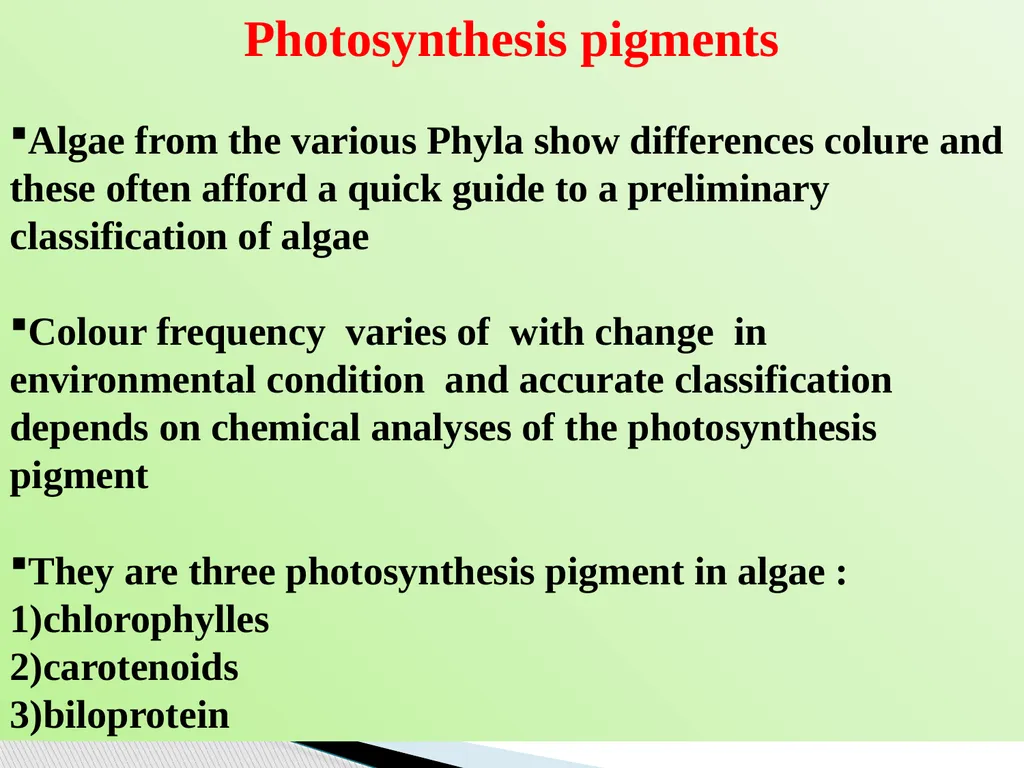
Algae from the various Phyla show differences colure and these often afford a quick guide to a preliminary classification of algae
Colour frequency varies of with change in environmental condition and accurate classification depends on chemical analyses of the photosynthesis pigment
They are three photosynthesis pigment in algae :
1)chlorophylles
2)carotenoids
3)biloprotein<br>
Algae from the various Phyla show differences colure and these often afford a quick guide to a preliminary classification of algae
Colour frequency varies of with change in environmental condition and accurate classification depends on chemical analyses of the photosynthesis pigment
They are three photosynthesis pigment in algae :
1)chlorophylles
2)carotenoids
3)biloprotein<br>
24
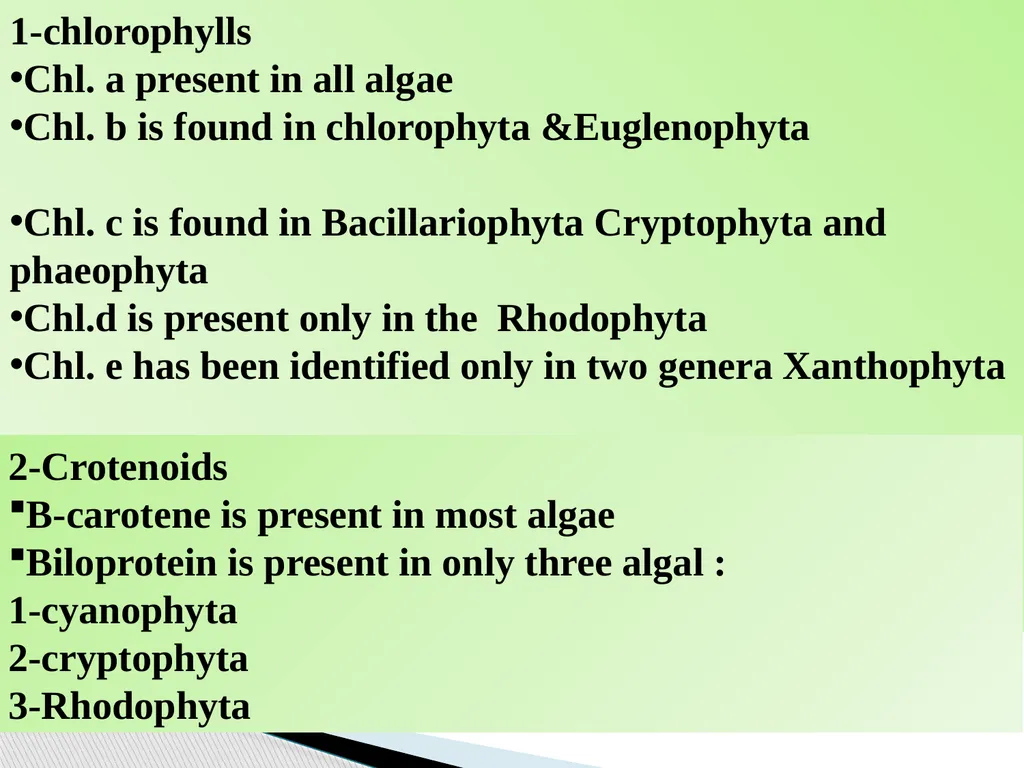
1-chlorophylls
Chl. a present in all algae
Chl. b is found in chlorophyta &Euglenophyta
Chl. c is found in Bacillariophyta Cryptophyta and phaeophyta
Chl.d is present only in the Rhodophyta
Chl. e has been identified only in two genera Xanthophyta 2-Crotenoids
B-carotene is present in most algae
Biloprotein is present in only three algal :
1-cyanophyta
2-cryptophyta
3-Rhodophyta<br>
Chl. a present in all algae
Chl. b is found in chlorophyta &Euglenophyta
Chl. c is found in Bacillariophyta Cryptophyta and phaeophyta
Chl.d is present only in the Rhodophyta
Chl. e has been identified only in two genera Xanthophyta 2-Crotenoids
B-carotene is present in most algae
Biloprotein is present in only three algal :
1-cyanophyta
2-cryptophyta
3-Rhodophyta<br>
25
2-Food storage products
-ture starch similar to that found in higher plants. 3-Wall composition
Cellulose
Xylens
Mannans
Sulphated polysachccraids
Alginic acids
Protein
Silicon dioxide
Calcium carbonate<br>
-ture starch similar to that found in higher plants. 3-Wall composition
Cellulose
Xylens
Mannans
Sulphated polysachccraids
Alginic acids
Protein
Silicon dioxide
Calcium carbonate<br>
26
5-Algae cell
-Broad range of cell type can be observed
-same algae of unicells e.g. Chlorella sp. And many diatoms Most algae are more complex that exist as colonies ,as filaments<br>
-Broad range of cell type can be observed
-same algae of unicells e.g. Chlorella sp. And many diatoms Most algae are more complex that exist as colonies ,as filaments<br>
27
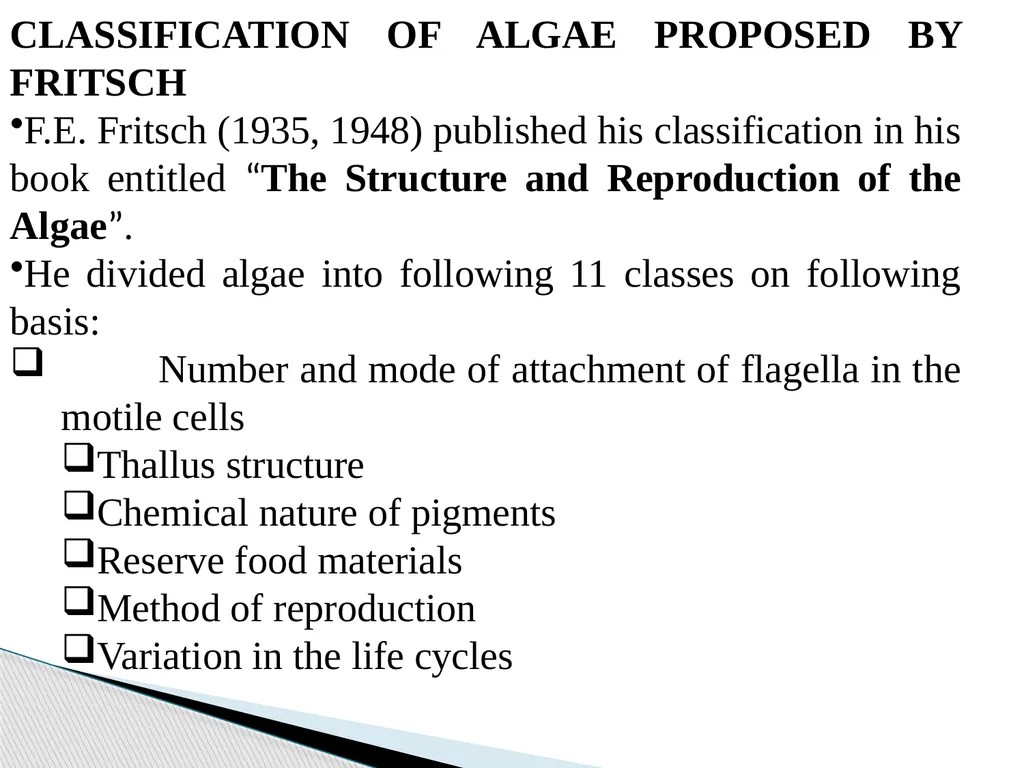
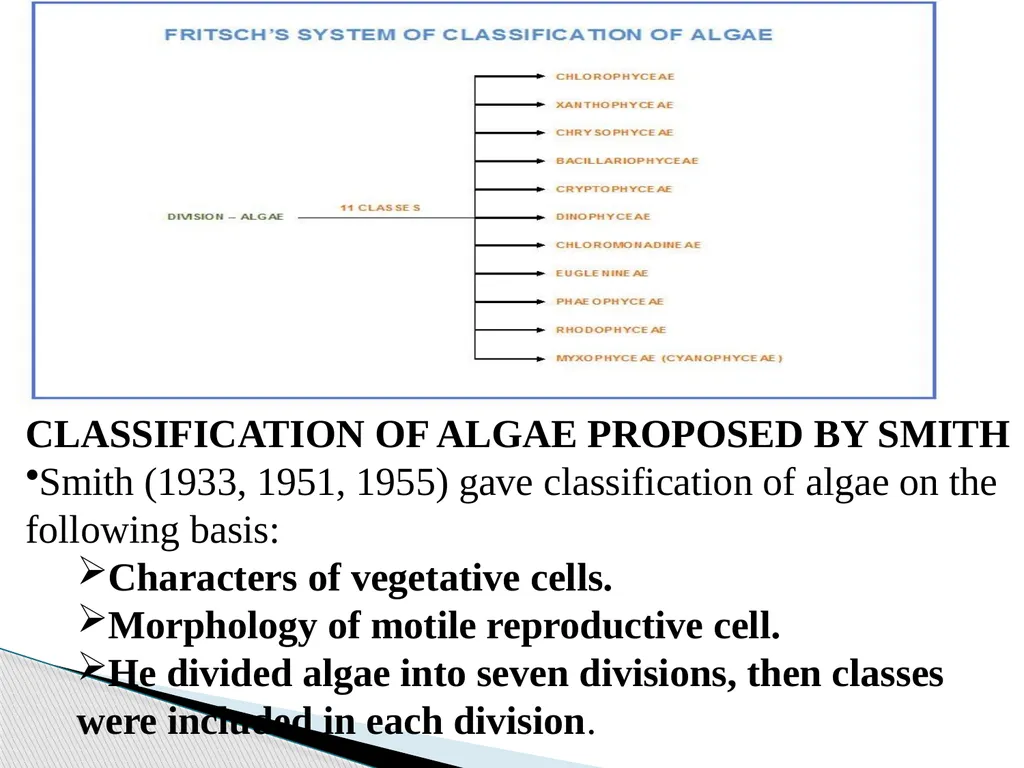
CLASSIFICATION OF ALGAE PROPOSED BY FRITSCH
F.E. Fritsch (1935, 1948) published his classification in his book entitled “The Structure and Reproduction of the Algae”.
He divided algae into following 11 classes on following basis:
Number and mode of attachment of flagella in the motile cells
Thallus structure
Chemical nature of pigments
Reserve food materials
Method of reproduction
Variation in the life cycles<br>
F.E. Fritsch (1935, 1948) published his classification in his book entitled “The Structure and Reproduction of the Algae”.
He divided algae into following 11 classes on following basis:
Number and mode of attachment of flagella in the motile cells
Thallus structure
Chemical nature of pigments
Reserve food materials
Method of reproduction
Variation in the life cycles<br>
28
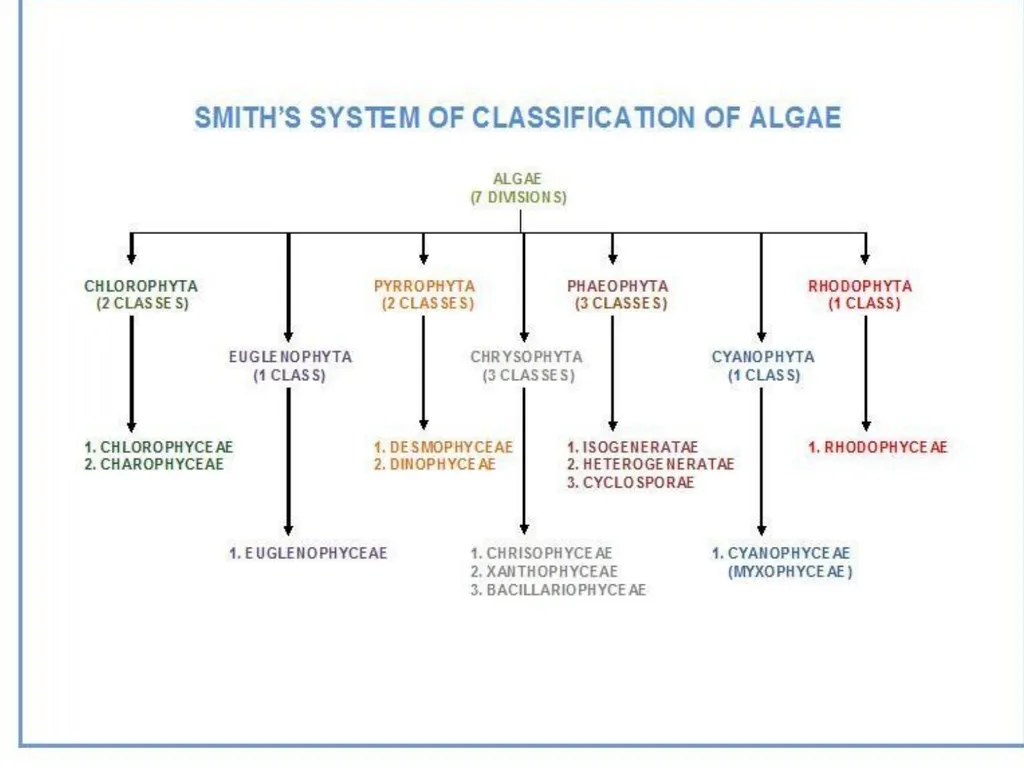
CLASSIFICATION OF ALGAE PROPOSED BY SMITH
Smith (1933, 1951, 1955) gave classification of algae on the following basis:
Characters of vegetative cells.
Morphology of motile reproductive cell.
He divided algae into seven divisions, then classes were included in each division.<br>
Smith (1933, 1951, 1955) gave classification of algae on the following basis:
Characters of vegetative cells.
Morphology of motile reproductive cell.
He divided algae into seven divisions, then classes were included in each division.<br>
29
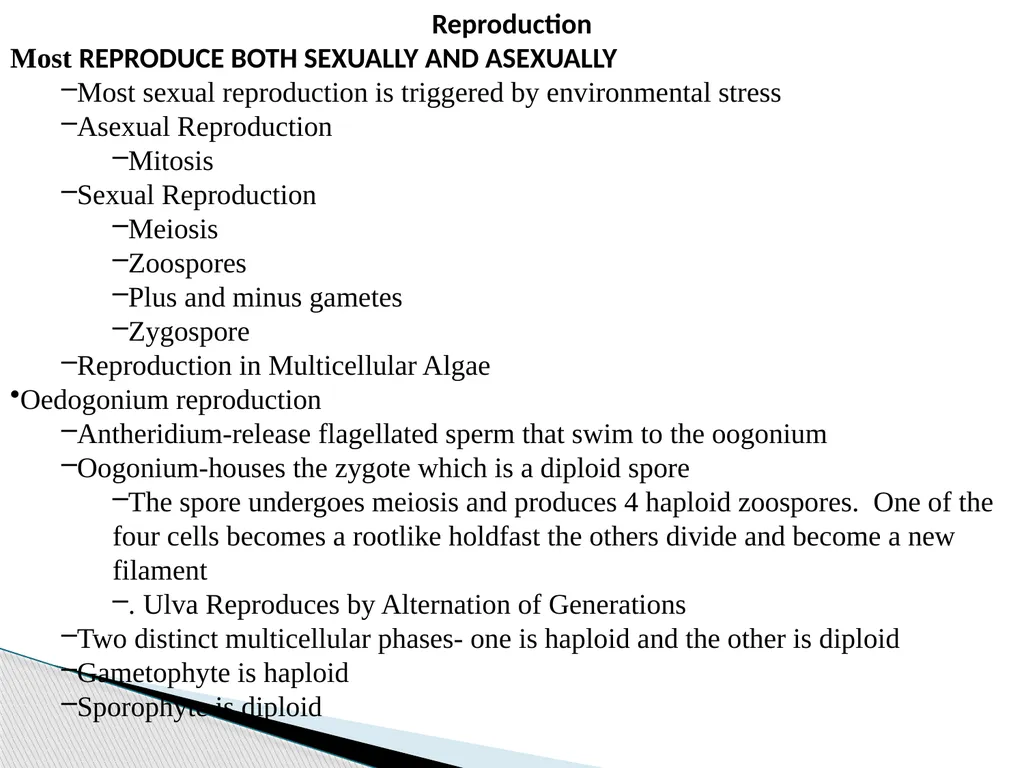
Reproduction
Most REPRODUCE BOTH SEXUALLY AND ASEXUALLY
Most sexual reproduction is triggered by environmental stress
Asexual Reproduction
Mitosis
Sexual Reproduction
Meiosis
Zoospores
Plus and minus gametes
Zygospore
Reproduction in Multicellular Algae
Oedogonium reproduction
Antheridium-release flagellated sperm that swim to the oogonium
Oogonium-houses the zygote which is a diploid spore
The spore undergoes meiosis and produces 4 haploid zoospores. One of the four cells becomes a rootlike holdfast the others divide and become a new filament
. Ulva Reproduces by Alternation of Generations
Two distinct multicellular phases- one is haploid and the other is diploid
Gametophyte is haploid
Sporophyte is diploid<br>
Most REPRODUCE BOTH SEXUALLY AND ASEXUALLY
Most sexual reproduction is triggered by environmental stress
Asexual Reproduction
Mitosis
Sexual Reproduction
Meiosis
Zoospores
Plus and minus gametes
Zygospore
Reproduction in Multicellular Algae
Oedogonium reproduction
Antheridium-release flagellated sperm that swim to the oogonium
Oogonium-houses the zygote which is a diploid spore
The spore undergoes meiosis and produces 4 haploid zoospores. One of the four cells becomes a rootlike holdfast the others divide and become a new filament
. Ulva Reproduces by Alternation of Generations
Two distinct multicellular phases- one is haploid and the other is diploid
Gametophyte is haploid
Sporophyte is diploid<br>
30
defiant terms:
Isogamy – sexual fusion between flagellated gametes that
are similar in size and shape
Anisogamy – sexual fusion between flagellated gametes of
distinctly different sizes
Oogamy – sexual fusion between a flagellated gamete
(sperm) and non-flagellated gamete (egg)
Sporophyte: diploid, 2n, multicellular release spores in
alternation of generations
Gametophyte: hapliod, 1n, multicellular release gametes in alternation of generations<br>
Isogamy – sexual fusion between flagellated gametes that
are similar in size and shape
Anisogamy – sexual fusion between flagellated gametes of
distinctly different sizes
Oogamy – sexual fusion between a flagellated gamete
(sperm) and non-flagellated gamete (egg)
Sporophyte: diploid, 2n, multicellular release spores in
alternation of generations
Gametophyte: hapliod, 1n, multicellular release gametes in alternation of generations<br>
31
Beneficial Aspects of Algae
Food for humans
Food for invertebrates and fishes in marin culture
Animal feed
Soil fertilizers and conditioners in agriculture
Treatment of waste water
Diatomaceous earth (= diatoms)
Chalk deposits
Phycocolloids (agar, carrageenan from red algae; alginates from brown algae)
Drugs
Model system for research
Phycobiliproteins for fluorescence microscopy<br>
Food for humans
Food for invertebrates and fishes in marin culture
Animal feed
Soil fertilizers and conditioners in agriculture
Treatment of waste water
Diatomaceous earth (= diatoms)
Chalk deposits
Phycocolloids (agar, carrageenan from red algae; alginates from brown algae)
Drugs
Model system for research
Phycobiliproteins for fluorescence microscopy<br>
32
Detrimental Aspects of Algae
Blooms of freshwater algae
Red tides and marine blooms
Toxins accumulated in food chains
Damage to cave paintings, frescoes, and other works of art
Fouling of ships and other submerged surfaces
Fouling of the shells of commercially important bivalves<br>
Blooms of freshwater algae
Red tides and marine blooms
Toxins accumulated in food chains
Damage to cave paintings, frescoes, and other works of art
Fouling of ships and other submerged surfaces
Fouling of the shells of commercially important bivalves<br>
33
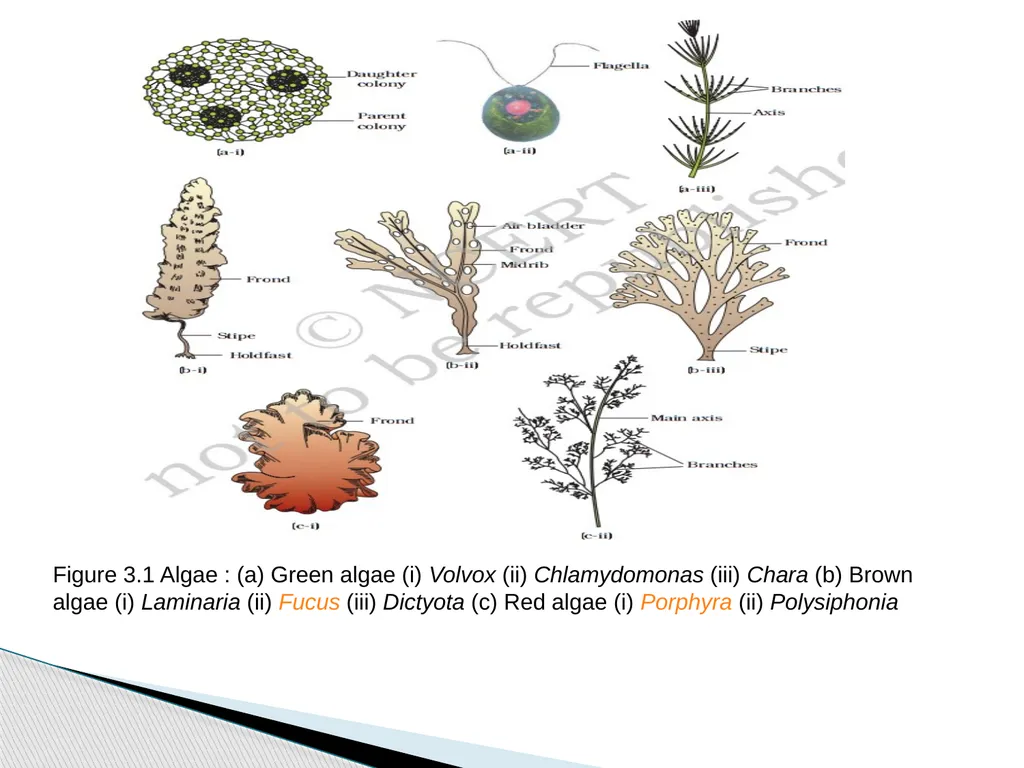
Figure 3.1 Algae : (a) Green algae (i) Volvox (ii) Chlamydomonas (iii) Chara (b) Brown algae (i) Laminaria (ii) Fucus (iii) Dictyota (c) Red algae (i) Porphyra (ii) Polysiphonia<br>