
Alkaline rocks Lamprophyre Carbonatite Lamproites





Description: Alkaline rocks Lamprophyre Carbonatite Lamproites Kimberlites Basanite feldspathoid-bearing basalt. Usually contains nepheline, but may have leucite olivine Tephrite olivine-free basanite Leucitite a volcanic rock that contains leucite
Related Topics
Download Presentation
"Alkaline rocks Lamprophyre Carbonatite Lamproites" is the property of its rightful owner. Permission is granted to download and print the materials on this website for personal, non-commercial use only, and to display it on your personal computer provided you do not modify the materials and that you retain all copyright notices contained in the materials. By downloading content from our website, you accept the terms of this agreement.
Presentation Transcript
slide1. Alkaline rocks Lamprophyre
Carbonatite
Lamproites & Kimberlites<br>
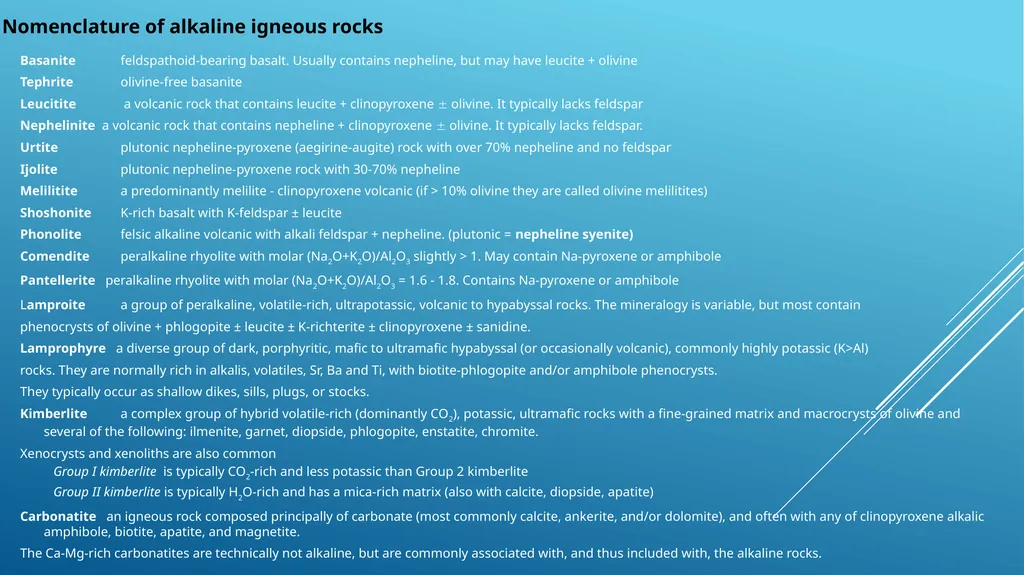
slide2. Basanite feldspathoid-bearing basalt. Usually contains nepheline, but may have leucite + olivine
Tephrite olivine-free basanite
Leucitite a volcanic rock that contains leucite + clinopyroxene olivine. It typically lacks feldspar
Nephelinite a volcanic rock that contains nepheline + clinopyroxene olivine. It typically lacks feldspar.
Urtite plutonic nepheline-pyroxene (aegirine-augite) rock with over 70% nepheline and no feldspar
Ijolite plutonic nepheline-pyroxene rock with 30-70% nepheline
Melilitite a predominantly melilite - clinopyroxene volcanic (if > 10% olivine they are called olivine melilitites)
Shoshonite K-rich basalt with K-feldspar ± leucite
Phonolite felsic alkaline volcanic with alkali feldspar + nepheline. (plutonic = nepheline syenite)
Comendite peralkaline rhyolite with molar (Na2O+K2O)/Al2O3 slightly > 1. May contain Na-pyroxene or amphibole
Pantellerite peralkaline rhyolite with molar (Na2O+K2O)/Al2O3 = 1.6 - 1.8. Contains Na-pyroxene or amphibole
Lamproite a group of peralkaline, volatile-rich, ultrapotassic, volcanic to hypabyssal rocks. The mineralogy is variable, but most contain
phenocrysts of olivine + phlogopite ± leucite ± K-richterite ± clinopyroxene ± sanidine.
Lamprophyre a diverse group of dark, porphyritic, mafic to ultramafic hypabyssal (or occasionally volcanic), commonly highly potassic (K>Al)
rocks. They are normally rich in alkalis, volatiles, Sr, Ba and Ti, with biotite-phlogopite and/or amphibole phenocrysts.
They typically occur as shallow dikes, sills, plugs, or stocks.
Kimberlite a complex group of hybrid volatile-rich (dominantly CO2), potassic, ultramafic rocks with a fine-grained matrix and macrocrysts of olivine and several of the following: ilmenite, garnet, diopside, phlogopite, enstatite, chromite.
Xenocrysts and xenoliths are also common
Group I kimberlite is typically CO2-rich and less potassic than Group 2 kimberlite
Group II kimberlite is typically H2O-rich and has a mica-rich matrix (also with calcite, diopside, apatite)
Carbonatite an igneous rock composed principally of carbonate (most commonly calcite, ankerite, and/or dolomite), and often with any of clinopyroxene alkalic amphibole, biotite, apatite, and magnetite.
The Ca-Mg-rich carbonatites are technically not alkaline, but are commonly associated with, and thus included with, the alkaline rocks. Nomenclature of alkaline igneous rocks<br>
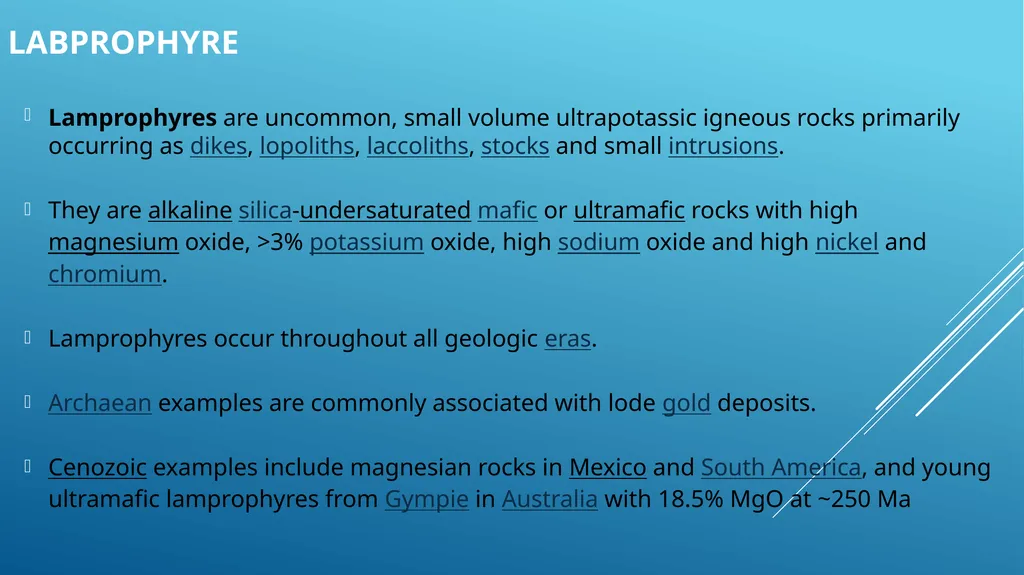
slide3. labprophyre Lamprophyres are uncommon, small volume ultrapotassic igneous rocks primarily occurring as dikes, lopoliths, laccoliths, stocks and small intrusions.
They are alkaline silica-undersaturated mafic or ultramafic rocks with high magnesium oxide, >3% potassium oxide, high sodium oxide and high nickel and chromium.
Lamprophyres occur throughout all geologic eras.
Archaean examples are commonly associated with lode gold deposits.
Cenozoic examples include magnesian rocks in Mexico and South America, and young ultramafic lamprophyres from Gympie in Australia with 18.5% MgO at ~250 Ma<br>
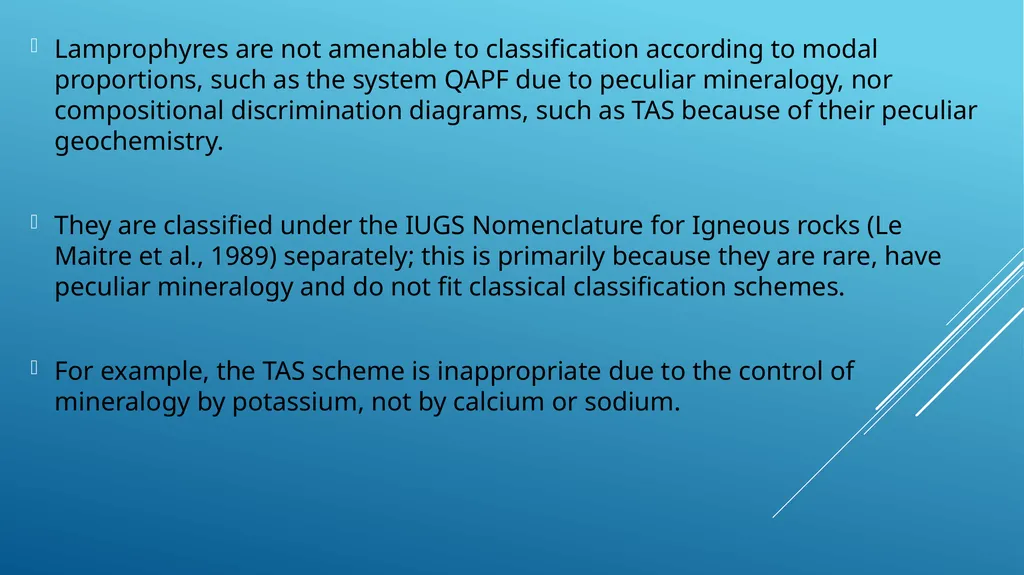
slide4. Lamprophyres are not amenable to classification according to modal proportions, such as the system QAPF due to peculiar mineralogy, nor compositional discrimination diagrams, such as TAS because of their peculiar geochemistry.
They are classified under the IUGS Nomenclature for Igneous rocks (Le Maitre et al., 1989) separately; this is primarily because they are rare, have peculiar mineralogy and do not fit classical classification schemes.
For example, the TAS scheme is inappropriate due to the control of mineralogy by potassium, not by calcium or sodium.<br>
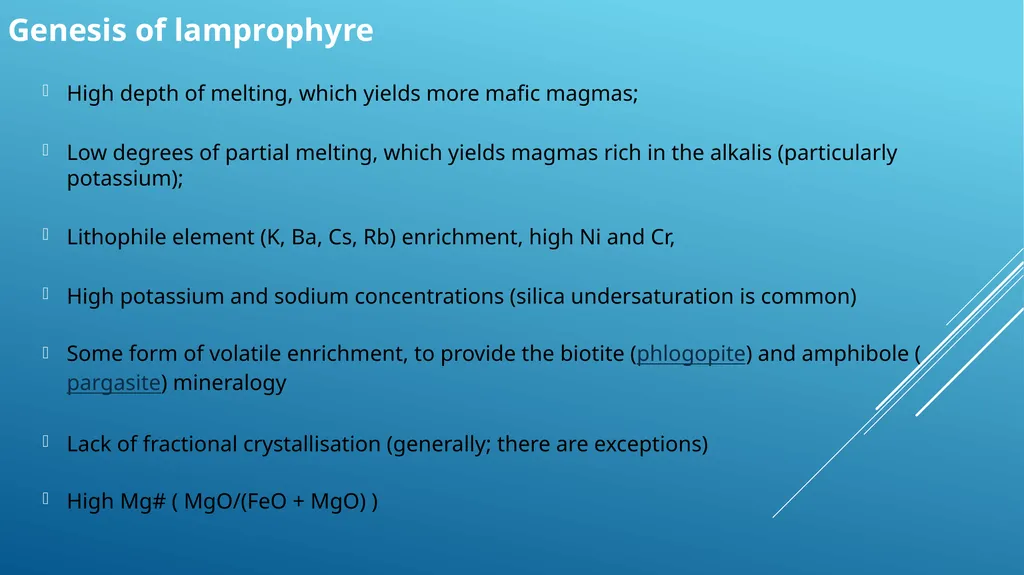
slide5. Genesis of lamprophyre High depth of melting, which yields more mafic magmas;
Low degrees of partial melting, which yields magmas rich in the alkalis (particularly potassium);
Lithophile element (K, Ba, Cs, Rb) enrichment, high Ni and Cr,
High potassium and sodium concentrations (silica undersaturation is common)
Some form of volatile enrichment, to provide the biotite (phlogopite) and amphibole (pargasite) mineralogy
Lack of fractional crystallisation (generally; there are exceptions)
High Mg# ( MgO/(FeO + MgO) )<br>
slide6. petrology The presence or absence of the four dominant minerals, orthoclase, plagioclase, biotite and hornblende, determines the species:
Minette contains biotite and orthoclase.
Kersantite contains biotite and plagioclase.
Vogesite contains hornblende and orthoclase.
Spessartite contains hornblende and plagioclase.
Each variety of lamprophyre may and often does contain all four minerals but is named according to the two which predominate.<br>
slide7. Distribution of lamprophyre Lamprophyres are usually associated with voluminous granodiorite intrusive episodes.
They occur as marginal facies to some granites, though usually as dikes and sills marginal to and crosscutting the granites and diorites.
In other districts where granites are abundant no rocks of this class are known.
It is rare to find only one member of the group present, but minettes, vogesites, kersantites, etc., all appear and there are usually transitional forms.<br>
slide8. Lamprophyres are also known to be spatially and temporally associated with gold mineralisation, for example orogenic gold deposits.
Rock (1991) considered lamphrophyres to be possible source rocks for the gold, but this view is not generally supported.
The more reasonable explanation for the correlation is that lamprophyres, representing "wet" melts of the asthenosphere and mantle, correlate with a period of high fluid flow from the mantle through the crust, during subduction-related metamorphism, which drives gold mineralisation.<br>
slide9. Lamproite<br>
slide10. Mineralogy of lamproites The mineralogy of lamproites is controlled by their peculiar geochemistry, with a predominance of rare silica-deficient mineral species and rare, mantle-derived minerals predominating.
Minerals typical of lamproites include: forsteritic olivine; high iron leucite; titanium-rich aluminum-poor phlogopite; potassium- and titanium-rich richterite; low aluminium diopside; and iron-rich sanidine.
A variety of rare trace minerals occur.
The rocks are high in potassium with 6 to 8% potassium oxide. High chromium and nickel content is typical.
The rocks commonly are altered to talc with carbonate or serpentine, chlorite, and magnetite. Zeolites and quartz may also occur.<br>
slide11. There are numerous varieties of lamproite depending on their dominant phases.
The three most well known varieties are wyomingite, dominated by diopside, leucite, and phlogopite;
Madupite, dominated by phenocrysts of diopside and phlogopite; and
Fitzroyite, dominated by leucite and phlogopite.
Lamproites are found as lava flows or hypabyssal intrusions, generally pipes.<br>
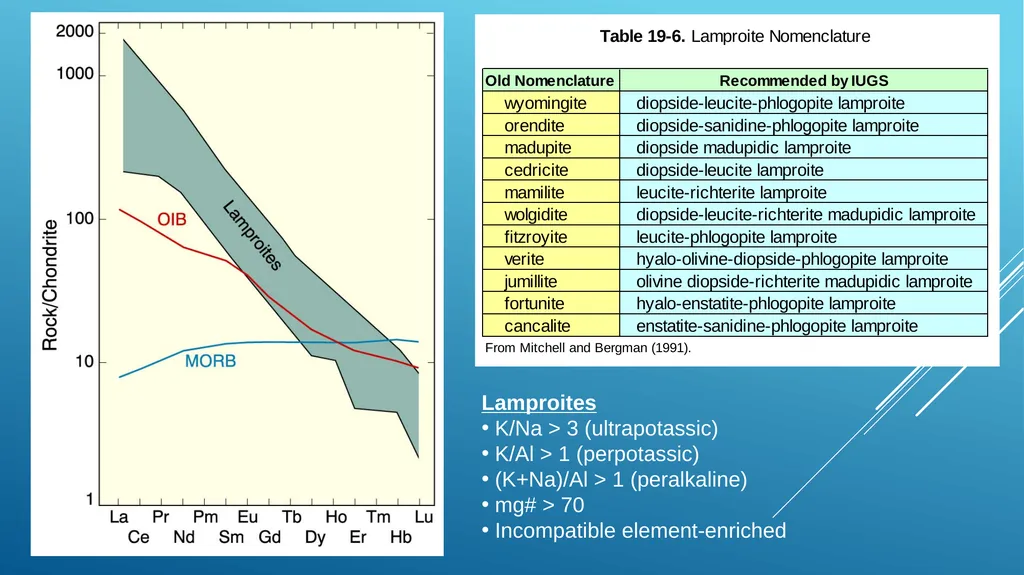
slide12. Lamproites
K/Na > 3 (ultrapotassic)
K/Al > 1 (perpotassic)
(K+Na)/Al > 1 (peralkaline)
mg# > 70
Incompatible element-enriched<br>
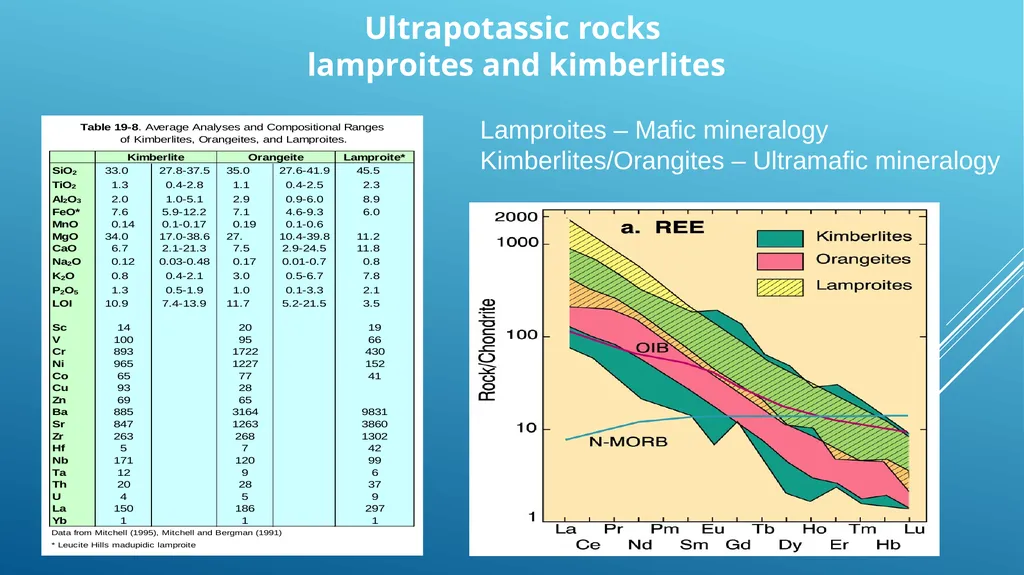
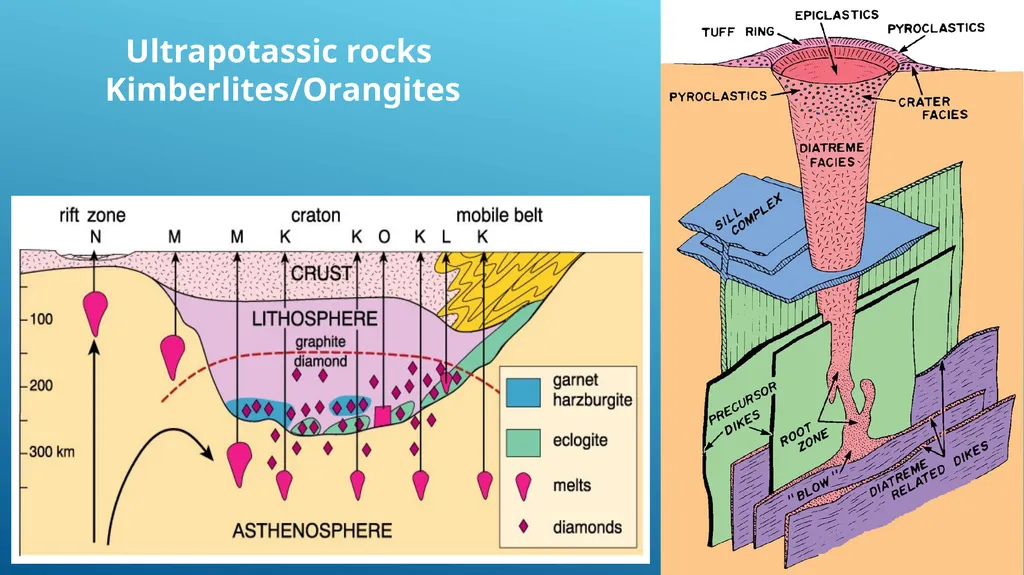
slide13. Ultrapotassic rocks lamproites and kimberlites Lamproites – Mafic mineralogy
Kimberlites/Orangites – Ultramafic mineralogy<br>
slide14. Lamproites are intracontinental mantle-derived magmas related to kimberlites but unlike these rocks are not restricted to Archean cratons.
The origin of lamproites is obscure, however, they probably form by partial melting of the mantle at depths of >150 km<br>
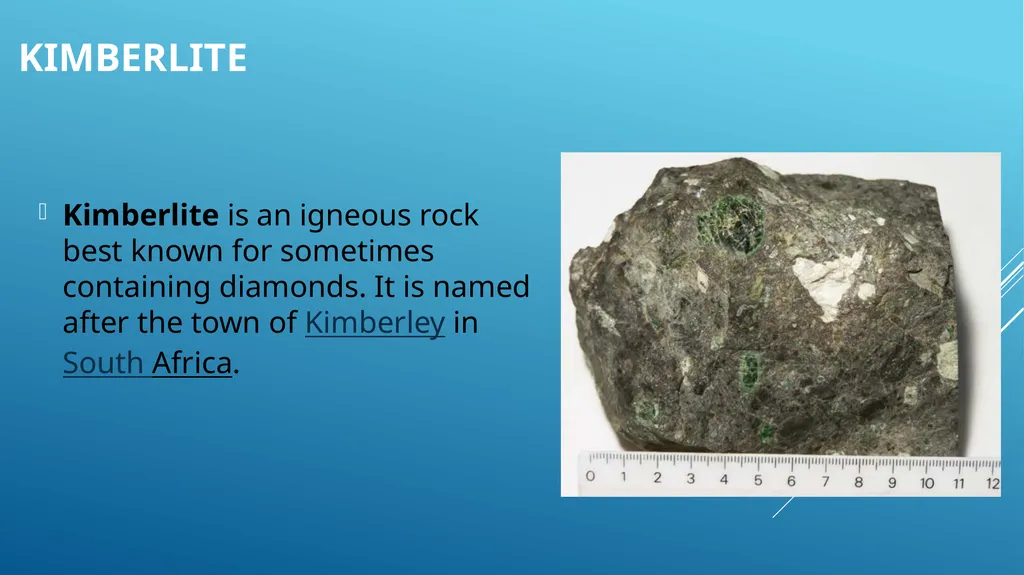
slide15. kimberlite Kimberlite is an igneous rock best known for sometimes containing diamonds. It is named after the town of Kimberley in South Africa.<br>
slide16. Mineralogy of kimberlite Kimberlites are peculiar igneous rocks because they contain a variety of mineral species with chemical compositions that indicate they formed under high pressure and temperature within the mantle.
These minerals such as chromium diopside (a pyroxene), chromium spinels, magnesian ilmenite, and pyrope garnets rich in chromium, are generally absent from most other igneous rocks, making them particularly useful as indicators for kimberlites.
These indicator minerals are generally sought in stream sediments in modern alluvial material.
Their presence may indicate the presence of a kimberlite within the erosional watershed which produced the alluvium<br>
slide17. Geochemistry of kimberlite The geochemistry of Kimberlites is defined by the following parameters:
Ultramafic; MgO >12% and generally >15%
Ultrapotassic; Molar K2O/Al2O3 >3
Near-primitive Ni (>400 ppm), Cr (>1000 ppm), Co (>150 ppm)
REE-enrichment
Moderate to high large ion lithophile element (LILE) enrichment;
ΣLILE = >1,000 ppm
High H2O and CO2<br>
slide18. Occurrences of kimberlite Kimberlite occurs in the Earth's crust in vertical structures known as kimberlite pipes as well as igneous dykes.
Kimberlite also occurs as horizontal sills.
Kimberlite pipes are the most important source of mined diamonds today.
The consensus on kimberlites is that they are formed deep within the mantle.
Formation occurs at depths between 150 and 450 kilometres (93 and 280 mi), potentially from anomalously enriched exotic mantle compositions, and they are erupted rapidly and violently, often with considerable carbon dioxide and other volatile components.
It is this depth of melting and generation which makes kimberlites prone to hosting diamond xenocrysts.<br>
slide19. Ultrapotassic rocks Kimberlites/Orangites<br>
slide20. Carbonatite lava at Ol Doinyo Lengai volcano, Tanzania.<br>
slide21. 21 Carbonatite Carbonatite is a type of intrusive or extrusive igneous rock defined by mineralogical composition consisting of greater that 50 % of carbonate minerals.
They are, almost exclusively, associated with continental rift related tectonic settings.
The majority of carbonatites are Proterozoic or Phanerozoic in age.
It appears that there has been a steady increase in the carbonatitic igneous activity through the Earth’s history, from Archean to present.<br>
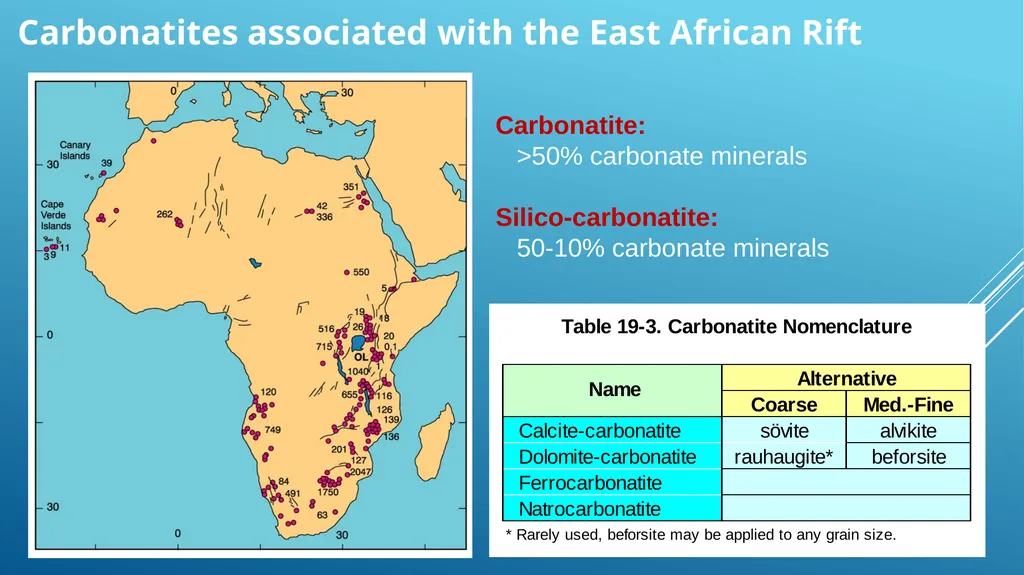
slide22. Mineralogy of carbonatites The primary mineral content of carbonatites is highly variable, but in may include natrolite, sodalite, soviet, apatite, magnetite, barite, fluorite, ancylite group minerals.
They may also be sources of mica or vermiculite. Carbonatites are classed as calcitic sovite (coarse textured) and alvikite (finer textured) varieties or facies.
The two are also distinguished by minor and trace element composition.
The terms rauhaugite and beforsite refer to dolomite and ankerite rich occurrences, respectively.
The alkali-carbonatites are termed lengaite. Classification of carbonatites<br>
slide23. Carbonatites associated with the East African Rift Carbonatite:
>50% carbonate minerals
Silico-carbonatite:
50-10% carbonate minerals<br>
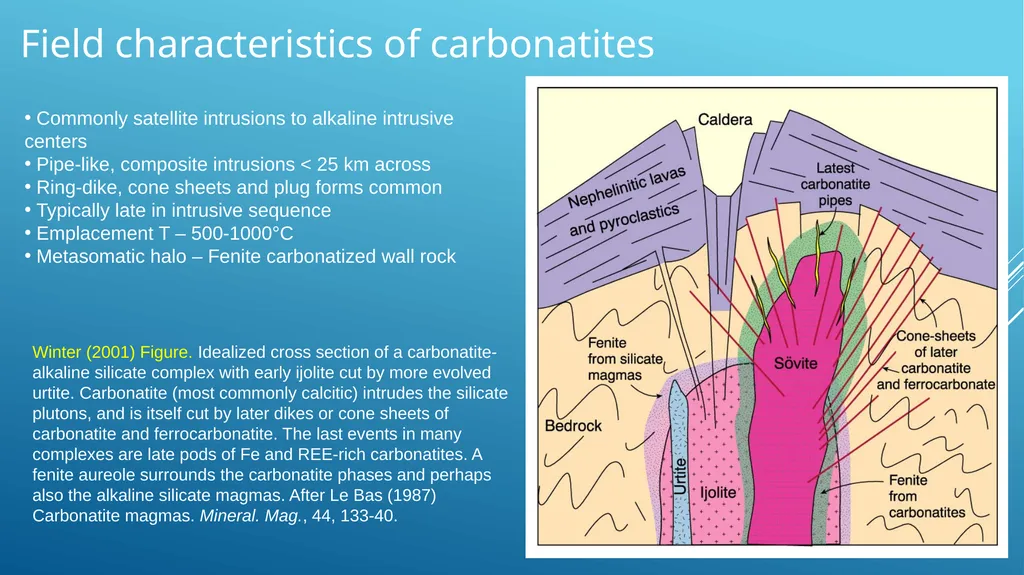
slide24. Field characteristics of carbonatites Winter (2001) Figure. Idealized cross section of a carbonatite-alkaline silicate complex with early ijolite cut by more evolved urtite. Carbonatite (most commonly calcitic) intrudes the silicate plutons, and is itself cut by later dikes or cone sheets of carbonatite and ferrocarbonatite. The last events in many complexes are late pods of Fe and REE-rich carbonatites. A fenite aureole surrounds the carbonatite phases and perhaps also the alkaline silicate magmas. After Le Bas (1987) Carbonatite magmas. Mineral. Mag., 44, 133-40. Commonly satellite intrusions to alkaline intrusive centers
Pipe-like, composite intrusions < 25 km across
Ring-dike, cone sheets and plug forms common
Typically late in intrusive sequence
Emplacement T – 500-1000°C
Metasomatic halo – Fenite carbonatized wall rock<br>
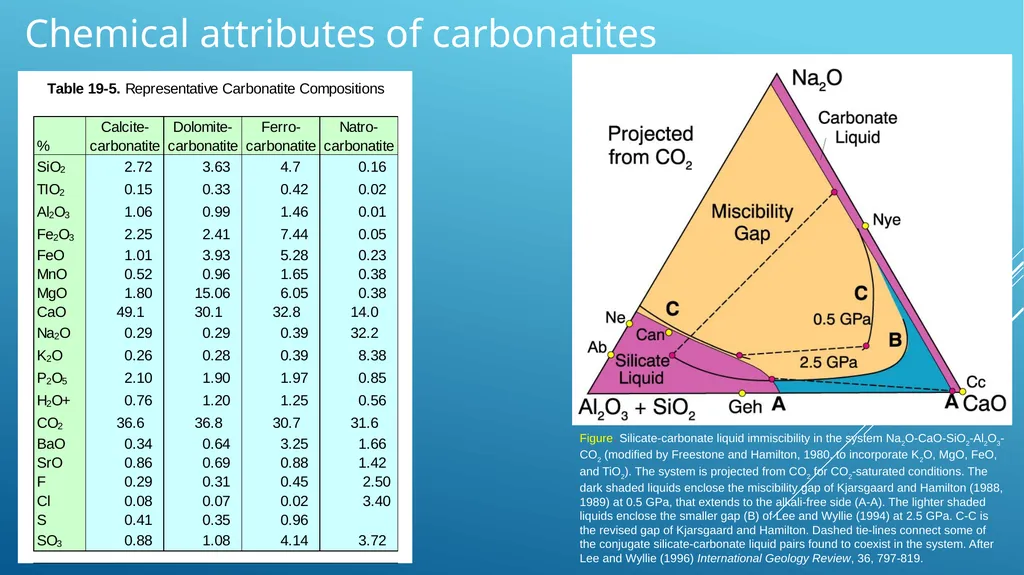
slide25. Chemical attributes of carbonatites Figure. Silicate-carbonate liquid immiscibility in the system Na2O-CaO-SiO2-Al2O3-CO2 (modified by Freestone and Hamilton, 1980, to incorporate K2O, MgO, FeO, and TiO2). The system is projected from CO2 for CO2-saturated conditions. The dark shaded liquids enclose the miscibility gap of Kjarsgaard and Hamilton (1988, 1989) at 0.5 GPa, that extends to the alkali-free side (A-A). The lighter shaded liquids enclose the smaller gap (B) of Lee and Wyllie (1994) at 2.5 GPa. C-C is the revised gap of Kjarsgaard and Hamilton. Dashed tie-lines connect some of the conjugate silicate-carbonate liquid pairs found to coexist in the system. After Lee and Wyllie (1996) International Geology Review, 36, 797-819.<br>
slide26. Geochemistry of carbonatite Carbonatite, if composed entirely of carbonate minerals, is extremely unusual in its major elemental composition as compared to silicate igneous rocks, because it is composed primarily of Na2O and CaO plus CO2.
Most carbonatites tend to include some silicate mineral fraction. Silicate minerals associated with these rocks are pyroxene and olivine, and silica-undersaturated minerals such as nepheline and other feldspathoids.
Geochemically, carbonatites are dominated by incompatible elements (Ba, Cs, Rb) and smaller amounts of compatible elements (Hf, Zr, Ti).
This, together with their silica-undersaturated composition, supports inferences that carbonatites are formed by low degrees of partial melting.<br>
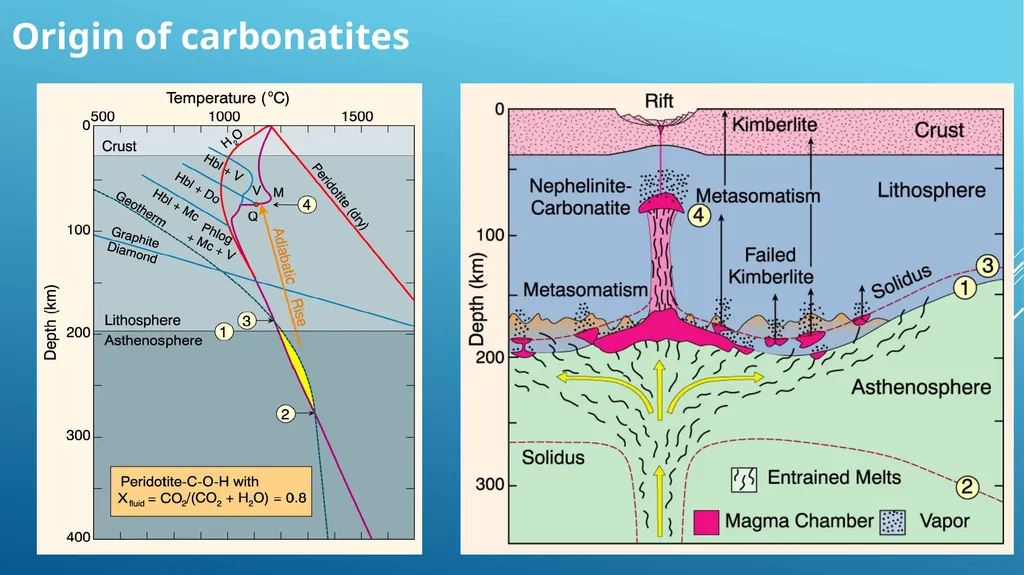
slide27. 27 Carbonatite origin The similarity between silicate and carbonate phase trace and minor elements has convinced most petrologists that the carbonatites must originate together with the silicates, possibly from the same source, and not from limestones, as early workers had suggested<br>
slide28. Origin of carbonatites<br>
slide29. 29 Carbonatite occurrence Carbonatites occur as plugs with surface areas of up to 8 km2.
They are enclosed in mafic alkaline rings.
Mafic rocks include biotite pyroxenite, ijolite, nephelinite (35% nepheline, 65% mafic on average), and jacupirangite (rocks consisting of pure magnetite, magnetite with accessory pyroxene, pyroxene with accessory magnetite, or pyroxene and nepheline with biotite and olivine).<br>
Carbonatite
Lamproites & Kimberlites<br>
slide2. Basanite feldspathoid-bearing basalt. Usually contains nepheline, but may have leucite + olivine
Tephrite olivine-free basanite
Leucitite a volcanic rock that contains leucite + clinopyroxene olivine. It typically lacks feldspar
Nephelinite a volcanic rock that contains nepheline + clinopyroxene olivine. It typically lacks feldspar.
Urtite plutonic nepheline-pyroxene (aegirine-augite) rock with over 70% nepheline and no feldspar
Ijolite plutonic nepheline-pyroxene rock with 30-70% nepheline
Melilitite a predominantly melilite - clinopyroxene volcanic (if > 10% olivine they are called olivine melilitites)
Shoshonite K-rich basalt with K-feldspar ± leucite
Phonolite felsic alkaline volcanic with alkali feldspar + nepheline. (plutonic = nepheline syenite)
Comendite peralkaline rhyolite with molar (Na2O+K2O)/Al2O3 slightly > 1. May contain Na-pyroxene or amphibole
Pantellerite peralkaline rhyolite with molar (Na2O+K2O)/Al2O3 = 1.6 - 1.8. Contains Na-pyroxene or amphibole
Lamproite a group of peralkaline, volatile-rich, ultrapotassic, volcanic to hypabyssal rocks. The mineralogy is variable, but most contain
phenocrysts of olivine + phlogopite ± leucite ± K-richterite ± clinopyroxene ± sanidine.
Lamprophyre a diverse group of dark, porphyritic, mafic to ultramafic hypabyssal (or occasionally volcanic), commonly highly potassic (K>Al)
rocks. They are normally rich in alkalis, volatiles, Sr, Ba and Ti, with biotite-phlogopite and/or amphibole phenocrysts.
They typically occur as shallow dikes, sills, plugs, or stocks.
Kimberlite a complex group of hybrid volatile-rich (dominantly CO2), potassic, ultramafic rocks with a fine-grained matrix and macrocrysts of olivine and several of the following: ilmenite, garnet, diopside, phlogopite, enstatite, chromite.
Xenocrysts and xenoliths are also common
Group I kimberlite is typically CO2-rich and less potassic than Group 2 kimberlite
Group II kimberlite is typically H2O-rich and has a mica-rich matrix (also with calcite, diopside, apatite)
Carbonatite an igneous rock composed principally of carbonate (most commonly calcite, ankerite, and/or dolomite), and often with any of clinopyroxene alkalic amphibole, biotite, apatite, and magnetite.
The Ca-Mg-rich carbonatites are technically not alkaline, but are commonly associated with, and thus included with, the alkaline rocks. Nomenclature of alkaline igneous rocks<br>
slide3. labprophyre Lamprophyres are uncommon, small volume ultrapotassic igneous rocks primarily occurring as dikes, lopoliths, laccoliths, stocks and small intrusions.
They are alkaline silica-undersaturated mafic or ultramafic rocks with high magnesium oxide, >3% potassium oxide, high sodium oxide and high nickel and chromium.
Lamprophyres occur throughout all geologic eras.
Archaean examples are commonly associated with lode gold deposits.
Cenozoic examples include magnesian rocks in Mexico and South America, and young ultramafic lamprophyres from Gympie in Australia with 18.5% MgO at ~250 Ma<br>
slide4. Lamprophyres are not amenable to classification according to modal proportions, such as the system QAPF due to peculiar mineralogy, nor compositional discrimination diagrams, such as TAS because of their peculiar geochemistry.
They are classified under the IUGS Nomenclature for Igneous rocks (Le Maitre et al., 1989) separately; this is primarily because they are rare, have peculiar mineralogy and do not fit classical classification schemes.
For example, the TAS scheme is inappropriate due to the control of mineralogy by potassium, not by calcium or sodium.<br>
slide5. Genesis of lamprophyre High depth of melting, which yields more mafic magmas;
Low degrees of partial melting, which yields magmas rich in the alkalis (particularly potassium);
Lithophile element (K, Ba, Cs, Rb) enrichment, high Ni and Cr,
High potassium and sodium concentrations (silica undersaturation is common)
Some form of volatile enrichment, to provide the biotite (phlogopite) and amphibole (pargasite) mineralogy
Lack of fractional crystallisation (generally; there are exceptions)
High Mg# ( MgO/(FeO + MgO) )<br>
slide6. petrology The presence or absence of the four dominant minerals, orthoclase, plagioclase, biotite and hornblende, determines the species:
Minette contains biotite and orthoclase.
Kersantite contains biotite and plagioclase.
Vogesite contains hornblende and orthoclase.
Spessartite contains hornblende and plagioclase.
Each variety of lamprophyre may and often does contain all four minerals but is named according to the two which predominate.<br>
slide7. Distribution of lamprophyre Lamprophyres are usually associated with voluminous granodiorite intrusive episodes.
They occur as marginal facies to some granites, though usually as dikes and sills marginal to and crosscutting the granites and diorites.
In other districts where granites are abundant no rocks of this class are known.
It is rare to find only one member of the group present, but minettes, vogesites, kersantites, etc., all appear and there are usually transitional forms.<br>
slide8. Lamprophyres are also known to be spatially and temporally associated with gold mineralisation, for example orogenic gold deposits.
Rock (1991) considered lamphrophyres to be possible source rocks for the gold, but this view is not generally supported.
The more reasonable explanation for the correlation is that lamprophyres, representing "wet" melts of the asthenosphere and mantle, correlate with a period of high fluid flow from the mantle through the crust, during subduction-related metamorphism, which drives gold mineralisation.<br>
slide9. Lamproite<br>
slide10. Mineralogy of lamproites The mineralogy of lamproites is controlled by their peculiar geochemistry, with a predominance of rare silica-deficient mineral species and rare, mantle-derived minerals predominating.
Minerals typical of lamproites include: forsteritic olivine; high iron leucite; titanium-rich aluminum-poor phlogopite; potassium- and titanium-rich richterite; low aluminium diopside; and iron-rich sanidine.
A variety of rare trace minerals occur.
The rocks are high in potassium with 6 to 8% potassium oxide. High chromium and nickel content is typical.
The rocks commonly are altered to talc with carbonate or serpentine, chlorite, and magnetite. Zeolites and quartz may also occur.<br>
slide11. There are numerous varieties of lamproite depending on their dominant phases.
The three most well known varieties are wyomingite, dominated by diopside, leucite, and phlogopite;
Madupite, dominated by phenocrysts of diopside and phlogopite; and
Fitzroyite, dominated by leucite and phlogopite.
Lamproites are found as lava flows or hypabyssal intrusions, generally pipes.<br>
slide12. Lamproites
K/Na > 3 (ultrapotassic)
K/Al > 1 (perpotassic)
(K+Na)/Al > 1 (peralkaline)
mg# > 70
Incompatible element-enriched<br>
slide13. Ultrapotassic rocks lamproites and kimberlites Lamproites – Mafic mineralogy
Kimberlites/Orangites – Ultramafic mineralogy<br>
slide14. Lamproites are intracontinental mantle-derived magmas related to kimberlites but unlike these rocks are not restricted to Archean cratons.
The origin of lamproites is obscure, however, they probably form by partial melting of the mantle at depths of >150 km<br>
slide15. kimberlite Kimberlite is an igneous rock best known for sometimes containing diamonds. It is named after the town of Kimberley in South Africa.<br>
slide16. Mineralogy of kimberlite Kimberlites are peculiar igneous rocks because they contain a variety of mineral species with chemical compositions that indicate they formed under high pressure and temperature within the mantle.
These minerals such as chromium diopside (a pyroxene), chromium spinels, magnesian ilmenite, and pyrope garnets rich in chromium, are generally absent from most other igneous rocks, making them particularly useful as indicators for kimberlites.
These indicator minerals are generally sought in stream sediments in modern alluvial material.
Their presence may indicate the presence of a kimberlite within the erosional watershed which produced the alluvium<br>
slide17. Geochemistry of kimberlite The geochemistry of Kimberlites is defined by the following parameters:
Ultramafic; MgO >12% and generally >15%
Ultrapotassic; Molar K2O/Al2O3 >3
Near-primitive Ni (>400 ppm), Cr (>1000 ppm), Co (>150 ppm)
REE-enrichment
Moderate to high large ion lithophile element (LILE) enrichment;
ΣLILE = >1,000 ppm
High H2O and CO2<br>
slide18. Occurrences of kimberlite Kimberlite occurs in the Earth's crust in vertical structures known as kimberlite pipes as well as igneous dykes.
Kimberlite also occurs as horizontal sills.
Kimberlite pipes are the most important source of mined diamonds today.
The consensus on kimberlites is that they are formed deep within the mantle.
Formation occurs at depths between 150 and 450 kilometres (93 and 280 mi), potentially from anomalously enriched exotic mantle compositions, and they are erupted rapidly and violently, often with considerable carbon dioxide and other volatile components.
It is this depth of melting and generation which makes kimberlites prone to hosting diamond xenocrysts.<br>
slide19. Ultrapotassic rocks Kimberlites/Orangites<br>
slide20. Carbonatite lava at Ol Doinyo Lengai volcano, Tanzania.<br>
slide21. 21 Carbonatite Carbonatite is a type of intrusive or extrusive igneous rock defined by mineralogical composition consisting of greater that 50 % of carbonate minerals.
They are, almost exclusively, associated with continental rift related tectonic settings.
The majority of carbonatites are Proterozoic or Phanerozoic in age.
It appears that there has been a steady increase in the carbonatitic igneous activity through the Earth’s history, from Archean to present.<br>
slide22. Mineralogy of carbonatites The primary mineral content of carbonatites is highly variable, but in may include natrolite, sodalite, soviet, apatite, magnetite, barite, fluorite, ancylite group minerals.
They may also be sources of mica or vermiculite. Carbonatites are classed as calcitic sovite (coarse textured) and alvikite (finer textured) varieties or facies.
The two are also distinguished by minor and trace element composition.
The terms rauhaugite and beforsite refer to dolomite and ankerite rich occurrences, respectively.
The alkali-carbonatites are termed lengaite. Classification of carbonatites<br>
slide23. Carbonatites associated with the East African Rift Carbonatite:
>50% carbonate minerals
Silico-carbonatite:
50-10% carbonate minerals<br>
slide24. Field characteristics of carbonatites Winter (2001) Figure. Idealized cross section of a carbonatite-alkaline silicate complex with early ijolite cut by more evolved urtite. Carbonatite (most commonly calcitic) intrudes the silicate plutons, and is itself cut by later dikes or cone sheets of carbonatite and ferrocarbonatite. The last events in many complexes are late pods of Fe and REE-rich carbonatites. A fenite aureole surrounds the carbonatite phases and perhaps also the alkaline silicate magmas. After Le Bas (1987) Carbonatite magmas. Mineral. Mag., 44, 133-40. Commonly satellite intrusions to alkaline intrusive centers
Pipe-like, composite intrusions < 25 km across
Ring-dike, cone sheets and plug forms common
Typically late in intrusive sequence
Emplacement T – 500-1000°C
Metasomatic halo – Fenite carbonatized wall rock<br>
slide25. Chemical attributes of carbonatites Figure. Silicate-carbonate liquid immiscibility in the system Na2O-CaO-SiO2-Al2O3-CO2 (modified by Freestone and Hamilton, 1980, to incorporate K2O, MgO, FeO, and TiO2). The system is projected from CO2 for CO2-saturated conditions. The dark shaded liquids enclose the miscibility gap of Kjarsgaard and Hamilton (1988, 1989) at 0.5 GPa, that extends to the alkali-free side (A-A). The lighter shaded liquids enclose the smaller gap (B) of Lee and Wyllie (1994) at 2.5 GPa. C-C is the revised gap of Kjarsgaard and Hamilton. Dashed tie-lines connect some of the conjugate silicate-carbonate liquid pairs found to coexist in the system. After Lee and Wyllie (1996) International Geology Review, 36, 797-819.<br>
slide26. Geochemistry of carbonatite Carbonatite, if composed entirely of carbonate minerals, is extremely unusual in its major elemental composition as compared to silicate igneous rocks, because it is composed primarily of Na2O and CaO plus CO2.
Most carbonatites tend to include some silicate mineral fraction. Silicate minerals associated with these rocks are pyroxene and olivine, and silica-undersaturated minerals such as nepheline and other feldspathoids.
Geochemically, carbonatites are dominated by incompatible elements (Ba, Cs, Rb) and smaller amounts of compatible elements (Hf, Zr, Ti).
This, together with their silica-undersaturated composition, supports inferences that carbonatites are formed by low degrees of partial melting.<br>
slide27. 27 Carbonatite origin The similarity between silicate and carbonate phase trace and minor elements has convinced most petrologists that the carbonatites must originate together with the silicates, possibly from the same source, and not from limestones, as early workers had suggested<br>
slide28. Origin of carbonatites<br>
slide29. 29 Carbonatite occurrence Carbonatites occur as plugs with surface areas of up to 8 km2.
They are enclosed in mafic alkaline rings.
Mafic rocks include biotite pyroxenite, ijolite, nephelinite (35% nepheline, 65% mafic on average), and jacupirangite (rocks consisting of pure magnetite, magnetite with accessory pyroxene, pyroxene with accessory magnetite, or pyroxene and nepheline with biotite and olivine).<br>