
American Institute of Constructors Constructor


Description: American Institute of Constructors Constructor Certification Commission Training for Finance Committee Members Purpose of Training Provides a brief history and overview of Constructor certification. Provides foundational information about
Related Topics
Download Presentation
"American Institute of Constructors Constructor" is the property of its rightful owner. Permission is granted to download and print the materials on this website for personal, non-commercial use only, and to display it on your personal computer provided you do not modify the materials and that you retain all copyright notices contained in the materials. By downloading content from our website, you accept the terms of this agreement.
Presentation Transcript
slide1. American Institute of Constructors Constructor Certification Commission Training for Finance Committee Members<br>
slide2. Purpose of Training Provides a brief history and overview of Constructor certification.
Provides foundational information about the Constructor Certification Commission.
Provides responsibilities associated with your specific role in the Commission.<br>
slide3. Training Instructions Carefully view the Power Point slides and make notes of any questions you may have.
Complete two short assessments – one relating to your mastery of the material presented and the second of the session itself.
Complete and sign and required Commission document(s).
Contact the Chair of the Finance Committee or the Certification Manager for any questions you may have.<br>
slide4. History & Overview of Constructor Certification You will now view a short Power Point presentation on the history and overview of constructor certification.
When complete note any questions you may have to later ask the Chair of the Committee or Certification Manager.
Continue with this Power Point to learn about the mission, goals of the Commission along with its major processes, and detailed information concerning your responsibilities.<br>
slide5. Constructor Certification Commission Mission and Goals Mission - To certify Professional Constructors through established standards based upon education, experience and examination process.
Goals are to:
Provide a valid Constructor certification process,
Improve the image of the Constructor and the construction profession,
Improve the standards of the practice of construction,
Promote the continual professional development of the Constructor.
Promote membership into an organization of professional constructors, the American Institute of Constructors, and
Promote the AIC Constructor Code of Conduct.<br>
slide6. Constructor Certification Commission Objectives The objectives of the Commission are to develop, implement and coordinate policies and procedures for:
The certification process,
A framework for the development of the professional Constructor,
A feedback process to higher education construction programs and the industry, and
Continual professional development for practicing professionals.<br>
slide7. Constructor Certification Commission Organization The Commission is a semi-autonomous body that operates under the auspices of the American Institute of Constructors.
The Commission is the governing body and consists of a Board of Governors and Board of Advisors.
Much of the work of the Commission is accomplished through its committees & subcommittees.<br>
slide8. Constructor Certification Commission Committees and Subcommittees Examination Committee - Responsible for developing, assessing, validating, up-dating, and formatting questions for examinations.
Examination Subcommittees:
Item Writing
Item Reviewing
Writing Skills Scoring for Level I (AC) Examination<br>
slide9. Constructor Certification Commission Committees and Subcommittees Skills and Knowledge Committee Responsibilities:
Works with the AIC Professional Standards Committee to maintain and revalidate the body of knowledge and provide the Examination Committee with any changes for incorporation into future examinations.
Prepares and maintains the criteria for evaluating continuing professional development programs.
Reviews the applications to sit for the examination for compliance with certification criteria.<br>
slide10. Constructor Certification Commission Committees and Subcommittees Skills and Knowledge Subcommittees:
Application Vetting
Continuing Professional Development Audit
Finance Committee - Responsible for preparing the annual budget, monitoring the spending of commission funds and revenues and developing in conjunction with the Certification Manager, marketing plans.<br>
slide11. Constructor Certification Commission Contractors Management Contractor – is responsible for administering the day to day activities and events of the Commission.
Talley Management Group
Certification Manager – Mr. Joe Sapp
Examination Contractor – is responsible for all certification examination-related activities.
Professional Testing Corporation
President – Ms. Sallyann Henry<br>
slide12. Constructor Certification Commission Major Processes Certification Examination Development
Entails developing and reviewing of questions and selecting them for both the Level I (AC) and Level II (CPC) examinations. The development process includes working with the Examination Contractor to insure all examinations are valid, reliable and fair through the utilization of nationally recognized effective test psychometric measures.
Commission Policies 2.1 and 2.2<br>
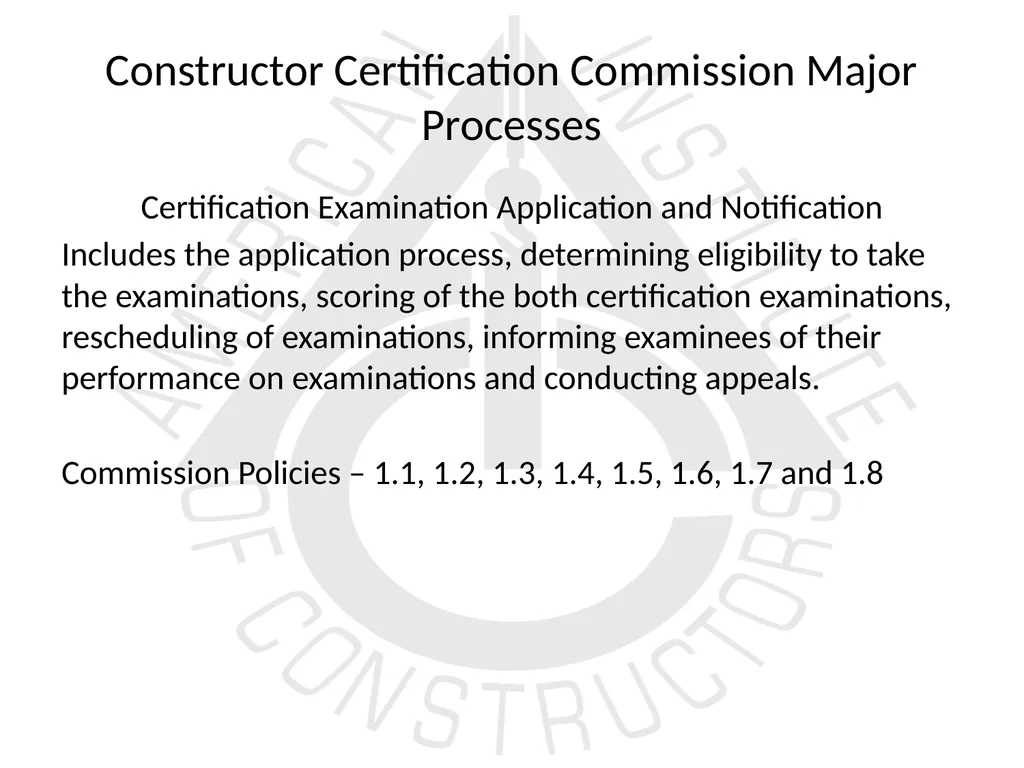
slide13. Constructor Certification Commission Major Processes Certification Examination Application and Notification
Includes the application process, determining eligibility to take the examinations, scoring of the both certification examinations, rescheduling of examinations, informing examinees of their performance on examinations and conducting appeals.
Commission Policies – 1.1, 1.2, 1.3, 1.4, 1.5, 1.6, 1.7 and 1.8<br>
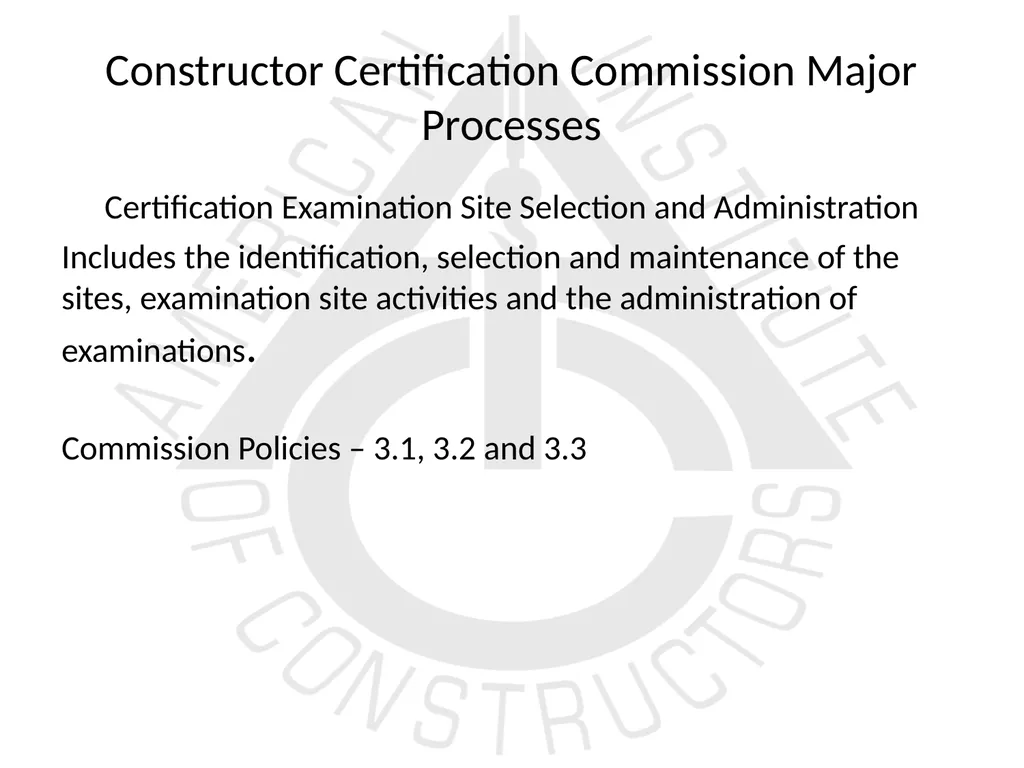
slide14. Constructor Certification Commission Major Processes Certification Examination Site Selection and Administration
Includes the identification, selection and maintenance of the sites, examination site activities and the administration of examinations.
Commission Policies – 3.1, 3.2 and 3.3<br>
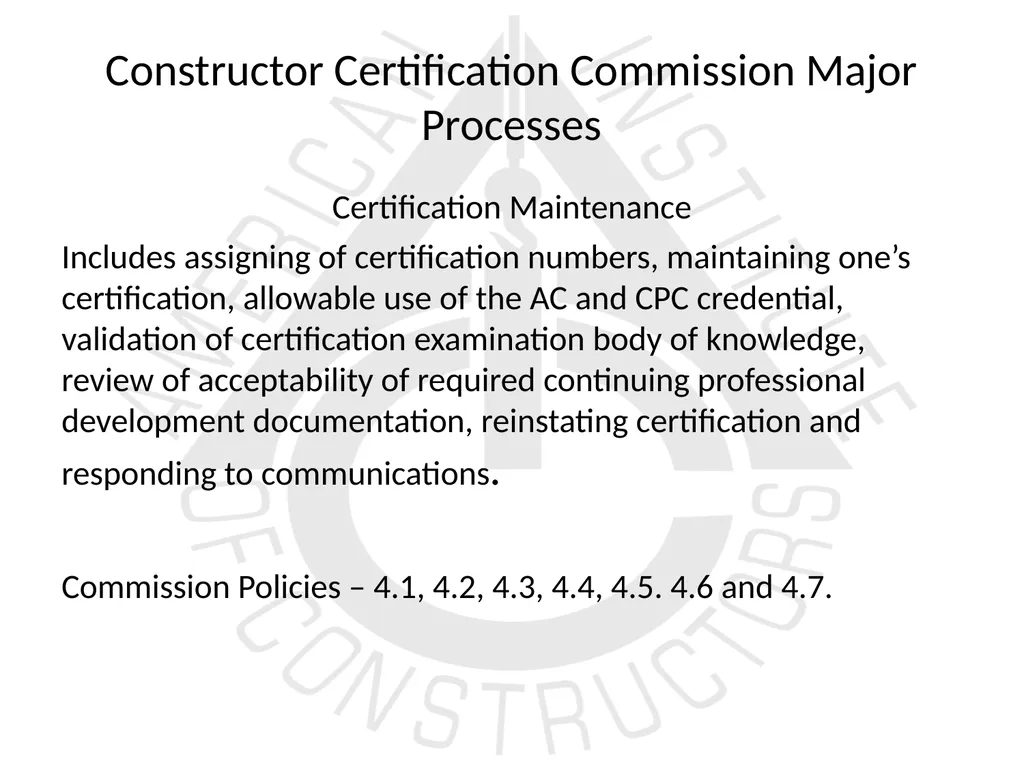
slide15. Constructor Certification Commission Major Processes Certification Maintenance
Includes assigning of certification numbers, maintaining one’s certification, allowable use of the AC and CPC credential, validation of certification examination body of knowledge, review of acceptability of required continuing professional development documentation, reinstating certification and responding to communications.
Commission Policies – 4.1, 4.2, 4.3, 4.4, 4.5. 4.6 and 4.7.<br>
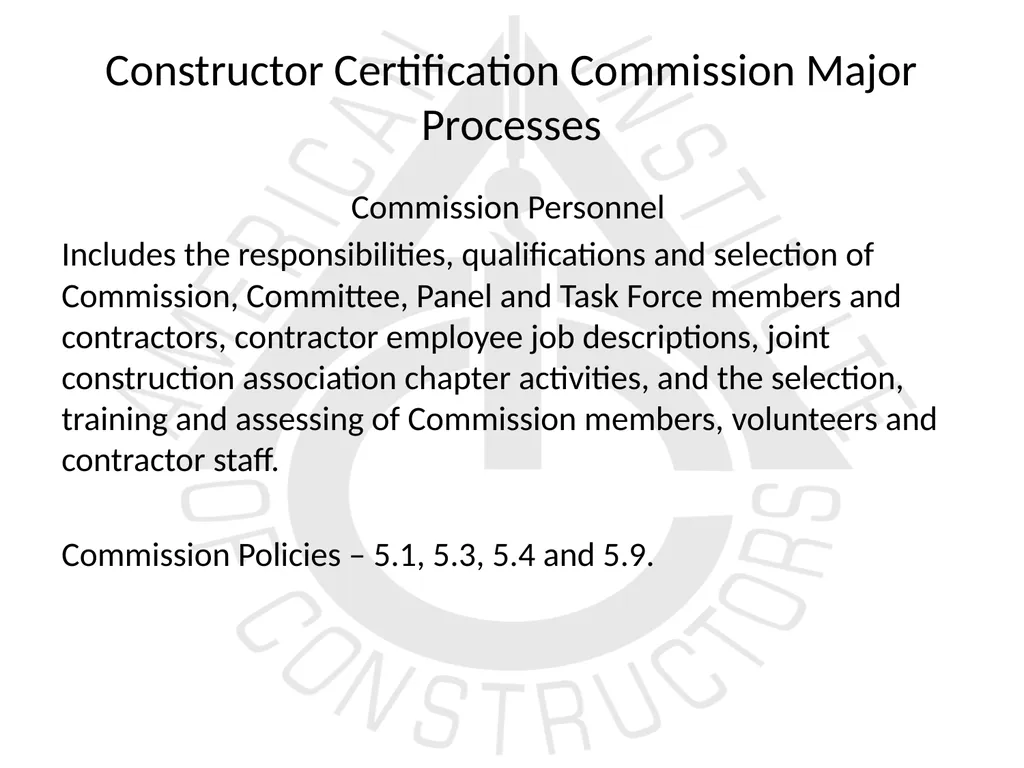
slide16. Constructor Certification Commission Major Processes Commission Personnel
Includes the responsibilities, qualifications and selection of Commission, Committee, Panel and Task Force members and contractors, contractor employee job descriptions, joint construction association chapter activities, and the selection, training and assessing of Commission members, volunteers and contractor staff.
Commission Policies – 5.1, 5.3, 5.4 and 5.9.<br>
slide17. Constructor Certification Commission Major Processes Governance of Constructor Certification Activities
Includes making changes to Commission organization, operations and certification schemes, signatory authority, internal audits, conflict of interest, confidentiality, ethical conduct of Commission members, volunteers, contractor staff and certificants, whistleblowing, and documentation and document control and security.
Commission Policies – 5.2, 5.5, 5.6, 5.7, 5.8, 5.9, 5.10, 5.11, 5.12, 5.13 and 5.14.<br>
slide18. Constructor Certification Commission Major Processes All of these processes have specific policies and procedures with associated documents. Some of these will be reviewed in the next portion of the training. All Commission Policies and Procedures along with their associated documents can be found at www.professionalconstructor.org.<br>
slide19. Finance Committee The Finance Committee shall have a chair and a vice-chair.
The chair shall be the Commission’s elected Treasurer.
The Minimum Qualifications to serve on this committee includes having obtained the CPC designation, and be familiar with the Commission’s policies and procedures and operating procedures.
The Committee Members shall include:
Commission Treasurer (Chair)
Immediate Past Chair of this Committee
Current Chair of the Commission
And other members as directed by the Board of Governors<br>
slide20. Finance Committee Duties of the Committee:
Responsible for preparing the annual budget
Monitoring the spending of Commission Funds and revenues
Developing, in conjunction with the Certification Manager, marketing plans and such duties as the Commission may assign<br>
slide21. Commission Budgeting Overview The Commission Fiscal year runs January 1 to December 31.
The majority of the Commission’s Revenues are generated from Exam Fees and CPD Fees.
The majority of the Commission’s Expenses are generated from Management Contractor Fees, Testing Exam Administration Fees. Other expenses include administrative, marketing, and meetings (Committee).
The Commission Testing Agency Fees are on a set schedule based on a per candidate price of $95 (2013), which is increased $5 every 2 years(2014 next increase). This contract was renewed in 2012.<br>
slide22. Commission Budgeting Overview The Commission Management contractor fees are set each year at $72,600.
As part of the current agreement, Talley Management Group receives 25% of net revenue.<br>
slide23. Commission Financial Structure Commission operates as a semi-autonomous Board within the AIC.
The Commission shares an Federal Tax ID number with the AIC (73-0934883) when establishing separate bank accounts and conducting business.
These independent accounts consisting of all monetary receipts of the Commission from donations, fees and otherwise are to be used for the administration, promotion and implementation of the Certification process only.<br>
slide24. Commission Financial Controls Annual Financial Audit – The AIC/CCC hires an auditor to audit or review to verify the amounts including in financial reports. In it’s fiduciary responsibility the board hires the external auditor and receives the report.
Sarbanes-Oxley – Direct impact on non-profits; whistle blower protection, and the prohibition of document destruction upon the commencement of a federal investigation.<br>
slide25. Commission Financial Controls Four factors essential to good internal financial controls
Clear lines of authority
Clear Definition and acceptance of responsibility
Authority commensurate with responsibility
Proper training<br>
slide26. Commission Finance Reporting Talley Management Group provides accounting functions for the Commission.
Monthly financials are reported monthly, included in those reports are:
Statement of Activities
Reports the financial activity of the organization by function over a period of time.
Statement of Financial Position
Also known as the balance sheet in the for-profit world, this statement summarizes the assets, liabilities, and net assets of the organization as of a specific date.<br>
slide27. Commission Finance Reporting Budget Tracking Spreadsheet
An updated forecast of income and expenses throughout the year.
Financial Dashboard
A one page visual document showing key financial indicators (# of CPDs, # of examinees, etc…)<br>
slide28. Finance Committee Terminology Budget - The organization's plan expressed in dollars (income and expense). Allows the organization to track actual performance against an approved plan.
Accrual Accounting - The recognition and recording of income when earned and expenses when incurred.
Assets - The properties or resources the agency owns and uses, for example, cash, investments, receivables, and equipment. Assets are found on the Statement of Financial Position. See also liquidity.
Liabilities - The debts of the organization, for example, accounts payable, unpaid employee salaries and vacation leave, and loans.<br>
slide29. Finance Committee Terminology Reserve - The accumulated unrestricted net assets available for the organization's use.
Variance - Difference between planned and actual financial performance.
Form 990 - The Federal tax return required to be filed annually by most nonprofits.
Accounts Receivable - Income already promised or earned but not yet received by an organization. Can be further specified, for example, grants receivable, contracts receivable, pledges receivable.<br>
slide30. Finance Committee Terminology Audit - The process completed by an auditor that results in an issued opinion on whether year-end financial statements reflect the actual financial activity and condition of the organization for the time period in question.
GAAP – General Accepted Accounting Principles<br>
slide31. Conclusion You now have been provided with a bit of Commission history, its mission, goals and objectives, an overview of its major processes and details about the responsibilities associated with your respective role in the work of the Commission along with related Commission Policies and Procedures and pertinent documents. If you have any specific questions relating to any of the material presented please contact the Chair of the body on which you serve or report to or the Commission Certification Manager.
To complete this training session by completing certain Commission documents and assessments please proceed.<br>
slide32. Required Commission Documents To comply with the Commission’s Policies and Procedures certain documents are required associated to your role. First the Commission will need a copy of your resume which needs to be updated to the current year. Second you are required to sign a Confidentiality Statement (Commission Document 25). These must be signed on an annual basis and you will be contacted by the Chair of your body or the Certification Manager to complete them when required.<br>
slide33. Assessments As part of its training process, the Commission feels it is critical that it assess if the participants understood the information presented through the administration of a short ten question multiple choice evaluation. This assessment can also be used to substantiate your participation in the training. Your score on the evaluation will remain confidential and will be used to not only improve the training and training materials but also your performance in your role. You will receive feedback on how you did along with any recommendations for improvement.<br>
slide34. Assessments Finally, the Commission, in its continuous improvement efforts, would appreciate it if you would complete an evaluation of the training session and materials using Commission Document No. 37 – Training Session Participant Evaluation.
Thank you for your participation and we look forward to your productive role to promote constructor certification.<br>
slide35. Questions For any questions please ask the trainer or contact:
Mr. Joseph Sapp, Certification Manager
Constructor Certification Commission
joe@professionalconstructor.org
703-683-4999
Revision History:
May 17, 2013<br>
slide2. Purpose of Training Provides a brief history and overview of Constructor certification.
Provides foundational information about the Constructor Certification Commission.
Provides responsibilities associated with your specific role in the Commission.<br>
slide3. Training Instructions Carefully view the Power Point slides and make notes of any questions you may have.
Complete two short assessments – one relating to your mastery of the material presented and the second of the session itself.
Complete and sign and required Commission document(s).
Contact the Chair of the Finance Committee or the Certification Manager for any questions you may have.<br>
slide4. History & Overview of Constructor Certification You will now view a short Power Point presentation on the history and overview of constructor certification.
When complete note any questions you may have to later ask the Chair of the Committee or Certification Manager.
Continue with this Power Point to learn about the mission, goals of the Commission along with its major processes, and detailed information concerning your responsibilities.<br>
slide5. Constructor Certification Commission Mission and Goals Mission - To certify Professional Constructors through established standards based upon education, experience and examination process.
Goals are to:
Provide a valid Constructor certification process,
Improve the image of the Constructor and the construction profession,
Improve the standards of the practice of construction,
Promote the continual professional development of the Constructor.
Promote membership into an organization of professional constructors, the American Institute of Constructors, and
Promote the AIC Constructor Code of Conduct.<br>
slide6. Constructor Certification Commission Objectives The objectives of the Commission are to develop, implement and coordinate policies and procedures for:
The certification process,
A framework for the development of the professional Constructor,
A feedback process to higher education construction programs and the industry, and
Continual professional development for practicing professionals.<br>
slide7. Constructor Certification Commission Organization The Commission is a semi-autonomous body that operates under the auspices of the American Institute of Constructors.
The Commission is the governing body and consists of a Board of Governors and Board of Advisors.
Much of the work of the Commission is accomplished through its committees & subcommittees.<br>
slide8. Constructor Certification Commission Committees and Subcommittees Examination Committee - Responsible for developing, assessing, validating, up-dating, and formatting questions for examinations.
Examination Subcommittees:
Item Writing
Item Reviewing
Writing Skills Scoring for Level I (AC) Examination<br>
slide9. Constructor Certification Commission Committees and Subcommittees Skills and Knowledge Committee Responsibilities:
Works with the AIC Professional Standards Committee to maintain and revalidate the body of knowledge and provide the Examination Committee with any changes for incorporation into future examinations.
Prepares and maintains the criteria for evaluating continuing professional development programs.
Reviews the applications to sit for the examination for compliance with certification criteria.<br>
slide10. Constructor Certification Commission Committees and Subcommittees Skills and Knowledge Subcommittees:
Application Vetting
Continuing Professional Development Audit
Finance Committee - Responsible for preparing the annual budget, monitoring the spending of commission funds and revenues and developing in conjunction with the Certification Manager, marketing plans.<br>
slide11. Constructor Certification Commission Contractors Management Contractor – is responsible for administering the day to day activities and events of the Commission.
Talley Management Group
Certification Manager – Mr. Joe Sapp
Examination Contractor – is responsible for all certification examination-related activities.
Professional Testing Corporation
President – Ms. Sallyann Henry<br>
slide12. Constructor Certification Commission Major Processes Certification Examination Development
Entails developing and reviewing of questions and selecting them for both the Level I (AC) and Level II (CPC) examinations. The development process includes working with the Examination Contractor to insure all examinations are valid, reliable and fair through the utilization of nationally recognized effective test psychometric measures.
Commission Policies 2.1 and 2.2<br>
slide13. Constructor Certification Commission Major Processes Certification Examination Application and Notification
Includes the application process, determining eligibility to take the examinations, scoring of the both certification examinations, rescheduling of examinations, informing examinees of their performance on examinations and conducting appeals.
Commission Policies – 1.1, 1.2, 1.3, 1.4, 1.5, 1.6, 1.7 and 1.8<br>
slide14. Constructor Certification Commission Major Processes Certification Examination Site Selection and Administration
Includes the identification, selection and maintenance of the sites, examination site activities and the administration of examinations.
Commission Policies – 3.1, 3.2 and 3.3<br>
slide15. Constructor Certification Commission Major Processes Certification Maintenance
Includes assigning of certification numbers, maintaining one’s certification, allowable use of the AC and CPC credential, validation of certification examination body of knowledge, review of acceptability of required continuing professional development documentation, reinstating certification and responding to communications.
Commission Policies – 4.1, 4.2, 4.3, 4.4, 4.5. 4.6 and 4.7.<br>
slide16. Constructor Certification Commission Major Processes Commission Personnel
Includes the responsibilities, qualifications and selection of Commission, Committee, Panel and Task Force members and contractors, contractor employee job descriptions, joint construction association chapter activities, and the selection, training and assessing of Commission members, volunteers and contractor staff.
Commission Policies – 5.1, 5.3, 5.4 and 5.9.<br>
slide17. Constructor Certification Commission Major Processes Governance of Constructor Certification Activities
Includes making changes to Commission organization, operations and certification schemes, signatory authority, internal audits, conflict of interest, confidentiality, ethical conduct of Commission members, volunteers, contractor staff and certificants, whistleblowing, and documentation and document control and security.
Commission Policies – 5.2, 5.5, 5.6, 5.7, 5.8, 5.9, 5.10, 5.11, 5.12, 5.13 and 5.14.<br>
slide18. Constructor Certification Commission Major Processes All of these processes have specific policies and procedures with associated documents. Some of these will be reviewed in the next portion of the training. All Commission Policies and Procedures along with their associated documents can be found at www.professionalconstructor.org.<br>
slide19. Finance Committee The Finance Committee shall have a chair and a vice-chair.
The chair shall be the Commission’s elected Treasurer.
The Minimum Qualifications to serve on this committee includes having obtained the CPC designation, and be familiar with the Commission’s policies and procedures and operating procedures.
The Committee Members shall include:
Commission Treasurer (Chair)
Immediate Past Chair of this Committee
Current Chair of the Commission
And other members as directed by the Board of Governors<br>
slide20. Finance Committee Duties of the Committee:
Responsible for preparing the annual budget
Monitoring the spending of Commission Funds and revenues
Developing, in conjunction with the Certification Manager, marketing plans and such duties as the Commission may assign<br>
slide21. Commission Budgeting Overview The Commission Fiscal year runs January 1 to December 31.
The majority of the Commission’s Revenues are generated from Exam Fees and CPD Fees.
The majority of the Commission’s Expenses are generated from Management Contractor Fees, Testing Exam Administration Fees. Other expenses include administrative, marketing, and meetings (Committee).
The Commission Testing Agency Fees are on a set schedule based on a per candidate price of $95 (2013), which is increased $5 every 2 years(2014 next increase). This contract was renewed in 2012.<br>
slide22. Commission Budgeting Overview The Commission Management contractor fees are set each year at $72,600.
As part of the current agreement, Talley Management Group receives 25% of net revenue.<br>
slide23. Commission Financial Structure Commission operates as a semi-autonomous Board within the AIC.
The Commission shares an Federal Tax ID number with the AIC (73-0934883) when establishing separate bank accounts and conducting business.
These independent accounts consisting of all monetary receipts of the Commission from donations, fees and otherwise are to be used for the administration, promotion and implementation of the Certification process only.<br>
slide24. Commission Financial Controls Annual Financial Audit – The AIC/CCC hires an auditor to audit or review to verify the amounts including in financial reports. In it’s fiduciary responsibility the board hires the external auditor and receives the report.
Sarbanes-Oxley – Direct impact on non-profits; whistle blower protection, and the prohibition of document destruction upon the commencement of a federal investigation.<br>
slide25. Commission Financial Controls Four factors essential to good internal financial controls
Clear lines of authority
Clear Definition and acceptance of responsibility
Authority commensurate with responsibility
Proper training<br>
slide26. Commission Finance Reporting Talley Management Group provides accounting functions for the Commission.
Monthly financials are reported monthly, included in those reports are:
Statement of Activities
Reports the financial activity of the organization by function over a period of time.
Statement of Financial Position
Also known as the balance sheet in the for-profit world, this statement summarizes the assets, liabilities, and net assets of the organization as of a specific date.<br>
slide27. Commission Finance Reporting Budget Tracking Spreadsheet
An updated forecast of income and expenses throughout the year.
Financial Dashboard
A one page visual document showing key financial indicators (# of CPDs, # of examinees, etc…)<br>
slide28. Finance Committee Terminology Budget - The organization's plan expressed in dollars (income and expense). Allows the organization to track actual performance against an approved plan.
Accrual Accounting - The recognition and recording of income when earned and expenses when incurred.
Assets - The properties or resources the agency owns and uses, for example, cash, investments, receivables, and equipment. Assets are found on the Statement of Financial Position. See also liquidity.
Liabilities - The debts of the organization, for example, accounts payable, unpaid employee salaries and vacation leave, and loans.<br>
slide29. Finance Committee Terminology Reserve - The accumulated unrestricted net assets available for the organization's use.
Variance - Difference between planned and actual financial performance.
Form 990 - The Federal tax return required to be filed annually by most nonprofits.
Accounts Receivable - Income already promised or earned but not yet received by an organization. Can be further specified, for example, grants receivable, contracts receivable, pledges receivable.<br>
slide30. Finance Committee Terminology Audit - The process completed by an auditor that results in an issued opinion on whether year-end financial statements reflect the actual financial activity and condition of the organization for the time period in question.
GAAP – General Accepted Accounting Principles<br>
slide31. Conclusion You now have been provided with a bit of Commission history, its mission, goals and objectives, an overview of its major processes and details about the responsibilities associated with your respective role in the work of the Commission along with related Commission Policies and Procedures and pertinent documents. If you have any specific questions relating to any of the material presented please contact the Chair of the body on which you serve or report to or the Commission Certification Manager.
To complete this training session by completing certain Commission documents and assessments please proceed.<br>
slide32. Required Commission Documents To comply with the Commission’s Policies and Procedures certain documents are required associated to your role. First the Commission will need a copy of your resume which needs to be updated to the current year. Second you are required to sign a Confidentiality Statement (Commission Document 25). These must be signed on an annual basis and you will be contacted by the Chair of your body or the Certification Manager to complete them when required.<br>
slide33. Assessments As part of its training process, the Commission feels it is critical that it assess if the participants understood the information presented through the administration of a short ten question multiple choice evaluation. This assessment can also be used to substantiate your participation in the training. Your score on the evaluation will remain confidential and will be used to not only improve the training and training materials but also your performance in your role. You will receive feedback on how you did along with any recommendations for improvement.<br>
slide34. Assessments Finally, the Commission, in its continuous improvement efforts, would appreciate it if you would complete an evaluation of the training session and materials using Commission Document No. 37 – Training Session Participant Evaluation.
Thank you for your participation and we look forward to your productive role to promote constructor certification.<br>
slide35. Questions For any questions please ask the trainer or contact:
Mr. Joseph Sapp, Certification Manager
Constructor Certification Commission
joe@professionalconstructor.org
703-683-4999
Revision History:
May 17, 2013<br>