
AML Tuesday’s Session #13 on: PF-TFS, Typologies,
LO
Published · 24 slides · 0 views

1 / 1
Description
AML Tuesdays Session 13 on: PF-TFS, Typologies, and Red Flags 02 May 2023 Agenda Financial Transparency Advisors What is PF-TFS? Financial Transparency Advisors Recap - What are Sanctions Range of sanctions regimes (many countries
Related Topics
Share
Embed code
Download this presentation From Below
"AML Tuesday’s Session #13 on: PF-TFS, Typologies," is the property of its rightful owner. Permission is granted to download and print the materials on this website for personal, non-commercial use only, and to display it on your personal computer provided you do not modify the materials and that you retain all copyright notices contained in the materials. By downloading content from our website, you accept the terms of this agreement.
Presentation Transcript
01
AML Tuesday’s Session #13 on: PF-TFS, Typologies, and Red Flags
02 May 2023<br>
02 May 2023<br>
02
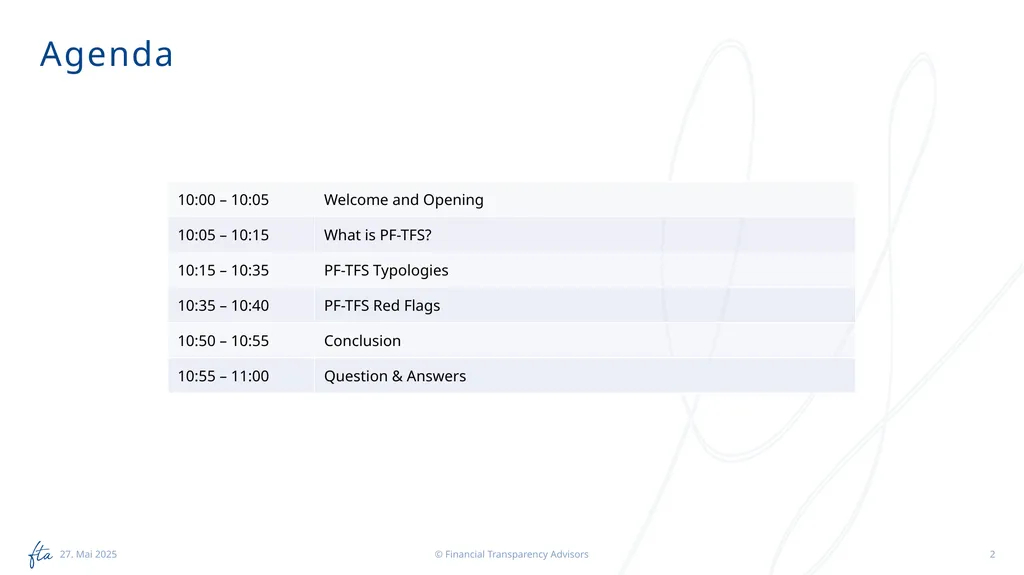
Agenda © Financial Transparency Advisors<br>
03
What is PF-TFS? © Financial Transparency Advisors<br>
04
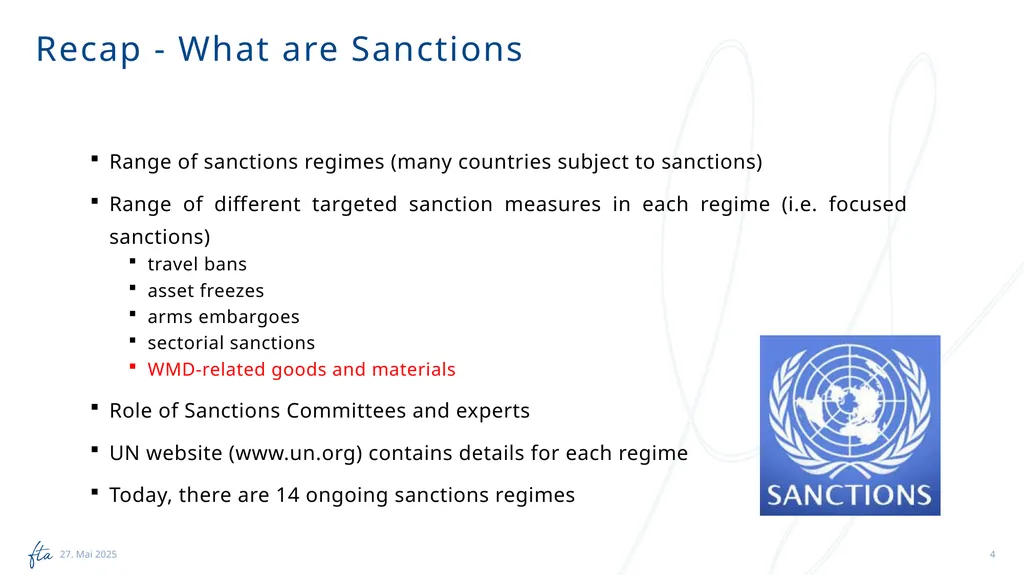
Recap - What are Sanctions Range of sanctions regimes (many countries subject to sanctions)
Range of different targeted sanction measures in each regime (i.e. focused sanctions)
travel bans
asset freezes
arms embargoes
sectorial sanctions
WMD-related goods and materials
Role of Sanctions Committees and experts
UN website (www.un.org) contains details for each regime
Today, there are 14 ongoing sanctions regimes<br>
Range of different targeted sanction measures in each regime (i.e. focused sanctions)
travel bans
asset freezes
arms embargoes
sectorial sanctions
WMD-related goods and materials
Role of Sanctions Committees and experts
UN website (www.un.org) contains details for each regime
Today, there are 14 ongoing sanctions regimes<br>
05
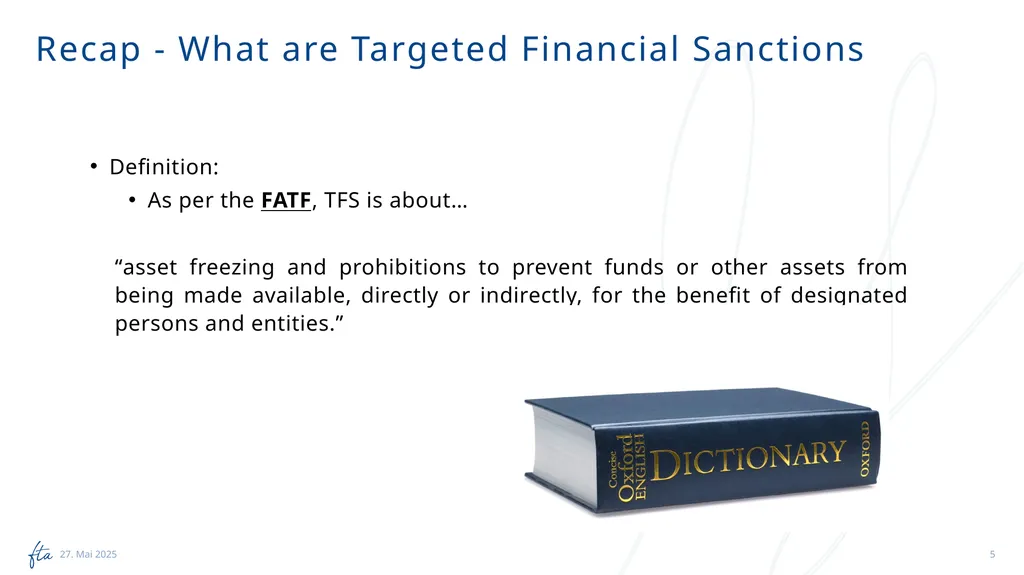
Recap - What are Targeted Financial Sanctions Definition:
As per the FATF, TFS is about…
“asset freezing and prohibitions to prevent funds or other assets from being made available, directly or indirectly, for the benefit of designated persons and entities.”<br>
As per the FATF, TFS is about…
“asset freezing and prohibitions to prevent funds or other assets from being made available, directly or indirectly, for the benefit of designated persons and entities.”<br>
06
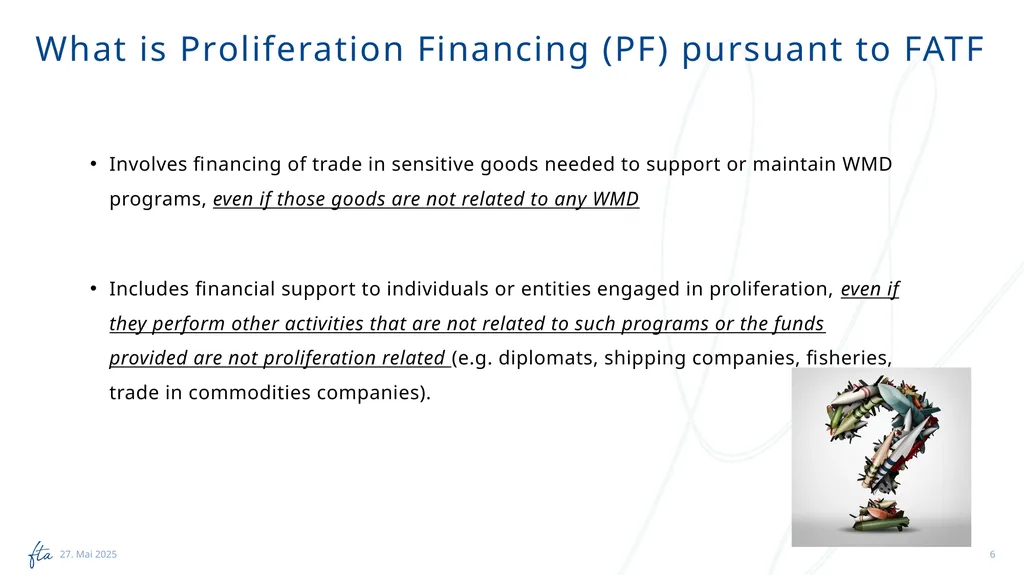
What is Proliferation Financing (PF) pursuant to FATF Involves financing of trade in sensitive goods needed to support or maintain WMD programs, even if those goods are not related to any WMD
Includes financial support to individuals or entities engaged in proliferation, even if they perform other activities that are not related to such programs or the funds provided are not proliferation related (e.g. diplomats, shipping companies, fisheries, trade in commodities companies).<br>
Includes financial support to individuals or entities engaged in proliferation, even if they perform other activities that are not related to such programs or the funds provided are not proliferation related (e.g. diplomats, shipping companies, fisheries, trade in commodities companies).<br>
07
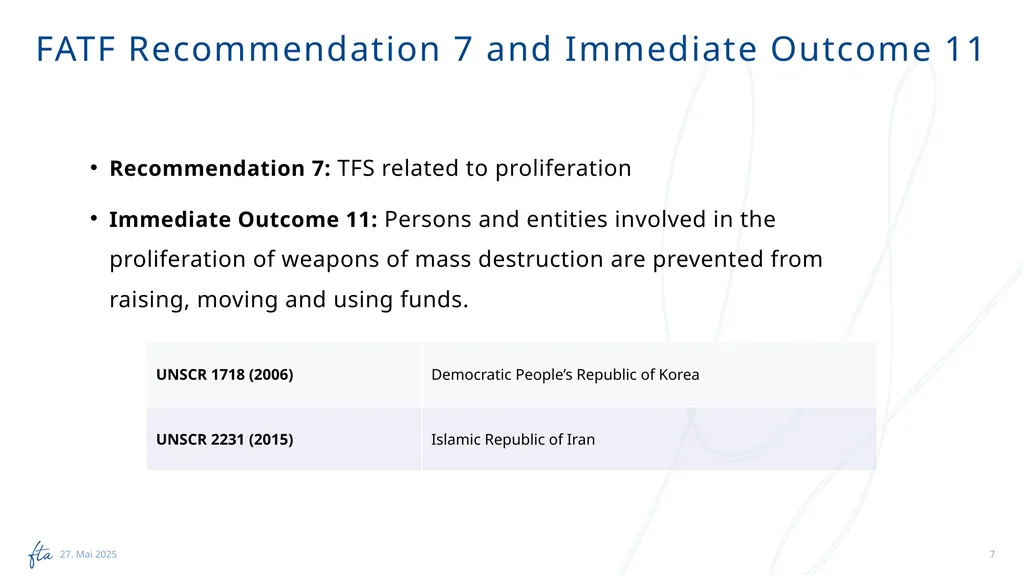
FATF Recommendation 7 and Immediate Outcome 11 Recommendation 7: TFS related to proliferation
Immediate Outcome 11: Persons and entities involved in the proliferation of weapons of mass destruction are prevented from raising, moving and using funds.<br>
Immediate Outcome 11: Persons and entities involved in the proliferation of weapons of mass destruction are prevented from raising, moving and using funds.<br>
08
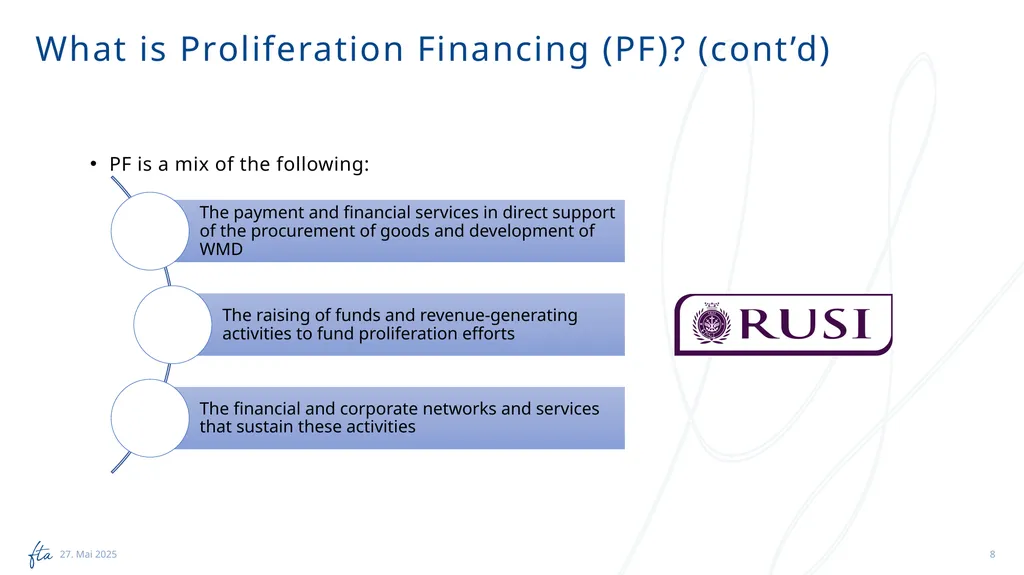
What is Proliferation Financing (PF)? (cont’d) PF is a mix of the following:<br>
09
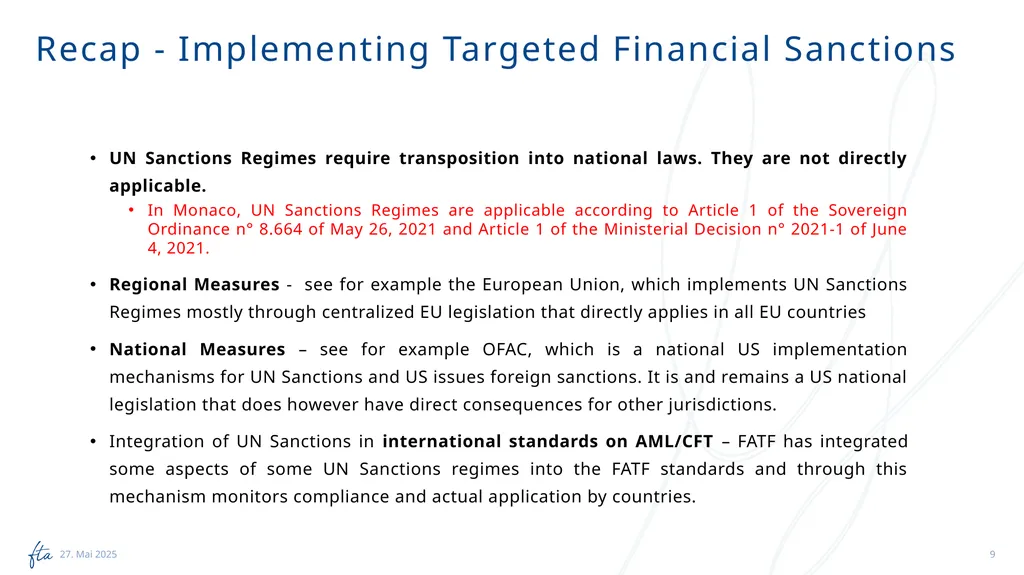
Recap - Implementing Targeted Financial Sanctions UN Sanctions Regimes require transposition into national laws. They are not directly applicable.
In Monaco, UN Sanctions Regimes are applicable according to Article 1 of the Sovereign Ordinance n° 8.664 of May 26, 2021 and Article 1 of the Ministerial Decision n° 2021-1 of June 4, 2021.
Regional Measures - see for example the European Union, which implements UN Sanctions Regimes mostly through centralized EU legislation that directly applies in all EU countries
National Measures – see for example OFAC, which is a national US implementation mechanisms for UN Sanctions and US issues foreign sanctions. It is and remains a US national legislation that does however have direct consequences for other jurisdictions.
Integration of UN Sanctions in international standards on AML/CFT – FATF has integrated some aspects of some UN Sanctions regimes into the FATF standards and through this mechanism monitors compliance and actual application by countries.<br>
In Monaco, UN Sanctions Regimes are applicable according to Article 1 of the Sovereign Ordinance n° 8.664 of May 26, 2021 and Article 1 of the Ministerial Decision n° 2021-1 of June 4, 2021.
Regional Measures - see for example the European Union, which implements UN Sanctions Regimes mostly through centralized EU legislation that directly applies in all EU countries
National Measures – see for example OFAC, which is a national US implementation mechanisms for UN Sanctions and US issues foreign sanctions. It is and remains a US national legislation that does however have direct consequences for other jurisdictions.
Integration of UN Sanctions in international standards on AML/CFT – FATF has integrated some aspects of some UN Sanctions regimes into the FATF standards and through this mechanism monitors compliance and actual application by countries.<br>
10
PF-TFS Typologies © Financial Transparency Advisors<br>
11
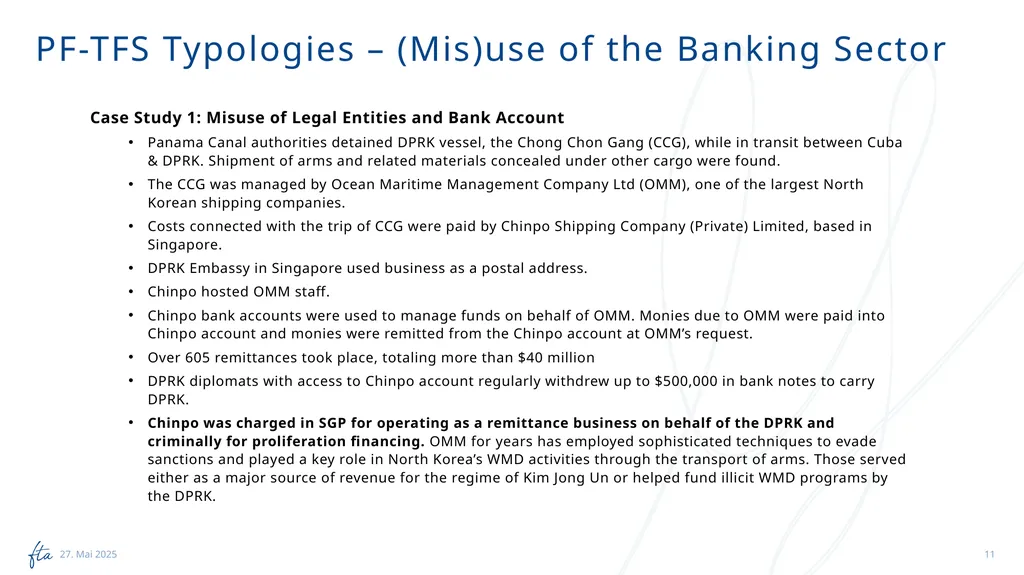
PF-TFS Typologies – (Mis)use of the Banking Sector Case Study 1: Misuse of Legal Entities and Bank Account
Panama Canal authorities detained DPRK vessel, the Chong Chon Gang (CCG), while in transit between Cuba & DPRK. Shipment of arms and related materials concealed under other cargo were found.
The CCG was managed by Ocean Maritime Management Company Ltd (OMM), one of the largest North Korean shipping companies.
Costs connected with the trip of CCG were paid by Chinpo Shipping Company (Private) Limited, based in Singapore.
DPRK Embassy in Singapore used business as a postal address.
Chinpo hosted OMM staff.
Chinpo bank accounts were used to manage funds on behalf of OMM. Monies due to OMM were paid into Chinpo account and monies were remitted from the Chinpo account at OMM’s request.
Over 605 remittances took place, totaling more than $40 million
DPRK diplomats with access to Chinpo account regularly withdrew up to $500,000 in bank notes to carry DPRK.
Chinpo was charged in SGP for operating as a remittance business on behalf of the DPRK and criminally for proliferation financing. OMM for years has employed sophisticated techniques to evade sanctions and played a key role in North Korea’s WMD activities through the transport of arms. Those served either as a major source of revenue for the regime of Kim Jong Un or helped fund illicit WMD programs by the DPRK.<br>
Panama Canal authorities detained DPRK vessel, the Chong Chon Gang (CCG), while in transit between Cuba & DPRK. Shipment of arms and related materials concealed under other cargo were found.
The CCG was managed by Ocean Maritime Management Company Ltd (OMM), one of the largest North Korean shipping companies.
Costs connected with the trip of CCG were paid by Chinpo Shipping Company (Private) Limited, based in Singapore.
DPRK Embassy in Singapore used business as a postal address.
Chinpo hosted OMM staff.
Chinpo bank accounts were used to manage funds on behalf of OMM. Monies due to OMM were paid into Chinpo account and monies were remitted from the Chinpo account at OMM’s request.
Over 605 remittances took place, totaling more than $40 million
DPRK diplomats with access to Chinpo account regularly withdrew up to $500,000 in bank notes to carry DPRK.
Chinpo was charged in SGP for operating as a remittance business on behalf of the DPRK and criminally for proliferation financing. OMM for years has employed sophisticated techniques to evade sanctions and played a key role in North Korea’s WMD activities through the transport of arms. Those served either as a major source of revenue for the regime of Kim Jong Un or helped fund illicit WMD programs by the DPRK.<br>
12
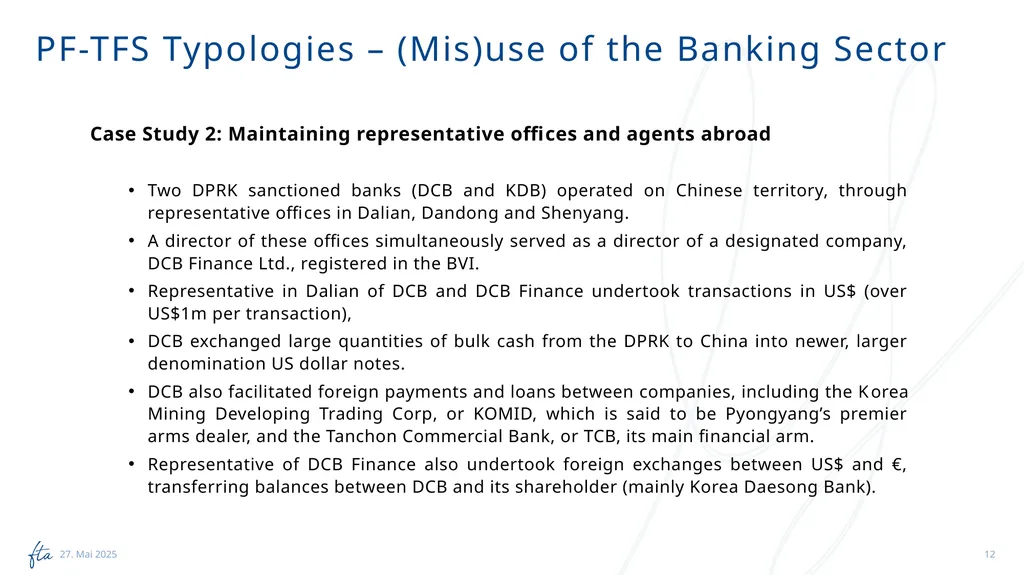
PF-TFS Typologies – (Mis)use of the Banking Sector Case Study 2: Maintaining representative offices and agents abroad
Two DPRK sanctioned banks (DCB and KDB) operated on Chinese territory, through representative offices in Dalian, Dandong and Shenyang.
A director of these offices simultaneously served as a director of a designated company, DCB Finance Ltd., registered in the BVI.
Representative in Dalian of DCB and DCB Finance undertook transactions in US$ (over US$1m per transaction),
DCB exchanged large quantities of bulk cash from the DPRK to China into newer, larger denomination US dollar notes.
DCB also facilitated foreign payments and loans between companies, including the Korea Mining Developing Trading Corp, or KOMID, which is said to be Pyongyang’s premier arms dealer, and the Tanchon Commercial Bank, or TCB, its main financial arm.
Representative of DCB Finance also undertook foreign exchanges between US$ and €, transferring balances between DCB and its shareholder (mainly Korea Daesong Bank).<br>
Two DPRK sanctioned banks (DCB and KDB) operated on Chinese territory, through representative offices in Dalian, Dandong and Shenyang.
A director of these offices simultaneously served as a director of a designated company, DCB Finance Ltd., registered in the BVI.
Representative in Dalian of DCB and DCB Finance undertook transactions in US$ (over US$1m per transaction),
DCB exchanged large quantities of bulk cash from the DPRK to China into newer, larger denomination US dollar notes.
DCB also facilitated foreign payments and loans between companies, including the Korea Mining Developing Trading Corp, or KOMID, which is said to be Pyongyang’s premier arms dealer, and the Tanchon Commercial Bank, or TCB, its main financial arm.
Representative of DCB Finance also undertook foreign exchanges between US$ and €, transferring balances between DCB and its shareholder (mainly Korea Daesong Bank).<br>
13
PF-TFS Typologies – (Mis)use of Legal Entities and Arrangements Case Study 1: Purchasing goods through 3rd parties
Person X owned two companies, one of which purchased aircraft equipment from companies in another country.
Equipment shipped to company in the UAE that operated on behalf of an entity listed on the OFAC list.
Person X and his companies had business relationship with a DPRK listed entity and were believed to have purchased equipment for the DPRK to avoid sanctions.
Freezing order was issued on Person X’s personal and corporate bank accounts.
UAE ordered an arrest of Person X and the freezing of funds and other assets worth AED 4,800,000 (roughly € 1,200,000).<br>
Person X owned two companies, one of which purchased aircraft equipment from companies in another country.
Equipment shipped to company in the UAE that operated on behalf of an entity listed on the OFAC list.
Person X and his companies had business relationship with a DPRK listed entity and were believed to have purchased equipment for the DPRK to avoid sanctions.
Freezing order was issued on Person X’s personal and corporate bank accounts.
UAE ordered an arrest of Person X and the freezing of funds and other assets worth AED 4,800,000 (roughly € 1,200,000).<br>
14
PF-TFS Typologies – (Mis)use of Legal Entities and Arrangements Case Study 2: Issuing unauthorized insurances
DGS Marine (Liechtenstein-registered offshore business company) had director, David Skinner, who issued insurance certificates for Iranian owned oil tankers transporting oil from Syria
Liechtenstein Financial Market Authority issued warning notice stating that DGS Marine was not licensed to issue insurances in Liechtenstein.
After warning notice, Mr. Skinner registered DGS Marine as a BVI business company.
DGS’s annual reports was found to contain false information (e.g. identity of DSG’s independent auditor).
Following investigation, DGS Marine was found to be an elaborate insurance scam.
Maintained offices (e.g. UK, UAE, Denmark) but did not possess the millions of pounds in securities alleged in its annual reports.
Mr. Skinner died shortly after the commencement of the investigation and the company disappeared from the internet sites, unclear whether the Iran link was in fact real.<br>
DGS Marine (Liechtenstein-registered offshore business company) had director, David Skinner, who issued insurance certificates for Iranian owned oil tankers transporting oil from Syria
Liechtenstein Financial Market Authority issued warning notice stating that DGS Marine was not licensed to issue insurances in Liechtenstein.
After warning notice, Mr. Skinner registered DGS Marine as a BVI business company.
DGS’s annual reports was found to contain false information (e.g. identity of DSG’s independent auditor).
Following investigation, DGS Marine was found to be an elaborate insurance scam.
Maintained offices (e.g. UK, UAE, Denmark) but did not possess the millions of pounds in securities alleged in its annual reports.
Mr. Skinner died shortly after the commencement of the investigation and the company disappeared from the internet sites, unclear whether the Iran link was in fact real.<br>
15
PF-TFS Typologies – (Mis)use of Legal Entities and Arrangements and Bank Accounts Case Study 3:
US authorities in 2016 and 2019 indicated the woman, Ma Xiaohong, her company, Dandong Hongxiang Industrial Development Corp., and other executives in the company on charges of money laundering and helping North Korea evade international sanctions.
Before the indictments, Ma and Dandong Hongxiang routed money to North Korea through China, Singapore, Cambodia, the US, and elsewhere, using an array of shell companies through US banks in New York.
There is an estimate that in 2015 alone, there were transfers of US $85.6 million<br>
US authorities in 2016 and 2019 indicated the woman, Ma Xiaohong, her company, Dandong Hongxiang Industrial Development Corp., and other executives in the company on charges of money laundering and helping North Korea evade international sanctions.
Before the indictments, Ma and Dandong Hongxiang routed money to North Korea through China, Singapore, Cambodia, the US, and elsewhere, using an array of shell companies through US banks in New York.
There is an estimate that in 2015 alone, there were transfers of US $85.6 million<br>
16
PF-TFS Typologies – (Mis)use of Legal Entities and Arrangements and Laborers/Migrant Workers Case Study 4:
Case was published in the UN Panel of experts report pursuant to resolution UNSCR 1874 in March 2019 and August 2019
Korea General Corporation for External Construction (a.k.a. GENCO, a.k.a. KOGEN) group, a network of legal companies and arrangements registered in different countries was found to be linked with the Reconnaissance General Bureau, a North Korean intelligence agency that manages the State's clandestine operations.
The UN Panel of experts reported on the ongoing investigation into GENCO/KOGEN that showed that the company has a large reach and extensive network in several countries in the Middle East, Africa, and Eurasia, where it utilizes laborers, prohibited cooperative entities, and joint ventures of the DPRK and earns significant revenue.
According to a UN Member Country, GENCO/KOGEN "has worked to supply North Korean laborers in the Middle East for the purpose of earning hard currency for [the] North Korea [n government]."The Panel's investigations found evidence of KOGEN activity by a joint venture with a company of the United Arab Emirates.
According to corporate registration documents, GENCO is the partial owner of a cooperative construction entity "SAKORENMA," with majority ownership belonging to a Russian national.
SARKORENMA maintains a bank account with a Russian bank. Furthermore, the company shares addresses, contact information, and shareholders with three other companies, all of which engage in construction-related activities.
Corporate registry documents show that GENCO operates two official representative offices in the Russian Federation, one in Vladivostok and one in Khasan, that together formally employ nationals of 17 different countreis.<br>
Case was published in the UN Panel of experts report pursuant to resolution UNSCR 1874 in March 2019 and August 2019
Korea General Corporation for External Construction (a.k.a. GENCO, a.k.a. KOGEN) group, a network of legal companies and arrangements registered in different countries was found to be linked with the Reconnaissance General Bureau, a North Korean intelligence agency that manages the State's clandestine operations.
The UN Panel of experts reported on the ongoing investigation into GENCO/KOGEN that showed that the company has a large reach and extensive network in several countries in the Middle East, Africa, and Eurasia, where it utilizes laborers, prohibited cooperative entities, and joint ventures of the DPRK and earns significant revenue.
According to a UN Member Country, GENCO/KOGEN "has worked to supply North Korean laborers in the Middle East for the purpose of earning hard currency for [the] North Korea [n government]."The Panel's investigations found evidence of KOGEN activity by a joint venture with a company of the United Arab Emirates.
According to corporate registration documents, GENCO is the partial owner of a cooperative construction entity "SAKORENMA," with majority ownership belonging to a Russian national.
SARKORENMA maintains a bank account with a Russian bank. Furthermore, the company shares addresses, contact information, and shareholders with three other companies, all of which engage in construction-related activities.
Corporate registry documents show that GENCO operates two official representative offices in the Russian Federation, one in Vladivostok and one in Khasan, that together formally employ nationals of 17 different countreis.<br>
17
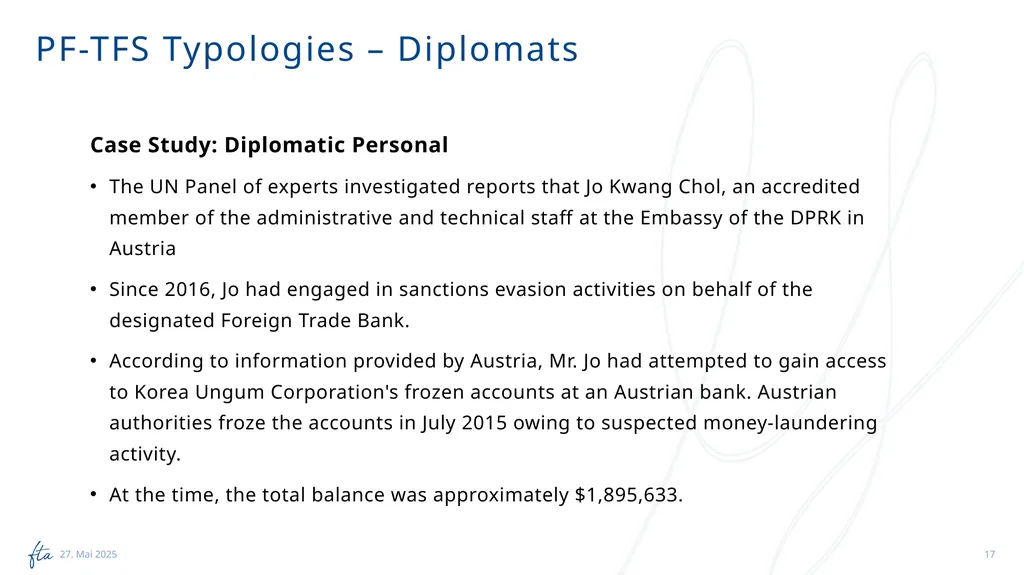
PF-TFS Typologies – Diplomats Case Study: Diplomatic Personal
The UN Panel of experts investigated reports that Jo Kwang Chol, an accredited member of the administrative and technical staff at the Embassy of the DPRK in Austria
Since 2016, Jo had engaged in sanctions evasion activities on behalf of the designated Foreign Trade Bank.
According to information provided by Austria, Mr. Jo had attempted to gain access to Korea Ungum Corporation's frozen accounts at an Austrian bank. Austrian authorities froze the accounts in July 2015 owing to suspected money-laundering activity.
At the time, the total balance was approximately $1,895,633.<br>
The UN Panel of experts investigated reports that Jo Kwang Chol, an accredited member of the administrative and technical staff at the Embassy of the DPRK in Austria
Since 2016, Jo had engaged in sanctions evasion activities on behalf of the designated Foreign Trade Bank.
According to information provided by Austria, Mr. Jo had attempted to gain access to Korea Ungum Corporation's frozen accounts at an Austrian bank. Austrian authorities froze the accounts in July 2015 owing to suspected money-laundering activity.
At the time, the total balance was approximately $1,895,633.<br>
18
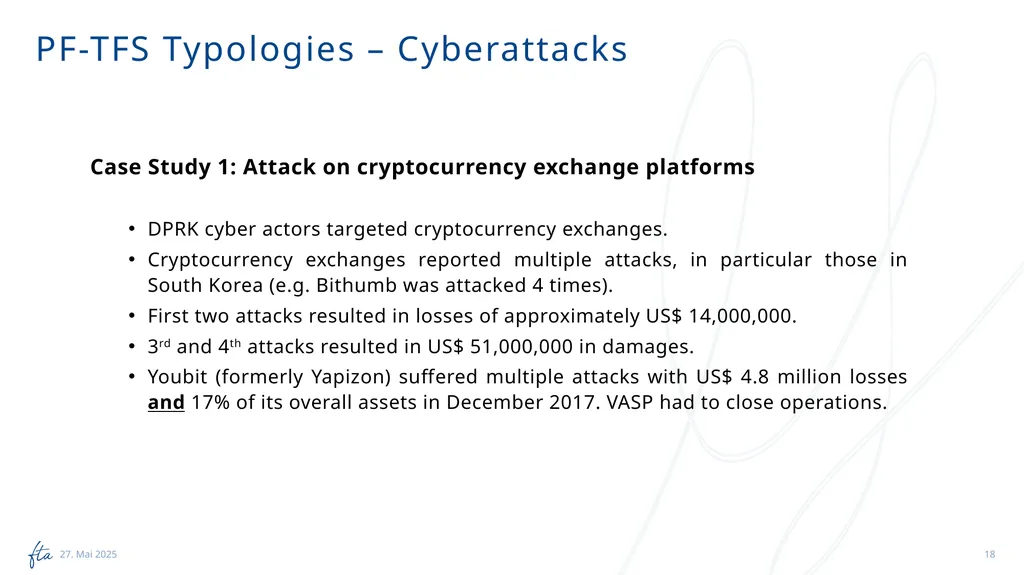
PF-TFS Typologies – Cyberattacks Case Study 1: Attack on cryptocurrency exchange platforms
DPRK cyber actors targeted cryptocurrency exchanges.
Cryptocurrency exchanges reported multiple attacks, in particular those in South Korea (e.g. Bithumb was attacked 4 times).
First two attacks resulted in losses of approximately US$ 14,000,000.
3rd and 4th attacks resulted in US$ 51,000,000 in damages.
Youbit (formerly Yapizon) suffered multiple attacks with US$ 4.8 million losses and 17% of its overall assets in December 2017. VASP had to close operations.<br>
DPRK cyber actors targeted cryptocurrency exchanges.
Cryptocurrency exchanges reported multiple attacks, in particular those in South Korea (e.g. Bithumb was attacked 4 times).
First two attacks resulted in losses of approximately US$ 14,000,000.
3rd and 4th attacks resulted in US$ 51,000,000 in damages.
Youbit (formerly Yapizon) suffered multiple attacks with US$ 4.8 million losses and 17% of its overall assets in December 2017. VASP had to close operations.<br>
19
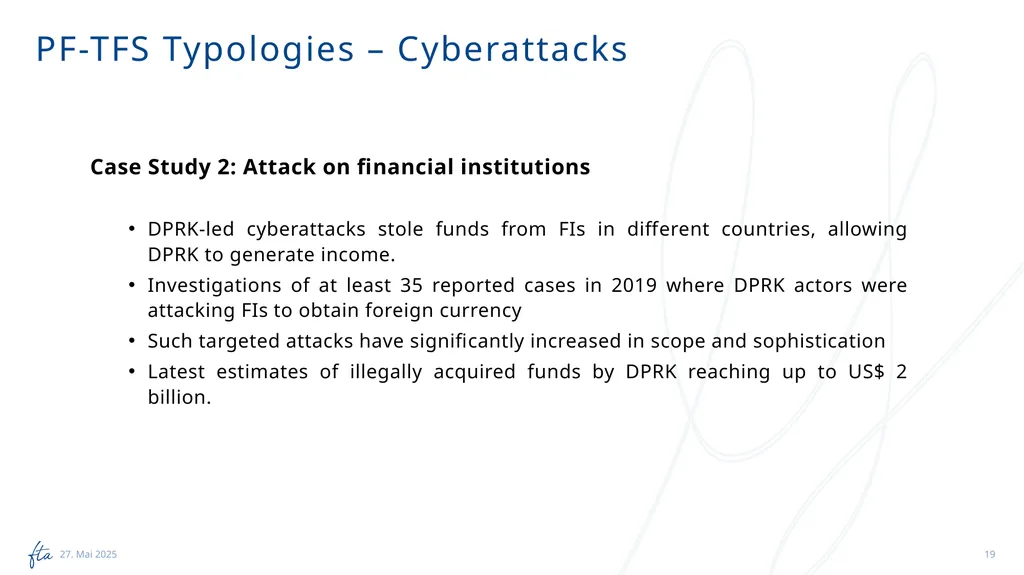
PF-TFS Typologies – Cyberattacks Case Study 2: Attack on financial institutions
DPRK-led cyberattacks stole funds from FIs in different countries, allowing DPRK to generate income.
Investigations of at least 35 reported cases in 2019 where DPRK actors were attacking FIs to obtain foreign currency
Such targeted attacks have significantly increased in scope and sophistication
Latest estimates of illegally acquired funds by DPRK reaching up to US$ 2 billion.<br>
DPRK-led cyberattacks stole funds from FIs in different countries, allowing DPRK to generate income.
Investigations of at least 35 reported cases in 2019 where DPRK actors were attacking FIs to obtain foreign currency
Such targeted attacks have significantly increased in scope and sophistication
Latest estimates of illegally acquired funds by DPRK reaching up to US$ 2 billion.<br>
20
PF-TFS Red Flags © Financial Transparency Advisors<br>
21
Difficulties in detecting PF Purchase and sale of elementary components and trade activities in general that may also have legitimate uses (dual-use goods), making their identification for illegitimate purposes even more problematic.
Dual-use goods are difficult to identify, requiring specialist knowledge.
Networks through which proliferation-sensitive goods may be obtained tend to be complex and closed off, and thus difficult to identify and investigate.
Risk of proliferation financing is more likely to be present in cases where the source of funds is legal and the illicit end-use of a type of goods involved is obscured.<br>
Dual-use goods are difficult to identify, requiring specialist knowledge.
Networks through which proliferation-sensitive goods may be obtained tend to be complex and closed off, and thus difficult to identify and investigate.
Risk of proliferation financing is more likely to be present in cases where the source of funds is legal and the illicit end-use of a type of goods involved is obscured.<br>
22
PF-TFS Red Flags Some red flags that can help FIs detect PF-related TFS evasion:
The customer or counterparty or its address is similar to one of the parties found on publicly available sanctions lists or has a history of export control contraventions.
Order for goods is placed by firms or persons from foreign countries other than the country of the stated end-user. Funds are sent or received via international transfers from or to higher-risk jurisdictions.
Wire instructions or payment from or to parties not identified on the original letter of credit or other documentation.
Involvement of items controlled under WMD export control regimes or national control regimes.
Customers or counterparties to transactions are linked (e.g., they share a common physical address, IP address or telephone number, or their activities may be coordinated).
Description of goods on trade or financial documentation is nonspecific, innocuous or misleading.<br>
The customer or counterparty or its address is similar to one of the parties found on publicly available sanctions lists or has a history of export control contraventions.
Order for goods is placed by firms or persons from foreign countries other than the country of the stated end-user. Funds are sent or received via international transfers from or to higher-risk jurisdictions.
Wire instructions or payment from or to parties not identified on the original letter of credit or other documentation.
Involvement of items controlled under WMD export control regimes or national control regimes.
Customers or counterparties to transactions are linked (e.g., they share a common physical address, IP address or telephone number, or their activities may be coordinated).
Description of goods on trade or financial documentation is nonspecific, innocuous or misleading.<br>
23
Conclusion © Financial Transparency Advisors<br>
24
Today’s Host: Gabriele Dunker
Today’s Presenter: Gabriele Dunker Next Session:
16.05.2023
Topic:
Conducting a Business Risk Assessment Thank you for your time<br>
Today’s Presenter: Gabriele Dunker Next Session:
16.05.2023
Topic:
Conducting a Business Risk Assessment Thank you for your time<br>