
An equalization measure for deep-seabed mining in
Description: An equalization measure for deep-seabed mining in the Area Presented by: Dr. Daniel Wilde (d.wildecommonwealth.int) July 2024 1 1 Summary of the thematic discussion, March 2024 The 1994 Implementing Agreement Section 8.1.b provides that
Related Topics
Download Presentation
"An equalization measure for deep-seabed mining in" is the property of its rightful owner. Permission is granted to download and print the materials on this website for personal, non-commercial use only, and to display it on your personal computer provided you do not modify the materials and that you retain all copyright notices contained in the materials. By downloading content from our website, you accept the terms of this agreement.
Presentation Transcript
slide1. An equalization measure for deep-seabed mining in the Area Presented by: Dr. Daniel Wilde (d.wilde@commonwealth.int) July 2024 1 1<br>
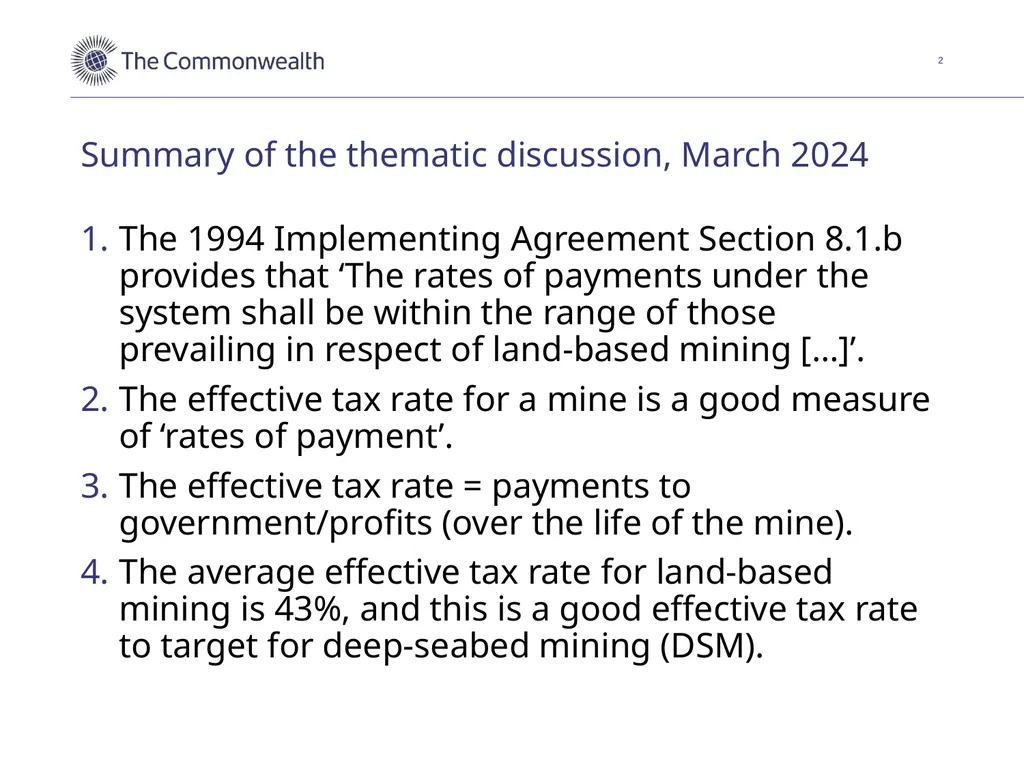
slide2. Summary of the thematic discussion, March 2024 The 1994 Implementing Agreement Section 8.1.b provides that ‘The rates of payments under the system shall be within the range of those prevailing in respect of land-based mining […]’.
The effective tax rate for a mine is a good measure of ‘rates of payment’.
The effective tax rate = payments to government/profits (over the life of the mine).
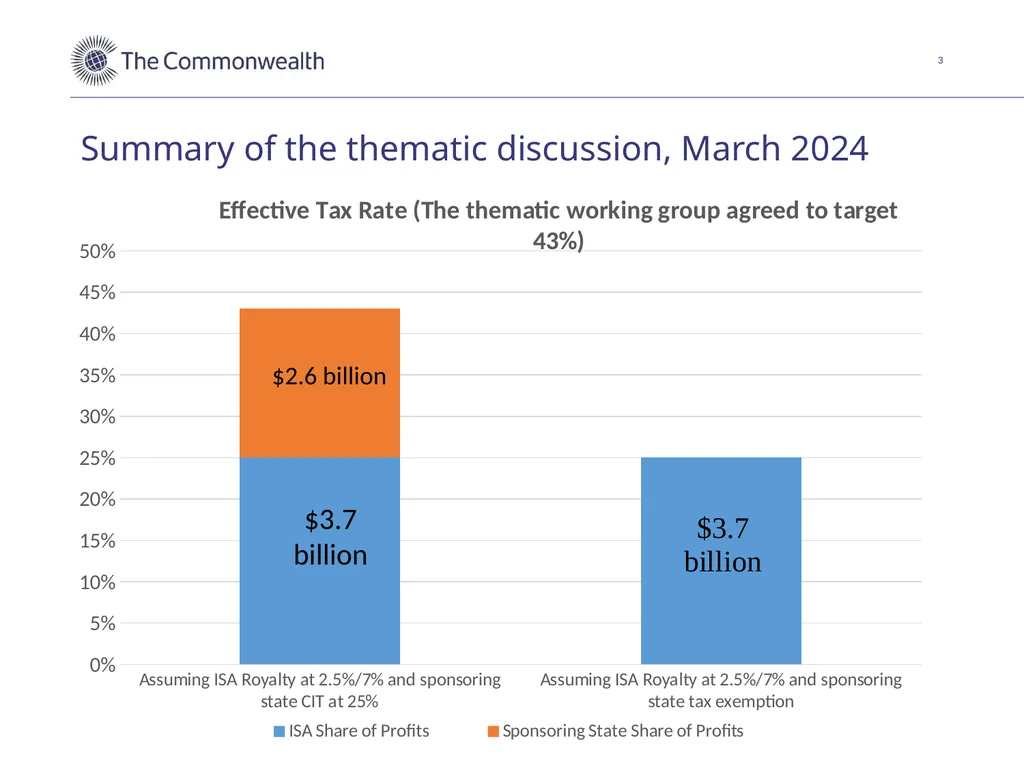
The average effective tax rate for land-based mining is 43%, and this is a good effective tax rate to target for deep-seabed mining (DSM). 2<br>
slide3. Summary of the thematic discussion, March 2024 3 $3.7 billion $2.6 billion<br>
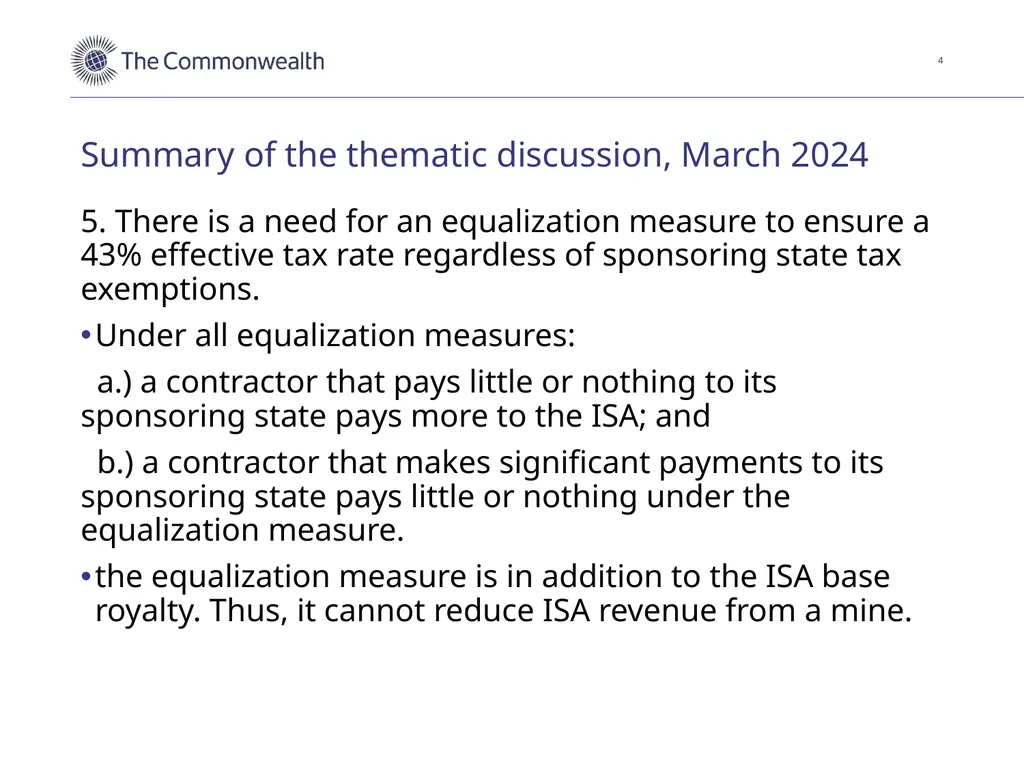
slide4. Summary of the thematic discussion, March 2024 5. There is a need for an equalization measure to ensure a 43% effective tax rate regardless of sponsoring state tax exemptions.
Under all equalization measures:
a.) a contractor that pays little or nothing to its sponsoring state pays more to the ISA; and
b.) a contractor that makes significant payments to its sponsoring state pays little or nothing under the equalization measure.
the equalization measure is in addition to the ISA base royalty. Thus, it cannot reduce ISA revenue from a mine. 4<br>
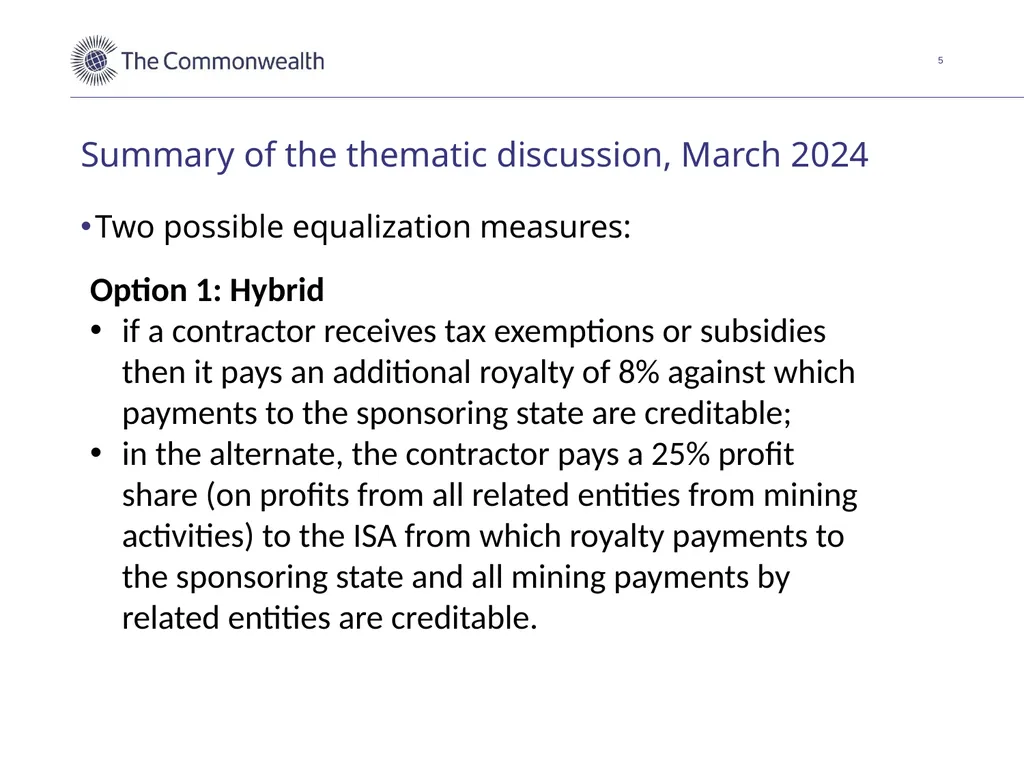
slide5. Summary of the thematic discussion, March 2024 Two possible equalization measures: 5 Option 1: Hybrid
if a contractor receives tax exemptions or subsidies then it pays an additional royalty of 8% against which payments to the sponsoring state are creditable;
in the alternate, the contractor pays a 25% profit share (on profits from all related entities from mining activities) to the ISA from which royalty payments to the sponsoring state and all mining payments by related entities are creditable.<br>
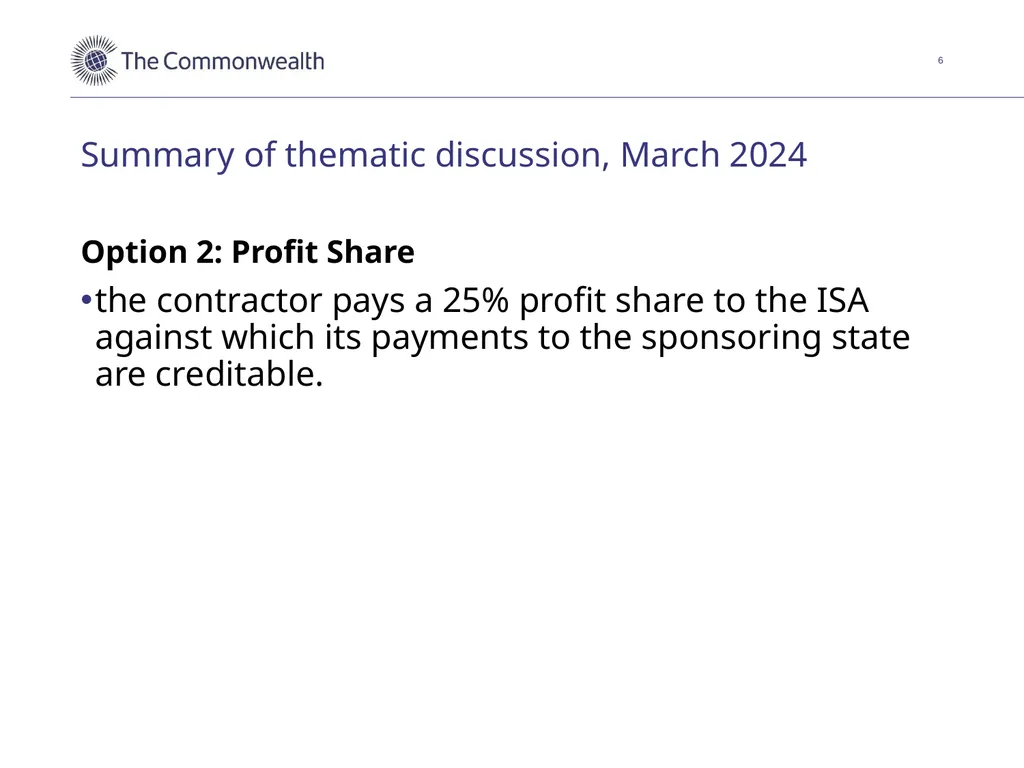
slide6. Summary of thematic discussion, March 2024 Option 2: Profit Share
the contractor pays a 25% profit share to the ISA against which its payments to the sponsoring state are creditable. 6<br>
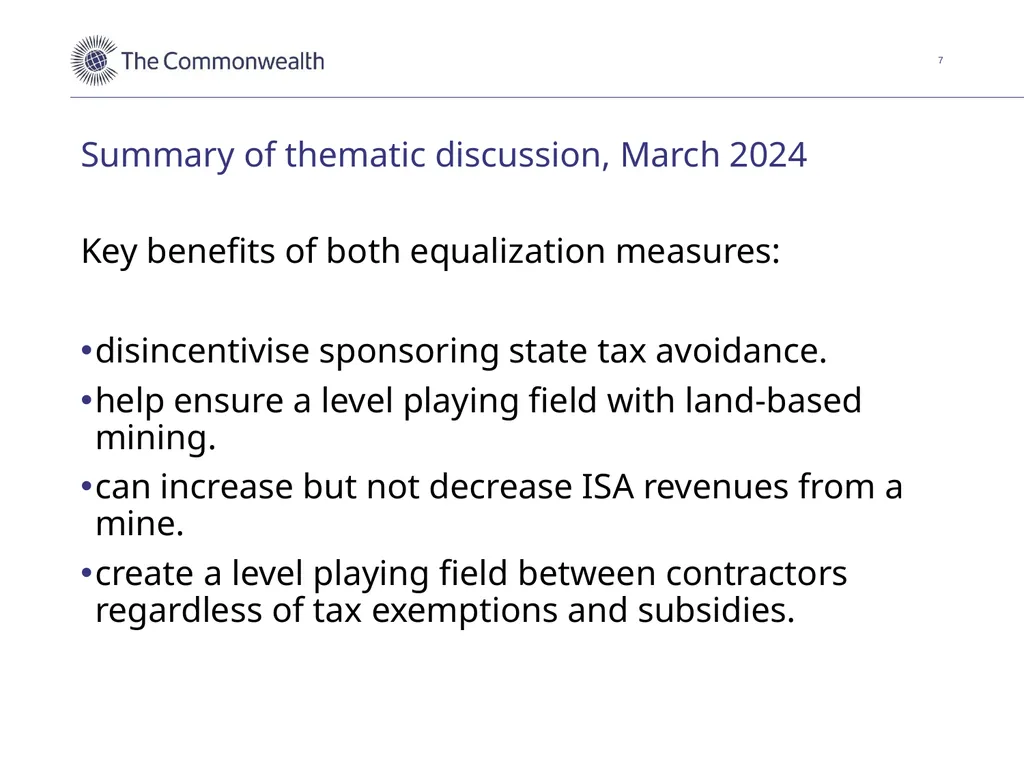
slide7. Summary of thematic discussion, March 2024 Key benefits of both equalization measures:
disincentivise sponsoring state tax avoidance.
help ensure a level playing field with land-based mining.
can increase but not decrease ISA revenues from a mine.
create a level playing field between contractors regardless of tax exemptions and subsidies. 7<br>
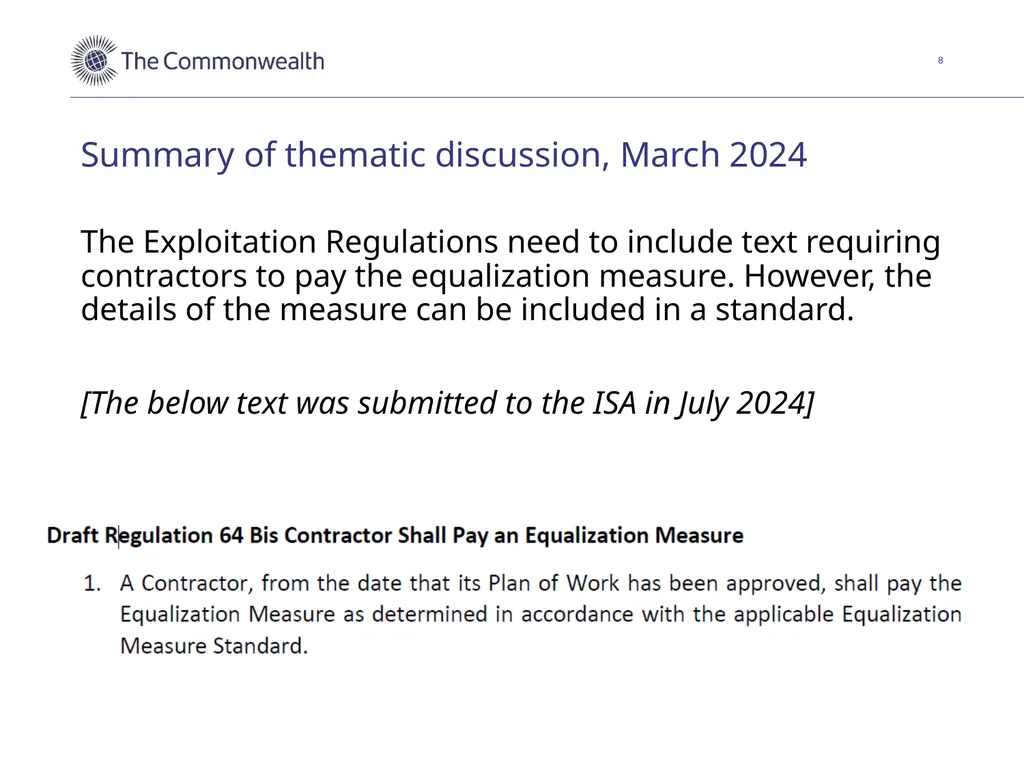
slide8. Summary of thematic discussion, March 2024 The Exploitation Regulations need to include text requiring contractors to pay the equalization measure. However, the details of the measure can be included in a standard.
[The below text was submitted to the ISA in July 2024] 8<br>
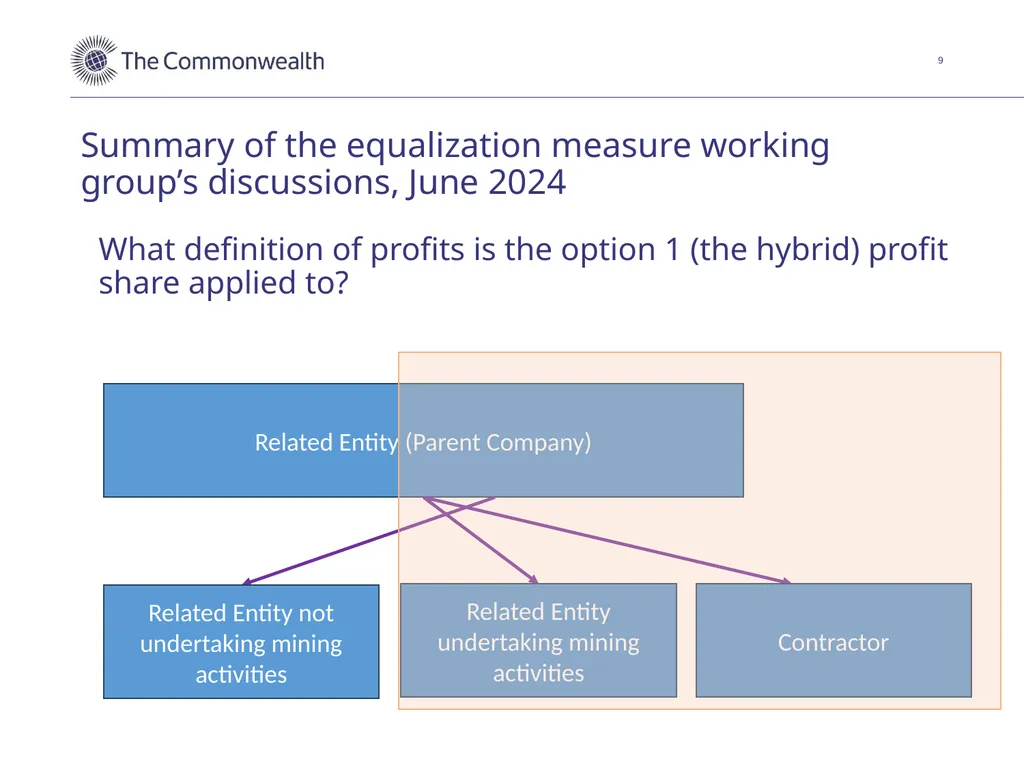
slide9. Summary of the equalization measure working group’s discussions, June 2024 9 Related Entity (Parent Company) Contractor Related Entity undertaking mining activities Related Entity not undertaking mining activities What definition of profits is the option 1 (the hybrid) profit share applied to?<br>
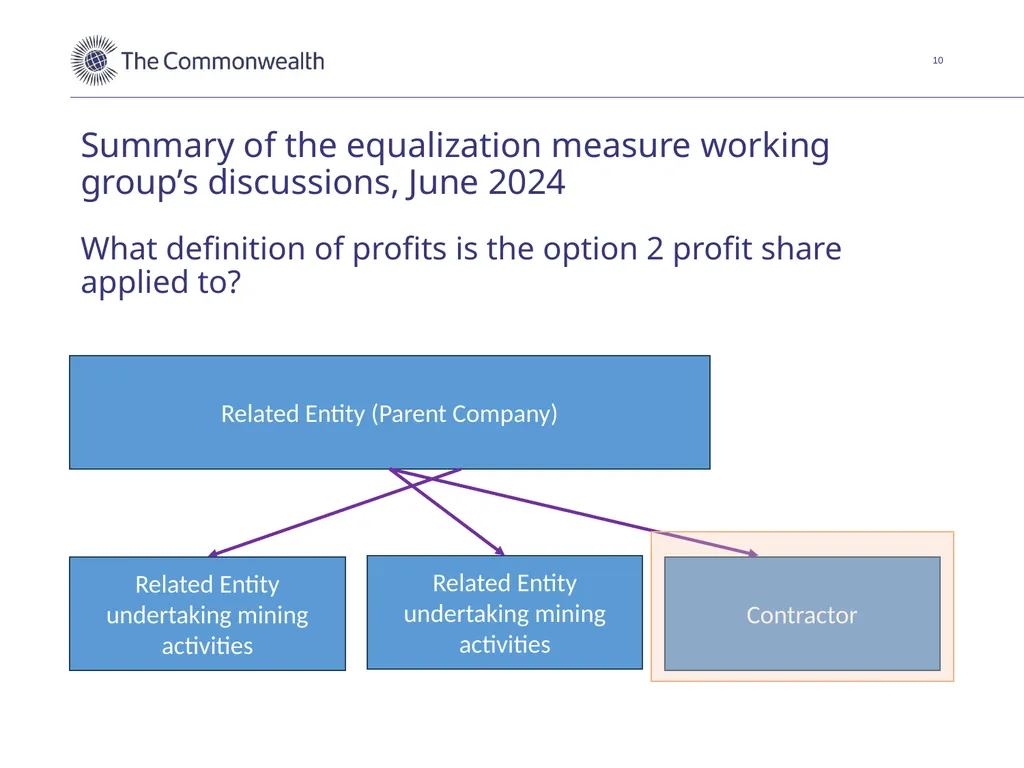
slide10. What definition of profits is the option 2 profit share applied to? 10 Related Entity (Parent Company) Contractor Related Entity undertaking mining activities Related Entity undertaking mining activities Summary of the equalization measure working group’s discussions, June 2024<br>
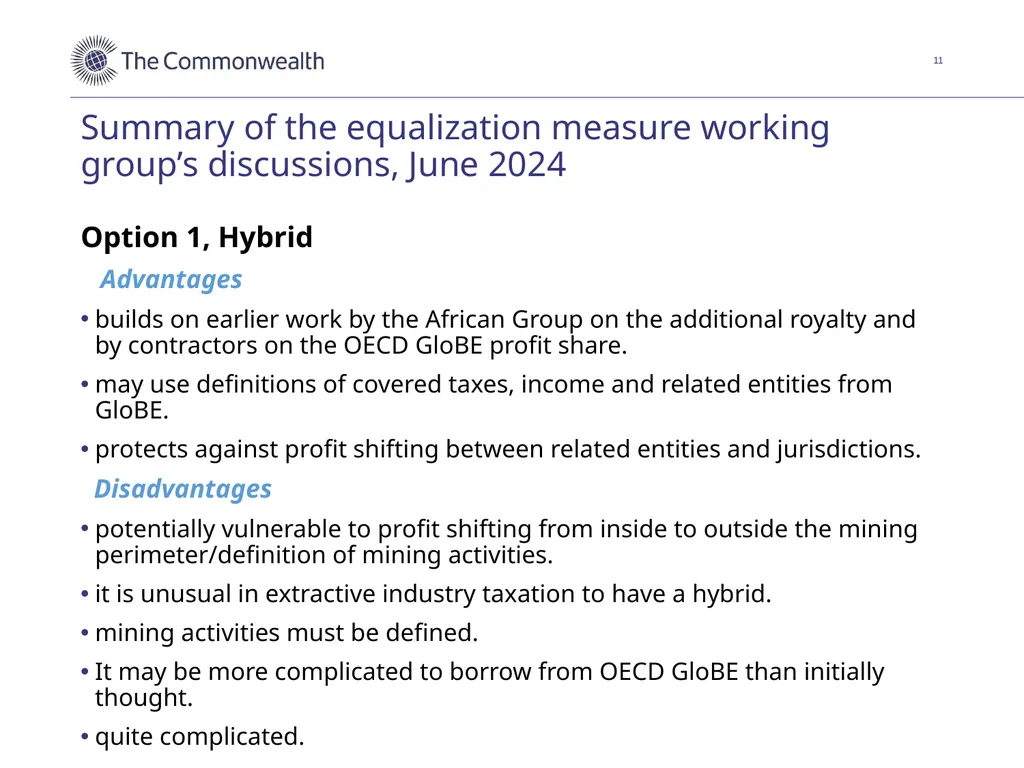
slide11. Option 1, Hybrid
Advantages
builds on earlier work by the African Group on the additional royalty and by contractors on the OECD GloBE profit share.
may use definitions of covered taxes, income and related entities from GloBE.
protects against profit shifting between related entities and jurisdictions.
Disadvantages
potentially vulnerable to profit shifting from inside to outside the mining perimeter/definition of mining activities.
it is unusual in extractive industry taxation to have a hybrid.
mining activities must be defined.
It may be more complicated to borrow from OECD GloBE than initially thought.
quite complicated. 11 Summary of the equalization measure working group’s discussions, June 2024<br>
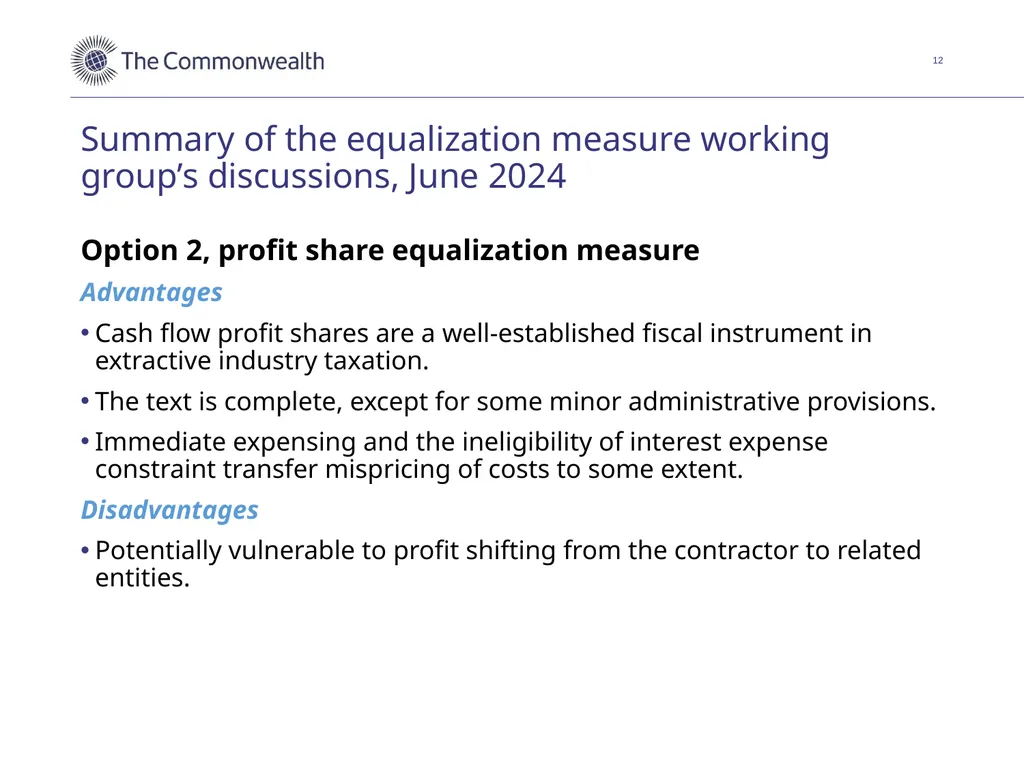
slide12. Option 2, profit share equalization measure
Advantages
Cash flow profit shares are a well-established fiscal instrument in extractive industry taxation.
The text is complete, except for some minor administrative provisions.
Immediate expensing and the ineligibility of interest expense constraint transfer mispricing of costs to some extent.
Disadvantages
Potentially vulnerable to profit shifting from the contractor to related entities. 12 Summary of the equalization measure working group’s discussions, June 2024<br>
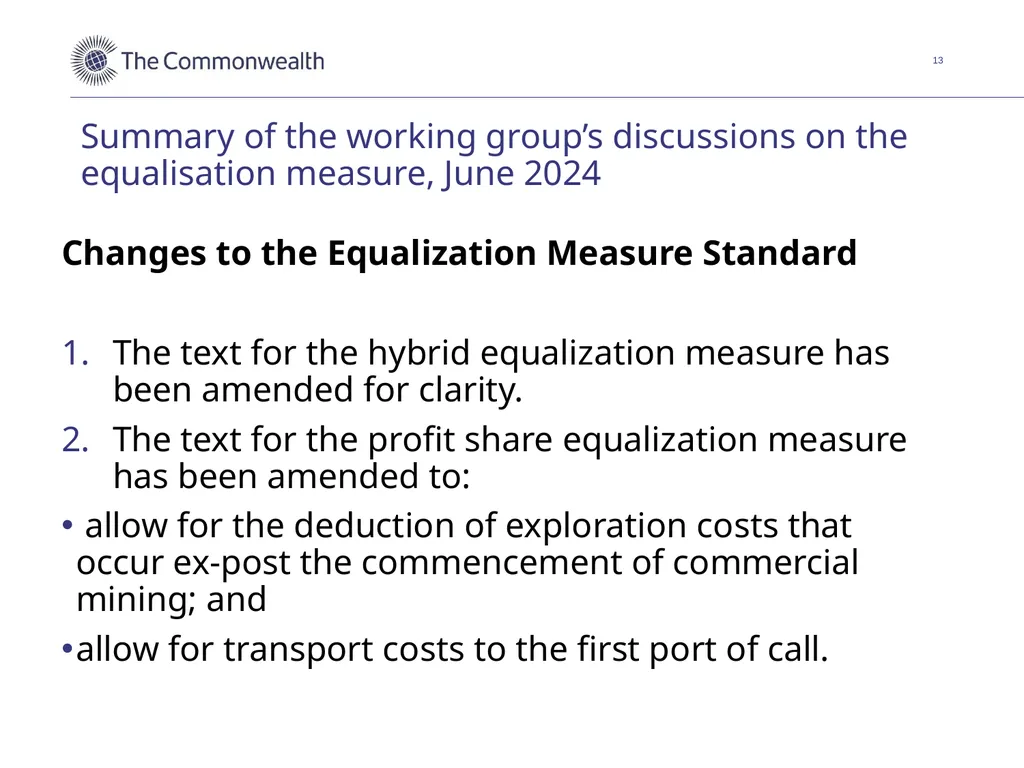
slide13. Summary of the working group’s discussions on the equalisation measure, June 2024 Changes to the Equalization Measure Standard
The text for the hybrid equalization measure has been amended for clarity.
The text for the profit share equalization measure has been amended to:
allow for the deduction of exploration costs that occur ex-post the commencement of commercial mining; and
allow for transport costs to the first port of call. 13<br>
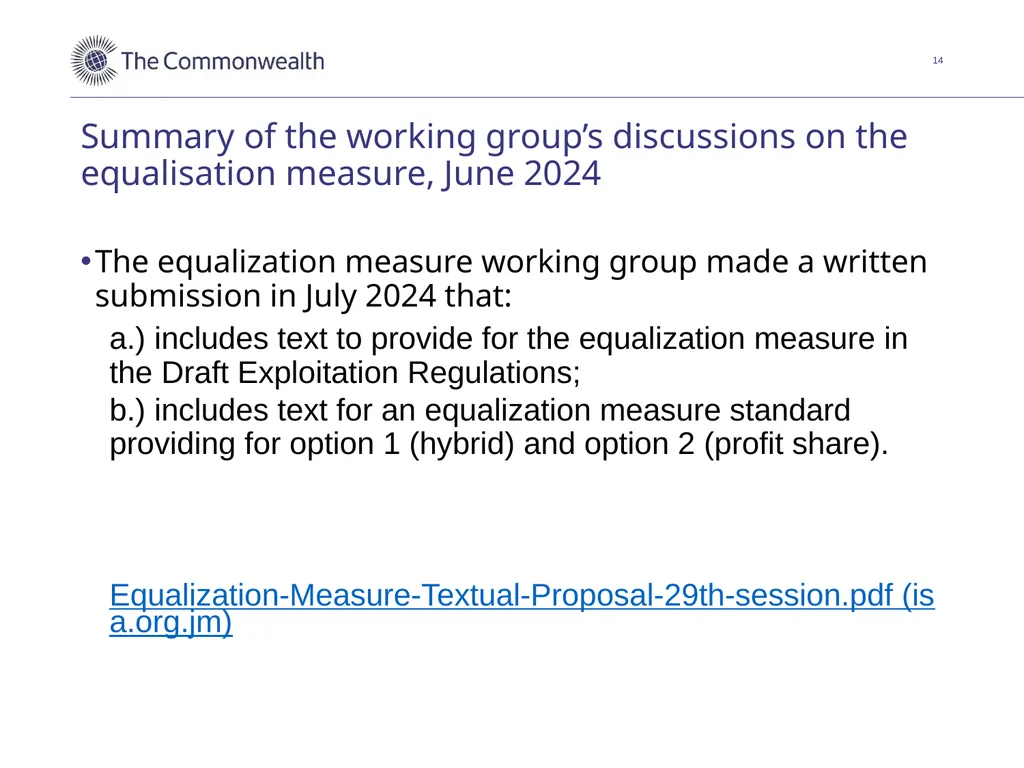
slide14. Summary of the working group’s discussions on the equalisation measure, June 2024 The equalization measure working group made a written submission in July 2024 that:
a.) includes text to provide for the equalization measure in the Draft Exploitation Regulations;
b.) includes text for an equalization measure standard providing for option 1 (hybrid) and option 2 (profit share).
Equalization-Measure-Textual-Proposal-29th-session.pdf (isa.org.jm) 14<br>
slide15. Conclusion Way forward:
a.) agree on the preferred equalization measure, and
b.) finalise the text for that measure. 15<br>
slide16. Disclaimer The views and opinions expressed in this Presentation are those of the presenter and do not necessarily represent the views of the Commonwealth Secretariat or any Commonwealth member country. 16<br>
slide2. Summary of the thematic discussion, March 2024 The 1994 Implementing Agreement Section 8.1.b provides that ‘The rates of payments under the system shall be within the range of those prevailing in respect of land-based mining […]’.
The effective tax rate for a mine is a good measure of ‘rates of payment’.
The effective tax rate = payments to government/profits (over the life of the mine).
The average effective tax rate for land-based mining is 43%, and this is a good effective tax rate to target for deep-seabed mining (DSM). 2<br>
slide3. Summary of the thematic discussion, March 2024 3 $3.7 billion $2.6 billion<br>
slide4. Summary of the thematic discussion, March 2024 5. There is a need for an equalization measure to ensure a 43% effective tax rate regardless of sponsoring state tax exemptions.
Under all equalization measures:
a.) a contractor that pays little or nothing to its sponsoring state pays more to the ISA; and
b.) a contractor that makes significant payments to its sponsoring state pays little or nothing under the equalization measure.
the equalization measure is in addition to the ISA base royalty. Thus, it cannot reduce ISA revenue from a mine. 4<br>
slide5. Summary of the thematic discussion, March 2024 Two possible equalization measures: 5 Option 1: Hybrid
if a contractor receives tax exemptions or subsidies then it pays an additional royalty of 8% against which payments to the sponsoring state are creditable;
in the alternate, the contractor pays a 25% profit share (on profits from all related entities from mining activities) to the ISA from which royalty payments to the sponsoring state and all mining payments by related entities are creditable.<br>
slide6. Summary of thematic discussion, March 2024 Option 2: Profit Share
the contractor pays a 25% profit share to the ISA against which its payments to the sponsoring state are creditable. 6<br>
slide7. Summary of thematic discussion, March 2024 Key benefits of both equalization measures:
disincentivise sponsoring state tax avoidance.
help ensure a level playing field with land-based mining.
can increase but not decrease ISA revenues from a mine.
create a level playing field between contractors regardless of tax exemptions and subsidies. 7<br>
slide8. Summary of thematic discussion, March 2024 The Exploitation Regulations need to include text requiring contractors to pay the equalization measure. However, the details of the measure can be included in a standard.
[The below text was submitted to the ISA in July 2024] 8<br>
slide9. Summary of the equalization measure working group’s discussions, June 2024 9 Related Entity (Parent Company) Contractor Related Entity undertaking mining activities Related Entity not undertaking mining activities What definition of profits is the option 1 (the hybrid) profit share applied to?<br>
slide10. What definition of profits is the option 2 profit share applied to? 10 Related Entity (Parent Company) Contractor Related Entity undertaking mining activities Related Entity undertaking mining activities Summary of the equalization measure working group’s discussions, June 2024<br>
slide11. Option 1, Hybrid
Advantages
builds on earlier work by the African Group on the additional royalty and by contractors on the OECD GloBE profit share.
may use definitions of covered taxes, income and related entities from GloBE.
protects against profit shifting between related entities and jurisdictions.
Disadvantages
potentially vulnerable to profit shifting from inside to outside the mining perimeter/definition of mining activities.
it is unusual in extractive industry taxation to have a hybrid.
mining activities must be defined.
It may be more complicated to borrow from OECD GloBE than initially thought.
quite complicated. 11 Summary of the equalization measure working group’s discussions, June 2024<br>
slide12. Option 2, profit share equalization measure
Advantages
Cash flow profit shares are a well-established fiscal instrument in extractive industry taxation.
The text is complete, except for some minor administrative provisions.
Immediate expensing and the ineligibility of interest expense constraint transfer mispricing of costs to some extent.
Disadvantages
Potentially vulnerable to profit shifting from the contractor to related entities. 12 Summary of the equalization measure working group’s discussions, June 2024<br>
slide13. Summary of the working group’s discussions on the equalisation measure, June 2024 Changes to the Equalization Measure Standard
The text for the hybrid equalization measure has been amended for clarity.
The text for the profit share equalization measure has been amended to:
allow for the deduction of exploration costs that occur ex-post the commencement of commercial mining; and
allow for transport costs to the first port of call. 13<br>
slide14. Summary of the working group’s discussions on the equalisation measure, June 2024 The equalization measure working group made a written submission in July 2024 that:
a.) includes text to provide for the equalization measure in the Draft Exploitation Regulations;
b.) includes text for an equalization measure standard providing for option 1 (hybrid) and option 2 (profit share).
Equalization-Measure-Textual-Proposal-29th-session.pdf (isa.org.jm) 14<br>
slide15. Conclusion Way forward:
a.) agree on the preferred equalization measure, and
b.) finalise the text for that measure. 15<br>
slide16. Disclaimer The views and opinions expressed in this Presentation are those of the presenter and do not necessarily represent the views of the Commonwealth Secretariat or any Commonwealth member country. 16<br>