An independent report commissioned by Public Services International (PSI) Co-Authors Dr. Sara Charlesworth, Professor Emerita, RMIT University, Melbourne, Australia Dr. Ian Cunningham, Professor, University of Strathclyde , Glasgow,
"An independent report commissioned by Public" is the property of its rightful owner. Permission is granted to
download and print the materials on this website for personal, non-commercial use only, and to display it
on your personal computer provided you do not modify the materials and that you retain all copyright
notices contained in the materials. By downloading content from our website, you accept the terms of this
agreement.
Presentation Transcript
01
An independent report commissioned by Public Services International (PSI)
Co-Authors
Dr. Sara Charlesworth, Professor Emerita, RMIT University, Melbourne, Australia
Dr. Ian Cunningham, Professor, University of Strathclyde , Glasgow, Scotland
Dr. Tamara Daly, Professor, York University, Toronto, Canada
Online presentation to PSI Long-Term Care Network Affiliates: January 25 & January 31, 2024<br>
02
Overview Aims
LTC – in context
Our Method
Principles and Indicators
Conditions that produce ‘unacceptable forms of work’ and ‘unacceptable care’
Typology
What should unions do?
Questions for consideration Charlesworth, Cunningham & Daly 2024: Decent Work & Quality Long-term Care Systems 2<br>
03
Our Aims Showcase examples of successful models and reforms that support workers to deliver accountable, high-quality Long-term Care (LTC)
Provide trade unions with an evidence-based resource documenting a suite of indicators and potential reforms to national long-term care (LTC) sectors that support local workers, care recipients and society.
For use in:
Campaigns,
Public Education and
Bargaining Charlesworth, Cunningham & Daly 2024: Decent Work & Quality Long-term Care Systems 3<br>
04
LTC – in context Residential and home care services are provided by paid workers + informal, familial and unpaid care
Long-term care spans:
aged care services,
disability services, and
health services for the chronically ill.
Our focus: care for older adults + formal care
This focus is important for number of reasons:
Women are overrepresented in ALL forms of unpaid care work
Many countries a sharp decline in available informal / familial care:
migration of younger people to larger cities
Increase in women engaged in paid work, and outbound migration.
In most OECD countries, these demographic changes have resulted in an increase in formal services offered by the state, the market, or the non-profit-sector but it remains insufficient given the need Charlesworth, Cunningham & Daly 2024: Decent Work & Quality Long-term Care Systems 4<br>
05
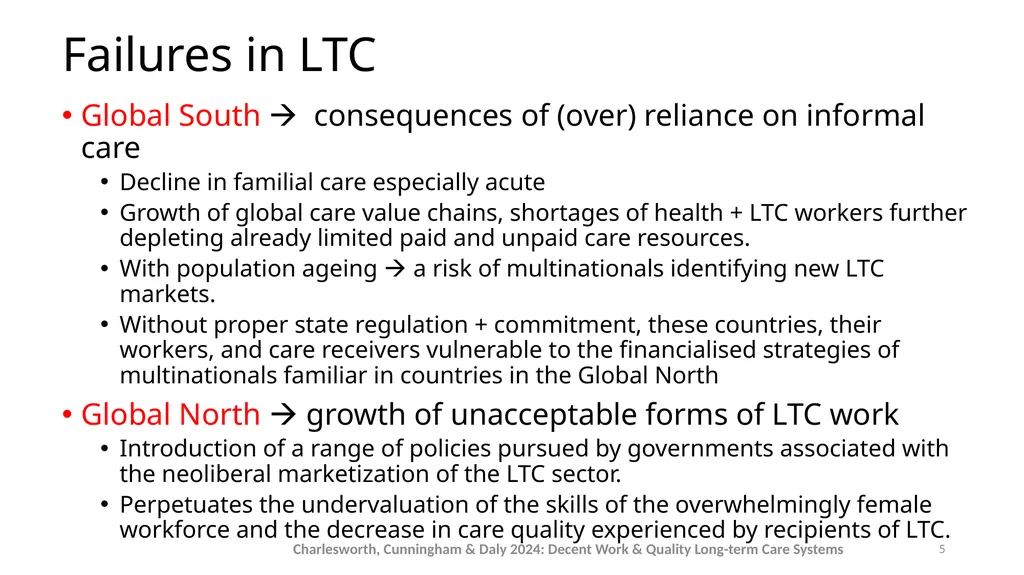
Failures in LTC Global South consequences of (over) reliance on informal care
Decline in familial care especially acute
Growth of global care value chains, shortages of health + LTC workers further depleting already limited paid and unpaid care resources.
With population ageing a risk of multinationals identifying new LTC markets.
Without proper state regulation + commitment, these countries, their workers, and care receivers vulnerable to the financialised strategies of multinationals familiar in countries in the Global North
Global North growth of unacceptable forms of LTC work
Introduction of a range of policies pursued by governments associated with the neoliberal marketization of the LTC sector.
Perpetuates the undervaluation of the skills of the overwhelmingly female workforce and the decrease in care quality experienced by recipients of LTC. Charlesworth, Cunningham & Daly 2024: Decent Work & Quality Long-term Care Systems 5<br>
06
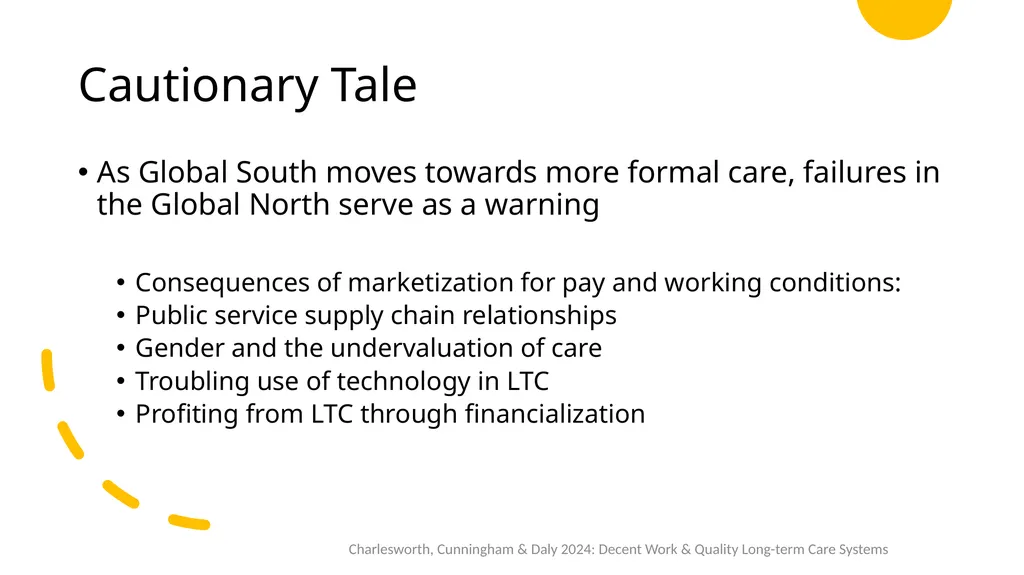
Cautionary Tale As Global South moves towards more formal care, failures in the Global North serve as a warning
Consequences of marketization for pay and working conditions:
Public service supply chain relationships
Gender and the undervaluation of care
Troubling use of technology in LTC
Profiting from LTC through financialization Charlesworth, Cunningham & Daly 2024: Decent Work & Quality Long-term Care Systems 6<br>
07
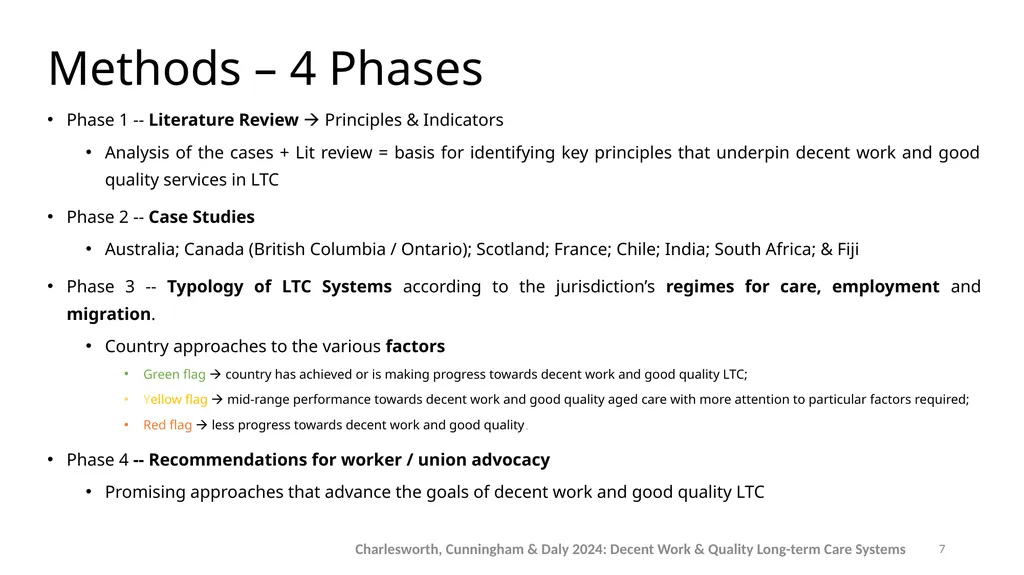
Methods – 4 Phases Phase 1 -- Literature Review Principles & Indicators
Analysis of the cases + Lit review = basis for identifying key principles that underpin decent work and good quality services in LTC
Phase 2 -- Case Studies
Australia; Canada (British Columbia / Ontario); Scotland; France; Chile; India; South Africa; & Fiji
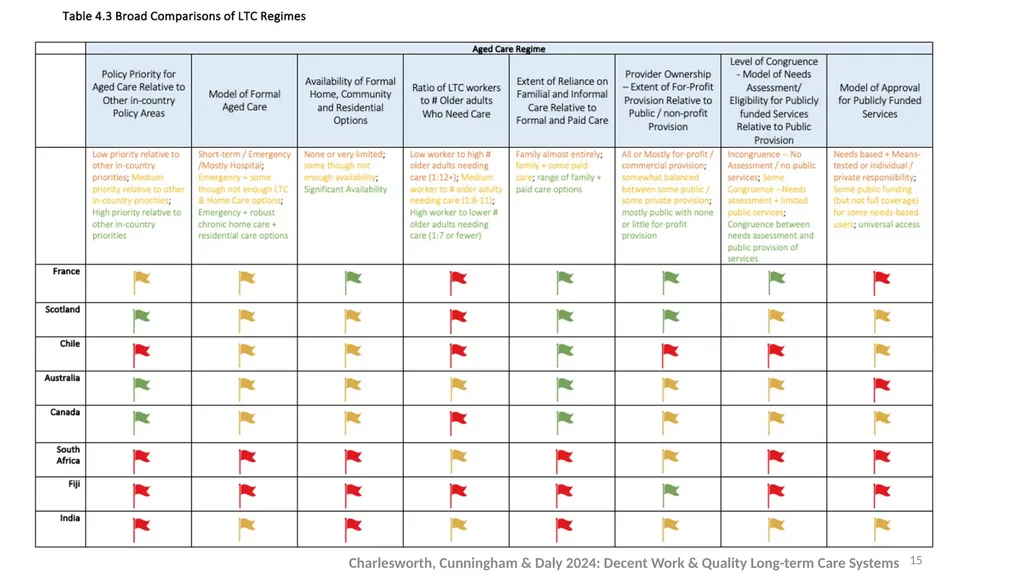
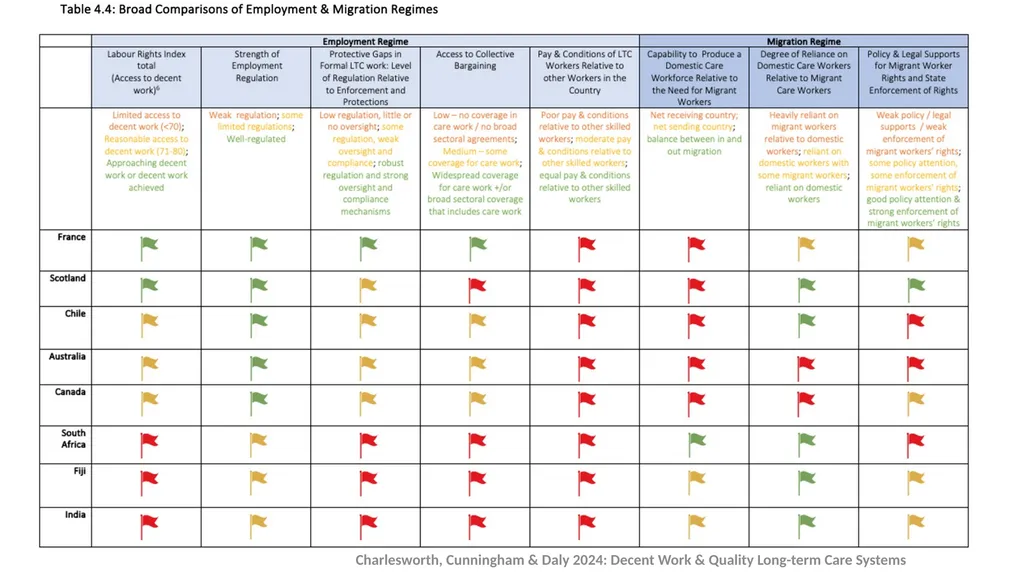
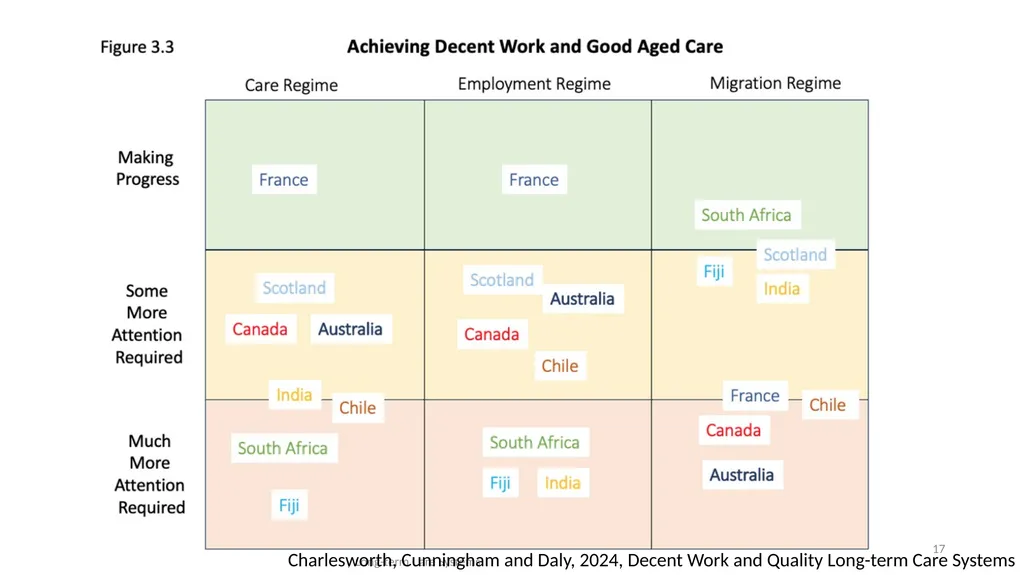
Phase 3 -- Typology of LTC Systems according to the jurisdiction’s regimes for care, employment and migration.
Country approaches to the various factors
Green flag country has achieved or is making progress towards decent work and good quality LTC;
Yellow flag mid-range performance towards decent work and good quality aged care with more attention to particular factors required;
Red flag less progress towards decent work and good quality .
Phase 4 -- Recommendations for worker / union advocacy
Promising approaches that advance the goals of decent work and good quality LTC Charlesworth, Cunningham & Daly 2024: Decent Work & Quality Long-term Care Systems 7<br>
08
Phase 1 Charlesworth, Cunningham & Daly 2024: Decent Work & Quality Long-term Care Systems 8<br>
09
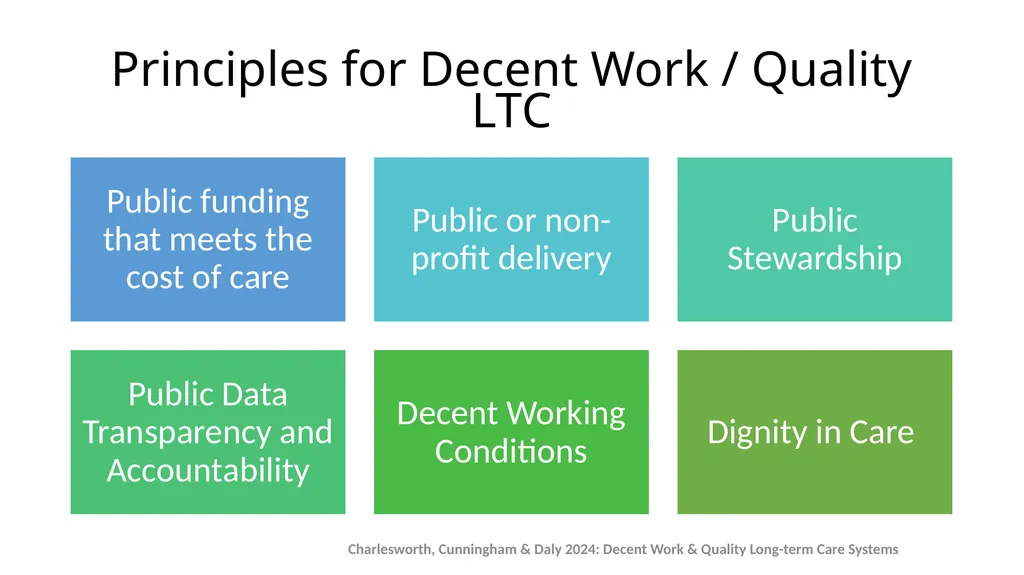
Principles for Decent Work / Quality LTC Charlesworth, Cunningham & Daly 2024: Decent Work & Quality Long-term Care Systems 9<br>
10
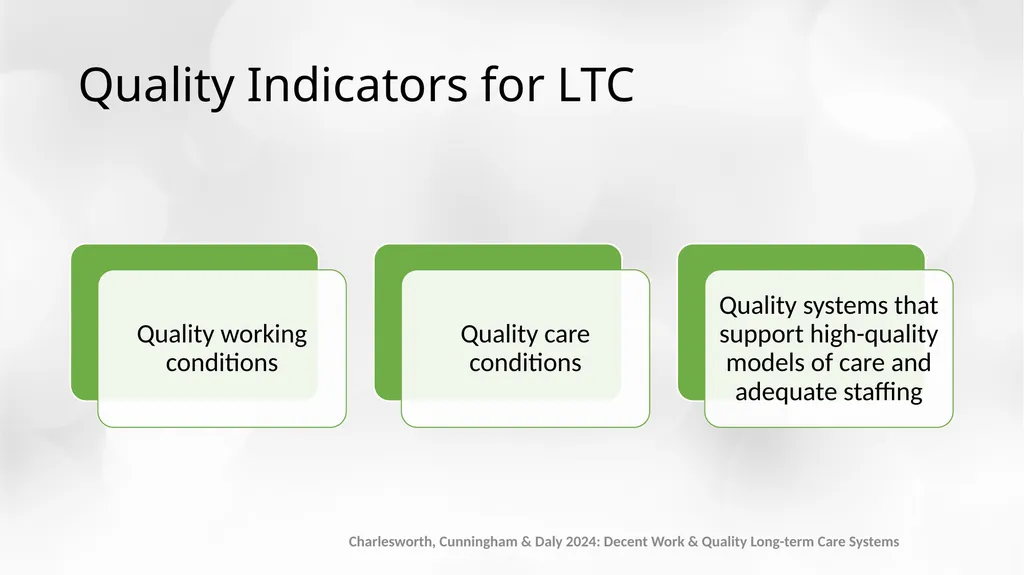
Quality Indicators for LTC Charlesworth, Cunningham & Daly 2024: Decent Work & Quality Long-term Care Systems 10<br>
11
Phase 2 Charlesworth, Cunningham & Daly 2024: Decent Work & Quality Long-term Care Systems 11<br>
12
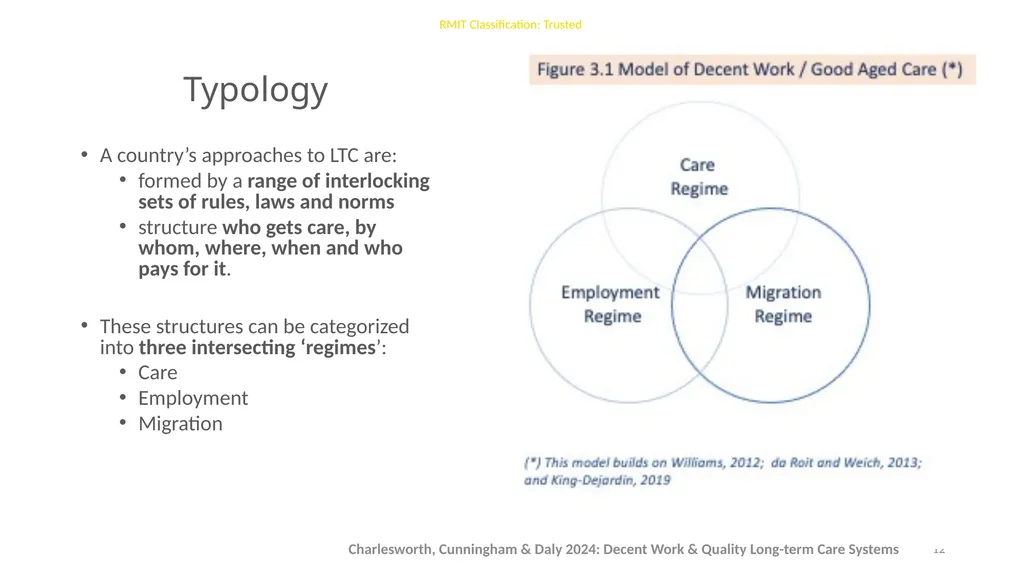
Typology A country’s approaches to LTC are:
formed by a range of interlocking sets of rules, laws and norms
structure who gets care, by whom, where, when and who pays for it.
These structures can be categorized into three intersecting ‘regimes’:
Care
Employment
Migration Charlesworth, Cunningham & Daly 2024: Decent Work & Quality Long-term Care Systems 12<br>
13
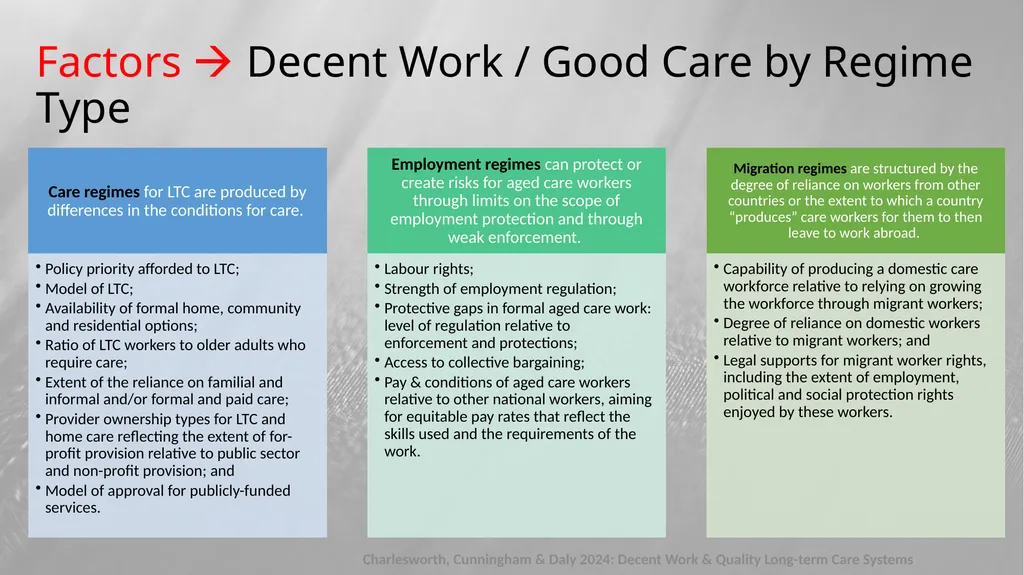
Factors Decent Work / Good Care by Regime Type Charlesworth, Cunningham & Daly 2024: Decent Work & Quality Long-term Care Systems 13<br>
14
Phase 3 Charlesworth, Cunningham & Daly 2024: Decent Work & Quality Long-term Care Systems 14<br>
15
Charlesworth, Cunningham & Daly 2024: Decent Work & Quality Long-term Care Systems 15<br>
16
Charlesworth, Cunningham & Daly 2024: Decent Work & Quality Long-term Care Systems 16<br>
17
Charlesworth, Cunningham and Daly, 2024, Decent Work and Quality Long-term Care Systems Charlesworth, Cunningham & Daly 2024: Decent Work & Quality Long-term Care Systems 17<br>
18
Phase 4<br>
19
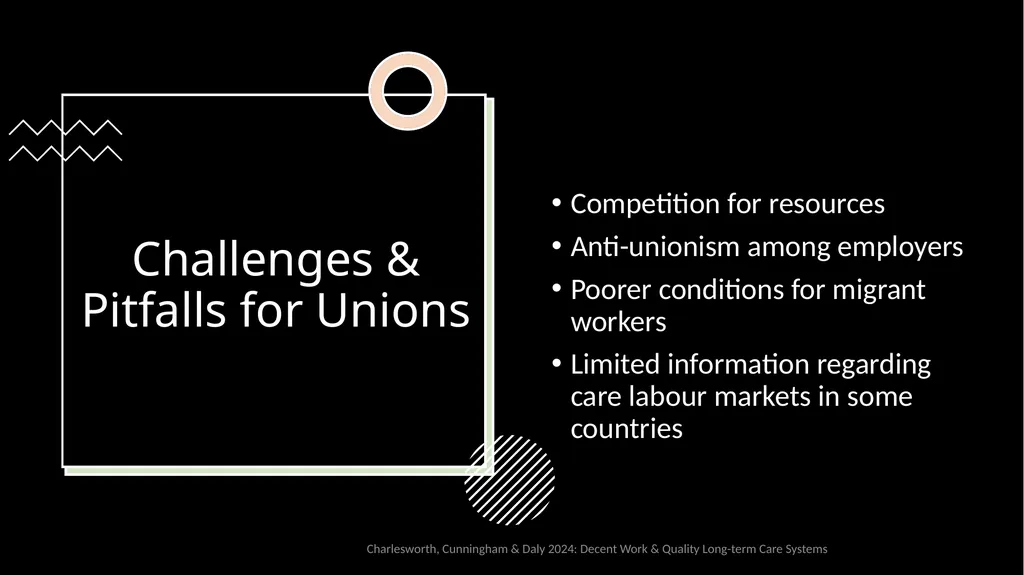
Challenges & Pitfalls for Unions Competition for resources
Anti-unionism among employers
Poorer conditions for migrant workers
Limited information regarding care labour markets in some countries Charlesworth, Cunningham & Daly 2024: Decent Work & Quality Long-term Care Systems 19<br>
20
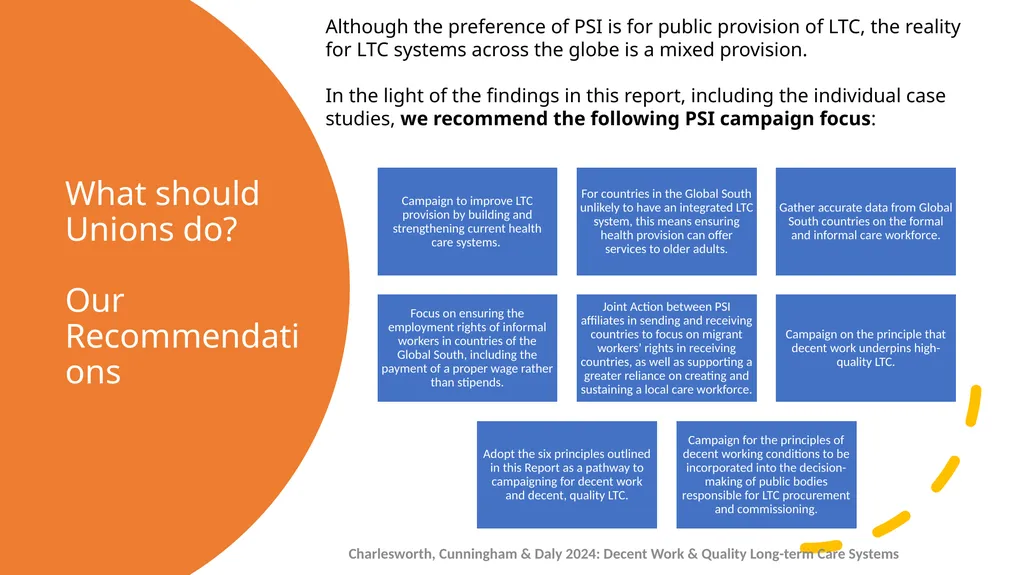
What should Unions do? Our Recommendations Although the preference of PSI is for public provision of LTC, the reality for LTC systems across the globe is a mixed provision.
In the light of the findings in this report, including the individual case studies, we recommend the following PSI campaign focus: Charlesworth, Cunningham & Daly 2024: Decent Work & Quality Long-term Care Systems 20<br>
21
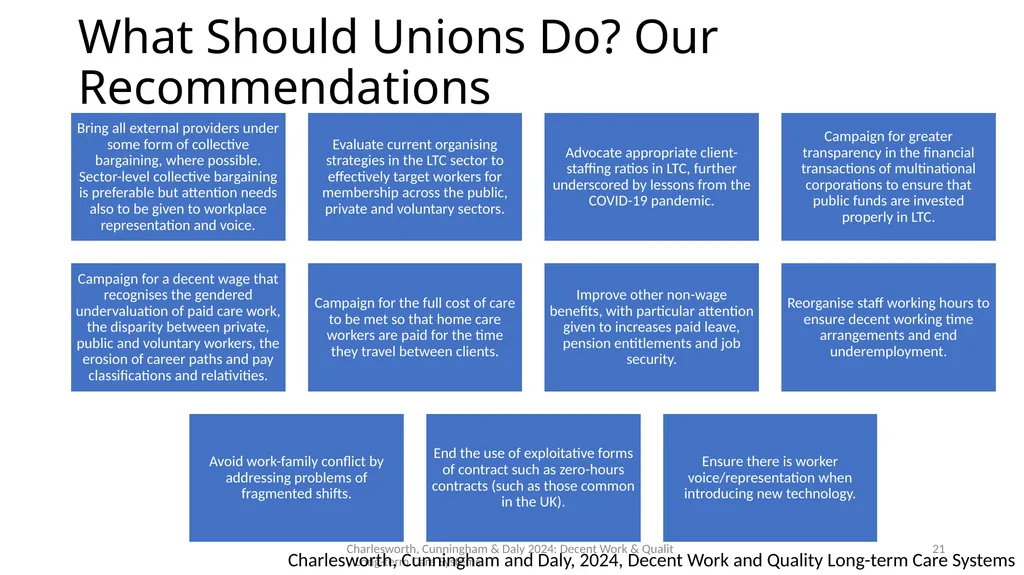
What Should Unions Do? Our Recommendations Charlesworth, Cunningham and Daly, 2024, Decent Work and Quality Long-term Care Systems Charlesworth, Cunningham & Daly 2024: Decent Work & Quality Long-term Care Systems 21<br>
22
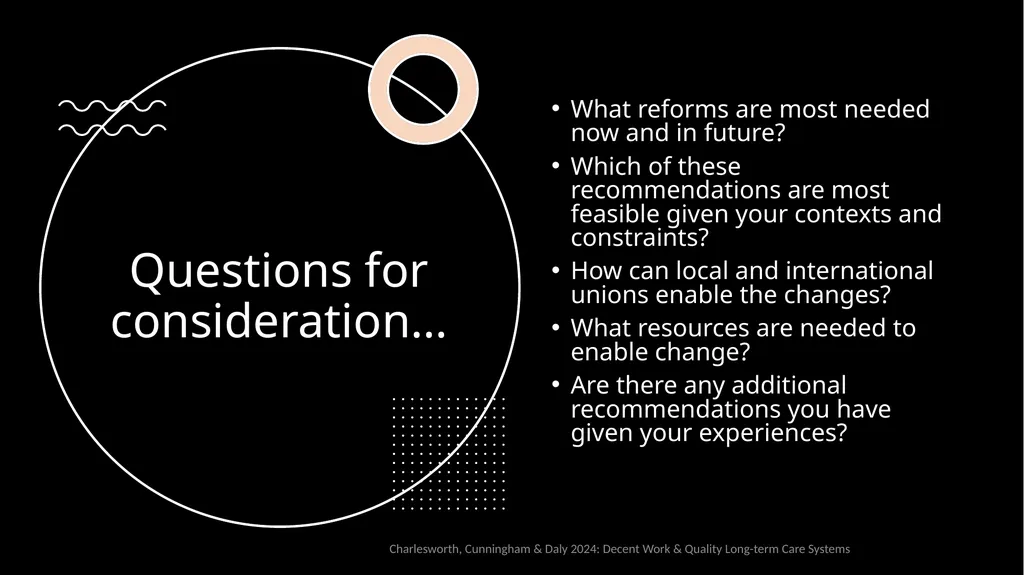
Questions for consideration… What reforms are most needed now and in future?
Which of these recommendations are most feasible given your contexts and constraints?
How can local and international unions enable the changes?
What resources are needed to enable change?
Are there any additional recommendations you have given your experiences? Charlesworth, Cunningham & Daly 2024: Decent Work & Quality Long-term Care Systems 22<br>