An Introduction to Outsourcing Professor Andrew
Description: An Introduction to Outsourcing Professor Andrew Thomas Aberystwyth Business School Objectives Introduce to outsourcing Introduce various cost definitions and demonstrate how they are applied in outsourcing strategies. Demonstrate how
Related Topics
Download Presentation
"An Introduction to Outsourcing Professor Andrew" is the property of its rightful owner. Permission is granted to download and print the materials on this website for personal, non-commercial use only, and to display it on your personal computer provided you do not modify the materials and that you retain all copyright notices contained in the materials. By downloading content from our website, you accept the terms of this agreement.
Presentation Transcript
slide1. An Introduction to OutsourcingProfessor Andrew ThomasAberystwyth Business School<br>
slide2. Objectives Introduce to outsourcing
Introduce various cost definitions and demonstrate how they are applied in outsourcing strategies.
Demonstrate how break-even analysis is used within an outsourcing context to determine outsourcing decisions .
Consider the non-financial issues associated with outsourcing strategies<br>
slide3. Outsourcing Strategy is a strategic decision making process where a company considers at what point it is more appropriate to make a product (or service) within their own company (in-house) or, whether it is better for another company to make the product (or service) for them. Outsourcing Strategy<br>
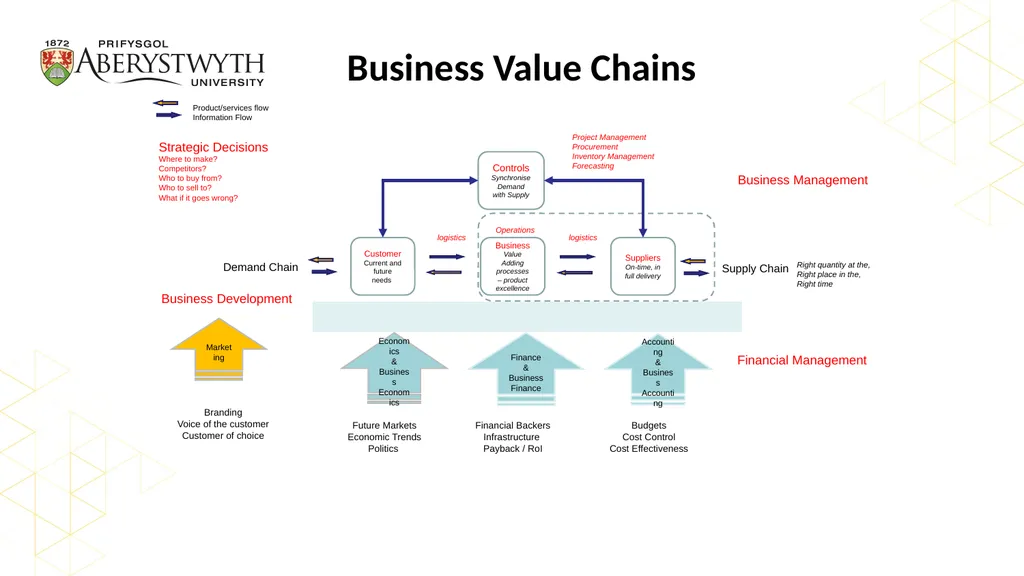
slide4. Business Value Chains Customer
Current and future needs Controls
Synchronise Demand with Supply Business
Value Adding processes – product excellence Suppliers
On-time, in full delivery Marketing Economics
&
Business Economics Finance
&
Business Finance Accounting
&
Business Accounting Demand Chain Supply Chain Business Management Financial Management Business Development Future Markets
Economic Trends
Politics Financial Backers
Infrastructure
Payback / RoI Budgets
Cost Control
Cost Effectiveness Product/services flow
Information Flow Branding
Voice of the customer
Customer of choice logistics logistics Operations Project Management
Procurement
Inventory Management
Forecasting Strategic Decisions
Where to make?
Competitors?
Who to buy from?
Who to sell to?
What if it goes wrong? Right quantity at the,
Right place in the,
Right time<br>
slide5. Outsourcing The outsourcing strategy will define the supply chain system and configuration.
Decisions can be based:
Financially
Qualitatively
Mixture of financial and qualitative analysis
Applying outsourcing can depend on position of product in product life cycle<br>
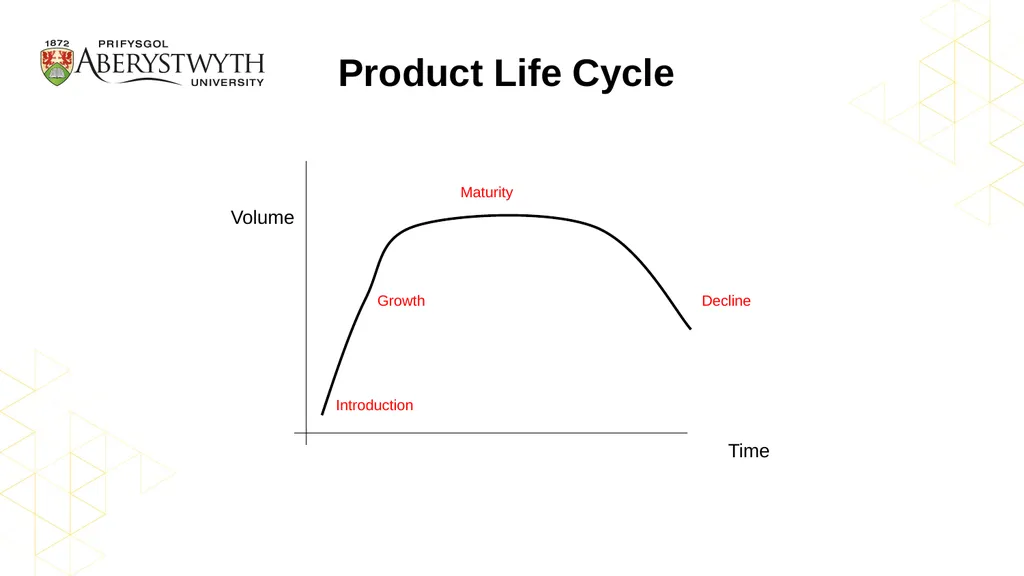
slide6. Product Life Cycle Time Volume Introduction Growth Maturity Decline<br>
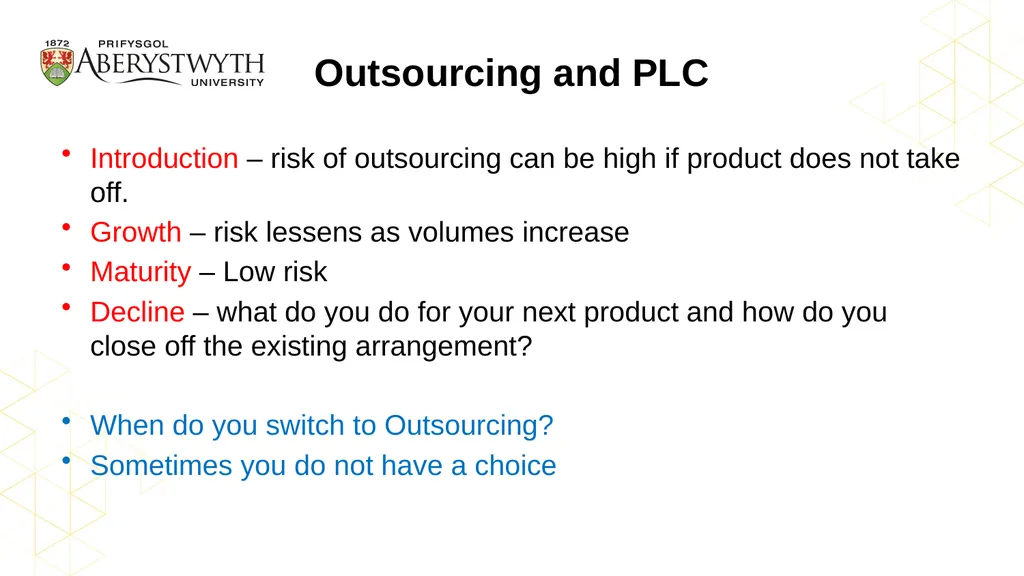
slide7. Outsourcing and PLC Introduction – risk of outsourcing can be high if product does not take off.
Growth – risk lessens as volumes increase
Maturity – Low risk
Decline – what do you do for your next product and how do you close off the existing arrangement?
When do you switch to Outsourcing?
Sometimes you do not have a choice<br>
slide8. Break-Even Analysis Break-Even Analysis
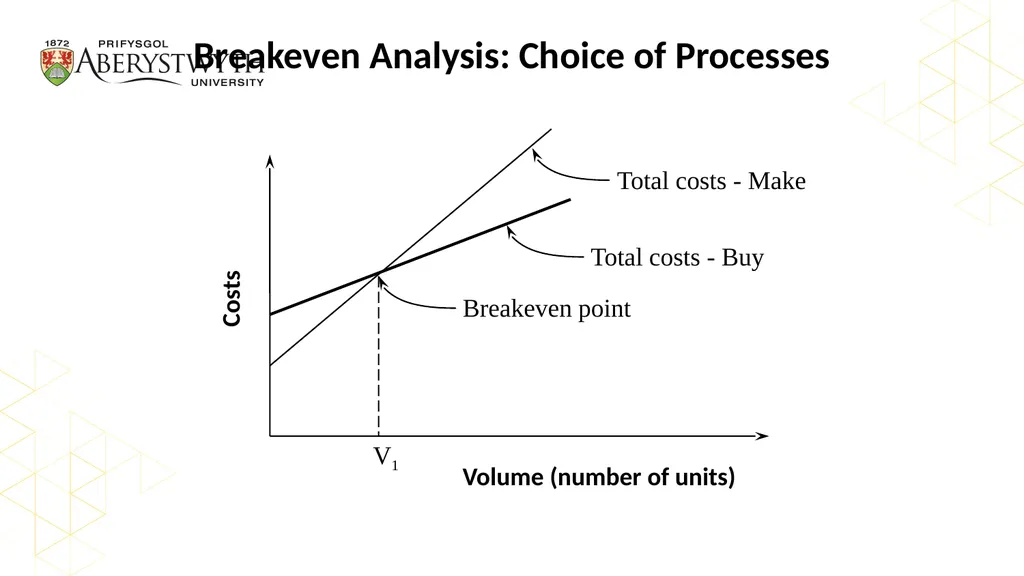
The volume where revenues equal total costs or costs associated with two alternative processes are the same.<br>
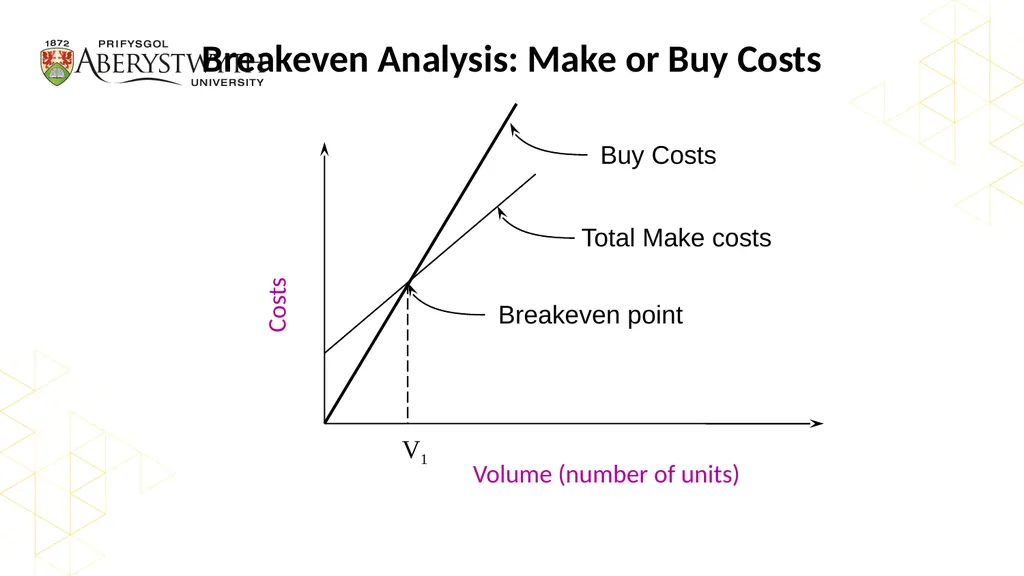
slide9. Break-Even Analysis Break-even analysis is used to compare processes by finding the volume at which two different processes have equal total costs.
Break-even point is the volume at which total revenues equal total costs.
Variable costs (vc) are costs that vary directly with the volume of output.
Fixed costs (Fc) are those costs that remain constant with changes in output level.<br>
slide10. Break-Even Analysis can tell you… If a forecasted volume is sufficient to break even (make or buy point)
How low variable cost per unit must be to break even given current prices and sales forecast.
How low the fixed cost need to be to break even.
How price levels affect the break-even volume.<br>
slide11. Types of Costs Fixed Costs
Variable Costs<br>
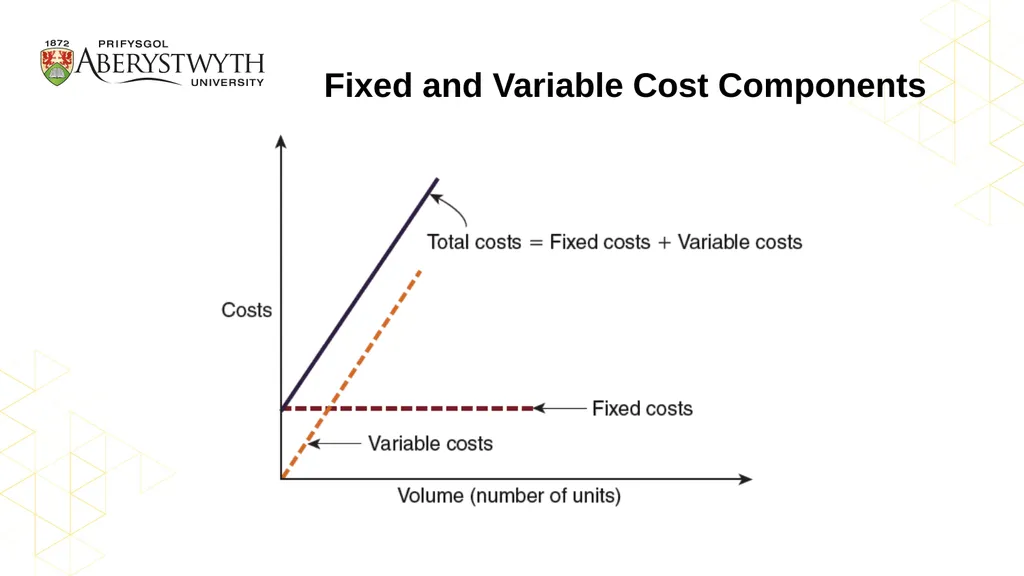
slide12. Cost Definitions Fixed Costs
Expenses such as rent that remain constant over a wide range of output volumes.
Variable Costs
Expenses such as material and direct labour that vary proportionately with changes in output.<br>
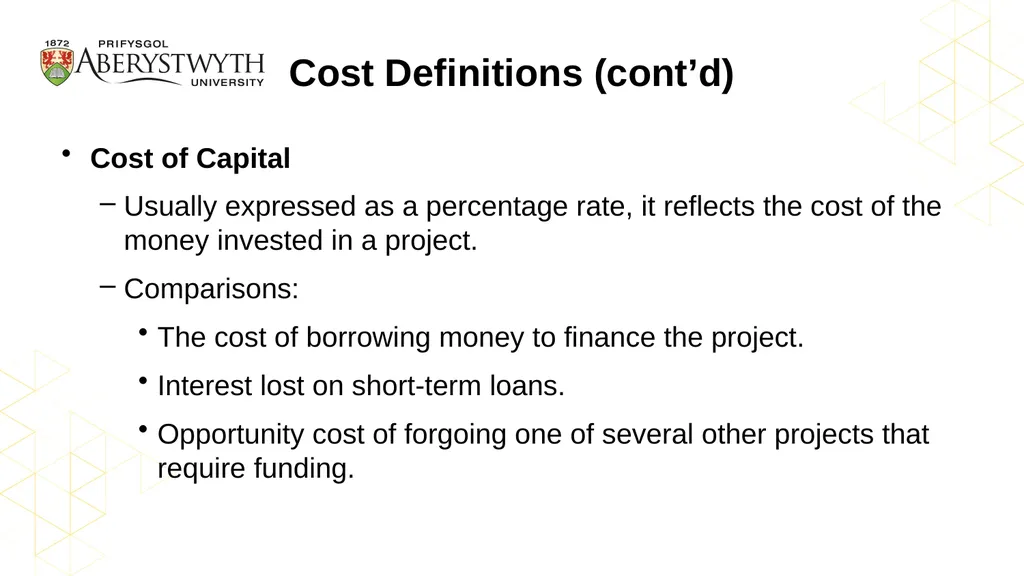
slide13. Cost Definitions (cont’d) Cost of Capital
Usually expressed as a percentage rate, it reflects the cost of the money invested in a project.
Comparisons:
The cost of borrowing money to finance the project.
Interest lost on short-term loans.
Opportunity cost of forgoing one of several other projects that require funding.<br>
slide14. Fixed and Variable Cost Components<br>
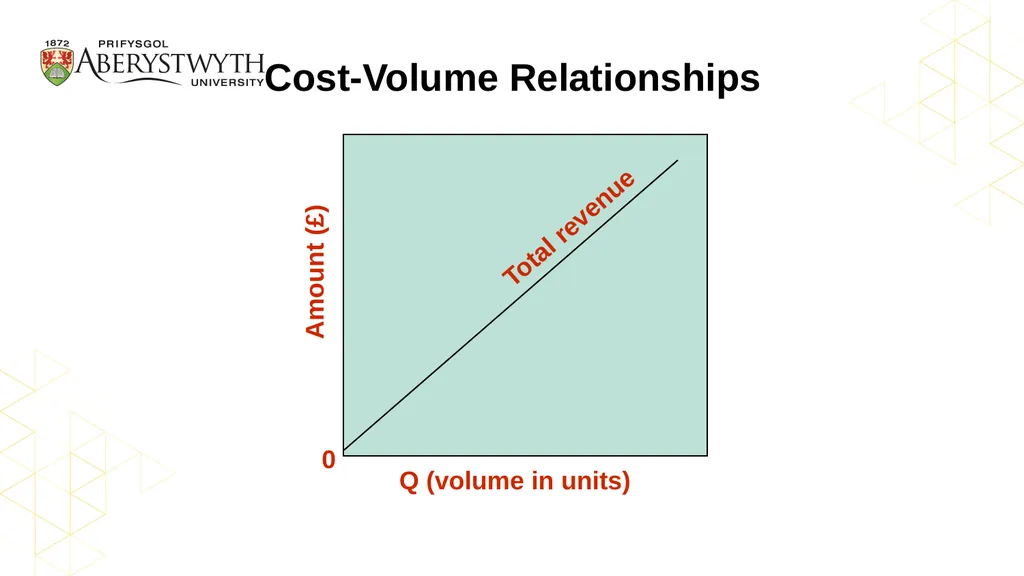
slide15. Cost-Volume Relationships<br>
slide16. Breakeven Analysis: Make or Buy Costs Costs Volume (number of units) Buy Costs Breakeven point Total Make costs V1 Supplement 3-5<br>
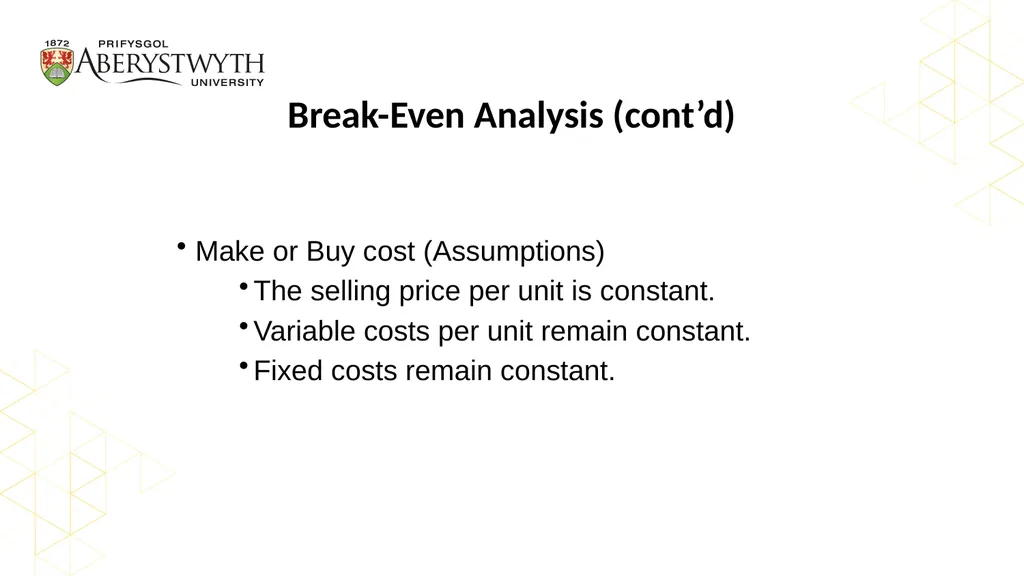
slide17. Break-Even Analysis (cont’d) Make or Buy cost (Assumptions)
The selling price per unit is constant.
Variable costs per unit remain constant.
Fixed costs remain constant.<br>
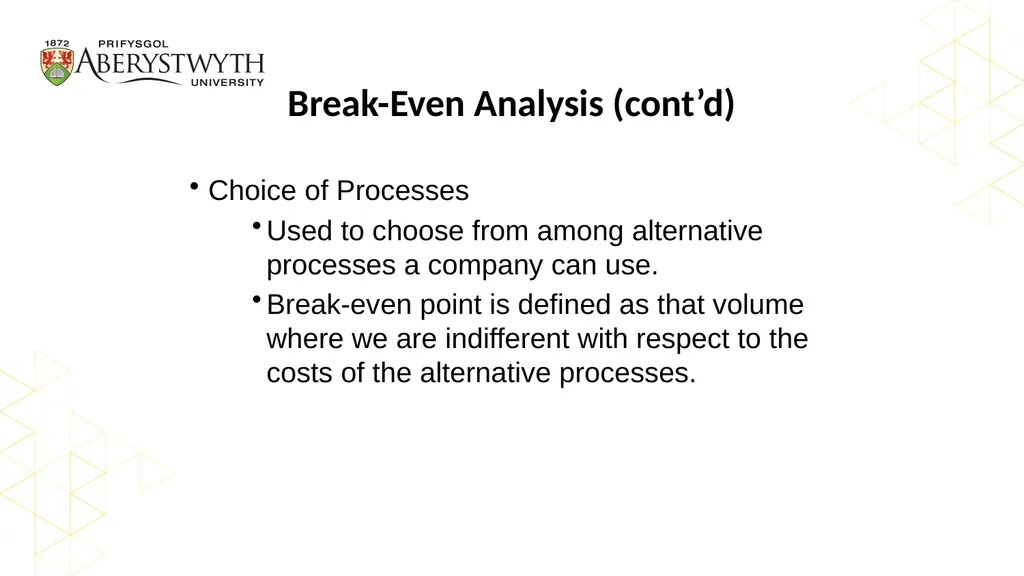
slide18. Break-Even Analysis (cont’d) Choice of Processes
Used to choose from among alternative processes a company can use.
Break-even point is defined as that volume where we are indifferent with respect to the costs of the alternative processes.<br>
slide19. Breakeven Analysis: Choice of Processes Costs Volume (number of units) Total costs - Make Breakeven point Total costs - Buy V1 Supplement 3-6<br>
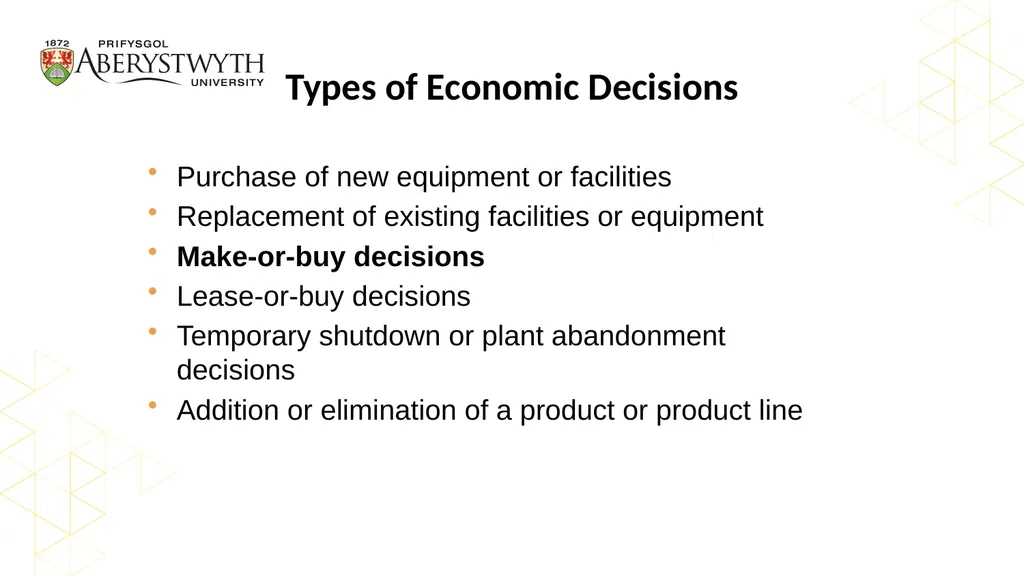
slide20. Types of Economic Decisions Purchase of new equipment or facilities
Replacement of existing facilities or equipment
Make-or-buy decisions
Lease-or-buy decisions
Temporary shutdown or plant abandonment decisions
Addition or elimination of a product or product line<br>
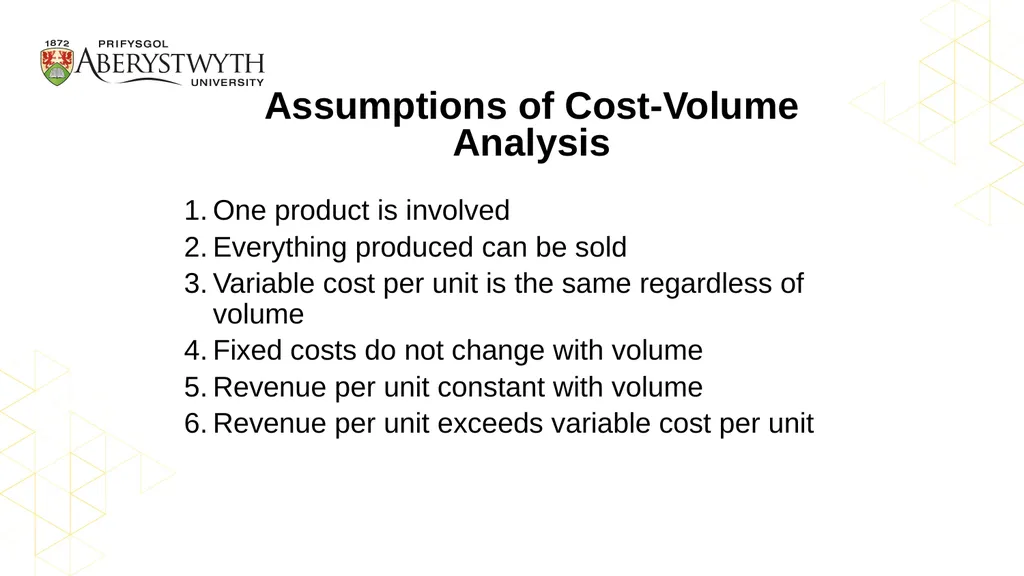
slide21. One product is involved
Everything produced can be sold
Variable cost per unit is the same regardless of volume
Fixed costs do not change with volume
Revenue per unit constant with volume
Revenue per unit exceeds variable cost per unit Assumptions of Cost-Volume Analysis<br>
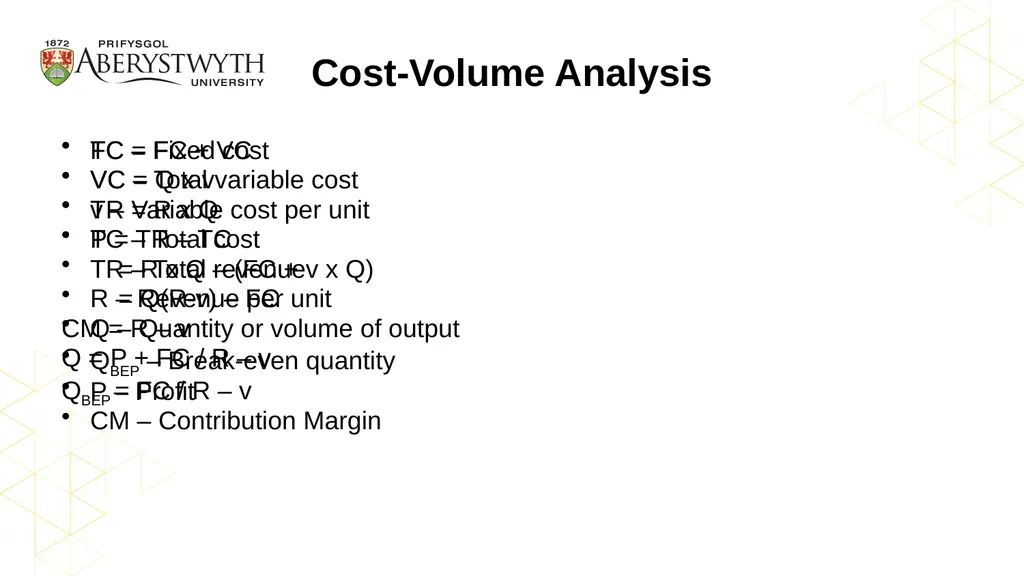
slide22. Cost-Volume Analysis FC – Fixed cost
VC – Total variable cost
v – Variable cost per unit
TC – Total cost
TR – Total revenue
R – Revenue per unit
Q – Quantity or volume of output
QBEP – Break-even quantity
P – Profit
CM – Contribution Margin TC = FC + VC
VC = Q x v
TR = R x Q
P = TR – TC
= R x Q – (FC + v x Q)
= Q(R-v) – FC
CM = R – v
Q = P + FC / R – v
QBEP = FC / R – v<br>
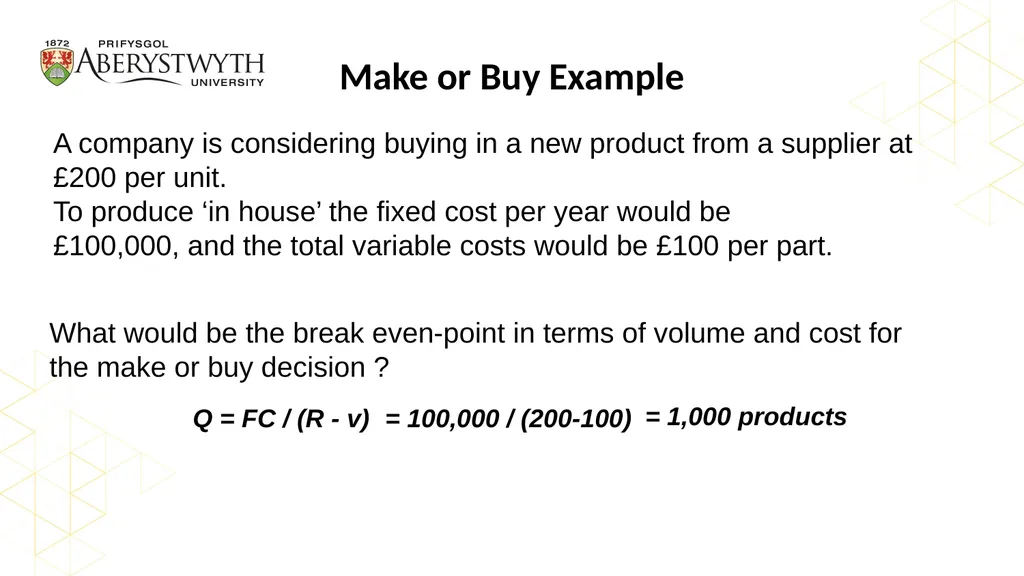
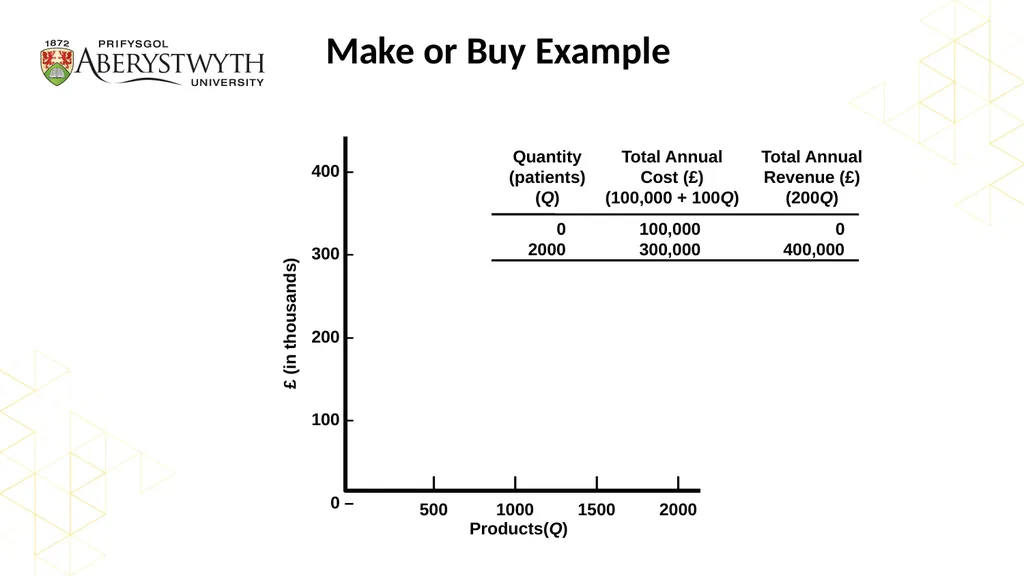
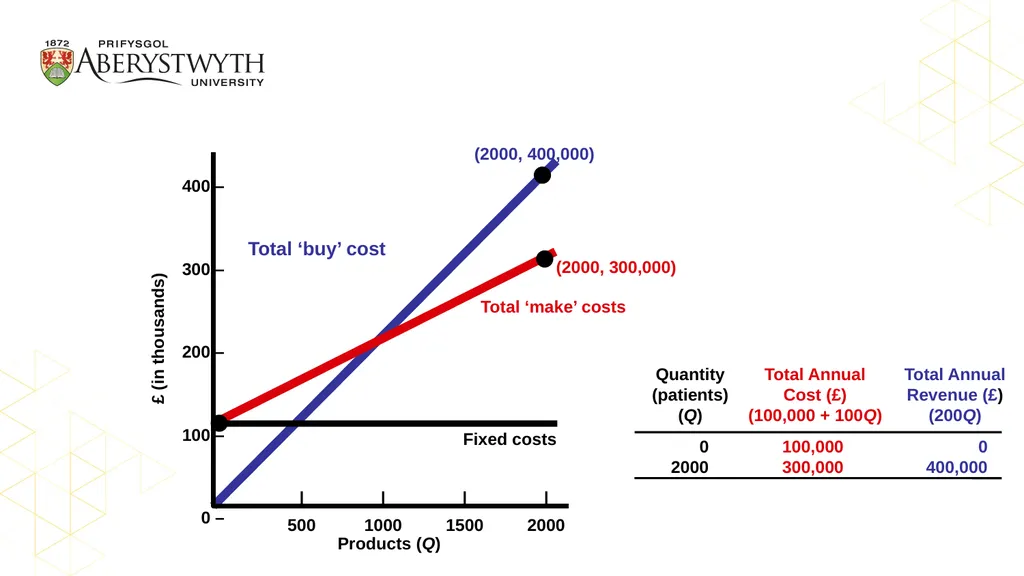
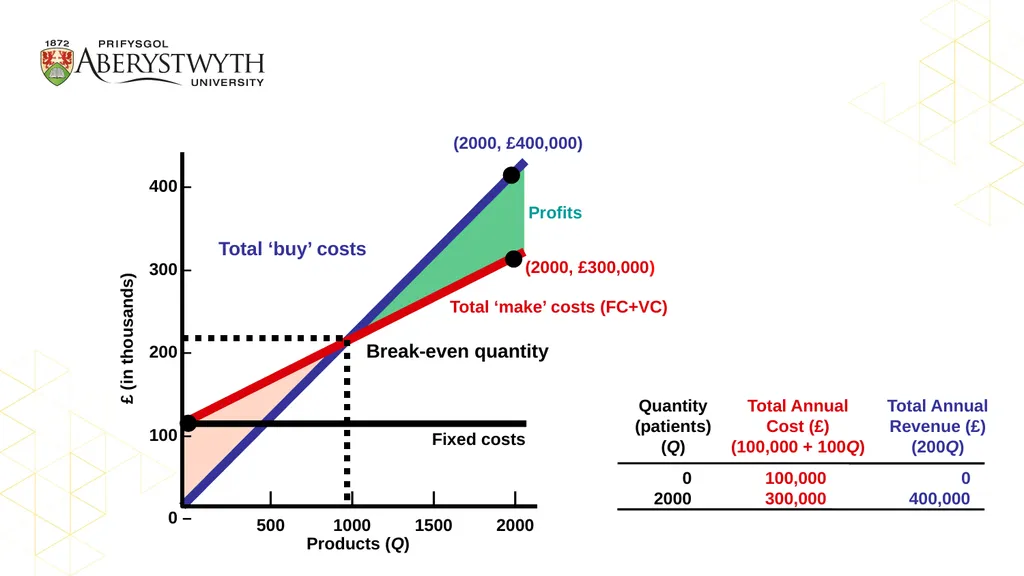
slide23. Make or Buy Example A company is considering buying in a new product from a supplier at £200 per unit.
To produce ‘in house’ the fixed cost per year would be
£100,000, and the total variable costs would be £100 per part. Q = FC / (R - v) = 100,000 / (200-100) = 1,000 products What would be the break even-point in terms of volume and cost for the make or buy decision ?<br>
slide24. 400 –
300 –
200 –
100 –
0 – Make or Buy Example<br>
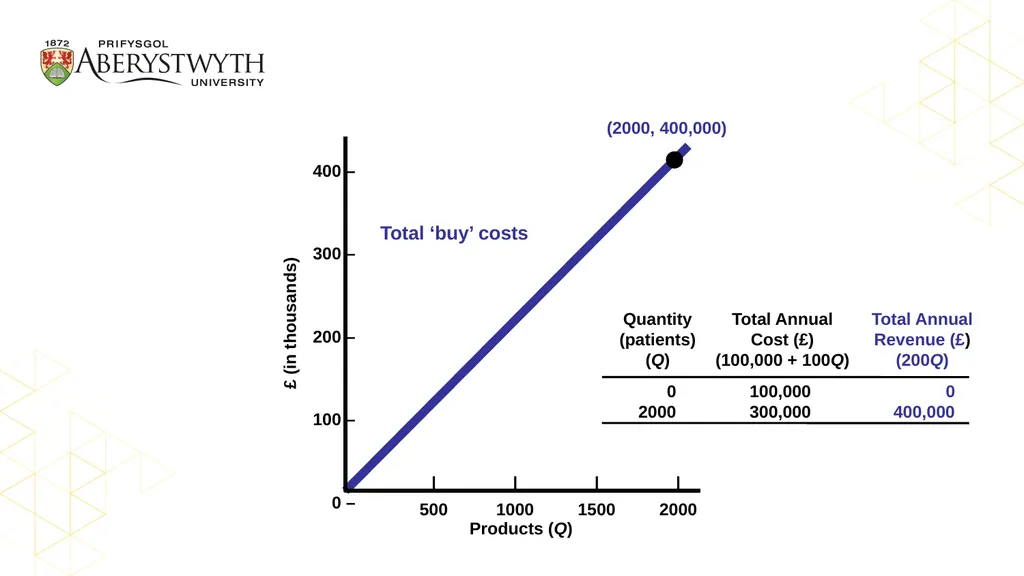
slide25. 400 –
300 –
200 –
100 –
0 – Total ‘buy’ costs<br>
slide26. Total ‘buy’ cost<br>
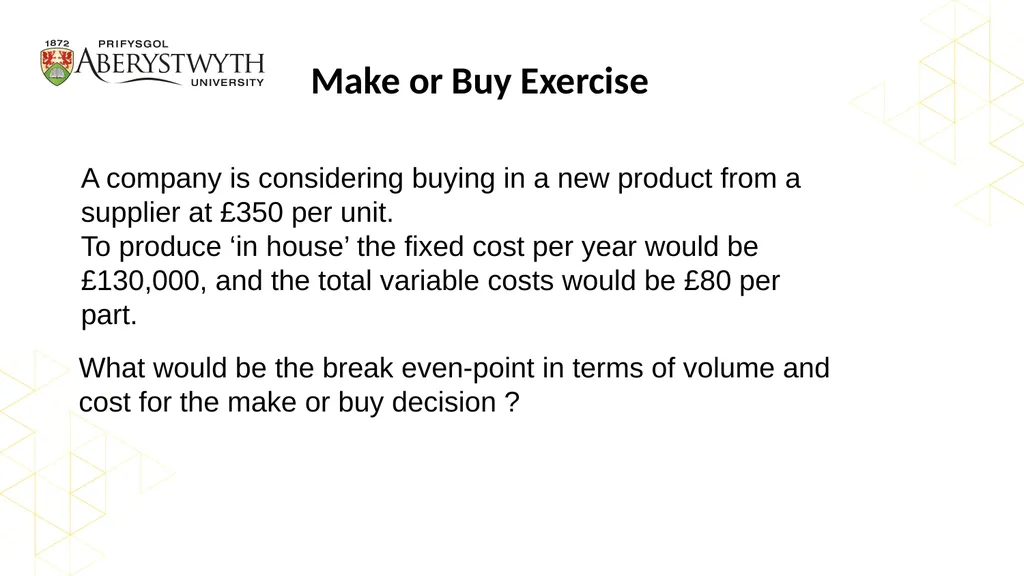
slide28. Make or Buy Exercise A company is considering buying in a new product from a supplier at £350 per unit.
To produce ‘in house’ the fixed cost per year would be
£130,000, and the total variable costs would be £80 per part. What would be the break even-point in terms of volume and cost for the make or buy decision ?<br>
slide29. Time to do Exercise 1(The answer is shown later in this slideshow so do not move forward until you have given the exercise a go)<br>
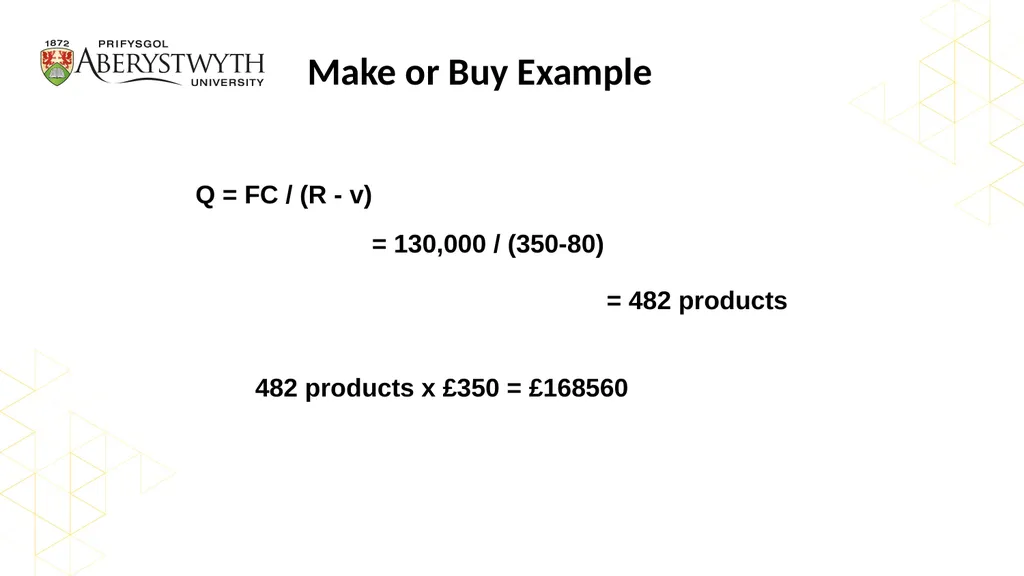
slide31. Make or Buy Example Q = FC / (R - v) = 130,000 / (350-80) = 482 products 482 products x £350 = £168560<br>
slide32. Time to do Exercise 2(The answer is shown later in this slideshow so do not move forward until you have given the exercise a go)<br>
slide34. Make or Buy Decisions Make In House
Cost considerations (less expensive to make the part)
Productive use of excess plant capacity to help absorb fixed overhead (using existing idle capacity)
Need to exert direct control over production and/or quality
Better quality control
Design secrecy is required to protect proprietary technology
Unreliable suppliers
No competent suppliers available
Desire to maintain a stable workforce (in periods of declining sales)
Quantity too small to interest a supplier
Control of lead time, transportation, and warehousing costs
Greater assurance of continual supply
Provision of a second source
Political, social or environmental reasons<br>
slide35. Make or Buy Decisions Buy in Part
Lack of expertise
Suppliers' research and specialized know-how exceeds that of the buyer
cost considerations (less expensive to buy the item)
Small-volume requirements
Limited production facilities or insufficient capacity
Desire to maintain a multiple-source policy
Indirect managerial control considerations
Procurement and inventory considerations
Brand preference
Item not essential to the firm's strategy<br>
slide36. Major Elements of ‘Make’ Decision
Incremental inventory-carrying costs
Direct labour costs
Incremental factory overhead costs
Delivered purchased material costs
Incremental managerial costs
Any follow-on costs stemming from quality and related problems
Incremental purchasing costs
Incremental capital costs Make or Buy Decisions<br>
slide37. Make or Buy Decisions Major Elements of ‘Buy’ Decision
Purchase price of the part
Transportation costs
Receiving and inspection costs
Incremental purchasing costs
Any follow-on costs related to quality or service<br>
slide38. Thank you for watching, now have a go at the multiple choice questions.If you have any questions then please contact me on ant42@aber.ac.uk<br>
slide39. Diolch | Thank you<br>
slide2. Objectives Introduce to outsourcing
Introduce various cost definitions and demonstrate how they are applied in outsourcing strategies.
Demonstrate how break-even analysis is used within an outsourcing context to determine outsourcing decisions .
Consider the non-financial issues associated with outsourcing strategies<br>
slide3. Outsourcing Strategy is a strategic decision making process where a company considers at what point it is more appropriate to make a product (or service) within their own company (in-house) or, whether it is better for another company to make the product (or service) for them. Outsourcing Strategy<br>
slide4. Business Value Chains Customer
Current and future needs Controls
Synchronise Demand with Supply Business
Value Adding processes – product excellence Suppliers
On-time, in full delivery Marketing Economics
&
Business Economics Finance
&
Business Finance Accounting
&
Business Accounting Demand Chain Supply Chain Business Management Financial Management Business Development Future Markets
Economic Trends
Politics Financial Backers
Infrastructure
Payback / RoI Budgets
Cost Control
Cost Effectiveness Product/services flow
Information Flow Branding
Voice of the customer
Customer of choice logistics logistics Operations Project Management
Procurement
Inventory Management
Forecasting Strategic Decisions
Where to make?
Competitors?
Who to buy from?
Who to sell to?
What if it goes wrong? Right quantity at the,
Right place in the,
Right time<br>
slide5. Outsourcing The outsourcing strategy will define the supply chain system and configuration.
Decisions can be based:
Financially
Qualitatively
Mixture of financial and qualitative analysis
Applying outsourcing can depend on position of product in product life cycle<br>
slide6. Product Life Cycle Time Volume Introduction Growth Maturity Decline<br>
slide7. Outsourcing and PLC Introduction – risk of outsourcing can be high if product does not take off.
Growth – risk lessens as volumes increase
Maturity – Low risk
Decline – what do you do for your next product and how do you close off the existing arrangement?
When do you switch to Outsourcing?
Sometimes you do not have a choice<br>
slide8. Break-Even Analysis Break-Even Analysis
The volume where revenues equal total costs or costs associated with two alternative processes are the same.<br>
slide9. Break-Even Analysis Break-even analysis is used to compare processes by finding the volume at which two different processes have equal total costs.
Break-even point is the volume at which total revenues equal total costs.
Variable costs (vc) are costs that vary directly with the volume of output.
Fixed costs (Fc) are those costs that remain constant with changes in output level.<br>
slide10. Break-Even Analysis can tell you… If a forecasted volume is sufficient to break even (make or buy point)
How low variable cost per unit must be to break even given current prices and sales forecast.
How low the fixed cost need to be to break even.
How price levels affect the break-even volume.<br>
slide11. Types of Costs Fixed Costs
Variable Costs<br>
slide12. Cost Definitions Fixed Costs
Expenses such as rent that remain constant over a wide range of output volumes.
Variable Costs
Expenses such as material and direct labour that vary proportionately with changes in output.<br>
slide13. Cost Definitions (cont’d) Cost of Capital
Usually expressed as a percentage rate, it reflects the cost of the money invested in a project.
Comparisons:
The cost of borrowing money to finance the project.
Interest lost on short-term loans.
Opportunity cost of forgoing one of several other projects that require funding.<br>
slide14. Fixed and Variable Cost Components<br>
slide15. Cost-Volume Relationships<br>
slide16. Breakeven Analysis: Make or Buy Costs Costs Volume (number of units) Buy Costs Breakeven point Total Make costs V1 Supplement 3-5<br>
slide17. Break-Even Analysis (cont’d) Make or Buy cost (Assumptions)
The selling price per unit is constant.
Variable costs per unit remain constant.
Fixed costs remain constant.<br>
slide18. Break-Even Analysis (cont’d) Choice of Processes
Used to choose from among alternative processes a company can use.
Break-even point is defined as that volume where we are indifferent with respect to the costs of the alternative processes.<br>
slide19. Breakeven Analysis: Choice of Processes Costs Volume (number of units) Total costs - Make Breakeven point Total costs - Buy V1 Supplement 3-6<br>
slide20. Types of Economic Decisions Purchase of new equipment or facilities
Replacement of existing facilities or equipment
Make-or-buy decisions
Lease-or-buy decisions
Temporary shutdown or plant abandonment decisions
Addition or elimination of a product or product line<br>
slide21. One product is involved
Everything produced can be sold
Variable cost per unit is the same regardless of volume
Fixed costs do not change with volume
Revenue per unit constant with volume
Revenue per unit exceeds variable cost per unit Assumptions of Cost-Volume Analysis<br>
slide22. Cost-Volume Analysis FC – Fixed cost
VC – Total variable cost
v – Variable cost per unit
TC – Total cost
TR – Total revenue
R – Revenue per unit
Q – Quantity or volume of output
QBEP – Break-even quantity
P – Profit
CM – Contribution Margin TC = FC + VC
VC = Q x v
TR = R x Q
P = TR – TC
= R x Q – (FC + v x Q)
= Q(R-v) – FC
CM = R – v
Q = P + FC / R – v
QBEP = FC / R – v<br>
slide23. Make or Buy Example A company is considering buying in a new product from a supplier at £200 per unit.
To produce ‘in house’ the fixed cost per year would be
£100,000, and the total variable costs would be £100 per part. Q = FC / (R - v) = 100,000 / (200-100) = 1,000 products What would be the break even-point in terms of volume and cost for the make or buy decision ?<br>
slide24. 400 –
300 –
200 –
100 –
0 – Make or Buy Example<br>
slide25. 400 –
300 –
200 –
100 –
0 – Total ‘buy’ costs<br>
slide26. Total ‘buy’ cost<br>
slide28. Make or Buy Exercise A company is considering buying in a new product from a supplier at £350 per unit.
To produce ‘in house’ the fixed cost per year would be
£130,000, and the total variable costs would be £80 per part. What would be the break even-point in terms of volume and cost for the make or buy decision ?<br>
slide29. Time to do Exercise 1(The answer is shown later in this slideshow so do not move forward until you have given the exercise a go)<br>
slide31. Make or Buy Example Q = FC / (R - v) = 130,000 / (350-80) = 482 products 482 products x £350 = £168560<br>
slide32. Time to do Exercise 2(The answer is shown later in this slideshow so do not move forward until you have given the exercise a go)<br>
slide34. Make or Buy Decisions Make In House
Cost considerations (less expensive to make the part)
Productive use of excess plant capacity to help absorb fixed overhead (using existing idle capacity)
Need to exert direct control over production and/or quality
Better quality control
Design secrecy is required to protect proprietary technology
Unreliable suppliers
No competent suppliers available
Desire to maintain a stable workforce (in periods of declining sales)
Quantity too small to interest a supplier
Control of lead time, transportation, and warehousing costs
Greater assurance of continual supply
Provision of a second source
Political, social or environmental reasons<br>
slide35. Make or Buy Decisions Buy in Part
Lack of expertise
Suppliers' research and specialized know-how exceeds that of the buyer
cost considerations (less expensive to buy the item)
Small-volume requirements
Limited production facilities or insufficient capacity
Desire to maintain a multiple-source policy
Indirect managerial control considerations
Procurement and inventory considerations
Brand preference
Item not essential to the firm's strategy<br>
slide36. Major Elements of ‘Make’ Decision
Incremental inventory-carrying costs
Direct labour costs
Incremental factory overhead costs
Delivered purchased material costs
Incremental managerial costs
Any follow-on costs stemming from quality and related problems
Incremental purchasing costs
Incremental capital costs Make or Buy Decisions<br>
slide37. Make or Buy Decisions Major Elements of ‘Buy’ Decision
Purchase price of the part
Transportation costs
Receiving and inspection costs
Incremental purchasing costs
Any follow-on costs related to quality or service<br>
slide38. Thank you for watching, now have a go at the multiple choice questions.If you have any questions then please contact me on ant42@aber.ac.uk<br>
slide39. Diolch | Thank you<br>