
An Introduction to Rust Programming Language
Description: An Introduction to Rust Programming Language Haozhong Zhang Jun 1, 2015 Acknowledgment Parts of contents in the following slides may use contents from following sources. Aaron Turon, The Rust Programming Language, Colloquium on Computer
Related Topics
Download Presentation
"An Introduction to Rust Programming Language" is the property of its rightful owner. Permission is granted to download and print the materials on this website for personal, non-commercial use only, and to display it on your personal computer provided you do not modify the materials and that you retain all copyright notices contained in the materials. By downloading content from our website, you accept the terms of this agreement.
Presentation Transcript
slide1. An Introduction
to
Rust Programming Language Haozhong Zhang
Jun 1, 2015<br>
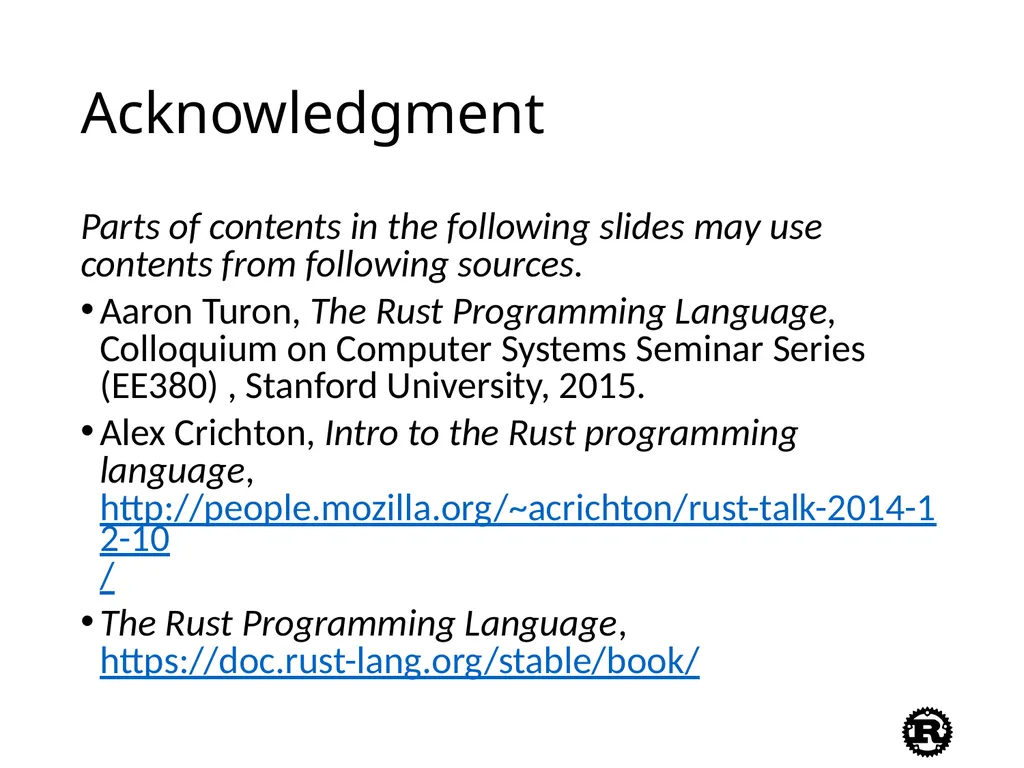
slide2. Acknowledgment Parts of contents in the following slides may use contents from following sources.
Aaron Turon, The Rust Programming Language, Colloquium on Computer Systems Seminar Series (EE380) , Stanford University, 2015.
Alex Crichton, Intro to the Rust programming language, http://people.mozilla.org/~acrichton/rust-talk-2014-12-10/
The Rust Programming Language, https://doc.rust-lang.org/stable/book/<br>
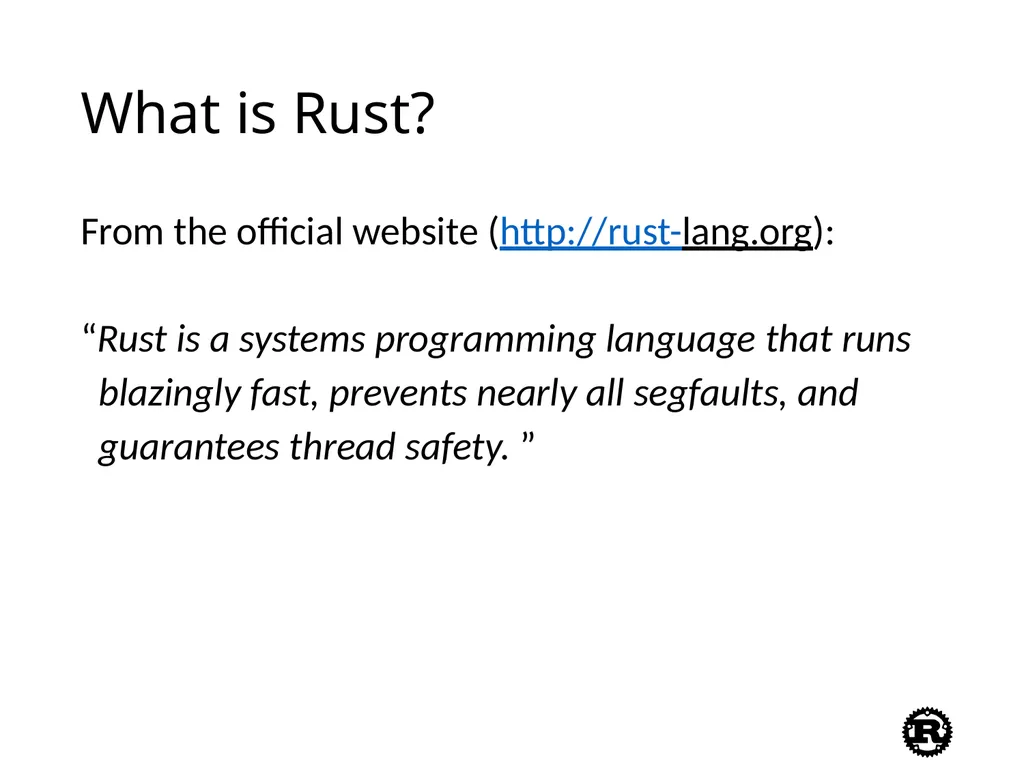
slide3. What is Rust? From the official website (http://rust-lang.org):
“Rust is a systems programming language that runs
blazingly fast, prevents nearly all segfaults, and
guarantees thread safety. ”<br>
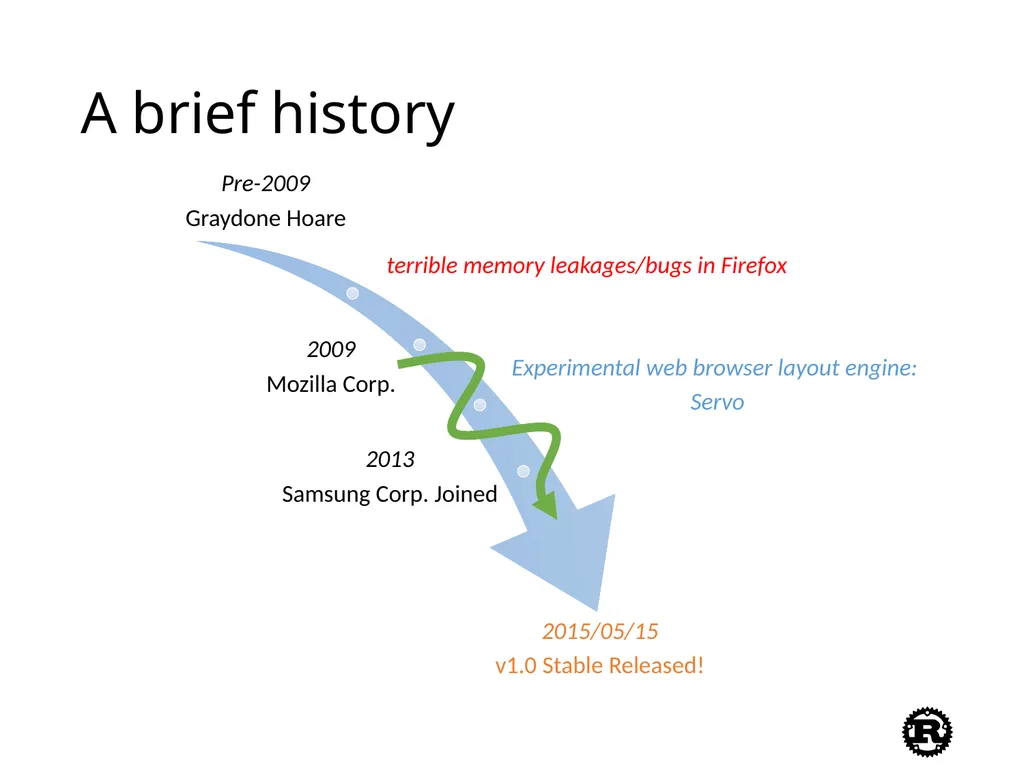
slide4. A brief history Pre-2009
Graydone Hoare terrible memory leakages/bugs in Firefox 2009
Mozilla Corp. Experimental web browser layout engine:
Servo 2013
Samsung Corp. Joined 2015/05/15
v1.0 Stable Released!<br>
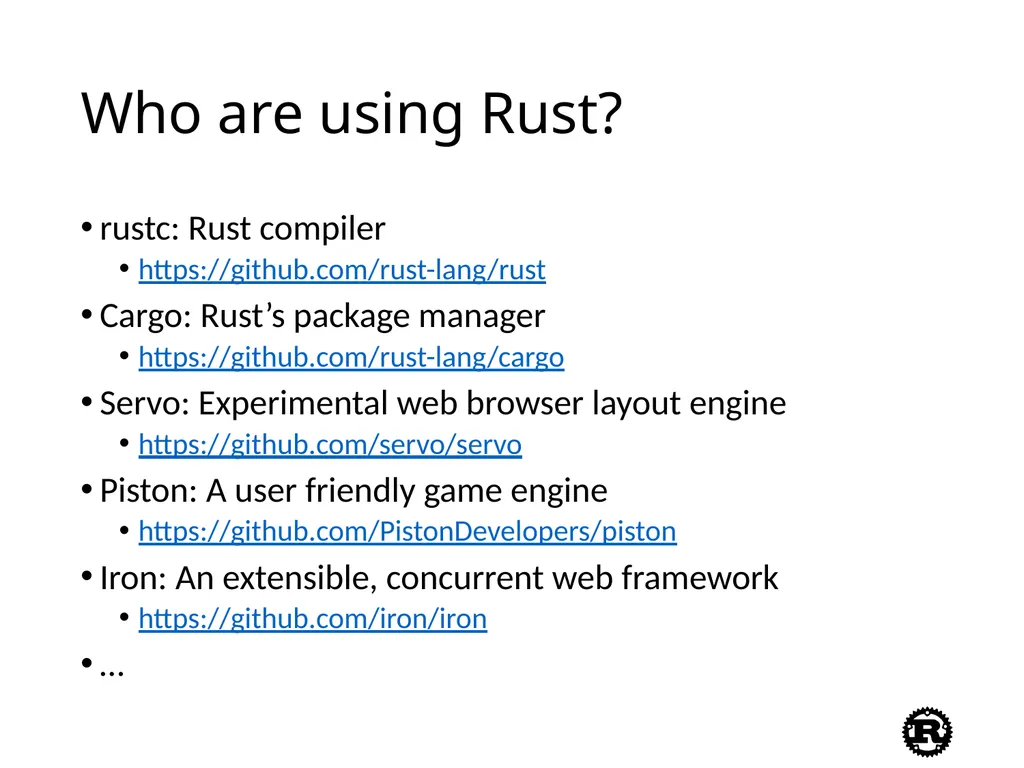
slide5. Who are using Rust? rustc: Rust compiler
https://github.com/rust-lang/rust
Cargo: Rust’s package manager
https://github.com/rust-lang/cargo
Servo: Experimental web browser layout engine
https://github.com/servo/servo
Piston: A user friendly game engine
https://github.com/PistonDevelopers/piston
Iron: An extensible, concurrent web framework
https://github.com/iron/iron
…<br>
slide6. Control & Safety Things make Rust Rust.<br>
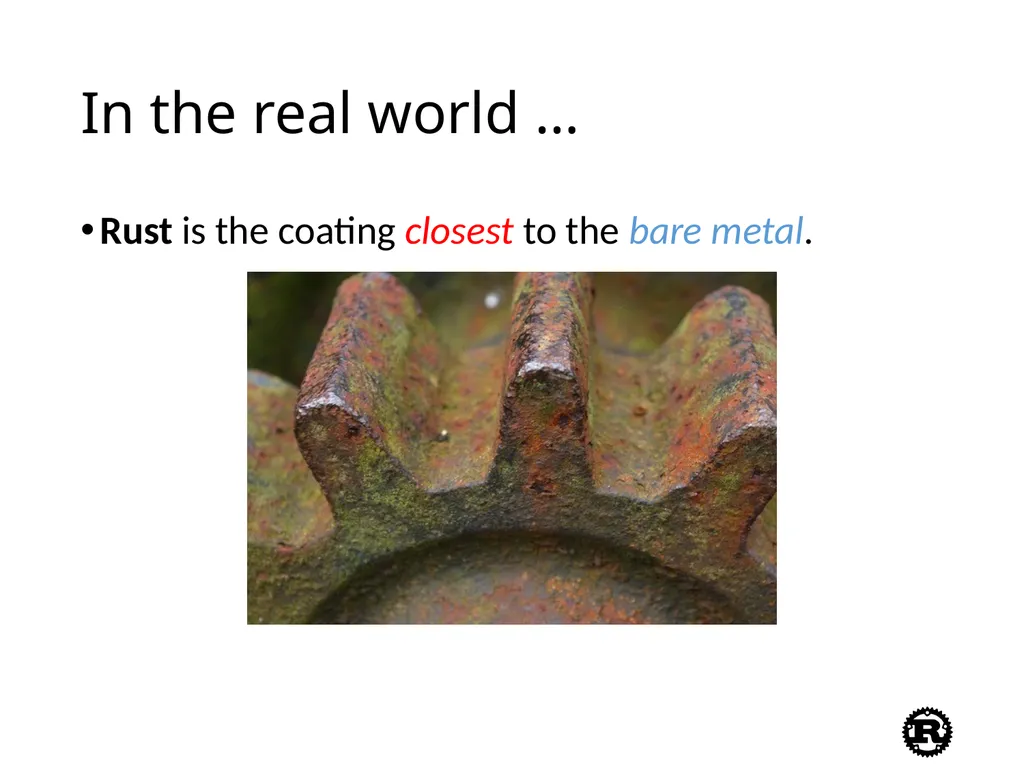
slide7. In the real world … Rust is the coating closest to the bare metal.<br>
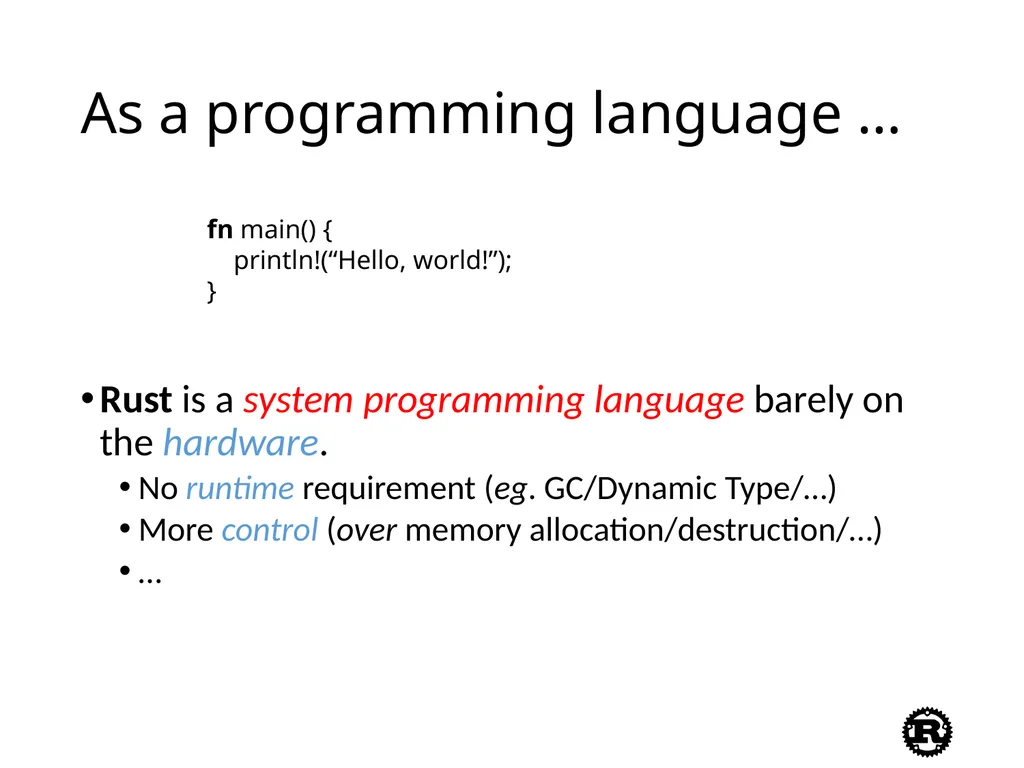
slide8. As a programming language … Rust is a system programming language barely on the hardware.
No runtime requirement (eg. GC/Dynamic Type/…)
More control (over memory allocation/destruction/…)
… fn main() {
println!(“Hello, world!”);
}<br>
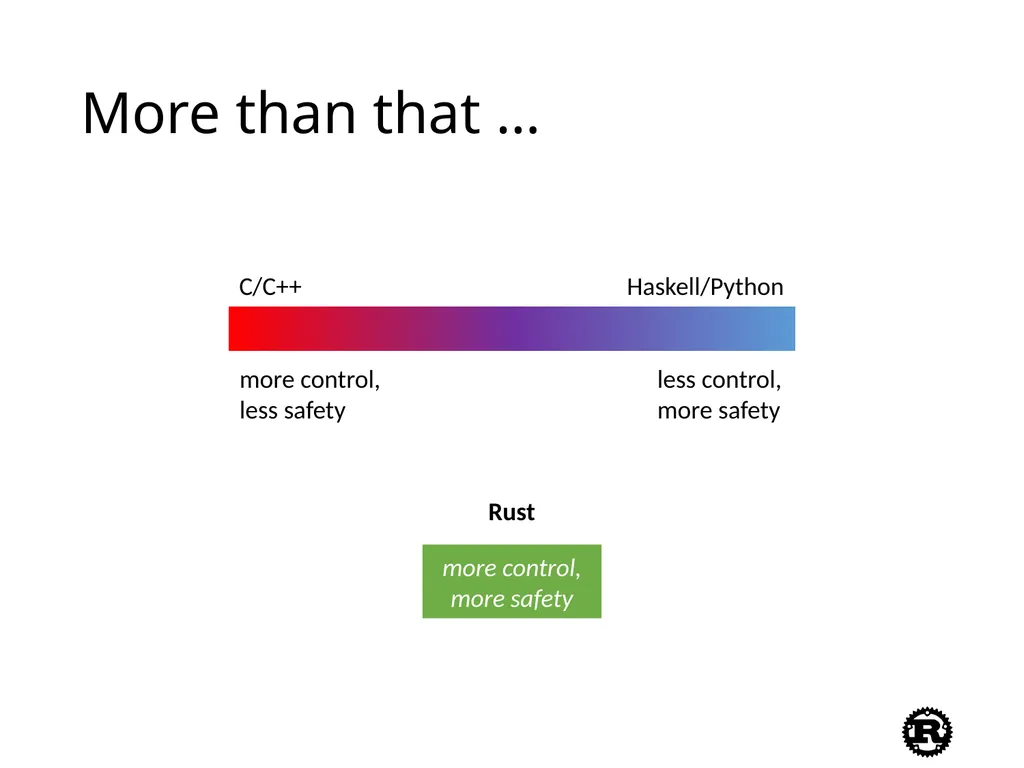
slide9. More than that … C/C++ more control,
less safety Haskell/Python less control,
more safety more control,
more safety Rust<br>
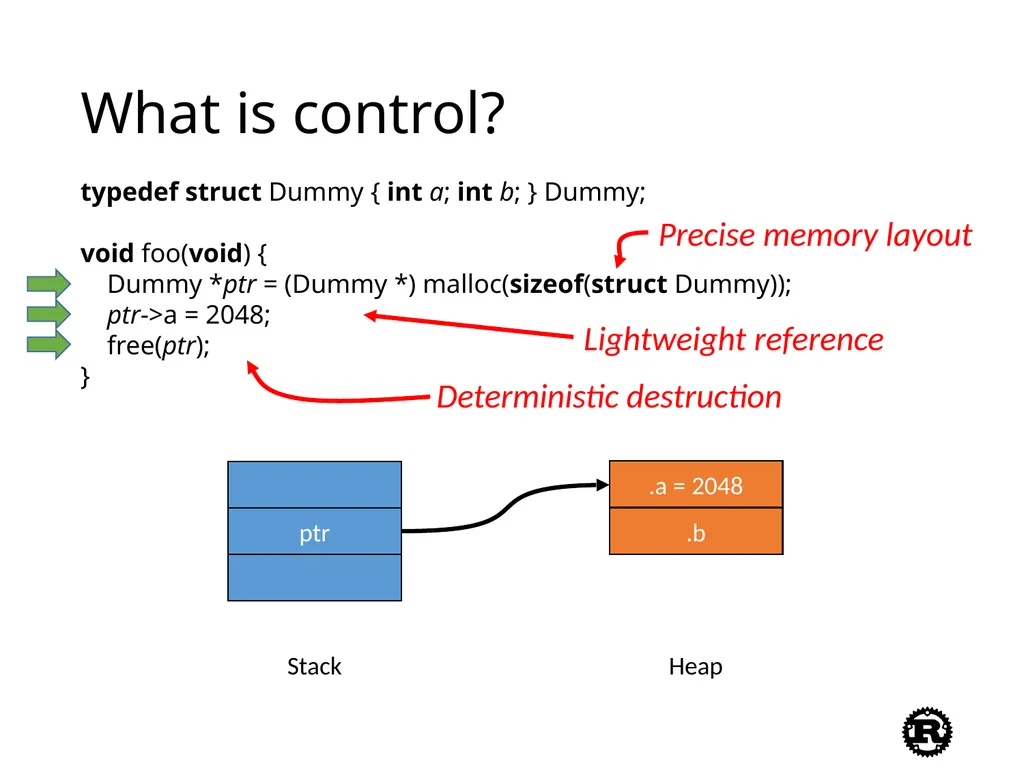
slide10. What is control? typedef struct Dummy { int a; int b; } Dummy;
void foo(void) {
Dummy *ptr = (Dummy *) malloc(sizeof(struct Dummy));
ptr->a = 2048;
free(ptr);
} ptr .a .b Stack Heap Precise memory layout Lightweight reference Deterministic destruction .a = 2048<br>
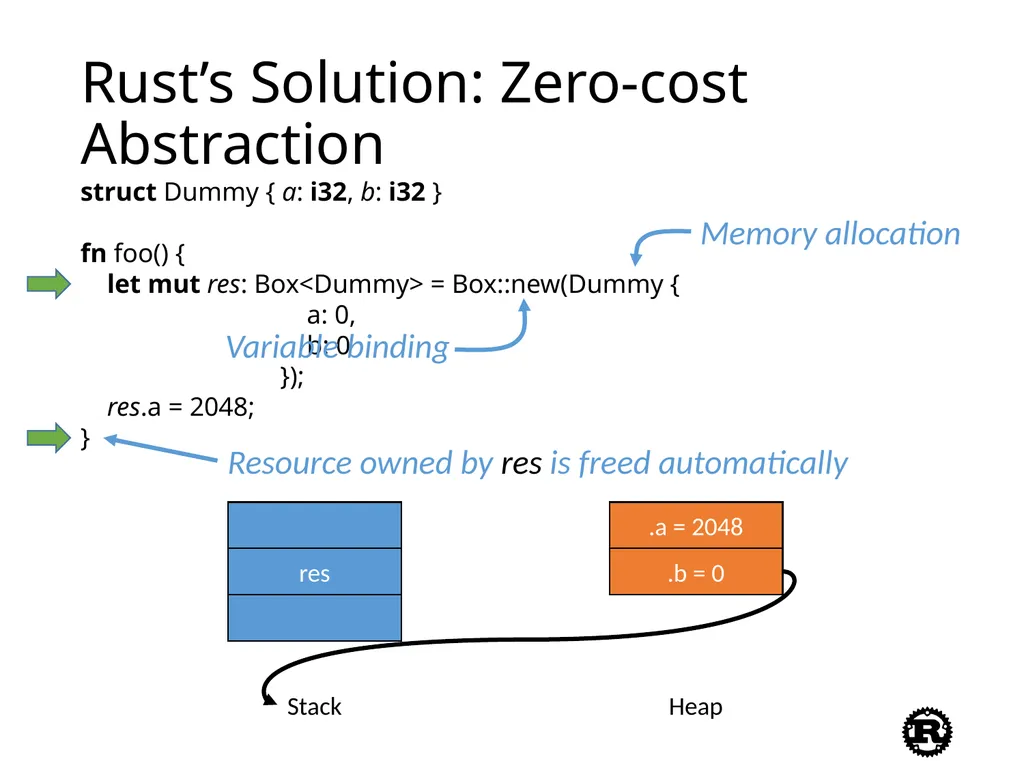
slide11. Rust’s Solution: Zero-cost Abstraction struct Dummy { a: i32, b: i32 }
fn foo() {
let mut res: Box<Dummy> = Box::new(Dummy {
a: 0,
b: 0
});
res.a = 2048;
} res .a = 0 .b = 0 Stack Heap .a = 2048 Variable binding Memory allocation Resource owned by res is freed automatically<br>
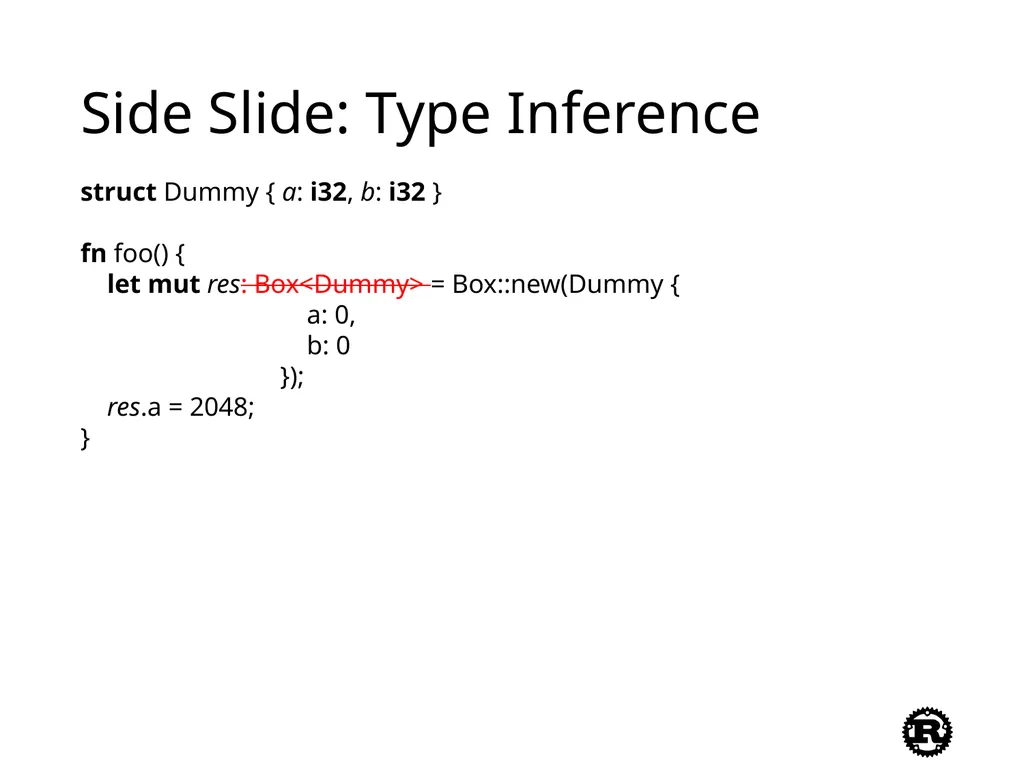
slide12. Side Slide: Type Inference struct Dummy { a: i32, b: i32 }
fn foo() {
let mut res: Box<Dummy> = Box::new(Dummy {
a: 0,
b: 0
});
res.a = 2048;
}<br>
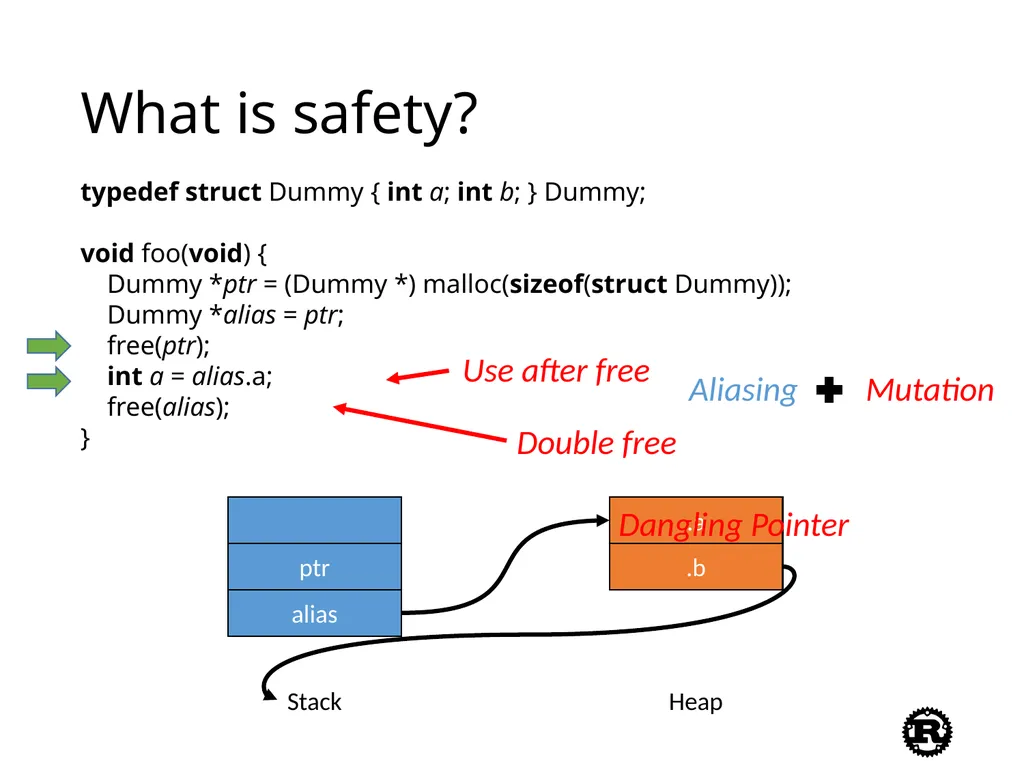
slide13. What is safety? typedef struct Dummy { int a; int b; } Dummy;
void foo(void) {
Dummy *ptr = (Dummy *) malloc(sizeof(struct Dummy));
Dummy *alias = ptr;
free(ptr);
int a = alias.a;
free(alias);
} ptr alias .a .b Stack Heap Dangling Pointer Use after free Double free Aliasing Mutation<br>
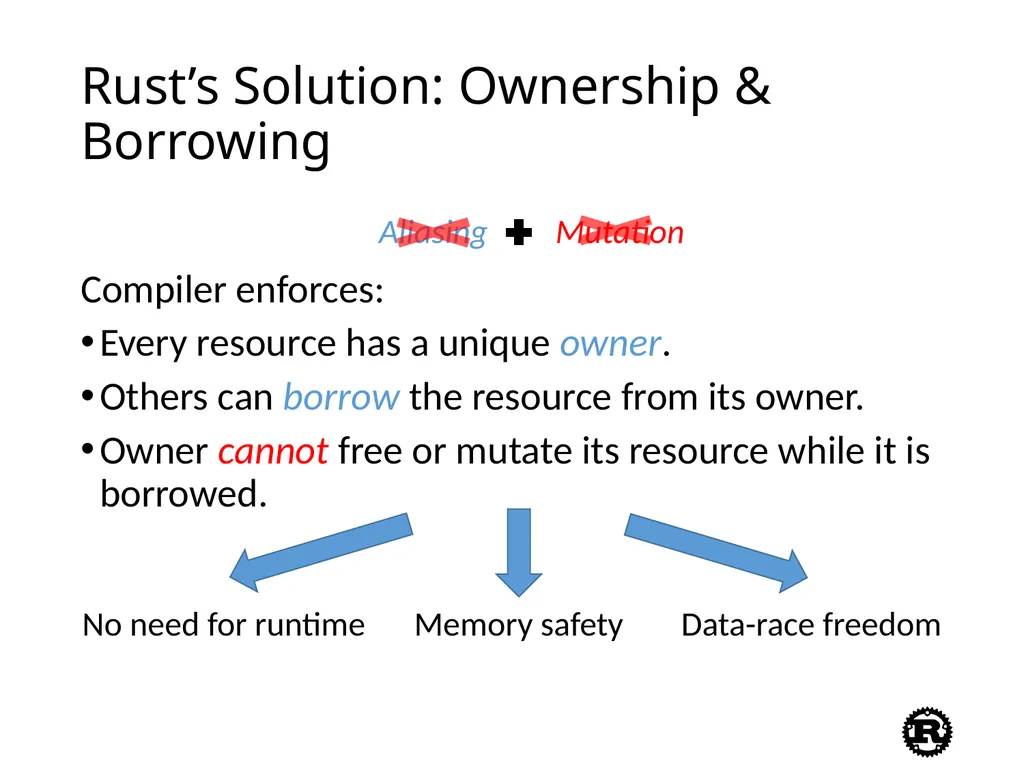
slide14. Rust’s Solution: Ownership & Borrowing Compiler enforces:
Every resource has a unique owner.
Others can borrow the resource from its owner.
Owner cannot free or mutate its resource while it is borrowed. Aliasing Mutation No need for runtime Memory safety Data-race freedom<br>
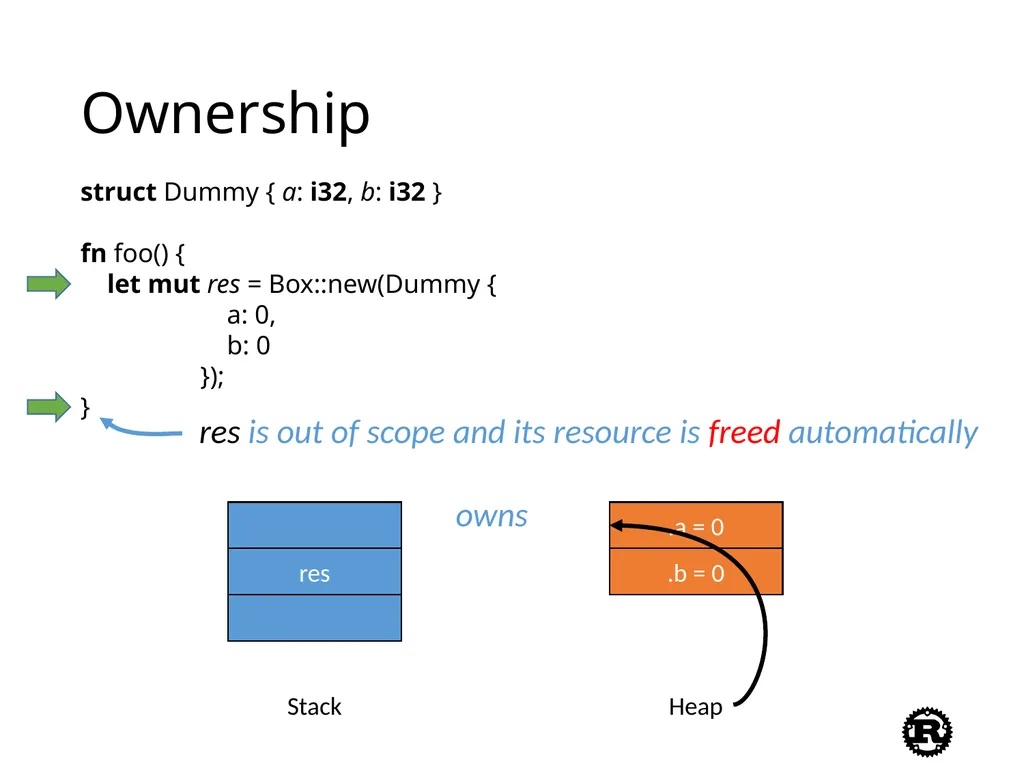
slide15. Ownership struct Dummy { a: i32, b: i32 }
fn foo() {
let mut res = Box::new(Dummy {
a: 0,
b: 0
});
} res .a = 0 .b = 0 Stack Heap owns res is out of scope and its resource is freed automatically<br>
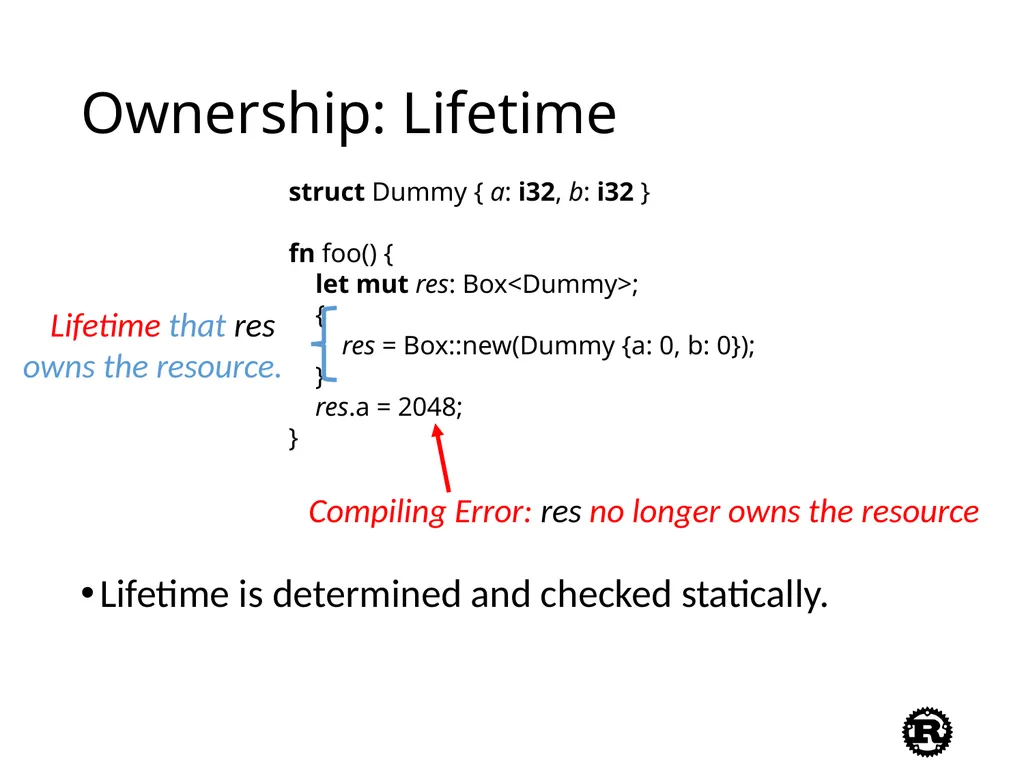
slide16. Ownership: Lifetime Lifetime is determined and checked statically. struct Dummy { a: i32, b: i32 }
fn foo() {
let mut res: Box<Dummy>;
{
res = Box::new(Dummy {a: 0, b: 0});
}
res.a = 2048;
} Lifetime that res
owns the resource. Compiling Error: res no longer owns the resource<br>
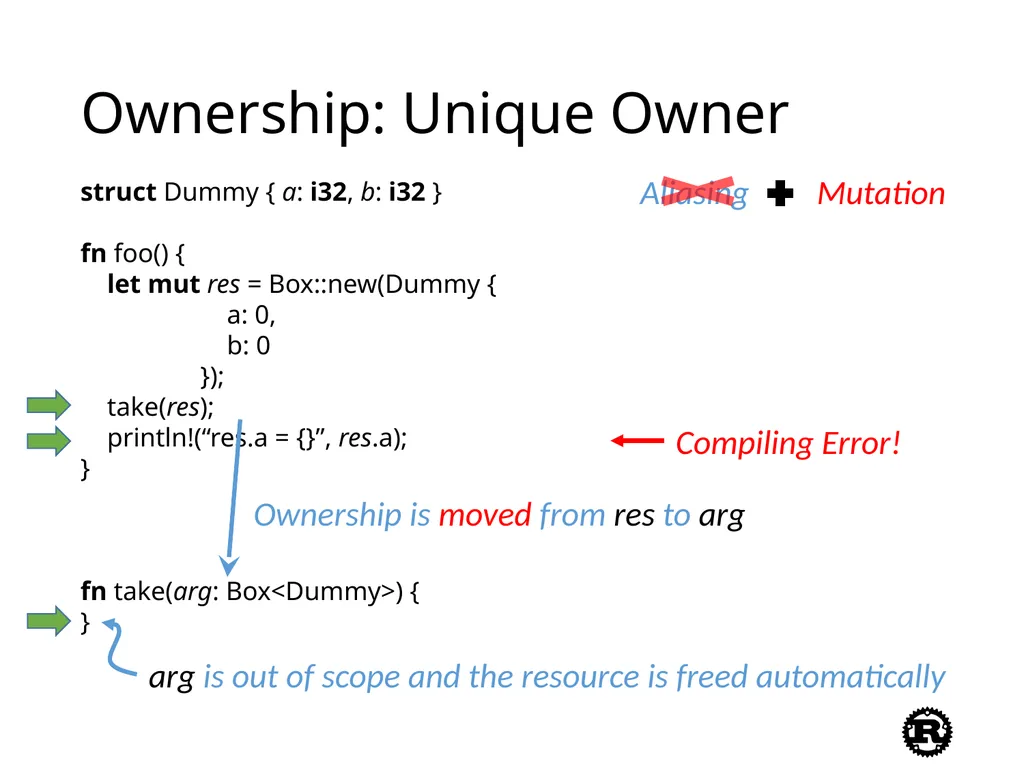
slide17. Ownership: Unique Owner struct Dummy { a: i32, b: i32 }
fn foo() {
let mut res = Box::new(Dummy {
a: 0,
b: 0
});
take(res);
println!(“res.a = {}”, res.a);
}
fn take(arg: Box<Dummy>) {
} Ownership is moved from res to arg arg is out of scope and the resource is freed automatically Compiling Error! Aliasing Mutation<br>
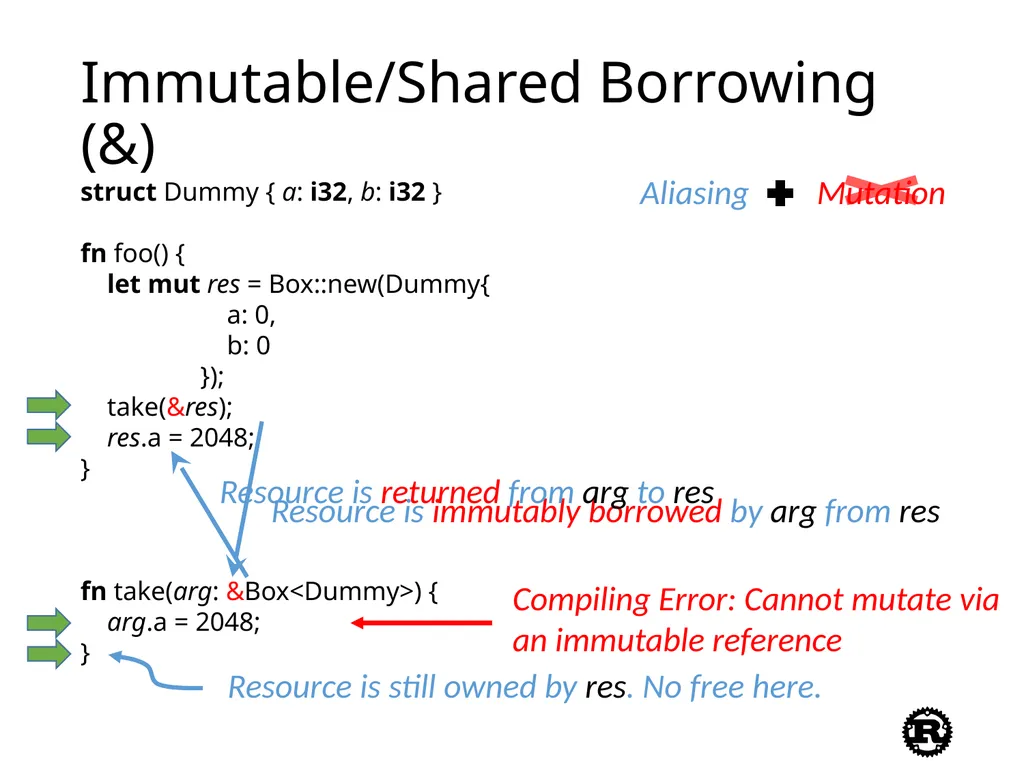
slide18. Immutable/Shared Borrowing (&) struct Dummy { a: i32, b: i32 }
fn foo() {
let mut res = Box::new(Dummy{
a: 0,
b: 0
});
take(&res);
res.a = 2048;
}
fn take(arg: &Box<Dummy>) {
arg.a = 2048;
} Resource is immutably borrowed by arg from res Resource is still owned by res. No free here. Resource is returned from arg to res Aliasing Mutation Compiling Error: Cannot mutate via
an immutable reference<br>
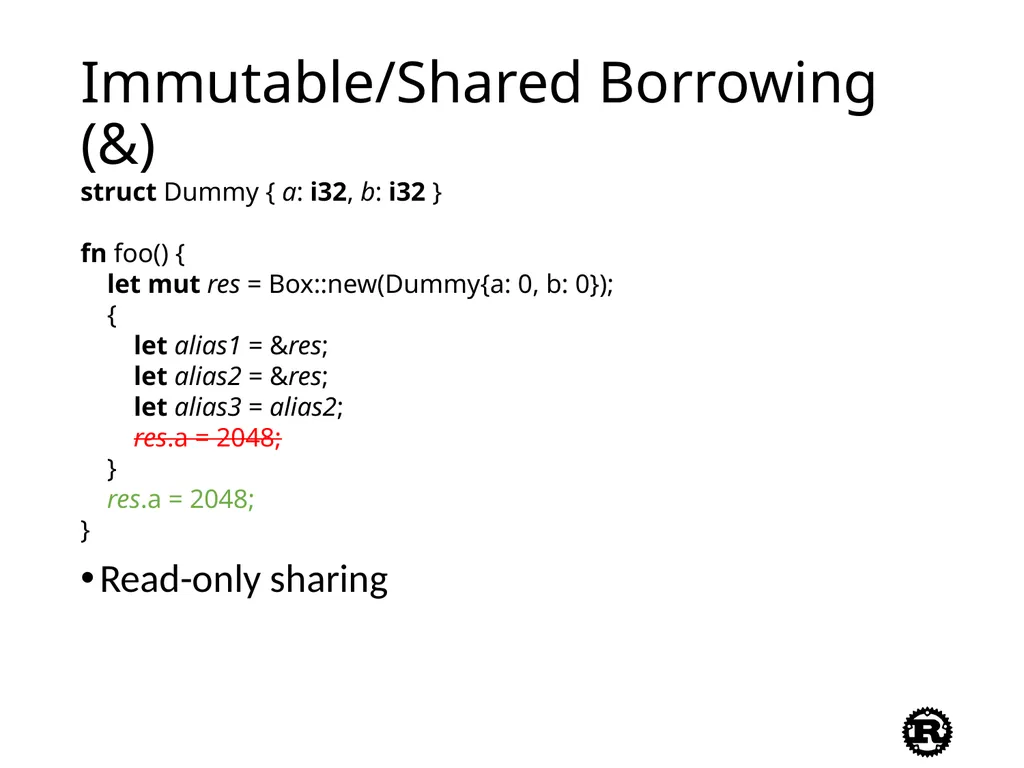
slide19. Immutable/Shared Borrowing (&) Read-only sharing struct Dummy { a: i32, b: i32 }
fn foo() {
let mut res = Box::new(Dummy{a: 0, b: 0});
{
let alias1 = &res;
let alias2 = &res;
let alias3 = alias2;
res.a = 2048;
}
res.a = 2048;
}<br>
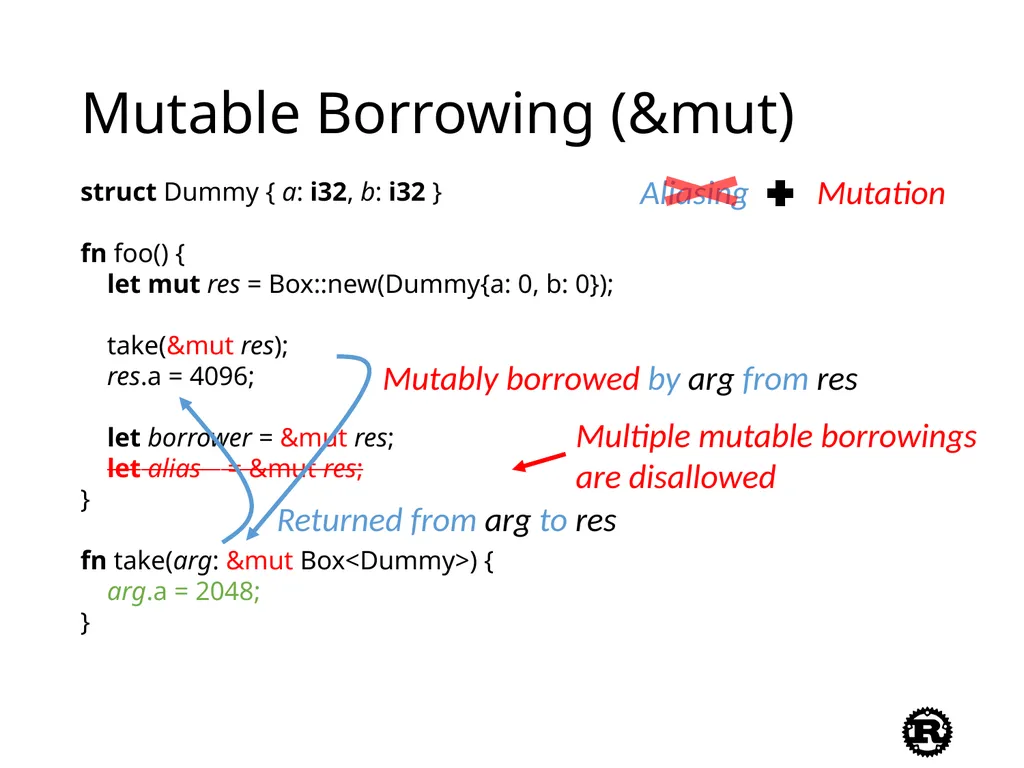
slide20. Mutable Borrowing (&mut) Aliasing Mutation struct Dummy { a: i32, b: i32 }
fn foo() {
let mut res = Box::new(Dummy{a: 0, b: 0});
take(&mut res);
res.a = 4096;
let borrower = &mut res;
let alias = &mut res;
}
fn take(arg: &mut Box<Dummy>) {
arg.a = 2048;
} Mutably borrowed by arg from res Returned from arg to res Multiple mutable borrowings
are disallowed<br>
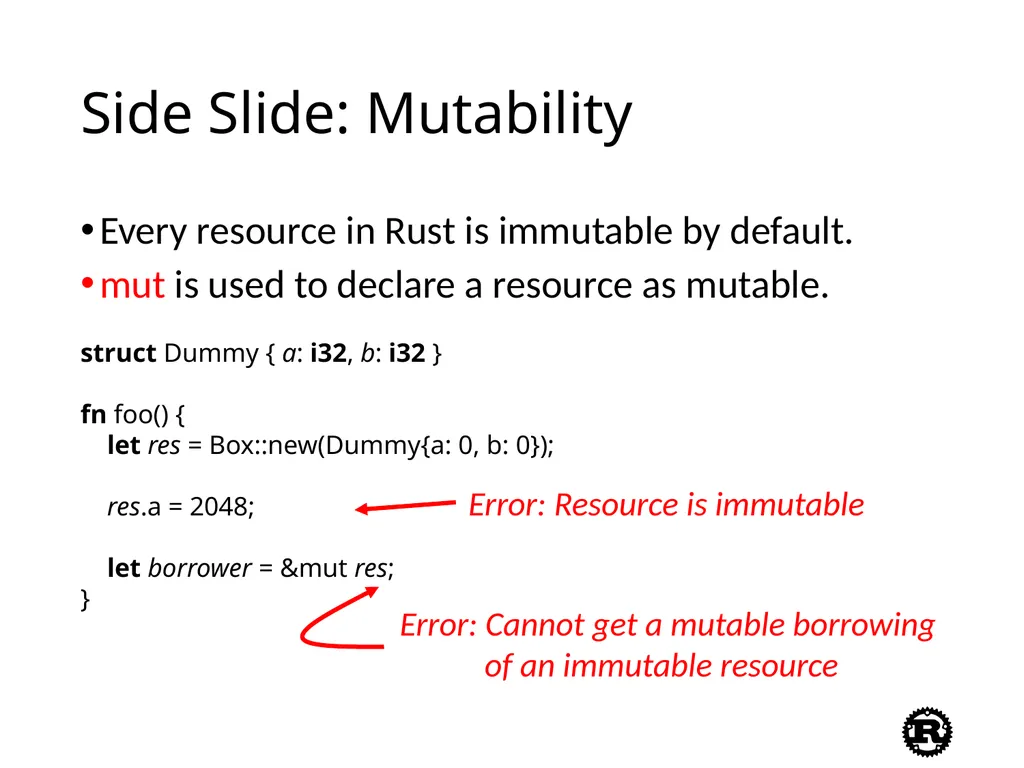
slide21. Side Slide: Mutability Every resource in Rust is immutable by default.
mut is used to declare a resource as mutable. struct Dummy { a: i32, b: i32 }
fn foo() {
let res = Box::new(Dummy{a: 0, b: 0});
res.a = 2048;
let borrower = &mut res;
} Error: Resource is immutable Error: Cannot get a mutable borrowing
of an immutable resource<br>
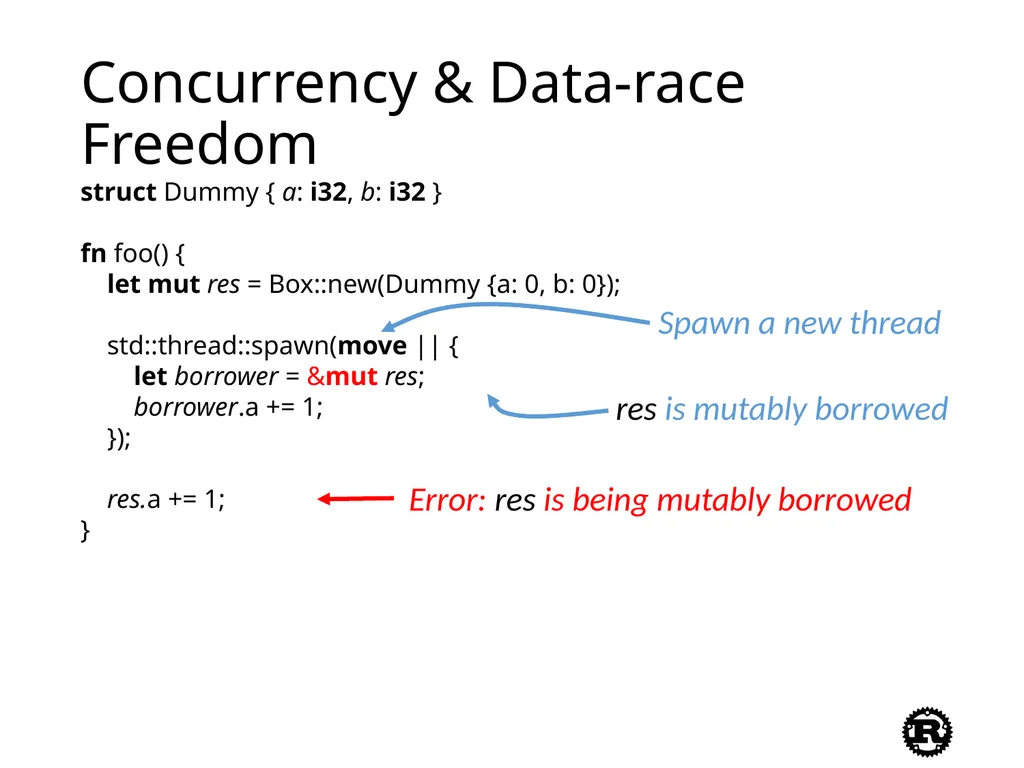
slide22. Concurrency & Data-race Freedom struct Dummy { a: i32, b: i32 }
fn foo() {
let mut res = Box::new(Dummy {a: 0, b: 0});
std::thread::spawn(move || {
let borrower = &mut res;
borrower.a += 1;
});
res.a += 1;
} Error: res is being mutably borrowed res is mutably borrowed Spawn a new thread<br>
slide23. Unsafe Life is hard.<br>
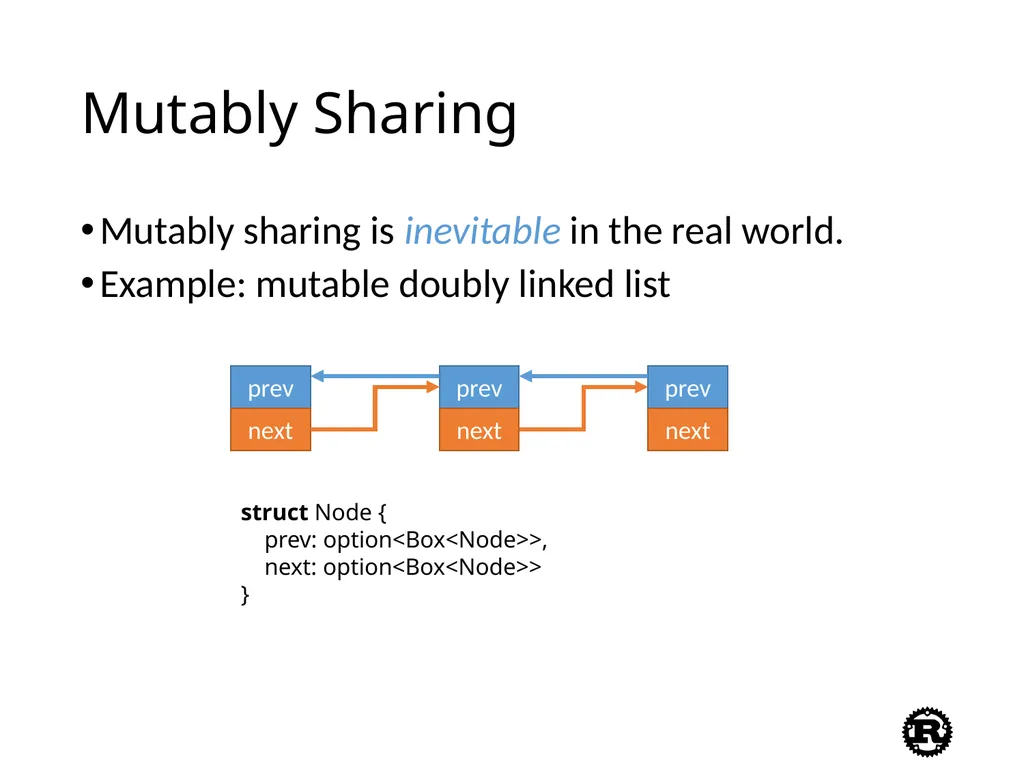
slide24. Mutably Sharing Mutably sharing is inevitable in the real world.
Example: mutable doubly linked list prev next prev next prev next struct Node {
prev: option<Box<Node>>,
next: option<Box<Node>>
}<br>
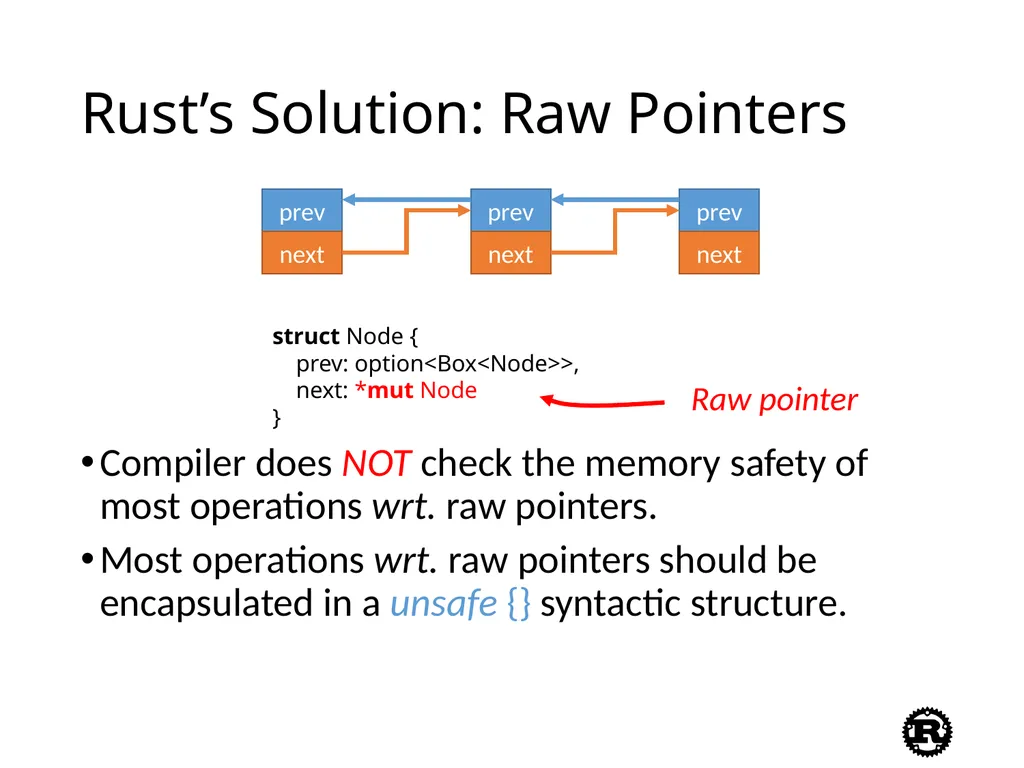
slide25. Rust’s Solution: Raw Pointers Compiler does NOT check the memory safety of most operations wrt. raw pointers.
Most operations wrt. raw pointers should be encapsulated in a unsafe {} syntactic structure. prev next prev next prev next struct Node {
prev: option<Box<Node>>,
next: *mut Node
} Raw pointer<br>
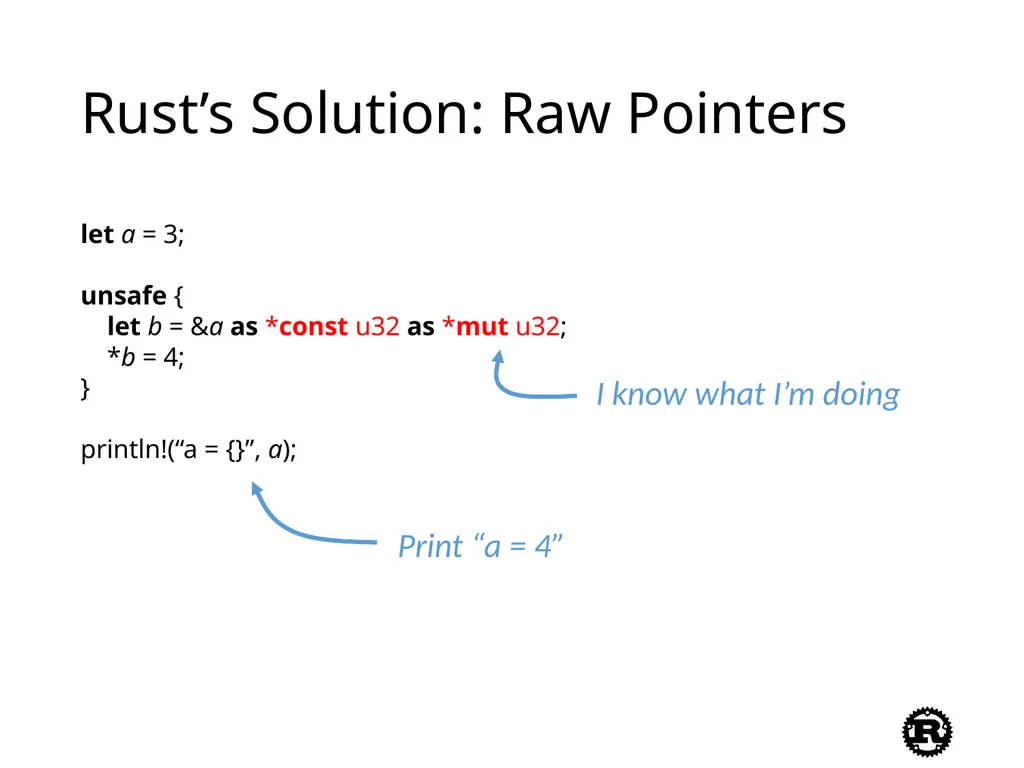
slide26. Rust’s Solution: Raw Pointers let a = 3;
unsafe {
let b = &a as *const u32 as *mut u32;
*b = 4;
}
println!(“a = {}”, a); I know what I’m doing Print “a = 4”<br>
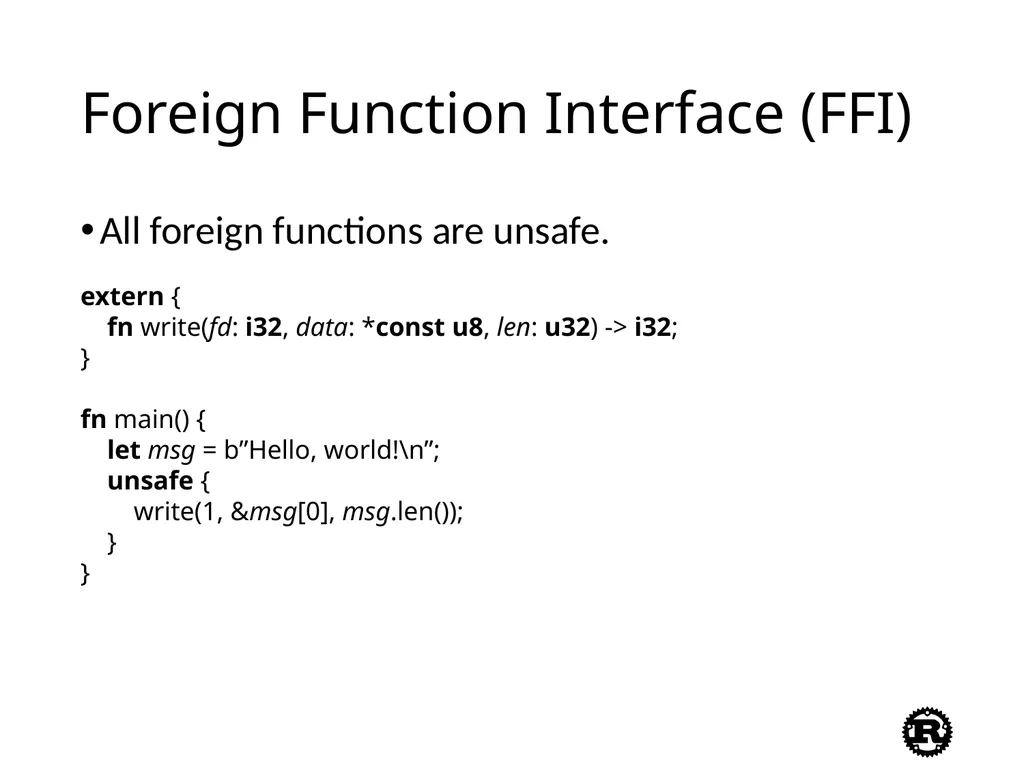
slide27. Foreign Function Interface (FFI) All foreign functions are unsafe. extern {
fn write(fd: i32, data: *const u8, len: u32) -> i32;
}
fn main() {
let msg = b”Hello, world!\n”;
unsafe {
write(1, &msg[0], msg.len());
}
}<br>
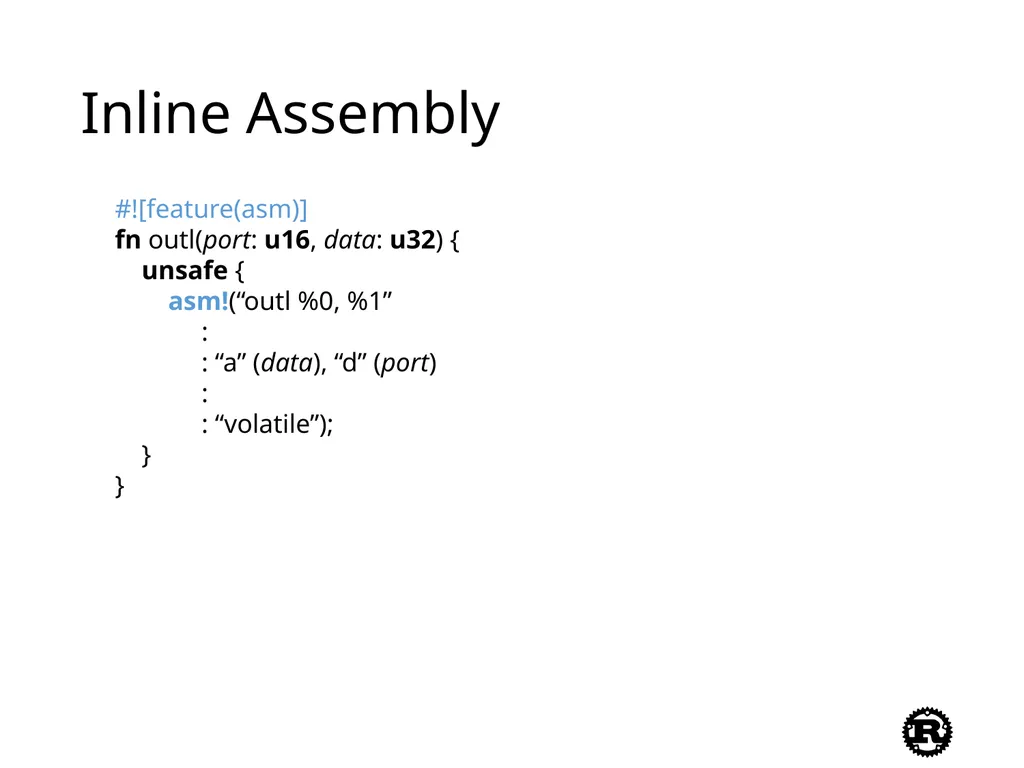
slide28. Inline Assembly #![feature(asm)]
fn outl(port: u16, data: u32) {
unsafe {
asm!(“outl %0, %1”
:
: “a” (data), “d” (port)
:
: “volatile”);
}
}<br>
slide29. Other Goodies Enums, Pattern Match, Generic, Traits, Tests, …<br>
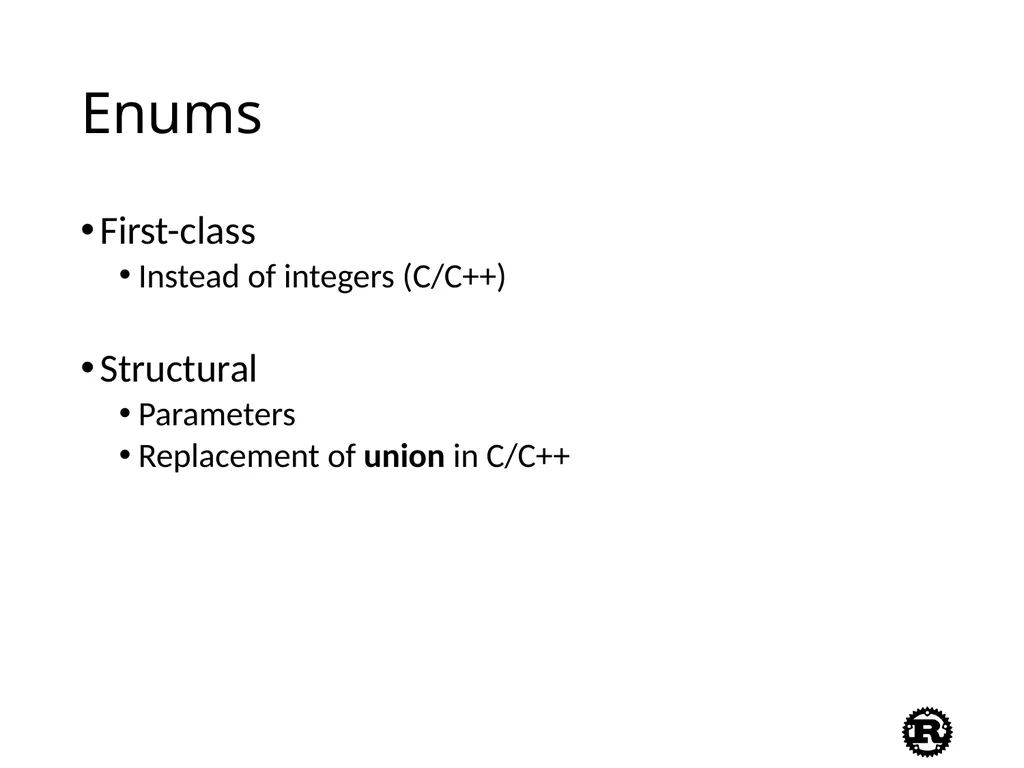
slide30. Enums First-class
Instead of integers (C/C++)
Structural
Parameters
Replacement of union in C/C++<br>
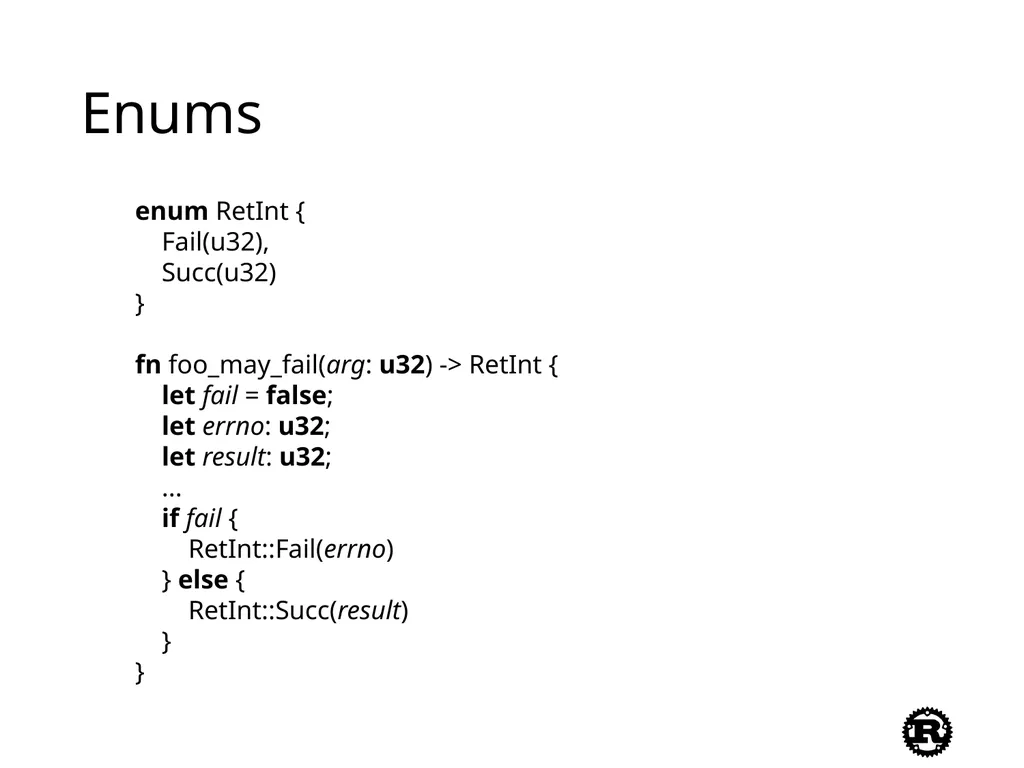
slide31. Enums enum RetInt {
Fail(u32),
Succ(u32)
}
fn foo_may_fail(arg: u32) -> RetInt {
let fail = false;
let errno: u32;
let result: u32;
...
if fail {
RetInt::Fail(errno)
} else {
RetInt::Succ(result)
}
}<br>
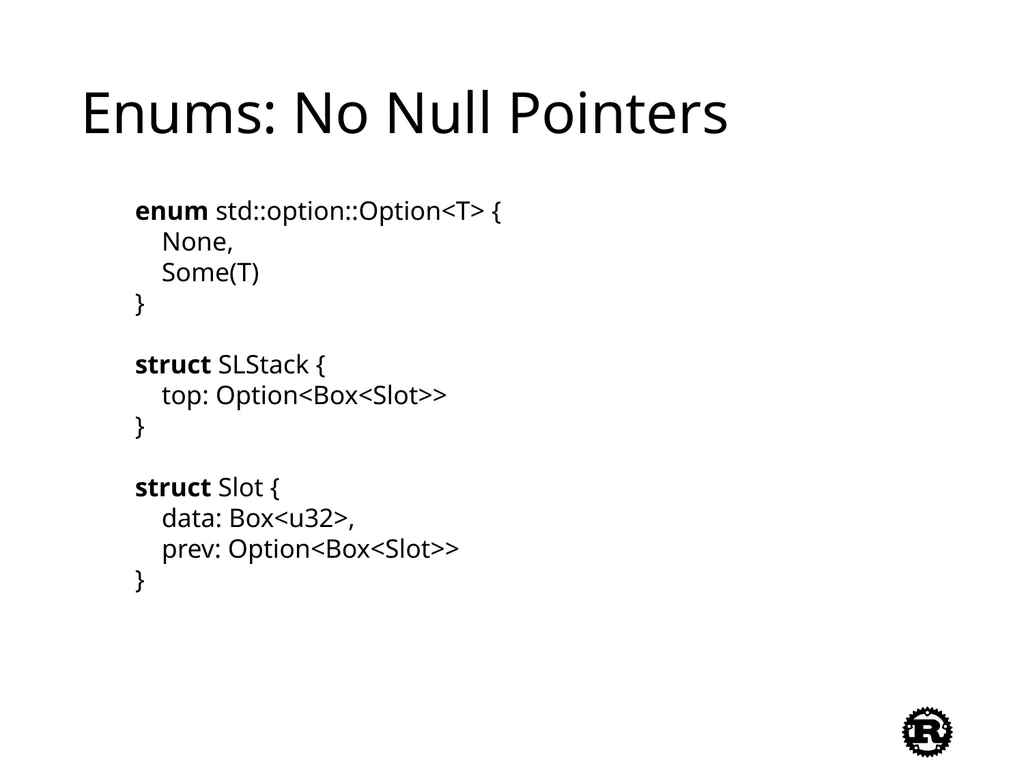
slide32. Enums: No Null Pointers enum std::option::Option<T> {
None,
Some(T)
}
struct SLStack {
top: Option<Box<Slot>>
}
struct Slot {
data: Box<u32>,
prev: Option<Box<Slot>>
}<br>
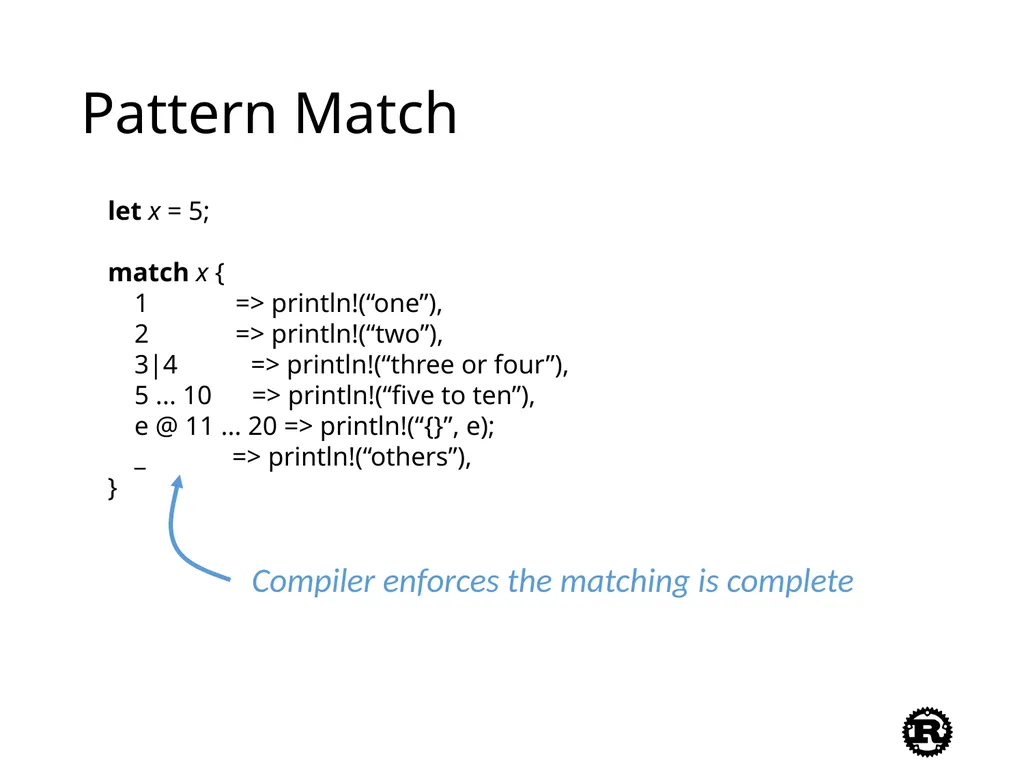
slide33. Pattern Match let x = 5;
match x {
1 => println!(“one”),
2 => println!(“two”),
3|4 => println!(“three or four”),
5 ... 10 => println!(“five to ten”),
e @ 11 ... 20 => println!(“{}”, e);
_ => println!(“others”),
} Compiler enforces the matching is complete<br>
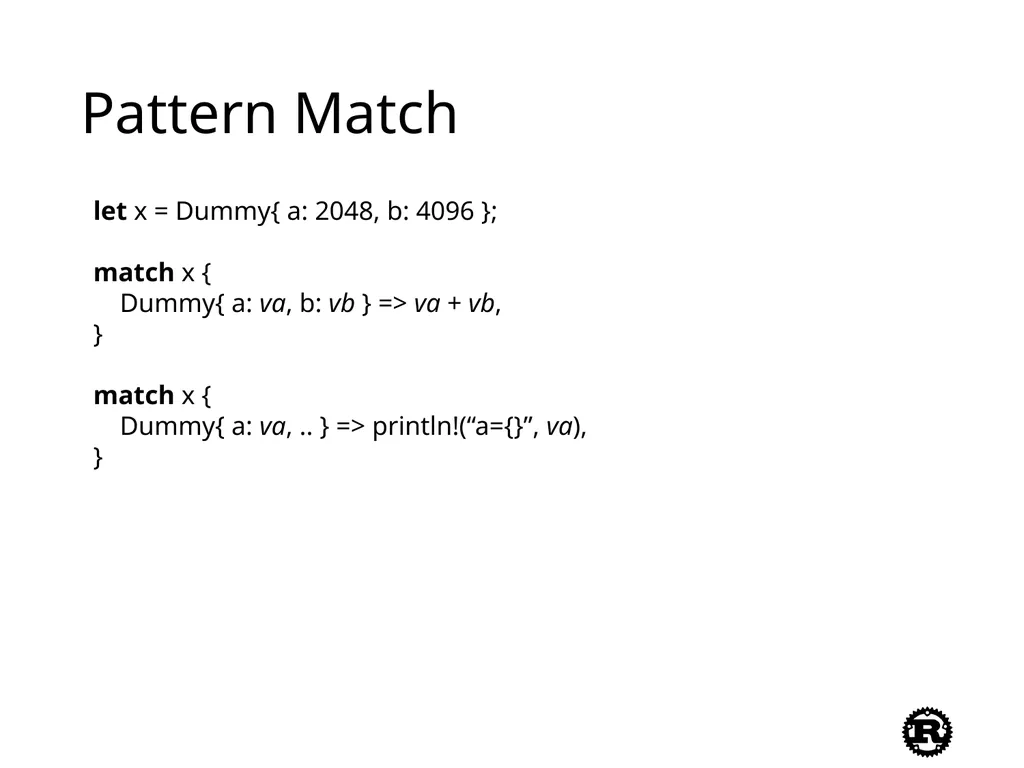
slide34. Pattern Match let x = Dummy{ a: 2048, b: 4096 };
match x {
Dummy{ a: va, b: vb } => va + vb,
}
match x {
Dummy{ a: va, .. } => println!(“a={}”, va),
}<br>
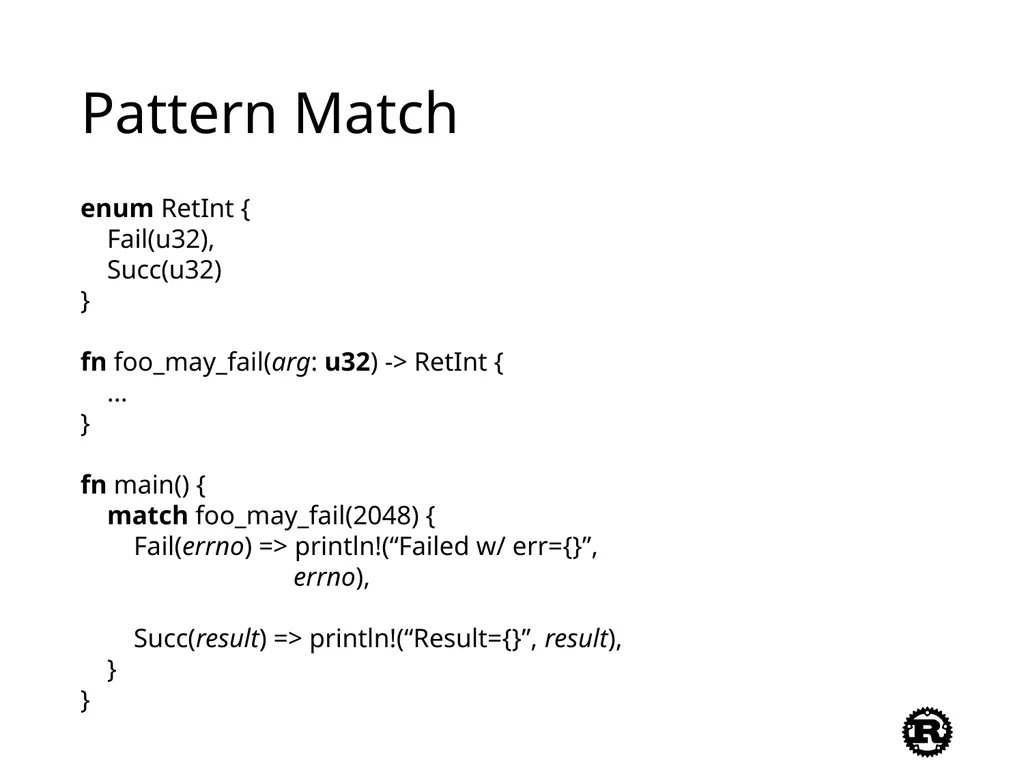
slide35. Pattern Match enum RetInt {
Fail(u32),
Succ(u32)
}
fn foo_may_fail(arg: u32) -> RetInt {
...
}
fn main() {
match foo_may_fail(2048) {
Fail(errno) => println!(“Failed w/ err={}”,
errno),
Succ(result) => println!(“Result={}”, result),
}
}<br>
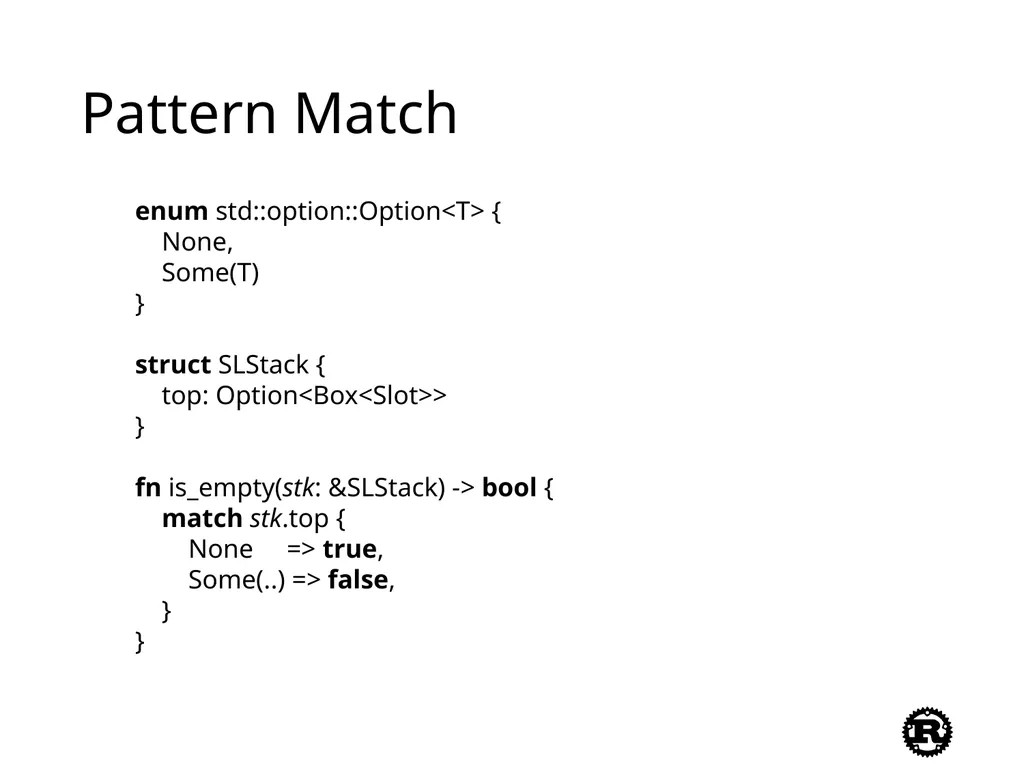
slide36. Pattern Match enum std::option::Option<T> {
None,
Some(T)
}
struct SLStack {
top: Option<Box<Slot>>
}
fn is_empty(stk: &SLStack) -> bool {
match stk.top {
None => true,
Some(..) => false,
}
}<br>
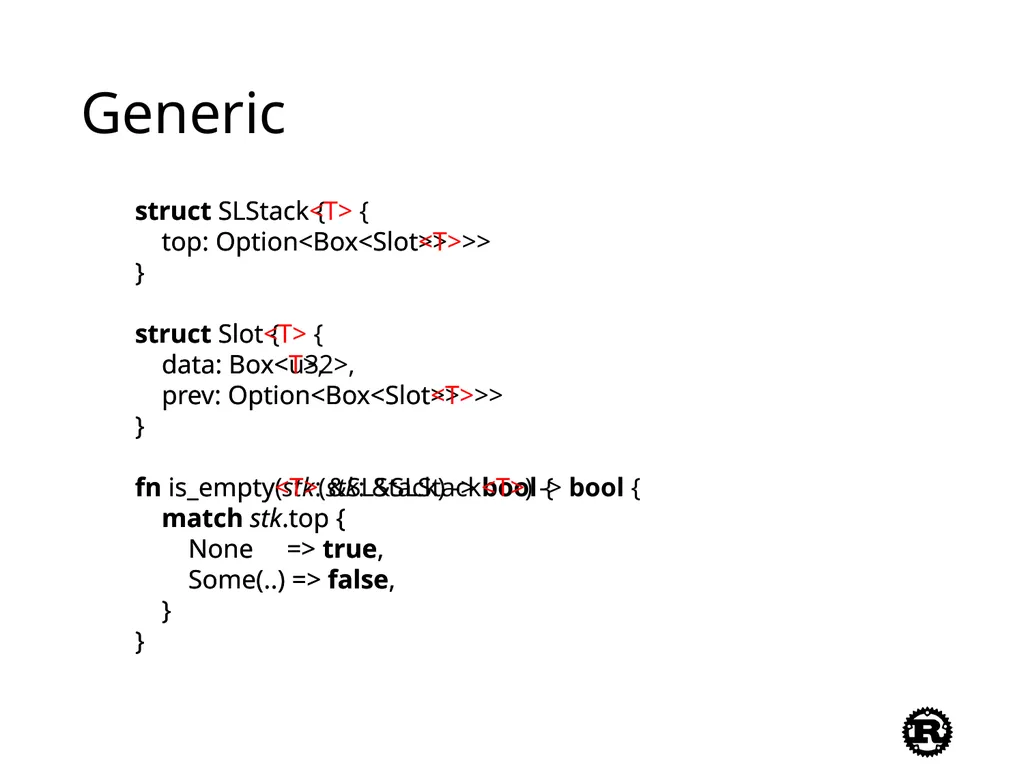
slide37. Generic struct SLStack {
top: Option<Box<Slot>>
}
struct Slot {
data: Box<u32>,
prev: Option<Box<Slot>>
}
fn is_empty(stk: &SLStack) -> bool {
match stk.top {
None => true,
Some(..) => false,
}
} struct SLStack<T> {
top: Option<Box<Slot<T>>>
}
struct Slot<T> {
data: Box<T>,
prev: Option<Box<Slot<T>>>
}
fn is_empty<T>(stk: &SLStack<T>) -> bool {
match stk.top {
None => true,
Some(..) => false,
}
}<br>
slide38. Traits More generic
Typeclass in Haskell<br>
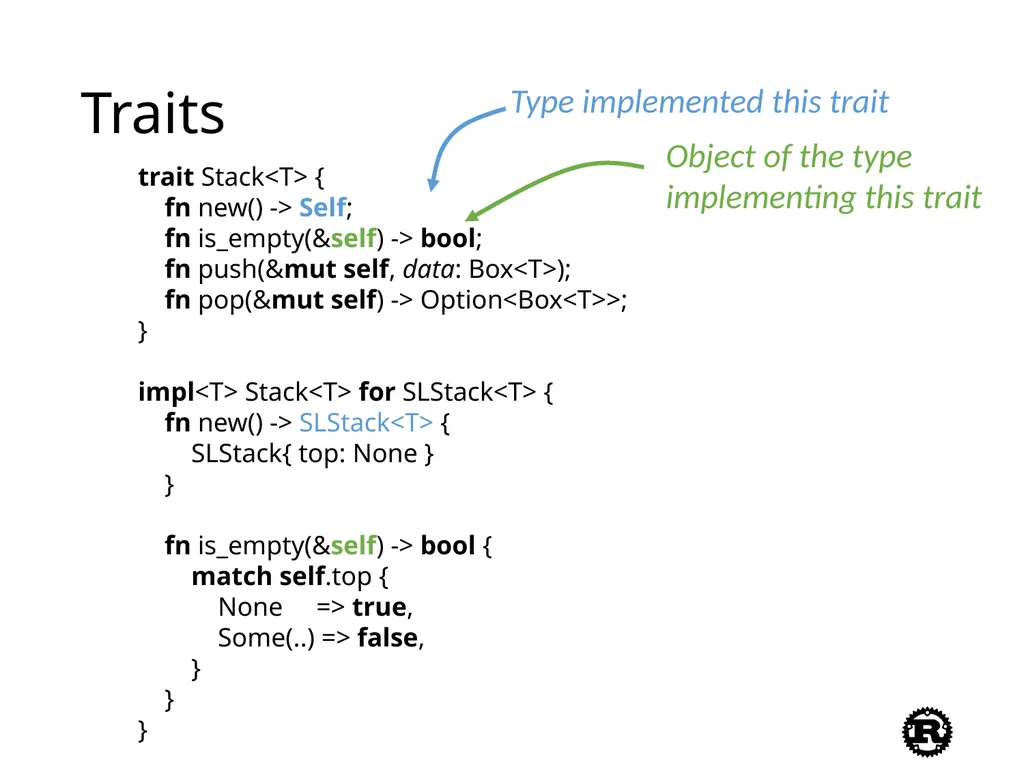
slide39. Traits trait Stack<T> {
fn new() -> Self;
fn is_empty(&self) -> bool;
fn push(&mut self, data: Box<T>);
fn pop(&mut self) -> Option<Box<T>>;
}
impl<T> Stack<T> for SLStack<T> {
fn new() -> SLStack<T> {
SLStack{ top: None }
}
fn is_empty(&self) -> bool {
match self.top {
None => true,
Some(..) => false,
}
}
} Type implemented this trait Object of the type
implementing this trait<br>
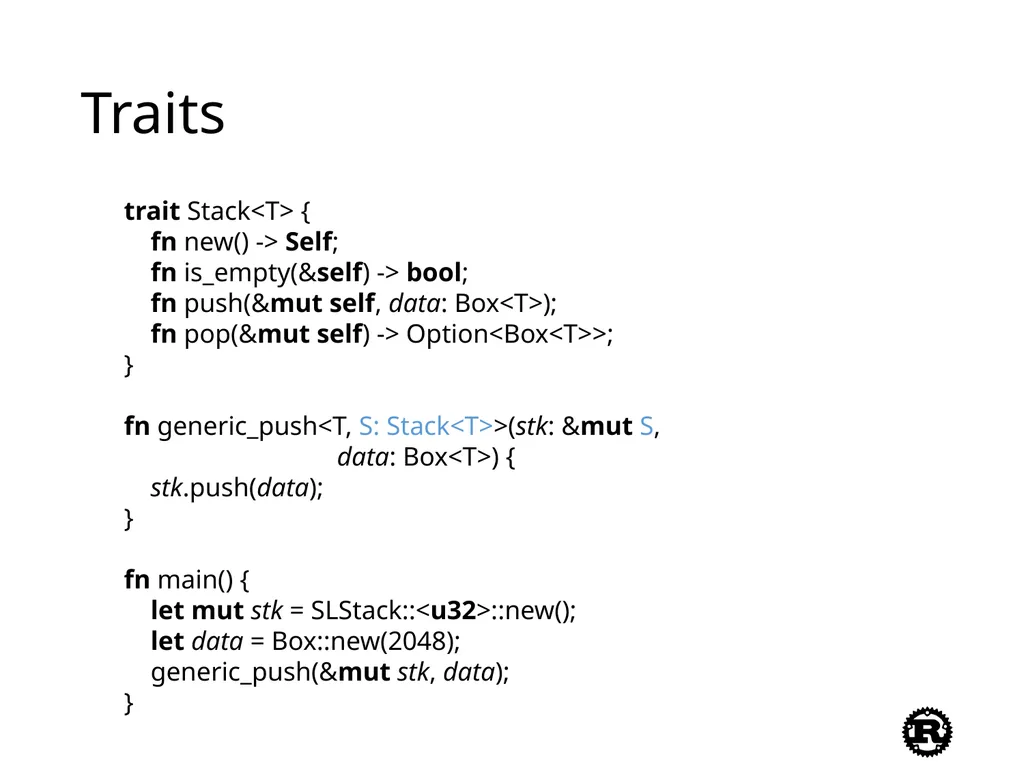
slide40. Traits trait Stack<T> {
fn new() -> Self;
fn is_empty(&self) -> bool;
fn push(&mut self, data: Box<T>);
fn pop(&mut self) -> Option<Box<T>>;
}
fn generic_push<T, S: Stack<T>>(stk: &mut S,
data: Box<T>) {
stk.push(data);
}
fn main() {
let mut stk = SLStack::<u32>::new();
let data = Box::new(2048);
generic_push(&mut stk, data);
}<br>
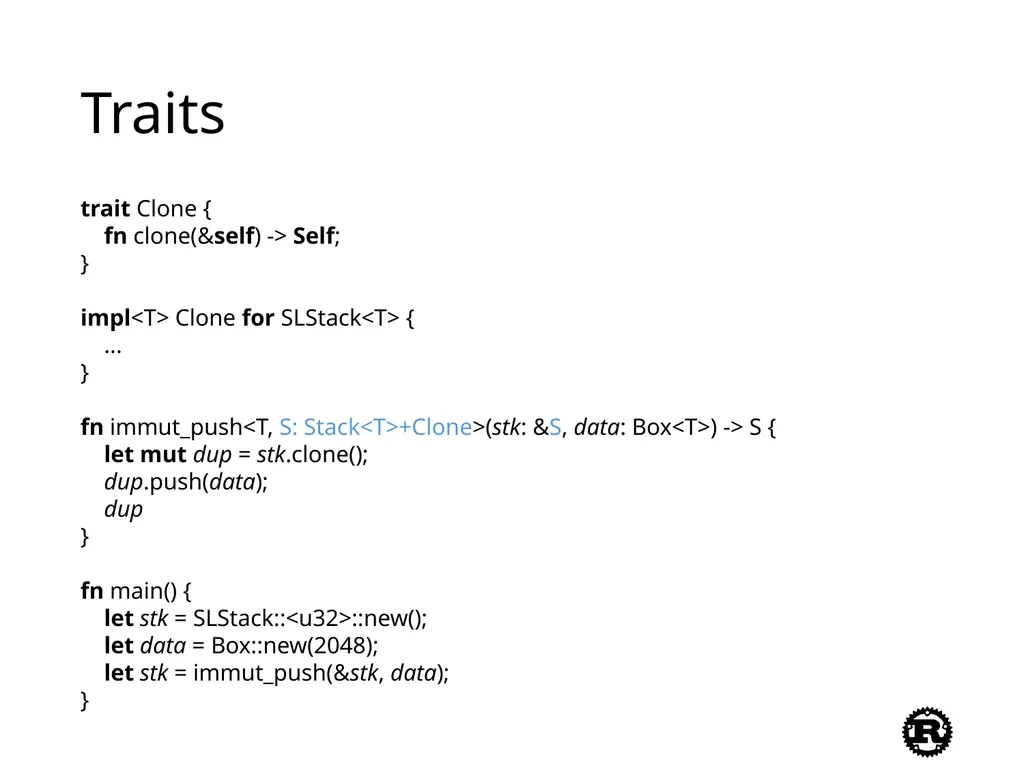
slide41. Traits trait Clone {
fn clone(&self) -> Self;
}
impl<T> Clone for SLStack<T> {
...
}
fn immut_push<T, S: Stack<T>+Clone>(stk: &S, data: Box<T>) -> S {
let mut dup = stk.clone();
dup.push(data);
dup
}
fn main() {
let stk = SLStack::<u32>::new();
let data = Box::new(2048);
let stk = immut_push(&stk, data);
}<br>
slide42. Tests Rust provides a builtin test system.<br>
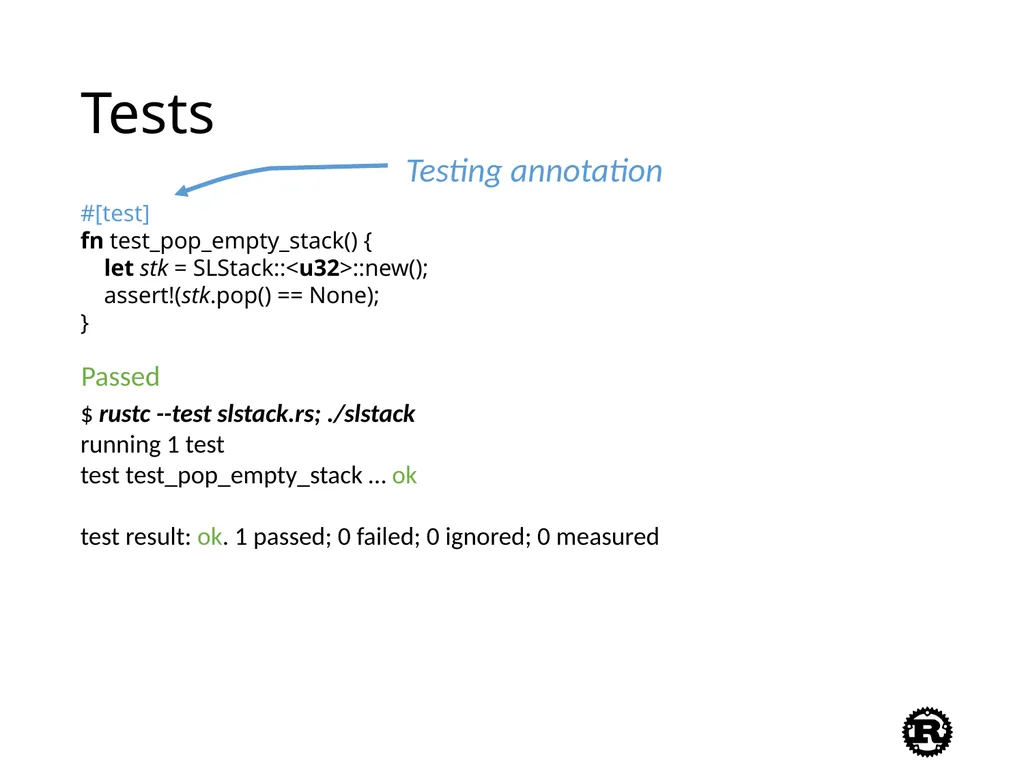
slide43. Tests #[test]
fn test_pop_empty_stack() {
let stk = SLStack::<u32>::new();
assert!(stk.pop() == None);
} Testing annotation $ rustc --test slstack.rs; ./slstack
running 1 test
test test_pop_empty_stack … ok
test result: ok. 1 passed; 0 failed; 0 ignored; 0 measured Passed<br>
slide44. Tests #[test]
fn test_pop_empty_stack() {
let stk = SLStack::<u32>::new();
assert!(stk.pop() == None);
} Testing annotation $ rustc --test slstack.rs; ./slstack
running 1 test
test test_pop_empty_stack … FAILED
--- test_pop_empty_stack stdout ---
thread ‘test_pop_empty_stack’ panicked at ‘assertion failed: stk.pop() == None’, slstack.rs: 4
failures:
test_pop_empty_stack
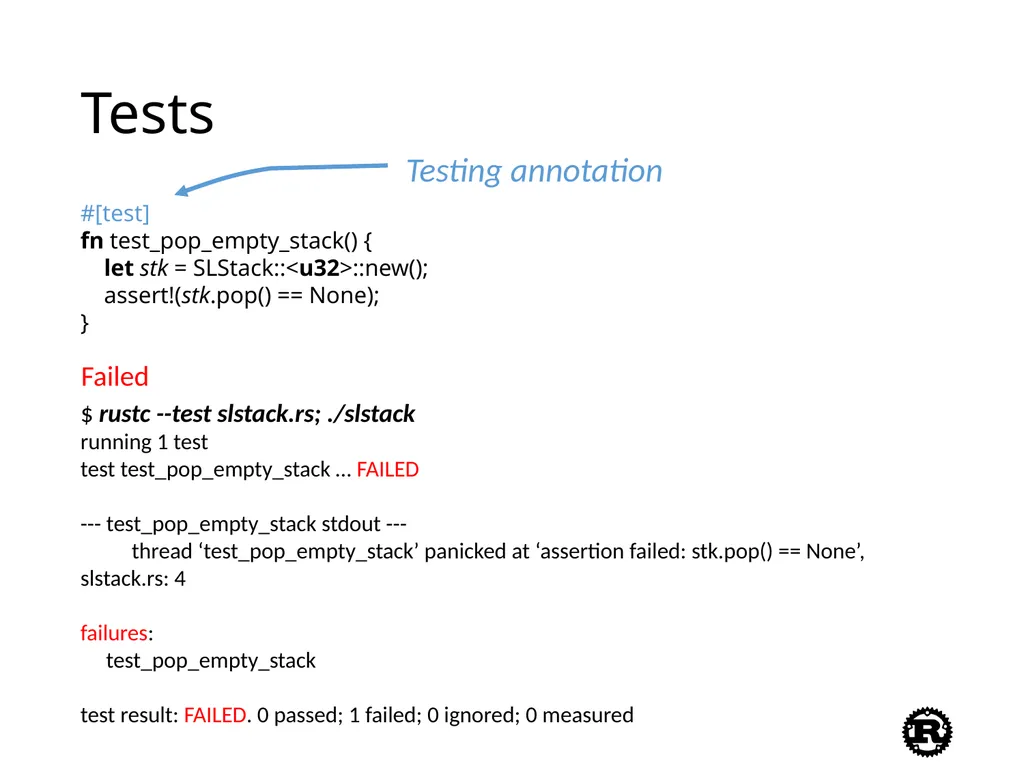
test result: FAILED. 0 passed; 1 failed; 0 ignored; 0 measured Failed<br>
slide45. Documentation Tests /// # Examples
/// ```
/// let stk = SLStack::<u32>::new();
/// assert!(stk.pop() == None);
/// ```
fn pop(&mut self) -> Option<Box<T>> {
...
} $ rustdoc --test slstack.rs; ./slstack
running 1 test
test test_pop_empty_stack_0 … ok
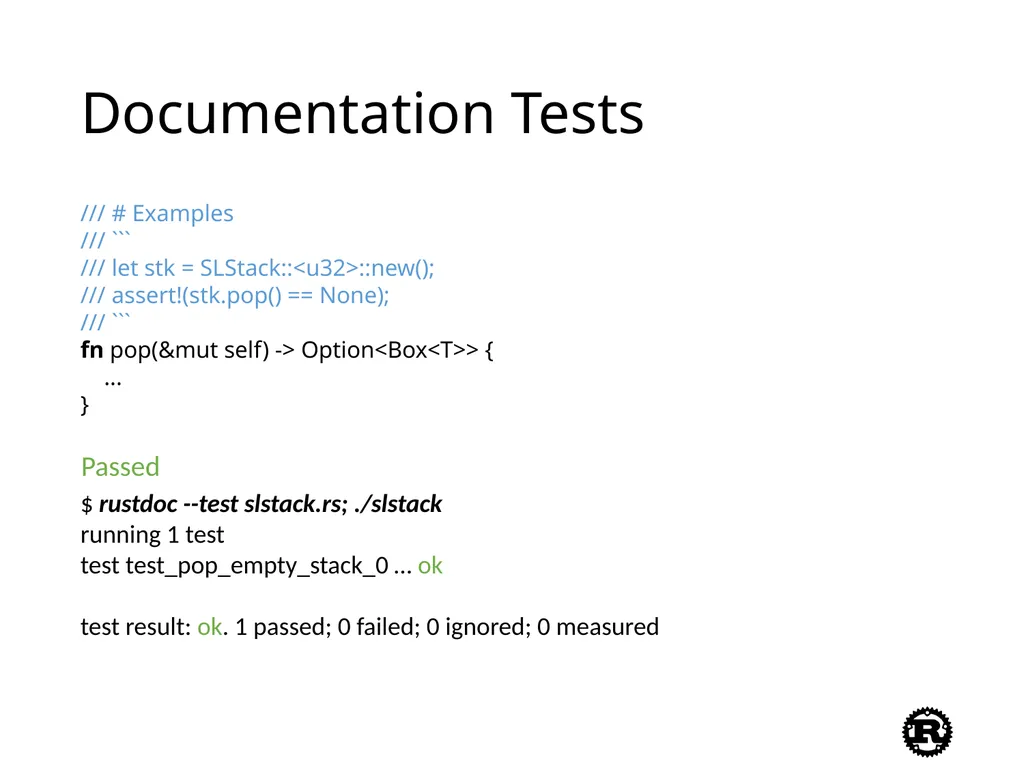
test result: ok. 1 passed; 0 failed; 0 ignored; 0 measured Passed<br>
slide46. Others Closures
Concurrency
Comments as documentations
Hygienic macro
Crates and modules
Cargo: Rust’s package manager
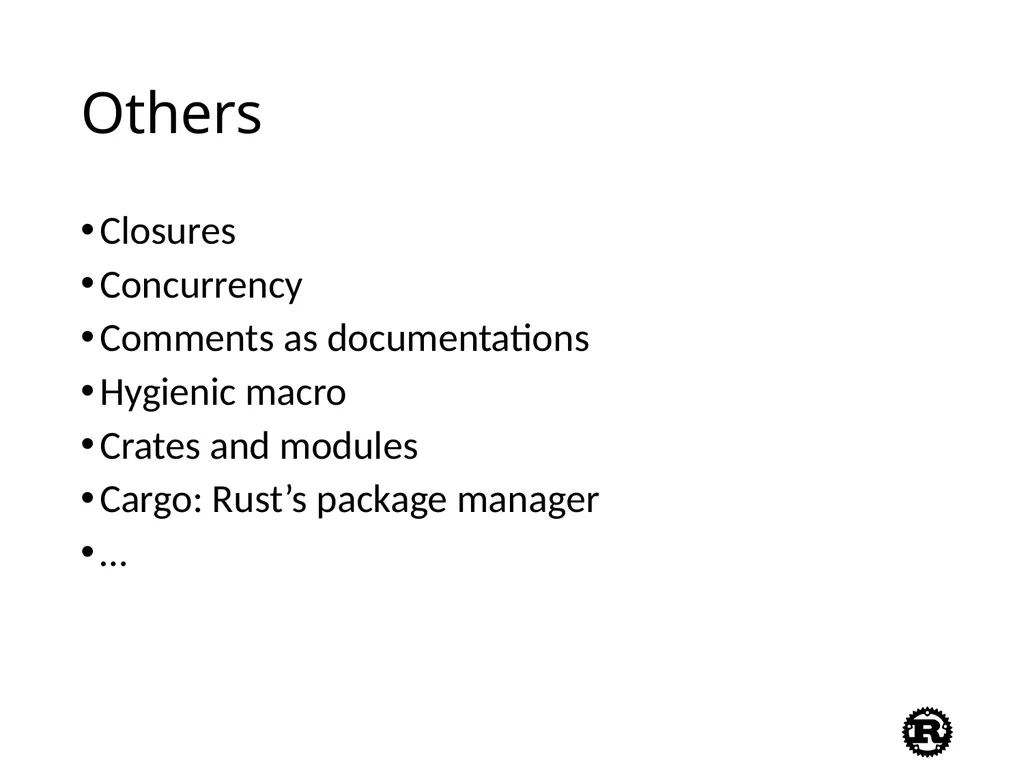
…<br>
slide47. Learning & Development Resources<br>
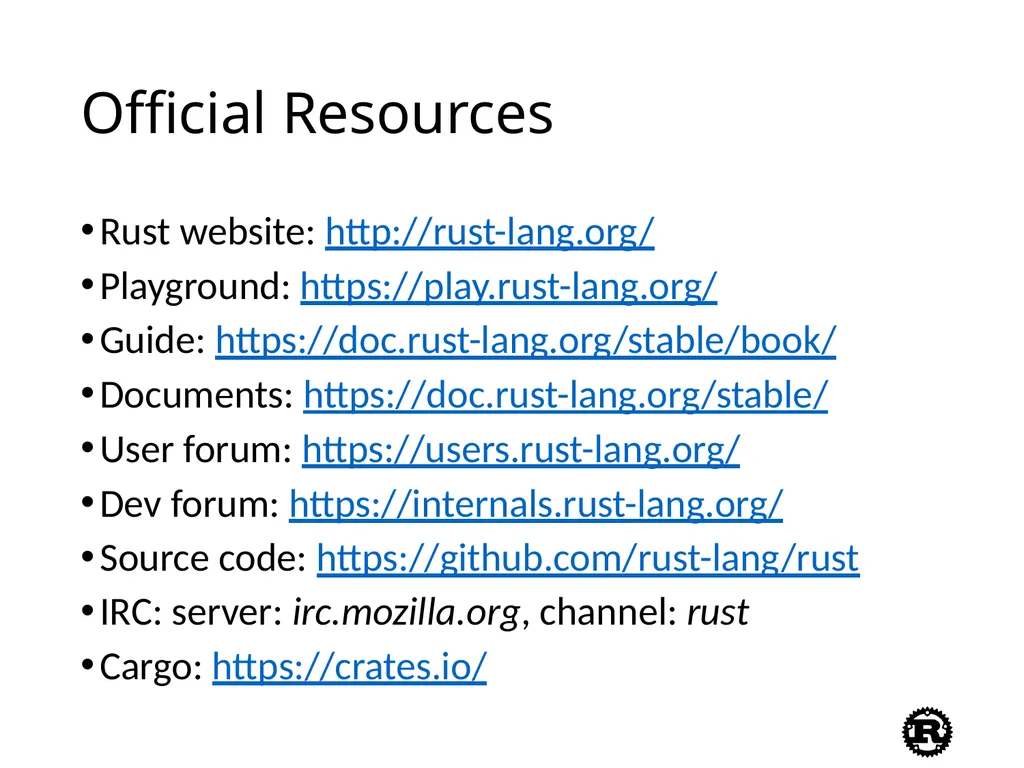
slide48. Official Resources Rust website: http://rust-lang.org/
Playground: https://play.rust-lang.org/
Guide: https://doc.rust-lang.org/stable/book/
Documents: https://doc.rust-lang.org/stable/
User forum: https://users.rust-lang.org/
Dev forum: https://internals.rust-lang.org/
Source code: https://github.com/rust-lang/rust
IRC: server: irc.mozilla.org, channel: rust
Cargo: https://crates.io/<br>
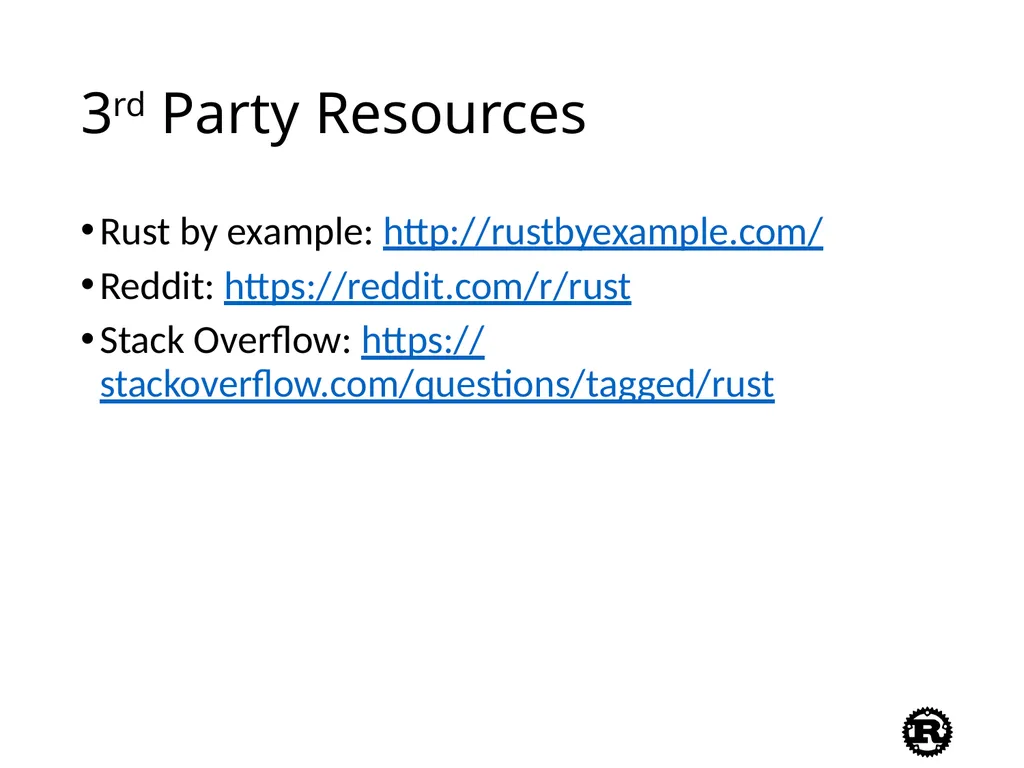
slide49. 3rd Party Resources Rust by example: http://rustbyexample.com/
Reddit: https://reddit.com/r/rust
Stack Overflow: https://stackoverflow.com/questions/tagged/rust<br>
slide50. Academic Research https://doc.rust-lang.org/stable/book/academic-research.html<br>
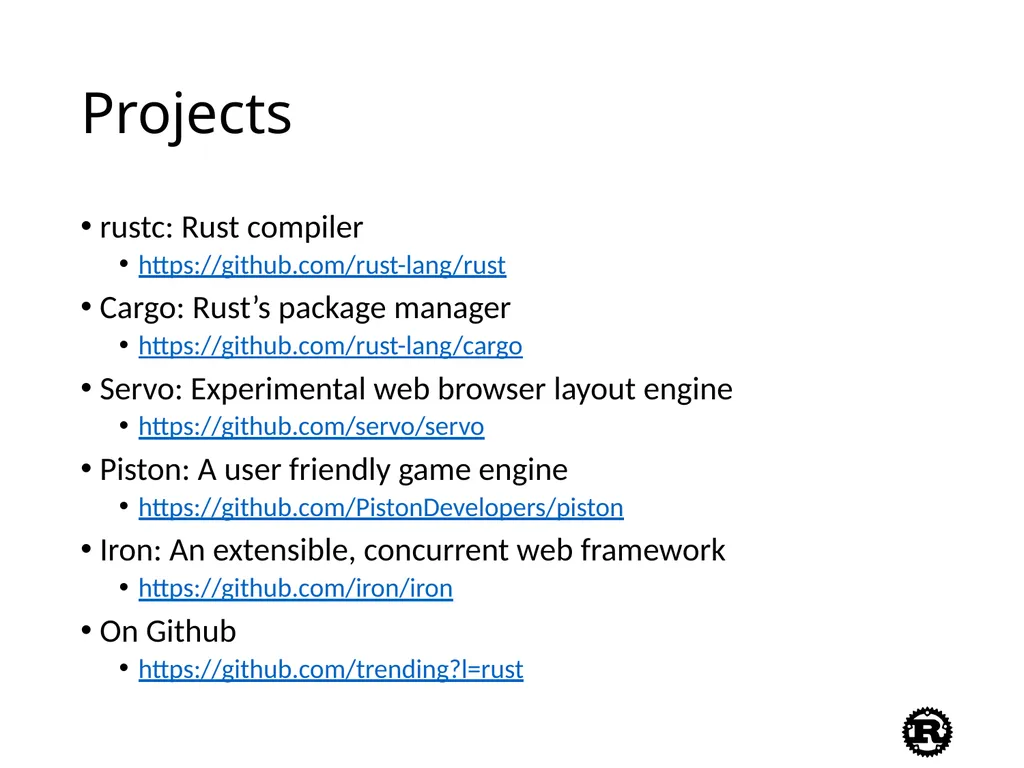
slide51. Projects rustc: Rust compiler
https://github.com/rust-lang/rust
Cargo: Rust’s package manager
https://github.com/rust-lang/cargo
Servo: Experimental web browser layout engine
https://github.com/servo/servo
Piston: A user friendly game engine
https://github.com/PistonDevelopers/piston
Iron: An extensible, concurrent web framework
https://github.com/iron/iron
On Github
https://github.com/trending?l=rust<br>
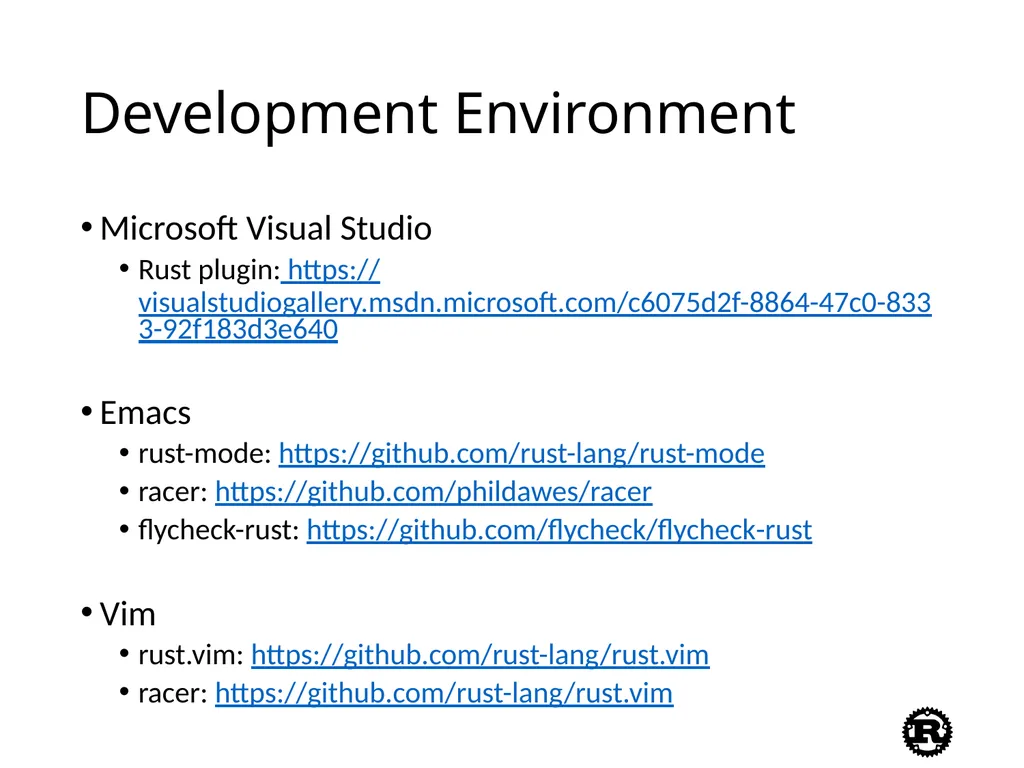
slide52. Development Environment Microsoft Visual Studio
Rust plugin: https://visualstudiogallery.msdn.microsoft.com/c6075d2f-8864-47c0-8333-92f183d3e640
Emacs
rust-mode: https://github.com/rust-lang/rust-mode
racer: https://github.com/phildawes/racer
flycheck-rust: https://github.com/flycheck/flycheck-rust
Vim
rust.vim: https://github.com/rust-lang/rust.vim
racer: https://github.com/rust-lang/rust.vim<br>
slide53. Questions?<br>
Jun 1, 2015<br>
slide2. Acknowledgment Parts of contents in the following slides may use contents from following sources.
Aaron Turon, The Rust Programming Language, Colloquium on Computer Systems Seminar Series (EE380) , Stanford University, 2015.
Alex Crichton, Intro to the Rust programming language, http://people.mozilla.org/~acrichton/rust-talk-2014-12-10/
The Rust Programming Language, https://doc.rust-lang.org/stable/book/<br>
slide3. What is Rust? From the official website (http://rust-lang.org):
“Rust is a systems programming language that runs
blazingly fast, prevents nearly all segfaults, and
guarantees thread safety. ”<br>
slide4. A brief history Pre-2009
Graydone Hoare terrible memory leakages/bugs in Firefox 2009
Mozilla Corp. Experimental web browser layout engine:
Servo 2013
Samsung Corp. Joined 2015/05/15
v1.0 Stable Released!<br>
slide5. Who are using Rust? rustc: Rust compiler
https://github.com/rust-lang/rust
Cargo: Rust’s package manager
https://github.com/rust-lang/cargo
Servo: Experimental web browser layout engine
https://github.com/servo/servo
Piston: A user friendly game engine
https://github.com/PistonDevelopers/piston
Iron: An extensible, concurrent web framework
https://github.com/iron/iron
…<br>
slide6. Control & Safety Things make Rust Rust.<br>
slide7. In the real world … Rust is the coating closest to the bare metal.<br>
slide8. As a programming language … Rust is a system programming language barely on the hardware.
No runtime requirement (eg. GC/Dynamic Type/…)
More control (over memory allocation/destruction/…)
… fn main() {
println!(“Hello, world!”);
}<br>
slide9. More than that … C/C++ more control,
less safety Haskell/Python less control,
more safety more control,
more safety Rust<br>
slide10. What is control? typedef struct Dummy { int a; int b; } Dummy;
void foo(void) {
Dummy *ptr = (Dummy *) malloc(sizeof(struct Dummy));
ptr->a = 2048;
free(ptr);
} ptr .a .b Stack Heap Precise memory layout Lightweight reference Deterministic destruction .a = 2048<br>
slide11. Rust’s Solution: Zero-cost Abstraction struct Dummy { a: i32, b: i32 }
fn foo() {
let mut res: Box<Dummy> = Box::new(Dummy {
a: 0,
b: 0
});
res.a = 2048;
} res .a = 0 .b = 0 Stack Heap .a = 2048 Variable binding Memory allocation Resource owned by res is freed automatically<br>
slide12. Side Slide: Type Inference struct Dummy { a: i32, b: i32 }
fn foo() {
let mut res: Box<Dummy> = Box::new(Dummy {
a: 0,
b: 0
});
res.a = 2048;
}<br>
slide13. What is safety? typedef struct Dummy { int a; int b; } Dummy;
void foo(void) {
Dummy *ptr = (Dummy *) malloc(sizeof(struct Dummy));
Dummy *alias = ptr;
free(ptr);
int a = alias.a;
free(alias);
} ptr alias .a .b Stack Heap Dangling Pointer Use after free Double free Aliasing Mutation<br>
slide14. Rust’s Solution: Ownership & Borrowing Compiler enforces:
Every resource has a unique owner.
Others can borrow the resource from its owner.
Owner cannot free or mutate its resource while it is borrowed. Aliasing Mutation No need for runtime Memory safety Data-race freedom<br>
slide15. Ownership struct Dummy { a: i32, b: i32 }
fn foo() {
let mut res = Box::new(Dummy {
a: 0,
b: 0
});
} res .a = 0 .b = 0 Stack Heap owns res is out of scope and its resource is freed automatically<br>
slide16. Ownership: Lifetime Lifetime is determined and checked statically. struct Dummy { a: i32, b: i32 }
fn foo() {
let mut res: Box<Dummy>;
{
res = Box::new(Dummy {a: 0, b: 0});
}
res.a = 2048;
} Lifetime that res
owns the resource. Compiling Error: res no longer owns the resource<br>
slide17. Ownership: Unique Owner struct Dummy { a: i32, b: i32 }
fn foo() {
let mut res = Box::new(Dummy {
a: 0,
b: 0
});
take(res);
println!(“res.a = {}”, res.a);
}
fn take(arg: Box<Dummy>) {
} Ownership is moved from res to arg arg is out of scope and the resource is freed automatically Compiling Error! Aliasing Mutation<br>
slide18. Immutable/Shared Borrowing (&) struct Dummy { a: i32, b: i32 }
fn foo() {
let mut res = Box::new(Dummy{
a: 0,
b: 0
});
take(&res);
res.a = 2048;
}
fn take(arg: &Box<Dummy>) {
arg.a = 2048;
} Resource is immutably borrowed by arg from res Resource is still owned by res. No free here. Resource is returned from arg to res Aliasing Mutation Compiling Error: Cannot mutate via
an immutable reference<br>
slide19. Immutable/Shared Borrowing (&) Read-only sharing struct Dummy { a: i32, b: i32 }
fn foo() {
let mut res = Box::new(Dummy{a: 0, b: 0});
{
let alias1 = &res;
let alias2 = &res;
let alias3 = alias2;
res.a = 2048;
}
res.a = 2048;
}<br>
slide20. Mutable Borrowing (&mut) Aliasing Mutation struct Dummy { a: i32, b: i32 }
fn foo() {
let mut res = Box::new(Dummy{a: 0, b: 0});
take(&mut res);
res.a = 4096;
let borrower = &mut res;
let alias = &mut res;
}
fn take(arg: &mut Box<Dummy>) {
arg.a = 2048;
} Mutably borrowed by arg from res Returned from arg to res Multiple mutable borrowings
are disallowed<br>
slide21. Side Slide: Mutability Every resource in Rust is immutable by default.
mut is used to declare a resource as mutable. struct Dummy { a: i32, b: i32 }
fn foo() {
let res = Box::new(Dummy{a: 0, b: 0});
res.a = 2048;
let borrower = &mut res;
} Error: Resource is immutable Error: Cannot get a mutable borrowing
of an immutable resource<br>
slide22. Concurrency & Data-race Freedom struct Dummy { a: i32, b: i32 }
fn foo() {
let mut res = Box::new(Dummy {a: 0, b: 0});
std::thread::spawn(move || {
let borrower = &mut res;
borrower.a += 1;
});
res.a += 1;
} Error: res is being mutably borrowed res is mutably borrowed Spawn a new thread<br>
slide23. Unsafe Life is hard.<br>
slide24. Mutably Sharing Mutably sharing is inevitable in the real world.
Example: mutable doubly linked list prev next prev next prev next struct Node {
prev: option<Box<Node>>,
next: option<Box<Node>>
}<br>
slide25. Rust’s Solution: Raw Pointers Compiler does NOT check the memory safety of most operations wrt. raw pointers.
Most operations wrt. raw pointers should be encapsulated in a unsafe {} syntactic structure. prev next prev next prev next struct Node {
prev: option<Box<Node>>,
next: *mut Node
} Raw pointer<br>
slide26. Rust’s Solution: Raw Pointers let a = 3;
unsafe {
let b = &a as *const u32 as *mut u32;
*b = 4;
}
println!(“a = {}”, a); I know what I’m doing Print “a = 4”<br>
slide27. Foreign Function Interface (FFI) All foreign functions are unsafe. extern {
fn write(fd: i32, data: *const u8, len: u32) -> i32;
}
fn main() {
let msg = b”Hello, world!\n”;
unsafe {
write(1, &msg[0], msg.len());
}
}<br>
slide28. Inline Assembly #![feature(asm)]
fn outl(port: u16, data: u32) {
unsafe {
asm!(“outl %0, %1”
:
: “a” (data), “d” (port)
:
: “volatile”);
}
}<br>
slide29. Other Goodies Enums, Pattern Match, Generic, Traits, Tests, …<br>
slide30. Enums First-class
Instead of integers (C/C++)
Structural
Parameters
Replacement of union in C/C++<br>
slide31. Enums enum RetInt {
Fail(u32),
Succ(u32)
}
fn foo_may_fail(arg: u32) -> RetInt {
let fail = false;
let errno: u32;
let result: u32;
...
if fail {
RetInt::Fail(errno)
} else {
RetInt::Succ(result)
}
}<br>
slide32. Enums: No Null Pointers enum std::option::Option<T> {
None,
Some(T)
}
struct SLStack {
top: Option<Box<Slot>>
}
struct Slot {
data: Box<u32>,
prev: Option<Box<Slot>>
}<br>
slide33. Pattern Match let x = 5;
match x {
1 => println!(“one”),
2 => println!(“two”),
3|4 => println!(“three or four”),
5 ... 10 => println!(“five to ten”),
e @ 11 ... 20 => println!(“{}”, e);
_ => println!(“others”),
} Compiler enforces the matching is complete<br>
slide34. Pattern Match let x = Dummy{ a: 2048, b: 4096 };
match x {
Dummy{ a: va, b: vb } => va + vb,
}
match x {
Dummy{ a: va, .. } => println!(“a={}”, va),
}<br>
slide35. Pattern Match enum RetInt {
Fail(u32),
Succ(u32)
}
fn foo_may_fail(arg: u32) -> RetInt {
...
}
fn main() {
match foo_may_fail(2048) {
Fail(errno) => println!(“Failed w/ err={}”,
errno),
Succ(result) => println!(“Result={}”, result),
}
}<br>
slide36. Pattern Match enum std::option::Option<T> {
None,
Some(T)
}
struct SLStack {
top: Option<Box<Slot>>
}
fn is_empty(stk: &SLStack) -> bool {
match stk.top {
None => true,
Some(..) => false,
}
}<br>
slide37. Generic struct SLStack {
top: Option<Box<Slot>>
}
struct Slot {
data: Box<u32>,
prev: Option<Box<Slot>>
}
fn is_empty(stk: &SLStack) -> bool {
match stk.top {
None => true,
Some(..) => false,
}
} struct SLStack<T> {
top: Option<Box<Slot<T>>>
}
struct Slot<T> {
data: Box<T>,
prev: Option<Box<Slot<T>>>
}
fn is_empty<T>(stk: &SLStack<T>) -> bool {
match stk.top {
None => true,
Some(..) => false,
}
}<br>
slide38. Traits More generic
Typeclass in Haskell<br>
slide39. Traits trait Stack<T> {
fn new() -> Self;
fn is_empty(&self) -> bool;
fn push(&mut self, data: Box<T>);
fn pop(&mut self) -> Option<Box<T>>;
}
impl<T> Stack<T> for SLStack<T> {
fn new() -> SLStack<T> {
SLStack{ top: None }
}
fn is_empty(&self) -> bool {
match self.top {
None => true,
Some(..) => false,
}
}
} Type implemented this trait Object of the type
implementing this trait<br>
slide40. Traits trait Stack<T> {
fn new() -> Self;
fn is_empty(&self) -> bool;
fn push(&mut self, data: Box<T>);
fn pop(&mut self) -> Option<Box<T>>;
}
fn generic_push<T, S: Stack<T>>(stk: &mut S,
data: Box<T>) {
stk.push(data);
}
fn main() {
let mut stk = SLStack::<u32>::new();
let data = Box::new(2048);
generic_push(&mut stk, data);
}<br>
slide41. Traits trait Clone {
fn clone(&self) -> Self;
}
impl<T> Clone for SLStack<T> {
...
}
fn immut_push<T, S: Stack<T>+Clone>(stk: &S, data: Box<T>) -> S {
let mut dup = stk.clone();
dup.push(data);
dup
}
fn main() {
let stk = SLStack::<u32>::new();
let data = Box::new(2048);
let stk = immut_push(&stk, data);
}<br>
slide42. Tests Rust provides a builtin test system.<br>
slide43. Tests #[test]
fn test_pop_empty_stack() {
let stk = SLStack::<u32>::new();
assert!(stk.pop() == None);
} Testing annotation $ rustc --test slstack.rs; ./slstack
running 1 test
test test_pop_empty_stack … ok
test result: ok. 1 passed; 0 failed; 0 ignored; 0 measured Passed<br>
slide44. Tests #[test]
fn test_pop_empty_stack() {
let stk = SLStack::<u32>::new();
assert!(stk.pop() == None);
} Testing annotation $ rustc --test slstack.rs; ./slstack
running 1 test
test test_pop_empty_stack … FAILED
--- test_pop_empty_stack stdout ---
thread ‘test_pop_empty_stack’ panicked at ‘assertion failed: stk.pop() == None’, slstack.rs: 4
failures:
test_pop_empty_stack
test result: FAILED. 0 passed; 1 failed; 0 ignored; 0 measured Failed<br>
slide45. Documentation Tests /// # Examples
/// ```
/// let stk = SLStack::<u32>::new();
/// assert!(stk.pop() == None);
/// ```
fn pop(&mut self) -> Option<Box<T>> {
...
} $ rustdoc --test slstack.rs; ./slstack
running 1 test
test test_pop_empty_stack_0 … ok
test result: ok. 1 passed; 0 failed; 0 ignored; 0 measured Passed<br>
slide46. Others Closures
Concurrency
Comments as documentations
Hygienic macro
Crates and modules
Cargo: Rust’s package manager
…<br>
slide47. Learning & Development Resources<br>
slide48. Official Resources Rust website: http://rust-lang.org/
Playground: https://play.rust-lang.org/
Guide: https://doc.rust-lang.org/stable/book/
Documents: https://doc.rust-lang.org/stable/
User forum: https://users.rust-lang.org/
Dev forum: https://internals.rust-lang.org/
Source code: https://github.com/rust-lang/rust
IRC: server: irc.mozilla.org, channel: rust
Cargo: https://crates.io/<br>
slide49. 3rd Party Resources Rust by example: http://rustbyexample.com/
Reddit: https://reddit.com/r/rust
Stack Overflow: https://stackoverflow.com/questions/tagged/rust<br>
slide50. Academic Research https://doc.rust-lang.org/stable/book/academic-research.html<br>
slide51. Projects rustc: Rust compiler
https://github.com/rust-lang/rust
Cargo: Rust’s package manager
https://github.com/rust-lang/cargo
Servo: Experimental web browser layout engine
https://github.com/servo/servo
Piston: A user friendly game engine
https://github.com/PistonDevelopers/piston
Iron: An extensible, concurrent web framework
https://github.com/iron/iron
On Github
https://github.com/trending?l=rust<br>
slide52. Development Environment Microsoft Visual Studio
Rust plugin: https://visualstudiogallery.msdn.microsoft.com/c6075d2f-8864-47c0-8333-92f183d3e640
Emacs
rust-mode: https://github.com/rust-lang/rust-mode
racer: https://github.com/phildawes/racer
flycheck-rust: https://github.com/flycheck/flycheck-rust
Vim
rust.vim: https://github.com/rust-lang/rust.vim
racer: https://github.com/rust-lang/rust.vim<br>
slide53. Questions?<br>