An Introduction to the AIDS Education Training Center (AETC) Program January 2021 This project is supported by the Health Resources and Services Administration (HRSA) of the U.S. Department of Health and Human Services (HHS) under grant
"An Introduction to the AIDS Education & Training" is the property of its rightful owner. Permission is granted to
download and print the materials on this website for personal, non-commercial use only, and to display it
on your personal computer provided you do not modify the materials and that you retain all copyright
notices contained in the materials. By downloading content from our website, you accept the terms of this
agreement.
Presentation Transcript
01
An Introduction to the AIDS Education & Training Center (AETC) Program January 2021<br>
02
This project is supported by the Health Resources and Services Administration (HRSA) of the U.S. Department of Health and Human Services (HHS) under grant number U1OHA28686 (AIDS Education & Training Centers National Coordinating Resource Center) awarded to Rutgers University School of Nursing, François-Xavier Bagnoud Center. No percentage of this project was financed with non-governmental sources. This information or content and conclusions are those of the authors and should not be construed as the official position or policy of, nor should any endorsements be inferred by HRSA, HHS or the U.S. Government. January 22, 2021<br>
03
About the AETC Program The AETC Program, a national program of leading HIV experts, provides locally based, tailored education and technical assistance to healthcare teams and systems to integrate comprehensive care for those living with, at risk of, or affected by HIV. The AETC Program transforms HIV care by building the capacity to provide accessible, high-quality treatment and services throughout the United States and its territories. January 22, 2021<br>
04
Mission To increase the number of healthcare providers who are effectively educated and motivated to counsel, diagnose, treat, and medically manage people with HIV, and to help prevent behaviors leading to HIV transmission. January 22, 2021<br>
05
Who We Serve All healthcare providers (from novice to expert)
Health profession students and faculty
Other multidisciplinary HIV care team members January 22, 2021<br>
06
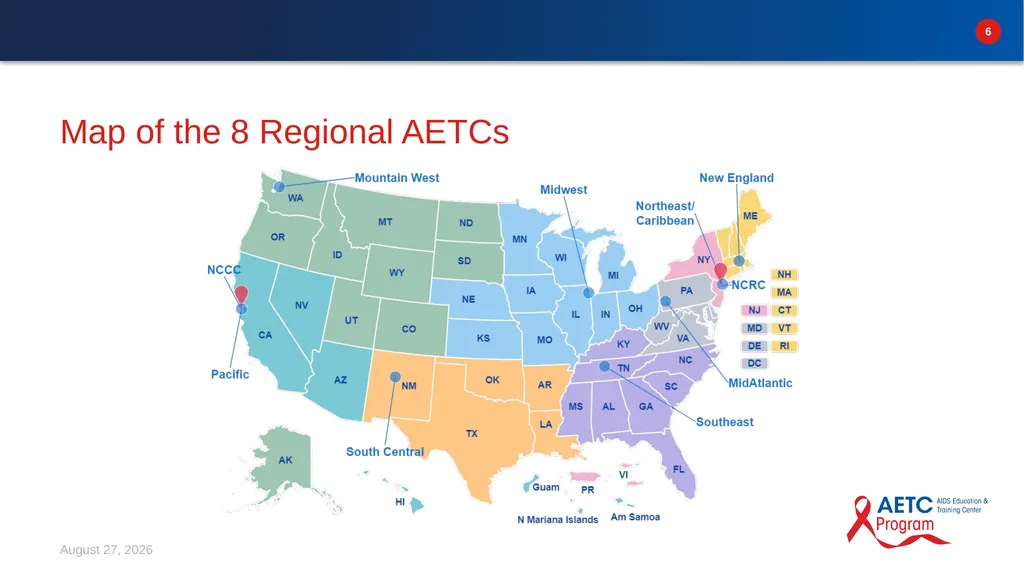
Map of the 8 Regional AETCs January 22, 2021<br>
07
National AETCs: NCRC National Coordinating Resource Center
François-Xavier Bagnoud Center, Rutgers School of Nursing
Centralizes free training and clinical materials through a virtual library: aidsetc.org
Maintains the AETC Program Directory
Fosters collaboration and group facilitation among AETCs and with external partners
Provides AETC Program promotional, marketing and communications services
Coordinates the annual Ryan White HIV/AIDS Program Clinical Conference January 22, 2021<br>
08
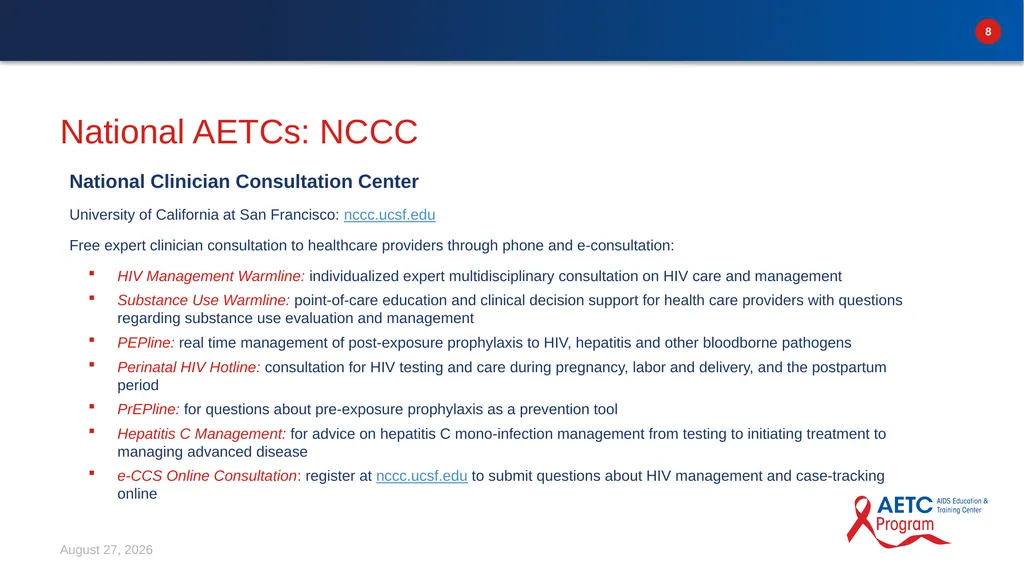
National AETCs: NCCC National Clinician Consultation Center
University of California at San Francisco: nccc.ucsf.edu
Free expert clinician consultation to healthcare providers through phone and e-consultation:
HIV Management Warmline: individualized expert multidisciplinary consultation on HIV care and management
Substance Use Warmline: point-of-care education and clinical decision support for health care providers with questions regarding substance use evaluation and management
PEPline: real time management of post-exposure prophylaxis to HIV, hepatitis and other bloodborne pathogens
Perinatal HIV Hotline: consultation for HIV testing and care during pregnancy, labor and delivery, and the postpartum period
PrEPline: for questions about pre-exposure prophylaxis as a prevention tool
Hepatitis C Management: for advice on hepatitis C mono-infection management from testing to initiating treatment to managing advanced disease
e-CCS Online Consultation: register at nccc.ucsf.edu to submit questions about HIV management and case-tracking online January 22, 2021<br>
09
Training Modalities Overview January 22, 2021<br>
10
Key Statistics Top 3 Training Activities*
Lecture/Workshop
Role play/Simulation
Chart/Case Review
Top 3 Healthcare Professions/Disciplines Trained**
Nurses/ Advanced Practice Nurses
Physicians
Other Non-clinical Professional
>145 active resources available on the AETC NCRC website***
>106,000 unique website users, >322,500 website pageviews***
AETC NCCC service lines receive >12,000 calls a year ***
45.9% MD/DO
35% NP/CNM/PA
13.6% RN/LVN
2.7% Pharmacists January 22, 2021 *2017 AETC Annual Data Report 7/1/16 – 6/30/17
**2017 AETC Annual Data Report 7/1/15 – 6/30/16
***2019 AETC Annual Data Report 7/1/19 – 6/30/20<br>
11
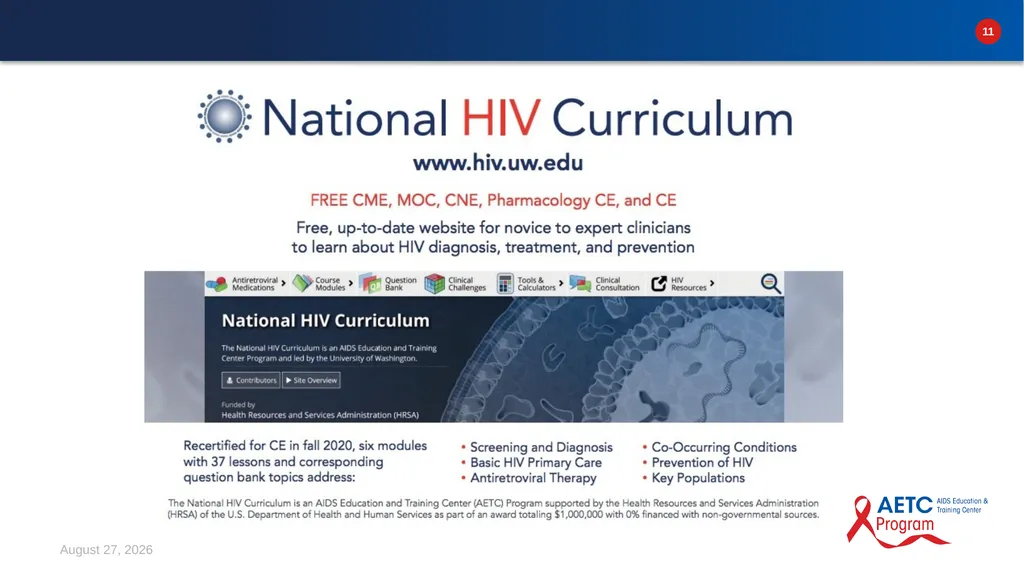
National HIV Curriculum postcard image January 22, 2021<br>
12
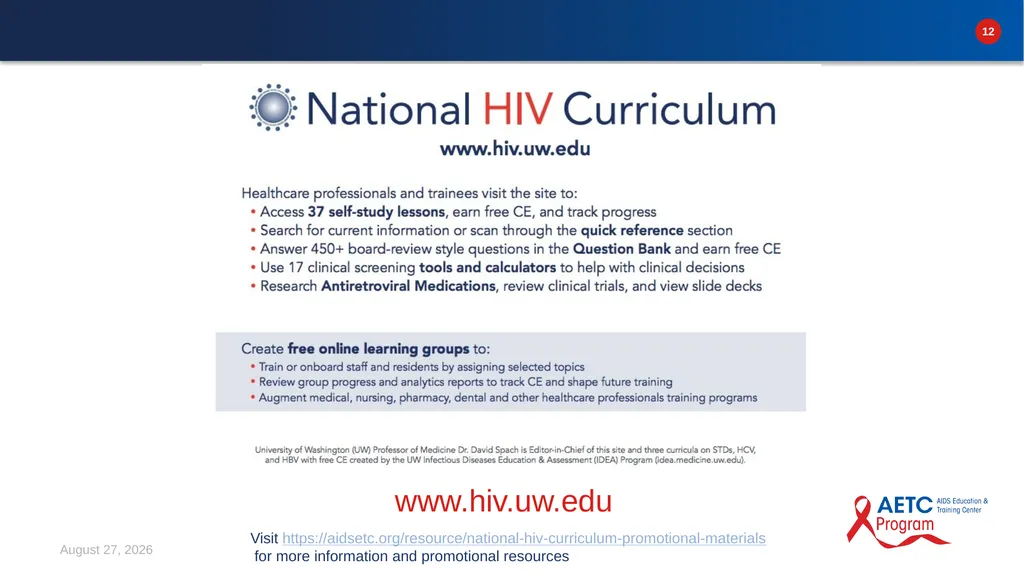
NHC postcard image side 2 January 22, 2021 www.hiv.uw.edu Visit https://aidsetc.org/resource/national-hiv-curriculum-promotional-materials
for more information and promotional resources<br>
13
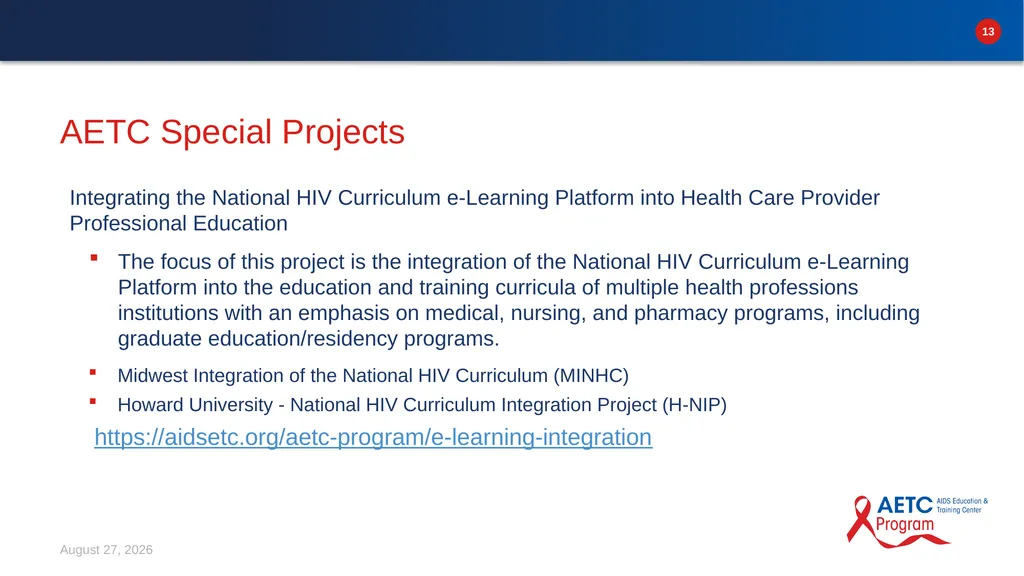
AETC Special Projects Integrating the National HIV Curriculum e-Learning Platform into Health Care Provider Professional Education
The focus of this project is the integration of the National HIV Curriculum e-Learning Platform into the education and training curricula of multiple health professions institutions with an emphasis on medical, nursing, and pharmacy programs, including graduate education/residency programs.
Midwest Integration of the National HIV Curriculum (MINHC)
Howard University - National HIV Curriculum Integration Project (H-NIP)
https://aidsetc.org/aetc-program/e-learning-integration January 22, 2021<br>
14
AETC Special Projects (continued) Ending the HIV Epidemic Initiative (EHE)
Each of the eight AETC regions has at least one EHE participating jurisdiction. The regional AETCs will support EHE activities in their regions with targeted training and technical assistance.
The two national AETCs are supporting the initiative and the AETC network
https://aidsetc.org/directory/aetcs-and-ending-hiv-epidemic-initiative January 22, 2021<br>
15
Collaborations Minority AIDS Initiative (MAI)
Center for Quality Improvement and Innovation (CQII)
TargetHIV
HRSA Special Projects of National Significance (SPNS) and other Ryan White HIV/AIDS Program initiatives
HRSA Bureau of Primary Health Care (BPHC)
U.S. Centers for Disease Control and Prevention (CDC)
Substance Abuse and Mental Health Services Administration (SAMHSA)
Community Based Organizations (CBOs) January 22, 2021<br>
16
For More Information Contact the AETC NCRC at info@aidsetc.org
Visit the AETC NCRC website at aidsetc.org
Access the NHC at http://aidsetc.org/nhc
Read the AETC blog ShareSpot at http://blog.aidsetc.org
Like us on Facebook at https://facebook.com/AETCNCRC/
Follow us on Twitter at https://twitter.com/AETCNCRC
Watch us on YouTube at https://youtube.com/user/AETCNRC
Repin on Pinterest at https://www.pinterest.com/aetcncrc/
Connect on LinkedIn at https://www.linkedin.com/in/aetcncrc/
Download the 2017 AETC Annual Data Report: https://hab.hrsa.gov/sites/default/files/hab/data/datareports/hrsa-aetc-annual-data-report-2017.pdf January 22, 2021<br>