An Introduction to the Unified Architecture Framework (UAF) An INCOSE presentation by Eric Barnhart Introduction Have you ever gone to DoDAF class and left more confused than when you went in? Now try going to a UAF class! What is UAF?
"An Introduction to the Unified Architecture" is the property of its rightful owner. Permission is granted to
download and print the materials on this website for personal, non-commercial use only, and to display it
on your personal computer provided you do not modify the materials and that you retain all copyright
notices contained in the materials. By downloading content from our website, you accept the terms of this
agreement.
Presentation Transcript
01
An Introduction to the Unified Architecture Framework (UAF) An INCOSE presentation by
Eric Barnhart<br>
02
Introduction “Have you ever gone to DoDAF class and left more confused than when you went in?” “Now try going to a UAF class!”<br>
03
What is UAF? Quick answer:
UAF is the next generation of the Unified Profile for DoDAF and MoDAF (UPDM)
At one time referred to as UPDM 3
Longer Answer:
An enterprise architecture framework
Applicable for domains similar to DoDAF, MoDAF and NAF (NATO Architecture Framework)
Flexible enough for non-defense domains
Implemented as a UML profile on top of SysML
Realistic answer:
A complicated framework that makes enterprise architecture even harder<br>
04
What is UAF Good For? Provides a framework for enterprise analysis
Common terminology across domains
Common concepts and models
Everybody speaks the same language
Unifies the terminology across multiple frameworks
Allows MBSE / SysML implementation of the models<br>
05
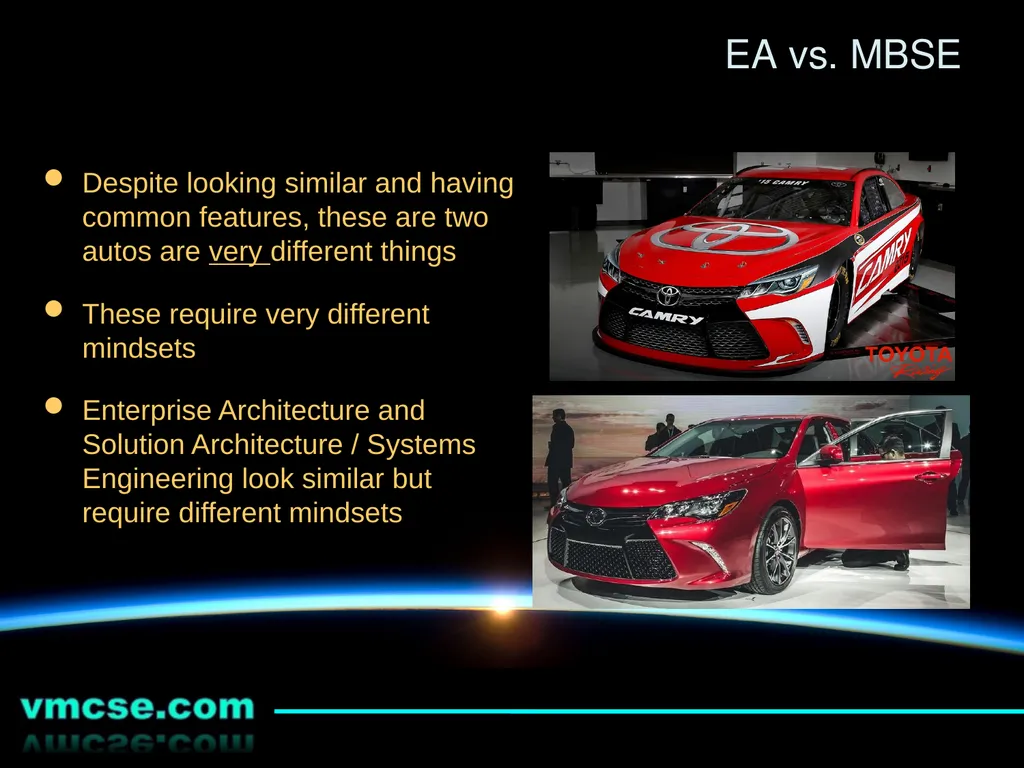
EA vs. MBSE Despite looking similar and having common features, these are two autos are very different things
These require very different mindsets
Enterprise Architecture and Solution Architecture / Systems Engineering look similar but require different mindsets<br>
06
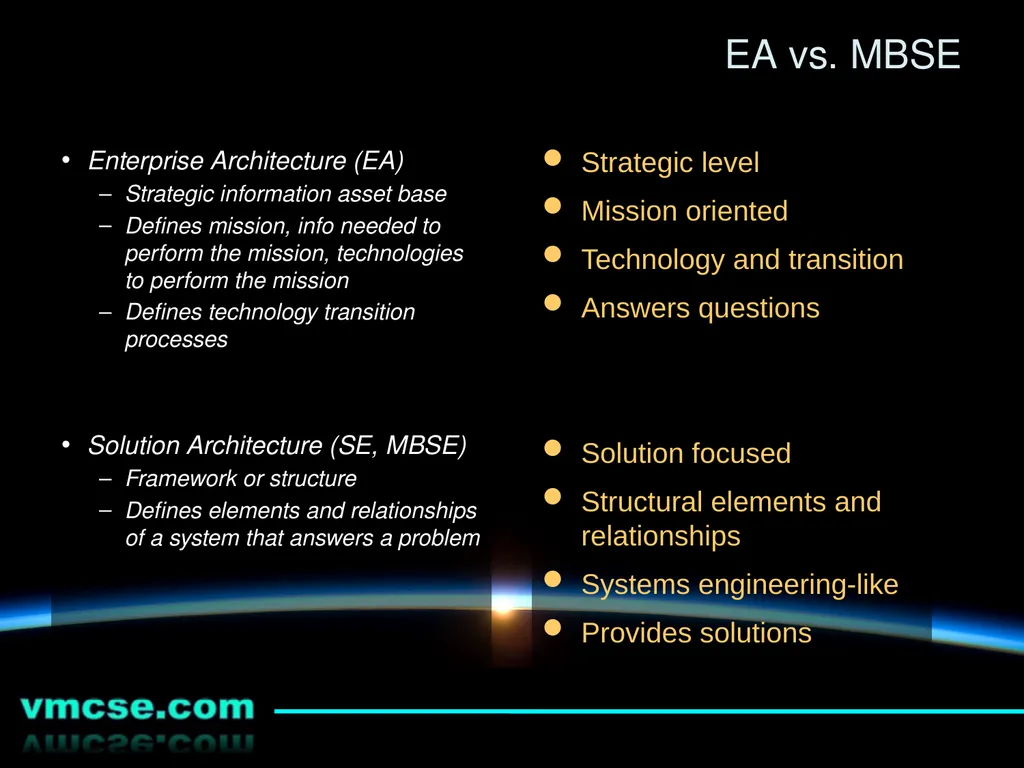
EA vs. MBSE Enterprise Architecture (EA)
Strategic information asset base
Defines mission, info needed to perform the mission, technologies to perform the mission
Defines technology transition processes
Solution Architecture (SE, MBSE)
Framework or structure
Defines elements and relationships of a system that answers a problem Strategic level
Mission oriented
Technology and transition
Answers questions
Solution focused
Structural elements and relationships
Systems engineering-like
Provides solutions<br>
07
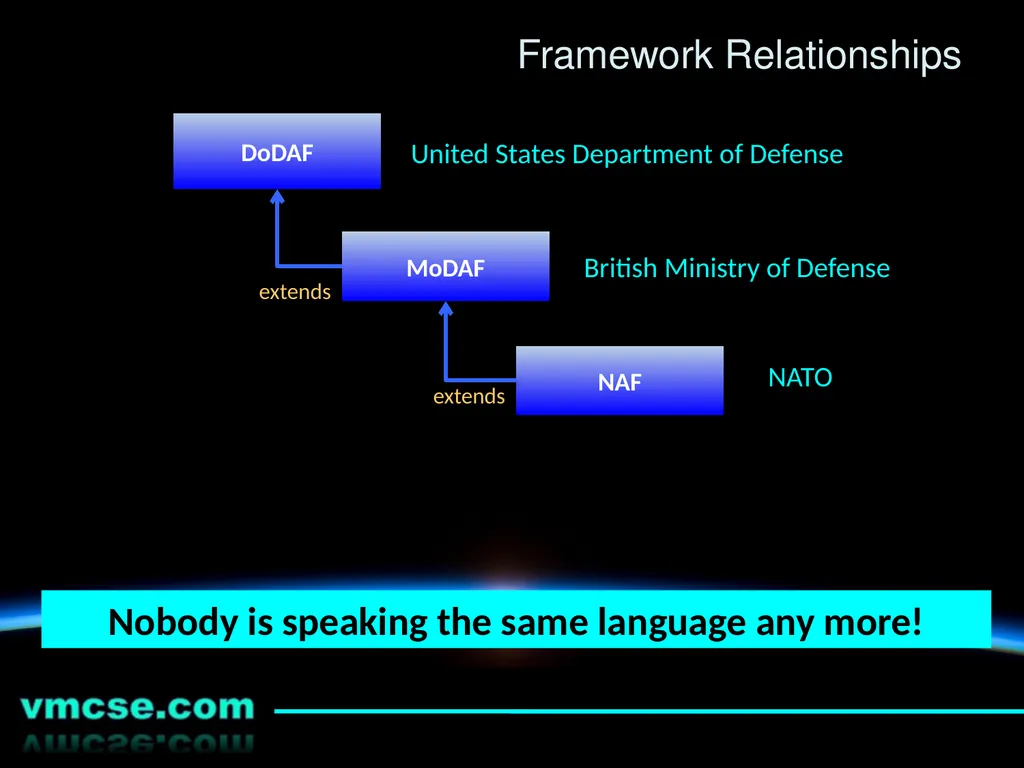
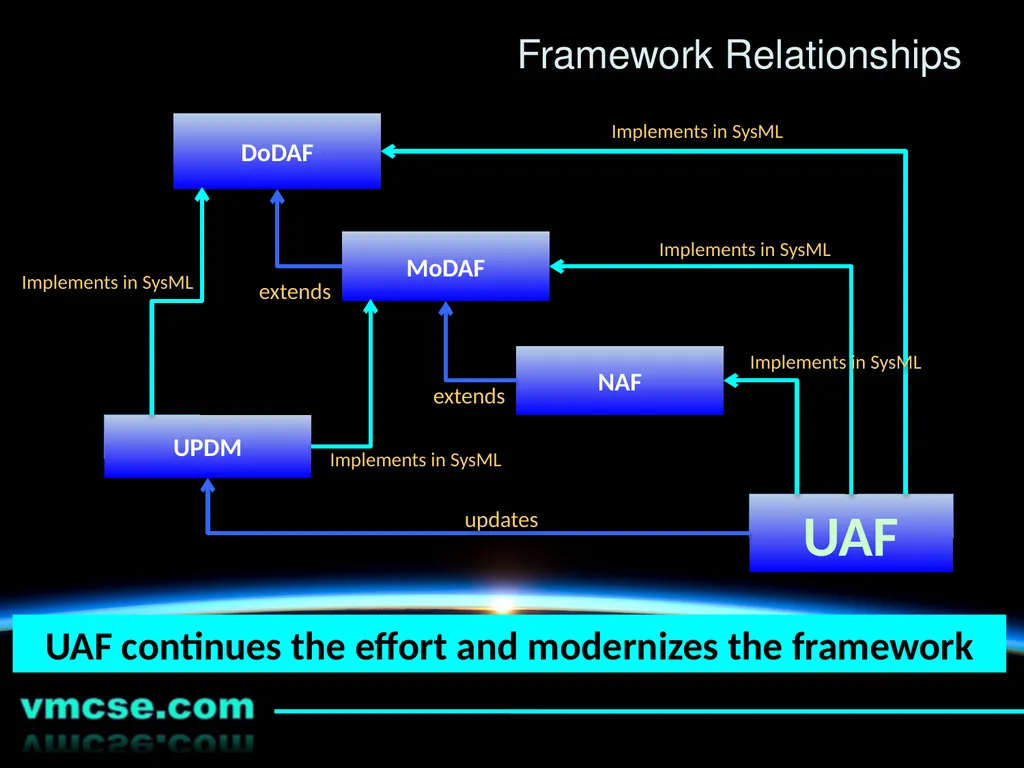
Framework Relationships DoDAF extends MoDAF NAF extends United States Department of Defense British Ministry of Defense NATO Nobody is speaking the same language any more!<br>
08
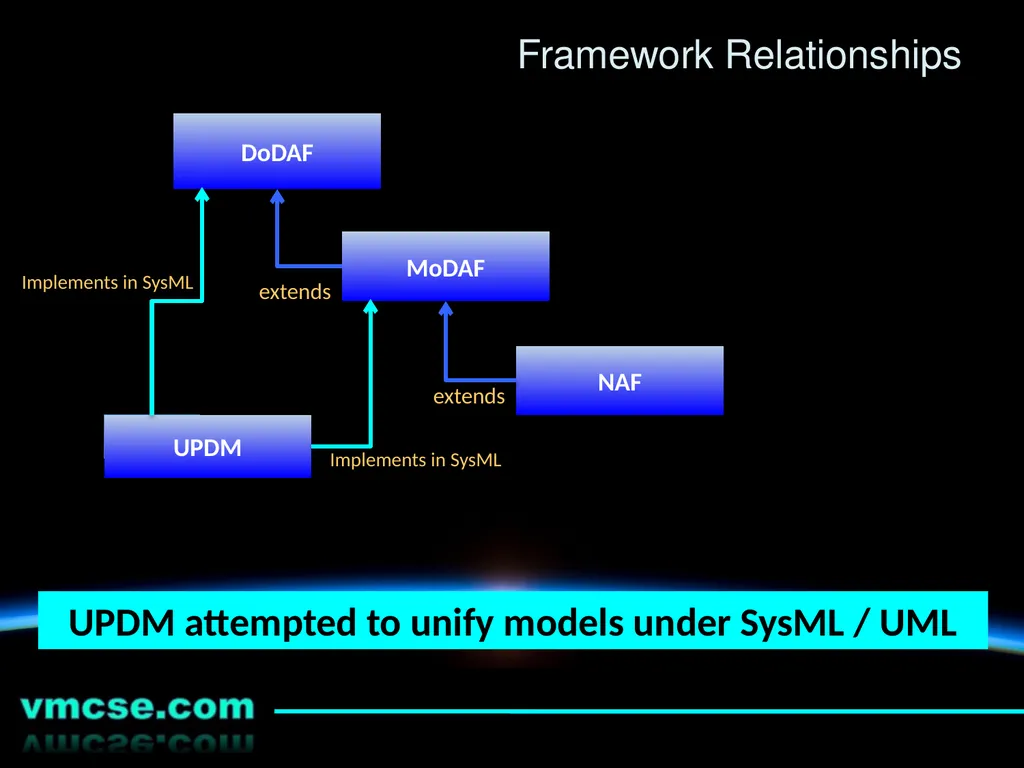
Framework Relationships DoDAF extends MoDAF NAF extends UPDM Implements in SysML Implements in SysML UPDM attempted to unify models under SysML / UML<br>
09
Framework Relationships DoDAF extends MoDAF NAF extends UPDM Implements in SysML Implements in SysML UAF Implements in SysML Implements in SysML Implements in SysML updates UAF continues the effort and modernizes the framework<br>
10
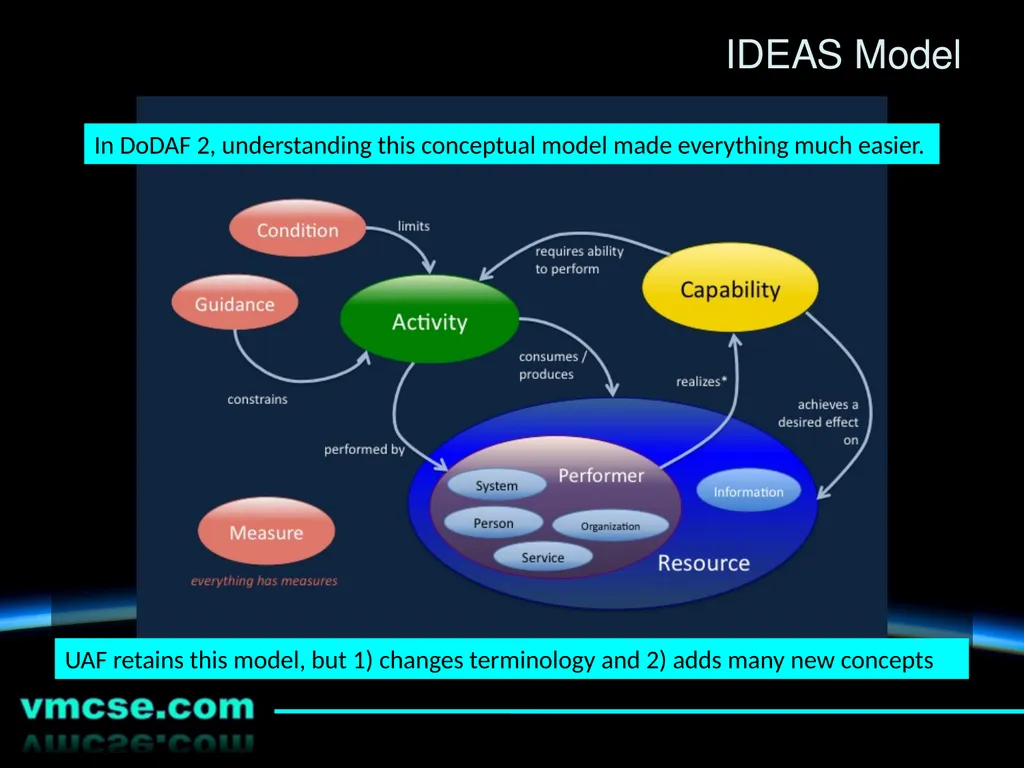
IDEAS Model In DoDAF 2, understanding this conceptual model made everything much easier. UAF retains this model, but 1) changes terminology and 2) adds many new concepts<br>
11
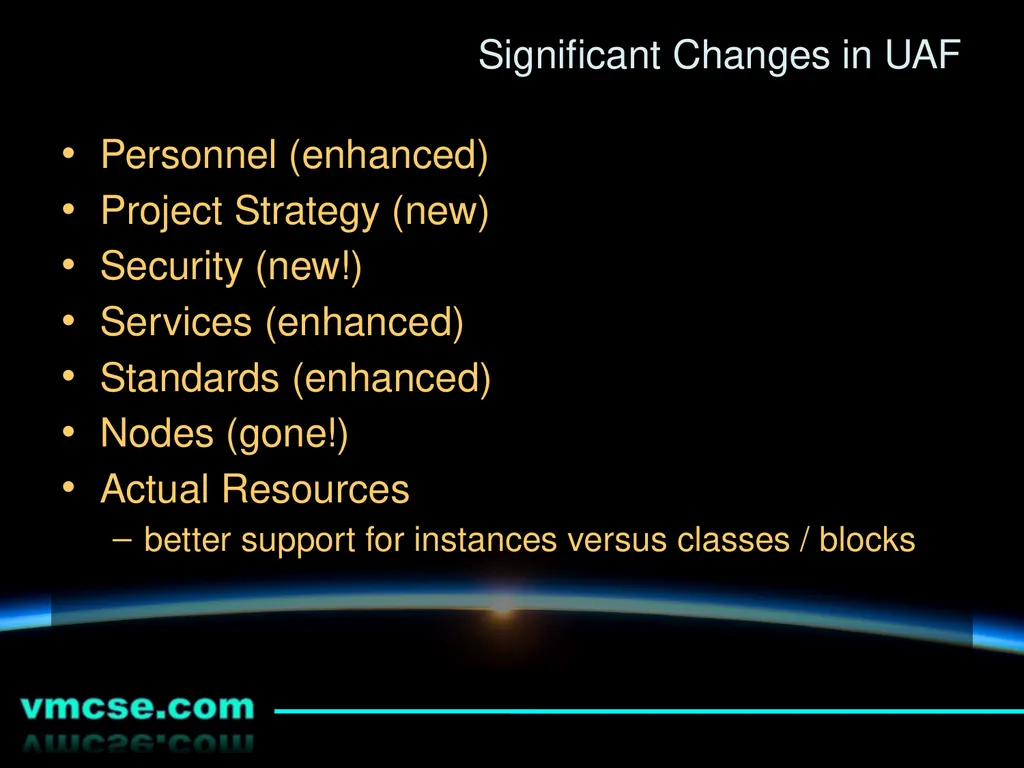
Significant Changes in UAF Personnel (enhanced)
Project Strategy (new)
Security (new!)
Services (enhanced)
Standards (enhanced)
Nodes (gone!)
Actual Resources
better support for instances versus classes / blocks<br>
12
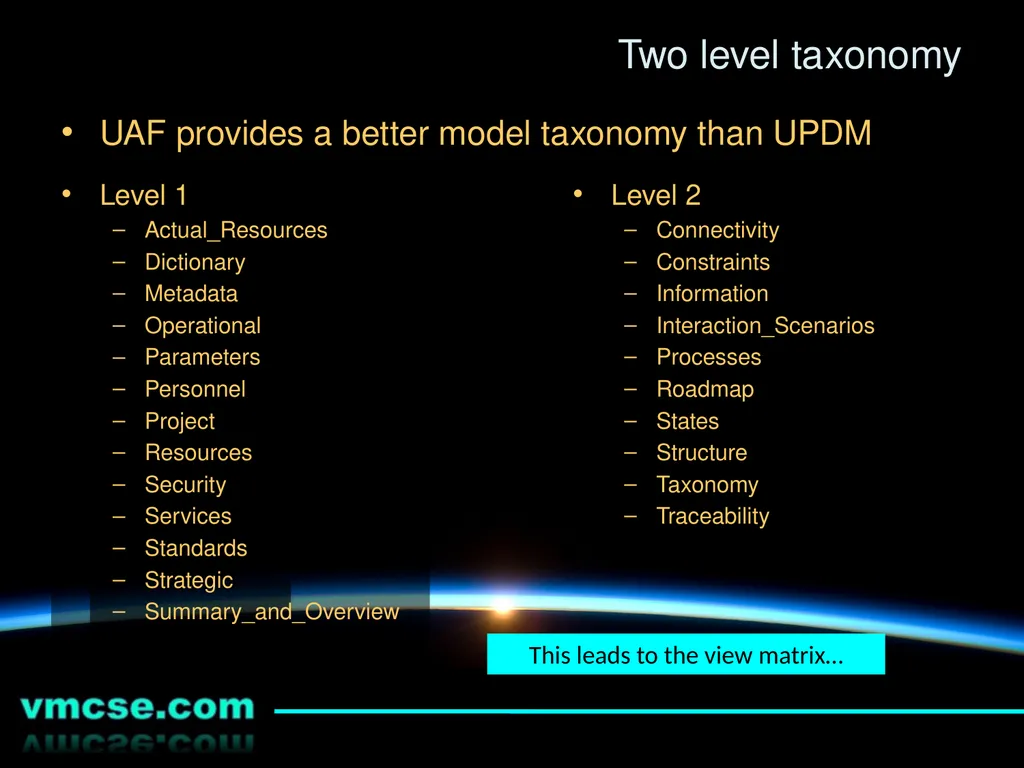
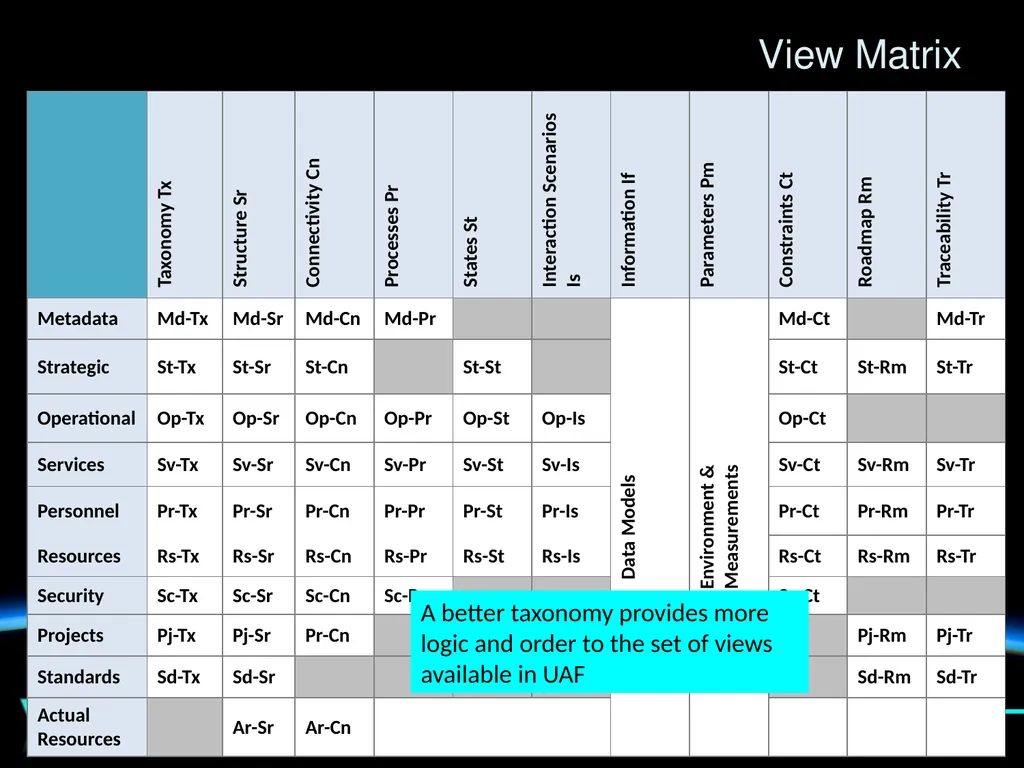
Two level taxonomy Level 1
Actual_Resources
Dictionary
Metadata
Operational
Parameters
Personnel
Project
Resources
Security
Services
Standards
Strategic
Summary_and_Overview Level 2
Connectivity
Constraints
Information
Interaction_Scenarios
Processes
Roadmap
States
Structure
Taxonomy
Traceability UAF provides a better model taxonomy than UPDM This leads to the view matrix…<br>
13
View Matrix A better taxonomy provides more logic and order to the set of views available in UAF<br>
14
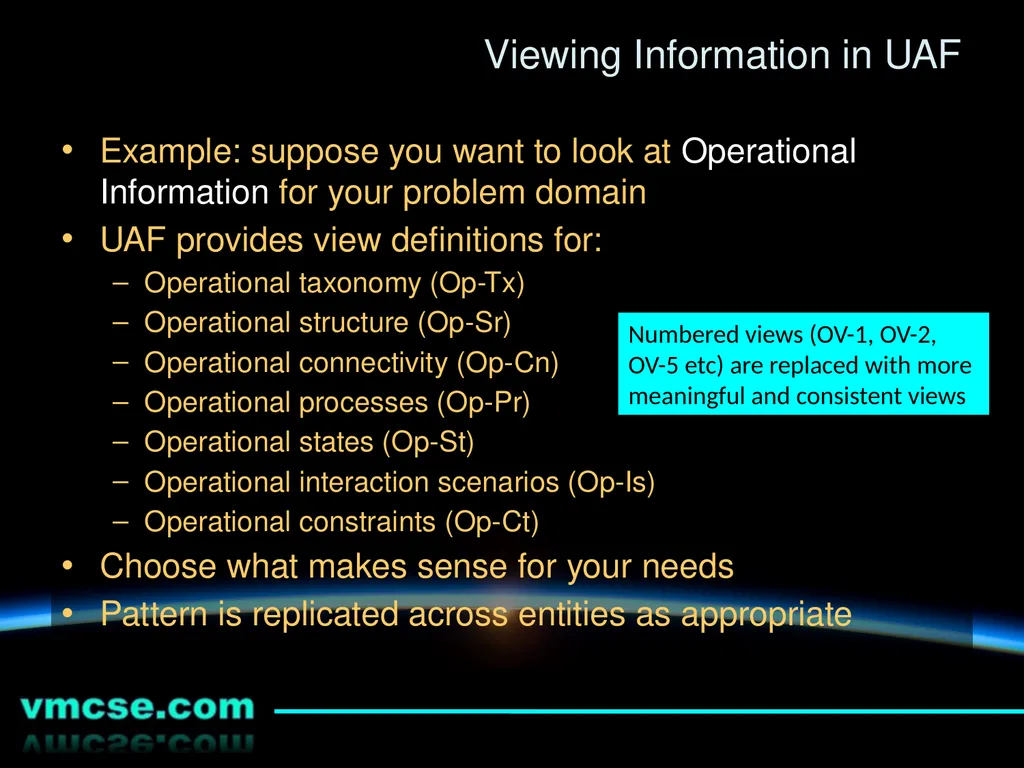
Viewing Information in UAF Example: suppose you want to look at Operational Information for your problem domain
UAF provides view definitions for:
Operational taxonomy (Op-Tx)
Operational structure (Op-Sr)
Operational connectivity (Op-Cn)
Operational processes (Op-Pr)
Operational states (Op-St)
Operational interaction scenarios (Op-Is)
Operational constraints (Op-Ct)
Choose what makes sense for your needs
Pattern is replicated across entities as appropriate Numbered views (OV-1, OV-2, OV-5 etc) are replaced with more meaningful and consistent views<br>
15
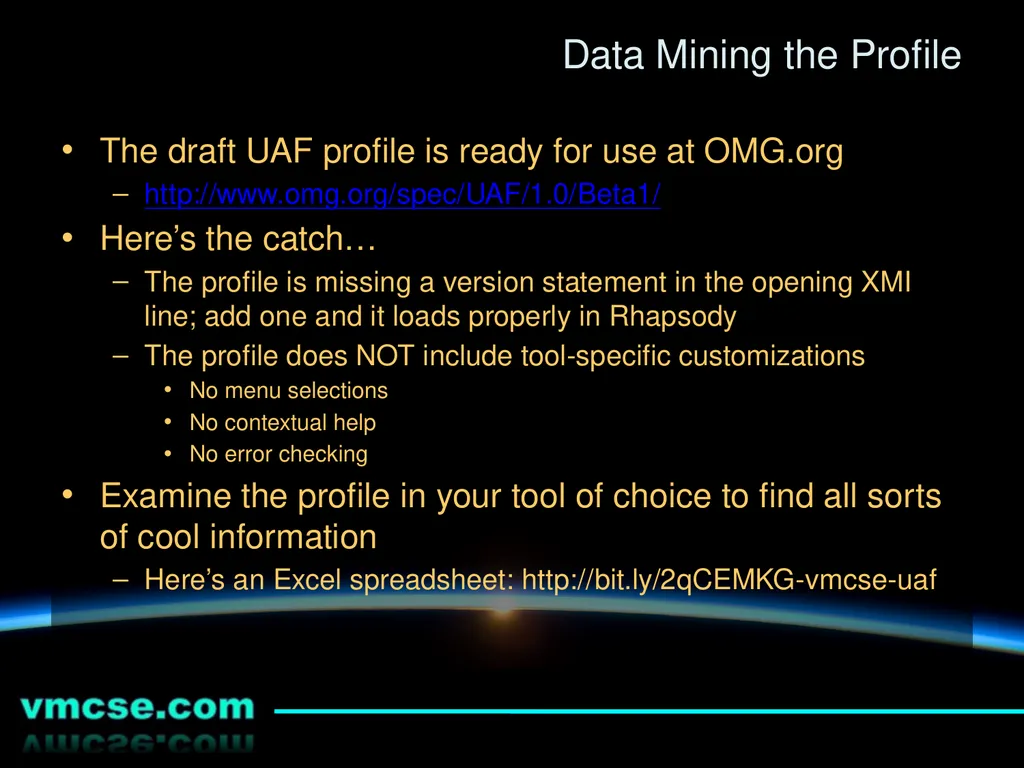
Data Mining the Profile The draft UAF profile is ready for use at OMG.org
http://www.omg.org/spec/UAF/1.0/Beta1/
Here’s the catch…
The profile is missing a version statement in the opening XMI line; add one and it loads properly in Rhapsody
The profile does NOT include tool-specific customizations
No menu selections
No contextual help
No error checking
Examine the profile in your tool of choice to find all sorts of cool information
Here’s an Excel spreadsheet: http://bit.ly/2qCEMKG-vmcse-uaf<br>
16
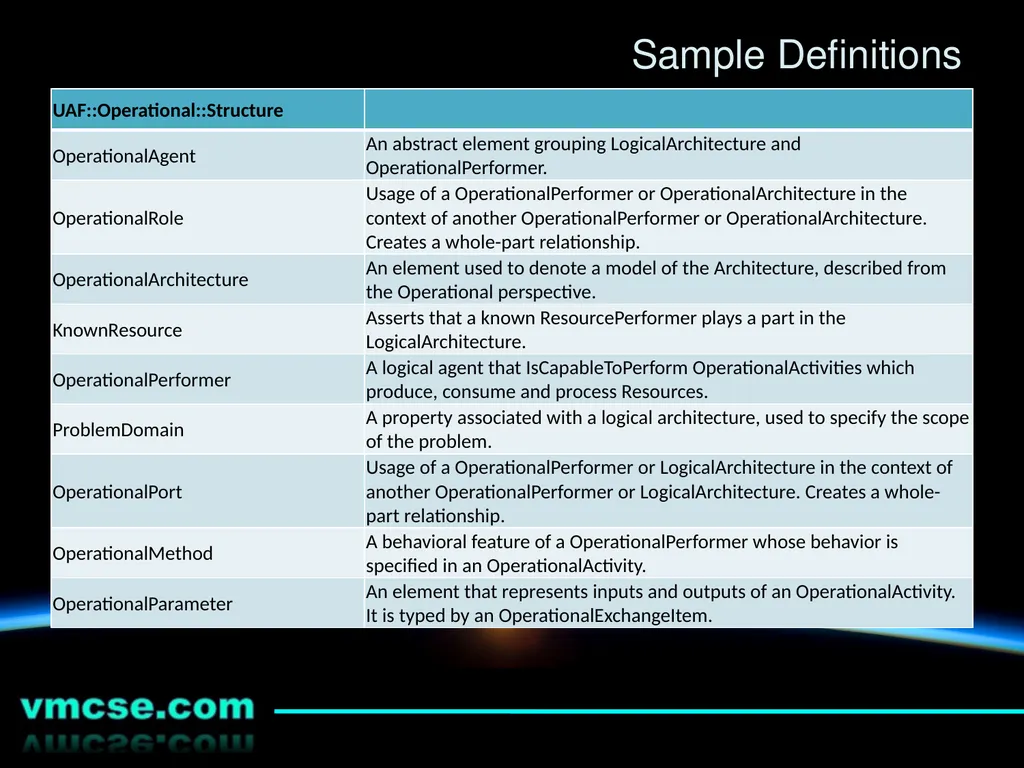
Sample Definitions<br>
17
Looking at the Views Most UAF documentation still refers to DoDAF view identification
It’s unclear if DoDAF nomenclature is obsolete or not
UAF spec from OMG does not use the DoDAF view names<br>
18
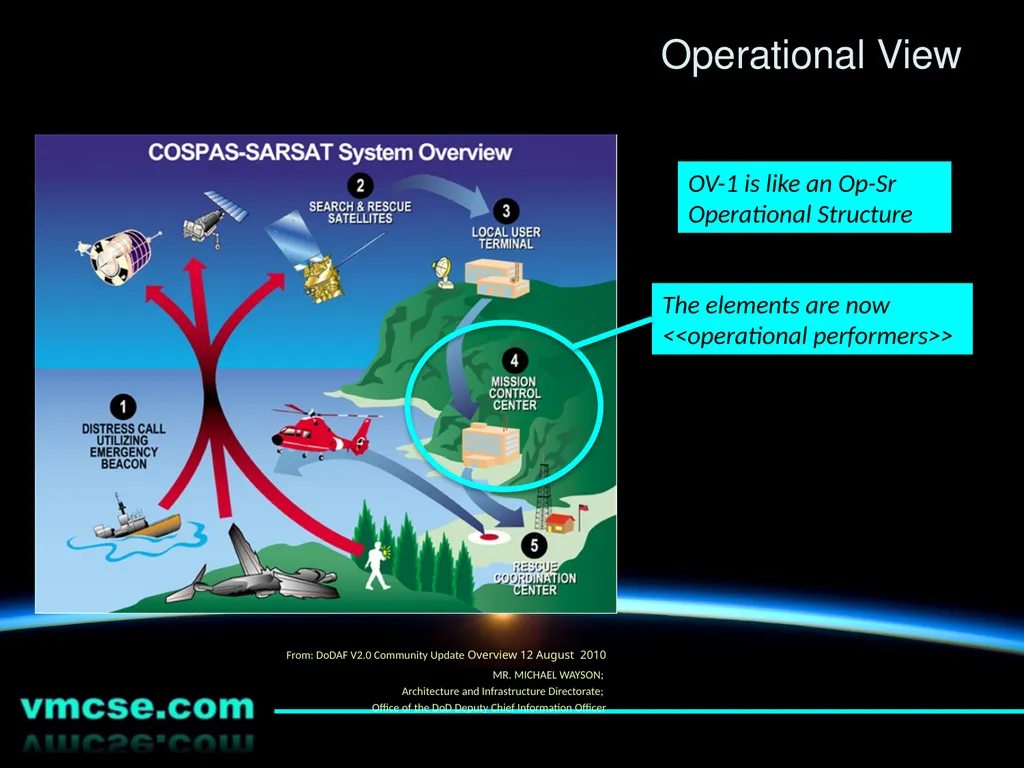
Operational View From: DoDAF V2.0 Community Update Overview 12 August 2010
MR. MICHAEL WAYSON;
Architecture and Infrastructure Directorate;
Office of the DoD Deputy Chief Information Officer OV-1 is like an Op-Sr Operational Structure The elements are now <<operational performers>><br>
19
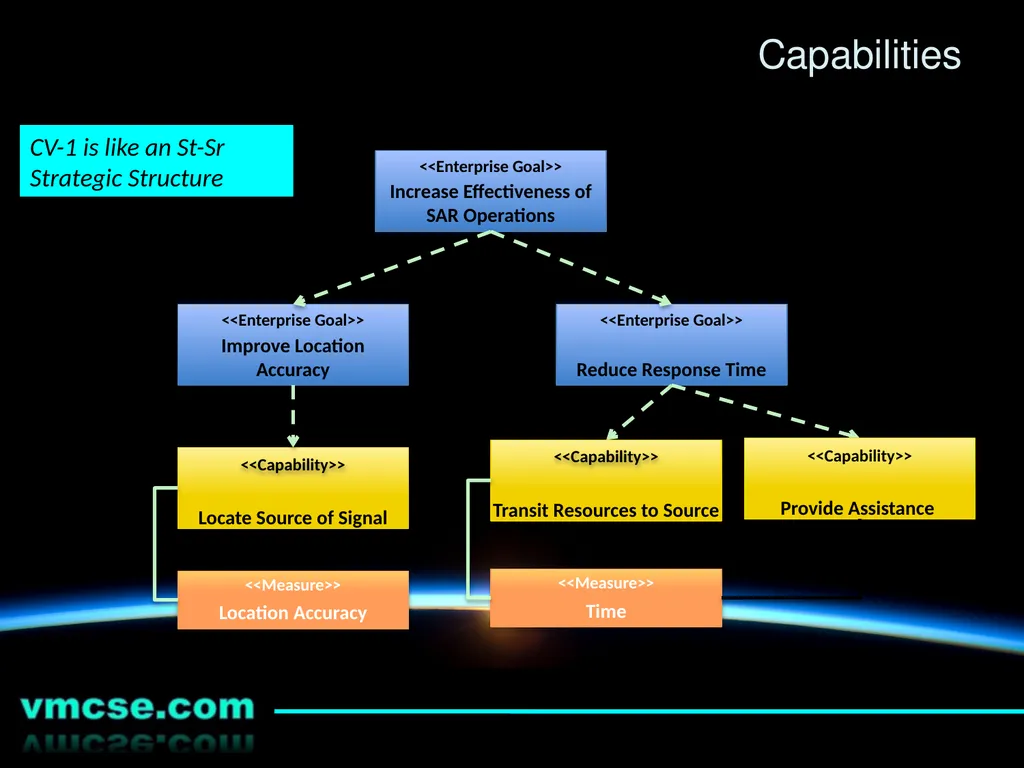
Capabilities Locate Source of Signal <<Capability>> Provide Assistance <<Capability>> CV-1 is like an St-Sr Strategic Structure<br>
20
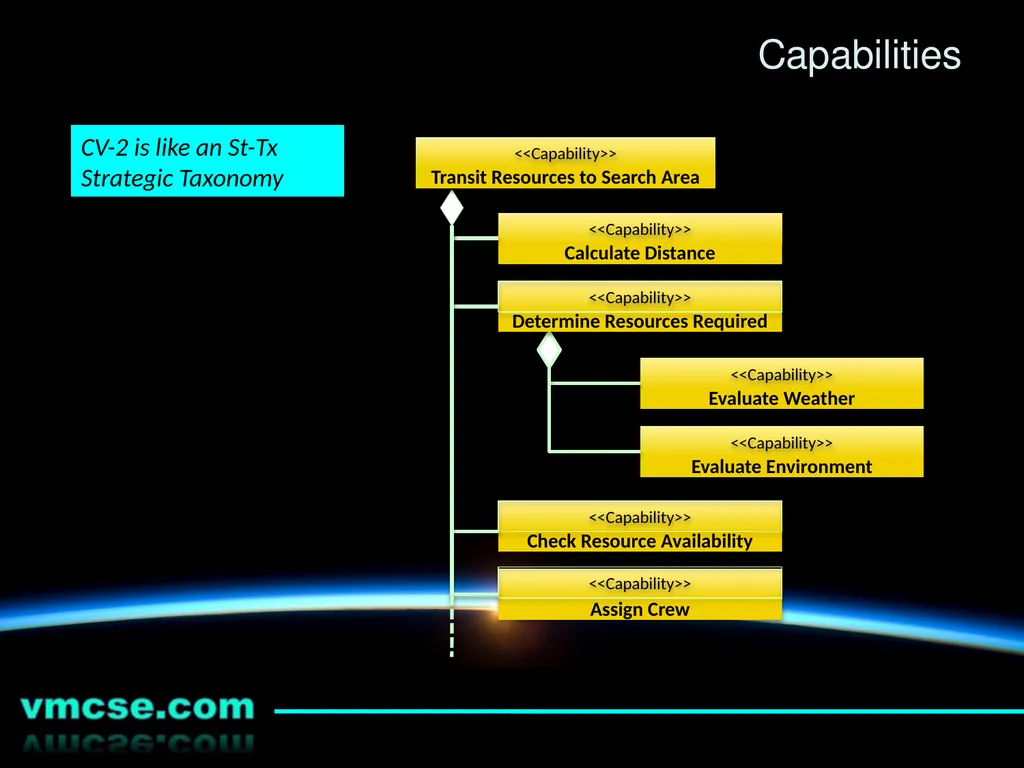
Capabilities Transit Resources to Search Area <<Capability>> Calculate Distance <<Capability>> Determine Resources Required <<Capability>> Evaluate Weather <<Capability>> Check Resource Availability <<Capability>> Evaluate Environment <<Capability>> Assign Crew <<Capability>> CV-2 is like an St-Tx Strategic Taxonomy<br>
21
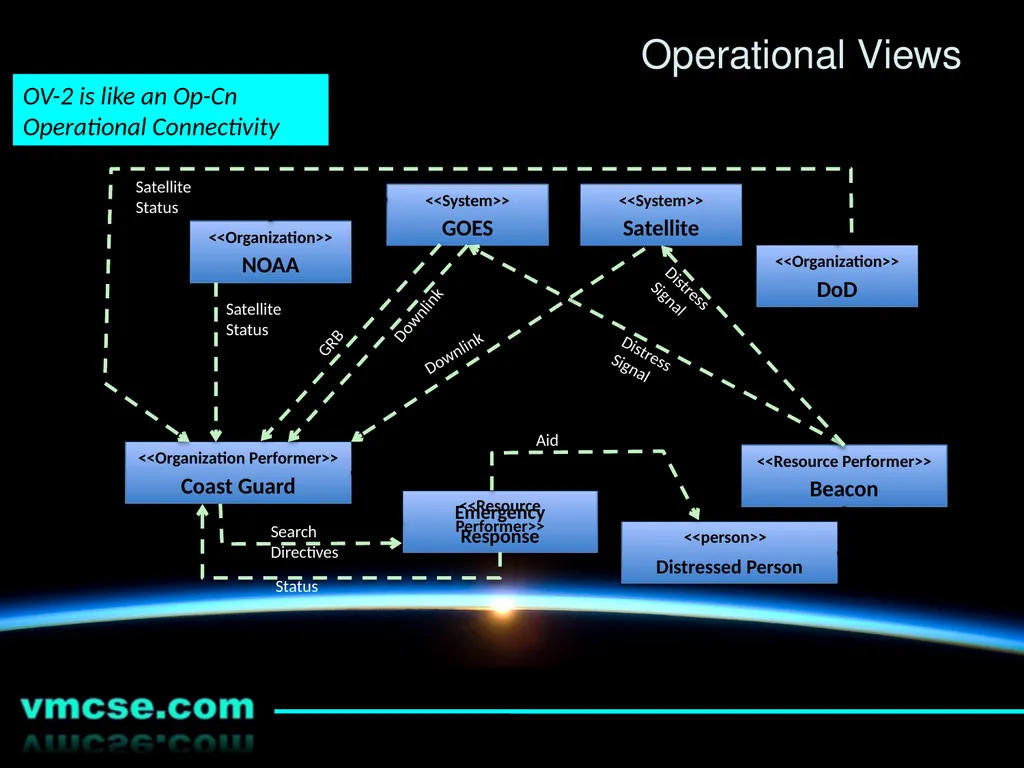
Operational Views Coast Guard <<Organization Performer>> NOAA <<Organization>> Distressed Person <<person>> Beacon <<Resource Performer>> GOES <<System>> Satellite <<System>> DoD <<Organization>> Emergency Response <<Resource Performer>> Satellite Status Satellite Status Distress Signal Distress Signal Aid Search Directives Status Downlink Downlink GRB OV-2 is like an Op-Cn Operational Connectivity<br>
22
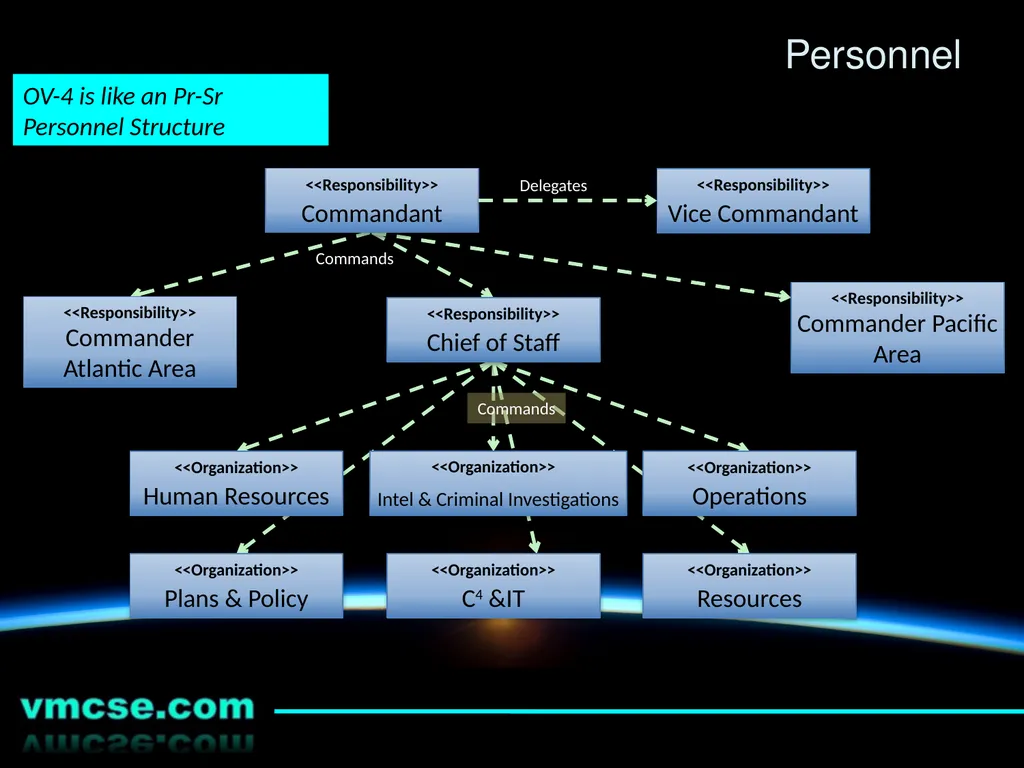
Personnel Commandant <<Responsibility>> Vice Commandant <<Responsibility>> Chief of Staff <<Responsibility>> Human Resources <<Organization>> Plans & Policy <<Organization>> Intel & Criminal Investigations <<Organization>> C4 &IT <<Organization>> Operations <<Organization>> Resources <<Organization>> Commander Atlantic Area <<Responsibility>> Commander Pacific Area <<Responsibility>> Commands Commands Delegates OV-4 is like an Pr-Sr Personnel Structure<br>
23
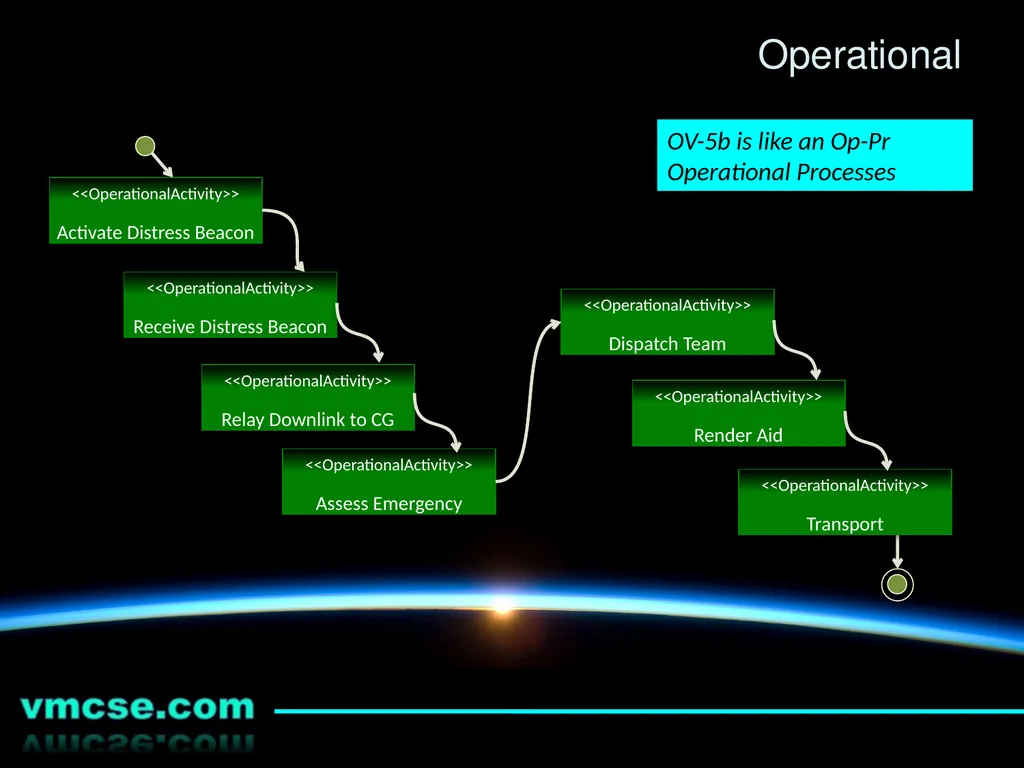
Operational Activate Distress Beacon <<OperationalActivity>> Receive Distress Beacon <<OperationalActivity>> Relay Downlink to CG <<OperationalActivity>> Assess Emergency <<OperationalActivity>> Dispatch Team <<OperationalActivity>> Render Aid <<OperationalActivity>> Transport <<OperationalActivity>> OV-5b is like an Op-Pr Operational Processes<br>
24
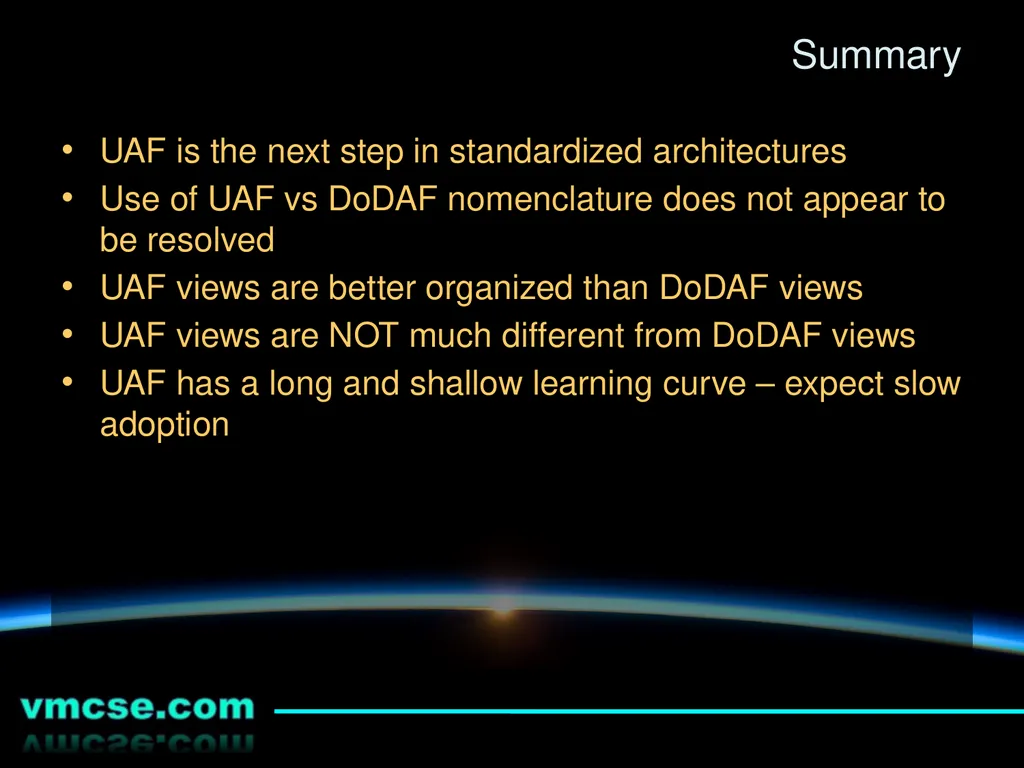
Summary UAF is the next step in standardized architectures
Use of UAF vs DoDAF nomenclature does not appear to be resolved
UAF views are better organized than DoDAF views
UAF views are NOT much different from DoDAF views
UAF has a long and shallow learning curve – expect slow adoption<br>